Electronic copy available at: http://ssrn.com/abstract=1918473
Effects of Lit and Dark Trading Venue Competition on
Liquidity: The MiFID Experience
Carole Gresse
March 2012
JEL classification: G14, G15, G18
Keywords: Fragmentation, Liquidity, Multilateral Trading Facility, MTF, OTC trading,
Internalization, Dark trading
I address special thanks to IFS (Intelligent Financial Systems) and their managing directors, Sabine and Darren Toulson, for generously providing the data used in this study. I am particularly grateful to Mark Holloway, Oliver Speakman, and Sugandha Sharma of IFS for their technical work on the data. I also wish to thank Laurent Fournier, Laurent Grillet-Aubert, Ryan Davies, Fabrice Pansard, Giovanni Petrella, Vincent Van Kervel, as well as participants at the AMF 2010 Scientific Board Conference and the finance seminar of the Catholic University of Milan, for helpful comments. All opinions expressed in this article only reflect my own views.
Université Paris-Dauphine, Pôle Universitaire Léonard de Vinci, 92916 Paris La Défense cedex, France. E-mail : [email protected].
A first version of this working paper, dated January 2011, was entitled “Multi-Market Trading and Market Liquidity”.
Electronic copy available at: http://ssrn.com/abstract=1918473
Effects of Lit and Dark Trading Venue Competition on
Liquidity: The MiFID Experience
Abstract
Based on trade and quote data from eight exchanges and a trade reporting facility for a
sample of LSE- and Euronext-listed equities, this article compares the consolidated liquidity
of competing markets, also called global liquidity, and the local liquidity of the primary
exchang, before and after MiFID. It then investigates how liquidity measured by spreads and
best-quote depth relate to market fragmentation and internalization after MiFID. Market
fragmentation is found to improve global and local liquidity, with spreads decreasing
proportionally to market competition. The decline in depth observed in the early post-MiFID
period is driven by other factors than market fragmentation. The only harmful effect is that
fragmentation may reduce market depth for small stocks. Further, internalization is not found
3 1. Introduction
Security markets are often considered as natural monopolies because of the so-called
virtuous circle of liquidity. Traders choose the market with the best liquidity, and the most
liquid market is the one with the most participants because it offers the highest probability of
order execution and the most competitive prices (Mendelson, 1987). As a result of “liquidity
begetting liquidity”, the market with the greatest number of traders should attract all other
traders, so that the order flow should inevitably consolidate in a single market (Pagano, 1989).
Nevertheless, today, equity trading is anything but consolidated.
There are several reasons why the market for a security may fragment: (1) multiple trading
mechanisms exist on the primary exchange for the trading of the security; (2) the security is
cross-listed and several exchanges compete for its order flow; (3) alternative trading platforms
compete with the primary exchange; or (4) a portion of the order flow is internalized by
broker-dealers or executed in the OTC market. With the development of sophisticated trading
technologies and the enforcement of pro-competition market regulations, order flow
fragmentation of type (3) has undeniably increased in all large western stock markets. More
than fifty trading venues now exist in the US, with almost 30% of volume traded off primary
exchanges in the first quarter of 2008 according to O’Hara and Ye (2011). In Europe, market
fragmentation is a relatively more recent phenomenon. Nevertheless, more than ten trading
venues have become fairly active in liquid European stocks during the past five years.
There is concern among regulators, issuers, and asset managers, about how this may
impact the quality of order execution and market liquidity. Whereas competition between
trading venues is most often considered as beneficial to the quality of order execution services
offered to investors, there is little empirical evidence about the impact of order flow
fragmentation on the consolidated liquidity of competing platforms. O’Hara and Ye (2011)
4 of high and low fragmented stocks shows no harmful effect of fragmentation. Degryse, De
Jong, and Van Kervel (2010) compare the primary market resiliency of Dutch large equities
before and after fragmentation became substantial for those securities. They find that the
order book of the primary exchange is more resilient in the fragmented period, in that it
reverts quicker to its normal level of liquidity after aggressive orders. Degryse, De Jong, and
Van Kervel (2011) evaluate the impact of fragmentation on depth for 52 Dutch stocks from
2006 to 2009. They find that fragmentation between lit order books improves the depth of the
consolidated marketplace but reduces that of the primary exchange. They also find a
detrimental effect of OTC and dark trading. The present article complements this literature by
examining how the consolidated liquidity of competing trading systems, also called global
liquidity, and the local liquidity of the primary exchange relate to fragmentation and
internalization. The relation is investigated over a relatively large sample of equities listed at
the London Stock Exchange and on Euronext, through two distinct empirical approaches that
exploit not only the cross sections but also the time series of spreads, depth, and
fragmentation measures.
A first approach consisted in comparing liquidity before and after the trading in European
stocks fragmented with the implementation of the Markets in Financial Instruments Directive
(MiFID)1 on 1 November 2007. In Europe, the enforcement of MiFID abolished the
concentration rule2 in the countries of the European Economic Area (EEA), and has created a
competitive environment for trading systems and services, in which new trading systems
allowed by technological innovation may be widely exploited. As a result, MiFID has served
as a catalyst for the soaring of competition between marketplaces, and the number of trading
1
This European Union law provides a comprehensive and harmonized regulatory regime for investment services and activities across the 30 member states of the European Economic Area (EEA), i.e. the 27 member states of the European Union (EU) plus Norway, Iceland, and Liechtenstein.
2
A provision in the 1993 Investment Services Directive (ISD) permitted (but did not mandate) individual member states to require orders from investors in that member state to be executed only on regulated markets. This provision was applied in France, Italy, and Spain.
5 venues at the disposal of investors has rapidly increased for European equities. In that, the
implementation of MiFID is a unique event of shifting from consolidated markets to
fragmented markets within a relatively short period of time, and this specific event makes it
ideal for original research on fragmentation. The present study uses this event to provide
empirical evidence on how market liquidity relates to order flow fragmentation. What makes
the analysis somehow delicate is the simultaneity of the 2008 financial crisis with the
immediate post-MiFID period. The observation periods and the methodology were thus
carefully chosen so as to avoid the background effect of the 2008 subprime crisis and its
related potential biases. In a second approach, I analyzed the two-way temporal relation
between fragmentation and liquidity by a two-stage panel methodology over a later
post-MiFID and post-crisis period. Results show that (1) spreads and depth have improved with
multiple-trading-platforms competition after controlling for endogeneity; (2) fragmentation
may nevertheless reduce depth for smaller stocks; (3) OTC and internalized trading has not
substantially harmed liquidity; while it may adversely affect quoted spread on the one hand
for some groups of stocks, it however favors depth on the other hand.
The remainder of the paper is organized as follows. Section 2 reviews the related
literature. Section 3 provides details about the regulatory framework that motivated the study
as well as on the organization of the marketplace. Section 4 describes the sample and the
data. The fragmentation and liquidity measures used in the empirics are presented in Section
5. Section 6 provides comparative statistics about fragmentation and liquidity before and
after MiFID came into force. In Section 7, a two-stage multivariate analysis is conducted to
compare the liquidity of the pre-MiFID quasi-consolidated marketplace with that of
post-MiFID fragmented markets. Section 8 exposes panel analyses of the relation between
6 2. Pros and cons of multi-market trading: A review of the literature
Whether order flow fragmentation adversely affects market quality has already been
addressed in numerous research articles. The earliest work usually quoted in this body of
literature is that of Hamilton (1979) who studied the effects of off-board trading of
NYSE-listed stocks on the regional exchanges and in the third market. Hamilton (1979) documents
two opposite effects: on the one hand, the dispersion of trading may increase competition and
thus improve liquidity (competition effect); on the other hand, it may “prevent full realization
of any economies of centralized trading on the exchange” (fragmentation effect).
2.1. Benefits of market consolidation and fragmentation effects
Security market centers are often considered as natural monopolies because the marginal
cost of a trade decreases with the quantity of orders executed in the market. First, a great part
of the costs born to run a market are fixed expenses, so that a consolidated market enjoys
economies of scale. If several markets that use the same technology and market model
compete together, the one with the highest volume has the lowest average cost, and thereby
enjoys a competitive advantage.
Second, there are network externalities associated with running a market. A market
becomes more attractive as the number of traders increases. It is easier to find a counterparty
in a market where there are more people willing to trade, so that the consolidation of the order
flow creates economies of scale on the provision of liquidity (Mendelson, 1987). Pagano
(1989) shows that, when a security trades in two markets with similar structures and types of
investors, orders concentrate in the market where traders are foreseen to be more numerous.
Third, under information asymmetry, Chowdry and Nanda (1991) show that adverse
selection costs increase with the number of markets listing an asset. Besides, when a new
market opens for a stock, it may skim the least informed and consequently more profitable
7 Bessembinder and Kaufman, 1997). In practice, dealers or market makers are the most able
to cream-skim profitable orders, and market fragmentation between competing dealers usually
result in larger spreads (for theoretical proofs see the inventory-cost model by Biais (1993) or
the information-based model by Madhavan (1995)). Empirically, Bennett and Wei (2006)
provide evidence that stocks switching from a fragmented environment (the old Nasdaq
structure) to a more consolidated structure (NYSE) experience an improvement in spreads.
Using European data, Gajewski and Gresse (2007) show that trading costs are smaller in a
centralized order book than in a hybrid market equally fragmented between an order book and
competing dealers off the order book.
Fourth, another cost of fragmentation is that priority rules are difficult to maintain across
markets. In particular, price priority can be violated when large orders in one market trade
through prices in another market (see Foucault and Menkveld, 2008; Riordan, Storkenmaier,
and Wagener, 2010).
2.2. Benefits of multi-market trading and competition effects
Because of the positive network externality that characterizes markets, trading systems
with identical structures have a natural tendency to consolidate, as shown in Pagano (1989).
Therefore, fragmentation often arises between trading systems that use different mechanisms
and thereby addresses the needs of different categories of investors (Harris, 1993). The
ability to serve different clienteles and satisfy diverse trading needs is a benefit of
fragmentation (Hendershott and Mendelson, 2000; Gresse, 2006).
Another positive effect stemming from fragmentation is that monopolistic exchanges may
behave noncompetitively and accumulate rents at the expenses of final investors while
fragmentation between competing markets often promotes innovation and efficiency. As
mentioned by Stoll (2003), “The term “fragmentation” has a harmful connotation, but, in fact,
8 order-driven market segment of the LSE, was competing with the continental European
exchanges for the trading of blue chips stocks. It succeeded in diverting block trading from
the primary exchanges, but progressively disappeared after continental exchanges and, in
particular, the Paris Bourse, implemented block trading procedures in the home market. More
recently, Euronext reduced tick sizes on 19 February 2007 and, in September 2008, the LSE
adopted a maker-taker fee schedule to remain competitive in front of emerging MTFs. In the
US, the development of electronic trading on established exchanges was spurred by
competitive pressures. In October 2002, in response to the pressure of ECNs, Nasdaq
launched SuperMontage, an electronic trading platform gathering quotes from market makers
and ECNs. In October 2006, the NYSE started to introduce its Hybrid market to enhance
electronic trading (cf. Hendershott and Moulton, 2008).
With competition between market places, spreads often narrow. Battalio (1997) shows that
the bid-ask spreads of NYSE-listed securities tightens after a major third market broker-dealer
starts operating. Boehmer and Boehmer (2003) document that the NYSE entry in the trading
of ETFs listed on the American Stock Exchange improves their liquidity. By examining the
entries of multiple markets into transacting three major US ETFs, Nguyen, Van Ness, and
Van Ness (2007) show that the competition effect dominates the fragmentation effect.
Mayhew (2002) and Fontnouvelle, Fishe, and Harris (2003) finds that multi-market trading
has the same consequences for the bid-ask spreads of equity options. With respect to
European markets, Lee (2002) reviews several empirical studies conducted on the competition
between SEAQ International and various continental European exchanges in the 90s. He
concludes that most of the measures of market performance show that such competition was
beneficial. Competition from new entrants has similar effects. The findings of Huang (2002)
suggest that the proliferation of alternative trading venues, such as ECNs, has promoted order
cross-9 section of a large sample of Nasdaq and NYSE listed equities and show that fragmentation
between incumbent exchanges and new trading platforms has reduced transaction costs and
increased execution speed. Furthermore, competition between order books may have specific
features. Foucault and Menkveld (2008) focus on the recent competition between EuroSETS,
the order book run by the LSE for Dutch stocks, and NSC, the order-driven system of
Euronext Amsterdam. They show, both theoretically and empirically, that, due to the absence
of price priority across markets, consolidated depth (i.e. the sum of all shares available at that
price or better in both markets) is larger after EuroSETS entry.
3. Regulatory framework, stock universe, and market organization
Since 1 November 2007, MiFID has recognized three types of order execution venues:
Regulated Markets (RMs), Multilateral Trading Facilities (MTFs), and Systematic
Internalizers (SIs). RMs and MTFs are multilateral trading systems with similar
functionalities but they differ in that RMs have to be authorized by a competent authority.
Both RMs and MTFs may organize primary listings, but securities with a primary listing on a
MTF are not considered as regulated instruments. SIs are investment firms which, “on an
organized, frequent and systematic basis,” execute client orders outside a regulated market or
an MTF, either on their principal accounts or against other clients’ orders. Legally, a SI does
not have to be designated by a regulated market, and an institution can be a SI for securities
listed on different stock exchanges. Creating the legal status of SIs institutionalizes
internalization. In counterpart, MiFID treats SIs as mini-exchanges and imposes pre-trade
and post-trade transparency requirements on them.3 In addition, under the post-trade
transparency rules introduced by MiFID, all transactions in regulated financial instruments
must be reported, even if they are carried out over the counter (OTC). Such disclosures do not
3
The same pre- and post-trade transparency requirements apply to all venues except dark pools, that is MTFs which trading mechanisms do not generate price discovery and are exempt from pre-trade transparency rules.
10 have to be made to the regulated primary market; they may be made using proprietary
resources or submitted to a MiFID-compliant trade reporting facility (TRF).
Main RMs are run by three exchange groups – Deutsche Boerse, LSE-Borsa Italiana and
NYSE-Euronext. They are challenged by a handful of pan-European MTFs that emerged in
2007 and 2008: BATS Europe, the subsidiary of US exchange BATS; Chi-X, owned by
broker Instinet at the time of the study and now taken over by BATS; Turquoise, which was
launched by a consortium of investment banks and then acquired by the LSE; and Nasdaq
OMX Europe, which belonged to the Nasdaq OMX group and then closed on 21 May 2010.
Further, PLUS-Markets, a new UK exchange often called PLUS, operates as an RM for small
caps and as an MTF for European securities. The legislation on transaction reporting
introduced by MiFID also led to the creation of several TRFs that offer MiFID-compliant
services. The largest of these by market share is the BOAT platform of Markit, a financial
information provider. Table 1 charts the key events in the development of Europe's RMs,
MTFs and TRFs.
Table 1 about here
MiFID changed the European trading industry in three key ways:4
- it abolished the concentration rule which existed on most continental exchanges, such as
the European branches of Nyse-Euronext, and forced any regulated trade to be executed
on the primary exchange;
- it offered a regulatory framework for internalization;
- it extended post-trade transparency duties to OTC trades in regulated securities and
allowed entities other than primary exchanges to report trades, which resulted in a
fragmentation of the trade reporting activity.
4
For details and comparison with RegNMS, the US counterpart of MiFID, refer to Davies (2008) and Petrella (2009).
11 Those regulatory changes combined with the rise of high frequency trading allowed European
stock markets to shift from quasi-consolidated markets to fragmented markets within a
relatively short period of time. This changing environment offers a perfect field of
investigation on how rapidly market competition can rise after regulatory changes and how
liquidity is affected in relation. I use this event to test the impact of market fragmentation on
the liquidity of three stock indices: the FTSE 100, the CAC 40, and the SBF 120. The FTSE
100 is comprised of the largest capitalization stocks of the LSE. The CAC 40 is the flagship
index of Euronext Paris and comprises the largest stocks of Euronext Paris as well as some
large capitalization stocks primarily listed on Euronext Amsterdam and Euronext Brussels.
The SBF 120 index comprises the CAC-40 stocks plus the next eighty most liquid stocks
listed on Euronext Paris. In the rest of the paper I use the SBF 120 acronym to designate the
non-CAC-40 components of this index. Studying FTSE-100 and CAC-40 securities will
allow me to compare stocks for which there was a concentration rule before MiFID (CAC 40)
with stocks that had no concentration rule prior to MiFID (FTSE 100). Comparing the
SBF-120 and the CAC-40 stocks will allow me to examine whether order flow fragmentation
12 3.1. Market design of primary exchanges
FTSE-100, CAC-40, and SBF-120 stocks have their primary listings on four exchanges
recognized as RMs: the LSE, Euronext Amsterdam, Euronext Paris, and Euronext Brussels.
Those exchanges run electronic order books on which buy and sell orders are continuously
matched from the open to the close according to the price/time priority rules. Trading
sessions commence and finish with call auctions. Until 14 January 2009, the order books of
Euronext, the European branch of Nyse-Euronext, operated with the NSC system. After that
date, the UTP system was introduced. On the LSE, the order-driven trading platform used for
FTSE-100 securities has been SETS since 1997.
On both the LSE and Euronext, off-order-book trading is permitted but with different rules
and practices. At the LSE, an important dealership activity has always existed simultaneous
to order book trading since its introduction in 1997 (cf. Gajewski and Gresse, 2007).
Broker-dealers execute a significant part of the order flow outside the book and the majority of retail
orders are routed to dealers specialized in retail trading, the so-called RSPs. Off order book
trading is less developed on Euronext, where the order book market model has prevailed for a
long time, and where concentration rules existed before the implementation of MiFID. Only
two categories of trades are executed outside the central order book: block and VWAP trades.
3.2. Other trading venues
The most active MTFs at the time of the study are Chi-X, BATS Europe, Turquoise, and
Nasdaq OMX Europe. They run order-driven matching engines in which anonymous orders
are matched continuously in time-price priority. No call auctions are organized either at the
open or at the close. Their business model is based on a make/take fee structure that
remunerates liquidity-providing orders and charges aggressive orders. In addition, PLUS, a
London-based quote-driven electronic platform, offers an execution venue for securities listed
13 The list of stocks traded on PLUS covers more than 850 liquid securities including FTSE-100
stocks and other European blue chip stocks. On the PLUS platform, competing market
makers display two-way quotes in a minimum size known as the Exchange Market Size,
during the Mandatory Quote Period (MQP), i.e. from 8:00 to 16:30 UK time.
4. Sample selection and data
My empirical work consists of two parts: a pre/post-MiFID comparison and a post-MiFID
time series analysis. Both parts are based on trade and quote data generously provided by IFS
for FTSE-100, CAC-40, and SBF-120 stocks.
4.1. Sample selection
In the pre-post MiFID comparison, the pre-MiFID period of October 2007 is confronted to
three post-MiFID one-month periods. These periods were determined so as to sidestep the
effects of the 2008 subprime crisis which unfortunately overlaps the immediate post-MiFID
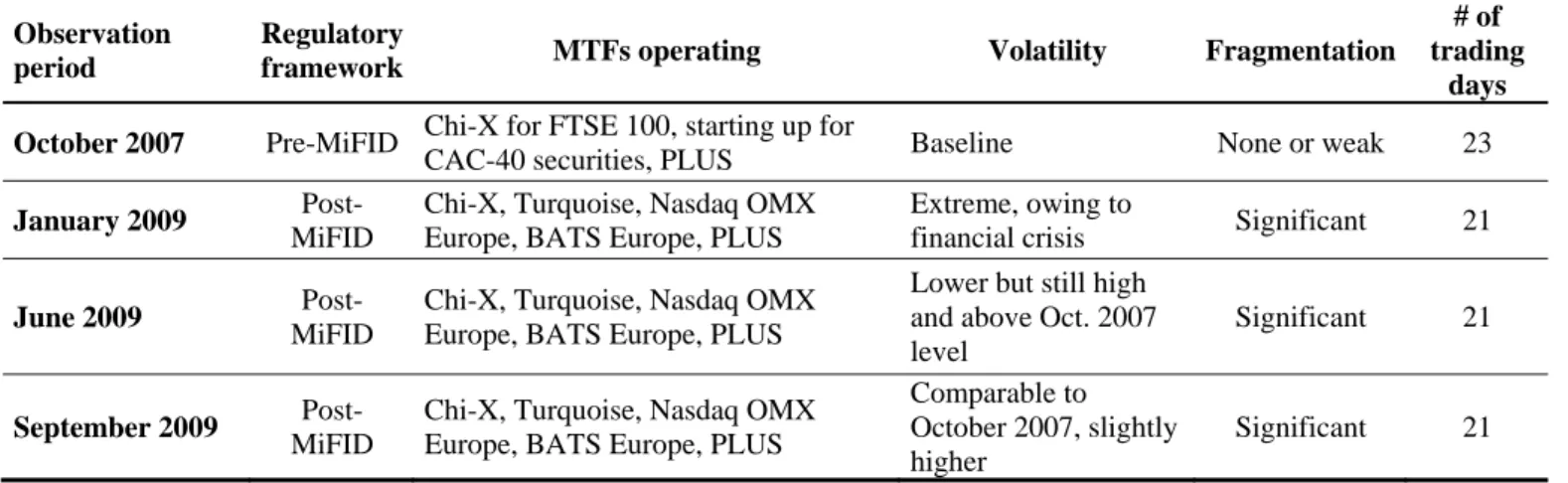
period. Year 2008 was voluntarily avoided. The three one-month periods were chosen in
2009 in order to correspond to different levels of fragmentation and volatility. Table 2 gives a
timetable and details some of the characteristics of the four observation periods. Pre-MiFID
period October 2007 comes just after the start-up of Chi-X but precedes the launch of the
other MTFs. The three post-MiFID observation periods (January, June and September 2009)
come after the launch of all the MTFs that now have visible market share, but correspond to
different levels of fragmentation and fundamental volatility measured by the standard
deviation of daily returns of the CAC-40 and FTSE-100 indices. Fragmentation progressively
increased from January to September 2009. Volatility was extreme in January, owing to the
financial crisis. Volatility had somewhat decreased by June 2009 but still exceeded the
baseline level of October 2007. October 2007 and September 2009, while characterized by
14 Table 2 about here
The post-MiFID time series analysis covers 63 trading days from 1 September to 30
November 2009. Stocks which were not continually part of their index from 2007 to 2009
were dropped from the sample. Financial stocks were excluded as very specific factors drove
their liquidity and volatility during the observation periods. This selection procedure resulted
in a pre/post-MiFID-comparison sample of 140 stocks of which 51 pertained to the FTSE 100,
32 to the CAC 40, and 57 to the SBF 120 specifically, and in a post-MiFID
time-series-analysis sample of 152 stocks distributed between 64 FTSE-100 components, 32 CAC-40
components, and 56 SBF-120-specific components.
4.2. Daily data, high frequency data, and data filtering
Daily closing prices, adjustment factors for corporate actions, and market values were
collected from Datastream. Prices of UK stocks are expressed in pence sterling. Some
metrics used in the study require expressing all prices and volumes in euro. For that purpose,
the daily foreign exchange rates of the GBP against EUR were downloaded from the Oanda
website (www.oanda.com).
The high-frequency data used in this study were kindly provided by Intelligent Financial
Systems (IFS). IFS data were generated from the original data flows of Euronext, the LSE,
Deutsche Boerse, Chi-X, Turquoise, Nasdaq OMX Europe, BATS Europe, PLUS, and
BOAT. The database includes transaction and best-limit data time-stamped to the second.5
For each stock, the data contain the trade prices and best limit quotes of all trading venues
where the stock is priced in the same currency as that of the primary listing. Order flow in
other currencies is not considered. All timestamps in the database are in UK time and hours
will be expressed in UK time throughout the article.
5
Data from dark pools such as POSIT, Liquidnet, or Chi-X Delta, are not covered, but the total market share of dark MTFs in trading volumes did not exceed a few percent at the time of the study, so that not holding their data should not bias the results.
15 Best limit data received from IFS provide, at each second of the trading session from 8:00
to 16:30, the best bid price, the best ask price, and quantities associated, for every trading
venue where a quote is displayed. The quotes originate from PLUS, Chi-X, BATS Europe,
Turquoise, Nasdaq OMX Europe, the Euronext order books, the SETS order book of the LSE,
and the Xetra order book of Deutsche Boerse. Bid and ask prices with times that could fall
inside the opening auction periods or after the end of the continuous session of the primary
exchange, are eliminated. As a result of this rule, I have deleted from the dataset bid and ask
quotes with times before 08:01 and after 16:30.
Trade data cover the same markets as quote data plus BOAT-reported trades. For each
trade, the data provide the execution time, the price, the size in number of shares, as well as
best bid and ask prices and displayed quantities prevailing on every sampled RM or MTF at
the time of the trade. Euronext and LSE data encompass opening and closing auction
transactions as well as all continuous trades except block and VWAP trades for Euronext.
LSE data include an indicator that can be used to identify trades executed on the SETS order
book, off-book trades executed by LSE members, and trades reported to the LSE European
Trade Reporting Service but not executed on the LSE regulated market. The third category of
trades (LSE-reported trades) are of the same type as trades reported by BOAT and should be
considered as OTC or internalized trades.
For all trading venues, overnight transactions, that is transactions executed before 07:00
and after 17:00, have been eliminated from the dataset. LSE-reported trades have a 2-figure
trade-type code. Any LSE trade for which this code indicates that the trade results from an
option exercise, a stock swap, or the cancellation of a previous trade, is deleted.
I have then identified batch auction trades. For the LSE, SETS call auction trades are
flagged with a special trade code. On Euronext, fixing trades have to be identified with
16 after the official start time of the open auction period are considered as open auction trades.
At the close, trades executed at the first trade time immediately superior or equal to the
official start time of the close auction but no later than the end time of the close auction period
are identified as close auction trades. Once auction trades have been determined, other trades
are classified into three groups: continuous trades executed between the open and the close
auctions, pre-open trades, and post-close trades.
5. Fragmentation and liquidity measures
The order flow in a given security distributes between trading volumes executed on MTFs
and RMs, further referred to as the lit order flow, and trading volumes executed by SIs or in
the OTC market, further referred to as the internalized order flow. I there present the metrics
used to measure both sources of fragmentation and then describe the way traditional measures
of liquidity are adapted to measure liquidity in a multi-market environment.
5.1. Measuring order flow fragmentation
Fragmentation is measured by using the reciprocal of a Herfindhal index based on RMs
and MTFs market shares in the lit order flow. This fragmentation index6 is calculated as one
divided by the sum of the squared market shares of all RMs and MTFs covered by the
database. With perfect concentration, the order flow concentrates in a single market which
market share is 100%, so that the fragmentation index equals one. As soon as a new entrant
attracts a share of the order flow, the index increases over one. Assuming that N competing
markets have perfectly equal market shares in volumes, the fragmentation index is equal to
N
NN 1 ² 1
and increases with N. Over the four monthly periods used for the
6
Fidessa, a company that provides trading systems, market data and connectivity solutions, uses this index to publish statistics on market fragmentation.
17 MiFID comparison, the level of fragmentation for a given stock index was calculated as the
cross-sample capitalization-weighted mean of individual stocks’ fragmentation indices.
In the post-MiFID observation periods, the weight of internalization was estimated by
using BOAT trade report data and LSE trade-reporting-service data. The traded quantities
reported by those reporting services were aggregated to calculate the share of internalized
volumes in total trading volumes. As most broker-dealer-owned dark pools report their trades
to Markit-BOAT, this internalization share covers various types of non-lit-market trades such
as trades executed by SIs as principal, dark pool trades, and other OTC trades. For the
statistics of September 2009, a fragmentation index of the total order flow including
internalized trades was calculated by adding the market share of internalization at the
denominator of the index.
5.2. Liquidity measures
Liquidity is measured for two categories of traders: local traders who can only connect to
the primary exchange, and cross-market traders who are connected to all trading venues or use
smart order routers (SORs) that enable them to distribute their orders across several
marketplaces. Three metrics of liquidity are considered: quoted spreads, effective spreads,
and depth displayed at best quotes. These metrics are determined locally in each primary
market in the perspective of local traders and across markets by optimizing the prices of all
competing markets.
5.2.1. Global and local quoted spreads
In the data provided by IFS, the quoted spreads of each market are observable at every
second. The spread observed on the primary market will be referred to as the local spread.
Each second, the highest bid price and the lowest ask price across all competing markets are
determined. The difference between these two prices divided by their mid value is the quoted
18 consolidated) quoted spread in the remainder of the study, as contrasted with the local quoted
spread. In the pre/post-MiFID comparison, global and local quoted spreads are averaged for
each stock and each month. Monthly average quoted spreads are then computed for each
stock index by weighting the averages of the individual stocks by market capitalization.7 In
the post-MiFID time-series analysis, local and global quoted spreads are averaged per stock
and per day.
5.2.2. Global and local effective spreads
The effective spread is a proxy for the implicit cost of a given transaction. It corresponds
to the difference between the transaction price and the mid quote prevailing at the time of the
transaction, measured as a percentage of this median price. It is doubled to make it
comparable with the quoted spread. The mid quote used as the baseline is a cross-market
consolidated mid quote, i.e. the mid-point of the best bid and ask prices, all markets
combined.
Effective spreads are averaged in the same way as quoted spreads, except that they are
weighted by transaction size. The transaction universe used to calculate these averages is
reduced to trades executed on-book in the continuous session. OTC, internalized and off-book
transactions are excluded. Local effective spreads are obtained by averaging the effective
spreads of the transactions executed on a given primary exchange, while global effective
spreads are obtained by averaging the spreads of the trades from all markets.
5.2.3. Global and local depth at best limits
Best-limit depth is the sum of the quantities associated with the best bid and ask prices. It
can be understood as the quantity of shares that can be instantaneously traded with no impact
on quoted prices. To ensure that depth is comparable between stocks regardless of price level,
it is expressed in terms of capital, specifically in thousands of euros, by multiplying quantities
7
Market capitalization for weighting purposes is the average of the stock's market capitalization at 1 October 2007 and at 30 September 2009.
19 by the mid price. Local depth is computed in the traditional way by considering the bid and
offer quantities of the primary exchange. Global depth (also denominated consolidated depth)
is determined by aggregating the quantities demanded at the best bid limit on all markets
quoting the best bid price and the quantities offered at the best ask limit on all markets
quoting the best ask price. Average depths are then calculated using the same procedure as
for average quoted spreads.
6. Shifting from monopolistic-market trading to multi-market trading and contemporaneous changes in liquidity
Part A of Table 3 reports the market shares of the primary market, other regulated markets,
MTFs and internalization in FTSE-100, CAC-40 and other SBF-120 stocks respectively in
September 2009. Part B presents the same statistics for continuous trading only, excluding
opening and closing auctions on the primary market. The primary market is found to have a
majority share of order-flow execution in all the samples. If we calculate a fragmentation
index by summing the squares of the market shares of each trading venue and the square of
the internalization share, and then taking the inverse of that sum, fragmentation is comparable
for FTSE-100 stocks (index of 2.7) and CAC-40 stocks (index of 2.65). Comparing the CAC
40 and the SBF 120 reveals that order flow is much less fragmented in mid caps than in large
caps, with Euronext capturing over 70% of volumes for the former, compared with 55% for
the latter.
Table 3 about here
As to the competitive position of MTFs, three players stand out: Chi-X, Turquoise, and
BATS Europe. Chi-X is the clear frontrunner with over 10% of volumes in the three samples.
BATS Europe and Turquoise are on a par in terms of market share (3-4% for the CAC 40,
4-5% for the FTSE 100). BATS Europe leads Turquoise in UK stocks, but Turquoise has the
20 There is virtually no direct order flow competition between the regulated markets.
Euronext loses a few trades to the LSE and Deutsche Boerse, but no more than 1-2% of
volume, and Euronext and Deutsche Boerse have no market share in LSE stocks.
Internalization and OTC account for around 20% of total volumes on the CAC 40 and
FTSE 100. The share is slightly lower than 20% for UK large caps and significantly higher
(approximately 24%) for French large caps.8
6.1. Shifting from monopolistic-market trading to multi-market trading
To estimate the change in fragmentation between October 2007 and September 2009,
volumes executed OTC are excluded from the analysis for the sake of comparability, since
these volumes were not reported in October 2007 (pre-MiFID) and only fragmentation
between multilateral platforms is comparable across all the observation periods.
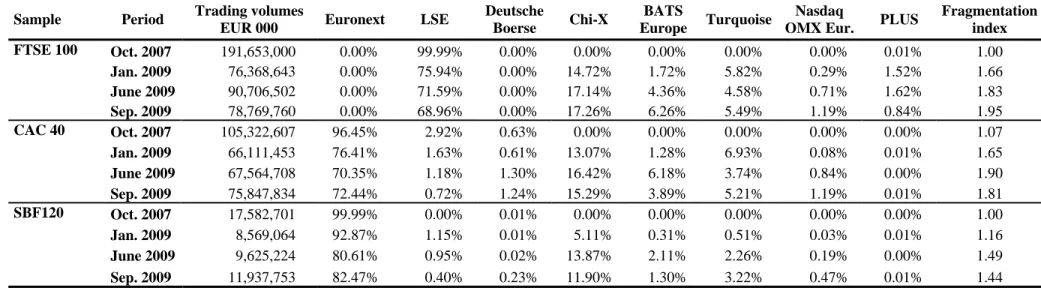
Table 4 lists the monthly market shares of all the markets and provides a fragmentation
index in the last column, which reveals that fragmentation was substantial in June and
September 2009 (around 1.9 for the CAC 40 and FTSE 100 and between 1.4 and 1.5 for the
non-CAC-40 SBF 120) and was at an intermediate level in January 2009. In the two samples
of large caps, the primary market's share of non-internalized volumes fell from over 95% in
October 2007 to around 70% in the final period. Among French mid caps, the primary
market's share remained above 80% in September 2009. The share of volumes executed on
MTFs stabilized at over 25% for CAC-40 constituents and reached about 30% for FTSE-100
constituents, but did not exceed 18% for the smaller stocks of the SBF 120.
Table 4 about here
8
The accuracy of these figures is a matter of discussion in several respects. First, the share of internalization is very unstable over time. Second, BOAT and LSE's reporting service do not account for all OTC and internalized volumes. However, it may be claimed that BOAT is the market leader in post-trade reporting and that the estimate may be considered to be in the right order of magnitude. Third, it is well acknowledged that internalized volumes may be subject to double or triple reporting, and may sometimes overlap lit volume statistics. An article by Jacquillat and Gresse (1998) dedicated to the competition between the electronic order book of the Paris Stock Exchange and the SEAQI dealer market, showed that dealer-reported volumes could be inflated by a factor 2 or 3.
21 In Table 4, the LSE market share is separated into volumes executed on the SETS order
book and off-book transactions executed by LSE members. This breakdown shows that the
structure of the large-cap order flow on LSE changed radically between 2007 and 2009,
reflecting competition from MTFs and increased automation of securities trading. In October
2007, over 40% of trading volumes were executed by LSE members off the order book, but
by September 2009, just 13.6% of the LSE 69% market share was traded off-book.
According to these figures, the SETS system has not really lost market share, but the off-book
order flow seems to have diminished as the competition from other trading venues has gained
ground.
6.2. Changes in liquidity: Univariate tests
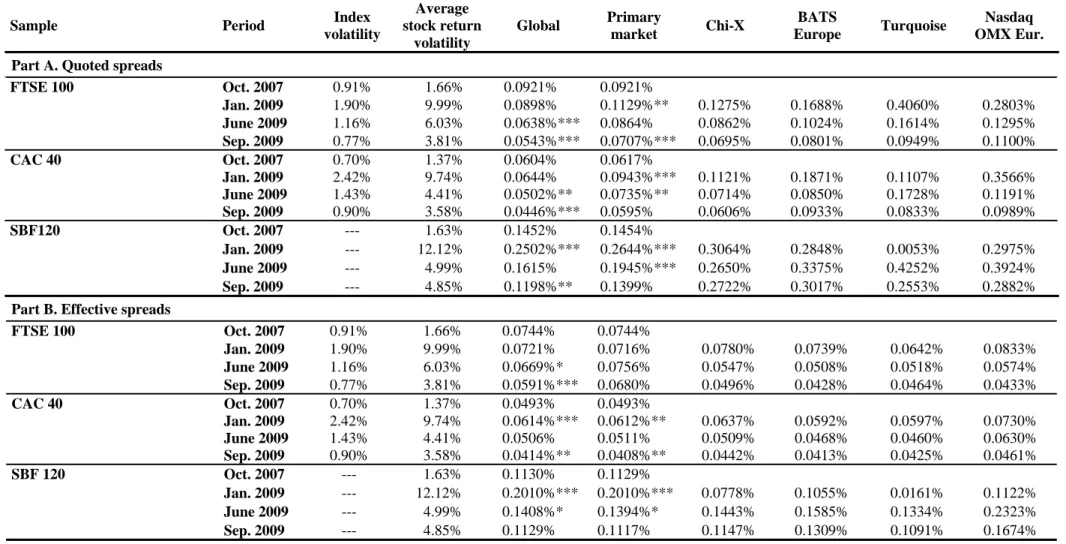
Global spreads and the local spreads of primary markets, reported in Table 5, narrowed
between October 2007 and September 2009 for the three samples. The biggest decline was on
the FTSE 100, for which the average global quoted spread fell from 9.21 to 5.43 bps and the
average local quoted spread fell from 9.21 to 7.07 bps. Spreads narrowed far less
dramatically for the mid caps of the SBF 120. Effective spreads contracted by less than
quoted spreads but nonetheless narrowed significantly, except in the case of SBF-120 mid
caps. The decline in spreads is especially noteworthy given that the average volatility of
individual stocks was higher in September 2009 than in October 2007 despite returning to
levels on a par with those of the pre-MiFID period.
Table 5 about here
Spreads declined steadily over the three months observed in 2009, despite high volatility in
January and June 2009. Spreads did widen for Euronext stocks in January 2009, but this was
weak compared with the surge in the volatility of the CAC 40 index and individual stocks
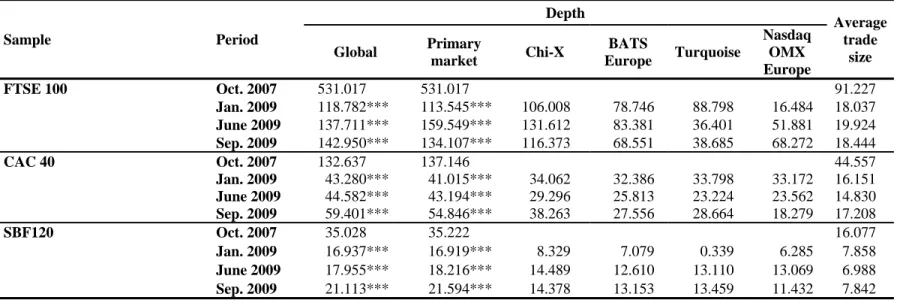
22 Depth did not display such a favorable change over the same period. Between October
2007 and September 2009, as shown in Table 6, average consolidated depth was divided by
3.7 for FTSE-100 stocks, by 2.2 for CAC-40 stocks and 1.7 for the SBF 120. Local depth
showed a similar change between the two periods. Although substantial, the reduction in
depth is far smaller than the decline in average transaction size. Whereas depth was divided
by 3.7 on average for FTSE-100 stocks, average transaction size was divided by 5. Average
size was divided by 2.6 for CAC-40 stocks and by 2 for the other stocks of the SBF 120.
Table 6 about here
These figures also have to be set in the context of the sharp decline in trading volumes
between October 2007 and September 2009 (cf. Table 4): -59% for FTSE-100 stocks, -28%
for CAC-40 stocks and -32% for the other stocks of the SBF 120.
Moreover, the statistics in the table reveal dispersion in instant depth across the competing
systems. If we sum the local depths of the primary market and the three most active MTFs,
the total goes down only for FTSE-100 stocks. It is relatively stable for the CAC 40, and
actually increases among SBF-120 constituents that are not in the CAC 40.
7. Comparing the pre-MiFID monopolistic-market liquidity with the post-MiFID multi-market liquidity: A two-stage regression analysis
In order to check to what extent the decrease in spreads and depth observed between
October 2007 and September 2009 is actually assignable to MiFID coming into force and
order flow fragmentation, I conducted two multivariate analyses: (1) panel regressions of
liquidity measures onto period dummies serving as proxies for the level of fragmentation; (2)
a two-stage regression analysis over the three post-MiFID monthly periods testing the relation
23 7.1. Assessing the general trend from October 2007 to September 2009: One-stage panel
regressions
In a first approach, I ran one-fixed-effect panel regressions of monthly average measures of
spreads and depth according to the following model:
, 1
ln 3 4 09 5 09 6 09
2
1 im im im Jan Jun Sep it
i
im a a a V a P a B a B a B
L (1)
where Lim is alternatively the average global quoted spread (GQSim), the average global
effective spread (GESim), the average global depth (GD ), the average local quoted spread (im
im
LQS ), the average local effective spread (GESim), and the average local depth (LDim), for
stock i over month m; im is the standard deviation of logarithmic daily closing returns for stock i over month m; lnVim is the logarithm of the total trading volume in euros for stock i
over month m; 1 Pim is the inverse of the average primary market’s closing price of stock i
during month m. BJan09, BJun09, and BSep09 are binary variables equal to one in January
2009, June 2009, and September 2009 respectively, and set to zero otherwise. Those panel
regressions were run with a fixed effect per stock (ai) with data covering the four month of
October 2007, January 2009, June 2009, and September 2009.
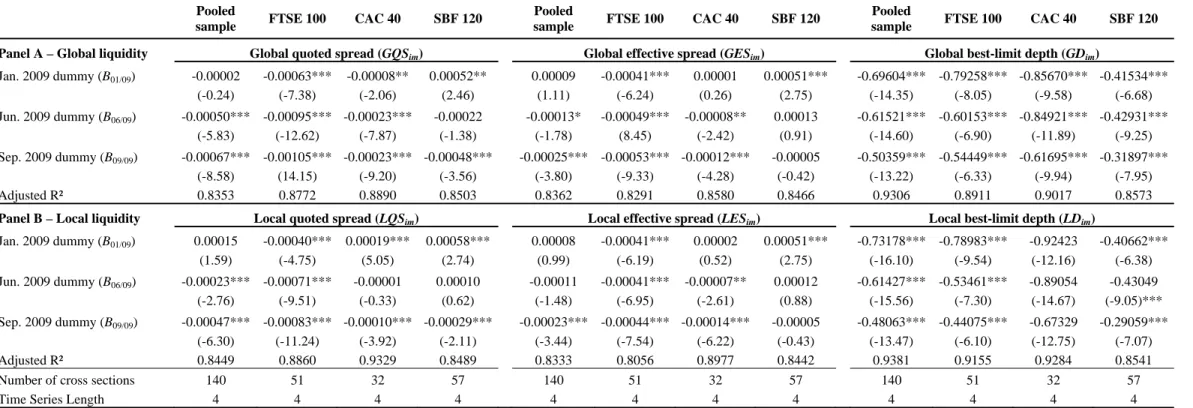
The estimates of the regressions of consolidated liquidity measures for the pooled sample
and by stock index are reported in Panel A of Table 7. They indicate that global spreads
decreased in the post-MiFID period with an increasing statistical and economic significance
from January 2009 to September 2009. This spread improvement is most significant for
FTSE-100 components and is nearly insignificant for SBF-120 mid-cap stocks. Global depth
decreased significantly but with very different patterns: (1) the decrease in depth is highly
significant for the three stock indices with no exception for SBF-120 securities; (2) the
statistical significance of this decrease was already as high in January 2009 as in later periods;
24 2009. This leads me to conclude that changes in spreads and changes in depth are not caused
by the same factors. Spread reductions seem to relate to the level of market competition as
this market competition was weaker for the SBF-120 mid caps at all periods and continually
increased from January to September 2009 for all indices. At the opposite, most of the fall in
depth happened before January 2009 for all indices and its statistical significance is not
weaker for French mid caps, suggesting that the reduction in depth most probably has other
determinants than the reduction in spreads.
Table 7 about here
Panel B of Table 7 reports the results for the regressions of local liquidity. These
regressions produce the same findings with the difference that the coefficients of the monthly
dummies have a slightly lower significance.
7.2. The two-stage regression approach
In a second approach I tested the relation between the level of fragmentation and liquidity
measures with a two-stage regression model that accounted for the co-determination between
fragmentation and liquidity. The observation periods were restricted to the three post-MiFID
months. As widely discussed by O’Hara and Ye (2011), “An immediate challenge to testing
for fragmentation effects on market quality are endogeneity issues”. When testing the impact
of market fragmentation on liquidity, endogeneity may arise at several levels: (1) at the firm
level, if for example, the trading in large stocks is more fragmented, finding greater liquidity
for more fragmented stocks could simply be the outcome of large stocks being more liquid;
(2) at the order level, the choice of routing an order to a given venue or of splitting it between
platforms is endogenous to the relative level of liquidity at each trading venue; (3) at the
market level, liquidity and fragmentation may be co-determined, with not only fragmentation
impacting liquidity but also liquidity determining fragmentation. For instance, insufficient
25 newly-established trading systems behave as satellite markets and therefore need a critical
mass of orders to attract order flow, higher liquidity may be required to increase
fragmentation. In brief, if the level of fragmentation is partly endogenous to liquidity, the
residual terms of regressions of liquidity measures onto fragmentation measures may correlate
with the independent-considered fragmentation variable. In order to remedy this potential
bias, I chose to implement a two-stage regression model in which the fragmentation index is
first regressed on instrumental variables and the predicted values of fragmentation obtained
from this first-stage regression serve as the regressor in the second-stage regression.
At the first stage, the fragmentation index of the lit order flow for a given stock i in a given
month m, FIim,9 is modeled in the following way:
im im im im im i im b b MV b UV b UTS b MN b MC FI 0 1ln 2 3 4 5 , (2)
where MV denotes stock i’s market value measured as the median between the begin-of-i
month market capitalization and the end-of-month market capitalization in euros, and plays
the role of a fixed effect per security; UV denotes the component of the logarithmic im
monthly traded volume which is not correlated to lnMVi; UTSim denotes the component of
the logarithmic average trade size which is not correlated to lnMVi;10 MNim is the average
number of trading platforms on which traders could find quotes for stock i during month m;
and MCim measures the intensity of the competition between those platforms as the average
number of markets quoting the best bid and ask prices divided by the average number of
markets quoting stock i.
lnMVi and UVim controls for the fact that the order flow of larger and more traded stocks
may fragment more. UTSim, MNim, and MCim represent exogenous determinants of
9
This fragmentation index is the reciprocal of an Herfindhal index based on RMs’ and MTFs’ market shares as defined in Sub-section 5.1.
10
UVim and UTSim are the residuals of preliminary OLS regressions of the average daily volume in logarithm and
the average euro trade size in logarithm on lnMVi. This procedure was designed to avoid colinearity in regression
26 fragmentation related to changes in the trading environment such as the rise of high frequency
(HF) trading or the effective entry in business of new electronic order books. Regarding
UTSim, order size has often been considered as a determinant of routing strategies, leading
several researchers (Madhavan and Cheng, 1997; Bessembinder, 2003; O’Hara and Ye, 2011;
Degryse, De Jong, and van Kervel, 2011) to use trade size as a first-stage regression
instrument in order to address the order-level endogeneity issue. Further, fragmentation is
highly determined by HF trading as suggested by Menkveld (2011) because HF traders are the
most eager for the low latency offered by alternative trading systems and the most likely to
slice and dice orders across markets or to supply liquidity at several venues. Because of the
slicing and dicing argument, HF trading negatively affects trade size so that average trade
size, even if far from being a perfect proxy, can be used as a first-stage instrument partially
reflecting the level of HF trading.11 MNim and MCim accounts for exogenous determinants of
changes in fragmentation such as the entry of new markets (MNim) or their ability to be
competitive in quotes relative to incumbent markets (MCim). First-stage regressions are
OLS-estimated for each index separately.
At the second stage, the values of FIim predicted by regressions (2) and denoted FˆIim, as
well as ITNim, the share of internalization defined at Sub-section 5.1, served as regressors for
liquidity measures: . ˆ ˆ ˆ 3 2 1 0 3 2 1 0 3 2 1 0 D im im im im im im ES im im im im im im QS im im im im im im ITN e I F e CV e e LD or GD ITN d I F d CV d d LES or GES ITN c I F c CV c c LQS or GQS (3) im
CV is a vector of control variables comprising im, lnMVi, UV , and im 1 Pim, i.e. return volatility, market size, trading volumes, and price level. c1, d1, and e1 are 3-dimension
11
More accurate proxies for HF trading volumes are based on the amount of message traffic (cf. Hendershott, Jones, and Menkveld, 2010; Hasbrouck and Saar, 2010). Calculating such proxies requires order submission and cancellation data that I do not hold.
27 coefficient vectors. Regressions (3) were estimated as seemingly unrelated regressions (SUR)
which assumed non-zero correlations between error terms imQS, imES, and imD. They were run for global liquidity measures on the one hand, and for local liquidity measures on the
other hand. Results are reported in Table 8.
Table 8 about here
All in all, liquidity has improved with fragmentation. Global and local spreads are all
negatively related to fragmentation with greater significance for FTSE-100 securities. The
only exception is the absence of statistical significance for the negative coefficient of
SBF-120 local quoted spreads. The economic impact is relatively low but greater for FTSE-100
stocks than for CAC-40 stocks. Global and local depths are also positively impacted by
fragmentation for all indices except the group of SBF-120 mid caps for which depth is not
significantly affected.
The effect of internalization is more mitigated and insignificant in most cases. According
to pooled-sample regressions, global and local spreads narrowed with the share of
internalization, whereas global and local depths were adversely affected by internalization.
However, those findings fail to be significant in by-index regressions, except for the global
depth of SBF-120 securities which was negatively affected at the 10% level.
8. A time series analysis of the relation between order flow fragmentation and liquidity While Sections 6 and 7 compare market liquidity in two different trading environment and
regulatory regimes, this section focuses on how liquidity relates to fragmentation in a
multi-market trading structure in which fragmentation has reached a substantial level. To test this
relation, I conducted several panel analyses on the basis of daily fragmentation and liquidity
measures over 63 trading days spreading from 1 September 2009 to 30 November 2009. The
28 constituents, and 56 SBF-120 specific constituents, selected according to the sampling
procedure described at Section 4.
8.1. One-stage panel regressions
I started this time-series analysis by running, as a first approach, simple two-fixed-effects
panel regressions of liquidity measures onto fragmentation and internalization with the
following design: it it it it it it it t i it V P L FI ITN u L 1 2ln 31 4 15 6 . (4) Dependent variable L is alternatively the global or local average quoted spread, average it
effective spread, and average best-limit depth of stock i on day t. FIit and ITNit are
respectively the Herfindhal fragmentation index and the share of internalized volumes for
stock i on day t. it denotes the mid-quote range of stock i on day t. V is the daily euro it trading volume. P is the primary market’s closing price of stock i on day t. Panel it
regressions (4) were estimated with two fixed effects.12 i and t denotes those cross-sections and time series fixed effects respectively. Autocorrelation was addressed by including the
first lag of the dependent variable. u is a residual term. it
The pooled-sample results, displayed at Panel A of Table 9, indicate a significant positive
impact of fragmentation on global liquidity regarding quoted spreads and best-limit depth.
The relation is insignificant for effective and local quoted spreads. Further, local depth
appears to have deteriorated. By-index regressions, whose estimates are reported in the left
half of Table 10, show that this detrimental effect on local depth is attributable to Euronext
stocks (CAC 40 and SBF 120). This adverse effect has a high statistical significance but a
low economic magnitude. Fragmentation most positively affected the liquidity of LSE-listed
equities, for which it has improved liquidity without harming any dimension of local liquidity.
12
29 More strikingly, findings for SBF-120 mid caps are in stark contrast: no measure of liquidity
was significantly correlated with fragmentation for those stocks; on the contrary, their quoted
spreads increased and their local depth was reduced with fragmentation.
Table 9 about here Table 10 about here
As for internalization, no harmful effect was identified either over the pooled sample or
over any index subsample. It was even found to positively affect the depth of LSE equities
and the quoted spreads of Euronext equities both at the primary-exchange and global levels.
8.2. Two-stage panel regressions
As discussed in Section 7, the estimates of the previous panel regressions may be subject to
endogeneity. Here again, I addressed this issue by implementing a two-stage methodology
which consisted in substituting to variables FIit and ITNit, in panel regressions (4), their
predictions FˆIit and I ˆTNit as estimated in the following first-stage regressions:
it it it it it i it MV V TS MC FI u FI 01ln 2ln 3 1 4 5 1 ; (5) it it it it it i it MV V TS MC ITN v ITN 01ln 2ln 3 2 4 5 1 . (6) Vit denotes volume as previously defined. MVi equals the market capitalization of stock i
on the first day of the observation period. MCit is the level of competition between markets,
measured by the average number of markets quoting the best bid and ask prices divided by the
average number of markets with quotes. This variable is computed in the same way as in
Subsection 7.2 but on a daily basis. TS1it and TS2it are daily average euro trade sizes in
logarithm. The TS2 measure involves all trades executed during the continuous session either
in electronic markets or by internalization while TS1 does not include internalized trades. v , it
and w are residual terms. Regressions (5) and (6) were OLS-estimated by stock index and it
30 Table 11 about here
The reasons for using market value, volume, trade size, and multi-market competition level
as first-stage instrumental variables are the same as those exposed in Subsection 7.2.
Instrument MN, that is the average number of markets quoting prices for a stock, was
abandoned because its variance was insufficient to provide explanatory power on a daily
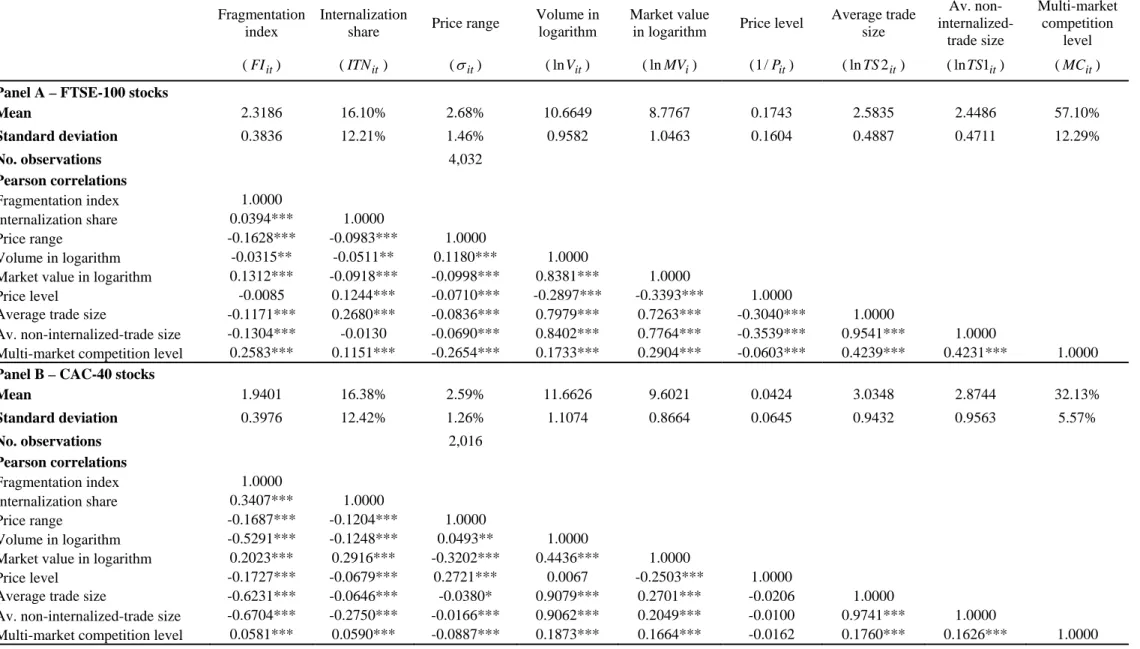
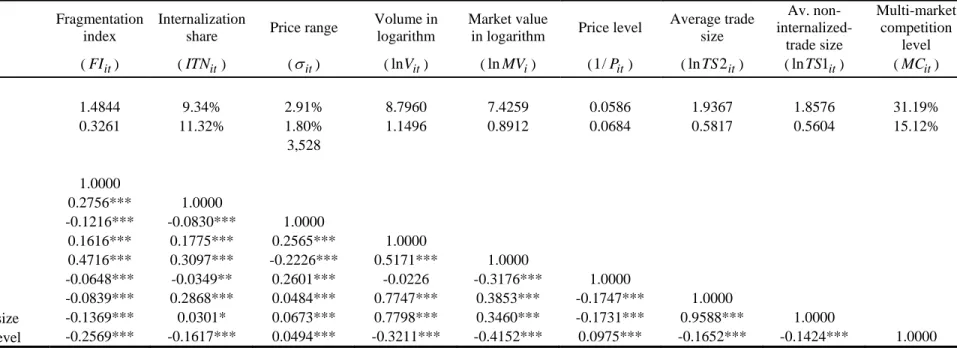
frequency after September 2009. Table 11 provides the Pearson correlations between
fragmentation measures and several market characteristics including the selected instruments.
It shows that for FTSE-100 and SBF-120 stocks, the variables that correlate most with
fragmentation measures are trade size and multi-market competition level. For those indices,
the fragmentation index of the lit order flow has a higher correlation with a trade size measure
that does not include internalized trades (TS1it) while, unsurprisingly, the internalization rate
is more correlated with the TS2it measure. This justifies the use of TS1it as an instrument for
FIit and the use of TS2it as an instrument for ITNit. In the case of CAC-40 stocks, ITNit
correlates more with TS1it than with TS2it and the correlation rate with MCit is relatively low;
yet for consistency, I preferred to use the same model for all indices.
Second-stage panel estimates are displayed in Panel B of Table 9 for the pooled sample
and in the right half of Table 10 for subsamples by index. They show greater benefits from
fragmentation than those assessed by the one-stage method. All global and local liquidity
measures are positively impacted with greater statistical and economic significance than
predicted by the one-stage procedure. The only adverse effect is a reduction in the global and
local depths of SBF-120 mid caps.
The two-step procedure confirmed the positive impact of internalization on depth with a
much greater economic magnitude. Whereas this effect was only significant for the
FTSE-100 sample with the one-step test, it has also become highly significant for the mid-cap
31 internalization could be harmful for quoted spreads: the coefficients of the internalization
variable are significantly positive in the regressions of global and local spreads for the pooled,
the FTSE-100, and the French mid-cap samples, with greater values in the case of local
spreads.
8.3. GMM dynamic panel regressions
As a robustness check, panel regressions (4) were estimated by using the dynamic panel
estimator method by Arellano and Bond (1991) with lnMVi, lnVit, lnTS2it, MCit, lagged
fragmentation FIit-1, and a SBF-120 dummy as instrumental variables.13 This methodology
was run for the pooled sample but could not converge by index. Results are reported at Panel
C of Table 9. They indicate that fragmentation and internalization positively impact all
measures of liquidity, both globally across markets and locally in the primary market. All
coefficients are significant at the 1% level except that of the fragmentation index in the
regression of local quoted spreads.
9. Conclusion
The coming into force of MiFID in 2007 has fomented competition, complexity, and
change in the trading industry across Europe. This study draws on high frequency data from
the most active markets for FTSE-100, CAC-40, and SBF-120 stocks to show that the trading
in European large equities was substantially fragmented by the end of 2009. Primary
exchanges, however, were still dominant players in terms of volume and price
competitiveness. Three MTFs had built significant market shares: Chi-X in all categories of
equities, BATS Europe more specifically in large UK securities, and Turquoise more
specifically in Euronext large equities. Between October 2007 and September 2009, spreads
decreased while depth and trade size declined dramatically. The decline in trade size was
13
All instruments were specified as exogenous except lnMVi and the SBF-120 dummy which were specified as
32 greater than that in depth. The pre/post-MiFID multivariate comparison shows that spreads
narrowed gradually as the fragmentation of lit order flow increased, with the spread reduction
being more significant after June 2009. It was less significant for mid caps than for large
caps, consistent with the lower fragmentation of the mid-caps order flow. Among large caps,
the decrease in spreads was more significant for LSE-listed stocks which were subject to
fiercer competition from Chi-X. The depth reduction identified with univariate tests followed
a different pattern. It was more significant in January 2009 than later, meaning that it could
have been driven by other explaining factors than fragmentation. In particular, the decrease in
average depth and average trade size can be as much a consequence of algorithmic trading14
as a consequence of fragmentation. Further, when focusing on 2009 data with a multivariate
two-stage approach, depth is even found to be positively related to fragmentation.
The post-MiFID time-series analysis confirms that market fragmentation should be viewed
as value-creating competition that benefits global liquidity or, in the worst-case scenario, does
not affect it. In most cases, it positively impacts the local liquidity of the primary market as
well. After an equilibrium level of order flow fragmentation is reached, marginal gains in
liquidity become relatively low in terms of economic magnitude, even if their statistical
significance is high. One exception to those benefits is that fragmentation may harm the
market depth of small stocks. This finding is consistent with those of Degryse et al. (2011) for
Euronext Dutch stocks.
Results on internalization are more mitigated. Contrary to Degryse et al. (2011), I found
that internalization could positively impact depth, but that it could be harmful for quoted
spreads. Those effects, however, are not significant for all indices and are not robust to the
methodology employed.
14
33 There are inevitably some caveats. First, the measure of depth used in this study, which is
the most widely used indicator, is a static measure of instantly available quantities. It does not
take account of the frequency with which these quantities are renewed. Yet with the
proliferation of trading facilities and the rise of algorithmic trading, the frequency of order
submission has increased exponentially and orders are much more broken up. In an ideal
world, we would measure depth dynamically, but the data do not allow this. Second, other
dimensions of liquidity such as speed of order execution, fill rate of orders, hidden depth or
34 References
Arellano, M., and S. Bond, 1991, “Some Tests of Specification for Panel Data: Monte Carlo
Evidence and an Application to Employment Equations”, Review of Economic Studies,
58(2), 277-297.
Battalio, Robert H., 1997, “Third Market Broker-Dealers: Cost Competitors or Cream
Skimmers?”, Journal of Finance, 52(1), 341-352.
Bennett, Paul, and Li Wei, 2006, “Market Structure, Fragmentation, and Market Quality”,
Journal of Financial Markets, 9(1), 49-78.
Bessembinder, Hendrik, 2003, “Selection Biases and Cross-Market Trading Cost
Comparison”, working paper, University of Utah, Eccles School of Business.
Bessembinder, Hendrick, and Herbert M. Kaufman, 1997, “A Cross-Exchange Comparison of
Execution Costs and Information Flow for NYSE-listed Stocks”, Journal of Financial
Economics, 46(3), 296-319.
Biais, Bruno, 1993 “Price Formation and Equilibrium Liquidity in Fragmented and
Centralized Markets”, Journal of Finance, 48(1), 157–185.
Boehmer, Beatrice, and Ekkehart Boehmer, 2003, “Trading Your Neighbor’s ETFs:
Competition or Fragmentation?”, Journal of Banking and Finance, 27(9), 1667-1703.
Chowdry, Bhagwan, and Vikram Nanda, 1991, “Multimarket Trading and Market Liquidity”,
Review of Financial Studies, 4(3), 483-511.
Davies, Ryan J., 2008, “MiFID and a Changing Competitive Landscape”, working paper,
Babson College, available at SSRN: http://ssrn.com/abstract=1117232.
Degryse, Hans, Frank de Jong, and Vincent van Kervel, 2010, “The Impact of MiFID on the