Consumer Procrastination and Purchase Delay
D. Darpy
Cahier n°283
Mai 2000
Denis Darpy Maître de Conférences Université Paris Dauphine Email : [email protected]Consumer Procrastination and Purchase Delay Track : Consumer Behavior
Abstract
Recent research on purchase delay have developed numerous situational and individual causes. This paper proposes Consumer Procrastination to conceptualize the individual factor which influence people to chronically delay their purchases. Consumer Procrastination is measured with a new scale. An experiment is designed to show the importance of its impact on the decision to not choose along with context effects.
Keywords : Purchase delay - Purchase intent - Context effects - Measurement Résumé
Les recherches concentrées sur le report d'achat ont proposé de nombreux facteurs explicatifs aussi bien situationnels qu'individuels. Ce papier propose de conceptualiser la Procrastination comme facteur individuel qui oriente les individus à reporter chroniquement l'achat. La procrastination du consommateur est ici mesurée par une nouvelle échelle. Un design expérimental montre l'importance de son impact sur la décision de choisir ou non au côté des effets de cadrage.
2
Introduction
This paper defines and conceptualizes the concept of Consumer procrastination tendencies, to identify individuals who are capable to choose rapidly from those who prefer a no-choice option (Dhar, 1997) which lead them to substantial purchase delay (Greenleaf & Lehmann, 1995). The paper is organized in three parts. First, it suggests procrastination as an answer to the questions raised by various research traditions focused on transformation of intentions into behaviors both in marketing and decision making psychology. Then, it defines the concept of consumer procrastination built upon psychological research (Ferrari & al, 1995). Finally it tests the impact of procrastination on the decision to choose and proposes a new scale, the Consumer Procrastination Scale (CPS).
Literature review
Delayed purchase intents are the object of a renewed attention from both practitioners and researchers. The marketing literature has investigated three questions: is the purchase intention a valid instrument to predict behavior? Would the strength of purchase intent be modified according to the choice set composition? Would the purchase intent transformation into behavior be dependant on certain personality traits?
To answer these three inter-related questions we should consider the three following research traditions in marketing.
1. Reliability of the measure of purchase intent. Researchers have investigated the lack of
homogeneity in the transformation process of intentions into purchases, as well as situational factors. The following variables may have a significant impact on the completion of a decision process initially originated with a purchase intention : the social class (Morwitz and Schmittlein, 1992; Dubois, Laurent and Quaghebeur, 1998), the nature of the deadline (Putsis and Srinavasan, 1994) and past behavior (Fitzimons and Morwitz, 1996)
2. The effect of the choice set on deferred decision. The second research tradition coming
from decisions theorists demonstrates the limits of the normative theory when considering the no choice option while manipulating context effects on decisions (Tversky et Shafir, 1992 ; Simonson et Tversky, 1992 ; Dhar, 1992, 1997). Experiments have shown that the composition of the choice set modifies the preference for the no-choice option, and therefore influences purchase delay. Tversky and Shafir (1992) suggest that a tendency to delay decisions might be the cause of their results. However very few research in marketing are focused on this aspect. Can the preference for the no-option choice be attributed to a psychological and stable tendency which would be active only in certain configurations of the choice set?
3. The nature of volition and its impact on the intention / behavior relationship. This
research tradition around the attitude theory provides the necessary theoretical ground to conceptualize a tendency to delay decision in bringing evidence that an individual psychological variable causes delay. Research on attitudes has been preoccupied with intention enactment (Bagozzi, 1994). When Ajzen (1985) introduced the notions of intent of behavior and behavioral control to explain behaviors which are not totally under volitional control, he also suggested that action control theory (Kuhl, 1984) to explain why the power of will may differ between individuals. According to the action control
theory, individuals are either in a state orientation or action orientation. Under stress, state
oriented individuals are ruminating, hesitating and being preoccupied rather than
defining an action plan, while action oriented individuals are focusing on action alternatives to solve their decision conflict (Kuhl & Beckmann, 1994). When a person has difficulties to initiate the enactment of intentions he or she is capable and willing to perform, Kuhl (1982; 1994) names this state orientation, procrastination.
Though state orientation has been considered to explain the failure of enactment of intentions within the framework of the theory of reasoned action (Bagozzi & al, 1992), procrastination has not been the object of research in marketing, while it has been the object of serious researches in psychology (Ferrari & al, 1995). Hence this research proposes procrastination as explanatory factor to chronic tendencies of purchase delay, along situational factors such as the task complexity (Dhar, 1997) and the nature of the deadline (Putsis and Srinavasan, 1994).
Conceptualization of the consumer procrastination tendency Definition
Opportunities to delay during the decision process are numerous. Consumer may avoid getting into the decision process, may slow down the process while evaluating the alternative options, or may be unable to act on the decision. These deviant behaviors cover the procrastination universe. Procrastination occurs when the consumer has the intention to buy, and has the means to do so (financial ability and desire or need to purchase). However, one may delay occasionally a purchase because of unexpected events and lack of control over the events (Ajzen, 1985) while not procrastinating in a chronic way : this is functional procrastination. Functional procrastination may be a sound strategy to avoid damaging consequences and may assist occasionally the individual in maximizing the likelihood of success. When the tendency to delay purchases becomes chronic and ineffective, we call this inclination to delay, dysfunctional procrastination.
This research focuses on the permanent and stable individual factor which may cause purchase delay. Hence chronic procrastination, will be studied. In this paper procrastination will be the word to name the chronic tendency to procrastinate.
Considering procrastination as tied to the existence of a purchase intention, Consumer
Procrastination is defined as the “chronic and conscious tendency to slow down or hold down a planned purchase”.
A two-dimension construct
Consumer Procrastination is proposed as a two-dimension construct : indecision and avoidance.
- The indecision component is based on the action control theory, which proposes procrastination as a consequence of state orientation (Kuhl, 1994). In a stress situation, the consumer developing state orientation may weight all product attributes and does not succeed in making a decision. Confusion in its mind is at a maximum. Correlates are cognitive disorganization (Lay, 1986), and cognitive failures (Lay, 1988 ; Effert et Ferrari, 1989 ; Ferrari, 1993).
- The avoidance component is based on the conflict decision theory (Janis & Mann, 1977), and can be considered as a consequence of the first indecision component. In this view, procrastination is a way to avoid a decisional situation that the individual views as conflicting. The decision is avoided until stress is lowered. Delaying tasks is then a way to
4 protect a vulnerable self-esteem (Burka & Yuen, 1983). Avoiding task completion, the procrastinator who is viewing its self-worth based on its task ability, cannot evaluate and cannot be evaluated by others on its performance. If a decision has to be taken, it’s highly possible that the individual is buck-passing the decision on someone else (Ferrari, 1993). This two-dimension approach provides a complete framework to study consumer procrastination in its global dynamic, from intention to action, through indecision and avoidance.
The importance of the deadline to study procrastination
As impulsiveness appears often to procrastinators as a behavioral answer to urgency (Ferrari, 1993), it is important to consider the nature of the deadline, temporal reference point of the purchase intention.
Indeed Putsis and Srinavasan (1994) suggested the nature of the deadline has an impact on purchase deliberation. A purchase intent is a plan to act. A purchase intention should be always considered as a one side of a coin where the purchase deadline should be the other side. A purchase intention is a projection into the future delineated with the deadline. All consumers mention a deadline when declaring a purchase intent. For example, one might declare "I will buy a new coat this winter" when another would say "I will buy a new washing machine this Saturday". The first deadline is self -set while the last one might be externally set if the washing machine just broke down. We thus distinguish an avoidable deadline versus an unavoidable deadline.
Impact of Consumer Procrastination on the decision to choose or not to choose Hypothesis
This research considers the interaction of procrastination (individual factor) with a combination of context effects (situation factor). Procrastination is measured through a new scale presented below, while the context effect is the interaction of the nature of the deadline -avoidable deadline and un-avoidable deadline, with the complexity of the task dependant on the differences of attractiveness between the proposed alternatives - low versus high difference (Tversky and Shafir, 1992). The four options allow to construct 2 extreme situations.
- A non procrastinable situation: there is no escape to an easy situation. The deadline is unavoidable while the differences between the alternatives are high which facilitates the choice..
- A procrastinable situation: the deadline is avoidable while the difference between alternatives is low. Hence there is no urgency to make a difficult choice.
According to Dhar (1997) the difference of context effect attractiveness causes the consumer to choose or not the no-option choice which operationalizes in this research the purchase delay. Hence our first hypothesis will be :
H1 : Subjects are more likely to defer choice when facing a procrastinable situation rather than a non-procrastinable situation.
Following the theoretical development on procrastination, consumer procrastination should also be considered as a valid cause to the no-option choice. Hence our the second hypothesis :
H2 : Procrastinators are more likely to choose the no-option choice in either situations (procrastinable and non-procrastinable situation).
Methodology 1. Scale development
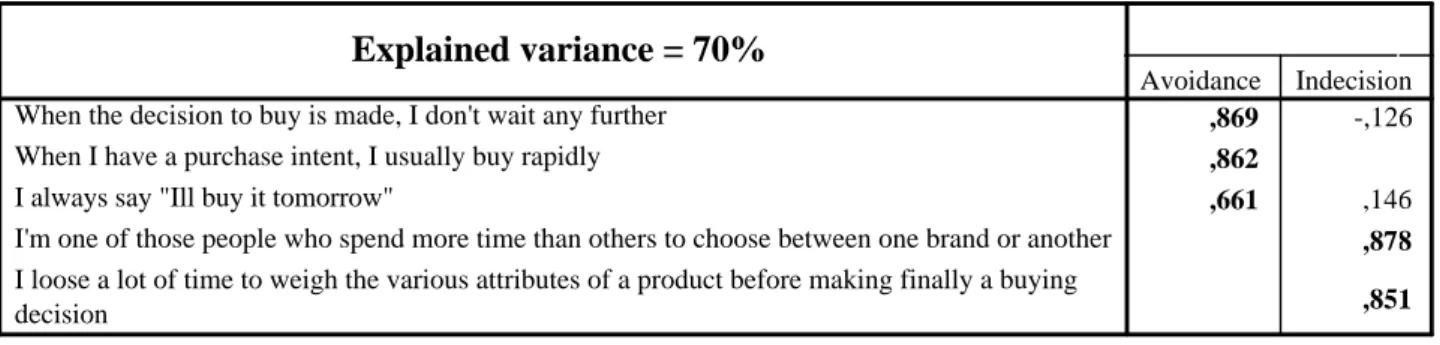
To measure procrastination, a new scale is developed : the Consumer Procrastination Scale (CPS). Item generation was based on exploratory interviews and on adaptation of existing procrastination scales to consumption situation. 66 items were created. A panel of 4 expert judges indicated the pertinence of the items with the definition of the concept. Hence we selected 29 items for further inquiry. Three principal component analysis were conducted on three successive data collection (for a total of 989 subjects). The first one allowed the selection of manifest dimensions of the construct. The last two data collection helped to purify the measure and to assess its reliability as well as validity. The final scale explains 70% of the variance, with the two expected dimensions (Avoidance and Indecision). Five items were finally retained at this stage
Table 1 : Principal Component Analysis Matrix with Oblimin rotation
,869 -,126 ,862 ,661 ,146 ,878 ,851 Explained variance = 70% When the decision to buy is made, I don't wait any further When I have a purchase intent, I usually buy rapidly I always say "Ill buy it tomorrow"
I'm one of those people who spend more time than others to choose between one brand or another I loose a lot of time to weigh the various attributes of a product before making finally a buying decision
Avoidance Indecision
Content validity is reached with the care of the four expert judges in selecting the items., while convergent and discriminate validity is assessed through confirmatory factor analysis (CFA).
After analysis of the residual moments, the item “I always say – I’ll buy it tomorrow” is dropped. The final CFA performed on a sample of 658 subjects shows a good adjustment fit of the scale to the data (GFI =0,993 ; AGFI = 0,999 ; RMSEA = 0,02). Reliability indices (ρ of Joreskog : avoidance = 0,76; indecision = 0,69) are acceptable for a new scale. Convergent validity indices (ρavoidance = 0,62 et ρindecision = 0,50) and discriminant validity indices (φ2 indecision-avoidance = (0,39)2 = 0,15 ) assess the convergent validity.
This short scale (4 items) is easy to use in both managerial and academic oriented researches. Its first application is proposed in a factorial design developed to test the two hypothesis of the paper.
2. Factorial design
A 2 x 2 factorial design is included in the final questionnaire of the last data collection of this research the effect of consumer procrastination (High vs Low), and the type of choice situation (procrastinable and non-procrastinable) on the decision to choose.
Type of choice situation is manipulated with a short text prompted to the reader. A choice of two models is then proposed with all objective attributes and a reseller comment. In a procrastinable situation, one model is clearly superior to the other one. Half of the sample is submitted to computer purchase, when the hi-fi system is the proposed product for the other half. The choice of these two products is based on open questions in the first data collection.
6
Results
Prior data analysis, manipulation check has been performed on both products with an ANOVA procedure on an independent measure (a bi-polar response difficult / not difficult to item "How did you find this choice?"). The procrastinable situation is perceived as more complex than the non-procrastinable situation.
Test of H1 was performed using the χ2 test. According to the results on computers (χ2 = 2,415; 1df ; sig = 0,120) and on hi-fi (χ2
= 0,156; 1df ; sig = 0,692), H1 is not validated. This unexpected result might be caused by our experiment design. Indeed we used real trade brochures to built the scenarios which was not the case of previous researches (Dhar, 1997). While it enhances the reality of the choice environment, it might decrease the opposition between alternatives.
Test of H2 was performed using a similar procedure. Procrastinators and Non-Procrastinators where qualified according their procrastination score. Hence two groups were built. The χ2 Test is performed on the contingency table crossing High and Low procrastinators with the choice option and no-choice option. H2 is validated (χ2
= 16,743 ; 1ddl ; sig=0,000) as we expected. A consumer presenting a high procrastination has 73% chance to do not decide while a consumer with a low procrastination will delay its purchase in only 26% of the cases. Procrastination predicts if a consumer will effectively buy or not.
Conclusion
This research brings two major contributions. First it provides a new measurement tool which can be used in both managerial and academic oriented studies. Second it shows that Consumer Procrastination is prevalent over situational factors to explain purchase delay. More research should be conducted on the interaction of other situational factors, such as promotional activities, with Consumer Procrastination. This first study on the topic provides the necessary tools to go further.
References
Ajzen, I. (1985), "From intentions to actions: a theory of planned behavior," in Action Control
: From cognition to behavior, ed. Julius Kuhl and Jürgen Beckmann, Heidelberg: Springer,
11-39.
Bagozzi Richard P. (1994), "ACR Fellow Speech," Advances in Consumer Research, 21, 8-11.
Bagozzi, R. P., Baumgartner, H., & Yi, Y. (1992). State versus Action Orientation and the theory of Reasoned Action : An application to Coupon Usage. Journal of Consumer
Research, 18(March), 505-518.
Beswick, G., & Mann, L. (1994). State Orientation and Procrastination. In J. Kuhl & J. Beckmann (Eds.), Volition and Personality (pp. 391-396). Göttingen: Hogrefe & Huber Publishers.
Burka, J., & Yuen, L. (1983). Procrastination: Why you do it and what to do about it?. PA: Addison-Weisley.
Dhar, R. (1992). Investigating context and task effects on deciding to purchase [PhD Dissertation], Berkeley: University of California.
Dhar, Ravi (1997), "Consumer Preference for a No-Choice option," Journal of Consumer
Research, 24(2), September.
Dubois, B., Laurent G. & Quaghebeur, A. (1998). Determinants of Erroneous Self-Reporting of Purchase Behavior In Proceedings of the 27th EMAC conference. Stockholm.
Effert, B. R., & Ferrari, J. R. (1989). Decisional Procrastination : Examining Personality Correlates. Journal of Social Behavior and Personality, 4(1), 151-156.
Ferrari, J. R. (1993). Procrastination and Impulsivness: Two sides of a coin? In Mc.Cown William, Johnson Judith L. & shure Myrna B. (Eds.), The Impulsive Client : Theory,
Research, and Treatment. Washington DC: American Psychological Association.
Ferrari, J. R. (1994). Dysfunctional Procrastination and its relationship with self-esteem, interpersonal dependency, and self-defeating behaviors. Personality and Individual
Differences, 17(5), 673-679.
Ferrari, J. R., Johnson, J. L., & Mc.Cown, W. (1995). Procrastination and task avoidance. NY: Plenum Press.
Fitzsimons, G. J., & Morwitz, V. G. (1996). The effect of measuring intent on Brand-level Purchase behavior. Journal of Consumer Research, 23(1), 1-11.
Greenleaf, Eric and Donald Lehmann (1995), "Reasons for Substantial Delay in Consumer Decision Making," Journal of Consumer Research, 22 (September 1995), 186-199.
Janis, I., & Mann, L. (1977). Decision Making : A psychological analysis of conflict, choice
and commitment. NY: Free Press.
Kuhl, J. (1994). A theory of action and state orientations. In J. Kuhl & J. Beckmann (Eds.),
Volition and Personality (pp. 9-46). Göttingen: Hogrefe & Huber Publishers.
Kuhl, J., & Beckmann, J. (1994). Volition and Personality : Action versus State Orientation. Göttingen: Hogrefe & Huber Publishers.
Lay Clarry H. (1988), "A modal profile analysis of procrastinators: a search for types,"
Personality and Individual Differences, 8(5), 705-714.
Lay, C. H. (1986). At last, my research on Procrastination. Journal of Research in
Personality, 20, 474-495.
Mann, L. (1982), The Decisional Procrastination scale, unpublished working paper, Flinders University, cité dans J. R. Ferrari, J. L. Johnson & W. Mc.Cown (Eds.), Procrastination and
Task Avoidance : Theory, Research and Treatment (pp. 71-96). NY: Plenum Press.
Morwitz, V. G., & Schmittlein, D. (1992). Using Segmentation to Improve Sales Forecasts based on Purchase Intent : Which "Intenders" actually buy? Journal of Marketing Research,
29(4), 391-405.
Putsis, W. P., & Srinivasan, N. (1994). Buying or Just Browsing? The duration of purchase deliberation. Journal of Marketing Research, 31(3), 393-402.
Simonson, I., & Tversky, A. (1992). Choice in Context : Tradeoff Contrast and Extremeness Aversion. Journal of Marketing Research, 29(3), 281-295.
Tversky, A., & Shafir, E. (1992). Choice under conflict : The dynamics of Deferred Decision.