HAL Id: hal-02160588
https://hal.laas.fr/hal-02160588
Submitted on 19 Jun 2019HAL is a multi-disciplinary open access
archive for the deposit and dissemination of sci-entific research documents, whether they are pub-lished or not. The documents may come from teaching and research institutions in France or abroad, or from public or private research centers.
L’archive ouverte pluridisciplinaire HAL, est destinée au dépôt et à la diffusion de documents scientifiques de niveau recherche, publiés ou non, émanant des établissements d’enseignement et de recherche français ou étrangers, des laboratoires publics ou privés.
New Generation of Micro Machined Silicon Gas
Sensors:Nano-structured Pd-and Pt-doped Tin Dioxide
Sensitive Layers for the Detection of Hazardous Gases
André Maisonnat, Hervé Delprat, Marc Baumbach, Andreas Schütze, Fei
Cheng, Steven Kelly, Frédéric Parret, Philippe Menini, Aikaterini Soulantika,
Bruno Chaudret
To cite this version:
André Maisonnat, Hervé Delprat, Marc Baumbach, Andreas Schütze, Fei Cheng, et al.. New Genera-tion of Micro Machined Silicon Gas Sensors:Nano-structured Pd-and Pt-doped Tin Dioxide Sensitive Layers for the Detection of Hazardous Gases. Eurosensors XVIII, Sep 2004, Rome, Italy. pp.636. �hal-02160588�
EUROSENSORS XVIII, Sep. 12-15, 2004, Roma/Italy
______________________________________________________________________________
New Generation of Micro Machined Silicon Gas Sensors:*
Nano-structured Pd- and Pt-doped Tin Dioxide Sensitive Layers for the
Detection of Hazardous Gases
André MAISONNAT 5; Hervé DELPRAT 1; Marc BAUMBACH 2; Andreas SCHÜTZE 2; Fei CHENG 3; Steven KELLY 3; Frederic PARRET 4; Philippe MENINI 4; Katerina SOULANTICA 5 and
Bruno CHAUDRET 5
1 MicroChemical Systems SA, Porcena 15, 2035 Corcelles, Switzerland
2 Laboratory for Measurement Technology, Saarland University, 66123 Sarbrücken, Germany 3 University of Hull, Department of Physical Sciences, Cottingham Road, Hull, United Kingdom
4 Laboratoire d’Analyse et d’Architecture des Systèmes du CNRS, 7, avenue du Colonel Roche, 31077 Toulouse cedex 04,
France
5 Laboratoire de Chimie de Coordination du CNRS, 205, route de Narbonne, 31077 Toulouse cedex 04, France
* Presently developed in the context of “NANOSENSOFLEX” project and funded by the European Commission (GROWTH-G5RD-CT-2002-00722)
Summary: In the present work, we demonstrate that organometallic complexes constitute efficient precursors to
design nanostructured Pd- or Pt-doped tin dioxide material. We demonstrate also that this material, under the form of colloidal solutions, can be implemented at an industrial scale as sensitive layer by drop deposition process onto micro-machined silicon substrates. Responses of these sensors to CO, H2, C3H8 and NO2 are
presented and discussed.
Keywords: SnO2 micro-machined gas sensors; Platinum and palladium catalysts; organometallic precursors
Introduction
Metal
oxide gas sensors are based on their property of varying their resistance when exposed to oxidizing or reducing gases, thus giving rise to a measurable signal. This property, of special interest for the detection of trace concentrations of flammable or toxic gases in air, is the subject of an extensive exploitation. Despite the fact that commercial devices have been available for a long time, selective and reliable simultaneous detection of several gases, at parts per million ranges, in the presence of other gases, remains a challenge. In this context we develop researches aiming at improving solid state gas sensor technology by designing a new generation of sensors according to a multi-disciplinary approach which takes advantage of nano-material technology and silicon micro-electronic processes. The use of innovative nano structured materials as sensitive elements as well as filters is supposed to offer a high level of sensing properties, in term of reproducibility, response time, long term-stability and selectivity whereas the semi-conductor manufacturing offers low cost sensors, high miniaturization level and very low power consumptionResults
We recently demonstrated that the organometallic route can be successfully applied for the synthesis of semi conducting nano structured metal oxides of controlled morphology [1,2] and for their
homogeneous doping with noble metals. We demonstrated also that these materials can be
implemented, by drop deposition process, as sensitive layers on micro machined silicon substrates to generate prototype gas sensors. [3,4]
Optimization of the processes implemented for the preparation of micro gas sensors at an industrial scale (basic chemical processes used for the synthesis and the doping of tin materials; integration and thermal conditioning of the sensitive layer) has been achieved in the frame of NANOSENSOFLEX program.
Typical responses of the as-obtained micro sensors when exposed to test gases, ie CO (5, 25 and 50 ppm), H2 (3, 10 and 20 ppm), C3H8 (50, 100 and
200 ppm) and NO2 (0.5, 1 and 2 ppm), under a
humidity content of 50 % and at a non-optimized working temperature of 450°C, are shown on figure 1.
Palladium and platinum-dopings considerably affect the resistances of the sensing materials which typically increase from values close to 20 Kohms for the undoped sensors to 100 Kohms.
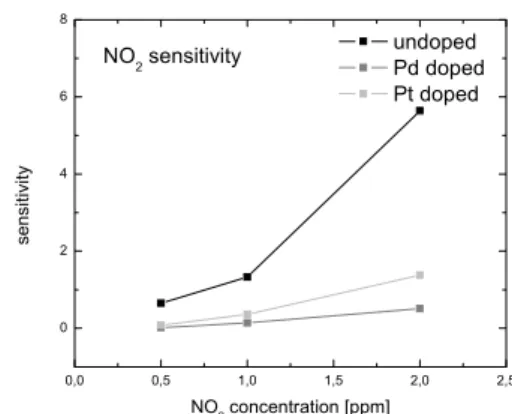
Responses of the undoped sensors to small amounts of NO2 are remarkable with, for example, a
sensitivity value S = [(Rgas-Rair)/Rair] of 6 under
2ppm of NO2 (Rgas and Rair corresponding to the
resistance values under test-gas and air respectively).
The palladium and platinum-doping effects on the responses to CO and NO2 are illustrated through
sensitivity profiles shown on figures 2 and 3. Pd-and Pt-doping leads to an increasing in sensitivity for the CO detection and to a strong reduction of the sensitivity toward NO2. Optimization of
EUROSENSORS XVIII, Sep. 12-15, 2004, Roma/Italy
______________________________________________________________________________
parameters like working temperature, doping rate,operating mode, in order to improve the cross sensitivities between such gases are presently under investigation.
Conclusion
In conclusion, we report in this communication a highly active system for gas detection. It is of special interest that the doping of the sensitive layer leads both to the increase in sensitivity for reducing gasses such as CO and H2 and to a strong reduction
of the sensitivity towards oxidizing gasses such as NO2. This will, in principle, make the selective
detection of NO2 and CO possible in a bi-sensor
system available for automotive applications. In addition, we note that these curves display useful transitory information which will now be studied in detail. 360 480 600 720 840 960 1080 1200 10k 100k 3 x NO2 3 x propane 3 x H2 NO2 propane H2 CO undoped #1 undoped #2 Pd doped 4% #1 Pd doped 4% #2 Pt doped 4% #1 Pt doped 4% #2 Rsens or [Ohm ] time [min] 360 480 600 720 840 960 1080 1200 0 100 200 3 x CO NO 2 [pp m ] ga se s [ ppm ] 360 480 600 720 840 960 1080 1200 0 1 2 3
Fig. 1. Gas response of sensors
0 20 40 60 -1,0 -0,9 -0,8 -0,7 -0,6 -0,5 -0,4 -0,3 -0,2 -0,1 0,0 undoped Pd doped Pt doped CO sensitivity sensiti vity CO concentration [ppm]
Fig.2. CO sensitivity profile
0,0 0,5 1,0 1,5 2,0 2,5 0 2 4 6 8 undoped Pd doped Pt doped NO2 sensitivity se ns itiv ity NO2 concentration [ppm]
Fig.3. NO2 sensitivity profile
References
1 C. Nayral, T. Ould-Ely, A. Maisonnat, B. Chaudret, P. Fau, L. Lescouzeres,
Adv. Mater., 1999, 11, 61-63
2 C. Nayral, E. Viala, P. Fau, F. Senocq, J.C. Jumas, A. Maisonnat, B. Chaudret,
Chem., Eur. J., 2000,6(22), 4082-4090
3 P. Fau, M. Sauvan, S. Trautweiler, C. Nayral, L. Erades, A. Maisonnat, B. Chaudret,
Sens. Actuators B 2001, 78, 83.
4 P. Menini, F. Parret, M. Guerrero, A. Martinez, K. Soulantica, L. Erades, A. Maisonnat, B. Chaudret, Sens. Actuators B, in press