UNIVERSITÉ DE MONTRÉAL
BIOMASS PROCUREMENT COST MINIMIZATION FOR
IMPLEMENTATION OF A RETROFIT BIOREFINERY IN A PULP AND
PAPER MILL
JOSE ALFONSO MELENDEZ ESQUIVEL DÉPARTEMENT DE GÉNIE CHIMIQUE ÉCOLE POLYTECHNIQUE DE MONTRÉAL
THÈSE PRÉSENTÉE EN VUE DE L’OBTENTION DU DIPLÔME DE PHILOSOPHIAE DOCTOR
(GÉNIE CHIMIQUE) NOVEMBRE 2015
UNIVERSITÉ DE MONTRÉAL
ÉCOLE POLYTECHNIQUE DE MONTRÉAL
Cette thèse intitulée:
BIOMASS PROCUREMENT COST MINIMIZATION FOR IMPLEMENTATION OF A RETROFIT BIOREFINERY IN A PULP AND PAPER MILL
présentée par : MELENDEZ ESQUIVEL Jose Alfonso en vue de l’obtention du diplôme de : Philosophiae Doctor a été dûment acceptée par le jury d’examen constitué de : M. FRAYRET Jean-Marc, Ph. D., président
M. STUART Paul, Ph. D., membre et directeur de recherche M. LEBEL Luc, Ph. D., membre et codirecteur de recherche M. PERRIER Michel, Ph. D., membre
DEDICATION
ACKNOWLEDGEMENTS
This work was completed with the support from the Natural Sciences and Engineering Research Council of Canada (NSERC) Environmental Design Engineering Chair at École Polytechnique, with funding from the Canadian Triticale Biorefinery Initiative (CTBI) and the Value Chain Optimization (VCO) network. In particular, I would like to thank the following people:
To the professors and support staff from Polytechnique and other universities and academic networks that helped me throughout my PhD. Your advice, and opinions were greatly appreciated, and helped me reach the end of my project. I am especially grateful to Dr. Yan Feng, without your help with my optimization model I could have never completed the project. To my co-supervisor Luc, thank you for your comments and reviews of my articles, and presentations. You always brought a new perspective to my project.
To my industry partners and especially Balazs, thank you for your support, advice, and your constant interest in teaching me and helping my project become better every time I presented it to you.
To the many colleagues and friends made during my time in Polytechnique: Eemeli, Hakim, Jeremy, Behrang, Tatiana, Carl, Matty, Jawad, Milan, Matthew, Hilda, Jean-Christophe, Deiudonne, Cedric, and especially Louis-Patrick, Banafsheh and Shabnam and anyone I might have forgotten to add. For all the good (and even some of the bad) times that we shared. To the beers, the parties, the meetings, the chats, the conversations, the lunches, the happy times, and the many many pranks we pulled on each other over the years. Thank you all very much.
Also to the other two wicked voices in my head and my computer at all times, Greg and Geraldine, how could I have survived the ordeal without you being there to get me through the worst of times, and help me celebrate the best of times, with burgers and beers.
Finally to my parents and family who’s unconditional support I had at all times, I couldn’t have done it without you, and will forever be grateful.
RÉSUMÉ
La récente récession économique a touché de plein fouet l’industrie des produits du bois, laquelle a dû s’ajuster à la chute de la demande pour ses produits phares, notamment la pâte et le papier. Pour les compagnies forestières, une des pistes de solution consiste à varier l’éventail de produits qu’elles proposent en implantant des procédés de bioraffinage en rétro-installation dans leurs usines. Cependant, la production de produits à valeur ajoutée en plus des produits existants requiert une utilisation plus complète des ressources, et entrainera certainement des changements le long de la chaîne d’approvisionnement.
Ainsi, la modernisation d’une usine en rétro-installation s’effectue sur le moyen-à-long terme, et l’évolution de la chaîne d’approvisionnement impacte non seulement l’usine concernée, mais la compagnie dans son ensemble. L’impact sur les coûts de l’usine influencera notamment le choix de la compagnie d’implanter ou non un procédé de bioraffinage donné. Par conséquent, il est dans l’intérêt d’une usine d’explorer au préalable les options d’approvisionnement de la biomasse pour comprendre les effets sur le coût global.
L’objectif du présent projet est de déterminer différentes stratégies d’approvisionnement de la biomasse pour une bioraffinerie qui soient économiquement viables, qui engendrent une réduction des coûts d’approvisionnement, tout en satisfaisant les besoins en termes de qualité et de quantité de matière première.
La réalisation de la recherche se base sur l’étude de cas d’une usine de papier journal et de son réseau de distribution de produits forestiers. Ce contexte a été utilisé pour le développement du cadre méthodologique et des outils de modélisation requis pour atteindre les objectifs. La structure de la simulation, de l’optimisation et des modèles de coûts associés vise à représenter au mieux les activités d’approvisionnement menées par la compagnie à l’étude.
L’approvisionnement en matières premières est destiné aux opérations courantes (papier journal et cogénération) et futures (bioraffinerie) de l’usine. La méthode de comptabilité par activité ou
activity-based cost (ABC) a été utilisée par le modèle de simulation pour calculer les coûts de
livraison aux usines par produit et bloc de coupe. Ces coûts sont ensuite intégrés au modèle d’optimisation qui vise à satisfaire les demandes de l’usine en matière première sur une base annuelle.
Les modèles peuvent être vus comme des plateformes d’évaluation de différentes stratégies d’approvisionnement suivant les processus entrepris par la bioraffinerie durant sa période d’activité. De l’analyse de ces processus découlent des informations relatives aux quantités de matière première et coûts qui guideront les décideurs dans leur sélection d’une stratégie de bioraffinage qui tienne compte de manière effective des ressources disponibles.
Le projet analyse les coûts d’approvisionnement en matière première et la faisabilité de onze scénarios impliquant deux technologies de bioraffinage : (1) la pyrolyse rapide et (2) le fractionnement de la biomasse utilisant un solvant organique, dit Organosolv. Les scénarios considèrent différentes variantes d’intégration au procédé de production de papier journal de l’usine, sur un horizon de vingt ans. Dans cet horizon de temps, l’usine peut (ou non) décider de stopper, partiellement ou complètement, la production de papier journal.
En plus des lignes de production de pâte et papier et des procédés de bioraffinage implantés, l’usine possède aussi une chaudière à biomasse et une unité de cogénération qui desservent les besoins en vapeur et en électricité de l’usine. Les variations des prix et de la demande en énergie des procédés implantés sont considérées sur la durée du projet, de même que les variations de la demande en biomasse pour le fonctionnement de la chaudière.
Les nouvelles contraintes s’appliquant à la chaine d’approvisionnement en biomasse suite à l’implantation de nouveaux procédés ont été intégrées au modèle d’optimisation. Afin de réduire les coûts d’approvisionnement, les systèmes de récolte en forêt ont été changés du bois court au bois long, sur une période de 10 ans. Le changement de système devrait améliorer la récolte pour plusieurs produits (bois de sciage, bois à pâte, bois de chauffage et résidus) et réduire les coûts de récolte. Aussi, des contrats d’échange ont été mis en place pour assurer l’acheminement des copeaux produits par les scieries à l’usine de pâte et à la biorafinnerie.
Les scenarios testés se concentrent sur la satisfaction de la demande en matière première selon les ressources disponibles dans la région pour les différents processus initiés ou stoppés à l’usine au cours des phases de transition de l’usine de pâte vers une usine de bioraffinage, tout en minimisant les coûts d’approvisionnement au cours de l’horizon de temps du projet.
Les analyses et comparaisons de scénarios de bioraffinage couplées à l’optimisation de l’approvisionnement en biomasse permettent de déterminer quelle implantation de bioraffinage est techniquement et économiquement la plus réalisable pour l’usine et ses partenaires.
Les résultats de l’analyse des scénarios indiquent que des coûts d’approvisionnement moindres sont obtenus quand le procédé de pyrolyse rapide est implanté comparativement au fractionnement par solvant organique. Ce résultat s’explique notament par le coût d’approvisionnement de copeaux de feuillus depuis une forêt en contenant peu.
Des compromis pour chaque scénario ont été trouvés, permettent qui peuvent leur implantation à l’usine. Par exemple, le scénario créant le plus faible coût d’approvisionnement, induit un approvisionnement en copeaux de résineux pour le procédé de pyrolyse rapide, et une fermeture complète des lignes de production de papier journal lors de la sixième année. Cependant, en analysant le ratio du coût de la biomasse par rapport au revenu, le scénario se révèle avoir une valeur inacceptablement élevée à cause du compromis entre un produit (le papier journal) et un autre de moindre valeur (huile bio, vendue comme carburant de substitution).
Pour d’autres scénarios de bioraffinage qui requièrent de plus grandes quantités de ressources forestières pour les procédés actuels et futurs de l’usine (par exemple utilisation de copeaux de bois de sciage pour la ligne de production de papier journal et utilisation de déchets de bois pour la pyrolyse rapide), la matière issue de la récolte est mieux exploitée. Il ressort cependant que ces scénarios tendent aussi à avoir des coûts annuels de biomasse plus élevés, à cause de la plus grande quantité de matière à acquérir.
En ce qui est du fractionnement de la biomasse utilisant un solvant organique, le rapport du coût de la biomasse sur le revenu est acceptable seulement pour les scénarios où la production de papier journal est continue; ce qui sous-entend l’existence d’un flux continu de revenus issu de la vente du papier journal. Idéalement dans cette situation, l’usine augmenterait la capacité du procédé Organosolv. Cependant, l’étudié ne permet pas l’approvisionnement de telles quantités de matière (plus de 1000 tonnes/jour de copeaux pour le procédé de bioraffinage).
Ainsi, le choix de la stratégie d’approvisionnement à utiliser dépendra grandement de la décision de l’usine de maintenir ou non sa ligne de production de papier journal. Dans l’ensemble le meilleur scénario pour l’usine serait celui de l’implantation d’une unité de pyrolyse rapide utilisant les déchets de bois, dont la bio-huile serait vendue comme substitut de combustible lourd, tout en maintenant la ligne de production du papier journal. D’autre part, si le procédé Organosolv était implanté, sa capacité ne devrait pas dépasser les 750 tonnes/jour, pour que le
réseau d’approvisionnement de la biomasse puisse fournir assez de copeaux aux deux procédés (production de pâte, et bioraffinerie).
Avec le développement et l’application de modèles de simulation et d’optimisation pour évaluer les scénarios de bioraffinage, tous les objectifs de ce projet de doctorat sont atteints et les hypothèses vérifiées, tout en contribuant à l’ensemble des connaissances.
ABSTRACT
As the forest industry emerges from the last economic recession, it finds itself evolving, to adjust to changes happening in their product markets (wood products, pulp and paper, etc.). In order to flourish in these new markets, many changes will come about in forestry firms, including expanding product portfolios by incorporating more biorefinery processes into current facilities. However, the added production of multiple value-added products along with current production will imply a more complete utilization of current feedstocks, and will most likely put a strain on the feedstock procurement supply chain.
Thus, as the transformation of mills into retrofit forest biorefineries occurs over a medium-to-long period of time, additional changes will have to occur throughout the mill (and company) supply-chains. These changes in procurement supply chains will have an impact on the bottom-line costs of the mill, and may ultimately determine whether or not a process is implemented. Therefore, it is in the best interest of the mills to explore biomass material procurement options beforehand, in order to better understand their effects on overall costs.
The objective of the project was to determine the conditions where different biomass procurement strategies for a biorefinery, result in reduced feedstock procurement costs, such that, they satisfy the facility's feedstock quantity and quality requirements, and are economically viable for a forestry firm in a competitive market.
A case study newsprint mill along with its forest material supply network was used to develop the necessary methodological framework and required modeling tools to prove the objectives.
The simulation, optimization, and their associated cost models aim to imitate realistic procurement activities to source forest material for all of their current (i.e. newsprint and cogeneration) and future (i.e. biorefinery) operations. Activity-based cost (ABC) accounting methods, were used within the simulation model, to calculate delivered product costs for each product extracted from each harvesting cutblock in the network, which was then used in the optimization model to fulfill the customers’ feedstock demands on an annual basis.
The models can thus be used as a platform for evaluating various optimized procurement strategies for a company according to the process activities (which will determine the feedstock requirements) undertaken during the biorefinery’s lifespan. This creates valuable feedstock
quantity and cost information which will assist decision-makers in developing the correct biorefinery implementation strategy that considers existing feedstock resources within the area. The project analyzed the feedstock procurement costs and feasibility of 11 biorefinery scenarios involving two biorefinery technologies (fast pyrolysis, and organic solvent pulping) retrofitted in a newsprint production mill, over a 20 year biorefinery project lifespan. During this time, the newsprint mill may (or may not) choose to partially (or completely) shut down newsprint production.
Along with the main pulp and paper production lines, and the implemented biorefinery processes, the mill also has a biomass boiler and cogeneration plant to produce steam and power consumed at the mill. Over the lifespan of the project, steam and power demands will change depending on the processes implemented, and so will the biomass demands of the boiler.
Along with process changes, other modifications are done to the biomass procurement supply chain and included within the optimization model as constraints. To reduce biomass procurement costs, forest harvesting systems are changed from cut-to-length to full-tree equipment over a 10 year period of time. This harvesting system change is expected to improve the integrated harvesting of multiple forest products (sawlogs, pulp logs, fuel logs and residues) as well as reduce harvesting costs due to the lower harvesting cost of using a full-tree system. Also, fibre exchange contracts are in place with local sawmills to exchange sawlogs harvested for chip materials used by the pulp and paper mill and biorefinery.
The tested scenarios focused on fulfilling feedstock demand according to available resources in the area, for the different processes being initiated or shutdown at the mill during the transition phases from P&P mill to biorefinery, while minimizing procurement costs over the lifespan of the project.
Biorefinery scenario analyses coupled with optimized biomass procurement costs for the simulated forest network determined which biorefinery implementation has the best technical and economic feasibility for the mill, and surrounding forest industry.
Results from the scenario analyses indicate that lower procurement costs are obtained when a pyrolysis process is implemented instead of an organic solvent due to the higher cost of providing hardwood chips from a forest with low amounts of hardwoods.
Certain trade-offs were found to be present in each scenario, that may affect their application in the newsprint mill used. The lowest cost procurement scenario for example involves the procurement of softwood chips for the pyrolysis process, as well as a complete exit from newsprint operations by year six. However, when analyzed with a biomass cost to revenue ratio, this scenario was found to have a value above 0.5 which makes it economically un-attractive. This is due in part to the trade-off of one commodity product (newsprint) for another (bio-oil) with lesser value (sold as a fuel oil substitute).
In other biorefinery scenarios that utilize higher quantities of products from the forest for both the current and future biorefinery processes (e.g running newsprint while running pyrolysis biorefinery using hogfuel as a feedstock) tend to better utilize all the materials coming from harvesting operations (i.e. chips, residues, barks, hogfuels); nevertheless, they also tend to have higher total biomass costs per year due to the procurement of larger quantities of materials.
In the organic solvent pulping biorefinery, the biomass cost to revenue ratio was found to be acceptable only in scenarios where newsprint production was continued, due to the continued revenues from newsprint. Ideally in this situation the mill would increase the capacity of the organosolv process, however it was found that the biomass network cannot provide such large quantities of materials (above 1000 dry tonnes per day of woodchips for the biorefinery process). Thus, the decision on which procurement strategy to use will depend on whether the mill decides or not to maintain its newsprint production.
If newsprint production is continued, and a pyrolysis technology is selected, than the use of hogfuel as a feedstock for the pyrolysis process is better suited as it will reduce feedstock costs, since there is an abundance of unused hogfuel in the supply chain. On the other hand, if organic solvent production is used, newsprint production must be maintained and the scale of the organosolv process needs to be reduced to 750tpd for the biomass procurement network to be able to produce enough woodchips to supply both processes.
With the development and application of both simulation and optimization models to evaluate biorefinery scenarios, all the objectives of the PhD study were accomplished, and the hypotheses proven, while contributing to the body of knowledge.
TABLE OF CONTENTS
DEDICATION ... III ACKNOWLEDGEMENTS ... IV RÉSUMÉ ... V ABSTRACT ... IX TABLE OF CONTENTS ...XII LIST OF TABLES ... XVI LIST OF FIGURES ... XVII LIST OF SYMBOLS AND ABBREVIATIONS... XX LIST OF APPENDICES ... XXI
CHAPTER 1 INTRODUCTION ... 1
1.1 Problem Statement ... 1
1.2 Hypotheses and Objectives ... 4
1.3 Thesis Organization ... 6
CHAPTER 2 LITERATURE REVIEW ... 7
2.1 Strategic Design of Retrofit Biorefineries ... 7
2.1.1 Biorefinery Integration strategies ... 8
2.1.2 Biorefinery Implementation strategies ... 10
2.1.3 Critical Analysis 1 ... 12
2.2 Supply Chain Management ... 13
2.2.1 Supply Chain Design ... 15
2.2.2 Supply Chain Modeling ... 17
2.3 Supply Chain modeling and Biomass Procurement Optimization ... 20
2.3.1 Biomass procurement for bioenergy ... 22
2.3.2 Biomass procurement for Biorefineries ... 24
2.3.3 Critical Analysis 3 ... 27
2.4 Simulation of Biomass Procurement Activities ... 28
2.4.1 Modeling biomass procurement costs ... 30
2.4.2 Application of simulation and optimization models in forestry ... 34
2.4.3 Critical Analysis 4 ... 36
2.5 Gaps in the Body of Knowledge ... 37
CHAPTER 3 THEORETICAL AND FIELD CASE STUDIES ... 40
3.1 Theoretical research ... 40
3.2 Case Study Mill and Forestry Supply Chain ... 42
3.2.1 The Pulp & Paper Mill ... 42
3.2.2 The Forest ... 43
3.2.3 Biomass Products and Intermediate Materials from the Forest ... 44
3.2.4 Harvesting Activities ... 46
3.2.5 Intermediate locations ... 49
3.3 The Biorefinery Case Study ... 54
CHAPTER 4 OVERALL METHODOLOGICAL APPROACH ... 58
4.1 Development of the Forest/Harvesting Simulation Model ... 62
4.1.1 Component 1: The Forest simulation ... 62
4.1.2 Component 2: Harvesting Simulation and Costing Model ... 63
4.2 Characterization of current forest harvesting operations ... 66
4.4 Design of forest/harvesting network for optimization ... 69
4.5 Definition of Biorefinery Scenarios ... 71
4.5.1 Harvesting system transition ... 71
4.5.2 Biorefinery technology ... 72
4.5.3 Process feedstock alternatives ... 72
4.5.4 New technology implementation period ... 73
4.5.5 Biorefinery/P&P mill configurations ... 73
4.5.6 Summary of Biorefinery Scenarios ... 74
4.6 Formulation of Optimization Model ... 76
4.6.1 Description of the optimization problem ... 76
4.6.2 Optimization model mathematical formulation ... 77
4.7 Biorefinery Scenario Analyses ... 86
CHAPTER 5 SUMMARY AND SYNTHESIS ... 88
5.1 Presentation of Publication and Additional Reports ... 88
5.2 Links between publications ... 89
5.3 Synthesis ... 93
5.3.1 The systematic development of a forest/harvesting simulation model ... 94
5.3.2 ABC accounting to improve product costs ... 105
5.3.3 Optimization of the current mill’s biomass procurement network ... 113
5.3.4 Evaluation of Biorefinery Scenarios using developed modeling tools ... 122
CHAPTER 6 GENERAL DISCUSSION ... 140
6.1 Simulating forest resources and their harvesting activities ... 142
6.2 Application of ABC accounting to the simulation model ... 143
6.4 Evaluating and analyzing biorefinery scenarios ... 145
CHAPTER 7 CONCLUSIONS ... 146
7.1 Contributions to the body of knowledge ... 146
7.2 Future work ... 147
REFERENCES ... 148
LIST OF TABLES
Table 4.1: Test case cutblock information for simulation model ... 67
Table 4.2: Pyrolysis biorefinery alternative scenarios ... 75
Table 4.3: Organic solvent biorefinery alternative scenarios ... 76
Table 4.4: Objective function components ... 80
Table 5.1: Sample cutblock input information for simulation model ... 95
Table 5.2: Input information for the optimization of the P&P mill’s current operations ... 114
Table 5.3: Key results for year 3 of the optimized harvesting network ... 119
Table 5.4: Description of all biorefinery scenarios evaluated using modeling tools ... 123
Table 5.5: Viable pyrolysis biorefinery scenarios ... 127
LIST OF FIGURES
Figure 2-1: Potential forest biorefinery biomass, processing and product combinations [35] ... 9
Figure 2-2: Example of a typical biorefinery supply chain ... 14
Figure 2-3: The 2 stage ABC methodology viewed from a process or cost perspective[109] ... 33
Figure 3-1: Typical forest cutblock ... 43
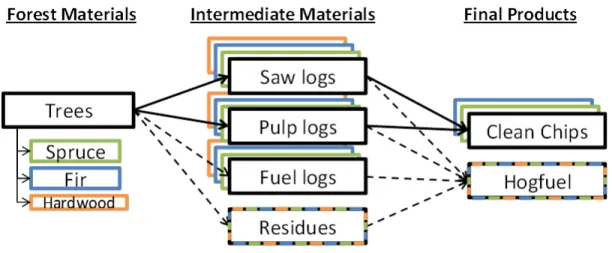
Figure 3-2: Breakdown of materials from whole harvested trees to final products for all species 44 Figure 3-3: Clean softwood chips ... 45
Figure 3-4: Hogfuel produced from various forestry sources ... 45
Figure 3-5: Intermediate materials extracted from the forest ... 45
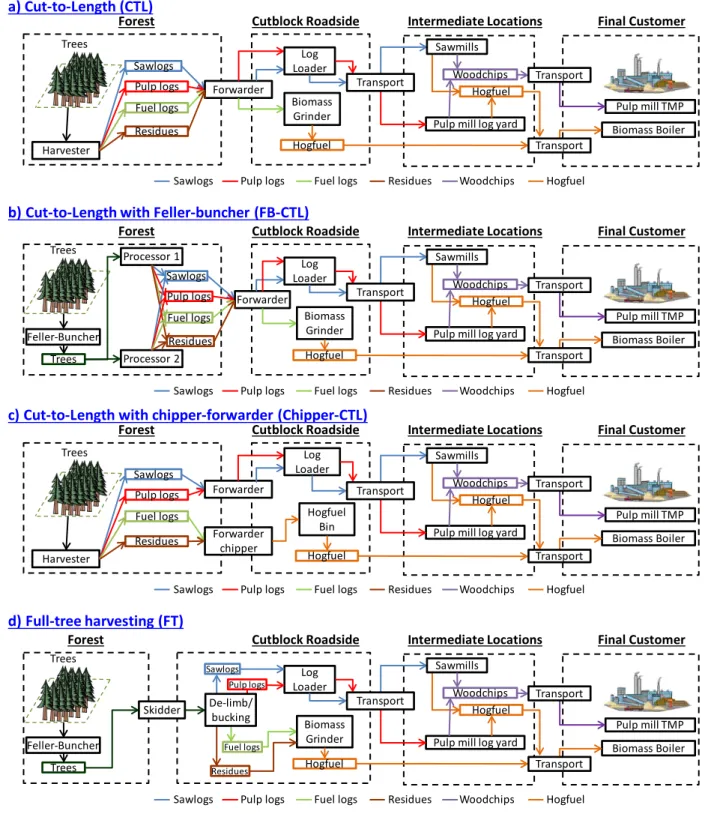
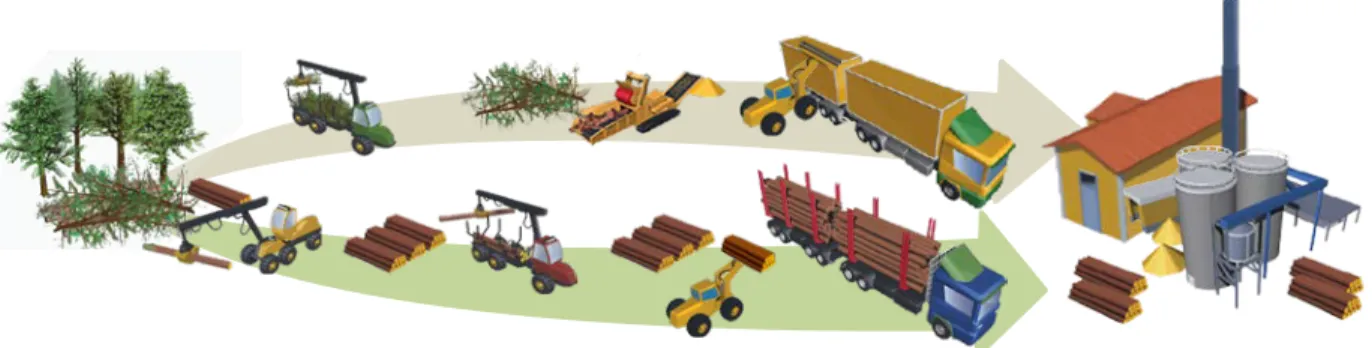
Figure 3-6: Cut-to-Length harvesting system with hogfuel grinder at cutblock roadside (modified image, original courtesy of Forest Energy Portal [136]) ... 47
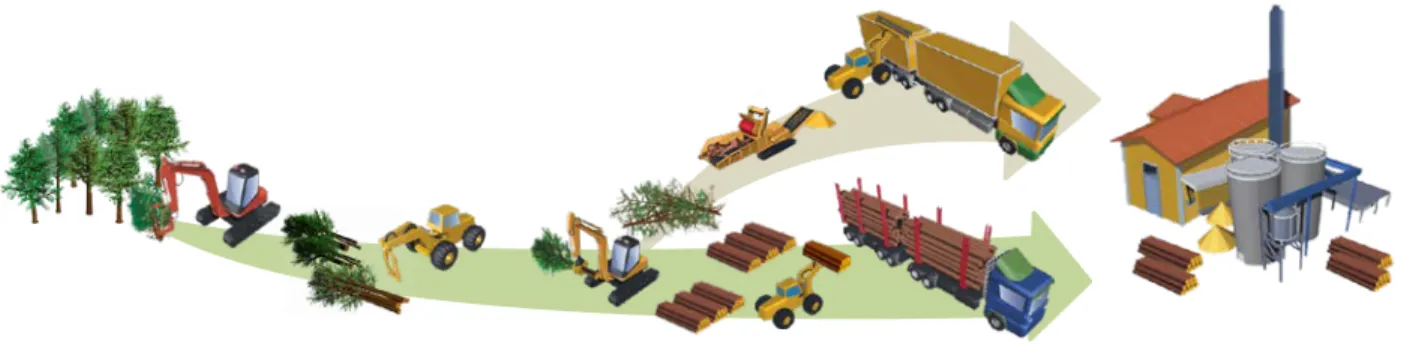
Figure 3-7: Full-tree harvesting system with hogfuel grinder at cutblock roadside (modified image, original courtesy of Forest Energy Portal [136]) ... 48
Figure 3-8: Hybrid harvesting system with hogfuel grinding at cutblock roadside (modified image, original courtesy of Forest Energy Portal [136]) ... 48
Figure 3-9: CTL harvesting system with forwarder-mounted chipper for hogfuel production in the forest (modified image, original courtesy of Forest Energy Portal [136]) ... 49
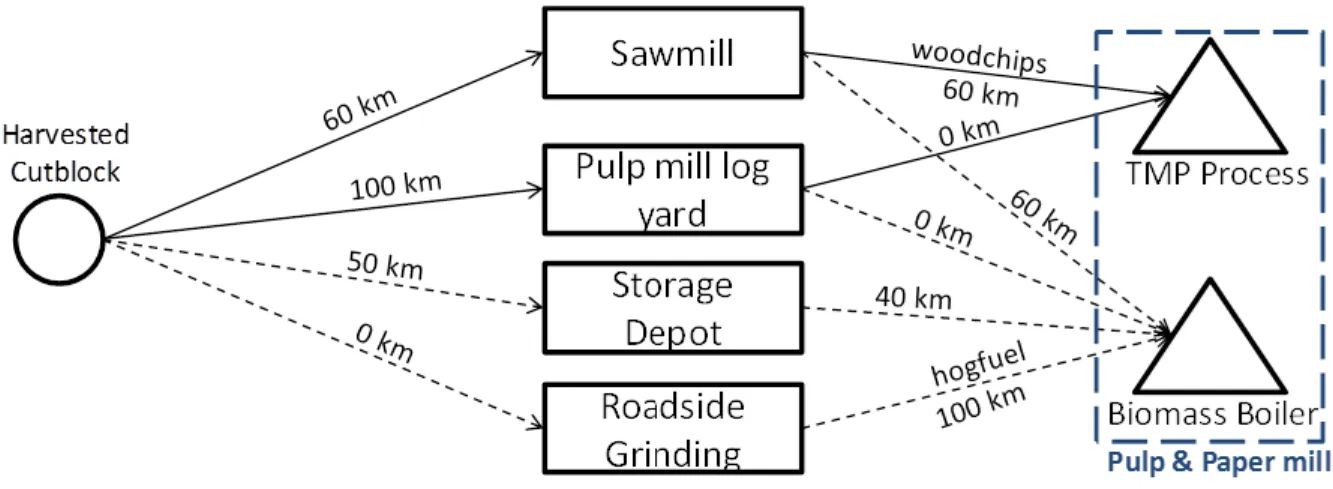
Figure 3-10: Case study mill’s feedstock supply chain with intermediate locations ... 50
Figure 3-11: Description of forest harvesting systems, supply chain and materials extracted and delivered to the P&P mill ... 53
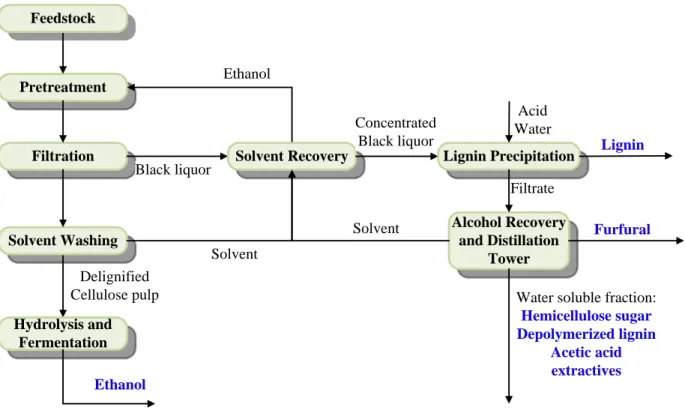
Figure 3-12: Schematic representation of the organosolv extraction process with co-product ... 57
Figure 4-1: General methodology with links to project objectives, hypotheses and gaps in the body of knowledge. ... 60
Figure 4-2: Descriptive methodology of all activities carried out throughout the study ... 61
Figure 4-3: Biomass costing of machinery used to harvest using a CTL harvesting system ... 64
Figure 4-5: Test cutblock with case study supply chain and distances ... 67 Figure 4-6: ABC framework implemented in forest simulation/harvesting model ... 68 Figure 4-7: Forest Cutblock locations with P&P mill, sawmills and fuel depot (map created using
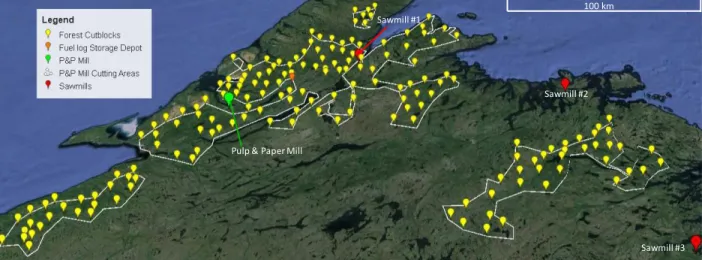
Goolge earth, 2014) ... 70
Figure 4-8: Biorefinery biomass procurement supply chain ... 77 Figure 4-9: Organosolv biorefinery production rates for all products and residues from woodchips
... 87 Figure 5-1: Linkage between publications, methodology and other academic activities carried out.
... 91 Figure 5-2: Quantitative results of intermediate materials from a sample cutblock modeled using the forest simulation model. ... 96 Figure 5-3: Comparison of weighted average chip material costs for all FMAs harvested to satisfy the P&P mill’s demand and simulation estimates for the same demand (normalized values) ... 98 Figure 5-4: Simulation model costs for products procured from a single cutblock, pre-processed and delivered to P&P mill ... 100 Figure 5-5: Sensitivity analyses for the developed simulation model, testing their effects on
quantities of materials extracted, and costs for both hogfuel and woodchips ... 103 Figure 5-6: Comparison of stacked product costs extracted from the sample cutblock using a
traditional cost allocation method and an ABC method ... 106 Figure 5-7: Costs breakdown for all products produced from materials extracted from the
cutblock using the traditional and ABC methodology ... 107 Figure 5-8: Alternative harvesting systems comparison of total costs per product using ABC .. 110 Figure 5-9: Comparison of alternative harvesting systems weighted average total costs for final delivered chip and hogfuel materials to P&P mill. ... 111 Figure 5-10: Comparison of weighted average chip material costs for all cutblocks harvested to
Figure 5-11: Comparison of material costs and quantities extracted from each FMA for woodchip production ... 116 Figure 5-12: Flow of materials to final customers during year 3 of the optimized harvest ... 118 Figure 5-13: Optimized material types and quantities used for the production of hogfuel in Year 3
... 120 Figure 5-14: Optimized chip and hogfuel costs for the P&P mill with and without harvesting
system changes in years 6 and 11. ... 121 Figure 5-15: Optimized Biorefinery Implementation Scenarios found to be Un-Feasible ... 124 Figure 5-16: Organosolv biorefinery with continued newsprint production at 3 different
production scales. ... 126 Figure 5-17: Delivered woodchip and hogfuel costs for all viable pyrolysis biorefinery scenarios
... 127 Figure 5-18: Delivered woodchip and hogfuel costs for viable organosolv biorefinery scenarios
... 128 Figure 5-19: Biomass product demands by the biorefinery facilities for pyrolysis scenarios ... 130 Figure 5-20: Biomass product demands by the biorefinery facilities for organosolv scenarios .. 131 Figure 5-21: Optimized average feedstock procurement costs for the pyrolysis biorefinery during the 20-year time horizon. ... 132 Figure 5-22: Optimized average feedstock procurement costs for the organosolv biorefinery
during the 20-year time horizon. ... 132 Figure 5-23: Forest material inventories for all feasible biorefinery scenarios during the 20-year
time horizon ... 134 Figure 5-24: Biomass cost to biorefinery product revenues for all biorefinery scenarios ... 137
LIST OF SYMBOLS AND ABBREVIATIONS
ABC Activity-Based Cost
Chipper-CTL Cut-to-Length harvesting system with forwarder-mounted chipper CTBI Canadian Triticale Biorefinery Initiative
CTL Cut-to-Length harvesting system DSS Decision-Support Systems
FB-CTL Feller Buncher with Cut-to-Length harvesting system FT Full Tree harvesting system
GIBRF Green Integrated Biorefinery GIS Geographic Information Systems LP Linear Programming
MILP Mixed-Integer Linear Programming MINLP Mixed-Integer Non-Linear Programming MSW Municipal Solid Waste
NLP Non-Linear Programming
NLDP Non-Linear Dynamic Programming OR Operations Research
PMH Productive Machine Hour P&P Pulp and Paper
SC Supply Chain
SCM Supply Chain Management SMH Scheduled Machine Hour TMP Thermo-Mechanical Pulping tpd tonnes (dry) per day
LIST OF APPENDICES
Appendix A – Article 1: Systematic assessment of triticale-based biorefinery strategies: A biomass procurement strategy for economic success ... 159
CHAPTER 1
INTRODUCTION
1.1 Problem Statement
The transformation of the pulp and paper industry has been motivated in the last decades by many factors. Amongst the most important, are increasing fuel and energy costs, shrinking markets for paper products such as newsprint, and strong competition in production from emerging economies (Brazil, Russia, India and China) [1]. However, within the last year, some of these factors have seen radical changes due to dropping oil prices [2], which have decreased fuel costs and depreciated the Canadian dollar (a favourable condition for P&P exporters). But other factors such as newsprint markets, and increased competition from emerging economies, have been unaffected, and mark irreversible changes in these traditional paper markets due to advancements in technologies that have come to replace these traditional products [3].
Newsprint mills in Canada, especially those that use thermo-mechanical pulping processes (TMP) have especially had a hard time accommodating the ever changing market place, and many have decreased production, been idled or shut down in order to stabilize supply and demand. But as the newsprint market continues to be downsized, many newsprint mills need to find suitable replacements and value-added products to produce if they wish to survive.
With the intent of adapting to changing market conditions, which seem to require less of some mainstay forest products (e.g. newsprint, copy paper, etc.), Canadian newsprint mills have sought out opportunities for introducing value-added products (e.g. bioenergy, combined heat and power generation, pellets, biofuels and biochemicals) into their current operations. Market demand for these new value-added products has seen expansion over the last few years [4] due to new policies which favour carbon neutrality, and sustainable use of renewable residual materials. In addition to the introduction of new products, forestry companies are continually looking to improve the performance of their supply chains (SC), in order to lower operation and logistics costs, and increase their competitiveness. Canadian pulp and paper companies are always seeking ways of restructuring their up- and down-stream operations, and investment and financing strategies, in order to improve the economic performance of the entire supply chain (SC) [5, 6]. But more than just the addition of new products, and improvements in supply chain costs that will benefit Canadian forestry companies, long-term action plans and policies must be developed
and put in place to achieve the long-term goals of the organization. In other words a business strategy. Corporate business strategies must be developed which optimize production for both the core business and additional products at the same time that they achieve short- and long-term competitive advantages. It is here that decision support systems (DSS) play a vital role, as they provide decision makers with tactical and operational level information from each stage of the supply chain necessary to develop and implement the most appropriate business strategy to aid in the improvement of their financial performance.
Thus, as the transformation of P&P mills into retrofit forest biorefineries comes about over a medium-to-long term period of time (5 to 10 years), redesigns due to process integration will have to take place throughout the mill supply chain as well as the company’s business strategy. During said timeframe, day-to-day operations will be affected, and must be altered to minimize costs and maximize productivity [7]. Simultaneously, lower-level operational and tactical information concerning alterations and redesigns in processes and supply chains, as well as their impacts from the costs accounting systems used, needs to be communicated to higher level decision makers which will make sure that the mill’s strategic goals are being satisfied (i.e. bottom-up decision making[8]).
Amidst the many changes that must take place, the biomass1 procurement strategy and supply chain must be adjusted to properly accommodate the material requirements of each phase of the transformation process. The efficient procurement of biomass feedstocks in each phase, is critical for the long-term economic viability of the retrofit forest biorefinery. Having access to a reliable and low-cost fibre source, evaluating the entire fibre procurement logistics network of the biorefinery, and implementing changes to maintain competitiveness over the long-term will represent an enormous competitive advantage to any business organization [9, 10].
Feedstock quantities and quality for both the core business (e.g. newsprint), as well as biorefinery processes, and the supply systems used to procure them will determine the overall feedstock costs for the facility during each phase of the biorefinery implementation. Ultimately, the feedstock costs will impact overall product profit, and therefore, maintaining or reducing feedstock 1 The term “biomass” in this document refers to all materials required by a mill or biorefinery for all their processes,
including sawlogs, pulp logs, clean whitewood chips, fuel logs, forestry residues, bark, hogfuels, etc. A more detailed description is given later-on in this document.
procurement costs for all processes in the facility will be an essential part of the transformation process. In addition, improving current cost accounting systems with newer, more accurate methods that take into account the production of multiple products that may or may not all use the same supply chain activities, will provide more accurate accounting of where costs are coming from (i.e. Activity-based cost accounting).
Nevertheless the procurement of biomass fibre (whitewood fibre as well as residuals) for a pulp mill, is a complex task, that involves a number of different activities and types of equipment for each task. The way biomass is harvested as well as its costs will be affected by a multitude of factors and decisions at both tactical and operational levels that must be taken into account. In order for P&P companies to analyze the important trade-offs between business strategies for feedstock procurement in a timely manner, systems-based2 decision support systems must be created that produce a simulated re-creation of current biomass procurement operations while estimating overall feedstock costs, taking into account all harvesting-related activities for each product. At the same time, these tools must allow companies to re-design and improve their supply chains to provide cost reductions in delivered feedstock products while including operational level data that affects tactical and strategic level planning for the entire biomass supply chain (SC). These decision support systems will be a critical element for the successful design, coordination and management of the P&P supply chains.
Both simulation and optimization have been found to be effective tools to use in the development of DSSs. Each methodology has its own specific application: Optimization tries to find the most cost-effective way of carrying out a network-wide activity (or set of activities) under a set of known and stable constraints, by maximizing desirable factors, and minimizing undesirable ones. On the other hand, simulation identifies the impact of different variables which may change over time, on the activity (or set of activities) and can also be used to visualize the real world behavior of a supply chain, plus identify and react to problematic areas within the system. [11]
Thus for the study of biomass procurement systems in a biorefinery implementation, simulation tools are used to explore the impact on costs of harvesting, using different harvesting systems
2 A systems-based approach refers the study of the interdependency and interactive nature of elements within and
external to a organization/supply chain, etc.
amongst different harvesting conditions (e.g. harvesting sites, feedstock quantities available, etc.). Activity-based cost (ABC) accounting methods are then introduced into the simulation model, to improve product cost distribution and traceability to the source activities that generate them. Then, optimization uses the data provided by simulation to explore the consequences for the larger network, by seeking to maintain minimum procurement costs, while satisfying a changing feedstock demand over the lifespan of the biorefinery. These two methods, allow the analysis of low-level operations, while examining their impact on higher level strategies. This gives decision makers information/data from the procurement cycle of the supply chain, needed to make decisions that will maintain the economic viability of a biorefinery. Furthermore, by changing the original biorefinery conditions (technology, scale, etc.) we create a different outcome which can be compared to the previous set of biorefinery conditions. This is what is known as a scenario analysis. The systematic development of these tools, along with their validation and application towards a realistic case study mill is the main motivation for the research presented in this thesis.
1.2 Hypotheses and Objectives
The ultimate goal of this thesis is to present a systematic approach by which to evaluate biorefinery biomass procurement strategies, within an existing P&P mill operation (i.e. in retrofit), taking into account tactical and operational level conditions (e.g. equipment selected to harvest, cutblock selection, products extracted, intermediate locations used, preprocessing carried out, etc.) that ultimately affect biomass procurement costs. Based on this, the main hypothesis of this work is as follows:
Main Hypothesis: Optimizing the biomass procurement strategies of biorefinery implementation
scenarios, will allow to compare the scenarios and determine which biorefinery implementation strategy creates the best conditions for the economic viability of the project (i.e. biorefinery implementation) over an extended period of time.
Sub-Hypothesis 1: The simulation of biomass procurement activities and harvesting systems for
different forest characteristics at the cutblock level, will allow to supply biomass demands from the biorefinery, and compare the procurement costs of each forest site harvested.
Sub-Hypothesis 2: The combination of a forest harvesting simulation model and activity-based
cost accounting method to improve the traceability of forest product costs, will allow to compare alternative harvesting systems in order to reduce harvesting costs for different biomass demands.
Sub-Hypothesis 3: By optimizing a simulated forest harvesting network taking into account
strategic scenario decisions and tactical/operational planning and decision-making horizons, will allow to satisfy a P&P mill’s quantity and quality requirements over an extended period of time.
Sub-Hypothesis 4: Adapted harvesting solutions can be implemented for different biorefinery
scenarios, depending on the quality and quantity of required biomass. Their cost-optimized biomass procurement supply chains will impact the economic viability of the biorefinery.
The problem statement and hypotheses call for the systematic development of two modeling tools which when used to examine different biorefinery scenarios, will assist strategic decision-makers in identifying promising biorefinery strategies from a biomass procurement point-of-view. To that end, the methodology used was guided by the following main objective:
• To design a systematic methodology for the comparison of biorefinery implementation scenarios with optimized biomass procurement strategies which result in reduced feedstock procurement costs, such that, they satisfy the facility's feedstock quantity and quality requirements and are economically viable for a forestry company in a competitive market.
Furthermore, the accomplishment of the main objective is tied to the completion of the following
sub-objectives:
• To design a forest/harvesting simulation model to evaluate a traditional forest biomass procurement supply chain used in a case study P&P case mill, for the procurement of both clean whitewood chips, and hogfuel in and integrated harvesting process
• To demonstrate how an alternative cost accounting method implemented in a forest harvesting supply chain simulation model, will allow for a more detailed view of the cost structure, which will better evaluate new procurement strategies using alternative
harvesting systems and sources of each product that will ultimately help decision-makers reduce procurement costs.
• To optimize a biomass procurement network in order to minimize procurement costs while satisfying mill feedstock demands, by implementing quantity and quality feedstock changes over time which are part of the strategic goals of the mill, while the tactical and operational level decisions are aligned with the overall strategic decisions.
• To assess the competitiveness of different biomass procurement strategies for several biorefinery implementation scenarios in order to determine the most economically viable solutions for the P&P mill being retrofitted with biorefinery technologies.
1.3 Thesis Organization
This thesis is organized as follows: In Chapter 2 the relevant literature is reviewed in order to identify the gaps in the body of knowledge. Chapter 3 gives a description of the case study mill and supply chain used to develop the simulation and optimization models as well as evaluate the biorefinery scenarios. Chapter 4 outlines the methodology followed in this study to create the simulation and optimization modeling tools, along with the mathematical model formulations (for the optimization model), constraints, and descriptions of their functions. Each modeling tool will help prove each one of the objectives presented beforehand that will ultimately help support the described hypotheses. Chapter 5 is a general discussion and synthesis of all work carried out, as well as implications of results obtained in each step. Chapter 6 presents overall conclusions, contributions to the body of knowledge and future work. In the Appendix you will find a published article detailing work carried out in agriculture
CHAPTER 2
LITERATURE REVIEW
2.1 Strategic Design of Retrofit Biorefineries
Biorefining and biorefineries refer to the process and facilities that integrate biomass conversion processes and equipment to produce fuels, power and chemicals from biomass. As stated by Ragauskas [12], biorefineries are analogous to today’s petroleum refineries which produce multiple fuels from petroleum; industrial biorefineries would create products from renewable feedstocks [12, 13]. However, unlike petroleum refineries which use only one type of raw material (petroleum), a biorefinery will most likely have multiple types of renewable feedstocks entering the process at any given time.
The “forest biorefinery”, as described by Chambost et al. [14], describes a retrofitted (i.e. continued production of core business products) or repurposed mill which creates multiple value-added products using integrated processes. The main focus of the integrated forest biorefinery is to take advantage of the existing facilities and supply chain networks already established in the forest-paper industry, and convert them into biorefineries. Part of the added benefit of biorefineries, is the fact that they can better utilize more feedstock types, in an integrated way, which reduces the amount of waste of the valuable resources.
Axegard [15] uses similar concepts to describe the “pulp mill biorefinery”, where value added products are extracted from Kraft pulp mill residuals. Examples they present are the separation and purification of lignin and xylan from black liquor, glucomannan and xylan from wood chips-forest residuals, and extractives from bark. Van Heiningan [16] also identifies his “integrated forest biorefinery” as the transformation of chemical pulp mills into biorefineries, although for the most part, focuses on process integration and the extraction of hemicelluloses for production of value added chemicals prior to pulping; an approach also taken by Amidon [17] and his research team.
Other authors [18-21] have also placed the biorefinery in the context of retrofit or repurposing of P&P mills. Thorp et al. [22] considered the transition of pulp mills to biorefineries, the next logical step to create new revenue streams; but the biggest challenge they identified was to move away from their commodity business model which has come to be less profitable than before. This is where biorefinery integration and implementation strategies become useful.
2.1.1 Biorefinery Integration strategies
Strategic integration of biorefinery processes is an important element in the process of improving a forest company’s performance because it facilitates the continuous alignment of business strategies within the ever changing business environment.
Dansereau [23] identified two strategies for integrating biorefinery processes in a retrofit P&P mill: a strongly integrated strategy, and a parallel-integrated strategy. The strongly integrated strategy implies a better utilization of current feedstocks used in the P&P mill core processes by extracting biomass components (i.e. lignin and hemicellulose) that through additional biorefining processes and upgrading, will have a higher product value than before. This leaves cellulose for the core P&P process and increases value of the other co-products. Because of its strong dependency on core business processes, the strongly integrated biorefinery processes such as lignin and hemicellulose extraction [24-26], work best with companies that aim to strengthen their competitive position in the P&P business, while achieving increased revenues.
On the other hand, the parallel-integrated strategy, builds biorefining processes adjacent to existing pulping lines in order to share services to the main processes: wood procurement and preparation, energy and water treatment integration, as well as the use of existing supply chains and sharing of manufacturing overheads [27]. Examples of parallel-integrated biorefinery technologies include pyrolysis [28, 29] and other thermochemical treatments [30]. Although the strongly-integrated processes would also have the benefits of sharing services, the main advantage of the parallel-integrated strategies is that they are less dependent on the core business, which at any point in time could be shut-down, or production decreased, without adversely affecting biorefining processes. This may fit in best with companies seeking to exit the P&P business.
Hytönen et al. [31, 32] analyzed the integration of biorefinery technologies into a kraft pulp mill from different aspects including techno-economic analysis [33], capital cost savings, operating costs synergies and revenue diversification for bioethanol production. Sammons Jr. [34] then proposed a general approach as a combination of several tools (process integration, mathematical optimization, and economic and environmental analyses) in order to determine the optimal biorefinery process and product design combination.
The number of potential biorefinery combinations (product/process/feedstocks) that can be integrated into a P&P mill is quite large as represented in Figure 2-1. The best integration strategy of a potential biorefinery alternative will depend on a number of factors such as the feedstocks (biomass) available in the local areas (both quantities and qualities), the P&P mill type (Kraft, TMP, etc.) and configuration, the biorefinery technology selected, the products and by-products produced, as well as financial (capital investment and production costs), environmental and social factors.
Figure 2-1: Potential forest biorefinery biomass, processing and product combinations [35] With the integration of biorefinery processes into P&P mills, new challenges will come about in the procurement of raw materials for the facility. The added production of multiple biorefinery products along with current core business production will imply a more complete utilization of currently procured raw materials, and the need for more biomass materials, that will most likely put a strain on the feedstock procurement supply chain (SC). Furthermore, the added need for raw materials, will cause procurement costs to increase. Thus companies will have to seek out ways to maintain, or reduce their feedstock procurement costs if they want to remain competitive, as well as secure supplies to fulfill all feedstock demands of the mill over the lifespan of the facility [36].
The up- and down- stream operations carried out to supply materials to the P&P mill (and future biorefinery), and deliver produced products to final customers will play a significant role in the design of a biorefinery. Because changes in the P&P mill will no doubt affect supply chain operations, the study and analysis of both supply chain and supply chain management are of importance for the biorefinery design process as was shown by Mansoornejad et al. [37] who integrated the concepts of product/process design with those of supply chain design within the biorefinery in order to develop a methodology framework for decision-making.
2.1.2 Biorefinery Implementation strategies
One of the biggest challenges faced by decision makers regarding biorefineries is the implementation strategy to follow. In order to achieve the full potential of a forest biorefinery, there must be an implementation strategy to assure that both current and future processes in the retrofit facility maintain economic viability during the transition period, and beyond.
Strategy implementation is a term used to describe the activities within an organization to manage the execution of a strategic plan. In this case the strategic plan refers to the integration of biorefining processes within a P&P mill, along with all the changes that it will produce in both the biomass feedstock and product supply chains.
Chambost et al. [38] considered that diversification to a new business model as an essential part of the biorefinery implementation strategy which would include the addition of new products to the core business products (i.e. P&P products) in order to form the company’s new product portfolio.
Wising and Stuart [39] expanded on the concepts of product portfolios in biorefineries by combining product design with process design using process systems engineering and process integration tools. Fernando et al. [40] also used the concepts of product portfolios to describe their 3 phase biorefinery process, where a great deal of focus was placed on the capacity of the processes to adapt to changing market demand using process flexibility. The goal as they described it, was to reach phase 3 where a biorefinery has multiple products, which can be of either high-volume low-value or low-volume high-value, and the flexibility to switch production between them.
Janssen et al. [41] further developed the concepts of a biorefinery product portfolio by proposing a phased approach for biorefinery implementation, taking into account the strengths and constraints of forest biorefinery industry.
Moshkelani et al. [42] presented a methodology by which to assess and implement a green integrated biorefinery (GIBRF) within a Kraft P&P mill. Their study suggested that a progressive implementation would be advantageous as it allows the mill to continue producing revenues throughout the process. However, the authors do conclude that the implementation strategy raises a number of unusual challenges such as selecting the appropriate process/product combinations to fit each mill, managing production flexibility of products so as to not oversaturate the market, and integrating the new processes with existing supply chains for products and raw materials. All of which are concepts that must be resolved before embarking in the implementation of a biorefinery retrofit. Rafione et al. [43] later expanded the GIBRF implementation strategy to a 5 phase strategy which takes into account the need to select the appropriate biorefinery technology and products for each mill, but does not resolve challenges external to the mill (i.e. production flexibility, supply chain integration, etc.).
Ultimately, it will be crucial to carry out a selection process to screen out the non-promising biorefinery integration and implementation strategies from the list of possible solutions at the early stage strategic design. This will ensure that the most promising combination of process technology and product portfolio are selected for the specific P&P mill under study [41].
Many P&P companies are eager to define long-term strategies and investments that will lead them to successfully transform their current operations towards integrated biorefineries which can fulfill future emerging markets. However, they face many challenging decisions to find the best investment strategy that will minimize their procurement and production costs and allow to maximize net profits. Decision support systems, such as simulation and optimization models, will play a vital role in the implementation strategies followed by P&P mills seeking to retrofit their facilities with biorefinery processes. These tools, plus, scenario analysis (the analysis of potential future events by considering possible future outcomes [44]) to compare different biorefinery alternatives which may include different technologies, feedstocks, production scale for both current and future processes, and other variables will provide decision makers with valuable
information to determine the best course of action for the retrofitting of a current P&P mill with biorefinery technologies.
2.1.3 Critical Analysis 1
Retrofitting P&P mills with biorefining technologies incorporates product and process design into its implementation strategies so that the selected product will fulfill market demand as explained by Chambost et al. [38] as well as Wising & Stuart [39]. However, going back to one of the main differences between petrochemical refineries and biorefineries, is the fact that biorefineries will use a wide variety of feedstock materials in their processes as opposed to the single material used in petrochemical refineries. This brings to light the importance that needs to be placed on the study of raw material procurement for the biorefinery, as it will differ considerably from what has been done in the past (for petroleum refineries).
As is depicted in Figure 2-1, different types of feedstock materials can be used by a biorefinery, and finding the correct combination of feedstock/process/product (along with other important factors such as scale of production, technologies used, process configurations, etc.) should be an integral part of the pre-design phase of a biorefinery implementation strategy. To add to the complexity, biomass materials will also have a significant impact on the economics of the biorefinery depending on quality and quantities available in the region, and required by the mill. In order to determine the optimum biorefinery implementation strategy there should be a comparison of several different alternatives by which we eliminate out the ones that are considered non-feasible, or do not provide the best outcome for the mill.
In addition, because feedstock materials differ from one pulp mill to another, and from one region to another, incorporating the study of biomass procurement during a biorefinery implementation is needed. Likewise, how biomass procurement strategies will adjust (or be adjusted by decision makers) in order to a) comply with the mill’s feedstock demands for all core business and new processes; and b) maintain the lowest procurement costs possible so as to contribute to the viability of the biorefinery during all stages of the transition, must also be considered.
2.2 Supply Chain Management
Several authors [45-51] have reviewed and studied the concepts of supply chain (SC) and supply chain management (SCM). Christopher [50] defined supply chains (SC) as a “representation of a network of organizations that are involved, through upstream and downstream linkages, in the different processes and activities that produce value in the form of products and services in the hands of the ultimate consumer”. Put into simpler words by Beamon [52] a supply chain consists of multiple business entities (i.e., suppliers, manufacturers, distributors, and retailers) working together to: (1) acquire raw materials, (2) convert them into specified final products, and (3) deliver these final products to retailers.
Furthermore, supply chain management (SCM) refers to the set of activities, resources, and information needed to plan, source, manufacture, store, sell and deliver products to customers. SC is traditionally characterized by a forward flow of materials, a backward flow of financial resources and ideally, information that flows both forwards and backwards as visualized in Figure 2-2.
An example of a typical biorefinery supply chain (as described in Figure 2-2) for a diverse product portfolio which includes traditional forestry products (e.g. lumber, paper), value added chemicals, as well as energy and fuel products. Supply chains are typically large, complex, very dynamic and involve a constant flow of information, products and funds between different stages with the overall objective of delivering the right product at the right time to the right place at the lowest cost for the greatest value. By accomplishing this overall objective, biorefinery supply chains manage to achieve many goals which benefit all parties involved [46-48, 53]:
• Maximize overall profitability (value preservation) • Achieve high customer satisfaction levels (value growth) • Improve product quality
• Reduce total delivered cost ( procurement, manufacturing, distribution, inventory levels and holdings costs), and
Figure 2-2: Example of a typical biorefinery supply chain
By analyzing industry data trends, Grossmann [45] was able to determine two distinct directions in which most industries were headed. On one hand a large portion of the commodity product industry (e.g. chemicals, petroleum) is seeking to “preserve value”; while on the other hand there are a number of industries (e.g. speciality chemicals, biotechnology and pharmaceuticals) that have great potential for “value growth”. The conclusion reached by the author (Grossmann) is that in order for companies to remain competitive and economically viable, industries seeking to preserve value must carry out enterprise-wide optimizations of their supply chains to reduce costs and inventories, improve operating efficiently and continuously improving their product quality. Comparing the SCM goals previously mentioned with the example examined by Grossmann, shows why supply chain strategies have become an essential approach in process industries as both seek to maximize profitability by both preserving and increasing value. For most commercial supply chains, value will be strongly correlated to supply chain profitability; and the supply chain’s profitability is considered to be the difference between the revenue generated from the customer and the overall cost of production across the entire supply chain [46]. Thus, the
Supplier Storage Transport Plants Products Customers
Material Flow Information Flow
success of a SC should not be measured by the success of the individual business units, but by the success of the SC as a whole.
In addition to the strategic overall SCM objective of maximizing profitability, Stadtler [49] also sees the overall objective of a supply chain as the need to increase competitiveness. This is because in recent years, no single company is solely responsible for the competitiveness of its products and services, it now depends on the supply chain as a whole. Thus competition is no longer between companies, but between supply chains. In order to improve supply chain competitiveness, there are two broad approaches:
• A closer integration and cooperation of the organizations involved seeking long-term benefits for all parties by aligning strategies,
• A better coordination of material, information, and financial flows in order to improve the efficiency of the SC and customer satisfaction.
2.2.1 Supply Chain Design
An initial stage in SCM, supply chain design, (i.e. strategic supply chain network planning) is an exercise where organizations set up long-term strategies and directions in order to make the right investment decisions for resource acquisitions and allocations in order to satisfy market demand. The objectives are usually financially oriented, being either profit maximization or cost minimization, subject to customer service and budget constraints [53]. Decisions taken to meet these objectives will typically fall into one of three decision-making/planning horizons according to the frequency and the time horizon in which they are made [46]. Conducting integrated planning becomes very important because every decision taken in one planning level can have significant impact on other decision levels [47, 54]:
• Strategic planning involves high level decision-making that focuses on the design and structure for the development of the organization or SC over the next 5 to 10 years. Decisions made include defining how resources will be allocated, what processes will be continued (core business) or introduced (e.g. biorefining processes) into the business model, location and capacity of production and warehouses, products contained in the product portfolio, transportation and distribution networks, etc. The strategic objectives (or goals) of the organization and the SC must be aligned to improve overall profitability.
Decisions made at this point are done so on a long term basis (typically years), and are not easily changed as they would incur in harsh financial penalties. Consequently organizations need to take into account uncertainty in anticipated market conditions over an extended planning horizon.
• Tactical Planning has a planning horizon that ranges anywhere from 6 to 24 months. Following the strategic planning’s long term objectives and constraints, the goal is to determine an outline of regular operations, roughly estimating quantities and time frames for the flows and resources. Forecasts for the coming year are made for different markets in order to determine (with acceptable uncertainty) market demand. Organizations will try to incorporate production flexibility3 into their respective supply chains, and exploit it to optimize performance [55]. This will lead to the definition of operating policies that will govern short-term planning and operations.
• Operational Planning: With a planning horizon going from a few days, up to 24 weeks, SC operations focus on handling incoming customer orders in the best possible manner. Inventory and production is allocated to individual orders, completion dates are set, allocation of orders to a particular shipping mode and shipment are made, etc. Because of the very short time frame, there is much less uncertainty of demand information. Given the constraints established by the supply chain configuration and planning policies, the goal during operations planning is to exploit the reduced uncertainty and optimize the actual performance of the supply chain.
All three SC decision/planning levels have an important impact over the profitability, competitiveness and (therefore) success of the organizational SC. There is a strong descending inter-dependency between levels: Strategic defines the supply chain, tactical constrains it, and operational defines the policies which will govern day-to-day operations. However, the inverse inter-dependency is also of importance, as typically the operational level will provide information regarding actual capacity and performance for an established supply chain. Integration of all levels will provide increased benefits which will create a more efficient supply chain.
3 Production or manufacturing flexibility is used as a tool to reduce production risk in the face of uncertainty in
product market demands. By having a diverse product portfolio that can be produced within an organization’s SC, production can be adjusted to meet changing markets.
As previously stated, the design of a supply chain network is a complex task that involves multiple planning and decision levels that all must be aligned with the goals of the company. It also requires comprehensive evaluations covering engineering and financial aspects that usually are specific and differ from one company to another. This is where developed decision support models allow for resolution of supply chain design problems. These models usually involve the use of mathematical programs and dominantly the mixed integer linear programs.
2.2.2 Supply Chain Modeling
The design of biorefinery supply chain networks involves a degree of complexity which is not easily evaluated without the use of decision-support systems (DSS) that can solve these large models involving both engineering and financial aspects specific to each company. With advances in information technology, the application of DSS, such as optimization modeling and simulation, that allow solving very large complex problems with the goal of maximizing overall revenues or minimal costs and risks, has become common in both industry and academia.
In the technical sense, simulation involves using a model to produce results rather than experiment with the real system (that may not exist yet) [56]. Simulation identifies the impact of different variables on the activity (or set of activities) and can also be used to visualize a system process, real-world facility or network [11]. Typically simulation models can be classified into two distinct categories: deterministic and stochastic. Deterministic simulation models usually contain a set of known inputs with no randomness involved. This causes the results to be exactly the same no matter how many times the model is run (assuming no changes in inputs). Stochastic simulation models on the other hand contain a degree of randomness and probability distributions are used to estimate the uncertainty of events [57]. Although simulation models cannot find optimal solutions in complex systems (such as supply chain networks), they can be integrated into optimization models to provide it with the information required to find the optimal solution. Optimization modeling seeks to find the most cost effective solution (e.g. maximize or minimize a desired output) to carry out an activity (or a set of activities) subject to a set of constraints, by maximizing desirable criteria, and minimizing undesirable ones [11, 58].
Planning, scheduling and control are some of the more common areas in which optimization is used within a supply chain, but their use has become more generic and its common to find optimization of different types in many areas [47, 59].
Kallrath [58] explains that with the exception of very simple cases, optimization problems cannot be solved using simulation as it normally will provide reasonable results, but does not guarantee the solution found will be optimal. Deterministic modeling using heuristic programming can improve upon solutions, however because they may be based on “rules of thumb” they may reach incorrect, or non-optimal solutions. In contrast to this, mathematical optimization methods search directly for an optimal solution and guarantee that the solution satisfies all restrictions of the real world problem. Mathematical representation of a real world problem for optimization will typically consist of four key objects:
• Data or parameters of the model (costs, fixed operating conditions, capacities, etc.) • Variables representing degrees of freedom (continuous, semi-continuous, binary, integer) • Constraints or restrictions (mass balances, equality relations, capacity limits, etc.)
• Objective Function (mathematical representation of the goal)
Apart from building the model, a solver is needed. A solver is a set of algorithms implemented capable of solving the model. The mathematical models for optimization can usually be classified in several categories:
• Linear programming (LP)
• Mixed integer linear programming (MILP) • Nonlinear programming (NLP), and
• Mixed integer nonlinear programming (MINLP)
A typical optimization formulation has the following form [60]:
min𝑥𝑥,𝑦𝑦 𝑓𝑓(𝑥𝑥, 𝑦𝑦) Objective function
𝑠𝑠. 𝑡𝑡 � ℎ(𝑥𝑥, 𝑦𝑦) = 0 𝑔𝑔(𝑥𝑥, 𝑦𝑦) ≤ 0 𝑥𝑥 ∈ 𝑋𝑋 ⊆ 𝑅𝑅𝑛𝑛 𝑦𝑦 ∈ 𝑌𝑌 Equality constraint Inequality constraint Continuous variables Integer or Binary variables
![Figure 3-9: CTL harvesting system with forwarder-mounted chipper for hogfuel production in the forest (modified image, original courtesy of Forest Energy Portal [136])](https://thumb-eu.123doks.com/thumbv2/123doknet/2339166.33523/70.918.119.810.600.779/figure-harvesting-forwarder-production-modified-original-courtesy-forest.webp)