HAL Id: tel-01400369
https://hal.archives-ouvertes.fr/tel-01400369
Submitted on 21 Nov 2016
HAL is a multi-disciplinary open access
archive for the deposit and dissemination of
sci-entific research documents, whether they are
pub-lished or not. The documents may come from
teaching and research institutions in France or
abroad, or from public or private research centers.
L’archive ouverte pluridisciplinaire HAL, est
destinée au dépôt et à la diffusion de documents
scientifiques de niveau recherche, publiés ou non,
émanant des établissements d’enseignement et de
recherche français ou étrangers, des laboratoires
publics ou privés.
Distributed under a Creative Commons Attribution - ShareAlike| 4.0 International
License
Sharing, Superposition and Expansion: Geometrical
Studies on the Semantics and Implementation of
λ-calculi and Proof-nets
Marco Solieri
To cite this version:
Marco Solieri. Sharing, Superposition and Expansion: Geometrical Studies on the Semantics and
Implementation of λ-calculi and Proof-nets. Logic in Computer Science [cs.LO]. Université Paris
XIII, Sorbonne Paris Cité; Università di Bologna, 2016. English. �tel-01400369�
Sharing,
Superposition
and Expansion
Geometrical Studies on the
Semantics and Implementation
of
λ
-calculi and Proof-nets
Marco Solieri
Thèse
présentée et soutenue le 30 novembre 2016
pour obtenir le grade de Docteur de l’Université Paris 13, spécialité informatique et de Dottore di ricerca in informatica
dirigée et co-encadrée par Stefano Guerrini et Simone Martini, et Michele Pagani preparée au sein du Laboratoire d’Informatique de Paris Nord
et du Dipartimento di Informatica – Scienza e Ingegneria Jury (et rapporteurs) :
Laurent Regnier Professeur, Université d’Aix-Marseille Président rapporteur (Patrick Baillot Chercheur, ENS Lyon Rapporteur)
Simone Martini Professeur, Université Paris 13 Directeur Michele Pagani Professeur, Université Paris 7 Co-encadrant Simone Martini Professore, Università di Bologna Co-directeur
Ian Mackie Chercheur, École Polytechnique Examinateur Damiano Mazza Chercheur, Université Paris 13 Examinateur
© Marco Solieri
LIPN, Université Paris 13, Sorbonne Paris Cité, CNRS DISI, Università di Bologna, INRIA
Université Franco-italienne mailto:[email protected] http:///ms.xt3.it
Licensed under Creative Commons BY-NC-SA 4.0 International
cbna
Version 1.2
Last updated on Friday 28thOctober, 2016 at 02:22
Abstract
Elegant semantics and efficient im-plementations of functional program-ming languages can both be de-scribed by the very same math-ematical structures, most promin-ently within the Curry-Howard cor-respondence, where programs, types and execution respectively coincide with proofs, formulæ and normalisa-tion. Such a flexibility is sharpened by the deconstructive and geometrical ap-proach pioneered by linear logic (LL) and proof-nets, and by Lévy-optimal reduction and sharing graphs (SG). Adapting Girard’s geometry of in-teraction, this thesis introduces the geometry of resource interaction (GoRI), a dynamic and denotational semantics, which describes, algebra-ically by their paths, terms of the resource calculus (RC), a linear and non-deterministic variation of the ordinary lambda calculus. Infinite series of RC-terms are also the domain of the Taylor-Ehrhard-Regnier expan-sion, a linearisation of LC. The thesis explains the relation between the former and the reduction by proving that they commute, and provides an expanded version of the execution formula to compute paths for the typed LC.
SG are an abstract implementation of LC and proof-nets whose steps are local and asynchronous, and shar-ing involves both terms and contexts. Whilst experimental tests on SG show outstanding speedups, up to exponen-tial, with respect to traditional imple-mentations, sharing comes at price. The thesis proves that, in the re-stricted case of elementary proof-nets, where only the core of SG is needed, such a price is at most quadratic, hence harmless.
Résumé
Des sémantiques élégantes et des im-plémentations efficaces des langages de programmation fonctionnels peuvent être décrits par les mêmes structures mathématiques, notamment dans la correspondance Curry-Howard, où le programmes, les types et l’exécution, coïncident aux preuves, formules et normalisation. Une telle flexibilité est aiguisé par l’approche deconstruc-tif et géométrique de la logique lin-eaire (LL) et les réseaux de preuve, et de la réduction optimale et les graphes de partage (SG).
En adaptent la géométrie de l’interac-tion de Girard, cette thèse propose une géométrie de l’interaction des res-sources (GoRI), une sémantique dy-namique et dénotationelle, qui décrit algébriquement par leur chemins, les termes du calcul des ressources (RC), une variation linéaire et non-déterministe du lambda calcul (LC). Les séries infinis dans RC sont aussi le domaine du développement de Taylor-Ehrhard-Regnier, une linéarisa-tion du LC. La thèse explique la re-lation entre ce dernier et la réduc-tion démontrant qu’ils commutent, et présente une version développé de la formule d’exécution pour calculer les chemins du LC typé.
Les SG sont un modèle d’implémen-tation du LC, dont les pas sont locales et asynchrones, et le partage implique et les termes et les contextes. Bien que les tests ont montré des accéléra-tions exceptionnelles, jusqu à expo-nentielles, par rapport aux implément-ations traditionnelles, les SG n’ont pas que des avantages. La thèse montre que, dans le cas restreint des reseaux élémentaires, où seule le cœur des SG est requis, les désavantages sont au plus quadratique, donc inoffensifs.
Sommario
Semantiche eleganti ed implemen-tazioni efficienti di linguaggi di pro-grammazione funzionale possono en-trambe essere descritte dalle stesse strutture matematiche, più notevol-mente nella corrispondenza Curry-Howard, dove i programmi, i tipi e l’esecuzione coincidono, nell’ordine, con le dimostrazioni, le formule e la normalizzazione. Tale flsesibilità è acuita dall’approccio decostruttivo e geometrico della logica lineare (LL) e le reti di dimostrazione, e della riduzione ottimale e i grafi di condi-visione (SG).
Adattando la geometria dell’intera-zione di Girard, questa tesi introduce la geometria dell’interazione delle risorse (GoRI), una semantica din-amica e denotazionale che descrive, algebricamente tramite i loro per-corsi, i termini del calcolo delle risorse (RC), una variante lineare e non-deterministica del lambda cal-colo ordinario. Le serie infinite di termini del RC sono inoltre il dominio dell’espansione di Taylor-Ehrhard-Regnier, una linearizzazione del LC. La tesi spiega la relazione tra quest’ultima e la riduzione di-mostrando che esse commutano, e fornisce una versione espansa della for-mula di esecuzione per calcolare i per-corsi del LC tipato.
I SG sono un modello d’implemen-tazione del LC, i cui passi sono loc-ali e asincroni, e la cui condivi-sione riguarda sia termini che contesti. Sebbene le prove sperimentali sui SG mostrino accellerazioni eccezion-ali, persino esponenzieccezion-ali, rispetto alle implementazioni tradizionali, la con-divisione ha un costo. La tesi di-mostra che, nel caso ristretto delle reti elementari, dove è necessario solo il cuore dei SG, tale costo è al più quad-ratico, e quindi innocuo.
Contents
1 Introduction 1
1.1 Proof nets . . . 1
1.2 Geometry of Interaction. . . 2
1.3 Taylor-Ehrhard-Regnier expansion and resource calculus . . . 3
1.4 Light logics . . . 3
1.5 Sharing graphs . . . 4
1.6 Lévy-optimal reduction . . . 5
1.7 Summary of contributions . . . 7
1.7.1 Superposition and expansion (Part I) . . . 7
1.7.2 Sharing and efficiency (Part II). . . 9
2 Lambda-calculus, linear logic and geometry of interaction 11 2.1 Introduction. . . 12
2.2 Nets and terms . . . 12
2.2.1 Pre-nets . . . 12
2.2.2 Proof-nets and paths . . . 14
2.2.3 Lambda terms and nets . . . 15
2.3 Proof-net reductions . . . 16
2.3.1 General notions . . . 16
2.3.2 Closed strategy. . . 18
vi CONTENTS
2.4.1 Statics . . . 21
2.4.2 Dynamics. . . 21
2.4.3 Closed dynamics. . . 23
2.5 Computation as path execution. . . 25
2.5.1 Dynamic algebra. . . 25
2.5.2 Equivalence of execution and reduction . . . 27
I Superposition and expansion
31
3 Geometry of Resource Interaction 33 3.1 Introduction. . . 343.2 Resource calculus . . . 34
3.2.1 Syntax. . . 35
3.2.2 Reduction . . . 35
3.3 Resource interaction nets . . . 36
3.3.1 Definition . . . 37 3.3.2 Term translation. . . 38 3.3.3 Reduction . . . 39 3.4 Resource paths . . . 45 3.4.1 Statics . . . 45 3.4.2 Dynamics. . . 46
3.4.3 Comprehensiveness and bijection . . . 48
3.4.4 Confluence and persistence. . . 51
3.5 Resource execution. . . 54
3.5.1 Dynamic algebra and execution . . . 54
3.5.2 Invariance and regularity . . . 57
3.6 Discussion . . . 60
CONTENTS vii
3.6.2 Open questions . . . 61
3.6.2.1 Higher expressivity . . . 61
3.6.2.2 Geometry of differential interaction. . . 61
4 Taylor-Ehrhard-Regnier Expansion and Geometry of Interaction 63 4.1 Introduction. . . 64
4.1.1 Expansion and paths computation . . . 64
4.1.2 Outline . . . 65
4.2 Taylor-Ehrhard-Regnier expansion . . . 65
4.2.1 Net expansion . . . 65
4.2.2 Term expansion and translation . . . 67
4.2.3 Path expansion. . . 71
4.3 Expansion and reduction . . . 75
4.4 Commutativity of reduction and expansion. . . 76
4.4.1 Commutativity on nets. . . 76
4.4.2 Commutativity on paths . . . 80
4.5 Expansion and execution . . . 87
4.6 Discussion . . . 89
4.6.1 Related works . . . 89
4.6.2 Open questions . . . 89
4.6.2.1 Infinite paths . . . 89
4.6.2.2 Resource abstract machine for the lambda-calculus . . . . 90
4.6.2.3 Combinatorics of path expansion . . . 90
II Sharing and efficiency
91
5 Sharing implementation of bounded logics 93 5.1 Introduction. . . 94viii CONTENTS
5.2 Elementary and light proof-nets . . . 95
5.3 Sharing implementation . . . 98 5.3.1 Definition . . . 98 5.3.2 Rewriting properties . . . 99 5.4 Adequacy properties . . . 102 5.4.1 Correctness. . . 102 5.4.2 Weak completeness . . . 102 5.4.3 Optimality . . . 103
5.5 Correctness by syntactical simulation . . . 104
5.5.1 Unshared graphs. . . 104
5.5.2 From sharing graphs to unshared graphs . . . 105
5.5.3 From unshared graphs to proof-nets . . . 106
5.5.4 From sharing graphs to proof-nets . . . 107
6 Efficiency of sharing implementation 109 6.1 Introduction. . . 110 6.2 Cost measures. . . 112 6.3 Input/output paths. . . 113 6.3.1 Statics . . . 114 6.3.2 Dynamics. . . 115 6.4 Sharing contexts . . . 117
6.4.1 Variable occurrences and sharing contexts . . . 117
6.4.2 Positivity . . . 120
6.4.3 Path irrelevance . . . 132
6.5 Unshared cost of reductions. . . 133
6.5.1 Share . . . 133
6.5.2 Unshared cost of mIELL reduction . . . 134
CONTENTS ix
6.6 Unshared cost comparison . . . 146
6.7 Discussion . . . 149
6.7.1 Related works . . . 149
6.7.2 Open questions . . . 150
Chapter 1
Introduction
Computer science is one of the few where elegance and efficacy, which elsewhere are frequently and variously opposed, can both be pursued exploiting their complementarit-ies. Programming language theory is a notable example. Both foundational and practical questions, for instance about semantics and implementations, can be phrased, explored and sometimes answered employing the very same frameworks. A prominent one is the Curry-Howard correspondence with proof theory, since there models of functional pro-grams, types and execution essentially coincide with those of proofs, formulæ and norm-alisation.
A modest example is given by the contributions presented in this thesis, and the literature which it is based upon, ranging from the denotational semantics of a non-deterministic variation of the λ-calculus, to the efficiency of a distributed model of computation for the ordinary one. Such conceptually distant results have all been understood and expressed within a narrow set of mathematical tools inspired by linear logic.
1.1 Proof nets
Linear logic [Girard,1987] unveiled the relation between the algebraic concept of linear-ity and the computational property of a function argument to be used exactly once. Its formulæ are syntactically discriminated depending on their usage in a proof, as if they are resources whose access is not gratis. Linear formulæ must be used exactly once in the proof, whilst the others, marked by the exponential modality, can instead arbitrarily be duplicated or erased. Thanks to this separation, the λ-calculus is allowed to have a subtler type system, where operations of duplication and erasure are detached from β-reduction. Proof-nets are one of the key tools introduced by linear logic. They are a graphical rep-resentation of proofs in which each rule corresponds to a graph constructor named link connecting the main premises of the rule to its main conclusion. Such a graphical ap-proach allows to naturally equate proofs that, because of the rigidity of the traditional sequent calculus, differ for bureaucratic details only. In the intuitionistic case, a proof-net
2 1. Introduction is in fact a decorated graph representation of the corresponding λ-term (with explicit sub-stitutions, to be precise [Di Cosmo, Kesner, and Polonovski,2000,Accattoli,2013]) that adds exponential boxes: delimited sub-graphs that can be erased or duplicated only as a whole. Another remarkable trait of proof-nets is that they allow the definition of the sys-tem not only with an inductive formalisation given by axioms and logical rules, but also with a geometrical condition on graphs that are freely built by assembling links together: acyclicity of some kind paths, called switching.
1.2 Geometry of Interaction
The dynamics of β-reduction or cut elimination can be described in a purely geometric way — studying paths in some graph representations of terms or proofs, and looking at those which are persistent, i.e. that have a residual path in any reduct. The quest for an effective semantic characterisation of persistence separately produced three notions of paths.
Regularity An algebraical condition arising from a set of equations over a monoidal struc-ture called the dynamic algebra, and whose objects are assigned to paths. Firstly presented byGirard[1989], the formulation has been simplified byDanos and Reg-nier[1995].
Legality Formulated in terms of pure graphical conditions byAsperti and Laneve[1995], it allow to precisely observe the correspondence withLévy’s labels [1978] and vir-tual redexes (see alsoSection 1.6).
Consistency A simple matching condition on execution traces of a token-machine, called contexts, developed byGonthier, Abadi, and Lévy[1992a], and for which exist an enjoyable tutorial byMairson [2002]. It was formulated to understand the imple-mentations [Lamping,1989,Kathail,1990] of the optimal reduction à laLévy.
These notions are equivalent [Asperti, Danos, Laneve, and Regnier,1994], and their com-mon core idea — describing computation by local and asynchronous conditions on rout-ing of paths — inspired the design of efficient parallel abstract machines [among others,
Mackie,1995,Danos et al.,1997,Laurent,2001,Pinto,2001,Pedicini and Quaglia,2007,
Dal Lago et al.,2014,Pedicini et al.,2014,Dal Lago et al.,2015]. More recently, the geo-metry of interaction (GoI) approach has been fruitfully employed for semantic investiga-tions which characterised quantitative properties of programs, with respect to both time [e.g.Dal Lago,2009,Perrinel,2014,Aubert et al.,2016] and space complexity [Aubert and Seiller,2014,2015,Mazza,2015b,Mazza and Terui,2015].
1.3. Taylor-Ehrhard-Regnier expansion and resource calculus 3
1.3 Taylor-Ehrhard-Regnier expansion and resource
calcu-lus
The previously mentioned decomposition of the intuitionistic implication enabled a differ-ential constructor and linear combinations to extend: the λ-calculus into the differdiffer-ential λ-calculus, discovered by Ehrhard and Regnier [2003]; and, more generally, linear logic into the differential linear logic (DiLL) [Ehrhard and Regnier,2006a,Tranquilli,2011]. These constructions allow considering the Taylor expansion of a term [Ehrhard and Reg-nier,2008], which rewrites it as an infinite series of terms of the resource λ-calculus (RC). It is a completely linear restriction of the differential λ-calculus, similar to the λ-calculus with multiplicities [Boudol,1993], where the argument of an application is a superposi-tion of terms and must be linearly used. Taylor-Ehrhard-Regnier expansion contains any finite approximation of the head-normalisation of a term, as evoked by its commutativity with Böhm trees: the expansion of the Böhm tree of a term is equal to the normal form of its expansion [Ehrhard and Regnier,2006b].
The approximation of λ-calculus has been studied through linear logic’s sub-structural lens also using affine calculi, those where duplication is forbidden, but erasure is allowed, [e.g.
Mazza,2015a], and also using legal paths to guide the very process of linearisation [Alves and Florido,2005]. Moreover, Taylor-Ehrhard-Regnier expansion originated various in-vestigations on quantitative semantics, using the concept of power series for describing program evaluation, and has been applied in various non-standard models of computation [seeDanos and Ehrhard,2011,Pagani, Selinger, and Valiron,2014, for example].
1.4 Light logics
Intuitionistic Light Affine Logic (ILAL) is a variant of Girard’s Light Linear Logic (LLL) [1995] introduced byAsperti and Roversi[2002]. The key property of light logics is that they characterise the class of deterministic polynomial time functions: in these logics, the length of cut-elimination is related to the size of the proof by a polynomial func-tion, whose degree depends on the exponential depth of the proof, i.e., on the maximum number of nested exponential boxes in the corresponding proof net.
In light logics, the control of computational complexity is obtained by restricting the use of the !-exponential. In particular, the usual promotion rule of linear logic is replaced by a functorial version that simultaneously introduces the !-modality on all the formulæ of the sequent, with the proviso that the l.h.s. of the sequent contain at most one formula— relaxing this proviso we get elementary complexity instead. In order to code all the poly-nomial algorithms, light logics requires the introduction of another exponential modality § named paragraph. For this second modality, contraction is not allowed, and its intro-duction rule is functorial—similarly to the case of the !-promotion, it adds a modality in front of every formula in the sequent—but, differing from the case of the !-promotion, there is no restriction on the size of the l.h.s. of the sequent and, on this side, the added modality can be either a § or an !. In details, here it is the promotion rules for ! and §:
4 1. Introduction With some provisos due to the presence of second order quantifiers [Dal Lago and Baillot,
2006], the exponential depth of a cut-free ILAL proof of a formula B= Ak⊸ . . . A1⊸ A0
depends on the nesting depth of the exponential modalities in B. As a consequence, by ensuring that a function f can be encoded by a proof of B and that its k arguments can be suitably encoded (i.e., preserving a polynomial relation between the sizes of the input data and of the corresponding proofs) by a proof of type A1, . . . , Ak, we can conclude
that f can be computed in polynomial time. On the other hand, ILAL is complete, since every polynomial time function can be represented into it [Asperti and Roversi,2002], i.e., encoded by a suitable ILAL proof. Summing up, a function f is polynomial time if and only if it can be represented in ILAL.
IEALis an elementary time variant of ILAL. In fact, by simply removing the constraint of a unique formula on the left-hand side of the !-promotion rule, the time complexity of the system passes from polynomial to elementary (i.e., bounded by a Kalmar elementary function). In IEAL there is no need of the §-modality. Moreover, since every ILAL proof can be transformed into an IEAL proof by replacing every § with an !, we see that ILAL is indeed a subsystem of IEAL.
1.5 Sharing graphs
Sharing graphs are a graph rewriting system introduced byLamping[1989] [but also in-dependently byKathail, 1990] in order to implement Lévy’s optimal reductions for λ-calculus β-reduction [1978,1980]. Lamping’s technique was successively cleaned and re-formulated byGonthier, Abadi, and Lévy[1992a], who also showed its relations with Gir-ard’s geometry of interaction [1989] and pointed out that, indeed, sharing graphs imple-ment a local and distributed algorithm for linear logic box duplicationGonthier, Abadi, and Lévy [1992b] [seeAsperti and Guerrini,1998, for a comprehensive presentation of sharing graphs and optimal reductions]).
Sharing graphs for optimal reduction can be also seen as a variant of interaction nets [ La-font,1990], in which the interacting agents (the links) are indexed by a natural number. The key property of interaction nets is that they are strongly confluent. In fact, an inter-action net is formed by agents with a given number of ports, and edges connecting pairs of ports in distinct agents, such that each port has a unique incident edge. Each agent has a unique principal port through which it can interact with another agent only if the edge is connected to the principal port of the other agent too. Each redex formed by a pair of connected principal ports can be rewritten in a unique way. Summing up, the redexes of an interaction net are disjoint and can be rewritten in a unique way; as a consequence, the corresponding rewriting system is strongly confluent.
Among the sharing graphs rules that allow to implement β-reduction, only one, the βs
-rule, actually corresponds to reducing one or several shared β-redexes; the other rules correspond instead to bookkeeping operations allowing to manage sharing and to explicit the connection between links corresponding to β-redexes eventually hidden by sharing nodes. Optimal sharing graphs implement Lévy’s optimal reduction, in the sense that the optimal sharing reduction of a term t corresponds to a Lévy family reduction of t whose
1.6. Lévy-optimal reduction 5 length is equal to the number of βs-rules in the sharing reduction.
1.6 Lévy-optimal reduction
The aim of Lévy-optimal theory [1978] was to define a notion of optimal cost for the reduction of a β-term. By reasoning on the notion of feasible sharing achievable in an effective implementation of β-reduction, Lévy defined a notion of family of redexes col-lecting all the redexes that can be shared by some efficient implementation — since in some sense they can be seen as coming from a same origin — and he showed that there exists a parallel reduction strategy reducing a whole family of redexes at each step. Ac-cording to this, the length of a family reduction reducing a needed redex at each step (a redex is needed when one of its residual must be reduced by, or is definitely present after, any reduction sequence of the initial term) gives a lower bound to the complexity of any reduction of a term. Therefore, by giving an implementation of Lévy optimal reduction with a cost at least polynomially related to the length of the number of Lévy families, one would show that Lévy families are a good measure of the cost of the reduction of a λ-term. Unfortunately,Asperti and Mairson[2001] proved that this is not case, by showing that the cost of the bookkeeping reduction in the sharing graph reduction of a term may become Kalmar-elementary bigger than the number of βs-rules in any normalizing
reduc-tion, i.e. the cost of reducing such terms is not polynomially related to the number of families in the term. This result is sometimes misunderstood as a negative one about the efficiency of implementations with sharing graphs, even though it does not say anything about it. In fact, it is achieved by showing that the cost of the reduction of the λ-terms in a given family is at least Kalmar-elementar in their size. Nevertheless, such terms have a polynomial number of families. Thus the mismatch between the effective cost of the reduction and the Lévy optimal cost.
We stress that the above results does not address any negative consideration on sharing implementations. They state that the number of bookkeeping operations in an optimal sharing reduction can be much bigger than the number of βs-rules, not bound by any
Kalmar elementary function in the worst cases. But this is a consequence of the intrinsic hardness of the language — the simply types λ-calculus — in which the cost of the reduc-tion cannot be bound by any Kalmar-elementary funcreduc-tion [Statman,1979]. Therefore, no other β-reduction implementation can do better than such a bound neither.
Empirical evidences from real implementations, for limited they can be, showed on the other hand very promising performances. For instance, benchmarks of the Bologna higher order optimal machine [Asperti, Giovannetti, and Naletto,1996] on pure λ-terms recorded polynomial cost of reduction against an exponential one of traditional imple-mentations of functional languages. This does not scale to ‘real world’ functional pro-grams, for which performances were measured in the same order of magnitude. At the moment of writing, another optimal implementation, the King’s College lambda evalu-ator [Mackie,2004] is considered the most efficient implementations of the λ-calculus. The question of effective efficiency of sharing reduction is then still open, and the case of light and elementary logics is particularly significant. In fact, in the general case, one can
6 1. Introduction distinguish two kinds of bookkeeping rules: the duplication rules that propagate shar-ing links, and the rules for the control links, the so-called brackets, ensurshar-ing the proper propagation of sharing links. The duplication rules correspond to a step by step imple-mentation of the duplication of the arguments of β-rules— after the execution of a βs
rule, the argument of the rule is not duplicated, but a sharing node is inserted. The shar-ing node will then duplicate link by link the argument when and if necessary. Accordshar-ing to the downward orientation from the node corresponding to the root of a term to the nodes corresponding to variables, the scope of a duplication link ends at the variables of the duplicating term. However, in sharing reductions, duplication does not proceed down-wards only — from the root of a term todown-wards its leafs, which correspond to its variables — but in some cases (when duplicating a λ-abstraction), a duplication link propagating upwards is inserted. Such a link is like a closed bracket matching a corresponding duplic-ation link propagating downwards and delimit the bottom of its scope. In other words, matching links are associated to the same duplication process and they delimit the part of the graph that is left to duplicate.
Unfortunately, in the general case, matching links do not properly nest as a sequence of matching brackets, since in some cases a duplication link propagating downwards may face a duplication link propagating upwards that do not matches with it. When two matching links faces, their scope is empty — they correspond to an opening bracket immediately followed by a closing one, so they have nothing to duplicate — and they can be erased; otherwise, the two links must swap continuing propagating (see the mux rules in Fig-ure 5.6a).
A direct implementation of sharing reduction requires then a sort of oracle allowing to decide when two facing sharing links are matching [see examples inAsperti and Guerrini,
1998, introduction]. Lamping[1989] showed that such an oracle can be implemented by labelling each link with an index and by introducing some new control nodes, named brackets, with a suitable set of rewriting rules managing link indexes. Lamping indexing ensures that two facing sharing links are matching if and only if they have the same index. Variants of Lamping’s algorithm have been proposed in the literature, but in any case we have some links and rules implementing duplication, and some additional links and rules implementing the oracle. The only exception are implementations of light/elementary logics, where link indexes do not change along the reduction, which implies that the oracle is not needed.
Asperti, Coppola, and Martini[2004] extended the result byAsperti and Mairson[2001] to the particular case of elementary logic, proving that in this case also we can have terms with a polynomial number of Lévy’s families, and therefore a polynomial number of shar-ing β-reductions, which require a non-elementary duplication cost — since, again, their reduction cannot be bound by any Kalmar-elementary function. Their analysis adds then an argument in favor to sharing graph implementations. In fact,Baillot, Coppola, and Dal Lago[2011] proved that the sharing implementation of elementary logic do not do worst then the tight lower-bound already known. Moreover they prove the above result for light logic too. In fact, the basic property of light and elementary logics is that the cost of the reduction of any proof is bound by a polynomial in the size of the proof, for the light case, and by an elementary function, for the elementary case. Baillot, Coppola and Dal Lago show that the cost of the sharing reduction of a light or elementary proof
1.7. Summary of contributions 7 can be bound by a polynomial and elementary function, respectively. Which allow to get two conclusions at the same time: first of all, another proof of the fact that light and ele-mentary logics are sound with respect to the expected computational bound; second, that sharing implementation introduce an overhead with respect to the usual implementation of reduction that is limited by the same computational bound.
1.7 Summary of contributions
We will present results that can be ascribed to two lines of investigations, both rooted in the related in their essence to the dynamics of linear logic’s contraction, and both based on a geometrical viewpoint. The first, within the area of semantics, explore the structure of superposition of resource calculus and that of Taylor expansion. The second, in the theory of implementation, tackle the question of efficiency of sharing graphs.
1.7.1 Superposition and expansion (Part I)
How can geometry of interaction and Taylor-Ehrhard-Regnier expansion interact? What is the GoI for resource calculus? How are paths dynamics related before and after the expansion? Can we expand β-reduction into an infinite parallel step of resource reduc-tions? Is there a linear and non-deterministic GoI for the resource calculus? Can we use it to characterise persistent paths in λ-terms, via expansion? The first part of the thesis addresses these questions and recounts the interplay between the two aforementioned se-mantic approaches, exploring both directions of their mutual influence.
In Chapter 2 we recall the needed preliminary notions about proof-nets for minimal MELL: the translation of λ-terms (Section 2.2), and the cut-elimination, together with che closed reduction reduction strategy (Section 2.3). Also, we introduce a concise reworked version of the geometry of interaction for such framework. We will introduce the appro-priate notion of paths and inspect its dynamics, formalising the property of persistence, which intuitively is the ability to survive to the graph rewriting until the normal form (Section 2.4). On top of this, we articulate the algebraic structure of weights, traditionally named “the dynamic algebra” (Section 2.5). Such algebra features a structural part which models path operations like concatenation and reversal, and a logical part which instead represent the interaction between paths, that lies under the reduction of containing proof-nets. The main intuition behind it is that the algebra’s equations check for persistence of a path by either: simplifying, and sometimes even neutralising, weights of sub-paths that can be deformed, or shortened by reduction; or annihilating the weights of those that can be destroyed by the latter. We will show that the execution of a proof-net, i.e. the set of weights assigned to all its paths, is invariant under reduction (Theorem 2.1). This implies that regularity is equivalent to persistence (Corollary 2.1).
InChapter 3we introduce resource interaction nets (RINs) and construct their geometry of interaction. RINs are a promotion-free fragment of minimal differential logic, or a linear-logic-like typing system and graphical formalism for RC. We first give an introduc-tion to RC (Section 3.2) and then, following the linear logic tradition, we present RINs
8 1. Introduction (Section 3.3) by mean of a correctness criterion, and we also show that the inductive defin-ition by translation/typing of resource terms is equivalent, once it is closed by reduction. We then adapt some of the previously introduced notions about paths to deal with the fact that the reduct of a term t is a sum of terms t1+ . . . + tn (Section 3.4). Also, we
observe that every path in the net-representation of tihas to be a residual of some path
in the net of t, and that the reduction strongly normalises. Thus, we say that a path of tis persistent whenever it has a residual in at least one of the addends of the reduct of (the net of) t. Restricting to the constant type, whose only inhabitant is the value⋆, we have t→ ⋆ + . . . + ⋆. Now there is only one persistent path of ⋆, the trivial one, therefore we prove that persistent paths of t are as many as persistent paths of its normal form (Theorem 3.1).
Furthermore, we define a suitable GoI for RC, in order to characterise persistence ( Sec-tion 3.5). We define the notion of regularity by rL∗, a monoidal structure simplifying the dynamic algebra, where exponential modalities (! and ?) become an n-ary variant of the multiplicatives connectives (resp. ⊗ and `), whose premises are not ordered. Mor-ally, they are the sum of those generalised multiplicatives we obtain by considering all the n! permutations of their premises. We weigh paths with objects of rL∗, and then consider the sum of the weights of all paths in a RIN. What we obtain is the execution formula for resource nets, which is shown to be invariant under reduction (Theorem 3.5). Therefore, the construction provides a denotational semantics for RC and of the corres-ponding logic, that is a minimal, propositional and promotion-free fragment of DiLL. From invariance theorem not only we subsume the equivalence of persistence and reg-ularity (Theorem 3.4), that is the usual result of GoI constructions, but we also show that the number of addends in a normal form is equal to the number of regular paths (Corollary 3.1).
InChapter 4we introduce a qualitative variant of Taylor-Ehrhard-Regnier expansion ( Sec-tion 4.2), which maps a proof-net, or a path within it, in an infinite sum of simple RINs, or of set of paths within them. Since there the superposing sum is idempotent, the expansion is essentially the infinite set. Also, we define a notion of expanded cut-elimination ( Sec-tion 4.3), a kind of infinite parallel reduction for RINs which reduces together all redexes that are copied by the expansion. This allow us to prove (Section 4.4) the commutativity between reduction and Taylor-expansion both at the level of nets (Theorem 4.1) and paths (Theorem 4.3). Thank to this, we discover that the property of being persistent can be transferred along expansion: a path persists to mMELL reduction if and only if there is a path in its expansion which persists to RIN reduction (Theorem 4.4).
This last fact turns out to be particularly interesting, since it enable the definition ( Sec-tion 4.5) of a variant of the execution formula for typed λ-calculus that is based on the GoRI. The idea is that, if we assign to every path π in a proof-net the infinite sets of rL∗ -weights that belong to the expansions of π, we obtain an expanded formula enjoying the properties of our interest: invariance (Theorem 4.5), hence characterisation of persistence (Corollary 4.1).
1.7. Summary of contributions 9
1.7.2 Sharing and efficiency (Part II)
Can we tighten the complexity overhead of sharing graph implementation of light and elementary linear logics under the currently known upper bounds (polynomial and ele-mentary)? Is it possible to do so by a direct syntactical simulation of sharing graphs in proof-nets? Can such approach unveil which components of the sharing graph machinery are the most efficient, and which other the most problematic?
Chapter 5is devoted to present the sharing implementation of the elementary and light variants of mMELL, recalling its main properties and proving its correctness by syntactical simulations. InSection 5.2we present the proof-nets of mIELL, that represent a framework of particular convenience because it considerably simplifies the rewriting system, whilst inSection 5.3we introduce their sharing implementation — the system SG— and its basic properties. A brief review of the most notable qualitative behavioural properties of SG as a Lévy-optimal implementation of mIELL proof-nets is given inSection 5.4. Among these, there is the correctness: any SG-normal-form of a mIELL proof-netN is the mIELL-normal-form ofN. A proof is given in the concluding Section 5.5(cf. Theorem 5.10), where we employ a simple syntactical simulation of SG in mIELL, exploiting an intermediate rewriting system — the unshared graphs (UG) — that possess the structure of mIELL proof-nets and a some sharing markers corresponding to SG graphs.
InChapter 6we illustrate an original analysis of the complexity of SG reductions with respect to mIELL reduction, showing that the former cannot be outperformed by the latter, up to a quadratic factor. The two reduction systems present a substantial behavioural difference in the way that they perform the duplication — small or big step — that is clarified when we firstly need to assign a cost for them (Section 6.2). With the intent to exploit the syntactical simulation between the system, we define on unshared graphs the notion of sharing contexts (Section 6.4) that essentially tells, for every vertex and link in a graph, the exact set of lifts (or their copies) that eventually will come there along any reduction.
This tool allow to formulate the two key quantitative correspondences. On the one hand, we can determine the set of sub-graphs of an unshared graph where a lift propagation will happen, the share, that morally represent the non-local portion of a big step duplication’s work (Subsection 6.5.1). On the other hand, among a set of lifts that are the unfolding of a k-ary mux m, we can precisely select those that are on the boundary of the share and show that their number correspond indeed to k. These two facts allow indeed to precisely trans-fer (Section 6.5) and compare (Section 6.6) the costs of mIELL and SG reductions in UG reductions. We show that the cost of logical operations and duplications essentially match between the two systems — the overhead is bounded by a linear function of the mIELL-cost. The same computational bound is obtained, this time indirectly, for annihilations, merges and most swap rules. We are able to limit some special kind of redundant swaps, instead, only by the product of the depth level of the graph and the square of the mIELL cost. Hence, we will prove that the overhead of an SGRB-reduction, i.e. including the read-back rules, with respect to its mIELL simulation is at most quadratic (Theorem 6.1).
Chapter 2
Lambda-calculus, linear logic and
geometry of interaction
Contents
2.1. Introduction 12
2.2. Nets and terms 12
2.2.1 Pre-nets 12
2.2.2 Proof-nets and paths 14
2.2.3 Lambda terms and nets 15
2.3. Proof-net reductions 16 2.3.1 General notions 16 2.3.2 Closed strategy 18 2.4. Execution paths 20 2.4.1 Statics 21 2.4.2 Dynamics 21 2.4.3 Closed dynamics 23
2.5. Computation as path execution 25
12 2. Lambda-calculus, linear logic and geometry of interaction
2.5.2 Equivalence of execution and reduction 27
2.1 Introduction
Even since the seminal paper byGirard [1989] it was clear that the elegance of the geo-metry of interaction (GoI) construction reaches its maximum only in some limited cases, where it represents a true denotational semantics, guaranteeing invariance with respect to reduction. This chapter is devoted to recall preliminary notions of a convenient setting for proof-nets and their translation of λ-terms, and to gently introduce the notion that are needed to present an invariant GoI. In order to do so, we present a minimal fragment of MELL and focus our attention on programs with ground types. There we exploit the convenience of closed reduction, that eliminates an exponential cut only if the box has no auxiliary doors (seeFernández, Mackie, and Sinot[2005] for a recent operational discus-sion of various closed strategies, also includes complexity comparidiscus-sions), and we are able to formalise a strikingly simple, though detailed, proof of invariance
2.2 Nets and terms
We introduce the multiplicative exponential fragment of linear logic (MELL) restricting it to the minimal version, with propositional and polarised formulæ/types. We shall call it mMELLfor short.
We use the terse formulation once dubbed nouvelle syntaxe and introduced byRegnier
[1992], where all negative links/rules of the exponential fragment, that are dereliction, weakening and binary contraction, are represented with a unique object having an arbit-rary number of premisses. With respect to the seminal presentation byGirard[1987] and the advances with respect to polarisation byLaurent[2002], this approach introduces a notable amount of conciseness and usability — from the syntax for terms/proofs to the dynamics of their computation/cut-elimination — not to mention its fruitful similarities to explicit substitution calculi [Di Cosmo et al.,2000,Accattoli,2013, for instance].
2.2.1 Pre-nets
Definition 2.1 (Links). Given a denumerable set of symbols called vertices, a link is a biparted and typed hyperedge, i.e. a triple(P, K, C), where:
P is a sequence of vertices, called premisses; K is an element a finite set of kinds;
2.2. Nets and terms 13 Figure 2.1 Links: kind, arity and polarity associated to vertices, in both graphical and textual notations. From left to right: constant, abstraction, application, promotion, con-traction (or weakening when n= 0).
★ vout ⟨(★)vout⟩ ⊸ vout uin2 uout1 ⟨uout1 , uin2(⊸)vout⟩ ¯ ⊸ uout2 uin1 vin ⟨uin1, uout2 ( ¯⊸)vin⟩ ! vout uin ⟨uin(! )vout⟩ ? uout1 uoutn vin . . . ⟨uout1 , . . . , uoutn (?)vin⟩
The polarity of a vertex is an element in {in, out}, that we say being opposite, and is determined by K. The arity of a link is the length of P, which is also determined by K, except when K= ?. A link ((u1, . . . , un), κ, {z}) will be denoted as ⟨u1, . . . un (κ) z⟩, or
more conveniently graphically depicted. In such a case, vertices of a link shall be placed following the usual convention for λ-calculus graphs (out-vertices on top, in-vertices on bottom); the arrow line shall be used to distinguish the conclusion of a link.
A mMELL link is a link having kind in{★, ⊸, ¯⊸, !, ?}; and whose arity and assigned polar-ities are determined by the link’s kind, as shown inFigure 2.1.
Definition 2.2 (Polarised types). A polarised type, or formula, is a word of the following grammar, where⋆ is the only ground type.
M ∶∶= ★ ∣ E ⊸ M (2.1) E ∶∶= !M (2.2) A typing functionT is a map from vertices to types. If l = ⟨u1, . . . , un(K(l)) v⟩ is a link,
and A, B are types, thenT respects the following constraints. • If K(l) = ★, then T (v) = ★.
• If K(l) = ⊸ or ¯⊸, then T (v) = A⊸B with A = T (u1) and B = T (u2).
• If K(l) = ? or !, then T (v) = !A, where A = T (u).
Definition 2.3 (Pre-net). A pre-net P is a triple (V, L, T ), where V is a set of vertices, Lis a set of links and T is a typing function on V, such that for every vertex v ∈ V the followings holds.
1. There are at least one and at most two links l, l′such that l∋ v ∈ l′, and when there
is only one, then v is called a conclusion ofP. We wrote v ∈ l to mean v ∈ P(l)∪C(l). 2. the set C(P) of conclusions of P contains exactly one vertex u with out polarity,
and if u is the unique element of C(P) then P is called closed;
3. if l∋ v ∈ l′, then l, l′associate opposite polarities to v. In particular, if C(l′) = v =
14 2. Lambda-calculus, linear logic and geometry of interaction We shall also write V(P) and L(P) to denote the first and second component of P, respectively. The type of a pre-net P is the type T = T (v), where v ∈ C(P) of out polarity, writtenP ∶ T.
The interior ofP is the complement of C(P) with respect to V(P). The interface of a pre-netP is the set, for all v ∈ C(P), of the triple (v, T (v), p(v)) where the last is the polarity of v. Two pre-netsP, Q are equal when there exists a type-preserving isomorphism ≃ such thatP ≃ Q. Given a pre-net P = (V, L, T ), a sub-pre-net P′ofP is a pre-net (V′, L′,T )
such that V′⊆ V(P), L′⊆ L(P′), and T′is the restriction ofT to V′.
2.2.2 Proof-nets and paths
Definition 2.4 (Boxes). A boxing b is a function that maps promotions to sub-pre-nets such that ifB ⊆ P is associated with a !-link l, then B is a box and the followings are satisfied.
1. The vertex v= P(l) belongs to V(B).
2. Any v′∈ iface(B) different from v is the premiss of a ?-link or a conclusion of P.
3. There is no v′∈ V(B) such that P(l′) ∋ v′∈ C(l′′) whilst l′∈ L(B) and l′′∉ L(B).
4. For any !-link l′such thatB′= b(l′), if L(B) ∩ L(B′) ≠ ∅ then B ⊆ B′orB ⊇ B′.
Definition 2.5 (mMELL structures). A mMELL structureN is a pair (P, b) where P is a pre-net with polarised types and b is a boxing for !-links ofP. A sub-structure N′ofN,
writtenN′⊆ N, is a structure (P′, b′) such that: P′⊆ P, and b′is the restriction of b
to L(P′) such that for any !-link l ∈ L(P′), b(l) ⊆ P′. If b(l) = P′for some !-link l in
L(N), then:
1. B = N′is a box ofN;
2. the sub-structure made byB and l is a bordered box and written B;
3. the vertex v∈ iface(B) is called the principal door of B if v ∈ C(l), otherwise an auxiliary door;
4. ifB has no auxiliary doors then is a closed box.
The set of boxes ofN is written Bxs (N). The box B is depicted drawing a dashed square enclosing all the vertices inB and connecting its doors. In textual notation, B will be denoted as its collapse to a link, e.g. as⟨x1, . . . , xn [B] w⟩, where w is the principal door
and xiis an auxiliary one.
The box depth level, or simply the depth, of a vertex v, written `(v), is the number of boxes it belongs to. By extension, the depth of a link l is `(C(l)), whilst the depth of a box ⟨V [B] w⟩ is `(w). Two structures are equal when there exists a box- and type-preserving isomorphism between them.
2.2. Nets and terms 15 In the rest of the chapter, we will mainly deal with the low-level notion of pre-net, so for the sake of simplicity we will sometimes abuse the notation and talk about a structure (or a proof-net) where we mean to refer to its pre-net; and we shall as well omit the pedantry about typing and boxing, for instance simply saying “the box of” or “the type of”, instead of “the box assigned by the boxing to” or “the type associated by the typing to”.
Definition 2.6 (Paths). Given a pre-netP, two vertices u, w ∈ P are connected, if there is a link l∈ P s.t. u, w ∈ l. A path π = (v1, . . . , vn) with n ≥ 0 in P is a sequence of vertices
s.t. for all i< n, the vertices vi, vi+1are connected. We call π empty if its length is 0, trivial
if its length is 1, atomic if it is 2, and remark that in the latter case π crosses exactly one link. We shall write u∼ v when there is a path from u to v.
Definition 2.7 (Basic path operators). Given π= (v1, . . . , vn) and φ = (u1, . . . , um) in
P(N), we denote the reversal of π by π†= (vn, . . . , v1). If vn= u1then the concatenation
of φ to π is defined as π∶∶ π′= (v
1, . . . , vn= u1, . . . um). If π ∈ P(N) and φ ∈ P(M), we
say π= φ when N = M and, if ≃ is the isomorphism such that N ≃ M, then vi≃ ui, for
any 1≤ i ≤ n = m.
Definition 2.8 (Straight paths). LetN be a proof-net and π a paths in N. If π crosses consecutively the same link l, then π is called bouncing. If l is not a⋆-link, and π crosses lthrough vi, vi+1 such that vi, vi+1 ∈ C(l) or vi, vi+1 ∈ P(l), then π is twisting. When
πis not bouncing nor twisting, π is straight. Given u, v∈ V(P), we say u is consequent to v, written u≼ v, if there is a straight path π from u to v such that all of its links are crossed from a premiss to a conclusion. In such a case, we say π is a concluding path. We conversely also say v is antecedent to u, written as v≽ u or that π†is assuming.
Definition 2.9 (Switching and cyclic paths [Danos and Regnier,1989]). A path π in a pre-netP is switching when, for every link in L(P) being ⟨v, v′(⊸) u⟩, or ⟨V (?) u⟩ with
v, v′∈ V, π does not contain both v, v′. A path γ= (v0, v1, . . . , vn, v0) for n > 0 is called a
cycle, and any π⊇ γ is called cyclic.
Definition 2.10 (mMELL proof-nets). Given a netN, let L(N) be the net obtained by interpreting each box as a single link, i.e. such that we can traverse it with a unitary path. Then,N is a mMELL proof-net if any switching path in L(N) or in L(B), for any B ∈ Bxs (N), is acyclic.
2.2.3 Lambda terms and nets
Definition 2.11 (λ-terms). Let V be the grammar of a denumerable set of variable symbols x, y, z, . . ., and let⋆ be a constant dummy value. Then, the set Λ of terms is generated by the following grammar.
T ∶∶= ⋆ ∣ V ∣ λV.T ∣ (T T ) (2.3) Definition 2.12 (Term translation). Given t∈ Λ, let the i-th free occurrence of a variable xappearing in t to be uniquely indexed with a natural number as x@i, with 1≤ i ≤ m for m
being the number of occurrences. Let Γ be an injection between the variable occurrences in t and a set of vertices V′. The translation⟦t⟧Γ is a mMELL structure whose vertices is
a superset of V′and that is defined inFigure 2.2. The actual work is performed by the pre-translation of t, denoted asjtoΓ, which goes by induction on the syntax of t; whilst
16 2. Lambda-calculus, linear logic and geometry of interaction Figure 2.2 Pre-translationj o and translation ⟦ ⟧ of λ-terms into mMELL nets
jλx.toΓ = jtoΓ ⊸ v ? u2 u1 w1. . . wn jt soΓ = ¯ ⊸ jtoΓ z1. . . zm ! jsoΓ y1. . . yn v u w y j⋆oΓ = ★v ⟦t⟧ Γ = jtoΓ w ? ? v1 vl . . . . . . . u11 u1j ul1 ulk jx@ioΓ = Γ(x@i)
the final step only adds a ?-link linking all occurrences of a given free variable x, for all free variables of t. More precisely, the (pre-)translation is such that two vertices v, u are premisses of the same ?-link if and only if Γ−1(v) = Γ−1(u). Since the choice of Γ produce
no change in the translation, we shall omit to specify it. Proposition 2.1. Any translation is a mMELL proof-net.
Proof. See the detailed work byRegnier[1992, Proposition 3.2.1]. ∎ Definition 2.13 (Variables). The free variables of a proof-netN is the set FVar(N) of in-vertices of iface(N), whilst BVar(N) is the set of in-vertices which are connected to the first premiss of a⊸-link in L(N), and which are called bounded variables. The set of variables is then FBVar(N) = BVar(N) ∪ FVar(N).
2.3 Proof-net reductions
Here we introduce the ordinary proof-net reduction recalling its most notable properties, and the closed variant, which acts on a box only if has no secondary doors, proving that in our setting such restriction causes no loss of generality.
2.3.1 General notions
Notation 2.1 (Rewriting). We fix some quite usual notational conventions and termino-logy we shall employ for rewriting notions. Given a rewriting relation→ on a set A, the symbols→+and→∗respectively denote the transitive and the transitive-reflexive closures
of→. Given a, a′∈ A, if a → a′(resp. a→∗a′) we say that there is a rewriting step (resp.
2.3. Proof-net reductions 17 we write→k. We write a /→ and say that a is a normal form, when there exists no a′such
that a→ a′. If a→∗a′ /→, then we say that a′is a normal form of a; if a′is unique1we
also write NF(a) = a′. Reduction steps are named with Greek letters ρ, σ, τ, . . ., and
se-quences with barred letters, so that we can denote the reduct of a with respect to a step ρ (resp. a sequence ¯ρ) as ρ(a) (resp. ¯ρ(a)).
Definition 2.14 (Context and pre-substitution). A hole-link is a link with arbitrary arity, polarity and types. A single-hole pre-context C[ ], or simply a pre-context, is a pre-net whose links contains exactly one hole-link h, and whose internal interface is the interface of h.
A mMELL context is a single-hole pre-context made of mMELL links and equipped with a typingT and a boxing b. Given a mMELL context C[ ] and a mMELL pre-net P whose interface is identical to the internal interface ofC[ ], the pre-substitution of the pre-net in the context, writtenC[P], is the pre-net obtained as follows.
1. Replace the hole link inC[ ] with P.
2. Given a bijection↔ between vertices of the internal interface of C and those of the interface ofP; for any v ∈ C and any v′∈ P, if v ↔ v′, then inC[P] the two vertices
are equated, and we write v≡v′.
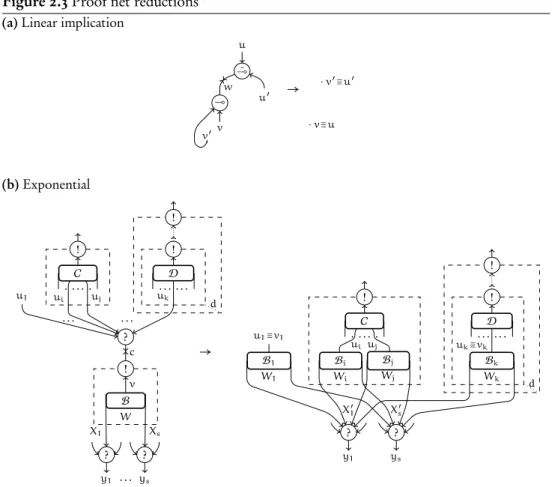
Definition 2.15 (Proof-net reduction). Given a proof-netN and a cut vertex, its redex is a subnet R⊆ N containing it, depending on its principal type, so that N = C[R]. For both type constructors we have, we now define: the shape of a redex R; the relation of reduction between R and its reduct R′, for which we write R→ R′; the notion of context-closure of
the relation, i.e. the definition ofC[R′].
Linear implication The redex sub-net is made by the two links insisting on the cut vertex. Its reduction is depicted inFigure 2.3aand written as:
⟨v′, v(⊸) w⟩, ⟨u′, u( ¯⊸) w⟩ → [v≡u, v′≡u′]. (2.4)
The notation v≡ u denotes the fact that the vertices v, u have been equated. The substitution of the reduct in a mMELL contex is simply its pre-substitution. Exponential In this case, the redex sub-structure R includes not only the two exponential
links ⟨u1, . . . , uk (?) c⟩ and p = ⟨v (! ) c⟩, but also the box ⟨W [B] v⟩ that is
connected to the cut !-link, together with the set of every link⟨Xi(?) yi⟩ such that
there exists w∈ W that also belongs to Xi. The redex, together with two
exempli-fying boxesC, D which are not part of it, are drawn on the left ofFigure 2.3b, the reduct is on the right, and both are also written as follow.
⟨u1, . . . , uk(?) c⟩, ⟨v (! ) c⟩, ⟨W [B] v⟩, ⟨X1(?) y1⟩, . . . , ⟨Xs(?) ys⟩ ⎫⎪⎪⎪⎪ ⎪⎬ ⎪⎪⎪⎪⎪ ⎭ →⎧⎪⎪⎨⎪⎪ ⎩ ⟨W1 [B1] u1⟩, . . . , ⟨Wk [Bk] uk⟩, ⟨X′ 1(?) y1⟩, . . . , ⟨Xs′(?) ys⟩ (2.5)
18 2. Lambda-calculus, linear logic and geometry of interaction The reduction removes the two cut exponential links, and duplicatesB into k copies (erasing it when k= 0): ⟨W1 [B1] u1⟩, . . . , ⟨Wk [Bk] uk⟩. Also, the boxing b′of
the reduct is obtained by the boxing b of R so that the box copyBhis included in
any box that in R contains vh. More precisely:
1. if p′is the !-link of a boxB containing u
hfor some 0≤ h ≤ k, then b′(p′) =
b(p′) ∪ Bh;
2. if p′≠ p is the !-link of a box B′⊊ B then b′(p′
h) = b(p′), for any 0 ≤ h ≤ k;
3. otherwise b′(p′) = b(p′).
Notice that for any 0 ≤ j ≤ s, the set of premisses of the j-th ?-link containing auxiliary doors forB is modified by the reduction: the sequence of premisses X′
j
of its reduct is obtained by replacing any occurrence of a vertex w ∈ W with the sequence(w1, . . . , wk) such that its elements respectively belongs to W1, . . . , Wk.
The substitution of the R′inC[ ] is defined as the pre-substitution of R′inC, plus
a modification of its boxing so that the sub-netBiis included to anyB′containing
vi. Pictorially: observe box borders in the upper part ofFigure 2.3b. Formally: if
for some 0≤ i ≤ k and according to b(C), we have ui∈ B′∈ Bxs (N) and z ∈ V(B),
then in the boxing of the reduct b′(C) we have also zi ∈ V(B′). In spite of this
detail, we shall abuse the notation and simply write thatC[R] → C[R′].
The proof-net reduction, also called cut elimination, is the graph-rewriting relation on mMELLnets obtained by the union of the context closures of the linear implication re-duction and the exponential rere-duction.
Proposition 2.2. Any reduct of a proof-net is a proof-net.
We only sketch the main idea of the proof, and address the interested reader to the well-detailed proof byRegnier[1992, Proposition 4.1.1].
Proof sketch. Consider a reduction step ρ on a redex R ⊂ N and take a switching path πthat is persistent to ρ. Ad absurdum, suppose that ρ(π) is cyclic, and observe that this would imply that π is cyclic as well, thus contradictingDefinition 2.10. Hence ρ(π) is acyclic. Repeat such argument by induction on the length of the reduction sequence N →∗N′, and obtain the thesis. ∎
Proposition 2.3 (Strong normalisation [Pagani and Tortora de Falco, 2010, Accattoli,
2013]). Any mMELL proof-netN strongly normalises. If N has a unique conclusion vertex v∶ T, with T ground, then the normal form of N is ⟨(★) v⟩.
2.3.2 Closed strategy
Closed reduction perform exponential steps only if the box is closed, i.e. has no auxiliary doors (cf.Definition 2.5).
Definition 2.16 (Closed reduction). The closed reduction, written→cl, is the restriction
2.3. Proof-net reductions 19
Figure 2.3 Proof net reductions
(a) Linear implication
⊸ ¯ ⊸ u u′ v v′ w
→
⋅v′≡u′ ⋅v≡u (b) Exponential ? . . . . u1 C ui uj . . . . . ! D uk . . . . ! ! d ! c B W v ? ? y1 ys X1 Xs . . .→
u1B≡1v1 W1 C . . . . . ui uj ! Bi Wi Bj Wj D . . . . ! ! d Bk Wk uk≡vk ? ? y1 ys X1′ X′s20 2. Lambda-calculus, linear logic and geometry of interaction Lemma 2.1 (Existence of closed exponential cut). Given a mMELL proof-netN ∶ ★ without ⊸-cuts, either N is cut-free, or N contains an exponential cut on a closed box.
Proof. GivenN a mMELL proof-net without ⊸-cuts, let c ∈ V(N) be an exponential cut such that `(c) = 0, and B be the box whose !-link has conclusion c. We proceed by induction on the number n of boxes at depth 0 crossed by π, which is finite thanks to the finiteness ofN.
1. If n= 0 then B is closed, so we found a witness and we conclude.
2. If n > 0, let a be the conclusion of a ?-link having a premiss that is an auxiliary door ofB. Consider any straight and consequent path π starting from a. π cannot reach the conclusion ofN, because otherwise the type on N would differ from ⋆ (contradicting such hypothesis). π can neither reach a⋆-link, since otherwise the typing of links would be broken somewhere along π (Definition 2.2). Therefore πmust reach a cut vertex c′, whose depth by hypothesis cannot be smaller than the depth of c. But the depth of vertices along π can neither increase, because π is consequent. Therefore `(c′) = `(c). Morever, it must be the case that c ≠ c′, since
N is switching cyclic byDefinition 2.10. Now repeat the previous reasoning right from the beginning, using the cut c′as our target cut instead of c, and the boxB′
that is associated with c′in place of the target boxB.
∎ Remark 2.1. PreviousLemma 2.1 holds a little more generally in full MELL, with the assumption that a proof-net does not contain any ?-link in any subtype of any of its con-clusions. Such assumption is the same that was firstly used byGirard[1989, Theorem 1, p. 239], and in our syntactical setting it implies that the only conclusion of the net has ground type.
Fact 2.1. For any given proof-netN, if N has a normal form N with respect to full mMELL reduction, then there exist aN →∗
clN
Proof. The claim follows from normalisation (Proposition 2.3), confluence of the ordin-ary reduction, and the existence of closed exponential cuts (Lemma 2.1). ∎
2.4 Execution paths
In this section we formalise the notion of execution paths, the action of reduction on them. Together with the property of persistence, i.e. the ability of resisting to the rewriting, we show that every path has a unique ancestor. We also present the closed reduction on proof-nets, which acts on a box only if it is closed, and prove that in this case path reduction induces a bijection.
2.4. Execution paths 21
2.4.1 Statics
We now introduce two restrictions on the shape of paths that rule out those which, from a proof-theoretic or computational perspective, we can a priori recognise as meaningless. We want paths which do not bounce, nor twist in a proof-net. A third restriction is instead unnecessary, but considerably improve the simplicity and readability.
Except for a cosmetic difference discussed inRemark 2.2, our formulation is essentially a rework of the presentation given byDanos and Regnier[1995].
Definition 2.17 (Execution paths). LetN be a proof-net and π a paths in N. If there is no other path π′∈ N such that π ⊆ π′, where⊆ is the inclusion ordering on sequences,
then π is maximal. Finally if π is both straight and maximal, then π is an execution path. We denote with P(N) the set of straight paths in N, whilst PE(N) is the set of execution
paths.
Fact 2.2. If v is the extremum vertex of an execution path π∈ N, then v is either a conclusion ofN, or the conclusion of a weakening.
Remark 2.2. Most of the previous literature about paths in LL proof-nets uses the notion of ‘composition’ instead of ‘concatenation’. As a result, the appropriate notation in func-tional style has been preferred, i.e. writing from right to left. We rather preferred the cognitive ease to orthodoxy2.
Remark 2.3. For the ease of presentation, we deliberately left a bit of ambiguity in the path definition. It may happen that, given an ordered pair of vertices, there actually exist two distinct hyperlink crossings. For instance, consider a pre-net having l= ⟨v (?) u⟩ and l′= ⟨u, v (⊸) w⟩, and a unitary path π = (u, v). What is the link crossed by π? In spite of this, all the possible ambiguities will be clarified either by the straightness of the paths we will consider almost everywhere, or by a direct explanation. For instance, again within the net considered in the previous example, consider π′= (w, u, v, w) and notice that, if π′is straight, then there is a unique sequence of links crossed by π′, i.e.(l′, l, l′). Indeed, the only other possible sequence of links, i.e.(l′, l′, l′), would imply π′being twisting.
2.4.2 Dynamics
We now define the action of reduction on paths and the notion of persistence, and show some elementary properties, the most notable of which is the fact that every path in a reduct has a unique ancestor.
Definition 2.18 (Redex crossing and sufficient length). Given a reduction step ρ on a redex R⊆ N, a redex crossing for R is a straight path χ that is maximal in R. Let ρ be a reduction step on a redex R inN. A path π ∈ N is long enough if and only if for any vertex r∈ π, the fact that r ∈ R and r is not a conclusion of R implies there is a subpath χ ⊆ π that is a crossing of R, and such that r∈ χ. If π is long enough for ρ, then there exist n ≥ 0 such that
π= π0∶∶ χ1∶∶ π1∶∶ . . . ∶∶ χn∶∶ πn,
22 2. Lambda-calculus, linear logic and geometry of interaction where for any 0≤ i ≤ n the sub-path χiis a crossing for R, whilst πiis not. This unique
form of expressing π is called its redex crossings form for R, and written RCFR(π).
Definition 2.19 (Straight crossing reduction). LetN be a proof-net where χ ∈ P(N) is a crossing of a redex R, and for which ρ is the reduction step on R. The reduction of R is a set of paths in ρ(N) defined as follows and denoted as ρ(χ).
Linear implication Let R be as inFigure 2.3aor equivalently, as inEquation 2.4, Then the residual of χ with respect to ρ, is defined as follows and by the rule ρ(χ†) = (ρ(χ))†.
ρ((v, w, u))def= {(v)[v≡u]} (2.6) ρ((v′, w, u′))def= {(v′)[v′≡u′]} (2.7) ρ((v, w, u′))def= ∅ (2.8) ρ((v′, w, u))def= ∅ (2.9) Exponential Since χ necessarily traverses the box B whose principal door is cut, let β be the maximal sub-path of χ whose vertices are in B, and let βj be the copy of
β traversing Bj, that is the j-th copy ofB. We isolate three kinds of crossings,
depending on the polarities (in or out) of the two extrema of β. out-out
ρ((uj, c, v) ∶∶ β ∶∶ (v, c, uj)) def
= {(uj) ∶∶ βj∶∶ (uj) [uj≡vj]} ; (2.10)
ρ((uj, c, v) ∶∶ β ∶∶ (v, c, uj′))def= ∅. (2.11)
out-in Let 1≤ j ≤ k and 1 ≤ l ≤ s. Then ρ((uj, c, v) ∶∶ β ∶∶ (wl, yl))
def
= {(uj) ∶∶ βj∶∶ (wlj, yl) [uj≡vj]} . (2.12)
in-in Let 1≤ l, m ≤ s. Then
ρ((yl, wl) ∶∶ β ∶∶ (wm, ym)) def
= {(yl, wlj) ∶∶ βj∶∶ (wmj, ym) ∣ 1 ≤ j ≤ k}. (2.13)
Definition 2.20 (Path reduction and persistence). Let π∈ P(N) long enough for a redex R⊂ N and suppose
RCFR(π) = π0∶∶ χ1∶∶ π1∶∶ . . . ∶∶ χn∶∶ πn.
The reduction of π with respect to the reduction step ρ on R, written ρ(π), is the function from paths to sets of paths obtained by concatenation of sets of reducts of any redex crossing, distributing set membership over path concatenation. Formally:
ρ(π)def= {π0∶∶ χ1′ ∶∶ π1∶∶ . . . ∶∶ χk′ ∶∶ πk∣ χ1′∈ ρ(χ1), . . . , χk′ ∈ ρ(χk)}. (2.14)
Observe, in particular, that, if ρ(χi) ≠ ∅ for all 1 ≤ j ≤ n, then also ρ(π) ≠ ∅ and π is
said to not be persistent to ρ. Otherwise ρ(π) = ∅ and π is not persistent to ρ. Moreover, if for every reduction sequence σ= (ρ1, . . . , ρm), and for every 1 ≤ j ≤ m, the path π is
persistent to ρj, then π is said persistent. In order to make path reduction uniform, we
extend its domain to sets of paths. Given a set of paths Π long enough for R, we then write ρ(Π) to denote {ρ(π) ∣ π ∈ Π}.
2.4. Execution paths 23 Fact 2.3 (Reduction preserve straightness). For any path π in a proof-netN, and any reduc-tion ρ, if π is straight then any π′∈ ρ(π) is straight.
Lemma 2.2. GivenN mMELL proof-net and ρ reduction step, for any π ∈ PE(ρ(N)) there
exists a unique φ∈ PE(N) such that π ∈ ρ(φ).
Proof. LetN = C[R], for some redex R and some context C[ ]. Suppose also that π = π0∶∶
χ1′ ∶∶ π1 ∶∶ . . . χn′ ∶∶ πn, where, for any 1 ≤ i ≤ k, the subpath χi′ is a maximal sequence
of vertices belonging to ρ(R). Observe that the extrema of χ′
inecessarily belong to the
interface of ρ(R), because π is an execution path. Now, by definition of reduction, and in particular as perEquation 2.14, if n= 0 (i.e. π does not cross ρ(R)), then there is nothing to prove, since by definition of reduction we have that π∈ PE(N) and ρ(π) = {π}. So,
suppose otherwise that n> 0 and let us discuss χ′
idistinguishing two cases depending on
the kind of the redex.
1. T (R) = ⊸/ ¯⊸. Because of the persistence of π to ρ, and byEquation 2.14, we have χi′≠ ∅. Let ρ is as inFigure 2.3a. We observe that in this sub-case we have indeed a bijection:
(a) χ′
i= (v) and ρ(χi) = {χi′} if and only if χl= (v, w, u);
(b) χi′= (v′) and ρ(χi) = {χi′} if and only if χl= (v′, w, u′).
◻ 2. T (R) = !/?. Let ρ be as inFigure 2.3band recall that ρ(R) is made by the subnets Bj, for any 1≤ j ≤ k, that are copies of the box ⟨W [B] c⟩ in R. We distinguish
three sub-cases depending on the polarity of the extrema of π. (a) out-out. Let χ′
i = (uj) ∶∶ βj ∶∶ (uj) for some 1 ≤ j ≤ k. Then take χi =
(uj, c, v) ∶∶ β ∶∶ (v, c, uj), and observe that by definition of reduction (cf.
Equa-tion 2.10) χiis the only crossing of R such that ρ(χi) = {χi′}.
(b) out-in. Let χ′
i= (uj) ∶∶ βj ∶∶ (wlj, yl). Then take χ = (uj, c, v) ∶∶ β ∶∶ (wl, yl),
and verify again (cf. Equation 2.12) that χiis the only crossing of R such that
ρ(χi) = {χi′}.
(c) Let χ′
i= (yl, wlj) ∶∶ βj∶∶ (wmj, ym) for some 1 ≤ l, m ≤ s (recall that s is the
number of ?-links having a premiss in Wj′ for some 1 ≤ j′ ≤ k). Then take
χ= (yl, wl) ∶∶ β ∶∶ (wm, ym) and inspectEquation 2.13to verify that χiis the
only crossing of R such that χ′
i∈ ρ(χi).
∎
2.4.3 Closed dynamics
If the reduction is closed, its dynamics gains elegant symmetries which make path reduc-tion induce a bijecreduc-tion on execureduc-tion paths.