Accepted Manuscript
Title: HETEROGENEOUS PHOTODEGRADATION OF PYRIMETHANIL AND ITS COMMERCIAL
FORMULATION WITH TiO2 IMMOBILIZED ON SiC
FOAMS
Authors: Ignace Christian M’Bra, Patricia Garc´ıa-Mu˜noz, Patrick Drogui, Nicolas Keller, Albert Trokourey, Didier Robert
PII: S1010-6030(18)30977-8
DOI: https://doi.org/10.1016/j.jphotochem.2018.09.007 Reference: JPC 11472
To appear in: Journal of Photochemistry and Photobiology A: Chemistry Received date: 9-7-2018
Revised date: 3-9-2018 Accepted date: 6-9-2018
Please cite this article as: M’Bra IC, Garc´ıa-Mu˜noz P, Drogui P, Keller N, Trokourey A, Robert D, HETEROGENEOUS PHOTODEGRADATION OF PYRIMETHANIL AND ITS COMMERCIAL FORMULATION WITH TiO2 IMMOBILIZED ON SiC
FOAMS, Journal of Photochemistry and amp; Photobiology, A: Chemistry (2018), https://doi.org/10.1016/j.jphotochem.2018.09.007
This is a PDF file of an unedited manuscript that has been accepted for publication. As a service to our customers we are providing this early version of the manuscript. The manuscript will undergo copyediting, typesetting, and review of the resulting proof before it is published in its final form. Please note that during the production process errors may be discovered which could affect the content, and all legal disclaimers that apply to the journal pertain.
HETEROGENEOUS PHOTODEGRADATION OF PYRIMETHANIL AND ITS COMMERCIAL FORMULATION WITH TiO2 IMMOBILIZED ON SiC FOAMS
Ignace Christian M’Bra1, 4, Patricia García-Muñoz3, Patrick Drogui2, Nicolas Keller3, Albert Trokourey4, Didier Robert1
1Institut de Chimie et Procédés pour l’Energie, l’Environnement et la Santé (ICPEES),
CNRS-UMR7515-University of Strasbourg, Saint-Avold Antenna, Université de Lorraine, 12 rue Victor Demange, 57500 Saint-Avold, France.
2Institut National de la Recherche Scientifique (INRS - Eau, Terre et Environnement), Université du
Québec, 490 rue de la Couronne, Québec city, Québec, Canada G1K 9A9
3Institut de Chimie et Procédés pour l’Energie, l’Environnement et la Santé (ICPEES),
CNRS-UMR7515-University of Strasbourg, 25 Rue Becquerel, 67087 Strasbourg, France
4Laboratoire de Chimie Physique, Université Félix Houphouët Boigny Abidjan, 08 BP 582 Abidjan 08
Côte d’Ivoire GRAPHICAL ABSTRACT -1 0 1 2 3 4 0,0 0,1 0,2 0,3 0,4 0,5 0,6 0,7 0,8 0,9 1,0 Pyrimethanil Scala TOC Pyrimethanil TOC Scala Irradiation UV time (h) C/Co Dark 0 1 2 3 4 5 6 7 8 9 10 TO C (mg /L)
ACCEPTED MANUSCRIPT
highlights
- Development a TiO2-P25/SiC foam photocatalytic material - Photocatalytic treatment and photomineralization of Pyrimethanil
- Study of the photocatalytic degradation of fungicide commercial formulation -
Abstract
Vine is one of the crops undergoing the most pesticide treatment. Due to the presence of pesticides residues in water and food, and the negative effects on human and wildlife health, it is necessary to develop an effective treatment. Photocatalytic oxidation using semiconductors is one of the advanced oxidation processes for degradation of organic pollutants in water and air. A TiO2 in
nanopowder is an excellent photocatalyst that can mineralize a large range of organic pollutants such as pesticides and dyes. In order to eliminate the problems due to TiO2 nanoparticles, we have
successfully supported TiO2 on β-SiC foams. The supporting material has been used to degrade
Pyrimethanil molecule and its commercial formulation: Scala® a fungicide produced by BASF ompany. After 4 hours of treatment in our conditions, a 88% and 74% of Pyrimethanil and Scala was removed with a 58 and 47% of mineralization, respectively. These results are very encouraging because there is no need to filter to separate the catalyst from the treated water which is very important for a large-scale use of this process.
Keywords: Photocatalysis, TiO2/β-SiC foam, Scala, Pyrimethanil, fungicide
I. Introduction
The use of chemical pesticides since half a century has allowed a spectacular increase in crop yield and the development of intensive farming. The aftermath of the intensive use of pesticides is a widespread contamination of the environment, the emergence of pest resistance to these products, the presence of pesticides residues in food, and the negative effects on human and wildlife health [1]. Vine is one of the crops undergoing the most pesticide treatment. In average, twenty treatments were applied annually in Europe. The main fungicide treatments are required to control two important diseases, powdery mildew and downy mildew, which generate 70% of the total grapevine
growing costs according to an INRA report in 2006 [2]. In this context, the grape growing sector is increasingly concerned with environmental, toxicological and health issues. New solutions are needed to assist the vineyard sector to change practices that combine better environment protection: pesticide use reduction and also a better treatment of contaminated water by fungicides in vineyard.
During the two last decades, advanced oxidation processes and especially photocatalysis have caused enormous considerations and have been demonstrated to be the “green” and effective methods for water purification and disinfection [3].This process is based on the absorption of light by a semiconductor, usually TiO2, to produce electron-hole pairs, reacting at the interface to produce
oxidizing species such as hydroxyl or superoxide radical. Hydroxyl radicals have been deemed to be the major active species during the photocatalytic oxidation reaction. One the main advantages of photocatalysis is they capacity to mineralize, without selectivity, the majority of organic compounds especially active molecules containing in the commercial formulations of pesticides.
However the utilization of TiO2 nanoparticles in suspension poses the problem of the recovery of the
photocatalyst after the treatment. In order to solve this, supported photocatalysis were developed since many years [4]. The use three-dimensional supports are necessary to improve the exchange surface between the supported photocatalyst and the organic pollutant. In our institute we developed 3D-support materials in silicon carbide foams are highly suitable due to their high chemical resistance, outstanding thermal stability and their macro-porosity providing a high internal surface enabling the immobilization of large amounts of photocatalysts [5].
Scala®, from BASF Company, is an efficient commercial fungicide that targets fungal pathogens such as gray mold and powder mildew in a variety of crops, which include apples, oranges, strawberries and grape vines. But its active substance: Pyrimethanil is toxic to aquatic life and the organs of several animal models in previous studies [6]. Pyrimethanil is classified as Group C “possible human carcinogen” by PubChem open chemistry database [7]. Some studies have shown the effectiveness of heterogeneous photocatalysis for the removal of pyrimethanil from water [8-11], but very few involved a supported catalyst system [12-13] or the its commercial formulation [14]
This study evaluates the influences of some important parameters (pH, CTiO2, Cpyrimethanil, …) involved
during the photocatalytic degradation of Pyrimethanil [N-(4,6-dimethylpyrimidin-2-yl) aniline] and its commercial formulation (Scala®) in the presence of suspended and supported on β-SiC foams TiO2
-P25 nanoparticles. The aim of this work is to determine the optimal experimental conditions for the photocatalytic degradation and mineralization of pyrimethanil in laboratory pilot scale photoreactor with integrated supported photocatalyst.
II. Experimental part
II.1. Chemicals and materials
Pyrimethanil (C12H13N3, 99.9 %, Techlab), commercial formulation of Scala® (40%, W/V, Pyrimethanil
from Bayer), TiO2-P25 (average size 20 nm, purity 97 %, surface area 50 m². g-1 and 80 % anatase, 20
% rutile, Evonik industries) P90 also from Evonik, Hombikat UV100 from Sachtleben and ST01 from Ishihara Sangyo Kaisha were used as received. Ethanol anhydride 99.8 % and titanium tetra isopropoxide (TTIP, C12H28O4Ti, 97%) were purchased from respectively Fluka and Sigma-Aldrich.
Distilled water was used to prepare all the solutions.
II.2. Preparation of TiO2-SiC foams by dipping in TiO2 suspension
The β-SiC alveolar foams were synthesized and supplied by SICAT Company (Willstätt, Germany) [15]. The foam samples have a dimension of 9.5 cm (length) x 6 cm (width) x 1 cm (thickness), with a weight of about 20 g. The foam has been calcined at 1000°C for 2h to eliminate the residual organic carbon. Each β-SiC foam samples was completely immersed in the TiO2 suspension (10 g of TiO2-P25
and 4 mL of TTIP in 200 mL of dry ethanol) for a period of three minutes at a speed of 5 rpm in order to immobilize TiO2 photocatalysts on foam. This operation was repeated five times. Then the
photocatalytic materials were dried at room temperature for 20 minutes, avoiding clogging of the alveoli. TiO2/β-SiC foams were placed in an oven at 110 °C overnight to evaporate residual organic
compounds. Subsequently, TiO2/β-SiC foams were brought to the furnace at 450 °C during 2 h at a
rise rate of 5 °C.min-1. The average wt % of TiO
2 per foam was about 7.5% corresponding to 1.5 g of
TiO2 fixed on the support. Photocatalytic materials have been characterized by Scanning electron
microscopy. SEM was carried out in secondary electron mode on a JEOL-JSM-6700 F microscope equipped with a field emission gun and operating with an extraction potential ranging from 1 to 10 kV.
II.3. Experimental setups
II.3.1. With TiO2-P25 suspension
Batch mode experiments were conducted at ambient temperature in a glass cylinder reactor with aqueous solutions of Pyrimethanil and Scala under UV–visible irradiation. The ATLAS Suntest CPS solar box simulating natural radiation and equipped with a vapor Xenon lamp was used in all experiments. TiO2 photocatalyst was dipped by means of stirring in a volume of 200 ml of
Pyrimethanil or scala aqueous solution (between 10 and 25 mg/l). Before each irradiation, the
suspensions were kept in the dark for 30 min in order to reach the adsorption equilibrium. During the irradiation procedure 10 ml of solutions were sampled at regular time interval and filtered (Whatmann, 0.45 mm). The remaining concentration of Pyrimethanil and Scala was determined with a LIBRA S12 UV– Vis spectrophotometer (max= 267 nm) and the mineralization by TOC analysis
(SHIMADZU TOC-L).
II.3.2. With supported TiO2-P25 on -SiC foam
Photocatalytic experiments were carried out in a recirculation mode photoreactor in polypropylene with a size of 20 cm (length) x 7.5 cm (width) x 2.5 cm (depth). One or two TiO2/β-SiC foam samples
were introduced inside the photoreactor to perform the photocatalytic tests. The photoreactor was covered with a quartz plates. Two UV-A lamps (Philips 18W) were placed horizontally at 2 cm above the reactor to illuminate the TiO2/β-SiC photocatalysts (figure 1). Irradiation wavelength was around
368 20 nm with an irradiance of about 60 W.m-² (radiometer, spectral range: 315 – 400 nm; HD 9021; Delta OHM; Italy). The treated solutions (Pyrimethanil or Scala® with a concentration between 10 and 30 mg/L) were circulated through the reactor system using a peristaltic pump (Master Flex, model 7520-47) at a flow rate between 26 and 78 mL.min-1 with a retention time varying from 4 to 12
min about. Before each irradiation, TiO2/β-SiC were kept 1h in the dark. The remaining concentration
of Pyrimethanil and Scala was determined with UV-Vis spectrophotometer and by TOC analysis without filtration.
Figure 1: Experimental photocatalytic device: A (2 UV-A lamps); B (photoreactor); C (Pyrimethanil or Scala aqueous solution); D (Thermostatic bath).
III. Results and discussions
III.1. Degradation of pure Pyrimethanil and Scala by TiO2-P25 slurry
Before to immobilize titania catalyst onto the foams, a screening of different commercial titania catalyst was performed to choose the most active for Pyrimethanil degradation. The catalysts showed very different physico-chemical properties like crystal-phases, external surface and isoelectric point (table 1).
Table 1: Physico-chemical properties of commercial photocatalysts and pseudo-first-rate constants of Pyrimethanil degradation. Catalyst XRD (A:R) S BET (m 2/g) Isoelectric Point
kpyri (min-1) /R2 kTOC x10-3
(mg/mL min)/R2
P25 80:20 55 6.3 0.023/0.99 2.7/0.99
P90 90:10 90 5.5 0.011/0.98 2.5/0.98
ST01 100:0 312 4.4 0.011/0.98 2.4/0.98
UV-100 100:0 330 5.5 0.003/0.99 0.6/0.98
For the majority of the organic molecules [16], the photocatalytic disappearance follows apparent first-order kinetics when the initial concentration is low enough and no catalyst saturation occurs, as in the case of Pyrimethanil. For a low initial fungicide concentration, the simplest representation for the rate of photodegradation is given by lnCt = - kt + lnC0. This equation can be used to demonstrate
the linearity of data. Its integration is given by Ln(C0/Ct) = kt where k is the constant of the
pseudo-first-order rate. On the other hand, at natural pH no degradation has been detected in the dark after 3 hours. This shows that Pyrimethanil hydrolysis in water is very low. All catalysts were able to degrade Pyrimethanil in solution, but P25 was the most active with a complete Pyrimethanil removal in 4h of reaction. Also, in terms of TOC mineralization P25 depicted the highest degradation rate (values included in the table).
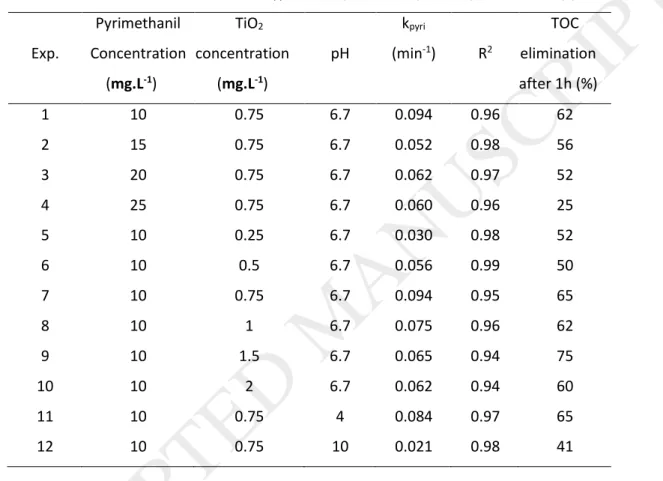
The next step was to evaluate the photocatalyst amount to degrade the Pyrimethanil solution (10 mg/l) because it was necessary to find the optimum concentration of TiO2 for efficient degradation
(table 2). In our conditions, this optimum is found to be 0.75 g/L, and a further increase of the catalyst concentration may cause light scattering and screening effects, reducing the penetration of light into the solution. This phenomenon is classic in heterogeneous photocatalysis. Figure 2A shows the evolution of the Pyrimethanil concentration according to the fungicide concentration. After 2
hours of irradiation, a total disappearance of Pyrimethanil was obtained. The obtained constants (k) have been listed in Table 2.
Table 2: Pseudo-first-order rate constant kpyri for the photocatalytic disappearance of pyrimethanil
Exp. Pyrimethanil Concentration (mg.L-1) TiO2 concentration (mg.L-1) pH kpyri (min-1) R2 TOC elimination after 1h (%) 1 10 0.75 6.7 0.094 0.96 62 2 15 0.75 6.7 0.052 0.98 56 3 20 0.75 6.7 0.062 0.97 52 4 25 0.75 6.7 0.060 0.96 25 5 10 0.25 6.7 0.030 0.98 52 6 10 0.5 6.7 0.056 0.99 50 7 10 0.75 6.7 0.094 0.95 65 8 10 1 6.7 0.075 0.96 62 9 10 1.5 6.7 0.065 0.94 75 10 10 2 6.7 0.062 0.94 60 11 10 0.75 4 0.084 0.97 65 12 10 0.75 10 0.021 0.98 41
In the range of pH 4 to 10, the Pyrimethanil degradation kinetic was pH dependent (table 2). The amino group protonated at pH around 4 because the pKa value of Pyrimethanil is 3.52. At this pH the
TiO2 surface is positively charged; therefore, there are weak repulsive forces with Pyrimethanil. In
basic condition (pH 10), there is repulsion between the negative surface of TiO2 and the free electron
pairs of the three nitrogen atoms as well as the aromatic ring, explaining the low rate constant at pH 10.
Finally, the best result is obtained at natural pH (6.7), because the molecule is neutral and, in this condition, the electrostatic interactions between Pyrimethanil and the TiO2 surface is weak but
optimum. This is an important result for industrial applications because it will be no need to adjust pH during treatment.
Regarding the kinetic variations of TOC according to the irradiation time, we observed three distinct steps in the mineralization of Pyrimethanil (figure 2B). As suggested by Aguera et al [14], who followed fungicide by-product formation, by LC-MS, during the first step we have the formation of hydroxy derivative of Pyrimethanil without mineralization of organic carbons.
Then, there is a rapid decrease of the TOC suggesting the transformation of organic carbon into mineral carbon by photooxidation into phenyl derivatives and to finish a very low abatement of TOC with formation of hardly oxidizable aliphatic molecules such as formamide, acetamide…
0 5 10 15 20 25 30 -30 -10 10 30 50 70 90 110 C pyri = 10ppm C pyri = 15ppm C pyri = 20ppm C pyri = 25ppm
Irradiation time (min)
Cpy ri (pp m ) Adsorption phase
A
0 2 4 6 8 10 12 14 16 18 20 -30 -10 10 30 50 70 90 110 C pyri = 10ppm C pyri = 15ppm C pyri = 20ppm C pyri = 25ppmIrradiation time (min)
TOC P yr i (m g.m L -1)
B
ACCEPTED MANUSCRIPT
Figure 2: Kinetics of Pyrimethanil disappearance (A) and TOC evolution (B) according to Pyrimethanil concentration
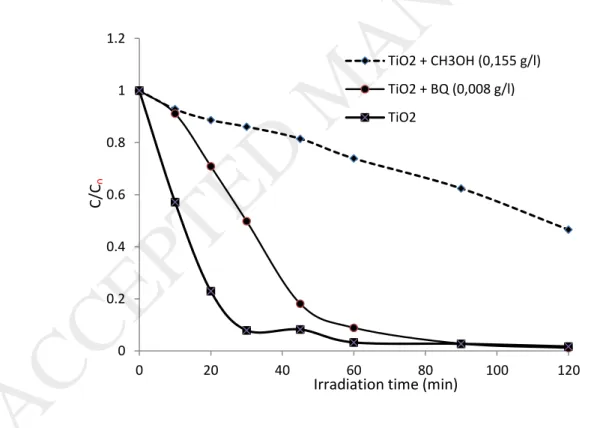
In order to learn more about the degradation mechanism of Pyrimethanil, we have tried to determine the role of reactive oxygen species (ROS) during photodegradation in the presence of TiO2.
For this, before irradiation, we added in the Pyrimethanil solution, different compounds as benzoquinone [17] (BQ) and methanol [18] (CH3OH) used as O2°- and OH° scavengers, respectively.
As you can see on figure 3, when methanol (hydroxyl radical quencher) is added to the Pyrimethanil solution in a concentration of 0.155g/l (15 times larger than the fungicide) a great inhibition in Pyrimethanil degradation is observed. These results suggest that OH° play an essential role in the reaction mechanism of Pyrimethanil oxidation. On the other hand, addition of BQ causes a weak inhibition of the Pyrimethanil degradation reaction. It shows that the oxidation of Pyrimethanil is also caused by the superoxide anion (inhibited by BQ), but at a more moderate level than by OH°.
Figure 3: Effect of BQ and MeOH addition in the photocatalytic degradation of Pyrimethanil
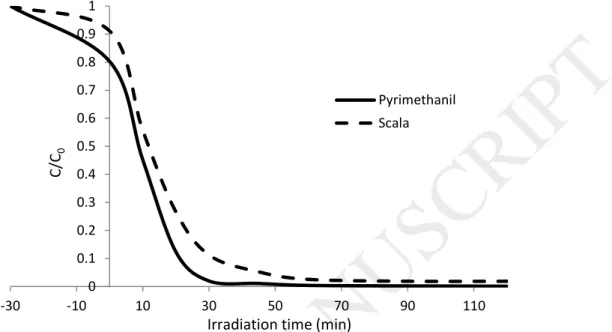
If we compare the degradation kinetics of Scala (commercial formulation) with its active molecule (Pyrimethanil), we observe that they are very similar (figure 4). This result shows that the formulation contains mainly the active substance with few organic additives. The small differences
0 0.2 0.4 0.6 0.8 1 1.2 0 20 40 60 80 100 120 TiO2 + CH3OH (0,155 g/l) TiO2 + BQ (0,008 g/l) TiO2
Irradiation time (min)
C/
C0
between degradation kinetics are due to the presence of trace amounts of 1,2-Benzisothiazol-3(2H)-one and 1 to 5% by weight of 1,2-Propanediol in the composition of Scala. This fact was confirmed by the kinetic variation of the TOC for the both solutions. After 120 min of irradiation the elimination of TOC was 76 % and 67 % for Pyrimethanil and Scala respectively.
Figure 4: Photocatalytic degradation kinetic of Scala compared to Pyrimethanil
III.2. Photocatalytic elimination of Pyrimethanil and Scala by TiO2-P25 supported on SiC foams
Although TiO2 in powder form demonstrates high photocatalytic activity for the elimination of
Pyrimethanil, the filtering process required after water treatment and the catalyst recovery and recycling makes its application on an industrial scale complex and costly. To solve this issue, research has been directed towards the utilization of several materials based on alumina, silica and carbons for use as TiO2 photocatalyst support in reactors. To overcome these limitations and reduce the
treatment cost, we developed TiO2 photocatalytic material supported on β-SiC foam. This material
has already been studied and described in our laboratory as photocatalytic support for air treatment [19] and water depollution [20]. These different works showed that β-SiC foam has all the advantages to be a good catalyst support (high mechanical strength, oxidative resistance, chemical inertness…). All the experiments with the supported catalysts, have been realized using UV-A lamps in order to increase the performances of the process and also because in the continuation of our works, we will build an industrial pilot reactor which will work with artificial lamps.
0 0.1 0.2 0.3 0.4 0.5 0.6 0.7 0.8 0.9 1 -30 -10 10 30 50 70 90 110 Pyrimethanil Scala
Irradiation time (min)
C/
C0
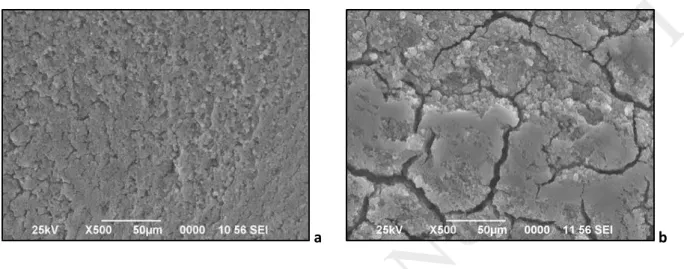
After dipping in TiO2 suspension and annealing at 450°C, the coated foam was characterized by
scanning electron microscopy (figures 5). In the case of the TiO2 suspension containing TTIP, the
coating is very homogeneous (figure 5a) but in the absence of TTIP of some cracks is highlighted at the microscale (figure 5b) due to the strains during the drying step (dip-coating) or the annealing step at 450°C. This suggests that the addition of TTIP improve the deposition method and the stability of the photocatalytic material because he plays the role of binder.
a b
Figure 5: SEM characterization of SiC foams coated by TiO2-P25 with TTIP (5a) and whitout TTIP (5b)
in the suspension
On the other hand, the stability of the deposit was verified systematically by weighing TiO2/SiC foams before and after photocatalytic tests. No significant differences were found even after a large use (13 times) of the same sample.
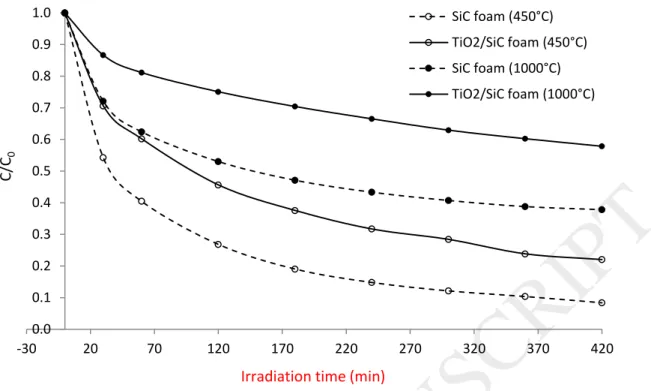
In the preliminary study, we showed that there was a strong adsorption of fungicide on photocatalytic materials prepared with foams calcined at 450 ° C (about 80% after 7h), this adsorption is halved with calcined foams at 1000 ° C for 2h (figure 5). This is explained by the presence in the cells of foams of organic carbon products, which are then removed at higher temperatures. For the rest of our study, all the foams were treated at 1000 ° C before the TiO2
deposit.
Figure 5: Effect of the calcination temperature on the pyrimethanil adsorption
Figure 6 shows the evolution of fungicide concentration and TOC during the irradiation in the presence of TiO2/SiC for Pyrimethanil and its commercial formulation (Scala). Firstly, even if we are
not exactly in the same conditions, the reaction rates are lower than when we use TiO2 in suspension
(figure 4). Then, we can note that the order of the reactions is slightly different because it is close to a pseudo zero order especially in the case of the TOC evolution. This is a logical result because in the case of supported catalyst, the rate is limited by the contact area between the phases (thus between the fungicide compound and the photocatalyst). The rate will further depend on the specific surface area of TiO2 supported on the β-SiC foams.
0.0 0.1 0.2 0.3 0.4 0.5 0.6 0.7 0.8 0.9 1.0 -30 20 70 120 170 220 270 320 370 420 SiC foam (450°C) TiO2/SiC foam (450°C) SiC foam (1000°C) TiO2/SiC foam (1000°C)
Irradiation time (min)
C/
C0
Figure 6: TOC abatement and concentration decay of Scala and Pyrimethanil in the presence of TiO2/SiC Foams.
Influence of flow rate: A flow study is essential to show the response of reactor efficiency towards
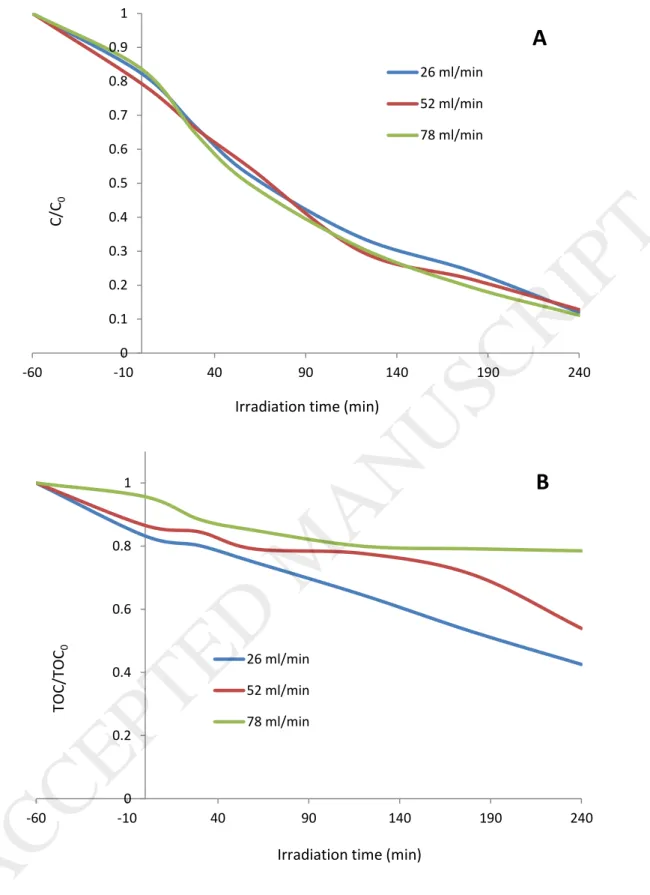
various flow rates. In wastewater treatment, the flow study is typically used to optimize flow, i.e. in the case of a continuous flow reactor the fastest possible flow without compromising the reactor efficiency. Here, in a closed system working in a recirculation mode, a compromise should be found between the photocatalytic efficiency, the flow rate and the mass transfer [21]. The influence of the circulation rate of the solution on the Pyrimethanil degradation kinetics obtained on TiO2/SiC foams
is shown in Figure 7A. Increasing the flow rate from 26 to 78 mL.min-1 (corresponding to a decrease
in residence time from 12 to 4 min) only resulted in a slight increase in the disappearance rate. This is not the case for the mineralization rates, on the figure 7B, we observed clearly that the flow rate had an incidence on the photooxidation of by-products. It is likely that the by-products will degrade less rapidly than Pyrimethanil and in this case the most important factor is the residence time in the photoreactor. This is a parameter that will need to be considered for a large scale application of photocatalytic treatment of Pyrimethanil (and Scala).
0 0.1 0.2 0.3 0.4 0.5 0.6 0.7 0.8 0.9 1 -60 -10 40 90 140 190 240 Scala pyrimethanil Scala (TOC) pyrimethanil (TOC)
Irradiation time (min)
C/ C0 an d TO C/ TO C0
ACCEPTED MANUSCRIPT
Figure 7: Effect of flow rate on the Pyrimethanil disappearance (A) and mineralization (B). IV. Conclusion 0 0.1 0.2 0.3 0.4 0.5 0.6 0.7 0.8 0.9 1 -60 -10 40 90 140 190 240 26 ml/min 52 ml/min 78 ml/min
Irradiation time (min)
C/ C0
A
0 0.2 0.4 0.6 0.8 1 -60 -10 40 90 140 190 240 26 ml/min 52 ml/min 78 ml/minIrradiation time (min)
TO C/ TO C0
B
ACCEPTED MANUSCRIPT
The photocatalytic degradation of Pyrimethanil and its commercial formulation (Scala) in aqueous solution has been investigated in the presence of TiO2-P25 slurry and supported on β-SiC foams
under UV-Visible irradiation. In our conditions, Pyrimethanil and Scala can be degraded efficiently with TiO2 suspension 98 % and 91 % respectively after 30 min illumination. Various experimental
parameters influencing the kinetics were investigated such as pH, catalyst concentration and Pyrimethanil concentration. The results showed that the optimum concentration of TiO2 was 0.75 g.
L-1 and it was necessary to work at natural pH. The study on the contribution of the ROSs indicates
that O2°- and more specially OH° are responsible for the major degradation of the Pyrimethanil.
In the case of the use of supported photocatalysts (TiO2/SiC foam), degradation kinetics are lower
than for suspensions. However, after 4 hours of treatment, we degraded 88% and 74% of Pyrimethanil and Scala respectively and mineralized 58% of Pyrimethanil and 47% of Scala. These are very encouraging results because there is no need to filter to separate the catalyst from the treated water which is very important for a large scale use of this process. Finally, the use of the supported catalyst showed a change in the mineralization kinetics since the reaction is closer to a pseudo-zero than to an order-one.
Acknowledgment
The European Fund for regional development (EFRE/FEDER) is acknowledged for partially supporting the work, in the frame of the project PHOTOPUR, within the Program Interreg V Rhin Supérieur and the Sciences Offensive
References
[1] J. M. Gerage, A. P. Gasques Meira, M. V. da Silva, Food and nutrition security: pesticide residues in food, Nutrire, 42 (2017) 1-8.
[2] Institut National de la Recherche Agronomique (INRA)
http://www.inra.fr/Chercheurs-etudiants/Systemes-agricoles/Tous-les-dossiers/Vignes-resistantes- au-mildiou-et-a-l-oidium-un-deploiement-responsable/Les-differentes-varietes-resistantes-au-mildiou-et-a-l-oidium
[3] D. Robert, N. Keller, E. Selli, Environmental photocatalysis and photochemistry for a sustainable world: a big challenge, Environ Sci Pollut Res. 24 (201) 12503–12505.
[4] D. Robert, V. Keller, N.Keller,. Immobilization of a Semiconductor Photocatalyst on Solid Supports: Methods, Materials, and Applications, in: Wiley-VCH: Weinheim, G. (Ed.), Photocatalysis and Water Purification. 2013 pp. 145–178.
[5] A.M. Kouamé, R. Masson, D. Robert, N. Keller, V. Keller,. Beta-SiC foams as a promising structured photocatalytic support for water and air detoxification. Cata. Today 209(2013)13–20
[6] I. Bernabò, A. Guardia, R. Macirella, S. Sesti, A. Crescente, E. Brunelli, Effects of long-term exposure to two fungicides, pyrimethanil and tebuconazole, on survival and life history traits of Italian tree frog (Hyla intermedia), Aquatic Toxicology 172 (2016) 56–66
[7] National Center for Biotechnology Information. PubChem Compound Database; CID=91650, https://pubchem.ncbi.nlm.nih.gov/compound/91650
[8] J. Araña, C. Fernández Rodríguez, J. A. Herrera Melián, O. González Díaz and J. Pérez Peña, Comparative Study of Photocatalytic Degradation Mechanisms of Pyrimethanil, Triadimenol, and Resorcinol, J. Sol. Energy Eng 130 (2008) 21-28
[9] J. Gomis, A. Arques, A. M. Amat, M. L. Marin, M. A. Miranda, A mechanistic study on photocatalysis by thiapyrylium salts. Photodegradation of dimethoate, alachlor and pyrimethanil under simulated sunlight, Applied Catalysis B: Environmental, 123–124 (2012) 208-213
[10] J. Araña, C. Garriga i Cabo, C. Fernández Rodríguez, J. A. Herrera Melián, J. A. Ortega Méndez, J. M. Doña Rodríguez, J. Pérez Peña, Combining TiO2-photocatalysis and wetland reactors for the efficient treatment of pesticides, Chemosphere, 71 (2008) 788-794
[11] A. Agüera, E. Almansa, A. Tejedor, A. R. Fernández-Alba, S. Malato, and M. I. Maldonado, Photocatalytic Pilot Scale Degradation Study of Pyrimethanil and of Its Main Degradation Products in Waters by Means of Solid-Phase Extraction Followed by Gas and Liquid Chromatography with Mass Spectrometry Detection, Environ. Sci. Technol., 34 (2000) 1563–1571
[12] K. Elatmani, G. Plantard, D. Sacco, I. Aitichou, V.Goetz, Innovative photocatalytic media optimized for solar-powered remediation: Application to pyrimethanil treatment, Materials Science in Semiconductor Processing, 16, Issue 4 (2013) 1117-1124
[13] K. Elatmani, N. Ben oujji, G. Plantar, V. Goetz, I. Aitichou, 3D Photocatalytic media for decontamination of water from pesticides, Materials Research Bulletin, 101, May (2018) 6-11
[14] A. Aguera, E. Almansa, A. Tejedor, A. R. Fernandez-Alba, S. Malato, M. I. Maldonato, Photocatalytic pilot scale degradation study of pyrimethanil and its main degradation products in water by means of solid-phase extraction followed by gas and liquid chromatography with mass spectrometry detection. Environ. Sci. Technol., 34 (2000) 1563-1571.
[15] Nguyen, P. and Pham, C. Innovative porous SiC-based materials: From nanoscopic understandings to tunable carriers serving catalytic needs. Appl. Catal. A Gene. 391 (2011) 443-454. [16] M. A. Rahman, M. Muneer, , Photocatalysed degradation of two selected pesticide derivatives, dichlorvos ans phosphamidon, in aqueous suspensions of titanium dioxide, Desalination 181 (2005) 161-172.
[17] T. Paul, P.L. Miller, T.J. Strathmann, Visible-light-mediated TiO2 photocatalysis of fluoroquinolone antibacterial agents, Environ. Sci. Technol., 41 (2007) 4720-4727
[18] P. Raja, A. Bozzi, H.D. Mansilla, J. Kiwi, Evidence for superoxide-radical anion, singlet oxygen and OH-radical intervention during the degradation of the lignin model compound (3-methoxy-4-hydroxyphenylmethylcarbinol), J. Photochem. Photobol. A : Chem. 169 (2005) 271
[19] A Alonso-Tellez, D Robert, V Keller, N Keller, H2S photocatalytic oxidation over WO3/TiO2 Hombikat UV100, Environ. Sci. and Pol. Research 21 (2013) 3503-3514
[20] A.M. Kouamé, R. Masson, D. Robert, N. Keller, V. Keller,. Beta-SiC foams as a promising structured photocatalytic support for water and air detoxification. Cata. Today 209 (2013) 13–20 [21] N. A. Kouamé, D. Robert, V. Keller, N. Keller, C. Pham, P. Nguyen ; Environ Sci Pollut Res 19 (2012) 3727–3734