HAL Id: dumas-01413350
https://dumas.ccsd.cnrs.fr/dumas-01413350
Submitted on 9 Dec 2016HAL is a multi-disciplinary open access archive for the deposit and dissemination of sci-entific research documents, whether they are pub-lished or not. The documents may come from teaching and research institutions in France or abroad, or from public or private research centers.
L’archive ouverte pluridisciplinaire HAL, est destinée au dépôt et à la diffusion de documents scientifiques de niveau recherche, publiés ou non, émanant des établissements d’enseignement et de recherche français ou étrangers, des laboratoires publics ou privés.
Do commercial bumblebees (Bombus terrestris) have an
added value in outdoor pollination of sweet cherry
(Prunus avium) and raspberry (Rubus ideaus)?
Sandrine Chaillout
To cite this version:
Sandrine Chaillout. Do commercial bumblebees (Bombus terrestris) have an added value in outdoor pollination of sweet cherry (Prunus avium) and raspberry (Rubus ideaus)?. Agricultural sciences. 2016. �dumas-01413350�
Mémoire de stage
Présenté pour l’obtention du diplôme d’ingénieur agronome, option Inter-Etablissement Protection des Plantes et Environnement
Sur le thème
Par
Sandrine Chaillout
Ecole de rattachement : Agrocampus-Ouest centre d'Angers
Stage réalisé à : Sous la Direction de :
Biobest Belgium NV Maribel POZO
Pollination R&D Department Felix WACKERS
Ilse Velden 18,
2260 Westerlo, Belgium
Soutenu le 27 septembre 2016 à Montpellier, devant le jury composé de :
Président: Bernard Vaissière
Membres: Yannick Outreman Frédéric Marion-Poll
Romain Bonafos
Do commercial bumblebees (Bombus terrestris) have an added value in outdoor pollination of sweet cherry (Prunus avium) and raspberry (Rubus ideaus)?
Chaillout Sandrine
Do commercial bumblebees (Bombus terrestris) have an added value in outdoor pollination of sweet cherry (Prunus avium) and raspberry (Rubus ideaus)?
Agrocampus Ouest CFR d'Angers
Summary
key words: supplemented pollination - cherry - raspberry - Bombus terrestris - honeybees - fruit set - fruit quality
The majority of fruit crops rely on insect pollination to set an acceptable number of fruits of commercial value. Bees are listed as the most common pollinators in commercial crops in Europe, but the role of honeybees is currently being revised due to global decline in honeybee health and colony collapse disorder. The use of artificially reared Bombus terrestris colonies is then proposed as an alternative, and they are thought to be specially valuable in cold climate areas or early blooming crops.
As study system we set pollination trials to test pollinator visitation, colony activity, fruit set and fruit quality in three commercial fields in Limburg province; the main agricultural area of Belgium. Two of these fields were Prunus avium orchards, belonging to the varieties 'Sweetheart'(self-fertile) and 'Carmen' (obligate outcrossing). The third field comprised 'Kwanza'
Rubus idaeus self-fertile clones. Honeybees were used as current pollination practice, and bagged
branches were used as control treatment.
Our results show that the colony activity was consistently high and the bumblebees were visiting the crops in an acceptable rate. We got a significant increase in the fruit set in 'Carmen' and 'Kwanza' varieties compared to bagged branches from the same plants. In raspberry, seed size was greater in the bumblebee-supplemented area, which translated to less variance in fruit weight but no difference in fruit weight average. However with the experimental designs used it is not possible to really conclude on the added value of the use of bumblebee colonies compared to the honeybee pollination.
Résumé
Mots clés: Pollinisation supplémentée - cerise - framboise - Bombus terrestris - mise à fruit - qualité du fruit
La pollinisation correspond au transfert de pollen depuis les étamines productrices d'une fleur jusqu'au stigma réceptif de la même ou d'une autre fleur de la même plante, ou d'une fleur d'une autre plante de la même espèce. Dans les deux premiers cas on parle d'autopollinisation et dans le dernier de pollinisation croisée. Le pollen ayant le même génotype que le stigma sur lequel il se dépose est appelé autopollen. Les espèces ou variétés qui peuvent être pollinisées par de l'autopollen sont dites auto-fertiles, celles qui requièrent absolument une pollinisation croisée sont dites auto-incompatibles. Quand l'interaction pollen-stigma est compatible, un tube pollinique croit à travers le style qui relie le stigma à l'ovule. Les ovules sont contenus dans les ovaires où leur fécondation à lieu. Si l'interaction est incompatible, dans le casoù un tube pollinique croit alors son développement est arrêté plus ou moins vite. Un grand nombre de variétés fruitières sont auto-incompatibles. La proximité d'une ou plusieurs autre(s) variétés dites pollinisatrices, compatible(s) et fleurissant à la même période, est nécessaire. Le rendement et la qualité des fruits de certaines variétés auto-fertiles peuvent être améliorés par la pollinisation croisée. Pour la majorité des plantes à fleurs, un vecteur est nécessaire pour assurer le transfert du pollen. Celui-ci peut être abiotique (vent ou eau) ou biotique (animaux pollinisateurs). 35% de la production mondiale repose sur les pollinisateurs. Les insectes sont considérés comme étant le vecteur principal de pollen des espèces fruitières, les deux groupes d'insectes pollinisateurs principaux étant les abeilles au sens large (Hymenoptera) et certains diptères (Diptera). Le terme abeille réfère aux abeilles domestiques (Apis
mellifera L.), aux bourdon (Bombus spp.) et aux abeilles solitaires.
Les abeilles domestiques sont largement utilisées pour compléter la pollinisation effectuée par les pollinisateurs sauvages pour les cultures destinées à la consommation humaine. Le niveau de dépendance des cultures à la pollinisation entomophile est élevé et tend à augmenter. Il semblerait que le nombre de colonies d'abeilles disponibles n'est pas suffisant pour couvrir les besoins de pollinisation. D'autre part, une combinaison de facteurs rend les colonies d'abeilles domestiques plus sensibles aux maladies et ravageurs, ce qui cause leur déclin. Des colonies de boudons, et en particulier de Bombus terrestris élevées artificiellement, ont été utilisées dans un premier temps pour la pollinisation de cultures sous serres comme la tomate. Depuis une dizaine d'années, elles sont utilisées en cultures fruitières et leur usage tend à augmenter. Cette technique de pollinisation supplémentée est proposée comme alternative à l'usage d'abeilles domestiques. Abeilles domestiques et B. terrestris sont généralistes mais ces derniers tendent à avoir un comportement de butinage plus individuel. Ils sont actifs même par mauvais temps et leur taille peut améliorer le dépôt du pollen sur le stigma. Enfin, ils ont tendance à changer plus souvent entre zones.
L' étude réalisée vise à tester l'utilisation de colonies commerciales de B. terrestris comme alternative aux abeilles domestiques pour la pollinisation des deux cultures suivantes: les cerises douces Prunus avium (L.) et les framboises Rubus ideaus (L.). Les fleurs des deux espèces étudiées ont des pétales pales. Les bourdons ont tendance à préférer les corolles bleues ou jaunes. Les fleurs de cerisiers et framboisiers produisent à la fois du nectar et du pollen facilement accessibles, servant de récompense pour les pollinisateurs. Le nectar est sécrété abondement par les deux espèces, est moyennement concentré en sucre et hautement attractif pour les abeilles. Leur pollen est riche en protéine ce qui est attractif tant pour les abeilles domestiques que pour les bourdons.
L'étude à été menée dans des parcelles en production commerciale afin de se rapprocher des conditions réalistes d'utilisation des colonies de bourdons. Les essais ont eu lieu dans la province du Limbourg en Belgique, principale zone agricole du pays, caractérisée par un climat tempéré. Au total trois essais ont été menés: deux essais en cerises, l'un avec la variété auto-compatible 'Sweetheart'
et l'autre avec la variété auto-incompatible 'Carmen', et le troisième essai avec la variété de framboises auto-compatible 'Kanzava'. Les abeilles domestiques sont largement utilisées par les producteurs dans la région où l'étude à été menée. Or, étant donné que celles-ci butinent jusqu'à 10km autour de leurs ruches, il n'était pas possible d'étudier ces deux pollinisateurs (abeilles domestiques et B. terrestris) séparément tout en ayant des parcelles similaires. Différentes approches ont été utilisées pour tenter tout de même d'étudier la valeur ajoutée des colonies de B.
terrestris. Dans les deux essais en cerises, nous avons fait varier la distance entre les plantes étudiées
et les colonies de bourdons, en faisant l'hypothèse que les bourdons seront plus nombreux près de leur colonies. En effet, les boudons butinent sur une distance limitée et 80% d'entre eux restent dans un périmètre de 100 m autour de leur colonie. De plus, pour un des deux essais, nous avons pu exclure sur la moitié de la parcelle les pollinisateurs autres que B. terrestris en plaçant un filet anti-grêle fermé sur le haut et les côtés. Dans l'essai en framboises, nous avons essayé de créer un gradient de B. terrestris en plaçant leurs colonies à l'opposé du côté de la parcelle où étaient placées les colonies d'abeilles domestiques. Dans ce cas, nous considérons que les abeilles domestiques seront réparties sur l'ensemble de la parcelle sans effet de gradient. Pour les trois essais, des branches ou groupes de fleurs ont été ensachés avant la floraison, pour voir le niveau de pollinisation en l'absence de visites des fleurs. Les objectifs de ces essais sont les suivants: i) évaluer le niveau d'activité des colonies de B. terrestris pendant la floraison, ii) évaluer l'activité de butinage de B.
terrestris durant la floraison, iii) évaluer la nouaison et mise à fruit, et enfin iv) étudier la qualité des
fruits et le succès de la pollinisation.
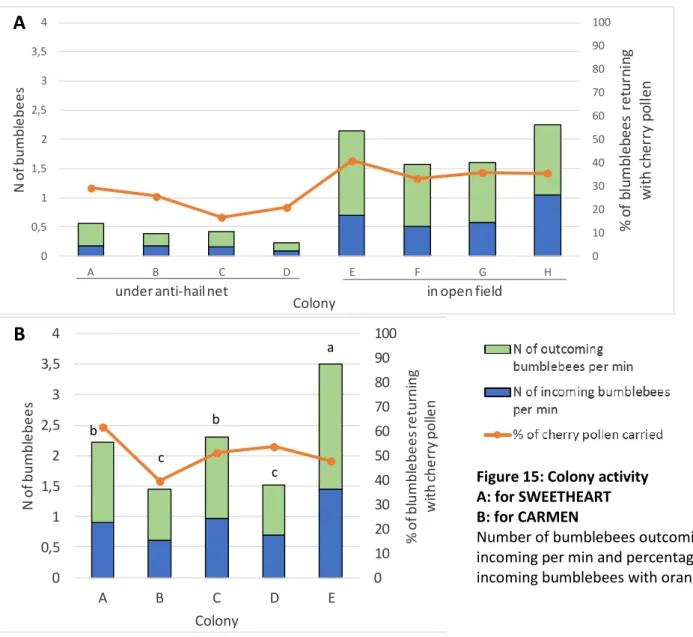
Malgré une météorologie pas toujours favorable pendant les périodes de floraison, le niveau d'activité des colonies de B. terrestris était élevé dans les trois essais, dans les situations de parcelles ouvertes, avec plus de 1.5 bourdons par minute. Ce niveau d'activité a été mesuré pour chaque colonie, différents jours et à plusieurs moments de la journée, en comptant pendant des périodes de 5 minutes le nombre de bourdons sortants et rentrants dans les ruches, avec ou sans pelotes de pollen. La couleur des pelotes était également notée. Dans les deux essais en cerise, plus d'un tiers des bourdons rentrants à la ruche avaient des pelotes de pollen orange qui ont été considérées comme contenant majoritairement du pollen de cerisiers. En revanche, sous le filet anti-grêle, l'activité de vol était très faible, au delà de ce qui était envisagé. Le filet utilisé semble modifier la quantité et/ou qualité de la lumière à tel point que les bourdons ont un niveau d'activité presque nul. Nous ne pouvons donc pas exploiter les résultats obtenus dans cette partie de cet essai.
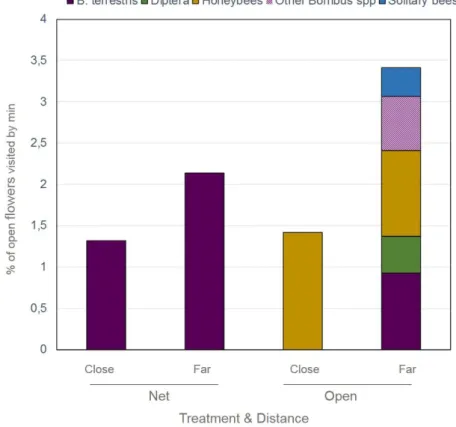
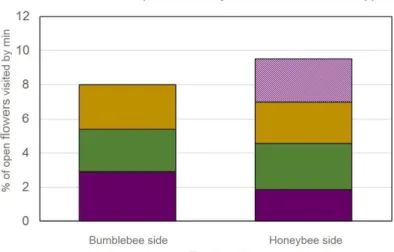
Des relevés de butinages ont été effectués, pendant les périodes de floraison, dans des zones de périmètre limité et choisies au hasard. Ces relevés consistaient à identifier chaque insecte entrant dans la zone pendant une période de 5 minutes. A la suite de quoi était calculé le pourcentage de fleurs ouvertes visitées par minute par chaque visiteur identifié. Les relevés ont été effectués plusieurs jours où les conditions météo étaient favorables au butinage des pollinisateurs et à différents moments de la journée. Ces relevés ont montré premièrement que la densité abeilles domestiques était élevée et que ces dernières avaient une activité de butinage importante. Ceci a été constaté dans les trois essais. Les taux de visites des fleurs par des B. terrestris étaient satisfaisants: 1/2 et 1/3 des visites sur respectivement cerisiers et framboisiers. En revanche, les relevés effectués dans les deux parcelles de cerisiers n'ont pas permis de mettre en évidence un gradient de B.
terrestris comme il était souhaité. Il n'est donc pas possible d'affirmer que les fleurs des arbres situés
plus près des colonies de bourdons aient été visitées par davantage de B. terrestris que ceux situés plus loin. En revanche, pour l'essai en framboisier, il semble qu'il y ait bien eu un gradient de B.
terrestris comme souhaité.
Le nombre de fruits par branches marquées, ensachées ou non, a été compté après la fin de la floraison et juste avant la récolte. Ces comptages ont permis de calculer les taux de nouaison et de mise à fruit connaissant le nombre initial de fleurs. Dans les cas de la variété de cerise auto-incompatible et de la variété de framboise, la mise a fruit a été significativement plus élevée sur les
branches pollinisées librement que sur celles ensachées. Ceci illustre que dans le cas d'une variété auto-incompatible les pollinisateurs sont essentiels pour assurer la production de fruits et que dans le cas d'une variété auto-compatible ceux-ci peuvent l'améliorer.
Les cerises récoltées et leur noyaux ont été pesés et leur teneur en sucre a été mesurée à l'aide d'un réfractomètre. Les framboises récoltées ont également été pesées, les graines ont été nettoyées de la chair puis photographiées afin de les compter et de mesurer leur taille. Pour les deux essais de cerises aucune différence de qualité de fruits n'a été constatée entre les arbres situés à différentes distances des colonies de bourdons. La distance entre les deux lots de plantes n'était probablement pas assez importante. En effet les arbres étaient éloignés d'une trentaine de mètres seulement, alors que les bourdons volent généralement dans les 100 premiers mètres autour de leur ruche. D'autre part les analyses statistiques de la mise à fruit et de la qualité des fruits ont révélées que la plus grande part de variance entre les données était due à des différences entre arbres. Il paraît donc difficile de conclure sur la valeur ajoutée de l'utilisation de colonies de B. terrestris pour la pollinisation de cerises. Dans l'essai framboise, les graines des framboises récoltées dans la partie supplémentée en B. terrestris étaient significativement plus grosses que celles du côté supplémenté en abeilles domestiques. Il semblerait également les framboises étaient plus homogènes en poids mais pas significativement plus lourdes en moyenne. Ainsi, l'utilisation de colonies de B. terrestris ne semble pas montrer d'avantages d'un point de vue du consommateur. En effet, avoir des graines plus grosses dans des fruits de même taille ne semble pas intéressant, sauf s'il en résulte des fruits plus aromatiques.
Cette étude met en lumière les difficultés à mener des essais de pollinisation dans des parcelles en production situées dans une zone à forte concentration de cultures fruitières. Plusieurs raisons peuvent être listées : peu de producteurs acceptent le fait que des essais soient conduits sur leur parcelle ; les résultats sont fortement impactés par les populations locales de pollinisateurs, principalement d'abeilles domestiques, étant donné leur usage répandu dans les zones de production fruitière ; les conditions climatiques pendant les périodes de floraison impactent grandement les observations effectuées et la physiologie des plantes. Cependant, les résultats d'études menées sur des parcelles de producteurs sont plus représentatives des situations rencontrées en production. C'est pourquoi il est nécessaire de poursuivre ce genre d'études.
Table of contents
Table of figures ... 3 Table of tables ... 3 1. Introduction ... 5 2. Review ... 6 2.1 Pollination ... 62.2 Use of supplemented pollination in crops ... 9
2.2.1 Honeybees ... 9
2.2.2 Bumblebees... 9
2.2.3 Comparison between honeybees and Bombus terrestris as pollinators of some crops and under inclement weather conditions ... 10
2.2.4 Previous experiences with pollination in P. avium and R. idaeus ... 12
2.3 Pollination success vs. fruit quality and market requirements ... 12
3. Material and methods ... 14
3.1 Study species and sites ... 14
3.1.1 Bombus terrestris ... 14
3.1.2 Prunus avium ... 15
3.1.3 Rubus idaeus ... 16
3.1.4 Field description ... 18
3.2 Experimental setup... 18
3.3 Methods used for observations and measurements ... 20
3.3.1 Bumblebees colonies activity ... 20
3.3.2 Pollinators foraging activity ... 22
3.3.3 Fruit set and harvest ... 22
3.3.4 Fruit quality and pollination success ... 24
3.4 Statistical analyses ... 24 3. Results ... 27 3.1 SWEETHEART ... 27 3.1.1 Colonies activity ... 27 3.1.2 Foraging activity ... 27 3.1.3 Fruit set ... 27 3.1.4 Fruit quality ... 27 3.2 CARMEN ... 28 3.2.1 Colonies activity ... 28 3.2.2 Foraging activity ... 28
2 3.2.3 Fruit set ... 28 3.2.4 Fruit quality ... 28 3.3 RASPBERRY ... 30 3.3.1 Colonies activity ... 30 3.3.2 Foraging activity ... 30 3.3.3 Fruit set ... 30 3.3.4 Fruit quality ... 30 5. Discussion ... 35 6. Conclusion ... 38 7. Acknowledgments ... 39 8. Bibliographic references ... 40 9. Annexes ... 45
3
Table of figures
Figure 1: Self pollination and cross pollination 9
Figure 2: Changes in global numbers of honeybee hives and agricultural production of dependent crops and nondependent crops between 1961 and 2007
13 Figure 3: Annual worldwide sales of bumblebee’s hives between 1988 and 2004 13 Figure 2: Aberrant sweet cherry fruits from abnormal ovary development 15
Figure 5: Fully formed raspberry and poorly formed raspberry 15
Figure 6: Hives entrance and exit system 19
Figure 7: Longitudinal section of a 'Bing' cherry flower, x7 19
Figure 8: Longitudinal section of 'Willamett' raspberry flower, x10 19
Figure 9: Fields 21
Figure 10: Hand pollination 23
Figure 11: B. terrestris hive and bee coat 23
Figure 12: Capture cage 25
Figure 13: Measurement of the nectar volume of one nectary 25
Figure 14: Raspberry seeds analyze with ImageJ 27
Figure 15: Colony activity for SWEETHEART and CARMEN 31
Figure 16: Foraging activity in SWEETHEART depending on the treatment and the distance to bumblebees colonies
33 Figure 17: Foraging activity in CARMEN depending on the sweet cherry variety and the distance to bumblebees colonies
33
Figure 18: Fruit set for each crop and variety 34
Figure 19: Nectar volume of virgin raspberry flowers at different time of the day depending on the age of the flower
35 Figure 20: Percentage of foraging bouts depending on the portion of the flower ring wandered for different categories of insects
35 Figure 21: Foraging activity in RASPBERRY depending on the side of the field 35
Figure 22: Cherry weight, stone weight and sugar content 36
Figure 23: Raspberry weight and number of seeds per raspberry 36
Table 1: Cherry categories criteria for fresh market 15
Table 2: Characteristics of the fields 21
Table 3: Trials' experimental designs 23
Table 4: Colony activity for RASPBERRY 31
Table 5: Visit duration of raspberry flowers depending on the visitor and the age and status of flowers
35
Table of tables
5
1. Introduction
Horticultural practices ensure human population sustainability and economical benefits. In term of volumes, 35% of global production depend on pollinators (Klein et al., 2007). Many flowering plants, especially fruit crops, require pollen from another genotype (variety) to set fruit or just benefit from crossed pollination (Dogteron et al., 2000). In this later case, fruit set and fruit quality can be improved by insects pollinators, such as honeybees, bumblebees, solitary bees, hoverflies and coleoptera (Klein et al., 2007). The association between foragers and flowering plants they visit, is presumed to have developed over many millions of years (Benton, 2006). It is generally a mutualistic association, both partners obtaining a net benefit from it: foraging insects find the food they need and from the plant side, sesile plants gain access to crossed reproduction (Benton, 2006). An optimal pollen deposition of pollen on stigma, neither insufficient nor excessive is essential to maximize yield of many fruits crops. Honeybee colonies (Apis mellifera L.) are mainly used to supplement wild pollinators in the crops that are grown for direct human consumption (McGregor, 1976; Delaplane & Mayer, 2000). However, it has been shown that the fraction of agricultural crops depending on pollinators outpaced the global growth of the global stock of domesticated honeybees (Aizen et al., 2008 ; Aizen & Harden, 2009). This decline in stock is due to multiple factors as the use of pesticides, habitat loss and the low genotypic diversity of colonies. Those combined factors make honeybees colonies to be less resistant to pests and diseases (Kluser, 2007).
Artificially reared bumblebees (Bombus spp.) were originally used in greenhouse crops, such as tomato (van Ravestijn & Nederpel, 1988). Since the last decade they are being used in an increasing number of open field crops, such as pip fruits, stone fruits and soft fruits. They are suggested as an alternative to the use of honeybees in crop pollination (McGregor, 1976). Bumblebees and honeybees are both generalist but bumblebees tend to prefer individual foraging (Benton, 2006). They can fly in poor weather conditions, their higher body size may improves pollen deposition on the stigma. Additionally, they tend to move more often between floral patches (Delaplane & Mayer, 2000).
This study aims to test the use of commercial B. terrestris colonies as alternative to honeybees for the pollination of two study species, namely sweet cherry Prunus avium (L.) and raspberry Rubus
ideatus (L.). We aimed to work in commercial plantations, to be able to translate the results to
realistic field situations. Honeybee colonies are widely used by growers in the region where trials were performed and they forage up to 10 km around their hive. Consequently there was no chance to study both pollinator types in separate and similar areas. Different approaches have been used in order to assess the added value of bumblebee as pollinators or the possibility of use them alone. In both cherries trials we varied the distance of studied plants from the bumblebees colonies. Here we make the hypothesis that B. terrestris will be more numerous close from their colonies than far away. Indeed, bumblebees forage on a limited distance, 80% of them forage in the first 100 m from the colony (Biobest unp. Results). Furthermore in one of this trial we could exclude other pollinators than commercial B. terrestris in one half of the orchard by placing an anti-hail net closed at the edges. In the raspberry trial we try to create a gradient of B. terrestris by placing their colonies to the opposite side of where honeybees colonies where located. Here we assume that honeybees will form a common background in the all field. In each trial we analysed plants of the same variety and age.
Both plant species have pale flowers, which are not the primary choice of bumblebees, which tend to prefer bluish or yellowish corollas (Chittika & Thomson, 2001). Cherry and raspberry flowers produce both nectar and pollen, readily accessible, as pollinators rewards (Delaplane & Mayer, 2000). In both crops nectar is secreted abundantly, it has a medium sugar concentration (up to 20%) and is highly attractive for bees (Haragsimova-Neprasova, 1960; Schmidt et al., 2004). While sweet cherry flowers have balanced nectar, with equivalent amounts of sucrose, raspberry nectar is low in
6 sucrose (Schmidt et al., 2009). Regarding the pollen quality, both crops have rich protein pollen that is attractive to both honeybees and bumblebees (Chagnon et al., 1991).
Our study system is located in Belgium, an area with a temperate climate. Therefore, we aim to investigate if bumblebees can forage better than honeybees, especially in early blooming crops such as sweet cherry. In addition, both flower types show a limited attractiveness regarding floral advertisement but have highly rewarding nectar and pollen. In this way we aim to investigate if both pollinator types might show differences in their foraging behavior.
From the plant side, for sweet cherry we have included either self-fertile an self-incompatible varieties in which pollination requirements are supposed to differ. We aim to test if the self-fertile variety can benefit from outcrossing as it can be observed (Delaplane & Mayer, 2000). As bumblebees tend to switch rows often when they are foraging (Willmer et al., 1994 ; Dag et al., 2006) we expect that the use of bumblebees will improve pollination in the self-incompatible variety in which pollinazers varieties are located in adjacent rows. In the case of self-fertile raspberry canes, we do the hypothesis that honeybees are not highly attracted by this crop (Delaplane & Mayer, 2000). We studied the foraging behavior of the two pollinator types.
The success of pollination trials are strongly affected by the context such as the crop variety and abiotic conditions. Furthermore the production processes of bumblebees colonies may affect the foraging activity of the bumblebees once in the field. In this way companies with R&D activities such as Biobest rely on scientific studies both on wild plants and crops but on the other hand they need to assess the potential of the colonies they produce themselves for each crop. Some studies assess for example the impact of the diet provide during colony' development on the level activity in the field.
More particularly, the objectives of the trials carried out during this study are as following: i) to assess Bombus terrestris colonies’ activity during blooming, ii) to assess Bombus terrestris foraging activity during blooming, iii) to assess fruit set (quantitative) after blooming and at harvest, and finally iv) to investigate the fruit quality and pollination success.
2. Review
2.1 Pollination
Fruit production depends greatly on a successful pollination and on fruit setting (Williams, 1970a). Pollination is defined as the transfer of pollen grains from the producing anthers of a flower to the receptive adhesive female stigmatic tissue of the same or another flower of the same or different plants of the same species (Goulson, 2009). Pollen grains are produced in anthers and contain the male gametes. There are three kind of pollination depending on which stigma receive the pollen grain (Kolreuter, 1761) (fig 1). The first two comprise self-pollination mechanisms: in autogamous pollination, pollen is transferred to the stigma of the same flower; while in geitonogamous pollination pollen is transferred to the stigma of another flower of the same plant. The third type is cross pollination, where pollen is transferred to the stigma of a flower of a different plant. In hermaphrodite flowers such as Rubus ideaus and Prunus avium, plants have mechanisms to avoid self pollination. Dichogamy refers to an asynchronous maturation of anthers and stigma of the same flowers, when pistil matures first it is called protogyny, in the other case it is called protandry. Pollen grains coming from the same flower, plant or genotype is called autopollen. Species or varieties that can be pollinated by autopollen are self-fertile. Species or varieties that require absolutely cross-pollination are self-sterile and present a self-incompatibility mechanism.
When the interaction pollen-stigma is compatible, a pollen tube grows through the length of the style. The style is a long column that connects the stigma to the ovule, the female germ cells. Then the tube reaches the ovule contained in the ovary, where the fecundation takes place (Dharam,
7 Figure 1: Self pollination and cross pollination (Kolreuter, 1761)
8 2012). When the interaction pollen-stigma is incompatible, no pollen tube grows or it is stopped more or less quickly (Schuster, 2012). As a result, in the main case neither fruit nor seeds are produced. This incompatibility can be explained by a genetic incompatibility, a deficient quality of the pollen grains or if the deposition occurs outside the effective pollination period (EPP).
In some self-fertile flowering plants species pollination can occur without a pollen vector; the phenomena is called autopollination. For other plants, a vector is needed for the pollen to reach the stigma. Flowering plants often display adaptations to increase the chances that a foraging insect will properly plays its role in their sexual reproduction: arrangement of flowers into inflorescences, colour patterns, shapes, scents and supply of pollen and/or nectar as rewards. Plants that require bee pollination to set seeds, have typically large, colourful, nectar-rich flowers, often deep nectar stores and several seeds per fruit (Corbert et al., 1991; Bentom, 2006). They include many crops grown for food, horticulture and industry, and wild plants important in semi-natural vegetation (Corbert et al., 1991). On the contrary, self pollinated flowers are generally small, colourless, odourless and nectarless.
There are many vectors including wind, water and animals. In 1994 it has been assessed that in Europe 84% of 264 crops depend at least to some extent upon animal pollination (Williams, 1994). A recent study about 115 crops (seeds, fruits or vegetables), considering data from 200 countries, has shown that animal pollination is essential, highly important or moderately important for respectively 13, 30 and 27 of those crops (Klein et al., 2007). In term of volumes, 35% of global production depend on pollinators (Klein et al., 2007). A wide range of crops depend on insect pollination also called entomophilous pollination. Insect pollinators are considered as main pollen vector in fruit trees (Klein et al., 2007). The two most important groups of insect pollinators are bees (Hymenoptera) and hoverflies (Diptera) (Mudri-Stojnic et al., 2012). The bees’ tendency for collecting pollen and nectar in order to feed their brood explains their importance as pollinators. The “bees” term refers to honeybees (Apis mellifera L.), bumblebees (Bombus spp.) and solitary bees (McGregor, 1976) and several species of those three groups are known for pollinating crops that are grown for direct human consumption.
Poor weather, cold or mild and wet, generally reduces pollinators flight activity. In a study carried out on apples, Prunus malus Mill., the amount of pollen transferred was found to be weather dependent (Williams et al., 1984). In a blueberry field, Vaccinium corymbosum L., the foraging community composition was changing depending on the weather: honeybees were dominant during good weather whereas bumblebees (Bombus impatiens) dominated during poor weather (Tuell & Isaacs, 2010). Honeybees’ flight activity begins at temperatures ranging between 12 and 14°C and decreases when the wind’s speed increases (Winston, 1987). Bumblebee is a cold-blooded animal and starts flying around 6°C (Goulson, 2009).
Pollen can be sterile due to a failure during pollen formation or due to environmental influences during its development (Wilcock & Neildan, 2002). The pollen can also become inviable due to a too long period between pollen transfer and deposition on the stigma (Wilcock & Neildan, 2002). The effective pollination period (EPP) is defined as the number of days during which pollination is effective in producing a fruit (Williams, 1965). The EPP is conditioned by three processes: stigmatic receptivity, pollen tube kinetics and ovule development. Stigmatic receptivity is the ability of the stigma to support pollen germination. Ovule development can be incomplete or displaying abnormalities (Sanzol & Herrero, 2001). Different factors affect the EPP: the temperature during blooming, the flower quality and the chemical treatments (Sanzol & Herrero, 2001). Low temperatures during blooming slow down pollen tube growth but extend ovule viability and so the EEP increases (Guerrero-Prieto et al., 1985 ; Stösser & Anvari, 1982). However, extreme low temperatures can shorten the EPP (Lombard et al., 1971). High temperatures lead to a shorten EPP by shorten both stigma and ovule receptivities (Sanzol & Herrero, 2001). Fruit set depends both on
9 the number of flowers and the EPP (DeGrandi-Hoffman et al., 1989). Agricultural practices can influence flower quality. This explains why growers have recourse to chemical treatments in order to improve the EPP. Some elements, as nitrogen, boron or polyamines, applied at bloom can improve the nutritional status of the flowers what extends the EPP (Williams, 1965 ; Sanzol & Herrero, 2001).
2.2 Use of supplemented pollination in crops
Interactions and links between bees, plants and human activities are complex. The decrease of undisturbed land and climate change affect plants phenology, wild flowers populations and both wild and not wild bee populations what affect consequently insect pollinated crops (Corbert et al. 1991 ; Vaissiere et al. 2011). Declines of pollinators abundance and diversity is a current problem affecting many locations (Goulson et al., 2005 ; Biesmeijer et al. 2006 ; Oldroyd, 2007 ; Lye et al., 2011 ; Vaissiere et al. 2011). Some crops suffer of insufficient pollination (Allen-Wardell, 1998 ; Klein et al., 2007). Pollination deficit can be detect and assess (Vaissiere et al., 2011). The introduce of managed pollinators at blooms can be a solution to improve flowering crops pollination, especially if wild bees populations in fields are low. Indeed without pollinators yields of some crops can decrease up to 90% (Southwick and Southwick, 1992).
2.2.1 Honeybees
Domesticated honeybees (Apis mellifera) are largely used for crops pollination (McGregor, 1976) and honey production. In Belgium, growers have the habit to use managed honeybee colonies for insuring crops’ pollination (Borneck, 1989). Honeybees are considered to be the single most important pollinator (McGregor, 1976) and the most economical (Delaplane & Mayer, 2000). However, honeybees would not be the most effective pollinators for some crops and some wild bees species could be more effective as for example: Osmia aglaia for raspberry and blackberry (Cane, 2005) and Osmia lignaria or Osmia cornuta for almond (Cane 1997 ; Bosh & Blas, 1994). Furthermore, it has been shown that the fraction of agricultural crops depending on pollinators outpaced the global growth of the global stock of domesticated honeybees. Global number of honeybees colonies has increased by about 45% between 1961 and 2007 (fig 2) (Aizen et al., 2008 ; Aizen and Harden, 2009). According to this study, the increase of pollinators’ dependence may have economic and political causes. Another important problem concerning honeybees and touching both North-America and Europe is the phenomena called Colony Collapse Disorder (CCD). The percentage of managed honeybee colonies that do not survive to winter is abnormally high and reaches often 30% even 80% or 100%. The CDD causes important economic losses for both crops and honey production (Kluser & Peduzzi, 2007). It is a multifactorial syndrome: Precise causes are not yet known but there are many potential ones as for example chemical residue/contamination (from both beekeeping and agricultural practices), pathogens, parasites, habitat fragmentation, loss and degradation, reduced floral diversity, periods of scarcity and lack of genetic diversity.
2.2.2 Bumblebees
The high potential of bumblebees as pollinators interests researchers since the late 1800’ in order to improve crops’ pollination. The efficiency for pollination depends on the number of workers of an appropriate species at the blooming season (Pouvreau & Marilleau,1979). Early in the season wild colonies of bumblebees have not yet sufficient time to produce a big amount of workers (Tuell & Isaacs, 2010). Furthermore the number of bumblebees’ colonies naturally present vary greatly from place to place and between years. An increase of the number of bumblebees colonies can be obtained by different techniques: development of habitats under the ground or at the soil surface, transfer of nets founded in nature or queen’s capture (Pouvreau et Marilleau,1979). However those techniques are not simple and convenient in greenhouses or for intensive open crops. In 1912 Sladen drew up a list of potential problems for Bombus terrestris domestication: mating, hibernation and
10 colonies’ initiation (Sladen, 1912). Several other researchers, both European and American, have studied the topic. In 1961, Horber solved the problem of rearing bumblebees in captivity by understanding how to induce artificial queen’s hibernation (Horber, 1961). Later on, Dr. de Jonghe, a Belgian veterinarian, found the economic benefits of using bumblebees for tomatoes pollination in greenhouses (van Ravestijn and Nederpel, 1988). Tomatoes’ flowers need buzz-foraging, also called sonication, to release their pollen, something that bumblebees are able to do contrary to honeybees. Up to this moment tomatoes under greenhouses were pollinated by mechanical vibrations or by hand (Velthuis & van Doorn 2006). In 1987, Dr. de Jonghe founded the commercial bumblebee rearing company Biobest in Belgium (Velthuis & van Doorn 2006). The annual worldwide sales of bumblebee’s hives had increased rapidly and constantly since the discovery and reached 1 million in 2004 (fig 3) (Velthious and Doorn, 2006). Of course it is not comparable to the worldwide number of honeybees’ colonies.
Bombus terrestris L. is an eusocial colonies’ species, very common in a large part of Europe
with a geographical distribution centred on Mediterranean. They are three castes morphologically defined: the queen (one per colony), workers (fertilized diploid eggs laid by the queen) and males (haploid eggs laid by the unfertilized females). It natural life cycle is annual and the colony is not permanent (Sladen, 1912). The size of B. terrestris colony can reach few hundred individuals. When the colony is between 10-14 weeks old the queen losses some of her dominance workers, it is called competition point (Bourke & Ratnieks, 2001). It leads to some of workers to lay unfertilized eggs, so haploid, which develop into males (Benton, 2006). Males do not forage as much as workers do and so the level activity of the colony starts to decreases (Benton, 2006). Workers live for 2 to 4 weeks (Pouvreau & Marilleau, 1979). During spring and summer colonies’ size increases and gain in complexity, and consequentially tasks are divided. About one third of workers, the oldest, forage for feeding the nest, some collect pollen and other one nectar, youngest workers do nursing and household tasks. B. terrestris do short to medium -distance foraging, up to 300 m (Darvill et al., 2004). Foragers collect resources for the reproductive success of the colonies as a whole (Benton, 2006). It follows that at the end of a foraging trip workers have to find their nest where they deliver their nectar and/or pollen loads. Workers can carry large loads of both pollen and nectar: up to 20% of their body weight of pollen and up to 90% of nectar (Heinrich, 1979). B. terrestris are a highly generalist species of bumblebees and enjoy colored flowers (Thomson, 1981). B. terrestris are able to learn and memorize colors and this training impacts significantly their choice when they are exposed to unknown colors (Gumbert, 2000). Bombus spp can learn how to get rewards from several flower species and easily switch between flower species without increase of the flower handling times (Raine and Chittka, 2006). The fidelity to a particular plant species within a same foraging bout is called floral constancy. It rests on establishment of associations between sensory cues and flowers' rewards. Brian (1951) found that the pollen eaten by bumblebees larvae of different Bombus species belonged to different species of flower what would show a low floral constancy. And Thomson (1981) found that the level of constancy decreases when diversity of flower types increases.
2.2.3 Comparison between honeybees and Bombus terrestris as pollinators of some
crops and under inclement weather conditions
Several study have compared honeybees and bumblebees for Rosaceae crops pollination. The aim of those studies is to assess bumblebees potential as alternative or complementary pollinators to honeybees. Bumblebees may improve pollination level for different reasons as:
better mobility between rows and plants for Almond (Dag et al., 2006) and Raspberry (Willmer et al., 1994)
higher working rate in Almond (Thomson & Goodell, 2001 ; Dag et al., 2006) and Raspberry (Willmer et al. 1994)
11 Figure 2: Changes in global numbers of honeybee hives and agricultural production of dependent crops (D) and nondependent crops (ND) between 1961 and 2007. (Aizen and Harden, 2009)
Figure 3: Annual worldwide sales of bumblebee’s hives between 1988 and 2004 (Velthuis and Doorn, 2006)
12 preference for receptive flowers in Raspberry (Willmer et al. 1994)
higher pollen deposition on Raspberry stigmas (Willmer et al., 1994) or comparable on Almond stigmas (Thomson & Goodell, 2001)
longer period of activity during the day in Sour cherry orchards (Hansted et al,. 2015), in Raspberry field (Willmer et al. 1994)
higher level of activity under inclement weather conditions in Almond (Dag et al., 2006) and Raspberry (Willmer et al., 1994)
higher level of activity under inclement conditions (Benton, 2006) in Raspberry fields (Willmer et al., 1994).
2.2.4 Previous experiences with pollination in P. avium and R. idaeus
Self-incompatible sweet cherry varieties have been shown to be highly dependent on insect pollination. According to Holzschuh et al. (2012), the fruit set on bagged branches is 97% lower compared to free pollinated branches. Although free pollinated branches were mostly visited by honey bees, fruit set differences were mostly accounted by Bombus and solitary bee visits, which was presumably due to their higher pollination efficiency. This study showed that initial fruit set and final cherry yield were closely and positively correlated. Finally they concluded that in sweet cherry, wild bees, including native Bombus spp., pollination surpassed pollination by honey bees.
For raspberries, results concerning fruit set in the case of pollinators exclusion are contradictory. Cane found that it does not lead to negative effect on fruit set (Cane, 2005) whereas Shank found the opposite result (Shank, 1969). The shape and so the quality of the fruit depend on the number of drupelets (Shank 1969). There is a relationship between seed size and drupelet size, small seeds tend to be associated with small drupelets (Pritts, 1989). The average weight of a seed is about 1mg (Pritts, 1989). Also if the percentage of developed drupelets is low, the cohesion between drupelets will be poor (Pritts, 1989). A ripe raspberry fruit contains about 5-6% sugar (Pritts, 1989). More recently, Lye et al. (2011) assessed the impact of commercial bumblebee colonies belonging to the British B. terrestris subsp. audax on the pollination success of raspberry canes growth under polytunnels. This study focused on the potential negative effect of commercial colonies on wild pollinators. Therefore wild pollinator composition was assessed and the presence of the commercial colonies have impacted neither the diversity nor the abundance of the local pollinators populations. This study has been carried in a non commercial plantation with several genotypes arranged in experimental plots.
2.3 Pollination success vs. fruit quality and market requirements
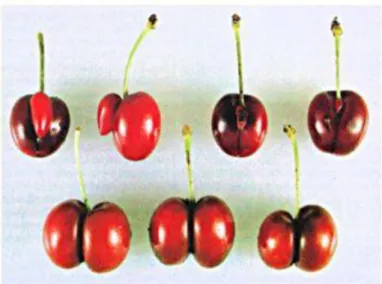
After pollination and seed development, the ovary develops into fruit tissue. In sweet cherries an abnormal ovary development, differentiation or suture sealing leads to spurred, sutured or doubled sweet cherry fruits (fig 4). In raspberries if the flower is well pollinated enough druplets the fruit is fully formed; on the contrary, inadequate pollination or unvisited flowers lead to poorly formed fruit (Shank, 1969) (fig 5). Poorly formed raspberries weight 1/3 less and are unsuitable for fresh market.
There is usually a positive correlation between seed size or the number of seeds and the final fruit size (de Jong et al. 2009). Seeds are a source of hormones, particularly auxins, gibberellins (GAs), and cytokinin, three hormones that initiate and stimulate the fruit growth (Kumar et al., 2014). The level of hormones also improve the nutritional value of fruits. Improving pollination may improve seeds development and so fruit quality. For instance, the number of seeds per apple of the variety 'Golden Delicious' have been observed increasing with the number of honeybees colonies in the field (Mantinger et al., 1998).
13 Table 1: Cherry categories criteria for fresh market (FFV-13: Cerises - 2010)
Category Shape Coloration Defects diameter (mm) Minimal
Extra Well developed,
typical of the variety Typical of the variety
Only superficial slight
degradations 20
I Slight defect tolerated but typical shape
Slight defect tolerated but typical coloration
No burst, bruise or
defects due to hail 17 II Defects tolerated but
typical shape
Defects tolerated but typical coloration
Slight cicatrised skin
defects 17
Figure 3: Aberrant sweet cherry fruits from abnormal ovary development (UCDAVIS)
14 Cherries are usually sold with their peduncle but it can be absent if this does not damaged the fruit. Cherries are classified into three categories regarding their aspect. Some level of defects is tolerated if it does not detract the general aspect, quality and preservation of the product (table 1). Price decreases within categories and with decreasing diameter. Raspberries are also classified into three categories regarding their aspect, some level of defects being tolerated if it does not detract the general aspect, quality and preservation of the product.
Raspberry fruits are aggregated fruits, in which several ovaries and the receptacle of the same flower forms the drupelets (Delaplane and Mayer, 2000). If the percentage of developed drupelets is low, the cohesion between drupelets will be poor (Pritts, 1989). Raspberries respiration rate is the highest of any fruit and have a thin skin. As a result, Raspberries are one of the most perishable fruits (Pritts, 1989).
In the category “extra”, slight superficial defect can be tolerated. In the category ”I”, berries can lose a really bit of juice and have really slight bruises. In category “II”, berries can lose a bit of juice and have slight bruises (FFV-57: Baies - 2010). The price decreases within categories. For economical reasons it is clearly understandable that growers have a strong interest in producing the biggest yield possible of fruits of the best quality possible: heavy fruits well developed with minimum defects. For this, they have to optimise both pollination and fruit setting.
3. Material and methods
This study presents three distinct trials:
- one with the variety 'Sweetheart'® of sweet cherries - one with the variety 'Carmen' of sweet cherries - one with the variety 'Kanzawa' of raspberries
For more simplicity, trials are called SWEETHEART, CARMEN and RASPBERRY in the text, the figures and the tables. This report is going to follow the chronological order of blooming of the studied crops. Even though the variety 'Sweetheart' blooms before 'Carmen', the harvest occurs so trials will be presented in the following order: SWEETHEART, CARMEN and then RASPBERRY.
3.1 Study species and sites
3.1.1 Bombus terrestris
Bombus terrestris L. is an eusocial colonies’ species, very common in a large part of Europe. B. terrestris adults have a massive form and are fuzzy and pollen grains stick well to their hairs (Benton,
2006). In both worker and queens the tibia of the hind legs is concave and shiny and forms the pollen basket or corbiculae. In males, the tibia is convex and there is no pollen basket, since they are not supposed to collect pollen. B. terrestris is a short-tongued species, its proboscis (tongue) length is 9-11 mm in average (Pouvreau & Marilleau, 1979). The proboscis is used to probe and suck up the nectar from nectaries of flowers. Adults B. terrestris need nectar as a carbohydrate source that provides the needed energy for flying (Benton, 2006). They also forage pollen and water. Pollen is a source of protein for the build-up of the colonies (Benton, 20006). Bumblebees do not store food over the winter period and food supplies are not as big as honeybees’ ones. However, in the net, the queen builds a wax honey pot filled with regurgitated nectar that is a kind of honey (Benton, 2006). Larvae are feed with the bee bread, a mixture of pollen, nectar and saliva.
Colonies of B. terrestris produced by Biobest are sold in plastic and cardboard hives (fig 11). There are different kinds of hives corresponding to different stages of the development of colonies. "Turbo hives" have been used for SWEETHEART and CARMEN and "standard hives" for RASPBERRY . A "standard hive" is composed of a bumblebee’s colony about 10 weeks old. It development is not
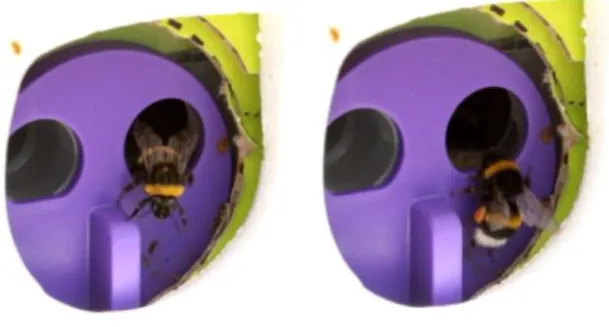
15 forced during production; there are less than 100 workers (between 45 and 80), about thirty pupae, no male and no queen pupae. For this kind of colonies the competition point should not be reached yet and so they are adapted to crops with a long blooming period as raspberry (around 6 weeks) because the foraging activity lengths several weeks. A "turbo hive" is composed of a bumblebee’s colony about 12 weeks old. It development is forced during production; there are 100 or more workers, more than 40 pupae and possibly males and queen pupae. For this kind of colonies the competition point has been usually reached already and so the level of activity may reduce faster than with "standard hives". This kind of colonies is adapted to crops with a peak blooming as cherries because foraging activity is at a high level as soon as colonies are set in the field. The entrance/exit system of hives consists of an entrance/exit hole and an only entrance hole (fig 6). There are three positions: go out and go in, only go in or closed.
Before setting, the quality of each colony has been checked. This procedure consists in counting or estimating wax cells of old larvae (L3-L4), of pupae and living workers. The presence of the living queen is checked and is an essential point for considering the colony as usable. The presence of males is also checked.
3.1.2 Prunus avium
Sweet cherry (Prunus avium L.) belongs to the family Rosaceae and is an important perennial fruit species in the temperate zone. Flower buds are produced laterally and terminally on one year old shoots. Delaplane and Mayer (2000) give the following description of cherries flowers (fig 7). Flowers are in clusters of 2-5, are radially symmetrical, have five white petals and the hypanthium has a shape of an open disk. They are hermaphroditic and counts around 30 stamens and a single pistil with a single ovary containing 2 ovules. Protogyny can be observed. Flowers are relatively unspecialised because their floral rewards, pollen and nectar, are quite easy to access for a wide spectrum of foragers. Nectar is secreted near the base of the pistil, it has a medium sugar concentration (up to 20%) and is balanced with equivalent amounts of sucrose and its monomers fructose and glucose (Schmidt et al., 2009). Pollen is rich in protein and is attractive to both honeybees and bumblebees (Chagnon et al., 1991).
Primary mode of pollination of sweet cherry is outcrossing however some varieties are self-fertile (Schuster, 2012). A homomorphic gametophytic self-incompatibility mechanism (GSI) is responsible of the incompatibility. A multi-allelic S-locus is responsible of the genetic control which prevents self-pollination. Each allele (s1, s2, s3...) acts independently and the incompatibility is
"carried" by the pollen grain. The self-incompatibility occurs when the S-allele of the pollen grain is identical with one of the two S-alleles in the style (Gibbs, 1988; Schuster, 2012). Self-incompatible varieties require an adequate pollinators variety called pollinezer in order to produce fruits or seeds reasonably. Cross-incompatibility groups of varieties are defined depending on the S-allele combinations of varieties (Schuster, 2012). Pollination groups are an arbitrary classification of varieties that bloom at around the same time.
The ovule degeneration can begin even before the flower opens, that is why pollination may occur as soon as possible after flower opening (Delaplane & Mayer, 2000). In the case of self-incompatible varieties, if autopollen lands on the stigma, the pollen germinates and a pollen tube grows. This stimulates the fruit development during five weeks but then the green fruit, which has the size of a pea, aborts (Delaplane & Mayer, 2000). If too much autopollen is growing on a stigma there is not enough place for pollen from other pollenizer varieties. Sweet cherry is a stone fleshy fruit called drupe.
16 3.1.2.1 P. avium var. 'Sweetheart'
'Sweetheart' is a self-fertile variety and does not require a pollinezer variety. However, fruiting can be improved with the presence of a compatible variety nearby. 'Sweetheart' blooming occurs in April, fruits slowly set from May to July and can be harvested at the end of July-beginning of August.
The trees are 9 years old which corresponds to a full production level. Around 20 trees among a total number of 720 are sick, so that they bloom but do not produce fruits. The cause is not really known but it could be due to an insect living within the trunk (grower communication). In 2015 this field had produced 10565kg of marketable fruits which have been sold 3.573€/kg to the fruit packing station.
According to the grower, the main plant protection problems encountered with this variety are
Drosophila suzukii (Matsumura, 1931), Botrytis cinerea (Pers, 1794) and birds’ predation. From the
beginning of fruit setting until just before the harvest, he has sprayed 6 insecticides for controlling D.
suzukii. For controlling B. cinerea he has sprayed 4 fungicides during blooming or fruit setting. He has
also sprayed some nutrients (Eureum, Fructomagnesium, Boor and Amino) every 14 days from the first flowers until one week before blooming. Those nutrients are useful for the plant which is producing new shoots and flowers. Boor increases the period of stigma receptivity.
3.1.2.2 P. avium var. 'Carmen', 'Kordia' and 'Satin'
'Carmen', 'Kordia' and 'Satin' are incompatible varieties due to a gametophytic self-incompatibility system (GSI). Those varieties belong to different self-incompatibility groups; 'Carmen' group V - S4S5, 'Kordia' group VI - S3S6 and 'Satin' group II - S1S3 (Schuster 2012). Carmen has not S-allele in common with 'Kordia' and 'Satin' so 'Carmen' is 100% cross-fertile with those varieties (Gibbs, 1988). Those three varieties have a similar blooming period.
The trees are 3 years old which corresponds to the first year of production, so the yield of 2015 cannot be taken in account.
According to the grower, the fact that 'Carmen' sets fruits early, when only a few varieties are blooming, reduces the problems regarding D. suzukii because the population is low. On the contrary birds’ predation is particularly high. B. cinerea is also a problem for this variety. The grower has used the same number of insecticides and fungicides than for 'Sweetheart'. Concerning the nutrients, they were sprayed every 5 days (and not every 14 days) because this variety sets more fruits than 'Sweetheart'.
3.1.3 Rubus idaeus
Raspberry, Rubus ideaus L., belongs to the Rosaceae family. Delaplane and Mayer (2000) give the following description of raspberries flowers (fig 8). Flowers are radially symmetrical and have usually five whitish petals. The size of the flower is really variable between species. The middle of the flower is composed by a bush of around 60 to 160 pistils setting atop a receptacle and a ring of about 90 stamens around (fig 8) (Redalen, 1980 ; Jenning, 1988 ; Pritts, 1989). Each pistil has a slender style and an ovary containing two ovules, but one usually abordts after differenciation (Pritts, 1989). Flowers produce both nectar and pollen. At the open flower stage, both are readily accessible. Nectar is secreted by a ring of nectaries located inside the ring of stamens (Delaplane & Mayer, 2000). It is highly attractive, is secreted abundantly, in average 13 µl per flower, has a medium sugar concentration (up to 20%) and is low in sucrose (Haragsimova-Neprasova, 1960 ; Schmidt et al., 2009). Pollen is pale gray or tan, rich in protein and attractive (Chagnon et al., 1991).
17 Figure 7: Longitudinal section of a 'Bing' cherry flower, x7. (USDA Handbook 496)
Figure 8: Longitudinal section of 'Willamett' raspberry flower, x10. (McGregor, 1976) Figure 6: Hives entrance and exit system
left: bumblebee going out
18 Raspberry flowers of the main cultivated varieties are hermaphroditic and self-fertile. Flowers are to a degree self-pollinating (Delaplane & Mayer, 2000): When the flower opens, stamens are bend over the immature styles and their anthers are immature. Then stamens bend back towards the petals and anthers dehisce (= opening for releasing pollen grains). The dehiscence progresess towards the center of the flower. At the same time styles grow and at their tips receptive stigmas appear. A bit after the anthers the most near from stigma dehisces. At this moment self-pollination can occur between anthers and stigmas of outer pistils (Cane, 2005). The degree of self-pollination vary between varieties but is generally high. Flowers shade a day or so after opening.
Raspberry fruits are aggregated fruits, in which several ovaries and the receptacle of the same flower forms the drupelets. The shape and so the quality of the fruit depend on the number of drupelets (Shank, 1969).
The variety of raspberry used in the trial is 'Kanzawa'. It is a self-fertile and self-pollinated variety. Canes are 2 years old. They are irrigated and fertilized (annual dose is N: 120, P: 80, K: 120) every day with a drop by drop system. According to the grower, the main plant protection problems are D. suzukii and B. cinerea. He has sprayed insecticides before blooming, during blooming and during fruit setting until just before harvesting. He has also sprayed fungicides every week during fruit setting.
3.1.4 Field description
The three commercial fields are located in the Limburg province of Belgium near the city of Sint-Truiden, an area with a temperate climate. This region is the main fruit growing area in Belgium. In the immediate proximity of the fields, there are pears, apples, sweet cherries and sour cherries orchards and some other crops as potato fields.
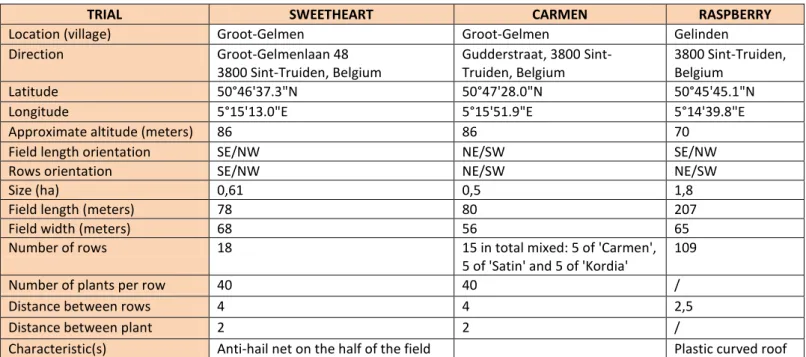
Map of the fields can be found in Annexes 1, 2 and 3. The sizes of the fields are 0.61ha, 0.5ha and 1.8ha for SWEETHEART, CARMEN and RASPBERRY, respectively. For SWEETHEART and RASPBERRY there is only one variety. For CARMEN there are, in same proportion and mixed rows, the three following varieties 'Carmen', 'Satin' and 'Kordia' (fig 9B). The two last ones are pollinezer variety of 'Carmen'. The half field of SWEETHEART is covered by an anti-hail net (Kristal Longlife®) with a 2.8 x 8 mm mesh (fig 9A). This net can be completely closed both on top and sides. Usually the growers close it during fruit setting for preventing bird predation but for responding to the study requirements it has been closed before blooming. This net may modify the light and consequently bumblebees’ flight activity, as already observed under greenhouses. Unfortunately, we cannot have access to the light curve transmission of the net. The RASPERRY field is equipped with an open-ended polytunnel that protects the plants against rain and hail (fig 9C). This structure is supported by posts spaced by 2.5 meters. Table 2 presents some other characteristics of the three fields as location, geographical coordinates, altitude, field and rows orientations, field length and width and number of rows as well as the planting pattern.
3.2 Experimental setup
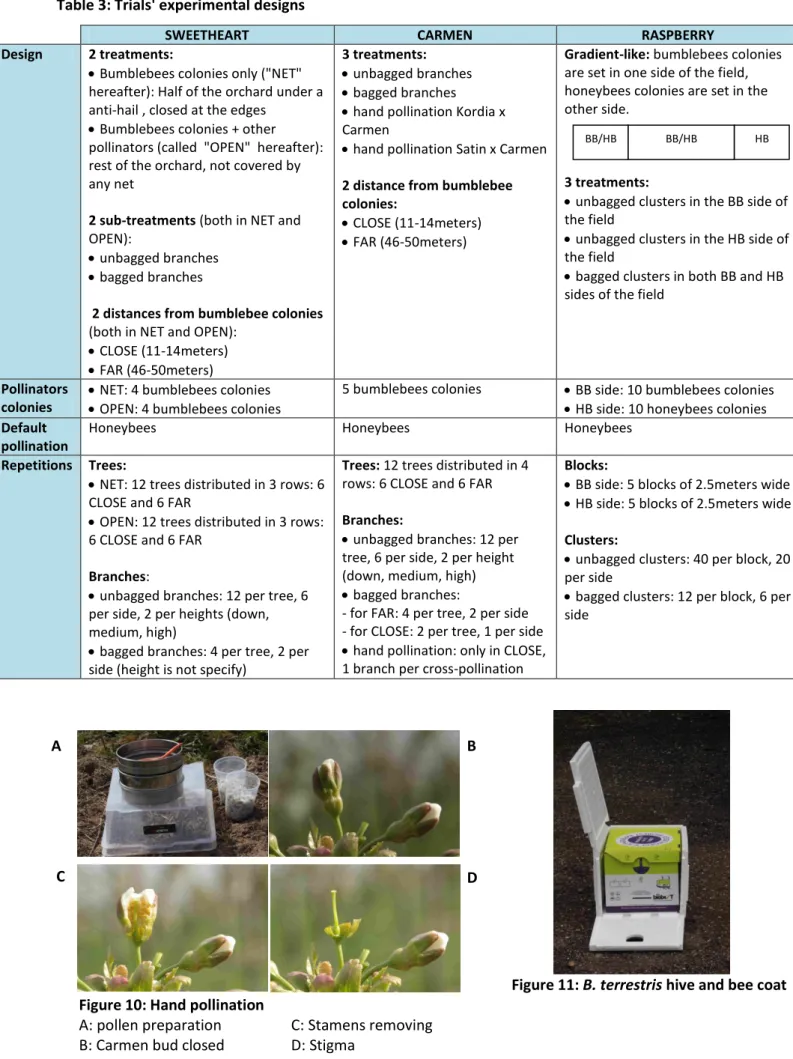
Before blooming branches on cherry trees have been marked according to the experimental design of each trial (table 3). Cherry trees have been chosen according to their location (row and number of the tree) in the field regarding their distance to bumblebee colonies. For SWEETHEART 12 trees were marked for both treatments (NET and OPEN), 6 were located CLOSE and 6 FAR away from bumblebees colonies. Per tree 12 branches unbbaged were labelled and 4 were bagged. Unbagged branches were at 3 different height in the tree. For CARMEN 12 trees were marked, 6 were located CLOSE and 6 FAR away from bumblebees colonies. The number of branches per tree were as for SWEETHEART: 12 branches unbbaged labelled and 4 bagged. Before blooming raspberry blocks of 2.5 meters wide have been marked. Per block 40 unbbaged clusters of flowers were labelled and 12
19 Table 2: Characteristics of the fields
TRIAL SWEETHEART CARMEN RASPBERRY
Location (village) Groot-Gelmen Groot-Gelmen Gelinden
Direction Groot-Gelmenlaan 48 3800 Sint-Truiden, Belgium Gudderstraat, 3800 Sint-Truiden, Belgium 3800 Sint-Truiden, Belgium Latitude 50°46'37.3"N 50°47'28.0"N 50°45'45.1"N
Longitude 5°15'13.0"E 5°15'51.9"E 5°14'39.8"E
Approximate altitude (meters) 86 86 70
Field length orientation SE/NW NE/SW SE/NW
Rows orientation SE/NW NE/SW NE/SW
Size (ha) 0,61 0,5 1,8
Field length (meters) 78 80 207
Field width (meters) 68 56 65
Number of rows 18 15 in total mixed: 5 of 'Carmen',
5 of 'Satin' and 5 of 'Kordia'
109
Number of plants per row 40 40 /
Distance between rows 4 4 2,5
Distance between plant 2 2 /
Characteristic(s) Anti-hail net on the half of the field Plastic curved roof
Figure 9: Fields A: SWEETHEART B: CARMEN C: RAPSBERRY
A
B
C
20 clusters were bagged. Flowers on marked branches or clusters have been counted. Those flowers’ counts are needed for assessing the fruit set after blooming and just before harvest. The material used for bagging is green light with a mesh of 0.7mm*0.2mm.
During blooming flower development stages have been defined according to the opening level of the flower and the aspect of the stamens and the stigma. Those stages are used during foraging censuses. For the three cherries varieties about 3 days are needed between bud starts openning and the full open flower.
For the two hand pollination treatments in the trial CARMEN, 'Kordia' and 'Satin' flowers with stamens at balloon stage have been collected. Then stamens have been removed and let for drying in the sun (for 'Kordia') or in an oven at 45°C (for 'Satin' since the day of 'Satin' pollen preparation it was cloudy and raining). Once stamens where enough dried and released pollen, they have been sieved with sieves of different mesh until getting a powder clean enough (fig 10A). 'Carmen' branches for hand pollination have been prepared as follows: only 16 buds per branch were kept and sepals, petals and stamens of these buds have been removed carefully using fine forceps (fig 10B, C and D). Then pollen have been drop off on stigmas with a brush. Finally branches have been bagged with the same material used for other bagged branches. Pollen viability has been assess with in vitro germination tests on agarose-sucrose medium containing 12% of sucrose.
Before colonies setting in the field, the quality of each one has been checked. This procedure consists in counting or estimating wax cells of old larvae (L3-L4), of pupae and living workers. The presence of the living queen is checked and is an essential point for considering the colony as usable. The presence of males is also checked. Pupae are considered as future workers as they become adults within 4 days (Benton, 2006).
Bumblebees colonies have been be introduced during the afternoon when around 10% of the crop was blooming. Hives have been installed on top of a 10cm high plastic crate in order to prevent soil humidity to reach the nest. For the trials SWEETHEART and CARMEN, colonies where placed during spring ; this is why a “bee coat”, composed of polystyrene, has been added around each hive for preserving colonies against cold weather (fig 11). For the trial RASPBERRY a polystyrene tray has been placed above the hive as a shelter from the rain. For all trials, a brick has been put on the top of each hive for stabilisation. After introduction hives were let closed during the first 30 minutes for colony "relaxation". After opening, it was checked that bumblebees went out and in. At the setting up time bumblebees have access to a ready-to-use sugar solution called BIOGLUC®. It supplies bumblebee’s needs at the beginning. Then a plastic cap screwed up closes the access but it can be opened really easily if needed.
3.3 Methods used for observations and measurements
3.3.1 Bumblebees colonies activity
During blooming, for each bumblebee colony the number of bumblebees going out, coming back with or without pollen were recorded during 5 minutes. Those censuses have been done several days and at different moments of the day: in the morning (9:00-10:30), at midday (11:00-14:00) and in the evening (15:00-18:00). If only one census was performed per day it was done around 11:00. The weather at the time of census was characterized as good or bad. When bumblebees bring back pollen pellets, the colour of those ones was noted. For SWEETHEART and CARMEN orange pellets are considered as containing mainly cherry pollen, for RASPBERRY white pellets are considered as containing mainly raspberry pollen.
21 Table 3: Trials' experimental designs
SWEETHEART CARMEN RASPBERRY
Design 2 treatments:
Bumblebees colonies only ("NET" hereafter): Half of the orchard under a anti-hail , closed at the edges
Bumblebees colonies + other pollinators (called "OPEN" hereafter): rest of the orchard, not covered by any net
2 sub-treatments (both in NET and OPEN):
unbagged branches bagged branches
2 distances from bumblebee colonies (both in NET and OPEN):
CLOSE (11-14meters) FAR (46-50meters)
3 treatments: unbagged branches bagged branches hand pollination Kordia x Carmen
hand pollination Satin x Carmen 2 distance from bumblebee colonies:
CLOSE (11-14meters) FAR (46-50meters)
Gradient-like: bumblebees colonies are set in one side of the field, honeybees colonies are set in the other side.
3 treatments:
unbagged clusters in the BB side of the field
unbagged clusters in the HB side of the field
bagged clusters in both BB and HB sides of the field
Pollinators colonies
NET: 4 bumblebees colonies OPEN: 4 bumblebees colonies
5 bumblebees colonies BB side: 10 bumblebees colonies HB side: 10 honeybees colonies Default
pollination
Honeybees Honeybees Honeybees
Repetitions Trees:
NET: 12 trees distributed in 3 rows: 6 CLOSE and 6 FAR
OPEN: 12 trees distributed in 3 rows: 6 CLOSE and 6 FAR
Branches:
unbagged branches: 12 per tree, 6 per side, 2 per heights (down, medium, high)
bagged branches: 4 per tree, 2 per side (height is not specify)
Trees: 12 trees distributed in 4 rows: 6 CLOSE and 6 FAR Branches:
unbagged branches: 12 per tree, 6 per side, 2 per height (down, medium, high) bagged branches:
- for FAR: 4 per tree, 2 per side - for CLOSE: 2 per tree, 1 per side hand pollination: only in CLOSE, 1 branch per cross-pollination
Blocks:
BB side: 5 blocks of 2.5meters wide HB side: 5 blocks of 2.5meters wide Clusters:
unbagged clusters: 40 per block, 20 per side
bagged clusters: 12 per block, 6 per side
Figure 10: Hand pollination
A: pollen preparation C: Stamens removing B: Carmen bud closed D: Stigma
C D
Figure 11: B. terrestris hive and bee coat
BB/HB BB/HB HB