1 | P a g e
THESIS
For obtaining
PHD from University of Toulouse
University of Toulouse 3 Paul Sabatier (UT3 Paul Sabatier)
Proposed by:
Prepared and presented by:
Wael F. Youssef
Date…
Title:
Instantiation of a textual description schema of video
surveillance scenes
Specialty:
ED MITT: Image, Information, Hypermedia
Unity of research:
IRIT
Thesis supervisor(s):
Philippe Joly Supervisor Prof., UT3 Paul Sabatier
Siba Haidar Co-Supervisor Dr., Lebanese University
Committee:
Sergio Velastin Rapporteur Prof., University of Carlos III de Madrid
Nicolas Henri Rapporteur Prof., University of Bordeaux
Philippe Joly Supervisor Prof., UT3 Paul Sabatier
Siba Haidar Co-Supervisor Dr., Lebanese University
5 | P a g e
Abstract
Surveillance systems are important tools for law enforcement agencies for fighting crimes. Surveillance control rooms have two main duties: live monitoring the surveillance areas, and crime solving by investigating the archives. To support these difficult tasks, several significant solutions from the research and market fields have been proposed. However, the lack of generic and precise models for video content representation make the building of fully automated intelligent video analysis and description system a challenging task. Furthermore, the application domain still shows a big gap between the research field and the real practical needs, it also shows a lack between these real needs and the on-market video analytics tools. Consequently, in conventional surveillance systems, live monitoring and investigating the archives still rely mostly on human operators.
This thesis proposes a novel approach for textual describing important contents in videos surveillance scenes, based on new generic context-free "VSSD ontology", with focus on two objects interactions. The proposed ontology presents a new generic flexible and extensible ontology dedicated for video surveillance scenes description. While analysing and understanding variety of video scenes, our approach introduces many new concepts and methods concerning mediation and action at a distant, abstraction in the description, and a new manner of categorizing the scenes. It introduces a new heuristic way to discriminate between deformable and non-deformable objects in the scenes. It also highlights and exports important features for better video objects interactions learning classifications and for better description. These features, if used as key parameters in video analytics tools, are much suitable for supporting surveillance systems operators through generating alerts, and intelligent search.
Moreover, our system outputs can support police incidents reports, according to investigators needs, with many types of automatic textual description based on new well-structured rule-based schemas or templates.
Additionally, in this thesis, many important propositions were made, driven by practical experience, to reduce the existing gaps between the surveillance systems operators’ needs from one side, the research field and the commercial (industry) field from the other side. These propositions encounter the research field, and the practical one, especially at the level of future intelligence video analytics development and integration with other systems. Some of these propositions are innovative yet simple to be applied, which can bring great benefits and optimize the use for surveillance systems operators when live monitoring, investigating, and analysing the crimes.
6 | P a g e
Résumé
Les systèmes de vidéosurveillance sont des outils importants pour les agences chargées de l'application de la loi dans la lutte contre la criminalité. Les chambres de contrôle de la vidéosurveillance ont deux fonctions principales : surveiller en direct les zones de surveillance et résoudre les infractions en enquêtant les archives. Pour soutenir ces tâches difficiles, plusieurs solutions significatives issues des domaines de la recherche et du marché ont été proposées. Cependant, le manque de modèles génériques et précis pour la représentation du contenu vidéo fait de la construction d'un système intelligent et automatisé capable d’analyser et de décrire des vidéos une tâche ardue. De plus, le domaine d’application montre toujours un écart important entre le domaine de la recherche et les besoins réels, ainsi qu’un manque entre ces besoins réels et les outils d’analyse vidéo dans le marché. Par conséquence, jusqu'à présent dans les systèmes de surveillance conventionnels, la surveillance en direct et la recherche dans des archives reposent principalement sur des opérateurs humains.
Cette thèse propose une nouvelle approche pour la description textuelle de contenus importants dans des scènes de vidéosurveillance, basée sur une nouvelle «ontologie VSSD» générique, sans contexte, centrée sur les interactions entre deux objets. L'ontologie proposée est générique, flexible et extensible, dédiée à la description de scènes de vidéosurveillance. Tout en analysant les différentes scènes vidéo, notre approche introduit de nombreux nouveaux concepts et méthodes concernant la médiation et l’action distante, la description synthétique, ainsi qu’une nouvelle façon de segmenter la vidéo et de classer les scènes. Nous introduisons une nouvelle méthode heuristique de distinction entre les objets déformables et non déformables dans les scènes. Nous proposons également des caractéristiques importantes pour une meilleure classification des interactions entre les objets vidéo, basée sur l’apprentissage, et une meilleure description. Ces caractéristiques, si elles sont utilisées comme paramètres clés dans les outils d’analyse vidéo, sont bien adaptées pour aider les opérateurs de systèmes de surveillance à travers des générations d’alertes, et une recherche intelligente.
De plus, nos sorties système peuvent prendre en charge les rapports d'incidents de police, selon les besoins des enquêteurs, avec de nombreux types de descriptions textuelles automatiques basées sur de nouveaux schémas ou modèles, bien structurés et basés sur des règles.
Enfin, dans cette thèse, de nombreuses propositions importantes ont été faites, s’appuyant sur l’expérience pratique, pour réduire les écarts existants entre les besoins des opérateurs de systèmes de surveillance d’un côté, le domaine de la recherche et le domaine commercial (de l’industrie) de l’autre côté. Ces propositions engagent le domaine de la recherche et le domaine pratique, en particulier au niveau du développement futur des produits intelligents d’analyse de vidéos et de l’intégration avec d’autres systèmes. Certaines de ces propositions sont novatrices mais simples à appliquer, ce qui peut apporter d’importants avantages et optimiser l’utilisation par les opérateurs de systèmes de surveillance lors du suivi en direct, de l’enquête et de l’analyse des crimes.
7 | P a g e
Table of Contents
Abstract ... 5 Résumé ... 6 Table of Contents ... 7 LIST OF TABLES ... 10 LIST OF FIGURES ... 12 I. Introduction ... 17I.1. State of the art ... 19
I.2. Goals and Challenges ... 25
I.3. Thesis outline ... 27
II. Generic video surveillance description Ontology ... 28
II.1. Introduction ... 28
II.2. Related Works ... 29
II.2.1. Ontology benefits and requirements ... 29
II.2.2. Previous works on video analysis using ontologies ... 29
II.2.2.A. Ontology on contextual information and context-aware ... 30
II.2.2.B. Ontology in the domain of video surveillance ... 30
II.3. Proposed Ontology ... 31
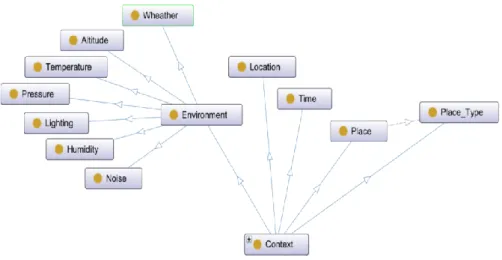
II.3.1. Context ... 31
II.3.2. Object ... 32
II.3.3. Video ... 33
II.3.4. Activity and Action ... 34
II.3.5. Scene ... 35
II.3.6. Description ... 37
II.4. Conclusion ... 39
III. Classifying deformable and non-deformable video objects ... 40
III.1. Introduction ... 40
III.2. Background and related works ... 41
III.2.1. Background ... 41
III.2.2. Works related to object deformability ... 42
III.2.3. Motion estimation ... 43
III.2.4. Projective transformation and Epipolar Geometry ... 44
III.2.4.A. Homography (projective transformation) ... 44
III.2.4.B. Fundamental matrix ... 45
III.3. Proposed approach ... 47
III.3.1. Motion estimation ... 48
III.3.2. Motion filtering ... 51
8 | P a g e
III.3.2.B. Uniformity filter ... 51
III.3.2.C. Texture Filter ... 51
III.3.3. Transformation ... 54
III.3.3.A. Homography (Projective transformation) ... 55
III.3.3.B. Fundamental Matrix... 55
III.3.4. Deformable and Non-Deformable Motions ... 56
III.3.5. Deformable and Non-Deformable Objects ... 59
III.3.6. Proposed Algorithms ... 64
III.4. Experiments ... 66
III.5. Conclusion ... 74
IV. Description of video surveillance scenes ... 75
IV.1. Introduction ... 75
IV.2. State of the art ... 76
IV.2.1. Object tracking and Multi-object tracking ... 77
IV.2.1.A. Object tracking ... 77
IV.2.1.B. Multi-object tracking ... 78
IV.2.2. Trajectory analysis ... 79
IV.2.3. Action and Activity classification and recognition ... 79
IV.2.4. Textual description templates ... 82
IV.2.5. Complexity of the video ... 83
IV.3. Proposed Approach... 84
IV.3.1. Segmentation and tracking algorithm ... 87
IV.3.2. Object classification ... 88
IV.3.3. Background change detection, and activity hot spots localisation... 89
IV.3.3.A. Changed Background detection ... 89
IV.3.3.B. Routes and activity hot spots localisation... 91
IV.3.4. Video Segmentation ... 92
IV.3.5. Feature extraction ... 93
IV.3.6. Scene type classification ... 96
IV.3.7. Interaction classification ... 97
IV.3.7.A. Interaction vs non-interaction classification ... 99
IV.3.7.B. Distant vs physical interaction classification... 99
IV.3.7.C. Aggressive vs Non-Aggressive interaction classification ... 99
IV.3.8. Scene analysis and description ... 101
IV.3.8.A. Scene key moments ... 102
IV.3.8.B. Scene activity characteristics matrix ... 108
IV.3.8.C. Scene description ... 109
IV.4. Experiments and results... 117
9 | P a g e
IV.4.2. Segmentation and tracking algorithms comparison ... 120
IV.4.3. Data preparation and pre-processing ... 120
IV.4.4. Classification training and results ... 121
IV.4.5. Scenes description results ... 126
IV.5. Discussion ... 132
IV.6. Conclusion ... 134
V. Surveillance systems - Between theory and practice ... 135
V.1. Introduction ... 135
V.2. Surveillance system overview ... 136
V.3. Surveillance systems for fighting crime and terrorist acts ... 137
V.3.1. The indirect effect ... 138
V.3.2. The direct effect ... 138
V.4. Filling the gap between practice and theory ... 139
V.4.1. Main difficulties and propositions in the research field ... 140
V.4.2. Main difficulties and propositions in practice field ... 141
V.4.2.A. System improvements propositions ... 142
V.4.2.B. Software improvements propositions ... 144
V.5. Conclusion ... 146
VI. General Conclusion ... 147
VI.1. Key contributions ... 147
VI.2. Summary ... 148
VI.3. Conclusion and Perspectives... 150
VII. References ... 152
VIII. Appendices ... 179
VIII.1. Appendix 1: related works in the domain of video surveillance ontologies ... 179
VIII.2. Appendix 2: Motion estimation techniques ... 180
VIII.3. Appendix 3: Argumentation of the maximization equation ... 184
VIII.4. Appendix 4: Examples of experiments on deformable vs non-deformable classification 186 VIII.5. Appendix 5: State of the art: Video Analysis ... 192
VIII.5.1. Object detection ... 192
VIII.5.2. Moving object segmentation ... 193
VIII.5.3. Object classification ... 193
VIII.5.4. Video action analysis ... 194
VIII.6. Appendix 6: Features extraction ... 195
VIII.7. Appendix 7: Graph representation of “Object characteristics template” ... 202
VIII.8. Appendix 8: Sample of a CCTV report ... 203
10 | P a g e
LIST OF TABLES
Table III-1: Table of ultimate thresholds: (a, b): a is the mapping error threshold, and b is the motion non-deformability threshold; below these thresholds is the corresponding percentage of
success (%). ... 59
Table III-2: Results from the temporal consistency-amelioration testing on 75 different videos (2141 frames), taking the Fundamental matrix, the Symmetric Epipolar distance, and the normalization level 2, where 𝛾𝐹2 =2.2 and 𝛿𝐹2 = 80.16. ... 63
Table III-3: Table of temporal motion non-deformability thresholds for each normalization when the mapping error threshold is fixed to 1(𝛾′𝐹𝑛 = 1and 𝛾′𝐻𝑛 = 1);(a, b): a is the percentage of success(%S),and b is the motion non-deformability threshold. ... 72
Table IV-1: Templates used for video surveillance textual description ... 82
Table IV-2: Scene type classification into 15 classes according to number of objects before and after the action, background changes and object features of the moving objects... 97
Table IV-3: The scene activity characteristics matrix Msac showing objects and interaction states for the scene “LeftBox”. ... 113
Table IV-4: The full description of the scene “LeftBox”, results of mapping the Msac into the proposed templates. ... 114
Table IV-5: The short description of the scene “LeftBox”, describe at each moment only the corresponding irregularity. ... 115
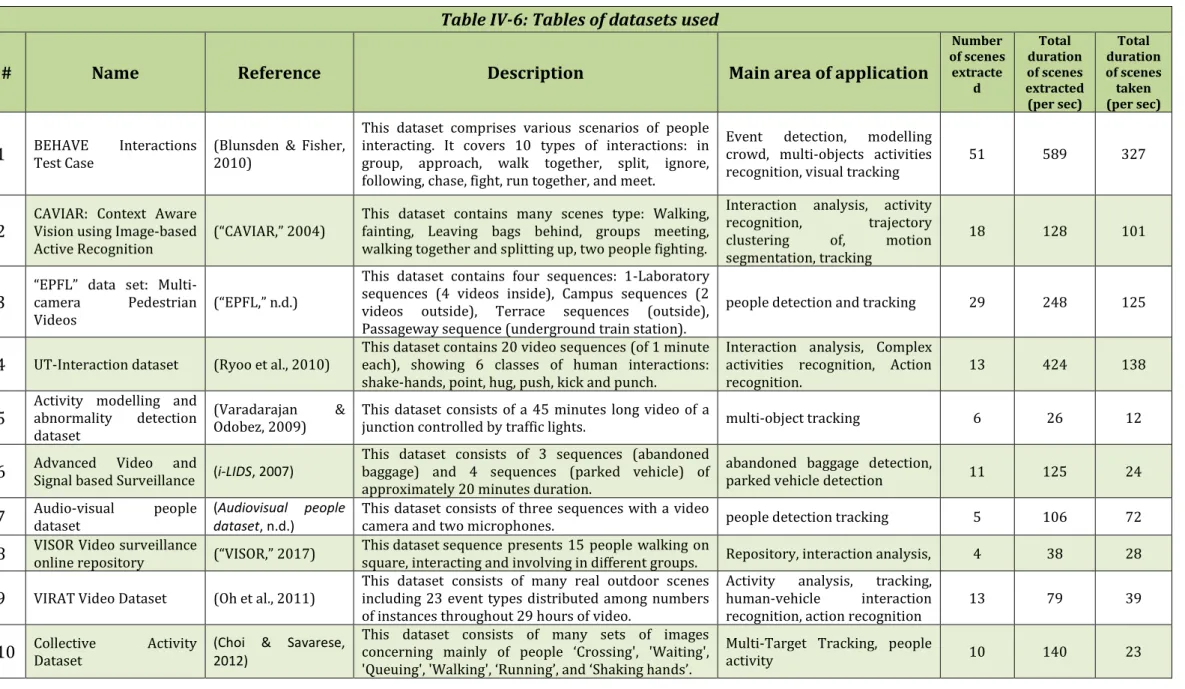
Table IV-6: Tables of datasets used ... 118
Table IV-7: Table listing 10 of the tested algorithms for objects segmentation and tracking ... 119
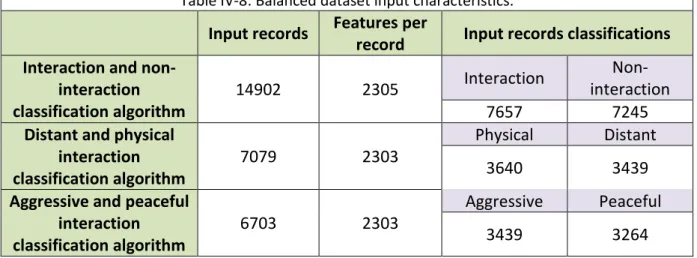
Table IV-8: Balanced dataset input characteristics. ... 121
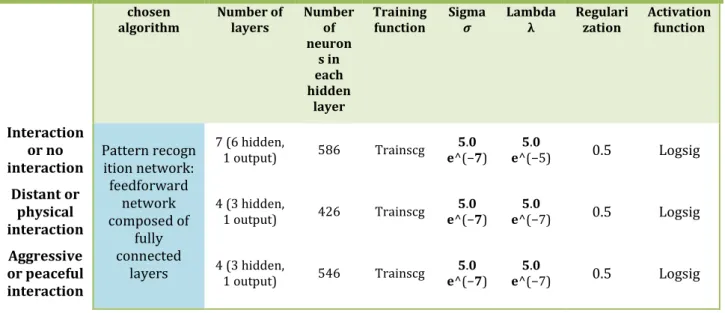
Table IV-9: Used parameters for the three classification DNN algorithms ... 125
Table IV-10: The short description of the scene “Fight_RunAway2”. ... 131
Table VIII-1: Comparison between the background subtraction, the temporal differencing, the optical flow approaches, block matching and feature correspondence. ... 183
Table VIII-2: Numerical representation of probability of 𝑎𝑟𝑔 𝑚𝑎𝑥𝑁, 𝑁2𝑃[𝑋 ≥ 𝑁2 with p = 82.58 and q= 17.42, and N, N2 = 1:15. ... 185
Table VIII-3: Percentage of correctly mapped points (𝛾′𝐹𝑛 = 1 and 𝛾′𝐻𝑛 = 1) ... 186
Table VIII-4: Percentage of correctly mapped points (Normalization = 2, 𝛾𝐹2 =2.2, 𝛿𝐹2 = 80.16) ... 186
Table VIII-5: Percentage of correctly mapped points (𝛾′𝐹𝑛 = 1 and 𝛾′𝐻𝑛 = 1) ... 187
Table VIII-6: Percentage of correctly mapped points (Normalization = 2, 𝛾𝐹2 =2.2, 𝛿𝐹2 = 80.16) ... 187
Table VIII-7: Percentage of correctly mapped points (𝛾′𝐹𝑛 = 1 and 𝛾′𝐻𝑛 = 1) ... 189
11 | P a g e
Table VIII-9: Percentage of correctly mapped points (𝛾′𝐹𝑛 = 1 and 𝛾′𝐻𝑛 = 1) ... 190
Table VIII-10: Percentage of correctly mapped points (Normalization = 2, 𝛾𝐹2 =2.2, 𝛿𝐹2 = 80.16) . 190 Table VIII-11: Percentage of correctly mapped points (𝛾′𝐹𝑛 = 1 and 𝛾′𝐻𝑛 = 1) ... 191
Table VIII-12: Percentage of correctly mapped points (Normalization = 2, 𝛾𝐹2 =2.2, 𝛿𝐹2 = 80.16) . 191 Table VIII-13: Spatial features of objects ... 195
Table VIII-14: Temporal features of objects ... 197
Table VIII-15: Inter-object features ... 199
12 | P a g e
LIST OF FIGURES
Figure I-1: An example of video captioning architecture using sequence learning approach, taken
from (Z. Wu, Yao, Fu, & Jiang, 2017) ... 21
Figure I-2: An example of dense video captioning taken from (Zhou, Zhou, Corso, Socher, & Xiong, 2018). The colour bars represent different events. Coloured texts highlight relevant content to the event. ... 23
Figure II-1: VSSD ontology’s six main classes: Object, Video, Context, Activity, Scene and Descriptor. ... 31
Figure II-2: The Context class. ... 32
Figure II-3: The Object class. ... 32
Figure II-4: The Video, object, video_object, and context classes. ... 33
Figure II-5: The Sub_object, Video_Object_state, and Sub_object_state classes. ... 33
Figure II-6: The Activity, Action-Interaction, and Operation classes ... 35
Figure II-7: The Scene, and Descriptor classes ... 37
Figure II-8: Abstract description, having in the location and direction: U (Up), M (Middle), D (Down), R (Right), L (Left), I (inside), and O (outside). ... 38
Figure II-9: The proposed "Video-Surveillance-Description Ontology". ... 39
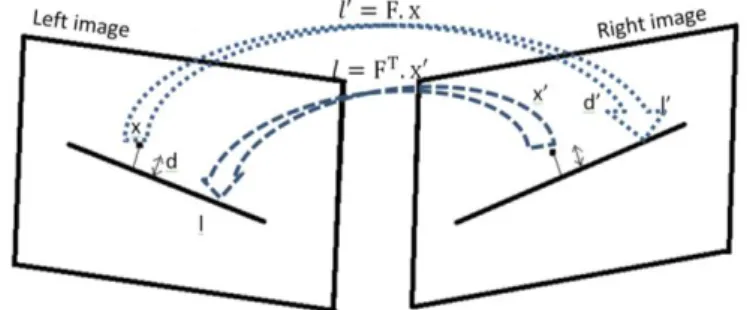
Figure III-1: Symmetric Transfer Error ... 45
Figure III-2: Symmetric Epipolar Distance ... 46
Figure III-3: Flow chart for the proposed method ... 48
Figure III-4: Scene with a person (Frame 25): Marzat’s algorithm applied for estimating motion. ... 50
Figure III-5: Walking Scene: Frames references (Figure III-5-a and Figure III-5-b), and result of Marzat’s algorithm applied give Figure III-5-c (without filtering). ... 52
Figure III-6: Walking Scene: Uniformity Filtering result (regular size) of Figure III-5-c; we can notice that the groups of false vectors on the left and near the boy are deleted. ... 52
Figure III-7: Walking Scene: Texture Filtering (zoomed size) of Figure III-6; we can notice that the groups of false vectors near the left foot of the boy are deleted. ... 52
Figure III-8: Highway 4 scene: Frames references (Figure III-8-a and Figure III-8-b), and result of Marzat’s algorithm applied give Figure III-8-c (without filtering). ... 53
Figure III-9: Highway 4 scene: Uniformity Filtering result (zoomed size) of Figure III-8-c; we can notice that the false vectors around the car are deleted. ... 53
Figure III-10: Highway 4 scene: Texture Filtering result (zoomed size) of Figure III-9; we can notice that the false vectors near right doors of the car are deleted ... 53
13 | P a g e
Figure III-11:Scene with a person (Frame 25): Marzat’s algorithm after filtering. ... 54
Figure III-12: The case N2<=N/2. ... 62
Figure III-13: The case N2>N/2 ... 62
Figure III-14: Scene from “Highway 2”: (a) Frame 97, (b) Frame 96, (c) Motion vectors, (d) Zoomed motion vectors (755×2 corresponding points). ... 67
Figure III-15: Scene from “Walking”: (a) Frame 83, (b) Frame 80, (c) Motion vectors, (d) Zoomed motion vectors (365×2 corresponding points). ... 67
Figure III-16: Scene from “Bomb2”: (a) Frame 117, (b) Frame 114, (c) Motion vectors, (d) Zoomed motion vectors (365×2 corresponding points). ... 68
Figure III-17: Ideal threshold (the yellow vertical line) and the discovered one (the violet oblique line). ... 70
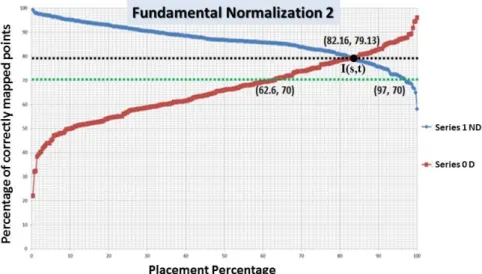
Figure III-18: Graph for F2 with a mapping error threshold 𝛾′𝐹2 = 1, y=70, intersecting with Series 0 at 62.6, and Series 1 at 97. ... 71
Figure III-19: Graph of the H1 with 𝜸′𝑯𝟏 = 𝟏 ... 72
Figure III-20: Graph of the F1 with 𝜸′𝑭𝟏 = 𝟏 ... 72
Figure III-21: Graph of the H2 with 𝜸′𝑯𝟐 = 𝟏 ... 72
Figure III-22: Graph of the F2 with 𝜸′𝑭𝟐 = 𝟏 ... 72
Figure III-23: Graph of the H3 with 𝜸′𝑯3 = 𝟏 ... 72
Figure III-24: Graph of the F3 with 𝜸′𝑭𝟑 = 𝟏 ... 72
Figure III-25: Graph of the variation of curves with intersection points according to variable mapping error thresholds, for F, normalization 3, mean distance, and a mapping error threshold of 𝛾′𝐹3 = 0.2: 0.2 ∶ 10. ... 73
Figure IV-1: Proposed approach diagram, where each phase connected to an arrow starting point feeds the phase connected to the terminal point of the corresponding arrow. ... 86
Figure IV-2: Objects movements and trajectories, Fight_RunAway2 scene from CAVIAR Video Sequence (“CAVIAR,” 2004). ... 88
Figure IV-3: Example: background Model (left image), activity map (right image), part of video Fight_OneManDown (“CAVIAR,” 2004). ... 91
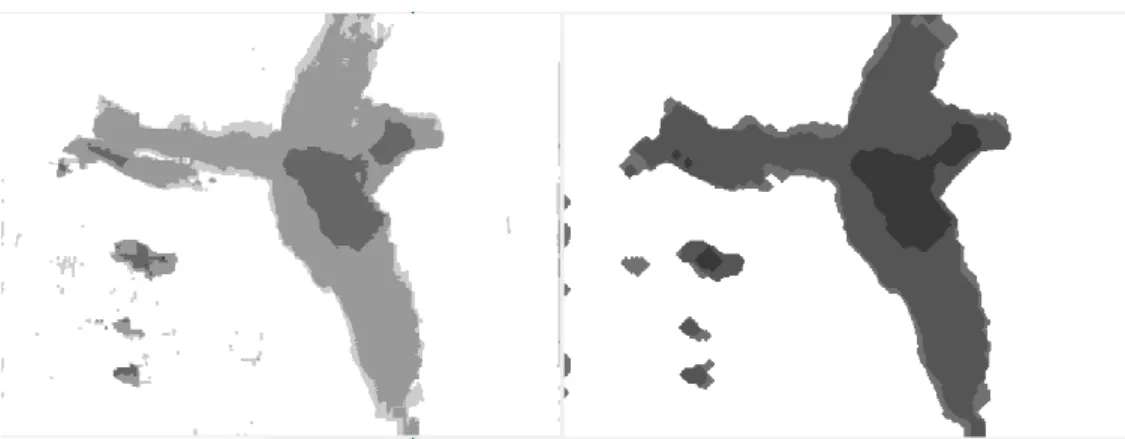
Figure IV-4: Pixels quantification of activity map (left image), and morphological filters result (right image), part of video Fight_OneManDown (“CAVIAR,” 2004). ... 92
Figure IV-5: Coloured morphological filters result (left image), and projected to background model (right image), part of video Fight_OneManDown. ... 92
Figure IV-6: Coloured morphological filters result (left image), and projected to background model (right image) of scene “Fight_RunAway2”. ... 92
14 | P a g e Figure IV-8: Features extracted from a window of N frames. Each set of features at an arrow starting point feeds the set of features at its terminal point. ... 95 Figure IV-9: Example scene left bag (left figure a), on the right side: X axis is the frame’s number, Y
axis is the percentage of changed pixels between
𝐼𝑥, 𝑦, 𝑡. 𝑀𝑡𝑎𝑥, 𝑦, 𝑡 𝑎𝑛𝑑 𝑀𝑡𝑏𝑥, 𝑦, 𝑡. 𝑀𝑡𝑎𝑥, 𝑦, 𝑡... 96 Figure IV-10: Extracting the scene classification vector indicating the existing or not of interaction.
... 100 Figure IV-11: Objects Hu moment variations in the scene “LeftBox” from the database (“CAVIAR,”
2004), it shows a brutal variations between frames 300 and 350, this is due to false detection. ... 102 Figure IV-12: Objects surfaces variations in the scene “LeftBox”, same false detection of the object 1
influence its surface. ... 103 Figure IV-13: Left image shows the eight directions (in red and green) and the sixteen areas (dashed
lines are the sectors borders). Right image shows trajectories (object1 trajectory in red, and object2 trajectory in green. ... 104 Figure IV-14: Figure showing the routes in green and the 2 levels of activity hot spots in blue and red, of scene “LeftBox. ... 104 Figure IV-15: Figure showing labelled route as A (green area) and activity hot spots as B (bleu area)
and C (red area) in the scene “LeftBox”. ... 104 Figure IV-16: Objects speed variations (skipping 10 frames between 2 positions used for
computations) in the scene “LeftBox”. ... 105 Figure IV-17: Objects angles variations (skipping 25 frames between 2 positions used for
computations) in the scene “LeftBox ”. ... 105 Figure IV-18: Two Objects distances (skipping 5 frames between 2 positions used for computations)
in the scene “LeftBox”. ... 106 Figure IV-19: Interaction existence classification results for the scene “LeftBox”, (0 no–interaction, 1
interaction): a- classification direct results, b- results after quantification (>=0.5) without filtering. ... 106 Figure IV-20: Interaction existence classification for the scene “LeftBox” after filtering using (Jaffré &
Joly, 2005), shows an interaction began to appear at window starting at frame 40... 107 Figure IV-21: Interaction existence classification variance for the scene “LeftBox” after filtering .... 107 Figure IV-22: Classification direct results: blue line (physical (1) or distant (0)), orange line (peaceful
(0) or aggressive (1)). Obviously all values are very close to 0 (distant and peaceful interaction). ... 107 Figure IV-23: Objects accelerations (skipping 10 frames between 2 positions used for computations)
in the scene “LeftBox”: different threshold should be chosen for each of the objects. . 107 Figure IV-24: Objects in the scene “LeftBox” at the frame 101: showing the trajectory of object 1,
15 | P a g e Figure IV-25: Objects distant interaction in the scene “LeftBox” at the frame 145: showing the first
distant peaceful interaction between objects 1 and 2... 111
Figure IV-26: Objects after interaction in the scene “LeftBox”, at the frame 190. ... 112
Figure IV-27: Object 2 exiting the scene “LeftBox”, at the frame 238. ... 112
Figure IV-28: Object 1 in the scene “LeftBox” is miss detected. ... 112
Figure IV-29: Object 1 exiting the scene “LeftBox”. ... 112
Figure IV-30: Confusion matrix for the chosen AdaBoost algorithm ... 123
Figure IV-31: Confusion matrix for the chosen DNN algorithm ... 123
Figure IV-32: Objects distant interaction in the scene “Fight_RunAway2”: frame 279 showing the trajectories of each object, and the distant aggressive interaction between objects 1 (showing as 5) and 2 (showing as 6). ... 126
Figure IV-33: Objects physical interaction in the scene “Fight_RunAway2”: frame 321 showing the physical aggressive interaction between objects 1 and 2. The two object are here detected as being one (object number 2 (showing as 6).). ... 126
Figure IV-34: Objects after interaction in the scene “Fight_RunAway2: frame 468 showing no more interaction between the object 1 (as 6) and object 2 (as 8). ... 126
Figure IV-35: Objects exiting in the scene “Fight_RunAway2”: frame 488 showing the object 1 (as 6) exiting the scene. ... 126
Figure IV-36: Variations of Hu moments in scene “Fight_RunAway2”. ... 127
Figure IV-37: Variations of Objects surfaces in the scene “Fight_RunAway2”. ... 127
Figure IV-38: Objects trajectories in the scene “Fight_RunAway2”: the red trajectory is the object1 centroid displacement and the green trajectory is for the object2. ... 128
Figure IV-39: Figure showing, in the scene “Fight_RunAway2”, the areas of interests (routes in green and the activity hot spots in blue and red). ... 128
Figure IV-40: Objects accelerations (skipping 5 frames between 2 positions used for computations) in the scene “Fight_RunAway2” for each of the two objects. ... 129
Figure IV-41: Objects angles variations (skipping 10 frames between 2 positions used for computations) in the scene “Fight_RunAway2”. ... 129
Figure IV-42: Two Objects distances in the scene “Fight_RunAway2”: the local minimum occurs when the two objects approaches physically. The algorithm detects them as being one single object. The distance is then 0. ... 130
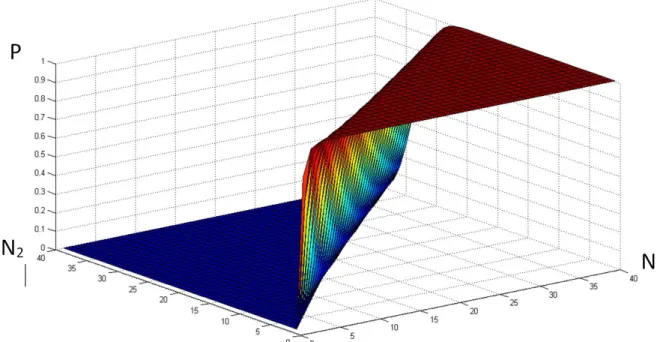
Figure VIII-1: Graphical representation of probability of 𝒂𝒓𝒈 𝒎𝒂𝒙𝑵, 𝑵𝟐𝑷[𝑿 ≥ 𝑵𝟐 for 1<= N <=40 and 1<= N2 <=N, having p = 82.58, q= 17.42, f, Symmetric epipolar distance, normalization level 2, 𝜸𝑭𝟐 =2.2, and 𝜹𝑭𝟐 = 80.16. ... 184
Figure VIII-2: Scene of “Stairwell”: a- frame 31, b- frame 28, c- motion’s vectors, and d- motions’ vectors zoomed (128*2 corresponding points) ... 186
16 | P a g e Figure VIII-3: Scene of “Stairwell”: a- frame 44, b- frame 40, c- motion’s vectors, and d- motions’
vectors zoomed (293*2 corresponding points) ... 187
Figure VIII-4: Scene “Stairwell”: Percentage of correctly mapped points for H ... 188
Figure VIII-5: Scene of “ Running ”: a- frame 28, b- frame 27, c- motion’s vectors, and d- motions’ vectors zoomed (351*2 corresponding points) ... 189
Figure VIII-6: Scene of “ Highway 2 ”: a- frame 97, b- frame 96, c- motion’s vectors, and d- motions’ vectors zoomed (690*2 corresponding points) ... 190
Figure VIII-7: Scene of “ Bomb 2 ”: a- frame 117, b- frame 114, c- motion’s vectors, and d- motions’ vectors zoomed (317*2 corresponding points) ... 191
Figure VIII-8: Two objects states in a frame. ... 195
Figure VIII-9: Figure showing bbox, mask and pixels features extracted from an object ... 196
Figure VIII-10: Temporal features of objects ... 196
Figure VIII-11: Figure showing the angle feature for object movement ... 197
Figure VIII-12: Figure showing bbox, mask and pixels features extracted from an object ... 198
Figure VIII-13: Inter-Objects features. ... 198
Figure VIII-14: Objects Trajectories ... 200
Figure VIII-15: Original trajectories are in blue. The new trajectories after filtering are in red. a- Average filter, b- First order prediction filter, and c- Second order prediction filter ... 201
Figure VIII-16: Graph representation of “Object characteristics template”. Clauses in red indicate that the clause may not be present in the output sentence (to be decided according to rules). ... 202
17 | P a g e
I. Introduction
In an era of rapid technological development on many fields (social, political, economic, security, …), and the accompanying changes of the crime aspects and its methods, getting more sophisticated by the day, the law enforcement agencies duties towards their citizens are becoming more and more difficult to enforce. These duties revolve around the protection of persons, property and freedom, the maintaining of order and the strengthening of security, public safety and the application of laws and regulations. Thus, law enforcement agencies, are in continuous search for effective public safety and security strategies to help deal with criminal and terrorist acts.
The new face of dealing and fighting with crimes is through collecting data, and transforming this data into intelligence. Among the most modern public safety and law enforcement tools is the surveillance system, where the video surveillance is a big source of data and the strong point of the most investigations.
The rapid progress in technology, Multiplexing, digital technology, NVRs, storage and processing made enormous progress in surveillance systems. For that, the deployment of video surveillance systems worldwide has grown exponentially in recent years. Many of large cities have concerns about crimes, terrorist attacks, incidents and antisocial behaviour problems, such as fights, vandalism, breaking and accidents, often these cities have video cameras already installed in the streets and around the important sites. Visual surveillance is now used to monitor the security of sensitive areas, as a risk management and crime reduction tool, such as in public places, schools, banks, shopping malls, transport infrastructures (e.g. airports, underground stations), hospitals, government buildings and borders.
One of the most important duties and goals of surveillance systems is to live monitoring the surveillance areas, in case incident occurs, actions should be taken. Another main focus is crime solving by investigating the archives. Two tasks are difficult to achieve, due to lack of human resources for active monitoring and of accurate parameters concerning archive indexation. Most, video surveillance recordings are indexed with rough descriptors such as time, camera ID and some photometric parameters.
Surveillance systems produce large amounts of video data which are stored for immediate or future use. Years of video surveillance are recorded. A crucial need is to make sense of this massive quantity of visual data. Surveillance videos are generous in motion information which rises up as one of the most important clue to identify the dynamic content of videos. Extraction and analysis of motion information in videos are essential in content-based surveillance video analysis and understanding. Detecting and understanding an incident is a simple mission for human, but it is very complicated for machine.
There is a fundamental need to extract automatically meaningful content and produce high-level scheme or descriptions of the activities. Such a system can help effectively to generate alerts to assist the live monitoring, and can help intelligently to index, organize, and retrieve valuable information from surveillance video databases, and finally to automatically generate useful reports.
Several significant solutions from the research and market fields have been proposed. However, the lack of generic and precise models for video content representation make building of fully automated intelligent video analysis and description a challenging task. This lack is due to the high complexity of video scenes, and its diversity from the
18 | P a g e
context to the objects and actions types. Furthermore, for these reasons and many others, the application domain still shows a big gap between the research field and the real needs, also show a lack between these real needs and the on-market video analytics tools. Unfortunately, till now, both tasks of crime solving and live monitoring in conventional visual surveillance systems rely mostly on human operators; either to dig hard threw hundreds of hours in the archives, or to monitor actively hundreds of cameras.
This thesis proposes a novel approach for textual description of the video scenes. We claim it to be a new approach for a general knowledge-based context-independent applicable in real-world surveillance video. Our approach is based on a proposed ontology, which combines objects features and derive high-level information; our ontology is methodologic and easily expendable.
From the perspective of an experienced Major, head of CCTV control room, the main two concerns of the approach were, to: first automatically extract useful information for investigating the archives and setting up alerts in real-cases, and second, to present it in an understandable way for the system operators by proposing new sentence representations. For that, well-structured schemas can be applied to generate incident scene descriptions similar to ones used in police reports. These schemas are also called templates.
"On Friday 17/05/2019 at 15:06:39: A person "2" moves, in intersection spot "Hamra-Rome" (33.895245, 35.487536), on the left of "Hamra" street, heading immediately north, toward the person "1", occurring respectively irregularity in its shape, and big changes occurring respectively on its surface having now smaller one, and having respectively considerable decreasing of its Speed.
"The two objects are approaching; a distant aggressive interaction occurs between them."
Example of scene description and of object interaction description.
A description as the one in the above example can be very helpful for the surveillance system operators. It is based on many useful parameters such as objects characteristics, and inter-objects parameters. Those characteristics can be set up to generate alerts. They also can be queried for, in the archives.
This thesis also highlights the existing gap between the research field and the surveillance system operators’ needs from one side and the gap between the latter one with the commercial (industry) field. Many propositions were made driven by my personal experience as a researcher and a CCTV Control Room manager.
The research works presented in this thesis have been conducted under high constraints of applicability in a professional context. They took place in the framework of cooperation between IRIT Laboratory in the University of Paul Sabatier – Toulouse, France, and the Lebanese university, Beirut, Lebanon, and Beirut CCTV control room, Lebanon.
19 | P a g e
I.1. State of the art
Understanding and textually describing a video scene is an easy task for most humans, but is still a complex task to the computer. Automatic video scene description includes understanding and differentiating between the multiplicity of the backgrounds, the objects, the interactions, the scenes types, and the temporal order of incidents and events. Moreover, it requires a translation of the information into a comprehensible textual description or what is known as natural language.
The textual description, in general, can be used to improve wide range of applications like human-robot interaction, scene descriptor for blind, summary of (web-) videos, medical diagnosis, surveillance systems, robotics, military systems and others. In specific, for surveillance systems and traffic surveillance in cities, generating alerts for the observers and intelligently investigating the archives for the investigators.
In the last decades, researchers have studied multiple strategies and ontologies to bridge the gap existing between visual content and textual description. For that, Computer vision and Natural language Processing (NLP) fields addresses such a problem, separately and also, some workshops have been held on both areas (Andrei et al., 2018).
Being stretched, over more than two decades, and having so many applications have made this area of research very wide. Therefore, it’s quite challenging to recapitulate and categorize all the works done in this area, especially as each contribution might differ according to the needs, outputs, methodologies, automation degree, used methods, and even sometimes trends.
In addition, researches in the related fields to video description like connecting words to pictures, image captioning, video to text, narrating images in natural language sentences, video captioning, video summarization, behaviour descriptions, natural-language video descriptions, and visual recognition and description, may share common methods or follow similar methodology.
Not restricted to video surveillance, two main approaches can be noticed:
1- Behaviour understanding and sentences generation (Barbu et al., 2012) (Thomason, Venugopalan, Guadarrama, Saenko, & Mooney, 2014) (Guadarrama et al., 2013), (A. Rohrbach et al., 2014), (R. Xu, Xiong, Chen, & Corso, 2015): this approach’s name was chosen because most of the researches following this approach are mainly focusing on two stages:
a. Behaviour understanding and content identification: also known as Knowledge-based or deterministic approaches. Extracting all needed features for identifying the semantic content and understanding the behaviour and the scene. A variety of approaches, techniques and methods have been proposed, we mention, object detection and segmentation, object classification, object recognition, multi-object tracking, trajectory analysis, action analysis, activity classification and recognition, and others. Typically, this part may involve training individual classifiers to identify background, objects, and actions in the scenes. As our main approach will focus on extracting many of the features, we will furthermore discuss the state of art of each of the corresponding methods in chapter IV.
b. Sentence generation: generating a sentence, normally, based on a template with syntactical structure (like Subject-Verb-Object SVO tuples, place, and scene). It may
20 | P a g e
uses also a probabilistic model to map the most important visual content results from the video for each of the template categories to generate a sentence.
Some approaches from the literature are explained in the next section:
- In (S. Park & Aggarwal, 2004), the authors present a method to describe two-person interactions in a semantic NL description. For that they detect body posture after integrating individual body parts (head, torso, arms and legs) recognized using Bayesian networks (BNs). To recognize specific interactions, they used decision tree with rule-based spatial and temporal constraints. Then they map it into verb phrases using sequential and simultaneous recognitions of the predefined interactions. Human interactions are then represented as cause–effect semantics between syntactical <agent-motion-target> triplets.
- In (Farhadi et al., 2010), the authors proposed a system based on the detection of one object per image, then map it to the corresponding textual descriptions using a predefined language templates (triplet of S-V-O).
- In (Barbu et al., 2012), the authors use a dynamic programming approach combined with Hidden Markov Models to obtain verb labels for short video clips, for producing sentential descriptions.
- In (Guadarrama et al., 2013), the authors used semantic hierarchies to indicate the appropriate level of the accuracy and specificity of sentence fragments.
- In (M. Rohrbach et al., 2013), the authors incorporated semantic unaries and hand-centric features and utilized a CRF-based approach to generate video descriptions. Their method is composed mainly of two steps; first to generate semantic representation models, they feed a Conditional random field CRF using dense trajectories and SIFT features and temporal context reasoning. Second they translate it to natural language using Statistical Machine Translation (SMT).
- In (R. Xu et al., 2015), for video sentence generation the authors designed a deep joint video-language embedding model.
- In (Hanckmann, Schutte, & Burghouts, 2012), the authors proposed a hybrid method to generate textual descriptions of video actions. Their system has mainly two parts, an action classifier and a description generator. They detect and classify 48 actions in a video using the Bag-of features. The description generator, a rule-based method, finds the actors (persons or objects) in the video and connects these to the appropriate verbs.
- Krishnamoorthy et al. (Krishnamoorthy, Malkarnenkar, Mooney, Saenko, & Guadarrama, 2013) they were the first to introduce early works of describing open domain short videos data (YouTube videos). They used knowledge mined from webscale text copora to determine the best likelihood of various combinations of subject-verb-object triplets. They use a template-based approach to present the textual description, as: “Determiner (A, The) - Subject - Verb (Present, Present Continuous) - Preposition (optional) - Determiner (A, The) - Object.” They evaluate the system automatically and by human evaluation.
Another interesting works were presented by (Guadarrama et al., 2013), (Das, Xu, Doell, & Corso, 2013).
2- Sequence learning approach (A. Rohrbach et al., 2017), (Jeff Donahue et al., 2017), (J. Xu, Mei, Yao, & Rui, 2016), (Venugopalan et al., 2014): Known also as deep learning, probabilistic or data-driven approaches. This approach directly learns to map between
21 | P a g e
video content and textual sentence. This approach can be mainly divided into two stages:
a. Video encoding stage: also known as Visual recognition where the visual features are directly extracted, more accurately, learnt, using different types of deep neural network algorithm, like Convolutional Neural Network (CNN), Recurrent Neural Network (RNN) or Long Short-Term Memory (LSTM). The produced result composes a fixed or dynamic real-valued vector.
b. Video decoding stage: also known as the sequence generation or text generation, where the vector result of the first stage is fed for text generation, as single or multiple sentences. For decoding, first RNN were used, RNN is a neural network adding extra feedback connections to feed-forward networks, enabling it to work with sequences of inputs. Then, the network is updated grounded on every input item and the preceding hidden state. They are networks with loops that allow persevering information. These networks, mainly, have been used in many fields such as speech recognition, language modelling, image captioning, translation and more. Different types of deep neural network are now in use, most commonly, deep RNN, Bi-directional RNN, Long Short-Term Memory LSTM, Gated Recurrent Units (GRU) or others.
In general, a sequence learning approach eludes the two steps of content identification and sentence generation by learning to match directly videos frames to human sentences. Different combination of encoding-decoding algorithm may be used, to mention CNN–RNN, RNN–RNN, and deep reinforcement networks. An example of a common architecture for video captioning using sequence learning approach is given in Figure I-1, where 2D or 3D CNNs are exploited, on a video sequence, to extract features on optical flow images, video frames, or others… The video-level representations are then produced by mean pooling or soft attention over these visual features. Then, on the level of representations, an LSTM is trained for generating a sentence.
Figure I-1: An example of video captioning architecture using sequence learning approach, taken from (Z. Wu, Yao, Fu, & Jiang, 2017)
Examples of some important works on sequence learning approach:
- Some of the researches on template-based video representation used statistical machine translations (Jeffrey Donahue et al., 2015), (Barbu et al., 2012), (Atsuhiro Kojima, Tamura, & Fukunaga, 2002), (M. Rohrbach et al., 2013). These approaches map semantic sentence representation (e.g. key objects, locations, and scenes), with
22 | P a g e
a Conditional Random Field (CRF) model, to high-level concepts such as the actors, actions and objects, for generating sentences. In (Jeff Donahue et al., 2017), the authors then improved their system by learning the output sequence representations into an LSTM model to translate it to a natural sentence.
- In (Venugopalan et al., 2014), the authors proposed an end-to-end neural network to generate video descriptions. By mean pooling, the features over all the frames are represented by one vector, to be used as an input of an LSTM model to generate sentences. For better modelling results, not only video contents and their spatio-temporal relationships were used, but also the syntactical structure. (Venugopalan et al., 2015) they extended their work by adding to the input frames and optical flow images to feed an encoder-decoder framework based on two LSTM modules. The encoding converts video into a compact representation, followed by the decoding to converts the output into a caption.
- In (Yao et al., 2015), the authors proposed to utilize a temporal attention mechanism and a spatio-temporal convolutional neural network to obtain action features. The resulting video representations were used as input into the text-generating RNN. - In (Pan, Mei, Yao, Li, & Rui, 2016), the authors proposed to model video content and
textual semantics as a regularizer in Long Short-Term Memory architecture. (Pan, Yao, Li, & Mei, 2017) presented LSTM with transferred semantic attributes (LSTM– TSA) architecture where the semantic features were extracted from both images and videos using the CNN plus RNN framework for enhancing video sentence generation. - In (Yu, Wang, Huang, Yang, & Xu, 2016), the authors used a hierarchical RNN (hRNN) to describe long video containing more than one event. The notion of hierarchical framework is to make use of the temporal dependency and semantic context between the sentences in a section. Mainly, they used two generators; a single sentence generator produced by a Gated Recurrent Unit (GRU) layer, using spatial and temporal information present in a precise time interval of a video, and a section generator models dependency between the sentences. As output, they generate a mundane description using multiple sentences in a section.
- In (Long, Gan, & de Melo, 2018), the authors proposed an LSTM with two multi-faceted attention layers which export temporal, motion and semantic properties, using nearest neighbor (NN) search, Support Vector Machine (SVM) and hierarchical recurrent neural encoders (HRNE) for a subject and verb prediction based on the temporal features.
- In (Das et al., 2013), the authors proposed to generate dense captions using sparse object stitching; their work for the description is not data-driven, however it is based on top-down ontology.
A comparative review of existing sequence learning approach in video description methods can be found in: (J. Xu et al., 2016), (Ryoo, Chen, Aggarwal, & Roy-Chowdhury, 2010), (Awad et al., 2018), and (Graham, Awad, & Smeaton, 2018). An example of video description (dense captioning) is shown in Figure I-2.
23 | P a g e
Figure I-2: An example of dense video captioning taken from (Zhou, Zhou, Corso, Socher, & Xiong, 2018). The colour bars represent different events. Coloured texts highlight relevant content to the event.
A comprehensive and interesting literature review on video description can be found in (Z. Wu et al., 2017), and (Aafaq, Mian, Liu, Gilani, & Shah, 2018).
Nevertheless, both approaches; Behaviour understanding and sentences generation and Sentences learning, have some major flows:
1- The Behaviour understanding and sentences generation approach: according to (Venugopalan et al., 2015) this approach is insufficient to model the richness of language used in human descriptions – e.g., which attributes to use and how to chain them effectively to generate a good description. Also, according to (Z. Wu et al., 2017), the missing, erroneous and misidentified information extracted from the video frames leads to disjointed descriptions. In plus, the handcrafted templates risk being non-generic for the variety of scene types (J. Xu et al., 2016).
2- The Sentences learning approach: according to (Aafaq et al., 2018) “The majority of current literature on video description focuses on domain specific short video clips with limited vocabularies of objects and activities”. And so, current state of-the-art methods may not be suitable for long video sequences because they mainly focus on short topic-coherent ones. For that, the description of longer videos and scenes having variety of types remains a challenge, due to the need of large vocabularies and training data. In this domain, there is a lack of rich models that can learn the sentences to the appropriate features in the frames sequence.
Despite the tremendous work done in the field of video description in general, the existing state of art on video surveillance scene description as has it is particularity, still, however not deeply prospected. For example, video description for movies, broadcast news, or sports, can unveil practical drawbacks for video surveillance (Jiangung Lou, Qifeng Liu, Tieniu Tan, & Weiming Hu, 2002), (C. Fernández, Baiget, Roca, & Gonzàlez, 2011).
But even though that most of the researches focus mainly on short non-surveillance videos, some of the advancements made in the approaches can be used in the field of video surveillance.
Next we mention some of the most influencing works on video surveillance understanding and description:
- In Remagnino et al. (Remagnino, Tan, & Baker, 1998a), (Remagnino, Tan, & Baker, 1998b), the authors mainly focus on traffic scene to represent the behaviour of pedestrians and vehicles, where their system is based on Bayesian network to give annotations for some events in natural language. They handle also some cases of
24 | P a g e
interaction between two objects when the distance between the two is below a threshold.
- In (Aishy, 2001), the authors proposed a system for object and event extraction for video processing and representation. They mainly targets videos having realistic environment (with objects occlusions, artefacts). They proposed three processing levels: video enhancement, video analysis and meaningful content extraction (spatio-temporal features), and video events interpretation. They tested the system on real-time videos. Nerveless they did not work on textual description, but they highlighted in their approach, many interesting aspects in this field, especially concerning the real-case features extracted, and the logical relations.
- (Atsuhiro Kojima et al., 2002), (A. Kojima, Izumi, Tamura, & Fukunaga, 2000) are two of the early works that proposed, on human activities, generating a hierarchical concept of actions for natural language description appearing in real image sequences. The authors primarily describe videos of a one person performing a single action. They detect humans head and hands by a probabilistic approach, and then they use their positions and the head direction to estimate the human posture. Meanwhile, the most appropriate verbs and many syntactic elements are selected. As last step, they used machine translation method to generate natural language text.
- In (Jiangung Lou et al., 2002), the authors propose an approach for semantic interpretation of pedestrian and vehicle’s behaviours for visual traffic surveillance. The trajectories recorded are then analysed using dynamic clustering, they introduce, based on HMM, a trajectory segment analysis method to every trajectory class. Then, in each segment, they assign the action of the tracked target to four basic types: Move Forward, Turn Right, Turn Left and Stop. Then they perform classification to feed the natural language semantic interpretation. For that, they use a simple grammar rule template: (The Obj) (Action) in (The place name) [at (high/low/middle) speed]. The system output module is only activated when:
1. A new action is occurring (Move Forward, Turn Right, Turn Left and Stop). 2. The object is entering a new region
3. An abnormal event is occurring
Their system is restricted to one scene type, and one object type, and did not take interactions into consideration.
- In (C. Fernández et al., 2011), (Carles Fernández, Baiget, Roca, & Gonzàlez, 2008), the authors present a supervised ontology-based methodology. Their ontology shown in (Carles Fernández et al., 2008) present interesting ideas and intersect with our ontology in many concepts. They first perform image segmentation for agent trajectories detection, body postures, and facial expressions, and targets identification. Then these information passes by a user for data filtering. They made this data for each detected agent available within a ground-plane representation of the controlled scenario. The uses XML for data exchange among the modules. Their approach considers, for video surveillance, different scene type, indoor and outdoor scenarios.
Their proposed taxonomical events include basic actions and events (e.g. walk, run, turn) and some scenario-specific interpretation of behaviours (e.g. meeting, giving way, chasing). Their textual output is presented like: turn (Agent 20, left, crosswalk).
25 | P a g e
- In (Z. Xu, Zhi, Liang, Lin, & Luo, 2014), (C. Hu, Xu, Liu, & Mei, 2015), (Z. Xu, Hu, & Mei, 2016) the authors proposed approaches were called as Video structural description VSD. VSD targets at describing video content in text sentences. Firstly, they extract the semantic content from the video relying on spatiotemporal segmentation, feature selection, object recognition. Secondly, VSD aims at organizing resources in the video according to their semantic relations. The proposed method is based on ontology; which, between barracks, is highly recommended for a video structured description, it defines a number of concepts including vehicle, people, and traffic sigh, and their spatial-temporal relations, which allow users to annotate traffic events. In their approaches, they did not consider objects interactions description in the scene.
- A very recent and interesting work was presented in (Ahmed, Dogra, Kar, & Roy, 2019), where the authors present template-based technique that generates natural language descriptions of surveillance events. First, they track moving objects, and then they perform classification using CNN on the output into four classes: pedestrian, car, Bike, and Cycle. Finally, their system generates natural language description based on template: “A {color} {size} {type} in {speed}, coming from {entry zone} toward {exit zone}”, as “A white medium vehicle in normal speed, coming from Main Building toward Residential Zone”.
Two important points were noticed, concerning the authors and their “experts” insist on the importance of structured templates, and human experts’ assessment. Their system assumes a surveillance scene with some prior region information, and they did not consider interaction.
Other interesting research is presented in (Tu, Meng, Lee, Choe, & Zhu, 2014), (L. Xu & Song, 2016), (W. Hu, Xie, Fu, Zeng, & Maybank, 2007), (Gerber, Nagel, & Schreiber, 2002).
I.2. Goals and Challenges
Our primary goal, in this thesis, is to describe textually video surveillance scenes, in a comprehensive way to support police incidents reports. We focus on scenes containing exactly two objects. The secondary goal will be extracting valuable features useful for generating alerts and investigating intelligently the archives by surveillance system operators.
Automatic systems that can assist police and law enforcement agencies still need improvements in order to cope the existing needs when working with video surveillance. While the video analytics companies focus on big in appearance deliveries dissipating small basic issues that are the real police needs, the research field suffers from the miss-integration, discontinuity of researches and missing the accuracy needed from the field (real cases); and the managers of such systems struggle from lack of knowledge in the “how”, “how much” and “what” they really need to assist their systems in an efficient way.
The path leading to achieve these goals is vast, and contains many details. These details are with significant challenges and involve questions that need to be answered. Therefore, to direct this research, we could sum up the goals by asking the following:
The first question is about the best approach for a good video surveillance semantic representation.
26 | P a g e
Which one of the two approaches is best suited for video surveillance? Behaviour understanding and sentences generation approach or sentences learning approach? It depends on several points.
- The sentences learning approach is still a developing field. It works well with images, but has limited vocabularies of objects and activities in videos, and is still not completely suitable for dealing with the variety of scene types and the long video sequences (Aafaq et al., 2018), (B.-C. Chen, Chen, & Chen, 2017). In plus, in our research, there is an indispensable need for structural description and behaviour understanding features, like speed, trajectory, direction, shape and others; and working with learning approaches, till now, did not encounter all these aspects together. However, we believe that this evolving field will meet finally all the needs.
- For the Behaviour understanding and sentences generation approaches, as mentioned before, there is three main difficulties:
1) The handcrafted templates risk being non-generic for the variety of scene types. However, on video surveillance researches, one big advantage is that we knows exactly the needed output templates for the system; as, it is similar to the real case reports that already take into consideration the scenes varieties.
2) It is insufficient to model the richness of language used in human descriptions. Again, in the surveillance field, it is sufficient for the video surveillance reports to have a simple structured sentence as output.
3) The missing, erroneous and misidentified information extracted from the video frames leads to disjointed descriptions, which means the semantic content identification approaches for extracting all the needed features still not up to norm, and need a lot of improvements. Dealing with that, many enhancements appeared recently on many levels in computer vision field, especially after benefiting from the rapid and increasing machine learning field. And so, focusing on improving the semantic content extraction with machine learning, and then combining their advantages with the advantages of handcrafted features (X. Wu, Li, Cao, Ji, & Lin, 2018), (Cilla, Patricio, Berlanga, & Molina, 2014) it can improve the resulting content extraction.
Dealing with video surveillance system, from our perspective, requires many improvements to be made on many levels. But, in no case, we should lose the content understanding outputs because it is the main core of video surveillance analysis.
Therefore, a description system suitable for video surveillance can be built using the behaviour understanding and sentences generation approach. However, building a good system cannot be without making some improvement, on different levels, by taking advantages of the emerging machine learning field.
Many other questions are important and essential for this research. However, solving and answering them, is significantly challenging.
a) How should the video description system be built in order to be more efficient and useful for different surveillance systems?
27 | P a g e
c) What should a system describe? How to decide when generating a textual description along the time dimension? How much the description is practical and responds to the user needs?
d) How to design a powerful sentence generation model? What an adequate textual/sentence representation contains? What is the best combination of different components of a representative sentence?
The following chapters will be answering these questions and a summary of these answers is presented in the chapter VI section VI.2.
I.3. Thesis outline
This section provides an outline of the entire thesis, which mainly consists of the next five chapters in order to achieve our goals.
In chapter II, trying to enable more integration between the high level semantics into the low level features automatically extracted, we present a new generic knowledge-based ontology, the "Video-Surveillance-Description Ontology", for describing video surveillance scenes.
As one of the most important features that can rule the way that an object can do the action, interaction or reaction, is its deformability, we present a method to classify, in chapter III, the deformable/non-deformable nature of a video object, using heuristic approach.
In chapter IV, we present our approach for textual description of surveillance scenes containing mainly two objects with main focus on the interaction occurring between the two objects. For this, we present how we produce activity matrixes of useful characteristics which can be used for generating alerts and querying the scenes, and how to generate textual descriptions of these matrixes.
In Chapter V, we highlight, based on our research and practical experience, the existing gaps between the surveillance systems operators’ needs from one side, and the research field and the commercial (industry) field from the other side. Consequently, we present many propositions about how to address these drawbacks.
Finally, in Chapter VI, a general conclusion and future works of this thesis are presented.
28 | P a g e
II. Generic video surveillance description Ontology
II.1. Introduction
Multimedia content, particularly videos, are big data source. While current video browsing methodologies are mainly time-based, there is a crucial need to develop intelligent methods for effective storing, indexing, organizing, mining and retrieval from surveillance video databases. However, until now, there’s still a lack in such automatic intelligent systems.
One probable reason for this lacking is that video is subject to different interpretation and description which can vary according to systems operators needs and applications (Pavlidis, 1992), (Kunt, 1991), (Jain, 1991). Many video representation techniques addressed this problem by trying to develop a specific solution for each application. Others focus on solving complex situations by assuming a simple environment, for example, without object occlusion, noise, or artefacts.
Consequently, advanced content-based video analysis has become a vastly active research field, and significant results have been reported for the last two decades (Hua, Lu, & Zhang, 2004), (Muller-Schneiders, Jager, Loos, & Niem, 2005), (Wactlar et al., 2001). However, the lack of precise and generic models for video content representation and the complexity of video processing algorithms make the development of fully automatic video semantic content description a challenging task. Actually, the complexity and diversity of video scenes makes hard to map the low-level features extracted automatically from video data, into high-level semantic concept. This challenge, which often referred as the semantic gap, is corresponding low-level spatio-temporal features that can be automatically extracted from video data with high-level semantic concepts. This, causes the existing systems and approach to be too non-flexible and cannot satisfy the need of video applications at the semantic level. So the use of domain knowledge is very necessary to enable higher level semantics in automatic parsing. This is where “Ontology” enters the scene.
Ontology is composed of a set of terms (vocabulary) and specifications about their meanings (properties, relationships). The most referenced definition of the notion of ontology is given by (Borst & Borst, 1997) as: “a formal specification of a shared conceptualization”. It was used, in many fields, as a knowledge management and representation approach. For the expression of concepts and relations in ontology, several standard description languages have been defined, we mention: Resource Description Framework (RDF) (RDF, 2004), Web Ontology Language (OWL) (OWL, 2004) and, for multimedia, the XML Schema in MPEG.
Ontology is a way to represent formally the knowledge. On the top of that, it is not qualified by the vocabulary but the conceptualizations that the vocabulary terms are intended to deliver. Thus, no change is conceptually made when translating the terms from one language to. In addition, ontology is a mean for the experts of different domains to communicate together, to share their experience and accumulate knowledge.
Many important efforts, based on ontologies, have been done in the field of video analysis, in general, and video surveillance in particular. In the state of the art, we present some of these works.
29 | P a g e
In the last section of this chapter we present our ontology named "Video-Surveillance-Description Ontology". It is a new generic approach for video surveillance description, and designed to be used as a generalist high-level layer for video analysis, principally in a video-surveillance system. We considered the temporal dimension of the video, using appropriate features. Our proposed ontology introduces six main classes; one of which is a representation for generic scene types, divided into fifteen subtypes according to the number of moving objects before and after the interaction. This ontology will be based on in the next chapters to fulfil an automatic textual description of video surveillance, focusing mainly on interactions between objects.
II.2. Related Works
II.2.1. Ontology benefits and requirements
Ontology is a way to reduce the semantic gap in video analysis between low level features and the needed output. They present powerful mechanisms for organizing, structuring, and sharing knowledge. The reasoning, flexibility, share-ability, and representation make these models suitable to surveillance domains. For instance, ontology of video understanding will enable different experts to communicate and exchange their point of view about functionality or an expected output result.
We can already see that having a domain-based ontology is important to reach our objectives. As Korpipää, et al. mentioned, some of the basic requirements that hold also for our approach when designing our ontology are, the simplicity, the flexibility, the extensibility, the genericity, and the expressiveness (Korpipää, Jani, Kela, Malm, & others, 2003).
Despite the great advancements in the last decade, the complexity and the quantity of possible complex activities (Naeem & Bigham, 2007), the importance of the semantics associated with a behaviour (L. Chen & Nugent, 2009) and the interaction of several objects in the same environment (Cook, Augusto, & Jakkula, 2009), (Singla, Cook, & Schmitter-Edgecombe, 2010), among others, make creating a suitable ontology, based on understanding of human behaviour, a challenging task.
II.2.2. Previous works on video analysis using ontologies
The state of the art of both approaches for video analysis, the data-driven approaches and the knowledge-based approaches, mentioned in the state of the art section I.1, reports many researches based on ontologies, (Rodríguez, Cuéllar, Lilius, & Calvo-Flores, 2014).
Nevertheless, working on ontologies trespasses the video surveillance domain to a wider one which the video in general.