This is an author-deposited version published in:
http://oatao.univ-toulouse.fr/
Eprints ID: 8345
To cite this version:
Dienot, Jean-marc and Batista, Emmanuel Real-cases of electromagnetic
immunity and reliability in embedded electronics architectures. (2012) In:
EUROEM 2012, 2-6 jul 2012, Toulouse, France.
O
pen
A
rchive
T
oulouse
A
rchive
O
uverte (
OATAO
)
OATAO is an open access repository that collects the work of Toulouse researchers and
makes it freely available over the web where possible.
Any correspondence concerning this service should be sent to the repository
administrator:
[email protected]
Real-Cases of Electromagnetic Immunity and
Reliability in Embedded Electronics Architectures
Jean-Marc Dienot
Labceem-Institute of Technology University P. Sabatier Tarbes, France [email protected]Emmanuel Batista
Alstom Transports Tarbes, France [email protected]Abstract—this papers concerns works about electromagnetic
immunity and reliability investigations on electronics devices, combined with different physical impacts as temperature.
Keywords-couplings; aggression; reliabilility; device; temperature; I. INTRODUCTION
New complex electromagnetic environment have to be taken into account to prevent real critical electromagnetic compliances [1]. We try to estimate the realistic impact of external temperature on Electromagnetic Interferences (EMI) and compliances (EMC) for couplings in electronic structures [2]. Some cases of instantaneous failures (susceptibility, immunity) and long-time failures (reliability) of these configurations are presented, both by technical (characterization) and virtual (simulation) investigations.
II. THE METHODOLOGY OF VIRTUAL EXPERIMENT
The aim is to identify the electromagnetic contributions in a 3D complex physical architecture. The modeling approach is based on the optimized use of electromagnetic numerical tools, as Finite Elements Method (FEM) and Partial Electric Equivalent Circuit (PEEC). Wide-band Electrical equivalent models of a Hybrid Printed Circuit Board(PCB) can be used to investigate the thermal influences on EM characteristics. The temperature as an influent parameter is the new key for good simulation's results and EMC couplings prevention.
III. RESULTS AND DISCUSSIONS
Some parts of an embedded architecture studied to investigate the modeling way and the effects of temperature on electromagnetic noise, immunity behavior and reliability.
A. EM noise and reliabilty
The electromagnetic noise with chips on PCB is due to supply, input-output network, and device packaging pins, which acts as parasitic elementary antennas excited by fast signals transitions. Application on an active power PCB using IGBT (Insulated Gate Bipolar Transistor) has been driven (fig. 1). The results on electromagnetic radiation frequency confirm the trends: with high-temperature aggression, devices are emitting electromagnetic noise peak at lower frequency and levels.
B. EM immunity with temperature agression
Immunity is driven by aggressing integrated circuit and connexions with a combination of power-frequency levels. A
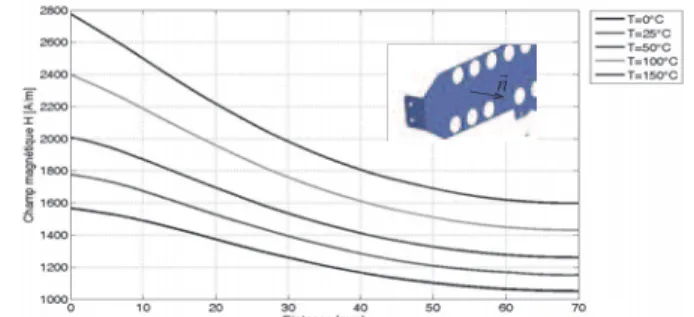
default is validated for when the criteria has been reached. The figures 2 and 3 show the difference of susceptibility/reliability on the parts of the devices, with the impact of T°
REFERENCES
[1] S. Weber, S. Guttowski, E. Hoene, W. John and H. Reichl, " EMI couplings from automotive traction systems", In Proc. IEEE EMC-S, , pp. 591-594 , May 2003.
[2] J.M. Dienot, "Experimental thermal impacts on EMC characteristics with new near-field measurements approach", In. Proc. of 3rd Intern. Conf. on Electromag. Near-field and Imaging Characterization, St Louis, pp. 302-307, June 2007.
Fig.1: Spectrum of radiated field over an IGBT module for different aggression temperature
Fig. 2: Simulation of radiated magnetic field(normal component) of a bus bar for different distances and aggression temperature.
- 8 0 - 6 0 - 4 0 - 2 0 0 0 2 0 0 4 0 0 6 0 0 8 0 0 1 0 0 0 F r e q u e n c y ( M H z ) A m p li tu d e ( d B µ V ) A m p lit u d e R e fe r e n c e ( n o t h e r m a l- f r e q u e n c y c o n s tr a in t ) T e m p . 2 2 °C T e m p . 6 5 °C
Fig. 3: Comparison of electromagnetic aggression over a digital PCB at different temperature (22°C, 65°C)