Al Kitab Journal
for Human Sciences
Scientific Biannual Refereed Journal
Published by Al-Kitab University
Editor-In-Chief
Prof.Dr.Ayad Ghany Ismaeel
(President of Alkitab University)
Managing Editor
Prof.Dr.Siham Kamel Mohammed
e-mail:
[email protected]
Volume, 1 No.2 (2018)
ISSN :2617-460x
II
Al-Kitab Journal for Human Sciences
Al-Kitab Journal for Human Sciences
Vol.:1 No.: 2 Dec: 2018
Linguistic & Scientific Revision
Dr. Nabeel Al- Obaidy
Dr. Imad Rifaat
Editing Secretary
Omar Adil M.Ali
Technical Supervision
Basma Khalid Salim
Editorial Board
#
Name
1 Prof .Dr Ayad Ghany Esmail Prisedent Of Alkitab University 2 Prof .Dr.Siham Kamel Mohammed Alkitab University
3 Assist. Prof Latif Saeed Nori Alkitab University
4 Prof. Dr. Arsalan FPE Sultan Idris Education University -Malaysia
5 Prof .Dr.Baydaa Sattar Lafta Post-Graduate Institute For Accounting &Financial Studies
6 Prof .Dr.Saadoon Hamood Chtheer Baghdad University
7 Prof.Dr.0mer Najmalddin Inja Kirkuk university-vice president of Kirkuk university 8 Prof.Dr Samir Abo El-Fotouh Saleh Almansura University Egypt
9 Prof.Dr Faaiq Mashal University of Tikrit
11 Dr.Abdul Ghfoor.I.Ahmad Al-Saidi Princess Sumaya University for Technology 11 Prof.Dr. Abdel Rhman Ebakri Mansour University of Neelain Al -sudan
12 Prof.Dr.Mohammed Shahateet Sumaya University for Technology 13 Prof. Dr. Al Eleesh Mohammed Al
Hassen University of Neelain Al -sudan
14 Prof.Dr.Hussein Aldoory Alkitab university 15 Assist. Prof. Rabih Banat Lebanese University 16 Ass.Prof.Mohammed Abdul Rahman
Mahal Alkitab university
17 Assist Prof Faisel Mohammed Olaewie Alkitab University
18 Prof. Azam Abdulhakeem Khalid Sultan Idris Education University -Malaysia 19 Ass.Prof Murshed Sami Mohammed Alkitab University
IV
Al-Kitab Journal for Human Sciences
Vol.:1 No.: 2 Dec: 2018
Rules and instructions for publication in Al-Kitab
Journal for Human Sciences
The Journal of Human Sciences is concerned with publishing research papers in
the fields of administration, economics, accounting, marketing, law, financial and
banking sciences, English and linguistics, international relations, and political science.
First: General Requirements
1. The paper should be submitted to the Editorial Secretariat directly in four copies
with a CD-ROM, or emailed to the journal in MS-Word and PDF files.
2. Before being sent to peer-reviewers, the research paper is subjected to the
quotation Turnitin programme.
3. The research paper is accepted for publication after being judged positively by the
peer-reviewers.
4. The publication fee in the Journal is ID 75000 for Al-Kitab University
researcher, ID125000 for researchers from outside the University and $125 for
non-Iraqi researchers.
Second: To Prepare A Research Paper For Publication, Authors Must Follow
The Following Procedures
:
1. The research paper should be typed on one side of A4 paper with a right margin
of 2.5 cm, a left margin of 2.5 cm, a space of 2cm from the top and the bottom, and
one and a half spaces. The pages must be numbered at the bottom for the first page
and at the top for the pages that follow it.
2. The paper should be typed in MS Word using "Simplified Arabic" fonts for
papers in Arabic and "Times New Roman" for papers in English.
3. The font size should be 16 bold for the main title, 10 bold for the names of
authors (whether in English or Arabic), key words, the main headings, the
references, and the acknowledgments, 12 bold for subheadings, 12 normal for the
abstract and the main body of the paper, and 9 bold for keywords (no less than 3
words and no more than 5).
4.The order of the divisions of the paper should be as follows:
The title of the paper, the names of authors and their addresses, and the abstract in
both Arabic and English.
5. The title of the paper should be as short as possible and indicative of the content
of the paper.
Al-Kitab Journal for Human Sciences
Vol.:1 No.: 2 Dec: 2018
6. The name of the author to whom correspondence is to be made should be
indicated with (*) in addition to showing his/her email address.
7. The size of the paper should not exceed 15 pages including charts and diagrams,
otherwise ID 5000 will be charged for every extra page.
8.The abstract should include the aims of the research, the findings, and the main
conclusions. It should also contain the scientific value of the research. It should not
exceed 250 words. It should also emphasize the content of the subject and include
the keywords used throughout the paper.
9. Figures and diagrams should be given after the explanation it is related to. The
title of the diagram or figure should be below it with a font size of 12. The diagram
or figure should be liable to editing in terms of enlargement or reduction within the
margins of the page size.
10. Tables should follow the parts of the paper that they are related to. The title of
the table should be placed below it with a font size of 12, and the content of the
table should also be size 12. .
11. References:
- The references should be typed in size 12 normal.
-They should be arranged in alphabetical order of authors’ surnames.
-Journal names should be typed in full (not abbreviated)..
-The following instructions should be followed:
(a) If the reference is a book, the name of the first author of the book should be
given first followed by the names of the other authors, then the title of the book (in
bold and italics), the edition number, the year of publication, the publisher, the place
of publication and the year of publication.
(b) If the reference is a research paper or an article in a journal, the name of the
author must be given first, then the title of the article, the name of the journal, the
volume (issue), pages (Year).
c) If the reference is an M.Sc/ M.A or Ph.D thesis, the name of the author must be
written with the first name first followed by the surname, then the title of the thesis,
the name of the university, the country (Year).
(d) If the reference is a paper delivered at a conference, the author’s name should
be given first, then the Paper Title”, the conference name, the Country, the
Publisher, volume, pages (Year).
The editorial board of the journal has the right to change any statement or phrase of
the paper if necessary in order to make it suitable for the general style of the journal.
VI
Al-Kitab Journal for Human Sciences
Vol.:1 No.: 2 Dec: 2018
The editorial board of the journal has the right to change any statement or phrase of
the paper if necessary in order to make it suitable for the general style of the journal.
2. After the paper is published in the journal, the editorial board will destroy all the
scrap papers, and the author has no right request having them back.
The proportion of modern sources should not be less than 50% of the total number of
sources in the work. The Modernity of the sources of the work is measured within
the last ten years before the submission of the work. For example, if the work is
submitted in 2018, the proportion of sources published in 2008 onwards should not
be less than 50% ..., and so on.
Note: For more information, please visit the following link, which provides a
template ready to write the source according to this system:
Note: For more information, visit www.uoalkitab.edu.iq
Or email the journal at:
[email protected]
Or the Editorial manager at:
[email protected]
Al-Kitab Journal for Human Sciences
Vol.:1 No.: 2 Dec: 2018
Table of Contents
#
Research Title
Researcher Name
Pages
1
A Study to Find Out the Best
Approach for the Iraqi Teachers to
Teach English Language Conversation
Nibras Ibrahim Saed
265-172
2 Some Contexts of the Syrian Crisis
Madeleine Kassab
272-289
3
The Explication of Loyalty and
Disloyalty in Farrokhzad’s "Captive"
Mariwan N. Hasan
290-302
4
The Green Marketing Orientation &
Environment Friendly Products Green
Plastic bag in Sudan
Dr. Fikre Kabashi Elemeen
303-312
5
A
Intertextuality
Stylistic
Study
of
Mythical
in Milton's "Lycidas"
VIII
Al-Kitab Journal for Human Sciences
Al-Kitab Journal for Human Sciences 1(2)2018
A Study to Find Out the Best Approach for the Iraqi Teachers to
Teach English Language Conversation
NIBRAS IBRAHIM SAED (*) Asst. Lecturer
Al-Kitab University /Department of English Education
Abstract
Being able to converse is an essential part of a complete foreign language education. However, the teaching of conversation is often equated with the teaching of speaking . A Conversation Norms Approach to teaching conversation incorporates aspects of authentic native speaker (or expert speaker) conversation, such as spoken grammar and pragmatics, into instruction. This study takes a closer look at conversation, and examines issues connected with the effective teaching of conversation. An informal inquiry of the foreign language conversation in the classroom also provides insight into the reality of teaching .
Key Word: English Language , Conversation , Iraq , Norms Approach.
2-INTRODUCTION
2.1 Background of the Study:
Foreign language “fluency” is a major goal of many language learners and teachers. To communicate clearly and naturally with native speakers of a language is the end that makes the means of studying, memorizing vocabulary, and practicing the language worth the effort. Achieving ‘fluency’ through foreign language education has focused on the written language. The issue remains that students are being taught written language spoken aloud, rather than being taught actual native speaker norms of conversation.[1]
If language learners were never expected to use their language with native speakers in the target culture, this approach towards teaching would be logical. However, the increasing reality of a global community—one in which nationality is less important than world-wide citizenship— creates a stronger need for language education that enables language learners to communicate with speakers beyond the borders of their own culture.[2]
The component that is missing from the type of foreign language education that would support this global citizenry is instruction in conversation. While language learners in typical language education programs are using the target language orally and internationally, they are not being taught to engage in authentic conversation as would native speakers of that language. It has been thought that knowledge and understanding of these native speaker norms of authentic conversation can be learned only through direct immersion in the target culture, and for this reason, instruction of conversation norms is generally not included in language curriculum. [3]
The lack of instruction in conversation can cause language learners to seem overly formal in their interactions in the target language, and can often be the root of cultural misunderstanding.[4] Moreover, failing to instruct language learners in conversational expectations can prevent them from successful integration into the target culture. English language needs more interaction and communication between learners of EFL and others who know how to speak English. Students learn the material of English in the primary stage and until the end of the secondary stage, then when they come to post-secondary and access to colleges and universities to study other sciences such as medicine, engineering and computer science, they face problems this is because all the sciences taught in English.[5]
566
Al-Kitab Journal for Human Sciences 1(2)2018 N.Saed
The proposed study titled “A Study of the Problems Faced by the Iraqi Teachers in Teaching English as a Foreign Language with Special Reference to the Conversational Skills” will analyze the problems the foreign teachers face in teaching English conversation and will find out the appropriate approach for teaching conversation.[6]
2-2 English Language Teaching (ELT):
The component that is missing from the type of foreign language education that would support the international citizenry is instruction in conversation.[7] While language learners in typical language education programs are using the target language orally and internationally, they are not being taught to engage in original conversation as would native speakers of that language. It has been thought that knowledge and understanding of these native speaker norms of actual conversation can be learned only through direct mix with the native speakers, and for this reason, instruction of the norms of conversation is generally not included in language curriculum. However, the lack of instruction in conversation can cause language learners to seem overly formal, rude, or awkward in their interactions in the target language, and can often be the root of cultural misunderstandings between native and non-native speakers. Moreover, failing to instruct language learners in conversational expectations can prevent them from successful integration into the target culture.[8]
3.Challenges and Difficulties in Teaching and Learning English language
To teach English as a foreign or second language is a challenge for each teacher to deal with, whether this teacher is a beginner or an experienced person. Teachers must work continuously to find the best ways to improve the levels of students and finding appropriate solutions to these difficulties to achieve success through dealing with students in a positive way.[9]The difficulties that the teacher face are:
3.1Difficulty 1: Pronunciation. 3.2 Difficulty 2: Thinking in Language. 3.3 Difficulty 3: In Using Authentic Materials. 3.4 Teachers and Dealing with Difficulties. 3.5Difficulties of the English Learners.[10]
4-Teaching English Conversation Approaches
To discuss the teaching and learning of conversation, it is necessary to first describe what does conversation mean? Conversation is the Exchange of Thoughts, Feelings, Opinions, and Ideas. Although it is often regarded as any oral production of a meaningful combination of words and phrases, real conversation requires a “true communication of ideas”.
4.1Approaches of Teaching Conversation.
4.1.1 The Controlled Communication Approach:-
The Controlled Communication Approach values the importance of LLs speaking the language in the classroom, but it does not necessarily emphasize authentic or relevant uses of the language. In reaction to the drills and the rigidity of the audio-lingual method, this approach encourages LL communication that is partially flexible, but not spontaneous.[11]
4.1.2 The Free Communication Approach:-
The Free Communication Approach, or what Dörnyei and Thurrell (1994) call the “indirect approach” for teaching conversation, sees appropriate instruction in conversation as having
Al-Kitab Journal for Human Sciences 1(2)2018
learners participate in activities that will foster ‘conversation,’ such as role play, problem solving tasks, info-gap activities, and language games.[11]
4.1.3 The Conversation Norms Approach:-
The Conversation Norms Approach is similar to the Free Communication Approach in that it emphasizes authentic exchanges of ideas; however, it additionally focuses on form that looks at skills, strategies, and processes of the TL and systematically integrates language input that will raise LLs’ awareness of the TC norms [11] It recognizes the LLs’ need to understand the more subtle issues of foreign language communication. As Barraja-Rohan (2000) points out, “just getting students to talk is not teaching them conversation…Students may be learning from using the TL, but in doing so they are not taught how conversation works and how participants manage talk-in-interaction” [8][10][11].
Often, in this approach, the role of instructors is to co-research authentic language samples with the LLs. They also must bring to the LLs’ attention to two main features of the approach that are not typically present in classrooms using the earlier two approaches. They are:-
a. Spoken Grammar b. Pragmatics.
5-FINDING.
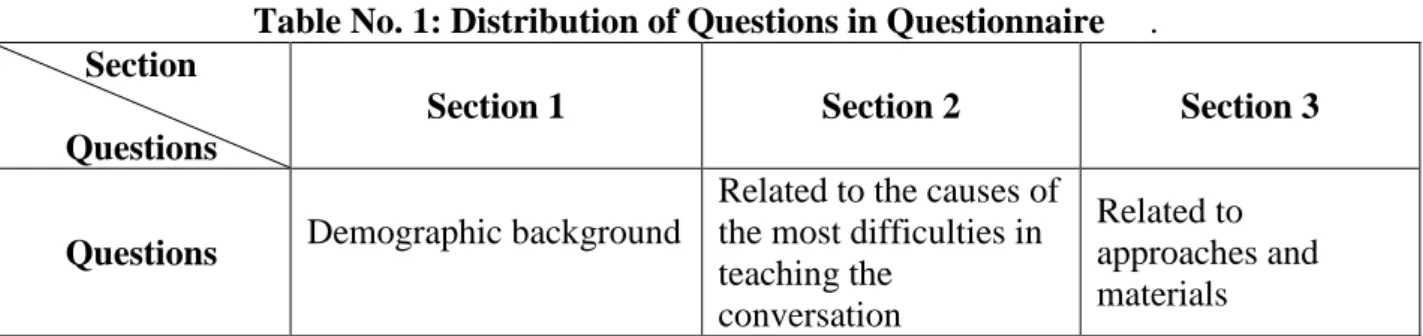
The findings are discussed in detail through the information collected from the questionnaire made on fifteen Iraqi teachers.
Table No. 1: Distribution of Questions in Questionnaire . Section
Questions
Section 1 Section 2 Section 3
Questions Demographic background
Related to the causes of the most difficulties in teaching the
conversation
Related to approaches and materials
5.1-Section One: This Section Is Related to the Demographic Information.
5.1.1 Teacher’s Gender
As for teacher's gender as it is indicated in table above, the majority of participants are male, as indicated in (Fig.no.1). Thirteen teachers, i.e. 86.6% were male and two teachers, i.e. 13.3%
562
Al-Kitab Journal for Human Sciences 1(2)2018 N.Saed
5.1.2-Teacher’s Level of Education:
The majority of teachers are B.A. holders i.e. nine (60%), while six teachers had M.A. degree holders (40%). The figure No.2 below explains the detailed results.
M.A., 40% 0 0 B.A., 60% 0 Male 86.6% 0 Female 13.3% 0 ender 1 Distribution of Teacher’s G Fig.No.
of Teacher’s Level of Education Distribution
Al-Kitab Journal for Human Sciences 1(2)2018
5.2 Section Two :Related to the Difficulties in Teaching Conversation
The findings of this question are explained below:
Q1. What are the causes of the difficulties in teaching conversation?
The majority of the teachers (9) answered the causes of the most difficulties in teaching conversation was in the approach they use and (6)of the teachers responded thedifficulties was in the materials. This is shown below:
5.3 Section Three : Tests the Results Related to the Approaches and Materials
This part contains five questions. The findings of those questions are explained below: Q2-What approach do you prefer to use in teaching conversation?
The majority of teachers (ten of fifteen) answered the free communication approach while three of them responded Controlled communication approach and two mentioned Conversational norms approachas indicated in table no. 2 as below.
Table No. 2 Results of the Approaches Used to Teach Conversation
Q3- What are your goals for your students when they finish the course?
The majority of teachers (12) answered that the goal is to teach students to Speak freely and (1) teacher responded to Use conversation norms. Two teachers didn’t answer this question.
Approach
No. of participants
Percentage %
Q2 a Free communication approach 10 67
b Controlled communication approach
3 20
c Conversational norms approach 2 13
Approach, 64% Material , 36%
Results of Causes of the Most Difficulties in Teaching the Fig.No.3
522
Al-Kitab Journal for Human Sciences 1(2)2018 N.Saed
Table No. 3 Results of the Goals for the students
6-Conclusion and
Recommendation
At one time, it was thought that native speaker norms of conversation could be acquired in immersion environments only, and that it was ineffective to teach them in the classroom. However, the study suggests that instruction can and will help in the acquisition of conversation norms, both in the second language and in the foreign language environments. While the immersion experience is, without doubt, a helpful experience in target language acquisition, it alone is not sufficient to teach LLs everything they need. Moreover, most LLs do not have the opportunity to go abroad for a period of time long enough to acquire these norms ‘naturally’. For these reasons, LLs must receive supplemental instruction to acquire TL conversation norms. It is understandable that the Conversation Norms Approach has not been adopted in the teaching of foreign language conversation, and the lack of instruction in conversation norms will continue to negatively affect students who intend to use their language in the TC or with NSs of that language. In order to improve the situation of teaching conversation, the researcher recommends to perform educational training courses in how to deal with syllables and texts. Moreover the educational institutions should provide teachers more courses and training in this field to gain experience and to learn modern methods to improve their teaching.
7-Refrences
1- Adolphs, S., & Carter, R., and She’s Like it’s Terrible, Like "Spoken Discourse, Grammar,
and Corpus Analysis" International Journal of English Studies, 45-56, 2003.
2- Bardovi-Harlig, K., Evaluating the Empirical Evidence "Grounds for Instruction in
Pragmatics?In K. R. Rose & G. Kasper (Eds.) Pragmatics in language teaching" Cambridge:
Cambridge University Press, 2001.
3- Bardovi-Harlig, K., "Understanding the Role of Grammar in the Acquisition of L2
Pragmatics" In A. MartínezFlor, E. Usó Juan, & A. Fernández Guerra (Eds.), 2003.
4- Barraja-Rohan, A., "Teaching Conversation and Sociocultural Norms with Conversation
Analysis In A. J. Liddlicoat and C. Crozet (Eds.), Teaching languages, teaching cultures "
Australia: Language Australia, 1997.
5- Brouwer, C., "Word Searches in NNS-NS Interaction: Opportunities for Language
Learning?" Modern Language Journal, 87(4), 534-545, 2003.
6- Brown, G., & Yule, G.," Teaching the Spoken Language: an Approach Based on the
Analysis of Conversational English" Cambridge: Cambridge University Press, 1983.
7- Brown, L., "Questions of Appropriateness and Authenticity in the Representation of Korean
Honorifics in Textbooks for Second Language Learners. Language, Culture and Curriculum"
23(1), 35–50, 2010.
The goals
No. of participants
Percentage %
Q3 a Speak freely 12 80
b Use conversation norms 1 6.4
Al-Kitab Journal for Human Sciences 1(2)2018
8- Campillo, P. S., "Pragmatic Instruction in the EFL Context. In A.MartínezFlor, E. Usó
Juan, & A. Fernández Guerra (Eds.) Pragmatic Competence and Foreign Language Teaching".Castelló de la Plana: Publicationes de la UniversitatJaume I, 2003.
9- Carter, R., "Standard Grammars, Spoken Grammars: Some Educational Implications. In T.
Bex and R.J. Watts (Eds.), Standard English: The widening debate " London: Rutledge, 1999.
10- Carter, R., & McCarthy M., "Grammar and the Spoken Language.Applied Linguistics" 141-158, 1994.
11- Cheng, W., & Warren, M., "Checking Understandings: Comparing Textbooks and a Corpus
272
Al-Kitab Journal for Human Sciences 1(2)2018
Some Contexts of the Syrian Crisis
Madeleine Kassab(*) assistant professor Aleppo University
Abstract
The research presents some of the contexts of the Syrian crisis which started in mid-March 2011. Those contexts contributed to creating disagreements concerning the opinions and attitudes of the Syrian society. The study axes are: an overview of some features of the Syrian history; the governance in Syria from Alexander the Great to the reign of Bashar Al-Assad; the religious and ethnic diversity; the splitting of the Syrian community into supporters and opponents of the government; and some data about the Syrian opposition and the woman in Syria. The Syrian history which is full of conflicts, the religious and ethnic diversity with the absence of a sufficient awareness, Assads´ policies, the Non-unity of the opposition and the absence of a clear vision, all are factors creating and enhancing the rift in the Syrian society. The importance of research lies on discussing the fogginess of theSyrian identity to understand the behavior of the Syrians with each other, especially during the crisis time.
Key words: The Arab Spring, the Syrian crisis, Syrian war.
Introduction
By the end of 2010, a protesting anti-government movement which led to the overthrow of the former president Zine El Abidine Ben Ali had started. This movement was followed by a group of protests in many regions of the Arab Homeland some of which were Egypt, Libya, Yemen, Bahrain and Syria. There is a disagreement in the viewpoints about the structure and targets of these protests. Some see them as revolutions of peoples who have suffered the oppression of the rulers for a long time. Others consider them merely a conspiracy fabricated by Arab and western actors aiming at the destruction of the Arab nation, especially Syria as it is the fort of steadfastness in the face of the Zionist occupation. In mid-March 2011, no sooner did the Syrian government opponent demonstrations start than this movement turned into a crisis due to many factors some of which are the reaction of the government and the drift of the opposition towards the military struggle against the government. The geopolitical importance of Syria and the interlacing and interference of the Syrian political and military factors on the local, Arab and international levels gave the protesting movement different values. This made some people justify all the militant movements of the Syrian government against the opposition and made others legalize the armed activities of the opposition and recognize them as an important solution of the Syrian crisis (Nasr, 2013; Mahmoud, 2013; Zanbou’ah, 2014; Janabi, 2016; Hoshoud, 2017; Al-Bayoumi, 2017). Studying the features of the Syrian crisis requires referring back to the Syrian history. The characteristics of the society, its actions and reactions towards any case are related to the cognitive accumulations of this society. The genetic, cultural, intellectual, religious, and sentimental heritage influences deciding the track of individual behaviors, whether the individual is aware or unaware of the mechanism of such influence.
The target of this study is to probe some of the factors that contributed to reinforcing the disagreement in the attitudes of the Syrians and created contradicting images of the Syrian crisis. The research discusses the following points:
Some of the civilizations which existed in Syria. The meaning of the word “Syria”. The
(*)
Al-Kitab Journal for Human Sciences 1(2)2018 M..Kassab
existing Syria, geographically and administratively in addition to the religious and ethnic distribution and the spoken languages. Governance in Syria from the reign of Alexander the Great to that of Bashar Al-Assad (only till 2013. The research does not discuss the events after this year when Syria entered a new stage which is that of ISIS and the open international interference in the Syrian crisis, especially militarily). Syria as a chain in the series of the Arab protests. The mistiness of the Syrian identity. The influence of the religious and ethnic diversity. The policy of “abolishing the other”. The split of the Syrian community into supporters and opponents of the government. Some data about the opposition (till 2013 only). The situation of women in Syria. The research found that many factors contributed to creating a crack in the opinions and attitudes of the Syrians and caused embodying the disagreement in a violent and intolerant way. Some of these factors are: The historical legacy which is full of conflicts. Autocracy and authoritarianism. Religion and factional affiliation. The ethnic and religious diversity in the presence of lack in awareness. The fogginess of the Syrian identity. The conflicts among those who belong to the same doctrine or trend. The deteriorating economic situation of some slices of the Syrian people in contrast to the good one of the others. Extremism of all kinds and forms. And exaggeration in believing or disbelieving in the validity of the targets and actions of the Syrian government.
Civilizations which existed in Syria
According to archaeologists, Syria is considered to be the cradle of the earliest human civilisations. Many cities and kingdoms were established over this land, including Ebla, Mari, Ugarit, Aphamea and Palmyra. Many peoples lived in Syria, whether based on peaceful means, through migration or commerce, or through wars. The most prominent of these peoples are the Sumerians, the Akkadians, the Chaldeans, the Canaanites, the Arameans, the Hittites, the Babylonians, the Persians, the Greeks, the Romans, the Nabatis, the Byzantines, and the Arabs. The Ottoman Turks ruled Syria for four centuries, then this country went under the French mandate between 1920 and 1946 (Al-Helu, 2004; Jad El-Rab, 2005; Troudi, 2006; Balanche, A, 2006; duMont, 2012)
The meaning of the word “Syria”
There are some assumptions about the origin of the name Syria. The name is derived from the Syriac word (Sir), which means the master. The feminine name is Sara and Syria, which mean the
master ground or the ground of the masters. The name is derived from the Greek description; Assur and Assyria, (the land of the Assyrians). According to the Phoenicians, the name Syria is
considered to be an expression for the land of the sun )Al-Hariri, 2013)1.
Syria before the Opposition control on some areas
The current Syria is considered part of the Greater Syria or the Levant which were divided into smaller countries (Syria, Lebanon, Jordan, and Palestine) according to the Sykes Picot accord; the British-French accord in 1916, which aimed at distributing shares among colonial countries. ---
1 Al-Maany Dictionary. https://www.almaany.com/ar/name/%D8%B3%D9%88%D8%B1%D9%8A%D8%A7/
Bashar Khakif. Syria the Civilisation and Name. Newsyrian.net.
https://newsyrian.net/ar/content/%D8%B3%D9%88%D8%B1%D9%8A%D8%A7- %D8%A7%D9%84%D8%AD%D8%B6%D8%A7%D8%B1%D8%A9-%D9%88-%D8%A7%D9%84%D8%A7%D8%B3%D9%85
274
Al-Kitab Journal for Human Sciences 1(2)2018
Under the patronage of the British mandate, the state of Israel was created in 1948 and Palestine was also divided (Sultan, 1987; Al-Rubaie, 2005; Troudi, 2006). The geographical location of Syria increases its importance. Its borders with Jordan, Iraq, and Turkey, and its nearness to Palestine and the locations of Israeli presence placed it in the heart of conflicts and wars (duMont, 2012).
The current Syria is made up of 14 governorates, each one is further divided into smaller administrative units: region, city, town, village, farm, and a square; 61 regions, 210 towns, 6247 villages, and 6717 farms (Qatash, 2002; Troudi, 2006).
Religious and sectarian distribution of the Syrian population
The Syrian population is estimated to be 23000000 people. The Sunni Muslims form the majority; their population is estimated to be more than 75%, when the Sunni Kurds’ population is included. The population percentage of the Alawites ranges between 10% and 15%; their population is growing systematically. The Alawites are mainly found in the counties of Lattakia, Tartus, and the countryside of the two counties Homs and Hama. The Druze sect constitutes nearly 3%, mainly present in the county of Sweida and the Golan Heights. The Ismaelites constitute 1%, living in Salamiyeh, Qadmus, Alkhawabi, and Misyaf. The Twelver Shia constitutes 0.3%. The Christian percentage ranges between 8 and 10%; half of them are Orthodox. The Christian churches observed in Syria are the Evangelical Armenian, Evangelical National Christian, Orthodox Syriac, Catholic Syriac, Chaldean Catholic Church, Maronite Church, Orthodox Armenian, Catholic Roman Church, Assyrian Church of the East, and the Church of Jesus the King for the Chaldean Catholics in the governorateof Al-Hasaka (Troudi, 2006; S.Abdo, 2009; duMOnt, 2012).
Most of the Jews left Syria to Palestine. Their population was 4.4% in Damascus and 4.3% in Aleppo until the year 1943. The Kurds constitute nearly 9% of the total population; some of them are Muslims and some others are Yazidis (Ayazidis). There are no accurate statistics about the number of the Yazidis in Syria. Turkmen and Turks are 1%, as are the Circassians. The number of the Chechens ranges between 10000 – 15000 (Troudi, 2006; S.Abdo, 2009; duMOnt, 2012). The Christians and Druze follow their own legal systems and legislative courts in relation to Personal Status issues. The other sects follow the Islamic-sharia-based law. The Syrian social construction was affected in recent decades because of the migration from the countryside to cities in addition to immigration abroad. The Syrian crisis also changed the demographic and numerical map of the Syrians (S.Abdo, 2009).
Languages spoken in Syria
Arabic is the official language of the country. Syrian people speak Arabic with local dialects. On a daily basis, people do not use standard Arabic. Aramaic and Syriac are still spoken by inhabitants of some small villages like Malula, Jabadeen, and a part of Saydnaya and Yabrud in the countryside of Damascus, or in the north east of Syria like Qamishli, Qahtaniyeh, Hasaka, and Khabur. There are other languages spoken by some minorities in Syria like Kurdish, Armenian, Turkic, and Circassian. English is taught in schools. French is also taught in schools but to a narrow level (Qatash, 2002; S.Abdo, 2009; duMOnt, 2012).
Rule in Syria
Syria never enjoyed a self-rule. For a long period of time Syria was subject to foreign rule (Chouet, 1995). We will go back in history to the era of occupation of Syria by Alexander the Great in 333 BC. The Macedonian Empire broke apart following his death, and Syria was ruled by the leader Seleucus who established the Seleucid Empire in the year 312 BC (Hajal, 2004). The Romans took over Syria in the year 64 BC. At the time, Syria was in state of chaos because of the
Al-Kitab Journal for Human Sciences 1(2)2018 M..Kassab
Seleucid rule and the successive wars that broke out among the parties fighting for power. The western part of the Levant (Bilad Alsham) came under the Roman rule, while the eastern part (Mesopotamia) was under the Persian control (Al-Hariri, 2013). Syria had a pivotal importance for the Romans; it was placed under the supervision of a Roman consul who had the authority to recruit armies and declare war. This is because Syria was the confrontation line with the Persians (Hajal, 2004).
The Byzantine rule in Syria started in 330 AD. This period was marked by the recognition of Christianity by Emperor Constantine as an official religion (Hajal, 2004). The demise of the Byzantine rule in Syria started when the Muslim armies entered the Levant and defeated the Romans after Alyarmuk battle in 636 AD (Al-Helu, 2004). After the death of the Prophet Mohammad, the first caliphate launched wars against the tribes that renounced Islam. Following his victory over the apostates, this caliphate and the following caliphates had dedicated time to what is called ‘Islamic conquests’2
. Many books about the Islamic religion heritage talk about the peacefulness of conquering many Syrian cities. The Syrians surrendered to the Muslims without fighting. The second group of cities were conquered after a long besiegement of huge Roman garrisons, like Damascus, Raqqa, and Homs. The third group was conquered after long and ferocious battles (Takkoush, 2002).
The Omayyad Muslims ruled Syria from 662 until 750 AD. After that, Syria was ruled by the Muslim Abbasids from 750 until 1258 AD. The Abbasid Caliphate ended after the Mongols, led by Hulagu, occupied Baghdad; Syria then came under the Mongol rule from 1259 until 1260. The Mamluk Sultanate (One of the Islamic states that rose in Egypt) triumphed over the Mongols, thus Syria came under the Mamluk rule until the year 1516; at that time the Ottoman armies invaded the Levant and Damascus became an Ottoman province until the year 1919 AD (Al-Helu, 2004). The Ottoman sultans used to be titled as the Muslims` caliphates (Sultan, 1987). After the defeat of the Ottoman Sultanate, Syria came under the French mandate. King Faisal Ibn Al-Hussain was crowned as a king of Syria. This country was divided following the order of the French ruler into four states: The state of Damascus, the State of Aleppo, The State of Druze, and the State of the Alawites. In the year 1946 the French forces were evacuated from all Syrian land. Syria joined the Arab League on the basis of a charter signed in the year 1945; Syria is considered a founding member of this organisation (Al-Rubaie, 2005; Mehli, 2011).
After independence from France, Syria did not enjoy political stability. Military coups were commonplace during the period between 1949 and 1954. In 1958 a union between Syria and Egypt was established under the name ‘The United Arab Republic’ and continued until the year 1961 under the leadership of the Egyptian leader Jamal Abdul Naser. The different inclinations, interests, and political visions led to the separation of the two countries. After that, Syria came back to the era of military coups (Qatash, 2002; Al-Hariri, 2013).
Al-Baath Party took over the power in Syria in 1963 through a military action, called by some a ‘coup’ and called by some others ‘The Revolution of the 8th
of March’ conveying that it changed the nature of the political authority, where for the first time power was reached by social forces comprised mostly by the middle class in cities and the countryside. This happened thanks to the coalition between workers, peasants, the revolutionary educated, and some small bourgeois groups (Habib, 1989; Hussein, 1996; Ghalioun, 2002-2003).
---
2The purpose of such naming is legalising wars launched by the Muslims and giving a sublime mental image about
these wars; not being out of motivation for occupying and controlling the riches of the peoples invaded by Muslim armies, rather, for the sake of spreading the religion of God.
276
Al-Kitab Journal for Human Sciences 1(2)2018
However, conflicts spread among members of Al-Baath Party and the schism widened amongst the leadership following the victory of Israel over the armies of Syria, Egypt and Jordan in the year 1967; Israel took over vast areas of Arab land including the Syrian Golan Heights (Qatash, 2002). At that time, Hafez Al-Assad was minister of defence and a member of the regional leadership of Al-Baath Party. He was opposing the policies of the president and the policies of some of Al-Baath Party leaders. In 1970, Al-Assad led what is known as the ‘Correctionist November Movement’; the most prominent features of the this movement are a military coup against the president of the country and the secretary general of Al-Baath Party Nour Eldin Al-Atasi and appointing Ahmad Alkhatib as a temporary president. According to the supporters of this movement, it was imperative to abolish differences among the members of Al-Baath Party, and also it was imperative unifying forces and organising priorities; the conflict with Israel had to gain the main interest (Hussein, 1996).
In 1971 Al-Assad held the position of Syria’s president, backed by the army. He gained the favouring of many sectors of the Syrian society thanks to reconstructing the Syrian army and winning over Israel in the October War in 1973.
President Assad was also the secretary general of the Socialist Al-Baath Party and the higher commander of the army and military forces. Al-Baath was the party ‘leading the country and the society’ throughout the rule of Al-Assad (Troudi, 2006). The slogan of this party is: One Unified
Arab Nation with an Eternal Message. Its goals are: union, freedom, and socialism. That refers to
the union of the Arab nation, liberation from occupation and imperialism, and establishing a socialist Arab system. The principles of the party emphasise the pioneering role of Syria in the Pan Arab Movement and the duty of the army to protect the homeland and guarantee the stability and safety of the people (Habib, 1989; Troudi, 2006; Haddad, 2007).
Syria during the time of Hafez Al-Assad
There are differences in the historical and analytical readings of the personality of president Hafez Al-Assad and the events witnessed during the period of his leadership. Kamal Deeb (2015) sees that the policies of Al-Assad laid foundations for stability after the period when the country was living time of chaos and coups; such policies also positioned Syria as a regional player within the context of conflicts inside and for the Middle East. Deeb considers the year 1970 as the year of change in Syria, since the Assad era ended the era of internal competing for positions among the leadership of Al-Baath Party (Deeb, 2015).
In the 70s and 80s of the 20th century Syria went through several internal and external crises, starting from launching the October war against Israel in 1973, through entering the Lebanese war in 1976 and the break out of a militant Islamic movement inside the country between 1979 and 1982. The Muslim Brotherhood used their Sunni sectarian position to attack the ruling regime led by Assad, being an ‘Alawite rule’ and that the claim for secularisation by the regime is nothing but another crime reflecting the heresy and infidelity of the Alawites. The rising popularity of Al-Baath Party amongst the Sunni circles from the 50s angered the Muslim Brothers and increased their grudge against the ruling regime. In addition to the Israeli invasion of Lebanon in 1982 and the repercussions of the Iraqi-Iranian war (1980-1988), in the year 1984 Syria witnessed an internal crisis in the ruling body, which was the conflict between President Assad and his brother Rifaat. The events of the 80s led to the rise of the role of the security forces in the Syrian state and the transfer towards the security regime and to the leadership controlling all civil and military sectors, even the economic and financial resources of the country. Syria was affected by the war in Kuwait in 1990 and by the collapse of the Soviet Union, the supporter of Syria and the major source of its weaponry. The Syrian-Israeli conflict is considered one of the most dangerous events that tear the Middle East (Seale, 1992; Chouet, 1995; Deeb, 2015).
Al-Kitab Journal for Human Sciences 1(2)2018 M..Kassab
In 1972, under the patronage of Al-Baath Party, the ‘Progressive National Front’ was created. It included a group of founding parties: The Socialist Baath Party, The Arab Socialist Union Party, The Socialist Unionists Party, The Arab Socialists Movement, and The Syrian Communist Party (Kaddah, 1991; Ghalioun, 2002-2003). The National Front was extended and included a new group of parties and organisations including: The Democratic Socialist Party, The National Al-Ahd Movement, and The Syrian Pan-Arab Socialist Party3. This front is headed by a central leadership including the secretary generals of the parties. The number of the members of the Arab Socialist Baath Party is half + 1 of the seats of the Central Headquarters of the Front. The most prominent mission of this front is to establish unity, cooperation, and protecting the pan-Arabic security. The priority used to be given to the members, and those who join Al-Baath Party; they had the priority in study and work.
There is another group of parties which participate in the political activities in Syria including: The Democratic National Solidarity Party, The National Youths for Justice and Development, and The Democratic Pioneer Party. It is prohibited to belong to a group of parties, the most known of which is The Muslim Brotherhood Party (Kaddah, 1991; Ghalioun, 2002-2003).
A set of economic, judicial, and social reforms and achievements were accomplished. The living circumstances got better in Damascus, the capital, which gained the biggest share out of the country’s resources. However, corruption was spread among the elite benefitting from their position in the regime. According to Deeb, Assad the father, had a wish to reform, but the malfunction was due to either the choice of the plans and executive mechanisms or to the corruption of the men in power. After the first Gulf War, a number of opposition movements appeared, asking for reform. Politics-wise, Al-Baath regime accepted the presence of independent members representing a third of the Parliament members, and some economic reforms were also put in place (Bauchard, 2008; Deeb, 2015).
The Syrian economy from the 70s until 2000 was depending of several factors including: the oil revenues, the money transfer by Syrians living abroad, Arab and foreign countries’ aids, drought seasons, the structure of industry and commerce, the authority of the regime, the corruption of the state bodies, the exploitation by people of their positions for increasing personal wealth, the ineffectiveness of jurisdiction in relation to protecting personal property and adjudication of investment cases. The most serious causes of the stumbling of the Syrian economy in the 80s and 90s are related to depriving Syria of the western and international economic support because of its stances against Israel; Syria came under economic embargo repeatedly and for a long time (Deeb, 2015).
The USA and the European countries often criticised Syria, considering it as a country embracing and sponsoring terrorism through supporting the Lebanese Hezbollah, the Palestinian Hamas and Islamic Jihad, and the Iraqi resistance. The Iranian-Syrian relation and the Russian-Syrian relation fed the international rejection of the policies of the ruling regime. Iran and Syria supervise arming Hezbollah and strengthening it quantitatively a qualitatively (Heydemann, 2000; Deeb, 2015)
Syria at the time of Bashar Al-Assad
In July 2000 President Bashar Al-Assad came to power. He adopted a project which he called ‘The track of advancing and modernising in all Syrian state institutions’. The phenomenon of ---
3
The official website for the National Front,
http://www.pnf.org.sy/index.php?page=show_det&category_id=84&id=73&lang=ar&lang=ar Available on 26 August 2017.
278
Al-Kitab Journal for Human Sciences 1(2)2018
cultural forums, which were seen as forums for free opinion, grew in number. Since then, the dominance of the one party started fading; some landmarks of political and cultural freedom started appearing (Al-Hariri, 2013). Assad the son wanted to liberate the political and economic system and to consolidate democracy inside Syria, so the start of his rule came to be known as the ‘Spring of Damascus’. Many sectors of the Syrian society and intellectuals viewed Assad as having future ambitions capable of transferring Syria into the world of development and modernity. Assad cares a lot about the Syrian Informatics Society considered the most important centre for opening the country to the most advanced technologies in the electronic communication world (Ghalioun, 2002-2003; Troudi, 2006; Al-Daghidi, 2006).
Even lots of intellectuals, media people, artists, and opinion leaders in Syria and the Arab world – who later became opponents to Assad – confessed their optimism about the ability of this young president to change situations in Syria. However, the security and military policy followed to solve the Syrian crisis changed their view and stances.
The experience of ‘Damascus Spring’ stumbled for two reasons: the first is the contention regarding the methodology; Assad wanted it planned and gradual, whilst the opposition and the civil society wanted it a quick reform. The second reason was the foreign threats which accompanied this reformist experience. Many events pushed Syria to focus on consolidating its stability and defensive capability. Threats started since the end of the year 2000 when the second Palestinian Uprising broke out, to be followed by the ramifications of September 11th attack in 2001, in addition to the American invasion of Iraq in 2003. The assassination of the Lebanese Prime Minister Rafiq Al-Hariri in 2005 affected Syria to a large extent and Syria had to withdraw from Lebanon. The economic and political embargo on Syria was tightened. Moreover, the war between Israel and Hezbollah broke out in 2006. The increase of foreign threats made continuing the process of liberalisation and reform characterised by hesitation, caution, and fear that Syria might lose its internal stability. After political prisoners were set free, and freedom was given to personalities belonging to many Islamic, liberal, and communist groups, the time of arrests and clamping down on the freedom of parties and media came back (Ghalioun, 2002-2003; Troudi, 2006; Balanche, 2006; Bauchard, 2008; Al-Hariri, 2013; Deeb, 2015).
In spite of pressures and embargo, Syria managed to reach self-sufficiency, regarding food provision, living requirements and power resources. This country has no external debts. The problem of city over-crowdedness was solved via the policy of balanced developing among the rural areas, cities, and the counties. An infrastructure network was launch all around Syria: airports; sea ports; dams; electricity; water, and communication networks. However, some villages still suffered absence of water pipes, and some others did not get electricity yet. The rapid increase of population creates numerous problems. The unemployment rate increased to 11.5% in the year 2005. The presence of the more than 1.5 million Iraqi refugees in Syria aggravated the unemployment problem4. The individual income is still low and does not fulfil the aspirations of many Syrians (Balanche, B2006; Bauchard, 2008; Deeb 2015).
In order to achieve development and openness, Syria coordinated – on an economic level – with a group of Arab and non-Arab countries (Al-Hariri, 2013). Privatisation was allowed, especially in the communication sector. However, the first beneficiary of this openness was some relatives of Assad (Bauchard, 2008). The education sector witnessed a huge advancement since the time of Assad the father. Much farming lands were reclaimed and the industrial production ---
4
Syria received Palestinian refugees. The Lebanese fled to Syria during the course of the Israel-Lebanese war. Moreover, about a million and a half Iraqis took refuge in Syria following the American invasion of Iraq.
Al-Kitab Journal for Human Sciences 1(2)2018 M..Kassab
grew bigger. However, the corruption spreading in the different sectors severely hinders the processes of developing and modernisation.
The Syrian crisis within its contexts The events of Syria, a ring in a chain
The Arab Spring, the Arab revolutions, the revolutions of the Arab Spring, were terms adopted by the media in describing protesting movements some of which were peaceful, the others were armed. They spread across a group of Arab countries. Their motives were similar due to the similarity of the situations and events the peoples of these countries lived. For long decades, the rulers and the kings have had hegemony over the reign subjugating the civilians to their will and command by all, direct and indirect, means. The spread of corruption hindered all the processes of development and progress. The gap between the rule and the people widened. The disappointment which resulted from the imposed censorship over all the sectors of life, especially the freedom of expression, led to the burst of the people's wrath.
Things started with the revolution in Tunisia from December 17th2010 to January 14th2011. It burst after Mohamed Bouazizi burned himself in protest against corruption, unemployment and poverty. It succeeded in overthrowing the previous Tunisian president Zine El Abidine Ben Ali and obliged him to run away from Tunisia. This event provoked many Arab countries peoples. The revolution in Egypt started on January 25th, 2011.The demonstrator protested against the spread of corruption, the bad living situation, and security and political tightening. This revolution resulted in the stepping down of the previous president Hosni Mubarak on February 11th, 2011. After Egypt, Libya witnessed a protesting movement which started in the middle of February and led to the murder of Muammar Gaddafi and the overthrow of his reign. This movement was characterized by using weapons as from its beginning. It was not as peaceful as the Egyptian revolution. The revolution in Yemen also started in February. A group of young people in Sana'a University demonstrated demanding the stepping down of the previous president Ali Abdullah Saleh. At that time, Saleh declared that he would not nominate himself for election again and that he would not hand power to his son. However, the demonstrations went on and many demonstrators were detained. This gave rise to the armed conflict in Yemen and a number of military personnel joined the revolution. In November 2011, the Gulf initiative was signed and, in accordance with its provisions, Saleh stepped down and handed power to the vice-president: Abdrabuh Mansour Hadi. The protests in Bahrain also started in February. The Bahraini government asked the help of the Cooperation Council of the States of the Gulf (GCC). The Kingdom of Saudi Arabia and the United Arab Emirates sent soldiers to Bahrain in order to suppress the movements which were considered Shiite aiming to arouse fitna and seize power. Some other Arab countries such as Jordan, Algeria, KSA, Sudan, Iraq, Palestine, Kuwait, Lebanon, Morocco and Mauritania intermittently witnessed protests but they had no great effect. On March 15th 2011, Syria witnessed the start of a protesting movement. Its organizers on Facebook announced the necessity for the opponents to gather in the quarters and streets of regions to raise their demands the most prominent of which were eliminating corruption and realizing reform. A forerunner of this start was a spontaneous unplanned protesting event in Al-Hareeqa area in Damascus. It started when a policeman humiliated a Syrian citizen. The Syrians angrily gathered and began cheering "the Syrian people can't be humiliated". Later, this slogan became one of the most significant slogans of the opponents'. As from the first days of the time when the opponents came out to streets, firing took place. The Syrian government charged "infiltrating people" of shooting the regime's forces and the civilians altogether in order to shake stability and sow hatred between the state and the people. However, the opponents charged the
280
Al-Kitab Journal for Human Sciences 1(2)2018
government forces themselves of being responsible for the brutal murder operations. The conflict quickly turned into an armed one. The two sides exchanged charges about committing massacre against the civilians. The Syrian security forces continually negated their responsibility for killing the peaceful demonstrators while the opposition insisted that the regime committed the most brutal and violent crimes against the unarmed people. The slogan of overthrowing the regime became the most repeatedly cheered slogan (Al-Baiyoomi, 2017; Janabi, 2016; Mokannawi, 2015; Harahsha, 2013; Shalash, 2013; Leila Vignal, 2012).
The data of the Syrian crisis are entangled and complex, the opinions of analyzers and interpreters strongly differ (Nasr et al, 2013).The interference of many Arab and non-Arab countries in the Syrian affairs made things more complicated. Who supports whom? Who finances whom? Why? What do the revolutionaries want? Islamization of Syria or freedom? Secularism or Islamic rule? Political dictatorship or suppression and religious takfirism? Is what is going on in Syria a people's revolution or a proxy war which is run by the benefited countries? The media – influenced by the attitudes of the countries towards the Syrian cause – depict different images about the events of Syria.
The ethnic and religious diversity
In several research like (duMont, 2012) and even in many newspaper articles, the Syrian society is described as a ‘mosaic’ due to its ethnic, religious, and sectarian diversity. The term ‘mosaic’ indicates art and beauty, but was such diversity really bliss for the Syrian society? Could diversity without awarenessfeed advancement of peoples? Probably the most important question is: How was such diversity created?
We saw previously that Syria for a long time was occupied and governed by many peoples, eastern or western. Such peoples even fought against other peoples on the Syrian soil. This leads us to think of the volume of congestion and pressure accumulating, and possibly genetically or culturally inherited down to the current Syrian generation. How much freedom can be there under occupation or mandate? Was the Syrian people ready to exercise intellectual and political freedom following the end of the Ottoman occupation and French mandate? The number of the military coups, the huge schism among politicians and the mechanisms embodying such schism (assassinations, for example) may reveal how unready this people is for exercising a free and peaceful political activity.
Hafez Al-Assad, who belongs to the Alawite sect, was the first Alawite president to rule Syria. For centuries, Syria was ruled by the Sunni commerce bourgeois who were totally subject to the Ottoman rule (Chouet, 1995). The Alawite sect was persecuted and marginalised politically and socially. The sect was also excluded, geographically and administratively, from the centre and mechanism of power. Many other minorities suffered the same, but the volume of Alawite sufferings was bigger; their women used to be sold or hired by Sunni families, particularly the wealthy families, until the sixties of last century. The Alawites ran away to the mountains and lived where there were no health services. Poverty was their main trait (Chouet, 1995; Troudi, 2006). For the Sunnis and for the Twelve-Imams-Shia, the Alawites were viewed as the heretics of Islam; disbelievers, infidels, traitors, and apostates. They were recognised as a Shia Muslim sect after Hafez Al-Assad came to power (Chouet, 1995; Balanche, A, 2006).
The name ‘Alawite’ means the supporters or followers of Imam Ali, the cousin of the Prophet Mohammad. They are sometimes called Nusayris, after Ibn Nusayr; an Iraqi from Basra. His followers fled from Iraq and came mostly to Aleppo in Syria (Balanche, C, 2006; duMOnt, 2012). The Alawites are divided theologically into several groups, including: the Haddadis and
Al-Kitab Journal for Human Sciences 1(2)2018 M..Kassab
having mosques, not wearing veils (hijab) by their women, and permitting drinking alcohol (Balanche, A, 2006).
The persecution suffered by the Alawites forced them to keep their religious beliefs marked by secrecy and reservation. They even lodged to ‘Taqiyah’ which means denying who they are sometimes and appearing in a way that suits and matches the trends of the dominant Sunni religion. In one of his legal opinions (Fatwas), Ibn Taymieh (the most prominent Sunni Muslim pundit) stated that the Alawites are more infidel than Jews and Christians, and that war and Jihad (religious war) are religiously legal, even mandatory against the followers of this mystic course (Chouet, 1995; Balanche, A, 2006). A question that can be asked is: Can the followers of this religious leader – who legitimises killing all those who disagree with him in thinking, whether religious or political – spread a free culture and accept the culture of those who are at odds with them? Can their slogans calling for democracy be believed?
When the Muslim Brotherhood revolted against Al-Baath regime, their basic motive was not accepting the rule of the ‘non-believer apostate infidel minority’. They bombed, killed, and destroyed. They were severely clamped down security- and military-wise. Many of them were killed. In response to this suppression and to the secular movement, the number of mosques increased considerably, women stuck by the Islamic veil (Hijab), and many movements appeared wanting to redistribute the rule; the Sunni majority has the right to rule the state. The conflict between the ruling regime and the Muslim brotherhood reflects the conflict between the United States and Russia; the Muslim Brotherhood are known for their loyalty to Saudi Arabia, thus obedience to the United Sates, while the socialists are loyal to Russia (Corm, 1989; Troudi, 2006). During the rule of Assad the father, Sunni adherent men took the highest positions, the most known of which were, Mustafa Tlas, Abdulhalim Khaddam, and Abdullah Al-Ahmar. However, the security sector was largely in Alawite hands (Chouet, 1995; Deeb, 2015).
The obscurity of the Syrian identity
The term ‘Arab’ is used even in much research – to denote the majority of the Syrian society. The Syriacs and Aramites are described as minorities, bearing in mind that they also speak Arabic and represent the origin of the Syrian people before Islam. This leads us to wonder: What is the foundation upon which this classification was done? If we assumed that the current Syriacs and Aramites adhered to their belonging, to the original nationality, what would make the Syrian Arabic in scientific descriptions? The use of Arabic which was imposed after the spread of Islam, or the politically imposed nationalism? According to item 10 in Al-Baath Party Constitution, an Arab is whoever speaks Arabic and lives on an Arabic land or aspires to live in such countries, with conviction that he belongs to such nationalism. Al-Baath viewed Islam as a unifying factor amongst the Arabic peoples (Troudi, 2006).
The on-going violence in Syria andapplied by all parties might be the result of belonging contradictions. Relating religion to politics and relating nationalism to religion are disastrous in a society which was forced for many centuries to succumb to foreign invaders; a society that needs a convalescence until it constructs its identity or at least until it purges its identity, if it already exists.
Arabism is based on Islamism; Islam is determinist and fatalist (the word of God must be obeyed; the Quran). Islam is divided into so many sects and doctrines. The Sunni-Shia conflict is not a superficial conflict as portrayed by many who call for the necessity of the convergence of religions and doctrines. Accusing the other of unbelief is commonplace among the majority of the doctrines adherents, thus legalising killing and blood shedding is not unexpected. Hence, we are
282
Al-Kitab Journal for Human Sciences 1(2)2018
experiencing a vortex of variables which encourage violence and schism, especially when politically employed, and this was what happened in Syria.
Al-Baath linked between Arabism, socialism, and secularism (Mehli, 2011), and tried to apply this approach in a society whose majority cannot apply critical thinking to the concepts in which they believe. The Sunni Muslims cannot suspect or even enquire about the credibility of the saying that ‘the Quran is the speech of God’, nor query the validity of the Hadith Shareef, registered sayings by the Prophet Mohammad (The Prophet Traditions). Even beyond that, many deny science when it contradicts a religious text, and permit punishing all those who regress from Islam, as did the first caliphate Abu Bakr when he launched wars against the apostates. The religious dictatorship prevailed for many centuries, supported by the political dictatorship. Both robbed the citizen of the right to think and the right to criticise, thus the right to know.
Awareness should also be raised about the role of illiteracy in increasing the amount of fanaticism of all its aspects, tribal, religious and political. In the modern days the number of schools and universities increased, but the centuries-long-rooted beliefs still dominate that thinking of many sectors of the Syrian society. The cleric is viewed as the most important ‘ideological’ reference for those adhering to their doctrines. In addition to the intolerance of the cleric, his low academic and cultural degree is enough to create a takfiri (labelling as infidel whoever disagrees with one’s opinion) society, shaken from within.
Denying the other; the dominant policy
This policy is not the product of the modern era; rather it is an accumulated heritage. A lot of historical events prove this, like the Islamic-Islamic conflict and the ideological conflict following independence from France, in addition to the actions and reactions of the sectors of the Syrian people towards those who oppose their views (in the context of the studied crisis). Dialogue needs understanding and accepting the other. However, what happened in Syria may be attributed in the first place to the culture of imposition and coercion. Analysing the rhetoric of the Syrians and their stances towards each other on the social media websites proves the dominance of the culture of “radically denying the other”. The most serious tool for this culture is demonising the opponent and presenting him as an internal enemy.
Dividing the Syrian society into proponents and opponents to the policy of the two Assads
The difference regarding opinions is centred around several major ideas. For the proponents, Assad the father managed to establish political stability in Syria following the time when chaos prevailed. He introduced many reforms and gave lands to the farmers after feudalism controlled everything. He improved the industrial and agricultural sectors; he led Syria towards self-sufficiency; he reconstructed the Syrian army and could win over Israel (regaining honour following the defeat in the 1967 war). He protected Syria from a sectarianism-based civil war. Thanks to the Syrian support, the Lebanese resistance (Hezbollah) realized victories over Israel. The two Assads support the Palestinian resistance and allow the Palestinian organisations to resume their activities over the Syrian land. Assad the father, and later on the son, continuously sought to create a real Arabic unity that constitutes a force able to deter all colonisation attempts. Syria is facing a major conspiracy because of its stances against Israel and the United States and because of its adherence to pan Arab nationalism. What is happening in Syria is not a revolutionary public movement; rather it is an American plot aiming at handing over the rule in Syria to the Muslim Brotherhood in order to break this country up on religious and sectarian bases, considering the policy of the Muslim Brotherhood is a takfiri policy that views minorities as