HAL Id: hal-02324106
https://hal.archives-ouvertes.fr/hal-02324106
Submitted on 1 Dec 2020
HAL is a multi-disciplinary open access
archive for the deposit and dissemination of
sci-entific research documents, whether they are
pub-lished or not. The documents may come from
teaching and research institutions in France or
abroad, or from public or private research centers.
L’archive ouverte pluridisciplinaire HAL, est
destinée au dépôt et à la diffusion de documents
scientifiques de niveau recherche, publiés ou non,
émanant des établissements d’enseignement et de
recherche français ou étrangers, des laboratoires
publics ou privés.
Design Theory for Generating Alternatives in Public
Decision Making Processes
Irene Pluchinotta, Akin Kazakçi, Raffaele Giordano, Alexis Tsoukiàs
To cite this version:
Irene Pluchinotta, Akin Kazakçi, Raffaele Giordano, Alexis Tsoukiàs. Design Theory for Generating
Alternatives in Public Decision Making Processes. Group Decision and Negotiation, INFORMS, 2019,
28 (2), pp.341-375. �10.1007/s10726-018-09610-5�. �hal-02324106�
(will be inserted by the editor)
Design Theory for Generating Alternatives in Public Decision
Making Processes
Irene Pluchinotta · Akin O. Kazakçi · Raffaele Giordano · Alexis Tsoukiàs
the date of receipt and acceptance should be inserted later
I. Pluchinotta
LAMSADE-CNRS, PSL Research University, Université Paris Dauphine, Place du Maréchal de Lattre de Tassigny, 75016 Paris, France
E-mail: [email protected] (corresponding author)
A. O. Kazakçi
Centre de Gestion Scientifique, MINES ParisTech, PSL Research University, 60 Boulevard Saint-Michel, 75006 Paris, France
E-mail: [email protected] R. Giordano
Water Research Institute, National Research Council, Via De Blasio 5, Bari, Italy E-mail: [email protected]
A. Tsoukiàs
LAMSADE-CNRS, PSL Research University, Université Paris Dauphine, Place du Maréchal de Lattre de Tassigny, 75016 Paris, France
1 Introduction
Governments and public bodies are beginning to involve stakeholders and the general public to a far greater extent thanbeforein the public decision process (Bayley and French, 2008). Public participation is widely documented as being a valuable component of policy making (e.g. Beierle and Cayford, 2002), bringing the problem of facilitating stakeholders’contributions and building collective commitment (Eden and Ackermann, 2013).
Policy makingthat includesstakeholders offers best practices but alsoexamples ofunsuccessful case studies (e.g. Creighton, 2005; Howlett, 2011a; UNDP, 2012; Webler and Renn, 1995). Actors with different stakes, points of view, rationales, and values are brought together to participate in public decision making processes (Fischer et al, 2007). Initially, policy making has beenconsidered to bea linear path from problem definition to options evaluation(Mintrom and Luetjens, 2016). Participation was traditionally reserved for political authoritiesand external experts(Celino and Concilio, 2011).Indeed, experts’ contributions received more attention than local stakeholders’ knowledge (e.g. Eden and Ackermann, 2004; Ostrom, 1990).However, thanks to the in-creasing awareness of the complexities facing the public sector, this view has been challenged (see recently De Marchi et al, 2016; Tsoukiàs et al, 2013). Instead of a rational selection among given policy alternatives, public decision makingbecomesthe result ofa collaborative process(Nogueira et al, 2017; Sabatier, 2007).As such, the development of a shared understanding among all involved actors is a prerequisite for the successful implementation of a collaborative process (Oppl, 2017).
Many academic studies have investigated participation, suggesting that all modes of public participation can potentially benefit society (e.g. Beierle, 2002; Daniell et al, 2010; French et al, 2007; Gregory et al, 2005; Lavin, 2010).Furthermore, stakeholders participation has been investigated in the field ofDecision Analysis where stakeholders’ problem frames, knowledge and preferencesareconsidered pivotal elements of the policy making process. For interested readers (Ferretti et al, 2019), soft systems methodologies and problem structuring meth-ods (Checkland, 2000; Pollock et al, 1994; Rosenhead, 2006), group modelling (Vennix, 1996), system dynamics (Sterman, 2000), stakeholder strategic management (Ackermann and Eden, 2011; Freeman, 2010),meta-planning knowledge management (Wilensky, 1981), strategic choice approach (Friend and Hickling, 1987), collabo-rative decision making approach (Zarate, 2013).
Althoughthe specializedliterature recognises the use of public participation necessary, it expresses doubts on the used methodologies (e.g. French and Bayley, 2011; Rowe et al, 2005). Ostrom (2010) highlights the deficiency of adequate methodologies for supporting public decision making processes with multiple stakeholders. Specif-ically, most approaches about participationare being used to draw stakeholders into the process of deciding between different options, but not on their generation (Ferretti et al, 2019).Indeed, the mainstream Decision Analysis literature focuses on how to “choose” an alternative without considering how these can be estab-lished (Colorni and Tsoukiàs, 2018).
Meaningful participation requires stakeholders engagement into all the phases of the process (Mart-tunen et al, 2013), which is not necessarily the case for most methods aimed at supporting participation and public policy making. Firstly, policy making oftenincorporatesstakeholderslate in the process, after the problem definition has occurredandalternatives have beenalreadydefined, raising the risk of the consultation being construed as a formality, limiting the ability of stakeholders to seriously inform the process (Mintrom and
Luetjens, 2016).Secondly, most collaborative decision making procedures are perceived to be unproductive in terms of efficiently utilizing the participants’ time and effectively achieving the policy objectives (Adla et al, 2011). Lastly, policydesign has long been seen as a component of policy development without any oper-ational characteristic (Howlett, 2011a; Lynn and Gould, 1980; Schneider and Ingram, 1997).For instance, the Strategic Choice Approach, as a method facilitating collaborative processes about complex decision prob-lems (Friend et al, 1974), improves the understanding of inter-organisational decision processes in various public policy domains and has been successfully used in supporting public policy making (e.g. Friend and Hickling, 1987; Norese et al, 2015). However, it does not explicitly support the design of policy alternatives, at least not using a formal theory and a replicable procedure. Thus, the efforts for structuring problems and working towards decisions are not combined with an in-depth designing.
Stakeholders involvement in policy making increases the need for effective policy design processes (Fischer, 2000).However, there seems to bea relatively small literature on how to formally design policy alternatives (Howlett, 2014). Experience suggests that well-structured and formalized methodsfor policy designare needed to integrate knowledge from different sources, allowing transparency of the process (Renn, 2006). Moore (1995) talks about the structured inclusion of different stakeholders’ knowledge, in order to unleash creativity and conceive new solutions. This should represent the starting point of aneffective and innovativedesign process (Tavella and Franco, 2015). Within this context, there is a demand for methodologies aimingto supportthe policy makers and relevant stakeholders during the design of alternativeswithinthe policy making process (Ferretti et al, 2019).
In this paper, we are interestedin introducing (and exploring) the operational role of design theory. Design theory highlights the value of early stakeholders engagement (e.g. Buchanan, 1992; Dorst and Cross, 2001; Liedtka et al, 2013; Rowe, 1998),challengingsome current mainstream approaches of policy making (Mintrom and Luetjens, 2016). Specialized literature in design theory already exists (e.g. Agogué and Kazakçi, 2014), offering a range of methodologies for products development (Brown, 2008).The research reported in this paper usesthe derived knowledge, methods and expertise to understand what “design” means in a policy making context. It aims to contribute by creating an innovative approach for the formalization of the policy design process. It claims that design theory can improvethe policy design processand that Concept and Knowledge (C-K) theory (Hatchuel and Weil, 2002) can be a suitable framework for the innovative design of policy alternatives. The paper is structured as follows. After the present introduction, section 2 depicts the mainstream approaches to policy design. Sections 3 illustrates the design theory framework. Section 4 describes the proposed methodology while section 5 and 6 discuss the case study, the obtained results and the lessons learned. Concluding remarks are reported in section 7.
2 Policy design
Public policies are abstract objects introducing a portfolio of interrelated actions, reflecting the policy mak-ers’ efforts to address public and societal problems (De Marchi et al, 2016). This set of actions aims to achieve a set of interconnected policy goals within a period of time (Elmore, 1987; Hand, 2012), through the influence on individual and collective decisions (Bemelmans-Videc and Vedung, 1998).
Policy makers create policy alternatives (Howlett, 2014). Thus, policy design is a critical step that en-ables the pursuit of innovation (Lasswell, 1956) and the formulation of effective policy alternatives (Howlett et al, 2015). “The invention of policy proposals” (Lasswell, 1971) is essential to the development of policies inasmuch an integral part of the public decision making process (Wildavsky, 1979). A worthy policy design process has a preponderant impact on the quality of the policy alternatives being considered.
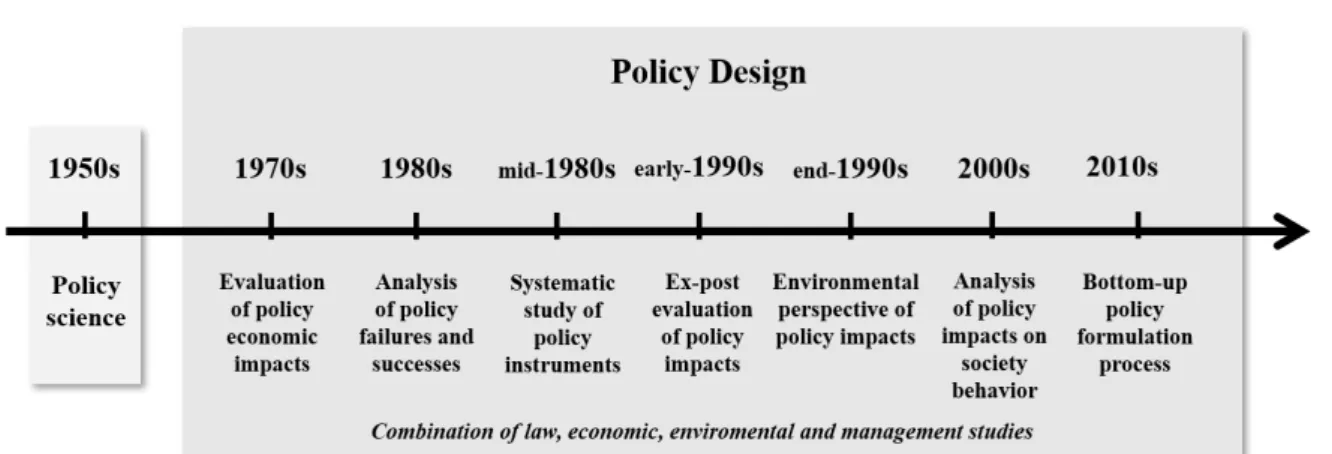
However, no significant research has examined the formal design processes for the generation of policy alternatives thus far (Ferretti et al, 2019, see).Bobrow (2006) underlines thatpolicy design is surprisingly understudied in the policy analysis literature. The roots of policy design studies can be found in the policy science literature since the 1950s, however it has received significant attention onlyin the past three decades (e.g. May, 1981, 2003)(see figure 1).
Figure 1 approximately here
In his early works on public policy making, Lasswell (1954) stated that the understanding of the policy instru-ments available is an important feature of both policy formulation and implementation. In the 1970s,policy design processesfocused on the evaluation of the economic impact of policy instruments (e.g. taxes and subsidies), in order tosupportpolicy makers in considerations of policy effectiveness (Mayntz, 1979; Sterner, 2003).
Policy design research was developed during the 1980s and 1990s, involving interdisciplinary literature. Specifically, the policy design literature shifted towards understanding design both as process and outcome. Sev-eral researchers and practitioners wrote about problem formulation, policy instrument choice and policy design outcomes (e.g. Howlett, 2014; May, 1991; Weimer, 1992). In the 1980s, the policy research was interested in the links between implementation failures and policy success (Mayntz, 1981; O’Toole, 2000). In the early 1990s the focuswas theex-post evaluation of policy outcomesimpacts(Bobrow and Dryzek, 1987). Furthermore, an inter-disciplinary approach combined economic and law studies in order to focus on policy outputs and governmental processes. On the one side, law studies analyzed how regulations mediated the delivery of goods and services, and how formal processes of rule-making led to policy (Keyes, 1996). On the other side, management studies investi-gatedthe links between administrative systems and implementation modes (Lowi, 1985; Peters and Pierre, 1998). Specifically, both Bardach (1977) and Salamon (1981) argued that the early policy studies analyzed policy in terms of “problems” rather than in terms of “instruments of government action” and “techniques of social intervention”. Aspecific policy design literature appeared in the mid-1980s through a systematic study of policy instruments (Howlett, 2014). Policy analysts’ attention shifted from practice to theory, classifying policy instruments in order to identify the reasons of their use (Bressers and Klok, 1988; Hood, 1986) and to improve both policy design and outcomes (Linder and Peters, 1984; Woodside, 1986). In the late 1990s, policy design literature focused on instrument selection. It aimed to systematically assess the development of optimal policies by using mixed strate-gies, moving away from the single instrument studies of earlier works (Gunningham et al, 1998; Howlett, 2004). This period was markedby the dispersion of policy design scholars in specific fields such as economics, and environmental studies (Del Rıo et al, 2010; Howlett and Lejano, 2013).
Recently,attention shifted from centrality of authority to the collaborative governance, involving non-governmental actors, among others (Howlett, 2011b).Policies are seen as the outcome of a decentralized pro-cess, involving the actions of several public and private stakeholders. As a result, the implemented policy design
practices became increasingly participatory and consultative in nature (e.g. Alshuwaikhat and Nkwenti, 2002). They replaced previous top-down processes dominated by government analysts with bottom-up ones. The demise of policy design research could be associatedwiththe change in demand for morecollaborativegovernance (e.g. Hysing, 2009; Levi-Faur, 2012).
Under a Decision Sciences perspective, Simon (1954) suggested attention to procedural rationality in wicked situations such as public policy making, i.e. when substantive rationality is impossible or inappro-priate. He stressed the importance of design processes to support decision making based on human deliber-ation. Procedural rational approaches are based on the discovery of new alternatives, i.e. in such situations, it is not a question of comparing options that are known for developing acceptable solutions (Pidd, 2004). The identification of a new set of alternatives intended to be a collaborative process for the resolution of conflicts between antagonistic or bounded stakeholders.
Lastly, policydesignhas been investigated as depending on the design of products and services (Alford, 2009). Consideringthatdesign thinkingisessential in product development (Brown, 2009; Martin, 2009), traditional public policy making contemplates policy development from a design theory prospective (e.g. Howlett, 2011a; Lynn and Gould, 1980). Whilst policy making constitutes a design activity, it is yet to be discussed in design terms (Mintrom and Luetjens, 2016).
The lack of methodologies for the generation of policy alternatives can be managed byintroducing design theory based approaches.This paper aims to contribute to the establishment of a methodology by formalizing the process of innovative design of policy alternatives. For this reason, we consider important to analyse the design theory literature in the next section.
3From rule-based design to innovative design: the genesis of the C-K theory
Design is defined as a process of changing an existing situation to a desired one (Simon, 1969), through the conceptionand descriptionof an idea (Alexander, 1982).The present section aims to present the key elements of the design theory in order to clarify its possible use for the policy design process.
The early design theory is characterized by the desire to understand design as a systematic process, based on objectivity and rationality: design tasks are broken down into simplified sub-tasks (Alexander, 1964) through ab-stract mathematical notation (Archer, 1963, 1970) within repeatable procedures (Forester, 1999). The main focus of early design theory is the attempt to incorporate scientific knowledge and engineering techniques into a ratio-nal design process (Bayazit, 2004).It generates adapted solutions to well-formulated requirements within a systematic reasoning (Elmquist and Segrestin, 2009). For instance, the Axiomatic Design approach (Suh, 1990) characterizes the quality of the design process through a two dimensional matrix analysing types of parameters describing a given object (Agogué and Kazakçi, 2014).The so called rule-based design methodolo-gies are based on the “dominant design” of objects, helping firms to face the growing need for a mass production around well-identified objects (Elmquist and Segrestin, 2009). According to Utterback and Abernathy (1975), the dominant design, identifies key features and attributes that become standard over the evolution of the industrial dynamics (see the key contribution of Pahl and Beitz (1984).) Consequentially, conceptual breakthroughs are rare (Hatchuel et al, 2015). The rule-based design is unable to describe objects outside their dominant patterns,moving
around its known and stable characteristics and design activities are structured around known performance parameters, establishing of optimized product lines process (Agogué and Kazakçi, 2014).
On the other side, the modern generation of design theory explores “disruptive innovation challenges”, mod-ifying thecharacteristics of objects (Hatchuel et al, 2008). In order to provide breakthrough innovations,the propertiesof the object are challenged. The attributes of products are questioned, and new expertise may need to be developed (Elmquist and Segrestin, 2009). With a purpose to meet such challenges, Hatchuel and Weil (1999) aimed to analyse the mechanisms of innovative design through the development of the Concept-Knowledge (C-K) theorywhere the design is defined as a generative process which something unknown can intentionally emerge from what is known. Fromthe beginning (Hatchuel and Weil, 2002), the features of C-K theorywere recognized as being unique for describing creative reasoning inthedesign process of generating alternatives (Sharif Ullah et al, 2012). Over the last few years, C-K theory has gained a growing academic and industrial interest (Agogué and Kazakçi, 2014). C–K is a theory of reasoning for innovative design situations, overcoming the limits of traditional design theory (Hatchuel et al, 2015) and creativity methods (Kazakçi and Tsoukiàs, 2005). It provides researchers and practitioners with a framework to describe and analyse innovative design processes for the generation of alternatives. Indeed, C-K theory goes beyond two traditional designaxioms: i) the design reasoning is arranged on a stabilized set of functions (i.e. rule-based design); ii) creativity in design is interpreted as an uncontrollable process of idea generation (Hatchuel et al, 2004).
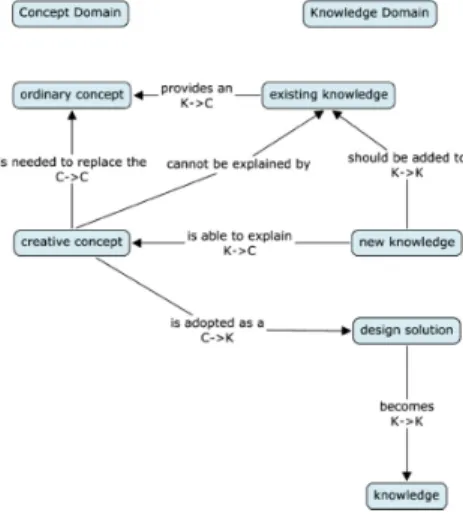
C-K theory is based on the distinction between two expandable spaces: a space of Concepts (C-space), and a space of Knowledge (K-space). The process of design is thus defined as the co-evolution of C- and K-spaces through four types of independent operators (C → C, C → K, K → C, K → K). According to Hatchuel and Weil (2003), the K-space is a space of propositions that have a logical status(i.e. “true” or “false”)for a designer. Whereas, the C-space is a set of propositionsdescribing an object, that has no logical status in the current K-space: when a Concept is formulated, it is an “unknown” entity, and it is impossible to prove that it is a proposition of the K-space. A Concept expresses a group of properties qualifying a given entity, such as “C: there exist an object x with the properties p1, p2,..., pn” (Agogué et al, 2014). Therefore, within the C-K theory, the design activity is
defined as the process by which a Concept generates other Concepts or is transformed into Knowledge, i.e. the co-evolutionof the C- and K- spaces(Le Masson et al, 2014). Figure 2 illustrates an examples of how the operators could be structured.
Figure 2 approximately here
Within a given design process every C-space has a strong dependency on the related K-space. Every element and possible expansion in the C-space relays on the structure and contents of the Knowledge base (Hatchuel et al, 2004).Once the designer imagines something new, he/she creates new concepts – expanding the Cspace -and he/she activates simultaneously new knowledge – exp-anding the K-space. These expansions are com-plementary: a new knowledge provokes the identification of new concepts and elaboration of new concepts results in the search process to acquire new knowledge. Thus, C-K theory proposes a formal framework for structuring the complementary expansions, supporting the generation of new concepts.
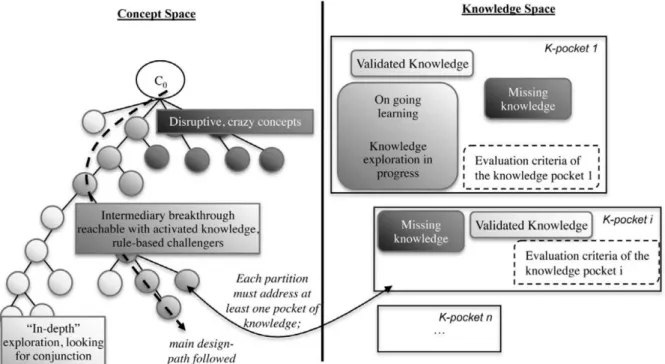
Building a C-K model (Figure 3) with different design paths andvariouslevels of mastery of theK-space, leads to the definition of the C-space with the existing dominant design of the object and possiblepathways ex-pansion (i.e identification of new alternatives) (Agogué et al, 2014). Within a C-K model, the C-space, is structured
as a tree including three different types of C-paths: i) describing the attributes of the existing dominant design re-lated to validated knowledge (items in light grey in Figure 3), ii) characterizing concepts that are reachable and attainable using existing knowledge oritsrecombination(items in mid grey in Figure 3)and iii)outlining new alternatives, through the C-space expansion combined with the further exploration of the K-space (dark grey in Figure 3). This evolving structure helps to identify fixation effects and lack of information that limit the ability to generate novel ideas.
Figure 3 approximately here
C-K theory offers a formal framework, providing a definition of the design process independent of any domain, where creative thinking, learning process, knowledge structuring,knowledgesharing, and innovation principles are not external phenomena but are the central core of the theory itself. Therefore, C-K theory helps to analyze the limits of traditional methods of collectivecreative design (Hatchuel et al, 2015). Methods ofharnessing group creativity, such as more or less sophisticated brainstorming, tend to lead to a consensus with very few breakthroughs. On the other hand,potential well-structured creativity task forces are not able to follow the creativebreakthrough due to the limited size of the Knowledge base or the lack expert inputs. C-K theory is used to overcome these constraints while creating a formal framework for collectively innovative design processes (Hatchuel and Weil, 2009).
3.1 The KCP tool for innovative collective design activities
According to the C-K theory theoretical framework, the design reasoning is interpreted as the co-evolution of the C- and K-spaces. This co-evolution allows to formally describe the learning process (K-space expansion) and to decode the way in which new knowledge supports the generation of new concepts (C-space expansion). Operationalizing the C-K theory, the KCP methodology (i.e. K for knowledge, C for concepts and P for proposals) was developed to manage collaborative design process, where many participants are involved (i.e. experts, users, researchers, engineers, designers, customers, ...) (Hooge et al, 2016). The KCP, described in detail by Hatchuel and Weil (2009) and Agogué et al (2014), is composed by three phases briefly outlined below:
K phase. K-sessions aim to collectively build and share the available knowledge about a given object under design. They consist of several days of seminars in which experts make presentations. The knowledge-exchange activities can be both internal to the design team (i.e. sharing internal knowledge usually compartmentalized in different departments and unshared) or external involving experts. This phase does not contain any creative activity and allows to open up new perspectives in a field of knowledge with an exploration scope. At the end of this phase, the team is able to (re)structure the K-space, identifying possible polysemy and ambiguity, isolating conventional forms of design to highlight paths of possible breakthrough. The K-phase can reveal some weaknesses in the initial individual K-space, in order to prepare for future C-space expansion.
C phase. The C-phase consists of a series of generative sessions during which the design team is involved in a “conceptual building effort”. It aims to activate and encourage unexpected concepts-exploration.The output of the C-phase are detailed proposals of innovative concepts. C-K theorydiffers from creativity techniques such as brainstorming in the way that disruptive paths are explored through pre-defined concepts that guide the
creativity session (i.e. contrary to brainstorming, relying on free divergence, the C-phase manages a divergence phase).
P phase. The last phase consists in synthesizing the outcomes of both the K- and the C- phases into a structured innovative design strategy. It focuses on the identification of different design paths. The P-phase aims toengage actors at all levels, by makingthem informed and aware of learning issues. The P-phase helps the decision-makers, to assimilate the structure of the innovation field, to keep the variety of alternatives and avoid to focus on one apparently dominating solution.
In conclusion, the KCP methodology has been successfully used in a variety of contexts ranging from large companies in the transport sector to agricultural cooperatives or firms from the energy industry (Agogué et al, 2014). It is lacking however, any application with respect to the more complex issue of public policies. To this end, the paperproposes a new participatorytoolfor the innovative design of policy alternatives, based on the KCP and within the C-K theoretical framework.The paper introduces and explores the possible role of design theory in the policy making process. There are a practical and a theoretical reason:howcan onepracticallyemploy the KCP methodology forpolicy design? Does C-K theory need to evolve and adapt with respect to policy design? A pilot case studyaimingto extend the KCP methodologyin the area of policy designis presented in the following sections.
4 Policy-KCP: a systematic generative mechanism for thedesign of policy alternatives
ThePolicy-KCP (P-KCP)isa participatorytoolfor the innovative generation of policy alternatives.ItisaC-K theorydrive tool, adapted tothe design of abstract objects such as public policies.The P-KCPaimsto formalize the innovative design of policy alternatives within a public decision making process. A formal methodology is developed allowing systematic design of public policies that can go beyond traditional policy alternatives. The P-KCPsupportsthe creation ofashared artefact(Ostanello and Tsoukiàs, 1993),further motivating stakeholders engagement and commitment to a participative policy making process.The steps of the P-KCP participatory toolare described in the following.
Policy-Definition phase (P-D phase). The preliminary phase aims to determine key topics and relevant ex-pertise, underpinning the development of policy alternatives. It identifiesthe relevant stakeholders and supports the initial problem formulation of the policy issue under analysis. Firstly, the policy design management team defines the list of suitable participants. In order to support the stakeholder engagement process, it is important that the participants are chosen based on their ability to inform the process and to be knowledgeable about it. In participatory approaches, stakeholder analysis has been seen as a way of generating information on the relevant actors to understand their behaviour, interests, agendas, and influence on decision making processes (Brugha and Varvasovsky, 2000; Reed et al, 2009). Usually, in order to minimise the selection bias and the marginalization of stakeholders (Ananda and Herath, 2003) a top-down stakeholder identification practice, namely “snowballing” or “referral sampling”, is implemented (e.g. Harrison and Qureshi, 2000; Reed et al, 2009). At the end, the stake-holder analysis leads to an in-depth characterization of the relevant actors, their objectives (Lienert et al, 2013) and the relationships between them (Giordano et al, 2017b).
Secondly, the collected knowledge is structured in theinitial problem formulation. In public decision making processes, the problems are often complex and wicked(De Marchi et al, 2016; Rittel and Webber, 1973) and stakeholder groups have different perspectives that need to be incorporated in aparticipatoryprocess (Marttunen et al, 2013). Differences in problem framing and understanding are unavoidable, deeming ambiguous problem definitions (Santoro et al, 2019). On the one hand, a diversity in frames can enhance the co-production of knowl-edge, offering opportunities for innovative solutions. On the other hand, the presence of ambiguity can be a source of discrepancies or conflict in a group, hampering the implementation and/or reducing the effectiveness ofthe policy (Giordano et al, 2017a). Thus, preliminary interviews allow to define an initial problem understanding, underlining the differences between the stakeholders’ points of view.
The expected outcomes are: i) a preliminary synthesis of the state-of-the-art knowledge, ii) the stakeholder analysis with the depiction of objectives and values, and iii) a preliminary analysis of the different problem understandings according to the stakeholder’s perceptions.
Policy-Knowledge phase (P-K phase). The aim ofthisphase is to reach a collective problem formulation agreed upon by all the involvedparticipants. This is accomplishedby gathering missing information and build-ing a comprehensive summary of current knowledge about the policy issue under consideration. Thus, the P-K phase provides the creation of a shared base of knowledge supporting the following generative phase, i.e. P-C phase. The management team combines the outputs from the stakeholders analysis and the initial problem for-mulation with scientific literature studies, available data, emerging technologies, best practices, current policies, etc. Afterwards, individual meetings with stakeholders complete the problem formulation stage. The individual meetings are organized as semi-structured interviews, where participants’ opinion and knowledge concerning the specific policy problem is investigated. Interviewees are free to share their personal knowledge about the given topic. A report of each interview is validated with the interviewed.
This phase supports the building of the overall K-spacecombining the individual (intermediary) K-spaces, in order to reach a common understandingbetween each viewpoint. It allows to: i) clarify the existing knowledge, identifying also missing studies, models, and action plans; ii) integrate new stakeholders’ views into the initial problem formulation; iii) identify potential barriers or preconditions to work with stakeholders; iv) analyze what competencies stakeholders need before the generative process starts in terms of motivation, knowledge, and prac-tical expertise, in order to be able to effectively participate to the P-C phase. The expected outcomes are: i) a summary of the complete state-of-the-art knowledge on the case study and policy issue under analysis, ii) an improved and detailed stakeholder analysis, iii) the definition of the common problem formulation including the individual points of view and iv) the identification of the dominant design concerning the traditional policy alter-natives represented via a preliminary C-tree model. At the end of the P-K phase, the document summarising the complete K-space is shared with all the participants in order to prepare themforthe following phase.
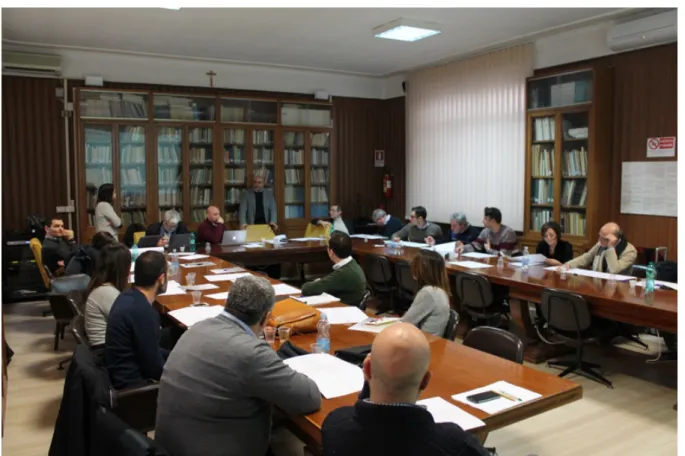
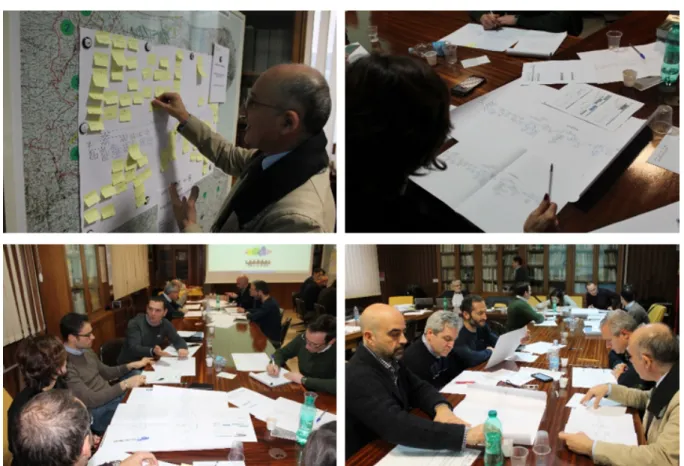
Policy-Concepts Generation phase (P-C phase). The aim of the P-C phase is to generate policy alternatives using the C-K theoretical framework. It consists of one-day generative workshop with a group of participants and it is divided in four steps. Firstly, the common problem formulation is shared, discussed and validated in order to builda common knowledge ground and a collective shared problem formulation for the generative workshop. Secondly, the preliminary C-tree is explained to all the participants. Afterwards, the participants are dividedinto heterogeneous groups, in order to collectively evaluate and discuss the elements representing the policy dominant
design and to suggest the expansions of the C-tree. During this step, each group needs to agreeuponthe evaluation of the alternatives and C-expansion,leading to a facilitation of a“local” process of defixation. Lastly, a general discussion on the group activities is concluding the workshop, as starting point for theparticipatorylearning process.
The C-space allows to illustrate various alternatives as concepts connected to the initial concept (C0) thanks to the tree-like structure. It represents the map of all possibilities where alternatives are broken down and represented in the form of a concepts-tree. The tree structure highlights the dominant design and improves the search among alternatives branches, thus designs.The C-tree for the innovative design of policy alternatives displays different exploration paths. Figure 3showsan example ofC-tree(Agogué et al, 2014).The leftpaths describe the genealogy of known objects, i.e. the hierarchy of attributes stabilized in the dominant design. The central branches outline the first C-expansions allowed by the incremental addition of knowledge or the re-organization of existing K-space.Finally, the right side of the C-tree displays the expansions leading to innovative policy alternatives, which are not explored in the K-space yet.
Policy-Project phase (P-P phase). The P-P phase uses the K-space and the C-tree generated in the previous steps, to build a set of policy recommendations, including the innovative set of policies alternatives. Similarly to the KCP approach, an expert team is involved in this phase to test feasibility of the policy alternatives identified andto evaluate them.Considering the different phases of a decision-aiding process (Tsoukiàs, 2007), the P-P phase supports the decision-making process by considering the whole range of possible methodologies for the evaluation of alternatives.
The developed P-KCP participatory tool to formally support the design of policy alternativeshas been applied toa pilot case study concerning an environmental policy designproblem described in the following section.The pilot case study focuses on the generation of policy alternatives (P-D, P-K and P-C phases) and the possible contribution of its outputs to a following evaluation phase (P-P phase).
5 The groundwater protection policy within the agricultural sector of the Apulia Region (southern Italy)
The purpose of this section is to illustratethe implementation of the P-KCPtool (described in section 4)for the innovativegeneration of policy alternatives in a pilot case study.It is worth underlining that the alternatives’ evaluation represents the subsequent phase of the decision aiding process (Tsoukiàs, 2007). For this reason, this paper details the alternatives’ design phase, i.e. how to build the C-space and the related K-space.The case studydiscussesthe groundwater protection policy and water management within the agricultural sector of the Apulia Region (southern Italy).
5.1 Case study description
The areais located in the north of the Apulia Region (southern Italy) andis characterized by the combined use of surfacewater (SW) and groundwater (GW) for irrigation. The strong GW dependency of the agricultural sector and consequential overexploitation generates social and environmental problems. Specifically, the Capitanata Irri-gation Consortium (IC) provides SW management, ensuring an adequate technical and administrative assistance to
farmers (Giordano et al, 2015). The SW annual availability depends strictly upon weather conditions and rainfall patterns,inan area characterised by recurrent drought events. The Regional Authority needs to protect GW qual-ity and at the same time to preserve high productivqual-ity standards for the agricultural sector. In 2009 the Regional Authority implemented the Water Protection Plan, in order to significantly restrict the GW use (according to the European Water Framework Directive, CEE 2000/60).
Based on a traditional policy design approach, this policy was defined without considering the potential im-pacts on theotherstakeholders (i.e. farmers and IC) and it caused strong conflicts (Giordano et al, 2013). The policy resistance mechanisms mainly occurred due to the economic damages to the agricultural sector, highly de-pendent on the water-demanding crops and irrigation practices (Giordano et al, 2017a). On the one side, the IC has to deal with the water shortage and with the farmers’ water requests. It uses an increasing pricing strategy (based on the Water Protection Plan), defining two different price thresholds for the SW: the base water supply volume (0.12e/m3for 2050 m3/ha) and the additional water supply volume considerably more expensive (0.36e/m3
for 2050-4000 m3/ha). In the IC’s problem understanding, this policy would force farmers to reduce the irrigated areas and/or to select less water demanding crops, without considering the GW alternative (Ferretti et al, 2019). On the other side, each farmer maximizes her/his profits by choosing the crop plan with regard to the quantity of available water (i.e. SW and GW) and the hectares of arable land owned. The base water supply volume is not adequate to cover the water request. Within this situation, each farmer can choose between two alternatives: paying for the additional water supply volume (sold by the IC) or using the GW, a cheaper (approximately 0.19 e/m3) and easily accessible resource. Thus, the use of GW is restricted by the Water Protection Plan but the price
of the additional water volume is higher than the price of GW withdrawal. Even if the GW quality is lower than the water managed by the IC, farmers tend to prefer the useofGW. The farmers perceive the price for the additional water volume as unsustainable (Ferretti et al, 2019). Therefore, they use the base water supply volume, combined with the GW for the remaining water demand. A detailed description of the case study can be found in Giordano et al (2017a) and Pluchinotta et al (2018).
Given this context, the P-KCPtool aims: i) to allow a collective andparticipatory discussionon the water management issue, in order to reach a shared understanding of the different problem framing; ii) to contribute to the conflicts mitigation andto therenewed understanding of the problems by all parties; iii) to ensure a better participation of all the stakeholders and integration of their knowledge, in order to overcome the limits of the traditional methodologies; iv) to suggestnovelalternatives for the GW protection policies and water management strategies within the agricultural sector.
From a methodological point of viewthis paper aims: i)to testand validate the effectiveness of a C-K based tool for the innovative design of policy alternatives within the policy cycle; ii)to showcasea proactive approach, supportingresearch andproposing a “best practice” participatory processes as an example to improve the policy design process.
5.2 The Policy-KCP participatorytoolfor theinnovativegeneration of policy alternatives
P-D phase. During the pre-workshops activities, the policy design management team outlineda first list of relevant participants, determining which stakeholder is involved in or affected by the policy issue under investigation.
Asstakeholders were considered all the individuals,groups, or institutions related to the policy problemwith common or conflicting objectives.Further details on the identified stakeholders and their role are showed in table 1. To make sure that all relevant stakeholders were included in the process, the selection process starts with the identification of the stakeholders mentioned in official documents, reports, and institutional protocols. Thereafter,preliminary interviews with experts and institutional actors allowed to widen the set of stakeholders to be involved (examples of questions are: which stakeholder should be involved in the policy design process and in the P-KCP workshop? Why? Whatis your viewpointconcerning the policy goal? What are the other stakeholders’ viewpoints? etc.) The profile of each possible participant was created including objectivesand perspectives of the GW management problem. Moreover, the relationships with other stakeholders were investigated in order to detectconflictualsituations(using the Interaction Space model defined in Ostanello and Tsoukiàs (1993) and applied in Giordano et al (2017a). Previous research activities on the same case study supported this preparatory phase(e.g. Portoghese et al, 2013; Giordano et al, 2015; Pluchinotta, 2015)).The D-phase allowedan initial definition of the problem formulation, i.e. reducing the GW dependence, ensuring a suitable water volume for the agriculture (C0).
P-K phase.The P-K phase supportedthe identification of the common knowledge on the GW protection and SW management problem, including the quali- quantitative state of GW aquifers and the analysis of the different stakeholders’ problem framing.Theknowledge elicitation activities were carried out by integrating scientific and technical evidences available in literature with expert and local knowledge (Fischer, 2000; Schon, 1983), accord-ing to participatory work principles. After the first round of interviews of theP-Dphase, a second extended round of semi-structured interviews was carried out. The interviews inspected several topics such as the water manage-ment strategies, the peculiarities of the IC’s SW managemanage-ment, the main characteristics of the agriculture sector and farmers’ behaviours, the issues related to field controls, the known effects of the high irrigation practices on the GW aquifers state, etc. Due to the stakeholders’ time constraints, K sessions and common knowledge sharing seminars were not possible (see section 3.1). Nevertheless, the design management team interacted and collabo-rated with all the participants along all the phase.Scientific knowledge available in literature was combined with expert knowledge elicited the interviews and thanks to participatory processes performed previously on the same area (e.g. Pluchinotta et al, 2018; Giordano et al, 2017a). All theinformationcollectedwas writ-ten and distributed to all theinvolved stakeholders, developing the first version of the P-K space.During this phase, participants started learning from other stakeholders’ knowledge and realizing missing knowledge elements thanks to the P-K space. The knowledge sharing process supporting the alignment of the different stakeholder’s perception of the policy issue (i.e. the social aspect of the K-sessions) was organized asthestarting point of the C-phase (i.e. a general discussion at the beginning of the one-day generative workshop). Lastly, in this phase, students supportedthe design management team, acceleratingthe time-demanding task of GW manage-ment best-practices identification. The students attending the 2017 master of ENSAM-Mines ParisTech, trained with the C-K principles, enriched the P-K spacewith information about innovative irrigation techniques and sustainable water management examples.
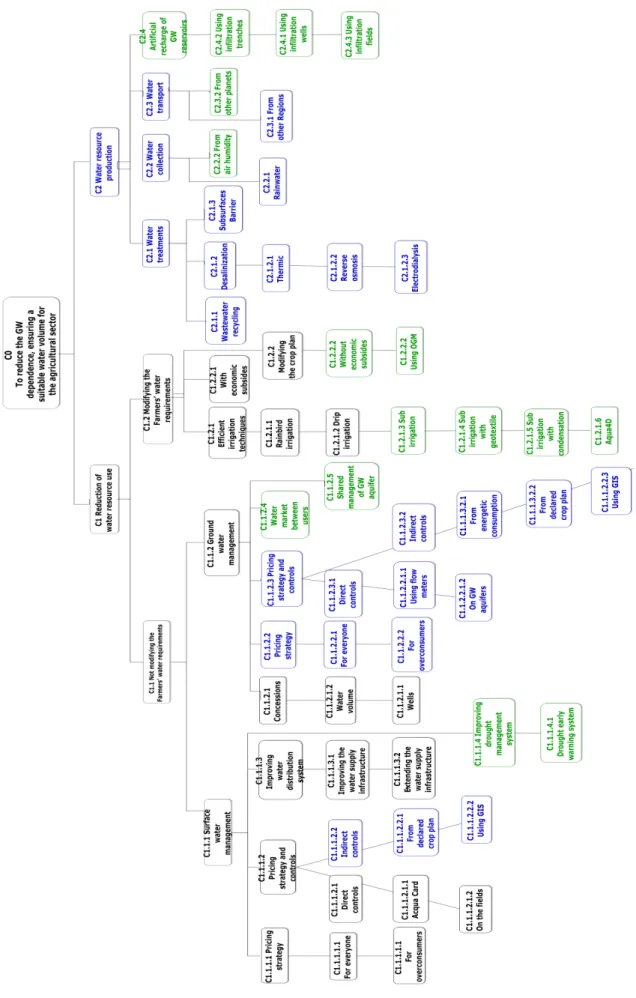
P-C phase. Similarly to the traditional KCP methodology, the P-C phase includes the generation of different designpaths within the C-tree.Further details on the stakeholders involved in the one-day generative work-shop are shown in table 1. Using a color code, figure 6 shows the whole C-tree: i) the branches describing the
attributes of the existing dominant design of known policy alternatives are colored in black, ii) the ones in blue indicateattainable policy alternativesuseexisting knowledge or a combination of K-spacesubsets(i.e. policy alternatives used in best practices of comparable case studies), and iii) the paths in green represent breaking new ground policy alternatives, requiring the expansion of the K-space in order to enlarge the C-space.
Table 1 List of participants involved in the one-day generative workshop
Stakeholders Number of Role
involved Stakeholders
Farmers - Small scale 4 Water user Farmers - Large scale 3 Water user
Consortium of Capitanata - Technical 3 Local water management authority Consortium of Capitanata - Political 3 Local water management authority Regional Authority 1 Regional political authority River Basin Authority 2 Regional technical authority Expert - IRSA-CNR 1 Water management and governance Expert - IRSA-CNR 1 Water balance physical models Expert - CIHEAM 1 Agricultural land/water governance Expert - University of Bari 1 Agricultural economy
Management team 1 C-K theory expert Management team 1 Decision science expert Management team 1 Case study expert
Assistants 1
-Observers 2
-Table 2 lists the elements of the C-tree (figure 4), underlining the concepts hierarchy and the preliminary stakeholders’ interestin exploring certainalternatives(i.e. number of stakeholders considering relevant the alternative at the beginning of the process).
The expected output of the P-C phase is to frame possible innovative alternatives to be explored in the follow-ing P-P phases. Through the generative workshop, a collective problem understandfollow-ing and formulation have been settled and the set of policy alternatives have been analysed and improved. During the one-day generative work-shop, the process ofdesigningpolicy alternatives was supported and managed accordingly to the C-K principles of innovation management.
Table 2: List of policy alternatives generated in order to reduce the GW dependence, ensur-ing a suitable water volume for the agricultural sector (C0)
C0 To reduce the GW dependence, ensuring a suitable water volume for the agriculture
ID Policy alternatives Number of Status stakeholders
interested in exploring the alternative
C1 Reduction of water resource use
C1.1 Not modifying the Farmers’ water requirements C1.1.1 Surface water management
C1.1.1.1 Pricing strategy - Dominant Design C1.1.1.1.1 Pricing strategy for everyone 1 Dominant Design C1.1.1.1.1 Pricing strategy for overconsumers - Dominant Design C1.1.1.2 Pricing strategy and controls - Dominant Design C1.1.1.2.1 Direct controls 2 Dominant Design C1.1.1.2.1.1 Direct controls using Acqua Card - Dominant Design C1.1.1.2.1.2 Direct controls on the fields - Known
C1.1.1.2.2 Indirect controls 1 Dominant Design C1.1.1.2.2.1 Indirect controls from declared crop plan - Known
C1.1.1.2.2.2 Indirect controls using GIS 1 Known
C1.1.1.3 Improving the water distribution system 1 Dominant Design C1.1.1.3.1 Improving the water supply infrastructure 2 Dominant Design C1.1.1.3.2 Extending the water supply infrastructure 2 Dominant Design C1.1.1.4 Improving drought management system - Unknown C1.1.1.4.1 Drought early warning system 7 Unknown C1.1.2 Ground water management
C1.1.2.1 Concessions - Known
C1.1.2.1.1 Concessions - wells - Known C1.1.2.1.2 Concessions - water volume - Known
C1.1.2.2 Pricing strategy - Known
C1.1.2.2.1 Pricing strategy for everyone - Known C1.1.2.2.2 Pricing strategy for overconsumers - Known C1.1.2.3 Pricing strategy and controls - Known C1.1.2.3.1 Direct controls - Known C1.1.2.2.1.1 Direct controls using flow meters - Known C1.1.2.2.1.2 Direct controls on the GW aquifers 2 Known C1.1.2.3.2 Indirect controls 4 Known C1.1.1.3.2.1 Indirect controls from energetic consumption - Known C1.1.1.3.2.2 Indirect controls from declared crop plan 1 Known C1.1.1.2.2.3 Indirect controls using GIS 4 Known C1.1.2.4 Water market between users 2 Unknown C1.1.2.5 Shared management of GW aquifer 10 Unknown C1 Reduction of water resource use
C1.2 Modifying the Farmers’ water requirements C1.2.1 Efficient irrigation techniques 3
C1.2.1.1 Rainbird irrigation - Known
C1.2.1.2 Drip irrigation - Known
C1.2.1.3 Sub irrigation 2 Known
C1.2.1.4 Sub irrigation with geotextile - Unknown C1.2.1.5 Sub irrigation with condensation - Unknown
C1.2.1.6 Aqua4D 4 Unknown
C1.2.2 Modifying the Farmers’ crop plan (CP) 3 Dominant Design C1.2.2.1 Modifying the CP with economic subsides 6 Dominant Design C1.2.2.2 Modifying the CP without economic subsides 1 Unknown
C2 Water resource production
C2.1 Water treatments 2
C2.1.1 Wastewater recycling 8 Known C2.1.2 Desalinization (general suggestion) 4 Known C2.1.2.1 Thermic desalinization - Known C2.1.2.2 Reverse osmosis desalinization - Known C2.1.2.3 Electrodialysis desalinization - Known C2.1.3 Subsurface barriers 1 Unknown
C2.2 Water collection 2
C2.2.1 Rainwater collection 4 Known C2.2.2 Water collection from the air humidity 6 Unknown C2.3 Water resource transport
C2.3.1 From other Regions 3 Known
C2.3.2 From other planets 1 Unknown C2.4 Artificial recharge of GW reservoirs 9
C2.4.1 Using infiltration wells 3 Unknown C2.4.2 Using infiltration trenches 1 Unknown C2.4.3 Using infiltration fields 1 Unknown
Figure 4 approximately here
Following the P-KCP description, the one-day generative workshop consistedoffour main steps divided as follows:
1. The group discussed aboutthe collective problem formulation starting form the different stakeholders’ prob-lem perspectives collected during the previous phase. This step focused on the definition of the GW overex-ploitation policy issue according to the different participants’ backgrounds (Figure 5).
2. A C-K theory expert briefly explained the C-K theoretical framework and made a general illustration of the preliminary C-tree (1h30min). A detailed description of each policy alternative identified at the end of the P-K phase (i.e. dominant design) was carried out. The description of the C-tree branches was supported by therelatedK-space. At the end of this phase, each participant had to express preferences over the five most interesting/suitable policy alternatives for the given policy issue.
3. Small heterogeneous groups were formed to evaluate the dominant design of policy alternative and to propose innovative policy alternatives through the expansion of the C-tree. Each group had to choose at least 5 policy alternatives/elements of the C-tree andtoanalyse the selected items in the following ways: carrying out a collective evaluation of the items providing specific and practical observations and criticisms, defining the interest of each chosen item using scale from 1 to 5 (not useful at all to very useful for the case study), providing suggestions and group recommendations for improving the analysed items, and prompting new policy alternatives or innovative combinations of them. Table 2 lists the elements of the C-tree selected from the groups for the second part of the generative workshop.
4. A general discussion concerning the results of the small group activities and the C-tree expansion suggestions. The general discussion leads to a portfolio of preferred policy alternatives shared with all the stakeholders and to the introduction of few innovative policy alternatives.
5.3 The outputs of the C-phase generative workshop
During the generative workshop (Figure 6), the groupsdecided to work on specificpolicy alternatives. All three stakeholder groups considered “Water resource production - Artificial recharge of GW reservoirs” (C2.4) and “Shared management of GW aquifers” (C1.1.2.5) to be valuable alternatives. The “Drought early warning system” (C1.1.1.1.4.1) and “ Water resource production - Wastewater recycling” (C2.1.1) alternatives were discussed at length. Perhaps the most interesting observation was the groups shifting focus from the alternatives generated via dominant design at the beginning of the workshop to the alternatives in the more innovative C-tree branches towards the last part of the workshop. The explored policy alternatives are shown in table 3.
Table 3 Summary of the groups’ activities
ID Policy alternatives Groups
C1.1.2.5 Shared management of GW aquifers G1, G2, G3 C2.4 Artificial recharge of GW reservoirs G1, G2, G3 C1.1.1.1.4.1 Drought early warning system G1, G2 C2.1.1 Wastewater recycling G1, G2 C2.3.1 Water transport from other Regions G1 C1.1.2.3.2 Indirect controls of GW use G2 C1.2.2 Modifying the crop plan G2 C1.1.1.2.2 Indirect controls of SW use G3 C1.1.2.3.1.4 GW aquifers monitoring G3
C2.2.1 Rainwater collection G3
Figure 6 approximately here
The workshop ended with the generation of a new set of policy alternatives: i) delocalization of the tomato production as new option for modifying the crop plan with economic subsidies (C-tree branch C.1.2.2), ii) sales at the end of irrigation season for the SW managed by the IC, i.e. a lower price for additional water volume in case of abundance (C-tree branch C1.1.1.1), iii) construction of new dams and related infrastructures at different scales. Furthermore, during the discussion, participants highlighted the need to combine policy alternatives in order to builda portfolio of actions.Specifically:
– The alternative “Water resource production - Artificial recharge of GW reservoirs” (C2.4) was proposed for increasing the water availability, considering GW aquifers as reservoirs for properly treated water. This al-ternative defined a new role/attribute for the GW reservoirs. The participants underlined the need to analyse the interdependencies between the alternative C2.4 and economic and management issues (e.g. the high costs of investment, the need for a detailed analysis of the aquifers state, the farmers’ will to accept). During the discussion G1 suggested that the strength of this alternative was related to the abundance of winter water flow that could be collected and reintroduced by helping the aquifer hydrologic balance in dry and summer seasons (i.e. requiring newly built storage space). Participants were inspired by the alternatives explored in the related C-tree branch and suggested implementing a decision support system to evaluate the economic and technical feasibility of the proposed sub-alternatives (C2.4.1, C2.4.2, C2.4.3) through detailed hydrological studies and analysis of current regulations.
– The alternative “Shared management of GW aquifers” (C1.1.2.5) has been recognised a promising long term policy strategy, enhancing the innovative management of GW through shared and informed decision processes. The starting point has been a specificelement of the K-space brought by one stakeholder on common pool resources management, according to Ostrom (1990)’s works introduced the awareness of the attributes defining the GW resource (i.e. the K-space expansion). Thus, GW is a shared resource characterized by a highly distributed structure with several collection points (i.e. wells) in private properties. In this regard, farmers tend to deny the legitimacy of a centralized entity for its management. Furthermore, stakeholders’ knowledge clarified that the centralised "command and control" approach fails in verifying the actual num-ber of wells and GW volume consumptions due to high management costs.In this context, a shared GW governance could empower the farmer community through reward regulations for virtuous GW use. Shared GW governance is supported by non-centralized self-organizing management structures (i.e. groups of farmers managing shared sub-aquifers). Following the discovered GW attributes the discussion leads to considering a distributed management system, in order to overcome the shortfalls of a centralized management for GW. At the end of the discussion, the principles of shared governance were revised by a few stakeholdersand a new alternative was proposed: the IC as an integrated water resource management authority (i.e. SW and GW) through a specific GW withdrawals legislation, legitimated by a bottom-up participative decisional process in order to preserve the equal water distribution principle. For the shared management policy alternative, partic-ipants identified the necessity of: i) a detailed database on the quali-quantitative state of the aquifers from a physical point of view; ii) farmers’ crop plan patterns from a management point of view in order to organize farms in sub-structures; iii) a learning process via pilot a case study from the social point of view.
– The alternative “Drought early warning system (DEWS)” (C1.1.1.1.4.1) was discussed with a twofold per-spective. On the one hand, all the participants recognised that a DEWS does not have a direct effect on GW availability, underlining (i.e. via a specificelement of the K-space related to innovation)the differences be-tween superficial drought and GW shortage, the latter becoming visible with a significant delay. On the other hand, some participants observed that a DEWS managed outside the IC structure, could erase the farmers’ dependency on the IC information system, encouraging irrigated crop practices in case of water abundance with a major negative impact of the GW aquifers. However, the experts of the G1 highlighted that analysis based on historical data could be beneficial for supporting the annual farmer’s crop planning phase through timely information on water availability.
– The “Water resource production - Wastewater recycling” (C2.1.1) was considered a pragmatical alternative despite several technical reportsshowingthat it does not significantly increase the quantity of available wa-ter. New elements were added to the K-space during the discussion (i.e. the IC is developing a project for introducing recycled wastewater in its distribution system). The discussion focused on the role of the IC as a management authority for an integrated water distribution system. The participants identified the following actions to be considered in a portfolio of policy alternatives: i) to explore innovative water treatment tech-nologies in order to expand the related C-tree branch; ii) to develop a reliable treatment process in order to recognize the different responsibilities in the production and distribution phases; iii) to face problems related to the recycled water quality, avoiding a decrease in crops conditions; iv) to fairlydividethe energetic
con-sumption of the treatment plant (i.e. paid by the Farmers or by the whole community); v) to develop strategies and infrastructures (i.e. water storage systems) in order to secure the water distribution in case of breakdown. – The known alternatives “Indirect controls of GW use” (C1.1.2.3.2) and "Indirect controls of SW use" (C1.1.1.2.2)
were considered as basic actions for the implementation of the more innovative policy alternatives. Providing more detailed information about the current situation would improve policy effectiveness. A key step would be the introduction of new institutional actors that could support the phase of gathering the above-mentioned information. Expansion of the two C-tree branches involves: i) controls on the energetic consumption via the collaboration with the energy company; ii) controls on the actual cultivated hectares and crop plans; iii) intro-duction or re-organization of a dedicated institutional actor for the data set task. Furthermore, G3 suggested a combination of policy alternatives, including the declaration of the annual crop plan as fundamental con-straint for the access to the SW distribution system. Similarly, "GW aquifers monitoring" (C1.1.2.3.1.4) was recognized a basic action for the implementation of other policy alternatives.
– The “Water resource production - Water transport from other Regions” was considered a well established alternative with several related technical and organizational issues. Several Regions neighbouring the Apuglia Region have a surplus of SW and this additional water volume is already used for the urban potablewater distribution system. The participants underpinned that there is available knowledge on the topic but that this alternative has not been explored yet for the agricultural system due to political issues concerning specific institutional actors that were not involved in the process. Consequentially, the missing knowledge did not allow to expand the C-tree branch.
– Within a generic perspective, the G2 suggested to explore the C-tree branch related to the alternative “Modify-ing the crop plan” (C.1.2.2). The economic subsidies driv“Modify-ing the farmers’ tendency to prefer irrigation practices were proposed, i.e. an economic compensation for voluntary GW quantity monitoring and reduction of GW consumption. Participants suggested that this branch should be explored in detail thanks to the combination with a related K-space expansion (i.e. missing knowledge on the subject).
– Lastly, the alternative “Water resource production - Rainwater collection” (C.2.2.1) was pictured as an es-sential, even if limited, answer to the GW overexploitation problem. The collected rainfall represents a small volume, but this alternative combined with other options of water resources production (i.e. “Wastewater re-cycling”) could reduce the GW dependency of the agricultural sector. During the discussion a new alternative was generated and the group proposed to use rainwater and recycled wastewater for softening the seawater intrusion, increasing the GW quality. The rainfall collection practices were wellknown bythe participants and they did not explore any discussion on the technical aspects.
It is worth underlining that the alternative “Water resource production - Water transport from other planets” (C.2.3.2.) represents a typical sample of innovative design through provocation. Thus, thanks to a successful generative phase where the C-space was explored without any constraints, participants proposed an alternative for increasing the quantity of available water, considering the presence of natural resources on other planets. The discussion during the one-day generative workshop pointed out the lack of knowledge on technologies for universe exploration.
5.4Evaluation of the Policy-KCP tool
At the end of the process, a questionnaire on the advantages and disadvantages of the P-KCP participatory tool was distributed to all the participants, followed by detailed interviews. Participants have been asked to reply to open evaluation questions, namely, “Overall, what did you like about the P-KCP? Could you please describe strengths and weaknesses of the process proposed for the innovative design of policy alternatives?” The participants’ answers helped the evaluation of the process for future improvement. Specifically, within the pilot case study, the methodology received positive feedback, e.g. “good the C-tree building activity”, “open discussions”, “useful the information exchange before the discussions and C-tree”, “different points of view considered”.The involved stakeholders considered theP-KCPan innovative and intriguing methodologi-cal approach since during the final discussion further innovativepolicyalternatives emerged(see section 5.3).The highlighted advantages include the pre-workshop activities for eliciting and aligning the available knowledge on the policy problem under consideration(i.e. D- and K-phase). Furthermore, the K-phase and the preliminary C-tree were considered useful for structuringthe discussion during the one-day generative workshop, with-out influencing the stakeholders’ opinion because it was mirroring their own point of view and partial K-spaces. Stakeholders appreciated the supplied information about the policy problem, with specific emphasis to the knowl-edge sharing sessions (i.e. K-sessions)and the definition of a shared problem understanding. They recognized that the P-KCP approach brought them at the same level during the discussions, in a more inclusive participatory perspective.
On the other side, the pinpointed disadvantages were mainly concernedthe K-space building time-consuming activity and theone-day workshop timeline.The majority of participants complainedabout the lack of time for continuing exploring the C-tree and for further discussions.Specifically, the experts considered the K-sessions long despite their recognition that the lack of stakeholders’ availability was an important driver for the workshop organization decisions.Furthermore, one of the experts stated the needfora longer training on C-K theory, in order to deeply understand the generative process. Lastly, few participants underlined the missing validation for the terminology used in the C-space.
6 Discussion
From a methodological point of view, the C-K theory framework and the P-KCP participatorytooloffers a for-mal support for policy design, assisting thegenerationof innovative policy alternatives. In the presented policy design process based on C-K theory, it was possible to observe and formalize a “generative mechanism” aimed at modifying the stakeholders’ values structure with the consequential expansion of the set of policy alternatives. It improved the quality of the participationprocessfor the policy design and expandedits scope. This was achiev-able thanks to three main differences between the P-KCP participatorytool and other traditional participatory approaches (e.g. Creighton, 2005; Majone, 1993): i) the alignment of different stakeholders’ knowledge indepen-dently from the source in order to build a collective problem understanding and a shared concern; ii) the assisted sharing of structured knowledge allowing the expansion of the available knowledge (i.e. K-space expansion) as a starting point for the unfixation process (i.e. C-space expansion); iii) the methodological support for innovation management applied to policy design.We discuss these briefly in the following.
Firstly, the dichotomy between expert and local knowledge, characterizing the traditional participatory ap-proaches, has been overcome thanks to the P-KCP participatorytoolfor the design of policy alternatives. Differ-ent knowledgesubsets of the K-spacehave been aligned in a more inclusive participatory process. On one side, stakeholders are experts of the local policy issue and they offer a valuable insight for the problem formulation with a K-space expansion. On the other side, experts in several domains linked to the policy goal (e.g. technical, orga-nizational, legislative expertise) facilitated the group learning process through the K- and C-space co-evolution. P-KCP aimsto equally useeach stakeholder’s knowledge, in order to support the group generative mechanism for the innovative design of policy alternatives, enhancing a common problem understanding and improving en-gagement and consensus on the whole policy making process.New information not considered before has now become available.
Secondly, P-KCP reestablishes communication between stakeholders by unfixing the group from the dominant design, i.e. traditional and known policy alternatives. Fixation phenomena within the policy design process bring policy makers and stakeholders in conflicting and unsustainable situations. As it is possible to observe from our pilot case study, at the beginning of the one-day generative workshop, participants tended to debate only about the dominant design, while at the end they were able to explore and expand more innovative branches of the C-tree with mutual consent, on both traditional and non-traditional solutions. Thus, the first part of the workshop leaded antagonistic stakeholders to discuss on the collected knowledge and to agree with the different problem formulations presented, allying their differences (see section 5.1). Each participant realized the missing informa-tion and was more accommodating to new K-space expansions. This represented the starting point for stimulating discussions during the generative mechanism for the C-space exploration. Initially, the discussions were driven by conflicting situations due to knowledge limitations and fixation phenomena, while after the injection of new knowledge and the alignment of problem frames, they weremore willingto cooperate in constructive debates. In addition,the injection of new knowledge related to non-traditional solutions (and provocationssuch as the alternative “Water resource production - Water transport from other planets”) had positive effects on their collective activities and workshop results. Unfixed participants were available to propose new solutions or integrate known alternatives in a different perspective. Moreover, they were able to introduce useful knowledgeK-space expansion)that became operational in the new alternative propositionsC-space expansion)(see section 3).
Lastly, P-KCP and the C-K theory framework provides a support for the innovative generation of policy al-ternatives. Traditional participatory approaches focus their efforts on the problem identification and the collective evaluation of known alternatives, following the dominant design.Several structured approaches such as Prob-lem Structuring Methods drive the identification of known alternatives and not of the ones that are unimag-inable.The generation of innovative policy alternatives is not considered and managed explicitly. In order to allow theemergenceofunimaginablealternatives, a formal methodology for innovation management is needed. Under suchperspectives, C-K theory and P-KCP represent the required guidance for a wider and inclusive policy design process.
Discussing the differences between P-KCP and KCP, the first one to note is the peculiar contextin which we operate.With reference to the main features defining public policy, discussed in De Marchi et al (2016), theKCP has been conceived and operationally validated in the private sector where innovationmanagement is a central activity.Participants to KCP are generally incentivized to work together sharing the same company
objectives and the only differences are between departments expertise and specific goals. Whereas, in public decision processes, the informationis distributed, but not necessarily shared between differentstakeholders with their own goals, backgrounds, expertise and knowledge bases. The lack of motivation to participate to the policy design process as well as of the willingness to change towards a more inclusive participatory approach are pivotaldrivers of the policy making process.
Indeed, under a participatory decision making perspective, an effective policy design process requires the identification of a shared concern in order to motivate stakeholders’ commitment.The P-KCP methodologically supports the participants for its identification.Generally antagonistic stakeholders are not motivated to work together, they have conflicting objectives, different values systems and distant personal perceptions of the same problem.Moreover, Kim and Mauborgne (1998) underlined that people tend to react more positively when treated with higher levels of “procedural justice”. Ackermann and Heinzerling (2004) stated that the ability to capture, structure and analyse contributions from participants assists not only in ensuring that “procedu-ral rationality” (Simon, 1976) takes place but also that “procedu“procedu-ral justice” is served (Kim and Mauborgne, 1995), encouraging stakeholders to absorb a larger share of ownership for the outcomes, therefore increas-ing the likelihood of their implementation. A conceptsimilar to the shared concernhas been discussed in Ostanello and Tsoukiàs (1993), where the identification of the meta-object of the Interaction Space allows an integrated problem representation to be developed. In this regard, P-KCP builds a collective problem understand-ing allowunderstand-ing the stakeholders tomotivateto participation. In case of stakeholders lacking proactive efforts and a shared concern, each stakeholder tends to think and discuss policy alternatives related only to their individual problem framing (i.e. fixation phenomenon). Building a collective problem formulation allows the activation of the design process while conflicting situations considering the individual perceptions causes clashes.
Secondly,in classical KCP participants are physically working in the same company, while stakeholders and institutional actors are often delocalised and have to interact from distance. The geographical constraint and the time limitation make the realization of the classical seminars for the K-space expansion difficult. During a KCP, each participant develops its own K-space and several seminars are developed in order to offer more knowledge-able guidance for the generative phase and the C-space evolution. Whereas, during a P-KCP process, the learning processwithinthe K-phase is compressed because the K-space has been built by analysts. Stakeholders receive an initial set of alternatives andare required to discuss the starting point and explore it in order to support the C-space expansions. The design management team elicits and structures stakeholders’ knowledge before the gen-erative workshop due to the lack of engagement in the process andin thepolicy issuesas well as the lack ofskills in developing research activities in a systematic way. This represents an innovation in C-K theory based tools.
7 Conclusion
This paper presentsa pilot application ofan original approach for the innovative design of policy alternatives. P-KCP is a methodology formalizing the policy design process based on C-K theory. It supports the generation ofunimaginablealternatives thanks to the co-evolution of the K- and C- spaces according to the C-K framework. It connects local and expert knowledge within the whole design process thanks to the construction of a collective problem understanding.