On the existence and determination of
satisfactory partitions in a graph
Cristina Bazgan1, Zsolt Tuza2, and Daniel Vanderpooten1
1
LAMSADE, Universit´e Paris-Dauphine, France {bazgan,vdp}@lamsade.dauphine.fr
2
Computer and Automation Institute, Hungarian Academy of Sciences, Budapest and Department of Computer Science, University of Veszpr´em, Hungary
Abstract. The Satisfactory Partition problem consists in deciding if a given graph has a partition of its vertex set into two nonempty sets V1, V2 such that for each vertex v, if v ∈ Vi then dVi(v) ≥ s(v),
where s(v) ≤ d(v) is a given integer-valued function. This problem was introduced by Gerber and Kobler [EJOR 125 (2000), 283–291] for s = ⌈d
2⌉. In this paper we study the complexity of this problem for different
values of s.
Keywords: Satisfactory partition, graph, complexity, polynomial algorithm, NP -complete, degree constraints.
1
Introduction
Gerber and Kobler introduced in [3] the problem of deciding if a given graph has a vertex partition into two nonempty sets such that each vertex has at least as many neighbors in its set as in the other. The complexity of this problem remains open in their paper. They showed the strong NP -hardness of a generalization of this problem where there are weights on the vertices and we ask for a vertex partition into two nonempty sets such that for each vertex the sum of weights of the neighbors in the same set is at least as large as the sum of weights of the neighbors in the other set. The case where edges are weighted was also proved to be strong NP -hard.
For a graph G = (V, E), vertex v ∈ V , and subset Y ⊆ V we denote by dY(v) the
number of vertices in Y that are adjacent to v; and, as usual, we write d(v) for the degree dV(v) of v in V . Throughout, the subgraph of graph G = (V, E) induced
by Y ⊆ V will be denoted by G[Y ]. The general problem we are interested in is as follows:
Satisfactory Partition
Input: A graph G = (V, E), and a function s : V → IN such that s(v) ≤ d(v), for all v ∈ V .
Question: Is there a nontrivial partition (V1, V2) of V such that, for every v ∈ V ,
Considering A ⊂ V , a vertex v ∈ A is satisfied in A if dA(v) ≥ s(v). Moreover
A is a satisfactory subset if all of its vertices are satisfied in A. If A, B ⊆ V are two disjoint, nonempty vertex subsets such that A and B are satisfactory subsets, we say that (A, B) is a satisfactory pair . If, in addition, (A, B) is a vertex partition then it will be called a satisfactory partition and a graph admitting such a partition is said to be partitionable.
In our statement of the Satisfactory Partition problem, the function s indicates the level of satisfaction required for the vertices to be satisfied. The problem studied by Gerber and Kobler corresponds to s = ⌈d2⌉. As remarked in [3], this problem may have no solution. In particular, the following graphs are not partitionable: complete graphs, stars, and complete bipartite graphs with at least one of the two vertex classes having odd size. Some other graphs are easily partitionable: cycles of size at least 4, trees which are not stars, and disconnected graphs.
After stating some preliminary results (Section 2), we study in Sections 3-5 Satisfactory Partition for different values of s. For s ≤ ⌈d
2⌉ − 1, a result of
Stiebitz [5] indicates that the graph always has such a partition. The original proof is not constructive, and we give here a polynomial-time algorithm that finds such a partition (Section 3). For s = ⌈d
2⌉, we prove that for graphs with
maximum degree at most 4, both the decision and search problems are polyno-mially solvable. This problem on general graphs remains open (Section 4). For ⌈d
2⌉ + 1 ≤ s ≤ d − 1, Satisfactory Partition is proved to be NP -complete
(Section 5). For s = d, the problem is trivial since it consists in deciding whether the graph is disconnected.
2
Preliminary results
Firstly we establish a necessary and sufficient condition to obtain a satisfactory partition.
Proposition 1. When s ≤ ⌈d
2⌉, a graph G = (V, E) is partitionable if and only
if it contains a satisfactory pair (A, B). Moreover, if a satisfactory pair (A, B) is given, then a satisfactory partition of G can be determined in polynomial time. Proof. The necessary part is obvious. The sufficient part is proved as follows. Let V1 = A and V2 = B. While there is a vertex v in V \ (V1∪ V2) such that
dV1(v) ≥ s(v), insert v into V1. While there is a vertex v in V \ (V1∪ V2) such
that dV2(v) ≥ s(v), insert v into V2. At the end, if C = V \ (V1∪ V2) 6= ∅, then
dV1(v) < s(v) and dV2(v) < s(v) for any v ∈ C. Since s(v) ≤ ⌈ d(v)
2 ⌉, we have, for
any v ∈ C, dV1∪C(v) ≥ s(v) and dV2∪C(v) ≥ s(v). Thus we can insert all vertices
of C either into V1 or into V2, forming a satisfactory partition. 2
We show now how to determine satisfactory subsets efficiently.
Proposition 2. For any s ≤ d, it is decidable in polynomial time, if a subgraph G[A] of a graph G contains a satisfactory subset.
Proof. The algorithm iteratively removes from G[A] the vertices v of degree less than s(v), while it is possible.
If at the end of the algorithm we obtain a non-empty subgraph G[A′
], then G[A] contains a satisfactory subset A′
since dA′(v) ≥ s(v), for all v ∈ A ′
. Conversely, suppose that the algorithm removes all vertices from A and that G[A] would contain a satisfactory subset A′
. The first vertex v of A′
considered by the algorithm cannot be removed since its current degree is greater than or equal to dA′(v) ≥ s(v). In this way no vertex of A′ could be removed. Thus, if
the entire set A gets deleted, then G[A] does not contain a satisfactory subset.2
A minimal satisfactory subset A is a satisfactory subset such that, for every A′
⊂ A, there exists a vertex u ∈ A′
with dA′(u) ≤ s(u) − 1.
Proposition 3. For any s ≤ d, if a graph contains a satisfactory subset, then a minimal satisfactory subset A can be found in polynomial time.
Proof. Let A1 be a satisfactory subset of G. We construct a sequence of
sub-graphs of G, G[A1], ..., G[At] such that Ai+1⊂ Ai and each Ai is a satisfactory
subset:
In step i (i ≥ 1), we select a vertex v ∈ Ai, tentatively remove from Aivertex
v and we iteratively remove from Ai\ {v} the vertices u of degree less than s(u)
until we obtain a set X which is either empty or a satisfactory subset. If X = ∅, then we iterate the previous procedure for vertices v ∈ Ai until a set X 6= ∅ is
obtained, and in this case we continue the construction with Ai+1 = X. In the
other case, i.e. where all the sets X obtained are empty, we stop the algorithm with t = i. The set A with the required properties is the set At.
It is clear that A is a satisfactory subset. We have to prove that A is minimal. Suppose on the contrary, that there exists a subset A′
⊂ A such that dA′(v) ≥
s(v) for all v ∈ A′
. Choose any u ∈ A \ A′
. Continuing the procedure from At = A by removing u, a nonempty set At+1 ⊇ A
′
would be generated, which contradicts the previous assumption that At+1= ∅ holds for all u ∈ A. 2
3
The case s
≤ ⌈
d2
⌉ − 1
Stiebitz [5] proved the following result:
Theorem 1 ([5]). Let G = (V, E) be a graph, and let a, b : V → IN be two functions such that d(x) ≥ a(x) + b(x) + 1 for every x ∈ V . Then, there is a nontrivial vertex partition (A, B) of V such that dA(x) ≥ a(x) for every x ∈ A,
and dB(x) ≥ b(x) for every x ∈ B.
Obviously, if we take a = b = s, Stiebitz’s result shows the existence of a satisfactory partition for s ≤ ⌈d
2⌉ − 1. The proof in [5] is not constructive. We
show here how to determine such a partition in polynomial time.
Proposition 4. Algorithm 1 finds in polynomial time a satisfactory pair in any graph for s ≤ ⌈d
Algorithm 1 Determination of a satisfactory pair (s ≤ ⌈d 2⌉ − 1)
Find a minimal satisfactory subset A ⊆ V B← V \ A
if G[B] contains a satisfactory subset then
(A, ˜B) is a satisfactory pair, ˜B being a satisfactory subset of G[B] else
while(G[A] or G[B] has no satisfactory subset) do if G[B] has no satisfactory subset then
Let v ∈ A such that dA(v) ≤ s(v)
A← A \ {v}; B ← B ∪ {v} end if
if G[A] has no satisfactory subset then Let v ∈ B such that dB(v) ≤ s(v)
A← A ∪ {v}; B ← B \ {v} end if
end while
( ˜A, ˜B) is a satisfactory pair where ˜A and ˜B are satisfactory subsets of G[A] and G[B], respectively
end if
Proof. Using Proposition 3, the first step is computable in polynomial time. Using Proposition 2, the if and while conditions are polynomial-time decidable. We justify that in the while loop the selection of a vertex v is always possible. For this, we show that at the beginning of each iteration in the while loop, G[A] and G[B] are such that all their subgraphs contain a vertex u of degree at most s(u); and in addition at least one of G[A] and G[B] is such that all their subgraphs contain a vertex u of degree at most s(u) − 1. In fact, before entering the while loop, each subgraph of G[A] contains a vertex u of degree at most s(u), since A is a minimal satisfactory subset. Also, before entering the while loop, G[B] has no satisfactory subset, which means that each of its subgraphs contains a vertex u of degree strictly smaller than s(u). At the end of an iteration of the while loop after moving v from A to B for example, the degree of vertices in G[B ∪ {v}] increases with at most one, so in each subgraph of G[B ∪ {v}], there is a vertex u of degree at most s(u). Since we are inside the while loop only if one of the graphs G[A] and G[B] is such that none of the subgraphs has a satisfactory subset, the corresponding graph has in each subgraph a vertex u of degree at most s(u) − 1 that can increase to at most s(u) after moving vertex v into the other vertex class. Hence, the operations inside the loop can always be performed.
We show now that the number of iterations is polynomially bounded. Con-sider any iteration of the while loop. Assume, without loss of generality, that G[B] has no satisfactory subset. By the choice of v, since dA(v) ≤ s(v), we have
dB(v) ≥ s(v) + 1. Thus, the number of edges between A and B decreases by at
Theorem 2. Satisfactory Partition for s ≤ ⌈d2⌉ − 1 is polynomial-time solvable.
Proof. From Propositions 1 and 4. 2
By slightly modifying Algorithm 1 replacing s by a or b in appropriate places we obtain the following result:
Theorem 3. Let G = (V, E) be a graph, and let a, b : V → IN be two functions such that d(x) ≥ a(x)+b(x)+1 for every x ∈ V . Then, we can find in polynomial time a nontrivial vertex partition (A, B) of V such that dA(x) ≥ a(x) for every
x ∈ A, and dB(x) ≥ b(x) for every x ∈ B.
4
The case s =
⌈
d2
⌉
In this section we show that for graphs G with ∆(G) ≤ 4 it is polynomial-time solvable to decide if the graph is (not) partitionable, and also to find a satisfactory partition if it exists. In particular, all cubic graphs except K4 and
K3,3 are partitionable and all 4-regular graphs except K5are partitionable.
Firstly we prove two propositions.
Proposition 5. Each cubic graph containing a triangle, except K4, is
partition-able.
Proof. Let G be a cubic graph, G 6= K4, and let C be a triangle of G with
vertices v1, v2, v3. Remark that a vertex outside C cannot have all its neighbors
on C since G 6= K4.
If each vertex of V \ V (C) has at most one neighbor on C then V1= V (C)
and V2= V \ V (C) form a satisfactory partition.
Suppose that there is a vertex v4with two neighbors v1, v2on C. If v3and v4
have a common neighbor v5, then V1= {v1, v2, v3, v4, v5} and V2= V \ V1 6= ∅
form a satisfactory partition of G. Otherwise V1 = {v1, v2, v3, v4} and V2 =
V \ V16= ∅ form a satisfactory partition of G. 2
Proposition 6. Each cubic graph containing a cycle of size 4, except K4 and
K3,3, is partitionable.
Proof. Let G be a cubic graph other than K4 and K3,3. If G contains a triangle
then G is partitionable by Proposition 5. Otherwise let C = v1v2v3v4 be a cycle
of size 4. A vertex outside C cannot have more than two neighbors on C since otherwise G contains a cycle shorter than C.
If each vertex of V \ V (C) has at most one neighbor on C, then V1 = V (C)
and V2= V \ V (C) form a satisfactory partition.
Otherwise, suppose that a vertex v5has neighbors v1and v3. Since G 6= K3,3
there is no vertex of G with the three neighbors v2, v4, v5. Thus, a vertex vi
with i ≥ 6 has at most two neighbors among {v2, v4, v5}. If all vertices vi with
and V2 = V \ V1 6= ∅ form a satisfactory partition of G. Otherwise, let v6 be a
vertex that has v2, v4 as neighbors. If all vertices viwith i ≥ 7 have at most one
neighbor among {v5, v6}, then V1 = {v1, v2, v3, v4, v5, v6} and V2 = V \ V1 6= ∅
form a satisfactory partition of G. Otherwise, there is another vertex v7 with
neighbors v5, v6. In this case V1= {v1, v2, v3, v4, v5, v6, v7} and V2= V \ V16= ∅
form a satisfactory partition of G. 2
We show now how to determine a satisfactory partition.
Algorithm 2 Determination of a satisfactory partition for cubic and 4-regular graphs
Let G be an (ℓ + 1)-regular graph (ℓ = 2 or 3). Search a shortest cycle C.
if |C| ≥ 5 then
V1← V (C); V2← V \ V (C)
else
V1← V (C)
whilethere exists a vertex v ∈ V \ V1 with at least ℓ neighbors in V1do
V1← V1∪ {v}
end while V2← V \ V1
end if
Theorem 4. All cubic graphs except K4 and K3,3 are partitionable in
polyno-mial time.
Proof. Let G be a cubic graph, G 6= K4and K3,3. Let us verify that Algorithm 2
with ℓ = 2 is correct.
If |C| = k ≥ 5, then there are no two vertices on C with a common neighbor v outside C, since otherwise there exists in G a cycle of length at most ⌊k/2⌋ + 2. For k ≥ 5 this would be a cycle shorter than C. So, each vertex outside C has at least two neighbors among V \V (C) and thus V1= V (C) and V2= V \V (C) 6= ∅
form a partition where each vertex is satisfied.
If |C| ≤ 4, then the proofs of the above propositions show that in the partition
(V1, V2) each vertex is satisfied. 2
Theorem 5. All 4-regular graphs except K5 are partitionable, in polynomial
time.
Proof. Let us see in the following that Algorithm 2 with ℓ = 3 is correct. If |C| ≥ 5, then as above, V1 = V (C) and V2 = V \ V (C) 6= ∅ form a
satisfactory partition.
If |C| = 4, then there is no vertex outside C with three neighbors on C, and thus V1= V (C) and V2= V \ V (C) 6= ∅ form a satisfactory partition.
If |C| = 3, then denote C = v1v2v3. If each vertex of V \V (C) has at most two
neighbors on C, then G is partitionable, and V1= V (C) and V2= V \V (C) form
a satisfactory partition. Otherwise let v4 be a vertex with neighbors v1, v2, v3.
If each vertex vi, i ≥ 5 has at most two neighbors among v1, v2, v3, v4 then G is
partitionable. Otherwise, since G 6= K5, let v5 be a vertex with three neighbors
among v1, v2, v3, v4. Then V1 = {v1, v2, v3, v4, v5} and V2 = V \ V1 6= ∅ form a
satisfactory partition of G. 2
Thus, all cubic graphs except K4and K3,3are partitionable and all 4-regular
graphs except K5are partitionable. These results cannot be extended for regular
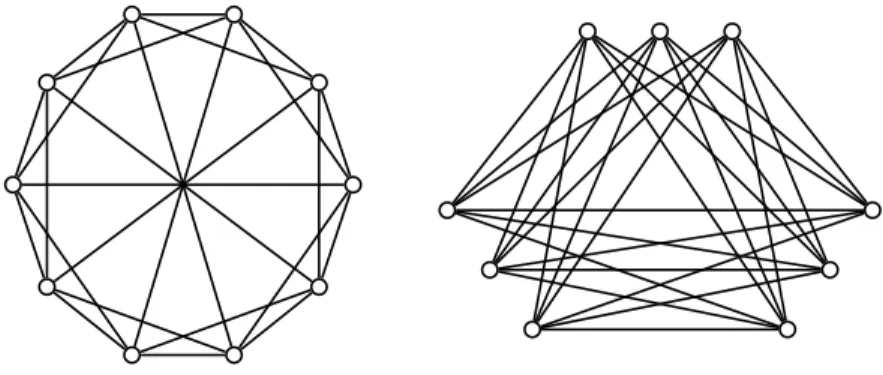
graphs with degree greater than 4 since there are 5-regular graphs, different from K6and K5,5 that are not partitionable, and there are 6-regular graphs different
from K7 that are not partitionable (see Figure 1).
Fig. 1.Non-partitionable 5-regular and 6-regular graphs
We consider now graphs with maximum degree at most 4. As usual, the mini-mum and maximini-mum degree of G will be denoted by δ(G) and ∆(G), respectively. Proposition 7. A graph G with δ(G) = 3 and ∆(G) ≤ 4 is partitionable if and only if it contains two vertex-disjoint cycles.
Proof. (If) Immediate from Proposition 1. (Only if) If G is partionable then each vertex has at least two neighbors in its part, so each part contains a cycle. 2 Proposition 8. Let G be a graph with ∆(G) ≤ 4. Then G is partitionable if and only if we can add in G at most two disjoint edges between vertices of degrees 1 or 2, such that the resulting multigraph contains two vertex-disjoint cycles. Proof. (If) If G contains two disjoint cycles C1, C2 then V (C1) and V (C2) can
be completed to form a satisfactory partition, using Proposition 1.
If G has no two disjoint cycles but adding one edge (vi, vj) the graph G′ =
these cycles. Then V (C1) and V (C2) form a satisfactory pair once we remove
(vi, vj) since vi and vj have degree at most two.
Assume now that the addition of two non-adjacent edges (vi, vj), (vk, vℓ) is
such that the new graph contains two disjoint cycles. Since these two edges are not adjacent, as above, the two disjoint cycles can be completed to a satisfactory partition.
(Only if) Let (V1, V2) be a satisfactory partition of G. If Vi(i = 1, 2) contains
no cycle, then we add one edge between two degree-1 vertices of a tree component inside Vi. If the tree in question is just an edge, then we add a parallel edge
creating a multiple edge. 2
Theorem 6. Let G be a graph with ∆(G) ≤ 4. We can decide in polynomial time if G is (not) partitionable, and find a satisfactory partition of G if it exists. Proof. There is a polynomial number of choices to add at most two non-adjacent edges in G. For a fixed choice, we first verify if there are multiple edges. If there are two non-adjacent multiple edges, then we have found two disjoint cycles; if there is one multiple edge, then we search a cycle in the graph obtained by removing the two vertices incident to this edge. The graph is partitionable if and only if such a cycle exists. If the graph has no multiple edges, then we apply a polynomial algorithm that finds two disjoint cycles in a graph if they exist (Bodlaender [1]), to decide if the graph is partitionable. 2
5
The case
⌈
d2
⌉ + 1 ≤ s ≤ d − 1
Chv´atal introduced in [2] the decomposition problem of bicoloring the vertices of a graph in such a way that each vertex has at most one neighbor with a different color. He gave a polynomial-time algorithm for this problem for graphs with maximum degree 3. For graphs with vertices of degree 2 and 3 this problem coincides with Satisfactory Partition when s = ⌈d
2⌉. Theorem 6 contains
this result. Chv´atal also proved the NP -hardness of this problem for graphs with minimum degree δ(G) = 3 and maximum degree ∆(G) = 4. This result implies the following result for our problem.
Theorem 7. Satisfactory Partition is NP-complete when s = d − 1, even for graphs with δ(G) = 3 and ∆(G) = 4.
Observe that Chv´atal’s problem coincides with Satisfactory Partition when s = ⌈d
2⌉+1 or s = d−1 for graphs G with δ(G) = 4 and ∆(G) = 5. In order
to prove the NP -hardness of Satisfactory Partition when ⌈d2⌉+1 ≤ s ≤ d−1, we just need to adapt Chv´atal’s construction using a graph with δ(G) = 4 and ∆(G) = 5.
Theorem 8. Satisfactory Partition for ⌈d
2⌉+1 ≤ s ≤ d−1 is NP-complete
Before proving this theorem, we define a problem used in the reduction. Bicoloring Hypergraphs
Input: A hypergraph H = (V, E).
Question: Is there a coloring with two colors Red and Blue of the vertices such that no hyperedge is monochromatic?
Bicoloring Hypergraphsis NP -hard even if all hyperedges have size 3 ([4]). Proof. The reduction is from Bicoloring Hypergraphs with hyperedges of size 3. Given an input hypergraph H = (V, E) where V = {v1, . . . , vn} and
E = {e1, . . . , em}, we construct a graph G = (V ′
, E′
) such that H is bicolorable if and only if G is partitionable. We first briefly describe Chv´atal’s construction, which uses the following graph Qd that is a sequence of d triangles (see Figure 2
(a)). (a) (z, e, ℓ) (e, ℓ) (y, e, ℓ) (a, e, ℓ) (x, e, ℓ) (b) Fig. 2.(a) Graph Qdfor d = 4; (b) The gadget Te,ℓ
Graph G contains two subgraphs B0, B1 and subgraphs Ai for each vi∈ V .
B0 and B1 are graphs Qn+m−2 and Ai is Q2di−1, where di is the number of
hyperedges of H containing vi. In each Bℓ, ℓ = 0, 1 the first n consecutive vertices
of degree 2 are labeled by (v1, ℓ), . . . , (vn, ℓ); the remaining m consecutive vertices
of degree 2 are labeled by (e1, ℓ), . . . , (em, ℓ). The 2di+ 1 vertices of degree 2
in Ai are labeled by v ∗
i and (vi, ej, 0), (vi, ej, 1) if vi belongs to hyperedge ej.
Another gadget used by Chv´atal is the graph of Figure 2 (b). For each ℓ = 0, 1 and for each hyperedge e of H containing vertices x, y, z, we add the graph Te,ℓ.
This graph has the property that if the three vertices of degree 1 are in the same part of a satisfactory partition then the other two vertices of Te,ℓ are in
the same part. Also, if two of the three vertices of degree 1 are in different parts of a satisfactory partition then the vertex of degree 2 could be in either of the two parts of the partition.
We specify in the following the edges in G that link the subgraphs A1, . . . , An,
B0, B1. Each vi∗ is joint with (vi, 0) and (vi, 1) for i = 1, . . . , n. Subgraphs B0
and B1 are joined to subgraphs Aj, j = 1, . . . , n using gadgets Te,ℓ, e ∈ E and
ℓ = 0, 1, by identifying vertices with the same labels. With this construction Chv´atal proves the NP -hardness of this decomposition problem.
We introduce the gadget C5,w(see Figure 3) in order to transform any vertex
5 while preserving the reduction. The property of this gadget is that its vertices are necessarily in the same part of a satisfactory partition.
w
Fig. 3.The gadget C5,w
We identify vertex w of such a gadget C5,w with vertices (vi, 0) and (vi, 1)
for i = 1, . . . , n and with vertices (vi, ej, 0) and (vi, ej, 0) of the graphs Ai. Also,
we identify vertex w of such a gadget C5,w with vertices (a, e, ℓ) of gadgets Te,ℓ.
We justify in the following that H is bicolorable if and only if G′
is parti-tionable.
Suppose firstly that G′
is partitionable. It is easy to see that all vertices in B0
must belong to the same part of the satisfactory partition. The same property holds for B1 and also for Ai for vi ∈ V . Subgraphs B0 and B1 must be in the
different parts of the satisfactory partition since otherwise all vertices of G would be in the same part. We construct a vertex bicoloring of H from this partition as follows: if Ai is in the same part as B0then viis colored Red, and if it is in the
same part as B1 then vi is colored Blue. Given a hyperedge e of H containing
vertices x, y, z, it is easy to see using the properties of Te,ℓ that e cannot be
monochromatic, since otherwise (e, 0) and (e, 1) would be in the same part of the partition.
Suppose that H is bicolorable. All vertices of Ai in G corresponding to
ver-tices vi in H of the same color belong to the same part. This partition can be
extended to a satisfactory partition. 2
References
1. H. L. Bodlaender, On disjoint cycles, International Journal of Foundations of Com-puter Science 5(1) (1994), 59–68.
2. V. Chv´atal, Recognizing decomposable graphs, Journal of Graph Theory 8 (1984), 51–53.
3. M. Gerber and D. Kobler, Algorithmic approach to the satisfactory graph parti-tioning problem, European Journal of Operation Research, 125 (2000), 283–291. 4. L. Lov´asz, Coverings and coloring of hypergraphs, In Proceedings of 4th
Southeast-ern Conference on Combinatorics, Graph Theory and Computing, Utilitas Math-ematica, Winnipeg, 1973, 3–12.
5. M. Stiebitz, Decomposing graphs under degree constraints, Journal of Graph Theory 23 (1996), 321–324.