O
pen
A
rchive
T
OULOUSE
A
rchive
O
uverte (
OATAO
)
OATAO is an open access repository that collects the work of Toulouse researchers and
makes it freely available over the web where possible.
This is an author-deposited version published in :
http://oatao.univ-toulouse.fr/
Eprints ID : 13605
To link to this article : DOI:10.1016/j.indcrop.2015.01.041
URL :
http://dx.doi.org/10.1016/j.indcrop.2015.01.041
To cite this version :
Vandenbossche, Virginie and Brault, Julien and Vilarem, Gérard
and Rigal, Luc Bio-catalytic action of twin-screw extruder
enzymatic hydrolysis on the deconstruction of annual plant
material: case of sweet corn co-products. (2015) Industrial Crops
and Products, vol. 67 . pp. 239 -248. ISSN 0926-6690
Any correspondance concerning this service should be sent to the repository
administrator:
[email protected]
Bio-catalytic
action
of
twin-screw
extruder
enzymatic
hydrolysis
on
the
deconstruction
of
annual
plant
material:
Case
of
sweet
corn
co-products
Virginie
Vandenbossche
a,b,∗,
Julien
Brault
a,b,
Gérard
Vilarem
a,b,
Luc
Rigal
a,baUniversitédeToulouse,INP,LaboratoiredeChimieAgro-Industrielle,ENSIACET,4AlléeEmileMonso,BP44362,31030ToulouseCedex4,France bINRA,LaboratoiredeChimieAgro-Industrielle,31030ToulouseCedex4,France
Keywords:
Sweetcornco-product Twin-screwextruder Enzymatichydrolysis Bioextrusion Alkalinepre-treatment
a
b
s
t
r
a
c
t
Acontinuousprocesscombininganalkalinethermo-mechano-chemicalpretreatmentneutralization step,followedbyinjectionofenzymesintothetwin-screwextruder,wasdevelopedusingsweetcorn co-productsasabiomassmodel.Theimplementationofthecontinuousprocessisdescribed.Particular attentionispaidtotheinfluenceofthebio-catalyticactionofenzymatichydrolysisonthedeconstruction ofannualplantmaterialinthetwin-screwextruder(aprocesscalled“bioextrusion”).Theuseofa twin-screwextruderallowsworkingwithhighconsistency(20%),inahighshearenvironment,forashorttime (∼2min).Inthepresentwork,thenatureoftheligno(hemi)cellulosicmaterialtransformations,covering solubilizationandextractionofsaccharidesandmodificationofcellulosicfibers,wereinvestigated.41% ofhemicellulosesand14%ofligninareextractedbythealkalinepretreatment.Hydrolyticenzymesare notdeactivatedduringbioextrusion,whichhasadestructingeffectonthefiber.Itleadstoachangeof rheologicalpropertiesandinducesanincreaseofsugarsreleasedintheformofmonoand polysaccha-rides(upto13%/DMoftotalsugars)withlongerchainsthaninthecaseofabatchreactor.Atthesame time,thedegreeofpolymerizationdecreasesandashorteningofthecellulosechainsoccurs.
1. Introduction
The lignocellulosic materials from agriculture and forest by-products represent an important source of renewable and carbon-neutralenergy.Theseresourcesareclean,cheap,available inlargequantities,andareindependentofgeographicallocation, plustheyarecarbonneutralandrenewable.However,the lignocel-lulosicbiomassisacomplexassemblyofcellulose,hemicelluloses andligninwhoseextractionandconversionrequirestheuseofa refiningprocess(Himmeletal.,2007).
Thesetransformationprocessesareactuallystudiedworldwide and manyreviewsexist onthesubject(VanDykand Pletschke 2012).Theyaretypicallyrealizedintwosteps:oneofpretreatment intendedtoimprovetheaccessibilityofthecelluloseandasecond allowinghydrolysisofthecellulosebyenzymaticaction.Sunand Cheng,2002,Mosieretal.(2005),Zhengetal.(2009),Harmsenetal. (2010)andAlviraetal.(2010)havereviewedpre-treatment
tech-∗ Correspondingauthorat:UniversitédeToulouse,INP,LaboratoiredeChimie Agro-Industrielle,ENSIACET,4AlléeEmileMonso,BP44362,31030ToulouseCedex 4,France.Tel.:+33534323549;fax:+33534323599.
E-mailaddress:[email protected](V.Vandenbossche).
nologiesforabioethanolproductionprocessbasedonenzymatic hydrolysis.Mostcitedpretreatments,amongwhichdiluteacid pre-treatment(Sahaetal.,2005),steamexplosion(Olivaetal.,2003; Caraetal.,2006;Vargaetal.,2004;Ballesterosetal.,2006)and ammoniafiberexplosion(GalbeandZacchi,2007)arethemostwell known,arepenalizedbyimplementationconstraints,technology orreagentcosts,orinhibitorproductionforenzymatichydrolysis orethanolicfermentation.
Soft alkaline pretreatment is one approach that has several potentialadvantagescomparedtootherpretreatmentprocesses, includingloweroperatingcost, reduceddegradationof holocel-lulose, and subsequentformation of inhibitors for downstream processing(Carvalheiroetal.,2008;Kumaretal.,2009;McIntosh andVancov,2011;TaherzadehandKarimi,2008).Themain mech-anismsofsoftalkalinepretreatmentarehydroxylgroupsolvation, leadingtotheruptureofintraorintermolecularhydrogenbonds, andthebreakdownofesterbondswithcleavageoflinkagesinthe lignocellulosiccellwallmatrix,allofwhichleadtothealteration oftheligninstructure,thehydrolysisofthelignin–hemicellulose complex,celluloseswelling,andthepartialdecrystallizationofthe cellulose(Bobleter,1994;SunandCheng,2002).
Awaytoimproveprocesscostsistoincreasethesolid con-centration of biomass in each unit operation. Such high solid
Fig.1.Schematicrepresentationofthesequencesoftheprocesscarriedoutintwosuccessivetwinscrewextruderswithrecirculationofthebioextrudateinthesecondtwin screwextruderwithorwithoutafiltrationmodule.
concentrationsdramaticallyincreaseeconomicviability,reducing operatingcosts duetodecreased volumes. However,increasing solid concentrationincreases theapparentviscosityof biomass slurries,makingmixingandconveyingoperationsmore challeng-ing.Among theprocesses used tocarry out pretreatmentwith a minimum number of steps, twin-screw extrusion technology hasmany advantages andallows workingwithhighsolid con-centrations. It produces a high shear, rapid heat transfer, and effectiveandrapidmixing,inacontinuousoperation,withgood adjustabilityoftreatmentsteps.
Co-penetratingandco-rotatingtwin-screwextrudersaremost common(Dziezak,1989),andaverywidechoiceofscrewelements isavailable.Thescrewprofileisdefinedbythearrangementofthe differentscrewelementsandtheircharacteristics(pitch,length,
numberand shapeofscrew,andanglebetweentwosuccessive elementsincaseofpaddlescrews)indifferentpositionsandspaced differently.
Theperformanceoftwin-screwextrusionandtheinfluenceof theoperatingparametershavebeenstudiedonbiomass fraction-ationfrompoplar (N’Diaye andRigal, 2000), Miscanthussp.(De Vrijeetal.,2002),sugarbeetpulp(Rouillyetal.,2006),sunflower (Evonetal.,2007;Kartikaetal.,2006),soybeanhulls(Yooetal., 2011),ricestraw(Chenetal.,2011), andwheatstraw andbran (Marechaletal.,2004;Zeitounetal.,2010;Vandenbosscheetal., 2014a).
Moreparticularly, twin-screw extrusion canbeused to pre-treatdifferentbiomassesfortheproductionofsugars,andseveral authorshave reportedthistype ofapplicationoverthelast few
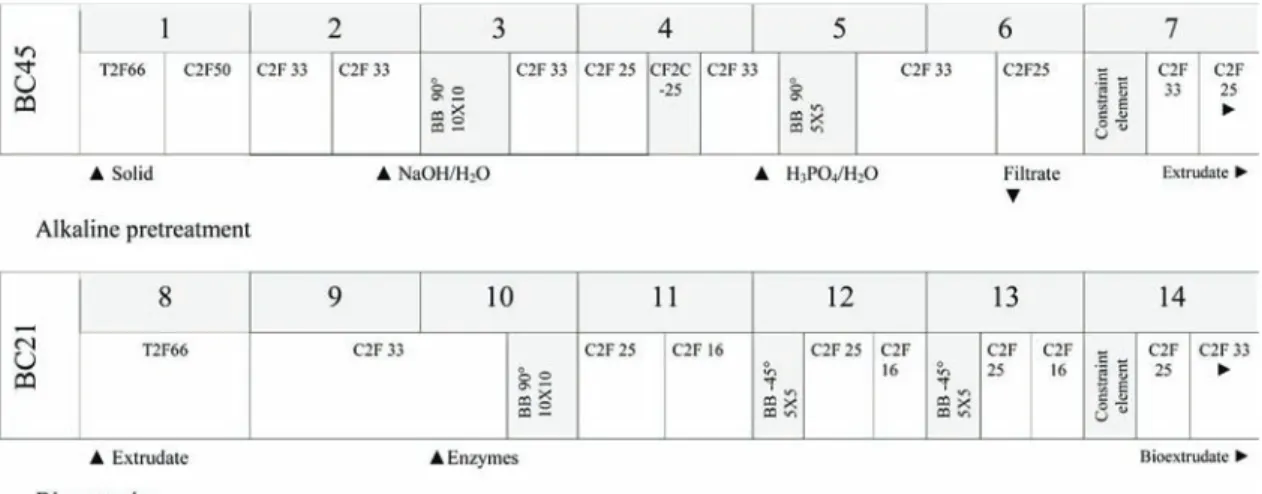
Fig.2.Screwconfigurationforthecombinedprocessofpretreatmentandbioextrusionwithorwithoutliquid/solidseparationzone.(T2F=trapezoidaldouble-threadscrew; C2F=conveyingdouble-threadscrew;BB=bilobepaddlescrew;CF2C=reverseddouble-threadscrew.ThenumbersfollowingthetypeofthescrewindicatethepitchofT2F, C2F,andCF2CscrewsortheanglebetweentwosuccessiveelementsincaseofBBscrews).
Table1
Operatingconditions.
Profile Constraintelements SS T NaOH/DM H3PO4/DM pHex L/S FR I Stability (rpm) (◦C) (%) (%) (kgh−1/kgh−1) (A)
A1 CF2C-25 110 100 32.4 36.6 7.0 10.3 0.06 9 Instabilityofdynamicplug 100 100 10.7 13.1 6.5 3.6 0.20 23 Instability
filtrationmaintainedbut irregular
110 100 9.4 11.0 6.0 7.6 0.08 17 Instability
filtrationmaintainedbut irregular
A2 CF1C-25 110 100 10.5 11.8 6.0 8.2 0.07 17 Stable 110 100 12.1 29.4 5.0 8.4 0.08 21 Stable 110 100 18.6 28.0 5.5 8.1 0.07 14 Stable
ConstraintelementsandoperatingconditionsforAlkalinepre-treatment(CF2C=reverseddouble-threadscrew,CF1C=reversedsimple-threadscrew,DMisthedrymatter ofinletsweetcorn,Ssisthescrewrotationspeed(rpm),pHexisthepHoftheextrudate,L/Sistheliquid/solidratio,FRistheextruderfillingratio,Iisthecurrentfeedingthe motor(A).
Table2
ConstraintelementsandoperatingconditionsforBioextrusionstep.
Profile Constraintelements SS T Enzyme/DM L/S FR Stability (rpm) (◦C) (%) (kgh−1/kgh−1)
B1 CF2C-33(25) 280 50 4.0 2.5 0.01 Instabilityofdynamicplug B2 CF2C-33(50) 280 50 4.0 2.5 0.01 Instabilityofdynamicplug
B3 CF2C-16(25) 200 50 4.1 2.5 0.01 Stable
B4 DM-45◦(5×5) 200 50 4.6 2.5 0.01 Stable
CF2C=reverseddouble-threadscrew,DM=monolobepaddle-screw,thelengthofthescrewsisindicatedinbrackets,FR=extruderfillingratio.
years. Zheng and Rehmann (2014) providean overview of the extrusionpretreatmentoflignocellulosicbiomass.
Lamsaletal.(2010)firstshowedthatextrusionledtohigher reducingsugaryieldscomparedtogrinding,andtheystudiedthe process onwheat bran in two steps: impregnationwith water followedbymechanicaltreatment(grindingorextrusion).A com-bination of both extrusion and alkaline pretreatmenthasbeen explored more recently (Zhang et al., 2012; Karunanithy and Muthukumarappan,2011;Duqueetal.,2013;Umetal.,2013;Kang etal.,2013;Hanetal.,2013).KarunanithyandMuthukumarappan, 2013 provide an overview of this type of thermo-mechanical pretreatment,includingthemechanisminfluencingextruderand feedstockparameters,plusevaluationofpretreatmentefficiency.A continuousprocesscombiningalkalinethermo-mechano-chemical pretreatment, followed by injection of enzymes into the twin-screwextruder,called“bioextrusion”wasdevelopedand tested ondifferentbiomasssuchassweetcornresidue(SC),blueagave bagasse,oilpalmemptyfruitbunchasresiduefrompalmoil man-ufacture,and barleystraw(Vandenbosscheetal.,2014b; Duque et al.,2014).This newprocessleadstoexcellentmixing ofthe enzymeswiththepretreatedbiomassathighconcentrations,and allowssaccharificationtobeginduringbioextrusion.
The implementation of the continuous process, and the influence of the bio-catalytic action of hydrolytic enzymes on deconstructionofannualplantmaterialinthetwin-screwextruder during“bioextrusion”,isstudiedhereincaseofaweaklylignified material:thesweetcornco-products.
2. Experimental 2.1. Materials 2.1.1. Feedstocks
Dehydratedsweetcornco-products,providedbySARLSoupro+, camefromanindustrialcorngraincannery.It wasmilledusing ahammermillfittedwitha6mmscreen,andcontained4%ash, 39%cellulose,36%hemicellulosesand4%lignin(allexpressedin %/drymatteranddeterminedaccordingtotheFrenchstandardNF V03-322andADF-NDFmethodcitedinSection2.3).
2.1.2. Enzymaticcocktails
Enzymaticsaccharification wasconductedusing the Saccha-risedC6cocktailfromAdvancedEnzymeTechnologies(India)in acitratebuffer(300mM,pH4.8).Asolutionof1%ofsaccharised C6cocktailischaracterizedby:proteincontentof9mg/ml, cellu-loseactivityof5s5FPU/ml,endoglucanaseactivityof1940nkat/ml, xylanaseacivityof 16,900nkat/ml,andb-glucosidaseactivityof 310nkat/ml. The protein content was measured after acetone precipitation with Bio-Rad DC protein assay kit, cellulose and endoglucanaseactivityaccordingtoGhose(1987),xylanaseactivity accordingtoBaileyetal.(1992)andb-glucosidaseactivity accord-ingtoBaileyandNevalainen(1981).
A preliminary study showed that the mixture of advance enzyme had an optimum temperature at 54◦C. Beyond 56◦C
enzymeactivitybeginstodecrease,tokeep asafetymarginwe placedat50◦Cforthebioextrusiontrials.
2.2. Twin-screwextruder
Thermo- mechano-chemical alkaline pre-treatment and the neutralizationphase,wereconductedusingaco-penetratingand co-rotating ClextralBC 45 twin-screw extruder. For the bioex-trustionphaseaClextralBC21isused.BothBC45andBC21had sevenmodularbarrels,eachofthesemeasuring200mminlength forBC45 and100mmforBC21.Bothextruderswereequipped withdifferentsegmentalscrewelements.Themetallurgyis, respec-tively,CLX200forBC45andhastelloyforBC21.Botharecorrosion resistant.Moduleswerethermo-regulatedbythermalinduction for BC45and byheater bandfor BC21;modulecoolingwasby watercirculation.Afiltersectionwasusedtoenablethefiltrate tobecollectedandconsistedofsixhemisphericaldisheswith con-icalholes(1mmentry,2mmexit).Theoutputsofextruderswere notequippedwithdie.Schematicrepresentationofthesequence ofstepsfortheprocesscarriedoutintwosuccessivetwin-screw extrudersisshowninFig1.Screwconfigurationforthecombined processofpretreatmentandbioextrusionisshowninFig2.After alkalinepretreatmentandneutralizationintwin-screwextruder BC45,theextrudatewasstoredfrozenanddefrostedjustbefore beingintroducedintoBC21forthebioextrusion.
Table3
Operatingconditionsforalkalinepre-treatmentandbioextrusion. Alkalinepretreatment Bioextrusion
SS(rpm) 110 SS(rpm) 200 T(◦C) 100 T(◦C) 50 QS(Kg/h) 8.8 QS(Kg/h) 3.29 DMs(%) 90 DMs(%) 39.6 QLAlk(Kg/h) 20.7 QT+Ez(kg/h) 1.95 QNaOH(Kg/h) 0.8 QEz(g/h) 60 QLAc(Kg/h) 51.6 QH3PO4(Kg/h) 0.9 NaOH/DM(%) 10.5 Enzyme/DM(%) 4.6 H3PO4/DM(%) 11.7 L/S(kg.h−1/kg.h−1) 7.6 L/S(kgh−1/kgh−1) 2.5 Qext(kg/h) 16.5 Qbioext(kg/h) 5.29 DMext 40.7 DMbioext 29.0 Qfil(kg/h) 62.4 DMfil 4.7 pHext 6 pHfil 5.5 I(A) 17 SME(Wh/kg) 141
WhereSSisthescrewrotationspeed(rpm);Tisthesettemperatureoftheheating modules(◦C);QsandDMSarethefeedrate(kg/h)anddrymatter(%)ofsweet corn;QLAlkandQLAc arerespectivelytheinletflowrateofalkalisolution(kg/h) andacidsolution(kg/h);QNaOHandQH3PO4aretheinletflowofNaOHandH3O4; NaOH/DMandH3PO4/DMarethereagenttosweetcorndrymatterratio(%);L/Sis theliquid/solidratio;Qext,QbioextandQfilare,respectively,theflowrateofextrudate, bioextrudateandfiltrate(kg/h);DMext,DMbioextandDMfilare,respectively,thedry matterofextrudate,bioextrudateandfiltrate.Iisthecurrentfeedingthemotor(A); SMEisthespecificmechanicalenergyconsumedbythemotorperunitweightof solidmatter(Wh/kg).
2.2.1. Alkalinethermo-mechano-chemicalpre-treatmentand neutralizationphase
The alkali used for the pretreatment is sodium hydroxide (NaOH),andtheneutralizationstepusesphosphoricacid(H3PO4).
OperatingconditionsaredescribedinTables1and3.
Feedstockswerefedintotheextruder’sfirstmoduleandthe alkaline solutioninjected usinga piston pump.A first zone of mechanicalpressure,consistingofasuccessionofbilobalpaddles, ensuresgrindingandgoodmixingofthematerialwiththisalkaline solution.Anacidsolutionwastheninjectedusingapistonpump, toneutralizethemediumandreducetheviscosityofthematterto ensuregoodfiltration.Asecondzoneofmechanicalpressure guar-anteesgoodmixingwiththemedium,andfastneutralization.The filtrationzonesituatedinmodule6wascarriedoutbyathirdzone ofmechanicalpressureusingreversedpitchscrewstoensurethe formationofadynamicplug,andthusthepressingofthemixture.
Table4
Compositionandenzymatichydrolysabilityofthepretreatedcoproductofsweet corn.
Composition
DM(%) 40,7
MM(%/DM) 7,3
OM(%/DM) 92,7
Hotwatersoluble(%/DM) 31,4
Cellulose(%/DM) 46,4 Hemicelluloses(%/DM) 28,8 Lignin(%/DM) 4,8 Glucose(%/DM) 54,4 Xylose(%/DM) 22,3 Arabinose(%/DM) 3,0 Galactose(%/DM) 0,7 Mannose(%/DM) 0,1 Enzymatichydrolysability (%/DM) 35
DM=drymatter;MM=mineralmatter;OM=organicmatter.
2.2.2. Bioextrusion
Bioextrusionconsistsofintroducinganenzymecocktailintothe extruder,andthenusingasuccessionofcompressionand expan-sionstepstofacilitatethepenetrationoftheseenzymesintothe matter.OperatingconditionsareshowninTables2and3. 2.3. Analyticalmethods
2.3.1. Drymatterandparietalcompounds
Moisturecontentswere determinedaccordingtotheFrench standardNFV03-903andmineralcontentsaccordingtotheFrench standard NFV 03-322.Anestimationof thethreeparietal con-stituents(cellulose,hemicelluloses,andlignins)containedinthe solids,wasmadeusingtheADF-NDFmethodofVanSoestandWine (1967,1968).Alldeterminationshavebeencarriedoutintriplicate andstandarddeviationwaslessthan1.5%forallmeasurements.
Anestimationofthehotwater-solublecomponentscontained, wasmadebymeasuringthemasslossofthetestsampleafter1hin boilingwater.ThismethodhasbeenadaptedusingstandardTAPPI 204cm-97ontheFibertecTecatorM1017apparatus.All determi-nationswerecarriedoutinduplicate.
2.3.2. Sugars
Reducing sugars were determined using the DNS method (Miller,1959).
Total sugars were determined after acid hydrolysis using a methodadaptedfromNERL(Sluiteretal.,2008).10mloffiltrate wasmixedwith1.25ml72%H2SO4.Hydrolysiskineticswere car-riedoutin sealedtubes between30and 90minat100◦C.After
cooling,samples wereneutralized with3.6ml NaOH32%(m/v), dilutedandfiltered(0.45mm).Analysiswasthenmadeusing high-performanceliquidchromatography(HPLC).
FreeandtotalsugarsweremeasuredusingHPLIC(DIONEX ICS-3000coupledwithpulsedamperometricdetection(PAD)andfitted withaCarbopacPA1column).
Enzymatic hydrolysability was determined by enzymatic hydrolysisin50mMcitratephosphatebuffer(pH4.6)inthe pres-enceofAdvancedenzymes(2.5%/DMsubstrate)at50◦Cfor48h.It
hasbeencalculatedasthepercentageofreducingsugarsreleased byenzymatichydrolysis,relativetodrymatter.
Sugarsreleasedafterbioextrusionweremeasuredonwater sol-ublesextractedfrombioextrudates.Thelatter,obtainedafter1,3,5 or7passagesintheBC21twin-screwextruder,werefirstdilutedin waterwithaLiquid/Solidratioof20andthenfilteredontoaglass filter(porositygrade:2).
2.3.3. Degreeofpolymerization(DP)ofoligosaccharides
The degree of polymerization (DP) of oligosaccharides was determinedinhighperformanceanion-exchangechromatography equippedwithapulsedamperometricdetectorandaneluent gen-eratorEluGen®(HPAEC-PAD,ICS-3000,Dionex).Theanalyseswere
carriedout withananion exchange column(250mm Carbopac PA200) and used a mixtureof two eluents (A:100mM sodium hydroxide and B:100mM sodium hydroxide with 1M sodium acetate)withagradientfrom100%ofAatt=0to75%ofAand 25%ofBatt=35min.Theflow rateofthecolumnwasfixedat 0.35mL/min.
2.3.4. Residencetimedistribution(RTD)
Sweet corn particles colored with Erythrosin were placed quickly(<2s)onthefirstscrewelement.Thisdyewaschosenas atracerforitsneutralcharacteristicswithrespecttotheprocess and becauseof its good colorization of mostvegetable matter, itselfoftenhighlycolored(N’Diaye,1996).Samplesofextrudate aretakenevery5satthesolidoutletsoftheextruder.All sam-plesaredriedat103◦Candgroundtohomogenizethecolorand
0 0,005 0,01 0,015 0,02 0,025 0 20 40 60 80 100 120 140 160 180 200 220 240 Time (s) E (t ) Malaxage Contre filet Retention tim e : 118,2s Retention tim e : 127,9s DM - 45° C2FC - 16
Fig.3.Residencetimedistribution(RTD)ofthematerialintheBC21twin-screwextruderequippedwithprofilesB3andB4.
toeliminatelargesizeparticleswhichaffectmeasurements.The ‘a’coordinateofcoloredoutletsamplesintheCIE(L*a*b)system, isreaddirectlyusingaspectrophotocolorimeter(ModelCM500i, Minolta,Japan,illuminant:D65,observerangle:2◦).TheRTDdata
areexaminedthroughtypicaldistributionversustimeplots.RTDis definedas:
Ei= n Ci
X
i=1Ci×Dt
whereCiisthetracerconcentrationineachsampleandDtisthe samplingperiod.Typicalcurvesareshownon(Fig.3).
2.3.5. Dynamicviscosity
Viscosity values were determined in accordance withTAPPI Standard T 230om-94“viscosity ofpulp” (capillary viscometer method).Inourcase,thesamplewassolvatedwith cupriethylene-diamineandpassedthroughacanon-fenskeViscometer,type150 at25◦C.Theviscometerreadingswereperformedthreetimesfor
eachsample.
3. Resultsanddiscussion
Theprocessofdeconstructionoflignocellulosicplantmaterial iscarriedoutusingtwoconsecutiveextrudersBC45andBC21. Itincludedthreedifferentparts:analkalinepre-treatment(inBC 45),aneutralizationphase(inBC45),andanenzymeimpregnation phase(bioextrusion,inBC21)duringwhichthehemicellulosesand cellulosesaccharificationbegan.(Figs.1and2).
3.1. Alkalinepre-treatmentandneutralizationphase
Thefirststepoftheprocessisthedestructurationofcellulosic materialunderalkalineconditions.
Thealkalineextractionconditionsforhemicellulosesandlignin intwin-screwextrudershavebeenwidelystudied,forinstanceon sorghumandpoplarwoodfibers(N’Diayeetal.,1996)oronwheat straw(Magro,1995;Marechal,2001;Zeitounetal.,2010),andthis previousworkhasallowedustodefinetheconfigurationandscrew profilesused inthis study.Theaimofthis firststepis toopen upthecomplexstructureofthebiomass,andfacilitateaccessof thehydrolyticenzymestopolysaccharides,byincreasingthe sur-facearea(KarunanithyandMuthukumarappan2011)andporosity (Zhangetal.,2012;Vandenbosscheetal.,2014b).
Thethermomechanicaleffectoftheflowrestrictingelementsof thescrewprofile,ensuresphysicaldisintegrationofthematerial byseparatingthefiberbundles.Thepresenceofsodium hydrox-ideensuresadditionalchemicaldestructurationbysolubilization
oforganicmatter,especiallyhemicellulosesandlignin,depending ontheamountused.
TheneutralizationphaseisnecessarytoobtainapH compati-blewitheffectiveenzymeactivityduringbioextrusion.Phosphoric acidisusedinthisstepbecauseitistriprotic andsolimitsthe massofacidneeded.Thisneutralizationstepalsodecreasesthe viscosityofthematterviaachangeofpHandadilutioneffect, whichfacilitatesfiltrationandplaysapartindevelopingfriction, shear,andimpactsresidencetime.Theeffectivenessofthefiltration stepdependsontheformationandstabilityofthe“dynamicplug” formedinmodule7,andtothepresenceofconstraintelements (Fig.2).Theselectionoftheseconstraintelementsisimportantfor theformationofastable“dynamicplug”.TheuseofaC2FC-25 reverseddouble-threadscrewfailedtoachieveastablefiltration despitevaryingtheoperatingconditions,includingachangeinthe amountofsodiumhydroxide,intheliquid–solidratio,orinthe degreeoffilling(Table1).Indeed,inthepresenceofinsufficient backpressure,theoperationoftheextruderasaliquid/solid sepa-ratormaybecyclic,withanaccumulationoffluidinthefiltration zoneresultinginalossofdynamicplugstructure.Liquid separa-tionislesseffectiveandthesolidisinsufficientlypressed.Thisis accentuatedinthepresenceofhighlevelsofsodiumorhigh liq-uid/solidratiosandcanexplaintheworstresults,obtainedwitha NaOH/DMratioof32.4%.Achangeinextruderconfiguration, con-sistingofreplacingtheC2FC-25reverseddouble-threadscrewwith areversedsimple-threadscrewC1FC-25,hasachievedasteady stateforaL/Sratiocloseto8,afillingratio(Q/S)of0.07–0.08and forarangeofNaOH/DMratiosbetween10%and19%.Thereversed simple-threadscrewC1FC-25ensuredbetterbackpressurethan theC2FC-25reverseddouble-threadscrew.Forsubsequentworka minimumNaOH/DMratioof10.5%hasbeenretained.Underthese conditions,8%ofthecelluloseisdrivenintothefiltrate,and41% ofthehemicellulosesplus14%oftheligninsareextractedbythe alkalinepretreatmentincludingneutralizationstep(Table4).The pHofthefiltrateandoftheextrudateattheendofthisstepis, respectively,of5.5and6.
3.2. DevelopmentoftheimpregnationprofileonBC21
After thealkaline pretreatment and theneutralization step, enzymesareintroducedintotheconveyingzoneofthe bioextru-sionstep(Fig.2),andimpregnationofthematerialisensuredbythe useofaseriesofmechanicalpressureandrelaxationzones.Four constraintzonesareimplementedinmodules10,12–14.Thefirst threeconsistofaseriesofbilobepaddlescrews,thefirstmounted atanangleof90◦(noconveyingeffect),andthelasttwoat−45◦
(retentioneffectonthematerial).Thefourthzoneisformedeither byareversedscreworbyamonolobepaddlescrewmountedat anangleof−45◦.These constraintelementsprovidegood
mix-0 5 10 15 20 25 30 0 10 20 30 40 50
Time (h)
H
y
d
ro
ly
s
a
b
il
it
y
(
%
/D
M
)
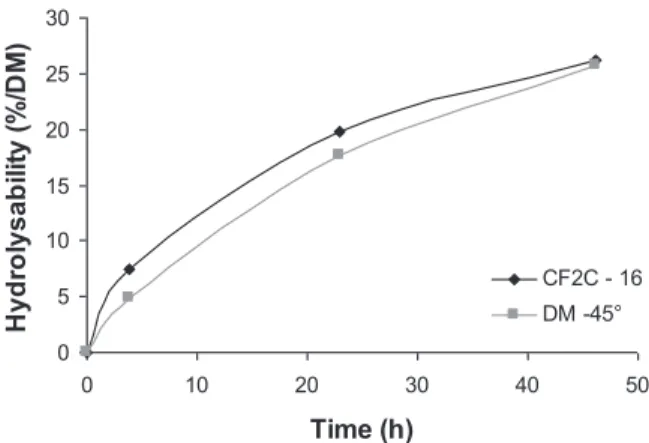
CF2C - 16 DM -45°Fig.4.EnzymatichydrolysabilitykineticsoftheextrudateproducedbyprofileB3 andB4.
ingofthematerial.Betweentheseareasofmechanicalpressure, conveyingelementswithdecreasingpitchensurethetransportof themixture.Inordertoincreasetheresidencetimeandoptimize thebiomass–enzymecontact,differentconstraintelementshave beentestedinmodule14(Tables1and2).Thereversed double-thread screws C2FC -33 generated insufficientbackpressure to formastable“dynamicplug”,whateverthelengthtested.Reversed screwswithshorterpitchormonolobepaddle-screwswereused andallowedasteadystatetobeachieved.Thedeterminationof theresidencetimedistributionofthematterintheextruderfor thesetwoprofilesB3andB4,showedthattheuseofmonolobe paddle-screwsresultedinaloweraxialdispersionofresidencetime aswellasaslightshorteningthereof.However,inbothcasesthe retentiontimeisverysimilar,closetotwominutes(Fig.3). Com-parisonoftheyieldsofsugarsreleasedbyenzymatichydrolysisata lowconcentration(2.5%,)withoutaddingfreshenzymes,revealed nosignificantdifferenceafter48h(Fig.4).Atmost,thehydrolysis kineticwasinitiallyslightlyaccelerated.Thisresultalsoshowed thattheimplementationofashearingelementsuchasreversed screws,doesnotcausesignificantdeactivationoftheenzymes. 3.3. Increaseintheresidencetimeoftheenzymeimpregnation step:bioextrusion
AscanbeseenfromFig.3theresidencetimeofthematerialin theBC21forthebioextrusionstepisverycloseto2minwhatever
therestricting elementused. Thisis verylow compared tothe timesrequiredforasignificantincreaseinenzymatichydrolysisfor releaseofthemonosaccharides.Thus,tounderstandandvalidate theactionofenzymesintheextruderitisnecessarytoextendtheir actiontimeduringbioextrusion. Theincreasedextrudercontact timeissimulatedbyrecirculatingthebioextrudateinBC21.The operation is undertaken using the same configuration and the same screwprofileas for the firstpassage (Figs. 1 and 2), but withoutfurtheradditionofenzymesolution.Itisasiftheduration of thecontact time wasmultiplied by thenumber of passages throughtheextruder.
The material is worked on more and more withsuccessive passagesthroughtheextruder,andbecomessticky.Thispasty con-sistenceislessandlesstextured,thematerialisliquefiedgradually, anditsrheologicalpropertieschange.Andthischangeinrheology tendstoprovethatafiberdestructuringeffectisoccurringduring bioextrusion,whichwasalsoobservedbySamaniuketal.(2011), whohaveshownasynergisticrelationshipbetweenmixingand enzymeactivityduringenzymatichydrolysis.Andbyusingatorque rheometer,theydemonstratedthatthetorquerequiredformixing biomasssampleswith20%soliddrymatter,decreasesinthe pres-enceofenzymesasafunctionoftime,andthisisaccompaniedby anincreaseinglucoseconverted.
3.4. Natureofthetransformationsofthelignocellulosicmaterial inthetwin-screwextruderduringenzymeimpregnation 3.4.1. Solubilizationandextractionofsaccharides
Tostudytheimpactofbioextrusionontheevolutionofthe mat-terdestructuration,ananalysisofdissolvedcompoundsduringthis bioextrusionismade.Tothisend,samplesofbioextrudateare col-lectedaftereach passagethroughtheBC21 extruder,and then dilutedinwater,withaliquid/solidratio(L/S)of20.Theyarethen pressedandfiltered.Freesugars,reducingsugarsandtotalsugars arethenmeasuredintherecoveredfiltrates.
Tocomparethethermomechanicaleffectswiththe thermome-chanicaleffectscoupledtoenzymaticaction,atestiscarriedout withouttheadditionofenzyme,maintainingasolidliquidratio of2.5byadditionofwater.Analysisoftheresultantfiltratefrom thetestswithoutenzyme,shows thatvery fewsaccharides are extractedduringextrusionwhateverthenumberofbioextrusion passages(Fig.5).Thethermomechanicaleffectgeneratedby extru-sionundertheseoperatingconditionsdoesnotactontherelease ofsugars,eitherinfreeformorinpolysaccharideform.
0 2 4 6 8 10 12 14 16
TMO TM1 TM3 TM7 TME1 TME3 TME5 TME7 Control
S ug a rs ( % /D M ) Free sugars Reducing sugars Total sugars
Fig.5.Sugarreleasedinbioextrudateafter1,3,5or7passagesthroughthetwinscrewextruderwithonlythermomechanicaleffects(TM)orwiththermomechanicaleffects coupledtoenzymaticaction(TME),comparedwithbiomasstreatedinastirredreactorinthepresenceofadvancedenzymes,4.6%/ms,consistencyof30%,70min,T:50◦C (control).TMOcorrespondstothealkalinpretreatedcoproductofsweetcorn.
-50 0 50 100 150 200
250 1 - 110502 #22 [modified by Administrateur, 4 peaks manually assigned] ED_1
nC 1 Az 0.0 5.0 10.0 15.0 20.0 25.0 30.0 35.0 40.0 -2.0 0.0 2.0 4.0 6.0 8.0 10.0 12.0 2 - 110502 #25 m al to 51.7 ED_1 nC m i n 2
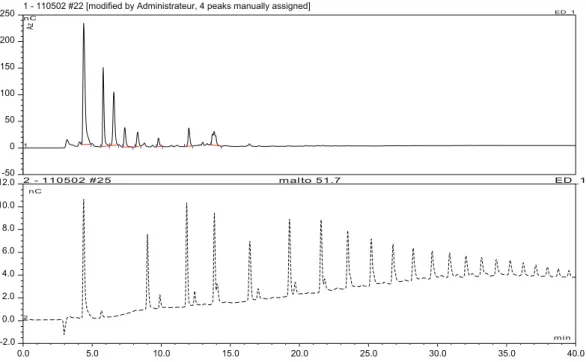
Fig.6.HPAE-PADanalysisofoligosaccharidesreleasedintothefiltrateintheseventhcycleofbioextrusioncomparedwiththemaltodextrinestandard.
Duringthebioextrusion,freesugarsappear,whichmeansthat theenzymesareactiveintheextruderandthatmonosaccharides arereleased(1–2%ofdrymatterintroduced).Analysisofthe reduc-ing sugarsand of the total sugarsin the wash filtrates reveals thepresence of sugars releasedby enzymesin the twin-screw extruder.These sugarsarein theformof free sugars, oligosac-charidesandpolysaccharides,andtheirproportionincreaseswith thenumber of passagesthrough theBC21extruder.Looking at thedifferencebetweentheproportionofreducingsugarsandof totalsugarsderivedfromthedifferentdeterminationmethods,the DNSmethodquantifiesonlythereducingendsofmono,oligoand polysaccharides,whereasthemethodbyacidhydrolysiscoversall themonosaccharidesinthesesugars.
Acontrolispreparedinordertocomparetheenzymaticaction duringbioextrusionwiththeenzymaticactioninastirredreactor. Alkalipretreatedbiomassisplacedincontactwiththeenzymes inastirredreactorunderthesameoperatingconditionsasforthe bioextrusion(T:50◦C,enzymerate:4.6%,L/S:2.5)for70min.The
lattercorrespondstothetimenecessarytoachievetheseven pas-sagesincludingthedeadtimebetweentwosuccessiveones.The sugarreleasedbyenzymesafterthistimeinthestirredreactor,is thesameintermsofreducingsugarsandlessintermsoftotal sug-arsorfreesugars,comparedtothoseobtainedinthetwin-screw extruder.Thisreflects thefact thatin thecase of bioextrusion, thesugarsarereleasedingreateramountsintheformoflonger chainsorintheformofmonosaccharides.Thedifferenceinthe totalamountreleasedandthelengthofsugarchainwouldseem toshowadifferenceofhydrolyticenzymeaction.However,thisis probablyrelatedtothemixingintensityintheextruder,inducing betterpenetrationofendoglucanasesinsidethematerial.Analysis byionchromatographyHPAE-PADwithaDionexCarboPacPA200 column,confirmsthepresenceofpolysaccharidesreleasedduring bioextrusion(Fig.6).Comparedtostandardmaltodextrins,these wouldbeoligomerswithalowdegreeofpolymerization(DP<6–7). Duringthebioextrusion,thesolubilizationofthesaccharidesis accompaniedbyadestructurationofthebiomass,resultinginan increaseininsolublefineparticlescarriedalonginthefiltratewhen washingthebioextrudate(Fig.7).Thisincreaseswithincreasing numberofpassages,andmayreflect theeffectofbreakdownof thebiomassbyhydrolysisofpolysaccharides.Itsproportionnearly
Fig.7.Fineparticlesproducedbyextrusionandbioextrusioninsingleandmultipass mode.
doubledwhenextrusionwasperformedinthepresenceofenzymes for7successivepassages.
Similarly,theamountofhotwatersolublecomponents mea-suredinthebioextrudatesincreases.Itdoublesafter7passagesin thepresenceofenzymescomparedtoextrusionwithoutenzymes (Fig.8),confirmingtheeffectofthesehydrolyticenzymesinthe extruder.
3.4.2. Modificationofligno(hemi)cellulosicfibers
Thestructuralmodificationofthefibersisobservedunderan electronmicroscopethroughoutthepretreatmentand bioextru-sionstepsinthetwin-screwextruder(Fig.9).Afterpretreatment, thefiberstructureappearsmuchwrinkled(Fig.9b),showingthat thefibersurfacehasreleaseditsextractablecompounds,andapart ofthehemicellulosesandlignin.
Fig.8. Hotwatersolublesafterextrusionandbioextrusioninsingleandmultipass mode.
Fig.9. Scanningelectronmicroscopy(SEM)offiberobservedincaseofrawsweet corncoproduct(a),ofalkalinepretreatedsweetcorncoproduct(b),ofbioextruded sweetcorncoproduct(c).
Thisextractionofhemicellulosesandligninisclearingthe cel-lulosemicrofibrilsonthefibersurface.
Followingbioextrusion,theactionofenzymesinthetwin-screw extruderisvisibleonthesurfaceofthefibers(Fig.9c),andthey appeartobedamaged.Theenzymesattackthesurfaceofthefiber givinga“peeling”effectcausedbyapartialdepolymerizationofthe cellulose.
3.4.3. Modificationofthedegreeofpolymerization(DP)of cellulose
Inthepaperindustry,thedegreeofpolymerizationofthe cel-luloseisconventionallyevaluatedbymeasuringtheviscosityafter
0,00 2,00 4,00 6,00 8,00 10,00 12,00
Raw Biomass Pretreated Bioextrudated (1 passage) Bioextrudated (7 passage) Dyna m ic vi s cosi ty ( m P a. s )
Fig.10. Evolutionofthedynamicviscosityofthesweetcornco-productsatdifferent stagesoftreatment.
dissolvingthepaperpulpincupriethylenediamine solution.The greaterthedegreeofpolymerizationthehighertheviscosityofthe resultingsolution.AccordingtoTAPPIT230om94standard,the relationshipbetweentheviscosity(intrinsicanddynamic)andthe DPiscalculatedaccordingtothefollowingequations:
DP=(0.75×V′)1.105 withV′=(954×logV )−325
andV=c×d×t where
c=constantoftheviscometerused;
d=densityoftheworkingsolution,givenbytheTAPPIT230om 94;
t=measurementduration(s); V′=intrinsicviscosity(dm3kg−1);
V=dynamicviscosity(mPas).
However,this method,designed for pure cellulose fibers, is notintendedtobeapplieddirectlytocomplexmaterialsasisthe case for sweet corncoproducts. To minimize interferencewith the non-cellulosiccompounds, materials obtainedat each step werepurifiedtoisolatetheirholocellulosicfractionandsolubilize thewater-solublesandthelignin.Theprotocolformeasuringthe viscositydirectlyin thecupriethylene diamine,appliedto holo-cellulosicfractionsofrawmaterial,pretreatedextrudatesandthe bioextrudates,revealedthattheviscosityofthesolutionsincrease sharplywiththepre-treatmentandthengraduallydecreasewith thenumberofbioextrusionpassages(Fig.10).Duringpretreatment inthetwin-screwextruder,aproportionofhemicellulosesis dis-solved,whereascelluloseis notaffected,andthis proportionof hemicellulosestocellulosedecreases.Nonetheless,hemicelluloses arecharacterisedbyasignificantlylowerdegreeof polymerisa-tionthancellulose(3–20timeslower)(Klemmetal.,2005;Girio etal.,2010).Thisresultsin ahigher valueofDPfor pretreated extrudatescomparedtorawmatter,andexplainsthehigher vis-cositymeasuredfortheholocellulosefromthepretreatedbiomass. Thereforethedecreaseinmeasuredviscosityobservedwith bioex-trusion,essentiallyreflectsashorteningofthecellulosechainsand confirmstheenzymeactionduringbioextrusion.
4. Conclusion
The implementation of a new process of deconstruction of annualplantmaterialinatwin-screwextruderisdescribedusing sweet cornco-products.The choice of theprofile is explained. Theprocesshasbeeninvestigatedtobetterunderstandenzymatic actionin thebioextrusion step,andtheresultsobtainedin this studyprovethehydrolyticactionoftheenzymesintheextruder.
Thematerialbecomesstickyandless andlesstextured with successivepassagesthroughtheextruder.Itsrheologicalproperties changeanditgraduallyliquefies.Theproportionofsugarreleased increaseswiththenumberofpassages.
Oligosaccharideswithalowdegreeofpolymerization(DP<6–7) werereleasedduringthebioextrusion.Thecontentofhotwater solublecomponentsmeasuredinthebioextrudates,increases.
Partialdepolymerizationofthecelluloseinduceda“peeling”on thefibersurface.
The enzymeaction during bioextrusion was confirmedby a decreaseinmeasuredviscosityofthesolubilizedbioextrudatein cupriethylenediamine,reflectinginfactashorteningofthe cellu-losechains.
Theseresultsprovethatenzymesareactiveintheextruderand thattheprocessofdeconstructionofannualplantmaterialusing thisapparatusishighlyadvantageousandcouldbeaveryattractive pre-treatmentfortheproductionofbioethanol.Itenables work-ingwithahighconsistency,inahighshearenvironment,overa shorttime,andinitiatingenzymatichydrolysiswithoutexcessive dilution.Inasubsequentstudy,theprocesswillbeadaptedand optimizedinonecontinuousstep.
Acknowledgements
Thiswork hasbeen partiallyfunded bythe European Com-munity(SeventhFrameworkProgrammeunderGrantagreement referencen◦227498(BABETHANOLPROJECT)).Theauthorswould
liketothankthestafffromVTTforthehydrolysabilityanalyses.
References
Alvira,P.,Tomás-Pejó,E.,Ballesteros,M.,Negro,M.J.,2010.Pretreatment
technologiesforanefficientbioethanolproductionprocessbasedon
enzymatichydrolysis:areview.Bioresour.Technol.101(13),4851–4861.
Bailey,M.J.,Biely,P.,Poutanen,K.,1992.Inter-laboratorytestingofmethodsfor
assayofxylanaseactivity.J.Biotechnol.23,257–270.
Bailey,M.,Nevalainen,K.M.H.,1981.Induction,isolationandtestingofstable
Trichodermareeseimutantwithimprovedproductionofsolubilizingcellulase.
EnzymeMicrob.Technol.3,153–157.
Ballesteros,I.,Negro,M.,Oliva,J.M.,Caba ˜nas,A.,Manzanares,P.,Ballesteros,M., 2006.Ethanolproductionfromsteam-explosionpretreatedwheatstraw.Appl.
Biochem.Biotechnol.130,496–508.
Bobleter,O.,1994.Hydrothermaldegradationofpolymersderivedfromplants.
Prog.Polym.Sci.19,797–841.
Cara,C.,Ruiz,E.,Ballesteros,I.,Negro,M.J.,Castro,E.,2006.Enhancedenzymatic
hydrolysisofolivetreewoodbysteamexplosionandalkalineperoxide
delignification.ProcessBiochem.41,423–429.
Carvalheiro,F.,Duarte,L.C.,Gírio,F.M.,2008.Hemicellulosebiorefineries:areview
onbiomasspretreatments.J.Sci.Ind.Res.67,849–864.
Chen,W.H.,Xu,Y.Y.,Hwang,W.S.,Wang,J.B.,2011.Pretreatmentofricestraw
usinganextrusion/extractionprocessatbench-scaleforproducingcellulosic
ethanol.Bioresour.Technol.102,10451–10458.
DeVrije,T.,deHaas,G.G.,Tan,G.B.,Keijsers,E.R.P.,Claassen,P.A.M.,2002.
Pre-treatmentofMiscanthusforhydrogenproductionbyThermotogaelfii.Int.J.
HydrogenEnergy27(11),1381–1390.
Duque,A.,Manzanares,P.,Ballesteros,I.,Negro,M.J.,Oliva,J.M.,González,A., Ballesteros,M.,2014.Sugarproductionfrombarleystrawbiomasspretreated
bycombinedalkaliandenzymaticextrusion.Bioresour.Technol.158,262–268.
Duque,A.,Manzanares,P.,Ballesteros,I.,Negro,M.J.,Oliva,J.M.,Sáez,F., Balles-teros,M.,2013.Optimizationofintegratedalkaline-extrusion
pretreatmentofbarleystrawforsugarproductionbyenzymatichydrolysis.
ProcessBiochem.48,775–781.
Dziezak,J.D.,1989.Singleandtwin-screwextrudersinfoodprocessing.Food
Technol.43,164–174.
Evon,Ph.,Vandenbossche,V.,Pontalier,P.Y.,Rigal,L.,2007.Directextractionofoil
fromsunflowerseedsbytwin-screwextruderaccordingtoanaqueous
extractionprocess:feasibilitystudyandinfluenceofoperatingconditions.Ind.
CropsProd.26(3),351–359.
Ghose,T.K.,1987.Measurementofcellulaseactivities.PureAppl.Chem.59, 257–268.
Girio1,F.M.,Fonseca,C.,Carvalheiro,F.,Duarte,L.C.,Marques,S.,Bogel-Łukasik,R., 2010.Hemicellulosesforfuelethanol:areview.BioresourceTechnol.101(13), 4775–4800.
Harmsen,P.F.H.,Huijgen,W.J.J.,BermúdezLópez,L.M.,Bakker,R.R.C.,2010. LiteratureReviewofPhysicalandChemicalPretreatmentProcessesfor
LignocellulosicBiomass.Wageningen:WageningenURFoodBiobased Research,(Rapport1184)54p.
Himmel,M.E.,Ding,S.-Y.,Johnson,D.K.,Adney,W.S.,Nimlos,M.R.,Brady,J.W., Foust,T.D.,2007.Biomassrecalcitrance.Engineeringplantsandenzymesfor
biofuelsproduction.Science315,804–807.
Galbe,M.,Zacchi,G.,2007.Pretreatmentoflignocellulosicmaterialsforefficient
bioethanolproduction.Adv.Biochem.Eng.108,41–65.
Han,M.,Kang,K.E.,Kim,Y.,Choi,G.W.,2013.Highefficiencybioethanolproduction
frombarleystrawusingacontinuouspretreatmentreactor.ProcessBiochem.
48,488–495.
Kang,K.E.,Han,M.,Moon,S.K.,Kang,H.W.,Kim,Y.,Cha,Y.L.,etal.,2013.
Optimizationofalkali-extrusionpretreatmentwithtwin-screwforbioethanol
productionfromMiscanthus.Fuel109,520–526.
Kartika,I.A.,Pontalier,P.Y.,Rigal,L.,2006.Extractionofsunfloweroilby
twin-screwextruder:screwconfigurationandoperatingconditioneffects.
Bioresour.Technol.97(18),2302–2310.
Karunanithy,C.,Muthukumarappan,K.,2011.Optimizationofalkaliconcentration,
switchgrassparticlesizeandextruderparametersformaximumsugar
recoveryusingreponsesurfacemethodology.Chem.Eng.Technol.34(9),
1413–1426.
Karunanithy,C.,Muthukumarappan,K.,2013.Thermo-mechanicalpre-treatment
offeedstocks.In:Gu,T.(Ed.),GreenBiomassPretreatmentforBiofuels
Production.
Klemm,D.,Heublein,B.,Fink,H.P.,Bohn,A.,2005.Cellulose:fascinating
biopolymerandsustainablerawmaterial.Angew.Chem.Int.Ed.Engl.44(22),
3358–3393.
Kumar,R.,Mago,G.,Balan,V.,Wyman,C.E.,2009.Physicalandchemical
characterizationsofcornstoverandpoplarsolidsresultingfromleading
pretreatmenttechnologies.Bioresour.Technol.100,3948–3962.
Lamsal,B.,Yoo,J.,Brijwani,K.,Alavi,S.,2010.Extrusionasathermo-mechanical
pre-treatmentforlignocellulosicethanol.BiomassBioenergy34,
1703–1710.
Magro,C.,1995.ValorisationdesPaillesdebléparFractionnement Thermo-Mécano-ChimiquedansunRéacteurbivis.INPT,Toulouse
http://www.theses.fr/1995INPT057G
Marechal,P.,2001.AnalysedesPrincipauxFacteursImpliquésdansle Fraction-NementCombinédePaillesetdeSonsdebléenExtrudeurbi-vis: Obtentiond’agro-Matériaux.INPT,Toulouse
http://www.theses.fr/2001INPT031G
Marechal,P.,Jorda,J.,Pontalier,P.Y.,Rigal,L.,2004.Twin-screwextrusionand
filtrationforxylanproductionfromwheatstrawandbran.PaulGatenholm
andMaijaTenkanenWashington(USA)In:Hemicelluloses:Sciencesand
technology–ACSSymposiumSeries864;ED,864,pp.38–50.
McIntosh,S.,Vancov,T.,2011.Optimisationofdilutealkalinepretreatmentfor
enzymaticsaccharificationofwheatstraw.BiomassBioenergy35(7),
3094–3103.
Miller,G.L.,1959.Useofdinitrosalicylicacidreagentfordeterminationofreducing
sugar.Anal.Chem.31,426–428.
Mosier,N.,Wyman,C.,Dale,B.,Elander,R.,Lee,Y.Y.,Holtzapple,M.,Ladisch,M., 2005.Featuresofpromisingtechnologiesforpre-treatmentoflignocellulosic
biomass.Bioresour.Technol.96(6),673–686.
N’Diaye,S.,1996.FractionnementdelaMatiereVe´ıge´ıtale:MiseauPointd’un
Proce´ıdeThermo-Me´ıcano-ChimiqueetMode´ılisationduRe´ıacteurbi-vis
Thesis.INPT,ToulouseFrance.
N’Diaye,S.,Rigal,L.,2000.Factorsinfluencingthealkalineextractionofpoplar
hemicellulosesinatwin-screwreactor:correlationwithspecificmechanical
energyandresidencetimedistributionoftheliquidphaseoriginalresearch
article.Bioresour.Technol.75(1),13–18.
Oliva,J.M.,Sáez,F.,Ballesteros,I.,Gónzalez,A.,Negro,M.J.,Manzanares,P., Ballesteros,M.,2003.Effectoflignocellulosicdegradationcompoundsfrom
steamexplosionpretreatmentonethanolfermentationbythermotolerant
yeastKluyveromycesmarxianus.Appl.Microbiol.Biotechnol.105,
141–154.
Rouilly,A.,Jorda,J.,Rigal,L.,2006.Thermo-mechanicalprocessingofsugarbeet
pulp.I.Twin-screwextrusionprocess.Carbohydr.Polym.66(1),
81–87.
Saha,B.C.,Iten,L.B.,Cotta,M.A.,Wu,Y.V.,2005.Diluteacidpretreatment,
enzymaticsaccharificationandfermentationofwheatstrawtoethanol.
ProcessBiochem.40,3693–3700.
Samaniuk,J.R.,Scott,C.T.,Root,T.W.,Klingenberg,D.J.,2011.Theeffectofhigh
intensitymixingontheenzymatichydrolysisofconcentratedcellulosefiber
suspensions.Bioresour.Technol.102(6),4489–4494.
Sluiter,A.,Hames,B.,Ruiz,R.,Scarlata,C.,Sluiter,J.,Templeton,D.,Crocker,D., 2008.Determinationofstructuralcarbohydratesandlignininbiomass.In:
LaboratoryAnalyticalProcedure.
Sun,Y.,Cheng,J.,2002.Hydrolysisoflignocellulosicmaterialsforethanol
production:areview.Bioresour.Technol.83,1–11.
Taherzadeh,M.J.,Karimi,K.,2008.Pretreatmentoflignocellulosicwastesto
improveethanolandbiogasproduction:areview.Int.J.Mol.Sci.9,
1621–1651.
Um,B.H.,Choi,C.H.,Oh,K.K.,2013.Chemicalseffectontheenzymaticdigestibility
ofrapestrawoverthethermo-mechanicalpretreatmentusingacontinuous
twinscrew-drivenreactor(CTSR).Bioresour.Technol.130,38–44.
Varga,E.,Reczey,K.,Zacchi,G.,2004.Optimizationofsteampretreatmentofcorn
stovertoenhanceenzymaticdigestibility.Appl.Biochem.Biotechnol.113–116,
Vandenbossche,V.,Doumeng,C.,Rigal,L.,2014a.Thermomechanicaland
thermo-mechano-chemicalpretreatmentofwheatstrawusingatwin-screw
extruder.BioResources9(1),1519–1538.
Vandenbossche,V.,Brault,J.,Vilarem,G.,Hernández-Meléndezc,O.,Vivaldo-Lima, E.,Hernández-Luna,M.,Barzana,E.,Duque,A.,Manzanares,P.,Ballesteros,M., Mata,J.,Castellón,E.,Rigal,L.,2014b.Anewlignocellulosicbiomass
deconstructionprocesscombiningthermo-mechanochemicalactionand
bio-catalyticenzymatichydrolysisinatwin-screwextruder.Ind.CropsProd.
55(2014),258–266.
VanDyk,J.S.,Pletschke,B.I.,2012.Areviewoflignocellulosebioconversionusing
enzymatichydrolysisandsynergisticcooperationbetweenenzymes-factors
affectingenzymes,conversionandsynergy.Biotechnol.Adv.30,1458–1480.
VanSoest,P.J.,Wine,R.H.,1967.Useofdetergentsintheanalysisoffibriousfeeds.
IV.Determinationofplantcellwallconstituents.J.AOACInt.50,50–55.
VanSoest,P.J.,Wine,R.H.,1968.Determinationofligninandcelluloseinacid
detergentfiberwithpermanganate.J.AOACInt.51,780–784.
Yoo,J.,Alavi,S.,Vadlani,P.,Amanor-Boadu,V.,2011.Thermo-mechanical
extrusionpre-treatmentforconversionofsoybeanhullstofermentablesugars.
Bioresour.Technol.102,7583–7590.
Zhang,S.,Keshwani,D.R.,Xu,Y.,Hanna,M.A.,2012.Alkalicombinedextrusion
pretreatmentofcornstovertoenhanceenzymesaccharification.Ind.Crops
Prod.37,352–357.
Zeitoun,R.,Pontalier,P.-Y.,Marechal,P.,Rigal,L.,2010.Twin-screwextrusionfor
hemicelluloserecovery:influenceonextractpurityandpurification
performance.Bioresour.Technol.101,9348–9354.
Zheng,Y.,Pan,Z.,Zhang,R.,2009.Overviewofbiomasspretreatmentforcellulosic
ethanolproduction.Int.J.Agric.Biol.Eng.2(3),51–68.
Zheng,J.,Rehmann,L.,2014.Extrusionpretreatmentoflignocellulosicbiomass:a review.Int.J.Mol.Sci.15(18),967–18984,