OATAO is an open access repository that collects the work of Toulouse
researchers and makes it freely available over the web where possible
Any correspondence concerning this service should be sent
to the repository administrator:
[email protected]
This is an author’s version published in: http://oatao.univ-toulouse.fr/20472
To cite this version: André, Laurie and Abanades, Stéphane and
Cassayre, Laurent
High-temperature thermochemical energy
storage based on redox reactions using Co-Fe and Mn-Fe mixed
metal oxides. (2017) Journal of Solid State Chemistry, 253. 6-14.
ISSN 0022-4596
Official URL : http://doi.org/10.1016/j.jssc.2017.05.015
Open Archive Toulouse Archive Ouverte
High-temperature thermochemical energy storage based on redox reactions
using Co-Fe and Mn-Fe mixed metal oxides
Laurie André
a, Stéphane Abanades
a,⁎, Laurent Cassayre
baProcesses, Materials, and Solar Energy Laboratory, PROMES-CNRS, 7 Rue du Four Solaire, 66120 Font-Romeu, France bLaboratoire de Génie Chimique, Université de Toulouse, CNRS, INPT, UPS, Toulouse, France
Keywords: Metal oxide Thermal heat storage Solid-gas reaction Reduction Oxidation
Thermodynamic equilibrium calculations
A B S T R A C T
Metal oxides are potential materials for thermochemical heat storage via reversible endothermal/exothermal redox reactions, and among them, cobalt oxide and manganese oxide are attracting attention. The synthesis of mixed oxides is considered as a way to answer the drawbacks of pure metal oxides, such as slow reaction kinetics, loss-in-capacity over cycles or sintering issues, and the materials potential for thermochemical heat storage application needs to be assessed. This work proposes a study combining thermodynamic calculations and experimental measurements by simultaneous thermogravimetric analysis and calorimetry, in order to identify the impact of iron oxide addition to Co and Mn-based oxides. Fe addition decreased the redox activity and energy storage capacity of Co3O4/CoO, whereas the reaction rate, reversibility and cycling stability of
Mn2O3/Mn3O4was significantly enhanced with added Fe amounts above ~15 mol%, and the energy storage
capacity was slightly improved. The formation of a reactive cubic spinel explained the improved re-oxidation yield of Mn-based oxides that could be cycled between bixbyite and cubic spinel phases, whereas a low reactive tetragonal spinel phase showing poor re-oxidation was formed below 15 mol% Fe. Thermodynamic equilibrium calculations predict accurately the behavior of both systems. The possibility to identify other suitable mixed oxides becomes conceivable, by enabling the selection of transition metal additives for tuning the redox properties of mixed metal oxides destined for thermochemical energy storage applications.
1. Introduction
The purpose of thermal energy storage (TES) in solar thermal power plants is to store solar heat in the form of sensible, latent or chemical energy during on-sun hours and then to use it during off-sun hours in order to match a variable electricity demand with an intermittent energy source supply, thus enabling energy production according to needs and enhancing energy generation dispatchability
[1]. This study focuses on thermochemical heat storage, which shows advantages over latent and sensible heat storage, including higher energy storage densities, possible heat storage at room temperature in the form of stable solid materials, and long term storage in a broad temperature range (400–1200 °C) with heat released at a constant
restitution temperature defined by the reaction equilibrium.
Concentrated solar power (CSP) provides the heat source required for endothermal/exothermal reversible reactions involved in thermo-chemical energy storage (Eqs.(1)and(2)) in order to store solar energy in the form of chemical bonds. When combined with CSP systems, the continuous production of electricity in thermal power plants becomes
possible. The reaction enthalpy is stored in the reaction products during the heat charge (Eq.(1)), and can be released by reversing the reaction during the discharge (Eq.(2)).
MO(ox)+ Heat → MO(red)+ α O2(g) (1)
MO(red)+ α O2(g)→ MO(ox)+ Heat (2)
An advantage of using metal oxides as TES materials is the use of air as the heat transferfluid that can be processed in an open-loop system. Such thermochemical systems are suitable for application in high-temperature solar power plants based on central air receiver (pressurized air-based solar tower receivers for power generation via gas turbines). Cobalt oxide (Co3O4) and manganese oxide (Mn2O3),
which reduce into CoO and Mn3O4respectively, are among the most
studied metal oxides considered as promising materials for thermo-chemical energy storage. Experiments showed that Co3O4is the most
suited raw material given the fast reaction kinetics, complete reaction reversibility and cycling stability with a measured gravimetric energy storage density of 576 kJ/kg[2](while reported theoretical enthalpy is
⁎Corresponding author.
844 kJ/kg [3–6]). However, the cost and potential toxicity of cobalt oxide may require the development of other alternative materials. The reduction step of Mn2O3was observed in the range of 920–1000 °C,
with notably slow re-oxidation in the range of 850–500 °C, with a reported gravimetric energy storage density of 110–160 kJ/kg [7,8]
and a theoretical enthalpy of 202 kJ/kg[8]. The re-oxidation usually happens in two steps, the first one being during the cooling and in between 700 °C and 500 °C and the second one being during the re-heating and in the range of 500–850 °C[9]because of strong kinetic limitations. In order to complete the slow re-oxidation during the cooling step, it needs to last long enough by decreasing drastically the cooling rate.
Optimization of materials reactivity is generally required for metal oxide species by using e.g. doping strategies, controlled synthesis techniques for tailored morphology, or stabilization with inert materi-als to alleviate sintering effects. Improvement of materimateri-als properties and flexibility such as reaction kinetics and reaction temperature tuning can be obtained by the addition of dopants. In the specific case of the Mn2O3/Mn3O4 cycle, the doping with transition metals is an
option to relieve the slow re-oxidation issue[2,4].
The present study aims at investigating the effect of Fe addition on the performances of Co and Mn metal oxides, which have been identified as interesting candidates for TES[10]. The optimal mixed metal oxide composition to reach the highest performances for TES is addressed, encompassing high reaction enthalpy, stability upon cy-cling, low temperature gap between reduction and re-oxidation, and reaction in a temperature range adapted to CSP. The addition of transition metals is investigated as a way to answer the drawbacks of simple metal oxides, including slow reaction kinetics [5], sintering
[11], loss-in-capacity over cycles[8], etc. Block et al.[2]reported that both addition of iron to cobalt oxide or addition of cobalt to iron oxide results in lower enthalpies of reaction compared to those of the pure oxides. However, they estimated that cobalt oxide doped with 10% of iron possesses higher reduction/oxidation reversibility than pure cobalt oxide and still shows high enthalpy of reaction. Pagkoura et al.
[9] showed that cobalt oxide with 10–20 wt% of iron shows good thermo-mechanical stability over ten redox cycles. Carrillo et al.[11]
showed that the addition of iron does not allow avoiding the sintering encountered with Mn2O3but helps to increase the heat storage density
of the material. Furthermore, the addition of iron helped to stabilize and enhance the oxidation rate of manganese oxide over thirty redox cycles. According to their study, the fastest and most stable oxidation reaction was obtained for Mn2O3doped with 20 mol% Fe. In another
study, the authors also considered Fe-Cu co-doping in manganese oxide and showed that the incorporation of Cu diminished the reduction temperature, whereas the incorporation of Fe increased the oxidation temperature[12].
Recent models provide thermodynamic descriptions of the Co-Fe-O
[13,14]and Mn-Fe-O[15,16]systems, based on exhaustive studies of available experimental data. In the present work, some of these models were used to calculate the nature and composition of solid phases at equilibrium, the oxygen storage capacity (equal to the mass loss during reduction), the transition temperature, and the reaction enthalpy of Co-Fe and Mn-Co-Fe mixed oxides, with Co-Fe content up to 50 mol%. Equilibrium calculations were compared to experimental (thermogra-vimetric and calorimetric) measurements carried out with various oxide compositions, under 20%O2/Ar atmosphere, in the 750–
1050 °C temperature range. The combination of experimental data and thermodynamics aims at providing a better understanding of the behavior of the mixed oxides and defining the optimal composition. 2. Materials and methods
2.1. Synthesis and characterization
Pure Co3O4and cobalt oxide mixed with 5, 10, 25, and 40 mol% Fe
as well as pure Mn2O3and manganese oxide mixed with 10, 15, 20, 30,
40 and 50 mol% Fe were synthesized. In the following, the oxides compositions are either noted x(Fe) or mol% Fe, referring to the molar content of Fe on metal basis (based on a Fe/(Fe+Co) and Fe/(Fe+Mn) mole ratio). All the powders were synthesized via a modified Pechini method[2], using metal nitrates ( > 98% purity), citric acid ( > 99% purity) and ethylene glycol ( > 99% purity) in aqueous solution. The solution was heated up until obtaining a viscous solution. The powders were then calcined in air at 200 °C for 2 h and at 750 °C for 4 h in order to fully eliminate the organic fraction and residues of the synthesis, and to stabilize the structure. Higher calcination temperatures were not considered to avoid the reduction of the materials during the synthesis.
The powders were characterized by X-ray diffraction (XRD) before being studied in redox cycles. XRD analysis was performed (Figs. 1 and 2, SI1, SI2) at room temperature using a PANalytical XPert Pro diffractometer (CuKα radiation, λ = 0.15418 nm). X-ray diffraction measurements of θ-θ symmetrical scans were made over an angular range of 10–80°. The step size and the time per step were fixed at 0.01° and 20 s, respectively. The contribution from Kα2was removed and the
X-ray diffractograms were recorded and studied using the PANalytical software. The instrumental function was determined using a reference material (SRM 660, lanthanum hexaboride, LaB6 polycrystalline
sample) and can be expressed by a polynomial function [17]. The synthesized oxide phases were corresponding to the structures of (i) a cubic spinel solution (Co1−xFex)3O4(Fig. 1) and (ii) a bixbyite solution
(Mn1−xFex)2O3[18](Fig. 2), with traces of iron oxide only detected for
the materials containing the largest amount of iron (Figs. 1a and b, and
2a). Above 20 mol% Fe added to Co3O4, the material is no longer a
single spinel phase but a mixture of two spinels.
The morphology of the synthesized (Mn1−xFex)2O3phase was also
characterized (Fig. SI3) by SEM (FESEM, HITACHI S4800). The very porous structure obtained with the Pechini method can be observed in Mn2O3samples synthesized with no iron (Fig. SI3a and b). The porous
structure is still present with the addition of iron during the synthesis; however, the porosity reduces with increasing iron content. The sample with 10 mol% Fe (Fig. SI3c and d) still resembles the pure Mn2O3
sample, while the sample with 50 mol% Fe appears different (Fig. SI3e and f), with thicker necks forming the pore walls. This change in morphology does not alter the reactivity, as evidenced in the experi-mental section.
2.2. Experimental procedure for thermochemical redox cycling Experimental data concerning transition temperatures during re-dox process, oxygen storage capacity and reaction enthalpies were obtained by coupled thermogravimetric analysis (TGA) and differential scanning calorimetry (DSC), using a Netzsch STA 449 F3 System. About 50 mg of powder was placed into an alumina crucible and then subjected to simultaneous thermal analysis (STA) consisting of TGA coupled with DSC.
Reduction-oxidation cycles were performed in a 20% O2/Ar
atmo-sphere (10 N mL/min O2and 40 N mL/min Ar), between 800 °C and
1050 °C for cobalt based oxides and between 750 °C and 1050 °C for manganese based oxides. Each run also included a last reduction step under Ar (99.999% purity), in order to get information about the reduction temperature of the material under inert atmosphere. The
heating rate was 20 °C/min for the reduction step, and the cooling rate was 10 °C/min for the re-oxidation step. For some runs with cobalt based oxides, the temperature was maintained for 15 min at 1050 °C and at 800 °C for achieving the state of reaction equilibrium. For all the materials, a series of three cycles was performed for each studied formulation in order to determine their suitability for achieving reversible reactions and to assess a possible chemical deactivation of the materials as a result of a loss of redox stability during thermal treatment.
2.3. Thermodynamic calculations
Equilibrium calculations were performed with the FactSage 7.0 software[19]and the FToxid database, which includes models of the thermochemical properties of the oxide phases in Fe-Co-O[13]and Fe-Mn-O [15] systems. For calculations in the Fe-Co-O system, the following solid phases were considered: the Fe2O3 compound, the
cubic spinel solution (Co1−xFex)3O4(C-Spin) and the monoxide
solu-tion (Co1−xFex)O1+y(Monoxide). For the Fe-Mn-O systems, four phases
were considered: two spinel solutions (Mn1−xFex)3O4, one with cubic
structure (C-Spin) and the other with tetragonal structure (T-Spin), the bixbyite solution (Mn1−xFex)2O3 (Bixb) and the corundum solution
(Fe1−xMnx)2O3(Cor). The monoxide and spinel solid solutions were
described within the framework of the Compound Energy Formalism
[20], with two and three ionic sublattices, respectively (see[13,15]for more details). The bixbyite and corundum phases were modelled as a random mixture of the two end-members (Fe2O3and Mn2O3), with no
interaction parameter[15]. Two gaseous components, O2and Ar, were
taken into account, with ideal mixing properties. The total pressure was always 1 atm.
For both systems, two kinds of calculations were carried out: (i) plot of phase diagrams, (ii) system equilibrium at various compositions and temperatures, providing, for each composition and at each temperature step, the phase assemblage and the cationic distribution in each solution phases, as well as the total enthalpy of the system.
The second type of calculations gives access to the theoretical mass loss (i.e. oxygen storage capacity), Δm, as defined by (Eq.(3)). This quantity is directly comparable to the mass change measured by TGA.
m mass of solid at T mass of solid at T mass of solid at T
∆ (%) = 100. max− min
min (3)
where Tmin and Tmax are referring to the minimal and maximal
temperature of the thermochemical cycle.
The enthalpy of the reduction reaction (Eq. (1)), ΔrH, was
calculated according to (Eq.(4)). This quantity is compared to the heat of reaction determined by DSC analysis. For reactions occurring on a large temperature range (see Section 3), this calculation includes a contribution due to the calorific capacity of the compounds (sensible heat), which leads to an overestimation of the enthalpy strictly related to the reaction. H of s m m H T m H T m H T H T ∆ (kJ/kg ) = 1 [ ( )+ ( )+ ( )] − ( ) r s s s end s s end O O end s beg 0 2 2 0 1 1 2 2 0 (4) where Tendis the temperature (°C) at the end of the phase transition or
the maximal temperature of the cycle; Tbegis the temperature (°C) at
the beginning of the phase transition; mS0is the mass (kg) of the solid
phase at Tmin; mS1and mS2are the mass (kg) of the solid phases at
Tend; mO2is the mass (kg) of dioxygen at Tend; Hx(T) is the enthalpy
(kJ/kg) of the compound x at the temperature T. 3. Results and discussion
3.1. Cobalt-based mixed oxides
The calculated Co-Fe-O phase diagram for pO2 = 0.20 atm is
presented in Fig. 3a. It shows that, at equilibrium, the iron content greatly influences the composition and the amount of the monoxide phase formed at 1050 °C when heating the spinel phase from 800 °C. For small Fe additions (0 < x(Fe) < 0.1), the spinel phase is fully converted into the monoxide phase. At very high Fe content (x(Fe) > 0.6), there is no phase transition achievable below 1200 °C, which is the upper temperature limit usually considered for TES applications. For intermediate Fe content (0.1 < x(Fe) < 0.6), an increasing proportion of spinel phase is not converted into monoxide. As an example, Fig. 3b presents the influence of the temperature on the phases amount for x(Fe) = 0.25. A temperature of about 1460 °C is required to fully convert the spinel phase into the monoxide phase. Furthermore, as illustrated inFig. 3c for x(Fe) = 0.25, the monoxide phase (Co1−xFex)O1+ypresents a noticeable over-stoichiometry (y) in
oxygen, which increases with temperature.
The TGAs of cobalt-based oxides are presented inFigs. 4 and 5with different temperature programs. A first observation is that a noticeable change in the re-oxidation onset temperature (Fig. SI4) is measured between the samples with 0–10 mol% Fe (Figs. 4b–c,5c–e) and with 25–40 mol% Fe (Figs. 4a,5a–b). Indeed, the re-oxidation step starts at the beginning of the temperature decrease (i.e. 1050 °C) for the samples containing 25 mol% Fe and 40 mol% Fe, which is in line with the phase diagram (Fig. 3a) since the two-phase equilibrium strongly depends on the temperature. The Co-Fe samples were kept in a reduced state after TGA (final cooling step in Ar to avoid re-oxidation inFig. 5) and analysed via XRD (Fig. SI1). Phase identification confirmed the presence of the single monoxide phase for low Fe contents (0 and 5 mol %), whereas the samples consisted of a mixture of monoxide and spinel phases for higher Fe contents (10–40 mol%), in agreement with the calculated phase diagram.
The influence of Fe incorporation on reaction temperatures is reported in Fig. 6(Fig. SI4 compares data under Ar and 20%O2/Ar
atmosphere). Both temperatures at peak reaction rate (i.e. tempera-tures at which the reaction kinetics reached its maximum,Fig. 6) and onset temperatures (Fig. SI4) were measured. The measured onset temperature for reduction of Co3O4to CoO is about 920 °C, which is in
good accordance with previous studies carried out in air atmosphere, reporting temperatures ranging from 880 to 930 °C [6,7,9,21]. A gradual increase of the reduction and oxidation temperatures is observed with increasing amount of iron in the material, which is consistent with the phase diagram (Fig. 3a). An effect of Fe addition on the temperature gap between reduction and oxidation is also
evi-denced. Indeed, as both temperatures rise with Fe addition, it can be noticed that the gap between the reduction and oxidation temperatures reduces. For 40 mol% Fe, the onset temperature for reduction has increased by 50 °C compared to pure Co3O4, while the onset
tempera-ture for oxidation has increased by 90 °C. The reduction of this temperature gap is an asset for large-scale applications since it reduces the amount of energy spent for the heating and cooling of the system between the charge and the discharge steps. However, an increase in the oxidation temperature may also be a disadvantage if the system must be externally heated to initiate the oxidation (in case the material is stored in reduced form at room temperature).
InFig. 7are reported, along with the calculated equilibrium values,
Fig. 3. (a) Calculated Co-Fe-O phase diagram at pO2 = 0.20 atm, (b) calculated temperature evolution of the mass of solid phases for x(Fe) = 0.25, (c) calculated temperature evolution of oxygen over-stoichiometry (y) in the monoxide phase (Co0.75Fe0.25)O1+y.
the maximum values of Δm measured for each oxide composition, which means the highest amount of O2released during reduction, and
the average Δm for the three redox cycles. The hypothetic case of a full conversion of the initial spinel into a stoichiometric monoxide, calculated according to (Eq.(5)), is also plotted inFig. 7.
(Co1−xFe ) Ox 3 4( )s = 3 (Co1−xFe )Ox ( )s + 0.5 O (g)2 (5)
Measurements of the Δm values clearly show that increasing the amount of iron in the material reduces the amount of O2it is able to
release at a given temperature. Furthermore, the maximum Δm values are in excellent accordance with equilibrium calculations, which
implies that a full conversion has been reached.
According to the thermodynamic model, the decrease in O2storage
capacity with increasing Fe content is due to a combination of two factors. First, as evidenced by the phase diagram and the temperature profile for x(Fe) = 0.25 (Fig. 3b), the upper temperature limit of 1050 °C does not lead to a full conversion of the spinel phase when x(Fe) > 0.10. This contribution is represented as C1 inFig. 7. It does not account for the decrease in Δm evidenced for x(Fe) = 0.05 and 0.10 (C2 inFig. 7), which should be closer to the mass loss calculated according to (Eq.(5)) since a full conversion into monoxide occurs. This second factor is linked with the fact that the monoxide solid solution becomes non stoichiometric with the incorporation of Fe (Fig. 3c). This leads to a residual storage of oxygen in the monoxide phase, according to (Eq.(6)):
(Co1−xFe ) Ox 3 4( )s = 3 (Co1−xFe )Ox 1+ ( )y s + (1−3y)/2 O (g)2 (6)
where y is the over-stoichiometry of oxygen in the monoxide phase. As illustrated inFig. 7, the calculated contribution of the oxygen over-stoichiometry in the monoxide phase at 1050 °C accounts for a loss of storage capacity of about 1% per unit mass of spinel when x(Fe) > 0.10, as compared to a maximum capacity of 6.6% for pure cobalt oxide.
As for the cycling stability, for pure Co3O4, the average Δm is the
same as both the theoretical value and the maximum value measured experimentally. This means that the amount of O2 released and
regained did not change, confirming the good material cycling stability over three cycles, as already reported by several authors[2–7]. For the samples containing 5 and 10 mol% iron, since the average Δm falls slightly below the theoretical and maximum value, a minor loss in O2
exchange capacity upon cycling is evidenced. Conversely, the amount of O2exchanged remains stable over cycles for larger Fe contents (x(Fe)
> 0.10) at the expense of a decreased oxygen storage capacity. Thus, the cycling stability of cobalt oxide does not suffer from the addition of iron, as the re-oxidation conversion rate is not significantly decreasing over multiple cycles for Co-Fe mixed oxides, similarly to pure Co3O4.
An additional cycling test was performed with a Co-Fe mixed oxide (10 mol% Fe) subjected to multiple consecutive cycles (12 cycles) in order to demonstrate the stability of the material regarding both oxygen storage capacities and energy storage densities (Fig. SI5). This confirms the robustness of the active redox materials and the ability to cycle without deactivation.
Regarding the effect of the gas flow composition, the measured Δm due to the reduction under pure Ar was not significantly different from the one measured with 20% O2/80% Ar. However, as illustrated byFig.
SI4, the reduction onset temperature under Ar was decreased by 60– 80 °C, to reach a value of about 860 °C, almost independent of x(Fe). These data are rather different from the equilibrium state calculated with the thermodynamic model (Fig. SI6). Indeed, under pure Ar, the
Fig. 4. TGA of Co3O4/CoO with addition of (a) 25 mol% Fe, (b) 10 mol% Fe, (c) 5 mol% Fe, including afinal re-oxidation step under 20% O2/Ar at the end.
Fig. 5. TGA of Co3O4/CoO with addition of (a) 40 mol% Fe, (b) 25 mol% Fe, (c) 10 mol% Fe, (d) 5 mol% Fe, (e) no Fe added, ending on afinal reduction step under Ar.
Fig. 6. Experimental temperatures at peak reaction rate for cobalt-based oxides in 20% O2/Ar and comparison with the calculated temperature of the C-Spin/Monoxide transition.
Fig. 7. Average and maximal experimental mass loss (Δm in %) of the Co-Fe mixed oxide between 800 °C and 1050 °C compared to Δm at thermodynamic equilibrium.
experimental oxygen partial pressure should be around 10−5atm
(10 ppm O2), which corresponds to a transition temperature of about
650–700 °C but it increases with a higher pO2. Furthermore, the
calculated transition temperature depends noticeably on the composi-tion of the system. It is thus concluded that, with a heating rate of 20 °C/min, the system does not reach equilibrium at low temperature, most likely because of solid-state diffusion limitations. Independently of the system composition, a minimum temperature threshold of about 850 °C is required to achieve the phase transition.
The effect of applying a higher temperature limit than 1050 °C was also estimated, both with experimental measurements and calcula-tions. Cycles with a maximal temperature of 1150 °C were carried out on Co3O4with 5 mol% Fe (Fig. SI7). While this sample behaved well
with a maximum temperature set at 1050 °C, the heating up to 1150 °C clearly affected its reactivity. Indeed, the sample did not regain the whole mass on cooling (67% average instead of 86% when heating at 1050 °C) and was sintered at the end of the run.
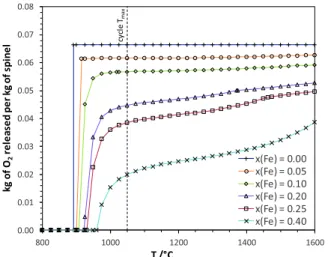
Furthermore, equilibrium calculations show that applying a tem-perature limit higher than 1050 °C will not increase drastically the oxygen storage capacity of mixed Co-Fe oxides, as illustrated byFig. 8. Indeed, for Fe contents between 0% and 10%, the oxygen storage capacity is almost constant with temperature, because the non-stoichiometry of the monoxide is stable. For higher Fe contents (0.10 < x(Fe) < 0.40), a small increase of the storage capacity is evidenced at high temperature, due to a higher conversion rate of the spinel phase (Fig. 3b), but Fe addition is still detrimental for the total storage capacity.
As reported in Fig. 9, the measured reaction enthalpies are
decreasing with increasing amount of Fe: the highest measured enthalpy is 597 kJ/kg for pure Co3O4, while the lowest is 50.7 kJ/kg
for x(Fe) = 0.40. It should be noted that the DSC peaks for x(Fe) = 0.40 are very small, which makes them difficult to analyze. For pure Co3O4,
our data is close to the value of 576 kJ/kg obtained by[2]with a similar experimental procedure. As recently discussed in details by Block et al.
[22], this kind of DSC measurements, operated in an open reactor at a rather fast heating rate, is not able to reproduce the tabulated enthalpy value, which is commonly reported as 844 kJ/kg[3–6]. To explain the large discrepancy, the authors state that the contribution of a Co3+
spin-state change, associated with an enthalpy of about 222 kJ/kg, is not measured by dynamic techniques.
The thermodynamic model used in this study[13], which takes into account the heat capacity anomaly due to spin-state transition of Co3+,
leads to an enthalpy of reaction of 749 kJ/kg for x(Fe) = 0. This is noticeably lower than the commonly admitted value of 827 kJ/mol
[2,22]. For higher Fe contents, the calculations reproduce well the general trend (decrease of ΔrH) with a systematic gap of about 180 kJ/
kg.
In TES application, the enthalpy of the reaction is related to the oxygen storage capacity of the material (the energy stored/released during the reduction/oxidation is related to the reaction extent that corresponds to the quantity of O2released/captured). As evidenced by
measurements and calculations, the gravimetric energy storage density of mixed oxides is decreased when compared with pure Co3O4,
resulting in less storage capacity per gram of material. This observation is in accordance with the work of Block et al.[2], who stated that both pure Co3O4and Fe2O3 show higher enthalpies of reaction than any
mixture of the two.
In summary, while the Co3O4/CoO redox pair shows very good
cycling stability, the addition of iron is shown to slightly affect it and to decrease drastically the overall oxygen storage capacity. According to equilibrium calculations in the Co-Fe-O system, the addition of iron to Co3O4results in a lower amount of O2exchanged during cycles and a
loss of the reduction reaction enthalpy, due to an incomplete conver-sion of the spinel phase at 1050 °C and to the formation of a non-stoichiometric monoxide. The addition of iron also increases the reduction and oxidation temperatures, while slightly decreasing the gap in temperature between the reduction and the oxidation step. 3.2. Manganese-based mixed oxides
The calculated Mn-Fe-O phase diagram is presented inFig. 10, for pO2= 0.20 atm. Again, the expected behavior of the mixed oxides is
strongly dependent on the system composition. At Fe contents above 50%, the requested temperature to reach a full conversion of the initial oxide into a spinel phase is above 1100 °C. At very low Fe contents (0 < x(Fe) < 0 .05), the stable phase at 1050 °C is the tetragonal spinel. For 0.05 < x(Fe) < 0.15, the transition of bixbyite to cubic spinel goes
Fig. 8. Temperature evolution of the amount (kg) of O2(g) released per kg of cobalt-based spinel containing various amounts of Fe.
Fig. 9. Experimental and calculated enthalpies of reaction for the Co-Fe and Mn-Fe
through two consecutive two-phase zones (T-Spin+Bixb and T-Spin+C-Spin). Finally, above about 20 mol% Fe, the material transforms almost directly from the bixbyite phase to the cubic spinel.
According to the model[15], the non-stoichiometry of the oxide phases should not play a significant role regarding oxygen storage capacity. Indeed, the bixbyite phase (Mn1−xFex)2O3is considered as
fully stoichiometric. For the spinel phases T-Spin and C-Spin, a cationic non-stoichiometry is considered in the model, with the presence of cationic vacancies. However, as shown in Fig. SI8, the vacancies concentration at 1050 °C is at the most 1.4×10⁻⁴mol per mol of Mn
+Fe, which leads to a negligible impact on the oxygen storage capacity. In the composition range 0 < x(Fe) < 0.5 considered in this study, the redox cycle is thus represented by:
(Mn1−xFe ) Ox 2 3( )s = 2/3 (Mn1−xFe ) Ox 3 4( )s + 1/6 O (g)2 (7)
At equilibrium, according to the model, the theoretical amount of O2exchanged between 750 °C and 1050 °C remains thus the same in
the 0 < x(Fe) < 0.5 composition range.
The TGA, presented in Fig. 11, shows that the sample with the composition x(Fe) = 0.10 is unable to regain its full mass during oxidation, as the mass lost during the first reduction step is not recovered during the re-oxidation step, similarly to the case of pure Mn2O3(TGA shown inFig. SI9). Conversely, the other compositions,
from 15 mol% Fe to 50 mol% Fe, are regaining their lost mass in a complete reversible way. XRD analysis of Mn-Fe samples after TGA was performed (Fig. SI2). The XRD pattern of Mn2O3with 10 mol% Fe
is identified as a mixture of tetragonal spinel structure and Fe2O3(Fig.
SI2e), which confirms the poor re-oxidation yield of the cycled material. Conversely, the XRD pattern of Mn2O3with 20, 30, 40 and
50 mol% Fe after TGA is identified as (Mn1−xFex)2O3(Fig. SI2a–d) with
Fe2O3visible on the sample with the highest amount of Fe added (Fig.
SI2a), which denotes the complete re-oxidation of the samples after TGA. SEM characterization of the cycled materials compared with the fresh ones reveals sintering regardless of the amount of Fe (Fig. SI10), which does not alter the cycling ability of Mn-Fe mixed oxides. Sintering is thus not the cause of the reactivity loss in the case of pure Mn2O3and Mn2O3mixed with 10 mol% Fe.
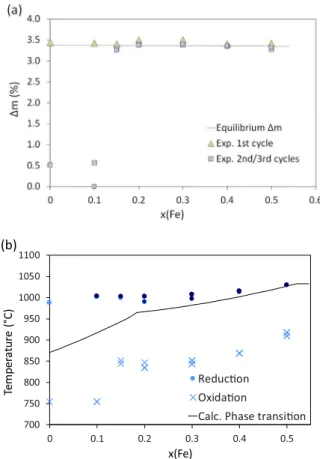
Experimental and theoretical mass variations, Δm, were compared. As illustrated inFig. 12a, all the samples feature the same Δm during thefirst reduction, in good accordance with the equilibrium calcula-tions summarized by (Eq.(7)). However, pure Mn2O3shows cycling
stability issues as already evidenced by [8]. This phenomenon is reflected by the drop of the experimental Δm during 2nd and 3rd cycles, showing a decrease of redox activity with redox cycling. Similarly, Mn2O3mixed with 10 mol% Fe also loses cycling stability,
regaining only 31% of its lost mass (Fig. 11f). From x(Fe) = 0.15 to 0.50, a great improvement is evidenced, since the experimental Δm
value for each cycle remains close both to the maximum Δm value and to the equilibrium value, which denotes negligible deactivation during redox cycling. The addition of iron to Mn2O3thus increases the
re-oxidation yield of the material and enhances the cycling stability, as recently observed by Carrillo et al.[11].
Experimental measurements clearly indicate that the minimum Fe content necessary to improve the TES properties of mixed Mn-Fe oxides lies between 10 and 15 mol% Fe. The phase diagram indicates that this corresponds to the formation of the cubic spinel phase only, compared to lower Fe contents, where the tetragonal spinel cannot be reversibly oxidized during cooling. The addition of 20 mol% Fe in Mn2O3 was previously mentioned as the optimal composition for
obtaining the highest enthalpy and most stable re-oxidation yields
[11]. However, the authors also obtained full conversion for all their tested samples regardless of the Fe content (especially below 10% Fe), which contrasts sharply with the results of the present study in which pure Mn2O3and Mn2O3sample with 10 mol% Fe were not able to fully
recover the O2 lost mass. More recently, an in-depth kinetic and
mechanistic study focused on the 20 mol% Fe composition was carried out by the same group[23]. It is stated that the cationic distribution in the spinel structures (cubic and tetragonal) might be sufficiently different to explain the strong variation in the kinetics of the oxidation reaction. The use of the thermodynamic model proposed by Kang and Jung[15]brings support to this explanation. Indeed, as illustrated in
Fig. 13a, the calculated cationic distribution evidences that the amount of Mn2+on octahedral sites of the spinel strongly increases in the cubic spinel. Furthermore, it has been shown that Mn2+on octahedral sites is
easier to oxidize than Mn2+on tetragonal sites[24]. This difference
might very well explain the reason why the cycling properties of the cubic spinel are much better than those of the tetragonal spinel.
Another difference between the two spinel structures is that, in the
Fig. 11. TGA of Mn2O3/Mn3O4with addition of (a) 50 mol% Fe, (b) 40 mol% Fe, (c) 30 mol% Fe, (d) 20 mol% Fe, (e) 15 mol% Fe, and (f) 10 mol% Fe.
Fig. 12. (a) Evolution of experimental Δm (%) during reduction compared to theoretical Δm (pO2 = 0.20 atm), (b) Experimental temperatures at peak reaction rate for manganese-based oxides in 20% O2/Ar and comparison with the calculated temperature of the Bixb/Spinel transition.
cubic spinel, a disproportionation reaction takes place according to Mn3+= 1/2 Mn4++ 1/2 Mn2+, as illustrated inFig. 13b. The increased amount of Mn2+in the cubic spinel, which can be more easily oxidized
than Mn3+thanks to the favored thermodynamic driving force, may
also explain the enhanced re-oxidation ability of the cubic spinel. This result means that pure Mn2O3 (that reduces into pure tetragonal
spinel) and mixed Mn-Fe oxides with Fe content below 15% cannot be suitable candidates for achieving reversible reactions because of the poor re-oxidation ability of the tetragonal spinel formed upon reduc-tion.
As for the influence of Fe incorporation in Mn2O3on the reaction
temperatures, a similar tendency as with cobalt oxide is observed. The reduction and oxidation temperatures of Mn2O3 softly increase with
increasing amount of added iron (Fig. 12b). According to TGA, an increase of 60 °C is noted between the onset temperatures for reduction (Fig. SI11) of pure Mn2O3 and Mn2O3 with 50 mol% Fe.
Concomitantly, a temperature increase of 160 °C is observed for oxidation of Mn2O3with 50 mol% Fe when compared to Mn2O3alone.
This way, the reaction temperature can be tuned. On top of an increase of the reaction temperature, addition of iron also reduces the perature gap between the reduction and the oxidation step. A tem-perature increase was also reported by [11], with 60 °C difference between 0 and 40 mol% Fe added for the reduction, and 236 °C for the oxidation.
Regarding the effect of the gaseous atmosphere composition, the experimental and theoretical Δm values for the reduction in pure Ar atmosphere were found stable with the addition of Fe to manganese
oxide and similar to the Δm measured with 20% O2. Again, the
reduction temperature increases with the O2 partial pressure (Fig.
SI11). The onset temperature for reduction under inert atmosphere rises with the amount of Fe added to manganese oxide, from about 800 °C for pure Mn2O3 up to 903 °C for x(Fe) = 0.5 (Fig. SI11). As
illustrated by the phase diagram (Fig. SI12) calculated at low pO2
(10−5atm), decreasing the oxygen content results in enhancing the
tetragonal spinel stability, which is likely to be detrimental to the cycling stability of the materials.
As for the energy storage density, the measured enthalpy for the first reduction step with full conversion of pure Mn2O3(148 kJ/kg) is
smaller than theoretical estimations of 190.1 kJ/kg at turning tem-perature (ΔG° = 0) of 915 °C [10]. An average of 187.7 kJ/kg is measured for the samples with compositions between 20 and 50 mol% Fe. Increasing the amount of Fe thus slightly improves the energy storage capacity of the material at low Fe contents while it remains unchanged above ~20 mol% Fe (Fig. 9). Accordingly, the thermody-namic calculations indicate that an increase of ΔrH is expected when
the Fe content increases from 0 mol% (207 kJ/kg) to 20 mol% (300 kJ/ kg), and is stable for higher Fe contents.
In summary, the addition of iron to manganese oxide enhances considerably the cycling stability of the material by improving the re-oxidation yield thanks to the formation of a reactive cubic spinel phase. Also, the higher the amount of Fe added to Mn2O3, the higher the
reaction temperatures. In addition, the gap in temperature between the reduction and the oxidation decreases with higher iron content. The low re-oxidation yield observed for pure Mn2O3 and Mn2O3 with
10 mol% Fe is attributed to the low reactivity of the tetragonal spinel phase. The addition of Fe to Mn2O3 becomes effective for the
enhancement of the cycling stability above ~15 mol% Fe, with the suppression of any transition involving this tetragonal spinel phase. The markedly improved reactivity of the cubic spinel featuring reversible reactions is attributed to the increased amount of Mn2+
cations (resulting from Mn3+disproportionation) on octahedral sites of the spinel.
4. Conclusion
The effect of Fe addition in Co and Mn-based oxides was studied experimentally and results were compared with thermodynamic calcu-lations. The calculations were shown to be pertinent since equilibrium is reached at least on thefirst reduction step of all materials considered in this study. The addition of Fe to Mn2O3was shown to be beneficial to
tune the temperature of redox reactions, to reduce the gap in temperature hysteresis between the reduction and the oxidation step, as well as to enhance the re-oxidation kinetics and cycling stability of the material by countering the deactivation issue of Mn2O3.
Furthermore, a Fe content of ~15 mol% added to Mn2O3was identified
as a minimum threshold for avoiding the formation of a low reactive Mn3O4tetragonal spinel phase during reduction, which is detrimental
to the reaction reversibility because of poor oxidation rate and yield. Noticeably, the Mn2O3compounds with Fe content in the range 15–
50 mol% could be cycled between bixbyite and cubic spinel phases without any reactivity losses during redox reactions. Conversely, the incorporation of Fe to Co3O4 shows adverse effect on the redox
performances since both the maximum amount of O2exchanged and
the reaction enthalpy are lowered when the amount of iron added is increased. The increasing amount of iron added to Co3O4reduces the
maximum oxygen exchange capacity during a redox cycle. The addition of iron to Co and Mn-based oxides also results in an increase of the reaction temperatures, while slightly lowering the gap in temperature between the reduction and oxidation step, which thereby reduces the sensible energy losses during the heating and cooling stages. The comparison of the obtained experimental data with thermodynamic modelling proves that equilibrium calculations bring a strong support for predicting the behavior of mixed oxides since it results in consistent
Fig. 13. (a) Evolution of the amount of Mn2+on octahedral sites of the spinel phases with Fe content, at 1050 °C. (b) Evolution of the oxidation number of Mn cations in the spinel phases with Fe content, at 1050 °C.
phase transition temperatures and reliable oxygen storage capacities. It further provided new physical insights into the role of Fe incorporation on the oxidation improvement of Co and Mn-based oxides related to the crystallographic transformations that take place during such redox process depending on Fe content. With the development of new models covering large multi-components systems, it could be further used for selecting other transition metals to enhance the properties of mixed metal oxides for thermochemical energy storage application.
Acknowledgments
This study was performed in the framework of the STAGE-STE European Project (FP7, Project no. 609837). Philippe Tailhades is warmly thanked for the fruitful discussion on spinel properties. Appendix A. Supplementary material
Supplementary data associated with this article can be found in the online version atdoi:10.1016/j.jssc.2017.05.015.
References
[1]A.H. Abedin, M.A. Rosen, A critical review of thermochemical energy storage systems, Open Renew. Energy J. 4 (2011) 42–46.
[2]T. Block, N. Knoblauch, M. Shmücker, The cobalt-oxide/iron-oxide binary system for use as high temperature thermochemical energy storage material, Thermochim. Acta 577 (2014) 25–32.
[3]C. Agrafiotis, M. Roeb, M. Schücker, C. Sattler, Exploitation of thermochemical cycles based on solid oxide redox systems for thermochemical storage of solar heat. Part 2: redox oxide-coated porous ceramic structures as integrated thermochemical reactors/heat exchangers, Sol. Energy 114 (2015) 440–458.
[4]C. Agrafiotis, S. Tescari, M. Roeb, M. Schücker, C. Sattler, Exploitation of thermochemical cycles based on solid oxide redox systems for thermochemical storage of solar heat. Part 3: cobalt oxide monolithic porous structures as integrated thermochemical reactors/heat exchanger, Sol. Energy 114 (2015) 459–475. [5]M. Neises, S. Tescari, L. De Oliveira, M. Roeb, C. Sattler, B. Wong, Solar-heated
rotary kiln for thermochemical energy storage, Sol. Energy 86 (2012) 3040–3048. [6]S. Tescari, C. Agrafiotis, S. Breuer, L. De Oliveira, M. Nieses-von Puttkamer,
M. Roeb, C. Sattler, Thermochemical solar energy storage via redox oxides: materials and reactor/heat exchanger concepts, Energy Procedia 49 (2014) 1034–1043.
[7]G. Karagiannakis, C. Pagkoura, A. Zygogianni, S. Lorentzou, A.G. Konstandopoulos, Monolithic ceramic redox materials for thermochemical heat storage applications
in CSP plants, Energy Procedia 49 (2014) 820–829.
[8]A.J. Carrillo, D.P. Serrano, P. Pizarro, J.M. Coronado, Improving the thermo-chemical energy storage performance of the Mn2O3/Mn3O4redox couple by the incorporation of iron, ChemSusChem 8 (2015) 1947–1954.
[9] C. Pagkoura, G. Karagiannakis, A. Zygogianni, S. Lorentzou, M. Kostoglou, A.G. Konstandopoulos, M. Rattenburry, W.J. Woodhead, Cobalt oxide based structured bodies as redox thermochemical heat storage medium for future CSP plants, Sol. Energy 108 (2014) 146–163.
[10] L. André, S. Abanades, G. Flamant, Screening of thermochemical systems based on solid-gas reversible reactions for high temperature solar thermal energy storage, Renew. Sustain. Energy Rev. 64 (2016) 703–715.
[11] A.J. Carrillo, D.P. Serrano, P. Pizarro, J.M. Coronado, Thermochemical heat storage based on the Mn2O3/Mn3O4redox couple: influence of the initial particle size on the morphological evolution and cyclability, J. Mater. Chem. A 2 (2014) 19435–19443.
[12] A.J. Carrillo, D.P. Serrano, P. Pizarro, J.M. Coronado, Manganese oxide-based thermochemical energy storage: modulating temperatures of redox cycles by Fe-Cu Co-doping, J. Energy Storage 5 (2016) 169–176.
[13] I.H. Jung, S.A. Decterov, A.D. Pelton, H.M. Kim, Y.B. Kang, Thermodynamic evaluation and modeling of the Fe-Co-O system, Acta Mater. 52 (2004) 507–519. [14] W.-W. Zhang, M. Chen, Thermodynamic modeling of the Co–Fe–O system,
Calphad 41 (2013) 76–88.
[15] Y.B. Kang, I.H. Jung, Thermodynamic modeling of oxide phases in the Fe-Mn-O system, J. Phys. Chem. Solids 98 (2016) 237–246.
[16] L. Kjellqvist, M. Selleby, Thermodynamic assessment of the Fe-Mn-O system, J. Phase Equilib. Diffus. 31 (2010) 113–134.
[17] E. Beche, G. Peraudeau, V. Flaud, D. Perarnau, XPS unvestigation of (La2O3)1−x (CeO2)2x(ZrO2)2compounds elaborated by solar energy, Surf. Interface Anal. 44 (2012) 1045–1050.
[18] J.i. Lai, K.V.P.M. Shafi, A. Ulman, N.-L. Yang, M.-H. Cui, T. Vogt, C. Estournès, Mixed iron-manganese oxide nanoparticles, Nanopart. Chem. Soc. Div. Fuel Chem. 48 (2) (2003) 729–730.
[19] C.W. Bale, E. Bélisle, P. Chartrand, S.A. Decterov, G. Eriksson, A.E. Gheribi, K. Hack, I.H. Jung, Y.B. Kang, J. Melançon, A.D. Pelton, S. Petersen, C. Robelin, J. Sangster, P. Spencer, M.A. Van Ende, FactSage thermochemical software and databases, 2010–2016, Calphad 54 (2016) 35–53.
[20] M. Hillert, The compound energy formalism, J. Alloy. Compd. 320 (2) (2001) 161–176.
[21] B. Ehrhart, E. Coker, N. Siegel, A. Weimer, Thermochemical cycle of a mixed oxide for augmentation of thermal energy storage in solid particles, Energy Procedia 49 (2014) 762–771.
[22] T. Block, M. Schmucker, Metal oxides for thermochemical energy storage: a comparison of several metal oxide systems, Sol. Energy 126 (2016) 195–207. [23] A.J. Carrillo, D.P. Serrano, P. Pizarro, J.M. Coronado, Understanding redox
kinetics of iron-doped manganese oxides for high temperature thermochemical energy storage, J. Phys. Chem. C 120 (2016) 27800–27812.
[24] F. Agnoli, B. Albouy, P. Tailhades, A. Rousset, Manganites de Fer de Structure Spinelle Déformée à Très Fort Champ Coercitif. Exemple de l′Oxyde Lacunaire Mixte Mn1.7Fe1.3O4+δ, C. R. Acad. Sci. 2 (1999) 525–530.