To link to this article : DOI :
10.1080/00140139.2016.1175671
URL :
http://dx.doi.org/10.1080/00140139.2016.1175671To cite this version :
Jacquier-Bret, Julien and Gorce, Philippe and Genaro
Motti, Lilian and Vigouroux, Nadine Biomechanical analysis of upper limb
during the use of touchscreen: motion strategies identification. (2016)
Ergonomics, vol. 60 (n° 3). pp. 1. ISSN 0014-0139
O
pen
A
rchive
T
OULOUSE
A
rchive
O
uverte (
OATAO
)
OATAO is an open access repository that collects the work of Toulouse researchers and
makes it freely available over the web where possible.
This is an author-deposited version published in :
http://oatao.univ-toulouse.fr/
Eprints ID : 16996
Any correspondence concerning this service should be sent to the repository
administrator:
[email protected]
Biomechanical analysis of upper limb during the use of touch screen: motion
strategies identification
Julien Jacquier-Breta, Philippe Gorcea, Genaro Motti Lilianb and Nadine Vigourouxb
aLaboratoire HandiBio, EA 4322 – Université de Toulon, France; bIRIT UMR – 5505, Université de Toulouse 3 – Paul Sabatier – Toulouse, France
ABSTRACT
Nowadays touch technology is growing and developers try to make it ever more intuitive and easier to use. This present work focused on the upper limb joint coordination during the achievement of puzzles on touch screen. A 5-inch and 10-inch devices were used to perform 9 and 16 pieces puzzles dragged with digits. The conclusions showed an increase in joint solicitation with the number of piece and the touch screen size. Moreover, three interactions strategies proved to be an evidence: the ‘wrist strategy’ preferentially implying wrist flexion/extension, the ‘elbow strategy’ preferentially implying the elbow flexion/extension and the ‘neutral strategy’ mobilising equally the two joints. From an ergonomic point of view, the data about how the upper limb segments are mobilised while interacting with the screen could be relevant to increase the adaptability of the devices to the user, including users with motor impairments.
Practitioner Summary: Information about the biomechanical organisation of movement during interaction with touch devices appears relevant in order to develop applications adapted to the motor capacities of users. From the analysis of joint angles when performing several times a puzzle with healthy subjects, three motor strategies were highlighted.
Introduction
Among the recent technological advances, touch tech-nology is increasingly used for electronic devices. Smartphones and tablets are currently unavoidable touch screen and form the category of handheld devices (Park and Han 2010). Alongside them, other systems are developing such as computers, vertical or tilted displayed (Kin, Agrawala, and DeRose 2009; Sears and Shneiderman
1991), tabletops (Micire, Schedlbauer, and Yanco 2007) or global positioning system (Kim and Song 2014). These systems are used for applications that continue to diver-sify (e.g. the location in a space, purchase tickets, or the settings of transport).
This new form of interaction is attractive because direct input on the screen seems very intuitive. Moreover, users can use these devices, especially the handheld versions, in a wide variety of situations (sitting, standing, transportation, during their leisure or work …). Many studies in the field of ergonomics applied to Human–Computer Interaction have focused accessibility of this new technology to make it more efficient and easier to use. For example, some studies
have been done to evaluate how users conceive and use new interaction techniques (Wobbrock, Morris, and Wilson
2009) and the new positions of the hands and the inter-action zones (Wagner, Huot, and Mackay 2012). Others studies focused on the way to interact with different sizes of screen (Lai and Wu 2014) or the effect of the display size and object scale to optimise the motion-transforming input devices (Oehl, Sutter, and Ziefle 2007; Park and Han
2010).
Beyond their development, the use of touch screen implies human upper limb motion, but very few works have shown interest for evaluating posture during interac-tions. However, the mobility of upper limb conditions how the user will interact with the touch device. Few recent works began to take into account this aspect but the 3D models remains macroscopic and do not take into account the complexity of the upper limb kinematic chain (Choi, Kim, and Chung 2014). Indeed, its redundant structure due to the large number of degrees of freedom involved in the 3D position of the end-effector (Wu et al. 2005) allows to perform a specific task with an infinite number of joint angle combinations (Bernstein 1967). Some previous
KEYWORDS Biomechanics; upper limb; human–computer interaction; touch screen
touch screen was at 15 cm from the edge of the table. Three reflexive markers were added on the touch screen corners to record its 3D position relative to the subject during the task.
From this initial standardised posture, the task consisted in achieving a puzzle presented on the touch screen device and then returning to the starting posture. The pieces were mixed and displayed at the bottom of the screen and a translucent guide was presented in the upper part. To move the different pieces, subject simply dragged them from their initial location to their final position with the finger. Two sizes of devices, a 5-inch and a 10-inch touch screen size, were used during the experiment. Secondly, for each device, two puzzles with a different number of pieces (9 or 16 pieces) were selected to manipulate the size of the piece of the puzzle. The size of the puzzle pieces is proportional to the screen size and inversely proportional to the number of pieces. Each of the four puzzles (9 or 16 pieces performed with a 5- or a 10-inch touch screen) was repeated five times in a random order.
To perform the motion analysis, the trajectories of the 25 reflective markers were recorded using an optoelectronic system with 6 Oqus 400 cameras (Qualisys AB, Gothenburg, Sweden) at a sampling rate of 200 Hz. To study the upper limb joint organisation during the achievement of the puz-zle, the first and the last paths of the hand (i.e. the travel from the initial posture and return to this position) have not been taken into account. Then, only the interaction phase corresponding to the dragging of the pieces on the screen was analysed. From the coordinates of the reflective markers and following ISB instructions (Wu et al. 2005), trunk and upper limb joint angles (15 degrees of freedom) were computed (Matlab, The Mathworks, Inc., Natick, MA).
Repeated analysis of variance was performed to com-pare the effect of touch screen size (two levels: 5 and 10-inch) and of the number of the puzzle pieces (two lev-els: 9 or 16 pieces) on the range of motion and the lengths of the paths of the wrist. The shoulder flexion/extension, shoulder abduction/adduction, elbow flexion/extension and wrist flexion/extension were selected for their major implication in the execution of movement. Their respec-tive involvements were presented with percentile for each experimental condition. The level of significance was set at p < 0.05 (Statistica 7.1, Statsoft, Tulsa, OK, USA).
Results
In initial posture, the subjects were seated against the back of the chair. The distance between the head and the screen was constant and no variation was observed between conditions (F(1, 10) = 3.9, p > 0.05). The head was placed at 521.7 ± 37.2 mm from the centre of the pad. During the task, an advancement of the head has been works focused on the upper limb coordination. For
exam-ple, Hoffmann et al. found during a pointing task two dif-ferent synergies to extend the elbow: one is for orientating and the other is for stretching out the limb (Hoffmann et al.
2006). More recent experiments have shown that different degrees of freedom of the upper limb were combined, so that some movement parameters (such as the trajectory of the wrist or elbow) are controlled and stabilised during the execution of a prehensile task (Jacquier-Bret, Rezzoug, and Gorce 2009). Secondly, this particular upper limb joint coordination seemed to have a direct impact on the abil-ity to move or to product force with the hand. Indeed, depending on the posture of the subject, these capac-ities were different according to the direction of move-ment (Jacquier-Bret, Gorce, and Rezzoug 2012). However, no information on the human motion organisation or on motor strategies is available during tactile tasks. So, the posture of a user and the way he interacts with a touch screen could provide useful data for both the ergonomic features of the device and the consequences that could have a long-term use on the body. On the other hand, such an approach could highlight different strategies of interaction that could be exploited later in the context of ergonomics/biomechanics to provide adapted interfaces to the capabilities of subjects, whether healthy or suffering from motor disabilities.
Then, the present work focused on the analysis of the upper limb motion and more particularly on the mobi-lisation of the different degrees of freedom during the realisation of a puzzle on a touch screen. The aim was to describe the subject’s behaviour during a simple task and see how they are stable according to different conditions.
Material and methods
Eleven healthy subjects voluntarily participated to the experience (10 males, 1 female). All are right-handed and have no pathology of the upper limb. Each subject was informed of the complete contents of the protocol and gave their written consent before participating. The experi-mental procedure was in agreement with the Helsinki dec-laration and was approved by the local ethics committee. After a detailed presentation of the protocol, 22 reflec-tive markers were placed on the head, trunk and right upper limb of each subject. Sixteen were positioned on bony anatomical landmarks identified by palpation, in agreements with the International Society of Biomechanics recommendations (Wu et al. 2005). The other six ones were divided into two clusters of three markers placed on the right arm and forearm as technical markers.
Then, subjects were seated in front of a touch screen device horizontally placed on a table with the forearms resting on either side of the device. The centre of the
detected whatever the condition (F(1, 10)=1.7, p > 0.05). The mean distance was 262.9 ± 57.3 mm.
The distance made by the wrist was evaluated during the achievement of puzzles. An interaction effect screen size vs. number of pieces was observed (F(1, 10) = 42.3, p < 0.05, Figure 1). On one hand, the wrist displacement is lower for puzzles performed on the 5-inch device (1616.8 ± 420.4 and 2908.0 ± 815.7 mm, respectively, for 9 and 16 pieces) in comparison with those of the 10-inch device regardless of the number of pieces (2464.7 ± 353.3 and 4517.5 ± 689.4 mm respectively for 9 and 16 pieces). On the other hand, the distance increases with the number of pieces for both touch screen sizes.
About the movement time, no difference was observed between the two conditions with 9 pieces (18.6 ± 2.0 and 17.9 ± 1.6 s respectively for the 5-inch and 10-inch touch screen). The execution time increased for the 16 pieces puzzle and was lower on the 10-inch (38.2 ± 3.4 s) tablet in comparison to the 5-inch touch screen (44.0 ± 4.4 s, F(1,
54) = 11.1, p < 0.05).
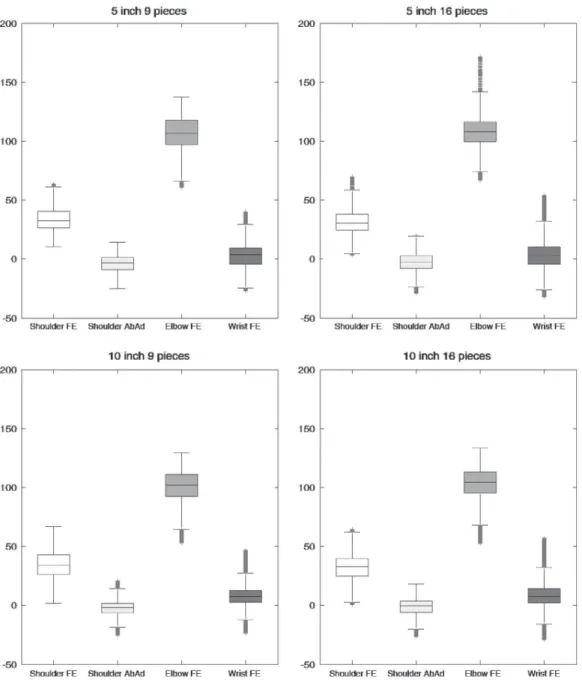
The ranges of motion (RoMs) of the shoulder flexion/ extension (shoulder FE), shoulder abduction/adduction (shoulder AbAd), elbow flexion/extension (elbow FE) and wrist flexion/extension (wrist FE) are presented in Figure 2
with percentiles. Firstly, the statistical analysis evidenced an increase in the all the RoMs (F(3, 30) = 59.3, p < 0.05) with the size of the touch screen and the number of pieces (i.e. the reduction in their size) except for the wrist FE accord-ing to the followaccord-ing order : the lowest mean RoMs were obtained with the 5-inch touch screen with 9 pieces, then with the 5-inch/16 pieces, then with the 10-inch/9 pieces and finally, the highest mean values were computed with the 10-inch touch screen and a 16 pieces puzzle. More specifically, shoulder FE increased from 13.1 ± 3.4° to 27.4 ± 3.3°; shoulder AbAd increased from 11.0 ± 1.5° to 19.9 ± 1.9°; and elbow FE increased from 18.6 ± 3.7° to 29.7 ± 2.9°. Whatever the experimental condition, shoul-der AbAd was lower than the other ones (15.7 ± 5.1°, F(9,
90) = 59.3, p < 0.05). Maximal RoMs were observed for the
elbow and the wrist flexion/extension (22.5 ± 4.0 and 25.5 ± 4.2° respectively), especially with the 10-inch touch screen device.
As presented in the Figure 2, the distribution of the joint angles was larger than the ROMs. Indeed, the angles varied between 13.1° (5th percentile) and 55.7° (95th per-centile) for the shoulder FE, and between −17.9° and 9.7° for the shoulder AbAd. Elbow FE (80.1°–125.6°) and wrist FE (−18.8°–37.5°) presented the largest variation.
To study the relation between these two distal joint angles, wrist flexion/extension was plotted in relation to the elbow flexion/extension and the 95% confidence ellipse was plotted on the data. Three different strategies were identified when performing the puzzles (Figure 3). The first one implied a more important solicitation of the wrist in comparison to the elbow (Figure 3, panel A). This was highlighted by a very elongated ellipsoid of confi-dence along the vertical axis. On the contrary, the second strategy showed a higher solicitation of the elbow flexion/ extension than the wrist (Figure 3, panel B), with a hori-zontal elongated ellipsoid. The last one, represented by a circle, showed an equal participation of the elbow and wrist during the realisation of the puzzle (Figure 3, panel C). The corresponding angles were plotted in the Figure 4.
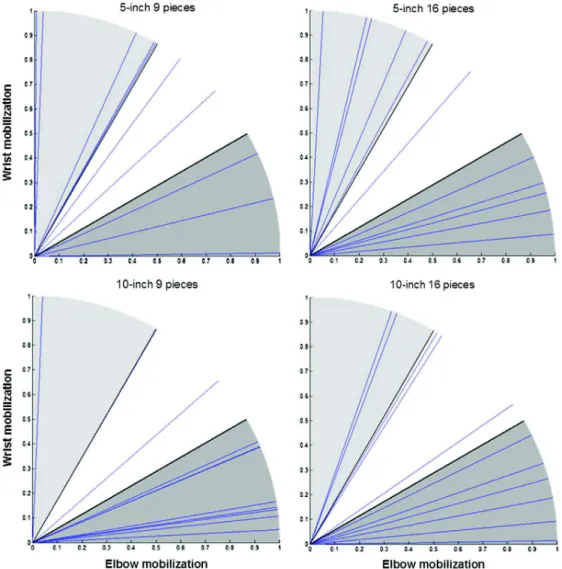
The slope of the linear equation of the major axis was used to highlight the joint coordination strategy during the interaction for each subject (Figure 5). These slopes were plotted in a normalised quadrant (the radius was equal to one unit) divided into three equal sector (each portion covers a sector of 30°) represented by black lines. A straight that belongs to the upper area (light grey) cor-responds to a higher solicitation of the wrist. On the con-trary, a straight that belongs to the lower area (dark grey) is interpreted as a higher solicitation of the elbow joint. The central area (white area) represents an equal solicitation of the two joints. Results showed that 29.5% of the trials were performed using a ‘wrist strategy’, whereas 52.3% were performed using an ‘elbow strategy’. The remaining 18.2% of the trials were performed using a neutral strategy with an equal mobilisation of the wrist and the elbow.
Discussion
The aim of this work was to study the biomechanical coor-dination of the upper limb segments during the use of touch screen device. A 5-inch and a 10-inch touch screen size and two different puzzles (that differs by the number on pieces, 9 and 16) were used during the experiments.
First, the effect of screen size (which influences the size of the displayed items) was presented in numerous works focused on modalities of interaction between man and machine. Studies about steering, typing, simple pointing or multidirectional pointing tasks reported an effect of
Figure 1. Mean wrist displacement computed for each device and each puzzle size. Vertical bars represent the standard deviation.
Note: * means a significant difference with the 9 pieces puzzle; £ means a significant difference with the 5-inch touch screen.
results were observed when comparing the number of pieces of puzzles: the highest values were obtained with 16 pieces puzzles. The distribution of the joint angle revealed an important mobilisation of the elbow and the wrist with a respective range of 85°–125° and −20° to 40°. From an ergonomic point of view, significant RoMs and proximity with joint limits are risk factors for onset of musculoskeletal disorders. For example, a variation of 30° from the elbow neutral position (Jane Cote Gil Coury et al. 1998) or a flexion/extension of the wrist over 15° (Faessen, Stee, and Rozendal 1989) were considered as binding positions or significant uncomfortable posture (Rempel, Camilleri, and Lee 2015). So, it appears that large displacements of virtual objects on the screen the display size on kinematics parameters such
move-ment time (Accot and Zhai 2001; Lai and Wu 2014; Oehl, Sutter, and Ziefle 2007): an increase in size conducted to an increase in the performance and a decrease in move-ment time. This effect was observed with the 16 pieces puzzle. Due to a larger target position, and therefore eas-ier to achieve, the subjects are more successful to realise the puzzle on a larger screen, even if the paths are more important.
As shown in the present study, the size of the touch screen device/puzzle also affected the upper limb kin-ematics data. With the 10-inch touch screen, the wrist displacement and the RoMs of the upper limb joint were higher than those computed with the 5 inch. The same
Figure 2. Ranges of joint angles for each condition of the puzzle task using the touch screen. Form the bottom to the top, 2.5th, 25th, 50th, 75th, and 97.5th percentile of the used angles were presented.
Figure 3. Wrist flexion/extension in relation to elbow flexion/extension obtained for three subjects during the realisation of the 9 pieces puzzle on the 5-inch touch screen. Each panel represents an interaction strategy. (A) wrist strategy; (B) elbow strategy; (C) neutral strategy.
Figure 4. Evolution of the joint angles of three subjects highlighted the three strategies (9 pieces puzzle on the 5-inch touch screen). Each panel represents an interaction strategy. (A) wrist strategy; (B) elbow strategy; (C) neutral strategy.
used this coordination froze their wrist joint (RoM lower than 10°) to perform the task with their elbow flexion/ extension. In this case, the shoulder must support the arm and participates to the movement. Then, the reachable space was larger than with the wrist. As a result, a small angular change would cause a greater movement of the fingers. From an ergonomic point of view, in addition to a large implication of the elbow, maintaining such posi-tion may cause disorders at the shoulder. Indeed, Van Rijn reported that a mobilisation of the shoulder over 45° dur-ing 15% of the task could be traumatic (van Rijn et al.
2010). The last one, called the ‘neutral strategy’, (Figure
4(C)) mobilised equally the elbow and the wrist with a notable participation of the shoulder. Then, the involved degrees of freedom were higher and the task demands were spread over the different joints. This distribution of the task comes close to results proposed by Jaric et al. (Jaric and Latash 1998) during a task of moving a cur-sor on a screen between obstacles with a mouse. The authors found that the straight movements were mainly could generate significant movements of the wrist (over
4 m for a 16 pieces puzzle) and uncomfortable postures that might cause pain or muscular disorders in a frequent and repeated use. Therefore, even if a larger screen seems to increase the user’s performance, human user motion should be taken into account for the touch screen applica-tion design to ensure a satisfactory level of performance while minimising harmful effects on the user. The study of elbow flexion/extension–wrist flexion/extension revealed three different coordinations. The first one, called ‘wrist strategy’, implied an important mobilisation of the wrist (RoM higher than 20°) with little involvement of the elbow (less than 10°).This letter was around 90° considered as the most comfortable posture (Rempel, Camilleri, and Lee
2015) during the task. The shoulder AbAd was close to the neutral position and the shoulder FE was lower than the discomfort limit of 30° (Jane Cote Gil Coury et al. 1998). In this configuration, an extensive use may result in occur-rence of troubles at the wrist joint. The second coordina-tion was called ‘elbow strategy’ (Figure 4B). Subjects who
Choi, E., H. Kim, and M. K. Chung. 2014. “A Taxonomy and Notation Method for Three-Dimensional Hand Gestures.” International Journal of Industrial Ergonomics 44 (1): 171–188. Faessen, H. G. M., M. J. v. d. Stee, and R. H. Rozendal. 1989.
Normering Van Polsbelasting (Research Report). Amsterdam: Vrije Universiteit.
Jane Cote Gil Coury, H., S. Kumar, S. Rodgher, and Y. Narayan. 1998. “Measurements of Shoulder Adduction Strength in Different Postures.” International Journal of Industrial Ergonomics 22 (3): 195–206.
Hoffmann, G., I. Laffont, S. Hanneton, and A. Roby-Brami. 2006. “How to Extend the Elbow with a Weak or Paralyzed Triceps: Control of Arm Kinematics for Aiming in C6–C7 Quadriplegic Patients.” Neuroscience 139 (2): 749–765.
Jacquier-Bret, J., P. Gorce, and N. Rezzoug. 2012. “The Manipulability: A New Index for Quantifying Movement Capacities of Upper Extremity.” Ergonomics 55 (1): 69–77. Jacquier-Bret, J., N. Rezzoug, and P. Gorce. 2009. “Adaptation of
Joint Flexibility during a Reach-to-grasp Movement.” Motor Control 13 (3): 342–361.
Jaric, S., and M. L. Latash. 1998. “Learning a Motor Task Involving Obstacles by a Multi-joint, Redundant Limb: Two Synergies within One Movement.” Journal of Electromyography and Kinesiology 8 (3): 169–176.
Kim, H., and H. Song. 2014. “Evaluation of the Safety and Usability of Touch Gestures in Operating in-Vehicle Information Systems with Visual Occlusion.” Applied Ergonomics 45 (3): 789–798. Kin, K., M. Agrawala, and T. DeRose. 2009. “Determining the
Benefits of Direct-touch, Bimanual, and Multifinger Input on a Multitouch Workstation.” GI’09 Proceedings of Graphics Interface 2009, Canadian Information Processing Society, 119–124, Kelowna, BC, Canada.
Lai, C. C., and C. F. Wu. 2014. “Display and Device Size Effects on the Usability of Mini-notebooks (Netbooks)/Ultraportables as Small Form-factor Mobile PCs.” Applied Ergonomics 45 (4): 1106–1115.
Micire, M., M. Schedlbauer, and H. Yanco. 2007. “Horizontal Selection: An Evaluation of a Digital Tabletop Input Device.” Proceedings of 13th Americas Conference on Information Systems (AMCIS 2007), 164, Keystone, CO.
Oehl, M., C. Sutter, and M. Ziefle. 2007. “Considerations on Efficient Touch Interfaces: How Display Size Influences the Performance in an Applied Pointing Task.” Proceedings of the 2007 Conference on Human interface: Part I, Springer-Verlag, Beijing, China.
Park, Y. S., and S. H. Han. 2010. “One-handed Thumb Interaction of Mobile Devices from the Input Accuracy Perspective.” International Journal of Industrial Ergonomics 40 (6): 746–756. Rempel, D., M. J. Camilleri, and D. L. Lee. 2015. “The Design of
Hand Gestures for Human–Computer Interaction: Lessons from Sign Language Interpreters.” International Journal of Human-Computer Studies 72 (10–11): 728–735.
Sears, A., and B. Shneiderman. 1991. “High Precision Touchscreens: Design Strategies and Comparisons with a Mouse.” International Journal of Man-Machine Studies 34 (4): 593–613.
van Rijn, R. M., B. M. Huisstede, B. W. Koes, and A. Burdorf. 2010. “Associations between Work-related Factors and Specific Disorders of the Shoulder – A Systematic Literature Review.” Scandinavian Journal of Work, Environment & Health 36 (3): 189–201.
performed by a shoulder–elbow synergy (here the princi-pal displacement of a piece of the puzzle) and the avoid-ance, movements demanding more precision were done using a synergy at the wrist (here, the final adjustment of the piece on its location).
This study presents some limitations. Firstly, the use of one or other strategies to achieve the puzzle did not seem to be directly related to the number of pieces or to the screen size. Indeed, some subjects kept the same coordination in the different experimental conditions, whereas others have used several of them in the protocol but indecently of the condition. This result demonstrates that users are likely to mobilise joint redundancy to per-form a task on the screen, but further studies are needed to find the parameters which determine the choice of a strategy. More specifically, on one hand, why do some subjects keep the same strategy under different condi-tions? On the other hand, what are the parameters caus-ing a modification of coordination? Secondly, no data were collected on the touch device. So the performances of different strategies have not been evaluated as this can be done to compare different devices (Bachynskyi et al. 2015). It could be relevant and provide some infor-mation about a possible adaptation of the subject to the task.
In conclusion, the use of touch devices is becoming increasingly important in daily life whatever their size. Due to the redundancy of the upper limb, there are sev-eral strategies to interact with the screen: one that involves mainly the elbow, a second one that mobilises principally the wrist and a third strategy that spreads the task on the different degrees of freedom of the upper limb. For the first two strategies, some calculated range of motion may increase the risk of developing musculoskeletal disorders, especially during prolonged use. These results suggest that the way that the user interacts with the device could have various ergonomic implications and the human motion should be considered in the development of future touch screen devices.
References
Accot, J., and S. Zhai. 2001. “Scale Effects in Steering Law Tasks.” CHI 01 – Proceedings of the SIGCHI 19th International Conference on Human Factors in Computing Systems, ACM, Seattle, WA, USA.
Bachynskyi, M., G. Palmas, A. Oulasvirta, J. Steimle, and T. Weinkauf. 2015. “Performance and Ergonomics of Touch Surfaces: A Comparative Study Using Biomechanical Simulation.” CHI 15 – Proceedings of the SIGCHI Conference on Human Factors in Computing Systems, ACM, Seoul, Korea. Bernstein, N. A. 1967. The Coordination and Regulation of
Wu, G., F. C. van der Helm, H. E. (DirkJan) Veeger, M. Makhsous, P. Van Roy, C. Anglin, J. Nagels, A. R. Karduna, K. McQuade, X. Wang, F. W. Werner, and B. Buchholz. 2005. “ISB Recommendation on Definitions of Joint Coordinate Systems of Various Joints for the Reporting of Human Joint Motion – Part II: Shoulder, Elbow, Wrist and hand.” Journal of Biomechanics 38 (5): 981–992.
Wagner, J., S. Huot, and W. Mackay. 2012. “BiTouch and BiPad: Designing Bimanual Interaction for Hand-held Tablets.” CHI 12 – Proceedings of the SIGCHI 30th International Conference on Human Factors in Computing Systems, ACM, Austin, TX, USA. Wobbrock, J. O., M. R. Morris, and A. D. Wilson. 2009. “User-defined
Gestures for Surface Computing.” CHI 09 – Proceedings of the SIGCHI 27th International Conference on Human Factors in Computing Systems, ACM, Boston, MA, USA.