2D½ thermo-mechanical model of continuous steel casting using F.E.M.
F. Pascon
1, A.M. Habraken
11
Department of Mechanics of materials & Structure (M&S), University of Liège Chemin des Chevreuils 1, 4000 Liège (Belgium)
URL: www.ulg.ac.be/matstruc/ e-mail: [email protected] ; [email protected]
ABSTRACT: Two complementary approaches of steel continuous casting modelling using the finite element code LAGAMINE have been developed in the M&S Department. The first one (at a macroscopic scale) describes the whole continuous casting process, from the free surface in the mould and through the entire machine, including thermal and mechanical behaviour of the steel. The second approach focuses on the prediction of cracks and is developed at grain scale. We present in this paper a description of the context in which the study started, the description of the macroscopic approach and some results.
Key words: continuous casting, transverse cracking, generalised plane strain state, finite element method 1 CONTEXT OF THE STUDIES
Continuous casting is widely used nowadays for production of steel all around the world. Even if the process has been developed for several decades, it is still in improvement to reach always better quality and higher yield. One can summarizes the improvement of the process following two different ways: the first one is the optimisation of the caster performance, the second one is the management of existing problems in particular casting conditions. In a first study, we developed a thermo-mechanical F.E.M. model of the steel solidification in the area of the mould and we focused on the effect of the mould taper on the primary cooling. This approach has been performed in order to optimise the mould for complex cross sections (beam blanks). Some papers have already been published on this part and the work was presented at ESAFORM conference [1,2]. In a second time, we enhanced this model to represent the behaviour of the steel strand during the bending as well as in the straightening zone. The aim of the study is the prediction of transversal cracking. Beside the macroscopic scale model (which one is presented in this paper), a mesoscopic model is being developed at the grain scale. For more details about this approach see [3].
2 MACROSCOPIC APPROACH OF THERMO-MECHANICAL BEHAVIOUR
2.1 Global approach
A thermo-mechanical macroscopic model has been worked out using a non-linear finite element code, called LAGAMINE, which has been developed since early eighties at University of Liege for large strains/displacements problems, more particularly for metal forming modelling.
Since a complete 3D discretization of continuous casting seemed impossible to manage (both because of numerical stability and convergence reasons, but also computing time), a 2D½ model has been preferred.
This model belongs to the “slice models” family. We can summarise the approach as follows: we model with a 2D mesh a set of material points representing a slice of the steel strand, perpendicularly to the casting direction. Initially the slice is at the meniscus level and its temperature is assumed to be uniform and equal to the casting temperature. Since this slice is moving down through the machine, we study heat transfer, stress and strain development and solidification growth, according to boundary conditions.
2.2 Mechanical model
2.2.a Generalized plane strain state
From a mechanical point of view, the slice is in generalised plane strain state (2D½). That means that the thickness t of the slice is governed by the following equation:
0 1 2
( , )
t x y =α +α x+α y (1)
where α0, α1, α2 are degrees of freedom
corresponding respectively to the thickness at the origin of the axes (α0) and the variation of thickness
along axes x (α1) and y (α2), both directions in the
plane of the slice.
This formulation allows at the same time stresses and strains in the out-of-plane direction, which means in the casting direction. It is thus more complete than classical 2D approaches (plane strain/stress state) and much less CPU expensive. Moreover, it allows the modelling of bending and straightening of the strand, enforcing a relation between αi degrees of freedom so that the correct
radius of curvature of the machine is respected. Last but not least, this 2D½ also permit to apply a force in the casting direction, which is of prime importance since it was necessary to take into account the withdrawal force of the strand due friction in different places in the machine.
2.2.b Constitutive law
The mechanical behaviour of steel is modelled by an elastic-viscous-plastic law. The elastic part is governed by a very classical Hooke's law. In the viscous-plastic domain, we developed a Norton-Hoff type constitutive law, the expression of which (in terms of Von Mises equivalent values) is:
1 3 4
2
3.p e. pε.( 3. ) .p p σ = − ε& ε
(2) where p1,2,3,4 are temperature dependent parameters,
which can be fit on experimental curves.
According to the assumptions of Von Mises loading surface, associated plasticity and normality in Prandtl-Reuss flow law, the expression (2) becomes in terms of tensors:
(
)
1 4 5 3 3 3 . 2 1 0 2 . . ˆ ˆ 2. . p p p p p vp ij ij p J e K p ε ε ε σ − = & ⋅ (3) where 2 1 ˆ ˆ 1 2 2 ij ij 3 J = ⋅σ σ⋅ = ⋅The integration of this constitutive law is based on an implicit scheme [4]. All the parameters are thermally affected.
2.2.c Ferrostatic pressure
The liquid pool in the middle of the strand applies a hydrostatic pressure on the solidified shell. This pressure is called ferrostatic pressure pf and it is
equal to:
(
1)
f s
p = ⋅ ⋅ −γ D f (4)
where γ is the volumetric weight of steel, D the depth under the meniscus level and fs the solid
fraction.
Since the studied steel is not a eutectic composition, solidification occurs over a range of temperature limited by the solidus temperature (Tsol) and the
liquidus one (Tliq). We assume a linear variation of
the solid fraction according to temperature in this range:
( )
0 s liq 1 liq, sol
liq sol T T f T T T T T T − ⎡ ⎤ ≤ = ≤ ∀ ∈ ⎣ ⎦ − (5) 2.3 Thermal aspects
2.3.a Internal heat conduction
The heat transfer in the material is govern by the classical Fourier's law, expressing the energy conservation and taking into account the release of energy during phase transformation (solidification is exothermic):
(
H T T λ T)
Δ = ∇ ⋅ ∇ Δ & (6)where H is the enthalpy, T the temperature and λ the thermal conductivity of the material. The enthalpy H is given by:
(
1 s)
. FH =
∫
ρ c dT+ − f L (7)where ρ is the volumetric mass, c the specific heat and LF the latent heat of fusion.
2.3.b Thermal shrinkage
Thermal shrinkage due to solidification is given by: therm ε
( )
therm T T I ε& =α ⋅ ⋅& (8) σ and 5 3 3 1 2. p p p −= . where I is identity tensor and α is the linear thermal expansion coefficient, which is thermally affected.
2.4 Boundary conditions
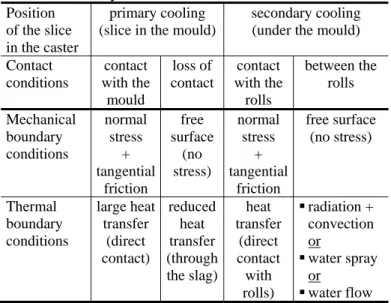
Different boundary conditions can occur, according to the position of the slice in the machine and the contact conditions. The following table summarizes the different cases:
Table 1. Boundary conditions Position
of the slice in the caster
primary cooling (slice in the mould)
secondary cooling (under the mould) Contact conditions contact with the mould loss of contact contact with the rolls between the rolls Mechanical boundary conditions normal stress + tangential friction free surface (no stress) normal stress + tangential friction free surface (no stress) Thermal boundary conditions large heat transfer (direct contact) reduced heat transfer (through the slag) heat transfer (direct contact with rolls) radiation + convection or water spray or water flow
In case of mechanical contact, the normal pressure is calculated by allowing, but penalizing, the penetration of bodies into each other. The friction τc
is then computed with the Coulomb's friction law:
.
c µ n
τ = σ (9)
where µ is the friction coefficient and σn is the
normal stress.
The heat transfer q from the strand to the ambient is given by the simple relation:
(
strand ambient)
q=h T −T (10)
where h is the heat transfer coefficient according to the boundary conditions (see Table 1). In case of contact, h is the inverse of the contact resistance. In case of water spray cooling, h has been experimentally determined for different temperatures (700-1200 °C), different shapes of spray, different rates of flow and at different distances from the nozzle.
3 INDUSTRIAL APPLICATIONS 3.1 Effect of the mould taper
A first industrial application was the study of the influence of the mould taper on the cooling rate
during the primary cooling [1,2]. The bases of the model had already been developed and some interesting results led to use now the model in order to evaluate the efficiency of a given taper for the casting of relatively complex cross sections (such as beam blanks, the optimal mould taper of which is not easily determined as for simple cross section such as round or squared billets).
3.2 Study of bending and straightening
In the last three years, another industrial application has been performed. This time, the purpose of the study was to evaluate the influence of some local defects (such as nozzle perturbation, roll locking or roll misalignment) on the risk of transversal cracks initiation. The chosen way to do so was to define some “macroscopic” indicators of crack initiation. We used the two following ones, both combining the gap of ductility of steel in a given range of temperature (TA-TB for a steel composition) and the
mechanical constraints in the direction of casting: the longitudinal stress for the first indicator I1 and
the longitudinal strain rate for the second one I2.
)
[
]
(
[
]
1 max ; 0 ; 0 ; zz A B A B T T T I T T T σ ⎧ ∈ ⎪ = ⎨ ∉ ⎪⎩ (11)(
)
[
]
[
]
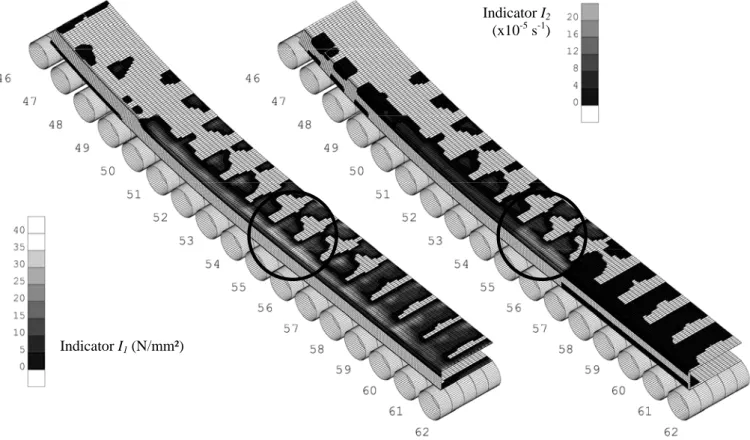
2 max ; 0 ; 0 ; zz A B A B T T T I T T T ε ⎧ ∈ ⎪ = ⎨ ∉ ⎪⎩ & (12) As it clearly appears, these indicators are different of zero only if the temperature corresponds to the gap of ductility and if the constraint is in the sense of opening a crack (tensile stress or elongation). In such a case, the value of the indicators are higher the constraint the higher is. In any other case, the indicators are equal to zero, meaning that the risk of transverse crack initiation vanishes.The model provides many results, among others: temperature evolution (thus surface temperature, evolution of solidification, metallurgical length,…), stress and strain states (and combinations such as indicators defined here above), bulging between rolls, extracting force. The figure 1 represents a part (straightening zone) of the casting of a micro allied steel with standard conditions (without any local defect). This figure shows the value of the 2 indicators and the localization of the maximum values (maximum risk) accords with observation. Other computations including local defects (water spray cooling perturbation, roll locking, roll
misalignment) have been performed. Comparing the following reference case (standard conditions) to the value of the indicators in each defect case, we
studied the effect of each defect. This comparison allowed us to classify the defects from the less to the most critical.
Indicator I2 (x10-5 s-1)
Indicator I1 (N/mm²)
Fig. 1. Indicators of risk of transverse crack initiation with standard casting conditions (reconstituted 3D view of the surface of the cast product – ½ structure because of symmetry).
4 CONCLUSIONS ACKNOWLEDGEMENTS
We express our gratitude to the industrial partner ARCELOR and its Technical Direction of Cokerill-Sambre.
A thermal-mechanical F.E.M. model has been developed to predict the behaviour of steel during continuous casting at the macroscopic scale. This model belongs to the “slice family” models and it is based on generalized plane strain state approach.
As Research Associate of National Fund for Scientific Research (Belgium), A.M. Habraken thanks this Belgian research fund for its support.
Two different industrial applications have been analysed. The first one tends to evaluate the efficiency a of the mould taper on the primary cooling.
REFERENCES
1. F. Pascon, A.M. Habraken, M. Bourdouxhe and F. Labory, Finite element modelling of thermo-mechanical behaviour of a steel strand in continuous casting, In: Proc. 4th ESAFORM Conference, April 23-25 2001, Liège (Belgium), 867-870
The second application, which one is illustrated in this paper, helps to better understand the effect of some local defects and to classify them using macroscopic indicators from the less to the most critical in terms of transversal cracking. To do so, two macroscopic indicators have been defined. These indicators combine the gap of ductility of steel in a given range of temperature and the longitudinal tensile stress or the longitudinal extension rate, both origins of transversal cracking.
2. F. Pascon, A.M. Habraken, M. Bourdouxhe and F. Labory, Modélisation des phénomènes thermo-mécaniques dans une lingotière de coulée continue, In: Mec. Ind. Vol. 1 – n°1 (2000), 61-70 (in French).
3. G. Blès, S. Castagne, F. Pascon and A.M. Habraken, Developments in finite element simulations of continuous casting, In: Proc.2nd Int. Conf. on Thermal Process Modelling and Computer Simulation (ICTPMCS), March 31 April 1-2 2003, Nancy (France). 4. A.M. Habraken, J.F. Charles, J. Wegria and S. Cescotto,
Dynamic Recrystallisation During Zinc Rolling, In: Int.J. of Forming Processes, Vol. 1 – n°1 (1998), 53-73
In other respects, a mesocopic F.E.M. model is in development to predict cracking at the grain scale.