HAL Id: pastel-00962176
https://pastel.archives-ouvertes.fr/pastel-00962176
Submitted on 20 Mar 2014
HAL is a multi-disciplinary open access
archive for the deposit and dissemination of
sci-entific research documents, whether they are
pub-lished or not. The documents may come from
teaching and research institutions in France or
abroad, or from public or private research centers.
L’archive ouverte pluridisciplinaire HAL, est
destinée au dépôt et à la diffusion de documents
scientifiques de niveau recherche, publiés ou non,
émanant des établissements d’enseignement et de
recherche français ou étrangers, des laboratoires
publics ou privés.
Asymmetric Distributional Similarity Measures to
Recognize Textual Entailment by Generality
Sebastião Pais
To cite this version:
Sebastião Pais. Asymmetric Distributional Similarity Measures to Recognize Textual Entailment by
Generality. Other [cs.OH]. Ecole Nationale Supérieure des Mines de Paris, 2013. English. �NNT :
2013ENMP0063�. �pastel-00962176�
T
H
È
S
E
École doctorale n°432:
SMI - Sciences des Métiers de l’Ingénieur
Doctorat ParisTech
T H È S E
pour obtenir le grade de docteur
préparée dans le cadre d’une cotutelle entre
l’École nationale supérieure des mines de Paris
et Université de Beira Interior
Spécialité «Informatique temps réel, robotique et automatique
-Fontainebleau»
présentée et soutenue publiquement par
Sebastião PAIS
le 06 décembre 2013
Asymmetric Distributional Similarity Measures to
Recognize Textual Entailment by Generality
Directeurs de thése: Robert MAHL et Gaël Harry DIAS
Co-encadrement de la thèse: Katarzyna WEGRZYN-WOLSKA
Jury
Witold KOSINSKI,Professeur, Polish-Japanese Institute of Information Technology Président & Rapporteur
Robert MAHL,Professeur, CRI, Mines ParisTech Directeur de la Thèse
Gaël DIAS,Professeur, Département d’ Informatique, Univ. of Caen Basse-Normandie Directeur de la Thèse
Katarzyna WOLSKA-WEGRZYN,Professeur, ESIGETEL Co-encadrant de la Thèse
Antoine DOUCET,Professeur, Département d’ Informatique, Univ. of Caen Basse-Normandie Rapporteur
João CORDEIRO,Professeur, Département d’Informatique, Univ. of Beira Interior Examinateur
Zornitsa KOZAREVA,Professeur, Information Sciences Institute, Univ. of Southern California Examinateur
the force that you give me, and to the new meaning that you give to my life, my wife and my daughter. To you I dedicate this thesis. You are responsible for this work, this
Acknowledgements
“Each person who goes in our life goes alone; it is because each person is unique and no one replacing the other. Each person who goes in our life passes us alone and not only because each person leaves a bit of himself and takes a bit of us. (…)”
Charles Chaplin
At all stages of our lives we cross paths with people who contribute directly or indirectly to our success, people who by their importance, became forever in the history of our lives, in our history. Though only my name appears on the cover of this dissertation, many people have contributed to and helped me to bring it up and in its production. I owe my sincere gratitude to all those people who have made this thesis possible and because of whom such experience has been one that I will cherish forever.
I have been fortunate to have an adviser who gave me the freedom, courage and confidence to explore this path on my own, and at the same time the helpful guidance to recover when my steps failed. During all these years of working together, Gaël Dias taught me how to be precise, organized and focused. His support even during the last stages of my thesis and his management and coordination skills have been valuable lessons that I’m sincerely grateful for. “Muito Obrigado Por Tudo AMIGÃO”
I am grateful to Robert Mahl and Katarzyna Wegrzyn-Wolska, my adviser and co-advisers, respectively, in the Centre de Recherches en Informatique of Mines Paris (Paristech group of Engineering schools) in Fontainebleau1. I am thankful to them for giving me the
opportunity to attend Mines ParisTech and get my PhD, one unforgettable experience of great value to me.
My deepest gratitude is to my friend and colleague, Rumen Moraliyski, who has been always there to listen, share ideas and give advices. Through long discussions, critical corrections, creative ideas on technical writings and presentations with him, I have learned priceless lessons during my PhD. I also owe him a debt of gratitude for carefully reading, commenting and revising my writings and slides in all stages of my work. Thanks to all the members of HULTIG2, a special thank to João Paulo Cordeiro and Isabel Marcelino.
1http://cri.mines-paristech.fr/ 2http://hultig.di.ubi.pt/
Most importantly, none of this would have been possible without the love and patience of my family. My family to whom this dissertation is dedicated, has been a constant source of love, concern, support and strength for all these years. I would like to express my heart-felt gratitude to my wife and daughter - Carla Pereira and Lara Pais - who have helped and encouraged me. I also offer my deepest thanks and love to my mother -Maria Odete Pais - whose love and support has sustained me during these years. I cannot forget my father and my grand-mother, who already left us, but I know both are looking to me, there, where they are…
I thank you all! Sebastião Pais
Extended Abstract
“If you can’t explain it simply, you don’t understand it well enough.”
Albert Einstein
Textual Entaiment (TE) aims to capture major semantic inference needs across applica-tions in Natural Language Processing (NLP). Since 2005, in the TE recognition (RTE) task, systems are asked to automatically judge whether the meaning of a portion of text, the Text - T, entails the meaning of another text, the Hypothesis - H. A number of novel approaches, and improvements in TE technologies demonstrated in recent Recognizing Textual Entaiment (RTE) Challenges are signaling of renewed interest towards a deeper and better understanding of the core phenomena involved in TE.
In line with this direction, in this thesis we focus on a particular case of entailment, en-tailment by generality. For us, there are various types of implication, range of different levels of entailment reasoning, based on lexical, syntactic, logical and world knowledge at different levels of difficulty. We introduce the paradigm of TE by Generality, which can be defined as the entailment from a specific sentence towards a more general sen-tence. In this context, the Text T entails the Hypothesis H, because H is more general than T.
We propose an unsupervised and language-independent method to recognize TE by Gen-erality given a case of Text−Hypothesis or T−H where entailment relation holds. To this end, we introduce an Informative Asymmetric Measure (IAM) called Simplified Asym-metric InfoSimba, which we combine with different AsymAsym-metric Association Measures (AAM).
To evaluate the performance of our proposal, we did three experiments:
1. we tested our methodology on all pairs Text−Hypothesis of the Test Set of the first five RTE Challenges;
2. we tested in pairs Text− > Hypothesis, where we know the entailment between Text and Hypothesis is by generality;
3. finally, we tested our methodology on 100 pairs T− > H which were randomly extracted from set of pairs submitted in CrowdFlower (60 pairs T− >H Entailment
by Generality and 40 pairs T− > H Entailment, but no Generality) and translated into Portuguese by Google Translate1.
To do the experiment with pairs T− > H, where we know the entailment between T and H is for generality, it was necessary us create a corpus of pairs Text− >Hypothesis with Entailment by Generality. This corpus was annotated using the CrowdFlower 2
system, a cheap and fast way to collect annotations from a broad base of paid non-expert contributors over the Web. The corpus is composed of pairs of Text−Hypothesis, collected for RTE-1 through RTE-5 challenges. Only positive pairs of TE were submitted to CrowdFlower for annotation, together with a small set of carefully selected cases of known categorization that are used to train the participating annotators and to exercise quality control.
In this work we hypothesize the existence of a special mode of TE, namely Textual Entailment by Generality. Thus, the main contribution of our study is to highlight the importance of this inference mechanism. Consequently, the new annotation data seems to be a valuable recourse for the community.
Keywords:
Natural Language Processing, Textual Entailment, Recognizing Textual En-tailment by Generality, Word Similarity, Informative Asymmetric Measure, Asymmetric Association Measure1https://translate.google.pt/ [Last access: 21thDecember, 2013]
2CrowdFlower service provides a crowdsourcing interface to Amazon Mechanical Turk (MTurk) for non-US
Contents
Contents ix
List of Figures xiii
List of Tables xv
List of Abbreviations xvii
1 Introduction 1
1.1 Natural Language Processing . . . 1
1.1.1 Historical Review . . . 2
1.1.2 Applications of Natural Language Processing . . . 4
1.2 Motivation and Rationale . . . 4
1.3 Linguistic Notion of Entailment . . . 8
1.3.1 Variants of the Entailment . . . 8
1.4 Context of Textual Entailment . . . 10
1.4.1 Probabilistic Textual Entailment . . . 11
1.4.2 Recognizing Textual Entailment . . . 12
1.5 Our Proposal for RTE by Generality . . . 13
1.6 Structure of the Thesis . . . 14
2 Related Work 17 2.1 Overview of the First Five RTE Challenges . . . 17
2.1.1 Datasets and Annotations . . . 18
2.1.1.1 RTE-1 . . . 18 2.1.1.2 RTE-2 . . . 21 2.1.1.3 RTE-3 . . . 25 2.1.1.4 RTE-4 . . . 27 2.1.1.5 RTE-5 . . . 29 2.1.1.6 Summary . . . 31
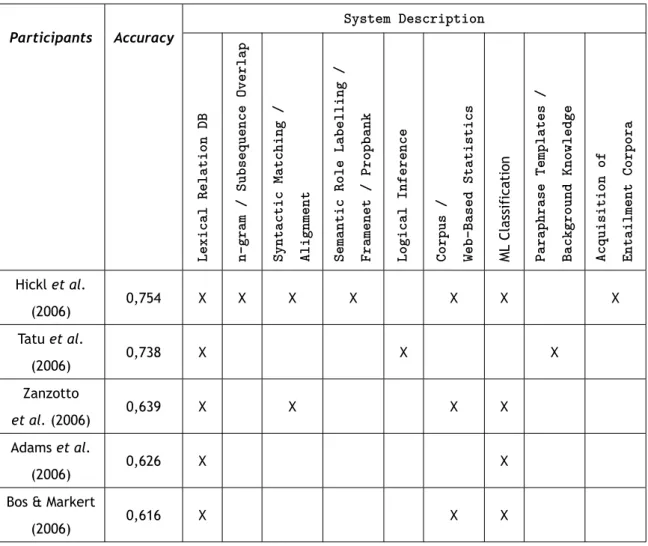
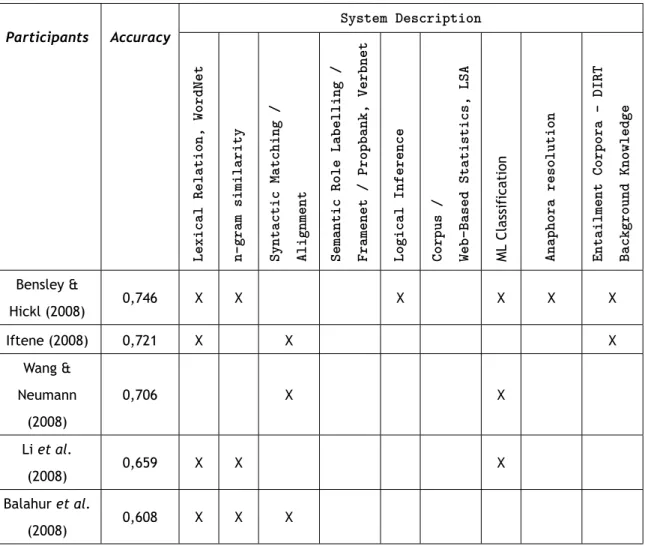
CONTENTS 2.1.2.1 Evaluation Measures . . . 33 2.1.2.2 First Challenge . . . 33 2.1.2.3 Second Challenge . . . 35 2.1.2.4 Third Challenge . . . 36 2.1.2.5 Fourth Challenge . . . 38 2.1.2.6 Fifth Challenge . . . 40 2.1.2.7 Summary . . . 41
2.2 Unsupervised Language-Independent Methodologies for RTE . . . 42
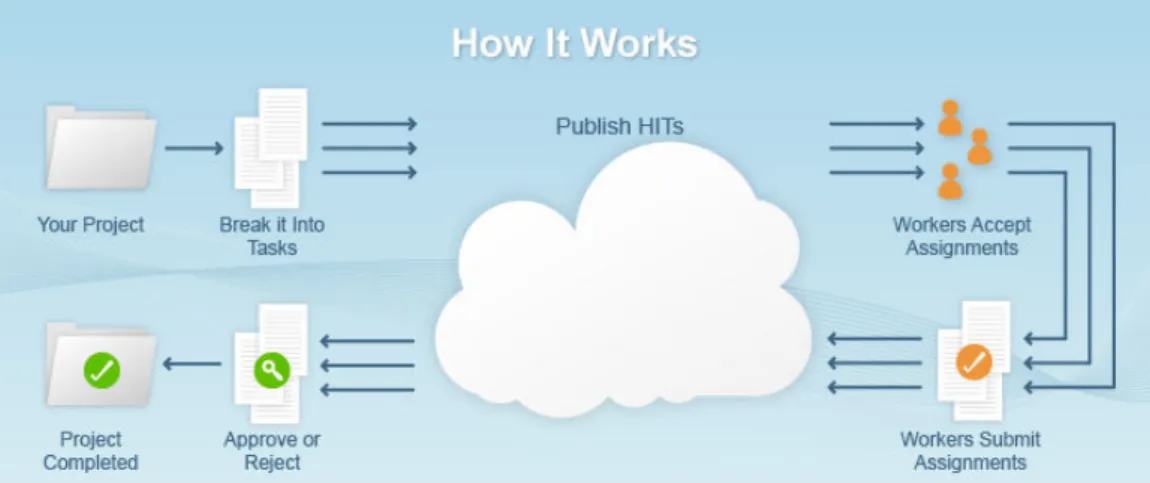
3 Corpus construction 45 3.1 Crowdsourcing . . . 45
3.2 Quality Control of Crowdsourced Data . . . 46
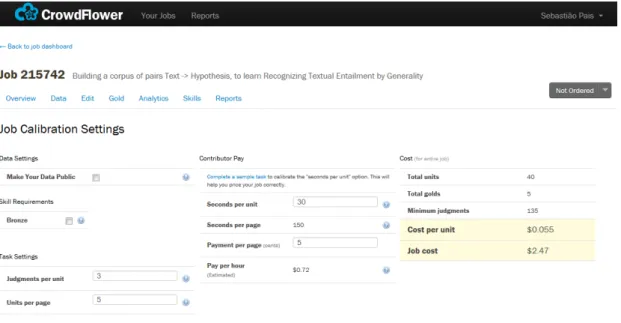
3.3 Building Methodology . . . 47
3.4 Quantitative Analysis . . . 49
4 Our Methodology for RTE by Generality 51 4.1 Contextual Word Similarity . . . 51
4.1.1 Applications of Word Similarity . . . 52
4.1.2 Co-occurrence relations . . . 53
4.1.2.1 Non-grammatical relations . . . 53
4.1.3 Asymmetric Word Similarities . . . 55
4.1.3.1 Asymmetric Association Measures . . . 55
4.1.3.2 Asymmetric Attributional Word Similarities . . . 57
4.2 Asymmetry between Words . . . 60
4.3 Asymmetry between Sentences . . . 61
4.4 Three Levels of Pre-Processing . . . 62
4.4.1 Multiword Units Identification . . . 63
4.5 Sample of Calculation for Identify Entailment by Generality . . . 64
5 Evaluating the Performance of our Methodology 67 5.1 Evaluation Scheme . . . 67
5.1.1 Measures to evaluate the performance . . . 67
5.2 All pairs of the Test Set of the first five RTE Challenges . . . 69
5.2.1 All Words . . . 69
5.2.2 Without Stop Words . . . 72
5.2.3 With Multiword Units . . . 75
5.2.4 Summary . . . 78
5.3 Corpus TE by Generality . . . 81
5.3.2 Without Stop Words . . . 84
5.3.3 With Multiword Units . . . 86
5.3.4 Summary . . . 87
5.4 Corpus TE by Generality translated into Portuguese . . . 89
5.4.1 All Words . . . 90
5.4.2 Without Stop Words . . . 91
5.4.3 With Multiword Units . . . 93
5.4.4 Summary . . . 95
5.5 Qualitative Analysis . . . 97
6 Conclusion and Future Work 99 6.1 Recapitulation . . . 99
6.2 Future Research . . . 101
References 103 Appendices 113 Stop Words Lists 115 A.1 Stop Words List in English . . . 115
A.2 Stop Words List in Portuguese . . . 117
Multiword Units - Extraction of 2-ary Textual Associations 119 B.1 Multiword Units in English . . . 119
B.2 Multiword Units in Portuguese . . . 136
Sample form submitted to the “Turkers” in CrowdFlower 161 Sample Web Frequencies for Calculations 163 D.1 All Words . . . 163
D.2 Without Stop Words . . . 166
List of Figures
1.1 Venn diagram of the entailment relation. . . 8
1.2 Example the entailment by generality relation. . . 10
3.1 Mechanical Turk process. . . 46
3.2 Job Calibration Settings in CrowdFlower. . . 48
3.3 Add Funds in CrowdFlower. . . 48
3.4 All Reports in CrowdFlower. . . 49
4.1 Sample calc with all words. . . 65
4.2 Sample calc with list of the stop words . . . 65
List of Tables
2.1 Examples of T−H pairs in RTE-1 (Dagan et al., 2005) . . . . 21
2.2 Examples o T−H pair in RTE-2 (Ido et al., 2006) . . . . 24
2.3 Examples o T−H pair in RTE-3 (Giampiccolo et al., 2007) . . . . 26
2.4 Examples o T−H pair in RTE-4 (Giampiccolo et al., 2008) . . . . 28
2.5 Examples o T−H pair in RTE-5 (Bentivogli et al., 2009) . . . . 30
2.6 RTE - 1 to RTE - 5 data sets . . . 32
2.7 Best Results in RTE-1 (Dagan et al., 2005) . . . . 34
2.8 Best Results in RTE-2 (Ido et al., 2006) . . . . 35
2.9 Best Results in RTE-3 (Giampiccolo et al., 2007) . . . . 37
2.10 Best Results in RTE-4 (Giampiccolo et al., 2008) . . . . 39
2.11 Best Results in RTE-5 . . . 41
2.12 Average the top five results . . . 42
3.1 Summary of RTE by Generality corpus annotation task . . . 50
4.1 Web frequencies for calculations with All Words . . . 59
4.2 Web frequencies for calculations with All Words . . . 59
5.1 Contingency table for evaluating a binary classifier. For example, a is the number of objects in the category of interest that were correctly assigned to the category. (Manning & Schütze, 1999) . . . 68
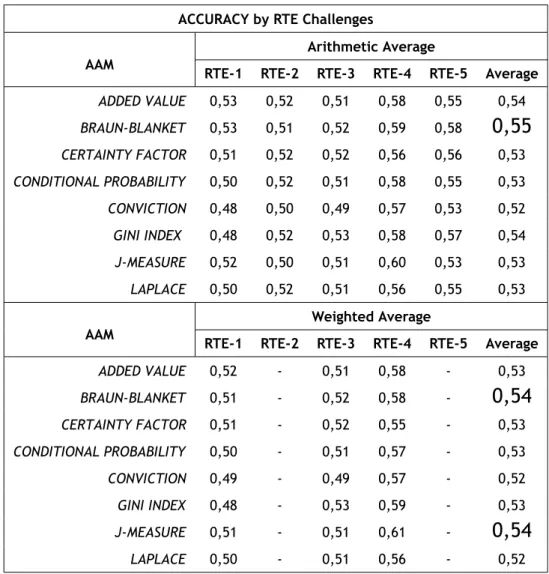
5.2 Accuracy Average by RTE Challenges | With All Words . . . 70
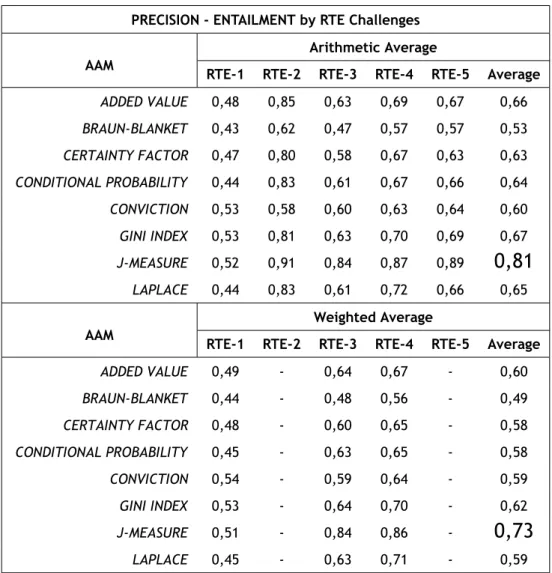
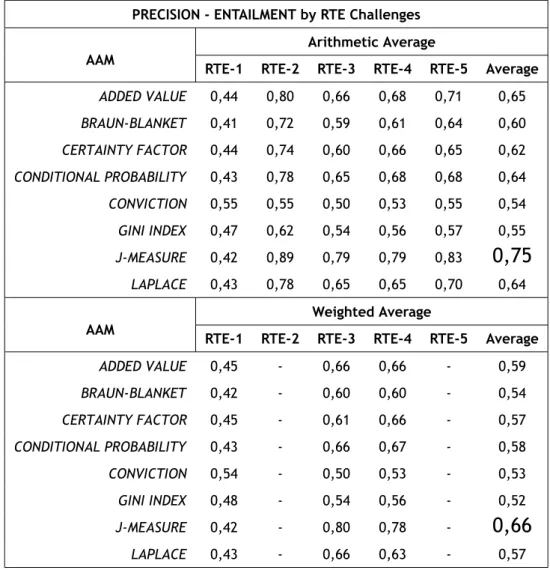
5.3 PRECISION - ENTAILMENT Average by RTE Challenges | With All Words . . . 71
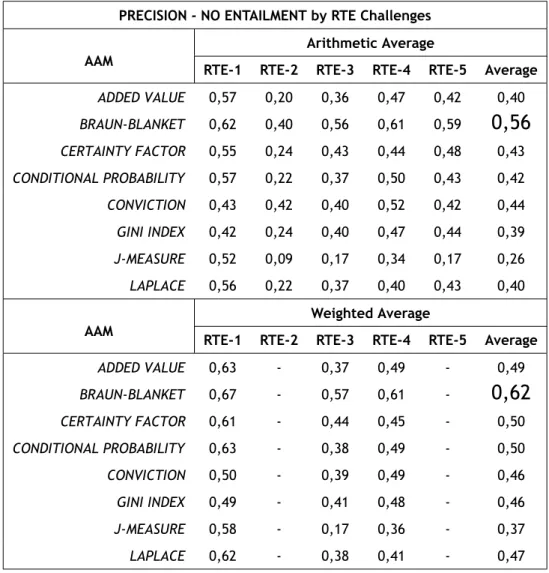
5.4 PRECISION - NO ENTAILMENT Average by RTE Challenges | With All Words . . . 72
5.5 Accuracy Average by RTE Challenges | Without Stop Words . . . 73
5.6 PRECISION - ENTAILMENT Average by RTE Challenges | Without Stop Words . . . 74
5.7 PRECISION - NO ENTAILMENT Average by RTE Challenges | Without Stop Words . . . . 75
5.8 Accuracy Average by RTE Challenges | With MWU . . . 76
5.9 PRECISION - ENTAILMENT Average by RTE Challenges | With MWU . . . 77
LIST OF TABLES
5.11 Accuracy Averages | Measures versus Approach . . . 79
5.12 PRECISION - ENTAILMENT Averages | Measures versus Approach . . . 80
5.13 PRECISION - NO ENTAILMENT Averages | Measures versus Approach . . . 81
5.14 Confusion Matrix for all AAM | All Words . . . 82
5.15 Accuracy and Precision by AAM | All Words . . . 83
5.16 Confusion Matrix for all AAM | Without Stop Words . . . 84
5.17 Accuracy and Precision by AAM | Without Stop Words . . . 85
5.18 Confusion Matrix for all AAM | With MWU . . . 86
5.19 Accuracy and Precision by AAM | All Multiword Units (MWU) . . . 87
5.20 Accuracy by AAM . . . 88
5.21 Precisions by AAM . . . 89
5.22 Confusion Matrix for all AAM | All Words . . . 90
5.23 Accuracy and Precision by AAM | All Words . . . 91
5.24 Confusion Matrix for all AAM | Without Stop Words . . . 92
5.25 Accuracy and Precision by AAM | Without Stop Words . . . 93
5.26 Confusion Matrix for all AAM | With MWU . . . 94
5.27 Accuracy and Precision by AAM | All MWU . . . 95
5.28 Accuracy by AAM . . . 96
5.29 Precisions by AAM . . . 97
A.1 Stop Words List in English . . . 115
A.2 Stop Words List in Portuguese . . . 117
B.1 MWU extracted from the first five RTE dataset test. . . 119
B.2 MWU extracted from the first five RTE dataset test, translated into Portuguese. . . . 136
D.1 Web frequencies for calculations with All Words . . . 163
D.2 Web frequencies for calculations with All Words . . . 164
D.3 Web frequencies for calculations without Stop Words . . . 166
D.4 Web frequencies for calculations without Stop Words . . . 166
D.5 Web frequencies for calculations with MultiWords Units . . . 168
List of Abbreviations
AAM Asymmetric Association Measures. AC Accuracy.
AI Artificial Intelligence.
AIS Asymmetric InfoSimba Similarity.
AISs Simplified Asymmetric InfoSimba Similarity. ATN Augmented Transition Network.
CD Comparable Documents. CM Confusion Matrix.
DIRT Discovery of Inference Rules from Text. DUC Document Understanding Conferences. HITs Human Intelligence Tasks.
IAM Informative Asymmetric Measure. IE Information Extraction. IR Information Retrieval. IS InfoSimba Similarity. ME Mutual Expectation. ML Machine Learning. MT Machine Translation. MTurk Amazon Mechanical Turk. MWU Multiword Units.
NE Named Entity.
NIST National Institute of Standards and Technology. NL Natural Language.
NLP Natural Language Processing. P Precision.
PASCAL Pattern Analysis, Statistical Modelling and Com-putational Learning.
PO Precision-Oriented. PP Paraphrase Acquisition.
LIST OF ABBREVIATIONS
QA Question Answering.
RAIS Recursive Asymmetric InfoSimba Similarity. RC Reading Comprehension.
RTE Recognizing Textual Entaiment. SUM Summarization.
TAC Text Analysis Conference. TE Textual Entaiment. WWW World Wide Web.
I
“Victory is always possible for the person who refuses to stop fighting.”
Napoleon Hill
In this Chapter we introduce the context and the motivations underlying the present research work, we analyze the notion and variants of entailment and consequently Textual Entaiment (TE). Also here we introduce our objective in this work - identifying entailment by generality in pairs of sentences.
1.1 Natural Language Processing
We can not imagine a world without communication. Every living being must communicate to survive. For us, human beings, language is a fundamental aspect and it is a crucial component of our life. In written form it serves as a long-term record of knowledge from one generation to the next. In spoken form it serves as our primary means of coordinating our day-to-day behavior with others. Thus, producing language is above all a social activity.
NLP is a field of computer science and linguistics concerned with the interactions between computers and humans by means of natural language. In theory, NLP is a very attractive method of human-computer interaction. Natural Language (NL) understanding is sometimes referred to as an Artificial Intelligence (AI) complete problem, because NL recognition seems to require extensive knowledge about the outside world and the ability to manipulate it. NLP has significant overlap with the field of computational linguistics, and is often considered a sub-field of artificial intelligence.
Modern NLP algorithms are grounded in Machine Learning (ML), especially statistical ML. Research into modern statistical NLP algorithms requires understanding of a number of fields, including linguistics, computer science, statistics (particularly Bayesian Statistics), linear algebra and optimization theory.
1.1.1 Historical Review
Work in the NLP field has concentrated first on one problem, then on another, sometimes because solving problem X depends on solving problem Y but sometimes just because problem Y seems more tractable than problem X, or because there is market interest in a solution to Y. There has been very substantial progress, both in understanding how to do NLP and in actually doing it, since work in the field took off in the 1950s. In the last twenty-five years in particular, advances in computing technology have made it possible to implement ideas that could only be adumbrated before, to con-solidate research, and to carry speech and language processing into the ordinary world. Sometimes the scientific advance in NLP, or the computational linguistics underlying it, is less than the onward rush of information technology field evident in the fifty-year period reviewed here.
Sometimes innovation is only old ideas reappearing in new guises, like lexical list approaches to NLP, or shallow parsing. But the new costumes are better made, of better materials, as well as more becoming: so the research is not so much going round in circles as ascending a spiral.
The work of the late 1940s to late 1960s, was focused on Machine Translation (MT). Following a few early birds, including Booth and Richens’ investigations and Weaver’s influential memorandum on translation of 1949, research on NLP began in earnest in the 1950s. Automatic translation from Russian to English, in a very rudimentary form and limited experiment, was exhibited in the IBM-Georgetown Demonstration of 1954 (Hutchins et al., 1955). The journal Mechanical Translation, the ancestor of Computational Linguistics, also began publication in 1954. The first international conference on Mechanical Translation was held in 1952, the second in 1956 (the year of the first AI conference); at the important Washington International Conference on Scientific Information of 1958 language processing was linked with information retrieval, for example in the use of a thesaurus, Minsky drew attention to AI, and Luhn provided auto-abstracts (actually extracts) for one session’s papers. The Teddington International Conference on Machine Translation of Language and Applied Language Analysis in 1961 was perphars the high point of this phase: it reported work done in many countries on many aspects of NLP including morphology, syntax and semantics, in interpretation and generation, and ranging from formal theory to hardware.
Some notably successful NLP systems developed in the 1960s were SHRDLU1- “SHRDLU was primarily
a language parser that allowed user interaction using English terms. The user instructed SHRDLU to move various objects around in a “blocks world” containing various basic objects: blocks, cones, balls, etc. What made SHRDLU unique was the combination of four simple ideas that added up to make the simulation of “understanding” far more convincing.”2 - a natural language system
working in restricted “blocks worlds” with restricted vocabularies, and ELIZA (Weizenbaum, 1966), a simulation of a Rogerian psychotherapist, written by Joseph Weizenbaum3between 1964 to 1966.
Using almost no information about human thought or emotion, ELIZA sometimes provided a startlingly
1http://hci.stanford.edu/~winograd/shrdlu/ [Last access: 14thDecember, 2013] 2http://en.wikipedia.org/wiki/SHRDLU [Last access: 14thDecember, 2013]
human-like interaction. When the “patient” exceeded the very small knowledge base, ELIZA might provide a generic response, for example, responding to “My head hurts” with “Why do you say your head hurts?”.
In 1969 Roger Schank1 introduced the conceptual dependency theory for natural language
under-standing (Schank & Tesler, 1969).
In 1970, William A. Woods introduced the Augmented Transition Network (ATN) to represent nat-ural language input (Woods, 1970). Instead of phrase structure rules ATN used an equivalent set of finite state automata that were called recursively. ATN and their more general format called “generalized ATN” continued to be used for a number of years. During the 70’s many programmers began to write “conceptual ontologies”, which structured real-world information into computer-understandable data.
Up to the 1980s, most NLP systems were based on complex sets of hand-written rules. Starting in the late 1980s, however, there was a revolution in NLP with the introduction of machine learning algorithms for language processing. This was due both to the steady increase in computational power resulting from Moore’s Law2and the gradual lessening of the dominance of Chomskyan3theories of
linguistics (e.g. transformational grammar), whose theoretical underpinnings discouraged the sort of corpus linguistics that underlies the machine-learning approach to language processing. Some of the early machine learning algorithms, such as decision trees, produced systems of hard if-then rules similar to existing hand-written rules. Increasingly, however, research has focused on statisti-cal models, which make soft, probabilistic decisions based on attaching real-valued weights to the features making up the input data. The cache language models upon which many speech recognition systems now rely are examples of such statistical models. Such models are generally more robust when given unfamiliar input, especially input that contains errors (as is very common for real-world data), and produce more reliable results when integrated into a larger system comprising multiple subtasks.
Many of the notable early successes occurred in the field of MT, due especially to work at IBM Re-search, where successively more complicated statistical models were developed. These systems were able to take advantage of existing multilingual textual corpora that had been produced by the Parliament of Canada4 and the European Union5 as a result of laws calling for the translation of
all governmental proceedings into all official languages of the corresponding governmental systems. However, most other systems depended on corpora developed for specific task, which was (and of-ten continues to be) a major obstacle to the success of these systems. As a result, a great deal of research has gone into methods of more effectively learning from limited amounts of data.
Recent research has increasingly focused on unsupervised (our case) and semi-supervised learning
1http://en.wikipedia.org/wiki/Roger_Schank [Last access: 14thDecember, 2013] 2http://en.wikipedia.org/wiki/Moore's_Law [Last access: 14thDecember, 2013]
3http://web.mit.edu/linguistics/people/faculty/chomsky/index.html [Last access: 14thDecember, 2013] 4http://www.parl.gc.ca/common/index.asp?Language=E [Last access: 14thDecember, 2013]
algorithms. Such algorithms are able to learn from data that has not been hand-annotated with the desired answers, or using a combination of annotated and raw data. Generally, this task is much more difficult than supervised learning, and typically produces less accurate results for a given amount of input data. However, there is an enormous amount of non-annotated data available (including, among other things, the entire content of the World Wide Web (WWW)), which can often make up for the inferior results.
1.1.2 Applications of Natural Language Processing
NLP is an interdisciplinary research area at the border between linguistics and AI aiming at develop-ing computer programs capable of human-like activities related to understanddevelop-ing or producdevelop-ing texts or speech in a natural language, such as English or Chinese.
The most important applications of NLP include Information Retrieval (IR) and information organiza-tion, MT, and natural language interfaces, Information Extraction (IE), Summarization (SUM), search engine, among others. However, as in any science, the activities of the researchers are mostly con-centrated on its internal art and craft, that is, on the solution of the problems arising in analysis or generation of natural language text or speech, such as syntactic and semantic analysis, disambigua-tion, or compilation of dictionaries and grammars necessary for such analysis.
1.2 Motivation and Rationale
Natural Language (NL) allows the same meaning to be expressed in many different ways, making automatic understanding particularly challenging. Almost all computational linguistics tasks such as IR, Question Answering (QA), IE, SUM and MT have to cope with this phenomenon.
Inference is generally perceived as the process by which new knowledge is inferred from given infor-mation. For example, the Merriam-Webster online dictionary1defines the first sense of infer as “to
derive as a conclusion from facts or premises”. Somewhat more technically, inference is defined as “the act of passing from one proposition, statement, or judgment considered as true to another
whose truth is believed to follow from that of the former”.
Moving to the realm of NLP, we can analogically perceive inference over information stated in human language. Such inference can be defined as the process of concluding the truth of a textual state-ment based on (the truth of) another given piece of text. This language-oriented view on inference was captured by the textual entailment paradigm, originally proposed by Dagan & Glickman (2004) and subsequently established through the series of benchmarks known as the PASCAL Recognising
Textual Entailment (RTE) Challenges.
While capturing a generic notion of inference over texts, the introduction of entailment recognition as a computational task was particularly motivated by its overarching potential for NLP applications.
For example, consider a QA scenario, addressing the question “Who painted ‘The Scream’?”. In order to provide the answer “Edvard Munch”, based on the text snippet “Norway’s most famous painting,
‘The Scream’ by Edvard Munch,…”, the QA system needs to validate that the hypothesized answer statement “Edvard Munch painted ‘The Scream’.” is indeed entailed (inferred) by the given text. Entailment is widely used in many aspects of the human life. Assume that someone is seeking for something and he or she searches for the answer from books, friends, or the Web. In most cases, the information gathered or retrieved is not the exact answer, although the (information) seeker may have one in his or her mind. Instead, the consequences of the original goal may be detected, so the entailment plays a role and confirms or denies the original information being sought (Dagan et al., 2013).
For example, John wants to know whether the Amazon river is the longest river in the world. Natu-rally, he can find the exact lengths of the Amazon and other rivers he knows of, and then compare them. But once he sees “Egypt is one of the countries along the longest river on earth”, he can already infer that Amazon is not the longest river, since Egypt and the Amazon river are not on the same continent. Similarly, assuming that Albert is not sure who is the current president of the U.S., Bush or Obama, since both “president Bush” and “president Obama” are retrieved. If he performs an inference based on one of the retrieved documents containing “George Bush in retirement”, the answer is obvious. In short, finding out the exact information is not always trivial, but inference can help a lot. In both cases, the retrieved information entails the answer instead of being the precise answer.
Entailment also occurs frequently in our daily communication, with respect to language understanding and generation. Usually we do not literally interpret each other’s utterances, nor express ourselves in a straight way. For example:
• Tom: Have you seen my iPad?
• Robin: Oh, nice! I’d like to have one too. • Tom: You have to get one.
The dialogue seems to be incoherent, if we literally and individually interpret each sentence. Firstly, Tom asks a yes-no question, but Robin does not directly give the answer. Instead, Robin implies that he has not seen it before the conversation by showing his compliment to it (“Oh, nice!”). Probably Tom is showing his iPad to Robin during the conversation. Robin’s second sentence also implies that he does not have an iPad till then, and therefore Tom’s response is a suggestion for him to get one. If we literally interpret the conversation, it sounds a bit awkward. Here is one possibility:
• Tom: Here is my iPad.
• Robin: I haven’t seen it before. It is nice. I don’t have one, but I’d like to have one. • Tom: I suggest you get one.
Although the interpreted version may be easier for the computers to process human dialogues, the original conversation occurs more naturally in our daily life. Each utterance in the interpreted version is actually implied or entailed by the utterances in the original conversation. Consequently, if we want to build a dialogue system, dealing with this kind of implication or entailment is one of the key challenges. Let alone there is common sense knowledge which does not appear in the dialogue but is nevertheless acknowledged by both speakers, e.g., what an iPad is.
RTE was proposed by Dagan & Glickman (2004) as a generic NLP task in order to overcome the problem of lexical, syntactic and semantic variability in natural languages. In 2005, the RTE Challenge has been launched by Dagan et al. (2005), defining TE as a task for automatic systems.
Given a text T and a hypothesis H, the task consists of deciding whether the meaning of H can be inferred from the meaning of T. The following examples show T−H pairs for which the entailment relation holds (Example 1) or not (Example 2):
• Example 1
T: Euro-Scandinavian media cheer Denmark vs Sweden draw. H: Denmark and Sweden tie.
Entailment: YES
• Example 2
T: Oracle had fought to keep the forms from being released. H: Oracle released a confidential document.
Entailment: NO
In the many evaluation campaigns that in recent years addressed the TE recognition problem, complex definitions of the task have been proposed. The released datasets reflect the long-term objective of creating more natural evaluation settings. These include the formulation of TE as a search task1(i.e. finding all the sentences in a set of documents that entail a given hypothesis), the
use of TE to approach the Answer Validation Exercise2(emulate human assessment of QA responses
and decide whether an answer to a question is correct or not according to a given text), and the very recent effort to explore multi-directional TE recognition3(moving from YES/NO to directional
entailment judgements such as Forward, Backward and Bidirectional). Consequently, a large number
1RTE:http://www.nist.gov/tac/2010/RTE/ [Last access: 14thDecember, 2013] 2AVE:http://nlp.uned.es/clef-qa/ [Last access: 14thDecember, 2013]
of methods and resources for TE has been published or released.
As for the NLP perspective, RTE can be viewed as a generic semantic processing module, which serves for other tasks. For instance, it has already been successfully used for question answering (Harabagiu & Hickl, 2006), including answer validation (Peñas et al., 2008; Rodrigo et al., 2009), information extraction (Roth et al., 2009), and MT evaluation (Padó et al., 2009a). In the long term, RTE can also play an important role in understanding conversation dialogues (Zhang & Chai, 2010), metaphors (Agerri, 2008), and even human-robot communication (Bos & Oka, 2007).
Given the multiple applicability that Textual Entailment can have, we understand that there are several types of implications, where each type of implication stems or suits specific task. Proof of this is the diversity of methodologies and results presented in the RTE challenges. It is accepted that textual entailment is not an exact science and we believe that there is still much to be investigated in this area.
In this thesis we introduce a new concept, Entailment by Generality. This new paradigm can be defined as the relation that holds between a specific statement that implies a more general one, for example, strawberry (specific) implies fruit (general), because strawberry is really a fruit, but fruit does not necessarily imply strawberry, because, fruit can be strawberry but can also be
orange, banana, or other fruit.
Also in this thesis we present our methodology - unsupervised, language-independent and threshold free - for learning to identify entailment by generality between two sentences. This technology is enabling Ephemeral Clusters Summarization of Web Pages (Dias et al., 2011), useful for optimized
Search Engine results visualization.
In the context of Ephemeral Clustering of Web Pages, it can be interesting to label each cluster with a small summary instead of just a label. Thus we are interested to find the best web snippet, which summarizes and subsumes all the other web snippets within an ephemeral cluster. This summary can be defined as a general entailment from a specific information characteristic of the cluster. Although, Ephemeral Clustering has been studied for more than a decade, it has received low user acceptance. According to us, there are two main reasons for this situation. First, state-of-the-art systems tend to generate an excessive number of clusters. As a consequence, browsing through a high number of clusters is mostly similar to searching through a high number of Web pages. Second, improved user interfaces can only be achieved through high quality cluster labeling. In the optimal case, the labels of the clusters should clearly evidence their overall contents. However, very little has been proposed in the community to overcome the latter obstacle. The only exception is certainly (de Buenaga et al., 2008) who propose to increase the expressiveness of cluster labels with a summary obtained by classical Multi-document Summarization techniques. However, their solution is fulltext based and can not be applied in real-time real-world applications. As a consequence, we propose to increase cluster expressiveness based on finding the web snippet within the ephemeral cluster, which best summarizes and subsumes all the other web snippets present in the cluster. For that purpose, we propose a different methodology based on TE by Generality.
1.3 Linguistic Notion of Entailment
The application-oriented notion of textual entailment is related, of course, to a classical logic-based notion of entailment in linguistics. A common definition of entailment in formal semantics specifies that a Text T entails another text H (hypothesis, in our terminology) if H is true in every circumstance (possible world) in which T is true. However, the TE definition allows for cases in which the truth of the hypothesis is highly plausible (“most likely true”), for most practical purposes, rather than certain.
In propositional and predicate logic, entailment (or logical implication) describes a relation between one sentence or a set of sentences - the entailing expressions - represented as formulae of a formal language, and another sentence that is entailed. Formally, given a set of formulae Γ=A1, ..., Anand
a formula B, we say that Γ semantically entails B(Γ|=B)if and only if every model (or interpretation) of A1, ..., An is also a model of B. The Venn diagram of this relationship is show in Figure 1.1.
..
Γ
.
B
1
Figure 1.1: Venn diagram of the entailment relation.
1.3.1 Variants of the Entailment
As already mentioned in this thesis, we argue that there are several types of entailment, for example in the study done in (Pazienza et al., 2005),they present three types of entailment can be defined:
1. Semantic Subsumption - T and H express the same fact, but the situation de-scribed in T is more specific than the situation in H. The specificity of T is ex-pressed through one or more semantic operations. For example in the sentential pair:
• H: The cat eats the mouse. • T: The cat devours the mouse.
T is more specific than H, as eat is a semantic generalization of devour.
2. Syntactic Subsumption - T and H express the same fact, but the situation de-scribed in T is more specific than the situation in H. The specificity of T is
expressed through one or more syntactic operations. For example in the pair: • H: The cat eats the mouse.
• T: The cat eats the mouse in the garden. T contains a specializing prepositional phrase.
3. Direct Implication - H expresses a fact that is implied by a fact in T. For example: • H:The cat killed the mouse.
• T: The cat devours the mouse.
H is implied by T, as it is supposed that killed is a precondition for devour. In (Da-gan & Glickman, 2004) syntactic subsumption roughly corresponds to the restrictive extension rule, while direct implication and semantic subsumption to the axiom rule.
In (Pazienza et al., 2005) despite the two types of subsumption entailment, direct implication underlies deeper semantic and discourse analysis. In most cases, as implication concerns two distinct facts in T and H, and as facts are usually expressed through verbs, it follows that the implication phenomenon is strictly tied to the relationship among the T and H verbs. In particular, it is interesting to notice the temporal relation between T and H verbs, as described in (Miller, 1995). The two verbs are said to be in temporal inclusion when the action of one verb is temporally included in the action of the other (e.g. snore − > sleep). Backward-presupposition stands when the H verb happens before the T verb (win entails play). In causation a stative verb in H necessarily follows a verb of change in T (e.g. give − > have). In this case, the temporal rela-tion is thus inverted with respect to backward-presupposirela-tion. Such considerarela-tions leave space to the application of temporal and verb analysis techniques both in the acquisition and recognition tasks. Ultimately, we want to regard entailment by generality as a relation between utterances (that is, sentences in context), where the context is relevant to understand the meaning. Then, considering study in (Pazienza et al., 2005), we understand that the relation entailment by generality can be compared with one of three relations:
• Semantic Subsumption; • Syntactic Subsumption;
• Or a combination - Semantic Subsumption+Syntactic Subsumption;
For us, in the most common definition, Entailment by Generality can be defined as the entailment from specific sentence towards a more general sentence. (Dias et al., 2011; Pais et al., 2011).
...
Entailment: S1 entails S2
...
S1
.
John is from Osnabrueck
...
S2 .
John is from Germany
... S1 entails S2 iff[[S1]] ⊆ [[S2]] . [[S1]] . [[S2]] .. Set of .. possible .. situations 1
Figure 1.2: Example the entailment by generality relation.
1.4 Context of Textual Entailment
Natural languages allow to express the same meaning in many possible ways, making automatic un-derstanding particulary challenging. Almost all computational linguistics tasks such as IR, QA, IE, text summarization and MT have to cope with this phenomenon.
Within TE framework, a text T is said to entail a textual hypothesis H if the truth of H can be in-ferred from T. This means that most people would agree that the meaning of T implies that of H. Somewhat more formally, we say that T entails H when some representation of H can be “matched” with some (or part of a) representation of T, at some level of granularity and abstraction.
Dagan & Glickman (2004) define TE as a relationship between a coherent textual fragment T and a language expression, which is considered as a hypothesis H. Entailment holds (i. e. T→H) if the meaning of H can be inferred from the meaning of T, as interpreted by a typical language user. This relationship is directional and asymmetric, since the meaning of one expression may usually entail the other, while entailment in the other direction is less certain.
This definition of textual entailment captures quite broadly the reasoning about language variability needed by different applications aimed at natural language understanding and processing (Androut-sopoulos & Malakasiotis, 2010; Dagan et al., 2009). For instance, a QA system has to identify texts that entail the expected answer. Given the question “Who painted the Mona Lisa?”, the text “Among the works created by Leonardo da Vinci in the 16th century is the small portrait known as the Mona Lisa or la ‘Gioconda’”, entails the expected answer “Leonardo da Vinci painted the Mona Lisa”. Similarly, in IR relevant documents should entail the combination of semantic concepts and rela-tions denoted by the query. In IE, entailment holds between different text variants expressing the same target relation (Romano et al., 2006). In text summarization, an important processing stage is sentence extraction, which identifies the most important sentences of the texts to be summarized; especially when generating a single summary from several documents (Barzilay & McKeown, 2005), it is important to avoid selecting sentences that convey the same information as other sentences that have already been selected (i.e. that entail such sentences). Also in MT, an entailment relation should hold:
1. among machine-generated translations and human-authored ones that may use different phras-ings in the evaluation phase (Padó et al., 2009b), or
2. in the translation phase, between source language words and longer phrases that have not been encountered in training corpora (Mirkin et al., 2009).
Other applications that could benefit from such inference model are reading comprehension systems (Nielsen et al., 2009).
Below, we give a few variants of informal definitions for textual entailment.
• Dagan et al. (2005) - […] a text T entails a hypothesis H if, typically, a human reading T would
infer that H is most likely true;
• A definition of entailment in formal semantics (Chierchia & McConnell-Ginet, 2000) reads - A
text T entails another text H if H is true in every circumstance (possible world) in which T is true.
Several definitions are given by the participants in various RTE challenges:
• T entails H if we have a sequence of transformations applied to T such that we can obtain H with an overall cost below a certain threshold, empirically estimated on the training data
(Kouylekov & Magnini, 2005);
• If the BLEU’s output is higher than a threshold value the entailment is marked as TRUE, other-wise as FALSE (Pérez & Alfonseca, 2006);
• T entails H if we succeed to extract a maximal subgraph of XDGT that is in isomorphism
relation with a subgraph XDGH(Pazienza & Pennacchiotti, 2005);
• In Guidelines of RTE-41Challenge - T entails H if the truth of H can be inferred from T within
the context induced by T.
1.4.1 Probabilistic Textual Entailment
In many intuitive cases, the textual entailment recognition task may be perceived as being deter-ministic (Glickman & Dagan, 2005). For example, given the hypothesis h1 = “Harry was born in
Iowa”and a candidate text t1 that includes the sentence “Harry’s birthplace is Iowa”, it is clear
that t1does (deterministically) entail h1, and humans are likely to have high agreement regarding
this decision. In many other texts, though, entailment inference is uncertain and has a probabilistic nature. For example, a text t2that includes the sentence “Harry is returning to his Iowa hometown
to get married.” does not deterministically entail the above h1since Harry might have moved to
Iowa as a child. Yet, it is clear that t2does add substantial information about the correctness of h1.
In other words, the probability that h1is indeed true given the text t2ought to be significantly higher
than the prior probability of h1being true. More specifically, we might say that the probability p of
h1 being true should be estimated based on the percentage of cases in which someone’s reported
hometown is indeed his/her birthplace. Accordingly, we wouldn’t accept t2as a definite assessment
for the truth of h1. However, in the absence of other definite information, t2 may partly satisfy
our information need for an assessment of the probable truth of h1, with p providing a confidence
probability for this inference.
Meanings are captured in Glickman & Dagan (2005) model by hypotheses and their truth values. Let T denotes a space of possible texts, and t∈ T a specific text and let H denote the set of all possible hypotheses. A hypothesis h∈ H is a propositional statement which can be assigned a truth value. For now it is assumed that h is represented as a textual statement, but in principle other representations for h may fit their framework as well. A semantic state of affairs is captured by a possible world w: H→0, 1, which is defined as a mapping from H to 0=False, 1=True, representing the set of w’s concrete truth value assignments for all possible propositions. Accordingly, W denotes the set of all possible worlds.
Glickman & Dagan (2005) present a first attempt to define a generative probabilistic setting for TE, which allows a clear formulation of probability spaces and concrete probabilistic models for this task. According to their definition, a text t probabilistically entails a hypothesis h(t →h)if t increases the likelihood of h being true, i.e. if P(Trh=1|t) >P(Trh=1), where Trhis the random
variable whose value is the truth value assigned to h in a given world.
From this applied empirical perspective, textual entailment represents therefore an uncertain - but highly plausible - relation, that has a probabilistic nature.
1.4.2 Recognizing Textual Entailment
The RTE task, as defined by Dagan et al. (2005), and established in the RTE Challenges, is formulated as follows:
Textual entailmentis defined as a directional relationship between pairs of text expres-sions, denoted by T (the entailing “Text”) and H (the entailed “Hypothesis”). We say that T entails H if humans reading T would typically infer that H is most likely true.
of the texts is entailed (can be inferred) from the other text.
As noted by Dagan et al. (2005), this definition is based on common human understanding of language, much like the definition of any other language understanding task. Accordingly, it enables the creation of gold-standard evaluation data sets for the task, where humans can judge whether the entailment relation holds for given Text-Hypothesis pairs. This setting is analogous to the creation of gold standards for other text understanding applications like QA and IE, where human annotators are asked to judge whether the target answer or relation can indeed be inferred from a candidate text. The distinguishing characteristic of the textual entailment task is that it captures textual inference in a generic, application-independent manner. This allows research to focus on core inference issues, while making the results applicable across application areas.
Similar to other semantic annotation tasks, such as those mentioned above, the RTE judgment criterion has some fuzziness with respect to “what a person would typically infer”, particularly in boundary cases. However, the various RTE annotation efforts have shown that sufficiently consistent human judgments can be obtained, allowing research progress on this task (Dagan et al., 2013). Also, this task captures generically a broad range of inferences that are relevant for multiple applications. For example, QA system has to identify texts that entail the expected answer. Given the question “Who is John Lennon’s widow?” the text “Yoko Ono unveiled a bronze statue of her
late husband, John Lennon, to complete the official renaming of England’s Liverpool Airport as Liverpool John Lennon Airport”entails the expected answer “Yoko Ono is John Lennon’s widow”. Similarly, semantic inference needs of other text-understanding applications such as IR, IE and MT evaluation can be cast as entailment recognition (Candela et al., 2006). A necessary step in transforming textual entailment from a theoretical idea into an active empirical research field was the introduction of benchmarks and an evaluation forum for entailment systems.
1.5 Our Proposal for RTE by Generality
We introduce the paradigm of TE by Generality, which can be defined as the entailment from a specific sentence towards a more general sentence. For example, from sentences (1) and (2)
extracted from RTE-1, we would easily state that (1) → (2) as their meaning is roughly the same although sentence(2)is more general than sentence(1).
• (1) Mexico City has a very bad pollution problem because the mountains around the city act as walls and block in dust and smog.
To understand how Textual Entailment by Generality can be modeled for two sentences, we propose a new paradigm based on a new Informative Asymmetric Measure (IAM), called the Asymmetric In-foSimba Similarity (AIS) measure. Instead of relying on the exact matches of words between texts, we propose that one sentence infers the other one in terms of generality if two constraints hold: (a) if and only if both sentences share many related words and (b) if most of the words of a given sentence are more general than the words of the other sentence. As far as we know, we are the first to propose an unsupervised, language-independent, threshold free methodology in the context of TE by Generality, although the approach from Glickman & Dagan (2005) is based on similar assumptions. This new proposal is exhaustively evaluated against the first five RTE datasets by testing different Asymmetric Association Measures (AAM) in combination with the AIS. In particular, the RTE-1 as it is the only dataset for which there exist comparable results with linguistic-free methodologies (Bayer
et al., 2005; Glickman & Dagan, 2005; Perez et al., 2005).
Finally, we propose to avoid the definition of a “hard” threshold and study exhaustively asymmetry in language i.e. not just by the conditional probability as done in Glickman & Dagan (2005). For that purpose, we propose a new IAM called the AIS combined with different Association Measures.
1.6 Structure of the Thesis
The Thesis is structured as follows:
• Chapter 2 gives an overview of the research in TE, in particular, it focuses on the first five RTE Challenges (datasets and annotations, and relevant resources and tools).
• Chapter 3 describes the methodology for the creation of the corpus of pairs T− >H, to learn RTE by Generality, taking advantage of crowdsourcing. This corpus was created with the help of the CrowdFlower service1which provides a crowdsourcing interface to MTurk2 for non-US
citizens.
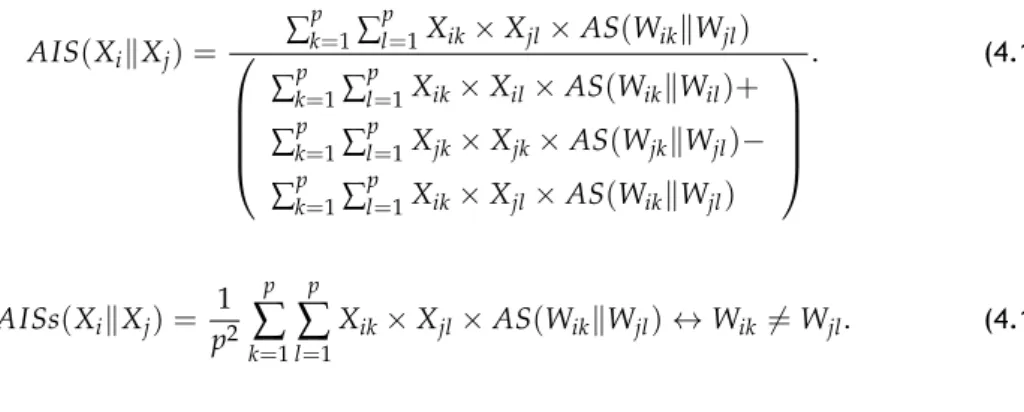
• Chapter 4, the core of our work - our methodology, this chapter presents an IAM called the Simplified Asymmetric InfoSimba Similarity (AISs), which we combine with different AAM to recognize the specific case of TE by Generality. The AISs provides an unsupervised, language-independent and threshold free solution.
• Chapter 5 reports extensively several experiments and respective results on three datasets. In this experiments, we extract MWU with SENTA and used the Stop Words lists.
• Chapter 6 concludes the Thesis drawing final remarks and suggesting directions for future improvements.
1http://crowdflower.com/ [Last access: 14thDecember, 2013] 2http://www.mtruk.com/ [Last access: 14thDecember, 2013]
• Appendix A show Stop Words list in English1and show other Stop Words list in Portuguese2.
• Appendix B show two lists the MWU, in English and Portuguese, prepared for the first five RTE Challenges.
• Appendix C illustrates the submitted form to “Turkers” in CrowdFlower.
• Appendix D presents the Web frequencies for the calculations in the pair T−H in the section 4.5.
1Source:http://www.microsoft.com/en-us/download/confirmation.aspx?id=10024 [Last access: 14thDecember,
2013]
R
W
“Never regard study as a duty, but as the enviable opportunity to learn to know the liberating influence of beauty in the realm of the spirit for your own personal joy and to the profit of the community to which your later work belongs.”
Albert Einstein
This chapter presents the state of the art of the research in TE. Given the significant number of publications on this topic, we focus on a set of relevant works that are unsupervised and language-independent.
2.1 Overview of the First Five RTE Challenges
The first three RTE competitions - RTE-11, RTE-22and RTE-33- were organized by Pattern Analysis,
Statistical Modelling and Computational Learning (PASCAL) Network4.
The 2008 and 2009 (RTE-45 and RTE-56, respectively) challenges were organized within the Text
Analysis Conference (TAC). The TAC is a new series of evaluation workshops organized to encourage research in NLP and related applications, by providing a large test collection, common evaluation procedures, and a forum for organizations to share their results. Year-to-year, new features were added in every new competition.
In 2005, the RTE Challenge was launched by Dagan et al. (2005), defining TE as a task for automatic systems. Given two texts T and H, the task consists in deciding whether the meaning of H can be inferred from the meaning of T. The following example shows a T−H pair for which the entailment
1http://pascallin.ecs.soton.ac.uk/Challenges/RTE/ [Last access: 14thDecember, 2013] 2http://pascallin.ecs.soton.ac.uk/Challenges/RTE2 [Last access: 14thDecember, 2013] 3http://pascallin.ecs.soton.ac.uk/Challenges/RTE3/ [Last access: 14thDecember, 2013] 4http://www.pascal-network.org [Last access: 14thDecember, 2013]
5http://www.nist.gov/tac/2008/rte/index.html [Last access: 14thDecember, 2013] 6http://www.nist.gov/tac/2009/RTE/index.html [Last access: 14thDecember, 2013]
relation holds:
• T: In the end, defeated, Antony committed suicide and so did Cleopatra, according to legend, by putting an asp to her breast.
• H: Cleopatra committed suicide.
At present, TE is considered an interesting and challenging topic within the NLP community, due to its many potential applications. The PASCAL Network promoted a generic evaluation framework covering semantic-oriented inferences for several NLP applications, which led to launch the RTE Challenge. Many research areas such as IE, QA, IE, text summarization and MT have to cope with different kinds of inference mechanisms, closely related to the entailment notion. In this direction, some works attempted to apply textual entailment to various NLP tasks in order to benefit from a semantic inference framework, and to potentially improve their performances (Glickman, 2009).
2.1.1 Datasets and Annotations
2.1.1.1 RTE-1
The set of Text−Hypothesis pairs used in the first RTE challenge was collected by human annotators. It consists of seven subsets, which correspond to typical success and failure settings in other appli-cations. Within each application setting the annotators selected an equal number of both positive entailment examples, where T is judged to entail H, and negative examples, where entailment does not hold. Typically, T consists of one sentence (sometimes two) while H was most often made of a single short sentence. Part of the examples were collected using external sources, such as available datasets or systems as follows:
• Document Understanding Conferences (DUC) 2004 MT evaluation data, from the National Insti-tute of Standards and Technology (NIST)1;
• TextMap Question Answering online demo, from the Information Sciences Institute2;
• Relation Recognition dataset, from University of Illinois at Urbana-Champaign3;
• DIRT paraphrase database (online demo), from the University of Southern California4;
• The output of the TEASE system for extracting entailment relations and paraphrases (Szpektor
et al., 2004);
1http://duc.nist.gov/duc2004/ [Last access: 14thDecember, 2013] 2http://www.textmap.com/ [Last access: 14thDecember, 2013]
3http://l2r.cs.uiuc.edu/~cogcomp/ [Last access: 14thDecember, 2013]
• Corpus of aligned sentences extracted from monolingual comparable corpora, Columbia Uni-versity1.
A fraction of the examples were collected from the Web, focusing on the general news domain. In all cases the decision as to which example pairs to be included was made by the annotators. The annotators were guided to obtain a reasonable balance of different types of entailment phenomena and of levels of difficulty. Since many T−H pairs tend to be quite difficult to recognize, the annotators were biased to limit the proportion of difficult cases, but on the other hand to try avoiding high correlation between entailment and simple word overlap. It is interesting to note that more negative examples than positive ones were produced in the cases where T and H have a very high degree of lexical overlap (Dagan et al., 2005). Bellow are listed the specific routines followed for each application area.
• Collecting Information Retrieval (IR) pairs: Annotators generated hypotheses H that may correspond to meaningful IR queries that express some concrete semantic relations. These queries are typically longer and more specific than a standard keyword query. The queries were selected by examining prominent sentences in news stories, and then submitted to a web search engine. Candidate texts T were selected from the search engine’s retrieved documents, picking candidate texts that either do or do not entail the hypothesis;
• Collecting Comparable Documents (CD) pairs: Annotators identified T−H pairs by examining a cluster of comparable news articles that cover a common story. They examined pairs of aligned sentences that overlap lexically, in which semantic entailment may or may not hold. Some pairs were identified on the web using Google News2and others were taken from a corpus
of aligned sentences. The motivation for this setting is the common use of lexical overlap as a hint for semantic overlap in comparable documents, e.g. for multi-document summarization; • Collecting Reading Comprehension (RC) pairs: This task corresponds to a typical reading
com-prehension exercise in human language teaching, where students are asked to judge whether a particular statement can be inferred from a given text story. Annotators were asked to cre-ate such T−H pairs, that constitute an adequate reading comprehension test for high school students;
• Collecting Question Answering (QA) pairs: The TextMap Web Based Question Answering sys-tem, available online, was queried with questions taken from CLEF-QA and TREC, also the annotators were allowed to construct their own questions. For a given question, the annota-tors chose first a relevant text snippet T that was suggested by the system as including the
1http://www.cs.columbia.edu/~noemie/alignment/ [Last access: 14thDecember, 2013] 2http://news.google.com/ [Last access: 14thDecember, 2013]
correct answer. They then turned the question into an affirmative sentence with the hypothe-sized answer “plugged in” to form the hypothesis H. For example, given the question, “Who is Ariel Sharon?” and taking a candidate answer text “Israel’s Prime Minister, Ariel Sharon, visited Prague.” as T, the hypothesis H is formed by turning the question into the statement “Ariel Sharon is Israel’s Prime Minister.”, thus producing a True entailment pair;
• Collecting Information Extraction (IE) pairs: For this task the annotators used an available dataset annotated for the IE relations “kill” and “birth place” produced by University of Illinois at Urbana-Champaign, as well as general news stories in which they identified manually “typi-cal” IE relations. Given an IE relation of interest, annotators choose T candidate among news story sentences in which the relation holds. As a hypothesis they created a straightforward for-mulation of the IE relation. For example, given the information extraction task of identifying killings of civilians, and a text “Guerrillas killed a peasant in the city of Flores.”, a hypothesis “Guerrillas killed a civilian.” is created, thus producing a True entailment pair;
• Collecting Machine Translation (MT) pairs: Two translations of the same text, an automatic translation and a gold standard human translation, were compared and modified in order to obtain T−H pairs. The automatic translation was alternately taken as either T or H, where a correct translation corresponds to True entailment. The automatic translations were gram-matically adjusted whenever needed;
• Collecting Paraphrase Acquisition (PP) pairs: PP systems attempt to generate pairs of ex-pressions that convey mostly equivalent or entailing meanings being at the same time as much grammatically correct as possible. Annotators selected a text T from some news story which includes a certain relation, for which a paraphrase acquisition system produced a set of para-phrases. Correct paraphrases suggested by the system yielded True T−H pairs; otherwise a
Falseexample was generated.
In a second phase of this dataset production process the examples produced by one annotator were validated by the other annotator who received only the text and hypothesis pair, without any additional information from the original context. The annotators agreed in their judgment for roughly 80% of the examples, which corresponded to a 0.6 Kappa level (moderate agreement). The 20% of the pairs on which the judges disagreed were discarded. A third person reviewed the remaining examples and eliminated about additional 13% of the original examples, which seemed controversial.
The final dataset is believed to represent a broad range of naturally occurring entailment factors. However, it is unclear whether it corresponds to a particular representative distribution of these factors. Thus, results on this dataset may provide useful indications of system capabilities to address various aspects of entailment, but do not predict directly the performance figures within a
particular application. A sample of this dataset is given in Table 2.1.
ID TEXT Hypothesis TASK ENTAILMENT
1 iTunes software has seen strong sales in Europe.
Strong sales for iTunes in
Eu-rope. IR True
2
Cavern Club sessions paid the Beatles £15 evenings and £5 lunchtime.
The Beatles perform at Cavern
Club at lunchtime. IR True
3
American Airlines began laying off hundreds of flight attendants on Tuesday, after a federal judge turned aside a union’s bid to block the job losses.
American Airlines will recall hundreds of flight attendants as it steps up the number of flights it operates.
PP False
4
The two suspects belong to the 30th Street gang, which became embroiled in one of the most no-torious recent crimes in Mexico: a shootout at the Guadalajara air-port in May, 1993, that killed Car-dinal Juan Jesus Posadas Ocampo and six others.
Cardinal Juan Jesus Posadas
Ocampo died in 1993. QA True
Table 2.1: Examples ofT−Hpairs in RTE-1 (Dagan et al., 2005)
2.1.1.2 RTE-2
The RTE-2 dataset consists of 1600 T−H pairs, divided into a development set and a test set, each containing 800 pairs. The texts T consist of 1 or 2 sentences, while the hypotheses H are usually made of a single short sentence. The focus here was on four out of the seven applications presented in RTE-1, namely IR, IE, QA, and multi-document summarization (equivalent to the CD task in RTE-1). Within each application setting the annotators selected 100 of both positive entailment examples, where T does entail H, as well as negative examples, where entailment does not hold for total of 200 pairs. Each pair was annotated with its related task (IE/IR/QA/SUM) and entailment judgment. A sample of the development set is given in Table 2.2. The examples in the dataset are based mostly on outputs (both correct and incorrect) of Web-based systems, while most of the input was sampled from existing application-specific benchmarks. Thus, the examples give some sense of how existing systems could benefit from an entailment engine postprocessing their output. This dataset was collected with regard to the following text processing applications: