Protection du bois par barrière pénétrante - Stratégie
multifonctionnelle
Thèse
Simon Pépin
Doctorat en génie du bois et des matériaux biosourcés
Protection du bois par barrière pénétrante
Stratégie multifonctionnelle
Thèse
Simon Pepin
Sous la direction de :
Pierre Blanchet, directeur de recherche
Véronic Landry, codirectrice de recherche
Résumé
Le bois est un matériau de construction hors du commun; solide, léger et esthétique, il permet la construction de bâtiments sécuritaires et accueillants. De plus, en tant qu’important puit de carbone, il est un excellent outil pour combattre l’accumulation de dioxyde de carbone dans l’atmosphère. Étant de nature biologique et hygroscopique, il est cependant sujet à être dégradé par divers agents biotiques et abiotiques. Parmi ceux-ci, les changements de dimensions, suite à l’adsorption et la désorption d’eau, et la biodégradation limitent beaucoup son usage à l’extérieur des bâtiments. Fort heureusement, la dégradation peut être limitée de plusieurs façons, comme en adoptant des pratiques de construction qui réduisent l’exposition du bois aux sources de dégradation et en utilisant différents traitements. Cette thèse, divisée en trois axes, s’est dédiée au développement d’une barrière pénétrante, un traitement du bois permettant à la fois son imprégnation et son revêtement. Le premier axe s’est concentré sur le développement de la partie pénétrante du traitement et ses performances pratiques. Dans le second axe, la partie pénétrante a été caractérisée de manière plus descriptive pour assurer une protection durable. Finalement, lors du troisième axe, des résines acryliques ont été ajoutées au traitement en guise de partie barrière.
Le premier axe a permis de développer une partie pénétrante inspirée du traitement Tru-Core® de la compagnie américaine Kop-Coat et d’évaluer son efficacité sur le pin blanc (Pinus strobus L.) et l’épinette blanche (Picea glauca (Moench) Voss). Celle-ci utilise des oxydes d’amines tertiaires pour permettre l’imprégnation du bois par diffusion, évitant les procédés classiques nécessitant des cycles de vide et de haute pression. Les oxydes d’amines permettent la solubilisation de fongicides organiques et leur transport dans le bois, améliorant la résistance à la biodégradation du bois traité. Ils réduisent également les changements de dimensions provoqués par les fluctuations d’humidité relative. Le traitement a permis une inhibition presque complète de la dégradation du champignon à pourriture brune Rhodonia placenta, alors que les échantillons témoins ont perdu plus de 22% de leur masse initiale. Des essais de stabilité dimensionnelle ont montré une réduction de 29% des changements de dimensions chez le pin blanc et de 24% dans le cas de l’épinette. Ces résultats se situent loin de ce qui est obtenu par d’autres traitements, comme l’acétylation, qui peuvent atteindre jusqu’à 70%. Ces traitements sont cependant accompagnés de besoins en équipements beaucoup plus sophistiqués, de coûts et de consommations énergiques supérieurs, et d’un gain de masse de plus de 20% du bois traité. Dans le cas de la
pour sa structure chimique et sa masse moléculaire, qui sont celles qui se rapprochaient le plus des fongicides utilisés parmi toutes les teintures disponibles. Pour leur part, les oxydes d’amines ont imprégné le bois plus profondément et dans toutes les directions principales. Les fongicides imprégnés ont été quantifiés par chromatographie liquide, indiquant une concentration supérieure à celle suggérée par les normes en matière de protection du bois (minimum 0.040 kg/m3). Même après deux semaines de lessivage par immersion, la
concentration des fongicides représentait encore entre 50% et 200% des recommandations des normes, selon l’espèce et le traitement utilisé. Il est donc raisonnable de s’attendre à ce que la protection antifongique reste efficace sur une longue durée.
Lors du troisième axe, des résines acryliques commerciales ont été ajoutées à la formulation développée en guise de partie barrière. Plusieurs propriétés des revêtements ont été évaluées, avant et après vieillissement artificiel, en portant une attention particulière sur l’influence de la partie pénétrante sur celles-ci. L’adhérence du revêtement a sensiblement diminué en présence de la partie barrière, tel qu’évalué par des tests d’arrachement. En effet, une rupture à l’interface bois-revêtement était parfois observée à des valeurs inférieures à 2 MPa. La perméabilité à l’eau liquide a environ doublé, mais celle à l’humidité relative n’a pas été affectée. La pénétration de la teinture indigo a légèrement diminué en présence de la résine acrylique, résultat de la viscosité plus élevée des solutions de traitement.
Abstract
Wood is an outstanding building material; hard, light and aesthetic, it allows the construction of safe and welcoming buildings. Furthermore, as an important carbon sink, it is a great tool to prevent the accumulation of carbon dioxide in the atmosphere. Being biologic and hygroscopic, it is however subject to degradation by diverse biotic and abiotic agents. Amongst those, dimensional changes, following the absorption and desorption of water, and biodegradation limit its use outdoor. Fortunately, degradation may be limited by adopting building practices which reduce the exposition of wood to the sources of degradation and by using wood treatments. This thesis, divided in three axes, was dedicated to the development of a penetrating barrier, a wood treatment allowing both its impregnation and coating. The first axis was focused on the development of the penetrating part of the treatment and its service performances. During the second axis, the penetrating part was characterized to ensure durable performances. Finally, during the third axis, acrylic resins were added to the treatment as a barrier part.
The first axis allowed the development a penetrating part, inspired by the Tru-Core® treatment of the American company Kop-Coat, and the evaluation of its service performances on eastern white pine (Pinus strobus, L.) and white spruce (Picea glauca (Moench) Voss). It used tertiary amine oxides to allow the impregnation of wood through diffusion, avoiding the classic processes relying on vacuum and high pressure. The amine oxides allow the solubilisation of organic fungicides and their transportation into the wood, improving the treated wood’s resistance to biodegradation. They also reduce the dimensional changes induced by the fluctuating relative humidity. The treatment allowed an almost complete inhibition of the degradation from the brown-rot fungi Rhodonia placenta, while untreated samples lost more than 22% of their initial mass. Dimensional stability tests showed 29% less dimensional changes in white pine and 24% in white spruce. These results do not meet the performances of other treatments, like acetylation, which can attain as much as 70%. These treatments however need more sophisticated equipment, are more expensive and energy consuming, and increase the density of the treated wood by more than 20%. With the penetrating barrier, the mass increase is limited to 1-2%.
During the second axis, more descriptive and technical aspects of the treatment were evaluated. While they do not directly affect the performances of the treatment, these aspects indicate the level of protection offered by the
For the third axis, commercial acrylic resins were added to the formulation as the barrier part of the treatment. Many properties of the coatings were evaluated, before and after artificial aging, according a particular attention to the influence of the penetrating part on the former. The adhesion of the coatings were substantially reduced, as evaluated with pull-off tests showing fracture at the wood-coating interface at values below 2 MPa. The permeability to liquid water slightly increased, although the permeability to relative humidity was not affected. The penetration of the indigo blue dye was slightly diminished by the acrylic resins, as a result of the increased viscosity of the treatment solutions.
Table des matières
Résumé ... ii
Abstract ... iv
Table des matières ... vi
Liste des tableaux ... ix
Liste des figures ... x
Liste des acronymes ... xii
Remerciements ... xiv
Avant-propos ... xv
Introduction... 1
Chapitre 1 : Performances of White Pine and White Spruce Treated with Organic Fungicides Using an Aqueous Buffered Amine Oxide Preservation System ... 6
1.1 Résumé ... 6 1.2 Abstract ... 6 1.3 Introduction ... 7 1.4 Experimental ... 9 1.4.1 Materials ... 9 1.4.2 Wood treatment ... 9
1.4.3 Synthesis of N,N-dimethylhexadecylamine N-oxide ... 10
1.4.4 Treatment solutions... 10
1.4.5 Preparation of the solutions ... 10
1.4.6 Products retention ... 12
1.4.7 Biodegradation ... 12
1.4.8 Dimensional stability ... 13
1.4.9 Statistical analysis ... 14
1.5 Results and discussion ... 15
2.1 Résumé ... 31 2.2 Abstract ... 31 2.3 Introduction ... 32 2.4 Experimental ... 34 2.4.1 Materials ... 34 2.4.2 Wood treatment ... 35
2.4.3 Treatment and treatment solutions ... 35
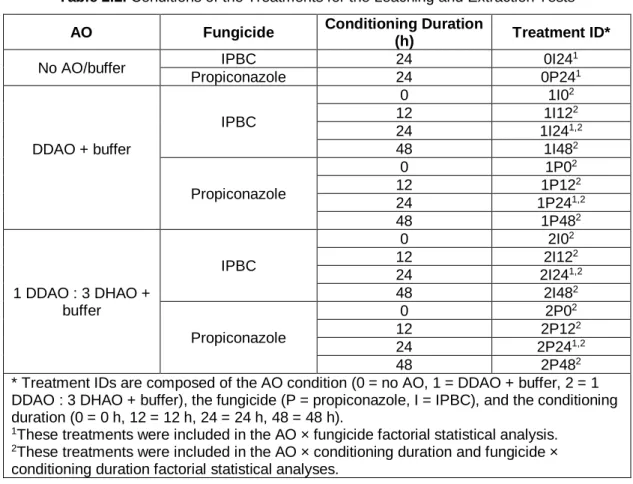
2.4.4 Leaching ... 36
2.4.5 Soxhlet extractions ... 36
2.4.6 HPLC... 37
2.4.7 Impregnation depth ... 38
2.4.8 Statistical analysis ... 41
2.5 Results and discussion ... 41
2.5.1 Leaching and Extractions ... 41
2.5.2 Depth of Impregnation ... 47
2.6 Conclusions ... 53
Chapitre 3 : Interactions between a buffered amine oxide impregnation carrier and an acrylic resin, and their relationship with moisture. ... 54
3.1 Résumé ... 54
3.2 Abstract ... 54
3.3. Introduction... 55
3.4. Materials and Methods ... 56
3.4.1 Materials ... 56 3.4.2 Treatments... 57 3.4.3 Permeability to moisture ... 59 3.4.4 Adhesion ... 60 3.4.5 Artificial aging ... 60 3.4.6 Impregnation depth ... 61 3.4.7 Statistics... 61
3.5 Results and discussion ... 61
3.5.1 Properties of the treatments ... 61
3.5.2 Permeability to moisture ... 65
3.5.4 Impregnation depth ... 74
3.6 Conclusions ... 77
Conclusion générale ... 79
Bibliographie ... 82
Annexe 1 : Rétrospective expérimentale... 92
Annexe 2 : Development and characterisation of a penetrating barrier treatment for wood protection ... 96
Annexe 3 : Affiche présentée lors du colloque facultaire de la FFGG (21 mars 2019) ...108
Annexe 4 : Affiche présentée lors de la rencontre annuelle de l’International Research Group on Wood Protection (14 mai 2019) ...109
Liste des tableaux
Table 1.1. Conditions of the Different Treatments and Their ID………11
Table 1.2. Concentration of the Active Ingredients in the Treatment Solutions...12
Table 1.3. Statistical Analysis of the PR of White Pine and White Spruce Samples for the Biodegradation and Dimensional Stability Tests Following Treatment...18
Table 1.4. Anti-swelling and Anti-shrinking Efficiencies for the Three Successive Cycles of the High RH Test on the White Pine………...…27
Table 1.5. Anti-swelling and Anti-shrinking Efficiencies for the Three Successive Cycles of the High RH Test on the White Spruce………..28
Table 1.6. Dimensional Changes of the Untreated Eastern White Pine and White Spruce………..…29
Table 2.1. Concentrations of the Chemicals in the Treatment Solutions……….36
Table 2.2. Conditions of the Treatments for the Leaching and Extraction Tests……….37
Table 2.3. Method for the HPLC Analysis of the IPBC and Propiconazole………..38
Table 2.4. Recovery Rates for the Liquid-liquid and Soxhlet Extractions………38
Table 2.5. Conditions of the Treatments for the AO Depth of Penetration Test………..40
Table 2.6. Conditions of the Treatments for the Indigo Blue Dye Depth of Penetration Test…………41
Table 2.7. Concentrations of IPBC and Propiconazole in the White Pine and White Spruce Samples before Leaching………...42
Table 2.8. Surface Tensions, Contact Angles on the Tangential-longitudinal Face of White Pine and White Spruce, and Viscosities of Solutions 1N and 2N at 65 °C………49
Table 3.1. Dimensions of the wood samples for the different tests………...57
Table 3.2. Configuration and identification of the treatments………58
Table 3.3. Proportion (in %) of the different chemicals in the treatments……….…59
Table 3.4. Treatments that were used in each test……….59
Table 3.5. Conditions of one cycle of artificial aging………...61
Table 3.7. F ratio and p values of the statistical analyzes for the permeability test.………68
Table 3.8. F ratio and p values of the statistical analyzes for the adhesion test……..………74
Table 3.9. F ratio and p values of the statistical analyzes for the impregnation depth test……….…76
Liste des figures
Fig. 1.1. H1 NMR spectra of the N,N-dimethylhexadecylamine and DHAO……….15
Fig. 1.2. Products retention of the eastern white pine samples following treatment………...…17
Fig. 1.3. Products retention of the white spruce samples following treatment……….17
Fig. 1.4. Interaction plot of the AO*fungicide*time relationship for the PR of the eastern white pine dimensional stability samples; AO: 1 = No AO, 2 = DDAO, 3 = 3 DDAO:1 DHAO, and 4 = 1 DDAO:3 DHAO; time: 1 = 12 h, 2 = 24 h, and 3 = 48 h………19
Fig. 1.5. Mass loss of the eastern white pine samples after 10 weeks of exposure to the brown rot fungus R. placenta.……….20
Fig. 1.6. Mass loss of the white spruce samples after 10 weeks of exposure to the brown rot fungus R. placenta………20
Fig. 1.7. Mass loss of the eastern white pine samples after 10 weeks of exposure to the white rot fungus I. lacteus………..21
Fig. 1.8. Mass loss of the white spruce samples after 10 weeks of exposure to the white rot fungus I. lacteus………..…22
Fig. 1.9. ASE values for the high RH test on the eastern white pine……….23
Fig. 1.10. ASE values for the immersion test on the eastern white pine………...23
Fig. 1.11. ASE values for the high RH test on the white spruce……….24
Fig. 1.12. ASE values for the immersion test on the white spruce………24
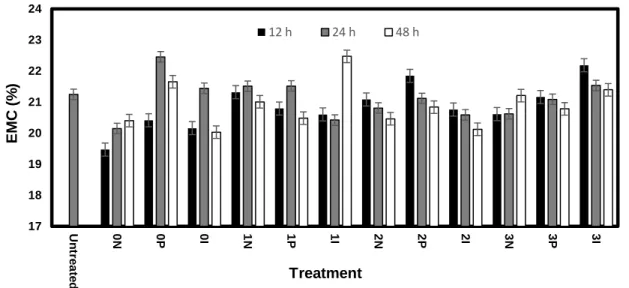
Fig. 1.13. EMC of the eastern white pine samples during the first cycle of the high RH test………..…25
Fig. 1.14. EMC of the white spruce samples during the first cycle of the high RH test………25
Fig. 1.15. Sorption isotherms for the (A) untreated eastern white pine, (B) treated eastern white pine, (C) untreated white spruce, and (D) treated white spruce………26
Fig. 2.1. Dimensions of the treated sample and of the section selected for analysis………..38
Fig. 2.2. Masses of IPBC and propiconazole before and after the leaching experiment, in white pine (wp, on the left) and white spruce (ws, on the right), following the factorial designs: (A) AO × conditioning duration (IPBC), (B) AO × conditioning duration (propiconazole), (C) fungicide × conditioning duration (AO condition 1), (D) fungicide × conditioning duration (AO condition 2), and (E) AO × fungicide………...44
Fig. 2.3. Percentages of the remaining IPBC and propiconazole in white pine after 6 h, 4 d, 9 d, and 14 d of leaching, following the factorial designs: (A) AO × fungicide, (B) fungicide × conditioning duration (AO condition 1), and (C) fungicide × conditioning duration (AO condition 2)………46
Fig. 2.7. Greatest impregnation depths of the AOs in (A) white pine and (B) white spruce, with (2N#)
and without (3N#) borates………..50
Fig. 2.8. Impregnation depths of the indigo dye in white pine and white spruce………..51 Fig. 2.9. Impregnation depths of the indigo dye in white pine and white spruce, with and without
borates………..52
Fig. 3.1 Experimental procedure of the study………..58
Fig. 3.2. Dimensions of the treated sample and of the section selected for analysis………..61 Fig. 3.3. Water repellent efficiency (WRE) of the white pine before and after artificial aging…………66
Fig. 3.4. Water repellent efficiency (WRE) of the white spruce before and after artificial aging………66 Fig. 3.5. Optical microscopy of the transverse plane of white spruce and white pine treated with
R1-AO1 and R2-R1-AO1.The arrows indicate the presence of resin at the surface of the latewood………67
Fig. 3.6. Equilibrium moisture content (EMC) of the samples before (top) and affecter removing the
mass of the coating (left) and time elapsed after reaching the equilibrium (right) at the different steps during the sorption isotherms in white pine………..70
Fig. 3.7. Equilibrium moisture content (EMC) of the samples before (top) and affecter removing the
mass of the coating (left) and time elapsed after reaching the equilibrium (right) at the different steps during the sorption isotherms in white spruce………..71
Fig. 3.8. Tensile strength required to pull-off the dollies from white pine (left) and white spruce
(right)……….73
Fig. 3.9. Impregnation depth of the indigo dye in the white pine (earlywood and latewood) and the
Liste des acronymes
Français :ACC : Arséniate de cuivre chromé COV : Composés organiques volatils IPBC : Butylcarbamate d’3-iodo-2-propynyl PCP : Pentachlorophénol
PVC : Polychlorure de vinyle UV : Ultraviolet
Anglais :
AO : Amine 0xide
ASE : Anti-swelling efficiency ou anti-shrinking efficiency DDAO : Dimethyldodecylamine oxide
DHAO : Dimethylhexadecylamine oxide
MDMHEU : 3-Dimethylol-4,5-dihydroxyethyleneurea EMC : Equilibrium moisture content
HLB : Hydroplile-lipophile balance
HPLC : High-performance liquid chromatography MC : Moisture content
PR : Products retention RH : Relative humidity
Tg : Glass transition temperature WRE : Water repellent efficiency
Non, la science n'est pas une illusion. Mais
ce serait une illusion de croire que nous
puissions trouver ailleurs ce qu'elle ne peut
pas nous donner.
Sigmund Freud
Le succès n'est pas la clé du bonheur. Le
bonheur est la clé du succès. Si vous aimez ce
que vous faites, vous réussirez.
Albert Schweitzer
On fait la science avec des faits, comme on
fait une maison avec des pierres : mais une
accumulation de faits n'est pas plus une
science qu'un tas de pierres n'est une maison.
Henri Poincaré
Remerciements
Je tiens tout d’abord à remercier chaleureusement mon directeur de recherche, Pierre Blanchet, pour tout ce qu’il a fait pour moi au cours des quatre dernières années, en commençant par me donner la chance de développer mes compétences de chercheur en travaillant sur ce merveilleux projet. Débordant de ressources et d’une efficacité exceptionnelle, il a toujours su régler mes embûches avec une facilité déroutante. Je tiens également à remercier Véronic Landry, ma co-directrice, pour sa patience, sa disponibilité et ses excellents conseils, guidant mes perpétuelles périodes de doutes.
Il serait impensable de ne pas souligner l’aide précieuse que m’ont apporté les techniciens de la faculté, sans qui ce projet n’aurait pas été possible. Leur compétence, la passion pour leur travail, leur désir de voir les étudiants réussir et leur implication sans relâche dans les projets méritent la plus grande admiration. Merci également au personnel de soutien, dont le travail essentiel passe trop souvent inaperçu.
Merci aux membres de la faculté, amis et collègues, qui ont rendu cette aventure des plus agréables même s’ils dînent beaucoup trop tôt. Ces quatre années auraient définitivement été beaucoup plus pénibles sans leur bonne humeur, leurs conseils et nos séances de volley-ball. Merci également à Juliette Triquet, ma voisine de bureau, qui m’a aidé avec le HPLC, la tension de surface et la viscosité des surfactants.
Merci aux partenaires industriels de CIRCERB, et en particulier à Maibec, pour leur implication dans nos travaux et l’intérêt qu’ils portent à nos projets. Leur regard d’expert et leurs commentaires encourageants sont définitivement une source de motivation pour mener à bien notre recherche.
Finalement, merci à mes proches, famille et amis, qui m’ont encouragé tout au long du parcours et qui se sont intéressés à mes travaux dès le premier jour. Ils ont été une source de moral importante pour passer à travers ce long trajet.
Avant-propos
Ce projet de thèse a été réalisé au sein de la Chaire industrielle de recherche sur la construction écoresponsable en bois (CIRCERB), grâce au financement du Conseil de recherches en sciences naturelles et en génies du Canada (CRSNG) et de ses partenaires industriels. Il s’est déroulé sous la direction de Pierre Blanchet, titulaire de CIRCERB et professeur titulaire au département des sciences du bois et de la forêt, et de Véronic Landry, titulaire de la Chaire de recherche industrielle du CRSNG – Canlak en finition des produits du bois d'intérieur et professeure agrégée au département des sciences du bois et de la forêt. L’étude a commencé à la maîtrise en sciences du bois en mai 2016, puis au doctorat à l’hiver 2018 suite à un passage accéléré au doctorat. La thèse est rédigée sous la forme d’une thèse par articles, dans laquelle trois articles scientifiques rédigés en anglais sont présentés.
Les articles, qui constituent le cœur de la thèse, sont les suivants :
Article 1
Pepin, S.; Blanchet, P.; Landry, V. (2019). « Performances of White Pine and White Spruce Treated with Organic Fungicides Using an Aqueous Buffered Amine Oxide Preservation System. ». Soumis à BioResources le 17/08/18 et publié le 16/11/2018.
Article 2
Pepin, S.; Blanchet, P.; Landry, V. (2020). « Characterization of the Diffusion of Organic Fungicides with Amine Oxides in White Pine and White Spruce ». Soumis à BioResources le 09/10/19 et accepté le 18/12/19.
Article 3
Pepin, S.; Blanchet, P.; Landry, V. « Interactions between a buffered amine oxide impregnation carrier and an acrylic resin, and their relationship with moisture.» Soumis à Coatings le 18/03/20 et accepté le 7/04/20.
L’auteur principal de ces articles est Simon Pepin. Il a planifié et réalisé les expériences, interprété les résultats et rédigé les manuscrits. Les co-auteurs, son directeur Pierre Blanchet et sa co-directrice Véronic Landry, ont apporté une contribution importante non seulement en commentant et en corrigeant les textes, mais aussi en proposant des pistes pour améliorer les expériences et interpréter les résultats.
Les résultats ont aussi été divulgués sous forme de présentations orales :
- Séminaire de maîtrise (cours SBO-6000) – Québec, Canada, 30 novembre 2017
- Rencontre annuelle de la Canadian Wood Preservation Association (CWPA) – Vancouver, Canada, 17 octobre 2018
et de posters :
- Colloque faculaire de la Faculté de foresterie, géographie et géomatique - Québec, Canada, 21 mars 2019
- Rencontre annuelle de l’International Research Group on Wood Protection (IRG) - Québec, Canada, 14 mai 2019
Introduction
De tous les matériaux ayant permis aux sociétés humaines d’évoluer, le bois est incontestablement un des plus importants. Grâce à ses nombreuses qualités et à son abondance, il a rapidement occupé une place centrale dans diverses sphères de notre quotidien. Possédant d’excellentes propriétés mécaniques, il est devenu un incontournable dans des domaines aussi variés que la chasse, l’agriculture, la cuisine et le transport. Sa rigidité et son isolation thermique, sans parler de son esthétisme encore très apprécié aujourd’hui, ont permis la construction de logis à la fois solides, sécuritaires et accueillants. Dans la foulée des problèmes environnementaux, le bois s’avère un choix avantageux pour la construction puisqu’il est renouvelable, biodégradable et réutilisable sous forme de différents matériaux composites. De plus, environ 50% de sa masse sèche est faite de carbone, puisé à même le dioxyde de carbone atmosphérique. Il stock donc d’une quantité importante de dioxyde de carbone, important responsable du réchauffement climatique, puisqu’il est estimé qu’un m3 de bois solide représente une tonne de dioxyde de carbone en moins dans l’atmosphère (MFFP, 2015).
En dépit de toutes ses qualités, le bois peut être dégradé de différentes façons. Comme il s’agit d’un matériau très hygroscopique, son contenu en humidité varie suivant son exposition à la pluie et aux fluctuations d’humidité relative de l’air (Glass & Zelinka, 2010). Tandis que l’eau pénètre ou quitte ses parois cellulaires, le bois change de dimensions, ce qui l’amène à se déformer et même à fissurer. Il peut aussi subir l’attaque de plusieurs types d’organismes biologiques comme les moisissures, les insectes et les champignons (Reinprecht, 2016). Les moisissures sont incapables de dégrader les constituants structuraux du bois, se limitant à des dommages esthétiques. Par contre, les insectes et les champignons peuvent dégrader les polymères structuraux du bois, menant à des pertes de propriétés mécaniques importantes et, dans le cas des champignons, à des changements de couleur et de propriétés chimiques. Finalement, il peut être érodé par divers facteurs abiotiques tels que le sable, le vent et les rayons UV du soleil. Plusieurs matériaux existent sur le marché pour rivaliser avec le bois, comme l’acier, le béton, le ciment et le polychlorure de vinyle (PVC), mais la plupart comportent également d’importantes lacunes. Le ciment, par exemple, consomme énormément d’énergie à produire, est un important producteur de dioxyde de carbone et vieillit prématurément lorsqu’exposé à l’humidité, alors que l’acier est très sensible à la corrosion. Pour sa part, le PVC est sujet à être dégradé par les rayons UV et doit être stabilisé à l’aide d’un savon de cadmium et terminera inévitablement sa vie en déchet, ne pouvant être récupéré d’aucune manière (Hill, 2006). En utilisant des moyens adaptés, il est possible de protéger le bois et d’améliorer sa longévité. À titre d’exemple, le temple Horyu-Ji, au Japon, est bâti entièrement en bois et s’élève depuis plus de 1400 ans (Japan Guide, 2016). Pour profiter des vertus écologiques du bois et concurrencer avec les autres matériaux, il est nécessaire d’utiliser les bons produits du bois et d’optimiser la conception des bâtiments pour en limiter la dégradation. Aussi, il peut être souhaitable de le traiter ou de le modifier pour améliorer sa résistance à dégradation et accroître ses possibilités d’utilisation.
Pour protéger le bois, deux stratégies complémentaires peuvent être utilisées, soit l’imprégnation et l’ajout d’un revêtement. L’imprégnation consiste à faire pénétrer des composés chimiques dans le bois pour améliorer son hydrophobicité et sa résistance à la biodégradation. Différentes méthodes existent pour permettre aux traitements de pénétrer dans le bois, mais les plus fréquentes utilisent un autoclave (Freeman, 2008; Leightley, 2003). Ces procédés font appel à des cycles de haute pression et de vide pour accélérer et amplifier la pénétration des traitements dans le bois. L’imprégnation est utilisée depuis très longtemps avec des composés plutôt toxiques comme l’arséniate de cuivre chromé (ACC), la créosote et le pentachlorophénol (PCP). Bien que durables et efficaces contre une large gamme d’organismes, ces composés suscitent de vives inquiétudes quant à leur toxicité et leur spécificité. De nouvelles réglementations ont donc limité leur usage, préconisant l’utilisation de pesticides moins polyvalents, mais plus sécuritaires et spécifiques. Selon leur nature chimique, ces pesticides peuvent être dissouts dans l’eau ou des solvants organiques, qui ont chacun leurs inconvénients. Par exemple, les traitements à base de solvant génèrent une quantité non négligeable de composés organiques volatils (COV), représentant un risque pour la santé humaine et l’environnement. Pour leur part, les traitements à base d’eau sont plus susceptibles au lessivage, compromettant leur efficacité à long terme. Les propriétés du bois peuvent également être modulées par modification chimique, où les composés imprégnés réagissent avec ses constituants chimiques. L’acétylation est la forme la plus répandue de modification chimique, où des anhydrides acétiques réagissent avec les groupements hydroxyles du bois (Rowell, 2014). Les hydroxyles ainsi substitués par des acétates confèrent au bois modifié une plus grande stabilité dimensionnelle et une plus grande résistance à la biodégradation.
Les revêtements sont très pratiques, car ils sont appliqués directement à la surface du bois. Ils sont donc plus faciles à mettre en place et à entretenir. Par ailleurs, en fonction de la taille et de la forme du substrat à recouvrir, de nombreuses méthodes existent pour appliquer les revêtements (pinceau, rouleau, trempage, rideau, vaporisation, etc.). La science derrière les revêtements est cependant fort complexe, car leurs propriétés doivent être choisies en fonction de leur utilisation. Bien qu’il soit aisé de moduler une propriété désirée dans un revêtement, différentes propriétés sont généralement interreliées. Il n’est ainsi généralement pas possible d’améliorer une propriété sans en amoindrir une autre. Il devient donc nécessaire, lors du développement d’un revêtement, de chercher le meilleur compromis possible pour l’optimiser en fonction de l’usage prévu (Bulian & Graystone, 2009). Une façon d’obtenir un revêtement possédant un mélange de propriétés antagonistes est
sensibles aux rayonnements ultraviolets que les alkydes, menant à des pertes de propriétés mécaniques moins importantes à mesure qu’ils vieillissent. Leurs propriétés mécaniques augmentent en fonction de leur température de transition vitreuse (Tg), qui est la température à laquelle le polymère acrylique passe d’un état vitreux à un état plastique. Une Tg élevée est donc souhaitable pour avoir de bonnes propriétés mécaniques, mais peut aussi compromettre la formation du film. En effet, la température minimale de formation de film (TMFF), qui est la température à partir de laquelle les particules acryliques sont suffisamment souples pour fusionner et former un film continu, est en général légèrement inférieure à la Tg. Ainsi, un compromis doit être fait entre une Tg élevée pour avoir des propriétés mécaniques intéressantes et une TMFF basse pour permettre une bonne formation de film. En général, une TMFF entre 0 oC et 15 oC permet d’obtenir des propriétés
mécaniques suffisante tout en permettant d’appliquer le revêtement à température ambiante. Finalement, ils sont beaucoup plus perméables à la vapeur, ce qui permet au bois d’évacuer l’humidité absorbée avant le recouvrement et de sécher plus facilement lorsque mouillé. Dans chaque cas, les formulations peuvent être à base d’eau ou de solvant. Les formulations à base d’eau sont généralement plus flexibles, mais tendent à gonfler en présence d’eau et sont plus perméables. Les formulations à base de solvant sont cependant de grandes génératrices de COV et sont par conséquent de plus en plus délaissées, malgré que leurs performances soient préférées.
Au cours de ce projet, un traitement a été développé pour traiter le bois par imprégnation et en surface suite à un simple trempage. Il s’agit d’un procédé inspiré du traitement Tru-Core® de la compagnie américaine Kop-Coat, décrit comme étant une barrière pénétrante du fait qu’il protège à la fois l’intérieur et la surface du bois. Le procédé utilise des oxydes d’amines tertiaires pour solubiliser des fongicides organiques dans une solution aqueuse. Comme ces fongicides sont très peu solubles dans l’eau, ils ont moins tendance à lessiver que les traitements aqueux traditionnels. Les oxydes d’amines ont la capacité de diffuser dans le bois, ce qui leur permet d’imprégner plus profondément qu’un trempage normal, mais sans utiliser d’autoclave (Shen & Walker, 2001). Il s’agit de composés présents dans de nombreux produits courants, comme des détergents et des produits d’hygiène corporelle, et qui sont sans danger pour l’humain et l’environnement. De plus, les oxydes d’amines améliorent la stabilité dimensionnelle du bois traité. Les fongicides utilisés sont le butylcarbamate d’iodopropynyle (IPBC) et le propiconazole. Il s’agit de deux fongicides organiques couramment utilisés dans le domaine de la protection du bois et homologués au Canada pour cet usage. Traditionnellement, ils sont également utilisés en agriculture. Pour améliorer la pénétration du traitement, un tampon formé de tétraborate de sodium et d’acide borique est utilisé pour tamponner le pH de la solution à une valeur de huit. Il s’agit d’une façon de maximiser la diffusion des oxydes d’amines, qui autrement peuvent complexer prématurément aux groupements acides présents dans le bois (Ross & Cutler, 2014). Ces composés du bore sont présents partout dans l’environnement, dont dans l’eau potable. Finalement, des résines commerciales de résines acryliques ont été ajoutées au traitement de façon à appliquer une première couche de revêtement à la surface bois, soit un
apprêt. Ces résines ont été sélectionnées pour leur petite taille de particules et leur faible température de transition vitreuse, de manière à bien adhérer au bois et à avoir une bonne coalescence (formation de film). De manière générale, le traitement utilise donc des produits très peu toxiques, et ne représente pas une menace pour l’environnement ou la santé humaine.
Le projet se différencie du traitement de Kop-Coat pour deux raisons principales. Tandis que Kop-Coat utilise son procédé Tru-Core® principalement dans des endroits souffrant d’importants problèmes de termites, comme le Sud de États-Unis, Hawaii, la Nouvelle-Zélande et l’Australie, le projet s’est principalement concentré sur la stabilité dimensionnelle et, de façon moindre, la résistance fongique. Ensuite, la partie barrière du procédé Tru-Core® n’a été décrite ou mentionnée dans aucune forme de littérature; l’utilisation d’une résine acrylique est donc propre à ce projet. Cette décision s’est basée sur les bonnes propriétés de vieillissement des acryliques et leur compatibilité avec les autres peintures pouvant être ajoutées par-dessus, qui sont souvent des acryliques. De plus, comme les produits exacts utilisés par Kop-Coat et leurs proportions sont inconnus, de même que la méthode d’application du traitement, il s’agit plutôt d’une reconstitution probable du traitement original, qui a ensuite évoluée en fonction de nos observations et de nos résultats.
L’objectif principal du projet était de développer, caractériser et documenter un traitement du bois par barrière pénétrante. Pour y parvenir, le projet s’est divisé selon les objectifs spécifiques suivant :
1) développer une partie pénétrante fonctionnelle et démontrer son efficacité pratique,
2) caractériser cette partie pénétrante, et
3) ajouter la partie barrière et caractériser les interactions entre les deux parties.
Ainsi, le projet s’est divisé en trois volets principaux. Dans un premier temps, une formulation de la partie pénétrante et un procédé d’application ont été mis au point, et les performances pratiques du traitement ont été testées. Les points évalués ont été la stabilité dimensionnelle, la résistance à une souche de champignon à pourriture brune (Rhodonia placenta) et une souche de champignon à pourriture blanche (Irpex lacteus), et le gain de masse suite au traitement. Satisfaits par les résultats obtenus, la deuxième partie du projet consistait à décrire le traitement développé. Pour ce faire, la masse de fongicides imprégnés a été évaluée, ainsi que leur
l’interaction entre la partie barrière et la partie pénétrante, de façon à observer comment les deux composantes s’influençaient. Les aspects étudiés étaient l’adhérence, la perméabilité à l’eau liquide, la perméabilité à la vapeur, et la pénétration des fongicides (avec la teinture indigo). Les essais d’adhérence et de perméabilité à l’eau liquide ont été couplés à des cycles de vieillissement artificiel pour évaluer l’évolution des performances du revêtement en fonction du temps. Le projet a été réalisé sous la direction de Pierre Blanchet, la co-direction de Véronic Landry et en partenariat avec les industriels Maibec Inc et Société Laurentide.
Chapitre 1 : Performances of White Pine and White
Spruce Treated with Organic Fungicides Using an
Aqueous Buffered Amine Oxide Preservation System
1.1 Résumé
Dans certaines conditions de mise en service, le bois a besoin d’être protégé contre la dégradation. Dans de cette étude, du pin blanc (Pinus strobus L.) et de l’épinette blanche (Picea glauca (Moench) Voss) ont été imprégnés avec du propiconazole et du butylcarbamate d’3-iodo-2-propynyl (IPBC). Contrairement aux méthodes d’imprégnation conventionnelles, aucune pression n’a été nécessaire. Un système de préservation aqueux à base d’oxydes d’amines tamponnés a plutôt été utilisé pour permettre aux fongicides de diffuser dans le bois. Différentes combinaisons de fongicides et d’oxydes d’amines, ainsi que différentes périodes de diffusion, ont été testées pour étudier l’effet du traitement sur la stabilité dimensionnelle et la résistance à la dégradation fongique. La stabilité dimensionnelle était améliorée uniquement par les oxydes d’amines, avec des valeurs d’anti-swelling et d’anti-shrinking efficiencies atteignant 29%. Les oxydes d’amines et les fongicides ont tous deux réduit la perte de masse causée par le champignon à pourriture brune Rhodonia placenta. La perte de masse après dix semaines d’exposition au champignon était réduite de moitié en utilisant des oxydes d’amines ou un fongicide, mais inhibée en les combinant ensemble.
1.2 Abstract
Under certain circumstances, wood needs to be protected from degradation. In this study, eastern white pine (Pinus strobus L.) and white spruce (Picea glauca (Moench) Voss) were impregnated with propiconazole and 3-iodo-2-propynyl butylcarbamate. Unlike most impregnation techniques, no pressure treatment was needed. Instead, an aqueous buffered amine oxide system was used to allow the fungicides to diffuse into the wood. Many combinations of fungicides, amine oxides, and diffusion times were tested to study the effect of the treatment on the dimensional stability and resistance to decay fungi. It was found that only the amine oxide affected the dimensional stability of the treated wood, with anti-swelling and anti-shrinking efficiencies values up to 29%. Amine oxides and fungicides both had an impact on the weight loss caused by the brown rot fungi. The weight loss after 10 weeks of exposure to Rhodonia placenta was reduced by half when using amine oxides or
1.3 Introduction
Wood is one of the most versatile materials known to man. A whole variety of goods can be made with it, such as boxes, bridges, tools, and houses. Because of its relatively low density and high mechanical properties, it is a material of great interest in construction. However, any material used in this field is expected to last for years, even decades. Because it can crack under the effect of water and be deteriorated by fungi, insects, ultraviolet rays, and more (Hill, 2006), it is a great challenge to maintain the good structural and aesthetic conditions of wood for long periods. Such long-term performance is required to ensure wood’s competitiveness with other materials, such as steel, concrete, polymers and composites. Its price, appearance, properties, low environmental impact (Lippke et al., 2004; Nath, 2017), and capacity to sequester CO2 contribute to making this
challenge worthwhile.
If suitable conditions are met, decay fungi can degrade wood polymer components, which affects its mechanical and chemical properties, as well as its appearance. The optimal conditions for fungal growth usually include a temperature between 21 °C and 32 °C, appropriate levels of O2 (1% to 4%), CO2 (up to 20%), and nitrogen
(over 0.3%) into the wood, a moisture content (MC) slightly over the fiber saturation point (30%), and more (Carll & Highley, 1999; Reinprecht, 2016; Tudor et al., 2012). However, both the extreme and optimal conditions depend on the species and can include a temperature between 10 oC and 45 oC, and a MC from 12.3% to 210%
(Huckfeldt & Schmidt, 2006; Meyer & Brischke, 2015; Stienen et al., 2014). Brown rot fungi feed on cellulose and hemicelluloses (Hill, 2006). Using Fenton’s oxidation (H2O2/Fe2+/(COOH)2), a chemical reaction using
ferrous ions and hydrogen peroxide to create hydroxyl radicals, these fungi can easily break down crystalline cellulose and resist copper treatments (Goldstein et al., 1993; Reinprecht, 2016). They can also modify lignin but will not consume it. Brown rot fungi cause wood to become darkened, cracked, and fragile. White rot fungi can feed on all wood components, but primarily they feed on lignin (Blanchette et al., 1990). These fungi have two different decay patterns. Some species, called “simultaneous white rot”, will break down all three wood polymers at the same time, while the “selective white rot” will degrade the lignin and hemicelluloses to a greater extent than cellulose (Goodell et al., 2008). They make the wood pale (native cellulose color) and brittle.
The hygroscopicity of wood causes its MC to change according to ambient conditions (temperature and relative humidity). Its dimensions change accordingly because of water molecules entering/leaving the amorphous zones of cellulose, which causes the separation/combination of microfibrils and the swelling/shrinking of cell walls (Siau, 1995). Dimensional changes are not the same in each direction and are approximately twice as important in the tangential axis compared to the radial axis (Panshin et al., 1964). Disproportionate swelling and shrinking cause important stresses in the wood structure, which eventually warps and cracks (Glass & Zelinka, 2010). Moreover, the wood MC at equilibrium is influenced not only by ambient conditions, but also by whether the wood is gaining or losing moisture (Siau, 1995). This phenomenon, known as hysteresis, is caused by the free
energy difference between water adsorption and desorption and is mostly influenced by compressive stresses in the wood during the adsorption of water (Navi & Heger, 2005). This phenomenon can be illustrated in a sorption isotherm graph (Siau, 1995).
Wood can be protected against biodegradation through impregnation. Impregnation is usually performed in an autoclave to help deliver the treatment solution to the wood cells using cycles of vacuum and pressure (Freeman, 2008; Leightley, 2003). Pressure has been used for treatments including borates, triazoles, quaternary ammoniums, synthetic pyrethroids, carbamates, copper oxides, and copper carbonates (with or without tebuconazole) (Laks, 2008; Ross, 2008; Schultz & Nicholas, 2003). These substances can be dissolved or diluted in water or organic solvents such as white spirit.
Impregnation can also be used to increase the dimensional stability of wood. This can be achieved by bulking the lumen or by modifying and crosslinking the hydroxyl groups of the cell wall polymers (Navi & Heger, 2005). These methods include bulking with silane, phenol, or amino resins and modification with formaldehyde, anhydrides, epoxides, and 1,3-dimethylol-4,5-dihydroxyethyleneurea (Kocaefe et al., 2015; Reinprecht, 2016; Wang & Piao, 2010; Yuan et al., 2013). Acetylation is the most important chemical modification for wood that is commercially available.
Recently, an aqueous wood treatment has been developed to make wood more resistant to biodegradation. It uses the ability of tertiary amine N-oxides, non-toxic surfactants, to dissolve organic pesticides in water and diffuse into wood to allow for impregnation without using a pressure treatment (Shen & Walker, 2001). The amine oxides (AO), having antiseptic properties themselves, can increase the resistance to biodegradation even more (Tseng et al., 2002). An AO with a long aliphatic chain can also increase the dimensional stability of the treated wood (Tseng & Walker, 2000). The contact of the AO with the acids of the hemicelluloses allows their fixation into the wood (Jiang, 2008). To ensure maximum penetration, the pH needs to be controlled with a buffer, preferably made of borates (Ross & Cutler, 2014). Because their toxicity is very low, the replacement of a physical mean of impregnation (vacuum/pressure) for a chemical one does not make the treatment and treated wood any more harmful (Sanderson et al., 2006; Sanderson et al., 2009). Although such treatment is already commercialized in a few countries, little has been published on the subject.
by the mass loss caused by brown rot and white rot fungi degradation, as well as the decrease in the swelling and shrinkage.
1.4 Experimental
1.4.1 Materials
The wood samples for this study were cut from boards of eastern white pine (Pinus strobus L.), which were obtained from Bois Delta (Quebec City, Canada), and white spruce (Picea glauca (Moench) Voss) from Maibec (St-Pamphile, Canada), which were initially brought to a MC of approximately 12% in a conditioning room at 20 °C ± 2 °C and 65% ± 5% relative humidity (RH). These species were selected because they are of great importance for the construction market in Canada, while also having important differences in permeability to impregnation treatments (Alberta Canada, 2013; Morris, 2017). They were then sawn into 25 mm × 25 mm × 10 mm (longitudinal × tangential × radial) blocks for the biodegradation tests and 20 mm × 20 mm × 20 mm cubes with ring growth angles of less than 10° along the tangential direction for the dimensional stability tests. All of the samples were free of knots and visible stains. All the samples for the biodegradation tests were made of sapwood. Some heartwood (about 5%) could be found in the dimensional stability samples, but they were distributed in order to limit their impact on the statistical analysis.
The dimethyldodecylamine N-oxide (approximately 30% aqueous solution; DDAO), N,N-dimethylhexadecylamine (95%), 3-iodo-2-propynyl N-butylcarbamate (97%; IPBC), and 50% hydrogen peroxide (H2O2) were purchased from Sigma-Aldrich Co. (St. Louis, MO, USA). The American Chemical Society
(ACS)-grade ortho-boric acid was obtained from Anachemia (Mississauga, Canada). Sodium tetraborate (98%) was purchased from Thermo Fisher Scientific (Ottawa, Canada). Propiconazole (Tilt 250E, 25% aqueous solution) was generously supplied by Syngenta (Plattsville, Canada). Bacteriological grade agar was obtained from Hardy Diagnostics (Santa Maria, CA, USA). The malt extract was a product of Becton, Dickinson & Co. (Mississauga, Canada). Fungi for the biodegradation tests came from the Canadian fungi collection and were offered by FPInnovations (Quebec City, Canada) a few years ago and pricked out regularly by our department.
1.4.2 Wood treatment
The method to treat the wood samples was inspired by the methods of Ward & Scott (2009) and Morris et al. (2014). Samples of white pine and white spruce were individually dipped for 15 s in various treatment solutions maintained at 65 °C. After removing the excess solution, the samples were sealed in plastic wrap for 6 h to prevent evaporation. The plastic wrap was then disposed of, and the samples were placed in a conditioning chamber at 85 °C ± 1 °C and 85% ± 3% RH for different periods of time to allow for diffusion. The samples were then left for two weeks in the conditioning room at 20 °C ± 2 °C and 65% ± 5% RH to bring them back to a 12%
MC. At this step, hysteresis was observed, which kept the MC at 14% to 15%. Therefore, the samples were stored in the laboratory for a week, where the ambient conditions were drier, before spending another week in the conditioning chamber. The samples were weighed before treatment to monitor the target MC (12%), immediately after dipping, after removal of the plastic wrap, and at the end of the process (12% MC).
1.4.3 Synthesis of N,N-dimethylhexadecylamine N-oxide
The N,N-dimethylhexadecylamine N-oxide (DHAO) used in this study could not be provided and was therefore prepared following the method by Prabhu (1999). In a 500-mL round-bottom flask, 69.95 g (0.260 mol) of N,N-dimethylhexadecylamine, 70.10 g of propan-2-ol, and a few drops of acetic acid were mixed under mild stirring. The mixture was heated to 55 °C and 21.20 g (0.294 mol) of 50% H2O2 were added over 60 min. The temperature
was then increased to 65 °C for 18 h. The final product was isolated using a rotary evaporator at 45 °C and 5 kPa for 4 h and characterized by hydrogen nuclear magnetic resonance (H1 NMR, 8 scans, CDCl3)
spectroscopy (500 MHz; Direct Drive Model, Agilent, Santa Clara, CA, USA). Before being used, the DHAO was dissolved in deionized water to obtain a 30% w/w solution.
1.4.4 Treatment solutions
The treatments were prepared using a factorial method. The solutions used in this study were prepared using a borate buffer with different combinations of AOs and fungicides, which were paired with different diffusion times. All of the treatment combinations are shown in Table 1.1. The AOs used were DDAO and DHAO. The solutions containing no AO were not buffered. The fungicides chosen were propiconazole and IPBC, which are two organic fungicides broadly used for wood protection.
1.4.5 Preparation of the solutions
The concentration of each compound is shown in Table 1.2. Depending on their formulation, the treatment solutions could have contained 5.00 g of borate buffer (2.50 g of both ortho-boric acid and sodium tetraborate) combined with a total of 66.66 g of AO solution (20.00 g of AO) or no borate and AO. They could have contained 5.00 g of IPBC, 2.00 g of propiconazole, or no fungicide. Water was added to bring the solution to a total weight of 1000 g. The mixture was heated to 65 °C under stirring for 30 min to ensure complete solubilization of the fungicides.
Table 1.1. Conditions of the Different Treatments and Their ID
Amine Oxide Fungicide Diffusion Duration Treatment ID*
No AO/buffer No fungicide 12 h 0N12 24 h 0N24 48 h 0N48 Propiconazole 12 h 0P12 24 h 0P24 48 h 0P48 IPBC 12 h 0I12 24 h 0I24 48 h 0I48 DDAO + buffer No fungicide 12 h 1N12 24 h 1N24 48 h 1N48 Propiconazole 12 h 1P12 24 h 1P24 48 h 1P48 IPBC 12 h 1II12 24 h 1I24 48 h 1I48 3 DDAO:1 DHAO + buffer No fungicide 12 h 2N12 24 h 2N24 48 h 2N48 Propiconazole 12 h 2P12 24 h 2P24 48 h 2P48 IPBC 12 h 2I12 24 h 2I24 48 h 2I48 1 DDAO:3 DHAO + buffer No fungicide 12 h 3N12 24 h 3N24 48 h 3N48 Propiconazole 12 h 3P12 24 h 3P24 48 h 3P48 IPBC 12 h 3I12 24 h 3I24 48 h 3I48
*IDs are composed of the amine oxide condition (0= no amine oxide, 1= DDAO + Buffer, 2=
3 DDAO:1 DHAO, 4= 1 DDAO:3 DHAO), the fungicide (N= none, P= propiconazole, I= IPBC) and the diffusion time (12 = 12 h, 24 = 24 h, 48 = 48 h).
Table 1.2. Concentration of the Active Ingredients in the Treatment Solutions
Ingredient Concentration (%, w/w)
Borate buffer 0.5
AO 2.0
Fungicide 0.5 (IPBC) 0.2 (Propiconazole)
1.4.6 Products retention
To calculate the products retention (PR) of the samples following treatment, the samples were weighed before the treatment (w1, kg). After being treated, they were brought back to their initial MC and weighed again (w2, kg).
The PR was expressed as the mass of products (sum of the borates, amine oxides and fungicides) absorbed by the samples, divided by its volume (V, m3), and was calculated with Eq. 1:
PR (kg/m3) = w2 – w1
V (1)
1.4.7 Biodegradation
The biodegradation tests were performed following a method based on AWPA E10-12 (2012), and took place in mason jars lying on their side. The culture medium used was a malt-agar gel with 20 g/L malt as a food source and 15 g/L agar to form the gel. The hot malt-agar mixture (20 mL) was added to the mason jars and allowed to cool until the gel formed. V-shaped glass rods were heated with a flame and deposited on the gel. An inoculum of the brown rot fungus Rhodonia placenta or white rot fungus Irpex lacteus was added to the mason jars and was given a two-week incubation period.
Meanwhile, the samples were oven-dried for 24 h at 60 °C, which was followed by further drying at 103 °C for 24 h. They were then weighed to determine their initial dry mass and placed in aluminum cups. The cups were layered in a large plastic bin, with each layer separated by cheese cloth. The bottom of the bin was filled with 5 cm of deionized water, which was separated from the samples by a fiberglass mesh. The bin was sterilized in an autoclave and sealed for two weeks. This allowed the samples to reach a MC of 22% to 25%.
The samples were positioned on the V-shaped glass rods in the inoculated mason jars. The jars were placed in a conditioning chamber (26.7 °C ± 0.1 °C, 70% ± 3% RH) for a 10-week incubation period. The caps were perforated and lined with a cloth filter (Filtration Québec Ltée, Bedford, Canada), which allowed air and moisture exchange. After 10 weeks, the fungal growth was carefully brushed from the samples, which were then oven-dried (60 °C for 24 h, and then 103 °C for 24 h) and weighed to determine their final dry mass.
The degradation was measured by the mass difference between the oven-dried samples before (m1, g) and after
1.4.8 Dimensional stability
The dimensional stability tests were performed following two different methods. To measure the swelling, the samples were oven-dried at 103 °C ± 2 °C for 24 h, after which they would either (1) be placed in a conditioning chamber at 20 °C ± 1 °C and 95% ± 3% RH for 90 h or (2) be completely immersed in water for 72 h (20 °C ± 2 °C). During these periods, the samples would be weighed every 6 h to ensure that either (1) their mass was stable for at least 24 h before measurement, which shows that a moisture equilibrium has been attained, or (2) that the MC was beyond the fiber saturation point (MC = 30%), which is the point after which swelling no longer occurs (Siau, 1995). The swollen samples were then oven-dried to measure their shrinkage, thereby completing a cycle. Because wood treatment components are likely to leach and become less effective over time, three full cycles were performed for each method (Hill, 2006).
Both the swelling and shrinkage were measured in the radial (R) and tangential (T) axes using a digital micrometer with a 0.0001-mm precision. According to literature, longitudinal dimensional changes are small (approximately 0.2%) and can be ignored (Glass & Zelinka, 2010; Panshin et al., 1964). The calculations were based on ISO 4469 (1981) and ISO 4859 (1982). For the swelling, the samples were measured after oven-drying (R1 and T1) and at equilibrium (R2 and T2). The volumetric swelling (α) was calculated with the following
equations, αR (%) = R2 – R1 R1 × 100 (3) αT (%) = T2 – T1 T1 × 100 (4) α (%) = αR + αT (5)
where αR and αT are the radial and tangential swelling, respectively.
Similarly, the shrinkage was measured after swelling (R2 and T2, mm) and drying (R3 and T3, mm). The volumetric
shrinkage (β) was calculated with the following equations,
R(%) = 𝑅2 – 𝑅3
𝑅2 × 100 (6)
βT (%) = T2 – T3
T2 × 100 (7)
β (%) = βR + βT (8)
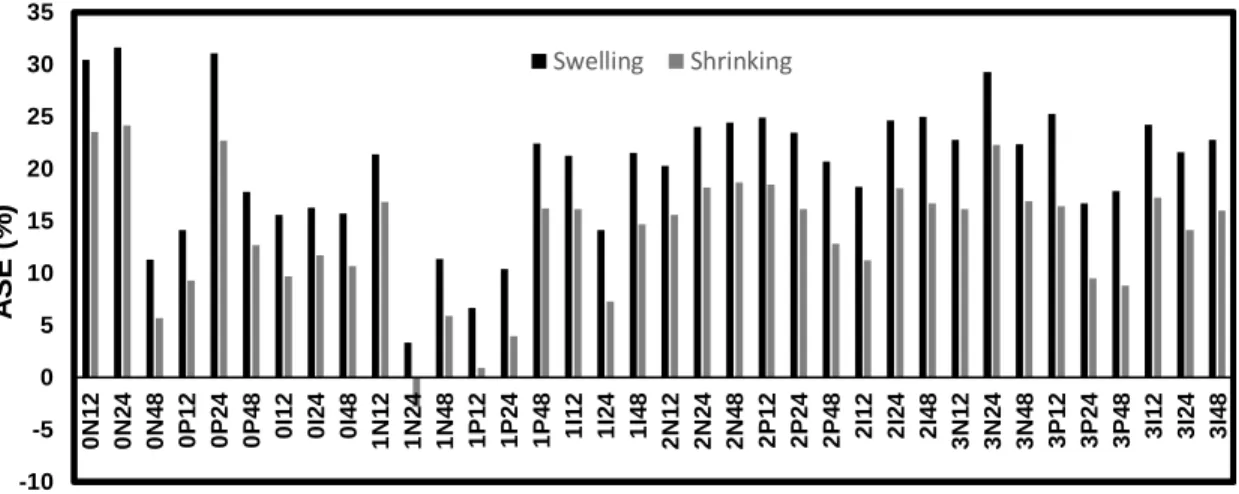
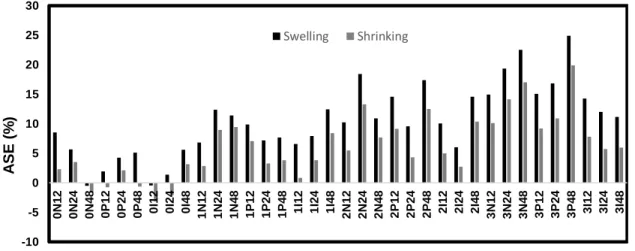
Improvement in the dimensional stability was defined by the anti-swelling/ shrinking efficiency (ASE) (Hill, 2006), which can be calculated by comparing the untreated and treated samples with the following equations,
ASE (%) = αu – αt
αt × 100 (9)
ASE (%) = βu – βt
βt × 100 (10)
where αu and βu are the swelling and shrinkage of the untreated samples, respectively, and αt and βt are the
swelling and shrinkage of the treated samples, respectively.
For each wood species, both methods used 10 samples for each treatment and 10 untreated standards. The high RH tests were further characterized by the equilibrium moisture content (EMC) of the samples and sorption isotherms. The EMC is described by Hill (2006) as the constant MC wood will attain when placed in an environment where the RH is stable. It was calculated with Eq. 11,
EMC (%) = w2 – w1
w1 × 100 (11)
where w1 and w2 are the weight (g) of the samples when oven-dried and after 90 h in the conditioning chamber
(20 °C and 95% RH), respectively.
The sorption isotherms were obtained with a VTI-SA+ vapor sorption analyzer (TA Instruments, New Castle, DE, USA). Samples with the dimensions 5 mm × 5 mm × 5 mm were oven-dried and exposed to increasing RH levels (5%, 20%, 40%, 60%, 80%, and 95% ± 1%) for the adsorption curve and then decreasing RH levels (80%, 60%, 40%, 20%, and 5% ± 1%) for the desorption curve. For each level, the EMC was determined when the mass of the samples increased less than 0.003% within 5 min. The temperature was 25.0 °C ± 0.1 °C for the duration of the experiment.
1.4.9 Statistical analysis
The factorial design observations were analysed with an analysis of variance (ANOVA) using the mixed procedure in the SAS University software (SAS, Cary, NC, USA) at an α of 0.01.
1.5 Results and discussion
1.5.1 Synthesis of N,N-Dimethylhexadecylamine N-Oxide
From the 69.95 g (0.260 mol) of N,N-dimethylhexadecylamine used, 77.45 g (0.268 mol) of the DHAO were obtained, which resulted in a yield of 103%. After evaporation of the reaction medium, the product obtained was a vitreous, white solid. The H1 NMR spectra (Fig. 1.1) displayed shifting of the C1 (from δ = 2.20 ppm to 3.23
ppm), C2 (δ = 2.25 ppm to 3.29 ppm), and C3 peaks (δ = 1.45 ppm to 1.85 ppm), which showed an increase in
polarity on the nitrogen atom. The introduction of a small singlet (integration 0.64) at a δ of 1.99 ppm demonstrated the presence of oxygen atoms under an O-/OH equilibrium. The surprising absence of the singlet
at a δ of 2.20 ppm on the AO spectrum indicated the complete conversion of the amine, even though the amine was not distilled before the reaction. Synthesis performed directly on commercially available tertiary amines usually yields an 85% to 87% conversion (Singh et al., 2006).
Fig. 1.1. H1 NMR spectra of the N,N-dimethylhexadecylamine and DHAO
Because the solid was too hard to be scraped from the round-bottom flask, it was dissolved under stirring in 180 mL of water to make a 30% solution. The solution was white, translucent, and viscous.
1.5.2 Products Retention
Despite their different shapes, the PR values of the samples used for the biodegradation and dimensional stability tests were similar (Figs. 1.2 and 1.3). The dimensional stability samples even had higher PR values in many instances, although their surface/volume ratio was notably lower. The mass of the white spruce samples increased more than that of the white pine, which even had negative values in some cases. This was first explained by the loss of water-soluble extractives in the case of the white pine, which was expected because of a rather quick yellowing of the solutions during treatments. The period in the conditioning room (85 °C and 85% RH) could also have promoted the loss of volatile compounds from the samples. However, a test using untreated samples of both species submitted to, either a 15-s dipping in water or 24 h in the conditioning room, and brought back to their initial MC, showed that neither of these steps caused the loss of any material in such amounts that affected the final weight of the samples. In contrast, while the white pine samples did come back to their initial mass in all of the cases, the white spruce samples, which were placed in the conditioning room, had a final mass approximatively 2% higher than their initial mass, probably caused by a higher MC. This difference in MC, which could originate from a difference between the desorption curves of the two wood species, was probably the real reason behind their different PR values. This could have been avoided by comparing the oven-dried mass of the samples, but the PR values were expected to be so low that the loss of volatile compounds during drying was predicted to affect the results more than hysteresis. Furthermore, the loss of some of these compounds before the treatments could also have affected impregnation.
These PR values were lower than the PR required to obtain good performances with acetylation, typically 20% of the mass of the dried wood (80 kg/m3 for a wood weighting 400 kg/m3), and quaternary ammonia compounds,
approximately 7.7 to 18.5 kg/m3 (Kartal et al., 2006; Terzi et al., 2011), which allows for keeping the advantages
of a low wood density. It is however higher than the typical values of PR from pressure impregnation of IPBC (0.04-0.06 kg/m3) and propiconazole (0.04-0.12 kg/m3) (European Commission (EC) Directive 98/8/EC, 2007,
Fig. 1.2. Products retention of the eastern white pine samples following treatment
Fig. 1.3. Products retention of the white spruce samples following treatment
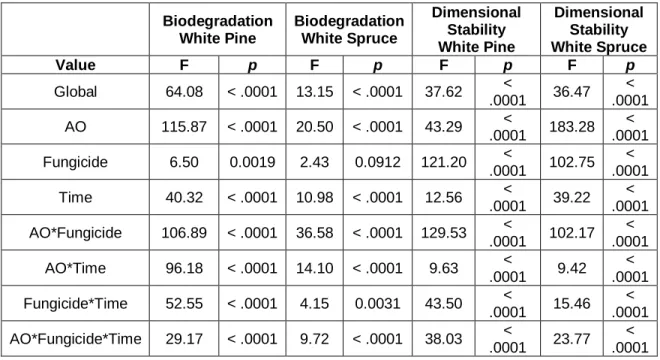
The ANOVA of the PR results showed a significant (p < 0.0001) AO*fungicides*time relationship for both species and sample sizes (Table 1.3). Because AOs are polar, their attraction to water may have caused them to be slowly washed from the surface during the diffusion period when condensation droplets formed in the conditioning chamber and fell onto the samples. Likewise, a slight odor during this period suggested they may also have been carried into the air by the high air moisture content (85% RH). Both of these elements suggested that a longer diffusion period could lead to more AO losses.
Additionally, because the fungicides have a higher affinity with AOs than water, they were likely washed off to a greater extent in their presence. Because the fungicides were affected by the AOs and the AOs were affected
-6 -4 -2 0 2 4 6 0 N 1 2 0 N 2 4 0 N 4 8 0 P1 2 0 P2 4 0 P4 8 0 I1 2 0 I2 4 0 I4 8 1 N 1 2 1 N 2 4 1 N 4 8 1 P1 2 1 P2 4 1 P4 8 1 I1 2 1 I2 4 1 I4 8 2 N 1 2 2 N 2 4 2 N 4 8 2 P1 2 2 P2 4 2 P4 8 2 I1 2 2 I2 4 2 I4 8 3 N 1 2 3 N 2 4 3 N 4 8 3 P1 2 3 P2 4 3 P4 8 3 I1 2 3 I2 4 3 I4 8 Pr o d u c ts R e te n ti o n (k g /m 3) Treatment
Biodegradation Dimensional Stability
0 2 4 6 8 10 12 14 16 18 0 N 1 2 0 N 2 4 0 N 4 8 0 P1 2 0 P2 4 0 P4 8 0 I1 2 0 I2 4 0 I4 8 1 N 1 2 1 N 2 4 1 N 4 8 1 P1 2 1 P2 4 1 P4 8 1 I1 2 1 I2 4 1 I4 8 2 N 1 2 2 N 2 4 2 N 4 8 2 P1 2 2 P2 4 2 P4 8 2 I1 2 2 I2 4 2 I4 8 3 N 1 2 3 N 2 4 3 N 4 8 3 P1 2 3 P2 4 3 P4 8 3 I1 2 3 I2 4 3 I4 8 Pr o d u c ts R e n te n ti o n (K g /m 3) Treatments
by the time, it was logical that these three factors were connected. A higher PR means more active ingredients in the wood. Therefore, it was indicated that shorter diffusion times will likely lead to better performances of the treated wood, which also fits the needs of the industry. The ANOVA also showed, with high F values, that the AO*fungicide interaction was important. It was established that the presence of AOs enhanced the penetration of the fungicides into the wood and increased the PR.
The solutions with IPBC usually had the highest PR, which was explained by its higher concentration (0.5% IPBC vs. 0.2% propiconazole). Surprisingly, most of the time the solutions with propiconazole led to the smallest PR, even lower than that of the solutions without a fungicide. Likewise, the solutions with AO condition 2 (3 DDAO:1 DHAO) had the smallest PR of all of the AO conditions. However, the highest PR was obtained for these two conditions when they were combined (Fig. 1.4). While this apparent synergy between propiconazole and AO condition 2 was hard to explain, it is a useful piece of information if propiconazole is the fungicide used with this treatment. Its higher affinity with wood, lower leaching, and higher stability in wood are incentives to use it (Kukowski et al., 2017; Mazela & Perdoch, 2012; Schiopu & Tiruta-Barna, 2012; Schultz & Nicholas, 2003).
Table 1.3. Statistical Analysis of the PR of White Pine and White Spruce Samples for the
Biodegradation and Dimensional Stability Tests Following Treatment
Biodegradation White Pine Biodegradation White Spruce Dimensional Stability White Pine Dimensional Stability White Spruce Value F p F p F p F p Global 64.08 < .0001 13.15 < .0001 37.62 < .0001 36.47 < .0001 AO 115.87 < .0001 20.50 < .0001 43.29 < .0001 183.28 < .0001 Fungicide 6.50 0.0019 2.43 0.0912 121.20 < .0001 102.75 < .0001 Time 40.32 < .0001 10.98 < .0001 12.56 < .0001 39.22 < .0001 AO*Fungicide 106.89 < .0001 36.58 < .0001 129.53 < .0001 102.17 < .0001 AO*Time 96.18 < .0001 14.10 < .0001 9.63 < .0001 9.42 < .0001 Fungicide*Time 52.55 < .0001 4.15 0.0031 43.50 < .0001 15.46 < .0001 AO*Fungicide*Time 29.17 < .0001 9.72 < .0001 38.03 < .0001 23.77 < .0001
Fig. 1.4. Interaction plot of the AO*fungicide*time relationship for the PR of the eastern white pine
dimensional stability samples; AO: 1 = No AO, 2 = DDAO, 3 = 3 DDAO:1 DHAO, and 4 = 1 DDAO:3 DHAO; time: 1 = 12 h, 2 = 24 h, and 3 = 48 h
1.5.3 Biodegradation
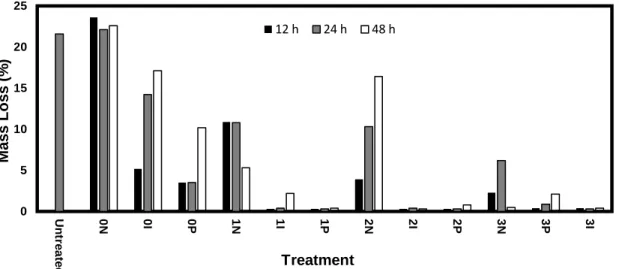
After incubation, the untreated samples of both species that were exposed to the brown rot fungus R. placenta were covered with a thick layer of fungal growth. This was also the case for the samples treated without AO or fungicide (solution 0N). After removal of the fungal growth, these samples were bent and showed visible cracks on their top surface. The samples treated with the other solutions were all sound and free of fungal growth, with only a few exceptions that showed a small amount of fungal growth.
Figures 1.5 and 1.6 show that, for both species, the treatments using only a fungicide (0I and 0P) or AO (1N, 2N, and 3N) led to a lower mass loss compared with the untreated specimens. For the white pine, there was only slightly less decay than for the untreated specimens, while the white spruce showed an almost complete inhibition of mass loss, except with IPBC. The poor performance of the IPBC might have been because of its low solubility in water (156 mg/L at 20 °C) (Juergensen et al., 2000), which led to an insufficient accumulation in the wood. In contrast, because propiconazole was used as a ready-to-use commercial solution, its solubility might have been increased by the presence of emulsifiers and solvents. These conclusions seemed to contradict those from the PR but could also have been the result of the propiconazole’s efficiency against this fungus, even at lower concentrations. -3 -2 -1 0 1 2 3 4 5 6 1 1 1 2 1 3 2 1 2 2 2 3 3 1 3 2 3 3 4 1 4 2 4 3 Pr o d u c ts R e te n ti o n (k g /m 3)
Amine Oxide Time