HAL Id: pastel-00772440
https://pastel.archives-ouvertes.fr/pastel-00772440
Submitted on 10 Jan 2013HAL is a multi-disciplinary open access archive for the deposit and dissemination of sci-entific research documents, whether they are pub-lished or not. The documents may come from teaching and research institutions in France or abroad, or from public or private research centers.
L’archive ouverte pluridisciplinaire HAL, est destinée au dépôt et à la diffusion de documents scientifiques de niveau recherche, publiés ou non, émanant des établissements d’enseignement et de recherche français ou étrangers, des laboratoires publics ou privés.
communities and long term soil organic matter dynamics
Tanvir Shahzad
To cite this version:
Tanvir Shahzad. Role of plant rhizosphere across multiple species, grassland management and tem-perature on microbial communities and long term soil organic matter dynamics. Agricultural sciences. AgroParisTech, 2012. English. �NNT : 2012AGPT0032�. �pastel-00772440�
Doctorat ParisTech
T H È S E
pour obtenir le grade de docteur délivré par
L’Institut des Sciences et Industries du Vivant et de l’Environnement
(AgroParisTech)
Spécialités : Ecologie, Biogéochimie, Agronomie
Présentée et soutenue publiquement par
Tanvir SHAHZAD
le 30 Mars 2012
Role of plant rhizosphere across multiple species, grassland
management and temperature on microbial communities
and long term soil organic matter dynamics
Directeurs de thèse
Claire CHENU et Sébastien FONTAINE
Jury
Mme. Evgenia Blagodatskaya Pr. Georg-August-Universität Göttingen Germany Rapporteur
Dedicated to
Waniya
Amna
A C K N O W L E D G E M E N T
A C K N O W L E D G E M E N T
A C K N O W L E D G E M E N T
A C K N O W L E D G E M E N T
Foremost, I am heartily grateful to the jury members who accepted to dedicate their precious time to evaluate this work: Evgenia (Jane) Blagodatskaya, Sébastien Barot, Sylvie Recous, Pierre Barré, Claire Chenu and Sébastien Fontaine.
My sincere thanks go to Jean-François Soussana who welcomed me in INRA-Unité de
Recherche sur l’Ecosystème Prairial and also to Pascal Carrère who helped me through
various administrative issues during this long project.
I am indebted to Higher Education Commission of Pakistan for providing me the financial assistance in the first place to come and realize the PhD in France.
My sincere and cordial gratitude to my PhD advisor Sébastien Fontaine for his continuous support, trust, patience, rich and mostly scientific and some times unscientific discussions, passion of research that he wittingly or unwittingly imparted to me and quiet and loud encouragement. He strives for originality in research and I thank him for making me to believe the value of this trait. Over the years, I was impressed by his capacity of combining the critique with immediate empathy and commitment to his co-workers, especially students.
I am equally thankful to Claire Chenu, also my PhD advisor, who, despite some geographical distance was always there to help me whenever I needed. Her contribution in formulating the scientific questions was very constructive. Her productive comments on the earlier drafts of main chapters contributed a lot to their objectivity and clarity.
This work would not have seen accomplishment without the regular and rigorous isotopic analyses carried out by Olivier Delfosse from INRA-Reims. I am highly indebted to his cooperation during this work. Thanks to Robert Falcimagne for making the labelling system function, Maurice Crocombette and Patrick Pichon for constructing and putting in place the mesocosm. I am grateful to Jean-Luc Ollier for analyses on inorganic C. Thanks also to Laurence (VetAgroSup, Clermont Ferrand) for mineral N analyses. Thanks to Cédric and Rachid for providing me opportunity of PLFA analyses.
A big thanks to all at INRA-UREP who transform the workplace into a convivial setting: Vincent with whom I shared had a lot of discussions on science and geopolitics,
Hythem, Romain, Frank, Marine, Antoine, Alex, Mathilde, Olivier, Lionel, Mickael and lastly Gaël whose intellectual inquisitiveness is just admirable. Thank you les amis!
Memories of my stay at Clermont Ferrand will remain a treasure for my life. Thanks to Umar, Ayesha, Gills, Suha, Sameer, Muneeb, Mudassir, and Nazia who turned the time into nonchalant and pleasant ride.
Thanks to my brothers Aamir and Abrar and my sisters Samina and Nabeela for their love and moral support.
I would not be able to thank enough Amna, for the love and care she gives me. Love to my little daughter, Waniya, whose joyfulness used to lessen the fatigue of the write up.
My sincere gratitude to Abbu and Ammi whose encouragement and prayers kept me going through this adventure.
Sommaire
CHAPTER 1 ... 3
GENERAL INTRODUCTION ... 3
I. CONTEXT OF STUDY ... 3
I.1.GLOBAL CARBON CYCLE... 3
I.2.SOIL ORGANIC CARBON... 3
I.3.INTERACTION OF C CYCLE WITH OTHER CYCLES... 3
II. STATE OF THE ART ... 3
II.1.INTRODUCTION TO PRIMING EFFECT... 3
II.2.MEASURING PRIMING EFFECT... 3
II.3.WHY PRIMING EFFECT IS IMPORTANT... 3
II.4.KNOWLEDGE GAPS... 3
III. OBJECTIVES OF THESIS... 3
III.1.HYPOTHESES OF THESIS... 3
III.2.APPROACHES OF THE STUDY... 3
IV. THESIS LAYOUT... 3
V. REFERENCES ... 3
CHAPTER 2 ... 3
PLANT CLIPPING DECELERATES THE MINERALIZATION OF RECALCITRANT SOIL ORGANIC MATTER UNDER MULTIPLE GRASSLAND SPECIES ... 3
I. SUMMARY ... 3
II. INTRODUCTION... 3
III.6.STATISTICAL ANALYSES... 3
IV. RESULTS ... 3
IV.1.PLANT BIOMASS AND ISOTOPIC COMPOSITION... 3
IV.2.RESPIRATION FLUXES... 3
IV.3.SOLUBLE C& MINERAL NITROGEN IN SOIL... 3
IV.4.MICROBIAL BIOMASS & COMMUNITY COMPOSITION... 3
V. DISCUSSION... 3
VI. REFERENCES... 3
CHAPTER 3 ... 3
LIVING ROOTS INDUCE THE MINERALIZATION OF 15, 000 YEARS OLD ORGANIC C FROM DEEP SOIL OF A TEMPERATE GRASSLAND... 3
I. SUMMARY ... 3
II. INTRODUCTION... 3
III. MATERIALS & METHODS ... 3
III.1.SOIL SAMPLING AND PLANT SOWING... 3
III.2.RESPIRATION MEASURES... 3
III.3.SOIL CARBON FRACTIONS... 3
III.4.SOIL NITROGEN... 3
III.5.PLFA MEASUREMENTS... 3
III.6.STATISTICAL ANALYSES... 3
IV. RESULTS ... 3
IV.1.SOM MINERALIZATION &RHIZOSPHERE PRIMING EFFECT... 3
IV.2.MINERAL NITROGEN IN SOIL... 3
IV.3.ROOT LITTER AND SOIL ORGANIC C... 3
IV.4.MICROBIAL BIOMASS & COMMUNITY COMPOSITION... 3
V. DISCUSSION... 3
VI. CONCLUSION ... 3
VII. REFERENCES ... 3
TEMPERATURE RESPONSE OF ORGANIC C MINERALIZATION: A NEW EXPERIMENTALLY TESTED THEORY BASED ON ENZYME INACTIVATION AND MICROBIAL ENERGY LIMITATION RECONCILES THE RESULTS OF LAB
AND ECOSYSTEM EXPERIMENTS... 3
I. SUMMARY ... 3
II. INTRODUCTION... 3
III. THEORY... 3
IV. EXPERIMENTAL TEST... 3
V. MATERIALS AND METHODS... 3
V.1.SOIL SAMPLING AND EXPERIMENTAL DESIGN... 3
V.2.LABELLING SYSTEM & MESOCOSM... 3
V.3.RESPIRATION MEASUREMENT... 3
V.4.STATISTICAL ANALYSIS... 3
VI. RESULTS ... 3
VI.1.EFFECT OF PLANT ON SOIL RESPIRATION... 3
VI.2.EFFECT OF TEMPERATURE ON FRESH C RESPIRATION... 3
VI.3.TESTING THE THEORY: EFFECT OF TEMPERATURE ON RECALCITRANT C MINERALIZATION IN PLANTED AND BARE SOILS... 3
VII. CONCLUSION... 3
VIII. REFERENCES ... 3
CHAPTER 5 ... 3
ARTICLES IN PREPARATION... 3
PART 1: THE EFFECT OF SIX GRAMINEAE AND ONE LEGUMINOUS SPECIES ON SOIL ORGANIC MATTER DYNAMICS IN TEMPERATE GRASSLAND ... 3 PART 2: DOES HIGHER AVAILABILITY OF N DECREASE SOIL ORGANIC C
REFERENCES ... 3
CHAPTER 6 ... 3
ROLE OF PLANT RHIZOSPHERE ACROSS MULTIPLE SPECIES, GRASSLAND MANAGEMENT AND TEMPERATURE ON MICROBIAL COMMUNITIES AND LONG-TERM SOIL ORGANIC MATTER DYNAMICS ... 3
I. GENERAL DISCUSSION ... 3
II. PERSPECTIVES... 3
III. REFERENCES: ... 3
ANNEX OF THE THESIS ... 3
ACELLULAR RESPIRATION: RECONSTITUTION OF AN OXIDATIVE METABOLISM BY ENZYMES RELEASED FROM DEAD CELLS ... 3
Abstract
It is increasingly being recognized that the soil microbes can mineralize recalcitrant soil organic matter (SOM) by using the fresh carbon (C) as a source of energy, a process called priming effect (PE). It has been shown mostly in lab incubations that PE can have important consequences for sequestration of organic C in soils. However, the importance of PE in C and N dynamics of ecosystems remains little known. The soil-plant interactions and rhizospheric processes can modulate the rates of PE and its consequences on C and N dynamics in an ecosystem.
The objective of this thesis was to determine the role of PE in the C and N dynamics of permanent grasslands and the modulation of this role in response to management (plant clipping, fertilization) and global warming. Moreover, it was aimed to identify the microbial groups involved in PE and to unravel the way, e.g. absorption of N, root exudations and litter deposition, by which plant can induce PE.
The thesis was based on a new approach allowing continuous dual labelling of multiple grassland plants with 13C- and 14C-CO
2. The dual labelling permitted the separation of soil-derived CO2 from plant-derived CO2, the calculation of PE and the determination of mean age of soil-derived CO2-C. Moreover, phospholipids fatty-acids analysis (PLFA) permitted to correlate the variation of PE with changes in microbial community composition.
Our work showed that the increased SOM mineralization under grasses was consistently two to three times more than that in bare soils (i.e. PE) over long term (511 days). This reveals that the PE plays key role in ecosystem CO2-C flux and indicates that a very large pool of SOM is under the control of PE. Moreover, we report that 15,000 years old organic C from an undisturbed deep soil can be mineralized after the supply of fresh C by living plants to soil microbes. This result supports the idea that the SOM in deep soils is stable due to the energy-limitation of microbes and the ‘inert’ pool of organic C defined in current models is not so ‘inert’ finally.
The supply of N in soil-plant system through the use of fertilizer or legume decreased the PE suggesting that the C storage in soils is limited by nutrient supply. Similarly, plant clipping reduced the plant N uptake thereby PE. Collectively these results suggest synchronization between plant N uptake and SOM mineralization supporting the idea that soils under permanent plant cover function as a bank of nutrients for the plant, maximizing plant productivity and nutrient retention.
An innovative method clearly showed that the root exudation is the major way by which grassland plants induce PE. Moreover, saprophytic fungi are suggested as the key actors in the mineralization of recalcitrant SOM & PE.
Lastly, we developed a new theory on temperature response of SOM mineralization by taking into account the energy-limitation of microbes and the temperature-dependent inactivation of enzymes. This theory predicts a negative relationship between temperature and mineralization of recalcitrant SOM, which was supported by experimental results. This finding challenges the classical paradigm of positive relationship between temperature and recalcitrant SOM mineralization.
Overall, these investigations on plant-soil systems reinforce the idea that PE and underlying mechanisms play a key role in ecosystem C and N dynamics and even suggest that
CHAPTER 1
General Introduction
CHAPTER 1
GENERAL INTRODUCTION
I. Context of study
I.1.
Global carbon cycle
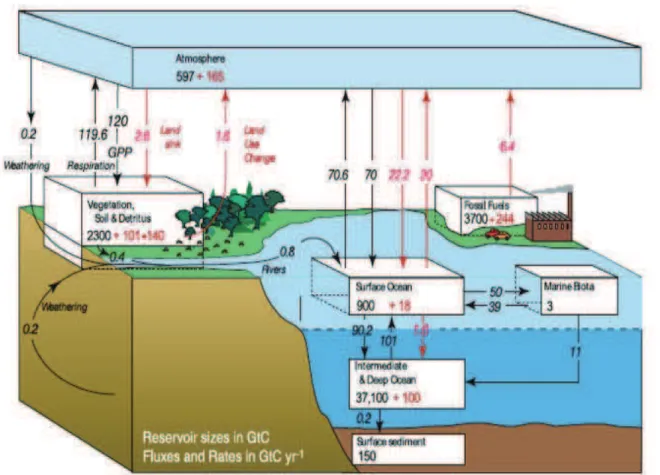
The carbon (C) cycle, like every biogeochemical cycle, is a complex cycle consisting of different pools and stocks (Figure 1.1). For better understanding, this cycle can be divided into two components, mineral (CO2, CH4, CaCO3 etc.) and organic. These two components are connected together via different fluxes like plant photosynthesis and soil respiration. The strong link between global C cycle and world climate is the reason why global C cycle gets such important attention from world’s scientific community.
Since the industrial era commenced (around 1750), huge changes in global C stocks and fluxes between them have occurred (IPCC, Figure 1.1, In red are quantities due to anthropogenic changes post 1750 and in black are pre-1750 estimations). Prior to 1750, the atmospheric concentration of CO2, the most important greenhouse gas, had been relatively stable between 260 and 280 ppm for 10 kyr (Petit et al., 1999; Siegenthaler et al., 2005). Perturbations of the carbon cycle from human activities were insignificant relative to natural variability. Since 1750, the concentration of CO2 in the atmosphere has risen, at an increasing rate, from around 280 ppm to nearly 380 ppm in 2005. The increase in atmospheric CO2 concentration results from human activities: primarily burning of fossil fuels and deforestation, but also cement production and changes in land use and management such as biomass burning, crop production and conversion of grasslands to croplands. While human
The anthropogenic rise in CO2 levels in the atmosphere contributes to greenhouse effect which increases global mean temperature of Earth’s surface. This situation has stimulated the research on analysis of global C stocks as sources and sinks of CO2 and the means to limit these anthropogenic effects. This concept of global C stocks as sources and sinks was upheld and popularized by Kyoto protocol 1997 that was held to minimize the emissions of green house gases. One of the most important C stocks on Earth is inorganic C dissolved in deep oceans that represents 38.3012 t C (Millennium Ecosystem Assessment 2005). These stocks of passive C can not be manipulated since they are regulated by oceanic currents and the dissolution of the atmospheric CO2 in the oceans over which human activity has little control. However the soil C stocks are manageable by human activities and have
Figure 1.1. The global carbon cycle for the 1990s, showing the main annual fluxes in
GtC yr–1: pre-industrial ‘natural’ fluxes in black and ‘anthropogenic’ fluxes in red Source: http://www.ipcc.ch/publications_and_data/ar4/wg1/en/ch7s7-3.html
CHAPTER 1
been identified as important potential sinks in Kyoto protocol. Moreover, the important quantities of soil C stocks and respiration from them being the largest flux in global C cycle make these stocks of high stakes in the context of global climate change.
I.2.
Soil organic carbon
The global mass of soil organic carbon (SOC) is at least ~ 2300 Pg C (Jobbàgy and Jackson 2000). It represents ~ 75% of the total land biosphere C reservoir given that the litter and vegetation C stocks amount to 850 Pg C (Houghton 2005). A small change in soil C stocks may cause important changes in global C cycle and potential feedbacks to climate change (Schlesinger and Andrews 2000) underpinning their potential role as important source or sink of CO2.
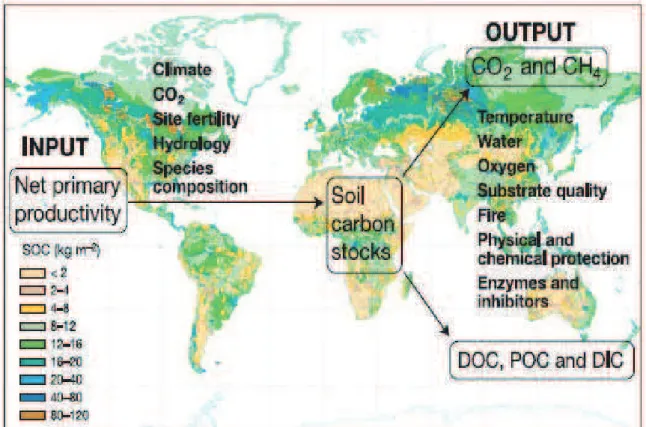
The stocks of organic matter in soils are the result of balance between the inputs and outputs of C within the belowground environment. The inputs are products of net primary productivity like root exudates, plant litter, crop stubbles etc. The outputs are the release of C from soil principally as CO2 although CH4 efflux and hydrologic leaching of dissolved and particulate C compounds can also be important. The CO2 release consists of microbial decomposition of soil organic matter. The size of inputs as well as outputs is determined by a variety of factors thus generating a range of soil organic C stocks around the world (For details, Figure 1.2).
The organic matter in soils is mainly stabilized by three mechanisms i.e. chemical stabilization, physical protection and biochemical stabilization (Stevenson 1994; Christensen 1996). Chemical stabilization of SOM is understood to be the result of chemical and or physicochemical binding between SOM and soil minerals like clay and silt particles
proposed as the major sites of organic matter stabilization (Chenu and Plante 2006). The aggregates protect SOM from decomposition by entrapping and making it inaccessible to microbes. Biochemical stabilization of SOM occurs due to the
complex chemical composition of the organic materials. The complex chemical composition can be an inherent property of the plant material (like lignin, polyphenols) or can be attained during decomposition through the condensation and complexation of decomposition residues, rendering them more resistant to subsequent decomposition. The microbes must invest energy to produce high concentrations of enzymes to break the high number of chemical bonds in such compounds. However, the metabolites acquired as a result of decomposition of such
Figure 1.2. Factors controlling the main inputs and outputs of soil C, superimposed over
a global map of soil organic C stocks (Miller projection; 1 : 100,000,000 for background map). Taken from Davidson & Janssens (2006).
CHAPTER 1
compounds are not economically viable for microbes (Fontaine et al., 2007).That is why chemically complex organic compounds may remain stable.
Although SOM is a continuum of biochemical complexity, for the purpose of understanding it has been divided into three pools depending on their turnover rates (Figure 1.3, and Parton et al., 1987; Coleman et al., 1997; Wutzler and Reichstein 2008). The ‘fast’ pool turnovers within hours to weeks, the ‘slow’ pool turnovers within some years to decades and the ‘passive’ pool turnovers in centuries to millennia (Lützow et al., 2006). A recent
Figure 1.3. Simplified quality-wise fractions of soil organic C
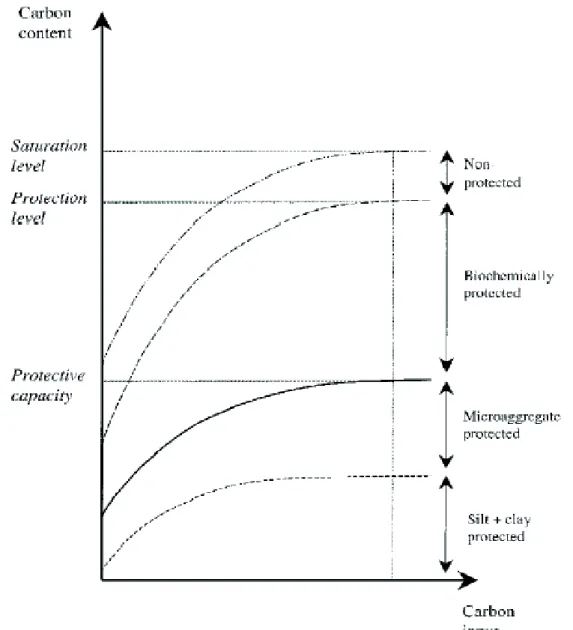
The above described soil C stabilizing mechanisms determine soil C saturation limit in terms of a soil’s capacity to act as sink for C (Figure 1.4, Six et al., 2002). The important stocks of SOC as well as their long mean residence times (MRT) suggest soils as potentially important sink for minimizing the effect of anthropogenic emissions by fixing C in vegetation and its stabilization and humification in soils. This model also indicates that the capacity of
Figure I.4. The protective capacity of soil (which governs the silt and clay and
micro-aggregate protected C pools), the biochemically stabilized C pool and unprotected C pool define a maximum C content for soils. The pool size of each fraction is determined by their unique stabilizing mechanisms. (Six et al., 2002)
CHAPTER 1
soils to raise their C stocks is limited (Six et al., 2002; Jastrow et al., 2005; Hungate et al., 2009). However, the chronosequence studies have shown that the soils have unlimited capacity of soil C sequestration (Syers et al., 1970; Schlesinger 1990).
The soil microbes performing the mineralization of SOM use C as energy as well as assimilate it along with other nutrients as their DNA. The stabilization and mineralization of SOM is thus not exclusively dependent on inputs and outputs of C but on the availability of other nutrients as well.
I.3.
Interaction of C cycle with other cycles
Six major elements-H, C, N, O, S and P- constitute the major building blocks for all biological macromolecules (Schlesinger WH, 1997). As a result of constitutional needs of organisms for these elements to build their tissues, the elemental cycles of C, N and other elements are interlinked at the molecular level (Sterner RW & Elser JJ 2002). For example the anthropogenic additions of N in atmosphere are deposited back on ground in the forms that are readily available to plants thereby stimulating productivity and enhancing the uptake of CO2 from the atmosphere. In contrast, the increase in plant biomass production under elevated CO2 strongly depends on the availability of mineral N i.e. more the N is available; higher would be the production of plant biomass (Figure 1.5). Moreover, the stimulation of plant growth by elevated CO2 should lead to sequestration of soil available nutrients and hence to progressive N limitation. The progressive N limitation hypothesis suggests that the increased plant biomass and plant fixation of CO2 under elevated CO2 subsides in the long term.
Similarly in soils, one of the reasons of difficulty to understand and theorize the dynamics of biogeochemical cycles is the inter-dependence of these cycles through soil organisms. The
dependent on the availability of P. Soil organic matter, a major component of soil C (Batjes 1996), is another point of interlink for various biogeochemical cycles due to its chemistry. Soil organic matter (including fresh plant-derived C and soil humified recalcitrant C) is a major source of energy as well as various nutrients for soil microbes for cellular activity and growth. The understanding of dynamics of C cycle in soil without the knowledge about other biogeochemical cycles, like N and P, is hence difficult.
The importance of availability of mineral N for storing C in soils has recently been observed at ecosystem level. It seems that, when mineral N availability is weak, the soil does not store excess C coming from increased plant production under elevated CO2. Moreover, turnover of soil C stocks seems to be increased in this condition (Hungate et al., 2009). In
Figure 1.5. Theoretical demonstration of CO2-N interactions. Biomass increase with a 50% increase in CO2 concentration is greater at higher than lower N supply rates. Moreover elevated CO2 can diminish N availability (Progressive N limitation), further stopping biomass increase at elevated CO2 (taken from Reich et al., 2006)
CHAPTER 1
contrast, when mineral N is relatively high in availability, the total stock of C appears to go up due to reduced turnover of soil C stocks (van Groenigen et al., 2006; Hungate et al., 2009). The fact that the amount of organic C stored in the soil does not necessarily increase, and can even decrease, after an input of fresh organic matter had been demonstrated in lab incubations (Fontaine et al, 2004a and b). These incubation experiments show that certain microbial species (Fontaine et al., 2003; Blagodatskaya et al., 2007) are able to degrade recalcitrant soil organic matter by using energy-rich substrates present in the fresh organic matter, a co-metabolism named priming effect in soil science (Blagodatskaya and Kuzyakov 2008). Although the mechanisms at play are not understood, the availability of nutrients for soil microbes controls the intensity of the priming effect. When the availability of nutrient is high, the priming effect is relatively low and the supply of fresh organic matter increase the reserve of C in soil. When the availability of nutrients is low, the priming effect may be so high that the reserve of C in soil decrease with the supply of fresh organic matter. Therefore, priming effect provides another good example of how C cycle in soil is interlinked with cycles of other nutrients.
II. State of the art
The acceleration in mineralization of recalcitrant SOM after the supply of fresh (labile) C i.e. priming effect is the cornerstone of this thesis. Thus it would be pertinent to understand in detail what this phenomenon is, its historical background, its precise definition in the context of this study, its importance for SOM mineralization and the methods to measure.
amended with green manure of legumes. He showed that the N balance could only be explained by considering a significant acceleration of native soil organic matter mineralization induced by the green manure. No progress was made on the subject until 1946 when isotopic techniques source partitioning of CO2 evolution from soil and Broadbent and Norman (1946) showed that the CO2 evolution from the soil can increase from 4 to 11 fold after addition of 13C labelled plant residues. The term “priming effect” was however introduced by Bingemann et al. (1953). Since its introduction by Bingemann et al. in 1953, the term priming effect has also been used in other context and for describing other processes (Jenkinson et al., 1985; Dalenberg and Jager 1989). The focus of this thesis is SOM mineralization we refer to the original definition of priming effect given by by Bingeman et al. (1953), “the extra decomposition of native soil organic matter in a soil receiving an organic matter amendment” in this manuscript. Since priming effect in this work was studied in the presence of living roots (i.e. rhizosphere), it will be termed as rhizosphere priming effect (RPE).
What is the rationale behind this priming effect induced by soil microorganisms? According to energy limitation theory (Fontaine et al., 2005; 2007), despite the presence of large soil organic carbon stocks in most soils, the soil microbes are unable to use it for assimilation and growth because the direct and indirect (cell maintenance) cost on synthesizing extracellular enzymes that mineralize SOM exceeds the return the microbes could get in terms of energy and nutrients. However, some microbial species mineralize recalcitrant SOM in co-metabolism using the fresh organic matter as a source of energy (Fontaine et al., 2003; Blagodatskaya et al., 2007). This degradation of recalcitrant SOM would permit microorganisms to access to the large reserve of nutrients that were held up SOM.
CHAPTER 1
II.2.
Measuring priming effect
The isotopic labelling, which permit separating soil C and fresh C mineralization, is the sole current reliable technique to quantify the priming effect.. Other approaches have been proposed to estimate the priming effect when the labelling approach is not possible but the results are highly disputable (Kuzyakov 2010).
In lab incubation studies, C labelled simple components of root exudates like glucose, fructose, alanine etc. (Hamer and Marschner 2005) or the extraction of labelled plant material like cellulose (Fontaine et al., 2007) or labelled plant litter (Conde et al., 2005) is added to
unlabelled soil. The CO2 efflux from such soils as well as controls are measured and separated into soil-derived (unlabelled) and added-substrate derived (labelled) by isotopic mass-balance equations. The difference of soil-derived CO2 between treated (substrate-added) and control soil is the amount of priming effect. This is very excellent method, easy to control the conditions but it excludes the living roots thus neglecting the rhizospheric processes like rhizodeposition, root absorption of N and root-induced breaking of aggregates.
The measurement of priming in living soil-plant systems is measured by continuous or pulse labelling of plants by exposing them to an atmosphere with constant ratios of 14C- or 13C- CO
2 to total CO2 over a certain period (Kuzyakov et al., 2001; Dijkstra et al., 2007). The root-derived (labelled) and soil-derived (unlabelled) CO2-C is separated from total soil (soil
plus roots) CO2 efflux using isotopic mass balance equations. The difference of soil-derived CO2 between treated (planted) and control soil is the amount of priming effect.
Another method to separate soil-derived and root-derived CO2 efflux is by using the natural 13C abundance of soils and plants. The 13C natural abundance method is based on the
abundance method is based on cultivation of C4 on a C3 or vice versa and estimation of the contribution of root-derived CO2 according the į13C value in the CO2 evolved.
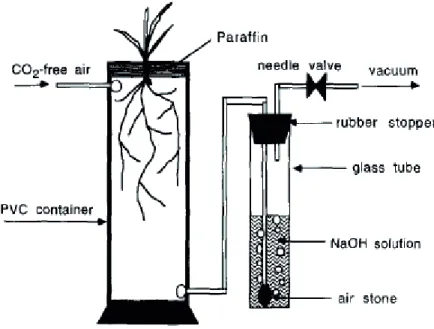
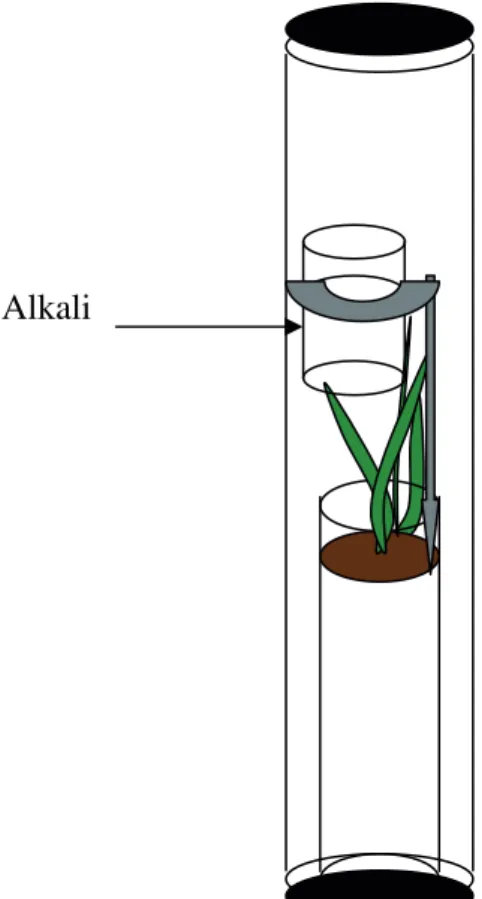
The current method for measuring soil respiration and hence the priming effect induced by plants can only be used for single-stem plants like tree seedlings or annual plants with strong single stems like sunflower. Indeed, the soil-part must be separated from above ground plant part in order to avoid the assimilation of released soil CO2 by the plant. To this end, a paraffin wax is applied around stem separating soil and plant compartments (Figure 1.6). The CO2 efflux from soil (soil plus root) is then trapped in an alkali or directly measured by Gas Chromatography Mass Spectrometry (GCMS). This method can not be used for multi-tillered plants like herbaceous species signifying that the priming effect induced by plant grasses is not known.
II.3.
Why priming effect is important
Plant roots are an important of organic matter-labile C in the form of exudation, sloughed off roots cells, mucilage collectively called as ‘rhizodeposition’ and dead root litter-in soil.
Figure 1.6. The method used to trap soil CO2 efflux in alkali excluding the trapping of CO2 from aboveground plant parts. (Cheng 1996).
CHAPTER 1
Living roots, being a source of labile C, have been found to induce rhizosphere priming effects. The importance of this effect can be gauged from the fact that the increase in SOM mineralization in planted soils can reach to three-fold of SOM mineralization in bare soils under similar temperature and moisture conditions (Zhu and Cheng 2011). RPE have also been shown to induce net C loss from a soil (Fontaine et al., 2004; Dijkstra et al., 2007). Moreover, various biotic and abiotic factors that have been shown to modulate the rate of RPE suggest the importance of studying this phenomenon to devise future strategies for favouring net positive sequestration under living plants and not the net positive SOM mineralization.
Among biotic factors, plant biomass (Dijkstra et al., 2006), photosynthesis (Kuzyakov and Cheng 2001), plant phenology (Fu and Cheng 2002) have been related with rate of RPE. Plant biomass and photosynthesis have been linked with RPE suggesting that the increased rate of rhizodeposition under increased plant biomass or photosynthesis increases the rate of RPE (Kuzyakov and Cheng 2001; Dijkstra et al., 2006). For annual plants, it has been shown that the RPE is higher during vegetative growth stages of plant in comparison to reproductive (or later) stages presumably due to high amount of exudation from young roots during early age of plant (Fu and Cheng 2002).
Abiotic factors like soil nutrient status, especially the availability of mineral N has also been found to influence the magnitude of RPE. Under high availability of mineral N, lesser amount of priming effect was observed and vice versa (Fontaine et al., 2004a). High availability of N reduces the N limitation and the competition for N between microbial biomass and plant roots. Under high soil fertility the microbes are more adapted to assimilate
The atmospheric CO2 levels, soil and air temperature and moisture are expected to change in future climates (IPCC 2007) and all of them have been found to modulate the magnitude of RPE. For example, in low fertility soils the sustained growth responses of forest to elevated CO2 are maintained by enhanced rates of N cycling fuelled by inputs of root-derived exudates and enhanced RPE (Phillips et al., 2011). The increased temperature has been found to increase RPE suggesting the increased temperature sensitivity of SOM mineralization due to RPE (Zhu and Cheng 2011). Higher soil moisture contents (not anaerobic conditions) also facilitate the RPE presumably by increased root exudation (Dijkstra and Cheng 2007).
In summary, the future climatic changes that can influence RPE directly or indirectly by changing soil nutrient status, soil moisture, biomass production etc. underscore the importance of rhizosphere priming effect and the need to study it.
II.4.
Knowledge gaps
The importance of rhizosphere priming effect (RPE) vis-à-vis C and N cycles in grasslands is not clear owing perhaps to the absence of a method to directly measure RPE induced by grasses. After detailed literature review, six knowledge gaps were identified to work on for this thesis:
What is the effect of grazing on RPE? Grazing is central to the management of
grasslands and has been shown to accelerate the decomposition of plant litter present in soil (Klumpp et al., 2009). However, the effect of grazing on mineralization of SOM is unclear. The increased availability of soluble C, higher net N mineralization and increased microbial biomass in soil after clipping the plant leaves were considered an evidence to suggest that the plant clipping could accelerate SOM mineralization i.e. increased RPE thereby releasing mineral N from recalcitrant SOM for plant uptake (Hamilton and Frank 2001). If this hypothesis is true, then clipping (a simulation of mowing or grazing minus animal excreta)
CHAPTER 1
could decrease soil C stocks on two fronts i.e. first, due to reduced overall C input into soil due to reduced aboveground production and rhizodeposits and second, by stimulating the mineralization of already existing soil C (SOM). However, the studies where soil CO2 efflux was measured after plant clipping do not support the hypothesis of increased RPE after plant clipping. In contrast, these studies have shown that the plant clipping can reduce soil CO2 efflux by 20-50 % (Craine et al., 1999; Bahn et al., 2006). Thus, the impact of grazing on recalcitrant soil organic matter must be studied though a direct approach.
Are plants with deep roots able to reactivate deep ancient C and N cycle trough a
priming effect? The SOM mineralization has been found to accelerate in the presence of
living roots of annual plants and tree seedlings (Cheng et al., 2003; Dijkstra et al., 2007) and in some cases to result in net soil C loss (Dijkstra et al., 2007). Most of the studies aiming to find out the effect of living roots on soil C stocks and soil-derived CO2 efflux are limited to upper 20 or 30 cm of soil. However, of the 1600 Gt of organic C held in the top meter of world soils, about half is in the 25-100 cm layer (Jobbàgy and Jackson 2000). Moreover, some recent studies focussing on C sequestration in soils have suggested that deep soils may not be sequestering C or even losing some of it (Carter 2005). The C loss from deep soils suggests that the labile C deposition may be accelerating the mineralization of deep soil C. A recent study in lab conditions (Fontaine et al., 2007) have actually shown that the labile C addition to soil sampled from deep soil (80 cm depth) could accelerate SOM mineralization and destabilize ~ 2500 years old C. The SOM dynamics in deep soils in the presence of living roots is an important question to study to predict its feedbacks as well as viability of deep soil for C sequestration in future climates in which temperatures have been predicted to rise.
number of studies. According to Arrhenius (1889) most of chemical reactions need a ‘little push’ in the form of exogenous energy to proceed, which he called activation energy. In a reaction, higher the fraction of reactants having required activation energy or more, the higher will be the rate of that reaction. Moreover, higher the activation energy of a reaction higher will be the temperature response of that reaction. For example, chemically more recalcitrant organic compounds need higher activation energy to proceed for mineralization thus will show stronger temperature response as compared to relatively labile organic compounds (Bosatta and Agren 1999). A lot of lab incubation studies have shown the increase in SOM mineralization with increasing temperature as predicted in Arrhenius equation (Kirschbaum 1995; Waldrop and Firestone 2004; Knorr et al., 2005). However, the results of long term soil warming field experiments (in the presence of plants) do not always support this theoretical prediction and the results of lab incubations. They show that the mineralization of recalcitrant SOM may acclimatize to temperature increase in the long term (Luo et al., 2001; Melillo et al., 2002; Eliasson et al. 2005; Bradford et al., 2008). One reason for this discrepancy between lab and field experiments’ results may lie in the omission of rhizospheric processes, i.e. consistent supply of labile C substrate and rhizosphere priming effect, in lab incubation studies. It should be noted that the effect of priming effect on SOM mineralization is known to be higher than the effect of temperature (Hoosbeek et al., 2004). Moreover, the warm temperatures (for example summer season) stimulate photosynthesis, plant biomass production and C inputs into the soil with possibility of increasing RPE. However, to date the reports on the direct effects of temperature on RPE are scarce.
How do plant growth strategies affect plant-soil interactions and the priming effect?
Various plant species varying with respect to the quantity of rhizodeposits have been shown to modify soil C stocks in varying amounts (Dijkstra et al., 2006 b). The chemistry of root litter has also been linked to the dynamics of SOM. Specifically, root N concentration across
CHAPTER 1
species was significantly negatively related to decomposition of soil C. Moreover various plant species, especially grassland species, vary in nitrogen uptake and the duration for which they conserve this nitrogen in their biomass by controlling the amount of rhizodeposits thereby imposing certain negative mineral N balance in soil. The quantity and quality of rhizodeposits and the duration for which negative mineral N balance is induced in soil by various species could induce varying amounts of RPEs thereby altering soil C stocks.
Can legumes foster C storage in soils by lowering the priming effect? The
availability of mineral N can modify the interaction between incoming labile organic matter and recalcitrant SOM (Section 1.1.3, 1.2.3). In lab conditions, it has been shown that under higher availability of mineral N the amount of RPE was less as compared to that under lower N availability for similar supplies of labile organic matter. Moreover high fertility stabilized more added-C than low fertility. Could the similar results be produced under living plants where high N availability will stimulate higher production of plant biomass and rhizodeposits? Moreover, is the natural availability of mineral nitrogen under N-fixing plants capable of stabilizing more C deposited by N-fixing as well as a co-occurring non N-fixing plant? The inter-play of amount and quality of rhizodeposits and soil fertility is yet to be determined vis-à-vis RPE and soil C stocks.
What is the relative contribution of root exudates, mycorrhizae and root litter
depositions in the priming effect induced by plants? The rhizodeposits can loosely be
divided into three major components: root exudates, mycorrhizae and root litter. Among them root litter has been shown to induce the RPE. The mycorrhizae have been shown to accelerate the mineralization of labelled plant litter and obtain mineral N for their host plant (Hodge et
effect determined (Hamer and Marschner 2005). However, certain components of root exudates do not accelerate the mineralization of SOM (Dalenberg, 1981, 1989; Hamer and Marschner 2005) in these experiments and no evidence of RPE under living plants exclusively by exudates is available. Actually, it is uncertain if they can stimulate SOM mineralizing microbes or they are readily used up by that group of microbes which is capable of mineralizing the ‘too’ labile organic C only.
Soil microbes, the drivers of RPE are perhaps the least known component of the RPE phenomenon. We shall discuss briefly our knowledge or lack thereof about the microbes involved in RPE in succeeding section.
Which soil microbes ‘prime’ the SOM mineralization? The question as to which microbes
are responsible for mineralization of recalcitrant SOM is still an open one and closely linked with priming effect mechanisms. Fontaine et al. (2003) suggested that microbial groups are specialized in using organic substrate on the basis of their ability to acquire mineral nutrients and can be divided into two groups: r-strategists and k-strategists. While both of them are energy limited in soil and can use the labile C, r-strategists are quicker to assimilate labile substrates than their competitors. However, k-strategists boosted by the energy obtained from labile C can mine recalcitrant SOM for mineral nutrients and more C thereby inducing the
RPE. Recently it has been suggested that it is fungi are the main actors in priming effect
(Fontaine et al., 2011). It has been suggested that the fungi specialize in accessing and degrading substrates that are poorly available to most bacteria and, in contrast to bacteria, can grow through low nutrient zones to the distantly located substrates using their hyphae (Otten et al., 2001). However, as shown by 13C-PLFA, Gram-negative bacteria may also contribute to priming effect (Nottingham et al., 2009). Most of priming studies are short term (a few weeks to couple of months) and only a very few (Blagodatskaya et al., 2007; Marx et al., 2007) have examined the dynamics and activity of microbial groups over an extended period.
CHAPTER 1
We know that RPE can last for over a year (Dijkstra et al., 2007) however we do not know which microbial groups are involved in RPE. A large number of microbial groups may be involved. Nevertheless, the study of microbial communities in a soil-plant system adopting a correlative approach could help identify the microbial groups that play key role in priming effect.
III. Objectives of thesis
The principal objective of this thesis is to contribute to the knowledge of mechanisms controlling the priming effect and hence the long-term soil organic matter dynamics in grasslands. From an applied perspective, this work aims at identifying key biological mechanisms that could be used to increase the C storage and the efficiency of forage production (more primary production with less mineral fertilizers) in permanent grasslands. On the basis of contradictions and knowledge gaps found in literature (Section 1.2), we formulated some hypotheses which provided the base for the research work carried for this thesis.
III.1.
Hypotheses of thesis
In the first experiment, we wanted to test the effect of plant clipping on SOM mineralization. We hypothesized that the plant clipping would decrease rhizosphere priming effect by decreasing the supply of labile C to mycorrhizae and soil microbes. We also assumed that clipping would reduce total plant N uptake due to curtailed photosynthesis thereby increasing mineral N quantity in soil. Moreover, reduced photosynthesis and decreased labile C supply after clipping was expected to change microbial community structure with the relative
counterparts in surface soils and are capable of accelerating SOM mineralization i.e. inducing
RPE in the presence of living roots by using labile C coming from roots. Moreover, the
accelerated SOM mineralization in the presence of living roots was expected to increase nitrogen mineralization. Microbial community structure especially relative abundance of saprophytic fungi was expected to correspond with the amount of RPE.
For the question of effect of temperature on RPE, we theorized that when specific enzyme activity, time and temperature dependent enzyme inactivation and microbial production of enzyme in the presence of fresh supply of labile C (e.g. in the presence of living roots) is taken into account, SOM mineralization would have a negative relationship with temperature. This theoretical framework was then validated by measuring short term (24 hours) temperature treatments as well as seasonal temperature response of RPE under living plants in a mesocosm.
To test the effect of different grassland species producing varying quantity and quality of rhizodeposits and the mineral nitrogen balance in soil they impose, six gramineae and one legume commonly found in temperate grasslands were selected. It was hypothesized that the quick growing species would induce strong amounts of RPEs in early periods while slow growing species would induce lower amounts of RPEs early on and strong RPEs in the later stages. Moreover, the leguminous species would induce important amounts of RPEs though it would stock more C than it would mineralize.
In another experiment, the possibility of high C stocks and lower RPE under high availability of nitrogen, through mineral fertilizers or natural N fixation by an N-fixing plant, was tested. It was hypothesized that under high availability of mineral N the microbial mineralization of SOM would decrease since the microbial need to acquire N from SOM would lessen due to supply of mineral N.
CHAPTER 1
Lastly, the hypothesis that root exudates from living roots are capable of stimulating the soil microbes and accelerating SOM mineralization thereby inducing RPE was tested. In addition, the contribution of each component of rhizodeposition i.e. roots, mycorrhizae and root exudates in inducing RPE was estimated.
III.2.
Approaches of the study
The most original part of approaches developed in the thesis are presented here:.
a. Experimental approach
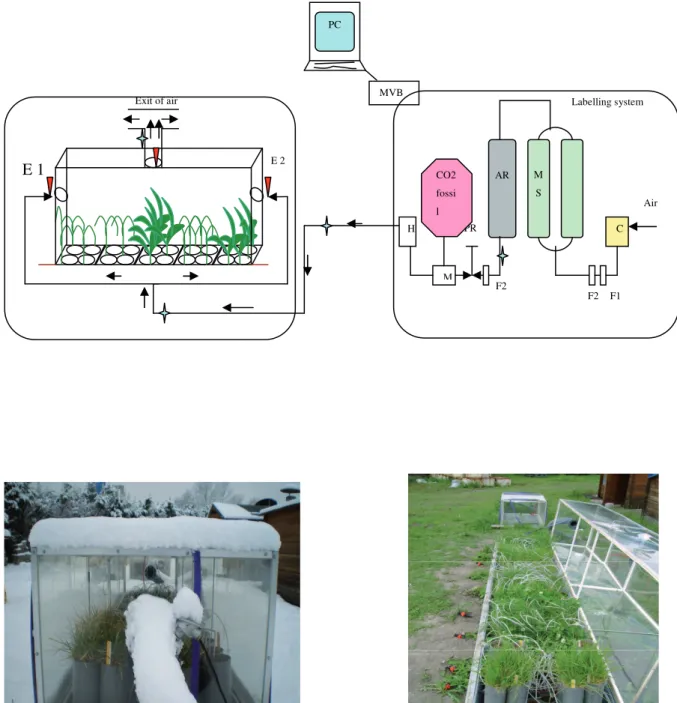
A dual labelling (13C and 14C) of fresh material is needed for quantifying the priming effect and the age of soil C released by this priming (Fontaine et al., 2007). Therefore, we set up a labelling system permitting a continuous dual labelling of grassland plants in a mesocosm where plants benefited from natural light and temperature. A schematic diagram of the labelling system and picture of the mesocosm containing the planted and unplanted pots are shown in Figure 1.7. A screw compressor, a self-regenerating adsorption dryer capable of generating decarbonised air at a rate of up to 5000 standard liters per minute (SLPM) and residual CO2 below 1µmol CO2 mol-1 air, an air reservoir, gas cylinders containing fossil fuel derived CO2 and a humidifier (1m3:1m2 cross corrugated cellulose pads) constitute the main parts of the labeling system. Ambient air was taken into the system by a compressor, its CO2 and H2O contents and all other particles were scrubbed by a molecular sieve. This decarbonised air was then mixed with fossil-originated CO2 which is naturally depleted in 13C and 14C. A mass flow meter served to control the CO2 injection rate. Flow rate of the whole system was controlled by pressure regulators. During daytime, around 30 % of decarbonised dry air was diverted to one of the two molecular sieves in order to regenerate it.
maintained at 400±20 ppm. The air in mesocosm was renewed twice a minute to avoid the uptake of soil-derived (unlabelled) CO2 by plants. The relative humidity within the mesocosm was maintained around 50-60 %.
PC MVB Exit of air C Air F2 F1 M S AR PR M CO2 fossi l H F Labelling system F2 E 2 E 1
Figure 1.7. The scheme of labelling system and mesocosm (above). Pictures of
mesocosm containing plants (below). C Compresser: MS, Molecular sieve: AR, Air reservoir: F1, oil & water extraction: F2, oil, water & particle filter
CHAPTER 1
As discussed earlier (section 1.2.2, Figure 1.6), the current method for measuring soil respiration and hence the priming effect induced by plants can only be used for single-stem plants. Therefore, we conceived a novel method to measure RPE induced by herbaceous plant. To this end, planted soil pot as well as bare-soil pots (40 cm height, Ø 9.8 cm) were put into opaque respiration chambers (100 cm height, Ø 15 cm) (Figure 1.8). The absence of light in respiration chambers stopped the photosynthesis and avoided re-assimilation of soil-derived CO2 (unlabelled) by plants. The respiration chambers were tightly sealed and placed under shade for 24 hours. An alkali solution (200 ml of 1M NaOH) was placed into respiration chambers to trap the CO2 released by the plant-soil system. Preliminary tests showed that 99% of CO2 respired by soil-plant system is trapped by the alkali solution. The CO2 trapped in NaOH was measured with a total inorganic-C analyzer. The 13C abundance of trapped CO2 was analyzed with an Isotope-Ratio Mass Spectrometer (IRMS) after precipitating the carbonates with excess BaCl2 and filtration. Isotopic labeling allowed the separation of soil-derived CO2-C from plant-derived CO2-C using classical balance mass equations (See chapters 2 for details). In order to calculate the rhizosphere priming effect (RPE), CO2-C released by bare soils was subtracted from soil-derived CO2-C released by planted soils.
To determine the effect of living roots on SOM mineralization in deep soil layers, intact soil columns were sampled from 10-80 cm soil depth and placed into PVC pots (Height 70 cm, Ø 9.8 cm) without disturbing their structure. A grassland species, Festuca arundinacea, known for producing deep roots was sown and cultivated under dual labelled CO2. The 13C labelling permitted separation of soil-derived CO2 from plant-derived CO2 whereas 14C labelling
Then, the PVC tubes- were cut horizontally into three parts corresponding to the three soil horizons 10-33 cm, 33-56 cm and 56-80 cm. These three horizons were separately incubated to quantify the RPE and the age of soil C released by the RPE (See Chapter 3 for more details).
In order to decouple the effects of root exudates, mycorrhizae and roots on soil organic C, a novel experiment was put into place. Soil, sampled from temperate grassland, was put into PVC cylinders whose cross sections were closed with 0.45 µm, 30µm or 1000 µm mesh. Four cylinders of a particular mesh (about 60 g soil) were buried in inert sand in a pot. Three grassland plants i.e. Lolium perenne, Poa trivialis and Trifolium repens were grown on these pots and continuously labelled with 13C depleted air in a mesocosm. The soil cylinders (1000 µm) placed in unsown sand pots were used as controls. The 0.45 µm mesh was permeable
Alkali
CHAPTER 1
only to root exudates thus corresponding to the effect of root exudates on SOC (RE treatment), 30µm mesh was permeable to root exudates and mycorrhizae representing the effect of root exudates and mycorrhizae (RE+Myc treatment) and 1000 µm mesh being permeable to root exudates, mycorrhizae and roots represented the combined effect of all of them (Whole-root treatment). The respiration from plant-soil system was measured periodically as described earlier.
b) Theoretical approach
The relationship between temperature and SOM mineralization was explored by developing a novel theoretical framework and then validating the prediction of the theory with experiment results. The model includes two key processes that are usually omitted which are often overlooked while modeling or describing the experimental results of effect of temperature on enzymatic activities and organic matter mineralization. First, microbial decomposers are limited by fresh energy-rich C which controls their enzyme production capability to mineralize recalcitrant C in soil. Second, enzyme inactivation, occurring due to loss of three dimensional structures of enzymes induced by the Brownian movement, accelerates with warming. The analysis of the model in dynamic and at steady state stress on the need of separating non steady-state-system like incubated bare soil wherein there is a continuous decrease in enzymatic pool, from a steady-state-system where the enzymatic pool is maintained by microbes which are supplied with fresh C like in soil-plant system. The model predicts that soil C mineralization should increase with temperature till an optimum in bare soil whereas it should continuously decrease with temperature in planted soil. These predictions were confirmed by an experiment on planted soil and bare soil systems submitted
IV.
Thesis layout
During the experiment phase of this thesis, six hypotheses were made and consequently tested with six experiments. However in this manuscript three are presented in the form of finished articles and three others, for which only preliminary results are available at this stage, have been assembled in chapter 5 under the heading ‘articles in preparation’.
This chapter of introduction is preceded by four chapters discussing the results of original research work.
First finished article describes the effect of plant clipping on SOM mineralization, mineral N availability, soil microbial biomass and microbial community structure (Chapter 2, pages 37-66). This article has already been accepted in ‘Soil Biology & Biochemistry’ with minor corrections.
Second article describes the effect of rhizodeposition by living roots on mineralization of SOM in deep soils and microbial community along the soil profile. Moreover, this study aims to identify the microbes involved in SOM mineralization and rhizosphere priming effect (Chapter 3, pages 67-97).
Third article is about the relationship of temperature with SOM mineralization (Chapter 4, pages 98-129).
Fifth chapter assembles the preliminary results of three experiments under the heading ‘Articles in presparation’ (pages 130-146).
A general discussion and perspectives emanating from the thesis make up the last chapter of this work (pages 147-160).
An annexe containing a novel work on acellular respiration in soils in which this doctorate student participated is attached in the end.
CHAPTER 1
V. References
Arrhenius, S. 1889. Uber die Reakionsgeschwindigkeit bei der Inversion von Rohrzucker durch Sauren. Zeitschrift fuer physikalische Chemie 4, 226-248.
Bahn, M., Knapp, M., Garajova, Z., Pfahringer, N., Cernusca, A., 2006. Root respiration in temperate mountain grasslands differing in land use. Global Change Biology 12, 995-1006.
Batjes, N.H., 1996. Total carbon and nitrogen in the soils of the world. European Journal of Soil Science 47, 151-163.
Bingeman, C.W., Varner, J.E., Martin, W.P., 1953. The effect of the addition of organic materials on the decomposition of an organic soil. Soil Science Society of America Journal 17, 34-38.
Blagodatskaya, E.V., Blagodatsky, S.A., Anderson, T.H., Kuzyakov, Y., 2007. Priming effects in Chernozem induced by glucose and N in relation to microbial growth strategies. Applied Soil Ecology 37, 95-105.
Blagodatskaya, ȿ., Kuzyakov, Y., 2008. Mechanisms of real and apparent priming effects and their dependence on soil microbial biomass and community structure: critical review. Biology and Fertility of Soils 45, 115-131.
Bosatta, E., Ågren, G.I., 1999. Soil organic matter quality interpreted thermodynamically. Soil Biology and Biochemistry 31, 1889-1891.
Bradford, M.A., Davies, C.A., Frey, S.D., Maddox, T.R., Melillo, J.M., Mohan, J.E., Reynolds, J.F., Treseder, K.K., Wallenstein, M.D., 2008. Thermal adaptation of soil microbial respiration to elevated temperature. Ecology Letters 11, 1316-1327.
Carter, M.R., Gregorich, E.G., Carbon and nitrogen storage by deep-rooted tall fescue (Lolium arundinaceum) in the surface and subsurface soil of a fine sandy loam in eastern Canada. Agriculture, Ecosystems & Environment 136, 125-132.
Cheng, W., 1996. Measurement of rhizosphere respiration and organic matter decomposition using natural 13C. Plant and Soil 183, 263- 268.
Cheng, W., Johnson, D.W., Fu, S., 2003. Rhizosphere effects on decomposition: controls of plant species, phenology, and fertilizationRhizosphere Effects on Decomposition. Soil Science Society of America Journal 67, 1418-1427.
Chenu, C., Plante, A.F., 2006. Clay-sized organo-mineral complexes in a cultivation chronosequence: revisiting the concept of the ‘primary organo-mineral complex’. European Journal of Soil Science 57, 596-607.
Chenu, C. and Stotzky, G. 2002. Interactions between microorganisms and soil particles: an overview. In Interactions Between Soil Particles and Microorganisms. Eds. Huang, P.M. Bollag, J.M. and Senesi, N. pp. 3-40. Wiley and Sons, New York.
Coleman, K., Jenkinson, D.S., Crocker, G.J., Grace, P.R., Klir, J., Körschens, M., Poulton, P.R., Richter, D.D., 1997. Simulating trends in soil organic carbon in long-term experiments using RothC-26.3. Geoderma 81, 29-44.
Conde, E., Cardenas, M., Ponce-Mendoza, A., Luna-Guido, M.L., Cruz-Mondragón, C., Dendooven, L., 2005. The impacts of inorganic nitrogen application on mineralization of 14C-labelled maize and glucose, and on priming effect in saline alkaline soil. Soil Biology and Biochemistry 37, 681-691.
Craine, J., Wedin, D., Chapin, F., 1999. Predominance of ecophysiological controls on soil CO2 flux in a Minnesota grassland. Plant and Soil 207, 77-86.
CHAPTER 1
Christensen, B.T., 1996. Carbon in primary and secondary organomineral complexes. In Structure and Organic Matter storage in Agricultural Soils. Eds. M.R. Carter and B.A.Stewart, page 97-165. CRC Press, Inc. Boca Raton, FL.
Dalenberg, J.W., Jager, G., 1981. Priming effect of small glucose additions to 14 C-labelled soil. Soil Biology and Biochemistry 13, 219-223.
Dalenberg, J.W., Jager, G., 1989. Priming effect of some organic additions to 14C-labelled soil. Soil Biology and Biochemistry 21, 443-448.
Davidson, E.A., Janssens, I.A., 2006. Temperature sensitivity of soil carbon decomposition and feedbacks to climate change. Nature 440, 165-173.
Dijkstra, F.A., Cheng, W., 2007a. Interactions between soil and tree roots accelerate long-term soil carbon decomposition. Ecology Letters 10, 1046-1053.
Dijkstra, F.A., Cheng, W., 2007b. Moisture modulates rhizosphere effects on C decomposition in two different soil types. Soil Biology and Biochemistry 39, 2264-2274.
Dijkstra, F.A., Cheng, W., Johnson, D.W., 2006a. Plant biomass influences rhizosphere priming effects on soil organic matter decomposition in two differently managed soils. Soil Biology and Biochemistry 38, 2519-2526.
Dijkstra, F.A., Hobbie, S.E., Reich, P.B., 2006b. Soil Processes Affected by Sixteen Grassland Species Grown under Different Environmental Conditions. Soil Science Society of America Journal. 70, 770-777.
Edwards, A.P., Bremner, J.M., 1967. Microaggregates in soils-1. Journal of Soil Science 18, 64-73.
Elliott, E.T., Aggregate structure and carbon, nitrogen, and phosphorus in native and cultivated soils. Soil Science Society of America Journal 50, 627-633.
Fagerbakke, K.M., Heldal, M., Norland, S., 1996. Content of carbon, nitrogen, oxygen, sulfur and phosphorus in native aquatic and cultured bacteria. Aquatic Microbial Ecology 10, 15-27.
Fontaine, S., Bardoux, G., Abbadie, L., Mariotti, A., 2004a. Carbon input to soil may decrease soil carbon content. Ecology Letters 7, 314-320.
Fontaine, S., Bardoux, G., Benest, D., Verdier, B., Mariotti, A., Abbadie, L., 2004b. Mechanisms of the Priming Effect in a Savannah Soil Amended with Cellulose. Soil Science Society of America Journal 68, 125-131.
Fontaine, S., Barot, S., 2005. Size and functional diversity of microbe populations control plant persistence and long-term soil carbon accumulation. Ecology Letters 8, 1075-1087.
Fontaine, S., Barot, S., Barre, P., Bdioui, N., Mary, B., Rumpel, C., 2007. Stability of organic carbon in deep soil layers controlled by fresh carbon supply. Nature 450, 277-280.
Fontaine, S., Henault, C., Aamor, A., Bdioui, N., Bloor, J.M.G., Maire, V., Mary, B., Revaillot, S., Maron, P.A., 2011. Fungi mediate long term sequestration of carbon and nitrogen in soil through their priming effect. Soil Biology and Biochemistry 43, 86-96.
Fontaine, S., Mariotti, A., Abbadie, L., 2003. The priming effect of organic matter: a question of microbial competition? Soil Biology and Biochemistry 35, 837-843.
Fu, S., Cheng, W., 2002. Rhizosphere priming effects on the decomposition of soil organic matter in C4 and C3 grassland soils. Plant and Soil 238, 289-294.
CHAPTER 1
Hamer, U., Marschner, B., 2005. Priming effects in different soil types induced by fructose, alanine, oxalic acid and catechol additions. Soil Biology and Biochemistry 37, 445-454.
Hamilton, E.W., Frank, D.A., 2001. Can plants stimulate soil microbes and their own nutrient supply? Evidence from a grazing tolerant grass. Ecology 82, 2397-2402. Hodge, A., Campbell, C.D., Fitter, A.H., 2001. An arbuscular mycorrhizal fungus
accelerates decomposition and acquires nitrogen directly from organic material. Nature 413, 297-299.
Hoosbeek, M.R., Lukac, M., van Dam, D., Godbold, D.L., Velthorst, E.J., Biondi, F.A., Peressotti, A., Cotrufo, M.F., de Angelis, P., Scarascia-Mugnozza, G., 2004. More new carbon in the mineral soil of a poplar plantation under Free Air Carbon Enrichment (POPFACE): Cause of increased priming effect? Global Biogeochemical Cycles 18, GB1040.
Houghton, R.A., 2005. Aboveground forest biomass and the global carbon balance. Global Change Biology 11, 945-958.
Hungate, B.A., Van Groenigen, K.-J., Six, J., Jastrow, J.D., Luo, Y., De Graaff, M.-A., Van Kessel, C., Osenberg, C.W., 2009. Assessing the effect of elevated carbon dioxide on soil carbon: a comparison of four meta-analyses. Global Change Biology 15, 2020-2034.
IPCC, 2007. Climate Change 2007 : Synthesis Report. Contributions of working groups I, II and III to the Fourth Assessment Report of the Intergovernmental Panel on Climate Change. In, IPCC, Geneva.
Jastrow, J.D., Michael Miller, R., Matamala, R., Norby, R.J., Boutton, T.W., Rice, C.W., Owensby, C.E., 2005. Elevated atmospheric carbon dioxide increases soil carbon. Global Change Biology 11, 2057-2064.
Jenkinson, D.S., Fox, R.H., Rayner, J.H., 1985. Interactions between fertilizer nitrogen and soil nitrogen—the so-called ‘priming’ effect. Journal of Soil Science 36, 425-444. Jobbagy, E.G., Jackson, R.B., 2000. The vertical distribution of soil organic carbon and its
relation to climate and vegetation. Ecological Applications 10, 423-436.
Kirschbaum, M.U.F., 1995. The temperature dependence of soil organic matter decomposition, and the effect of global warming on soil organic C storage. Soil Biology and Biochemistry 27, 753-760.
Kirschbaum, M.U.F., 2004. Soil respiration under prolonged soil warming: are rate reductions caused by acclimation or substrate loss? Global Change Biology 10, 1870-1877.
Klumpp, K., Fontaine, S., Attard, E., Le Roux, X., Gleixner, G., Soussana, J.-F., 2009. Grazing triggers soil carbon loss by altering plant roots and their control on soil microbial community. Journal of Ecology 97, 876-885.
Knorr, W., Prentice, I.C., House, J.I., Holland, E.A., 2005. Long-term sensitivity of soil carbon turnover to warming. Nature 433, 298-301.
Kuzyakov, Y., Cheng, W., 2001. Photosynthesis controls of rhizosphere respiration and organic matter decomposition. Soil Bilogy & Biochemestry 32, 1915-1925.
Kuzyakov, Y., Ehrensberger, H., Stahr, K., 2001. Carbon partitioning and below-ground translocation by Lolium perenne. Soil Biology & Biochemistry 33, 61-74.
Kuzyakov, Y., 2010. Priming effects: Interactions between living and dead organic matter. Soil Biology and Biochemistry 42, 1363-1371.
CHAPTER 1
Luo, Y., Wan, S., Hui, D., Wallace, L.L., 2001. Acclimatization of soil respiration to warming in a tall grass prairie. Nature 413, 622-625.
Lützow, M.v., Kögel-Knabner, I., Ekschmitt, K., Matzner, E., Guggenberger, G., Marschner, B., Flessa, H., 2006. Stabilization of organic matter in temperate soils: mechanisms and their relevance under different soil conditions – a review. European Journal of Soil Science 57, 426-445.
Marx, M., Buegger, F., Gattinger, A., Marschner, B., Zsolnay, Á., Munch, J.C., 2007. Determination of the fate of 13C labelled maize and wheat rhizodeposit-C in two agricultural soils in a greenhouse experiment under 13C-CO2-enriched atmosphere. Soil Biology and Biochemistry 39, 3043-3055.
Melillo, J.M., Steudler, P.A., Aber, J.D., Newkirk, K., Lux, H., Bowles, F.P., Catricala, C., Magill, A., Ahrens, T., Morrisseau, S., 2002. Soil warming and carbon-cycle feedbacks to the climate system. Science 298, 2173-2176.
Merckx, R., den Hartog, A., van Veen, J.A., 1985. Turnover of root-derived material and related microbial biomass formation in soils of different texture. Soil Biology and Biochemistry 17, 565-569.
MEA, Millennium Ecosystem Assessment-Nutrient Cycling. World Resource Institute, Washington DC (2005).
Nottingham, A.T., Griffiths, H., Chamberlain, P.M., Stott, A.W., Tanner, E.V.J., 2009. Soil priming by sugar and leaf-litter substrates: A link to microbial groups. Applied Soil Ecology 42, 183-190.
Parton, W.J., Schimel, D.S., Cole, C.V., Ojima, D.S., 1987. Analysis of factors controlling soil organic-matter levels in great-plains grasslands. Soil Science Society of America Journal 51, 1173-1179.
Petit, J.R., Jouzel, J., Raynaud, D., Barkov, N.I., Barnola, J.M., Basile, I., Bender, M., Chappellaz, J., Davis, M., Delaygue, G., Delmotte, M., Kotlyakov, V.M., Legrand, M., Lipenkov, V.Y., Lorius, C., Pepin, L., Ritz, C., Saltzman, E., Stievenard, M., 1999. Climate and atmospheric history of the past 420,000 years from the Vostok ice core, Antarctica. Nature 399, 429-436.
Phillips, R.P., Finzi, A.C., Bernhardt, E.S., 2011. Enhanced root exudation induces microbial feedbacks to N cycling in a pine forest under long-term CO2 fumigation. Ecology Letters 14, 187-194.
Reich, P.B., Hobbie, S.E., Lee, T., Ellsworth, D.S., West, J.B., Tilman, D., Knops, J.M.H., Naeem, S., Trost, J., 2006. Nitrogen limitation constrains sustainability of ecosystem response to CO2. Nature 440, 922-925.
Schlesinger, W.H., 1990. Evidence from chronosequence studies for a low carbon-storage potential of soils. Nature 348, 232-234.
Schlesinger, W.H. 1997. Biogeochemistry: An Analysis of Global Change. Academic Press, New York, ed. 2)
Schlesinger, W.H., Andrews, J.A., 2000. Soil respiration and the global carbon cycle. Biogeochemistry 48, 7-20.
Siegenthaler, U., Stocker, T.F., Monnin, E., Lüthi, D., Schwander, J., Stauffer, B., Raynaud, D., Barnola, J.-M., Fischer, H., Masson-Delmotte, V.r., Jouzel, J., 2005. Stable Carbon Cycle–Climate Relationship During the Late Pleistocene. Science 310, 1313-1317.