Conjugated linoleic acids: why the discrepancy between animal
and human studies?
Mélanie Plourde, Stephanie Jew, Stephen C Cunnane, and Peter JH Jones
Conjugated linoleic acids (CLA) are positional and geometric isomers of linoleic acid.
In animals, CLA consumption reduces body fat but results in humans are less
conclusive. This review of the literature on CLA and loss of body fat or body weight in
humans was conducted to explore the reasons for the discrepancy between animal
and clinical trials. It indicates that the incongruity between human and animal data
is largely related to methodological differences in the experimental design, including
age and gender and, to a lesser extent, to CLA dose and isomers. The relatively
unknown metabolic fate of CLA in humans may also be a contributing factor that
helps explain the lack of consistency for CLA efficacy across studies.
© 2008 International Life Sciences Institute
INTRODUCTION
Conjugated linoleic acids (CLA) are a group of polyun-saturated fatty acids with a single pair of conjugated
double bonds.1 CLA are found in ruminant meat and
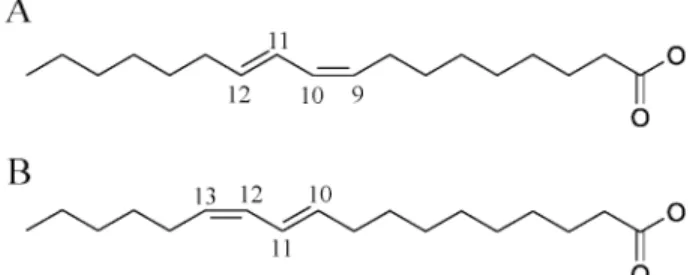
milk products (about 0.4% and 1% of total lipids, respec-tively). The major natural CLA isomer is 18:2 cis-9,trans-11, or rumenic acid (RA: Figure 1A). Chemically synthesized CLA mixtures are also available and are usually composed of a 50:50 mixture of RA and 18:2
trans-10,cis-12 (Figure 1B). Over the past 20 years,
numerous studies conducted with rodents, pigs, and chickens have shown that CLA, at doses ranging from 0.5 to 1.0% of total dietary fat, reduces body fat in compari-son to vegetable oils free of CLA.2–6
Over at least the past 7 years, attempts to replicate these results in humans have produced inconsistent results. Recently, a meta-analysis of human trials con-cluded that at an average dose of 3.2 g/d CLA reduces body fat mass (FM) by 3–4 g/d for each gram of CLA consumed.6However, 12 papers were not included in this
meta-analysis, either because they were published after
the meta-analysis or because they did not meet the inclu-sion criteria chosen for the meta-analysis.6Among the 12
papers not reviewed in the meta-analysis, three reported a loss of 2–8% of FM,7–10but none of these papers reported
significant losses of body weight (BW) with CLA supple-mentation. Hence, the purpose of the present review was to re-evaluate the available data concerning loss of FM and/or BW following CLA supplementation in humans in order to provide a possible explanation for the incon-sistent data reported for humans and animals.
CLA AND LOSS OF BODY WEIGHT OR FAT MASS Normal-weight humans
Studies reporting BW and fat loss (FL) in normal-weight humans given CLA are shown in Table 1. In all of these studies, normal weight was defined as a body mass index of 20–25 kg/m2. To date, we are not aware of studies
reporting BW loss in normal-weight humans given 0.6– 6 g/d CLA for periods of 4–14 weeks, regardless of
Affiliations: M Plourde and SC Cunnane are with the Research Center on Aging and Departments of Medicine, and Physiology and Biophysics, Université de Sherbrooke, Sherbrooke, Québec, Canada. S Jew is with the School of Dietetics and Human Nutrition, McGill University, Ste-Anne-de-Bellevue, Québec, Canada. PJH Jones is with the Richardson Centre for Functional Foods and Nutraceuticals, University of Manitoba, Winnipeg, Manitoba, Canada.
Correspondence: M Plourde, Research Center on Aging, 1036 Belvédère South, Sherbrooke, Québec J1H 4C4, Canada. E-mail: [email protected], Phone:+1-819-821-1170 #45383, Fax: +1-819-829-7141.
Key words: animal studies, body weight, conjugated linoleic acid, fat loss, human clinical trials, metabolism
Abbreviations: ARA, arachidonic acid (20:4n-6); BW, body weight; CLA, conjugated linoleic acid; FL, fat loss; FM, fat mass; LA, linoleic acid (18:2n-6); RA, rumenic acid (18:2 cis-9, trans-11)
whether the CLA was provided as a mixture of two or four CLA isomers, or as a single isomer9,11–23(Table 1). A
loss of body FM in normal-weight subjects was reported in five of nine trials after CLA intake.9,13,15,16,22Three of
these studies resulted in a FM loss of 4%,9,13,15one showed
a FL of 8%22and the fifth reported a FM loss of 20%.16
However, two of these studies had potential confounders because the subjects in both the CLA and the control groups were undergoing physical training three times/ week.9,16Colakoglu et al.22also reported that subjects who
were both taking CLA and doing physical training expe-rienced a cumulative effect on BW and FM loss.
Overweight and obese humans
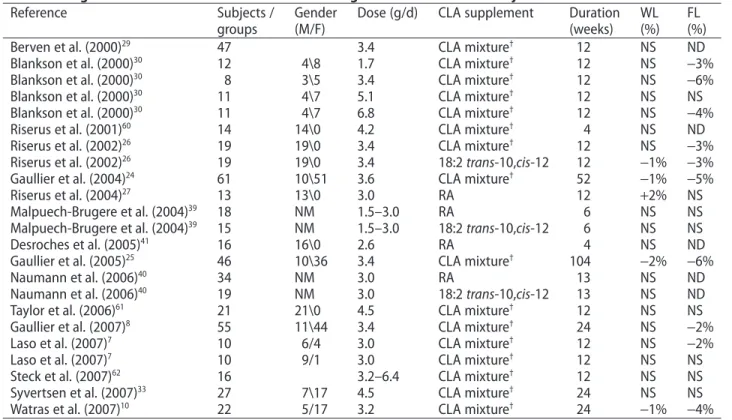
BW and FM loss in overweight and obese humans given CLA are summarized in Table 2. Overweight was defined in all studies as a body mass index of 25–30 kg/m2, and
obesity was defined as a body mass index>30 kg/m2. In
overweight and obese subjects, 4 of 16 studies10,24–26
reported statistically significant BW loss (ⱕ3% in all cases) during CLA supplementation, but the remaining 11 studies showed no significant effect. Seven of the 16 studies reported a loss of 2–6% of body FM during CLA supplementation (Table 2), amongst which four demon-strated loss of both BW and body FM following CLA intake.10,24–26Thus, there is minimal evidence supporting
weight loss in normal-weight, overweight, and obese sub-jects following CLA supplementation (Tables 1 and 2), yet approximately 50% of the studies claim losses of FM after CLA intake in normal, overweight, and obese subjects. Thus, it may be possible that CLA intake leads to a loss of body fat but, unless new, stronger evidence emerges, CLA supplementation should not yet be considered either as a BW and/or FL agent in humans.
INCONSISTENCIES IN EXPERIMENTAL DESIGN
Variations in experimental design may explain observed differences in BW and FM loss across animal versus
Figure 1 Chemical structures of A) rumenic acid, 18:2 cis-9,trans-11 and B) 18:2 trans-10,cis-12.
Table 1 Weight and fat mass loss in normal-weight human subjects.
Reference Subjects /
groups
Gender (M/F) Dose (g/d) CLA supplement Duration
(weeks)
WL (% ) FL (%)
Zambell et al. (2000)19 17 0\17 3.0 Four isomers* 9 NS NS
Benito et al. (2001)12
10 0\10 3.9 Four isomers* 13 NS ND
Mougios et al. (2001)13 12 7\5 0.7 CLA mixture† 4 NS NS
Mougios et al. (2001)13
12 7\5 0.7–1.4 CLA mixture†
4+ 4 NS -4%
Thom et al. (2001)16 20 10\10 1.8 CLA mixture† 12 NS -20%
Smedman et al. (2001)15
26 15\11 4.2 CLA mixture†
12 NS -4%
Noone et al. (2002)20 16 6\10 3.0 CLA mixture† 8 NS ND
Belury et al. (2003)11
21 NM 6.0 CLA mixture†
8 NS ND
Petridou et al. (2003)21 16 0\16 2.1 CLA mixture† 6 NS NS
Tricon et al. (2004)18 39–49 NM 0.6–2.4 RA 8 NS NS
Tricon et al. (2004)18 NM 0.6–2.5 18:2 trans-10,cis-12 8 NS NS
Colakoglu et al. (2006)22 44 0/44 3.6 CLA mixture† 6 NS -8%
Tricon et al. (2006)17
32 32\0 1.4 RA 6 NS ND
Pinkoski et al. (2006)9 38 19/19 5.0 CLA mixture† 7 NS -4%
Lambert et al. (2007)23
64 26/38 3.9 CLA mixture†
12 NS NS
Nazare et al. (2007)14 21 NM 3.8 CLA mixture† 14 NS NS
* Mixture of four CLA isomers: RA, 18:2 trans-10,cis-12, 18:2 cis-11,trans-13, 18:2 trans-8,cis-10.
†CLA mixture is composed of rumenic acid (RA) and 18:2 trans-10,cis-12.
Abbreviations: CLA, conjugated linoleic acid; F, female; FL, fat loss; M, male; RA, rumenic acid; ND, not determined; NM, not mentioned;
human trials. Inconsistencies in age, gender, and genetic predisposition to fat accumulation in the experimental design also exist between animal and human trials. For example, growing mice accumulate 70% less body fat on a diet containing 0.5 weight % of a 50:50 CLA mixture of RA and 18:2 trans-10,cis-12, compared to controls given corn oil.28However, the first human trials attempting to
link CLA supplementation to body FL were all conducted in adult men.19,29,30Among these three trials, only one30
achieved significance for FM loss. Thus, in animal trials, mice were in a growing state, i.e., approximately equiva-lent to the adolescent stage in humans, whereas in the human trials, weight-stable adults were utilized. Such dif-ferences in developmental state may confound the results, because there are important differences in metabolic rate, growth rate, and energy requirements between these two physiological states.
Also, CLA-induced loss of body fat in growing mice may depend on the proportion of brown adipose tissue in young mice,31a depot which is lost in older animals
and does not occur beyond infancy in humans.32Brown
adipose tissue is used mainly for energy and heat produc-tion in young animals and human infants.32
Gender may also influence the efficacy for weight loss in humans. In animals, Park et al.28assumed that male
and female mice were equally sensitive to CLA-induced
body fat gain. However, in humans, five of the clinical trials in which CLA induced loss of body fat in over-weight and obese subjects, had 2–5 times more women than men,8,10,24,25,30suggesting that gender affects body FL.
On the other hand, one CLA study with a female : male ratio of 2 reported no body FL.33Three of these studies
were among the largest published human CLA feeding trials (Table 2).8,24,25However, no one has directly
evalu-ated whether gender impacts the efficiency of CLA for FM loss in humans.
Another factor that may influence body FL is genetic predisposition to fat accumulation.In rats given CLA at 0.5 weight % of the diet, those with a genetic predisposition to fat accumulation such as obese Zucker rats, had retroperi-toneal fat pads that were 15% heavier than those of obese Zucker rats on control diets.Yet in wild-type (lean) Zucker rats given CLA, retroperitoneal fat pads were 24% smaller compared to controls.34 Hence, it was suggested that a
genetic predisposition to fat accumulation could play an important role in the effectiveness of CLA in rats. To our knowledge, no human trials using CLA supplementation have tried to match genetic predisposition to fat accumu-lation with efficacy of CLA on body FL or risk factors for other diseases such as atherosclerosis.
It would be of interest to see if CLA given to humans regulates genes of lipid metabolism such as fatty
acid-Table 2 Weight and fat mass loss in trials with over weight and obese human subjects.
Reference Subjects /
groups
Gender (M/F)
Dose (g/d) CLA supplement Duration
(weeks) WL (%) FL (%) Berven et al. (2000)29 47 3.4 CLA mixture† 12 NS ND
Blankson et al. (2000)30 12 4\8 1.7 CLA mixture† 12 NS -3%
Blankson et al. (2000)30
8 3\5 3.4 CLA mixture†
12 NS -6%
Blankson et al. (2000)30 11 4\7 5.1 CLA mixture† 12 NS NS
Blankson et al. (2000)30
11 4\7 6.8 CLA mixture†
12 NS -4%
Riserus et al. (2001)60 14 14\0 4.2 CLA mixture† 4 NS ND
Riserus et al. (2002)26
19 19\0 3.4 CLA mixture†
12 NS -3%
Riserus et al. (2002)26 19 19\0 3.4 18:2 trans-10,cis-12 12 -1% -3%
Gaullier et al. (2004)24 61 10\51 3.6 CLA mixture† 52 -1% -5%
Riserus et al. (2004)27 13 13\0 3.0 RA 12 +2% NS Malpuech-Brugere et al. (2004)39 18 NM 1.5–3.0 RA 6 NS NS Malpuech-Brugere et al. (2004)39 15 NM 1.5–3.0 18:2 trans-10,cis-12 6 NS NS Desroches et al. (2005)41 16 16\0 2.6 RA 4 NS ND Gaullier et al. (2005)25 46 10\36 3.4 CLA mixture† 104 -2% -6% Naumann et al. (2006)40 34 NM 3.0 RA 13 NS ND Naumann et al. (2006)40 19 NM 3.0 18:2 trans-10,cis-12 13 NS ND
Taylor et al. (2006)61 21 21\0 4.5 CLA mixture† 12 NS NS
Gaullier et al. (2007)8
55 11\44 3.4 CLA mixture†
24 NS -2%
Laso et al. (2007)7 10 6/4 3.0 CLA mixture† 12 NS -2%
Laso et al. (2007)7
10 9/1 3.0 CLA mixture†
12 NS NS
Steck et al. (2007)62 16 3.2–6.4 CLA mixture† 12 NS NS
Syvertsen et al. (2007)33
27 7\17 4.5 CLA mixture†
24 NS NS
Watras et al. (2007)10 22 5/17 3.2 CLA mixture† 24 -1% -4%
†CLA mixture is composed of rumenic acid (RA) and 18:2 trans-10,cis-12.
Abbreviations: CLA, conjugated linoleic acid; F, female; FL, fat loss; M, male; RA, rumenic acid; ND, not determined; NM, not mentioned;
binding protein, peroxisomal proliferator-activator receptor, or fatty acid synthase, which could help our understanding of the precise roles for CLA in biological and physiological processes and assist in explaining the inter-individual responsiveness. Another factor that may influence the outcome of the clinical trials is the caloric intake of the subjects. In animal studies, the caloric intake is usually well controlled and/or monitored. In some animal studies, food is provided ad libitum, i.e., intakes are not controlled but at least the amount of food con-sumed is monitored and the daily nutritional value is known because the animal has eaten only one type of food. In contrast, human trials performed to date have failed to control and/or monitor the dietary intake of the subjects for the whole experimental period.
Thus, the lack of reproducibility between animal and clinical trials using CLA to lower BW and FM may be largely influenced by age, gender, and genetic predisposi-tion to fat accumulapredisposi-tion, but results may also be influ-enced by other confounders such as dietary intake. Differences between experimental designs used in animal and human trials may contribute to low reproducibility of BW and FL results obtained in animal studies compared to clinical trials. The poor reproducibility between human trials is also possibly linked to differences in experimental design. For instance, most of the clinical studies that report a loss of either weight or FM were conducted in Norway or Sweden,8,15,16,24–26,30so the environmental
back-ground of the subjects, such as their country and culture, could have been confounders in an unknown way.
WHICH CLA DOSE AND ISOMER(S) SHOULD BE USED?
In the human trials demonstrating statistically significant weight10,24–26and body fat7–11,15,16,22,24–26,30losses after CLA
intake, the average dose was 3.2 g/d,6which is more than
10 times the habitual normal (0.1–0.3 g/d) intake of CLA in humans.1There is no indication to date that the CLA
dose given to humans was too low (generally between 0.5 and 1% of dietary lipids) to be able to reproduce in humans the loss of weight and fat observed in animals.
Apart from the CLA dose, different mixtures of CLA isomers may contribute to different outcomes of clinical trials, since some single CLA isomers or mixtures have opposing effects.18,35Considering that most CLA
supple-ments are chemically synthesized and would thus contain impurities such as trans, trans CLA, purification of the mixtures is essential because trans, trans CLA might be
toxic to humans if consumed in large quantities.35
Usually, CLA exists as a mixture of two isomers (50:50 of RA and 18:2 trans-10,cis-12). However, several animal studies have suggested that the single conjugated isomer 18:2 trans-10,cis-1236–38 is the body fat-lowering agent,
whereas RA is proposed to be implicated more in growth modulation.38
Some human trials have thus been designed to study the question of whether one CLA isomer is more potent to lower body FM than another. Of four human trials using pure 18:2 trans-10,cis-12,18,26,39,40only one reported
a loss of weight and FM.26Six clinical trials used either
pure RA18,27,39,40or dairy products naturally enriched in
RA17,41 and none reported a loss of weight. Moreover,
none of these studies reported a gain of lean body mass following the intake of RA, as was observed in an animal study using pure RA.38
Thus, although a CLA isomer-dependant effect for body FL has been suggested in animals, in humans, clear evidence to support this hypothesis is lacking, suggesting that the incongruity between the results obtained in animals and humans for body FL may be in part related to the CLA isomer used. Thus, differences in experimental design may contribute importantly to the incongruity across data.
METABOLIC FATE OF CLA
The lack of knowledge about the mechanisms by which single isomers or mixtures of CLA induce body FL in animals and in a few clinical trials may also contribute to this discrepancy as well as to the unknown metabolic fate of CLA after ingestion. In animal studies, the absorption of CLA given either as a free fatty acid or as a triglyceride was around 99%, whether assessed by lymphatic recov-ery42 or fecal analysis after CLA supplementation.43 In
animals, CLA are incorporated similarly to oleic acid into different organs, preferentially accumulating in neutral
lipids.44 The only study reporting CLA absorption in
humans showed that incorporation into chylomicrons of CLA given as ethyl esters was almost 50% less than CLA given as a triglyceride.45 In humans, CLA are
incorpo-rated into plasma and leukocyte lipids in proportion to dietary intake46,47 and have also been identified in milk
and breast adipose tissue.48,49 Aside from these few
studies, the metabolic fate of CLA in humans remains largely unknown. Without knowing the exact process of disposal of CLA, potential heterogeneity in such a system between and within subjects cannot be evaluated, which could account for variations in metabolism and, thus, in efficacy of CLA. Indeed, it is unknown if CLA are either b-oxidized, elongated or desaturated, or compete with other fatty acids such as linoleic acid for signalling pro-cesses in lipid metabolism. In rats, one study has reported that ~70% of14C-CLA was completely b-oxidized within
24 h, a rate similar to that of a-linolenic acid, and 18% more than linoleic acid.50At present, there are no
avail-able data on the b-oxidation of CLA in humans, partly due to a lack of availability of suitable tracers for CLA.
CLA that are not b-oxidized could be elongated and desaturated in rats. Two animals studies have shown that conjugated arachidonic acid (ARA) accounted for 5% and 22% in rats given CLA.51,52Higher conjugated ARA
was obtained in livers of rats that had been reared on a fat-free diet for 2 weeks before being fed with 180 mg/day
CLA for 6 days.53 One study reported data on CLA
metabolites in six healthy adult women following con-sumption of deuterated conjugated CLA mixtures of ethyl esters. No metabolites of deuterated RA were iden-tified but ~5% of 18:2-d4trans-10,cis-12 was D6
desatu-rated to 18:3-d4 cis-6,trans-10,cis-12.54 Thus, it appears
that conversion of RA and 18:2 trans-10,cis-12 to conju-gated ARA in humans is relatively inefficient or does not occur. Recent data show that the conversion rate of LA to ARA in humans is less than 0.1%.55The significance of
possibly producing conjugated ARA to explain discrep-ancies in the results on BW and FL in animals and humans is partly linked to the role of ARA as a ligand for nuclear receptors, such as peroxisomal proliferator-activator receptors and liver X receptor, both of which are involved in multiple cellular processes such as lipid anabolism and catabolism.56CLA is a ligand to
peroxiso-mal proliferator-activated receptors alpha and gamma in vitro and in vivo.57,58Considering that the conversion of
CLA to conjugated ARA seems to be very limited both in animals and humans, this pathway would not seem to explain the discrepancy between animals and humans for losses in weight and fat.
CLA increases b-oxidation of other fatty acids in liver mitochondria and peroxisomes in mice by increas-ing the expression of specific enzymes such as carnitine palmitoyltransferase-1 and acyl coenzyme A.59However,
none of these mechanisms proposed by animal models have yet been evaluated in humans. The unknown fate and poor understanding of the metabolic pathways of CLA in humans is thus probably part of the explanation for the ongoing discrepancy in CLA efficacy between animal and human data.
CONCLUSION
Our assessment of the CLA literature is that body FL is not consistently observed in human subjects given a CLA supplement, and that BW loss is rarely observed after such supplementation. Major reasons for inconsistencies in the results obtained across animal and human trials include the substantially different experimental designs utilized in humans compared to animals, the unknown metabolic fate of CLA, and the absence of confirmed or even plausible mechanisms by which CLA reduce BW and FM. For these reasons, we suggest it is inappropriate to extrapolate to humans results obtained in animals. Until new evidence emerges addressing current
limita-tions, CLA supplementation should not be recommended either as a BW and/or a FL agent in humans.
Acknowledgments
The authors have no conflicting interests to declare. MP holds a post-doctoral fellowship from the Department of Medicine, Université de Sherbrooke, Canada. AFMNet provided support for our ongoing work with CLA.
REFERENCES
1. Bauman DE, Lock AL, Corl BA, Ip C, Salter AM, Parodi PW. Milk fatty acids and human health: Potential role of conjugated linoleic acid and trans fatty acids. In: K. Sejrsen TH, M.O. Nielsen, ed. Ruminant Physiology: Digestion, Metabolism
and Impact of Nutrition on Gene Expression, Immunology and Stress. Wageningen, The Netherlands. Academic Publishers,
Wageningen; 2006:529–561.
2. Kim MR, Park Y, Albright KJ, Pariza MW. Differential responses of hamsters and rats fed a high-fat or low-fat diet supple-mented with conjugated linoleic acid. Nutr Res. 2002;22:715– 722.
3. Koba K, Akahoshi A, Yamasaki M, et al. Dietary conjugated linolenic acid in relation to CLA differently modifies body fat mass and serum and liver lipid levels in rats. Lipids. 2002;37:343–350.
4. Ostrowska E, Muralitharan M, Cross RF, Bauman DE, Dunshea FR. Dietary conjugated linoleic acids increase lean tissue and decrease fat deposition in growing pigs. J Nutr. 1999;129:2037–2042.
5. Szymczyk B, Pisulewski PM, Szczurek W, Hanczakowski P. Effects of conjugated linoleic acid on growth performance, feed conversion efficiency, and subsequent carcass quality in broiler chickens. Br J Nutr. 2001;85:465–473.
6. Whigham LD, Watras AC, Schoeller DA. Efficacy of conjugated linoleic acid for reducing fat mass: a meta-analysis in humans. Am J Clin Nutr. 2007;85:1203–1211.
7. Laso N, Brugue E, Vidal J, et al. Effects of milk supplementa-tion with conjugated linoleic acid (isomers cis-9, trans-11 and trans-10, cis-12) on body composition and metabolic syn-drome components. Br J Nutr. 2007;98:860–867.
8. Gaullier JM, Halse J, Hoivik HO, et al. Six months supplemen-tation with conjugated linoleic acid induces regional-specific fat mass decreases in overweight and obese. Br J Nutr. 2007;97:550–560.
9. Pinkoski C, Chilibeck PD, Candow DG, et al. The effects of conjugated linoleic acid supplementation during resistance training. Med Sci Sports Exerc. 2006;38:339–348.
10. Watras AC, Buchholz AC, Close RN, Zhang Z, Schoeller DA. The role of conjugated linoleic acid in reducing body fat and pre-venting holiday weight gain. Int J Obes (Lond). 2007;31:481– 487.
11. Belury MA, Mahon A, Banni S. The conjugated linoleic acid (CLA) isomer, t10c12-CLA, is inversely associated with changes in body weight and serum leptin in subjects with type 2 diabetes mellitus. J Nutr. 2003(Suppl);133:S257–S260. 12. Benito P, Nelson GJ, Kelley DS, Bartolini G, Schmidt PC, Simon V. The effect of conjugated linoleic acid on plasma lipoproteins and tissue fatty acid composition in humans. Lipids. 2001;36:229–236.
13. Mougios V, Matsakas A, Petridou A, et al. Effect of supple-mentation with conjugated linoleic acid on human serum lipids and body fat. J Nutr Biochem. 2001;12:585–594. 14. Nazare JA, de la Perriere AB, Bonnet F, et al. Daily intake
of conjugated linoleic acid-enriched yoghurts: effects on energy metabolism and adipose tissue gene expression in healthy subjects. Br J Nutr. 2007;97:273–280.
15. Smedman A, Vessby B. Conjugated linoleic acid supple-mentation in humans–metabolic effects. Lipids. 2001;36: 773–781.
16. Thom E, Wadstein J, Gudmundsen O. Conjugated linoleic acid reduces body fat in healthy exercising humans. J Int Med Res. 2001;29:392–396.
17. Tricon S, Burdge GC, Jones EL, et al. Effects of dairy products naturally enriched with cis-9,trans-11 conjugated linoleic acid on the blood lipid profile in healthy middle-aged men. Am J Clin Nutr. 2006;83:744–753.
18. Tricon S, Burdge GC, Kew S, et al. Opposing effects of cis-9,trans-11 and trans-10,cis-12 conjugated linoleic acid on blood lipids in healthy humans. Am J Clin Nutr. 2004;80:614– 620.
19. Zambell KL, Keim NL, Van Loan MD, et al. Conjugated linoleic acid supplementation in humans: effects on body composi-tion and energy expenditure. Lipids. 2000;35:777–782. 20. Noone EJ, Roche HM, Nugent AP, Gibney MJ. The effect of
dietary supplementation using isomeric blends of conju-gated linoleic acid on lipid metabolism in healthy human subjects. Br J Nutr. 2002;88:243–251.
21. Petridou A, Mougios V, Sagredos A. Supplementation with CLA: isomer incorporation into serum lipids and effect on body fat of women. Lipids. 2003;38:805–811.
22. Colakoglu S, Colakoglu M, Taneli F, Cetinoz F, Turkmen M. Cumulative effects of conjugated linoleic acid and exercise on endurance development, body composition, serum leptin and insulin levels. J Sports Med Phys Fitness. 2006;46:570– 577.
23. Lambert EV, Goedecke JH, Bluett K, et al. Conjugated linoleic acid versus high-oleic acid sunflower oil: effects on energy metabolism, glucose tolerance, blood lipids, appetite and body composition in regularly exercising individuals. Br J Nutr. 2007;97:1001–1011.
24. Gaullier JM, Halse J, Hoye K, et al. Conjugated linoleic acid supplementation for 1 y reduces body fat mass in healthy overweight humans. Am J Clin Nutr. 2004;79:1118–1125. 25. Gaullier JM, Halse J, Hoye K, et al. Supplementation with
con-jugated linoleic acid for 24 months is well tolerated by and reduces body fat mass in healthy, overweight humans. J Nutr. 2005;135:778–784.
26. Riserus U, Arner P, Brismar K, Vessby B. Treatment with dietary trans10,cis12 conjugated linoleic acid causes isomer-specific insulin resistance in obese men with the metabolic syndrome. Diabetes Care. 2002;25:1516–1521.
27. Riserus U, Vessby B, Arnlöv J, Basu S. Effect of cis-9, trans-11 conjugated linoleic acid supplementation on insulin sensiti-vity, lipid peroxidation, and proinflammatory markers in obese men. Am J Clin Nutr. 2004;80:279–283.
28. Park Y, Albright KJ, Liu W, Storkson JM, Cook ME, Pariza MW. Effect of conjugated linoleic acid on body composition in mice. Lipids. 1997;32:853–858.
29. Berven G, Bye A, Hals O, et al. Safety of conjugated linoleic acid (CLA) in overweight or obese human volunteers. Eur J Lipid Sci Technol. 2000;102:455–462.
30. Blankson H, Stakkestad JA, Fagertun H, Thom E, Wadstein J, Gudmundsen O. Conjugated linoleic acid reduces body fat
mass in overweight and obese humans. J Nutr. 2000;130: 2943–2948.
31. Wahle KW, Heys SD, Rotondo D. Conjugated linoleic acids: are they beneficial or detrimental to health? Prog Lipid Res. 2004;43:553–587.
32. Klingenberg M, Huang SG. Structure and function of the uncoupling protein from brown adipose tissue. Biochim Biophys Acta. 1999;1415:271–296.
33. Syvertsen C, Halse J, Hoivik HO, et al. The effect of 6 months supplementation with conjugated linoleic acid on insulin resistance in overweight and obese. Int J Obes (Lond). 2007;31:1148–1154.
34. Sisk MB, Hausman DB, Martin RJ, Azain MJ. Dietary conju-gated linoleic acid reduces adiposity in lean but not obese Zucker rats. J Nutr. 2001;131:1668–1674.
35. Gaullier JM, Berven G, Blankson H, Gudmundsen O. Clinical trial results support a preference for using CLA preparations enriched with two isomers rather than four isomers in human studies. Lipids. 2002;37:1019–1025.
36. Choi Y, Kim YC, Han YB, Park Y, Pariza MW, Ntambi JM. The trans-10,cis-12 isomer of conjugated linoleic acid downregu-lates stearoyl-CoA desaturase 1 gene expression in 3T3-L1 adipocytes. J Nutr. 2000;130:1920–1924.
37. Kang K, Liu W, Albright KJ, Park Y, Pariza MW. trans-10,cis-12 CLA inhibits differentiation of 3T3-L1 adipocytes and decreases PPAR gamma expression. Biochem Biophys Res Commun. 2003;303:795–799.
38. Park Y, Storkson JM, Albright KJ, Liu W, Pariza MW. Evidence that the trans-10,cis-12 isomer of conjugated linoleic acid induces body composition changes in mice. Lipids. 1999;34:235–241.
39. Malpuech-Brugere C, Verboeket-van de Venne WP, Mensink RP, et al. Effects of two conjugated linoleic acid isomers on body fat mass in overweight humans. Obes Res. 2004;12:591–598.
40. Naumann E, Carpentier YA, Saebo A, et al. Cis-9, trans- 11 and trans-10, cis-12 conjugated linoleic acid (CLA) do not affect the plasma lipoprotein profile in moderately overweight sub-jects with LDL phenotype B. Atherosclerosis. 2006;188:167– 174.
41. Desroches S, Chouinard PY, Galibois I, et al. Lack of effect of dietary conjugated linoleic acids naturally incorporated into butter on the lipid profile and body composition of over-weight and obese men. Am J Clin Nutr. 2005;82:309–319. 42. Martin JC, Sébédio J-L, Caselli C, Pimont C, Martine L,
Bernard A. Lymphatic delivery and in vivo pancreatic lipase hydrolysis of glycerol esters of conjugated linoleic acids in rats. J Nutr. 2000;130:1108–1114.
43. Plourde M, Sergiel JP, Chardigny JM, Gregoire S, Angers P, Sebedio JL. Absorption and metabolism of conjugated alpha-linolenic acids given as free fatty acids or triacylglycerols in rats. Nutr Metab. 2006;3:8.
44. Carta G, Angioni E, Murru E, Melis MP, Spada S, Banni S. Modu-lation of lipid metabolism and vitamin A by conjugated lino-leic acid. Prost Leukot Essent Fatty Acids. 2002;67:187–191. 45. Fernie CE, Dupont IE, Scruel O, Carpentier YA, Sébédio JL,
Scrimgeour CM. Relative absorption of conjugated linoleic acid as triacylglycerols, free fatty acid and ethyl ester in a functional food matrix. Eur J Lipid Sci. Technol. 2004;106:347–354.
46. Burdge GC, Lupoli B, Russell JJ, et al. Incorporation of cis-9,trans-11 or trans-10,cis-12 conjugated linoleic acid into plasma and cellular lipids in healthy men. J Lipid Res. 2004;45:736–741.
47. Burdge GC, Tricon S, Morgan R, et al. Incorporation of cis-9, trans-11 conjugated linoleic acid and vaccenic acid (trans-11 18 : 1) into plasma and leucocyte lipids in healthy men con-suming dairy products naturally enriched in these fatty acids. Br J Nutr. 2005;94:237–243.
48. Chajes V, Lavillonniere F, Maillard V, et al. Conjugated linoleic acid content in breast adipose tissue of breast cancer patients and the risk of metastasis. Nutr Cancer. 2003;45:17–23. 49. Hasin A, Griinari JM, Williams JE, Shahin AM, McGuire MA,
McGuire MK. Consumption of c9,t11-18:2 or t10,c12-18:2 enriched dietary supplements does not influence milk macronutrients in healthy, lactating women. Lipids. 2007;11. 50. Sergiel JP, Chardigny JM, Sebedio JL, et al. Beta-oxidation of conjugated linoleic acid isomers and linoleic acid in rats. Lipids. 2001;36:1327–1329.
51. Banni S, Carta G, Angioni E, et al. Distribution of conjugated linoleic acid and metabolites in different lipid fractions in the rat liver. J Lipid Res. 2001;42:1056–1061.
52. Sébédio J-L, Juaneda P, Grégoire S, Chardigny JM, Martin JC, Ginies C. Geometry of conjugated double bonds of cla isomers in a commercial mixture and in their hepatic 20:4 metabolites. Lipids. 1999;34:1319–1325.
53. Sebedio JL, Juaneda P, Dobson G, et al. Metabolites of conju-gated isomers of linoleic acid (CLA) in the rat. Biochim Biophys Acta. 1997;1345:5–10.
54. Emken EA, Adlof RO, Duval S, Nelson G, Benito P. Effect of dietary conjugated linoleic acid (CLA) on metabolism of isotope-labeled oleic, linoleic, and CLA isomers in women. Lipids. 2002;37:741–750.
55. Plourde M, Cunnane SC. Extremely limited synthesis of long chain polyunsaturates in adults: implications for their dietary
essentiality and use as supplements. Appl Physiol Nutr Metab. 2007;32:619–634.
56. Chawla A, Repa JJ, Evans RM, Mangelsdorf DJ. Nuclear recep-tors and lipid physiology: opening the X-files. Science. 2001;294:1866–1870.
57. Granlund L, Juvet LK, Pedersen JI, Nebb HI. Trans10, cis12-conjugated linoleic acid prevents triacylglycerol accumula-tion in adipocytes by acting as a PPARgamma modulator. J Lipid Res. 2003;44:1441–1452.
58. Moya-Camarena SY, Van den Heuvel JP, Belury MA. Conju-gated linoleic acid activates peroxisome proliferator-activated receptor alpha and beta subtypes but does not induce hepatic peroxisome proliferation in Sprague-Dawley rats. Biochim Biophys Acta. 1999;1436:331–342.
59. Degrace P, Demizieux L, Gresti J, Chardigny JM, Sebedio JL, Clouet P. Hepatic steatosis is not due to impaired fatty acid oxidation capacities in C57BL/6J mice fed the conjugated trans-10,cis-12-isomer of linoleic acid. J Nutr. 2004;134:861– 867.
60. Riserus U, Berglund L, Vessby B. Conjugated linoleic acid (CLA) reduced abdominal adipose tissue in obese middle-aged men with signs of the metabolic syndrome: a ran-domised controlled trial. Int J Obes Relat Metab Disord. 2001;25:1129–1135.
61. Taylor JS, Williams SR, Rhys R, James P, Frenneaux MP. Conju-gated linoleic acid impairs endothelial function. Arterioscler Thromb Vasc Biol. 2006;26:307–312.
62. Steck SE, Chalecki AM, Miller P, et al. Conjugated linoleic acid supplementation for twelve weeks increases lean body mass in obese humans. J Nutr. 2007;137:1188–1193.