Université de Montréal
Génération de résumés par abstraction
par
Pierre-Etienne Genest
Département d’informatique et de recherche opérationnelle
Faculté des arts et des sciences
Thèse présentée à la Faculté des arts et des sciences
en vue de l’obtention du grade de Philosophiæ Doctor (Ph.D.)
en informatique
Mai, 2013
c
RÉSUMÉ
Cette thèse présente le résultat de plusieurs années de recherche dans le domaine de
la génération automatique de résumés. Trois contributions majeures, présentées sous la
forme d’articles publiés ou soumis pour publication, en forment le cœur. Elles retracent
un cheminement qui part des méthodes par extraction en résumé jusqu’aux méthodes par
abstraction.
L’expérience HexTac, sujet du premier article, a d’abord été menée pour évaluer le
niveau de performance des êtres humains dans la rédaction de résumés par extraction de
phrases. Les résultats montrent un écart important entre la performance humaine sous la
contrainte d’extraire des phrases du texte source par rapport à la rédaction de résumés
sans contrainte. Cette limite à la rédaction de résumés par extraction de phrases, observée
empiriquement, démontre l’intérêt de développer d’autres approches automatiques pour
le résumé.
Nous avons ensuite développé un premier système selon l’approche Fully
Abstrac-tive Summarization, qui se situe dans la catégorie des approches semi-extracAbstrac-tives, comme
la compression de phrases et la fusion de phrases. Le développement et l’évaluation du
système, décrits dans le second article, ont permis de constater le grand défi de
géné-rer un résumé facile à lire sans faire de l’extraction de phrases. Dans cette approche,
le niveau de compréhension du contenu du texte source demeure insuffisant pour
gui-der le processus de sélection du contenu pour le résumé, comme dans les approches par
extraction de phrases.
Enfin, l’approche par abstraction basée sur des connaissances nommée K-BABS est
proposée dans un troisième article. Un repérage des éléments d’information pertinents
est effectué, menant directement à la génération de phrases pour le résumé. Cette
ap-proche a été implémentée dans le système ABSUM, qui produit des résumés très courts
mais riches en contenu. Ils ont été évalués selon les standards d’aujourd’hui et cette
éva-luation montre que des résumés hybrides formés à la fois de la sortie d’ABSUM et de
phrases extraites ont un contenu informatif significativement plus élevé qu’un système
provenant de l’état de l’art en extraction de phrases.
Mots clés : Résumés automatiques, Résumés par abstraction, Génération des
langues naturelles, Traitement automatique des langues naturelles
ABSTRACT
This Ph.D. thesis is the result of several years of research on automatic text
summariza-tion. Three major contributions are presented in the form of published and submitted
papers. They follow a path that moves away from extractive summarization and toward
abstractive summarization.
The first article describes the HexTac experiment, which was conducted to evaluate
the performance of humans summarizing text by extracting sentences. Results show
a wide gap of performance between human summaries written by sentence extraction
and those written without restriction. This empirical performance ceiling to sentence
extraction demonstrates the need for new approaches to text summarization.
We then developed and implemented a system, which is the subject of the second
article, using the Fully Abstractive Summarization approach. Though the name suggests
otherwise, this approach is better categorized as semi-extractive, along with sentence
compression and sentence fusion. Building and evaluating this system brought to light
the great challenge associated with generating easily readable summaries without
ex-tracting sentences. In this approach, text understanding is not deep enough to provide
help in the content selection process, as is the case in extractive summarization.
As the third contribution, a knowledge-based approach to abstractive summarization
called K-BABS was proposed. Relevant content is identified by pattern matching on
an analysis of the source text, and rules are applied to directly generate sentences for
the summary. This approach is implemented in a system called ABSUM, which
gen-erates very short and content-rich summaries. An evaluation was performed according
to today’s standards. The evaluation shows that hybrid summaries generated by adding
extracted sentences to ABSUM’s output have significantly more content than a
state-of-the-art extractive summarizer.
Mots clés: Automatic Summarization, Abstractive Summarization, Natural
Lan-guage Generation, Natural LanLan-guage Processing
TABLE DES MATIÈRES
RÉSUMÉ . . . .
ii
ABSTRACT . . . iii
TABLE DES MATIÈRES . . . iv
REMERCIEMENTS . . . .
v
CHAPITRE 1 :
INTRODUCTION . . . .
1
1.1 Définition du problème . . . .
1
1.2 Contexte de notre recherche . . . .
2
1.2.1 Remise en question de l’approche par extraction de phrases . .
3
1.2.2 Résumer par division de phrases . . . .
4
1.2.3 L’approche K-BABS et le système ABSUM . . . .
6
CHAPITRE 2 :
HEXTAC : GÉNÉRATION MANUELLE DE RÉSUMÉS PAR
EXTRACTION . . . .
7
CHAPITRE 3 :
GÉNÉRATION DE RÉSUMÉS PAR DIVISION DE PHRASES 14
CHAPITRE 4 :
GÉNÉRATION DE RÉSUMÉS PAR ABSTRACTION
BA-SÉE SUR DES CONNAISSANCES . . . 25
CHAPITRE 5 :
CONCLUSION . . . 60
BIBLIOGRAPHIE . . . 63
I.1
Preprocessing . . . .
vii
I.1.1
Input Format . . . .
vii
I.1.2
Text Cleaning and Uniformization . . . .
vii
I.1.3
Sentence Segmentation . . . .
vii
I.1.4
Post-Segmentation Text Cleaning . . . viii
I.2
The Task Blueprint . . . viii
I.3
Summarization System . . . .
xii
II.1 Automatic Metrics and ROUGE . . . .
xv
REMERCIEMENTS
Merci au professeur Guy Lapalme pour sa direction attentionnée et chaleureuse, sa
générosité et sa patience. À Fabrizio Gotti pour son aide technique et son amitié. À mon
épouse Myriam et mes parents Suzanne et Bernard-André pour leur appui tout au long
de mes études.
CHAPITRE 1
INTRODUCTION
Dans notre monde surchargé en information, le grand besoin d’outils pour en
faci-liter l’accès n’est plus à démontrer. Un utilisateur désirant accéder à un certain contenu
fait face à deux problèmes : la recherche de documents pertinents, et la recherche de
l’information pertinente à l’intérieur des documents trouvés. De nombreux outils pour
la recherche de documents sont maintenant disponibles ; la popularité des engins de
re-cherche de documents sur Internet tel Google est d’ailleurs sans équivoque. Pour ce qui
est de faciliter la recherche des informations pertinentes, peu d’outils sont disponibles et
utilisés à grande échelle. La génération automatique de résumés est une solution
envisa-geable pour améliorer l’efficacité de la consultation des documents.
Cette thèse présente le résultat de plusieurs années de recherche dans le domaine de
la génération automatique de résumés. Trois contributions majeures, présentées sous la
forme d’articles publiés ou qui le seront prochainement, en forment le cœur. Ce chapitre
définit le problème et le contexte de recherche, tout en introduisant les articles qui seront
reproduits.
1.1 Définition du problème
Nous voulons produire automatiquement un court résumé informatif à partir de
plu-sieurs documents textuels portant sur un même sujet d’actualité.
Un résumé permet d’accéder rapidement aux éléments d’information importants dans
des documents. Ce travail s’intéresse en particulier aux résumés de type informatif,
c’est-à-dire ceux qui proposent une condensation du contenu d’un texte sans l’altérer et en ne
gardant que l’essentiel. L’alternative serait de rédiger plutôt un résumé indicatif, qui
pro-pose de décrire les différentes sections du documents sans en donner les résultats.
Bien qu’il soit possible de produire des résumés pour des documents non-textuels ou
multi-média, la tâche reste difficile, même en nous limitant à des documents textuels.
Le genre de texte à résumer joue également un grand rôle sur le type de résumé qui
sera produit. Nous avons décidé de poursuivre dans la voie la plus fréquemment
em-pruntée dans ces dernières années et nous nous sommes attardé aux résumés portant sur
des textes de nouvelles provenant d’agences de presse, afin de pouvoir comparer notre
approche à celles des autres chercheurs dans le domaine. Au cours de la dernière
décen-nie, des campagnes d’évaluations annuelles de systèmes automatiques de génération de
résumés ont eu lieu dans le cadre des conférences internationales Document
Understan-ding Conference
1(DUC), de 2001 à 2007, et Text Analysis Conference
2(TAC), de 2008
1
http://duc.nist.gov/
à 2011. Ces campagnes d’évaluation ont notamment rendu disponibles des corpus de
nouvelles journalistiques et de résumés de celles-ci, sur lesquels il est possible de tester
les systèmes et de les comparer.
Dans ce contexte, le résumé multi-documents est devenu la tâche la plus populaire,
pour laquelle un résumé doit effectuer une condensation du contenu de plusieurs sources.
Il s’agit d’agglomérer des informations et découvrir les éléments sur lesquels les sources
sont en accord (les désaccords entre sources peuvent aussi être relevés dans le résumé).
Il est facile aujourd’hui d’obtenir en ligne un ensemble d’articles à propos d’un sujet
d’actualité. Pour mieux répondre au besoin d’information du lecteur, il serait d’autant
plus intéressant de lui proposer un résumé plus court que n’importe lequel de ces articles,
et qui contiendrait l’essentiel des faits relatifs à l’événement d’intérêt. C’est justement
le problème de recherche que nous traitons dans cette thèse.
1.2 Contexte de notre recherche
Les travaux de recherche présentés dans cette thèse sont le fruit d’une longue
ré-flexion sur les méthodes de génération automatique de résumés. Cette réré-flexion a débuté
dans le cadre de travaux de maîtrise [2], qui ont porté sur le problème des résumés
multi-documents d’articles de journaux et mené au développement du News Symbolic
Summarizer (NESS). Les résumés étaient générés à partir d’un groupe de 10 articles de
journaux et d’une requête de l’utilisateur qui servait à orienter le résumé. Un deuxième
résumé devait aussi être généré sur un deuxième groupe de 10 articles de journaux, en
évitant de répéter toute information contenue dans le premier groupe de 10 articles.
L’approche utilisé dans NESS génère des résumés en extrayant des phrases provenant
des articles à résumer. Elle se démarquait d’autres approches similaires par son côté
symbolique, utilisant un parseur syntaxique et une base de donnée lexicale pour recueillir
des connaissances linguistiques riches pour guider la sélection de phrases. Un score de
pertinence pour chaque phrase de chacun des articles était calculé à partir de critères
pondérés, certains critères étaient standards pour cette tâche, alors que d’autres étaient
nouveaux. Les critères standards utilisés étaient la similarité entre les mots de la phrase
et la requête, calculée à l’aide d’un poids TF∗IDF, la position de la phrase dans le texte
et le poids informationnel de la phrase, donné par la somme des poids IDF de tous les
mots de la phrase. Les critères innovateurs étaient d’utiliser la profondeur d’arbre pour
pondérer quels mots sont les plus représentatifs de la phrase et de faire appel à la base
lexicale WordNet [13] pour inclure des synonymes dans le calcul de similarité.
NESS a été soumis à la campagne d’évaluation de résumés automatiques de TAC
2008. Deux versions du système ont été soumises pour la tâche de résumés orientés
multi-documents, une avec tous les critères pondérés, l’autre sans les critères considérés
nouveaux. Or, la version du système qui n’utilisait pas les outils linguistiques plus riches
comme un parseur et WordNet a obtenu les meilleurs résultats. De fait, cette version du
système a été meilleure non seulement que la version avec tous les critères, mais
ment la meilleure soumission d’un système (autant au niveau de la qualité linguistique
que du score global) de toute la campagne d’évaluation, qui comptait 57 soumissions.
Cette soumission avait pourtant été considérée simplement comme une version de base
(baseline) durant le développement de NESS.
1.2.1 Remise en question de l’approche par extraction de phrases
Les excellents résultats de la version dépouillée de NESS lors de TAC 2008 étaient
surprenants. Il n’y avait à toute fin pratique aucune innovation dans cette version, si
ce n’est l’effort considérable qui avait été consacré à pondérer les critères de
sélec-tion de phrases. Des approches déployant des modèles plus complexes ou utilisant des
ressources nouvelles n’obtenaient pas de meilleurs résultats. Ceci était inquiétant pour
l’avancement de la recherche en résumés automatiques. Jusqu’où pouvait-on aller avec
des approches par extraction de phrases ?
C’est justement la question à laquelle a voulu répondre l’expérience Human
Extrac-tion for the Text Analysis Conference [10] (HexTac), sujet du chapitre 2 de la thèse.
Lors des campagnes d’évaluation ouvertes à tous et dans la littérature en général, ce
sont des résumés rédigés par des humains qui servent de base à la comparaison et aux
évaluations automatiques. Ces modèles sont toujours composés sans contraintes et, bien
qu’ils relèvent adéquatement l’écart qui existe entre les performances humaines et celles
des machines, ils ne permettent pas de déterminer le degré de performance des systèmes
sur la tâche spécifique d’extraction de phrases pour rédiger un résumé. HexTac
propo-sait donc de comparer les systèmes automatiques avec des modèles de l’extraction de
phrases écrits par des humains.
En collaboration avec les organisateurs de la compétition, mais à l’insu de la majorité
des participants, un ensemble de résumés composés manuellement par extraction a été
créé. HexTac a fait appel à cinq résumeurs pour rédiger les 88 résumés de la participation
à la campagne d’évaluation de TAC 2009. Ces résumés d’une longueur de 100 mots ou
moins ont été composés uniquement à partir de phrases contenues intégralement dans
les documents à résumer et aucune modification des phrases n’a été faite.
Les résultats de cette expérience ont essentiellement mené à deux conclusions.
Pre-mièrement, l’écart de performance entre les résumés automatiques et les résumés
pro-duits manuellement par extraction est faible. Il reste donc peu de chemin à faire pour
améliorer la performance des systèmes par extraction pure. Deuxièmement, l’écart de
performance entre les résumés rédigés manuellement par extraction et ceux rédigés
ma-nuellement sans restrictions est très important. En d’autres mots, pour les résumés très
courts, même si des être humains sélectionnent les phrases du résumé, les approches par
extraction de phrases ne donnent pas des résultats satisfaisants. Pour se rapprocher des
performances humaines, il faudra considérer d’autres catégories d’approches.
Nous profitons de cette section pour apporter quelques précisions sur l’article publié.
À la section 3.3, la métrique d’évaluation ROUGE a été utilisée pour vérifier si HexTac
pourrait adéquatement servir de modèles à la place des résumés de références rédigés
manuellement sans contrainte. ROUGE compare les n-grammes (ici des bigrammes ont
été utilisés, puisqu’il s’agit du standard) des résumés générés automatiquement aux
n-grammes de résumés modèles. La métrique proposée, HexTac-ROUGE, utilise comme
modèles les résumés de HexTac plutôt que les résumés de référence. Les mêmes
para-mètres, i.e. ceux qui sont utilisés par les organisateurs de TAC 2009, ont été utilisés pour
faire tourner ROUGE dans tous les cas. On note que HexTac-ROUGE est bien corrélé
avec l’évaluation manuelle (les corrélations dans le tableau 4 sont des corrélations de
Pearson), mais toutefois très nettement moins que le ROUGE standard, soit le ROUGE
qui utilise les résumés de référence comme modèle.
Dans le but de continuer à participer annuellement à TAC, un nouveau système de
ré-daction de résumés par extraction nommé NESS2 [9] a également été produit pour TAC
2009. NESS2 se voulait relativement simple, étant donné que les resources linguistiques
plus riches ne semblaient pas apporter une contribution positive aux résumés. Il
cher-chait à vérifier l’hypothèse selon laquelle un résumé par extraction gagnait à effectuer
deux passes pour la sélection des phrases, l’une servant à donner un score de pertinence
à chaque phrase, la seconde à sélectionner quel sous-ensemble de phrases ayant un score
élevé formerait le meilleur résumé, avec le moins de redondance possible. Cette
hypo-thèse fut vérifiée avec succès, et NESS2 a obtenu le 4
emeilleur score global et le 4
emeilleur score de qualité linguistique sur les 52 soumissions envoyées cette année-là.
Encore une fois, un système par extraction relativement simple obtenait un score parmi
les meilleurs. Ceci contribuait à confirmer les conclusions de HexTac : il y a sans doute
peu à gagner à continuer d’optimiser les systèmes par extractions de phrases.
1.2.2 Résumer par division de phrases
On sépare habituellement les approches à la génération automatique de résumés de
texte en deux classes : les résumés par extraction et les résumés par abstraction [12].
L’extraction consiste à former un résumé en retirant et réorganisant des groupes lexicaux
(mots, propositions, phrases, paragraphes) de la source. À l’opposé, l’abstraction est une
reformulation de la source qui peut inclure des entités textuelles n’apparaissant pas dans
la source.
Bien que la plupart des systèmes automatiques produisent des résumés par extraction
(de phrases), les conclusions de HexTac ne laissent pourtant pas de doute sur la voie à
suivre pour progresser : il faudra se concentrer sur les approches par abstraction, ou à tout
le moins sur les approches faisant nettement plus que simplement de l’extraction. Des
approches qu’on pourrait considérer comme semi-extractives ont été proposées, comme
la compression de phrases et la fusion de phrases.
Des travaux [5] effectués en 2010-2011 dans le cadre de cette thèse ont mené à une
nouvelle approche semi-extractive pour la rédaction automatique de résumés, appelée
Fully Abstractive Summarization, décrite au chapitre 3. L’élément central de celle-ci se
trouve dans le concept de Information Item (InIt), qui est défini comme étant le plus
petit élément d’information cohérent dans un texte ou dans une phrase. L’objectif est de
trouver ces InIts dans le texte source, de sélectionner ceux qui permettraient de répondre
au besoin d’information de l’utilisateur, puis de générer un résumé contenant les InIts
les plus pertinents.
Dans cette première tentative de générer des résumés par abstraction, un raccourci
est utilisé pour simplifier la découverte et la manipulation des InIts. Les InIts sont
re-présentés par des triplets sujet-verbe-complément d’objet direct. Une phrase courte au
style télégraphique est générée pour chaque InIt avant que la sélection ne soit
effec-tuée. Puis, le résumé est assemblé à partir de ces phrases générées en s’appuyant sur
les méthodes habituellement employées dans l’extraction de phrases. Ceci s’apparente
à d’autres méthodes comme la compression de phrases et la fusion de phrases, tout en
offrant l’avantage d’avoir accès à des phrases très courtes lorsque vient le temps de les
assembler pour le résumé.
Un système implémentant cette approche fut soumis aux campagnes d’évaluation de
TAC 2010 [4] et TAC 2011 [6]. Les résultats montrent que l’approche n’est pas encore
mature et qu’il reste beaucoup à faire au niveau de la génération de phrases
syntaxi-quement et sémantisyntaxi-quement correctes. Il était très probable, en effet, que ce système
montre une faiblesse relative au niveau de la qualité linguistique par rapport aux autres
approches automatiques, qui ont habituellement l’avantage d’extraire des phrases
exis-tantes telles quelles. Au niveau du contenu du résumé, le système ne performe pas mal,
au point où le score global obtenu est particulièment élevé compte tenu de la faible
qua-lité linguistique. Il n’en demeure pas moins que ce système n’est pas compétitif lorsque
comparé aux meilleurs extracteurs de phrases.
En somme, cette initiative a permis d’observer à nouveau les failles inhérentes aux
approches par abstraction qui n’effectuent que des manipulations syntaxiques. Ce
sys-tème peut être décrit de façon plus directe comme effectuant de la division de phrases
en plus courtes phrases ne contenant qu’une idée, ces phrases étant utilisées pour la
ré-daction du résumé, ce qui est similaire à réduire la taille de la phrase pour le résumé
(compression de phrases).
Tout en réfléchissant aux façons qui pourraient être utilisées pour insérer de l’analyse
sémantique ou de la compréhension du texte dans le système de résumé, un bref travail
sur l’évaluation de résumés à l’aide de méthodes modernes d’apprentissage machine [3]
a été effectué, menant à des résultats intéressants. La méthode standard pour l’évaluation
automatique de résumés, ROUGE [11], obtient un très bon taux de corrélation avec les
métriques manuelles, lorsque l’échantillon de résumés de chaque approche à comparer
est élevé, mais un taux beaucoup plus faible lorsqu’on observe ses prédictions sur de
petits échantillons. Le système d’évaluation automatique utilisant le Deep Learning a
été développé et testé, ce qui a permis d’observer qu’il performe mieux que ROUGE sur
les prédictions de performance de systèmes à comparer, lorsque de petits échantillons
sont utilisés.
1.2.3 L’approche K-BABS et le système ABSUM
Les difficultés observées lors du développement de l’approche par division de phrases
ont permis de constater que l’analyse syntaxique des phrases n’était pas suffisante pour
obtenir le genre d’analyse en profondeur du contenu des documents à résumer
néces-saire pour une approche réellement non-extractive. En tentant de produire à la main de
bons résumés à partir des InIts trouvés dans l’approche par division des phrases, nous
avons remarqué que quelques connaissances propres au domaine et à la tâche suffisaient
pour guider adéquatement la découverte d’informations, sa sélection et la génération du
résumé. Des travaux préliminaires [7] ont permis d’établir la faisabilité d’une approche
où de telles connaissances sont mises à contribution.
Cette réflexion nous a permis de développer l’approche
Knowledge-Based Abstractive
Summarization (K-BABS) [8] pour la génération automatique de résumés par
abstrac-tion, décrite au chapitre 4 qui inclut également une revue de littérature complète des
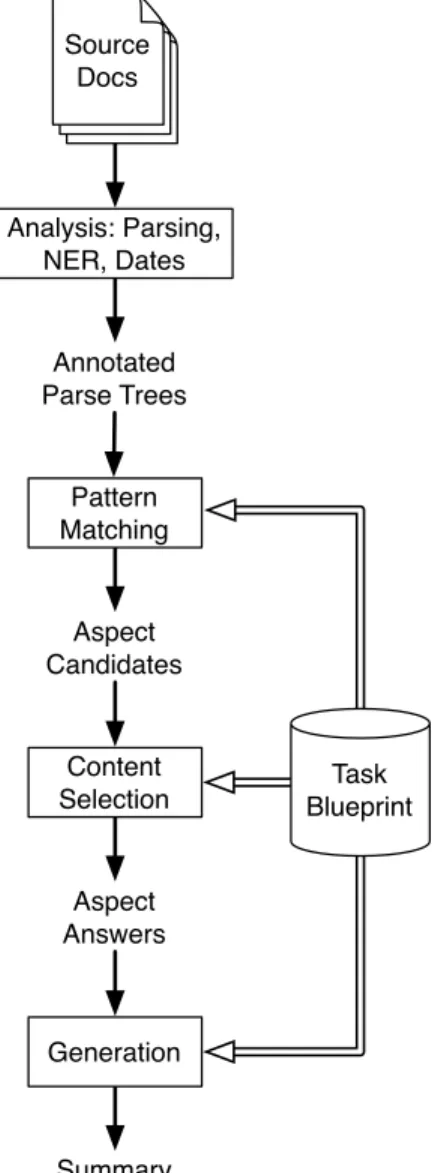
approches par abstraction. L’architecture de K-BABS repose sur une analyse des
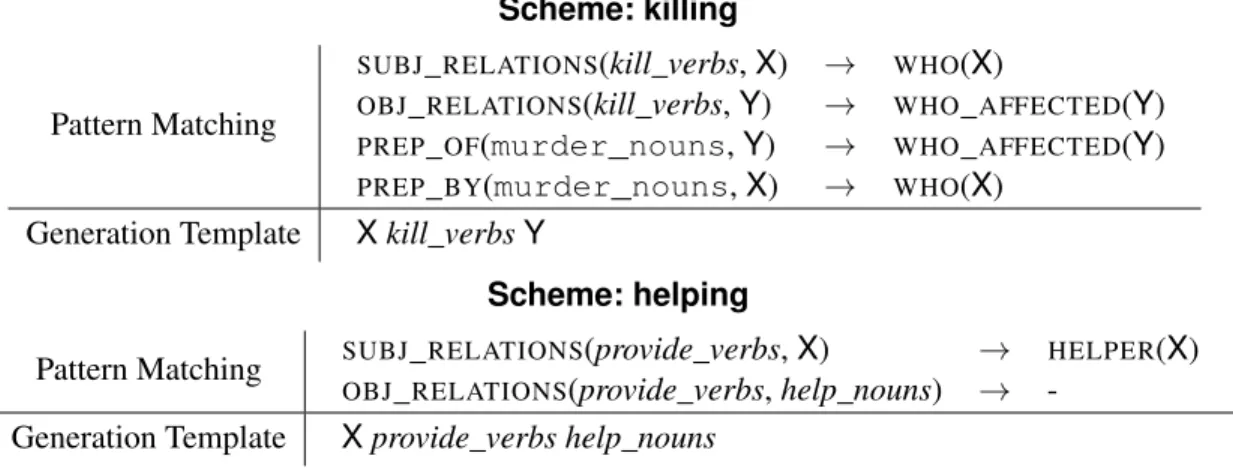
docu-ments sources et sur un plan, appelé Task Blueprint, qui décrit des transformations de
la représentation du texte résultant de l’analyse vers du texte généré pour le résumé.
Ces transformations encodent implicitement des connaissances à propos de la tâche à
accomplir et du domaine ou du sujet des documents à résumer.
Le système
Abstractive Summarizer of Université de Montréal (ABSUM) a été
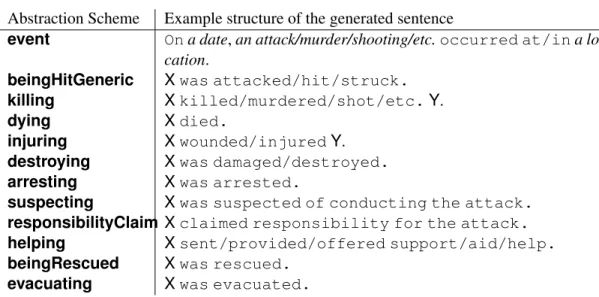
réa-lisé pour la tâche de résumés guidés de TAC 2011, en suivant la théorie K-BABS. Deux
task blueprints ont été contruits manuellement pour répondre à deux grandes catégories
de sujets d’actualité. ABSUM génère de très courts résumés faciles à lire. Évalués sur
le corpus de TAC 2011, les résumés générés par une combinaison de ABSUM et d’un
système faisant partie de l’état de l’art en extraction de phrases contiennent plus
d’infor-mations pertinentes que tout autre système ayant participé à la campagne d’évaluation.
Ces résumés sont significativement plus informatifs que si ABSUM n’était pas utilisé.
De plus, les résumés produits par ABSUM ont une meilleure qualité linguistique et une
densité de contenu presque deux fois supérieure aux autres systèmes automatiques.
En somme, l’utilisation d’ABSUM dans un contexte hybride représente l’état de l’art
de la génération automatique de résumés textuels. L’approche K-BABS, qui sous-tend
ABSUM, est d’ailleurs la contribution principale de cette thèse.
CHAPITRE 2
HEXTAC : GÉNÉRATION MANUELLE DE RÉSUMÉS PAR EXTRACTION
Pierre-Etienne Genest, Guy Lapalme et Mehdi Yousfi-Monod. HexTac : the Creation
of a Manual Extractive Run. Dans Proceedings of the Second Text Analysis Conference,
Gaithersburg, Maryland, USA, 2009. National Institute of Standards and Technology.
Cet article a été publié dans le cadre d’une participation spéciale à la conférence Text
Analysis Conference 2009. Les résumés construits à l’aide de HexTac ont été utilisés
comme nouvelle référence (baseline 3) par les organisateurs de la conférence, à l’insu
des autres participants, pour évaluer la performance espérée des approches de génération
de résumés par extraction de phrases.
H
EX
T
AC
: the Creation of a Manual Extractive Run
Pierre-Etienne Genest, Guy Lapalme, Mehdi Yousfi-Monod
–
–
–
–
--Abstract
This article presents an attempt to
es-tablish an upper bound on purely
ex-tractive summarization techniques.
Al-together, five human summarizers
com-posed 88 standard and update summaries
of the TAC 2009 competition. Only entire
sentences of the source documents were
selected by the human “extractors”,
with-out modification, to form 100-word
sum-maries. These summaries obtained better
scores than any automatic summarization
system in both linguistic quality and
over-all responsiveness, while still doing worse
than any human abstractive summarizer.
1 Introduction
Year after year, notably at the Document
Under-standing Conference (DUC) and later the Text
Anal-ysis Conference (TAC), the best-performing
sum-marization systems have been sentence
extraction-based rather than abstractions of the source
doc-uments. However, in those conferences and in
the literature, human-written model summaries are
used for comparison and automatic evaluation. The
model summaries are abstractive rather than
extrac-tive summaries. While these gold standards show
how far computers are from achieving what humans
can, it does not address the more restrictive – but
probably no less interesting – question of how well
one can solve the simpler problem of extracting
sen-tences from documents for summarization. Some
researchers in the summarization community even
seem to consider this problem of extracting
impor-tant sentences from groups of documents as solved!
We were also motivated in further studying
ex-tractive methods because in some areas, namely in
the judicial domain, extraction is a method of choice
because summary sentences can be safely used as
ju-risprudence without worrying that the original might
have been interpreted by the human abstracter.
With the support of Hoa Trang Dang and
mem-bers of the TAC steering committee, our team
cre-ated an extractive manual run for this year’s Update
Summarization task, called Human EXtraction for
TAC (H
EXT
AC), which appeared in the 2009
com-petition as baseline number 3.
This experiment was designed with the goal of
quantifying how well humans could perform at
ex-traction and comparing the results with automatic
summarizers. H
EXT
ACis thus an attempt to
estab-lish an upper bound on purely extractive
summariza-tion techniques. Five human extractors composed
the 88 standard and update summaries for the TAC
2009 competition. Only entire unedited sentences in
the source documents were selected, to create
sum-maries of 100 words or less. In practice, this meant
selecting about three to five sentences out of the 232
(on average) in each cluster, a tedious and finally
quite harder task that we had originally anticipated.
We are glad that we have developed computer
sys-tems for that!
The methodology and context of the
experimen-tation are described in section 2. Section 3 presents
the results and discusses them. We conclude with
lessons that we learned during this exercise.
1. Pick one of your assigned topic to work on. Always begin with part A, the standard summary.
2. Read the topic and all 10 of the articles in full (to know all of the information and to have read each
sen-tence at least once). All of the information in part A must be well remembered to avoid any repetition
of information in part B.
3. Extract sentences that answer the topic and best summarize the source documents. Select preferentially
sentences that can be understood on their own (avoid problems of referential clarity).
4. Refine your sentence selection to bring the summary under the limit of 100 words, while maximizing
the information content.
5. Re-order the sentences of the extract to improve readability and save your work.
6. Make sure to complete the update summary – part B – immediately after writing the standard
sum-mary. Follow the same steps as for part A, with the added criterion that extracted sentences must avoid
repetition of information included in part A articles.
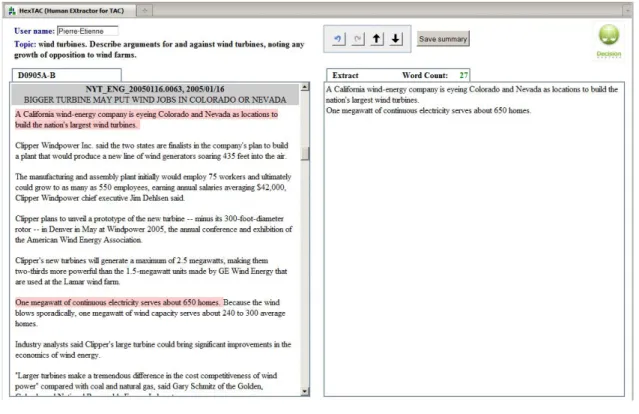
Figure 1: Screen shot of the H
EXT
ACinterface for human extractors and the guidelines given to the human
extractors. The left part of the screen contains the texts of all documents from a cluster from which only full
sentences can be selected and dragged into the right part to build the summary. The total number of words
is updated as each sentence is added to the summary. Sentences added to the summary can be removed and
or reordered using drag and drop. Undo and redo of extraction operations are possible.
2 Methodology and Context
2.1 Interactive Human Extraction Interface
In order to simplify the handling and creation of
ex-tractive summaries, we developed a browser-based
interface. It enables the users to build a summary
step by step in a convenient environment. The
sum-marizers can access the data, check which ones they
should work on, save their summaries, and consult
or modify them later. In the background, the system
logs the access times and other peripheral data.
The extractive summaries are created on a
sin-gle, user-friendly page, shown at the top of figure
1. From the top down and left to right, it contains a
user name box, a topic description, the articles and
their meta-data (ID, date of publication and title),
the editing tools, the save button, and the extractive
summary area.
All articles of a given cluster are shown one after
the other. The text of the articles has been
previ-ously segmented into sentences although the
origi-nal paragraph structure of the articles is kept. When
the user hovers over a part of the text, the sentence
covered by the mouse pointer is highlighted and its
number of words is shown. The total number of
words in the summary should this sentence be added
is also temporarily updated. This sentence can then
be double-clicked to be put into the summary area.
The selected sentences are building blocks for the
summary. They can be later removed or re-arranged
in any order desired, but they can never be
modi-fied by the user in any way (the text areas of the
browsers are read-only). No summary of more than
100 words can be accepted by the system as a valid
submission, though they can still be saved
temporar-ily. The whole system works equally well with
drag-and-drop and with double-clicking and using
but-tons. Undo and redo buttons are also included for
convenience.
This interface is an adaptation of a summary
revision interface that we have developed in a
project dealing with judgements in cooperation with
NLP Technologies
1(Farzindar and Lapalme, 2004)
(Chieze et al., 2008).
1http://www.nlptechnologies.ca
2.2 Experimental Context
There were 44 topics to answer in the TAC 2009
competition, with a standard and an update part for
each – 88 total summaries. The human extraction
task was divided unevenly between five computer
scientists, all specialized in NLP with experience
in automatic summarization, including the three
au-thors, who volunteered to do this manual work.
They all used the interactive interface, while
follow-ing the specific guidelines shown at the bottom of
Figure 1. The summaries were all composed within
about a week and submitted five days after the
dead-line for the automatic runs. As our laboratory was
also submitting automatic runs (IDs 10 and 8)
de-veloped by the first author, he only started working
on the manual process once our automatic runs had
been submitted.
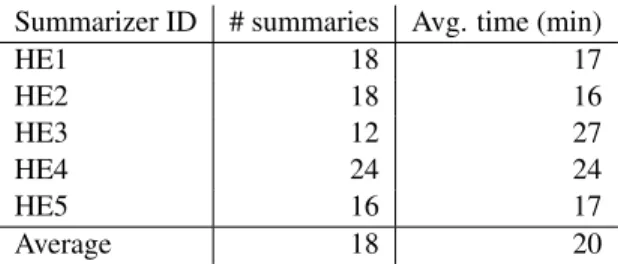
Table 1 shows how many summaries were
writ-ten by each human extractor (HE) and the average
time in minutes it took him to complete one
sum-mary (Part A or B). A total of 30 man-hour were
required to complete the 88 summaries.
Summarizer ID # summaries Avg. time (min)
HE1
18
17
HE2
18
16
HE3
12
27
HE4
24
24
HE5
16
17
Average
18
20
Table 1: Number of summaries out of the 88
com-posed by each human extractor and the average time
in minutes it took them.
2.3 Feedback from Participants
Following the experiment, we met with the human
extractors who participated in the H
EXT
ACexperi-ment to receive feedback on their experience.
The foremost opinion was that the interactive
in-terface made everything a lot easier. According to
the feedback, this tool saved a lot time and even
helped in organizing thoughts. Using text editors
and copy-paste would have made this task an even
greater chore than it already was to some.
The extractors felt some frustration because of the
inability to make even the smallest of textual
fications to the sentences. Cutting down one or two
words in one sentence would, in some cases, have
permitted them to fit their preferred choice of
sen-tences into the summary. Also, some sensen-tences had
great content but could not be included because of
an unresolved personal pronoun anaphora or relative
time reference, which would be easy for a human –
and in some cases for a machine as well – to resolve.
The topic queries also caused some headaches,
because they often times asked for a broad
descrip-tion or a list of several related events/opinions/etc.,
whereas the articles would only offer sentences
with one piece of information at a time. Choosing
which sentences to extract became a huge difficulty
in those circumstances and, in general, subjective
choices of what content to prioritize in the very
lim-ited space has been a big issue. At times, the tradeoff
between quality of content and linguistic quality was
also difficult to deal with.
Most extractors complained about the time
com-mitment and the repetitiveness of the task. It was
re-ported that doing several summaries in a row might
decrease the level of attention to details of the
ex-tractors. On the other hand, many felt that the more
extracts they completed, the easier the task became.
3 Results and Discussion
3.1 TAC 2009 Scores
H
EXT
ACis considered a baseline in TAC 2009, and
it has run ID 3. Table 2 shows the scores of
pyra-mid, linguistic quality and overall responsiveness for
H
EXT
AC, the best score obtained by an automatic
system, and the average of human abstractors.
Part A
Pyramid Ling. Qual. Ov. Resp.
Abstracts
0.683
8.915
8.830
H
EXT
AC0.352
7.477
6.341
Best Auto
0.383
5.932
5.159
Part B
Abstracts
0.606
8.807
8.506
H
EXT
AC0.324
7.250
6.114
Best Auto
0.307
5.886
5.023
Table 2: Scores for H
EXT
ACwhen compared to the
best automatic systems and the humans abstracts for
parts A and B.
The overall responsiveness score is significantly
higher for H
EXT
ACthan for any automatic
sum-marizer. This might come to a surprise to some,
since we used pure extraction whereas the best
sys-tems often use sentence compression and/or
refor-mulation. This superiority probably comes from
the much higher linguistic quality of H
EXT
ACsum-maries, while the pyramid scores were on par with
the best systems of the competition.
The human extracts still receive far lower scores
than abstracts in all evaluation metrics, as expected.
The difference in performance is easily
understand-able given the severe limitations that pure extraction
puts on our summarizers. In particular, the amount
of content that can be included in an extract is much
less than in an abstract, as shown by the pyramid
scores. The difference in linguistic quality probably
arises because of some sentences with unresolved
references that were still included by extractors, and
mostly because pure extraction does not grant the
flexibility required to create text that flows as nicely
as abstracts can. We notice that the difference in
linguistic quality between extracts and abstracts is
much less noticeable than the difference in pyramid
scores, thus hinting that good language quality can
still be achieved without even any modification to
the sentences.
We believe that these evaluation results can be
in-terpreted as a soft upper-bound on what can
theoret-ically be done by purely extractive methods. “Soft”
because the extractors were not as competent as
pro-fessional summarizers probably would have been
and we have strong reasons to believe better extracts
than those submitted exist. The known tradeoff
be-tween content and linguistic quality could play a
role here, for example. The variations in the
perfor-mance of the different extractors and the low
inter-extractor agreement are other indicators that better
extracts could likely be written. Nevertheless, the
gap between the manual extracts and abstracts is so
large that we can safely claim – now with numerical
results to show for – that the performance of pure
extraction summarization will never come close to
what can be achieved by abstraction.
On the other hand, the results show that even
us-ing pure extracts, there is still significant
improve-ments that can be made to improve the quality of
the summaries we create automatically. It seems
that perhaps a lot of progress could still be made in
aspects that increase linguistic quality like sentence
ordering and avoiding redundancy, unresolved
refer-ences, bad grammar in reformulated sentrefer-ences, etc.
3.2 Inter-Extractor Agreement
We computed the inter-extractor agreement on a
small sample of 16 summaries that have been
writ-ten twice. On average, each extract has 0.58
sen-tence in common with one written by an other
ex-tractor, on an average of 3.88 sentences per
sum-mary. This gives roughly a 15% chance that a
sen-tence selected by one extractor is also selected by
another one working on the same topic. We
con-sider this level of agreement to be very low, although
it can be expected because of the redundancy in the
source documents of a multi-document
summariza-tion corpus. Indeed, we have observed that some
sentences were even repeated verbatim in more than
one article of the same cluster, not to mention all the
sentences which were nearly identical and had the
same information content.
The scores obtained individually by each human
extractor, on average, were very different for each
one and in each metric, as can be seen in Table 3.
Pyramid Ling. Qual. Overall Resp.
HE1
0.278
8.222
7.556
HE2
0.297
7.611
5.333
HE3
0.340
7.000
5.917
HE4
0.378
7.583
7.125
HE5
0.392
6.063
4.125
Table 3: Average scores for each human extractor.
The small sample size can partly explain the high
variance of the scores between human extractors.
Some summaries were harder to complete than
oth-ers, because of the topic or the available sentences.
Also, the extractors have had different types of
expe-riences with summarization, they possessed
differ-ent levels of knowledge on the topics given to them,
and a different level of proficiency in English, which
was not the native language of any of them.
3.3 H
EXT
ACas a ROUGE model
As part of our experiment, we ran the automatic
summarization evaluation engine ROUGE on all the
runs except for the baselines and human extracts,
us-ing H
EXT
ACas the model – we call this H
EXT
AC-ROUGE. We wanted to see how this evaluation
would compare to the ROUGE evaluation based on
4 human abstraction models, with jack-knifing (the
ROUGE metric used in TAC). The correlation
coef-ficients between H
EXT
AC-ROUGE, ROUGE, and
the overall responsiveness scores of all the
partici-pating systems (runs 4 through 55) are given in
Ta-ble 4. All the ROUGE scores use ROUGE2.
Part A Part B
H
EXT
AC-ROUGE–ROUGE
0.80
0.85
H
EXT
AC-ROUGE–O. Resp.
0.78
0.91
ROUGE–O. Resp.
0.97
0.94
Table 4: Correlation coefficients between H
EXT
AC-ROUGE, -ROUGE, and the overall responsiveness
scores.
H
EXT
AC-ROUGE is fairly well correlated to
both ROUGE and the overall responsiveness scores,
with correlation coefficients between 78 and 91%.
This shows that H
EXT
ACsummaries are potential
models for extractive systems to compare
them-selves with, obtaining better evaluation scores, as
we have seen before. We believe that training a
sen-tence selection engine on the manual extracts, using
H
EXT
AC-ROUGE, is easier and more
straightfor-ward than training on ROUGE scores obtained from
abstracts, because the model sentences can be found
in the source documents.
4 Conclusion
The H
EXT
ACexperiment presents a successful,
reusable approach to human sentence extraction for
summarization. We have developed a
comprehen-sive methodology with detailed guidelines, and we
now have a better idea of how much time is
re-quired to complete the summaries. We have
ob-served that an interactive interface such as the one
we used is an invaluable tool, in part because it
re-duced the amount of time spent on writing each
ex-tractive summary, thus keeping our extractors
hap-pier.
Viewed as an upper-bound on purely extractive
summarization techniques, the competition results
for H
EXT
AClead to two main conclusions. First,
that significant improvements to current sentence
se-lection engines and sentence ordering schemes can
still be made since the current automatic
summariz-ers do not achieve results comparable to those of
hu-man extracts yet. Second, that since there are large,
now quantifiable gaps between the scores of human
abstracts and extracts – mostly in the amount of
con-tent that can be included –, developing techniques to
extract smaller segments than sentences or to
com-press or reformulate sentences is essential to make
great improvements to the current techniques in the
long-term.
We view the H
EXT
ACextracts as an interesting
alternative to using the ROUGE scores based on
ab-stracts for sentence selection engine training. The
main attraction lies in the fact that the training is
su-pervised through data that corresponds to the same
challenge. Similarly, sentence ordering could
per-haps be trained using H
EXT
ACsummaries to
super-vise the learning.
More comprehensive information from humans,
in the form of sentence evaluation, would lead to
even much more valuable information for the
pur-pose of supervised training. Humans could list all
the sentences in the cluster that could potentially be
of use in a summary, excluding anything with low
content or bad linguistic form. They could then rate
the sentences in that list and identify which ones are
redundant and could not be included together. While
this would be a monumentally larger amount of
work, the gathered data would be more directly
us-able and the inter-annotator agreement would likely
increased, improving the reliability of the data.
5 Acknowledgements
Great thanks to Atefeh Farzidar, president of NLP
Technologies, who accepted that we adapted the
re-vision interface for his project. Thanks to Fabrizio
Gotti and Florian Boudin for their valuable
contri-bution as human extractors.
References
Emmanuel Chieze, Atefeh Farzindar, and Guy Lapalme. 2008. Automatic summarization and information ex-traction from canadian immigration decisions. In Pro-ceedings of the Semantic Processing of Legal Texts Workshop, pages 51–57. LREC 2008, may.
Atefeh Farzindar and Guy Lapalme. 2004. Legal texts summarization by exploration of the thematic struc-tures and argumentative roles. In Text Summarization Branches Out, Conference held in conjunction with ACL04, Barcelona, Spain, jul.
CHAPITRE 3
GÉNÉRATION DE RÉSUMÉS PAR DIVISION DE PHRASES
Pierre-Etienne Genest et Guy Lapalme. Framework for Abstractive Summarization
using to-Text Generation. Dans Proceedings of the Workshop on Monolingual
Text-To-Text Generation, pages 64–73, Portland, Oregon, USA, June 2011. Association for
Computational Linguistics.
Cet article a été publié dans le cadre d’une participation (avec révision à l’aveugle)
à un atelier sur la génération texte-à-texte lors de la conférence internationale annuelle
de l’Association for Computational Linguistics (ACL), en 2012. L’ACL est la plus
im-portante association internationale en traitement automatique des langues naturelles. Son
médium de publication principal est la conférence internationalle annuelle tenue par l’un
de ses trois chapitres, ceux d’Amérique du Nord, d’Europe et d’Asie, qui ont également
leur propre conférence annuelle.
Framework for Abstractive Summarization using Text-to-Text Generation
Pierre-Etienne Genest, Guy Lapalme
–
–
–
–, –
–, –
--Abstract
We propose a new, ambitious framework for abstractive summarization, which aims at se-lecting the content of a summary not from sen-tences, but from an abstract representation of the source documents. This abstract repre-sentation relies on the concept of Information Items (INIT), which we define as the smallest element of coherent information in a text or a sentence. Our framework differs from previ-ous abstractive summarization models in re-quiring a semantic analysis of the text. We present a first attempt made at developing a system from this framework, along with eval-uation results for it from TAC 2010. We also present related work, both from within and outside of the automatic summarization do-main.
1 Introduction
Summarization approaches can generally be
cate-gorized as extractive or abstractive (Mani, 2001).
Most systems developped for the main international
conference on text summarization, the Text
Analy-sis Conference (TAC) (Owczarzak and Dang, 2010),
predominantly use sentence extraction, including all
the top-ranked systems, which make only minor
post-editing of extracted sentences (Conroy et al.,
2010) (Gillick et al., 2009) (Genest et al., 2008)
(Chen et al., 2008).
Abstractive methods require a deeper analysis of
the text and the ability to generate new sentences,
which provide an obvious advantage in improving
the focus of a summary, reducing its redundancy
and keeping a good compression rate. According
to a recent study (Genest et al., 2009b), there is an
empirical limit intrinsic to pure extraction, as
com-pared to abstraction. For these reasons, as well as for
the technical and theoretical challenges involved, we
were motivated to come up with an abstractive
sum-marization model.
Recent abstractive approaches, such as sentence
compression (Knight and Marcu, 2000) (Cohn and
Lapata, 2009) and sentence fusion (Barzilay and
McKeown, 2005) or revision (Tanaka et al., 2009)
have focused on rewriting techniques, without
con-sideration for a complete model which would
in-clude a transition to an abstract representation for
content selection. We believe that a “fully
abstrac-tive” approach requires a separate process for the
analysis of the text that serves as an intermediate
step before the generation of sentences. This way,
content selection can be applied to an abstract
repre-sentation rather than to original sentences or
gener-ated sentences.
We propose the concept of Information Items
(I
NI
T) to help define the abstract representation.
An
I
NI
Tis the smallest element of coherent
informa-tion in a text or a sentence. It can be something as
simple as some entity’s property or as complex as a
whole description of an event or action. We believe
that such a representation could eventually allow for
directly answering queries or guided topic aspects,
by generating sentences targeted to address specific
information needs.
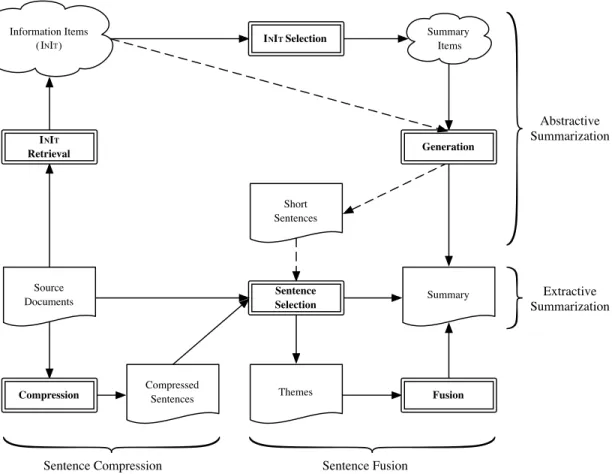
Figure 1 compares the workflow of our approach
with other possibilities. Extractive summarization
consists of selecting sentences directly from the
Source Documents Summary Information Items ( ) Short Sentences Summary Items Compressed Sentences Themes InIt Selection Sentence Selection Compression InIt Retrieval Generation
Sentence Compression Sentence Fusion
Abstractive Summarization Extractive Summarization Fusion InN TIt InN TIt InN TIt
Figure 1: Workflow diagram of our suggested approach for abstractive summarization, compared to pure extractive summarization, sentence compression, and sentence fusion for summarization. The dashed line represents the simpli-fied framework used in our first attempt at abstractive summarization (see section 2.4).
source documents and generating a summary from
them. Sentence compression first compresses the
sentences and chooses from those and the source
documents’ sentences to form a summary; it may
also be completed in the reverse order, which is
to select sentences from the source documents and
then compress them for the summary. Sentence
fusion first identifies themes (clusters of similar
sentences) from the source documents and selects
which themes are important for the summary (a
pro-cess similar to the sentence selection of
centroid-based extractive summarization methods (Radev et
al., 2004)) and then generates a representative
sen-tence for each theme by sensen-tence fusion.
Our proposed abstractive summarization
ap-proach is fundamentally different because the
selec-tion of content is on Informaselec-tion Items rather than on
sentences. The text-to-text generation aspect is also
changed. Instead of purely going from whole
sen-tences to generated sensen-tences directly, there is now
a text planning phase that occurs at the conceptual
level, like in Natural Language Generation (NLG).
This approach has the advantage of generating
typically short, information-focused sentences to
produce a coherent, information rich, and less
re-dundant summary. However, the difficulties are
great: it is difficult for a machine to properly extract
information from sentences at an abstract level, and
text generated from noisy data will often be flawed.
Generating sentences that do not all sound similar
and generic is an additional challenge that we have
for now circumvented by re-using the original
tence structure to a large extent, which is a type of
text-to-text generation. Even considering those
diffi-culties, we believe that efforts in abstractive
summa-rization constitute the future of summasumma-rization
re-search, and thus that it is worthwhile to work
to-wards that end.
In this paper, we present our new abstractive
sum-marization framework in section 2. Section 3
de-scribes and analyses our first attempt at using this
framework, for the TAC 2010 multi-document news
summarization task, followed by the competition’s
results in section 4. In this first attempt, we
simpli-fied the framework of section 2 to obtain early
re-sults which can help us as we move forward in this
project. Related work is discussed in section 5, and
we conclude in section 6.
2 Abstractive Summarization Framework
Our proposed framework for fully abstractive
sum-marization is illustrated in figure 1. This section
dis-cusses how each step could be accomplished.
2.1 I
NI
TRetrieval
An Information Item is the smallest element of
co-herent information in a text or a sentence. This
in-tentionally vague definition leaves the
implementa-tion details to be decided based on resources
avail-able. The goal is to identify all entities in the text,
their properties, predicates between them, and
char-acteristics of the predicates. This seemingly
un-reachable goal, equivalent to machine reading, can
be limited to the extent that we only need I
NI
Ts to
be precise and accurate enough to generate a
sum-mary from them.
The implementation of I
NI
Ts is critical, as
every-thing will depend on the abstract information
avail-able. Semantic Role Labeling (SRL) and
predicate-logic analysis of text are two potential candidates for
developing I
NI
TRetrieval. Word-sense
disambigua-tion, co-reference resolution and an analysis of word
similarity seem important as well to complement the
semantic analysis of the text.
2.2 I
NI
TSelection
Given an analysis of the source documents that leads
to a list of I
NI
Ts, we may now proceed to select
content for the summary. Frequency-based
mod-els, such as those used for extractive summarization,
could be applied to I
NI
Tselection instead of
sen-tence selection. This would result in favoring the
most frequently occurring entities, predicates, and
properties.
I
NI
Tselection could also easily be applied to
tasks such as query-driven or guided
summariza-tion, in which the user information need is known
and the summarization system attempts to address it.
With smaller building blocks (I
NI
Ts rather than
sen-tences), it would be much easier to tailor summaries
so that they include only relevant information.
2.3 Generation
Planning, summary planning in our case, provides
the structure of the generated text. Most I
NI
Ts do not
lead to full sentences, and need to be combined into
a sentence structure before being realized as text.
Global decisions of the I
NI
Tselection step now lead
to local decisions as to how to present the
informa-tion to the reader, and in what order.
Text generation patterns can be used, based on
some knowledge about the topic or the information
needs of the user. One could use heuristic rules with
different priority levels or pre-generated summary
scenarios, to help decide how to structure sentences
and order the summary. We believe that machine
learning could be used to learn good summary
struc-tures as well.
Once the detailed planning is completed, the
sum-mary is realized with coherent syntax and
punctu-ation. This phase may involve text-to-text
genera-tion, since the source documents’ sentences provide
a good starting point to generate sentences with
var-ied and complex structures. The work of (Barzilay
and McKeown, 2005) on sentence fusion shows an
example of re-using the same syntactical structure of
a source sentence to create a new one with a slightly
different meaning.
2.4 First Attempt at Abstractive
Summarization
The three-step plan that we laid down is very hard,
and instead of tackling it head on, we decided to
fo-cus on certain aspects of it for now. We followed
a simplified version of our framework, illustrated
by the dashed line in Figure 1. It defers the
con-tent selection step to the selection of generated short
sentences, rather than actually doing it abstractly as
Original Sentence The Cypriot airliner that crashed in Greece may have suffered a sudden loss of cabin
pressure at high altitude, causing temperatures and oxygen levels to plummet and leaving everyone
aboard suffocating and freezing to death, experts said Monday.
Information Items
1. airliner – crash – null (Greece, August 15, 2005)
2. airliner – suffer – loss (Greece, August 15, 2005)
3. loss – cause – null (Greece, August 15, 2005)
4. loss – leave – null (Greece, August 15, 2005)
Generated Sentences
1. A Cypriot airliner crashed.
2. A Cypriot airliner may have suffered a sudden loss of cabin pressure at high altitude.
3. A sudden loss of cabin pressure at high altitude caused temperatures and oxygen levels to
plum-met.
4. A sudden loss of cabin pressure at high altitude left everyone aboard suffocating and freezing to
death.
Selected Generated Sentence as it appears in the summary
1. On August 15, 2005, a Cypriot airliner crashed in Greece.
Original Sentence At least 25 bears died in the greater Yellowstone area last year, including eight
breeding-age females killed by people.
Information Items
1. bear – die – null (greater Yellowstone area, last year)
2. person – kill – female (greater Yellowstone area, last year)
Generated Sentences
1. 25 bears died.
2. Some people killed eight breeding-age females.
Selected Generated Sentence as it appears in the summary
1. Last year, 25 bears died in greater Yellowstone area.
Figure 2: Two example sentences and their processing by our 2010 system. In the summary, the date and location associated with an INITare added to its generated sentence.