HAL Id: hal-00968832
https://hal.archives-ouvertes.fr/hal-00968832
Submitted on 1 Apr 2014HAL is a multi-disciplinary open access archive for the deposit and dissemination of sci-entific research documents, whether they are pub-lished or not. The documents may come from teaching and research institutions in France or abroad, or from public or private research centers.
L’archive ouverte pluridisciplinaire HAL, est destinée au dépôt et à la diffusion de documents scientifiques de niveau recherche, publiés ou non, émanant des établissements d’enseignement et de recherche français ou étrangers, des laboratoires publics ou privés.
Reutilization of diagnostic cases by adaptation of
knowledge models.
Brigitte Chebel-Morello, Mohamed Karim Haouchine, Noureddine Zerhouni
To cite this version:
Brigitte Chebel-Morello, Mohamed Karim Haouchine, Noureddine Zerhouni. Reutilization of diag-nostic cases by adaptation of knowledge models.. Engineering Applications of Artificial Intelligence, Elsevier, 2013, 26, pp.2559-2573. �10.1016/j.engappai.2013.05.001�. �hal-00968832�
1
Reutilization
of diagnostic cases by adaptation of knowledge
models
B. Chebel-Morello, M.K. Haouchine, N. Zerhouni
Automatic Control and Micro-Mechatronic Systems Department, FEMTO-ST Institute, 24, Rue Alain Savary, 25000 Besançon, France
{Brigitte.morello, karim.haouchine, noureddine.zerhouni}@ens2m.fr}
Abstract.
This paper deals with design of knowledge oriented diagnostic system. Two challenges are addressed. The first one concerns the elicitation of expert practice and the proposition of a methodology for developing four knowledge containers of case based reasoning system. The second one concerns the proposition of a general adaptation phase to reuse case solving diagnostic problems in a different context. In most cases, adaptation methods are application-specific and the challenge in this work is to make a general adaptation method for the field of industrial diagnostics applications. This paper is a contribution to fill this gap in the field of fault diagnostic and repair assistance of equipment. The proposed adaptation algorithm relies on hierarchy descriptors, an implied context model and dependencies between problems and solutions of the source cases. In addition, one can note that the first retrieved case is not necessarily the most adaptable case, and to take into account this report, an adaptation-guided retrieval step based on a similarity measure associated with an adaptation measure is realized on the diagnostic problem. These two measures allow selecting the most adaptable case among the retrieved cases. The two retrieval and adaptation phases are applied on real industrial system called Supervised industrial system of Transfer of pallets (SISTRE).
Keywords: case-based reasoning, adaptation, adaptation-guided retrieval, dependency relations, hierarchical model, context model, diagnostic.
1
Introduction
This study is a part of our research work realized in the European project SMAC. The goal of this project was to develop a distributed cooperative knowledge oriented platform that proposes a set of maintenance services (Karray et al, 2009).
These services offer support to the maintenance operators in their daily tasks. The platform is composed of several modules like the equipment model for instance, and a functional analysis and resource management unit that is interconnected by domain ontology (Karray et al, 2011) to ensure an intelligent maintenance policy within a company. The knowledge models are used in this platform to solve practical problems such as fault detection, fault diagnosis, etc. in industrial applications.
The paper aims at building an intelligent application based on a case based reasoning system that is dedicated to industrial diagnostic and repair in the context of maintenance services. Althoff (Althoff et al, 1996) assert that case based-reasoning (CBR) is the most appropriate technology to implement a knowledge based system. Moreover, CBR is frequently proposed as a methodology for knowledge management applications, in particular in experience based system technologies. It presents the expert knowledge as past and real experiences that are easily understandable by human users. It is a problem solving and learning method that uses similar past problems formalization to solve new ones by adapting them to the context. This method is suitable for diagnostic applications, because fault diagnostic is a domain based on the experience of human experts, where problems are recurrent and can be reused. In addition, diagnostic by case-based reasoning is one of the methods preferred by the industrials. Indeed,
reasonin a signifi Therefo experts phase n knowled in organ Their st Fig. 1 sh and 45.9 Fig. 1:P Our pro industri costs, th method, Industri diagnos remote CaseLin 737 in industri al,1996) (Devane CBR (C problem More k NodalC case cha We no depends domain represen Very fe Lamont sc mee ng in this m ficant cost an ore designin to explicit needs to b dge gatherin nizations, th tatistical stu hows that 3 9% to the k Percentage o oblem is to al system his can be , we briefly ial systems stic techniqu diagnostics ne (Watson CASSIOPE al printers ), gas turb ey et Cheet Cunningham ms when t knowledge-CBR, Patdex aracterizes a ote that ther s crucially . That is p ntation of th ew authors tagne & L cheduling etings with experts 6,2% method, and nd requires ng a diagnos their practi be optimize ng. AI Jaco heir predict udy involve 37.7% of the knowledge a of knowledge develop a of pallet tr achieved th y review som developed ue system s (Varma, et Marir, 1 EE (Bergma studied by bines studie tham, 2005 m,1994). Th there is ju -oriented s x, use mode a diagnostic re is no co on the repr phases of C he system an defined th apalme (La k unlike mac time, can st stic knowle ce. Howeve ed. Indeed, obson and L ion on the d more than e time of kn adaptation p e workers ‘tim knowledge ransfer (see hanks to th me of the CB d in the C named CR 1999), to a 1994) and u an et al, 20 Domino U ed in a fau ) and comp here is a w ust a weak systems su els of know c experience ommon met resentation CBR cycle. nd without he design m amontagne, adapting knowledge gained 45,9% s 2 chine learni tart with an dge oriente er, the cost
the challe L. Prusak(1 knowledge n 200 know nowledge w phase. me spent (Ja e based dia e APPEND he use of an BR industri CBR diagno REEK (Aam aircrafts (su used as a de 003) owned UK Ltd in C ult system plex machin wide variety k domain uch as Ga wledge diffe e. thod for bu of cases a . Actually, any associa methodolog , 2002) rep searching fo knowledge 10,2% ing methods n incomplete ed system re of this serv enge in kn 996) studie cost for th wledge work workers is de acobson, A., P agnostic sys DIX A) w n existing m ial diagnosis osis, can v modt, 2004) uch as Boe emonstrator d by CFM CHEKMAT of Genera ne like Patd y of method theory, to as Turbine, erent from e uilding a C nd knowled authors pr ated method gy in the c present a g e kn e r s where the e case. equires time vice is very nowledge m ed the know e year 2010 kers of diffe edicated to t Prusak, L. 19 stem for SI while minim method. To s system. ary from a ) to a locom ing 747 air by British Internation TE and pre al Electric dex (Richter ds ranging o knowledg , Creek, C each other. CBR system dge models rovide us j dology. case based generic mo eliciting nowledge from experts 37,7% e learning p e and availa y high, and t managemen wledge man 0 was € 2.6 ferent organ the elicitatio 996 ) ISTRE a su mizing deve o reuse an a a car studi omotive def rcraft devel Airways or nal). There sented in ( Energy in r, 1991) an from class ge based Cassiopee, In most sy m. The cons s of the app just with th d diagnosis odel of cas hase has ability of thus this nt is the agement 6 billion. nizations. on phase upervisor elopment adequate ied in a fined for loped in r Boeing are also Grant et Atlanta nd Nodal sification systems. Pad'im, ystems, a struction plication he cases system. se based
3 reasoning system in which they combine the CBR online cycle composed of 4 phases (elaborate, retrieve, reuse, retain) with knowledge container defined by Richter (Richter, 1995) (vocabulary; case base; similarity metrics; adaptation knowledge) making it possible to preserve and exploit the past experiences.
In the same way our team (Rasovska et al, 2008) combines the CBR reasoning “capitalize” and “actualize” phases with the knowledge “detection” and “preservation” in the knowledge capitalization cycle defined by Grundstein (Grundstein, 2000). The elicitation step is not defined by interviews with experts but by a methodology based on engineering safety tools, and reliability concepts such as FMECA and failure history (Rasovska et al, 2008). The creation of knowledge models is carried out by the analysis of the equipment and its decomposition (approach modeled on the practice ground of Cegelec company).
The idea developed in this paper is similar to Rasovka’s methodology, where a CBR system is built from knowledge models used by maintenance experts like functional and dysfunctional equipment models that are accessible on all equipments and easy to build when not available (Rasovska et al, 2008). This choice minimizes the cost of experts.
To elaborate an oriented knowledge CBR system, we must conceive first the different knowledge containers of CBR and secondly the CBR reasoning phase.
(i) In the knowledge elicitation, our proposal is to build
a. An appropriate case base (a case formalization based on the definition of the diagnostic taking into account the indicators used by the maintenance users). b. Similarity measures taking into account missing values and adaptation
measures reflecting the adaptation cost
(ii) In the reasoning process, our proposal is to develop a reasoning process suitable for this model. The reasoning process is dedicated to retrieve the similar case and adapt it to solve problems in other contexts. This adaptation phase is complex and is usually designed for a specific application.
a. The first challenge in this reasoning phase is to propose an algorithm based on the model and independent of the specific application.
b. The second challenge is to minimize the adaptation cost in the retrieve and reuse phases by proposing an “adaptation-guided retrieval phase”.
Our objective in this work is to minimize the cost of designing the knowledge diagnostic system. To evaluate the design cost of our diagnostic method we define in section 6.4.2 three indicators; the adaptability of the method, the reuse cost and the creation effort.
The paper is organized as follows. We first describe the principle of the elicitation approach which defines the knowledge containers of CBR system. In section 3, we focus on the retrieve step of the reasoning phase. One might think that the most similar case is always the best candidate. However, the literature reviews of the retrieve phase show that this is not always the case (Smyth et Keane,1993, 1995, 1998; Cordier et al, 2006). Consequently, we propose an adaptation-guided retrieval method applied to the industrial diagnostic based on two measures: the first one is similarity and the second one is adaptation. Section 4 deals with the adaptation phase, which is applied to the best adaptable retrieved case.
To define a general adaptation method on symbolic data in the field of industrial diagnostic, we are interested in the adaptation approaches in all applications of CBR.
Some studies of the “memory-based reasoning” (Kasif, 1995) avoid this step because the wealth of the case-base can compensate for the adaptation phase (Standfill, 1996).
4 However, other authors, like us, develop this phase to enrich the case-base. In this context the adaptation step is the core of CBR (Chebel-morello et al., 2011; Lieber, 2007). Furthermore, prior works on adaptation were dedicated to a given application. To avoid this specificity, three axes have been explored: (i) Adaptation Knowledge Acquisition (AKA) aims to define general principles of clarification in the studied field. A complete state of the art concerning these methods can be found in (Lieber, 2007). (ii) Catalogs of adaptation strategies are applied in several domains and are given in (Riesbek,1989). (iii) Unifying approaches are studied in order to find a general adaptation model as proposed by Fuchs (Fuchs et al, 2000). These authors propose a general adaptation algorithm independent of the application scope. It is applied to digital data as an interval that can be extrapolated. Therefore, we were inspired by the unifying approaches of Fuchs (Fuchs, 2000).
We propose a method is based on the dependencies between the problem and the solution of a solved case and uses two knowledge models. Three relations of dependencies are defined and exploited to adapt a retrieved case within an adaptation algorithm described in the same section. The matching carried out at the time of the retrieval, combined with dependency relations between the problems and solutions, can adapt the solution to the target problem.
Section 6 is devoted to the evaluation of the methodology of our CBR diagnosis system with the other industrial diagnosis systems.
2
Elicitation knowledge approach
2.1 Introduction
Our ambition is to construct a diagnostic system based on the European standard definition that specifies diagnostic as “they are actions carried out to detect breakdowns, localize them and identify the cause. (Maintenance terminology, 2001):NF EN 13306 of diagnostic. In order to build this system of help of diagnostic, we decompose the equipment into zones that include components. A zone will be characterized by the descriptors d1 d2 d3 (these descriptors are necessary to define the existing zones).
Within each zone, each component has a specific function. If this function is not fulfilled, it will induce dysfunctions that are revealed by some symptoms and characterized by the state of the component and its functioning mode. Fig. 9 gives you the internal functional analysis of an assembly station in SISTRE.
To define the functional mode diFM, the observed state is compared with the expected state in functional context and identified to the normal (nor) or abnormal (abn) mode.
Those components are characterized by symptoms descriptors. Three parameters are defined by: name, measure defining its state and functional mode
We describe the failure that might occur using the problem descriptors that include zone’s descriptors, descriptors in relation to the functions and/or dysfunctions associated to the zone where the failure is taking place.
value, state, FM
i i i i
5 These components will be classified into different families of components in a hierarchy of components (family of sensors, pneumatic actuators). This will be used by the reasoning phases, mainly, the phase of identification of the failing component.
The localization of the failed zone, when a fault is detected, is done thank at a conceptual graph (see Fig.3a and Fig.3b) where the node is the value of the zone descriptor and the solution is the failed zone. Failed zones are composed of the components potentially failing.
A case will describe the experience of how a diagnostic problem is solved. A retrieval phase will find the cases the most similar to the case to be solved by using similarity measures. An adaptation measure will select the most easily adaptable case among the most similar cases. An adaptation method will be applied if no identical cases are found in the case base. The method is based on the relations of dependence between the variations of the problem and the variation of the solution. It includes 3 classes of adaptation that will identify the cause of the failure in function of the context of the breakdown.
2.2 Diagnostic case representation
The case base reflects the experiment of solving a fault by linking the dysfunctional mode of component to the cause of this fault, and the repair action. Indeed, we propose the following representation.
A case is composed of a Problem and a Solution part: Case= (d1, d2, .di …., D1, D2, D3, D4)
(i) The problem space of the case contains descriptors relative to both the localization and the functional part of the equipment.
(ii) In the solution space of case, descriptors retain information about the detection of failure and the identification of the cause.
A case is formalized by two kinds of problem descriptors: the localization descriptor and the symptom descriptor, and by 4 solution descriptors: D1: the Class detected, D2: the cause of failure, D3: the Repair action, D4: the zone of failure.
The existing class is defined in the components taxonomy model.
To simplify the notation of the source case descriptors we note and the target case descriptors
The solution part is composed of four descriptors, the first one is relative to the class of the fault component, the second is dedicated to the component causing the failure, the next one describes the repair actions, and the last one defines the zone of the failure.
The notion defined in this paper will be d by the application SISTRE:
For example: let us consider the puller, a specific component in equipment. This component can have two states linked to its position: [front; back] and can have two functional modes [nor, abn].
value
, state
, FM
value, state, FM
i l i l i l i l i i i d S d S d S d S ds ds ds
i l i d S ds
i i d T dt
value
, state
, FM
value, state, FM
i i i i i i i
6 The descriptor associated to the puller in a diagnosis case can be written as illustrated in Table 1:
Table 1: example of source case
We can see in Table 1 a case containing in the supervisor descriptor the first symptom relative to the pusher ds3.
The localization of this equipment is the entry of internal Ring (ds1 and ds2) and so on. The
solution is composed of a class of failure Ds1=The Electrical Actuator and the cause of failure Ds2 =
Stopper S1 blocked. Ds3 is the repair action and Ds4 the Failure zone.
2.3 Knowledge models associated with the Case
Moreover, the knowledge representation is based on two models associated with the case-base, namely: the context model and the components taxonomy model.
2.3.1 The components taxonomy model
A case has a formalization object and defines a hierarchy of descriptors containing both problem and solution (Haouchine et al, 2008).
The model is determined from the functional components analysis of the industrial plant. Every group of components (in the source case or observed case) is regrouped by functional classes, and constitutes a component's hierarchy which is common to the problem descriptors “ds” and solution “Ds”. A part of SISTRE hierarchical model of components is described in Fig. 2
Equipment (component) Actuator
Magnetic sensor Conveyor Pneumatic actuator Electric actuator Balogh Stopper Brace Belt Motor Pallet D2 D9 D1 Balogh0 Balogh1 Puller Pusher Instance Class S2 S1 S5 Indexer … … Detector Speed transmission
Fig. 2:A part of the SISTRE’s components hierarchy.
3 3 , 3 , 3
value state FM
7 Context of Ds1
“Entry of internal ring”
Ds1: Blocked Stopper S1=f(D1, Bal0, Int. Carpet)
Ds1: Shifted Sensor D1=f(S1, Bal0, Int. Carpet)
Ds1: Dust in the Bal0=f(S1, D1, Int. Carpet)
Ds1: Defective interior carpet=f(S1, D1, Bal0) 2.3.2 Context Model
The context model is a contextual graph allowing the localization of components comprising a failure and selection of concerned components compared to the set. Therefore, the context model enables to inform the “localization” descriptors in order to determine the failure zone and the components potentially failing. The course of a pallet will be followed. Using a contextual graph, as shown in Fig. 3a, components likely to be failing will be localized.
An example of a context model concerning the descriptor “Ds1” is shown in Fig.3b.
Fig. 3a: A part of contextual graph of the equipment. Fig. 3b : A context model of “Ds1” The context allows the localization of components problems and the selection of the right descriptors compared to all others. Therefore, these present components constitute the context in which the failing component is identified. A dependency relation is associated with these components. The descriptors of the localization part are exploited by a context model in two phases of the CBR. In the phase of elaboration of the target case, the user is asked a dynamic tree of questions, and retrieval phase selects the correct element to be substituted in adaptation phase.
2.4 The diagnostic case base
A set of 125 cases is considered in the SISTRE case base which corresponds to a part of the component malfunction. The cost to realize the exhaustive case base becomes too large in complex equipment, and to get to this industrial condition, we do not exhaustively list malfunctions of all components. The case problem part is composed of seven descriptors. The first two descriptors define the localization of the failure. This localization is determined by “ds1: zone”, “ds2: pallet site”.
Let us consider the example of case S1 (Source 1 or observed case 1) in the Table 2.
R18 External ring Internal ring exc conveyor Internal ring Locate the failure at the components D1, Bal0 andS1. R19 Locate the failure at the components D3, D4 and ext. Place of breakdown Which under zone of secondary ring? Which under zone of secondary ring?
8 Table 2: A part of the SISTRE case base
This case represents a problem in the detector “D1”.
The localization part indicates that there is a failure on the entry of the “principal” internal ring. Then, the supervisor part provides the components state involved at the failure zone. The STP1 stopper is in “top” position which has a “normal” functional mode. The balogh ”bal0” has value “1”, which means that it must enter the working area so that it can be treated by a robot. Finally, the D1 detector does not detect the presence of the pallet which is in abnormal mode (“abn”).
The solution part is made up of, the class descriptor of the failing component, a descriptor identifying the failing component, the repair action and the failure zone.
3 Reasoning process: retrieval phase
In this work, three phases, elaboration retrieve and reuse compose the reasoning process (Mille, 1999). Case descriptors of the localization part are exploited by a context model (see Fig. 3a) in
(i) The elaboration phase. The user answers a dynamic tree of questions in order to build a target case (case to solve).
(ii) The adaptation phase. The correct element is selected to be substituted in the adaptation algorithm.
In this section, the retrieval phase is broached.
3.1 Retrieval phase
The main difficulty in the retrieval phase is the choice of the right selection criterion for cases to be retrieved (Althoff et Bartsch-Spörl, 1996). Most of the traditional approaches use simple similarity measures, while others involve the organization of the case-base to
9 improve the retrieval quality (Cordier, 2008). Thus, the retrieval phase can be described by two categories: the first is “simple retrieval" and the second is “combination retrieval/adaptation”. The current study is focused on the second type.
Before the Nineties, the two phases of retrieval and adaptation were used in a completely independent way until Veloso (Veloso, 1992) brought new life and suggested the combination of these two steps. Smyth et Keane (1998) also point out the synergy between plan adaptation and retrieval. In our work, we take into account this synergy and we combine the similarity measure with other criteria to retrieve the most adaptable case.
According to Lopez de Mantaras et al. (Lopez de Mantaras et al, 2005), six types of retrieval related to the adaptation are identified: Diversity-Conscious Retrieval (Smyth and McClave, 2001 ; McSherry, 2002 ; McGinty and Smyth, 2003), Compromise-Driven Retrieval (McSherry, 2003, 2004), Order-Based Retrieval (Althoff and Bartsch-Spörl, 1996; Bridge and Ferguson, 2002) Explanation-oriented retrieval (Cunningham et al., 2003; Doyle et al, 2004), Optimization-Based Retrieval (Mougouie et Bergmann, 2002; Tartakovski et al, 2004) and Adaptation-Guided Retrieval (AGR). This present work is based on AGR.
3.2 Adaptation-Guided Retrieval phase.
The AGR assumes that the source cases most similar to the target case are not always the easiest to adapt, particularly when the similarity measure is based on surface characteristics. Retrieval therefore must not only search for similar cases but above all easily adaptable cases. Indeed, the authors explain how this retrieval which is guided by adaptation binds specifications and solutions spaces by using the knowledge adaptation. The work of Leake et al. (1997) addresses the adaptation effort concept and the impact of traditional semantic similarity measures on adaptation. Sometimes, the retrieved cases are “similar” to target problem but difficult or impossible to adapt. This generates an inability for the system to solve a problem or give a wrong answer squarely. Therefore, Leake takes into account the adaptation effort at the time of the retrieval step in order to facilitate the adaptation step. This consideration is concretized by inserting the “adaptation cost” in the similarity measure. Leake proposes two steps: first, a classic similarity measure is made by comparing case descriptors, then the most similar cases retrieved at the end of the first step are prioritized according to their adaptability.
To retrieve the best similar case for the adaptation in this work, two measures are implemented:
the first one is a similarity measure (RM) taking into account all the descriptors informed. The retrieve phase associates the RM measure with a kNN algorithm in order to choose the set of the most similar cases to the target case
The second one, is an “adaptation measure" (AM). It emphasizes on the components which exhibit an abnormal functional mode. The AM measure selects the most adaptable retrieved source case (observed case) from the similar cases selected by the RM measure.
3.2.1 Retrieval Measure
To retrieve the best similar case for the adaptation, first one needs to evaluate the similarity between descriptors and between the attributes of each descriptor. Indeed, for the
10 localization part, the problem descriptors of the target case and source cases will be compared. Then, concerning the functional part, it will be the attributes of descriptors which will be compared. Four local similarity measures are exploited.
In the first one, the hierarchical relation between the values of the descriptors is taken into account.
For the value of which belongs to the hierarchical model of descriptors,
Let Sl be an expected state (source case) and T a component observed (target case).
ivalue, ivalue
sim d d is developed by
, , 1 0,8 0, 6 1 ,value value value value value value
i l i i i i i
value value
i i
value value
i i
sim d S d T sim ds dt when ds dt
when level ds level dt
when different level ds dt
For example: When the descriptor values are on the same level.
ivalue, ivalue
0,8 ivalue 1 ivalue 2sim ds dt if ds D and dt D
When descriptor‘s values have parents with the same level.
ivalue, ivalue
0, 6 ivalue 1 ivalue 1sim ds dt if ds D and d Bal
see Fig.4 Magnetic sensor Balogh D2 D9 D1 Balogh0 Balogh1 Instance Class Detector 0.8 0.6 0.4
Fig. 4: Example of a descriptor hierarchy.
For the descriptor value
ds
istateand MF ids
,
10
state state state state
i i i i state state i i sim ds dt if ds dt if ds dt
,
1 0 MF MF MF MF i i i i MF MF i i sim ds dt if ds dt if ds dt The similarity metric depends on the formalization of the case. Note that not all descriptors are filled. In order to compare cases in which the descriptors are not all filled, a similarity measure of the presence is defined. It will reflect the presence of descriptors in the case. To take into account the presence and/or the absence of information in descriptors, a local similarity is developed.
value, value
1presence i i
sim ds dt If information is present both in Sl and T
=0 if an information is not present in one descriptor
value i
d
value i ds11 The global similarity measure (1) is obtained by aggregation of these functions on the whole set of descriptors. From this measure, a set of cases can be selected.
1 1 1 , , , , , , , p mvalue value value value state state FM FM value value
i i i i i i i i presence i i i i p M l m value value presence i j i
sim ds dt sim ds dt sim ds dt sim ds dt sim ds dt
R S T sim ds dt
(1)Where p represents the number of localization descriptor m: represents the number of problem descriptors.
- Similarity Measure Calculation
1 2 3 5 7 4 1 (0 1) (1 1) (1 1 1 1) (1 1 1 1) (1 1 1 1) ( , ) 0, 8 5 M d d d d d R S T 1 2 3 5 6 7 9 1 (1 1) (1 1) (0,8 1 0 1) (1 1 1 1) (0,8 1 1 1) (1 1 1 1) ( , ) 0,8 6 M d d d d d d R S T 3.2.2 Adaptation Measure
To determine the most adaptable case, an adaptation measure is established to take into account the functional modes associated to components involved in the case of diagnostic. Indeed, during a fault diagnostic, experts are particularly interested in cases with abnormal operating conditions. Therefore, the adaptation measure preferred descriptors associated with the functional mode and gives priority to abnormal functional modes.
The Adaptation Measure “AM” (2) takes into account the source cases supervisor descriptors (expected state) which are different from case target (observed component) and will be only linked to the class and to the functional mode compared to the solution descriptors. The adaptation measure is conditioned by the functional mode value. Indeed, a strong weight is affected to the dysfunctional mode related to the failure.
1 1 , , , m value value i i i i p M l m value value presence i j i p sim ds dt A S T sim ds dt
(2)Where p represents the number of localization descriptor m-p-1: represents the number of supervisor descriptors λi is the associated weight according to the functional mode.
If 0 1 2 2 2 2 MF MF i i i MF MF i i i MF MF i i i ds dt nor ds dt ds dt ab FM = normal λi = 20= 1
A weight is associated to the functional mode because the latter is considered as being important in the determination of the failing component. The number of different descriptors is determined by the denominator in equation (2). The retrieved source case having the
12 greatest adaptation measure value among the retrieval source cases will be the candidate chosen for the adaptation step.
- Adaptation measure calculation
The second step consists of applying the adaptation measurement (AM) by taking the weight λi = {20, 21, 22}. This value considers that the abnormal functional mode is twice more important than the normal functional mode.
3 5 7 4 1 (1 4) (1 1) (1 1) ( , ) 2 3 M d d d A S T 3 5 6 7 9 1 (0,8 2) (1 1) (0,8 1) (1 1) ( , ) 1,1 4 M d d d d A S T
We note that AM (S4, T1) > AM(S9, T1). Thus, the case source 4 is the case which will be selected for the adaptation phase. We observe by at the same time that the source cases 4 and 9 are the same measures of similarity.
4
Adaptation
Phase
Our objective in this study is to generalize the adaptation phase.
To obtain a general method in the field of diagnostic, we focused particularly on a unifying method. These methods have as objectives to propose general models from different angles (principles, algorithms, etc...). Hanney and Keane (Hanney and Keane, 1996) build adaptation rules from differences between attributes of cases pairs. Fuchs (Fuchs et al, 2000) defines the adaptation rules for interval calculations on dependent descriptors (The dependence of descriptors are determined by an expert.) Our adaptation method is inspired by Fuchs work which defines the dependency relations between problem and solution.
To set this dependency relationship between the symbolic data, we relied on the definition of the relevance between problem descriptor and specially the class descriptor.
If the variation of a descriptor di has an impact alone on the variation of Dj, we qualify the relation as high since di is strongly relevant with respect to Dj. A problem descriptor dsi is strongly relevant compared to a solution descriptor Dsj when the value of dsi descriptor is crucial in the determination of Dsj value. The change of dsi value is directly reflected on Dsj value.
If this variation complete the variation of other descriptors, we have a weakly relevant with respect to Dj.
These relations identify for each couple (di, Dj=class) the existence of weakly relevant or strongly relevant features, this will select the kind of adaptation. Therefore three types of relationships are defined: [high, low, no relation].
Our data is symbolic; the adaptation rules must be detectable by using two models: context model that allows a set of components to adapt and,
hierarchical components model that addresses the component class.
In this contribution, we propose an adaptation algorithm based on the context model, dependency relations between various problem and solution descriptors and descriptors
13 hierarchical model. If the solution class of the best chosen source case is similar to the problem class then the algorithm uses the hierarchical model. If the class is different, then the algorithm uses the contextual model to localize a set of potentially failing components and then uses the hierarchical model.
4.1 Dependency relations (DR) 4.1.1 Definition
The influence of a descriptor problem “ds” on the solution descriptors “Ds” is expressed by a dependency relation. A dependency relation is a triplet (dsi, Dsj, DRij). DRij gives us the type of relationship between the problem and the solution to a given case.
The relationship DRij takes its value in the set DRij (No relation, Low, High).
DRij = High: there is a high dependency relation between dsi and Dsj descriptors. Indeed, dsi descriptor is strongly relevant compared to Dsj descriptor.
DRij = Low: there is a low dependency relation, i.e., the descriptors are connected thanks to the context which will be characterized by a contextual model.
DRij = No relation: there is independency between dsi and Dsj.
These relations are based on the definition of relevance between descriptor problem and class of solution problem: The strong relevance, the low relevance and the non-relevance. The relevance notion is well known in the field of feature selection.
“A feature dk is strongly relevant to sample N if there exist examples A and B in N that differ only in their assignment to dk and have different labels (class) (or have different distributions of labels if they appear in N multiple times). Similarly, dk is strongly relevant to target Dclass and distribution D if there exist examples A and B having non-zero probability over D that differ only in their assignment to dk and satisfy Dclass(A) # Dclass (B) (Blum and Langley et al, 1997 definition’s pages 248-249)”.
“A feature dk is weakly relevant to sample N (or to target Dclass and distribution D) if it is possible to remove a subset of the features so that dk becomes strongly relevant) (Blum and Langley et al, 1997 definition’s pages 248-249)”.
Remark
The measures AM and RM select the most adaptable case among the cases the most similar to the problem to be solved, while DR serves to qualify the type of the existing relations between the problem and the solution of the most adaptable case. This is done to select the category of adaptation.
4.1.2 Identification of DR
.
There are three way to determine the relationship between the problem and the class. 1°- The expert determines this relation.
2°- The relevant descriptors leading to a class of failure can be identified thanks to the causal model and by the use of a fault tree which defines the relation between the symptom and the
14 cause. The causal model is easily built by using the tools recommended by Rasovska’s methodology.
3°- The learning algorithm: To identify this type of relationship, we can apply a variables filtering algorithm such as Reporting Strong Algorithm for Subset Selection (STRASS) (Senoussi and Morello, 2008), which selects descriptors with high relevance and low relevance descriptors on a set of examples.
4.2 Adaptation Algorithm
The algorithm (algorithm 1) relies on the context model, the descriptors hierarchical model and the dependency relations. This algorithm checks descriptors one by one. The substitution’s adaptation, by generalization and by specialization, will be taken into account in the algorithm.
Three possible scenarios are treated differently by the algorithm: DR = high and same class of problem and solution descriptors. DR = high and different class of problem and solution descriptors DR = Low
This algorithm deals with the adaptation of one descriptor at a time. It is conditioned by the solution descriptor class found at retrieval step. After the retrieval phase which makes it possible to select a retrieved case (dsiret1, ret
j
Ds 2) thanks to both RM and AM measures, the adaptation phase is launched. The initialization step creates a list of couples having a relation either high or low. According to the nature of the relation, the treatment differs. Consequently, the second step will depend on the DR values and the classes of the descriptors.
1
Retrieval descriptors problem.
2
15 Algorithm 1. Adaptation algorithm
1. If by browsing through the list, a value of “DR = high” is found then the couple is selected and classes of “Ds ” and “retj dsiret” are compared. If they have the same parent class, the influence of this substitution will be considered in “ ret
j
Ds ” and the algorithm will assign this new value to ret
j
Dt , otherwise, the algorithm looks at the context list descriptors and selects the “dti” descriptor which belongs to the same parent class as “
ret j
Ds ”. The target descriptor is denoted “dt*”. Then, the value of the reminders will be determined and will be thereafter affected to “Dtj”.
2. If in the list there is only DR = low then the algorithm selects the parent class of Dsretj
descriptor. Then, it identifies the dti descriptor belonging to the same parent class as ret
j
Ds which will change status (dti dt*). After that, the relationship dt* will influence the transformation of the Dsretj solution which will be affected thereafter to “Dtj”.
3. Finally, when all DR values are equal to “no relation” then there is no adaptation.
5
Retrieval
and Adaptation Illustration
The diagnostic cases modeling took a specific form, described in Table 3. The three kind of adaptation which will be approached are illustrated in this Section.
Kind 1: DR = High and same functional class
Suppose a failure occurred in the D9 detector. The retrieved source cases closest to this target case 1 (noted “T1”) provide two sources cases: the source case 4 S4 and the source case 9 S9 (see Table 3).
16 The applied similarity threshold is 60%.
Similarity Measure RM and adaptation measure Calculation AM are shown in Table 4.
We observe at the same time that the similar source cases are S4 and S9 and they have the similar value of RM, but differ in the AM value
It is important to note that the DR value of the pair (Ds2, ds3) is “DR = high” and that the D8 detector which is shifted of the Ds2 descriptor as well as the D9 detector of the descriptor dt3 belong to the same class “presence sensor” (Table 4 bis).
Table 4: AM and RM calculation of case 1.
T1 S4 T1 S9
RM (0+1+0,8*1+1+1)/5 = 0,76 (1+1+0+1+0,8+1)/6 = 0,8 AM (0,8*4+1+1)/3=1,73 (0,8*2+1+0,8*1+1)/4=1,1
Table 4bis:Context of the case.
case 4 Ds2 Identification of the failure component
dsi ds3 ds4 ds5 ds7
subst. ds3 by dt3
value S4 D8 Puller STP6 Bal1 value T1 D9 STP6 Bal1
DR(Ds2;dsi) high low low low
Result=D9 DS1( Class)
Presence
sensor Actionner pneumatic Electrical actuator magnetic sensor DS2(T1) D9
DT1:
(Class) Presence sensor Consequently:
Substitution of the 3 ret
ds by “dt3= D9”. The new value of 3
ret
ds will affect the value of 2
ret
Ds
which will get the value 2retDs =
shifted D8.
Assignment of the new value of 2 ret
Ds to the target solution Dt2. By applying the adaptation algorithm the solution is as follows:
The failed component is: the detector D9, which is located in the entry of the external ring The repair action is: Replacement of the failed component.
Kind 2: DR = High and different functional class
Suppose a failure occurred in the “post zone” and represented by target case 2, denoted “T2”in Table 5. The results of the calculation of retrieval and adaptation measures are the following:
17 According to the results of the adaptation measure(s), the selected source case for the adaptation phase is case 6, S6.
The DRs values of the source case 6 are as follows :(Table 5bis) Ds4: Indexer of the post zone = Ft(ds1: post zone, ds2: indexer).
Ds2: Balogh1 (strong magnetic fields) = Ft(ds5: STP4; DR52 = high, ds6: D6; DR62 = low).
We note that the DR value of pair (Ds2, ds6) is “DR = High” and “D6” and “Balogh1” components do not belong to the same family. This confirms that we are in the scenario of: “DR = High and different functional classes”.
Table 5: AM and RM calculation of case
T2 S3 T2 S6 T2 S8
RM 1+0+0,6+0,8+1)/4 =0,85 (1+1+0+0,8*0)/4=0,5 (1+1+0,6+0,8+1+0,8*0)/6=0,733 AM (0,6+4*0,8+1)/3=1,6 (1+0,8*4)/2=2,1 (0,8+4*0,8+1+2*0,8)/4=1,65
Table 5bis: Context of the case.
case 6 Ds2 Identification of the failure component descriptor ds5 ds6 subst. ds3 by dt3 value S6 SPT4 D6 value T2 SPT4 D5 DR low high Result= Bal0 D1(S6) Electrical actuator Presence sensor D1(T1): magnetic detector DS 2: T1 Bal0
By applying the adaptation algorithm, we obtain: The class of source solution descriptor “ 2
ret
ds ” is “Magnetic detector”
The “STP4" component of the target descriptor “dc5” (which corresponds to the descriptor “ds5” which is in abnormal mode) is in the context of the “Indexer of the post zone". However, in this zone there are other components: “D1, pusher, D5 and Bal0” The “Bal0” component belongs to the same class of Dsret2 which is “Magnetic detector” Substitute the “Bal1” value of the “
ds
2ret” descriptor by the “Bal0” value of “dc7”.Thus, ret
ds
2 = Bal0 (strong magnetic fields) Assign this value to “Dc2”: Dc2 = Bal0 (strong magnetic fields) The solution is as follows:
18 The failed component is: The Balogh: Bal0, belonging to the “Magnetic detector” class,
which is located at the indexer of the post zone.
The repair action is: Clean the Balogh: Bal0.
Kind 3: DR = Low
Suppose a failure occurred in the “external ring” and represented by target case 3, denoted by T3 in the Table 6. The results of the calculation of retrieval and adaptation measures are the following:
Table 6: AM and RM calculation of case 3.
T3 S5 T3 S7
RM (1+1+0+0+1+1)/6=0,667 (1+1+0,6+0,8*0+0,8+1)/6=0,733 AM (0,8+0,8+1+1)/4=0,9 (0,6+0,8*2+0,8+1)/4=1
Table6bis: Context of the case
Ds2
Identification of the failure
component
case 7 descriptor ds3 ds5 ds6 ds7
contextual value S7 Bal1 STP5 D7 Bal1
value T3 D4 STP3 D5 Bal1
DR(Ds2;dsi) low low low low
subst. ds3 by dt3 D1(S7) magnetic detector Electrical Actuator Presence sensor Magnetic Sensor
Result=Pusher D2(T3): dt3 Pusher D1(T3)
Pneumatic Actuator The DRs values of the source case 7 are as follows (Table 6 bis)
Ds4: External conveyor of exit external ring = Ft (ds1: exit of external ring, ds2: external conveyor).
Ds2: Blocked puller = Ft(ds3: Bal1; DR32 = low, ds5: STP5; DR52 = low, ds6: D7; DR62 = low, ds7: Bal1; DR72 = low).
We note that all couples (Ds2, ds3), (Ds2, ds5), (Ds2, ds6) and (Ds2, ds7) have values of “DR = Low”
By applying the adaptation algorithm, we obtain the following steps: The solution descriptor “ ret
Ds2 ” is from “pneumatic actuator” class.
The context of the target case components “D4, STP3, D5 and Bal1” is located at the external conveyor of the secondary ring.
19 In this context, the component pertaining to the same context and which belongs to the
same class of Dsret2 (pneumatic actuator) is the component: “pusher”.
Substitution of the “puller” value by “pusher” value in the descriptor 2
ret
Ds , Ds2ret = blocked pusher.
Assign this new value to the “Dc2” descriptor.
By applying the adaptation algorithm the solution is as follows:
The failed component is: The pusher in the external conveyor of the exit external ring The repair action is: Unblock the pusher.
Furthermore, we have found through these three examples that the source case which is the most similar to the target is not necessarily the case chosen for the adaptation phase
We applied this method for a car system with a diesel motor 1.5 dCi K9K 105ch of from Renault (Chebel-Morello et al 2009). In order to validate the results obtained by using our method and to compare it with a traditional one that uses simple retrieval and adaptation phases, we will conduct a validation method. This method will be described in the next section.
6
Validation
& Discussion
In this section we present three experiments concerning our case based reasoning system: The first one concerns the need for the adaptation phase in our system. Accuracy of the diagnostics system with and without adaptation phases is compared.
The second one compares the computational speed of the system in the adaptation guided retrieval AGR phase with the retrieval classical phase.
The second one evaluates the computational speed of diagnosis reasoning (retrieve+ reuse phases) and compares it in the adaptation guided retrieval AGR phase with the classical retrieval phase.
And the third one studies the performance of the adaptation algorithm.
The main goal of these experiments is to prove the feasibility of the proposed method of diagnostics composed of a case base, knowledge model, AGR and adaptation method. We used a leave-one-out cross-validation method for the first two parts to assess SISTRE's ability to accurately adapt retrieved cases for a case base containing 125 cases.
6.1 Accuracy of the adaptation phase
In this part, the accuracy rate with and without adaptation will be calculated. The results show that the proposed method with the adaptation selects the cases which are the best adaptable ones and thus it gives an accuracy rate of 88% (See Fig.5 and Fig.6). If the adaptation algorithm is powerful, one can get a good performance concerning the CBR system applied to a limited number of cases.
H with the adaptati relies ar 6.2 A T T model a W Initially AM me similari F adaptati with a m Fig. 5: However, w e retrieval st ion a bad re re essential. AGR meth This experim To evaluate and to comp We start w y, we apply easures. Th ty measure Fig. 7 sho ion algorith microproces 0% 10% 20% 30% 40% 50% 60% 70% 80% 90% 100% 10 0% 20% 40% 60% 80% 100% Evolution of Fig we find bad tep. These r ecognition r Our diagno hod ment is desi e the solvin pare it to the with the co the adaptat hen we app RM. ows the ob hm in 10-3 ssor Intel (R 20 30 Acc wit ada With adaptat f Accuracy fo g. 6: Accurac d results wit results show rate. The ad ostic system igned ng time of e help diagn omparative tion algorith ply the alg
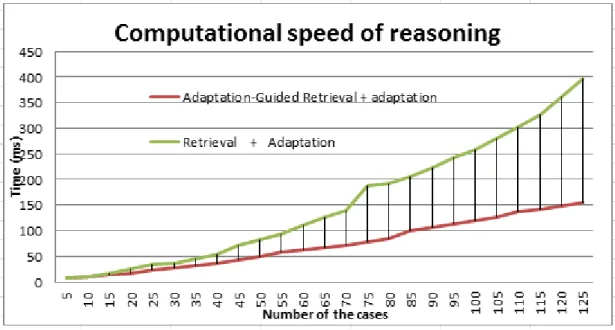
btained resu seconds. Th R) Core (TM 40 50 curacy hout aptation tion Wit adap 20 following the cy with and thout the ad w that the ca daptation ph m gives a go the help d nostics syste study of thm after a gorithm aft ults compa he adaptati M)2 Duo CP 60 70 thout ptation With ada e number of c without adap daptation, a ase base is n hase and mo ood recognit diagnostics em with two our adapta retrieval ste er a retriev ared to the ion algorith PU “2.66GH 80 90 aptation cases in the t ptation an accuracy not complet odels of kno tion rate. system wh o types of th tion-guided ep exploitin val stage e computati hm is execu Hz”. 100 110 1 test-base y rate of on te and gives owledge on hich use kn he retrieval d retrieval ng the two exploiting o ional speed uted on a c 120 nly58.1% s without which it nowledge phase. method. RM and only the d of the computer
21 The algorithm of adaptation, which is in relation to the knowledge of the system SISTRE through the models of knowledge, reacts differently depending on the AGR principle.
Fig.7: Analysis of the adaptation-guided retrieval method
According to Fig.7 which shows the elapsed adaptation time in ms, we note that the adaptation effort is less important when the AM adaptation measure is employed (in the AGR case). In fact, the larger the case base it, the more important the variation of the adaptation effort is. Consequently, the adaptation measure which is resulting from the AGR principle decreases considerably the adaptation effort. Moreover, this principle allows selecting the good case that will lead easily and correctly to the given final solution according to the equipment knowledge context. Moreover, retrieval using only the similarity measure without adaptation does not select the cases which are the best adaptable ones (in particular concerning their classes). These results also show that the most adaptable is not necessarily the most similar.
6.3 Adaptation phase
This experiment is designed to study the accuracy of the help diagnostics system; overall accuracy, and more precisely the accuracy of only retrieval cases. The results of this study are shown in Table 7
Table 7: Results of the adaptation.
We note that the accuracy rate 88% reflects that 110 cases were adapted correctly to the set of 125 cases. This accuracy is computed using “Ds2” as the component responsible for
22 the failure. By analysing the results, one can find that there are 5 retrieval failure cases. These cases are considered as generic cases that are covered by no other case of the case-base. Thus, their adaptation is impossible.
To evaluate the performance of the adaptation algorithm, these 5 cases are not considered in the accuracy calculation. For this subset of cases the accuracy rate is 91.66%. These algorithms can be applied to any type of discrete event systems (transfer systems). To prove the genericity of this method on any type of industrial plant, we applied these algorithms to another type of equipment, a diesel engine, but on a limited number of cases (Haouchine, 2009).
6.4 Comparison with other in industrial diagnosis system. 6.4.1 State of art in industrial diagnostic.
Concerning the reasoning process in the industrial diagnosis system, Gas Turbine, IRACUS and NodalCBR systems do not use adaptation: they offer directly the solution of the retrieved case. These systems are not effective because the retrieved case is not necessarily the chosen case for adaptation. As for Cassiopee, Pad’im (Mille et al, 1999) and Patdex systems, they propose simple adaptation rules and cannot ensure an accurate solutions’ result of the adapted cases. FormTool (Cheetham et Graf, 1997) exploits the relation between the retrieval and the adaptation phases. However, even if FormTool relies on this relation, the technique used is strictly dedicated to the treatment of plastic colors following a specific function. Consequently, it is not easily exploitable in other fields and cannot adapt other cases outside the characteristics of plastic colors.
Finally, the Creek system is the most effective among them because it proposes an explanation oriented retrieval and it exploits more complex and more complete relations in its adaptation phase thanks to models. In the retrieval step, the Creek system uses a similarity measure combined with measures related to the computation path in a semantic network. Concerning the adaptation step, it does not give any algorithm and it does not show how this step is carried out. The adaptation begins by activating a set of cases that are matches, and the step that refines the selection of a subset of cases by exploiting the non-identical explanation characteristics of each case. Lastly, the final focusing step is based on the solution and that’s by selecting the best case corresponding to the request and by copying or modifying the solution of this case. The adaptation phase is complex and is usually designed for a specific application.
6.4.2 Comparison methodology
To compare our diagnostic method to other CBR diagnostic method, we define three indicators linked to the elicitation and reusing knowledge in the new application.
CBR systems differ from each other in the development tool, the formalization of the case, the use of knowledge models, the different phases of the CBR cycle and the different algorithms and methods used in each step. Table 8 summarizes these points associated with the effort of creating the knowledge models the cost of adaptation and the cost of re-use.
23 Table 8. Comparison of the CBR diagnostic system.
1°- The effort of creating the knowledge models can be quantified by a development cost. To use development systems one needs to buy the system, to understand it and develop models. This requires expert availability. We will identify a cost of 8 on a scale of 0 to 10. However, representing expert knowledge from scratch will cost 10.
The creation of the knowledge model without the development system relies on the analysis of functional and dysfunctional models like Creek and our method requires less effort to model the creation. We can estimates the cost of this complex model to be 3
2°- To estimate the capacity to reuse the cases in the retrieval phase, we define the easiness of the adaptation by a cost of adaptation.
Adaptation guided retrieval method takes into accounts the cost of adaptation to select the most suitable course. The adaptation cost will be minimized (= 0) in this case. When there is an adaptation in the CBR system, the cost of adaptation is equal to 5
When there is no adaptation in the CBR system, the cost of adaptation is equal to 10.
Creek system is the most effective among the other diagnostic methods because it proposes an explanation oriented retrieval and it exploits more complex and more complete relations in its adaptation phase thanks to models.
3 °-For the re-use of the program of adaptation in the new application, the cost of re-use will depend on the generality of Adaptation methods.
If there is no algorithm of adaptation or there is a specific algorithm of adaptation the cost is maximal because a new algorithm must be developed. The cost of re-use is maximal, it is equal to 10.
If the application takes support on specific rules or models of knowledge the cost can be averaged, and it is equal to 5
When a method is independent of the application, as it is the case for our method, the cost is minimal and it is equal to 0.
24 We can see that our method was implemented to minimize the cost of designing a knowledge system and therefore it gives better results than other methods.
7
Conclusion
A knowledge oriented diagnostics system integrated in the e-maintenance platform is proposed in this paper. The case based reasoning system is well adapted to solve fault diagnostics issues because problems are recurrent and cases can be reused. A state of the art in the frame of case based reasoning for technical diagnostics highlighted that there is no common method to build a diagnostic support system. To conceive this system, we have followed the method of Rasovska which is to develop the two processes of Lamontagne model (offline and online processes):
1. Firstly we developed the following knowledge containers: (i) vocabulary that takes into account the definition of diagnostics.(ii)case base that formalizes the experience;(iii)two similarity metrics (one for the retrieval phase and one for the adaptation phase) and knowledge adaptation with two models.
We set up a formalization of the cases and we associated to the descriptors a hierarchical model. This model is common to problem and solution descriptors of the case-base cases and a model relating to the application context. All steps depend on the cases formalization and the associated knowledge models. The elaboration of this expert knowledge has a cost, but this cost is minimized because the first model which is the component taxonomy model is well known by the maintenance users. However, the second model requires a minimum of work. This modeling has influenced the proposed similarity measure as well as the adaptation measure. The latter is directly related to the functional mode of the supervised components (an attribute specific to the descriptor).
2. Secondly, concerning the reasoning process, an adaptation-guided retrieval method has been proposed.
The retrieval phase is related to the adaptation phase using the conjunction of similarity and adaptation measures. This conjunction makes it possible to select among the retrieved cases the most adaptable. The adaptation phase will exploit the dependency relations between the problem and the solution. These dependency relations will be given either by the selection of a relevant descriptor or by the use of a context model between the various failures which can appear in an industrial plant. And the results depend on this relation. One difficulty to overcome in this method is to define these relationships in the case base. The adaptation algorithm detects three scenarios and proposes associated actions to each case. We detailed one scenario where the most similar case is not necessarily the one selected for the adaptation.
Our previous studies have enabled us to formalize the case of a supervised industrial system of pallets transfer (SISTRE) in this paper and in a diesel engine, but on a limited number of cases. The proposed adaptation-guided retrieval and adaptation methods for a diagnostic application have been validated on a set of 125 cases resulting from the study carried out on SISTRE.
We have proved the feasibility of this diagnostic support system. To build it in any type of industrial equipment, two knowledge models need to be elaborated. To avoid the cost of the development of knowledge models, we are currently working on the use these algorithms with models (functional events and components models) developed in a web-maintenance platform. This model is defined in the domain ontology of web-maintenance, in the context of Semantic-maintenance and life cycle (SMAC) Project.
T any typ select d the case ACKN T mainten Switzer APPEN DIA T describe (SISTR Fig T stations and exte As show indexers (proxim and to p of the p pallet h in each memori This metho e of equipm different lev e. NOWLEDG This work w nance and li rland. NDIX A: T AGNOSTI To illustrat ed in this se RE).A descri g. 8a: SISTR The latter re which are ernal). wn in Fig 8 s) and elec mity sensors provide info pallets is en as a magne h working s ization of th d needs to b ment. We w els of granu GMENT was carried ife cycle), s THE SUP IC. e each noti ection. This iption of the RE. epresents a served by a 8b, each stat ctric actuato ). An induc ormation rel nsured by t etic label tha
station than he product
be applied o will apply th ularity in th
d out and fun upported by ERVISED ion of this application e system is g flexible pro a transfer sy tion is equi ors (stopper ctive read/w lative to the he friction at is used li nks to mag assembly se 25 on a large s his method he equipmen unded in the y European D INDUST study, the n is a superv given in Fig Fig. oduction sys ystem of pa ipped with p r) as well a write module e required o on belts th ike an embe gnetic read/ equence. Th scale that w to more co nt, and this w e framework n program In TRIAL SY industrial a vised indus g. 8a and Fi . 8b: The w stem, comp allets organi pneumatic as a certain e allows to peration in hat are pow
edded mem /write modu hese labels would attest omplex equ will affect t k of SMAC nterreg IV b YSTEM FO application trial system g.8b. working stati osed of five ized into do actuators (p n number o identify an a concrete wered by ele mory. This m ules (Balog thus enable its applicab uipments, w the formaliz C project (Se between Fra OR PALL to be deve m for pallets ion of SIST e robotized ouble rings pushers, pul of inductive nd locate eac station. The ectric moto memory can gh) and all e to track th bility for where we zation of emantic-ance and LET TO eloped is s transfer TRE. working (internal llers and e sensors ch pallet e motion rs. Each n be read lows the he pallet
26 path through the system. The feasibility of our approach was studied in Section 6 through 125 generic cases q.
Functional analysis of the system has identified main, additional (compelmentary) and secondary functions. Main functions are as follows: transfer assembly parts between stations; identify pallet and product lines; store product information; transform Content of the pallet. Secondary functions secure the transfer system; provide pneumatic energy and electrical energy. Secondary functions are concerned with adding/removing pieces of pallets, and managing assembly lines.
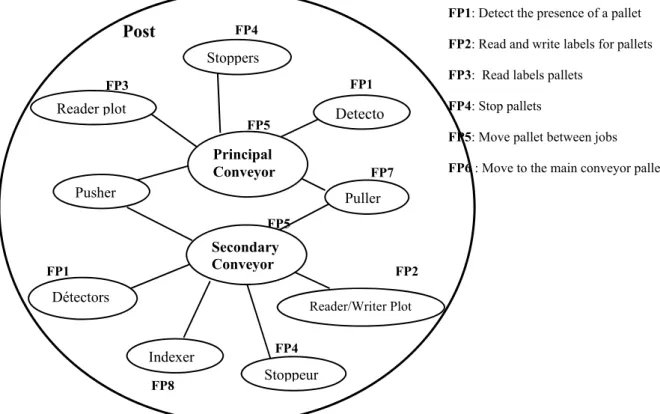
The base case is studied in relation to the functional analysis of the level 2 on a station which is shown in Figure 9.
The studied case base is in relation with the internal functional analysis of level 2 relative to the working station that is represented in figure 9.
Fig. 9: Functional Analysis Internal Level 2 (Post)
REFERENCES
Aamodt, A, 2004. Knowledge-Intensive Case-Based Reasoning and Sustained Learn Proc. of the 9th European Conference on Artificial Intelligence, ECCBR04, Lecture N in Artificial Intelligence, pp.1-15, Springer, (2004)
Althoff K.D. et Bartsch-Spörl B., 1996, Decision support for case based applicat Wirtschaftsinformatik, ISSN 0937-6429, 1996, vol. 38, no1 pp. 8-16.
Bergmann R., Althoff K.D., Breen S., Gker M., Manago M., Traphner R., Weiss S., 2003: Developing Industrial Case-Based Reasoning Applications: The INRECA Methodology. Lecture Notes in Artificial Intelligence, LNAI 1612, Springer Verlag, Berlin. FP4 Stoppers Principal Conveyor Pusher Reader plot Puller Detecto Stoppeur Reader/Writer Plot Indexer Détectors FP1 FP1 FP2 FP3 FP4 FP5 FP5 FP7 FP8 Post Secondary Conveyor
FP1: Detect the presence of a pallet FP2: Read and write labels for pallets FP3: Read labels pallets
FP4: Stop pallets
FP5: Move pallet between jobs FP6 : Move to the main conveyor pallet
27 BLUM A. L. and LANGLEY P. 1997, "Selection of relevant features and examples in
machine learning", Artificial Intelligence 97(1-2), 1997. pp. 245-271.
Bridge, D., Ferguson, A.,2002, An expressive query language for product recomme systems. Artificial Intelligence Review 18(3-4), 269-307 (2002
Chebel-Morello B., Haouchine M.-K., Zerhouni N., 2009. A methodology to conceive a case based system of industrial diagnosis. In World Congress of Engineering Asset Management, WCEAM'09, Greece
Chebel-Morello B., Haouchine M.-K., Zerhouni N., 2011 Adaptation based on knowledge models for diagnostic systems using case-base reasoning KMIS 2011 du 26 octobre au 29 octobre 2011 à Paris.
Cheetham, W., Graf, J.,1997, Case-Based Reasoning in Color Matching, Proceedings of Second International Conference on Case-Based Reasoning Research and Developm Lecture Notes In Computer Science; pp.1-12, vol. 1266, (1997)
Cordier, A., Fuchs, B., Mille, 2006, A.: Engineering and Learning of Adapta Knowledge in Case-Based Reasoning. 15th International Conference on Knowle Engineering and Knowledge Management EKAW'06, S. Staab and V. Svatek Podebrady, Czech Republic, 303-317, LNAI 4248. Springer-Verlag Berlin Heidelberg Cordier A., 2008,: Interactive and Opportunistic Knowledge Acquisition in Case-B Reasoning, PhD thesis, Laboratoire d'InfoRmatique en Images et Systèmes d'informat University of Lyon I, November.
Cunningham P., Doyle D. et Loughrey J.,2003 An evaluation of the usefulness of c based explanation. In Proceedings of the Fifth International Conference on Case-Ba Reasoning. Berlin: Springer, pp. 122-130, 2003.
Devaney, M., Cheetham, B., 2005: Case-Based Reasoning for Gas Turbine Diagnostic 18th International FLAIRS Conference (FLAIRS-05).
Doyle, D., Cunningham, P., Bridge, D., Rahman, Y,2004 .: Explanation oriented retrieval. In Proceedings of the Seventh European Conference on Case-Based Reasoning. Berlin: Springer, pp. 157-168
Fuchs B., Lieber, J., Mille, A., Napoli, A., 2000: An Algorithm for Adaptation in Case-Based Reasoning. In the 14th European Conference on Artificial Intelligence (ECAI00), Amsterdam, The Netherlands, August 20-25, IOS Press, volume 14, pp 45-49,
Grant P.W., Harris P.M. et Moseley L.G.1996 , Fault Diagnosis for Industrial Printers Using Case-Based Reasoning. Engineering Applications of Artificial Intelligence. Vol.9, No.2, pp.163-173.
Grundstein, M. 2000, From capitalizing on Company Knowledge to Knowledge Management, In D. Morey, M. Maybury, & B. Thuraisingham (Eds), Knowledge Management, Classic and Contemporary Works (chapter 12, pp. 261-287). Cambridge, Massachusetts: The MIT Press,
Hanney K., Keane M.T.,1996: Learning Adaptation Rules from a Case-Base. In Proceedings of the 3rd European Workshop on Advances in Case-Based Reasoning, Lecture Notes In Computer Science.
Haouchine, M.K., Chebel-Morello, B., Zerhouni, N., 2008: Adaptation-Guided Retrieval for a Diagnostic and Repair Help System Dedicated to a Pallets Transfer. In 3rd European Workshop on Case-Based Reasoning and Context-Awareness. 9th European Conference on Case-Based Reasoning, ECCBR 2008, Trier, Germany Haouchine, M.K. 2009 Rememoration guide par l’adaptation et maintenance des systèmes de diagnostic industriel par l’approche du raisonnement partir de cas. PhD thesis, Automatic en Micro-Mecatrnoic Department, Franche-Comt University, .Jacobson, A., Prusak, L. 1996 The Cost of Knowledge 13th National Conference on Artificial Intelligence, AAAI Press, Stanford, California (1996).