UNIVERSITE TOULOUSE III – PAUL SABATIER
UFR MIG, Laboratoire IRIT
THESE
en vue de l’obtention du
DOCTORAT DE L’UNIVERSITE DE TOULOUSE
délivré par l’Université Toulouse III – Paul Sabatier
Discipline : Informatique
présentée et soutenue
par
Belgin ERGENÇ
le 24 janvier 2008
Titre :
Un modèle d'exécution de requêtes mobiles pour des sources
à accès restreints en environnement d'intégration de données
JURY
Bruno DEFUDE Professeur à l’Institut National des Télécommunications (Rapporteur) Abdelkader HAMEURLAIN Professeur à l’Université Paul Sabatier (Directeur de thèse)
Serge MIRANDA Professeur à l’Université de Nice Sophia Antipolis (UNSA) Franck MORVAN Maître de Conférences – HDR à l’Université Paul Sabatier Halis PUSKULCU Professeur à l’Institut des Technologies d’Izmir
Mesut RAZBONYALI Professeur à l’Université Maltepe - Istanbul (Rapporteur) Florence SEDES Professeur à l’Université Paul Sabatier
3
Abstract: Query optimization in data integration systems over large scale network, faces the
challenges of dealing with autonomous, heterogeneous and distributed data sources, dynamic execution environment and changing user requirements. These issues initiate the need for crafting the traditional optimization methods in a way to produce stable query execution plans, use execution models which are able to adapt to run-time conditions and handle source restrictions. Centralization of the control in adaptive optimization methods result in bottleneck due to large amounts of message passing towards to the site of the central authority over large scale network where network bandwidth is low and network latency is high. In order to overcome this obstacle adaptive query optimization requires decentralized methods. A mobile execution model with mobile relational operators that are able to adapt in an autonomous way and focus on reducing of transfer cost is worth considering in large scale distributed data integration environment. However, this mobile query execution model needs to be extended with new operators to handle source restrictions. In this perspective we propose mobile relational operators developed for restricted sources. Another proposition is related with initial placement of mobile relational operators. The challenge is on defining a placement which would allow acceptable performance instead of a good placement which would cause dramatic performance sometimes at run-time. Finally we present and analyze a performance evaluation on the methods proposed.
Keywords: Data integration, Distribution in large scale, Adaptive optimization, Mobile
4
Résumé : L’optimisation de requêtes dans les systèmes d’intégration de données réparties sur
un réseau à grande échelle pose des problèmes liés à l’autonomie, l’hétérogénéité et la distribution des sources de données, l’environnement d’exécution dynamique et aux besoins changeant des utilisateurs. Résoudre ces problèmes nécessite de revisiter les méthodes d’optimisation traditionnelles afin de permettre la génération de plans d’exécution stables et d’utiliser des modèles d’exécution capables de s’adapter aux conditions d’exécution et de tenir compte des sources à accès restreints. La centralisation du contrôle dans les méthodes d’optimisation dynamique engendre un goulot d’étranglement dû au nombre important de messages transmis au site contrôlant l’optimisation à travers un réseau à grande échelle (à faible bande passante et à forte latence). Afin de résoudre ce problème, l’optimisation dynamique des requêtes nécessite de décentraliser ces méthodes. Dans un environnement d’intégration de données distribuées à grande échelle, un modèle d’exécution mobile, avec des opérateurs relationnels mobiles capables de s’adapter de façon autonomes et réduisant les coûts de communication a été proposé dans l’équipe. Cependant, ce modèle d’exécution de requêtes mobiles nécessite d’être étendu avec des nouveaux opérateurs afin de tenir compte des sources à accès restreints. Dans cette perspective, nous proposons des opérateurs relationnels mobiles développés pour des sources à accès restreints. Une seconde proposition est liée au placement initial des opérateurs mobiles. Le but est de déterminer un placement permettant d’obtenir des performances acceptables plutôt qu’un bon placement engendrant parfois de très mauvaises performances lors de l’exécution. Enfin, nous évaluons les performances des méthodes proposées.
Mot-Clés : Intégration de données, Répartition à grande échelle, Optimisation dynamique de
requêtes, Modèle d’exécution de requêtes mobiles, Sources à accès restreints, Placement initial, Evaluation des performances.
5 To my daughter and family
7
Acknowledgements
I should start by conveying my great appreciation to Mr. Luis Fariňas del Cerro, Director of Institute of Research on Informatics of Toulouse, who opened the doors of his institute and gave the chance of doing research there.
My sincere thanks to Professor Bruno Defude and Professor Mesut Razbonyali who were interested in reviewing my thesis and put their valuable efforts on enchancing it. Thanks to the members of the defence jury, Professor Serge Miranda, Professor Halis Puskulcu and Florence Sedes who were also very supportive in evaluating my works presented.
Special thanks to my advisor Professor Abdelkader Hameurlain who let me be creative but kept me on track. Even more importantly, he taught me to choose worthwhile problems and aim high. Other special thanks should be sent to my co-advisor, Professor Halil Sengonca who was always ready to support and without his help I could not write the Turkish version of my thesis. Thanks also to an exceptional chief, Mr. Franck Morvan with whom I've had countless stimulating discussions that led to new ideas.
I greatly appreciate the support that I got from my professor Sitki Aytac during these years which coincided with a difficult transition period in my personal life as well.
Thanks to the present and past members of team Pyramide for being supportive and friendly with me during all my stays. Special thanks to Nadhem Marsit without whom I would never feel at home and get the chance of contacting other people of IRIT.
Thanks to my friends who live in Turkey and abroad for their patience in listening to my changing moods and conveying their thrust with every chance. Special thanks to my students for keeping me motivated and young although I was unreachable periodically during those three years. I appreciate the support of Herkul and my pirate who were always reachable when I needed.
I am grateful to my parents who were always source of inspiration for me. They were with me whenever I needed them during these years. Thanks to the members of my family from different ages, they always made me feel cared and loved. Last but not the least, a thank you goes to my daughter for her support and confidence although during past three years I must have neglected her lot.
9
Table of Contents
Chapter I Introduction ... 15
1. Context ... 15
2. Data Integration Approaches ... 16
2.1 Data Warehousing ... 16
2.2 Virtual Data Integration ... 17
3. Query Processing in Data Integration Systems ... 19
3.1 Approaches to Specify Source Descriptions ... 20
3.2 Query Reformulation ... 21
3.3 Query Optimization ... 22
3.4 Limited Query Capabilities of the Sources ... 24
4. Problem Position ... 25
5. Content, Contribution and the Organization of the Thesis ... 28
Chapter II State of the Art: Query Optimization in Data Integration Systems ... 33
1. Introduction ... 33
2. Cost Models in Data Integration ... 35
2.1 Historical Cost Model ... 35
2.2 Calibration Cost Model ... 35
2.3 Generic Cost Model ... 36
3. Adaptive Query Optimization ... 36
10
3.2 Adaptive Query Optimization Methods ... 39
3.2.1 Inter-operator ... 39
3.2.2 Intra-operator ... 42
4. Query Optimization in the Presence of Restricted Sources ... 43
4.1 Abstraction Mechanisms for Describing the Query Capabilities ... 44
4.2 Query Execution in the Presence of Restricted Sources ... 46
4.3 Execution Space Size in the Presence of Restricted Sources ... 49
4.4 Optimization Methods in the Presence of Restricted Sources ... 51
5. Discussion on Query Optimization Methods in Large Scale Data Integration ... 53
6. Mobile Query Execution Model in Large Scale Data Integration ... 55
6.1 Mobile Join Operator ... 56
6.2 Interactions of the Mobile Join Operator ... 58
7. Conclusion ... 60
Chapter III Mobile Query Execution Model: Mobile Relational Operators for Restricted Sources and Initial Placement of Mobile Relational Operators ... 63
1. Introduction ... 63
2. Mobile Relational Operators for Restricted Sources ... 64
2.1 Basic Operators for Restricted Sources ... 65
2.1.1 Dependent Access Operator: DAccess ... 66
2.1.2 Dependent Join Operator: DJoin ... 67
2.2 Mobile Join Execution Model for Restricted Sources ... 70
2.2.1 Mobile Dependent Join Operator: MDJoin ... 71
11
3. Initial Placement of Mobile Relational Operators for Large Scale
Distributed Query Optimization ... 76
3.1 Mobile Relational Operators and Current Placement Methods ... 76
3.1.1 Characteristics of Mobile Relational Operators ... 76
3.1.2 Limitations of Single Point Placement Methods ... 77
3.2 Robust Placement ... 78
3.2.1 Migration Space... 78
3.2.2 Robust Site... 79
3.2.3 Robust Placement of Mobile Relational Operators of a Query ... 82
4. Conclusion ... 83
Chapter IV Performance Evaluation ... 85
1. Introduction ... 85
2. Performance Evaluation of Mobile Relational Operators for Restricted Sources ... 86
2.1 Impact of the Variation of the Sizes of Data ... 87
2.2 Impact of the CPU Frequency and the Communication Bandwidth ... 91
2.3 Discussion on the Performance Evaluation ... 95
3. Performance Evaluation of Initial Placement of Mobile Relational Operators ... 96
3.1 Single join ... 96
3.2 Multi-join ... 98
3.3 Discussion on the Performance Evaluation ... 102
12
Chapter V Conclusion and Future Work ... 105
13
List of Figures
Figure 1.1: Simple schema for a data warehouse ... 17
Figure 1.2: Simple schema for data integration solution ... 18
Figure 1.3: Query processing in data integration systems ... 19
Figure 1.4: Structures of query execution trees ... 23
Table 2.1: Comparison of adaptive query optimization methods ... 38
Figure 2.1: BindJoin and BindAccess operators ... 48
Figure 2.2: Query plan for Signs WebCount ... 49
Table 2.2: Bounds on the size of execution space for dynamic programming optimizer in the presence of binding patterns, for a chain query [MAN 01] ... 51
Figure 2.3: Environment of Mobile Query Execution Model [HUS 05] ... 56
Figure 2.4: Algorithm of a mobile hash join operator [ARC04] ... 57
Figure 3.1: Sample database ... 65
Figure 3.2: Function of DAccess operator ... 67
Figure 3.3: Co-ordination of DJoin and DAccess operators ... 68
Figure 3.4: Algorithm of a Dependent Join (DJoin) ... 69
Figure 3.5: Algorithm of a Mobile Dependent Join (MDJoin) ... 72
Figure 3.6: Algorithm of a Sampling Mobile Dependent Join (SMDJoin) ... 75
Figure 3.7: Response times of PS-1 and PS-2 with respect to error on |R1| ... 79
Figure 3.8: Algorithm of the Robust Site ... 81
Figure 3.9: Algorithm of the Robust Placement ... 82
Table 4.1: Simulation parameters ... 86
Figure 4.1: Response time with decreasing size of R1 (becoming less than the estimation) ... 88
Figure 4.2: Response time with increasing size of R1 (exceeding the estimation) ... 89
Figure 4.3: Response time with decreasing size of R2’ (becoming less than the estimation) . 89 Figure 4.4: Response time with decreasing size of R2’ (becoming less than the estimation) . 90 Figure 4.5: Response time with increasing size of R2’ (exceeding the estimation) ... 91
Figure 4.6: Speedup of MDJoin with increasing CPU frequency for different variations of the size of R1 ... 91
14 Figure 4.7: Speedup of SMDJoin with increasing CPU frequency for different variations on
the size of R1 ... 92
Figure 4.8: Speedup of MDJoin and SMDJoin with increasing CPU frequency for variations on the size of R1 = -60% ... 92
Figure 4.9: Speedup of MDJoin with increasing communication bandwidth for different variation of the size of R1 ... 93
Figure 4.10: Speedup of SMDJoin with increasing communication bandwidth for different variation of the size of R1 ... 94
Figure 4.11: Speedup of MDJoin and SMDJoin with increasing communication bandwidth for variation of the size of R1 = -30% ... 94
Figure 4.12: Response time with respect to error on |R1| ... 97
Figure 4.13: Response time with respect to error on selectivity ... 98
Figure 4.14: Response time with respect to error on |R1| ... 99
Figure 4.15: Response time with respect to error on |R2| ... 100
Figure 4.16: Response time with respect to error on |R3| ... 101
15
Chapter I
Introduction
1.
Context
Many of the current applications like e-commerce, digital government, medical genetics, astrophysics, environment and culture require access to the data from different sources. The main reason behind this is the increase in deployment and use of web due to the technical advances achieved. This increase demand highlighted the role of database technology as well: in storing, managing and efficiently querying large amounts of scattered information besides the functions for protecting data integrity, facilitating reliable and flexible data access and manipulation, synchronizing concurrent accesses from applications and securing data.
Increase in the demand of sharing data from different sources resulted in the research efforts to provide integration of data scattered over different sources. The aim of data
integration is to provide uniform access (same query interface to all sources) to multiple,
distributed, autonomous and heterogeneous data sources. As stated by [OZS 99] distribution of data means that the data resides on different sites. The autonomy of a system indicates the distribution of control: the data source might be sharing part of its data but in terms of operation it acts independently. Data source may be autonomous in its design, meaning their developers are free to define the domain, programming models, naming concepts, etc. A data source may be autonomous with respect to communication and execution, meaning that it may independently decide how to handle interaction with the outside world and how to handle the demands internally [HAS 00]. Due to the independent development and deployment of data sources, heterogeneity might occur at various levels and for various reasons. On a technical level, heterogeneity comes from different hardware platforms, operating systems, database
16 management systems. On a conceptual level, heterogeneity comes from different data models as well as different understanding and modeling of the same real-world concepts, for example, the use of the same name to denote different concepts and the use of different names for the same concept.
Major dimensions to consider in data integration are the number of sources, amount of data volume to be transferred, heterogeneity and autonomy of the sources together with the network bound imposed by the distribution and the requirements of the users like accuracy, completeness, performance, handling inconsistencies.
In this chapter, we will first discuss on data integration approaches where we will mainly compare data warehousing approach with virtual data integration. In section 3 we will present the mediator wrapper architecture with the functions of its components, phases of query processing in this architecture and the issues related with limited query capabilities of the sources. In section 4 we will discuss and present the position of the problem that motivated us for the works presented in this thesis. Content and contributions of the thesis can be found in section 5 of this chapter.
2.
Data Integration Approaches
Main current solutions for data integration are data warehousing and virtual data integration. We want to explain and compare the approaches of data warehousing and virtual data integration.
2.1 Data Warehousing
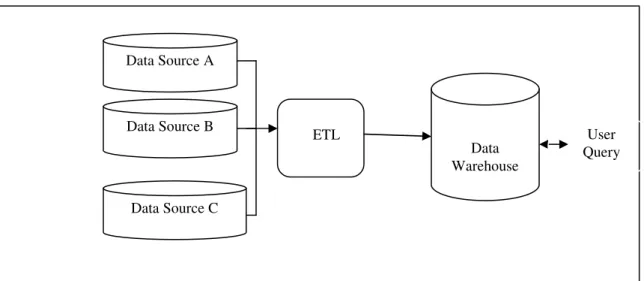
One popular approach is Data Warehousing as solution to enable a common storage providing user a uniform interface over different sources [GUP 97 and WID 95]. As seen in the Figure 1.1, data from several sources are extracted, transformed and loaded (ETL) into a source and can be queried with a single schema. This can be perceived architecturally as a
17 tightly coupled approach because the data reside together in a single repository located in one site. All user queries are posed to that common storage. The advantage of this system it is effective in querying and the decisional data is separated from operational data. However, problems with tight coupling can arise with the "freshness" of data, for example when an original data source is updated, but the warehouse still contains the older data and the ETL process needs to be executed again. It is not possible to add a new source. Another difficulty is to construct data warehouses when you only have a query interface to the data sources and no access to the full data.
Figure 1.1: Simple schema for a data warehouse
2.2 Virtual Data Integration
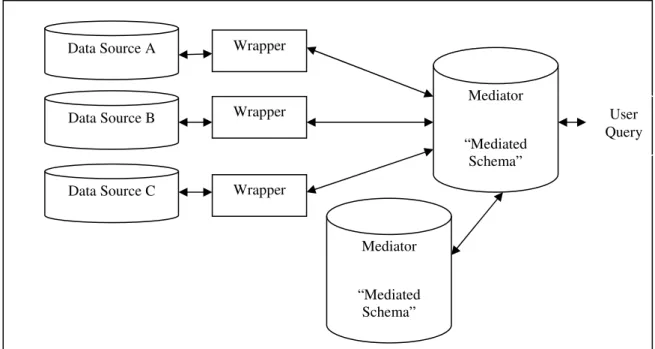
The recent trend in data integration has been to loosen the coupling between data following the idea presented in [WIE 92]. Here the idea is to leave the data in the sources, when the query arrives; determine the relevant sources to the query, break down the query into sub-queries for the sources using the mediated schema, get the answers from the relevant wrappers and combine them appropriately in the mediator (Figure 1.2). This process can also be called as view based query answering because we can consider each of the data sources to be a view over the mediated schema.
Data Source A Data Source B Data Source C ETL Data Warehouse User Query
18 There is a large body of research projects based on this approach: Garlic (IBM) [ROT 96], Information Manifold (AT&T) [LEV 96], Tsimmis [RAJ 95], InfoMaster (Stanford) [GEN 97], Tukwilla (UW) [IVE 99], Hermes (Maryland) [ADA 96], Disco (INRIA, France) [TOM 98], Cape [ZHU 04].
Other major component of this architecture is the wrapper whose task is to communicate with the data source and do format translations. Queries submitted in the language of mediator are translated into the language of the source and the results of the source are transformed into the format of the mediator. They are built with respect to a specific source and often it is hard to build. They can be intelligent in terms of performing source-specific optimization.
Figure 1.2: Simple schema for data integration solution
A convenience of this solution when compared with data warehouse solution is that new sources can be added by simply constructing a wrapper for them. This contrasts with ETL systems or a single database solution where the entire new dataset must be manually integrated into the system. Another advantage is that the data is always fresh. However, the challenges are expressive power, easy addition of a new source, effective and efficient
Data Source A Data Source B Data Source C Mediator “Mediated Schema” Wrapper Wrapper Wrapper User Query Mediator “Mediated Schema”
19 reformulation of the query for local data sources, query optimization and limited query capabilities of the sources. We will discuss these issues in section 3 of this chapter.
Throughout the rest of the thesis we will be referring to this approach when we say data integration, mediation system or mediator-wrapper architecture.
3.
Query Processing in Data Integration Systems
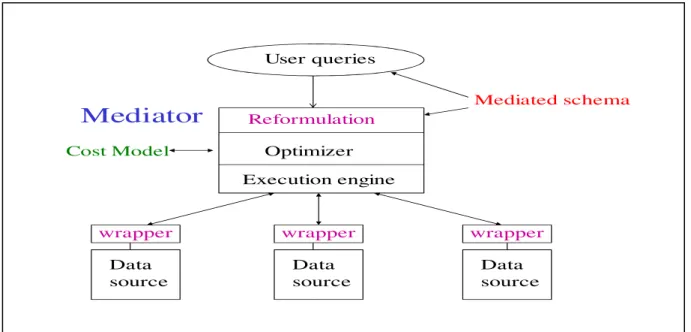
Let us look at the steps and the components of the query processing in data integration. As seen in Figure 1.3, the main components of a data integration system are mediator and wrapper basically and we have already summarized the functions of them in previous sub-section. In mediator a user query goes through three successive operations; (1) query reformulation: user query given in global schema is transformed into the sub-queries written in local source schemas, (2) global optimization: execution plans of the sub-queries with optimum cost is found, (3) execution plan is submitted to the execution. We will discuss about describing source descriptions in sub-section 3.1 and continue with the explanation of the query reformulation in sub-section 3.2. In sub-section 3.3 we will present query optimization in data integration.
Figure 1.3: Query processing in data integration systems
Data source wrapper Data source wrapper Data source wrapper
Mediator
User queries Mediated schema Reformulation Optimizer Execution engine Cost Model20
3.1 Approaches to Specify Source Descriptions
[LEN 02 ] states that data integration systems are formally defined as a triple where G is the global (or mediated) schema, S is the heterogeneous set of source schemas, and M is the mapping that maps queries between the source and the global schema. Both G and S are expressed in languages over alphabets comprised of symbols for each of their respective relations. The mapping M consists of assertions between queries over G and queries over S. When users pose queries over the data integration system, they pose queries over G and the mapping then asserts connections between the elements in the global schema and the source schemas.
A database over a schema is defined to be a set of sets, one for each relation (in a relational database). The database corresponding to the source schema S would be the set of tuples for each of the heterogeneous data sources and is called the source database. Note that this single source database may actually be a collection of disconnected databases. The database corresponding to the virtual mediated schema G is called the global database. The global database must satisfy the mapping M with respect to the source database. The legality of this mapping depends on the nature of the correspondence between G and S. Two popular ways to model this correspondence are Global as View or GAV and Local as View or LAV.
In GAV, the global database is modeled as a set of views over S. In this case M associates to each element of G a query over S. Query processing becomes a straightforward operation because the associations between G and S are well-defined. The burden of complexity is placed on implementing mediator code instructing the data integration system exactly how to retrieve elements from the source databases. If any new sources are added to the system, considerable effort may be necessary to update the mediator, thus the GAV approach should be favored in cases where the sources are not likely to change.
On the other hand, in LAV, the source database is modeled as a set of views over G. In this case M associates to each element of S a query over G. Here the exact associations between G and S are no longer well-defined. As is illustrated in the next section, the burden of determining how to retrieve elements from the sources is placed on the query processor. The benefit of an LAV modeling is that new sources can be added with far less work than in a
21 GAV system, thus the LAV approach should be favored in cases where the mediated schema is not likely to change.
For conclusion remarks we can state that in GAV approach query reformulation becomes as simple as query unfolding on the other hand in LAV it is a problem of answering queries using views and there exists a large body of research like Bucket algorithm of [LEV 96], inverse rules algorithm of [DUS 98], hybrid versions MiniCon [POT 01], etc.
3.2 Query Reformulation
The theory of query processing in data integration systems is commonly expressed using conjunctive queries [ULL 97]. One can loosely think of a conjunctive query as a logical function applied to the relations of a database such as "f(A,B) where A < B". If a tuple or set of tuples is substituted into the rule and satisfies it (makes it true), then we consider that tuple as part of the set of answers in the query. While formal languages like Datalog [KOW 88] express these queries concisely and without ambiguity, common SQL queries are classified as conjunctive queries as well.
An important property of conjunctive queries (in terms of data integration) is query
containment. A query A contains another query B (denoted ) if the results of applying B are a subset of the results of applying A for any database. The two queries are said to be
equivalent if the resulting sets are equal for any database. This is important because in both GAV and LAV systems, the user's conjunctive queries are posed over a mediated schema represented by a set of views, or "materialized" conjunctive queries. Integration seeks to rewrite the queries represented by the views to make their results equivalent or maximally contained by our user's query. This corresponds to the problem of answering queries using views (AQUV) [HAL 01].
In GAV systems, a system designer writes mediator code to define the query rewriting. Each element in the user's query corresponds to a substitution rule just as each element in the global schema corresponds to a query over the source. Query processing is simply expanding the sub-goals of the user's query according to the rule specified in the mediator and thus the resulting query is likely to be equivalent. While the majority of the
22 work is done beforehand by the designer, some GAV systems such as TSIMMIS involve simplifying the mediator description process.
In LAV systems, queries undergo a more radical process of rewriting. This is because there is no mediator to align the user's query with a simple expansion strategy. The integration system must execute a search over the space of possible queries in order to find the best rewrite. The resulting rewrite may not be an equivalent query but maximally contained, and the resulting tuples may be incomplete. For the problem of query reformulation, there exists a large body of research like Bucket algorithm of [LEV 96], inverse rules algorithm of [DUS 98], hybrid versions MiniCon [POT 01], etc.
3.3 Query Optimization
In traditional optimization, query optimization follows the steps of parsing, query rewriting (apply algebraic transformations, merge joins into blocks and move predicates before blocks), optimization of each block (join ordering), select scheduling. In this environment each relation is coming from a single database, all sources are assumed to be relational, completeness is expected and deterministic execution is possible since the statistics are available. Formal description of optimization is stated as “Given a query Q, an execution space E, and a cost function C defined over E, find an execution e in EQ that is of minimum
cost, where EQ is the subset of E that computes Q, mine€EQ C(e)” by [DU 92]. Any solution to
the above problem can be characterized by choosing: (1) an execution model and, therefore, an execution space, (2) a cost model, and (3) a search strategy. The execution model encodes the decisions regarding the ordering of the joins, join methods, access methods, materialization strategy, etc. The cost model computes the execution cost. The search strategy is used to enumerate the execution space, while the minimum cost execution is being discovered. These three choices are not independent; the choice of one can affect the others.
The execution space used can be abstractly modeled as the set of all join orderings (i.e., all permutations of relations) in which each relation is annotated with access/join methods and other such inflections to the execution [OZS 99]. It is obtained by applying transformation rules (e.g. commutativity of joins, associativity of joins, permutation of two
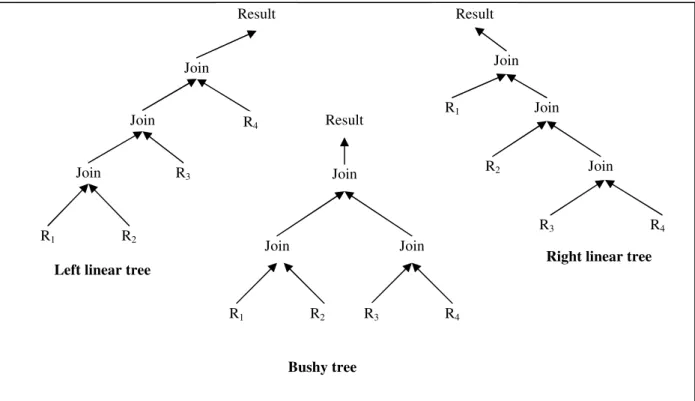
23 operators, etc.). It is usually large in size; the size depends on the number of relations and form of the query (e.g. chain, star, etc.). In order to reduce the size of the execution space optimizer might apply some heuristics like deconstructing conjunctive selections into a sequence of single selection operations, moving selection operations down the query tree for the earliest possible execution, avoiding cartesian product operations, creating new projections where needed, identifying those sub-trees whose operations can be pipelined, etc. Three types of execution tree structures are demonstrated in Figure 1.4.
Figure 1.4: Structures of query execution trees
When it comes to cost model we can say that it is used by the search strategy of the optimizer to find the optimum plan. The cost model is composed of the statistics about the data and the cost formula. The cost of a plan is calculated by the costs of operations in the query together with the cost of data transfer between the sites. The cost of an operation is the cost of processing (CPU) and the cost of I/O. In order to estimate the cost of an operation, cost formula uses the estimates on the statistics. The weights of these costs can be changing according to environment. In data integration environment, it is difficult to estimate the costs
Join R4 R1 R2 Join Join R3 Bushy tree Result Join Join R2 R3 R4 Join R1 Result
Right linear tree Result Join R3 R1 R2 Join Join R4
24 of the operations since the statistics about the data and the cost formula of different sources can be obsolete or unavailable. Different cost models are proposed by the researchers in order to overcome this problem. We will be discussing about these methods in chapter 2.
The search strategy of an optimizer is the way of the optimizer exploring in the execution space in order to find the optimum execution plan. There are different strategies behind the search algorithms: enumerative or randomized (e.g. genetic) [LAN 91]. Enumerative search strategy considers most of the points in the solution space, but tries to reduce the solution space by applying heuristics. The System R optimizer [SEL 79] demonstrates this approach by restricting the solution space to binary processing trees and using dynamic programming for searching. Enumerative strategies can lead to the best possible solution, but face a combinatorial explosion for complex queries (e.g. a join query with more than ten relations).
In order to consider larger execution spaces, randomized search strategies have been proposed based on the idea to improve a start solution until obtaining a local optimum. Examples of such strategies are simulated-annealing [IOA 87] and iterative improvement [SWA 88]. With the same objective, genetic search strategies [GOL 89] can be applied to query optimization as well. Randomized or genetic strategies do not guarantee that the best solution is obtained, but avoid the high cost of optimization.
3.4 Limited Query Capabilities of the Sources
Now we want to introduce the aspect of limited query capability; which is one of the characteristics of the most of the sources in data integration. Consider a web book store where user poses queries to this source by filling out a search form: author, title, subject, ISBN, publisher attributes. Specifically user must fill out at least one of the five attributes and submit the form. In response the source will return a list of books with some of these and additional attributes. In particular, it does not return the subject attribute but returns the price attribute among the others. Many simple queries cannot be posed to this source; e.g. books written by “Freud” that cost at most 10 Euro. This source has limited query capability in another words, is a restricted source. Sources might be restricted due to the limitations of its query interface,
25 certain attributes might be hidden due to privacy reasons or it mains indexes for some attributes only.
Let us give another example; consider a web bookstore, BarnesAndNoble.com [BAR 01]. Once again users can pose queries by filling out a search form which allows users to specify at least one of the author, title or keyword attributes along with optional specification of price, format and other attributes. In particular that web bookstore can support the query to find all by “Freud” that cost at most 10 Euros. However, it cannot support many other simple queries like “find all books published by Mc Graw Hill”. Incidentally, this query is supported by Amazon.
As seen by two examples query optimizer in data integration systems needs mechanisms to handle capability limitations together with capability descriptions (e.g. views). A language or a pattern should be found to describe these limited capabilities [MAN 01, VAS 97]. Query decomposition methods of the optimizer should be revised to take into account these restrictions like the case of [DUS 98, LI 03 and MAN 01] in finding executable plans (supported queries by the sources). [LI 03] differs from [ MAN 01] since it incorporates the sources that are not specified in the query to get maximum or partial information from the restricted sources as well. Feasible plan within this execution space should be found like the case of positive query (query posed on the sources with no access restrictions) [DUS 98, MAN 01, YER 99]. In query execution, additional operators are required to exploit a source with limited access [BOU 01, CHA 93 and MAN 01].
We have gone through phases query optimization; when the environment is data integration. In the next section we want to position the problems that motivate us in the framework of this thesis.
4.
Problem Position
Up to this point, we have introduced the need for accessing the data residing on different sources which are distributed, autonomous and heterogeneous. Among possible solutions for data integration that would provide user with uniform and transparent access to
26 these sources; we have introduced mediator-wrapper architecture. As we focused on the query processing in this architecture we have outlined various issues and research problems like describing source capabilities, query reformulation, query optimization, limited query capabilities of the sources. In this thesis, we want to concentrate on query optimization in data integration environment with the presence of the sources with limited query capabilities.
The focus of the first group of research on query optimization in data integration is related with finding better cost estimations while handling the autonomy of the data sources from which it is difficult to provide statistical or cost information. In these efforts; the cost
model used in optimization is extended as to incorporate the estimations based on the result of
the similar historical queries, result of calibrating or probing queries, cost models of the data sources [ADA 96, AMB 98, GAR 96, NAA 98 and ZHU 03]. The idea behind all these efforts is to better estimate the cost of an execution plan in compile time where the statistics might be absent or erroneous and knowledge about execution environment is limited.
However these cost models face the challenge of producing sub-optimal execution plans due to the unpredictability of the sources and execution environment. General solution to this problem is adaptive query optimization meaning interleaving optimization and execution (as you get to know more about your data and environment, you can improve your plan). Query optimizer has to generate stable plans to deal with execution uncertainties; non-blocking plans which give out results as soon as they are available. [AMS 97, AVN 00, KAB 98 and ZHO 05] are some of the examples of dynamic optimization methods; where the idea is to produce an execution plan in compile time, execute and when errors on the estimations occur, react as to adapt to run- time conditions. In all these examples, there is a main process in charge of monitoring and changing the execution plan during query execution. This kind of monitoring and decision taking is classified as centralized re-optimization by [HUS 06]. The drawback of these methods comes when they are applied to large scale environment due to the characteristics of the large scale environment where there is high network latency and low bandwidth. High amount of control and data message passing (1) creates bottleneck on the site of central authority and (2) increases the cost of the query due to high transfer cost.
27 In order to overcome this bottleneck, there are recent studies where the monitoring and decision taking for re-optimization is decentralized. The examples of such methods are presented in [ARC 04, COL 04, JON 03, IVE 99, MOR 03, OZA 05a and URH 00]. The approach of [IVE 99 and URH 00] is decentralized: the decision of adaptivity is taken by the operator. [JON 03] and [COL 04] are the examples of decentralized optimization methods where the adaptivity is at the sub-query level and execution model is based on communicating agents or brokers. These methods concentrate on improving the cost of local processing by changing the plan at operator level or at sub-query level in the presence of inaccuracies but do not take into account the network bound.
The methods presented in [ARC 04, HUS 05, MOR 03 and OZA 05a] are based on the idea of using mobile relational operators in query execution. In this mobile query execution
model; relational operators are mobile agents which are aware of their environment and able
to react in an autonomous and decentralized way during their execution to correct the sub-optimality of the execution plans. The mobile relational operator can migrate from one site to another among the set of sites determined by the optimizer, according to workload of the sites, the data unavailability, statistical information and the cost of migration. This style of execution allows taking into account the cost of local processing together with network sources. However, all the previous study on mobile query execution model is based on the mobile relational operators for positive query (query posed to sources without access restrictions).
As in the examples given in section 1.3.4 in large scale data integration environment some of the data sources have limited query capabilities. In order to retrieve data from them some of the required input should be given When dealing with these restricted sources data integration systems need (1) to model descriptions of the query capabilities of each source, i.e., the set of queries supported by each source [KIR 95 and MAN 01], (2) to have algorithms for deciding how a query can be answered given the capabilities of the sources at a minimum cost [LI 03, MAN 01, NIE 01, MOR 88 and YER 99] and (3) to device special algorithms for the operators in the query execution process [GOL 00 and MAN 01]. [MAN 01] is an elegant and compact work covering all the issues related with restricted sources: modeling the limited source capabilities, analyzing effects of the restrictions on the size of the
28 execution space, finding viable and feasible plan algorithms and special operators for execution. Bind Join operator of [MAN 01] focuses on returning the answer as early as possible but it is not adaptive.
Mobile query execution model as an example of decentralized adaptive query execution should include operators in order to query sources with restricted sources. Another drawback of mobile query execution model lies in it assumption that the optimizer can map the mobile relational to a site which will provide the optimum execution with single point estimations. However, mobile relational operators should be placed to the sites which would not obstruct them to move at run-time with refreshed estimations when there is an estimation error. Studies capturing the problem of building bridge between compile-time optimization methods and run-time adaptive methods are critical at this point. The approach presented as proactive re-optimization in [BAB 05b] is an elegant example of such studies. The authors are trying to find robust execution plans within bounding boxes around estimates that define the uncertainty in estimates of statistics. Similar to this approach, initial placement of mobile relational operators should take account the possibility of their migration in case of estimation errors. When we look at the placement methods provided by the parallel and distributed query processing field [CHE 92, CHE 95, FRA 98, GAR 96b, HAS 94, HON 91, LIU 98, LO 93, MAC 86 and ZHO 05] are based on single-point estimations. Such a placement is as good as compile-time estimations but it yields bad performance in cases of estimation errors. When we use a mobile relational operator, its placement is critical since wrong placement can block its adaptation capability.
5.
Content, Contribution and the Organization of the Thesis
In this thesis we start by presenting the context and try describing the challenges in terms of data integration. The challenges arise from the characteristics of the data sources, characteristics of the execution environment and recent user requirements. The sources to be integrated are heterogeneous, autonomous and distributed. In terms of query optimization all three attributes pose variety of problems. Heterogeneity necessitates methods to describe sources capabilities and query limitations, methods to decompose the query into sub-queries of the sources. Autonomy requires cost models to capture the different data sources in the
29 global cost of the query and adaptive re-optimization methods in case of estimation errors. Distribution and execution environment need extra attention to be paid to the volume of data and control message passing and to the occurrence of unpredictable events during execution of the query. Recent user requirements changes the objective of query optimization and forces the addition of new metrics like early arrival of the tuples, monetary costs of the data sources, quality of data sources, etc.
As seen in the context there is large spectrum of challenges; our interest was to focus on the query optimization in large scale data integration environment. Within this objective, our initial effort was to make a survey on the state of the art concerning the issues of query optimization in large scale data integration and locate our motivation. In this survey we first focused on cost models where the main concern was to be able to make better cost estimation about the global cost of the query capturing necessary information from different data sources. We have seen that, it was difficult to make good estimation at compile time due to the autonomy of the data sources and occurrence of the unpredictable events during execution time. To overcome these drawbacks, large amount of research were carried out in the area of adaptive query optimization. We at this point, made analysis of the proposed adaptive query optimization methods based on attributes like type of modification, place of modification, type of control, type of event and type of re-optimization. We found one of the attributes critical in large scale: the control of monitoring and decision making about adaptation. We emphasized the importance of decentralized control and demonstrated various works in this direction. We focused on mobile query execution model and its building blocks studied so far and seen that it needs methods to handle query execution (1) with the sources that have limited query capabilities and (2) to have link with the optimizer in mapping the mobile relational operators to the sites regarding their sensitivity to initial placement. This brought us to the survey of the methods of query processing in the presence of restricted sources. Finally we were ready to propose our methods for mobile query execution model in the presence of restricted sources and initial placement of mobile relational operators.
In our first work, our challenge was to propose mobile join operators designed for
restricted sources; meaning they should be able to work in the presence of access restrictions
30 execution model which is worth considering with its decentralized adaptive query optimization approach applicable in large scale network. In this perspective, we designed Mobile Dependent Join (MDJoin) and Sampling Dependent Join (SMDJoin): two join operators which are mobile (they adapt to inaccuracies at run time by changing their place of execution) and able to work with access restrictions imposed. The difference between the two new query operators lies in their level of adaptation ability to the execution environment. In our second work, we addressed the problem of initial placement taking into account the adaptation capability of mobile relational operators at run-time (mobile join, MDJoin and SMDJoin). Our challenge was not finding good placement based on single-point estimates but defining acceptable placement for an estimation interval in order to avoid dramatic performance at run-time.
We have carried out a performance evaluation study on our methods: mobile relational operators of restricted sources and initial placement of mobile relational operators. We had done our performance evaluation of both of the methods in a simulation environment. First study evaluates the performances MDJoin and SMDJoin in comparison to the dependent join operator of the standard strategy. The focus of the evaluation was on their performance with respect to the following parameters: response time in the presence of the variations between the compile-time estimations and the run-time computations of the sizes of the relations, speedup1 realized in comparison with the network bandwidth and CPU frequency. The second study compares single-point and robust placement methods mapping single join and multi-join. Both methods were tested when there is error on the estimations related to the sizes of relations.
The contribution of the thesis is as follows; (1) two mobile join operators (MDJoin and SMDJoin) which are capable to work with the sources having limited query capabilities and yet capable to adapt to run time conditions when there is estimation error and (2) initial placement method which finds robust site to place mobile relational operators taking into account their migration (adaptation) possibility. Performance study on (1) showed that if the
31 size of the data from the first source is more than 30% different than the estimation made by the optimizer, our mobile dependent operators have better performance compared to the operator of the standard strategy. Against the variations of the size of the data coming from the second source SMDJoin is superior to MDJoin, since due to its sampling step it sees the variation of the size of the data of the second source. The overhead of this sampling step for SMDJoin is less than 10 % of increase in response time compared to MDJoin. The performance study on (2) showed that robust placement method has better performance in case of the error on the size of the first relation 80%. We noticed that the error on the size estimated at compile-time of the first relation has greater impact on the query response time. Robust placement method outperforms when there is error on the size of the first relation since it expects adaptation and chooses the initial site according to this possibility.
Plan of the rest of the thesis is as follows; in chapter 2 we will give a state of art
covering our concerns related with query optimization in large scale network. In chapter 3 we will present two contributing studies of the thesis: mobile relational operators for restricted sources and initial placement of mobile relational operators. Chapter 4 is dedicated to performance results of the works discussed in chapter 3. Chapter 4 will present our conclusion remarks and the ideas for future work.
33
Chapter II
State of the Art: Query Optimization in
Data Integration Systems
1.
Introduction
In previous chapter we explained the need and the idea behind data integration and characteristics of the sources. As to brief; we can state that data integration approaches try to provide user uniform and transparent access to the data sources which are heterogeneous, autonomous and distributed over large scale network. Large spectrum of challenges arises due to the characteristics of the sources, environment and user requirements. First four of the challenges explained below are related with the characteristics of the data sources in data integration systems whereas 5 and 6 is related with the environment of execution and the last one with the user requirements.
1) Heterogeneity: As explained earlier, heterogeneity can happen at different levels of
the data integration system. Bridging that heterogeneity in terms of source descriptions, query reformulation, cost models, etc. may have important impacts on the optimization process.
2) Autonomy: Autonomy, has a more serious impact since several optimization
methods require specific information e.g. statistics, cost formula from information sources. This information is not always easily available.
3) Distribution: Distribution is another challenge on query optimization; data is
scattered over large number of sources. The large scale network imposes restrictions in terms of network latency and bandwidth. Query optimization should be aware of the possibility of the cases with high amount of data and control message passing required since this may end up in bottleneck towards a central site or congestion of network due to the network bound.
4) Restrictions: Data sources might not have the same query capabilities. The
34 integration systems require means to model, to find efficient and viable plans and to have operators capable to work with these sources.
5) Dynamic environment: Unpredictable events (e.g. change in the availability of the
memory, CPU load) could happen anytime during query execution. The query optimizer would need mechanisms to avoid missing optimal query execution in the occurrence of an event; e.g. means to gather information and methods to react (modify the plan) in execution time.
6) Number of sources: query optimization should take into account scalability issues
to avoid performance degradation. This degradation could lead to very inefficient query execution plans.
7) Optimization Paradigm: This is related with user requirements in data
integration; in traditional optimization as explained in previous chapter, main concern of optimization is to minimize response time. However optimizer of data integration systems might have to deal with parameters like fees of the sources, quality of data (e.g. freshness), etc. besides response time in cost function.
First and last challenge is out of the scope of this thesis. In this chapter we will make a survey on the state of the art related with remaining challenges. In the first part, section 2, we will focus on the research related with the cost models used in data integration systems where the objective is to capture information from data sources in order to make a better estimation at compile-time for the cost of the queries. In section 3 we started by presenting our classification parameters of adaptive optimization methods and continued discussing adaptive query optimization methods with inter and intra operator adaptivity. We preferred to dedicate a separate section (section 4) to explain the query optimization in the presence of restricted sources since the characteristics of these sources force us to concentrate on modified methods in modeling the restrictions, execution space generation, optimization algorithms and execution operators. In section 5 we have discussion on the applicability of the adaptive optimization methods in large scale data integration. Section 6 is dedicated to the explanation of previous studies on mobile query execution model. In section 7 we wrap up the chapter with our final remarks and introduction of the ideas motivating the works presented in following chapters.
35
2.
Cost Models in Data Integration
Several researches in data integration systems focus on the cost models extending the classical cost model in order to capture data sources. The main idea behind these efforts is to better estimate the cost of the global query incorporating the information retrieved from the autonomous data sources. They extend the classical cost model by various means such as estimation based on past similar queries, estimation based on probing queries or estimation incorporating cost estimations of the wrappers, in cost estimation of the global query. The methods can be classified according to the cost model they use as historical [ADA 96], calibrating [DU 92, GAR 96, ZHU 98, ZHU 00 and ZHU 03] or generic [NAA 98, NAA 99, ROT 99].
2.1 Historical Cost Model
Main idea in historical cost model presented in Hermes [ADA 96] is to accept that the formula based on execution costs is an accurate estimate for the next identical sub-query. HERMES stores the statistics of the calls to the data sources by recording the selection predicate. These statistics are exploited during the optimization of the next similar query (i.e. for identical selection predicate) on the same sources. This cost model is efficient for similar queries and when the data volume does not vary too much between two calls. In case the selection predicate change or during a first call to a data source, the cost model is “blind”. Furthermore, in the transactional applications where the data volume associated to a selection predicate can be different between two invocations, this model becomes less efficient.
2.2 Calibration Cost Model
The idea behind calibration cost model is to use a generic cost model in query optimization in the mediator [DU 92] and get the estimates from the wrappers for the coefficient of the parameters in the cost formula of this model. The process of calibration is realized once for each class of systems. [GAR 96] extended this approach as to capture object-oriented database systems. This approach has been implemented in Pegasus [SHA 93] and in IRO-DB [GAR 95]. [ZHU 98] proposed a query-sampling method that develops regression cost models for local query classes based on observed costs of sample queries. The idea is to
36 group the similar type of queries into classes and for each class, to make the calibration with a sample query in this class. In this approach, in order to group the queries into classes the characteristics of the referenced relations have to be known. This approach is extended to take into account the dynamic parameters related with the environment e.g., CPU load, available memory [ZHU 00, ZHU 03]. The drawback of the calibrating approach appears when the data source does not follow the generic cost model imposed by the mediator.
2.3 Generic Cost Model
Generic cost model introduced by [NAA 98, NAA 99] combines a generic cost model with specific information exported by the wrappers. The wrapper can specify any part of the cost information. This cost model is implemented in DISCO [TOM 98]. [ROT 99] is another example of this approach used in GARLIC data integration system. Mediator uses a default cost model and wrappers cooperate in the estimation of the total cost of a given query plan. Wrappers may use a default cost model or a more specific one to model their execution strategies. The default cost model considers the total cost of a POP operator as a combination of the cost of two basic tasks: reset for initializing the operator and advance for retrieving the next result. Default cost formulas are used to compute these two costs based on statistics. Based on the cost of the reset and advance tasks, the wrapper should be able to provide cost estimates for its own plans that are included in the global query plan. The total cost, re-execution cost, and result cardinality are considered in the cost of a PushDown POP. They are required to estimate the cost of the global query plan. Once the optimizer selects a winning plan, that plan is translated into an executable form. However, this approach is highly dependent on the developer of the wrapper.
3.
Adaptive Query Optimization
All the research mentioned in previous section focus on the cost model in data integration in order to better estimate the cost of the global query. Their effort is to retrieve statistical or cost model information from data sources while estimating the cost of the query at compile-time in order to find the optimum plan. But this optimum plan faces the challenge of becoming sub-optimal during run-time basically due to (1) missing or unavailable
37 statistical information about the data or the cost model of the autonomous sources at compile time and (2) the occurrence of unpredictable events during execution time. The challenge to overcome these problems caused the development of numerous adaptive (dynamic) query optimization methods. They generally start with an optimized execution plan, try to change execution plan at run-time with better knowledge of data and run time conditions (e.g. re-optimize the query or use specific operators to deal more flexibly with unpredictable events). They address the efficiency in the presence of unavailable or undependable statistics, unavailable cost models of data sources and unpredictable events (e.g. delays in data arrival, change in CPU load, etc) during query execution. Characteristics of such methods are given in [HEL 00]. It states that a query optimization is adaptive if: (1) it receives information from its environment, (2) it uses this information to determine its behavior, and (3) this process iterates over time, generating feedback loop between environment and behavior.
3.1 Classification of Adaptive Query Optimization Methods
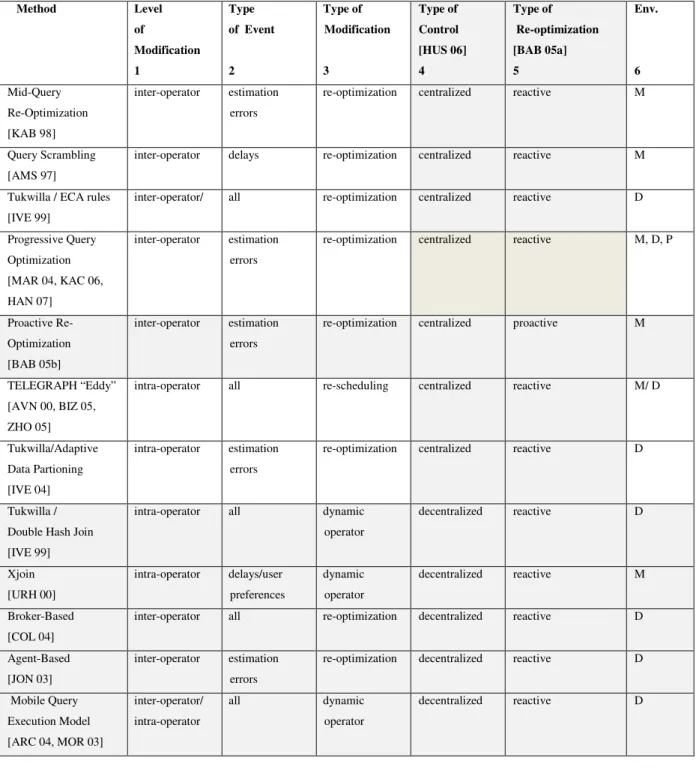
Based on the definition of adaptivity, we want to analyze the methods depending on the following attributes: the level of adaptation, type of event triggering the modification, type of modification realized, type of control about decision making, type of re-optimization and the environment (Table 2.1).
Level of modification (1) indicates the place of the modification of the method:
inter-operator and intra-inter-operator. Type of event (2) shows the case triggering the decision: presence of estimation errors on statistics, memory unavailability (memory allocated for the operators may become unavailable during execution), delays in data arrival (delay in arrival of data from remote sources due to network congestion or bandwidth of network) and user preferences (e.g. first tuple first). Type of the modification (3) can be re-optimization (re-optimize the rest of the execution plan with respect to run-time conditions) or re-scheduling (change the schedule of the operators for the rest of the execution) or replacement (change the implementation of the operators, e.g. replace hash join by sort merge join) or dynamic operator (operator is capable to adapt).
38 Method Level of Modification 1 Type of Event 2 Type of Modification 3 Type of Control [HUS 06] 4 Type of Re-optimization [BAB 05a] 5 Env. 6 Mid-Query Re-Optimization [KAB 98] inter-operator estimation errors
re-optimization centralized reactive M
Query Scrambling [AMS 97]
inter-operator delays re-optimization centralized reactive M Tukwilla / ECA rules
[IVE 99]
inter-operator/ all re-optimization centralized reactive D Progressive Query Optimization [MAR 04, KAC 06, HAN 07] inter-operator estimation errors
re-optimization centralized reactive M, D, P
Proactive Re-Optimization [BAB 05b]
inter-operator estimation errors
re-optimization centralized proactive M
TELEGRAPH “Eddy” [AVN 00, BIZ 05, ZHO 05]
intra-operator all re-scheduling centralized reactive M/ D
Tukwilla/Adaptive Data Partioning [IVE 04]
intra-operator estimation errors
re-optimization centralized reactive D
Tukwilla / Double Hash Join [IVE 99]
intra-operator all dynamic operator decentralized reactive D Xjoin [URH 00] intra-operator delays/user preferences dynamic operator decentralized reactive M Broker-Based [COL 04]
inter-operator all re-optimization decentralized reactive D Agent-Based
[JON 03]
inter-operator estimation errors
re-optimization decentralized reactive D Mobile Query Execution Model [ARC 04, MOR 03] inter-operator/ intra-operator all dynamic operator decentralized reactive D
Table 2.1: Comparison of adaptive query optimization methods
Type of the authority making the decision of modification: if a central control (4) for monitoring the run-time conditions and making the decision of adaptivity exists then the method is called centralized, otherwise it is decentralized method [HUS 06]. Type of
re-optimization (5) can be reactive or proactive [BAB 05a]. By re-active re-optimization it is
stated that the query processing follows the cycle of optimize-execute-make decision about adaptation (re-optimize). By proactive re-optimization it is understood that in optimization
39 phase the potential need for adaptation is considered and optimization captures the concerns of reducing the cost and frequency of adaptation. Last column indicates the environment (6) for which the method is applicable, three types are possible: M (mono-processor), D (distributed) and P (parallel).
3.2 Adaptive Query Optimization Methods
There is a large body of research on adaptive query processing in data integration systems and some surveys trying to compare these works with respect to different characteristics. In this section we will look over some methods of adaptive query optimization. Our analysis is done with attention of the place of adaptation: inter or intra operator. All the methods discussed in the following sub-section are centralized methods: the monitoring and decision taking is done by a central control. In section 5, we will demonstrate some decentralized adaptation methods while discussing the applicability of centralized methods on large scale network.
3.2.1 Inter-operator
The works [AMS 97, KAB 98, IVE 99 and MAR 04] we will present in this section, propose to modify execution plans after the termination of the execution of an operator or after the materialization of a temporary relation. The type of modification is re-optimization, re-scheduling or replacement for the remainder of the execution plan.
The goal of query scrambling of [AMS 97] is to react to delays by modifying the query execution plan on-the-fly. Unexpected delays (initial delay, bursty arrival or slow delivery) are “hidden” by performing other useful works. Scrambling has a two-pronged action: rescheduling (scheduling other operators for execution) and operator synthesis (new operators are created when there is no other operator to execute). These two techniques are repeated as necessary to modify the query execution plan. Scrambling policies differ by the degree of parallelism they introduce or the aggressiveness with which scrambling changes the existing query plan. Three important trade-offs must be considered in re-scheduling: (1) the number of operators to reschedule concurrently (the benefits of overlapping multiple delays
40 and the cost of materializations used to achieve this overlapping), (2) rescheduling individual operators or entire sub-trees and (3) choice of specific operator(s) to reschedule. For operator synthesis, a significant amount of additional work may be added since the operations were not originally chosen by the optimizer. To avoid this problem a simple heuristic of avoiding Cartesian products to prevent the creation of overly expensive joins is used. However, the performance of this heuristic is highly sensitive to the cardinality of the new operators created. In mid-query re-optimization method presented by [KAB 98], the execution plans are generated at compile time are annotated by the statistics used by the optimizer. At specific points, statistics collector operators are added to the execution plan. These operators calculate the statistics about the size and data distributions of temporary relations at run-time. The statistics are compared with those of marked by the optimizer in order to detect the sub-optimality. Correction of the sub-optimality is done in two ways: by dynamic re-allocation of the memory and by changing the remainder of the execution plan. They also demonstrate a technique to keep the overhead of this type execution within allowable limits.
Tukwila is another system addressing adaptiveness in data integration environment
[IVE 99]. Adaptiveness is introduced at two levels: (1) between the optimizer and the execution engine, and (2) within the execution engine. In the first level, adaptiveness is deployed by annotating initial query plans by (event-condition-action) ECA rules. These rules check some conditions when certain events occur and subsequently trigger the execution of some actions. Examples of events include operator failure, time-out, and out of memory exceptions. Conditions include the comparison of actual cardinalities known at run-time and those estimated. Finally, actions include rescheduling of the query operator tree, re-optimization of the plan, and alteration of memory allocation. A plan is organized into a partially ordered set of fragments and a set of corresponding rules. Fragments are pipelined units of operators. When a fragment terminates, results are materialized and the rest of the plan can be re-optimized or rescheduled. In addition to data manipulation, operators perform two actions: statistics gathering for the optimizer, and event handler invocation in case a significant event occurs.
![Table 2.2: Bounds on the size of execution space for dynamic programming optimizer in the presence of binding patterns, for a chain query [MAN 01]](https://thumb-eu.123doks.com/thumbv2/123doknet/2098479.7632/51.892.108.788.260.664/bounds-execution-dynamic-programming-optimizer-presence-binding-patterns.webp)
![Figure 2.3: Environment of Mobile Query Execution Model [HUS 05]](https://thumb-eu.123doks.com/thumbv2/123doknet/2098479.7632/56.892.103.784.230.639/figure-environment-mobile-query-execution-model-hus.webp)