HAL Id: hal-00759855
https://hal.archives-ouvertes.fr/hal-00759855
Submitted on 3 Dec 2012
HAL is a multi-disciplinary open access
archive for the deposit and dissemination of
sci-entific research documents, whether they are
pub-lished or not. The documents may come from
teaching and research institutions in France or
abroad, or from public or private research centers.
L’archive ouverte pluridisciplinaire HAL, est
destinée au dépôt et à la diffusion de documents
scientifiques de niveau recherche, publiés ou non,
émanant des établissements d’enseignement et de
recherche français ou étrangers, des laboratoires
publics ou privés.
Design of Experiments for Calibration of Planar
Anthropomorphic Manipulators
Alexandr Klimchik, Yier Wu, Stéphane Caro, Anatol Pashkevich
To cite this version:
Alexandr Klimchik, Yier Wu, Stéphane Caro, Anatol Pashkevich.
Design of Experiments for
Calibration of Planar Anthropomorphic Manipulators. Advanced Intelligent Mechatronics (AIM),
2011 IEEE/ASME International Conference on, Jul 2011, Budapest, Hungary.
pp.576 - 581,
Design of Experiments for Calibration
of Planar Anthropomorphic Manipulators
Alexandr Klimchik
1,2, Yier Wu
1,2, Stephane Caro
2, Anatol Pashkevich
1,2.
1Ecole des Mines de Nantes, 4 rue Alfred-Kastler, Nantes 44307, France2Institut de Recherches en Communications et en Cybernetique de Nantes, 44321 Nantes, France [email protected], [email protected], [email protected],
[email protected] Abstract – The paper presents a novel technique for the design
of optimal calibration experiments for a planar anthropomorphic manipulator with n degrees of freedom. Proposed approach for selection of manipulator configurations allows essentially improving calibration accuracy and reducing parameter identification errors. The results are illustrated by application examples that deal with typical anthropomorphic manipulators.
Keywords: calibration, design of experiments,
anthropomorphic manipulator
I. INTRODUCTION
The standard engineering practice in industrial robotics assumes that the closed-loop control technique is applied only on the level of servo-drives actuating the manipulator joint variables. However, for spatial location of the end-effector, it is applied the open-loop control method that is based on numerous computations of the direct/inverse transformations that define correspondence between the manipulator joint coordinates and the Cartesian coordinates of the end-effector. This requires careful identification (i.e. calibration) of the robot geometric parameters employed in the control algorithm, which usually differ from their nominal values due to manufacturing tolerances [1].
The problem of robot calibration is already well studied and it is in the focus of research community for many years [2]. In general, the calibration process is divided into four sequential steps [3]: modeling, measurements, identification and compensation. First two steps focus on design of the appropriate (complete but non-redundant) mathematical model and carrying out the calibration experiments. Usually, algorithms for the third step are developed for the identification of Denavit-Hartenberg parameters [4], which however are not suitable for the manipulators with collinear axis considered in this paper. For this particular (but very common) case, Hayati [5], Stone [6], and Zhuang [7] proposed some modifications but we will use a more straightforward approach that is more efficient for the planar manipulators.
Among numerous publications devoted to the robot calibration, there is very limited number of works that directly address the issue of the identification accuracy and reduction of the calibration errors [8-16]. It is obviously clear that the calibration accuracy may be improved by increasing
the number of experiments (with the factor 1 m , where m
is the experiments number). Besides, using diverse manipulator configurations for different experiments looks also intuitively promising and perfectly corresponds to some basic ideas of the classical theory [17] that intends using the factors that are distinct as much as possible. However, the classical results are mostly obtained for very specific models (such as linear regression) and can not be applied directly here due to non-linearity of the relevant expressions.
In this paper, the problem of optimal design of the calibration experiments is studied for case if a n-link planar manipulator, which does not cover all architectures used in practice but nevertheless allows to derive some very useful analytical expressions and to propose some simple practical rules defining optimal configurations with respect to the calibration accuracy. Particular attention is given to two- and three-link manipulators that are essential components of all existing anthropomorphic robots.
II. PROBLEM STATEMENT
Let us consider a general n-link planar manipulator which geometry can be defined by equations
0 0 1 1 0 0 1 1 co s si · n · n i i i j j i j n i i i j j i j x l l q q y l l q q
where ( ,x y) is the end-effector position, 0 0
,
i j
l q are the nominal length and angular coordinates of the i-th link and actuator respectively, li and qi are their deviations from
nominal values,n is the number of links. Let us also introduce notations 0 0 1 i i j j q
, and 1 i i j j q
that will be useful for further computations. As follows from (1), the manipulators geometrical model includes 2 n parameters{li, i,i1, }n that must be identified by means of the calibration.
It is assumed that each calibration experiment produces two vectors, which define the Cartesian coordinates of the
end-effector Pi [xi yi]T and corresponding joint
coordinates Qi (q1i, q2i, ... ,qn i) . Besides, the
measurement errors for the Cartesian coordinates ( x, y)are
assumed to be iid (independent identically distributed) random values with zero mean and standard deviation , while the measurement errors for the joint variables are relatively small. Hence, the calibration procedure may be treated as the best fitting of the experimental data {Qi,Pi}
by using the geometrical model (1) that leads to the standard least-square problem. However, due to the errors in the measurements, the desired values {li, i, i1, }n are always identified approximately. So, the problem of interest is to evaluate (in the frame of the above assumption) the identification accuracy for the parameters {li, i,i1, }n
and to propose a technique for selecting the set of the joint variables Qi (q1i, q2i, ... ,qn i) that leads to improvement
of this accuracy (in statistical sense).
To solve this general problem, let us sequentially present the calibration algorithm, evaluate related identification errors and develop optimality conditions allowing minimize the number of experiments for given accuracy in identification of the desired parameters.
III. CALIBRATION ALGORITHM
As follows from the previous Section, the input data for the manipulator calibration are its joint coordinates
1 2
( , , ... , ) i qi q i qn i
Q and corresponding end-effector
positions Pi [xi yi]T , i1,m . The goal is to find
unknown parameters Π { li, i, i1, }n which ensure the best mapping of the coordinates Qi to the end-effector
positions Pi that is defined by the geometrical model (1),
which may be re-written in a general form as
xi fx
Qi,Π
; yi fy
Qi, Π
; i1,m where fx
Qi,Π
, fy
Qi,Π
are the right-hand sides of system (1).To compute Π { li, i,i1, }n , let us apply the least-square method which minimizes the residuals for all experimental configurations. Corresponding optimization problem can be written as
2
2
1 , , m in i i т x i y i i F f x f y
Q Π Q Π and it can be solved by using stationary condition at the extreme point F /Πi 0 for i1, 2n with respect to
{ li, i,i 1, }n
Π . Corresponding derivations yield
0 0 ( ) 1 0 0 ( ) 1 0 0 ( ) 0 0 ( ) 1 sin co s co s sin 0 m n i l l l l i l i k n i l l l l i l n i l l l l l i n i l l l l i l F l l l l x l l l l y
0 ( ) 1 0 0 ( ) 0 ( ) 1 0 0 ( ) 1 (co s( ) ( ) co s( ) sin ( ) ( ) sin ( ) 0 m i k k i k n i i l l l l i k k l n i l l l l i l F l l l x l l y
where k 1,n, ( ) ( ) 1 j i i j k k q
is the orientation of j-th link in the i-th experiment. Since this system of equations is nonlinear with respect to i , it does not have generalanalytical solution. Thus, it is reasonable to linearize the model (1)
Pi P0iJi П
where P0 i is the end-effector position for the nominal values
of parameters and the joint variables
0 0 ( ) 0 0 ( ) 0 1 1 co s sin T n n i i i k k k k k k l l
P , i 1,m, iJ is the Jacobian matrix, which can be computed by differencing the system (1) with respect to П that leads to
( ) ( ) ( ) ( ) 2 2 i i xq xl i i i n yq yl J J J J J where ( ) ( ) ( ) 1 1 1 ( ) ( ) ( ) 1 1 1 ( ) ( ) ( ) 1 1 ( ) ( ) ( ) 1 1 sin ... sin co s ... co s co s ... co s sin ... sin i i i xq n n i i i yq j j i i i xl n i i i y n n n l n n l l l l J J J J
1 m in т T i i i i i F
J П P J П P where Pi PiP0i and expressions (4) are reduced to
1 1 ( )· ( ) т т T T i i i i i i
J J П
J P So, the unknown parameters П , can be computed as
1 ( аT а) аT а П J J J P where
1 2 ...
T a m J J J J ; Pa [ P1 P2 ...Pm]T. To increase the identification accuracy, the foregoing linearized procedure has to be applied several times, in accordance with the following iterative algorithm:Step 1. Carry out experiments and collect the input data
in the vectors of generalized coordinates Qi and
end-effector position Pi(xi,yi). Initialize П 0.
Step 2. Compute end-effector position via direct
kinematic model (1) using initial generalized coordinates Qi
Step 3. Compute residuals and unknown parameters П via (11)
Step 4. Correct mathematical model and generalized
coordinates lj lj lj, ji ji j, j1,m .
Step 5. If required accuracy is not satisfied, repeat from
Step 2.
It should be mentioned, that the proposed iterative algorithm can produce exact values of {li,i,i1, }n if and only if there are no measurement errors in the initial data
{Qi, Pi}. Since in practice it is not true, it is reasonable to
minimize the measurement errors impact via proper selection of {Qi, Pi}.
IV. ACCURACY OF CALIBRATION EXPERIMENT
Let us assume that the measurements of x, y are carrying out with some random errors xi,yithat are assumed to be
iid, with the standard deviation and zero mean value. Thus, model (6) can be rewritten as
Pi P0iJi Пεi
where the vector i , y T xi i
ε collect all measurement errors. So, expression (11) for computing the vector of the desired parameters П has to be rewritten as
T
1 T
a а a a а
П J J J P ε
where εa
ε ε1 2 ...εm
T .As follows from (13), the latter expression produces unbiased estimates
T
1 T a а a а E П J J J P Besides, it can be proved that the covariance matrix of the parameters П [18], defining the identification accuracy, can be expressed as
1
1cov(П)(JTaJа) JTaE ε εа· aT Jа(JaTJа)
Then, taking into account that
2 2· T ·
а a n
E ε ε I , where I2 n
is the identity matrix of the size 2n2n, the expression (15) can be simplified to
1 2 1 co v( ) m T i i i
П J J Therefore, for the problem of interest, the impact of the measurement errors (i.e. “quality” of the experiment plan) is defined by the matrix sum
1 m T i i i
J J .For the considered model (1), this sum can be expressed as
1 m T i i i
J J A B C D where ( ) ( ) ( ) ( ) 1 1 ; co s( ); sin ( ); · ; ; 1, ; 1, j k jk j jk jk m m i i i i jk j k jk j k i i l l c l s c c s j n k n
A B C D where Aj j, m l l·j k; Bj j, Cj j, 0;Dj j, m, j1,n, which can be presented via block matrix
1 m T T i i i
J J L C L L S L S C where L d ia g l( ,1 l2, ...,ln) , C cjk, j1, ;n k 1,n , , 1, ; 1, jk s j n k n S .This expression allows estimating the identification accuracy and it can be applied for optimal design of calibration that is presented in the following Section.
V. DESIGN OF CALIBRATION EXPERIMENTS
To optimize location of experimental points in the Cartesian space (and corresponding manipulator configurations), let us investigate in details all components of the matrix
1 m T i i i
J J that is similar to the “information matrix” in classical design of experiments. As it is known [17], this matrix can be evaluated by several criteria. The most common of them are A- and D-optimality criteria, but here it is not reasonable to use the A- criterion because the trace of the matrix
1 m T i i i
J J does not depend on the experiment plan. Besides, the D- criterion is also not applicable here in its direct form.Hence, let us introduce a modified D*-optimal criterion which takes into account the structure of the information matrix in this particular case. Since this matrix includes several blocks with different units (linear, angular, etc.), it is reasonable to focus on optimization of each block separately. This approach allows to reformulate the problem and to define the goal as
, 1, , 1, det m ax ; det m in j j q j m q j m C S where C cjk /n , S sjk /n correspond to the diagonal and non-diagonal blocks of (19) respectively. It can be proved that this goal is satisfied if
cjk 0; sjk 0; j1, ;n k 1, ;n jk
that perfectly corresponds to the classical D-optimality conditions. For practical convenience, cases of 2-, 3- and 4-links manipulators were investigated in details and corresponding optimality conditions are presented in Table 1. A correspondence between the proposed approach and the D-optimality can be also proved analytically. In particular, straightforward computations give
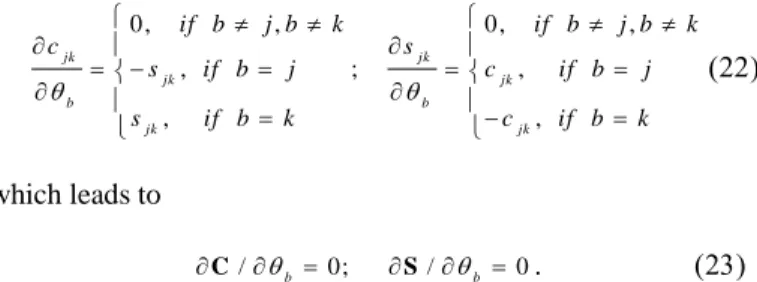
0, , 0, , , ; , , , jk jk jk jk b b jk jk if b j b k if b j b k c s s if b j c if b j s if b k c if b k which leads to C/b 0; S/b 0
The latter guarantees maximum of the relevant determinant and ensures agreement with the D-optimality.
Validity of the proposed approach and its practical significance was also conformed by a simulation example that deals with 4-links manipulator with geometrical parameters l12 6 0m m , l2 1 8 0m m , l3 1 2 0m m ,
4 1 0 0
l m m and their deviations l11 .5m m , 2 0.6
l m m
, l3 0 .4m m , l4 0 .7m m ; and
deviation of zero values of angular coordinates o 1 0 .5 q , o 2 0.5 q , o 3 0 .7 q , o 4 0.3 q . All experiments were carried out for 10 random experimental points, the results are summarized in the Figure 1. They show that random plans give rather poor results both for D-optimality and D*-optimality criteria comparing to the optimal ones (for the optimal plans d et
C 1 and d et
S 0; d et
D 1, where D is normalized block matrix (19)).0 10 20 30 40 50 0 0.2 0.4 0.6 0.8 1 det(D) Experimental points Optimal plan Random plan
Figure 1. Determinant values of matrix D' for 4-links manipulator for random calibration plans with 10 experimental points:
TABLE I. OPTIMAL PLAN CONDITIONS FOR 2-,3- AND 4-LINKS MANIPULATORS
Manipulator Conditions for optimal plan Notation
2-links manipulator 2 2 1 1 0; 0 m m i i i i c s , c2icosq2i; s2isinq2i; i1,m 3-links manipulator 2 2 3 3 2 3 2 3 1 1 1 1 1 1 0; 0; 0; 0; 0; 0 m m m m m m i i i i i i i i i i i i c s c s c s c3icosq3i; s3isinq3i; 23i cos( 2i 3i) c q q ; s3isin(q2iq3i); i1,m 4-links manipulator 2 2 3 3 4 4 1 1 1 1 1 1 23 23 24 24 34 34 1 1 1 1 1 1 0; 0; 0; 0; 0; 0; 0; 0; 0; 0; 0; 0 m m m m m m i i i i i i i i i i i i m m m m m m i i i i i i i i i i i i c s c s c s c s c s c s 4i cos 4i c q ; s4isinq4i; 24i cos( 2i 3i 4i) c q q q ; s24isin(q2iq3iq4i); 34i cos( 3i 4i) c q q ; s34isin(q3iq4i); i1,m
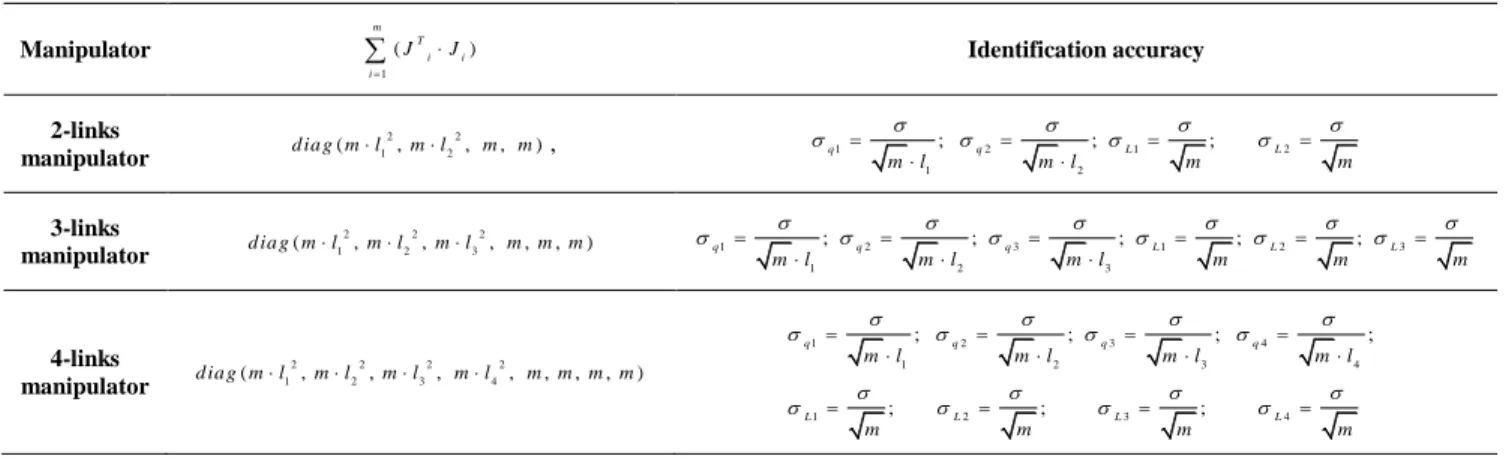
For the proposed set of calibration experiments, the calibration accuracy can be estimated via the covariance matrix, which in this case is diagonal and may be presented as 2 · · cov( ) m L L 0 П 0 I
where Ld ia g l( ,1 l2, ..., ln), and identification accuracy can
be evaluated as qi ; L i ; 1, i i n m l m
where q i,L i are standard deviations of angular (qi) and
linear (li) parameters from the nominal values.
The results show that identification errors of the linear parameters depend only on the number of experimental points, while the angular parameter errors also depend on the link length.
VI. SIMULATION STUDY
Let us present some simulation results that demonstrate efficiency of the proposed technique for several case studies that deal with two-, three- and four-links manipulators and employ different number of calibration experiments. It is assumed that in all cases the calibration experiments were designed in accordance with expressions developed in Section 5 ( see Table 1). To obtain meaningful statistics, the simulation was repeated 10000 times; the deviation of measurement error was equal to 0.1 mm.
It was also assumed that the manipulator geometrical parameters are l12 6 0m m , l2 1 8 0m m , l31 2 0m m ,
4 1 0 0
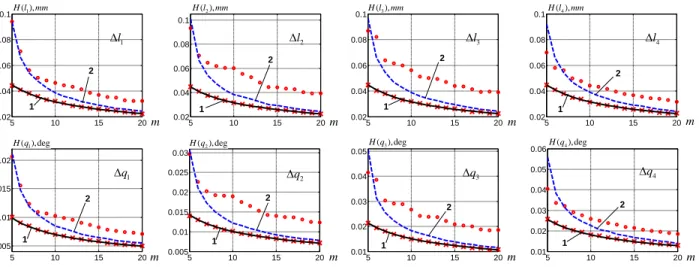
l m m and their deviations are equal to 1.5 mm, -0.6 mm, -0.4 mm and 0.7 mm. respectively, while the deviation of zero values of angular coordinates 0.5°, -0.5°, 0.7° and -0.3° for the first, second, third and fourth joints respectively. Short summary of the simulation results are presented in Table 3 and in Figure 2.
As follows from this study, the identification accuracy of the experimental result and analytical estimations are in good agreement. In particular, for linear parameters, the
TABLE II. ESTIMATION OF THE IDENTIFICATION ACCURACY OF GEOMETRICAL PARAMETERS: ANALYTICAL SOLUTION
Manipulator 1 ( ) m T i i i J J Identification accuracy 2-links manipulator 2 2 1 2 ( , , , ) d ia g m l m l m m , 1 2 1 ; 2 ; 1 ; 2 q q L L m l m l m m 3-links manipulator 2 2 2 1 2 3 ( , , , , , ) d ia g m l m l m l m m m 1 2 3 1 2 3 1 2 3 ; ; ; ; ; q q q L L L m l m l m l m m m 4-links manipulator 2 2 2 2 1 2 3 4 ( , , , , , , , ) d ia g m l m l m l m l m m m m 1 2 3 1 2 3 4 1 2 3 4 4 ; ; ; ; ; ; ; q q q q L L L L m l m l m l m l m m m m
TABLE III. ESTIMATION OF IDENTIFICATION ACCURACY OF GEOMETRICAL PARAMETERS
Manipulator Model parameters
Identification accuracy
3 experimental points 20 experimental points 2-links manipulator 1 1 1 2 2 2 260 , 1.5 , 0.5 180 , 0.6 , 0.5 m m L m m q deg m m L m m q L g L de , 1 1 2 2 0.058 , 0.013 deg 0.058 , 0.018 deg L m m q L m m q 1 1 2 2 0.058 , 0.005 deg 0.058 , 0.007 deg L m m q L m m q 3-links manipulator 1 1 1 2 2 2 3 3 3 2 6 0 , 1 .5 , 0 .5 1 8 0 , 0 .6 , 0 .5 1 2 0 , 0 .4 , 0 .7 m m L m m q d eg m m L m m q d e L g m m L m m q d L eg L 1 1 2 2 3 3 0 .0 5 8 , 0 .0 1 3 d eg 0 .0 5 8 , 0 .0 1 8 d eg 0 .0 5 8 0 .0 2 7 d eg L m m q L m m q L m m q 1 1 2 2 3 3 0 .0 2 2 , 0 .0 0 5 d eg 0 .0 2 2 , 0 .0 0 7 d eg 0 .0 2 2 0 .0 1 1 d eg L m m q L m m q L m m q 4-links manipulator 1 1 1 2 2 2 3 3 3 4 4 4 2 6 0 , 1 .5 , 0 .5 1 8 0 , 0 .6 , 0 .5 1 2 0 , 0 .4 , 0 .7 1 0 0 , 0 .7 , 0 .3 L L L m m L m m q d eg m m L m m q d eg m m L m m q d eg m m eg L L m m q d 1 1 2 2 3 3 4 4 0 .0 5 8 , 0 .0 1 3 d eg 0 .0 5 8 , 0 .0 1 8 d eg 0 .0 5 8 0 .0 2 7 d eg 0 .0 5 8 0 .0 3 3 d eg L m m q L m m q L m m q L m m q 1 1 2 2 3 3 4 4 0 .0 2 2 , 0 .0 0 5 d eg 0 .0 2 2 , 0 .0 0 7 d eg 0 .0 2 2 0 .0 1 1 d eg 0 .0 2 2 0 .0 1 3 d eg L m m q L m m q L m m q L m m q
identification error reduces from 0.022 mm to 0.005 mm while the experiment number increases from 4 to 20. Besides, these results allow defining minimum number of experimental points to satisfy the required accuracy. Thus, to satisfy an accuracy of 0.001 mm for linear parameters it is required to carry out 100 experiments, which will provide accuracy for angular parameters 0.002°, 0.003°, 0.005° and 0.006° respectively.
VII. CONCLUSION
The paper presents a new approach for design of calibration experiments that allows essentially reducing the identification errors due to proper selection of the manipulator postures employed in the measurements. There were obtained analytical expressions describing set of the optimal postures corresponding the proposed D*-criterion that is adopted to special structure of the information matrix. Validity of the obtained results and their practical significance were confirmed via simulation study that deals with two-, three- and four-links planar manipulators.
Compared to previous contributions, these results can be treated as further development of the design-of-experiments theory that is adapted to the specific type of the non-linear models that arise in robot kinematics. Future work will focus on extension of these results for non-planar manipulators.
ACKNOWLEDGEMENTS
The work presented in this paper was partially funded by the Region “Pays de la Loire”, France and by the project ANR COROUSSO, France.
REFERENCES
[1] Z.Roth, B.Mooring and B.Ravani, “An overview of robot calibration,” IEEE Journal of Robotic and Automation, Vol. 3, No 5, , 1987, pp. 377-385.
[2] A.Y. Elatta, Li Pei Gen, Fan Liang Zhi, Yu Daoyuan and Luo Fei, “An Overview of Robot Calibration,” Information Technology Journal Vol 3, No 1, 2004, pp. 74-78.
[3] B. W, Mooring, Z, S, Roth and M. R. Driels, “Fundamentals of Manipulator Calibration,” Jone Wiley& Sons, 1991.
[4] J. M. Hollerbach, “A Survey of Kinematic Calibration,” The Roborics Review 1, Cambridge, MIT Press, 1989, pp. 207-242.
[5] S. Hayati, “Robot Arm Geometric Link Parameter Estimation,” Proc 22 IEEE. Conference on Desaining and Cantrol, San Antonio, pp. 1477-1483, 1983.
[6] H. W. Stone, Kinematic Modeling, Identification, and Central of Robor Forward Manipulators, Boston,Kluwer,1987.
[7] H. Zhuang, Z.S. Roth and F. Harnano, “A complete and pararnetricatly continuous kinematic model for robot manipulators,” IEEE Trans. Robotics and Automation,Vol. 8, 1992, pp.451-463. [8] M. Ikits; and J.M. Hollerbach, “Kinematic calibration using a plane
constraint,” Robotics and Automation, 1997. Proceedings., 1997 IEEE International Conference on Vol 4, Apr 1997, pp 3191 - 3196 [9] C.R. Mirman, and K.C. Gupta, “Compensation of robot joint
variables using special Jacobian Matrices,”. J. Robotic System, Vol. 9, 1992, pp. 133-137.
[10] B. Mooring, W., M. Driels and Z. Roth, Fundamentals of Manipulator Calibration. 1991: John Wiley & Sons, NY, 1991.
[11] Y. Sun and J.M. Hollerbach, "Observability index selection for robot calibration," IEEE International Conference on Robotics and Automation, 2008 (ICRA 2008), pp 831-836.
[12] Y. Sun and J.M. Hollerbach, "Active robot calibration algorithm," IEEE International Conference on Robotics and Automation, 2008 (ICRA 2008), pp. 1276-1281.
[13] J.M. Hollerbach, W Khalil and M Gautier, ''Model Identification," In: Springer handbook of robotics, 2008, Part B, pp 321-344
[14] H. Zhuang; J. Wu and W. Huang, "Optimal planning of robot calibration experiments by genetic algorithms," IEEE International Conference on Robotics and Automation, 1996 (ICRA 1996), pp. 981-986
[15] D. Daney, Y. Papegay and B. Madeline, " Choosing Measurement Poses for Robot Calibration with the Local Convergence Method and Tabu Search," International Jornal of Robotics Research, Vol 24(6), Juin 2005, pp. 501-518
[16] J. Borm and C. Menq, "Determination of optimal measurement configurations for robot calibration based on observibility measure," Int. Journal of Robotics Research, Vol 10(1), 1991, pp. 51–63. [17] A.C. Atkinson and A.N. Donev, Optimum Experiment Designs.
Oxford University Press, Oxford, 1992.
[18] D.R. Cox, Planning of experiments, Wiley, New York, 1958.
5 10 15 20 0.01 0.02 0.03 0.04 0.05 0.06 5 10 15 20 0.01 0.02 0.03 0.04 0.05 5 10 15 20 0.005 0.01 0.015 0.02 0.025 0.03 5 10 15 20 0.005 0.01 0.015 0.02 5 10 15 20 0.02 0.04 0.06 0.08 0.1 5 10 15 20 0.02 0.04 0.06 0.08 0.1 5 10 15 20 0.02 0.04 0.06 0.08 0.1 5 10 15 20 0.02 0.04 0.06 0.08 0.1 1 q q2 q3 q4 1 l l2 l3 l4 1 ( ), H l mm m 2 ( ), H l mm H l( ),3 mm H l( ),4 mm 1 ( ),deg
H q H q(2),deg H q( ),deg3 H q(4),deg
m m m m m m m 1 2 1 2 1 2 1 2 1 2 1 2 1 2 1 2
Figure 2. Identification accuracy for the geometrical parameters identification of 4-links manipulator with optimal experiment planning: "x" are experimental values corresponding to the optimal calibration plan, "o" are experimental values corresponding to the standard calibration plan