HAL Id: tel-01426915
https://tel.archives-ouvertes.fr/tel-01426915v3
Submitted on 28 Aug 2017
HAL is a multi-disciplinary open access
archive for the deposit and dissemination of sci-entific research documents, whether they are pub-lished or not. The documents may come from teaching and research institutions in France or abroad, or from public or private research centers.
L’archive ouverte pluridisciplinaire HAL, est destinée au dépôt et à la diffusion de documents scientifiques de niveau recherche, publiés ou non, émanant des établissements d’enseignement et de recherche français ou étrangers, des laboratoires publics ou privés.
Transforming TLP into DLP with the dynamic
inter-thread vectorization architecture
Sajith Kalathingal
To cite this version:
Sajith Kalathingal. Transforming TLP into DLP with the dynamic inter-thread vectorization archi-tecture. Hardware Architecture [cs.AR]. Université Rennes 1, 2016. English. �NNT : 2016REN1S133�. �tel-01426915v3�
TH`
ESE / UNIVERSIT´
E DE RENNES 1
sous le sceau de l’Universit´e Bretagne Loire
pour le grade de
DOCTEUR DE L’UNIVERSIT´
E DE RENNES 1
Mention : Informatique
´
Ecole doctorale Matisse
pr´
esent´ee par
Sajith Kalathingal
pr´
epar´
ee `
a l’unit´e de recherche INRIA
Institut National de Recherche en Informatique et Automatique
Universit´
e de Rennes 1
Transforming TLP into
DLP with the Dynamic
Inter-Thread
Vector-ization Architecture
Th`
ese soutenue `
a Rennes
le 13 D´
ecembre 2016
devant le jury compos´e de :Bernard GOOSSENS
Professeur `a l’Universit´e de Perpignan Via Domitia / Rapporteur
Smail NIAR
Professeur `a l’Universit´e de Valenciennes/Rapporteur
Laure GONNORD
Maˆitre de conf´erences `a l’Universit´e Lyon 1 / Examinatrice
C´
edric TEDESCHI
Maˆitre de conf´erences `a l’Universit´e Rennes 1 / Examinateur
Andr´
e SEZNEC
Directeur de recherches Inria/ Directeur de th´ese
Sylvain COLLANGE
Acknowledgement
I would like to express my sincere gratitude to my thesis advisors, Andr´e SEZNEC and Sylvain COLLANGE. I would like to thank you for encouraging me and providing guidance during the course of work. Your advice on research have been priceless.
I would like to thank the jury members Bernard GOOSSENS, Smail NIAR, Laure GONNORD and C´edric TEDESCHI for providing the opportunity to de-fend the thesis.
I would like to thank my parents for supporting me throughout my life. Thank you for all of the sacrifices that you have made for me. Without your support I would not have reached so far.
I would like to thank the members of ALF team for their help and support and also for making my stay at Rennes really enjoyable.
I would like to thank my wonderful wife Amrutha Muralidharan for the moral support she has given me from thousands of kilometers away, in India. Thank you motivating me and for having the patience.
Contents
Table of Contents 1 R´esum´e en Fran¸cais 5 Introduction 9 1 Background 15 1.1 Instruction-level parallelism . . . 18 1.1.1 Instruction pipelining . . . 20 1.1.2 Superscalar execution . . . 21 1.1.3 Out-of-order execution . . . 221.1.4 Clustering for ILP . . . 23
1.2 Data-level parallelism . . . 23
1.2.1 Single Instruction Multiple Data . . . 24
1.2.2 Single Instruction Multiple Threads (SIMT) . . . 27
1.3 Thread-level parallelism . . . 30
1.3.1 Coarse-grained multi-threading . . . 31
1.3.2 Fine grained multi-threading . . . 31
1.3.3 Simultaneous multi-threading (SMT) . . . 32
1.3.4 Clustered multi-threading (CMT) . . . 33 1
1.4 TLP vs DLP . . . 35
1.5 Chip multiprocessor . . . 36
1.6 Conclusion . . . 36
2 Exploiting inter-thread similarity in microprocessors 39 2.1 Inter-thread similarities in SPMD applications . . . 39
2.1.1 Source of inter-thread similarities . . . 40
2.1.2 Vectorization efficiency in an SMT . . . 42
2.1.3 Dynamic Vectorization . . . 43
2.2 Thread reconvergence for SPMD applications . . . 44
2.2.1 Stack-based explicit reconvergence . . . 45
2.2.2 SIMT extensions for stack-based implicit reconvergence . . 45
2.2.3 Stack-less explicit reconvergence . . . 46
2.2.4 Stack-less implicit reconvergence . . . 47
2.3 Vectorization of instructions across threads . . . 49
2.4 General purpose architectures exploiting inter-thread redundancy 50 2.5 GPU architectures to exploit inter-thread redundancies . . . 51
2.6 Conclusion . . . 52
3 Dynamic Inter-Thread Vectorization Architecture 55 3.1 Warps in DITVA . . . 56
3.2 Overview of the Dynamic Inter-Thread Vectorization Architecture 58 3.3 Pipeline architecture . . . 60
3.3.1 Front-end . . . 60
3.3.2 In-order issue enforcement and dependency check . . . 63
3.3.3 Execution: register file and functional units . . . 66
3.3.4 Leveraging explicit SIMD instructions . . . 68
Contents 3
3.4 Data memory accesses . . . 70
3.5 Maintaining lockstep execution . . . 71
3.6 Clustered Multi-threading in DITVA . . . 72
3.7 Conclusion . . . 73
4 Evaluation 77 4.1 Experimental Framework . . . 77
4.1.1 DITVA-SIM . . . 77
4.1.2 Evaluations using DITVA-SIM . . . 79
4.2 Performance evaluation . . . 81
4.2.1 Throughput . . . 81
4.2.2 Divergence and mispredictions . . . 82
4.2.3 Impact of split data TLB . . . 83
4.2.4 L1 cache bank conflict reduction . . . 83
4.2.5 Impact of memory bandwidth on memory intensive appli-cations . . . 84
4.2.6 Impact of Warp size . . . 86
4.2.7 Impact of banked DV-SIMD register banking . . . 86
4.3 Hardware Overhead, Power and Energy . . . 87
4.3.1 Qualitative evaluation . . . 87 4.3.2 Quantitative evaluation . . . 89 4.4 Conclusion . . . 90 5 Future work 93 5.1 Out-of-order execution . . . 93 5.1.1 Register renaming . . . 94
5.1.2 Reservation station / Issue queue . . . 95
5.1.4 Branch misprediction . . . 95
5.2 Out-of-order extension for DITVA architecture . . . 96
5.2.1 Register management . . . 97
5.2.1.1 Register allocation . . . 98
5.2.1.2 Register deallocation . . . 99
5.2.1.3 Handling divergence and reconvergence . . . 99
5.2.2 Handling branch misprediction . . . 100
5.3 Conclusion . . . 100
Bibliography 119
R´
esum´
e en Fran¸
cais
Dans cette th`ese, nous proposons l’architecture Dynamic Inter-Thread Vector-ization (DITVA), une technique pour am´eliorer les performances des applica-tions multi-thread SPMD dans un microprocesseur g´en´eraliste. Les threads d’applications SPMD ex´ecutent souvent les mˆemes instructions sur des donn´ees diff´erentes. Pour tirer parti de la redondance de contrˆole dans les applications SPMD, DITVA assemble dynamiquement des instructions identiques de plusieurs threads en cours d’ex´ecution en une seule instruction vectorielle au moment de l’ex´ecution. La vectorisation r´eduit le nombre d’op´erations dans le pipeline, car l’instruction vectoris´ee factorise le contrˆole entre les threads en travaillant sur des donn´ees diff´erentes. DITVA ´etend un processeur SMT disposant d’instructions SIMD avec un mode d’ex´ecution de vectorisation inter-threads. Dans ce mode, DITVA exploite les unit´es vectorielles existantes, am´eliorant ainsi l’utilisation des capacit´es vectorielles des microprocesseurs existants. DITVA maintient la compatibilit´e binaire avec les architectures CPU existantes. Grˆace `a l’utilisation des unit´es vectorielles et `a la r´eduction des op´erations de pipeline, DITVA vise `a am´eliorer le d´ebit d’ex´ecution d’une puce microprocesseur x86_64 tout en r´eduisant sa consommation globale d’´energie.
Limitations au niveau transistor d’un microprocesseur La technologie
des microprocesseurs a beaucoup ´evolu´e depuis l’introduction du premier micro-processeur Intel 4004 en 1971 par Intel. L’Intel 4004 ´etait r´ealis´e avec une finesse de gravure de 10 µm avec seulement 2300 transistors. Le processeur Intel Skylake, mis sur le march´e en 2015, emploie un process de 14nm avec pr`es de 1,9 milliards de transistors. Gordon E. Moore a observ´e que le nombre de transistors dans un circuit int´egr´e double chaque ann´ee. [M+98]
Robert H. Dennard a observ´e qu’avec la r´eduction de taille des transistors, 5
la puissance totale requise reste constante [DRBL74]. La loi de Moore associ´ee au passage `a l’´echelle de Dennard se traduit par une croissance exponentielle de la performance par watt. La loi de Dennard a pris fin avec l’augmentation de la finesse de gravure. Les courants de fuite et la dissipation de chaleur ont com-menc´e `a devenir un r´eel probl`eme pour le passage `a l’´echelle de la performance au travers le l’augmentation des fr´equences d’horloge. Par cons´equent, les fr´equences d’horloge ont commenc´e `a se stabiliser apr`es le milieu des ann´ees 2000, malgr´e l’adoption de diff´erentes technologies de transistors.
Techniques micro-architecturales pour am´eliorer la performance Alors
que l’augmentation des fr´equences d’horloge est une fa¸con d’am´eliorer les per-formances des microprocesseurs, la micro-architecture elle-mˆeme joue un rˆole important dans l’optimisation des microprocesseurs pour le d´ebit, la latence et l’efficacit´e ´energ´etique. Suivant ces exigences, les fabricants de processeurs doivent souvent assurer des compromis lors de la conception d’un processeur `a usage g´en´eraliste. Par exemple, un processeur mobile, qui utilise des petits cœurs est optimis´e pour l’´energie aux d´epens du d´ebit, tandis qu’un GPU est optimis´e pour le d´ebit au d´etriment de la latence.
Avec l’´evolutivit´e limit´ee des fr´equences d’horloge, le multiprocesseur sur puce (CMP), c’est-`a-dire un multi-cœur [ONH+96], a ´et´e largement adopt´e au cours des dix derni`eres ann´ees. Au lieu d’un grand cœur monolithique, un CMP se compose de plusieurs cœurs dans une seule puce qui partagent certaines des ressources mat´erielles telles que des caches. Une application mono-thread est ex´ecut´ee dans un cœur unique du CMP tandis qu’une application parall`ele peut utiliser plusieurs cœurs grˆace `a un faible coˆut de communication entre les pro-cesseurs. Les processeurs multi-core h´et´erog`enes [KTJR05] sont ´egalement de plus en plus r´epandus. Pour conserver un meilleur compromis entre consomma-tion d’´energie et performance, une puce peut ˆetre constitu´ee de plusieurs cœurs grands et petits pouvant ˆetre allum´es et ´eteints, la charge de travail pouvant ˆetre migr´ee en fonction des exigences de l’application [PG13].
Les grands cœurs utilisent des techniques telles que l’ex´ecution sp´eculative, l’ex´ecution superscalaire, l’ex´ecution dans le d´esordre, etc., pour am´eliorer la performance d’un thread unique. La performance mono-thread est limit´ee par le parall´elisme d’instructions (ILP) d’une application. Les caract´eristiques micro-architecturales peuvent am´eliorer l’ILP mais sont encore limit´ees par les pro-pri´et´es inh´erentes de l’application. Avec un ILP limit´e, l’utilisation des ressources
R´esum´e en Fran¸cais 7 d’un cœur diminue. Le multi-threading a ´et´e mis en œuvre pour am´eliorer l’utilisation des ressources d’un cœur avec un impact minimal sur la latence mono-thread [TEL95, Upt, SBB+07, BEKK00]. Les petits cœurs ´evitent la plupart de ces optimisations pour am´eliorer l’efficacit´e ´energ´etique.
Microarchitecture pour application extrˆemement parall`ele Il existe
de nombreuses cat´egories d’applications extrˆemement parall`eles, orient´ees sur le d´ebit et tol´erantes `a la latence. Les GPU, introduits en 1999, sont plus efficaces dans l’ex´ecution de ces applications [NBGS08, KWm12, LNOM08, ND10a]. Avec un grand nombre d’applications de jeu et multim´edia, les GPU sont devenus pop-ulaires dans les ann´ees 2000. L’architecture Tesla de NVIDIA a ´et´e introduite en 2006 et permet notamment l’ex´ecution d’applications de calcul parall`ele haute performance ´ecrites en langage C `a l’aide de l’architecture CUDA pour le calcul g´en´eraliste sur GPU. Les GPU ne sont pas des dispositifs de calcul autonomes. Ils sont con¸cus pour compl´eter le CPU existant pour am´eliorer l’efficacit´e de l’ex´ecution d’application hautement parall`eles. Le CPU se d´echarge de ce travail vers un GPU. D’autre part, un GPU ne peut pas ex´ecuter les processus cri-tiques n´ecessaires pour ex´ecuter un syst`eme d’exploitation. Les CPU et GPU ont diff´erentes philosophies de conception architecturale, le probl`eme qu’ils essaient de r´esoudre ´etant diff´erent. Ils mettent en œuvre diff´erents jeux d’instructions (ISA).
DITVA - une optimisation pour les architectures SMT g´en´eralistes
Dans cette th`ese, nous proposons l’architecture de vectorisation dynamique inter-thread (DITVA), un point de conception interm´ediaire entre un CPU et un GPU. DITVA est une optimisation pour les applications parall`eles s’ex´ecutant sur un CPU tout en maintenant la performance mono-thread. DITVA optimise les threads d’application en vectorisant dynamiquement les instructions entre threads. DITVA est bas´e sur l’architecture x86_64 et supporte les applications r´eguli`eres ex´ecut´ees dans un CPU. DITVA peut ˆetre r´ealis´e comme un cœur sp´ecial dans une puce CMP (multi-core) hybride pour optimiser l’ex´ecution des applications parall`eles. DITVA n’a pas besoin de modifications dans l’ISA x86_64 existante. Les binaires existants peuvent ˆetre ex´ecut´es dans un cœur DITVA, sans n´ecessiter pas de recompilation. DITVA am´eliore le d´ebit des cœurs existants tout en consommant moins d’´energie.
Introduction
In this thesis, we propose Dynamic Inter-Thread Vectorization Architecture (DITVA), a technique to improve the performance of multi-threaded Single-Program Multiple-Data (SPMD) applications in a general purpose microproces-sor. Threads of SPMD applications often execute the same instructions on dif-ferent data. To take advantage of the control redundancy in SPMD applications, DITVA dynamically aggregates identical instructions of several threads running in lockstep into a single vector instruction at runtime. Vectorization reduces the number of pipeline operations as a vectorized instruction shares the control across threads while operating on multiple data. DITVA extends a vector enabled in-order SMT processor with an inter-thread vectorization execution mode. In this mode, DITVA leverages existing SIMD units, thus improving the utilization of the vector capabilities of the existing microprocessors. DITVA maintains binary compatibility with existing CPU architectures. With the improved utilization of SIMD units and the reduction of pipeline operations, DITVA intends to im-prove the throughput of an x86_64 microprocessor chip while reducing the overall energy consumption.
Limitations at the transistor-level of a microprocessor Microprocessor
technology has evolved a lot since the introduction of the first microprocessor Intel 4004 in 1971 by Intel Corp. Intel 4004 was a 10 µm process with just 2,300 transistors. Skylake processors, released by Intel in 2015, has a 14nm process with almost 1.9 billion transistors. Gordon E. Moore observed that the number of transistors in an integrated circuit doubles every year [M+98]. The projection of process technology shrinkage remained accurate for several decades, but it is predicted that this will not be true in the near future [Moo].
Robert H. Dennard observed that with the scaling down of transistor size, the 9
required power stays constant [DRBL74]. Moore’s Law coupled with Dennard scaling translates to exponential growth of performance-per-watt. Dennard’s law began to fail when the transistors started to become too small. Current leakage and heat dissipation began to become a real issue for performance scaling by increasing clock rates. Hence, the clock rates started to plateau after the mid-2000s even after adopting different transistor designs.
Microarchitectural techniques to improve performance While increasing
the clock rates is one way to improve the performance of the microprocessor, microarchitecture itself plays a significant role in optimizing microprocessors for throughput, latency and energy efficiency. Depending on the requirements, the processor manufacturers often have to balance the trade-offs when designing a general purpose processor. For example, a mobile processor, which uses small cores is optimized for energy at the cost of throughput, while a GPU is optimized for throughput at the expense of latency 1.
With the limited scalability concerning clock rates, Chip Multi-Processor(CMP), i.e., multi-core processors [ONH+96] are widely adopted in the past decade as an alternative design direction. Instead of a large monolithic core, a CMP consists of multiple cores in a single chip. The cores in a CMP shares some of the hardware resources such as caches. A single threaded application is executed on a single core of the CMP, and a parallel application can utilize multi-ple cores thanks to low inter-processor communication overhead. Heterogeneous multi-core processors [KTJR05] are also becoming popular. To maintain a better performance-energy profile, a chip may consist of multiple large and small cores that may be turned on and off or the workload can be migrated depending on the application requirements [PG13].
Large cores use techniques such as instruction pipelining, speculative execu-tion, superscalar execuexecu-tion, out-of-order execuexecu-tion, etc., to improve the single thread performance. Single thread performance is bounded by the Instruction-level parallelism (ILP) of an application. Microarchitectural features can improve the ILP but are still limited by the inherent properties of the application. With
1Throughput is the number of instructions completed in a cycle and latency is the number
of cycles taken to complete an instruction. In a single threaded microprocessor, latency is inversely proportional to throughput. However, in a multi-threaded processor, even though there are more instructions completed in a cycle, a thread could still slow down since it is sharing the resources with other threads
Introduction 11 limited ILP, the resource utilization of a core goes down. As an afterthought multi-threading [TEL95, Upt, SBB+07, BEKK00] was implemented to improve the resource utilization of a core with a slight impact on single thread latency. Small cores avoid many of these optimizations to improve energy profile.
Microarchitecture for embarrassingly parallel applications There are
broad classes of embarrassingly parallel, throughput oriented, latency-tolerant applications. GPUs, introduced in 1999, are more efficient in executing these applications [NBGS08, KWm12, LNOM08, ND10a]. With a large number of gaming and multimedia applications, GPUs became popular in 2000’s. NVIDIA’s Tesla architecture was introduced in 2006 to extend GPUs to enable the execution of high-performance parallel computing application written in C language using the Compute Unified Device Architecture(CUDA) for general purpose computing on GPUs. GPUs are not stand-alone computational devices. They are designed to compliment the existing CPU to improve the efficiency of executing high-performance, embarrassingly parallel applications. CPU’s offload such workload to a GPU. On the other hand, GPUs cannot run critical processes required to run an operating system. CPU and GPU have different architectural design philosophies as the problem they are trying to solve is different. They implement different Instruction Set Architecture(ISA).
DITVA - an optimization for general purpose SMT architectures SMT [TEL95] is a common implementation of multi-threading in modern mi-croprocessors. In SMT, multiple thread context co-exists in a single core of a microprocessor. The threads in an SMT are scheduled simultaneously so that when one of the thread is blocked, some other thread can execute the instruc-tions. SMT processors, unlike GPUs, are designed to execute both single threaded as well as multi-threaded applications. While SMT processors are beneficial for both single and multi-threaded applications, however, they fail to benefit from the unique property of embarrassingly parallel applications i.e., the instructions across the threads are mostly identical although they work with different data. DITVA architecture is designed to exploit this property that exists in parallel applications. By doing so, DITVA improves the throughput of the existing cores while consuming significantly less energy.
In this thesis, we propose Dynamic Inter-Thread Vectorization Architecture (DITVA), an intermediate design point between a CPU and a GPU. DITVA is
a hardware optimization for parallel applications running on a CPU while main-taining the single thread performance. DITVA optimizes the application threads by dynamically vectorizing instructions across threads. We evaluate DITVA on a x86_64 architecture and show that it supports the regular applications exe-cuted in a CPU. DITVA may be implemented as special cores in a hybrid CMP (multi-core) chip to optimize the execution of parallel applications. DITVA does not need any modifications in the existing x86_64 ISA. Existing binaries can be executed in a DITVA core as it does not require recompilation of the program with compiler hints.
Contributions
We developed a microarchitectural model, DITVA, to leverage the implicit data-level parallelism in SPMD applications by assembling dynamic vector instructions at runtime. DITVA extends an SIMD-enabled in-order SMT processor with an inter-thread vectorization execution mode. In this mode, multiple scalar threads running in lockstep share a single instruction stream and their respective in-struction instances are aggregated into SIMD inin-structions. To balance thread and data-level parallelism, threads are statically grouped into fixed-size indepen-dently scheduled warps. DITVA leverages existing SIMD units and maintains binary compatibility with existing CPU architectures.
We also developed an in-house, trace based simulator to simulate SMT and DITVA architectures. Our evaluation on the SPMD applications from the PAR-SEC and Rodinia OpenMP benchmarks shows that a 4-warp × 4-lane 4-issue DITVA architecture with a realistic bank-interleaved cache achieves 1.55× higher performance than a 4-thread 4-issue SMT architecture with AVX instructions while fetching and issuing 51% fewer instructions, achieving an overall 24% en-ergy reduction.
Organization
The thesis is organized as follows: Chapter 1 provides background for microar-chitectural techniques used to exploit parallelism in a program. In chapter 2, we discuss inter-thread similarities and the techniques used to exploit them. We
Introduction 13 also discuss various thread reconvergence techniques that enables dynamic vec-torization of instruction across threads. In chapter 3, we present the Dynamic Inter-Thread Architecture (DITVA). We discuss the implementation details and the design aspects of DITVA. In chapter 4, we demonstrate the energy/perfor-mance benefits of DITVA over an SMT architecture. We show that DITVA is able to achieve this without significant hardware overhead. In chapter 5, we provide some insights for an out-of-order version of DITVA (OOO-DITVA). Materials from chapter 3 and chapter 4 were presented at SBAC-PAD 2016 [KCSS16].
Chapter 1
Background
Figure 1.1: Source of parallelism in a program
In this chapter, we will discuss different kinds of parallelism that exist in a program, i.e., Instruction-level parallelism (ILP, section 1.1), Data-level paral-lelism (DLP, section 1.2) and Thread-level paralparal-lelism (TLP, section 1.3) and provides the background for the transformation of TLP to DLP using DITVA. We will also discuss different methods utilized by the current microarchitectures to exploit these parallelisms. Amdahl’s law [Amd67] identifies the serial section of a program as the limiting factor in the speedup of a workload. The implicit and explicit parallelism in a program is exposed at the program level, compiler level or microarchitectural level. The source of TLP and DLP in a conventional program execution is shown in figure 1.1. DLP is used to form vector instructions, and TLP is used to create program threads. At the program level, vector instructions and parallel threads expose parallelism using programming intrinsics and algorithms that use programming models based on the data decomposition [Fos95]. At the
compiler level, automatic vectorization and automatic parallelization expose par-allelism of the program. At the microarchitectural level, execution models based on Flynn’s taxonomy [Fly66, Fly72] are used to exploit parallelism. Based on the instruction control and the number of data it is working with, Flynn’s taxon-omy [Fly66, Fly72] classifies the execution model of computer architecture into SISD (Single instruction stream, single data stream), MISD (Multiple instruc-tion stream, single data stream), SIMD (Single instrucinstruc-tion stream, multiple data stream) and MIMD (Multiple instruction stream, multiple data stream).
(a) SISD (b) SIMD
(c) MISD (d) MIMD
Figure 1.2: Flynn’s taxonomy and MISD model
Figure 1.3: Classification of architectures based in thread count
Multi-Background 17 threaded architectures add another dimension to Flynn’s taxonomy. For the sake of clarity, we can define the stream as a sequence of instructions that is mapped to a thread at the program level.1 Some example architectures based on the number of streams in shown in figure 1.3. Traditional scalar uniprocessor architectures were SISD. A single threaded superscalar processor 1.1.2 is also classified as an SISD. SISD with more than one thread is a multi-threaded architecture. SIMD machines exploit data parallelism by using a single instruction stream to work on multiple data elements. Vector processors used for high-performance computing are SIMD architectures. Vector architectures are based on explicit vector in-structions. MIMD consists of multiple processors that may be executing different instruction streams that are working with different data streams. A multi-core processor is primarily an MIMD architecture but many modern x86_64 architec-tures is a combination of different models, they support the execution of scalar instructions (SISD) and with SSE and AVX instruction sets they support the execution of vector instructions (SIMD). In addition to threads and vector in-structions, microarchitecture techniques also exploit ILP from within the same thread.
SIMD architectures such as vector processors, GPUs, and CPUs with SIMD extensions, use vector instructions generated either by compiler or programmer. A large number of applications that are executed in x86_64 architectures does not efficiently utilize SIMD extensions even though the programs have data-parallelism (see section 2.5). The inefficiency is due to the existence of dynamic properties such as branches in the instruction flow. Such programs are often writ-ten using threads running the same code. Many multi-threaded programs have implicit data-parallelism.
In the following sections, we will discuss implicit and explicit techniques that are used to exploit parallelism in a program. The parallelism in SISD is the instruction-level parallelism, data-level parallelism is exploited by the SIMD model and MIMD is exposed by the thread-level parallelism. In this thesis, we will only consider single process model and hence we will not consider parallel programming with multiple processes.
1In section 3.2, we will redefine the notion of instruction stream as a sequence of instructions
Listing 1.1: Array addition 1
2 void add ( ) {
3 f o r ( i n t i = 0 ; i < N; i ++){
4 c_array [ i ] = a_array [ i ] + b_array [ i ] ;
5 f_array [ i ] = d_array [ i ] + e_array [ i ] ;
6 }
7 }
1.1
Instruction-level parallelism
Compiler techniques and programming constructions are used to exploit implicit parallelism between instructions of a sequential program. Several microarchitec-tural features efficiently utilize this parallelism and often enhance it at runtime. Hazards are factors limiting parallelism. Two of the most common hazards are Control hazard and Data hazard.
Control hazards occur with branches. A branch is an instruction which alters the sequence of execution based on a condition. Branches are often resolved at runtime and hence the instruction fetch should not be stalled until branch res-olution. Modern branch predictors such as TAGE [Sez11] are highly accurate. Microprocessors use branch predictors to continue fetching from one of the pre-dicted branches. In the case of a misprediction, the instructions that are already in the pipeline are flushed.
Data hazards occur when an instruction with data dependency changes the order of read/write operation. Data hazards can be classified as follows
1. Read after write (RAW) 2. Write after read (WAR) 3. Write after write (WAW)
RAW is a true dependency and cannot be circumvented as the instruction which is reading the value should wait until the previous instruction produces the result. WAR and WAW are false dependencies and can be prevented using microarchitectural techniques.
Instruction-level parallelism 19
Listing 1.2: Array addition (ASM)
1 100000 f15 : l e a 0xe4(% r i p ),% rax # 100001000 <_N>
2 100000 f 1 c : cmpl $0x0 ,(% rax )
3 100000 f 1 f : j l e 100000 f 6 f <_add+0x5f>
4 100000 f21 : movslq (%rax ),% rax
5 100000 f24 : xor %edx ,%edx
6 100000 f26 : l e a 0xe3(% r i p ),% r8 # 100001010 <_a_array> 7 100000 f2d : l e a 0 x10c(% r i p ),% r9 # 100001040 <_b_array> 8 100000 f34 : l e a 0x135(% r i p ),% r10 # 100001070 <_c_array> 9 100000 f3b : l e a 0 x15e(% r i p ),% r11 # 1000010 a0 <_d_array> 10 100000 f42 : l e a 0x187(% r i p ),% rcx # 1000010 d0 <_e_array> 11 100000 f49 : l e a 0x1b0(% r i p ),% r s i # 100001100 <_f_array> 12 100000 f50 : mov (%r9 ,%rdx ,4) ,% edi 13 100000 f54 : mov (%rcx ,%rdx ,4) ,% ebx 14 100000 f57 : add (%r8 ,%rdx ,4) ,% edi 15 100000 f5b : add (%r11 ,%rdx ,4) ,% ebx 16 100000 f 5 f : mov %edi ,(% r10 ,%rdx , 4 ) 17 100000 f63 : mov %ebx ,(% r s i ,%rdx , 4 ) 18 100000 f66 : l e a 0x1(%rdx ),% rdx 19 100000 f6a : cmp %rax ,%rdx 20 100000 f6d : j l 100000 f50 <_add+0x40>
Consider the pseudocode in list 1.1 for array addition and its corresponding assembly code in list 1.2 produced after compilation. When the compiled code is executed in a scalar microprocessor with a single execution unit, the instructions are sequentially executed as shown in the figure. However, in practice, a program in execution have a large amount of implicit parallelisms called Instruction-Level Parallelism (ILP). In listing 1.1, the statements in line 4 and line 5 are indepen-dent. Hence, the instructions corresponding to these statements can be executed in parallel. In listing 1.2, we find that the instructions from line 6 to line 11 are parallel. Similarly, inside the loop statements, instructions in line ( 12, 14, 16) and ( 13, 15, 17) can be executed in parallel.
Microarchitectural techniques such as instruction pipelining, speculative exe-cution, superscalar exeexe-cution, and out-of-order execution are used to exploit the ILP. Our DITVA proposal supports these microarchitectural techniques except out-of-order execution 2.
Figure 1.4: Instruction pipelining
1.1.1
Instruction pipelining
Instruction pipelining is a process an instruction technique in which the instruc-tion processing is done in multiple stages and rather than waiting for the entire instruction processing to complete, subsequent instructions are processed concur-rently. Figure 1.4 shows a simple 5 stage pipeline execution of instruction I1, I2, and I3. In the example, each stage has a single cycle latency. Instruction I2 starts fetch at cycle 2 as soon as instruction I1 completes the fetch stage. Simi-larly, I3 starts fetch at cycle 3. A non-pipelined execution would have taken 15
2DITVA can be extended to support out-of-order execution. We provide some insights for
Instruction-level parallelism 21 (3 × 5) cycles to complete the execution of 3 instructions, with pipelining, the total latency reduces to 7 cycles.
Figure 1.5: Superscalar execution (degree 2)
1.1.2
Superscalar execution
In superscalar processors, more than one instructions are processed at the same clock cycle. In Flynn’s taxonomy, superscalar processors are classified as SISD. A superscalar processor has replicated pipelined resources that allow multiple fetches, decodes, executions and writebacks per cycle. Superscalar execution of degree 2 is shown in figure 1.5. A superscalar processor improves the execution throughput by issuing independent instructions in the replicated functional units. An in-order processor issues the instructions in the order of fetch. Hence, the adja-cency of the independent instructions becomes the limiting factor in the scalability of a superscalar processor. To illustrate this limitation, let us consider listing 1.3, which is hypothetical reordered instruction sequence of listing 1.1. In listing 1.2 the instructions corresponding to c_array[i] = a_array[i] + b_array[i]; and f_array[i] = d_array[i] + e_array[i]; are interleaved to increase ILP. In list-ing 1.3, the interleavlist-ing is removed. And consequently, line 14 and 15 are the only instructions inside the loop which can be executed in parallel in an in-order machine. Even though modern compilers are smart enough to reorder the instruc-tions to improve the ILP, the parallelism is limited by the program behavior. The added hardware remains idle when a superscalar machine executes a program with limited ILP. Considering the high cost of replicating the pipeline units, increase in hardware have diminishing returns in terms of performance [PJS97, KHL99].
Listing 1.3: Array addition (ASM) - Reordered
1 100000 f15 : l e a 0xe4(% r i p ),% rax # 100001000 <_N>
2 100000 f 1 c : cmpl $0x0 ,(% rax )
3 100000 f 1 f : j l e 100000 f 6 f <_add+0x5f>
4 100000 f21 : movslq (%rax ),% rax
5 100000 f24 : xor %edx ,%edx
6 100000 f26 : l e a 0xe3(% r i p ),% r8 # 100001010 <_a_array> 7 100000 f2d : l e a 0 x10c(% r i p ),% r9 # 100001040 <_b_array> 8 100000 f34 : l e a 0x135(% r i p ),% r10 # 100001070 <_c_array> 9 100000 f3b : l e a 0 x15e(% r i p ),% r11 # 1000010 a0 <_d_array> 10 100000 f42 : l e a 0x187(% r i p ),% rcx # 1000010 d0 <_e_array> 11 100000 f49 : l e a 0x1b0(% r i p ),% r s i # 100001100 <_f_array> 12 100000 f50 : mov (%r9 ,%rdx ,4) ,% edi 13 100000 f54 : add (%r8 ,%rdx ,4) ,% edi 14 100000 f58 : mov %edi ,(% r10 ,%rdx , 4 ) 15 100000 f 5 c : mov (%rcx ,%rdx ,4) ,% ebx 16 100000 f60 : add (%r11 ,%rdx ,4) ,% ebx 17 100000 f64 : mov %ebx ,(% r s i ,%rdx , 4 ) 18 100000 f68 : l e a 0x1(%rdx ),% rdx 19 100000 f 6 c : cmp %rax ,%rdx 20 100000 f70 : j l 100000 f50 <_add+0x40>
1.1.3
Out-of-order execution
Out-of-order processors improve the execution throughput by not strictly issuing the instructions in the order of fetch. For example, in listing 1.3, instructions in line 13 and line 16 can be issued in parallel as they are no longer required to strictly conform to the order. Out-of-order processors use techniques such as scoreboarding [BRI+90] to resolve the dependencies. In out-of-order processors instruction-level parallelism (ILP) is often limited by data hazards. As
men-Data-level parallelism 23 tioned earlier, false dependencies can be avoided. False dependencies occur be-cause of the limited number of registers provided by the ISA. This limitation forces the compiler to reuse registers in an instruction sequence that often result in producing false dependencies. Out-of-order processors uses register renam-ing [Tom67, Kes99, MPV93] to prevent false dependencies.
1.1.4
Clustering for ILP
Clustering allows the implementation of wide superscalar processors without com-promising much on the clock rate. Essentially, clustering partitions a wide su-perscalar processor into multiple windows of smaller width. This reduces the delays in the critical path at various stages of the pipeline. Clustering can be done at different stages of the pipeline. [PJS97] study the complexity and delay characteristics of increasing the width of the superscalar processor. [CPG00, BM00, AF01, BDA03] discuss various techniques for clustering in su-perscalar processors. [Kes99] is one of the earliest implementation of a single threaded clustered micro-architecture that clusters the functional units.
1.2
Data-level parallelism
When a task operates on different pieces of data Data-level parallelism (DLP) arises. Data parallel algorithms perform independent operations on a large set of data and share the control flow. Many scientific applications, as well as multime-dia applications, have DLP. DLP is exploited with the SIMD model of Flynn’s taxonomy. Vectorization exposes DLP and SIMD/vector architectures are used to exploit them. Auto-vectorization [Nai04, NZ06, gcc, icc, MLN07] is done by many modern compilers for high-level programming languages such as C, C++, Fortran etc. Auto-vectorization compilers try to identify the Data parallel regions in the program code and vectorize them. Alternatively, the programmer rely on intrinsics [int] for vectorization efficiency. Intrinsics are often difficult to write and affects the portability. A relatively easier approach is SPMD-based
program-ming environments such as CUDA, OpenCL, and OpenMP [KDT+12, DM98].
1.2.1
Single Instruction Multiple Data
Microarchitectures such as vector processors and Graphics Processor Units (GPUs) exploit vectorization by using vector instructions. SIMD architectures optimize microprocessors for power efficiency by reducing the number of instruc-tion operainstruc-tions at the front-end of the pipeline. x86 architectures implement
SIMD exposed through MMX, SSE, and AVX [FBJ+08] instruction sets. In
the Intel’s implementation of SIMD, in addition to the supported instructions, MMX, SSE and AVX support varying data paths. MMX implementation reused the existing floating point registers for the 64-bit SIMD instructions. SSE im-plementation uses xmm registers with 128-bit wide data path [SKR00]. AVX instructions further widened the data path from 128-bit to 256-bit ymm regis-ters (AVX-512 [R13], with zmm regisregis-ters, supports 512-bit datapath) 3. SIMD instructions may support different data types. For instance, SSE2 supports two 64-bit double-precision floating point numbers or two 64-bit integers or four 32-bit integers or eight 16-bit short integers or sixteen 8-bit characters.
Listing 1.4: Array addition (ASM) - SIMD
1 100000 db4 : l e a 0x245(% r i p ),% rax
# 100001000 <_N>
2 100000dbb : movslq (%rax ),% r9
3 100000 dbe : t e s t %r9 ,% r9
4 100000 dc1 : j l e 100000 e9a <_add+0xea>
5 100000 dc7 : xor %eax ,%eax
6 100000 dc9 : t e s t %r9d ,%r9d
7 100000 dcc : j e 100000 e50 <_add+0xa0>
8 100000dd2 : xor %eax ,%eax
9 100000dd4 : mov %r9 ,%r8 10 100000dd7 : and $ 0 x f f f f f f f f f f f f f f f e ,% r8 11 100000ddb : j e 100000 e4a <_add+0x9a> 12 100000ddd : mov %r9 ,% r10 13 100000 de0 : and $ 0 x f f f f f f f f f f f f f f f e ,%r10 14 100000 de4 : l e a 0x225(% r i p ),% r11 # 100001010 <_a_array>
3Note that scalar double precision instructions in x86_64 architecture use half of the register
width of xmm registers and 1/4 width of ymm registers [R14]. Similarly, SSE instructions are implemented using half of the register width of ymm registers.
Data-level parallelism 25 15 100000 deb : l e a 0 x26e(% r i p ),% r d i # 100001060 <_b_array> 16 100000 df2 : l e a 0x2b7(% r i p ),% rcx # 1000010 b0 <_c_array> 17 100000 df9 : l e a 0x300(% r i p ),% rax # 100001100 <_d_array> 18 100000 e00 : l e a 0x349(% r i p ),% rdx # 100001150 <_e_array> 19 100000 e07 : l e a 0x392(% r i p ),% r s i # 1000011 a0 <_f_array> 20 100000 e0e : xchg %ax,%ax 21 100000 e10 : vmovdqa (% r d i ),%xmm0 22 100000 e14 : vpaddq (%r11 ),%xmm0,%xmm0 23 100000 e19 : vmovdqa %xmm0,(% rcx ) 24 100000 e1d : vmovdqa (%rdx ),%xmm0
25 100000 e21 : vpaddq (%rax ),%xmm0,%xmm0
26 100000 e25 : vmovdqa %xmm0,(% r s i )
27 100000 e29 : add $0x10 ,%r11
28 100000 e2d : add $0x10 ,% r d i
29 100000 e31 : add $0x10 ,% rcx
30 100000 e35 : add $0x10 ,%rax
31 100000 e39 : add $0x10 ,%rdx
32 100000 e3d : add $0x10 ,% r s i
33 100000 e41 : add $ 0 x f f f f f f f f f f f f f f f e ,% r10
34 100000 e45 : jne 100000 e10 <_add+0x60>
35 100000 e47 : mov %r8 ,%rax
36 100000 e4a : cmp %rax ,% r9
37 100000 e4d : j e 100000 e9a <_add+0xea>
38 100000 e 4 f : nop
39 100000 e50 : l e a 0x1b9(% r i p ),% rcx
# 100001010 <_a_array>
40 100000 e57 : l e a 0x202(% r i p ),% rdx
# 100001060 <_b_array>
41 100000 e5e : mov (%rdx ,%rax ,8) ,% rdx
42 100000 e62 : add (%rcx ,%rax ,8) ,% rdx
43 100000 e66 : l e a 0x243(% r i p ),% rcx
44 100000 e6d : mov %rdx ,(% rcx ,%rax , 8 ) 45 100000 e71 : l e a 0x288(% r i p ),% rcx # 100001100 <_d_array> 46 100000 e78 : l e a 0x2d1(% r i p ),% rdx # 100001150 <_e_array> 47 100000 e 7 f : mov (%rdx ,%rax ,8) ,% rdx
48 100000 e83 : add (%rcx ,%rax ,8) ,% rdx
49 100000 e87 : l e a 0x312(% r i p ),% rcx
# 1000011 a0 <_f_array>
50 100000 e8e : mov %rdx ,(% rcx ,%rax , 8 )
51 100000 e92 : inc %rax
52 100000 e95 : cmp %r9 ,%rax
53 100000 e98 : j l 100000 e50 <_add+0xa0>
Listing 1.4 is the assembly for the array addition when compiled for SSE architecture. In comparison to listing 1.2, the difference here is that the integer array elements (each element is 4-bytes) are grouped into 4 and are executed as SIMD instructions using 128-bit xmm registers. In listing 1.4, the block of instructions between line 21 and line 37 are the SIMD implementation of the array addition. However, as the array elements are grouped into 4, some of the last elements might not be vectorizable, these array elements are executed by the non-SIMD code block between line 39 and line 53.
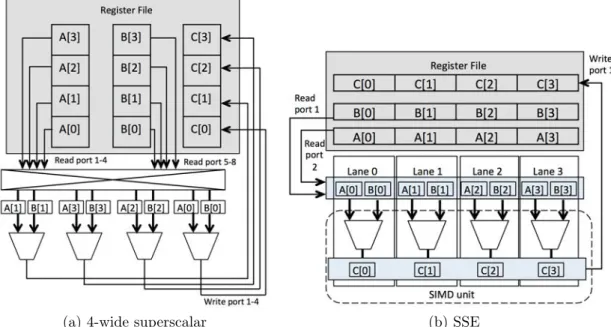
SIMD instructions reduce pressure in the front end of a pipeline as there are fewer instructions to be fetched (and consequently fewer instructions in other frontend pipeline stages). For example, the number of loop iterations (and hence the number of fetched instructions) in listing 1.4 is approximately reduced by 4 times. At the backend, for performance reasons, a common implementation of SIMD functional units is by banked register file/wide registers [RDK+00]. How-ever, SIMD is not equivalent to a wide superscalar processor. Figure 1.6 shows the execution of 32-bit integer array of size 4 in a 4-wide superscalar and a SSE unit. SIMD implementation partitions the register and data-path resources into multiple lanes. The reduced design complexity of the pipeline backend improves the scalability. The cost of implementation of SIMD architecture is much lower than a wide superscalar processor [PJS97].
Data-level parallelism 27
(a) 4-wide superscalar (b) SSE
Figure 1.6: 32-bit integer execution in 4-wide superscalar processor and a SSE unit
1.2.2
Single Instruction Multiple Threads (SIMT)
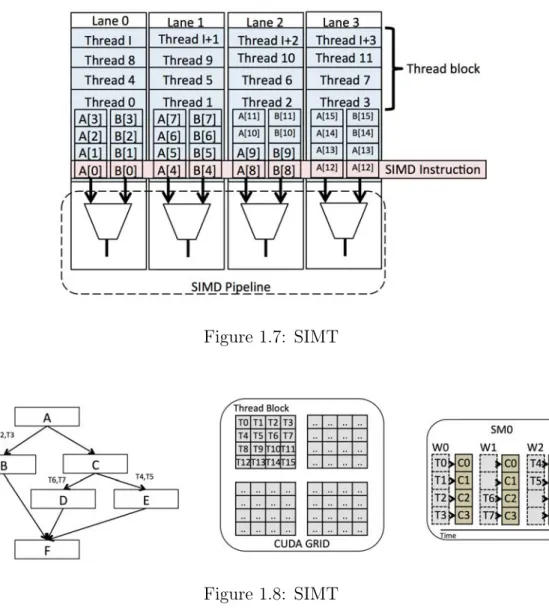
Single Instruction Multiple Threads (SIMT) [LNOM08] is a parallel execution model that is used to capture implicit DLP from SPMD code. NVIDIA introduced SIMT in their Tesla GPU architecture. SIMT eased programmability of NVIDIA GPU’s with the use of Compute Unified Device Architecture (CUDA) [Nvi07] programming libraries. NVIDIA later continued to use SIMT in their Fermi, Kepler, and Maxwell architectures. SIMT is generally combined with multi-threading and multi-core. SIMT relies on a large number of threads to keep the execution resources busy. SIMT works well for throughput oriented applications with large amount of implicit DLP. Hence, the program in execution may consist of a large number of threads. A simplified overview of array execution is shown in figure 1.7. Streaming Multiprocessors(SM) consists of many CUDA cores. An SM executes the SIMD instructions. Threads in CUDA is grouped into thread blocks. Using CUDA, the programmer specifies the number of threads per block and the number of thread blocks. CUDA maps multiple thread blocks to an SM. Hence, many warps are always active in an SM. A thread block is sub-divided
into groups of 32 threads (in our example this number is 4) called warps4. In SIMT, the threads in the warp form the lanes of the vectorized instructions.
Figure 1.7: SIMT
Figure 1.8: SIMT
Figure 1.8 shows a simplified overview of subdivision of a program with diver-gence into multiple thread blocks, their assignment to an SM and the execution of warps. A thread in SIMT is bound to a lane in SIMD. Threads in a warp
4Thread block is sub-divided into groups of 32 threads because there are 32 lanes (CUDA
Data-level parallelism 29 that are executing the same instructions form an SIMD instruction. When the threads are not executing the same PC, they are on a divergent path. SIMT uses an active bit mask to identify the participant threads in a vectorized instruction. Figure 1.9 illustrates the masks in SIMT, corresponding to the active threads, when there is a divergence. There is 1 bit corresponding to each thread in an SIMT. A set bit (i.e., 1) indicates that the thread is active and an unset bit (i.e., 0) corresponds to an inactive thread. SIMT can be considered as SIMD instruc-tions with hardware assisted divergence management. Branches in a data-parallel application cause the execution to follow divergent paths. Divergence adversely affects the efficiency of SIMD execution. The divergent paths merge at the recon-vergence point. In figure 1.9, block D is a reconrecon-vergence point. SIMT requires compiler hints to identify the reconvergence points after the divergence. NVIDIA GPUs uses a stack-based divergence management. Stack-based reconvergence is discussed in section 2.2.1.
Figure 1.9: SIMT divergence
As we have seen in figure 1.8, a thread block consists of multiple warps. SIMT hides the execution latency by switching between warps.
1.3
Thread-level parallelism
Thread-level parallelism (TLP) arises when independent threads work on different data. Even though the thread/process works with own data, some of the data might be shared. Synchronization techniques such as locks, mutex, semaphores, etc., are used to prevent race conditions in those cases. TLP is exploited by using threads. Single Program Multiple Data (SPMD) is a sub-class of MIMD that consist of multiple threads and processes that execute nearly the same instruction but with its own data. In comparison with DLP, a program written to exploit TLP tends to work better when there is a possibility of multiple divergent paths of execution. DLP and TLP are often interchangeable, especially in a SPMD application in which the threads are on a convergent path. However, when there is a divergence, the execution path can only be determined at the runtime. Hence, SPMD applications often have implicit DLP that are often unexploited. Hardware optimizations to exploit MIMD is explained in section 1.3.
High-level programming languages such as C/C++, Java, Python, etc. pro-vide abstractions to implement multi-threading with the support of operating system. Programmers use the libraries offered by the high-level languages to im-plement multi-threading in programs. POSIX threads [C+95], often referred to as PThreads, is an application programming interface for C and C++ languages.
Figure 1.10: Thread execution without multi-threading
Explicit TLP Hardware multi-threading supports multiple thread contexts at the same time on the same processor core. Processes or threads are mapped to
Thread-level parallelism 31 each of the hardware threads. In general, software threads and process scheduling is done by the operating system. However, at a much finer granularity, the micro-processor schedules the hardware threads to maximize the resource utilization. Figure 1.10 shows the execution of two threads without hardware multi-threading. Hardware multi-thread allows both the context to execute at the same time. De-pending on the scheduling technique, hardware multi-threading can be classified into
• Coarse grained multi-threading • Fine grained multi-threading • Simultaneous multi-threading
Figure 1.11: Coarse grained multi-threading (After cycle 1 T1 is scheduled as there is a long latency operation, T0 is rescheduled only when there is a long latency operation for T1)
1.3.1
Coarse-grained multi-threading
In coarse-grained multi-threading [ALKK90, SBCVE90, TE94] the processor switches the context when there is a very high latency operation such as a cache miss. Figure 1.11 illustrates how threads context switch when there is a long latency operation. Context switching could cost a few cycles to flush the pipeline. For coarse-grained muti-threading to be effective, the pipeline refill time should be much less than the stall time. IBM AS/400 [EJK+96] and Intel Itanium2 Montecito [MB05] cores implement coarse-grained multi-threading.
1.3.2
Fine grained multi-threading
In fine-grained multi-threading [Smi82] the thread interleaved execution between pipeline stages. However, only one thread is scheduled at a time in a given pipeline
Figure 1.12: Fine grained multi-threading (Rescheduling T0 do not wait until there is a very long latency operation for T1)
stage. The context switch happens without any cost. Figure 1.12 illustrates grained multi-threading. In comparison with coarse-grained multi-threading, fine-grained multi-threading improves the throughput by hiding both short and long stalls. The disadvantage of fine-grained multi-threading is that it slows down the individual threads when there are no stalls [PH13]. Fine-grained multi-threading works well for the in-order processors with narrow issue width. Sun Microsystems Niagara [KAO05] uses fine-grained multi-threading.
Figure 1.13: Simultaneous multi-threading
1.3.3
Simultaneous multi-threading (SMT)
SMT improves the throughput of a superscalar core by enabling independent threads to share CPU resources dynamically. Resource sharing policies have [TEE+96a, CRVF04, LFMS01, EA03, EE07] huge impact on execution through-put. Many studies have focused on optimizing the instruction fetch policy and leaving the instruction core unchanged while other studies have pointed out the ability to benefit from memory level parallelism through resource sharing poli-cies. Fairness among threads has been recognized as an important property that should be also tackled by resource sharing policies [LGF01]. However, these re-source sharing heuristics essentially address multi-program workloads.
SMT architectures [TEL95] were introduced to exploit thread-level and/or multi-program level parallelism to optimize the throughput of a superscalar core.
Thread-level parallelism 33 Typically, on an SMT processor, instructions from the different hardware threads progress concurrently in all stages of the pipeline. Depending on the precise implementation, some pipeline stages only treat instructions from a single thread at a given cycle. For instance, the instruction fetch pipeline stage [SFKS02], while some other pipeline stages like the execution stage, mix instructions from all threads.
SMT architectures aim at delivering throughput for any mix of threads with-out differentiating threads of a single parallel application from threads of a multi-program workload. Therefore, when threads from an SPMD application exhibit very similar control flows, SMT architectures only benefit from these similarities by side-effects of sharing structures such as caches or branch predictors [HS96].
SMT architectures have often been targeting both high single-thread perfor-mance and high parallel or multi-program perforperfor-mance. As a consequence, most commercial designs have been implemented with out-of-order execution. How-ever, in the context of parallel applications, out-of-order execution may not be cost effective. An in-order 4-thread SMT 4-issue processor has been shown to reach 85 % of the performance of an out-of-order 4-thread SMT 4-issue proces-sor [HS99]. Therefore, in-order SMT appears as a good architecture tradeoff for implementing the cores of an SPMD oriented throughput processor.
In a conventional single-threaded processor low ILP phases leave unused re-sources. SMT processors can leverage higher issue width with the use of multiple threads. [PJS97] identifies the various source of complexity for implementing a wider superscalar microprocessor. With higher complexity, various delays at dif-ferent pipeline stages increase, forcing the architecture to scale down the clock cy-cle rates at which the processor runs. Intel’s implementation of SMT is called Hy-perthreading [Upt], which appeared in 2002 and is still in use. [TT03, ECX+11] reports the performance improvement over a non-SMT architecture as around 20% in the older processors and 30% in the modern Intel processors.
1.3.4
Clustered multi-threading (CMT)
Clustering is also implemented in multi-threaded architectures. [KT98] proposed a clustered SMT architecture, which partitioned an aggressive, dynamic super-scalar core into several independent clusters that do not share the resources. This architecture is analogous to a multi-core SMT. [CT04, DS02] proposed combining
SMT architectures with clustering to have higher IPC while maintaining higher clock rates. CASH [DS02] proposed a hybrid of SMT and CMP architectures, in which certain hardware is shared between the threads and use split resources for hardware whose implementation complexity is high. [CT04] explored the im-pact of clustering on instruction window wakeup and functional unit bypass logic, register renaming logic, fetch unit and integer register file on an SMT. AMD’s Bulldozer [BBSG11] implements clustering in the multi-threaded processor.
SIMT is intended to run applications that are throughput oriented. SIMT does not support interrupts. Hence, it does not support operating system process. SIMT amortizes the control overhead. Unlike CMT, the pipeline operations are greatly reduced by sharing of instruction fetch and memory accesses. SIMT also needs specialized ISA for thread divergence management.
To improve the single thread performance CMT uses techniques such as su-perscalar execution, branch prediction, cache hierarchy, out-of-order execution, register renaming, speculative execution, etc. SIMT, on the other hand, is used in architectures aggressively optimized for throughput. SIMT supports a large number of cores. However, they are simple. They do not implement microarchi-tectural techniques to improve the single thread performance. Instead, it tries to improve the resource utilization with a large number of threads. More threads hide high latency operations. SIMT architectures have the benefits of cluster-ing because of the independence of its participant threads. However, this can have adverse effects when there is less instruction occupancy or lots of thread divergence 5.
Multi-threading in DITVA DITVA is implemented over an SMT
architec-ture. Whenever possible the instructions across SMT threads are vectorized. When vectorization is not feasible, the threads in DITVA executes as regular SMT. Like SIMT, DITVA groups the SMT threads into warps. Each thread in the warp occupies a lane. Consequently, DITVA also benefits from clustering, as the threads within the warp utilize independent resources.
5There are techniques such as Dynamic warp formation [FSYA07] and Dynamic warp
TLP vs DLP 35
1.4
TLP vs DLP
As mentioned in section 1.3, TLP arises when independent task works on different data. In the code segment given in listing 1.1, exploiting TLP is straightforward.
Listing 1.5: Array addition with multi-threading 1
2 void add ( i n t threadid , i n t num_threads ) {
3 i n t N_per_thread = N/num_threads ;
4 f o r ( i n t i=threadid ∗N_per_thread ; i<N_per_thread ; i ++){
5 c_array [ i ] = a_array [ i ] + b_array [ i ] ;
6 f_array [ i ] = d_array [ i ] + e_array [ i ] ;
7 }
8 }
A simple multi-threaded implementation of the code segment is shown in listing 1.5. All the threads execute the add function. In the given example, each thread adds a slice of the array. Parallel execution of the slices hides the long latency operations. Transformation of an algorithm with DLP to TLP is simple. However, vice versa is not straightforward. To illustrate this, consider listing 1.6, with ’condition’ variable which is known at the run-time. Even though there is data independence, the control flow of the program becomes dependent on the outcome of the conditional variable that is independent between iterations. The code segment in listing 1.6 still has inherent TLP. To exploit DLP in this example, the programmer has to rely on software based SPMD vectorization languages such as OpenCL [Mun09, SGS10] and ISPC [PM12], or hardware based SPMD techniques such as Single Instruction Multiple threads (SIMT).
Listing 1.6: Array addition with branch 1
2 void add ( ) {
3 f o r ( i n t i = 0 ; i < N; i++ ){
4 i f ( c o n d i t i o n [ i ] ) {
5 c_array [ i ] = a_array [ i ] + b_array [ i ] ;
6 f_array [ i ] = d_array [ i ] + e_array [ i ] ;
7 }
8 }
1.5
Chip multiprocessor
In section 1.1.4 and section 1.3.4 we have seen that clustering reduces the hard-ware complexity that allows the microprocessors to run at a higher clock rate. SMT architectures are introduced to improve resource sharing, but this increases the complexity. On the other hand, simultaneous multiprocessors (SMP) are computing elements that share nothing at all. However, on an SMP, the inter-processor communication is expensive. Moreover, the process or the threads run-ning on different processors may share data. Caches, which reduce the latency of expensive memory operations when there is data reuse, are not shared on an SMP.
Chip multiprocessors (CMP) consist of multiple computing elements (cores) on a single chip. The cores may have a separate L1 cache but may share caches at other levels. It has to be noted that the each core in a CMP may still support SMT. CMP aims to improve the scalability by clustering less critical hardware resources. A typical desktop computer may consist of a microprocessor having up to 8 cores (Intel Core i7 Extreme Edition 5960X [ci7]) and microprocessors designed for high performance may have even more cores.
An alternative CMP design consists of clustering resource by type. A CMP with different types of cores is called heterogeneous CMP. A heterogeneous CMP may consist of some specialized cores. For instance, Cell processors [PAB+05] consists of 1 Power Processing Element (PPE) for general purpose computing and 8 Synergistic Processor Elements(SPE) optimized for SIMD execution. AMD Fusion architecture [BFS12] consists of CPU and GPU in a single chip,
big.LITTLE [Gre11] from ARM reduce energy consumption by coupling powerful large cores(e.g. Cortex-A15) with smaller cores (e.g. Cortex-A7) for energy savings.
1.6
Conclusion
In this chapter, we saw different techniques to exploit parallelism in a program. These techniques are not mutually exclusive. Depending on the program be-havior (e.g., threadable vs non-threadable) and user requirement (e.g., latency vs throughput) an application can be programmed. Many general purpose mi-croprocessors incorporate all these techniques to exploit parallelism. Scalability
Conclusion 37 and effective resource utilization still remain an issue in these microprocessors. For example, SMT processors do not scale well beyond eight threads. Also, a program compiled with inefficient static vectorization does not use the SIMD ex-ecution units very well. There are inter-thread similarities (chapter 2) that allows threads to share the control flow. DITVA removes these inefficiencies of modern general purpose microprocessors. DITVA improves the throughput and overall energy consumption of the cores while maintaining the latency of the threads. DITVA is designed keeping in mind a heterogeneous CMP that may consist of regular cores coupled with DITVA cores optimized for SPMD applications.
DITVA does mask based vectorization of instruction like SIMT. Unlike SIMT, which uses a stack based divergence management, DITVA is heuristic based and hence it does not require the support of any specific ISA for divergence man-agement. Moreover, the use of intrinsics and compiler hints for reconvergence makes SIMT comparable to a predicate based static vectorization. DITVA, on the other hand, is entirely dynamic and even support speculative execution of branches with the help of a branch predictor. SIMT relies on fine-grained multi-threading (section 1.3.2) to maximize resource utilization while DITVA relies on simultaneous multi-threading technique (section 1.3.3).
Inter-thread similarity forms the basis of dynamic vectorization in DITVA. dynamic vectorization enables sharing of control flow when the threads are do-ing similar instruction operations. Dynamic vectorization results in reduction in pipeline operations in the microprocessor, thus reducing energy consumption and improving the utilization of existing SIMD units. In chapter 2, we discuss inter-thread similarities and the ways to exploit it to dynamically vectorize in-structions.
Chapter 2
Exploiting inter-thread similarity in
microprocessors
In this chapter, we will discuss the presence of inter-thread instruction simi-larities that cause redundancy while running SPMD application in an in-order SMT [TEE+96a] architecture. Dynamic Inter-Thread Vectorization Architec-ture (DITVA) avoids this redundancy by dynamically vectorizing the instruc-tions across threads. The efficiency of DITVA relies on convergent execution for dynamic vectorization. Hence, early reconvergence of threads after following divergent paths is of utmost importance. In this chapter, we discuss various recon-vergence techniques and our preferred reconrecon-vergence heuristics for DITVA. We will also discuss related microarchitectural techniques that exploit inter-thread redundancies.
2.1
Inter-thread similarities in SPMD
applica-tions
SPMD provides an easy-to-program model for exploiting data-level parallelism. A programmer may use programming libraries such OpenMP or Pthread to write SPMD application. SPMD is a higher level abstraction that uses of multiple instruction streams (threads or processes) that operate on a different subset of the data. The instruction streams would be loaded from the same executable.
And hence, each instruction streams often execute the same instructions. The instruction streams may also be on a divergent path. In this case, the instruc-tions streams may not share the instruction flow. The instruction streams are not required to execute the same instruction at every time step and hence, instruc-tion stream has its own program counter that is updated independently. SPMD applications may share the same program memory. The instruction streams are executed simultaneously. When an instruction stream is blocked for a long la-tency operation, an SMT processor may find another instruction stream that is not blocked.
SPMD assumes that the parallel instruction streams execute identical instruc-tions. In a single core SMT processor, SPMD applications benefits from shared instruction caches as the instruction streams share most of the instructions. The instruction streams may also share some data in the data caches. However, the flow of instructions in the pipeline front-end is redundant [KJT04], resulting in resource wastage and high energy consumption.
2.1.1
Source of inter-thread similarities
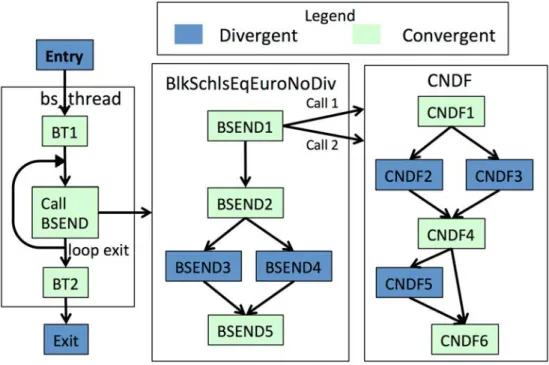
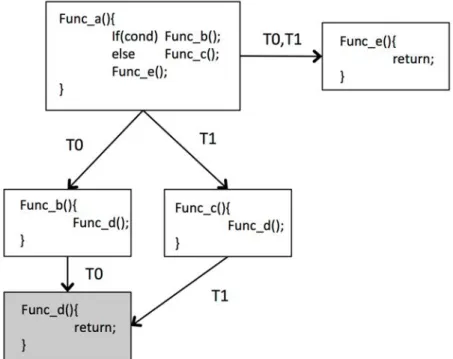
In SPMD applications, threads usually execute very similar flows of instructions. They exhibit some control flow divergence due to branches, but generally, a rapid reconvergence of the control flows occur. To illustrate this convergence/divergence scenario among the parallel sections, we display a control flow diagram from the Blackscholes workload [BKSL08] in figure 2.1.
All the threads execute the convergent blocks while only some threads execute the divergent blocks. Moreover, more than one thread often executes each diver-gent block. Threads that are in the converdiver-gent path fetch the same instructions. This results in instruction redundancy. The redundancy in SPMD applications could be instruction redundancy or data/value redundancy. With instruction redundancy, operations at the pipeline front end are repeated for each of the in-struction across threads. With data redundancy, inin-structions execute with the same data.
Since the threads are inherently independent, they are not guaranteed to execute in lockstep i.e., some threads may be ahead of the others in the execution flow. SPMD applications typically resort to explicit synchronization barriers at certain execution points to enforce dependencies between tasks. Such barriers are
Inter-thread similarities in SPMD applications 41
Figure 2.1: Control flow graph of blackscholes benchmark
natural control flow reconvergence points.
On a multi-threaded machine, e.g. an SMT processor, threads execute inde-pendently between barriers without any instruction level synchronization favoring latency hiding and avoiding starvation. On an SMT processor, each thread man-ages its control flow. In the example illustrated above, for each convergent block, instructions are fetched, decoded, etc. by each of the thread without any mu-tualization of this redundant effort. The same applies to the divergent blocks that are executed by more than one thread. This appears as a large waste of resources. Indeed, a prior study on the PARSEC benchmarks have shown that the instruction fetch of 10 threads out of 16 on average could be mutualized if the threads were synchronized to progress in lockstep [MCP+14].
(a) Thread execution in SMT (b) Lockstep execution and formation of vec-torized instruction
Figure 2.2: Overview of dynamic vectorization
0% 20% 40% 60% 80% 100% bar ne s blackscholes FFT flu idanima te fmm oc ean cp oc ean ncp radix swap@
ons vo
lren d
b+tree hotspot kmeans pathfi nde
r srad stream
cluste r
1 Thread 2 Threads 3 Threads 4 Threads
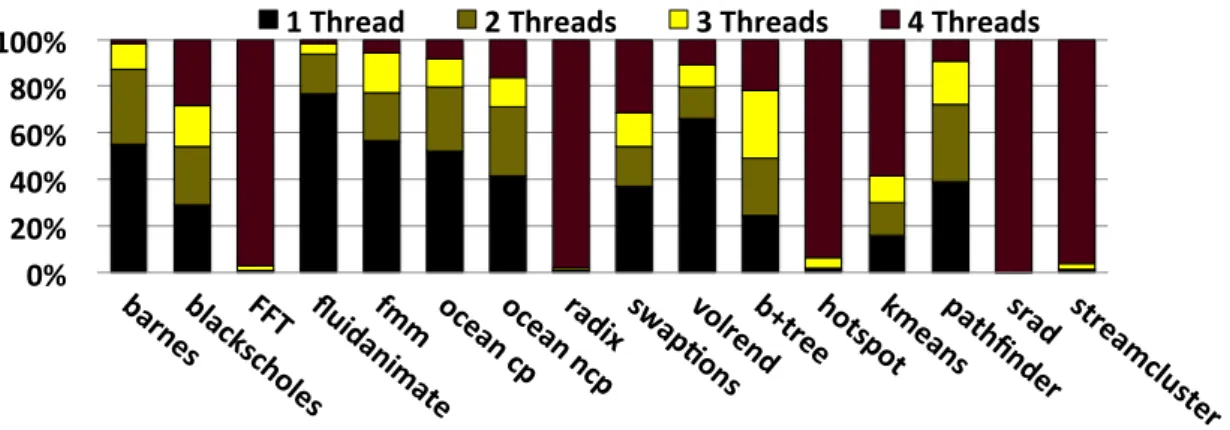
Figure 2.3: Breakdown of average vectorizable instructions for 4-way SMT
2.1.2
Vectorization efficiency in an SMT
Figure 2.3 illustrates the functional unit occupancy with a breakdown of vector-izable instruction count per for a 4-way SMT1 with MinSP-PC-Roundrobin fetch
1The programs shown in the figure are executed with 16 threads. The 16 threads are grouped
Inter-thread similarities in SPMD applications 43 heuristic2. Functional unit occupancy is the occupancy of active threads in an instruction. This is equivalent to the active threads represented by the set bits of a mask in an SIMT (see section 1.2.2). The k thread bar represents the average number of active threads in vectorized instructions throughout the execution of a program. For example, in blackscholes, around 30% of the instructions are non vectorizable, since they have occupancy one. Efficiency increases with the occu-pancy. Hence, the best case here are the instructions with occupancy 4 since they are perfectly vectorized. This figure represents the DLP that could be extracted from the SPMD program. Radix and FFT have vast amounts of DLP. Hence, most of their instructions are perfectly combined to form vectorized instructions. On the other hand, the threads of benchmarks that have low exploitable DLP like Fluidanimate tend to diverge. Only 23% of vectorized instructions contain more than one instruction on Fluidanimate.
2.1.3
Dynamic Vectorization
Dynamic vectorization leverages the instruction redundancy to mutualize the front-end pipeline of an in-order SMT processor, as a resource-efficient way to improve throughput on SPMD applications.
Figure 2.2a shows the execution of a code block by threads in SMT. In this example, we assume that all the threads are executing the same code block. How-ever, the threads may still fetch different PC at a given time. Figure 2.2b shows the dynamic vectorization across threads in an SMT processor. The vectorization involves two steps
1. Maximize lockstep execution
2. Vectorize instructions across threads that are running in lockstep
Maximize lockstep execution Threads run in lockstep when they fetch the
same PC at the same time. Lockstep execution is only possible among the threads that are in the convergent path. Lockstep execution is achieved by using special heuristics that prioritizes the slow running thread to catch-up with the faster running thread. When the threads are in the divergent path, the threads are
prioritized for early reconvergence. In section 2.2, we discuss some of the recon-vergence techniques and our motivation to use a hybrid MinSP-PC-Roundrobin heuristics in DITVA to maximize the convergent execution.
2.2
Thread reconvergence for SPMD applications
Similarity exploitation in SPMD applications requires the threads to execute sim-ilar instructions at around the same time. Thread synchronization is not difficult to achieve in a regular application when the threads are on a convergent path. With divergence, threads start to follow different execution paths. Divergence is the source of performance degradation in SIMD and SIMT architectures. An optimal solution to maximize thread synchronization should support early recon-vergence. It should perfectly identify the best reconvergence point. For certain programs, identifying reconvergence point is difficult. An example of such a progam is shown in listing 2.1. When the program is executed, the threads may execute either function A() or function B(). After the divergence, it is difficult to know the point at which the threads will reconverge.
Listing 2.1: A program with divergence 1 f o r ( i = 0 to n)
2 i f ( ( i+t i d ) %c ) )
3 A( ) ;
4 e l s e
5 B( ) ;
Thread reconvergence is a challenging task because of its dynamic nature. In general, there are two classes of reconvergence mechanisms. The first one is stack-based and the second one is stack-less. A bulk of SIMT architectures uses an explicit reconvergence mechanism based on explicit annotations from ISA and a hardware stack. A stack-based approach uses a stack to keep track of diver-gences within a thread group (warp). There are several proposals for implicit reconvergence in SIMT architectures that are still stack-based. DITVA uses a stack-less implicit mechanism, which prioritizes threads, to maximize convergent execution of an SPMD application. In this section, we will discuss some of the methods used for thread synchronization.