HAL Id: tel-02469417
https://tel.archives-ouvertes.fr/tel-02469417
Submitted on 6 Feb 2020HAL is a multi-disciplinary open access
archive for the deposit and dissemination of sci-entific research documents, whether they are pub-lished or not. The documents may come from teaching and research institutions in France or
L’archive ouverte pluridisciplinaire HAL, est destinée au dépôt et à la diffusion de documents scientifiques de niveau recherche, publiés ou non, émanant des établissements d’enseignement et de recherche français ou étrangers, des laboratoires
Multidomain virtual network embedding under
security-oriented requirements applied to 5G network
slices
François Boutigny
To cite this version:
François Boutigny. Multidomain virtual network embedding under security-oriented requirements applied to 5G network slices. Networking and Internet Architecture [cs.NI]. Institut Polytechnique de Paris, 2019. English. �NNT : 2019IPPAS002�. �tel-02469417�
NNT
:2019IPP
AS002
Multidomain Virtual Network Embedding
under Security-oriented Requirements
applied to 5G Network Slices
Th`ese de doctorat de l’Institut Polytechnique de Parispr´epar´ee `a T´el´ecom SudParis ´Ecole doctorale n◦626 Institut Polytechnique de Paris (IPP)
Sp´ecialit´e de doctorat : Informatique, donn´ees, IA
Th`ese pr´esent´ee et soutenue `a ´Evry-Courcouronnes, le 8 novembre 2019, par
FRANC
¸
OISBOUTIGNY
Composition du Jury : Gu´ena¨el Renault
Professeur, ´Ecole Polytechnique Pr´esident Yves Roudier
Professeur, Universit´e Nice Sophia Antipolis Rapporteur Micha¨el Hauspie
Maˆıtre de conf´erences HDR, Universit´e de Lille Rapporteur Christine Morin
Directrice de recherche, Inria Examinatrice Isabelle Chrisment
Professeur, T´el´ecom Nancy, Universit´e de Lorraine Examinatrice Nuno Neves
Professeur, Universidade de Lisboa Examinateur Samuel Dubus
Ing´enieur de Recherche, Nokia Bell Labs Examinateur Herv´e Debar
Professeur, T´el´ecom SudParis Directeur de th`ese Gregory Blanc
Maˆıtre de conf´erences, T´el´ecom SudParis Invit´e Antoine Lavignotte
Contents
1 Introduction 1
2 State of the Art 3
2.1 The Virtual Network Embedding (VNE) Problem . . . 4
2.2 Extensions to the VNE Problem . . . 5
2.2.1 Rethinking the Objective Function . . . 8
2.2.2 Rethinking the Substrate . . . 11
2.2.3 Rethinking the Requests . . . 13
2.2.4 Leveraging Software-Defined Network (SDN) . . . 17
2.2.5 Leveraging Network Function Virtualization (NFV) . . . 18
2.3 Security Aspects for the VNE Problem . . . 20
2.3.1 Security for the Tenants . . . 20
2.3.2 Security for the Infrastructure Providers (InPs) . . . 23
2.4 Methods for Modeling the VNE Problem . . . 25
2.4.1 The Integer Linear Programming (ILP) Model . . . 28
2.4.2 The Boolean Satisfiability (SAT) Model . . . 31
2.4.3 The Satisfiability Modulo Theories (SMT) Modeling . . . 33
2.5 Conclusion . . . 34
3 Security Constraint Model 37 3.1 The Attribute Model . . . 38
3.1.1 Attribute Classification . . . 38
3.1.2 Exclusion Attributes: Semantics and Typology . . . 40
3.1.3 Tolerant Attributes: Semantics and Typology . . . 43
3.1.4 Tolerant Attributes: Structure . . . 44
3.1.5 Node and Link Attributes: Semantics and Typology . . . 47
3.2 Application to the Single Domain Scenario . . . 48
3.2.1 VNE Description . . . 48
3.2.2 SMT Formulation . . . 51
Contents
3.3.1 The Theory of Non-Interpreted Function . . . 57
3.3.2 The Theory of Arrays . . . 60
3.3.3 Conditional Requirements . . . 62
3.3.4 Attribute-specific Exclusion and Collocation . . . 70
3.4 Conclusion . . . 75
4 Algorithm Resolution 77 4.1 From the Single Domain to the Multi-Domain Formulation . . . 78
4.1.1 SMT Formulation for the Intra-Domain Level . . . 78
4.1.2 SMT Formulation for the Inter-Domain Level . . . 83
4.2 Multi-level Resolution Algorithm . . . 84
4.2.1 Architecture . . . 85
4.2.2 Solution Enumeration . . . 85
4.2.3 Inter-level Coordination . . . 89
4.2.4 Solution Selection . . . 90
4.3 Conclusion . . . 91
5 Prototyping and Evaluation 93 5.1 Prototype Description and Use Case . . . 93
5.1.1 Prototype Description . . . 94
5.1.2 Use Case . . . 97
5.2 Implementation Challenges for Mutable Attributes . . . 99
5.3 Results and Interpretation . . . 103
5.4 Instantiation of the State-of-the-Art Security-oriented Attributes 107 5.5 Conclusion . . . 114
6 Conclusion and Future Tracks 117 6.1 Conclusion . . . 117
6.2 Cumulative Link Attributes . . . 118
6.3 Time-dependent Requirement . . . 118
Bibliography 121
A Chapter 5 Appendices 129
Acronyms 135
Table of all Notations 137
List of Figures 147
CHAPTER
1
Introduction
From 1G to 4G, the technology mainly focused on increasing the bandwidth ca-pacity of phones, to carry voice, message and Internet data. 5G has new goals: providing low latency, bandwidth, and increased support for diverse connected devices.
Network operators indeed anticipate an ever-growing number of more di-verse connected devices, be them vehicles on roads, traffic lights in cities, robots in factories, or healthcare devices in human bodies. However, the companies producing those devices and operating them know little about network opera-tors’ business. For instance, they are not expected to own nor manage mobile network equipment.
Fortunately, the MVNO business model shows that this business knowledge is not mandatory. The MVNOs already provide services similar to other network operators, while owning no or a few equipment. They rent them instead, after negotiating specific agreements on specific resources. 5G proposes to generalize the MVNO business model so that the aforementioned companies can operate their devices on top of network operators’ infrastructures, as if they had their own.
In the end, they get a dedicated, customized, virtual, end-to-end network on top of a shared infrastructure, which is called a “slice”. Companies renting slices are called “tenants”. And the shared infrastructure does not only rely on network operators, but more broadly on a subset of all possible Infrastructure Providers (InPs).
Each InP will then have to support multi-tenancy with a huge variety of de-vices (IoT, V2V, Industry 4.0) which willautonomously communicate, along with human-oriented devices.
Introduction
In this thesis, we focus on slice customization. It is crucial: as tenants know little about network operators’ business, network operators know little about tenants’ business. Tenants have their own requirements to make their services operational, or regulation-compliant. For instance, robots need low latency, while a remote radiography needs high bandwidth.
We are already used to define such QoS-oriented requirements, and to pay for it, in the cloud model. But 5G invites us to go beyond, by considering more general requirements, like security requirements. For instance, to comply with a certain regulation in a certain country, tenants may require that their slices must rent resources in certain other countries, from certain InPs, with a certain level of certification.
There is an obstacle, though. As of today, MVNOs get their infrastructures through manually configured resources. With 5G and thousands of tenants, such configuration will be unpractical. We then need to automate slice deployment. In this thesis, we present how we solve this problem.
We borrow from the literature the concept of VNE, which refers to the allo-cation of resources from the physical network to fulfill requirements of a virtual network request. However, Fischer et al. (2013) show that the VNE problem is
NP-hard. Besides, we identify two aspects of the slice embedding problem that previous works in VNE only covered partially: the multi-InP aspect, and the se-curity requirement aspect. The algorithm we propose in this thesis successfully covers both.
Throughout this thesis, the term domain refers to the infrastructure owned by a certain InP. A given InP may own different domains, which are not directly interconnected together. When we use the term multi-domain, we mean that there are both multiple InPs and multiple domains operated by different InPs.
This thesis is organized as follows. Chapter 2 presents the state of the art works addressing the same problem, or a related problem, to the one of this thesis. Chapter 3 presents our attribute model for enabling security-oriented constraints. Chapter 4 presents the algorithm leveraging our model to solve the problem. Chapter 5 presents how we implement and evaluate our algorithm. Chapter 6 concludes this thesis and provides possible future tracks.
CHAPTER
2
State of the Art
While applying for a job position at Nokia Bell Labs, one of my interviewers recommended me to read the transcription of a talk given by Richard Hamming, “You and Your Research”. In this talk, Richard Hamming gave many advice about how to do significant research, based on his experience, as well as the ones of many other well-known scientists.
As I am writing this thesis, I recall one of his ground ideas, which is that science is cumulative. It is true that I took many inspiration from the works I will describe in this chapter. Like an investigator, although heavily assisted by modern research tools, I could gather information about the core problem of this thesis, which is the Virtual Network Embedding (VNE) problem. I call it so, because it is its recent name; but it covers so many fields that I could find the same problem with other names, such as network testbed mapping problem, or resource allocation problem. I will then, only to the best of my knowledge, presents the origins of this problem in Section 2.1.
By the light of this core description, we will then explore different variants of the VNE problem in Section 2.2. It will not be exhaustive; the works presented there have been selected because they each refine the VNE problem in their own way, and we will classify them according to some key aspects. This will allow us to introduce what we learned and how we differ from these works.
One aspect is of particular interest for this thesis, the security aspect, which is investigated on its own in Section 2.3. Although we use the singular, again, the works focusing on security for the VNE problem each addresses the security aspect in its own way.
Yet, VNE works do share some similarities in how they solve the VNE prob-lem. This resolution method is analyzed in Section 2.4, where we position our
State of the Art
distinct resolution method, and explain why it is relevant and more appropriate to address the security aspect.
2.1
The VNE Problem
The VNE problem is a relatively old problem in computer science. To the best of my knowledge, its oldest mention is by Ricci et al. (2003). It is then referred to as thenetwork testbed mapping problem. The VNE problem can also be found in other papers as theresource allocation problem, like Haider et al. (2009), but the description remains basically the same.
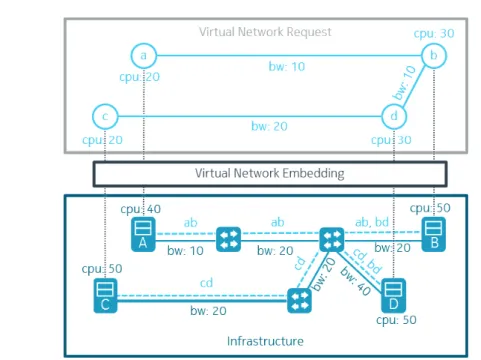
As the name suggests, thenetwork testbed mapping problem has emerged dur-ing the creation of a network experiments platform at the University of Utah. The idea of such a platform is to simplify the realization of experiments by connecting a large quantity of switches together, and then to select the switches and cables that must be part of a given experiment. All possible topologies can be imagined and tested without having to physically modify the wiring. This differentiates the network used during an experiment (referred to as avirtual network), from thephysical network. Another interesting property of this platform is that several virtual networks can, under certain conditions, be deployed in parallel.
To instantiate a virtual network, experimenters must send avirtual network request, in which they describe their needs. This description is given as a graph, where nodes are differentiated by their type. A (virtual) node whose type is “switch” (resp. “workstation”) must be assigned to a (physical) node whose type is “switch” (resp. “workstation”). The edges of the graph representvirtual ca-bles, which allow the different virtual nodes to communicate. For instance, the virtual cable that connects two virtual nodes “a” and “b” physically corresponds to a path in the physical network that connects the physical node corresponding to “a” to the physical node corresponding to “b”. When requesting such a virtual cable, the experimenter must provide a quantity representing the bandwidth of the virtual cable. At the physical level, this same quantity represents the maxi-mum bandwidth that the experimenter can consume. In practice, this also means that it is as much bandwidth that can not be reserved for any other virtual cable. It is precisely during the deployment of a set of virtual networks that the network testbed mapping problem appears. On the one hand, for a given virtual topology, several physical topologies can match, or none at all. On the other hand, as already mentioned, each virtual network consumes bandwidth: the vir-tual networks are thus competing to acquire it.
In the end, not all deployments are equal, and some may even be undesirable. Typically, some deployments overload the physical network, and so a virtual net-work may impact the behavior of another virtual netnet-work. Since the goal is to
2.2. Extensions to the VNE Problem
have independent experiences, such deployments are undesirable. The question then is to find the deployments that are desirable. This question is not simple. It turns out that the underlying problem is mathematicallyNP-hard (see Defini-tion 2.3), as Ricci et al. (2003) and Fischer et al. (2013) remind us.
Besides, the initial state for the network testbed mapping problem may not be a case where no virtual network is deployed, and no physical resource is re-seved. Instead, we may have a set of virtual networks already reserving physical resources. Finding deployments for newcoming virtual network requests then depends on the remaining, non-reserved resources. Consequently, the choice of resources for past virtual network requests matters, adding more complexity to the problem.
2.2
Extensions to the VNE Problem
Since then, the VNE problem has spread in many other fields of computer sci-ence. Today, it should be noted that although Ricci et al. (2003) uses the term “vir-tual network”, it rather means “logical network”, since every deployment merely changes the cabling in an abstract way between the different physical worksta-tions. This precision is necessary, because state of the art works have refined the definition of virtual networks, by following the advances of virtualization technologies. As an example, Ballani et al. (2011), Papagianni et al. (2013), and Rabbani et al. (2013) define a virtual network in the cloud computing field, where virtual nodes are VMs instantiated in physical servers. In other words, several virtual nodes can be instantiated within the same physical node, which requires the introduction of another consumption data, namely the computing capacity. Similar to the bandwidth, this capacity is consumed by each VM.
Consequently, it is now very common in the VNE to consider that a physical node can host more than one virtual node (which can be a VM, but also a virtual router).
This section is intended to be an overview and an introduction to the different variants of the VNE problem, applied to different fields. To do so, we decide to present how different works, shown in Table 2.1, adapt the VNE problem to their needs. We also add one of our previous publications, as Boutigny et al. (2018), in Table 2.1.
In Table 2.1, we distinguish the problem the authors focus on (either the gen-eral VNE problem or a variant), its formulation (or resolution method), and the objective of their work. We warn the reader that two rows share the same ref-erence. It is the case of Mehraghdam et al. (2014) and Liu et al. (2014). This is because in each of those papers, the authors propose three VNE problems, with each a different objective.
State of the Art
Overall, in the first column of Table 2.1, the different investigated problem variants are:
— VNE. The general VNE problem.
— Dynamic VNE. A VNE handling requests dynamically. See Subsec-tion 2.2.3.
— Service Function Chain Embedding (SFCE). One of the VNE prob-lems in the Network Function Virtualization (NFV) field. See Subsec-tion 2.2.5.
— Intra-Domain VNE. One of the VNE problems in multi-domain con-text. See Subsection 2.2.2.
— Inter-Domain VNE. One of the VNE problems in multi-domain con-text. See Subsection 2.2.2.
— Virtual Network Embedding Reconfiguration (VNER). A VNE vari-ant supporting virtual network migration. See Subsection 2.2.3.
— Survivable Virtual Network Embedding (SVNE). A VNE variant sup-porting fault tolerance. See Subsection 2.2.3.
— Intra-Domain VNER. One of the VNE problems in multi-domain context, handling virtual network migration. See Subsection 2.2.2 and Subsection 2.2.3.
— Inter-Domain VNER. One of the VNE problems in multi-domain context, handling virtual network migration. See Subsection 2.2.2 and Subsection 2.2.3.
— Virtual Data Center Embedding (VDCE). One of the VNE problems in the cloud field. See Subsection 2.2.2.
— Dynamic VDCE. One of the VNE problems in the cloud field, handling requests dynamically. See Subsection 2.2.2 and Subsec-tion 2.2.3.
The second column of Table 2.1 is about the problem formulation. We identify two formulations. When a paper proposes both formulations, it is indicated as “ILP, heuristic”.
— Integer Linear Programming (ILP). An exact resolution method. See Sec-tion 2.4.
— Heuristic. A resolution method relying on empirical evidence or apriori knowl-edge of the problem. The actual resolution algorithm depends on the au-thors.
Table 2.1 is a global presentation of all the works reviewed for the state-of-the-art in the VNE field. In the remainder of this section, we analyze those works using the following dimensions.
— Optimization Objective. In Subsection 2.2.1, we show that the optimization objective for the VNE problem is not unique, and that different concrete use cases lead to different optimization objectives, which can be conflictual.
2.2. Extensions to the VNE Problem
— Substrate Model. Subsection 2.2.2, we show that the VNE problem changes drastically when considering that the substrate (which is the dedicated term to refer to the infrastructure in the VNE field, see Fischer et al. (2013)) is divided into multiple domains.
— Request Model. In Subsection 2.2.3, we present how multiple requests can be handled, and different request models.
— Software-Defined Network (SDN) and NFV Impact. In Subsection 2.2.4 and Subsection 2.2.5, we show how two new emerging paradigms of network virtualization, namely SDN and NFV, may redefine the VNE problem.
Table 2.1: Classification of VNE Research Papers
Reference Problem Formulation Objective
Rost and Schmid (2018) VNE ILP Max acceptance
Boutigny et al. (2018) Intra-domain VNE Heuristic Enumeration
Inter-domain VNE Heuristic Enumeration
Li et al. (2017) VNE Heuristic Min VN cost
Alaluna et al. (2017) VNE ILP Min VN cost
Mano et al. (2016) Inter-domain VNE Heuristic Min VN cost
Fischer et al. (2016) VNE Heuristic Min VN cost
Bays et al. (2016) VNE ILP Min flow rules
Wang et al. (2015) VNE ILP Min VN cost
Nonde et al. (2015) VNE ILP, heuristic Min power consumption
Dietrich et al. (2015) Inter-domain VNE ILP, heuristic Min VN cost
Bellavista et al. (2015) VNE ILP, heuristic Min infrastructure load
Zhang et al. (2014) Dyn. VDCE ILP, heuristic
Min power consumption and migration cost
Mehraghdam et al. (2014) SFCE ILP, heuristic Max residual bandwidth
SFCE ILP, heuristic Min # of hosts in use
SFCE ILP, heuristic Min latency
Liu et al. (2014) VNE ILP Max acceptance ratio
VNE ILP Max long-term revenue
VNE ILP Max long-term revenue to cost ratio
Chau and Wang (2014) VNE ILP Min VN cost
Bays et al. (2014) VNE ILP, heuristic Min VN cost
State of the Art
Reference Problem Formulation Objective
Rahman and Boutaba (2013) SVNE ILP, heuristic Min overconsumption
Rabbani et al. (2013) VDCE Heuristic Max # of accepted requests
Papagianni et al. (2013) VNE ILP Min VN cost
Di et al. (2013) Inter-domain VNE ILP, heuristic Min VN cost
Houidi et al. (2011) Intra-domain VNE ILP, heuristic Min VN cost
Inter-domain VNE ILP, heuristic Min VN cost
Fajjari et al. (2011) Dyn. VNE Heuristic Min congestion and reconfiguration
Ballani et al. (2011) VDCE Heuristic Unknown
Arora et al. (2011) Intra-domain VNER Heuristic Min migration cost Inter-domain VNER Heuristic Min migration cost
Chowdhury et al. (2010) Inter-domain VNE Heuristic Unknown
Bienkowski et al. (2010) VNER Heuristic Min migration cost
Yu et al. (2008) VNE Heuristic Max long-term revenue
2.2.1
Rethinking the Objective Function
In thenetwork testbed mapping problem, the objective is to maximize the chances of accepting future virtual network requests. We can understand this objective, as it is in the context of an experimental platform.
For their part, all the works shown in Table 2.1 address a business use case, be it in a datacenter, multiple datacenters, or an Internet Service Provider (ISP) network. In all those cases, the authors oppose the tenant (the one requesting the virtual network), to the Infrastructure Provider (InP) (providing the physical resources). In some cases, another participant is added, the Virtual Network Provider (VNP), negotiating with InPs to rent their resources on behalf of the tenants. In all cases, the tenant is indeed renting the virtual network. A full presentation of the relations between the VNP, the InP and the tenant is given by Fischer et al. (2013).
Table 2.2 presents the same works as in Table 2.1 with a focus on their ob-jective functions, as many different obob-jective functions exist. For instance, Liu et al. (2014) propose to maximize the revenue of the InP. For their part, Alaluna et al. (2017) propose to minimize the cost of the virtual network to the tenant. Besides, in the field of cloud computing, Nonde et al. (2015) propose to minimize the power consumption of the whole data center, down to the optical devices. The reason why Nonde et al. (2015) minimize the power consumption is because they report it to be the greatest operational expenditure for data centers.
2.2. Extensions to the VNE Problem
Table 2.2: Classification of Objectives of VNE Research Papers Objective Category Objective References
Tenant oriented Min VN cost Li et al. (2017) and Alaluna et al. (2017) Fischer et al. (2016) and Mano et al. (2016) Wang et al. (2015) and Dietrich et al. (2015) Chau and Wang (2014) and Bays et al. (2014) Papagianni et al. (2013) and Di et al. (2013) Houidi et al. (2011)
InP oriented Min bottleneck load Bays et al. (2016) Bellavista et al. (2015) Mehraghdam et al. (2014)
Riggio et al. (2013) and Rahman and Boutaba (2013) Fajjari et al. (2011) and Arora et al. (2011)
Bienkowski et al. (2010)
Min expenditure Nonde et al. (2015) and Zhang et al. (2014) Max revenue Liu et al. (2014) and Yu et al. (2008)
Neutral Acceptance related Rost and Schmid (2018) and Rabbani et al. (2013)
Unknown Unknown Ballani et al. (2011) and Chowdhury et al. (2010)
Minimizing the cost of the virtual network is the most widespread objective, although the actual definition of the cost depends on the paper. It is a tenant-oriented objective, in the sense that InPs are likely to prefer to charge more. This variety of cost definitions comes from the fact that the cost must be understood as what the tenant is charged for (it is then referred to also as the “revenue”), and this is up to the business strategy of the InP, which may vary. InPs get a revenue from renting their resources, but must also pay for their expenditures, like energy consumption, the buildings they rent, and their employees. To make profit, they need multiple tenants, or tenants with big enough requests. Mean-while, as they rent the embedded virtual networks, tenants are sensitive to the rental price. Besides, virtualization naturally changes the perception of the vir-tual networks: they only become a set of files (VMs), software (VM hypervisor) and configuration (routing rules), consuming the desired amount of memory and CP U provided by whatever physical resources. This change in the perception of what a network represents may make it easier for tenants to consider to change their InPs.
Meanwhile, we consider that the objective functions from works like Mehragh-dam et al. (2014), Nonde et al. (2015), and Yu et al. (2008) belong to the same InP-oriented objective category. Overall, those objectives are to minimize the load of the bottlenecks in the infrastructure as identified by the respective paper, or to minimize InP expenditure (mainly power consumption), or to maximize the InP revenue. The definition of the bottlenecks may vary. For Bays et al. (2016), the bottleneck is the capacity of programmable switches in the SDN context (see
State of the Art
Subsection 2.2.4), as their capacity is very limited. In the cloud context, Bellav-ista et al. (2015) proposes to minimize the traffic load in the whole infrastruc-ture. Interestingly, Mehraghdam et al. (2014) propose, among other objectives, to minimize the number of hosts in use, which in turn may increase the load on the neighboring links. From their experiments, Fajjari et al. (2011) conclude that the main bottleneck in the link capacity.
The remaining works could not be classified as more tenant-oriented or more InP-oriented. Some focus on the acceptance of the requests, which may be ben-eficial for both the tenants and the InPs. As such, we classify them as neutral. This does not mean that they are better though. For instance, maximizing the number of accepted requests does not mean we maximize the revenue, unless the cost and the revenue of each request is equal.
For Ballani et al. (2011) and Chowdhury et al. (2010), we were not able to retrieve information about an objective function.
From a security viewpoint, Alaluna et al. (2017) and Bays et al. (2014) consider the security as a service, which is charged to the tenant. But other kinds of ob-jective function may be considered. For instance, we can leverage the National Vulnerability Database1, to retrieve the known vulnerabilities of each product setup in a given infrastructure. The products are retrieved from the MITRE Common Platform Enumeration (CPE) database2, and the vulnerabilities are re-trieved from the MITRE Common Vulnerabilities and Exposures (CVE) database. Each vulnerability is furthermore associated with a number, computed from the MITRE Common Vulnerability Scoring System (CVSS). This number represents the severity of the vulnerability. It is very different from a security level, in the sense that the CVSS is a scoring system which can be tuned by an organization to better adapt to its environment. This is possible by tuning the environmen-tal score metrics (in CVSS version 3). We could agglomerate the environmenenvironmen-tal score metrics of all tenants, and minimize the severity of their virtual resources. To the best of our knowledge, no work has proposed it yet. This approach has different downsides. First, it only deal with known vulnerabilities, and when a new vulnerability is published, the embedding may have to be updated. Sec-ond, the CPE database does not enumerate every known product, although every product should be described by the CPE naming system, butat least every known vulnerable product, even though the CPE can be contributed by organizations external to MITRE 2 ; to the best of our knowledge, there is no list of current non-vulnerable products3. 1 Seehttps://nvd.nist.gov/general. 2 Seehttps://nvd.nist.gov/Products/CPE. 3
As an illustration, the reader can verify that on 6/10/2019 (time of writing), there is no en-try for the Google Chrome 76 stable version (seehttps://en.wikipedia.org/wiki/Google_ Chrome_version_history), but one for Google Chrome 76beta version. The Google Chrome
2.2. Extensions to the VNE Problem
As a consequence, some CPE data can be misleading. For instance, vul-nerability CVE-2013-66624impactsevery version of Google Chrome, as it is in-dicated by the CPE referencecpe:2.3:a:google:chrome:*:*:*:*:*:*:*:*; however, the CPE database does not define any entry for Google Chrome 76, or Google Chrome 77. In other words, although they are known to be vulnerable, there is no entry for them.
As such, when a non-referenced product is declared, we must ensure that we have enough and correct data to identify it, if it happens to be vulnerable in the long term.
To conclude this investigation around the objective functions in use, we want to point out the work from Ludwig (2016), which proposes to price the virtual networks on their specificity. Such definition is more market-related, and con-siders that the price of a virtual network may vary over time. The reason Lud-wig (2016) proposes to do so is because a very specific virtual network topology, once embedded, may cause the reject of future virtual networks. The physical resources the embedded virtual network is using become then more valuable, because they become key to fulfill the demand. Ludwig (2016) proposes to rever-berate the fact they become more valuable by increasing their price. Changing the physical resources that are consumed by a virtual network is also a solution, called migration. This aspect is however addressed in Subsection 2.2.3.
2.2.2
Rethinking the Substrate
From a general viewpoint, the VNE problem can be described as the matching of an offer and a demand. The offer is brought by the InP, and the demand is brought by the tenant. If the offer was unlimited, the VNE problem would not be very complex. It is actually the meaning of being a NP-hard problem (see Definition 2.3). The VNE problem is a NP-hard problem in general. But some particular instances, like, a particular request, or a particular substrate, may lead to a simpler problem. At least, it may lead to heuristic that are really efficient for those particular instances.
Table 2.3 enumerates the same works as from Table 2.1 classifying them ac-cording to their substrate model. Our first discriminator is how many the model can handle, either one (single InP) or many (multiple InPs). For the single InP case, our second discriminator is if the substrate topology is structured or not.
For example, because data centers have structured topologies (usually in trees), particular heuristics can be applied, as Bari et al. (2013) report in their survey about virtual network embedding for cloud computing. These heuristics are not
76 version was released on 30/07/2019, and the 77 version was released on 24/09/2019.
4
State of the Art
Table 2.3: Classification of Substrates of VNE Research Papers Substrate Category Substrate Property References
Single InP Non-structured Topology Rost and Schmid (2018) and Li et al. (2017) Fischer et al. (2016)
Bays et al. (2016)
Wang et al. (2015) and Nonde et al. (2015) Chau and Wang (2014)
Bays et al. (2014)
Liu et al. (2014) and Mehraghdam et al. (2014) Papagianni et al. (2013) and Riggio et al. (2013) Rahman and Boutaba (2013)
Arora et al. (2011) and Fajjari et al. (2011) Bienkowski et al. (2010)
Yu et al. (2008)
Structured Topology Bellavista et al. (2015) and Zhang et al. (2014) Rabbani et al. (2013) and Ballani et al. (2011)
Multiple InPs Fully disclosed Alaluna et al. (2017)
Partially disclosed Mano et al. (2016) and Dietrich et al. (2015) Di et al. (2013) and Houidi et al. (2011) Chowdhury et al. (2010)
applicable when we reason with a distribution of virtual networks between sev-eral data centers, or even when we consider the infrastructure of a telecom op-erator, which has much less structured topologies. More specifically, Ballani et al. (2011), Zhang et al. (2014), and Rabbani et al. (2013) address the Virtual Data Center Embedding (VDCE) problem. The VDCE problem considers that both the substrate and the requests are tree-like graphs, the substrate representing a datacenter, and the requests representing the virtual datacenter requests.
Even the offered resources can be different. For instance, we can distinguish the following substrate networks:1) for Bays et al. (2014), the substrate network exposes only networking resources (i.e. switches, routers). Tenants request net-working resources, and are provided with virtual switches/routers;2) for Mano et al. (2016), Dietrich et al. (2015), Papagianni et al. (2013), Alaluna et al. (2017), and Liu et al. (2014), the substrate network exposes networking and computing resources (i.e. virtualization servers). Tenants request only computing resources, and are provided with VMs. Both cases are similar from the tenant’s viewpoint though, in the sense that they request a single type of resource, either computing or networking. Indeed, tenants are also provided with communication pathways interconnecting those resources.
Another way to rethink the substrate is to divide it into multiple subparts (referred to asdomains), each owned by a different InP. This corresponds to the multiple InP case in Table 2.3. The idea then is that the InPs act as if there was
2.2. Extensions to the VNE Problem
Table 2.4: Classification of Request Handling Methods of VNE Research Papers Request Handling Method References
Static Rost and Schmid (2018)
Mano et al. (2016)
Wang et al. (2015) and Bellavista et al. (2015)
Chau and Wang (2014) and Mehraghdam et al. (2014) Rahman and Boutaba (2013) and Di et al. (2013) Chowdhury et al. (2010)
Yu et al. (2008)
Online Li et al. (2017) and Alaluna et al. (2017) Bays et al. (2016)
Nonde et al. (2015) and Dietrich et al. (2015) Bays et al. (2014) and Liu et al. (2014)
Papagianni et al. (2013), Riggio et al. (2013), and Rabbani et al. (2013) Houidi et al. (2011) and Ballani et al. (2011)
Dynamic Fajjari et al. (2011), Zhang et al. (2014), and Fischer et al. (2016)
Reconfiguration Arora et al. (2011) and Bienkowski et al. (2010)
a single infrastructure. This does not mean that the requests will be always de-ployed over every InP, nor that they will always dede-ployed within a single InP.
Alaluna et al. (2017) apply such paradigm in the cloud context, with full in-formation disclosure. Full inin-formation disclosure means that the VNE algorithm knows all the information from every domain, like nodes, edges, node capacity, edge capacity. It corresponds to thefully disclosed row in Table 2.3.
Full information disclosure, however, cannot be applied to every context, be-cause topological information may be valuable, and sensitive, for the InPs. In that case, it is better to provide limited information disclosure. Limited information disclosure being related to InP protection, it will be treated within Section 2.3. It corresponds to thepartially disclosed row in Table 2.3.
2.2.3
Rethinking the Requests
In their survey, Fischer et al. (2013) use the request processing as a criterion to classify VNE algorithms. Indeed, this aspect is already mentioned in thenetwork testbed mapping problem. Fischer et al. (2013) identify two cases, namely, the static mode and the dynamic mode. We reuse this classification in Table 2.4, and we add two other classes, “Online” and “Reconfiguration”.
The static mode is the simplest mode of both. It assumes that the virtual net-work requests are known in advance. Then, the algorithm embeds them, while meeting the goal of the objective function. It corresponds to the “Static” row in Table 2.4.
State of the Art
The dynamic mode is more complicated. The first difficulty is that it implies to treat the requests in an online manner, as Houidi et al. (2011), Li et al. (2017), Alaluna et al. (2017), and Bays et al. (2014) do. Each request has a lifetime and a time of arrival. When the lifetime of a request is expired, the corresponding virtual network is shutdown, and the resources it occupied are released. At each instant, a new request may be submitted to the system, so the algorithm must be able to prepare enough resources to accommodate any new request. It must also memorize the residual capacities of the substrate network.
The second difficulty is that to increase the chances of a request to be ac-cepted, the online treatment is not sufficient. Some VNE algorithms rely indeed on the concept of migration. This second aspect is key to be part of the dynamic category of the Fischer et al. (2013) classification. In Table 2.1, Fajjari et al. (2011), Arora et al. (2011), Bienkowski et al. (2010), Zhang et al. (2014), and Fischer et al. (2016) are the only works addressing both difficulties. For this reason, we distinguish in Table 2.4 works that treat requests in an online manner, without considering their reconfiguration, in class “Online”. Works that treat requests in an online mannerand consider their reconfiguration are in class “Dynamic”.
This is such an intense research opportunity that simulation platforms (like ALEVIN from Fischer et al. (2011)) have been developed specifically to test dy-namic VNE algorithms. It is because Fischer et al. (2016) is implemented within this platform that we consider it as dynamic.
To be more specific, Arora et al. (2011) and Bienkowski et al. (2010) address the Virtual Network Embedding Reconfiguration (VNER) problem, which seeks how to migrate virtual networks to make room for another given virtual network. They are listed in class “Reconfiguration” in Table 2.4. This class is distinct from the others in the sense that the VNER problem reconfigures already embedded requests without handling new ones. The other works, Fajjari et al. (2011) and Zhang et al. (2014), are true dynamic VNE algorithms as per the definition from Fischer et al. (2013), in the sense that the same algorithm which is responsible for the embedding task does also the re-embedding when needed. The slight difference with the VNER algorithms is that those latter are executed when the VNE algorithm counterpart fails to embed the newcoming request.
The use case of migration is as follows: the system receives a request and replies that it can not process it, because it does not find a way to deploy a vir-tual network corresponding to the request. In other words, there are not enough physical resources available. To solve this problem, there are two ways: either increase the number of physical resources (by buying more hardware), or in-crease the number of available resources. In the latter case, the idea is that an optimized deployment ofn virtual networks does not necessarily allow to have an optimized deployment ofn + 1 virtual networks. To move from the n case to then + 1 case, it may be necessary to migrate the virtual elements, that is to
2.2. Extensions to the VNE Problem
say to change the physical resources that are associated with the nodes and the virtual links.
Such an operation is not harmless though. For example, there are two mi-gration paradigms: live migration and cold migration. Cold migration is the simplest, and involves taking a virtual network, disable it, re-deploy it, and then reactivate it. In other words, the virtual network, possibly in use, becomes un-usable during the migration. In addition, data in memory (in nodes) or in transit (in links) can be lost. The cold migration thus has a great advantage for solving the VNE problem, but a great disadvantage for the user of the virtual network.
On the other hand, live migration makes the problem drastically complex. The basic idea is to effect the migration in a continuous way. There are multiple scenarios, which are surveyed by Leelipushpam and Sharmila (2013). We only give an insight of one of them. In the case of VMs, the memory pages are trans-mitted from the source machine to the destination machine. In the case of virtual cables, there is a path for old traffic during migration, and a path for new traffic. As, obviously, the transfer of the memory pages, the destination machine, and the path of the new traffic are added to the virtual network, an overconsumption of resources occurs. This overconsumption must therefore be processed upstream in order to decide whether or not live migration is even possible.
The migration of virtual networks intervenes also in another case of use, that of the creation of backups. These backups must allow the virtual network to con-tinue to function, even in the event of a failure or unavailability of the physical resources on which it is deployed. This problem is investigated by Rahman and Boutaba (2013), and is called the Survivable Virtual Network Embedding (SVNE) problem. It is indeed a fault-tolerance oriented problem, as the algorithm tries to circumvent any failure at the substrate level by reserving resources for potential virtual network migrations.
Another approach is proposed by Alaluna et al. (2017). The idea is to allow tenants of the virtual network to ask if they want backups for this or that part of their virtual network. This service is obviously expensive, since the system must identify and prepare additional physical resources.
Another fundamental aspect has been questioned by Yu et al. (2008). This aspect can be summarized as follows: to what extent a virtual network should be considered and modeled like a physical network?
In the original description of the VNE problem, virtual cables are considered as an extension of the physical cables, which transmit packets without chang-ing their chronological order up to their bandwidth capacity. To keep the same properties, the original description of the VNE problem then define virtual ca-bles as physical paths, where a fraction of the bandwidth of each of its physical cable component is allocated for the given virtual cable. For Yu et al. (2008), we can also consider that a virtual cable correspond to a set of physical paths. The
State of the Art
bandwidth requirement of the virtual cable is thendistributed over the different physical paths, deployed in parallel. Such operation is referred to aspath splitting and increases the solution space for the VNE problem, as the bandwidth capac-ity is often the bottleneck (see Fajjari et al. (2011)), and as, for a given physical cable, fewer bandwidth may be required. Works like Li et al. (2017) also support path splitting. Concretely, path splitting means that different packets from the same traffic can take different paths. Consequently, this may not preserve their chronological order.
For their part, Dietrich et al. (2015) formulate an entirely new definition of virtual network requests. They use a matrix definition rather than a graph defini-tion, where the cells of the matrix contain the bandwidth demands (the requests in computing capacity of the nodes are treated separately). Again, this definition increases the number of candidates to the VNE problem, since the same ma-trix can be used to generate several different topologies, hence several different graphs.
All in all, the virtual network request is not set in stone. We see that requests can be treated dynamically, or statically. Defining virtual network requests as dynamic lead to cope with the migration problem, in order to make room for other requests. The substrate can also be dynamic, in the sense that some physi-cal resources may fail to work at some point, leading to migrate their guests onto other resources. What a virtual network request exactly represents is up to the virtualization technology. With enough care, we can support path splitting, that is, considering that a single virtual edge is represented by a bunch of physical paths. Other such transformations are covered in the next subsections.
A last point remains to be discussed. As we see, even the representation of virtual network requests as a graph can be questioned. If we stick to the graph representation though, it is important to consider that the request is still abstract. No work gives an exact definition of what the links in the graphs represent, for instance. And we can have various interpretations.
For instance, some work, like Yu et al. (2008), Alaluna et al. (2017), Houidi et al. (2011), and Chowdhury et al. (2010), assume that the virtual network re-quest is an undirected graph. Others, such as Rost and Schmid (2018) and Bays et al. (2016), consider it to be a directed graph. Considering an undirected graph is meaningful, in the sense that we assume that virtual edges are like cables con-necting two virtual nodes. The very idea is that all cables are bidirectional. How-ever, this does not mean that the terminals at each end of the cable will use it in the same proportions: the tenant may want to discriminate an upload and a download bandwidth, or even the InPs may want to discriminate some of their physical resources. Directed graphs become helpful in such context, by enabling the tenant to create two directed edges between the same nodes, each with a different bandwidth.
2.2. Extensions to the VNE Problem
2.2.4
Leveraging SDN
Definition 2.1: n-1 Mapping, n-n Mapping
A n-1 mapping (or one-to-many mapping) is a relation from a setX to a setY such that every element in Y is associated with at least one element ofX. Mathematically, it actually corresponds to a surjective function. The notation “n-1 mapping” is inherited from computer science, and especially for database models. Being surjective, a n-1 mapping can associate multiple elements of X to the same element in Y . Besides, each element of X is associated to a unique element ofY .
The n-n mapping (or many-to-many mapping) is another important re-lation in computer science. It is a rere-lation from a setX to a set Y such that each element ofX can have more than one image in Y . Mathematically, it is a multi-valued function. Given an element ofX, it is associated to mul-tiple elements ofY , by definition. Besides, multiple elements of X can be associated to the same elementY .
For completeness, we mention that a 1-1 mapping (or one-to-one map-ping) is a relation from a setX to a set Y such that two distinct elements of X have distinct images in Y . Mathematically, it actually corresponds to an injective function.
The latest advances in virtualization that are the SDN and NFV paradigms have also led to the formulation of specific VNE problems. SDN is commonly described as decoupling the control plane from the data plane. This means that switches and routers do no longer do anything by themselves, unlike legacy net-work elements. Instead, the management of these protocols is the responsibility of a new network component, referred to as thecontroller. The previously des-ignated switches and routers then become programmable switches, and are all connected to the controller. Programmable switches have only one default be-havior: send the received traffic to the controller. In response, the controller tells them what action to take on this traffic (for instance, to get it out of another port). Better, the controller can also tell them a rule to follow.
All these tasks revolutionize the world of transmission protocols, because the controller has a global view of the network it controls, which was not the case before. In addition, the controller can be physically distributed: that is, there are several physical controllers, but act logically as if there was only one controller. This should ensure scalability of this solution.
Returning to the description of SDN as a decoupling, what must be seen here is that the control plane corresponds to the traffic between the programmable switches and the controller. This traffic is carried by various protocols still
un-State of the Art
der study, the best known of which is OpenFlow. The data plane corresponds to the traffic exchanged by the programmable switches between them. SDN’s in-terest in virtualization is to pave halfway. Thus, in the same way that we speak of hypervisors for virtual machine managers, we speakof network hypervisors to designate virtual network managers. And SDN is at the heart of these hypervi-sors.
There are different solutions and different architectures of network hypervi-sors; but overall, the principle is the same: we use the SDN controller as a proxy server, able to transform one set of routing rules into another set. This exposes a user Alice and a user Bob a virtual switch A and a virtual switch B when it is the physical switch C. When Alice’s traffic arrives on C, it follows the routing rules of A, and when Bob’s traffic arrives on C, it follows B’s routing rules. This operation is an-1 mapping (cf. Definition 2.1), which is the same kind of map-pings used for virtual machines, which allows multiple VMs to coexist on the same host. However, network hypervisors enable alson-n mappings (cf. Defini-tion 2.1), which are much more complex. With such transformaDefini-tions, the virtual switch A physically corresponds to a set of interconnected physical switches, for example C and D, and the network hypervisor must then distribute the routing rules between these switches in an intelligent manner.
The SDN technology thus makes it possible to imagine virtual networks where certain nodes would themselves be programmable switches. These programmable switches are actually virtual, and are managed by the system through the afore-mentioned n-1 and n-n transformations. Of the two, the n-n transformation is the one that poses the most difficulty for a VNE formulation. Indeed, the choice of all the programmable switches to be used to represent a given virtual switch is not trivial, because it must also be able to route the traffic between the various chosen programmable switches, and this can only pass through the selection of paths, themselves consumers of bandwidth. To the best of our knowledge, no work in VNE enables such transformations yet. Riggio et al. (2013) and Bays et al. (2016) leverage SDN in their works though. Note that in Bays et al. (2016), the objective function is to reduce the number of flow rules on the programmable switches. Without diving into the details, this is because of a current hardware limit. The configuration of a virtual network with SDN is made with flow rules, which are regular expression describing how an input flow on a programmable switch is transformed, and where it is outputted. However the memory which is specialized into saving those flow rules is very limited in capacity.
2.2.5
Leveraging NFV
NFV technology is based on the concept ofnetwork function. In abstract, a net-work function is an operation that occurs within a netnet-work and affects its
behav-2.2. Extensions to the VNE Problem
ior. This definition is clearer if we compare it with the purpose of this technol-ogy. Indeed, NFV is originally a principle promulgated by operators, who spend time and energy to introduce devices into their networks. This is particularly true in security, where to protect the network, firewalls or intrusion detection systems are installed. The problem is that adding such devices to a network complicates its maintenance, especially since these devices are proprietary: to configure or update the network function they run, it is often necessary to have specific knowledge.
What NFV proposes is to use off-the-shelf hardware instead of dedicated hardware. The network function which is provided by the legacy hardware is provided by the means of a software program instead. This software program is referred to as a Virtual Network Function (VNF).
NFV’s interest in virtualization, however, is to provide an opportunity for a tenant to have its own network function, while the configuration and manage-ment of the scaling of this network function is performed by the provider of this function.
In addition, the work in NFV also relates to the Service Function Chains (SFCs). This chain translates the fact that the network functions must execute in a certain order. For example, traffic is usually passed through a firewall, then through an IDS, in order to handle only the most complex attacks. In the case of VNF, we end up with software that can be installed anywhere in the network: the traffic must therefore follow a particular route for all these functions to run in order, as issued by the SFC.
The NFV technology thus makes it possible to imagine virtual networks where the holder specifies network functions to be applied along this or that virtual ca-ble. The path used to represent the virtual cable must then follow the SFC as described. Several visions are opposed to the location of the VNFs of the SFC, however. Bellavista et al. (2015) considers that VNFs are instantiated at specific places by the InP: thus, when the specific holder has a network function, every-thing happens as if he was subscribing the virtual cable to a network function, and thus causing the path to be modified so that it reaches said VNF. Mehragh-dam et al. (2014), however, offers another vision, where the InP seeks to optimize the placement of VNFs. In this case, in a way, the information given by the holder of the virtual network will be used to place the VNF that he himself asks. Opti-mization aims to minimize the number or the load of instantiated VNFs, as well as the over-consumption of bandwidth caused by overly complex paths within the infrastructure.
To be more precise, as Mehraghdam et al. (2014) report it themselves, the problem they address is a bit different from the VNE problem, and can be more accurately described as the Service Function Chain Embedding (SFCE) problem. The SFCs are the equivalent of the virtual network requests of the VNE problem.
State of the Art
Their topology is more structured and simple though, as they are chains. The main difference though is that the virtual edge between two VNFs of one SFC may be reused between the same VNFs of another SFC.
2.3
Security Aspects for the VNE Problem
VNE is a long-studied problem. As explained by Fischer et al. (2013), even if we are told where to map virtual nodes, finding the right link allocations cor-responds to the unsplittable flow problem, which Kolliopoulos and Stein (1997) showed to be NP-hard. For this reason, the slice embedding problem is also
NP-hard.
This section presents works that address security aspects of the VNE problem. We identify mainly two aspects. Works in Subsection 2.3.1 enable the tenants to require security within their virtual network requests. Works in Subsection 2.3.2 enable the InP to protect themselves.
2.3.1
Security for the Tenants
We identify two primitives to provide security requirements into the VNE prob-lem. The first primitive uses a level to define a security requirement. When a tenant requires a certain level for a given virtual resource, only substrate re-sources with a greater level can be candidates to embed this virtual resource. In other words, there is a direct placement relation between the virtual resource and the substrate resource. This primitive is helpful, because it can directly be expressed in ILP, the problem formulation which is used by most VNE works, as shown in Table 2.1. Overall, this primitive is used to define security levels based on an absolute scale, which is then defined by the authors.
The second primitive defines a security requirement on an exclusion or a collocation principle on the virtual resources themselves. Contrary to the first primitive, this means that there is a direct placement relation between two or more virtual resources.
The reviewed papers provide a composition of the different primitives. Liu et al. (2014) allow tenants to require a security level for nodes and links, then following the first primitive. The InP must provide a resource with higher security level.
Bays et al. (2014) focus on privacy issues for a tenant in an ISP infrastructure context. The tenants can enforce their security through two ways. First way, by demanding acryptographic support for any virtual router. This translates into a binary attribute, following the first primitive. Second way, by enumerating the other requests with which they do not want to share any resource, following
2.3. Security Aspects for the VNE Problem
the second primitive. In addition, tenants can request a virtual router to be in a specifiedlocation, following the first primitive.
Alaluna et al. (2017) focus on tenant protection in the cloud context. They propose four security attributes: cloud provider trustworthiness, node backups, nodesecurity level, and link security level. Node and link security levels follow the first primitive, as well as cloud trustworthiness level. In essence, the node and link backups are duplicate of other virtual resources, as if the tenants require the same node or link twice. What Alaluna et al. (2017) add is that a level determines where to place the duplicate relatively to its originator. The duplicate may then be in the same cloud as the originator, or in another cloud. For this reason, the node and link backups follow the second primitive.
Wang et al. (2015) allow tenants to require a security plan on three categories: virtual network wise, virtual node wise, and virtual link wise. Each plan further propose three levels. The high (resp. medium, resp. low) level of the virtual network wise security plan allows the virtual network to be collocated with no (resp. trusted, resp. any) other virtual network, in the same datacenter. The high (resp. medium, resp. low) level of the virtual node wise security plan allows the virtual node to be collocated with any virtual node of no (resp. trusted, resp. any) other virtual network, in the same host. The high (resp. medium, resp. low) level of the virtual link wise security plan means that there is point-to-point encryption (resp. end-to-end encryption, resp. no encryption). In essence, the virtual network wise security plan and the virtual node wise security plan are based on the second primitive, and the virtual link wise security plan is based on the first primitive.
Fischer et al. (2016) propose to implement security requirements on the ALEVIN simulator (see Fischer et al. (2011)). They classify security requirements into three types: node requirements, such as encryption support; link requirements, such as data encryption; and topological requirements, such as separating the virtual network request into two administrative domains, one public, and one private, this latter protected by a firewall. Their node and link requirements are then based on the first primitive, while the topological requirements are based on the second primitive.
In this thesis, and like Fischer et al. (2016), we consider that the notion of security or trustworthiness level is too abstract, as it may cover different secu-rity properties in a way which do not correspond to the various tenant needs. Infrastructure Providers (InPs) and tenants may not have the same vision. For this reason, we want to enable tenants to express their security needs with ap-propriate attributes. To do so, we want to provide an attribute model general enough to cover every security use case. In particular, we show that every re-viewed security-oriented attribute is compatible with our model, and that we can model other relevant security-oriented attributes.
State of the Art
Our work is distinct to the aforementioned works as follows.
Liu et al. (2014) provide a single security level for the tenant. The definition of such a security level is however only relevant when all tenants have the same security policy, and the same security priorities. In a multi-tenant context as with the 5G network slices, we cannot expect such a situation. Tenants may use slice for a large variety of services: health care, vehicles, smart cities, governmental services, and industrial automation.
Bays et al. (2014) investigate the VNE in the ISP infrastructure context, which is slightly different from slice embedding in the sense that the tenants are re-questing (virtual) routers only, and virtual routers cannot be collocated on the same substrate router.
Besides, Bays et al. (2014) propose a location requirement such that the ten-ant can require a single location for each virtual resource. We consider it to be too limited, as it can only be applied for a geographical scale, be it continents, countries, or cities, but not a mix of different scales: this model makes them ex-clusive to each other. For instance, if the location of every substrate resource is identified at a country level, we have no way to support a city-level requirement; and to support a continent-level requirement, the only solution would be to en-able the tenant to require alist of countries. We consider that enabling tenants to require a list of authorized locations is a plus, and that requiring a list of values can also be generalized to other requirements.
Another limit of Bays et al. (2014) is that they leverage the second primitive at the request level, while we consider three levels of isolation (exclude tenant, exclude request, exclude resource), for the nodes as well as the edges of the tenant requests.
For Alaluna et al. (2017), the cloud provider trustworthiness is absolute, and does not vary for different tenants, while we think it should be up to the opinion of the tenant. In that latter case, it would mean that tenants can control in which cloud provider their virtual resources are hosted. Besides, the security levels are abstract, and the semantics of each level may vary among tenants, among InPs, and also between tenants and InPs. In the remainder of this thesis, we will show how to support the backup requirement they propose. We note also that, although they consider multiple cloud providers, they consider that they have full knowledge over their resources, while we follow a limited information disclosure principle.
Wang et al. (2015) distinguish two steps. The first step is to apply their three security plans (per virtual network, per virtual node, per virtual edge), and is referred to as the admission process. The second step is the execution of the VNE algorithm itself. The idea is that the admission process serves as a guide to the VNE algorithm, because the admission process produces an auxiliary graph where each substrate node is associated with a set of candidate virtual nodes.
2.3. Security Aspects for the VNE Problem
Those candidates are obtained by computing the exclusion constraints according to the security plan of the current virtual network request.
These latter words are important, because we can imagine that a past request refuse to be collocated with any other request and that the current one accept it; with the algorithm proposed by Wang et al. (2015), only the plan of the current request is considered, leading to a break in the security plan of the past request. We consider this flaw to be due to a lack of a single requirement model, from which the algorithm of the admission process should be derived.
Last but not least, the attribute model proposed by Fischer et al. (2016), al-though general, is implementation dependent. To support the second primitive in their topological requirements for instance, they add another embedding al-gorithm to their system, the cross-domain link embedding. As we focus on a security-oriented VNE, we think it is better to have at least a sound mathemati-cal formulation, which can be verified and audited.
2.3.2
Security for the InPs
This section presents works that aim to protect the InPs.
Liu et al. (2014) consider not only tenant protection (as shown in previous section), but also InP protection. This latter is modelled with a level, like the tenant protection, but it is a requirementfrom the InP. This means that tenants must declare the security level of their virtual resources, and that this level should be higher than the security level of the substrate resource of the InP. Regarding the 5G slice embedding, we may not be able to make the same criticism than in the previous section hold, that is, such a security level is too abstract, because we may expect that in a multi-InP scenario, the different InPs share some common priorities, as they are in a common business field.
Liu et al. (2014) is, to the best of our knowledge, the only work requiring information from the tenants. The other works providing security to the InPs rather focus on different aspects of limited information disclosure.
Limited information disclosure is part of the multi-provider VNE problem, as illustrated by Mano et al. (2016) and Dietrich et al. (2015), where InPs do not disclose their complete topologies, but only some nodes. In this variant of the VNE problem, the substrate is split into domains, each domain being owned by an InP. We can divide works supporting limited information disclosure into three categories.
The first category contains the work from Chowdhury et al. (2010). In this work, the authors provide a distributed algorithm that enable the domains to cooperate, and the tenants to sent their requests to any of those domains. In other words, there are multiple entry points for the VNE algorithm.
State of the Art
The second and the third category only use a single entry point for the tenant. It is in that case that we may have a VNP. The second and the third category distinguishes the inter-domain level and the intra-domain level, but do differ in how the two levels are related.
The second category follows atop-down approach. This basically means that the virtual network request is processed by an inter-domain level algorithm. This algorithm aims at selecting the domains that will embed the corresponding vir-tual network. Dietrich et al. (2015) and Houidi et al. (2011) provide each an inter-domain level algorithm. This algorithm leverages the only information that the InPs are not reluctant to share, like how the domains are interconnected, and what general types of resources they support. Then, it splits the virtual network request into subparts, that can each be considered as virtual network requests themselves to an intra-domain level algorithm. At this stage, we come back to a VNE problem where the substrate is the respective domain. Any suitable VNE algorithm can be used at this point, and Houidi et al. (2011) provide their own for instance.
For its part, the third category follows abottom-up approach. This basically means that the virtual network request is directly sent toeach participating InP. Those InPs then run an intra-domain level algorithm whose purpose is to gener-ate candidgener-ates. A candidgener-ate is actually a subpart of the virtual network request that the InP accepts and is able to embed. Then, an inter-domain level algorithm runs to select the candidates. The set of candidates that are selected has the prop-erty of covering the whole original virtual network request. Such an algorithm is proposed by Mano et al. (2016) and Di et al. (2013).
Note that the information disclosure is limited, not null, in all approaches. This follows the natural assumption that InPs know how they are intercon-nected with their neighbors. For Houidi et al. (2011), the inter-domain level algo-rithm knows the full pricing function of each InP for each given virtual resource. For Dietrich et al. (2015), the VNP knows the InP’s border nodes (i.e. nodes inter-connecting InPs with each other), as well as the types and prices of virtual nodes each InP supports. For Mano et al. (2016) and Di et al. (2013), the inter-domain level algorithm knowns the InP’s border nodes and the bandwidth of the inter-domain links. Besides, for Di et al. (2013), the actual price of each candidate is also fully known.
From all these works, two in particular focus on restricting access to prices, that is, Dietrich et al. (2015) and Mano et al. (2016). The reason is that price information is also sensitive.
Our work is distinct to the aforementioned works as follows.
For Dietrich et al. (2015), the capacity attributes (for nodes and for edges) are deeply inset into the matrix-oriented model, making it difficult to generalize to other attributes. Besides, the matrix-oriented model is not compatible with
2.4. Methods for Modeling the VNE Problem
support for multiple attributes at once. Some topologies generated by the matrix model of the virtual network request may also be seen as undesirable by the tenant. It may be even uneasy for an InP to disclose node types when considering multiple attributes. In such a scenario, telling the external parties the features which are not available, or the combinations of features which are available, may be considered as very specific and then too sensitive.
For Mano et al. (2016), the partial embeddings are limited to connected sub-graphs of the request. In other words, InPs cannot be used as a connection provider. It follows that the InP topology should be full-mesh, which does not correspond to the slice embedding scenario: we cannot expect every InP to be connected to all others.
Besides, Mano et al. (2016) do not make explicit the inter-domain nor the intra-domain algorithms, even if they rely on modified versions of other works of Yu et al. (2008) and Chowdhury et al. (2010). Last but not least, they limit InP embedding propositions to be connected subparts, whereas we support more general pieces.
2.4
Methods for Modeling the VNE Problem
When humans face a problem, they have a certain understanding of it. Some-times, they overcome such problem by themselves. Other Some-times, the problem is big enough that it requires automation. Encoding a problem refers to this very step of agreeing on the description of the problem. Such description comes with definitions of the concepts of the problem, which are relevant to solve it. From this description, we can formulate a procedure that will solve the problem. But it is clear by how the description is given that it is still only an agreement. The problem may be totally described in another way, and solved by another proce-dure. Therefore, the encoding is not unique.
In this section, we present formal methods for describing a problem. One method in particular is heavily used by the state of the art, Integer Linear Pro-gramming (ILP). However, ILP is only a particular example of Constraint Satis-faction Problems (CSPs). In this thesis, we propose to describe the VNE problem with another formal method, to suit our purpose of enabling security-oriented requirements.
From a mathematical point of view, the VNE problem is essentially a con-straint satisfaction problem (CSP). CSPs appear in several fields, such as software and hardware verification, type inference, static program analysis, test-case gen-eration, scheduling, planning, and graph problems, as reported by De Moura and Bjørner (2011).
State of the Art
Definition 2.2: CSP
ACSP is a triple(X, D, C)where:
1. X is a set of variables, denoted{X1, · · · , Xn}, 2. D is a set of domains, denoted{D1, · · · , Dn}, 3. C is a set of constraints.
Each domainDiis a set of values,{vi
1, · · · , vik}. Besides, each domain
Di corresponds to one variableXi.
For their part, constraints are Boolean functions defined over every com-binations of values from every domains. When the constraint is true for a combination of values, it is said to be satisfied. Otherwise, when the con-straint is false, it is said to be violated.
Solving a CSP means that we must exhibit a solution. A CSPsolution is a complete, consistent assignment. Anassignment is a function that associates some or all variableXi to one valuevi inDi. Aconsistent assignment is an assignment that does not violate any constraint. Acomplete assignment is an assignment that associates a value to every variable.
Russell et al. (2010) provide a formal definition of CSPs, which we give in Definition 2.2. This definition is rather general: it says nothing about the for-malism of the constraints, nor that of the domains5. This freedom makes CSP formalism rich, thus its applicability to different fields. It must be borne in mind that the most decisive step to mathematically solve a problem is still in the way of formalizing it. In the CSP terminology, we are talking about the encoding of the problem. In practice, it is a matter of translating a concrete problem possi-bly expressed in natural language into a mathematical problem. This translation, again, is not unique.
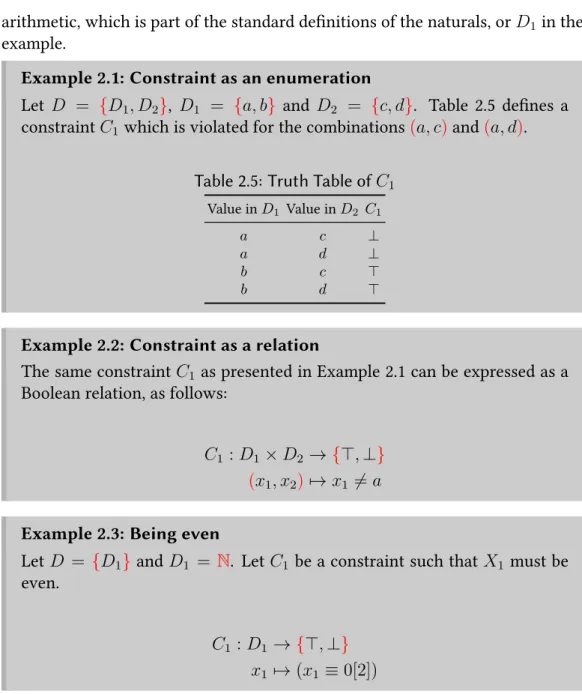
Note that Definition 2.2 is rather general. Domains may be finite or not, and nothing is said about how constraints are defined. In Examples 2.1 and 2.2, we show two simple examples of how the same constraint can be defined. ple 2.1 sees the constraint as a collection of allowed combinations, while Exam-ple 2.2 exhibits the (simExam-ple) equivalent relation.
Of course, when considering a non-finite domain, enumerating all allowed combinations is impossible. In such cases, representing a constraint as a relation may not be only a concise representation, but the only one. Consider a simple constraint likebeing even in Example 2.3. Here, we define the constraint using the modulo notation. This modulo notation is a common shorthand used in modular
5