
HAL Id: hal-03119907
https://hal.archives-ouvertes.fr/hal-03119907
Submitted on 25 Jan 2021
HAL is a multi-disciplinary open access
archive for the deposit and dissemination of
sci-entific research documents, whether they are
pub-lished or not. The documents may come from
teaching and research institutions in France or
abroad, or from public or private research centers.
L’archive ouverte pluridisciplinaire HAL, est
destinée au dépôt et à la diffusion de documents
scientifiques de niveau recherche, publiés ou non,
émanant des établissements d’enseignement et de
recherche français ou étrangers, des laboratoires
publics ou privés.
Guided Attentive Feature Fusion for Multispectral
Pedestrian Detection
Heng Zhang, Elisa Fromont, Sébastien Lefèvre, Bruno Avignon
To cite this version:
Heng Zhang, Elisa Fromont, Sébastien Lefèvre, Bruno Avignon. Guided Attentive Feature Fusion
for Multispectral Pedestrian Detection. WACV 2021 - IEEE Winter Conference on Applications of
Computer Vision, Jan 2021, Waikoloa /Virtual, United States. pp.1-9. �hal-03119907�
Guided Attentive Feature Fusion for Multispectral Pedestrian Detection
Heng ZHANG
1,3, Elisa FROMONT
1,4, S´ebastien LEFEVRE
2and Bruno AVIGNON
31
Univ Rennes 1, IRISA, France
2Univ Bretagne Sud, IRISA, France
3
ATERMES company, France
4IUF, Inria.
Abstract
Multispectral image pairs can provide complementary visual information, making pedestrian detection systems more robust and reliable. To benefit from both RGB and thermal IR modalities, we introduce a novel attentive mul-tispectral feature fusion approach. Under the guidance of the inter- and intra-modality attention modules, our deep learning architecture learns to dynamically weigh and fuse the multispectral features. Experiments on two public multi-spectral object detection datasets demonstrate that the pro-posed approach significantly improves the detection accu-racy at a low computation cost.
1. Introduction
Real world pedestrian detection applications require accurate detection performance under various conditions, such as darkness, rain, fog, etc. In these conditions, it is dif-ficult to perform precise detection using only standard RGB cameras. Instead, multispectral systems try to combine the information coming from e.g. thermal and visible cameras to improve the reliability of the detections.
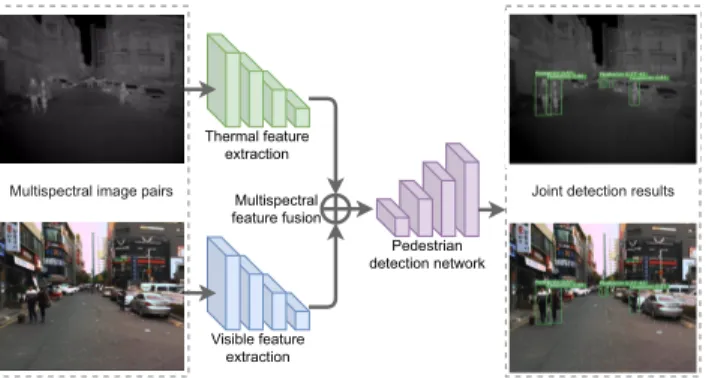
Deep learning-based methods, more specifically, two-stream convolutional neural networks, nowadays largely dominate the field of multispectral pedestrian detection [6, 9, 10, 11, 14, 18, 19, 20]. As illustrated in Fig. 1, a typical two-stream pedestrian detection network consists of two separate spectra-specific feature extraction branches, a multispectral feature fusion module and a pedestrian detec-tion network operating on the fused features. The system uses some aligned thermal-visible image pairs as input and outputs the joint detection results on each image pair.
Thermal and visible cameras have different imaging characteristics under different conditions. As shown in Fig. 2, visible cameras provide precise visual details (such as color and texture) in a well-lit environment, while ther-mal cameras are sensitive to temperature changes, which is extremely useful for nighttime or shadow detection. An adaptive fusion of thermal and visible features should take such differences into account, and should identify and
lever-Joint detection results Multispectral image pairs
Pedestrian detection network Multispectral feature fusion Thermal feature extraction Visible feature extraction
Figure 1: Multispectral pedestrian detection via a two-stream convolutional neural network.
Figure 2: Typical examples of thermal-visible image pairs captured during the day (first two rows) and night (bottom row). For each pair, the thermal image is on the left and the RGB image is on the right.
age the information from the most relevant modality. An intuitive solution to adapt the feature fusion to the different weather and lighting conditions is to manually identify multiple usage scenarios and design a specific so-lution for each scenario. For example, [6] proposes an illumination-aware network consisting of a day illumina-tion sub-network and a night illuminaillumina-tion sub-network. The
detection results from the two sub-networks are then fused according to the prediction of the illumination context. Such a kind of hand-crafted fusion mechanism improves the resilience of the model to a certain extent, nonetheless, there are still two limitations: firstly, cherry-picked scenar-ios may not cover all conditions, e.g., different illumina-tion/season/weather conditions; Secondly, the situation may be completely different even in the same usage scenario, e.g., at nighttime, lighting conditions in urban areas are dif-ferent from those in rural areas.
In this paper, we propose a novel and fully adaptive mul-tispectral feature fusion approach, named Guided Attentive Feature Fusion(GAFF). By combining the intra- and inter-modality attention modules, the proposed approach allows the network to learn the adaptive weighing and fusion of multispectral features. These two attention mechanisms are guided by the prediction and comparison of the pedestrian masks in the multispectral feature fusion stage. Specifically, at each spatial position, thermal or visible features are en-hanced when they are located in the area of a pedestrian (intra-modality attention) or when they possess a higher quality than in the other modality (inter-modality attention). To the best of our knowledge, GAFF is the first work that regards the multispectral feature fusion as a sub-task in the network optimization and that introduces a specific guid-ance in this task to improve the multispectral pedestrian detection. Extensive experiments on KAIST multispectral pedestrian detection dataset [8] and FLIR ADAS dataset [1] demonstrate that, compared with common feature fusion methods (such as addition or concatenation), GAFF brings important accuracy gains at a low computational cost.
This paper is organized as follows: Section 2 reviews some representative work applying static/adaptive feature fusion for multispectral pedestrian detection; Section 3 in-troduces implementation details on how to integrate GAFF into a typical two-stream convolutional neural network; In Section 4, we evaluate our methods on two public multi-spectral object detection datasets [8, 1], then we provide an extensive ablation study and visualization results to discuss the reasons of the accuracy improvements; Section 5 con-cludes the paper.
2. Related Work
2.1. Static multispectral feature fusion
KAIST released the first large-scale multispectral pedes-trian detection dataset [8], which contains approximately 95k well-aligned and manually annotated thermal-visible image pairs captured during daytime and nighttime. Some example image pairs are shown in Fig. 2. Then [18] demon-strated the first application of deep learning-based solutions in multispectral pedestrian detection. They compared the early and late fusion architectures and found that the late
fusion architecture is superior to the early one and the tra-ditional ACF method [4]. This late-stage fusion architec-ture can be regarded as a prototype of a two-stream neural network, in which multispectral features are fused through concatenation operations. Both [14] and [9] adapted Faster R-CNN [16] to a two-stream network architecture for multi-spectral pedestrian detection. They compare different mul-tispectral fusion stages and came to the conclusion that the fusion in the middle stage outperforms the fusion in the early or late stage. Based on this, MSDS-RCNN [10] adopted a two-stream middle-level fusion architecture and combined the pedestrian detection task and the semantic segmentation task to further improve the detection accuracy.
2.2. Adaptive multispectral feature fusion
As mentioned in Section 1, thermal and visible cameras have different imaging characteristics and the adaptive mul-tispectral fusion can improve the resilience and the detec-tion accuracy of the system. This has become the main focus of the multispectral pedestrian detection research in recent years. Both [11] and [6] use the illumination infor-mation as a clue for the adaptive fusion: they train a separate network to estimate the illumination value from a given im-age pair, then [11] uses the predicted illumination value to weigh the detection results from both the thermal and vis-ible images. [6] uses the illumination value to weigh the detection results from a day illumination sub-network and a night illumination sub-network. As mentioned in the pre-vious section, such a handcrafted weighing scheme is lim-ited and produces sub-optimal performance. CIAN [20] ap-plies the channel-level attention in the multispectral feature fusion stage to model the cross-modality interaction and weigh each feature map extracted from the different spec-trum. This network realizes a fully adaptive fusion of ther-mal and visible features, however, in this approach, the fu-sion module is optimized directly while solving the pedes-trian detection task which means that the network uses in-formation about what (pedestrian or background) and where (bounding box) relevant elements are in the images but it does not use the fact that some features may contain more relevant information than others. We believe and we show that with these additional information (that we include in our method through the guidance mechanism), we can im-prove the detection precision.
3. Proposed approach
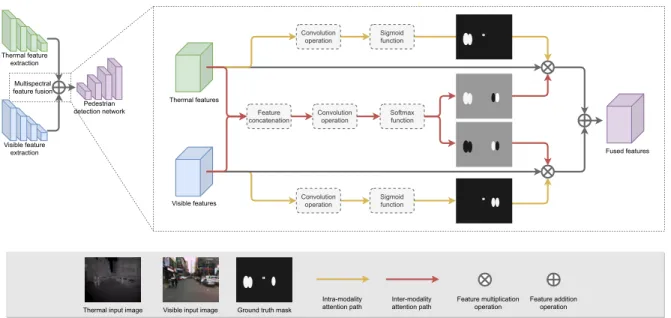
The proposed Guided Attentive Feature Fusion (GAFF), shown in Fig. 3, takes place in the multispectral feature fu-sion stage of a two-stream convolutional neural network. It consists of two components: an intra-modality attention module and an inter-modality one.
Thermal features Softmax function Convolution operation Feature concatenation Convolution
operation Sigmoidfunction
Convolution
operation Sigmoidfunction Visible features
Fused features
Thermal input image Visible input image Ground truth mask
Intra-modality attention path Feature addition operation Pedestrian detection network Multispectral feature fusion Thermal feature extraction Visible feature extraction Inter-modality attention path Feature multiplication operation
Figure 3: The overall architecture of Guided Attentive Feature Fusion (GAFF). Green, blue and purple blocks represent ther-mal, visible and fused features. Yellow and red paths represent the intra- and inter-modality attention modules, respectively.
3.1. Intra-modality attention module
The intra-modality attention module aims at enhanc-ing the thermal or visible features in a monospectral view. Specifically, as illustrated by the yellow paths on Fig. 3, features of an area with a pedestrian are highlighted by multiplying the learnt features with the predicted pedes-trian mask. Moreover, in order to avoid directly affecting the thermal or visible features, the highlighted features are added as a residual to enhance the mono-spectral features. This procedure can be formalized as:
fintrat = ft⊗ (1 + mt intra) fintrav = fv⊗ (1 + mv intra) (1) where mtintra= σ(Fintrat (ft)) mvintra = σ(Fintrav (fv)) (2) Superscripts (t or v) denote the thermal (t) or visible (v) modality; ⊗ denotes the element-wise multiplication; σ rep-resents the sigmoid function; Fintra represents a
convolu-tion operaconvolu-tion to predict the intra-modality attenconvolu-tion masks (pedestrian masks) mintra; f and fintrarepresent the
orig-inal and enhanced features, respectively.
The prediction of the pedestrian masks is supervised by the semantic segmentation loss, where the ground truth mask (mgtintra) is converted from the object detection anno-tations. As illustrated in Fig. 3 the bounding box annota-tions are transformed into some filled ellipses to approxi-mate the shape of the true pedestrians.
3.2. Inter-modality attention module
Thermal and visible cameras have their own imaging characteristics, and under certain conditions, one sensor has superior imaging quality (i.e. is more relevant for the con-sidered task) than the other. To leverage both modalities, we propose the inter-modality attention module, which adap-tively selects thermal or visible features according to the dynamic comparison of their feature quality. Concretely, an inter-modality attention mask is predicted based on the combination of thermal and visible features. This predicted mask has two values for each pixel, corresponding to the weights for thermal and visible features (summing to 1). This attention module is illustrated as the red paths in Fig. 3. It can be formulated as:
fintert = ft⊗ (1 + mtinter)
finterv = fv⊗ (1 + mv inter)
(3) where
mtinter, mvinter= δ(Finter([ft, fv])) (4)
Here, δ denotes the softmax function; [·] denotes the fea-ture concatenation operation; Finter represents a
convolu-tion operaconvolu-tion to predict the inter-modality attenconvolu-tion mask minter. At each spatial position of the mask, the sum of
mt
inter and mvinterequals to 1. Note that this formalization
could theoretically allow for more than two modalities to be fuse following the same principles.
The inter-modality attention module allows the network to adaptively select the most reliable modality. However, in
order to train this module, we should need a costly ground truth information about the best pixel-level modality qual-ity. Our solution to relieve the annotation cost is to assign labels according to the prediction of the pedestrian masks from the intra-modality attention module, i.e., we force the network to select one modality if its intra-modality mask prediction is better (i.e. closer to the ground truth pedes-trian mask) than the other. Specifically, we first calculate an error mask for each spectrum with the following formula:
etintra= | mtintra− m gt intra | evintra= | mvintra− m gt intra | (5)
then the label for the modality selection is defined as:
mgtinter =
1, 0 if (ev
intra− etintra) > margin
0, 1 if (et
intra− evintra) > margin
ignored otherwise
(6) Here, | · | denotes the absolute function; eintra
repre-sents the error mask, defined by the L1 distance between the predicted intra-modality mask mintra and the ground truth
intra-modality mask mgtintra; mgtinter is the ground truth mask for inter-modality attention (2 values at each mask po-sition); margin is a hyper-parameter to be tuned.
An example of the label assignment for the inter-modality attention mask is shown in Fig. 3. If the intra-modality pedestrian masks are predicted as shown in the yellow paths, the inter-modality (weak) ground truth masks are then defined as the ones shown on the red paths, where white, black and gray areas denote the classification la-bels 1,0 and ignored, respectively. Here, the thermal fea-tures produce a better intra-modality mask prediction for the pedestrians on the left side of the input images in Fig. 3. Therefore, according to Eq. 6, the label for the inter-modality mask on this area is assigned as 1,0 (1 for the ther-mal mask and 0 for the visible mask). For regions where the two intra-modality masks have comparable prediction qualities (i.e., the difference between prediction errors is smaller than the predefined margin), the optimization of the inter-modality attention mask prediction on these areas are ignored (i.e., do not participate in the loss calculation).
3.3. Combining intra- and inter-modality attention
The intra-modality attention module enhances features on areas with pedestrians and the inter-modality attention module adaptively selects features from the most reliable modality. When these two modules are combined, the fused features are obtained by:
ff used= f t hybrid+ f v hybrid 2 (7) where fhybridt = ft⊗ (1 + mt intra) ⊗ (1 + m t inter) fhybridv = fv⊗ (1 + mv intra) ⊗ (1 + m v inter) (8)
Here, mintra and minter are predicted intra- and
inter-modality attention masks from Eq. 2 and Eq. 4; fhybrid
represents features enhanced by both attention modules; ff usedrepresents the final fused features.
As mentioned in Section 2, the optimization of the mul-tispectral feature fusion task may not benefit enough from the sole optimization of the object detection task (as done e.g. in [20]). In GAFF, we propose two specific feature fu-sion losses, including the pedestrian segmentation loss for the intra-modality attention and the modality selection loss for the inter-modality attention, to guide the multispectral feature fusion task. These losses are jointly optimized with the object detection loss. The final training loss Ltotalis:
Ltotal= Ldet+ Lintra+ Linter (9)
where, Ldet, Lintra and Linter are the pedestrian
de-tection, the intra- and inter-modality attention loss, respec-tively.
4. Experiments
In this section, we conduct experiments on KAIST Mul-tispectral Pedestrian Detection Dataset [8] and FLIR ADAS Dataset [1] to evaluate the effectiveness of the proposed method. Moreover, we attempt to interpret the reasons for improvements by visualizing the predicted attention masks. Finally, we provide inference speed analysis on two differ-ent target platforms.
4.1. Datasets
KAIST dataset contains 7,601 training image pairs and 2,252 pairs testing ones. Some example image pairs from this dataset are shown in Fig. 2. [10] proposes a ”sanitized” version of the annotations, where numerous annotation er-rors are removed. Our experiments are conducted with the original as well as the “sanitized” version of annotations for fair comparisons with our competitors. We found out that the “sanitized” annotations substantially improve the detection accuracy for different network architectures. All models are evaluated with the improved testing annotations from [14] and the usual pedestrian detection metric: log-average Miss Rate over the range of [10−2, 100] false
posi-tives per image (FPPI) under a “reasonable” setting [5], i.e., only pedestrians taller than 50 pixels under no or partial oc-clusions are considered1.
1We use the evaluation code provided by [10]:
https://github.com/Li- Chengyang/MSDS-RCNN/tree/master/lib/datasets/KAISTdevkit-matlab-wrapper
We also conduct experiments on FLIR ADAS Dataset [1]. [19] proposed an ”aligned” version of the dataset for multispectral object detection. This new version contains 5,142 well-aligned multispectral image pairs (4,129 pairs for training and 1,013 pairs for testing). FLIR covers three object categories: “person”, “car” and “bicycle”. Models are evaluated with the usual object detection metric intro-duced with MS-COCO[13]: the mean Average Precision (mAP) averaged over ten different IoU thresholds.
4.2. Implementation details
The proposed GAFF module can be included in any type of two-stream convolutional neural networks. In these ex-periments, we choose RetinaNet [12] as our base detector. It is transformed into a two-stream convolutional neural net-work by adding an additional branch for the extraction of thermal features. A ResNet18 [7] or a VGG16 [17] net-work is pre-trained on ImageNet [2], then adopted as our backbone network. The input image resolution is fixed to 640 × 512 for training and evaluation. Our baseline detector applies the basic addition as the multispectral feature fusion method. GAFF is implemented by adding the intra- and inter-modality attention modules, corresponding to the yel-low and the red branches in Fig. 3. Focal loss [12] and Bal-anced L1 loss [15] are adopted as the classification loss and the bounding box regression loss to optimize the object de-tection task. In order to introduce our specific guidance, we adopt the DICE [3] loss as the pedestrian segmentation loss (Lintrain Eq. 9) and the cross-entropy loss as the modality
selection loss (Linterin Eq. 9).
4.3. Ablation study
M argin Miss Rate All Day Night 0.05 6.92% 8.47% 3.68% 0.1 6.48% 8.35% 3.46% 0.2 7.47% 9.31% 4.22%
Table 1: Detection results of GAFF with different margin values in the inter-modality attention module.
Hyper-parameter tuning. As reported in Table 1, we conduct experiments with different margin values in the inter-modality attention module on KAIST dataset [8] with “sanitized” annotations. The Miss Rate scores on the Reasonable-all, Reasonable-day and Reasonable-night sub-sets are listed. We observe that the optimal Miss Rate is achieved when margin = 0.1. Thus, we use margin = 0.1 for all the following experiments.
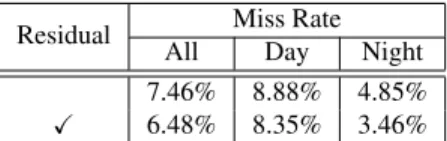
Residual attention. As mentioned in Section 3, attention enhanced features are added as residual to avoid directly af-fecting the thermal or visible features. We verify this choice
Residual Miss Rate All Day Night 7.46% 8.88% 4.85% X 6.48% 8.35% 3.46%
Table 2: Detection results of GAFF where the attention masks are directly applied or added as residual.
by comparing in Table 2 the Miss Rate of GAFF where the attention masks are directly applied to mono-spectral fea-tures (fintra = f ⊗ mintra and finter = f ⊗ minter) or
added as residual (as in Eq. 1 and Eq. 3).
Necessity of attention. We compare in Tab. 3 the detec-tion accuracy on KAIST dataset with different attendetec-tion set-tings, different backbone networks, and different annotation settings (original and “sanitized”). When conducting exper-iments with inter-modality but without intra-modality atten-tion, the pedestrian masks are predicted but are not multi-plied with the corresponding mono-spectral features. For each backbone network or annotation setting, both intra-and inter-modality attention modules consistently improve the baseline detection accuracy, and their combination leads to the lowest overall Miss Rate under all experimental set-tings. The present findings confirm the effectiveness of the proposed guided attentive feature fusion modules.
Necessity of guidance. To explore the effect of the pro-posed multispectral feature fusion guidance, we compare our guided approach to one with a similar architecture as ours but where the optimization of the specific fusion losses (Lintra and Linter in Eq. 9) are removed from the
train-ing process, i.e., the fusion is only supervised by the ob-ject detection loss (as done with [20]). We report in Tab. 4 the detection performance with and without guidance, un-der different backbone networks and annotations settings. The results confirm our assumption that the object detec-tion loss is not relevant enough for the multispectral feature fusion task: even though the non-guided attentive fusion module improves the baseline Miss Rate to some degree (e.g., with the “sanitized” annotations and VGG16 back-bone, non-guided model improves the base detector’s Miss Rate from 9.28% to 8.38%), it could be further improved when the specific fusion guidance is added (from 8.38% to 6.48%).
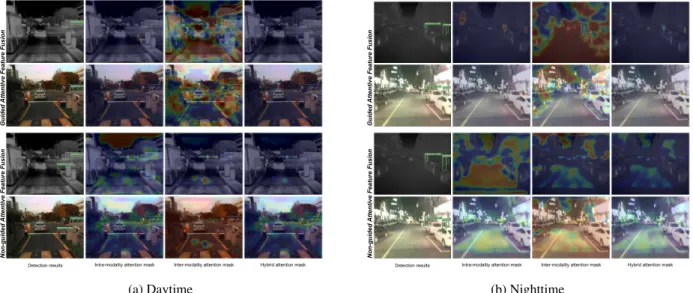
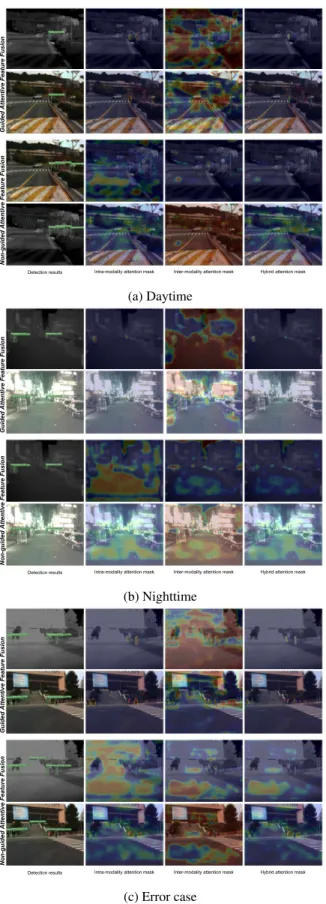
Attention mask interpretation. Fig. 4 provides the vi-sualization results of the intra-modality, the inter-modality and the hybrid attention masks during daytime and night-time. For each figure, the top and bottom two rows of images are visualization results of guided and non-guided attentive feature fusions, respectively. We can see on the
Detection results Intra-modality attention mask Inter-modality attention mask Hybrid attention mask
Guided Attentive Feature Fusion
Non-guided Attentive Feature Fusion
(a) Daytime
Detection results Intra-modality attention mask Inter-modality attention mask Hybrid attention mask
Guided Attentive Feature Fusion
Non-guided Attentive Feature Fusion
(b) Nighttime
Figure 4: Visualization examples of attention masks on KAIST dataset. Zoom in to see details.
Backbone GAFF Miss Rate Intra. Inter. All Day Night
ResNet18 13.04% 13.83% 11.60% X 12.13% 11.97% 11.99% X 11.15% 10.68% 11.67% X X 10.74% 10.46% 11.10% VGG16 12.72% 11.37% 15.57% X 11.78% 11.45% 12.50% X 11.03% 10.99% 11.44% X X 10.62% 10.82% 10.14%
(a) Original annotations
Backbone GAFF Miss Rate Intra. Inter. All Day Night
ResNet18 9.98% 12.46% 5.29% X 9.26% 11.51% 5.32% X 9.29% 11.97% 5.14% X X 7.93% 9.79% 4.33% VGG16 9.28% 11.73% 5.17% X 8.70% 11.42% 3.55% X 7.73% 10.35% 2.81% X X 6.48% 8.35% 3.46% (b) “Sanitized” annotations
Table 3: Ablation study of two attentive fusion modules on KAIST dataset [8] with original (top) or “sanitized” (bot-tom) annotations.
intra-modality attention masks that the guided attention mechanism focuses on pedestrian areas, even though, some-times, it is not accurate from a single mono-spectral view. For example, the traffic cone is misclassified as a pedestrian
Backbone Guidance Miss Rate
All Day Night ResNet18 13.15% 13.71% 11.54%
X 10.74% 10.46% 11.10% VGG16 13.67% 13.19% 14.51% X 10.62% 10.82% 10.14% (a) Original annotations
Backbone Guidance Miss Rate
All Day Night ResNet18 9.05% 10.63% 6.01% X 7.93% 9.79% 4.33% VGG16 8.38% 10.39% 4.44% X 6.48% 8.35% 3.46% (b) “Sanitized” annotations
Table 4: Comparison between guided and non-guided mod-els on KAIST dataset [8] with both annotation settings.
due to its human-like shape on the thermal image of Fig. 4a, and the pedestrian in the middle right position is missed due to insufficient lighting on the RGB image of Fig. 4b. For inter-modality attention masks, it appears that the guided attentive fusion tends to select visible features on well-lit areas (such as upside of images in Fig. 4b) and brightly coloured areas (e.g., traffic cone, road sign, speed bump, car tail light, etc), and to select thermal features on dark areas and uniform areas (such as sky and road). Note that these attention preferences are automatically learnt via our inter-modality attention guidance. On the contrary, despite the fact that the non-guided attention mechanism brings some accuracy improvements, the predicted attention masks are
Guided Attentive Feature Fusion
Non-guided Attentive Feature Fusion
Detection results Intra-modality attention mask Inter-modality attention mask Hybrid attention mask
(a) Daytime
Detection results Intra-modality attention mask Inter-modality attention mask Hybrid attention mask
Guided Attentive Feature Fusion
Non-guided Attentive Feature Fusion
(b) Nighttime
Detection results Intra-modality attention mask Inter-modality attention mask Hybrid attention mask
Guided Attentive Feature Fusion
Non-guided Attentive Feature Fusion
(c) Error case
Figure 5: More visualization examples of attention masks on KAIST dataset. Zoom in to see details.
quite difficult to interpret. More visualization results are shown in Fig. 5. Besides, an interesting error case is shown in Fig. 5c, where the pedestrian on the steps is not detected with the guided model but detected with the non-guided model. As mentioned earlier, GAFF selects thermal fea-tures on uniform areas, which is intuitive since thermal cam-eras are sensitive to temperature change and there exist few objects on uniform areas of the thermal image. However, in this particular case, the pedestrian is not captured on the thermal image, which leads to the final detection error.
0 1000 2000 3000 4000 Iterations 0.0 0.1 0.2 0.3 0.4 0.5 0.6 0.7 Di ce so cre
Thermal mask dice score
Visible mask dice score 0.4
0.5 0.6 0.7 0.8 0.9 1.0 Ac cu rac y
Intra- and inter-modality attention accuracy evolution
Modality selection accuracy
Figure 6: Intra- and inter-modality attention accuracy evo-lution during training.
Attention accuracy evolution We plot in Fig. 6 the evo-lution of intra- and inter-modality attention accuracy during training. Specifically, red solid and dashed lines represent the pedestrian segmentation accuracy (via DICE score [3] Dice = |A|+|B|2|A∩B|) from thermal and visible features in intra-modality attention module; blue line indicates the modal-ity selection accuracy in inter-modalmodal-ity attention module. From the plot, we can conclude that thermal images are gen-erally better for recognition than visible images. This ob-servation is consistent with our mono-spectral experiments, where thermal-only model reaches 18.8% of Miss Rate while visible-only model achieves 20.74% (both trained with “sanitized” annotations). Interestingly, as the segmen-tation accuracy increases for both images, the modality se-lection task becomes more and more challenging. Note that this accuracy is irrelevant at the beginning of the train-ing, where predicted pedestrian masks are almost zero for both thermal and visible features, thus the difference be-tween their error masks is minor and the set of margin makes most areas ignored for modality selection optimiza-tion. Such mechanism avoids the “cold start” problem. Runtime analysis In Tab. 5 we report the total number of learnable parameters and the average inference runtime on two different computation platforms. Specifically, the mod-els are implemented with Pytorch (TensorRT) framework
Backbone GAFF Param. Runtime 1080Ti TX2 ResNet18 23,751,725 10.31ms 10.5ms X 23,765,553 10.85ms 12.1ms VGG16 31,403,053 8.87ms 10.3ms X 31,430,705 9.34ms 11.6ms
Table 5: Runtime on different computing platforms.
Methods Miss Rate All Day Night ACF+T+THOG [8] 47.24% 42.44% 56.17% Halfway Fusion [14] 26.15% 24.85% 27.59% Fusion RPN+BF [14] 16.53% 16.39% 18.16% IAF R-CNN [11] 16.22% 13.94% 18.28% IATDNN+IASS [6] 15.78% 15.08% 17.22% CIAN [20] 14.12% 14.77% 11.13% MSDS-RCNN [10] 11.63% 10.60% 13.73% CFR [19] 10.05% 9.72% 10.80% GAFF (ours) 10.62% 10.82% 10.14%
(a) Original annotations
Methods Miss Rate All Day Night MSDS-RCNN [10] 7.49% 8.09% 5.92% CFR [19] 6.13% 7.68% 3.19% GAFF(ours) 6.48% 8.35% 3.46%
(b) “Sanitized” annotations
Table 6: Detection results on KAIST dataset [8] with origi-nal (top) or “sanitized” (bottom) annotations.
for an inference time testing on the Nvidia GTX 1080Ti (Nvidia TX2) platform. Since GAFF only involves 3 con-volution layers, the additional parameters and computation cost is low, i.e., it represents less than 0.1% of additional parameters and around 0.5ms (1.5ms) of inference time on 1080Ti (TX2). Note that the time for post-processing treat-ments (such as Non-Maximum Suppression) is not taken into account for the benchmarking. Our model meets the requirement of real-time treatment on embedded devices, which is essential for many applications.
4.4. Comparison with State-of-the-art
Multispec-tral Pedestrian Detection Methods
KAIST Dataset Tab. 6 shows the detection results of ex-isting methods and our GAFF with the original and “sani-tized” annotations on KAIST. It can be observed that GAFF achieves state-of-the-art performance on this dataset (it is slightly less accurate than CFR [19], which applies cas-caded Fuse-and-Refine blocks for sequential feature en-hancement and needs more computation than GAFF (see
Methods Platform Runtime ACF+T+THOG [8] MATLAB 2730ms Halfway Fusion [14] Titan X 430ms Fusion RPN+BF [14] MATLAB 800ms IAF R-CNN [11] Titan X 210ms IATDNN+IASS [6] Titan X 250ms CIAN [20] 1080Ti 70ms MSDS-RCNN [10] Titan X 220ms CFR [19] 1080Ti 50ms GAFF (ours) 1080Ti 9.34ms
Table 7: Runtime comparisons with different methods on KAIST dataset [8].
Backbone GAFF mAP AP75 AP50 ResNet18 36.6% 31.9% 72.8% X 37.5% 32.9% 72.9% VGG16 36.3% 30.2% 71.9% X 37.3% 30.9% 72.7%
Table 8: Detection results on FLIR dataset [1].
Table 7). According to Tab. 7, thanks to the lightweight de-sign of GAFF, our model has substantial advantage in terms of inference speed compared to e.g. [19].
FLIR Dataset Tab. 8 reports the detection results with and without GAFF on FLIR dataset. We can observe that the average precision is improved for all IoU thresholds with GAFF (around 1% of mAP improvement for both backbone networks), which shows that our method can gen-eralize well to different types of images. For comparison, the more costly CFR [19] reaches 72.39% of AP50 on this dataset, whereas our best result is 72.9%.
5. Conclusion
We argue that the lack guidance is a limitation for effi-cient and effective multispectral feature fusion, and we pro-pose Guided Attentive Feature Fusion (GAFF) to guide this fusion process. Without hand-crafted assumptions or addi-tional annotations, GAFF realizes a fully adaptive fusion of thermal and visible features. Experiments on KAIST and FLIR datasets demonstrate the effectiveness of GAFF and the necessity of attention and guidance in the feature fu-sion stage. We noticed that certain thermal-visible image pairs are slightly misaligned in the above datasets, such a problem could be more critical in real life applications. Our future research is devoted to the development of a real-time feature calibration module based on the predicted attention masks from GAFF.
References
[1] Free flir thermal dataset for algorithm train-ing. https://www.flir.com/oem/adas/ adas-dataset-form/.
[2] J. Deng, W. Dong, R. Socher, L.-J. Li, K. Li, and L. Fei-Fei. ImageNet: A Large-Scale Hierarchical Image Database. In CVPR09, 2009.
[3] Lee R. Dice. Measures of the amount of ecologic association between species. Ecology, 26(3):297–302, 1945.
[4] Piotr Dollar, Ron Appel, Serge Belongie, and Pietro Perona. Fast feature pyramids for object detection. IEEE Trans. Pat-tern Anal. Mach. Intell., 36(8):1532–1545, Aug. 2014. [5] P. Dollar, C. Wojek, B. Schiele, and P. Perona.
Pedes-trian detection: An evaluation of the state of the art. IEEE Transactions on Pattern Analysis and Machine Intelligence, 34(4):743–761, 2012.
[6] Dayan Guan, Yanpeng Cao, Jiangxin Yang, Yanlong Cao, and Michael Ying Yang. Fusion of multispectral data through illumination-aware deep neural networks for pedestrian de-tection. Information Fusion, 50:148–157, 2019.
[7] Kaiming He, Xiangyu Zhang, Shaoqing Ren, and Jian Sun. Deep residual learning for image recognition. In 2016 IEEE Conference on Computer Vision and Pattern Recognition, CVPR 2016, Las Vegas, NV, USA, June 27-30, 2016, pages 770–778, 2016.
[8] Soonmin Hwang, Jaesik Park, Namil Kim, Yukyung Choi, and In So Kweon. Multispectral pedestrian detection: Benchmark dataset and baselines. In Proceedings of IEEE Conference on Computer Vision and Pattern Recognition (CVPR), 2015.
[9] D. K¨onig, M. Adam, C. Jarvers, G. Layher, H. Neumann, and M. Teutsch. Fully convolutional region proposal net-works for multispectral person detection. In 2017 IEEE Con-ference on Computer Vision and Pattern Recognition Work-shops (CVPRW), pages 243–250, 2017.
[10] Chengyang Li, Dan Song, Ruofeng Tong, and Min Tang. Multispectral pedestrian detection via simultaneous detec-tion and segmentadetec-tion. In British Machine Vision Conference 2018, BMVC 2018, Northumbria University, Newcastle, UK, September 3-6, 2018, page 225, 2018.
[11] Chengyang Li, Dan Song, Ruofeng Tong, and Min Tang. Illumination-aware faster R-CNN for robust multispectral pedestrian detection. Pattern Recognition, 85:161–171, 2019.
[12] Tsung-Yi Lin, Priya Goyal, Ross B. Girshick, Kaiming He, and Piotr Doll´ar. Focal loss for dense object detection. In IEEE International Conference on Computer Vision, ICCV 2017, Venice, Italy, October 22-29, 2017, pages 2999–3007, 2017.
[13] Tsung-Yi Lin, Michael Maire, Serge Belongie, James Hays, Pietro Perona, Deva Ramanan, Piotr Dollar, and Larry Zit-nick. Microsoft COCO: Common objects in context. In ECCV. European Conference on Computer Vision, Septem-ber 2014.
[14] Jingjing Liu, Shaoting Zhang, Shu Wang, and Dimitris N. Metaxas. Multispectral deep neural networks for pedestrian detection. In Proceedings of the British Machine Vision
Conference 2016, BMVC 2016, York, UK, September 19-22, 2016, 2016.
[15] Jiangmiao Pang, Kai Chen, Jianping Shi, Huajun Feng, Wanli Ouyang, and Dahua Lin. Libra r-cnn: Towards bal-anced learning for object detection. In IEEE Conference on Computer Vision and Pattern Recognition, 2019.
[16] Shaoqing Ren, Kaiming He, Ross B. Girshick, and Jian Sun. Faster R-CNN: towards real-time object detection with re-gion proposal networks. In Advances in Neural Information Processing Systems 28: Annual Conference on Neural In-formation Processing Systems 2015, December 7-12, 2015, Montreal, Quebec, Canada, pages 91–99, 2015.
[17] K. Simonyan and A. Zisserman. Very deep convolutional networks for large-scale image recognition. In International Conference on Learning Representations, 2015.
[18] J¨org Wagner, Volker Fischer, Michael Herman, and Sven Behnke. Multispectral pedestrian detection using deep fu-sion convolutional neural networks. In 24th European Sym-posium on Artificial Neural Networks, ESANN 2016, Bruges, Belgium, April 27-29, 2016, 2016.
[19] Heng Zhang, Elisa Fromont, S´ebastien Lef`evre, and Bruno Avignon. Multispectral Fusion for Object Detection with Cyclic Fuse-and-Refine Blocks. In ICIP 2020 - IEEE Inter-national Conference on Image Processing, pages 1–5, Abou Dabi, United Arab Emirates, Oct. 2020.
[20] Lu Zhang, Zhiyong Liu, Shifeng Zhang, Xu Yang, Hong Qiao, Kaizhu Huang, and Amir Hussain. Cross-modality interactive attention network for multispectral pedestrian de-tection. Information Fusion, 50:20–29, 2019.
![Table 6: Detection results on KAIST dataset [8] with origi- origi-nal (top) or “sanitized” (bottom) annotations.](https://thumb-eu.123doks.com/thumbv2/123doknet/11615482.303691/9.918.505.778.103.280/table-detection-results-kaist-dataset-origi-sanitized-annotations.webp)
