HAL Id: hal-00112500
https://hal.archives-ouvertes.fr/hal-00112500
Submitted on 31 Oct 2018
HAL is a multi-disciplinary open access
archive for the deposit and dissemination of
sci-entific research documents, whether they are
pub-lished or not. The documents may come from
teaching and research institutions in France or
abroad, or from public or private research centers.
L’archive ouverte pluridisciplinaire HAL, est
destinée au dépôt et à la diffusion de documents
scientifiques de niveau recherche, publiés ou non,
émanant des établissements d’enseignement et de
recherche français ou étrangers, des laboratoires
publics ou privés.
General Relationships between Micro and Macro Scales
for the Non-linear Behaviour of Heterogeneous Media
Claude Stolz
To cite this version:
Claude Stolz. General Relationships between Micro and Macro Scales for the Non-linear Behaviour
of Heterogeneous Media. John Gittus; Joseph Zarka. Modelling Small Deformations of Polycrystals,
Springer, pp.89-115, 1999, �10.1007/978-94-009-4181-6_4�. �hal-00112500�
General Relationships between Micro and
Macro Scales for the Non-linear
Behaviour of Heterogeneous Media
C. STOLZ
Laboratoire de Mecanique des So/ides, Ecole Polytechnique, Palaiseau, France
ABSTRACTThis chapter is mainly concerned with the determination of general
relationships bet ween microscopic and macroscopic mechanical properties
for elastoplastic material with or without damage. The overall properties are
determined in terms of the unkno wn properties of each constituent phase of
the heterogeneous body. At first we must define a representative volume
element (RVE) of the heterogeneous material for which the macroscopic
mechanical fields are some spatial average of the microscopic one. The
determination of local quantities is achieved by solving some particular
boundary value problem on the
RVE,Jrom which macroscopic quantities are
derived. The essential structure of micro-macro relationships is presented in
the case of elastoplastic material. A generalisation is given to take the
temperature field into account. We present also a model of damage and its
averaging process. Finally we discuss the determination of macroscopic
temperature through continuum thermodynamics.
INTRODUCTION
There are two main steps in the determination of the overall properties of a material in terms of the known properties of the constituent phases. First, the complex geometry of the n-phase body and the
micro-mechanical behaviour of each of the phases being given, one has to solve a complicated boundary value problem. The determination of the local mechanical fields (stress a, strain e, plastic strain eP) is achieved by a localization process that requires some particular boundary conditions, from which macroscopic fields (stress :I:, strain
E, . . .
) are derived. A comprehensive review of methods to solve some particular localization process is given by Willis (1981), Walpole (1969) and Hashin (1983).The second step is concerned with the derivation of relationships between microscopic tensors and macroscopic tensors, which differ only by a length scale. Generally the macroscopic tensor is some spatial average of the microscopic one. Such a relationship is presented in continuum thermodynamics by Francfort
et al.
(1983) and Germainet
al.
(1983). This theoretical approach is summarized in the last section ofthis chapter.
This chapter is mainly concerned with the second basic problem, i.e. the determination of general relationships between microscopic and macroscopic fields for elastoplastic materials and for some model of damage. The essential structure of micro-macro relationships in elastoplastic materials is given in the previous works of Hill (1952, 1965) and Mandel (1964, 1971). After a general review and a second part concerned with the determination of the macroscopic elastic modulus of a heterogeneous material, we generalize the above-mentioned works and also our own previous results in plasticity to take the temperature field into account in Section 4.
In Section 5 we shall discuss the micromechanics of damage and its global average. Damage phenomena are due to microcracking in the body, for instance debonding between dissimilar materials, or at grain boundaries in polycrystals, and to the growth of holes or microcavities. Even if we assume small strain, the evolution of damage implies change of geometry, which is a non-linear and irreversible process.
In the last section we present a discussion about the determination of macroscopic temperature.
2. PRELIMINARY CONCEPTS
We consider a volume V, in which we distinguish two different scales, the micro one where the material properties vary from point to point like a highly heterogeneous medium, and the macro one where the properties are those of a homogeneous continuum.
To describe a heterogeneous medium it is essential to define a volume element which is small enough to allow us to distinguish the microscopic heterogeneities and sufficiently large to represent with accuracy the overall behaviour. This volume element is called a representative volume element (RVE); for example, the RVE of a periodic composite is simply the elementary cell (Suquet, 1982). For a randomly distributed composite of a polycrystalline aggregate it is necessary to have a minimum of information about the geometry of the constituent phases and to make assumptions like statistical homogeneity or ergodicity in order to define the RVE in a statistical sense (Beran, 1978; Fokin, 1979; Kroner, 1980; Willis, 1981; Hashin, 1983).
The problem is to characterize the overall behaviour only from a knowledge of the local constitutive equation of each constituent phase of the heterogeneous medium. On the microscopic level the mechanical properties vary from point to point with the local scale y while the average quantities vary smoothly with the macroscopic scale x.
With every microscopic quantity f (stress a, mass per unit volume
p, deformation e, heat flux q, ... ) we can associate its macroscopic value
J
by an averaging process on the RVE, extended eventually in the cases for which RVE contains holes or rigid inclusions:- 1
1.
f =
<f)
=V
/
(y) dvY (2.1)It is clear that eqn (2.1) defines a unique macro state quantity for each
micro state.
Conversely, starting with a macro state, the definition of a suitable corresponding micro state requires complementary information or a localization process to determine the nearest possible micro state of the real one. For the choice of a representative volume element suitable boundary conditions must be prescribed and must satisfy some requirements (Francfort
et al.,
1983; Germainet al.,
1983).In particular, for study of the macroscopic behaviour these boundary conditions can be homogeneous; in this case one prescribes homogeneous -stress conditions
(T
d = �.n ona
V) or homogeneous strain conditions(U = E.y for y E
aV)
(where� andE
are two symmetric tensors). For these boundary conditions, a local stress distribution a and alocal deformation e are developed over the volume V.
In the case of homogeneous loading the stress a verifies the equation
diva 0 over V
-a.n = r on av
l
(2.2) In the other case the local deformation e derives from a local displacementu
which verifieseij =
i
(�:�
+
:::)
over V]
u
= u on av(2.3)
We require that the Hill-Mandel macrohomogeneity condition is fulfilled by all field a* with a* = (a*) and by all e* kinematically admissible so
Cf*e* = (a*e*) (2.4) With these conditions it is obvious that, in the case of homogeneous loading,
(2.5) and the microdisplacement
u
fluctuates around the homogeneousdisplacement U such that
J
(U-u)
® n da 0av
(2.6) and
E
=( e)Dually, if
u
= u over av it is clear that 1i
1E
= Vovl(u
® n+
n ®u)
da = ( e) =e
(2.7) and the microstress is such thatL
(Cf n -an) ® y da = 0av
(2.8) and the macrostress I: = Cf = (a).
Some other boundary conditions can be used; in particular, for periodic structures (Sanchez-Palencia, 1974; Suquet, 1982), the elementary cell V generates the geometry of the whole by periodicity, all
the local fields are periodic functions and the Hill-Mandel macro homogeneity condition is a necessary condition resulting from periodicity.
The construction of the macroconstitutive law from the microscopic behaviour can proceed as follows: starting from some macroscopic quantities, using a localization process to determine local fields, then the averaging process determines the missing macro quantities.
3. OVERALL PROPERTIES OF AN ELASTIC COMPOSITE MATERIAL
The main difficult problem is to determine effectively the overall property of a composite material. We shall restrict our discussion to some methods for the determination of the overall moduli for an elastic material.
The heterogeneous body is characterized by n phases with different
elastic properties. The polycrystal aggregate is a particular case of a heterogeneous body, where the phases differ in the orientation of each crystal. Self-consistent theories which apply to polycrystal aggregates need knowledge of the properties of each grain (Hill, 1965; Berveiller and Zaoui, 1979). Kroner (1977, 1980), by a statistical approach, has compared the homogenization method of periodic media with the self consistent scheme. The periodic model is a representative model of
perfect order; one needs to solve a boundary value problem in a single
cell, and the self-consistent method is more appropriate to model perfect disorder,
3.1. Bounds of the Elastic Modulus for a Heterogeneous Body
The medium is assumed to be elastic; each phase r has an elastic constitutive law with modulus 1\ (e =
A,.
a, nr = A;1). We suppose that the characteristic function </>, of each phase is known:</>,(y) = 0 </>,(y) = 1
We have the equality
y does not belong to phase r
l
y belongs to phase r 1 n V
L L
</>,(y) dvY = 1 r = I (3.1) (3.2)and the concentration of the r phase is
c, =
bL
ct>,(y)
dvy (3.3) Several works (Beran and Molyneux, 1966; Hashin and Shtrikman, 1962; Hill, 1963) are related to the bounds of the moduli using minimum principles. For all displacements u* kinematically admissible with given boundary conditions onav
the real field minimizes the energy:l
f
lU(u*) =
V
2e*rr
s* dvy (3.4)then for a localization process, which describes a homogeneous deformation on iJV (u* =
e.y,y
E iJV), the following inequality holds:U
<}ve·I J.
rr,<Pr(Y)
dvy. 8r V
From the macrohomogeneity hypothesis we have U- = - erre = -ae = -ae 1 - 1- l __
2 2 2
(3.5)
(3.6)
and, noting ff the overall modulus (Cf = ff
e),
one can show that1fv -1f is positive semi-definite, where the estimate 1fv for the overall
modulus is the Voigt average (Voigt, 1889):
n
1fv =
I
c,n, (3.7) r = IDually, we use the minimum of complementary energy for a localization process which prescribes homogeneous tensions on
a V:
U
<2�0'! f
A,cp,(y) dvffr = I
Then, with the macrohomogeneity hypothesis, noting A the overall modulus
(Cf
=Aa),
the inequality shows that Av-A
is positivesemi-definite and
A;1
is an estimate of ff in the Reuss sense:nR =
A;l
=(I
c,A.
rl
r = IThe two estimates rrv and rrR are lower and upper bounds. The best
estimates are such that the localization process approaches the real solution. In the case of periodic media the answer is clear; for such a material
n.,
with many elementary cells, if homogeneous tension or homogeneous deformation are applied onan.,
far from the boundary, the field solution of the boundary value problem is a periodic field; the averages of stress or strain onV
are equal to the prescribed value. The real localization process is the periodic localization process, so the overall moduli obtained with homogeneous prescribed macrostress or macrostrain are equal.For other composites, it is necessary to have complementary information. The calculus of overall properties is related to the determination of fields which satisfy equilibrium equations; perfect bonding across phase interfaces and some simplifications must be made to derive explicit results.
In the self-consistent scheme, for example, we consider that the inclusions are spherical or ellipsoidal, and when the medium is statistically uniform the equivalent body is assumed to be isotropic. To estimate the overall moduli, we can consider that each inclusion is embedded in a homogeneous matrix with the overall moduli A as elastic properties, and subject to a homogeneous field at infinity. The interaction problem between a matrix and a spherical or ellipsoidal inclusion is well known (Eshelby, 1957, 1961). The microstress in the inclusion is homogeneous and an explicit result can be given in the
formal equation
a
(
r)
=I: +
J, :(E -
e(r)) (3.10) The interaction is described by J, which depends on the overall moduli A, on the inclusion geometry and on orientation (Berveiller and Zaoui, 1979).If we take the statistical average and the local behaviour into account,
we have the equation
I: =
(er,
) I: AE and£ =(
e)
]
A =(�(�
+
J,r1(A+
J,)) (3.11) (3.12) with unknown A Usually this equation is complex to solve; thedetermination ofJ, is not the easiest thing to do. Each phase seems to see the other phases through the homogeneous material; we have not given a good description of the interactions between all the inclusions. Some developments due to Berveiller and Zaoui
(1979),
Fokin(1979)
and Andrieux(1983)
can be used to solve this problem with greater accuracy.The first estimates (Voigt and Reuss estimates) are established using the minimull_l energy principle, and the bounds are obtained for extremal values associated with homogeneous boundary conditions. A successful method is to determine a suitable displacement field to have a better estimate. For this reason it is convenient to introduce a homogeneous comparison material with modulus
Ao
and to set the local modulusA
equal toA0
with some perturbationoA:
A= Ao + oA
If
e
is the real deformation over V, the stress polarizationp =
cr-Aoe = 8A.e
verifies
(3.13)
(3.14)
div(p
+ Aoe) =
0 over V(3.15)
and if we know the Green's function for the comparison material we have
u(x) = u0(x) +
L
G(x,y)
divp(y)
dvy(3.16)
The deformatione
is the sum of the homogeneous deformationE
=e0
and the last term of eqn(3.16),
due to heterogeneity. In thisintegral formulation we can substitute the variational expression. Such methods are presented by Willis
(1981)
and Hashin and Shtrikman(1962ab, 1963).
These authors have obtained bounds for overall moduli by different approximations ofp
and different averaging processes. 3.2. The Case of a Macrohomogeneous BodyIn the last section we saw that the estimate of the elastic modulus is not the same when one prescribes macrohomogeneous strain or stress over V. But when the body can be considered as macro homogeneous in the sense of Hill
(1952, 1965)
and Mandel(1964)
the difference between the two estimates is negligible.So when one prescribes homogeneous boundary conditions in stress
(Td = I:
·-;
on oV, with I: a symmetric tensor) the local stress is obtained as the solution of an elastic linear problem:Equation of equilibrium: div er =
0
over V er .-:
= r on avElastic constitutive law:
e =
N(y)
:er (Vy E V)Existence of a local displacement u such that
eij =
!(���
+
��)
(3.17)
and we can prove the existence of a localization tensor Aijpq such that
(3.18)
The tensor A is the elastic localization tensor introduced by Mandel
(1964)
in the case of a localization process in homogeneous macro stresses.As (er) =
l:
for all prescribedl:,
we have(Aijpq) = �(S;p o1q
+
O;q o1p)(3.19)
At fixed subscripts (p,
q)
Aijpq satisfies the equations of equilibriumAijpqj =
0
(3.20)
with the boundary conditions
AijJK!IJ = !(o;p o1q
+
O;q o1p) · n1and the deformation
satisfies the condition of compatibility.
(3.21)
(3.22)
With the help of a macro homogeneity condition, for all prescribed I:
we have
(3.23)
The macroscopic modulus A
(E
= Al:)
is determined as a function ofthe local one (e = A0
er)
by replacing er in eqn(3.23)
by A I::Apqrs = (Aijpq"AgkiAklrs) = t.A
N
A(3.24)
In the following we consider only the case of a macrohomogeneous body.
4. STUDY OF A THERMOELASTOPLASTIC MATERIAL 4.1. The Macroscopic Constitutive Law
In this example we consider a thermoelastoplastic material and we assume that there is no effect of viscosity. The absolute temperature T is given and the total deformation e is the s
u
m of an elastic part ee and an irreversible part eP:E = Se+ eP (4.1)
The irreversible part has a standard evolution; the rate tP is normal to a yield surface delimited by a convex function
(j>
of the stress a:eP =
a(j>
(4.2)a
aThe reversible part ee is related to a and to the increase of the temperature from its initial value T0:
ee = A0 a+ a(T- T0) (4.3)
4.2. Global Domain of Elasticity
At the local level there exists an elastic domain 't' defined by'G' = la/
(j>(a) <
Oj.
At the macro level there exists an elastic domain rffdefined as follows.Let two macrostresses I: and I:* belong to
rt,
at each point ofV;
the corresponding microstresses a and a* are elements of 'G' and the difference a -a* is deduced from I: - I:* by means of a localization process with purely elastic behaviour.So it is obvious that
(4.4)
where A is the localization tensor introduced in the last section. 4.3. On the Decomposition of the Macroscopic Deformation
Let I: be the real macro stress and a the corresponding micro one. At the initial temperature T0, the local response in purely elastic behaviour is
(4.5)
The stress field r = a - aE is a self-equilibrated stress and is the sum of two self-equilibrated stresses:
such that the two microdeformations
81 = A0r0 + a(T- T0)
)
82
A0rp+eP
(4.7
)
are kinematically admissible.
By definition the macroscopic elastic deformation due to the difference in absolute temperature
T - T0
and to the given macrostress I: is the deformation deduced from a purely elastic unloading with return of the temperature to its initial value (Mandel, 1971; Halphen, 1977).The local deformation defined by
eE = N
aE+ e1
(4.8)is related to the macro one E E by the lemma of macrohomogeneity and
(4.9)
and for all stresses a' statically admissible with I:'
=
(a') we have(4.10)
For the particular choice of a'
=A
I:', and taking into account thatr0
is self-equilibrated, we can split EE into two terms:
(4.11)
We recognize the macroscopic modulus
A= IAA0A
and the result obtained is in agreement with the definition of the macroscopic elastic deformation.In the same way, the global deformation E
= (e)
must satisfy eqn ( 4.10), and for the difference EP =
E - E E we have the definition of the irreversible macroscopic deformation:E
p
= 1Ae
p
(4.12)The irreversible part of the macrodeformation is not the mean of the micro one because the field of plastic deformation is not kinematically admissible (Mandel, 1964, 1971; Hill, 1965).
The relations (4.11
)
and (4.12)
describe the form of the stress-strain relation, and moreover these equations are true for quasi-static evolutions. If there exists a viscoplastic potential </J for the rate of the plastic deformation, such thatit is obvious that at the macro level the mean potential (Mandel, 1971; Rice, 1971)
<I>(:E, r)
= (/>(a)
(4.14) is the macroviscoplastic potential associated withEP: (a =
A:E+
r)and we obtain
---
--ae�> aQ> a
a = 1A
aQ> a:E aa a:E aa
ae�> •p
aQ>ar
= £ = aa
£P = !AsP
4.4. Analysis of the Dissipation
(4.15)
(4.16)
At the micro level, the second law of thermodynamics gives the rate of dissipation:
d
=
pTs
+
div q - q · � > oUsing the conservation of energy,
pe
= as-
divq(4.17) (4.18) and knowing the relation between the thermodynamical potentials e
and
w(e•,
I),
e=
w
-Ts,
we can deduced
= asP
-
q� > 0 (4.19)We have assumed that q is defined by q
=
-awl a� where w is a convex function of �. therefore the term -q · �is positive, and when we admit the decomposition of the dissipation rate in two parts, the term due to the irreversible mechanism is also positive, atP
> 0.
By integration overV
the total plastic dissipation rategp =asP
can be given in terms of macroscopic variables:(4.20) where Wb
=
!
r A0r is the energy of the self-equilibrated stresses. The last result is obtained by application of eqn (4.10); for the plastic deformation rate and the real stressesa=
A:E+
r.The physical meaning of this result is that perfect plastic behaviour at the micro level presents hardening behaviour on the macro scale.
5. THE CASE OF A SOLID HAVING LOCALLY DAMAGED ZONES 5.1. Description of the Model of Damage
It is observed that the reduction of material rigidity is generally due to the evolution of defects such as cavities, cracks, etc. Under external loading, these zones cannot support tensile stresses. It is proposed to characterize the damaged material only by the property that the stress tensor vanishes in the damaged zone. Therefore the stress vector must vanish on the boundary iJz; of any damaged zone z;
(e1
·-;
= 0 on iJz;).If the volume V contains many damaged parts with total volume z(t),
a function of the time t, the volume of the sound material is
!l(t) = V- z(t); we note iJ!l;, the common boundary between 0 and z.
The mechanical properties of the sound material are defined by the thermodynamical potential.
The definition of the average must be changed because f is only defined in n:
J
= (j)0 =� .{(
dv (5.1)We suppose that the mass per unit volume is constant:
vx
E np(x)
=Po
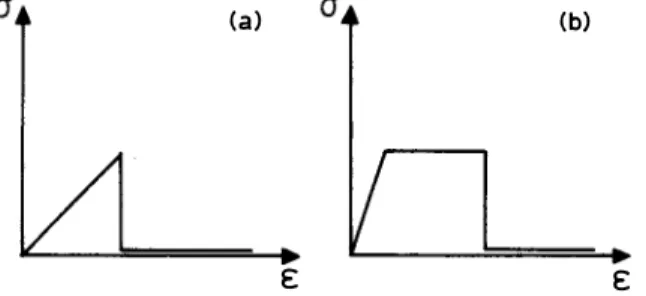
(5.2)Our study is concerned with the behaviour of material introduced by Bui and eo-workers (Bui and Ehrlacher, 1980; Bui et al., 1981) to study fracture, pictured in Fig. I.
To determine the evolution of damaged zones, it is necessary to introduce a rupture criterion. Rupture occurs when a threshold value (in stress, deformation or energy) is reached; when the strain is increasing the stress vanishes.
(f (a) (b)
E E
To define an accurate localization process, the boundary condition
(CT
• n=
0 on an;) must be taken into account. All the stressesCT
mustverify the equation of equilibrium and the new boundary conditions
CT
n=
0 at each point of an;(t). For the sake of simplicity, we assume that the heat flux is zero on an;, and the damaged zones are considered to have no heat conductivity.The localization process gives a new fourth rank tensor A of elastic concentration. This tensor has the properties (3.20)-(3.22) over n and verifies the boundary conditions Aijpq • nj
=
0 at each point of an;.One can define the general relations between the micro and macro deformations and stresses as follows:
E
�e
8-2�1
an;(u
® n). ds 'At-
1
L
(5.3) E=
e-2V (v ® n). ds 1!0; :I;=
0'The local compliance A
0
(e
=
Ne1)
is related to the macro compliance (E = A:I;) by the equation(5.4) because the field AoA is kinematically admissible and A is statically admissible with
A ·-; = 0
on an;.However, the tensor A depends on the actual volume O(t) of the sound material and its rate
A
is related to the propagation of the damaged zones (Buiet
al., 1982).
5.2. Determination of the Evolution of the Damaged Zone for a Thermoelastic Material
Consider a thermoelastic material with free energy
w(e,
T) which depends only on the deformation e and the absolute temperature T. At each point of V we define the energy density e and the entropy s per unit mass. For simplicity we assume that damaged zones have no heat conductivity and that they are inert (e =0,
s =0,
v=
0).
The first law of thermodynamics is the conservation of energy, at the macro level:
The variation of internal energy and kinetic energy K =
!pu2
is equal to the heat flux and the power of external loading. We consider only quasi-static evolution so that the contribution of kinetic energy is negligible. The heat flux determines Peal:Peal = -
(
q ·-;
da
J
av (5.6)and by means of the equilibrium equation we have, for the power of external loading,
Pext =
at
-J
anv
da
an; (5.7)
The localization process depends on the evolution of damaged zones and all the quantities are changed with the variation of n. Ifjis a regular mechanical quantity and defined on n, we have the equation
f
=f-- fcda
. -;- 1
1
V
an· I(5.8)
where
c
is the normal velocity of the boundary an;. So we have the local equation corresponding to (5.5):-qn
at-divq over n
l
on ani with et> > 0 .The production of entropy is necessarily positive:
;f
+
(
9__
•n
da
> 0J
an IT
By eqn (5.8) we can write the inequality (5.10) in another form:
(5.9)
(5.10)
p0
s+
�
divq -q ·;;
-tL
n(�n+p0sc)da
> 0 (5.11) IFor an elastic material we have
• 1 d" 0
PoS
+
T
1vq = (5.12)With the conductivity law q = -aw
I
a� where � =V
TIT
and w1 -
--q ·
Vq
> 0T
(5.13)Therefore the fracture dissipation rate is equal to the last term of (5.11): Using eqns (5.9), [hr
=
�
{
(qn +Pose )
da > 0Jan;
1{
w[hr
=
VJ Po
an;
T
e
da > 0 (5.14) (5.15) Per unit of area the thermodynamical force associated withe
has the dimensions of entropy. We assume a brittle criterion (Nguyen, 1978; Suquet, 1982; Stolz, 1984):y
=
WT
<.r;: e
=
0l
y
=
.r;:
e
> 0(5.16) The two criteria Y
=
.r;: anda"�:
=
0 must be satisfied along the moving part of the boundary an;, and we must introduce the transport condition at a geometrical point of an; by the convected derivative 01r:x
E ani �f {j,=
1. lmf(x
--'----'---,---�--"-'---_:_+ elit,
t + lit)
-f(x,
t)
ar-o
lit
On an; the two conditions are written as follows:
� . � ... �
!')(an
)=
(a+ en
· V
a)
·
n + a!')n
=
.
t
-T!')(Y)
=W- WT-
Ten VY
It is easy to show that, in the plane case (with normal
k),
!')-;
=
de . 7
ds
(5.17)
(5.18)
(5.19)
7
is the tangent vector to ani withs
the curvilinear coordinate. Taking into account the equilibrium equation-
- -
.
--and a particular form of
a = at"
®t"
+
azk
®k ,
the equations (5.18) become I'M • d-
I
.:z;(an) = an
+
ds(ea ·
r )=
0. (5.21) 8t
T ·�fl = a--e--Tc · Vfl =
0 pT
Knowing at each time
t
the thermomechanical fields and the geometry of!l(t),
we search for the rate quantities and the normal velocityc
on an;. The rate equations arediva= o pTs + divq
=
o 8=
!(�v + �Tv)
�=
�logT x E!l
a =
A0e + AT
aw q =-
-a�with the boundary conditions
q
.
n =
Qd on avq on av;.T =
r
on avT)
(m=
ffd on av;,. (5.22) (5.23)(oV = oVq U oVr = oVu U oV,., oVq n oVr = c/J, oV,. n oVu = c/J) and on
o!l; we have
c =
0;ii:
= 0; q· n =
0l
(5.24)
c
-=1= 0;�(an) =
0;�(!/) =
0; q· n = -poec
The solution of this problem is a stationary point of the functional (Stolz, 1984):
i
<
8 T>
J
c2
-- p
a---e cda
+
-pTn· V(f/)da
an I P
T
an. I2
On the set V=
{v, T/v
=vd
onavw t
=Td
onavrl·
Once the velocity c is determined, we are able to know the variation of all macro quantities by application of eqn (5.8). In the following part we suppose that c is determined, and our point of interest is the macro
scopic behaviour of a RVE V, and we reduce our consideration on elastoplastic material, with free energy of the form w
(
e- eP)
. The influence of temperature could be treated as in the last example (Section 4).5.3. Evolution of Macroscopic Quantities
Here we determine the evolution of the macroscopic modulus and we decompose the rate of deformation.
By comparison of the two expressions forE and
E
in eqns (5.3), the application of eqn (5.8) shows that- 1
i
'As
- V
'Aec da = 0ilO;
(5.26) for all kinematically admissible e. One particular field e is AgpqA pqm so it is obvious to obtain (Bui
et
al.,
1982)A
='AAoA
=�
( 'AAoAc
daJan;
(5.27)The elastic modulus varies with the propagation of the damaged zones; this variation must appear in the reversible part of the rate of the elastic macroscopic deformation.
When the damaged zone does not propagate inn the local stress field is a =AI:'
+
r where r is a self-equilibrated stress on the actual geometry. For an increasing± of the macrostress from the value I: such that the damaged zone has a normal velocity c of propagation, the localstresses are (;with a corresponding rate of deformation
(5.28) in the case of an elastoplastic material. Let 6-E be the fictitious stresses obtained with purely elastic behaviour with the same velocity of propagation c:
(5.29) whereA is related to the variation of the localization tensor A due to the change in the geometry of n induced by the damaged zone propagation.
If the stress field r is self-equilibrated on
O(t)
we have, from eqn (5.8),r
=
-
re da- 1
L
V
an· I (5.30)which shows that r is generally not self-equilibrated; we have inside n
a redistribution of residual stresses. The rate e and
A0aE
are two kinematically admissible fields of deformation, then the macroscopic deformations E and EE are given by the relations (5.3). For alla'
statically admissible with�· =
(a')
in the localization process we haveFor the particular choice of
a'
=A�'
we haveEE = 1AAoaE = A±+ A�
(5.31)
(5.32) which defines exactly the variations of the reversible part EE of the macrodeformation (EE
=A�).
Moreover, by subtraction in eqns (5.31) (with the same choice
a'
=A�')
one obtains(5.33) The complementary term is due to the redistribution of residual
stresses inside n, when the geometry changes with the propagation of the damaged zones.
When no damage occurs eqn (5.30) shows that r is self-equilibrated and the classical relation ( 4.20) is recovered. However, the existence of a viscoplastic potential at the microlevel does not ensure the existence of a macro-viscoplastic potential E1R. Only the first term can be deduced from the average potential
cl>(�, p) =
</>(a).
5.4. Study of the Dissipation Rate
The global energy W is the sum of a reversible part and an embedded energy Wb in the residual stresses r. For a quadratic form w
(
e - eP)
, thedissipation 1J can be decomposed into three terms, the first due to heat conduction, the second due to plasticity atP and the third due to fracture 1Jr.
So the mechanical part of £2 is given by
£2 =
af:P +
-
WC ds ;> 0-
V
11
iJO· 1 (5.34)With the hypothesis of macrohomogeneity applied to actual stresses, we can deduce
(5.35) with
w
and the equation
:Yr
=� J
wc da =ai: -ai:P -
:
tG
I;EE
+
wb)
(5.36) Using the macrohomogeneity hypothesisai:
=I;E
where wb =
!rA0r.
If the damaged zones do not propagate, 9r = 0 and the macro complianceA
is constant, we recover dwb/dt =rA0r,
i.e. the variation of the stored energy is only due to residual stresses, as in classical plasticity (Mandel, 1971; Bui et al., 1982).If there is propagation of damaged zones, the first term
!(I;EE - ±EE)
does not vanish. It is analogous to Irwin's energy release rate for crack propagation (Bui, 1978) and it contributes to the dissipation rate.6. THERMODYNAMICAL CONSIDERATIONS
6.1. Relationships between Micro and Macro Scales
In the preceding sections we were concerned by means of averaging processes and applications to define what are macroscopic mechanical quantities. We have said nothing about the macroscopic temperature or we have implicitly admitted that the temperature is given or corresponds to the temperature of the equilibrium state.
We have restricted our exposition to macro homogeneous bodies; can we then give general relations for other materials?
To be specific, one will be concerned with materials that admit thermodynamical potentials,
e(e,
a,
s) internal energy orw(e,
a,(})
free energy, wheree
is the deformation,a
the internal variables,(}
the absolute temperature and s the entropy. Then the local equation of state may be written e.g.(6.1) where a is the elastic stress (this supposes no viscosity), and A are the
thermodynamical forces associated with the variation of the internal variables
a.
To determine the field of temperature, we must add to the constitutive equations (6.1) the heat conduction law. Noting � =
V
(log0),
weassume the following form for the generalized Fourier relation between heat flux and temperature:
q
= (6.2)when w(�) is a convex no-negative function off
As in the first section, it is clear that with every microscopic quantity
f
we can associate its macroscopic value! by an averaging process on the RVE
V
extended eventually in the cases for whichV
contains holes, damaged zones, orrigid
inclusions:J
=(f)
=.!_
(
f
dvV)v
(6.3)and we have remarked that some constraints are necessary to determine a micro state corresponding to a given macro one. For the choice of a representative volume element suitable boundary conditions must be prescribed and must satisfy special requirements (Francfort
et al.,
1983; Germainet al.,
1983):R1 -Assume that the macro state (0', e,
�, w)
is given; the microscopicquantities
f
must then satisfy: -the local constitutive law; -the boundary conditions on av;-the equation of equilibrium in stress and flux diva = 0 and div q = 0 over V.
R2 -The Hill-Mandel macrohomogetl�ity condition must be fulfilled by all fields a*, q* with 0'* =(a*) and q* = (q*) and by all fields s* and �* kinematically and thermally admissible:
- (6.4)
0'*6* = (a* s*)
l
q*� * = (q* �*)We have given particular localization processes for periodic structures and for homogeneous boundary conditions.
R3
-The process of localization must ensure the existence anduniqueness of the microscopic response.
The construction of the macro constitutive law from the microscopic behaviour can proceed as follows:
-starting from some macro quantities;
-using a localization process to determine local fields then the averaging process to determine the missing macro quantities.
6.2. Study of Systems in Equilibrium
In this case the homogeneous deformation
E
= 6, the set of internalvariables a and the temperature T of the macroscopic description are
prescribed. Near the equilibrium we assume that the temperature is quasi-uniform
0
= T (but the presence of heterogeneity implies that the gradient � is not uniform, � * �).We wish to find the local quantities a, s, q, �as functions of the macro state E, T, a, E =�;they are solutions of the boundary value problem
(9):
E = (s) E =(�)
ow a = p 08 (s, a, T) q = ow a� � = VlogO = 0) (}'}
(6.5)
divyq = 0Boundary conditions of localization
For a given localization process this solution is unique
(R3).
Letp w (E; a, T) = (pw(s, a, T))
(6.6)
macrohomogeneity of Hill
(R2),
we obtainaw
<
aw
oe
) <
a
e
)
p
oE
=
p oe oE
=
C1oE
= (e1)
aE
oe
and noting that
e
=
E
+
11 with(q) =
0 for allE,
so(oe/oE)
=
1. The equation (6.6) gives the global behaviourow
15
aE
= <(1> =
a (6.7)and in the same way it can be proved that
s
=
-aw;ar
T =
a-e;a-s
(6.8)The global description has the same form as the local one, and the equation (6.7) gives the constitutive stress-strain relation. Similarly it is possible to give the generalized Fourier relation between
q
and""(.
If we consider that near a state of equilibrium the two principles of thermodynamics are valid at the microlevel
pe
= e1t
-
div ql
(6.9)pOs
+
div q- q · � > owe can write the same relations at the macrolevel, if all the equations
(6.6)--(6.9)
are valid at each time, which means that the thermostatic description and the Gibbs equation are true for the equivalent homogeneous medium if they are valid for each of the constituent phases (Francfortet
al., 1983; Germainet
al., 1983).6.3. Non-equilibrium Evolution
When the system is far from an equilibrium state, in particular when the local absolute temperature () is not uniform on V, the equilibrium equation and the property of macrohomogeneity are not valid. Some complementary terms due to inertia phenomena must be taken into account. However, we can try to define the macroscopic temperature by the concept of a local accompanying equilibrium state.
At each time, the volume element V must be isolated and one has to study the dynamical evolution toward an equilibrium state and find the micro quantities which characterize this equilibrium. When the volume
element V is isolated, quantities such as the strain
E
= 6 and energy e,together with some internal parameter
a,
must be kept constant. Inside the RVE various physical dissipative mechanisms have taken place and each of them is described by the internal variablea.
The dimensions of the RVE and the inertia effect define a characteristic timet", and we must distinguish two kinds of internal parametersa
anda'.
The first familya
can be considered as constant; the seconda',
having a relaxation time shorter than t", must be considered a function of time.Under the assumption that in this transition towards equilibrium the two principles of thermodynamics are valid, the equilibrium state is the solution of the problem (6.5) where
E
=(e,), a
=a,
fora
fl
l a'l
and e = (e1)are prescribed, and we obtain
�· - ae
(E
,. r•)
I
� -aE , a, a ,
aes•
=-(E a a'• r•)
ar
· ' ' (6.10)where r• and
a'•
are the values of the macroscopic temperature and thevalues of internal parameters at the equilibrium state, respectively. If the actual state is far from the equilibrium, it is obvious that
�· * (a,). Examples are given by Francfort (1982).
The major difficulty in this study is to define correctly the absolute temperature for a macroscopic body which has microheterogeneity. In the first part of this chapter we have studied only the quasi-static evolution of the RVE, for which the absolute temperature is defined as in Section 6.2.
7. CONCLUSION
We have presented some aspects of the general relations between micro and macro scales in heterogeneous media, and we have tried to exhibit some of the most significant lines of research in the mechanical behaviour of composite materials. This domain is still in a state of expansion, not only in solid mechanics but also in fluid mechanics and
in mixtures theory. In the next few years progress may be expected in many directions: better mathematical consistency, deepening of the physical interpretation and significance.
ACKNOWLEDGEMENTS
The author wishes to thank H. D. Bui, K Dang Van and Q. S. Nguyen for discussion and for guidance.
REFERENCES
Andrieux, S. (1983). Doct.-Ing. thesis, ENPC, Paris.
Beran, M. J. (1978). Statistical Continuum Theories, Wiley-Interscience, New York.
Beran, M. J. and Molyneux, J. (1966). Use of classical variational principles to determine bounds for the effective bulk modulus in heterogeneous media, Q. Appl. Math., 24, 107-18.
Berveiller, M. and Zaoui, A (1979). Mech. Phys. Solids, 26, 325. Bui, H. D. (1978). Mecanique de la Rupture Fragile, Masson, Paris.
Bui, H. D. and Ehrlacher, A (1980). Propagation dynamique d'une zone endommagee dans un solide elastique-fragile en mode Ill et en regime permanent, Compt. Rend Acad. Sci. (B), 290, 273-6.
Bui, H. D., Dang Van, K and Stolz, C. (1981). Relations entre grandeurs microscopiques et macroscopiques pour un solide elastique-fragile ayant des zones endommagees, Compt. Rend. Acad Sci. (11), 292, 863-6.
Bui, H. D., Dang Van, K and Stolz, C. (1982). Relations entre grandeurs microscopiques et macroscopiques pour un solide anelastique ayant des zones endommagees, Compt. Rend. Acad. Sci. (11}, 294, 1155-8.
Eshelby, J. D. (1957). The determination of the elastic field of an ellipsoidal inclusion and related problem, Proc. Roy. Soc. (London), A241, 376-96. Eshelby, J. D. (1961). Elastic inclusion and inhomogeneities. In Progress in Solids Mechanics, I. N. Sneddon and R Hill (Eds), North-Holland, Amsterdam, Vol. 11, pp 87-140.
Fokin, A G. (1979). Statistical properties of inhomogeneous solid media: central moment functions of material characteristics, l Appl. Mat h. Mech. (Engl. trans.), 42, 57Q-9.
Francfort, G. (1982a). These Ph.D.
Francfort, G. (1982b). Homogeneisation et oscillations rapides en thermo elasticite lineaire, Compt. Rend. Acad. Sci. (1), 295, 367-70.
Francfort, G., Nguyen, Q. S. and Suquet, P. (1983). Thermodynamique et lois de comportement thermo-mecanique homogeneisees, Compt. Rend. Acad. Sci. (11},
Germain, P., Nguyen, Q. S. and Suquet, P. (1983). Continuum thermodynamics, App/. Mech., 50, 1010-20.
Halphen, B. (1977). Sur la thermodynamique du polycristal metallique, Colloque Annuel 1977 du Groupe Fran<;ais de Rheologie (Paris).
Hashin, Z. (1983). Analysis of composite materials,! Appl. Mech., 50,481-505. Hashin, Z. and Shtrikman, S. (1962a). On some variational principles an anisotropic and non-homogeneous elasticity, ! Mech. Phys. Solids, 10,335-42. Hashin, Z. and Shtrikman, S. (1962b). A variational approach to the theory of the elastic behaviour of polycrystals, l Mech. Phys. Solids, 10, 343-55. Hashin, Z. and Shtrikman, S. (1963). A variational approach to the. theory of the elastic behaviour of multiphase materials, l Mech. Phys. Solids, 11, 127-40. Hill, R (1952). The elastic behaviour of a crystalline aggregate, Proc. Phys. Soc. (London), A65, 349-54.
Hill, R (1963a). Elastic properties of reinforced solids: some theoretical principles, ! Mech. Phys. Solids, 11, 357-72.
Hill, R (1963b). New derivations of some elastic extremum principles. In Progress in Applied Mechanics, Prager Anniversary Volume, Macmillan, New York, pp 99-106.
Hill, R (1965a). Continuum micromechanism of elastoplastic polycrystals, l Mech. Phys. Solids, 13, 89-101.
Hill, R (1965b). A self consistent mechanics of composite materials, l Mech. Phys. Solids, 13, 213-22.
Kroner, E. (1977). Bounds of effective elastic moduli of disordered materials, l Mech. Phys. Solids, 25, 137-55.
Kroner, E. (1980). Linear properties of random media: the systematic theory, C. R 15eme Coll. du Groupe Fran<;ais de Rheologie.
Mandel, J. (1964). Proc. 11th Int. Congr. Appl. Mech., Munich, p. 502. Mandel, J. (1971). Plasticite Classique et Viscoplasticite, Courses and Lectures No 17, CISM, Udine/Springer-Verlag.
Nguyen, Q. S. (1978). Normal dissipativity and energy criteria in fracture, IUTAM symposium, Evanston, Illinois.
Rice, J. R (1971). Inelastic constitutive relations for solids: an internal variable theory and its application to metal plasticity, l Mech. Phys. Solids, 9, 433-55. Sanchez-Palencia, E. (1974). Comportement local et macroscopique d'un type de milieux physiques heterogenes, Int. l Eng. Sci., 12, 331-51.
Stolz, C. (1984). Analyse du comportement et formulation du probleme en vitesse pour un solide thermoelastique fragile avec zone endommagee, Compt. Rend. Acad. Sci. (11), 299, 491-3.
Suquet, P. (1982). Plasticite et homogeneisation, These Universite Pierre et Marie Curie, Paris.
Voigt, W. (1889). Ueber die Bezichung zwischen den beiden Elastizitats constanten isotrope Korper, Ann. Phys. (Leipzig), 38, 573-87.
Walpole, L. J. (1969). On the overall elastic moduli of composite materials, l Mech. Phys. Solids, 17, 235-51.
Willis, J. R (1981). Overall properties of composites. In Advances in Applied Mechanics, Vol 21, C. S. Yih (Ed), Academic Press, New York.
BIBLIOGRAPHY
Bensoussan, A, Lions, J. L. and Papanicolaou, G. (1978).Asymptotic Analysisfor Periodic Structures, North-Holland, Amsterdam.
Beran, M. J. and McCoy, J. J. (1970). Mean field variations in a statistical sample of heterogeneous linearly elastic solids, Int. J Solids Struct., 6, 1035-54. Budiansky, B. (1965). On the elastic moduli of some heterogeneous materials, J Mech. Phys. Solids, 13, 223-7.
Budiansky, B. (1970). Thermal and thermoelastic properties of isotropic composites, J Compos. Mater., 4, 286-95.
Budiansky, B. and O'Connell, R J. (1976). Elastic moduli of cracked solids,/nt. J Solids Struct., 12, 81-97.
Christensen, R M. (1979). Mechanics of Composite Materials, Wiley-Interscience, New York.
Hashin, Z. (1962). The elastic moduli of heterogeneous materials,ASME, J Appl. Mech., 29, 143-50.
Hashin, Z. (1964). Theory of mechanical behaviour of heterogeneous media, Appl. Mech. Rev., 17, 1-9.
Herakovich, C. T. (1981). On the relationship between engineering properties and delamination of composite materials, J Mech. Phys. Solids, 11, 127-40. Hershy, A V. (1954). The elasticity of an isotropic aggregate of anisotropic cubic crystals, J Appl. Mech., 21, 236-40.
Hill, R (1964). Theory of mechanical properties of fibre strengthened materials: elastic behaviour, J Mech. Phys. Solids, 12, 199-212.
Kestin, J. and Bataille, G. (1980). Thermodynamics of Solids, Continuum Models of Discrete System, University of Waterloo Press, Freudenstadt, FRG.
Laws, H. (1973). On the thermostatics of composite materials, J Mech. Phys. Solids, 21, 9-17.
Leguillon, D. and Sanchez Palencia, E. (1982). On the behaviour of a cracked elastic body with or without friction, J. Mecan., 1 (2).
Reuss, A (1929). Calculation of the flow limit of crystals on the basis of the plasticity of monocrystals, Z. Angew. Math. Mech., 9, 49-58.
Walpole, L. J. (1966a). On bounds for the overall elastic moduli of inhomo geneous systems. I, J Mech. Phys. Solids, 14, 151-62.
Walpole, L. J. (1966b). On bounds for the overall elastic moduli of inhomo geneous systems. 11, J Mech. Phys. Solids, 14, 289-301.