This is the post print (Sage Version 2) of an article published by Sage in
Social Science Computer Review available online:
http://dx.doi.org/10.1177/0894439313504539
.
Please cite as :
Apparicio, Philippe, Joan Carles Martori, Amber L. Pearson, Éric Fournier, and Denis Apparicio. 2014. "An Open-Source Software for Calculating Indices of Urban Residential Segregation." Social Science Computer Review 32 (1):117-128. doi: 10.1177/0894439313504539.
An Open-Source Software for Calculating Indices of Urban Residential Segregation Philippe Apparicio1, Joan Carles Martori2, Amber Pearson3, Éric Fournier4, Denis Apparicio5
1 INRS Urbanisation Culture Société, Montréal, Canada; 2 University of Vic, Spain; 3 University of Otago, New Zealand; 4 Université du Québec à Montréal, Canada; 5 Université du Maine, France
Abstract
The aim of this article is to introduce a new stand-alone application —Geo-Segregation Analyzer— that is capable of calculating 43 residential segregation indices, regardless of the population groups or the metropolitan region under study. In practical terms, the user just needs to have a Shapefile geographic file containing counts of population groupsthat differ in ethnic origin, birth country, age or income across a metropolitan area at a small area level (e.g. census tracts). Developed in Java by using the GeoTools library, this free and open-source application is both multi-platform and multi-language. The software functions on Windows, Mac OS X and Linux operating systems and its user interface currently supports ten languages (English, French, Spanish, Catalan, German, Italian, Portuguese, Creole, Vietnamese and Chinese). The application permits users to display and manipulate several
Shapefile geographic files and to calculate 19 one-group indices, 13 two-group indices, eight
multigroup indices, and three local measures that could be mapped (location quotient, entropy measure, and typology of the ethnic areas proposed by Poulsen, Johnson and Forrest (2010, 2011)).
Keywords: residential segregation; urban segregation; segregation indices; geographic information systems; Java
Introduction
Today, residential segregation indices are well known and largely used in the social sciences. This is hardly surprising since such indices provide a way to describe and compare the distribution of population groups—defined by age, ethnic origin, country of birth, or income—across a metropolitan area, as well as compare the segregation levels of population groups in several metropolitan areas (Apparicio, Petkevitch, & Charron, 2008). As a result, they are widely used in urban studies (see in particular Allen & Turner, 2012; Iceland, Mateos, & Sharp, 2011; Lloyd & Shuttleworth, 2012; Martori & Apparicio, 2011; Peach, 2009; Poulsen et al., 2010; Scopilliti & Iceland, 2008). For example, using the classic dissimilarity index (Duncan & Duncan, 1955a, 1955b), Peach (2009) found that ethnic segregation in main English cities declined from 1991 to 2001 and the level of segregation was high only for one ethnic group—the Bangladeshis.
Over the past decade, numerous studies in health sciences have also used segregation indices to measure the effect of ethnic and racial segregation levels on a number of health indicators, such as mortality, infant mortality, overweight∕obesity, hypertension, health care services use, tobacco consumption, etc., on the other (Acevedo-Garcia, Lochner, Osypuk, & Subramanian, 2003; Chang, Hillier, & Mehta, 2009; Hayanga, Zeliadt, & Backhus, 2013; Hearst, Oakes, & Johnson, 2008; Kramer, Cooper, Drews-Botsch, Waller, & Hogue, 2010; Kramer & Hogue, 2009; Moon, Barnett, & Pearce, 2010). For instance, calculation of the isolation index (Lieberson, 1981) for 231 U.S. metropolitan statistical areas in 2000, Kramer et al. (2010) found that increased isolation residential segregation was associated with increased pre-term births among Black women but not White women.
In spite of this growing use of segregation indices, calculating such indices is often a complex and tedious task, since relatively few software applications facilitate this process (Reardon & O'Sullivan, 2004). The aim of this article is therefore to describe a new open-source application that was developed
in Java and allows the user to calculate 43 segregation indices, irrespective of the population grouping variables or the metropolitan region under study.
Indices of residential segregation: a brief overview
Evaluating the level of residential segregation of different ethnic groups has long been a major issue in sociology, and to a greater extent in urban studies. The first indices were proposed during the late 1940s and 1950s, including the widely used index of dissimilarity (ID) (Duncan & Duncan, 1955a, 1955b). This measure permits comparison of two groups’ spatial distributions (e.g., Blacks and Whites) across the spatial units of a metropolitan area. In practical terms, ID ranges from 0 (no dissimilarity, no segregation) to 1 (complete dissimilarity); it indicates the proportion of either of the two ethnic groups that would be required to re-locate in order to obtain identical spatial distributions.
From the 1980s onward, many researchers developed other residential segregation indices. Lieberson (1981) proposed two new indices to evaluate how the members of one particular group are isolated across spatial units of a metropolitan area (isolation index, xPx) and to what degree members of a minority group are exposed to members of the majority group (interaction index, xPy). At the same time, geographers proposed several spatial versions of the index of dissimilarity (Morrill, 1991; Wong, 1993, 1999) while other researchers developed indices to measure the segregation between more than two groups at once (e.g., Blacks, Whites, Hispanics and Asians) (Reardon, 1998; Reardon & Firebaugh, 2002; Sakoda, 1981; Wong, 1999).
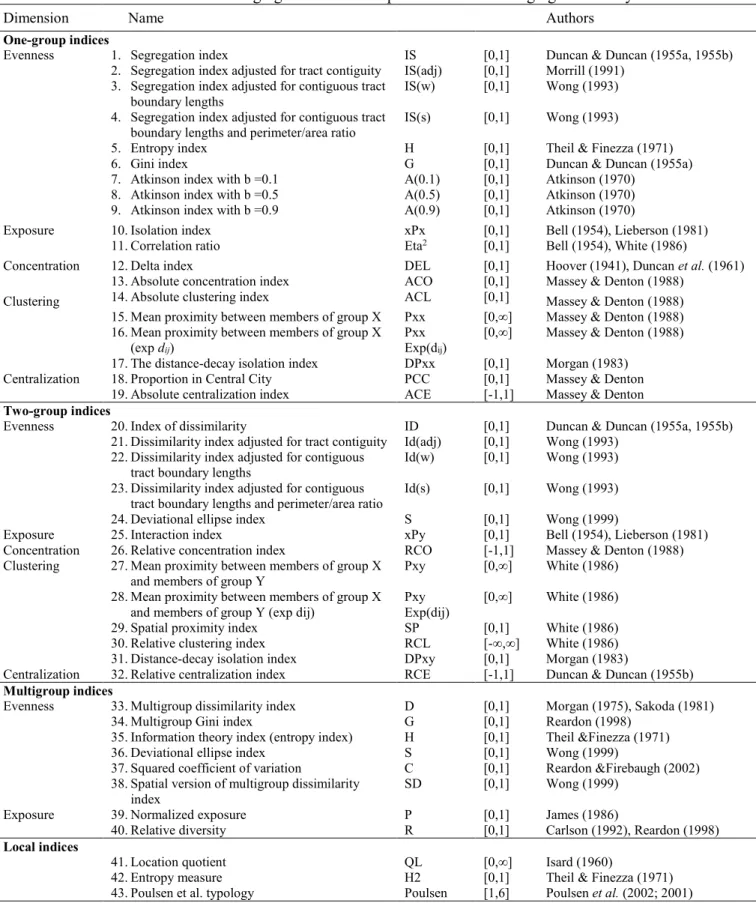
In a seminal paper on residential segregation indices, Massey and Denton (1988) classify the indices according to five dimensions: evenness, exposure, concentration, clustering, and centralization (Table 1). For each of these dimensions, three categories of indices are usually distinguished: one-group indices that measure the distribution of a population group compared to that of the total population; two-group indices that compare the distribution of one population group to that of another; and multigroup indices that analyze the distribution of several population groups simultaneously. Other local indices, which provide a value for each spatial unit of the metropolitan area, can be mapped to identify the spatial concentrations of ethnic groups in a metropolitan region. These indices notably include the following:
- The location quotient, which is useful for identifying spatial units in a metropolitan area where a population group is under-represented (LQ > 1) or, conversely, over-represented (LQ < 1); - The entropy or diversity index, which is useful for identifying spatial units that are completely
homogenous (inhabited by only one population group, H2 = 0) or maximally diversified (all population groups are equal in size, H2 = 1);
- The typology proposed by Poulsen et al. (2002; 2001), which classifies the spatial units of a metropolitan area (e.g. census tracts) into six categories based on the percentages of the ethnic minorities and of the host society in the local population (1. Isolated host community, 2. Non-isolated host community, 3. Associated assimilation-pluralism enclave, 4. Mixed-minority enclave, 5. Polarised enclave, and 6. Extreme polarised enclave, i.e., ghetto).
Table 1. The five dimension of residential segregation
Dimension Description
Eveness Evenness refers to the distribution of one or more population groups across the spatial units of the metropolitan area (e.g., census tracts). Evenness indices measure a group’s over- or under-representation in the spatial units of a metropolitan area. The more unevenly a population group is distributed across these spatial units, the more segregated it is.
Exposure Exposure is the degree of potential contact between members of the same group (one group) or between members of two groups (intergroup) inside spatial units. It measures the probability that members of one group will encounter members of their own group (isolation) or another group (interaction) in their spatial unit.
Clustering Concentration refers to the physical space occupied by a group. The less of the metropolitan area a group occupies, the more concentrated it is. According to Massey and Denton (1988), segregated minorities generally occupy a small portion of metropolitan areas.
Concentration Other indices measure clustering. The more contiguous spatial units a group occupies—thereby forming an enclave within the city—the more clustered and therefore segregated it is, according to this dimension.
Centralization Finally, centralization indices measure the degree to which a group is located near and in the center of the metropolitan area, which is usually defined as the central business district. The closer a group is to the city center, the more centralized and thus segregated it is according to this dimension. Adapted from Martori and Apparicio (2011).
Why a new tool for calculating residential segregation indices?
A number of applications are currently available for calculating residential segregation indices (Table 2). Since computing some of these indices requires the calculation of certain geometric parameters—polygon area, perimeter and centroid, contiguity and distance weight matrices, and common border length between adjacent polygons—most of these previous applications are integrated into and require the added use of commercial geographical information system (GIS) software (ArcInfo 7, ArcView 3.2 and MapInfo; see Table 2). Also worth mentioning is the Seg module developed by Sean F. Reardon (2002), which allows users to calculate nine segregation indices, including six multigroup indices, using Stata statistical software. To our knowledge, at the time of writing, the predecessor to Geo-Segregation Analyzer called Segregation Analyzer, developed in C# by Apparicio et al. (2008), was the only stand-alone application (i.e. it is not a component of a GIS or statistical program).
Table 2. Previous applications designed for calculating residential segregation indices
Name Language Integrated into Indices Authors
AML and Splus ArcInfo 7 4 Wong & Chong (1998)
Avenue ArcView 3.2 7 Wong (1996, 2003)
MapBasic MapInfo 24 Apparicio (2000)
Seg Stata Stata module 9 Reardon (2002)
Following a review of existing applications, we defined three important criteria for developing a new application. First, we sought to develop an application that would be easy to use but that would integrate a large number of residential segregation indices. Second, we intended the application to be independent rather than integrated in a GIS (ArcGIS, MapInfo, Quantum GIS, etc.) or statistical software (Stata, SAS, R, etc.), in order to limit the burden on the user. Third, we intended to develop free and open-source software. This provides the scientific community with access to the source code so that other researchers can modify it for subsequent integration in their own applications. In addition, researchers can participate in implementing other segregation indices within future versions of
Geo-Segregation Analyzer.
From a technical point of view, the application is written in Java and uses the Geotools Library, an open-source Java library that provides tools for geospatial data (http://www.geotools.org/). Using this library allows us to easily view and manipulate Shapefile files (i.e., Esri GIS vector format), as well as easily calculate all the geometric parameters needed to calculate several segregation indices.
In order to broaden access as widely as possible, Geo-segregation Analyzer is a stand-alone, multi-language and customizable application. Since it was developed in Java, the application works in the Windows, Mac OS X and Linux operating systems (Linux Debian, Ubuntu, RPM and other Linux distributions). The user interface currently supports ten languages (English, French, Spanish, Catalan, German, Italian, Portuguese, Creole, Vietnamese and Chinese), and the help documentation is also available in seven languages (English, French, Spanish, German, Italian, Portuguese and Chinese). Finally, the user can change the look and feel of the graphical user interface (Metal, Nimbus, CDE/Motif, Windows, and Windows Classic).
As for the application’s features, it allows users to 1) display and manipulate several Shapefile layers in different views organized as Tabs in a Web browser; 2) save a project (a text file with the .sat extension) that contains the names of the different views and the names and properties of each layer loaded in each view (similar to a Mxd document in ArcGIS, for example); and finally 3) calculate 43 indices (see Table 3). It therefore includes many more indices than previous applications, with the exception of Segregation Analyzer, which calculates 42 indices but does not offer visualization and is not open-source.
Table 3. Residential segregation indices implemented in Geo-Segregation Analyzer
Dimension Name Authors
One-group indices
Evenness 1. Segregation index IS [0,1] Duncan & Duncan (1955a, 1955b)
2. Segregation index adjusted for tract contiguity IS(adj) [0,1] Morrill (1991)
3. Segregation index adjusted for contiguous tract boundary lengths
IS(w) [0,1] Wong (1993)
4. Segregation index adjusted for contiguous tract boundary lengths and perimeter/area ratio
IS(s) [0,1] Wong (1993)
5. Entropy index H [0,1] Theil & Finezza (1971)
6. Gini index G [0,1] Duncan & Duncan (1955a)
7. Atkinson index with b =0.1 A(0.1) [0,1] Atkinson (1970)
8. Atkinson index with b =0.5 A(0.5) [0,1] Atkinson (1970)
9. Atkinson index with b =0.9 A(0.9) [0,1] Atkinson (1970)
Exposure 10. Isolation index xPx [0,1] Bell (1954), Lieberson (1981)
11. Correlation ratio Eta2 [0,1] Bell (1954), White (1986)
Concentration 12. Delta index DEL [0,1] Hoover (1941), Duncan et al. (1961)
13. Absolute concentration index ACO [0,1] Massey & Denton (1988)
Clustering 14. Absolute clustering index ACL [0,1] Massey & Denton (1988)
15. Mean proximity between members of group X Pxx [0,∞] Massey & Denton (1988)
16. Mean proximity between members of group X (exp dij)
Pxx
Exp(dij) [0,∞] Massey & Denton (1988)
17. The distance-decay isolation index DPxx [0,1] Morgan (1983)
Centralization 18. Proportion in Central City PCC [0,1] Massey & Denton
19. Absolute centralization index ACE [-1,1] Massey & Denton
Two-group indices
Evenness 20. Index of dissimilarity ID [0,1] Duncan & Duncan (1955a, 1955b)
21. Dissimilarity index adjusted for tract contiguity Id(adj) [0,1] Wong (1993)
22. Dissimilarity index adjusted for contiguous
tract boundary lengths Id(w) [0,1] Wong (1993)
23. Dissimilarity index adjusted for contiguous
tract boundary lengths and perimeter/area ratio Id(s) [0,1] Wong (1993)
24. Deviational ellipse index S [0,1] Wong (1999)
Exposure 25. Interaction index xPy [0,1] Bell (1954), Lieberson (1981)
Concentration 26. Relative concentration index RCO [-1,1] Massey & Denton (1988)
Clustering 27. Mean proximity between members of group X
and members of group Y
Pxy [0,∞] White (1986)
28. Mean proximity between members of group X and members of group Y (exp dij)
Pxy Exp(dij)
[0,∞] White (1986)
29. Spatial proximity index SP [0,1] White (1986)
30. Relative clustering index RCL [-∞,∞] White (1986)
31. Distance-decay isolation index DPxy [0,1] Morgan (1983)
Centralization 32. Relative centralization index RCE [-1,1] Duncan & Duncan (1955b)
Multigroup indices
Evenness 33. Multigroup dissimilarity index D [0,1] Morgan (1975), Sakoda (1981)
34. Multigroup Gini index G [0,1] Reardon (1998)
35. Information theory index (entropy index) H [0,1] Theil &Finezza (1971)
36. Deviational ellipse index S [0,1] Wong (1999)
37. Squared coefficient of variation C [0,1] Reardon &Firebaugh (2002)
38. Spatial version of multigroup dissimilarity index
SD [0,1] Wong (1999)
Exposure 39. Normalized exposure P [0,1] James (1986)
40. Relative diversity R [0,1] Carlson (1992), Reardon (1998)
Local indices
41. Location quotient QL [0,∞] Isard (1960)
42. Entropy measure H2 [0,1] Theil & Finezza (1971)
43. Poulsen et al. typology Poulsen [1,6] Poulsen et al. (2002; 2001)
Running Geo-Segregation Analyzer
The application is available free of charge and can be downloaded from the website http://geoseganalyzer.ucs.inrs.ca, which is written in English, French and Spanish. The first version of
Geo-Segregation Analyzer was released on November 5, 2012. Ten months later, the number of
downloads reached 1042 in 58 countries, distributed across Windows, Mac and Linux operating systems (respectively 84%, 12% and 5% of downloads). This is an indication of the widespread interest in the application, as well as the variety of its users.
Data Input
To calculate residential segregation indices, Geo-Segregation Analyzer requires a Shapefile geographic file whose spatial entities are polygons, for example the census tracts of a metropolitan area. The
Shapefile layer must contain the following fields:
- One numeric field for the total population in the area unit (as counts);
- Several numeric fields for the populations of various ethnic or social groups (as counts);
- One binary or numeric field for identifying the City Center (1= City Center; 0= Otherwise). This last field is needed to calculate the indices related to the centralization dimension.
Geo-Segregation Interface
The application’s interface is easy to use and includes the main visualisation functions found in GIS software. The views for visualizing one or more Shapefiles layers are organized as Tabs in a web browser. It is worth noting that a Tab can be renamed by double-clicking on it as shown in Figure 1.a. The left-hand panel, named Layers, allows the user to organize layers in the view using five buttons: Add layer, Remove layer, Move layer down, Move layer up, and View table (Figure 1.b). This last button lets the user visualize the Table of the active layer (Figure 1.c).
The basic map navigation functions on the map, which are available in any GIS software, are also implemented in the Geo-Segregation Analyzer (Zoom in and out, Pan, Full extent, Previous and next extent, Identify; Figure 1.d). The three last buttons (Figure 1.f), respectively allow the user to set the application preferences (theme, language and number of decimals for the calculation of indices) as illustrated in Figure 2; to check online for a new version of Geo-Segregation Analyzer; and to open the help documentation written in HTML.
Finally, six buttons are provided to launch a dialogue box in order to calculate one-group, two-group and multitwo-group indices as well as to map the location quotient and entropy index and to build the Poulsen and et al. typology (Figure 1.e).
Figure 1. Interface of the application Geo-Segregation Analyzer
The Geo-Segregation Analyzer Dialog Box
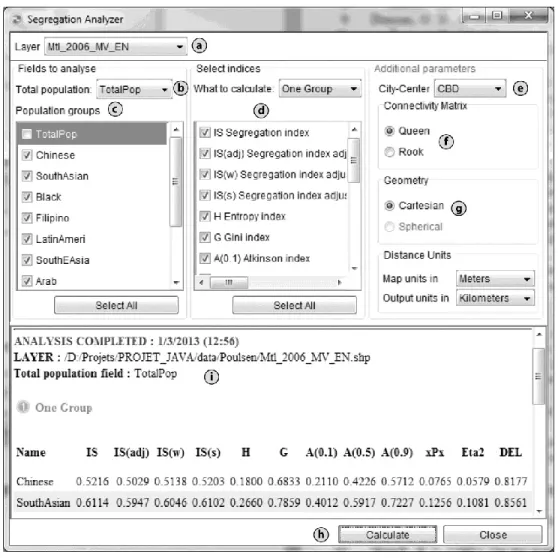
Once the Shapefile layer is opened in Geo-Segregation Analyzer, to calculate residential segregation indices, the user need only specify certain parameters as follows (Figure 3):
- Select the geographic layer, the total population field and the population group fields that will be used to calculate indices (Figure 3.a, b and c);
- Select the types of indices (one group, two groups, multigroup, location quotient, entropy index, typology of Poulsen et al.) and select the indices to calculate (Figure 3.d);
- Select the field identifying which sectors belong to the City Center in order to compute centralization indices (Figure 3.e);
- Specify the type of contiguity matrix (queen or rook) in order to calculate the segregation and dissimilarity indices adjusted for tract contiguity (Figure 3.f) (Morrill, 1991; Wong, 1993);
- Specify whether the layer coordinates are Cartesian (x, y) or spherical (latitude, longitude) (Figure 3.g);
- Click on the Calculate button (Figure 3.h) to see results in the bottom panel (Figure 3.h).
Finally, for local measures—location, quotient, entropy and Poulsen et al. typology—results can also be mapped and saved in a new field of the Shapefile layer.
Future developments
While the software is very functional, the current version (version 1.1) leaves room for improvement. As a result, subsequent versions are already planned. First, we intend to integrate new functionalities to improve the visualization of both geographic data (Shapefile) and results. A user interface will be developed to symbolize and classify features of the Shapefile layers. It is worth noting that a GeoTools class contains all the color schemes of the widely used mapping tool ColorBrewer developed by Brewer et al. (2003), which should greatly facilitate the development of this interface. As for the visualization of results, another interface will be developed to be able to export them in to different formats (eg Excel, dBase and text files).
We then plan to add capabilities to calculate other segregation indices, following a literature review of indices recently proposed by the scientific community. For example, several researchers have recently demonstrated new relevance of previously developed local measures of spatial autocorrelation—such as the Getis-Ord G* measure (Getis & Ord, 1960), the local indicators of spatial association (LISA) (Anselin, 1995), and the Q Statistic (Ruiz, López, & Páez, 2010)—to detect ethnic clustering and exposure patterns in a metropolitan area (Johnston, Poulsen, & Forrest, 2009, 2011; Páez, Ruiz, López, & Logan, 2012; Poulsen et al., 2010, 2011). Cromley and Hanink (2012) have also suggested a very interesting improvement on the classic local quotient, namely a focal location quotient. In terms of global indices, Mele (2013) also proposes Poisson indices of segregation, while Frankel and Volij (2011) have suggested multigroup versions of the Atkinson indices and the mutual information index. Improving the visualization options and the breadth of indices available to the user will likely further increase the already broad interest in this new open-source software.
References
Acevedo-Garcia, D., Lochner, K. A., Osypuk, T. L., & Subramanian, S. V. (2003). Future directions in residential segregation and health research: A multilevel approach. American Journal of Public Health, 93(2), 215-221.
Allen, J. P., & Turner, E. (2012). Black-White and Hispanic-White segregation in U.S. counties. Professional Geographer, 64(4), 503-520.
Anselin, L. (1995). Local Indicators of Spatial Association—LISA. Geographical Analysis, 27(2), 93-115. Apparicio, P. (2000). Les indices de ségrégation résidentielle: un outil intégré dans un système d'information
géographique. Cybergeo: European Journal of Geography, 134, 1-17.
Apparicio, P., Petkevitch, V., & Charron, M. (2008). Segregation Analyzer: A C#.Net application for calculating residential segregation indices. Cybergeo: European Journal of Geography, 414, 1-27.
Atkinson, A. B. (1970). On the measurement of inequality. Journal of Economic Theory, 2(3), 244-263.
Bell, W. (1954). A probability model for the measurement of ecological segregation. Social Forces, 32(4), 357-364.
Brewer, C. A., Hatchard, G. W., & Harrower, M. A. (2003). ColorBrewer in print: A catalog of color schemes for maps. Cartography and Geographic Information Science, 30(1), 5-32.
Carlson, S. M. (1992). Trends in race/sex occupational inequality: Conceptual and measurement issues. Social Problems, 39, 269-290.
Chang, V. W., Hillier, A. E., & Mehta, N. K. (2009). Neighborhood racial isolation, disorder and obesity. Social Forces, 87(4), 2063-2092.
Cromley, R. G., & Hanink, D. M. (2012). Focal location quotients: Specification and applications. Geographical Analysis, 44(4), 398-410.
Duncan, O. D., Cuzzort, R. P., & Duncan, B. (1961). Statistical geography: Problems in analyzing areal data. Illinois: The Free Press of Glencoe.
Duncan, O. D., & Duncan, B. (1955a). A methodological analysis of segregation indexes. American Sociological Review, 20, 210-217.
Duncan, O. D., & Duncan, B. (1955b). Residential distribution and occupational stratification. American Journal of Sociology, 60, 493-503.
Frankel, D. M., & Volij, O. (2011). Measuring school segregation. Journal of Economic Theory, 146(1), 1-38. Getis, A., & Ord, J. K. (1960). The analysis of spatial association by use of distance statistics. Geographical
Analysis, 24(3), 189-206.
Hayanga, A. J., Zeliadt, S. B., & Backhus, L. M. (2013). Residential segregation and lung cancer mortality in the United States. Archives of Surgery, 148(1), 37-42.
Hearst, M. O., Oakes, J. M., & Johnson, P. J. (2008). The effect of racial residential segregation on black infant mortality. American Journal of Epidemiology, 168(11), 1247-1254.
Hoover, E. M. (1941). Interstate redistribution of population, 1850-1940. The Journal of Economic History, 1(2), 199-205.
Iceland, J., Mateos, P., & Sharp, G. (2011). Ethnic residential segregation by nativity in great britain and the united states. Journal of Urban Affairs, 33(4), 409-429.
Isard. (1960). Methods of regional analysis: an introduction to regional science. Cambridge: The MIT Press. James, F. J. (1986). A new generalized “exposure-based” segregation index: demonstration in Denver and
Houston. Sociological Methods & Research, 14(3), 281-315.
Johnston, R., Poulsen, M., & Forrest, J. (2009). Measuring ethnic residential segregation: Putting some more geography in. Urban Geography, 30(1), 91-109.
Johnston, R., Poulsen, M., & Forrest, J. (2011). Evaluating changing residential segregation in Auckland, new zealand, using spatial statistics. Tijdschrift voor Economische en Sociale Geografie, 102(1), 1-23.
Kramer, M. R., Cooper, H. L., Drews-Botsch, C. D., Waller, L. A., & Hogue, C. R. (2010). Metropolitan isolation segregation and Black-White disparities in very preterm birth: A test of mediating pathways and variance explained. Social Science and Medicine, 71(12), 2108-2116.
Kramer, M. R., & Hogue, C. R. (2009). Is segregation bad for your health? Epidemiologic Reviews, 31(1), 178-194.
Lieberson, S. (1981). An asymmetrical approach to segregation. In C. Peach, V. Robinson, & S. J. Smith (Eds.), Ethnic Segregation in Cities (pp. 61-83). London: Croom Helm.
Lloyd, C. D., & Shuttleworth, I. (2012). Residential segregation in Northern Ireland in 2001: Assessing the value of exploring spatial variations. Environment and Planning A, 44(1), 52-67.
Martori, J. C., & Apparicio, P. (2011). Changes in spatial patterns of the immigrant population of a southern european metropolis: The case of the Barcelona metropolitan area (2001-2008). Tijdschrift voor Economische en Sociale Geografie, 102(5), 562-581.
Massey, D. S., & Denton, N. A. (1988). The dimensions of residential segregation. Social Forces, 67(2), 281-315.
Mele, A. (2013). Poisson indices of segregation. Regional Science and Urban Economics, 43(1), 68-85.
Moon, G., Barnett, R., & Pearce, J. (2010). Ethnic spatial segregation and tobacco consumption: A multilevel repeated cross-sectional analysis of smoking prevalence in urban New Zealand, 1981-1996. Environment and Planning A, 42(2), 469-486.
Morgan, B. S. (1975). The segregation of socioeconomic groups in urban areas: A comparative analysis. Urban Studies, 12(3), 47-60.
Morgan, B. S. (1983). A distance-decay based interaction index to measure residential segregation. Area, 15(3), 211-217.
Morrill, R. L. (1991). On the measure of geographic segregation. Geography Research Forum, 11, 25-36. Páez, A., Ruiz, M., López, F., & Logan, J. (2012). Measuring ethnic clustering and exposure with the Q Statistic:
An exploratory analysis of Irish, Germans, and Yankees in 1880 Newark. Annals of the Association of American Geographers, 102(1), 84-102.
Peach, C. (2009). Slippery segregation: Discovering or manufacturing ghettos? Journal of Ethnic and Migration Studies, 35(9), 1381-1395.
Poulsen, M., Johnson, R., & Forrest, J. (2002). Plural cities and ethnic enclaves: Introducing a measurement procedure for comparative study. International Journal of Urban and Regional Research, 26(2), 229-243. Poulsen, M., Johnston, R., & Forrest, J. (2001). Intraurban ethnic enclaves: Introducing a knowledge-based
Poulsen, M., Johnston, R., & Forrest, J. (2010). The intensity of ethnic residential clustering: Exploring scale effects using local indicators of spatial association. Environment and Planning A, 42(4), 874-894.
Poulsen, M., Johnston, R., & Forrest, J. (2011). Using local statistics and neighbourhood classifications to portray ethnic residential segregation: A London example. Environment and Planning B: Planning and Design, 38(4), 636-658.
Reardon, S. F. (1998). Measures of racial diversity and segregation in multigroup and hierarchical structured population. Paper presented at the Annual meeting of the Eastern Sociological Society, Philadelphia.
Reardon, S. F. (2002). SEG: Stata module to compute multiple-group diversity and segregation indices.
Reardon, S. F., & Firebaugh, G. (2002). Measures of multigroup segregation. Sociological Methodology, 32, 33-67.
Reardon, S. F., & O'Sullivan, D. (2004). Measures of spatial segregation. Sociological Methodology, 34, 121-162.
Ruiz, M., López, F., & Páez, A. (2010). Testing for spatial association of qualitative data using symbolic dynamics. Journal of Geographical Systems, 12(3), 281-309.
Sakoda, J. M. (1981). A generalized index of dissimilarity. Demography, 18(2), 269-290.
Scopilliti, M., & Iceland, J. (2008). Residential patterns of black immigrants and native-born blacks in the United States. Social Science Quarterly, 89(3), 551-572.
Theil, H., & Finezza, A. J. (1971). A note on the measurement of racial integration of schools by means of informational concepts. Journal of Mathematical Sociology, 1(2), 187-194.
White, M. J. (1986). Segregation and diversity: Measures in population distribution. Population index, 52(2), 198-221.
Wong, D. W. S. (1993). Spatial indices of segregation. Urban Studies, 30(3), 559-572.
Wong, D. W. S. (1996). Enhancing segregation studies using GIS. Computers, Environment and Urban Systems, 20(2), 99-109.
Wong, D. W. S. (1999). Geostatistics as measures of spatial segregation. Urban Geography, 20(7), 635-647. Wong, D. W. S. (2003). Implementing spatial segregation measures in GIS. Computers, Environment and Urban
Systems, 27(1), 53-70.
Wong, D. W. S., & Chong, W. K. (1998). Using spatial segregation measures in GIS and statistical modeling packages. Urban Geography, 19(5), 477-485.