Characterizing fundamental, superharmonic and subharmonic resonances using phase
resonance nonlinear modes
Martin Volvert, Ga¨etan Kerschen
Space Structures and Systems Laboratory, Department of Aerospace and Mechanical Engineering, University of Li`ege, Li`ege, Belgium
Abstract. Nonlinear normal modes (NNMs) are often used for the prediction of the backbone of resonance peaks in nonlinear frequency response functions. However, in principle, NNMs require multi-point, multi-harmonic external forc-ing for their practical realization. The present study proposes a new NNM definition termed phase resonance nonlinear modes. The definition is based on virtual, mono-point, mono-harmonic external forcing proportional to a specific har-monic of the velocity of the forced degree of freedom. Depending on the chosen harhar-monic, fundamental, superharhar-monic and subharmonic resonances can be characterized.
Introduction
NNMs can be defined as a (nonnecessarily synchronous) periodic motion of the considered unforced and un-damped nonlinear mechanical system [1]. This definition was extended to un-damped nonlinear systems in differ-ent studies [2, 3, 4]. However, in all those definitions, the practical realization of a NNM requires multi-point, multi-harmonic forcing, which is difficult to achieve experimentally. In addition, previous works disregarded resonances other than fundamental resonances. Both issues are adressed in this research through a new NNM definition, termed phase resonance nonlinear modes (PRNMs).
Results and discussion
By decomposing the displacement of the forced degree of freedom into its Fourier series, any harmonic can enter in resonance as long as the relation kνω is a natural frequency of the mechanical system, which can lead to superharmonic and subharmonic resonances if the ratio k/ν is greater or lower than 1, respectively.
To characterize all those resonances, the PRNM definition injects a virtual forcing signal proportional to the harmonic in resonance of the velocity of the forced degree of freedom ˙xk
ν in the unforced system:
m¨x(t) + c ˙x(t) + kx(t) + knlx3(t) − ξ ˙xk ν,T(t − ν k α ω) = 0 (1)
where α is an angle different from 0 if a phase shift other than π/2 is sought, which can be the case of even harmonic resonances such as, e.g., 2:1 or 1:2 resonances. The forcing term, in turn, ensures quadrature between displacement and forcing, a well-known condition for resonance.
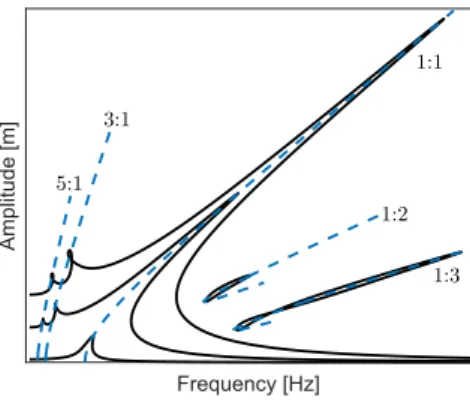
Frequency [Hz] Amplitude [m] 3:1 5:1 1:2 1:3 1:1
Figure 1: Nonlinear frequency responses and PRNMs of a Duffing oscillator.
In Figure 1, the nonlinear frequency responses of a single-degree-of-freedom Duffing oscillator are represented for different forcing levels. The calculated PRNMs are superposed to this Figure, which demonstrates that they offer an excellent characterization of the backbone of the fundamental resonance but also of the 3:1 and 5:1 superharmonic resonances and of the 1:2 and 1:3 subharmonic resonances.
References
[1] Kerschen, G., Peeters, M., Golinval, J. C., Vakakis, A. F. (2009). Nonlinear normal modes , Part I : A useful framework for the structural dynamicist. 23, 170–194.
[2] Shaw S., Pierre C. (1991). Non-linear normal modes and invariant manifolds. Journal of Sound and Vibration, 150 (1), pp.v170-173.
[3] Ponsioen, S., Pedergnana, T., Haller, G. (2018). Automated computation of autonomous spectral submanifolds for nonlinear modal analysis. Journal of Sound and Vibration, 420, 269–295.
[4] Krack, M. (2015). Nonlinear modal analysis of nonconservative systems : Extension of the periodic motion concept. Computers and Structures, 154, 59–71.