HAL Id: dumas-01313569
https://dumas.ccsd.cnrs.fr/dumas-01313569
Submitted on 10 May 2016
HAL is a multi-disciplinary open access archive for the deposit and dissemination of sci-entific research documents, whether they are pub-lished or not. The documents may come from teaching and research institutions in France or abroad, or from public or private research centers.
L’archive ouverte pluridisciplinaire HAL, est destinée au dépôt et à la diffusion de documents scientifiques de niveau recherche, publiés ou non, émanant des établissements d’enseignement et de recherche français ou étrangers, des laboratoires publics ou privés.
The interface between payment for health service and
Karimojong women’s health seeking behaviour
Anitta Underlin
To cite this version:
Anitta Underlin. The interface between payment for health service and Karimojong women’s health seeking behaviour. Sociology. 1999. �dumas-01313569�
The Interface Between Payment for Health Services and
Karimojong Women's Health Seeking Behaviour.
Anitta Underlin
IFRA
I IlI
IIHIIIIII II
N'. J IFRA371
01
Jot
UC/UJT362.I
A dissertation submitted in partial fulfilment of the requirements for the degree of Masters of Arts in Sociology of Makerere University. (Faculty of Social Sciences, November 1999).
DECLARATION
I hereby declare that this thesis is my original work and has not been submitted for a degree in any other University.
i-/l.q9
Signature Date
This thesis has been submitted for examination with my authority as University Supervisor.
a.
a-12-11
Signature Date
PREMAMBLE
Nadunget is a health unit seven kilometres from Moroto town in Karamoja. The buildings have recently been renovated. There are four rooms and an entrance hall in the main building. One room is used for storage of drugs; another room is equipped with a bed, which is rarely used. Another room is used for injections and for consultations with male patients. The last room is occupied by the In-charge, Anna, who is a nurse. Mothers also occupy this room with their babies. A nursing-aid is employed by the district, but he is usually absent, so Anna is in reality the only staff present in the health unit. In front of the building is a covered terrace where patients and their relatives meet. The only other buildings in the compound include pit-latrines and shower room for the mothers and their children. These were not working at the time of my visit.
Anna was born in the village just behind Nadunget. Aima worked for years in the private Kololo Hospital in Kampala. When the job as In-charge for Nadunget became she
"wanted to go home to serve my own people". She speaks the language, she is an integrated part of the society, and she familiar with cultural beliefs that impact on health seeking behaviour. She knows the practises of traditional health providers and she works closely with the traditional birth attendants in the district. My clear impression is that she is well liked, and respected by both male and female patients. She treats the patients with gentleness and respect and seems to take an interest in every patient she sees.
On the day that I spend in the health unit the majority of the patients were women with their babies and a few elderly women. The women would quietly wait on wooden benches inside the consultation room. Anna was seated in the middle of the room at a table with very basic medical equipment, a few drugs, and health charts. No man would enter that room. My attempt to be a 'fly on the wall' was at first a bit difficult, being the only white woman present and not talking Karimojong. Anna explained to the women I was a friend of hers and why I was there. The women sat with their children talking in low voices attending the babies. All the mothers were dressed in the typical Kanmojong style with beads and metal decorations and a piece of cloth tied around their body and another cloth in which the baby was tied. The clothes were often old, ragged, and sometimes appeared not to be washed for a long time. Only a few women wore shoes. The babies would wear a little piece of cloth like a little undershirt, but no under wear. The babies would also wear beads and other decorations which I later learned was different kind of amulets. Women sat patiently waiting for their turn. Anna would normally examine several
children at the same time. After the health card for the child was found, the mother would be interviewed about the child's symptoms and the child would have the temperature taken by placing a thermometer under the arm. I later learned that Anna also would question the mothers about the traditional herbs and other treatment they have tried before coming to the health unit. The reason for asking this was to separate the two types of treatment, as "only one form of treatment should be used at the time". Being a
Karimojong, Anna knew the most of the herbs and situations where used. After examining the baby the drugs would be given to the mother with an explanation of dosage.
Only a few men and young boys came during the day I stayed in Nadunget. Anna would sit so she that saw everybody entering the entrance hail. As soon as a male appeared she would leave the room and go with the male patient into the "injection room." Anna would sometimes come back for drugs to give to the male patient. Injections were sometimes to men. In contrast women and the babies received no injections. None of the women who had patiently waited for hours would complain or question Anna's procedure of serving the males immediately. When I asked Anna about this afterwards she seemed surprised by the question, and replied "this is how it is with us, you know that."
Cost sharing has been introduced by the health unit management committee in Nadunget. The fee is Shs. 300 for a consultation for a child and Shs. 500 for an adult. When women paid they would unpack an old plastic bag appearing somewhere from inside their cloth and careflully unfold rolled dirty and tattered bank notes. All the women would have the exact money - Shs. 300 only- and nothing more in their little plastic bag.
During my stay a mother came with a very sick baby. The mother was accompanied by an older man who I later learned was her father. They both looked exhausted as they had walked a long distance from their village. The baby was taken into the room with the unoccupied bed where Anna tried unsuccessfully for half an hour to save the life of the baby. The dead baby was given back to the mother, who was crying. The baby's grandfather stood a little distance away with tears rolling down the cheeks. Anna
explained that the mother had searched for money - the Shs. 300 - for too long. When she finally got the money it was too late and her baby died. I asked about exemptions from payment. Anna explained that no exemption rules are formally approved and all patient have to pay. When I asked about credit for males, Anna looked surprised at me and responded that she had never received such a request from any male. Her clear impression was that males are able to pay, as the household always will find money if a young
warrior or an elder male are sick.
This dissertation is about gender, health, and access to health services in a society where women have a status which might be considered of less value. It is a society in which women have less voice in decision making and limited access to resources at the
household level. It is a society where the mere payment of Shs. 300 for a consultation of a sick child is a problem.
ACKNOWLEDGEMENTS
I am grateful to the WHO Country Representative, Kampala Dr. A.B. Hatib Njie, and his staff for the encouragement and interest they showed in the study.
Special thanks go to Dr. Vincent Owiny, Medical Director of District Health Services Moroto District, who from the initial planning of the study to the implementation and finalisation showed positive interest in the project. The LCV-chairman Moroto District Local Council must also be thanked for his support and facilitation. Ms. Alobo Agnes, Gender Officer in Moroto District, Mrs. Betty Ogwel District Health Visitor Moroto District, and Anna Logiel, In-charge, Nadunget Health Unit, generously gave me their time and gave human faces to all the my statistics and thoughts through their knowledge and experiences from their daily work. Thanks to all the "great ladies", the TBA's who came walking from their villages to share their experiences with me with the common goal of improving the health services for mothers and their children. The Danida I CUAMM team Dr. Rossanigo, Dr. Oglio and Mr. Ivan Virtousi contributed greatly with local knowledge.
A special vote of thanks go to my research assistant Helen Alinga Akol, who, helped to carry out the household interviews. With Helen's knowledge, and dedication we were able to collect valuable and inaccessible information at the household level. Thanks to John Baptiste Lwanga who offered invaluable assistance in analysing the data.
Dr. Edward Kirumira and Dr. Andrew Mickleburgh, Department of Sociology, Makerere University, offered constructive critique and advice. Very special and warm thoughts go to Dr. Harriet Birungi, Medical Anthropologist MISR, Makerere University for
professional encouragement, constructive co-operation and advice.
Last, but not least, thanks to all the Karimojong women, who gave me their time and who gave voice to the findings presented in this report.
ABSTRACT
This study investigates how payment and payment terms1 in the formal and in-formal sector affects women's choice of health provider in Karamoj a, and why use of in-formal health care providers are the first choice for many Karimojong women. The main
objective of the study was to explore the inter-related factors that shape women's health seeking behavior in Karamoja, with particular emphasis on the role that user fees play in the process.
Like women in most parts of the world, Karimojong women have, compared to men, access to a smaller share of critical resources, including resources needed for health care. Access to resources and control over resources in the household impact on the ability to pay for health services and on the choice of health care option. Payment for health
services in the formal sector is, in contrast to the in-formal sector, normally characterized by up-front payment without possibilities for exemptions, credit, payment in installments, or payment in kind. Proximity of formal health care facilities with appropriate payment structures does not in itself guarantee that women will use the formal system as the first point of entry into the health care system outside the family. Co-operation between the different categories of health providers are therefore a necessity to ensure provision of affordable basic health care to rural Karimojong women. The traditional gender roles for men and women, which hinder equal access to health care and place responsibility for health care largely on women need to be addressed. Gender Officers in the districts should be actively involved in promotion of equal health for all by arranging sensitization
meetings in villages, as poor health status is linked to gender specific roles and to the fact that the discrimination against women in terms of access to resources hinder women's access to health services.
'Payment tenm' refers to the mode of payment required in the formal and informal sector i.e. cash up front before treatment, possibility of credit, exemption, payment in kind and timing of decided payment, which might impact the decision of preferred health care option.
LIST OF TABLES Page
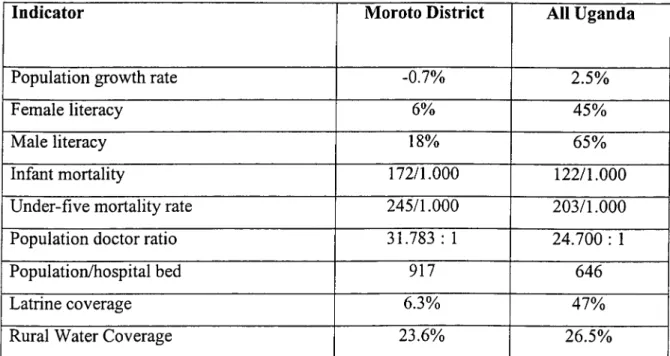
Table 1.1 Comparative regional health indicators. 2 Table 1.2 Social and health indicators for Karamoja. 9 Table 3.1 Basic health indicators for Moroto District and Uganda. 37
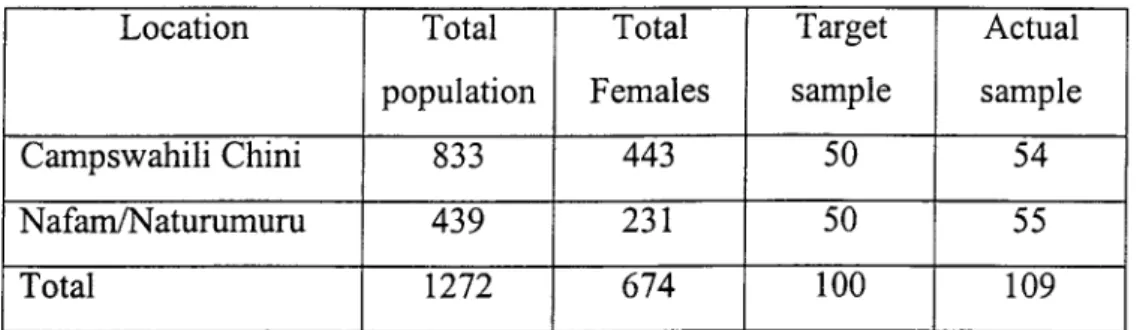
Table 3.2 Sampling frame. 40
Table 3.3 Profile of study of household. 42
Table 3.4 Head of family by sex. 43
Table 3.5 Profile of wealth status of family by gender. 43 Table 4.1 Availability of health care providers. 47 Table 4.2 Illnesses among children during the previous two weeks. 49 Table 4.3 Utilisation of health care options for child's last illness. 50 Table 4.4 Payment in connection with child's last illness in
different locations. 51
Table 4.5 Illnesses among women during the previous month. 52 Table 4.6 Utilisation of health care options for women's own illnesses. 53 Table 4.7 Payment in connection with women's last illness in
different locations. 54
Table 5.1 Sources of cash for health care for child's illnesses. 61 Table 5.2 Sources of cash for health care for women's own illnesses. 63 Table 5.3 Male and female participation in health decisions. 65
Table 5.4 Control of resources at the household level. 67 Table 5.5 Female/male equity of access to health care. 68 Table 6.1 Payment terms in formal health facilities. 71 Table 6.2 Fee paid during most recent hospital consultation. 72
LIST OF FIGURES AND ILLUSTRATIONS Page
Map 1 Map of Moroto District.
Figure 1.1: Conceptual framework. 15
ABBREVIATIONS
CHW Community Health Worker.
DDHS District Director of Health Services. DHV District Health Visitor.
FFS Fees-for-Service. GOU Government of Uganda.
HTJMC Health Unit Management Committees
MISR Makerere University Institute for Social Research. MOH Ministry of Health.
MS Medical Superintendent [in hospital]. NGO Non-Governmental Organisation. PHC Primary Health Care.
PRA Participatory Rural Appraisal. TBA Traditional Birth Attendance. TYP Three Year Plan.
UN United Nations.
TABLE OF CONTENTS Page
Declaration ii
Preamble iii
Acknowledgements v
Abstract vi
List of tables vii
List of figures and illustrations viii
Abbreviations ix
CHAPTER 1 Introduction
1.1 Background to the problem. 1
1.2 Statement of the problem. 10
1.3 Scope and purpose of the study. 13
1.4 Objectives. 14
1.5 Conceptual framework 15
1.6 Significance. 16
CHAPTER 2 Literature review 18
2.1 Karamoja and the Karimojong. 18
2.2 Women's health status and women's access to resources in Karamoja. 24
2.3 User fees. 27
2.4 Health seeking behaviour. 29
CHAPTER 3 Methodology 3.1 Research design 34 3.2 The setting 34
3.3 Methods of data collection 37
3.3.1 Quantitative methods 38
3.3.2 Sampling frame 39
3.3.3 Qualitative data collection 40
CHAPTER 1
INTRODUCTION
1.1 Background to the problem.
Uganda once had one of the best health care systems in Africa. With the misrule of Amin between 1971 and 1979 health services collapsed. By 1979 the organised provision of health ceased altogether in many areas. Strategies for improving health were identified in
1982, and a health sector programme funded by donors was implemented. 1 Since then Uganda's health policy has been guided by the Bamako and World Bank approaches, to be described shortly.
Uganda's population in 1999 was about 20.9 million people, of whom 5 1 % are female and 49% are male. The population growth rate is estimated at 2.5%.2 In 1991 the life expectancy was 45.7 years for males and 50.5 years for females. Uganda has poor health indicators and heavy burden of disease. Table 1.1 compares some of Uganda's health indicators with those of regional neighbours.
'Wiebe and Dodge, (1987:101-112).
2
Table 1.1 Comparative regional health indicators early-mid 1990s.
Health Indicator I Uganda4 Tanzania Kenya°
Life Expectancy (years) 48 51 54
Infant Mortality Rate per 1.000 97 82 67 Probability of death before 5 years 14.3% 12% 10% Total Fertility Rate 6.9 5.8 5.2
Maternal Mortality Rate per 100.000 506 529 345
Worldwide there are four principal sources of income for the health sector, namely:
governments, private cost-sharing, health insurance and external donor support. For a long time in many countries the most important source of health financing was the government. In recent years donor funding and private cost-sharing have become increasingly
important in many sub-Saharan African countries, as the government budgetary allocation for health has been limited due to a general deterioration in the national economy and budgetary constraints. 7 The shift towards private sources of finance has manifested itself in a variety of ways. The most notable change took place in 1980s, with the introduction and increase in user fees for government services. 8 By 1987 the private contribution to health expenditures as a percentage of total health expenditures in some African countries, including Uganda, was as high as 80%. 9+10 More recent studies from the World Bank
MOH, (1999:5) (c).
Uganda Demographic and Health Survey of 1995 referred in MOH, (1999c:4). Tanzania Demographic & Health Survey, 1996 referred in MOH, (1999c:5).
6
Kenya Demographic and Health Survey, 1993 referred in MOH, (1999c:5).
7WHO, (1993 :11-45). 8
Literature concerning user fees in the health sector includes, for example; Nolan & Turbat (1995); WHO (1993); MOH (1993b), Child health and Development Centre(1995).
The 'officially recognised' private contribution to health services in Uganda only covers service fees but excludes indirect costs such as transport, food and drink and accommodation for family members who care for their patients in hospital.
show a decrease in the percentage of private share of health service related expenditure from 70.6% of the total in 1993-4 to 57.9% in 1996-7. The private contribution of 57.9% is still more than donors and government together contribute. 11 In 1998/99 the
government and donors only spent the equivalent of USD 3.95 per capita on health in Uganda. 12
The Bamako Initiative, that was announced during a meeting of African Ministers of Health in 1987, saw user fees as playing an important role in the future provision of health care. The Bamako Initiative focussed on the attainment of universal accessibility to
primary health care in Africa through community financing and management. This model operates in a decentralized framework and recommends user financing of primary health care to be budgeted and planned at the community level. Higher levels of health care are not a direct concern in the Bamako model, nor does it promote the use of referral
hospitals. Although the Bamako model includes user fees with exemptions for the poor, these will have little application in communities, like most of those in Uganda, where almost everybody is poor. 13 It has been estimated that in 1998/99, 46% of Uganda's population were living in absolute poverty. 14 If the intentions in the Bamako initiative were followed nearly half of the Ugandan population would qualify for exemption from health user fees.
An alternative model for financing health is 'the standard model'. Here emphasis is on the general role of user fees in social sectors. This model has been of interest to the World Bank. The basic assumption in the 'standard model' is that user charges produce resources and efficiency benefits, while offering protection to the poor through exemption schemes.
WHO, (1993 :15). "Hay, (1998:34).
12
MOH, (1999b:2).
13
Nolan & Turbat, (1995: 1-5).
14
The standard model also assumes that fees for curative hospital services should be implemented first and will eventually cover the full cost of providing high-cost hospital care. If 'high' user fees are to be charged at hospital level, some form of insurance will be needed so that the risks of having to pay hospital charges can be shared. The model is a broadly-based model that could be applied to any developing country, although its
implementation would have to be tailored to a specific country's political, economic, and social circumstances. 15
Thus, the broader ('standard model') cost-recovery programmes and Bamako-type schemes are different in terms of: what the fees cover; who has control over the revenue raised; how fees for PHC relate to hospital costs; what kind of exemptions are provided to the poor; and how exemptions are implemented. This is not the place for a detailed
analysis of these differences between the two models, but the fact that the two models do differ must be kept in mind in discussing issues relating to cost-recovery. It must be emphasized, however, that poverty in Uganda remains high. Poverty is recognized by Government of Uganda to be the main underlying cause of poor health in the county. The Government has embarked on a major Poverty Eradication Programme. One of the components increases support to PHC in order to reduce the high burden of infectious diseases.' 6 According to the Burden of Disease Study in Uganda, over 75% of the life years lost due to premature death were due to just ten preventable diseases.' 7
The National Health Policy from Ministry of Health spells out the policy reform on private-public mix which is envisaged to take place during the planning period. The reform intends to restructure the relationship between public and private sector, with the aim of increasing the co-operation between the two sectors and increase the access to health care. More specifically the policy has stressed the integration of the previous
Nolan. & Turbat, (1995: 1-5).
16 MOH, (1999b:l). 17 MOH,
The Burden of Disease Study in Uganda, in MOH,( 1 999)(a). Prenatal and maternal conditions
20.4%, malaria 15.4%, acute lower respiratory tract infections 10.5%, AIDS 9.1% and diarrhoea 8.4%
together account for over 60% of the national death burden. Others include tuberculosis, malnutrition, trauma/accidents and measles.
isolated private sector ( NGO and private-for-profit as well as traditional healers and midwifes) in the national district health care system.' 8
The Ministry of Health (MOH) has deployed an operational planning framework. This planning framework initially covered a period of three years - a Three Year Plan (TYP). Five Year Plans will be developed for the period beyond the year 2000.' The objectives stated are:
to consolidate existing services and not to support expansion in terms of new hospitals and health units.
to reorient health services to primary health care. 2°
Financial constraints for the Health Sector are addressed in the TYP: 2'
"The plan frame stresses the financial constraints facing the public Health Sector - because the lack of fmance is a critical factor which is undermining the efforts to improve health in Uganda. The plan frame suggests that efforts be made to enhance the contribution of communities to their own health: it also identifies the need to increase contribution of external donors and to improve the efficiency of existing services." 22
The 'formal' (professional) sector is at present the only part of the health sector that qualifies for government finances, despite the fact that it is not the primary source of health care for Uganda's population. 23 People often use western medicine as 'last resort',
18
Birungi, (1999:47).
19 At the time of writing (July 1999) a Health Sector Strategy Plan 2000-2 005 was ready in draft. The Health
Sector Strategy Plan was developed as a collective undertaking of MOH, its development partners and other stakeholders. References are however made to the plan where appropriate and where it differs from the previous TYP although not passed through Parliament.
20
MOM, (1993a:preface:1).
21
MOH, (1993a).
22
MOM, (1993a: preface).
23
not only due to the cost of the medicine but also because non-formal health provision is an integrated part of the local society where people feel confident in the sense that the non-formal sector is subject to some community control in the sense that innon-formal service providers will be used only when they are trusted and recognised by the community. 24
To the best of my knowledge no research has been conducted covering the use of
traditional health care providers in Karamoja. 25 Research has, however, suggested that the traditional sector is the first point of entry into the health care system outside the family sphere for the overall majority of the Karimojong. 26 For particular communities in
Moroto District traditional health care providers are the only accessible health care option. The traditional health care sector is often considered as illegal by the professionals, due to the unregulated and unrecognised nature of the sector. However, TBA's have recently been recognised by the formal sector as valuable partners in out-reach health care
activities. Health messages can with the TBA's be disseminated to a rural population for whom accessibility to the formal health care system normally would be constrained or not possible.
In Karamoja few households have cash savings to pay for health care. The most
commonly reported strategies to obtain cash when immediate funds are needed for health care are the sale of subsistence crops and short-term borrowing. These strategies can be unreliable and loans depend on the presence of someone willing and able to lend out money. 27 Gender specific studies suggest that males are more likely than females to use
24
See, for example, Janzen, (1978:193), Kleinman, (1980), Henlander, (1989:25), Underlin, (1999)
25
Karamoja is the name of the district in the Northeast of Uganda. Karimojong is the name of the people. Ocan, (1993: 93) considers the Mathenko, the Pian, the Bokora and the Pokot as Karimojong. Pazzaglia, (1982: 39) and Novelli, (1988: 38) defme the Karimojong as 10 different groups Maseniko, Mogos, Kosowa, Bokora, Tome, Masingo, Muno, Peei, Kaleeso and Pian. These 10 groups are sub-groups of the three groups Maseniko, Bokora and Pian. I will use the last defmition for Karimojong.
26
Underlin, (1999), Hay, 1998(: 16:17), Lane eta!,. (1995:33), Barton etal., (1999).
27
Underlin, (1997). A pilot study carried out in the summer 1997 at Matany Hospital shortly after user fees were raised in a hospital in Karamoja, found that increased user fees affected women's attendance to the hospital negatively.
the government health system in Uganda. 28 Similarly, gender-specific data shows that female-headed-households29 are more likely than male headed-households to be forced to borrow to pay for health care services. 30+31 Like women in many parts of the world, Karimojong women have, compared to men, access to a disproportionately small share of the critical resources, including resources needed for health. Exit interviews with 82 women in three selected health units in Karamoja found that levels and terms for payment of health care impact on women's choice of health care option. 32
This research in this dissertation was conducted in Moroto - one of the two districts in Karamoja. The two communities in this study are Campswahili Chini near Moroto
Hospital and NafamlNaturumuru near Matany Hospital. The locations of the two hospitals are marked on the map of Moroto district on the following page.
28
GOU IUganda National Council for Children, (1994:96-97).
29
The term: "female headed household" is used in this dissertation in the way defined by the respondents themselves. Their defmition included: widows, women living alone as husband migrated, husband living with another woman, husband handicapped etc. The group of female-headed-household should therefore not be considered as a homogenous group.
° GOU fUganda National Council for Children, (1994:90-94).
31 Underlin, (1999:) A study carried out from November 1998 to May 1999 in Amudat Health Centre,
Tokora Health Centre and Nadunget Health Unit revealed that payment terms are an especially decisive factor for the women. Few women have savings to use for up-front payments - normally required in the formal sector.
Map of Moroto District.33
Moroto District
34°25E\..
s nup MATRENIIO e Moro to 6, KATIKEKILE S : Lodwar '•P.
tiatuk -Lu
P
LOLACHAT -KOTI DO
KolidoMOROTO
MATANY HOSPITAL —
Soro-v
'4
/ Keywee International boundary
District boundary - - - County boundary -. Sub-county boundary - Murram road District headquarters • Trading centre o 20 40 I. km El
E1'
Wi
4T? -' TNAMtt/7 I1
MALE)
4J1
eC1ORWA
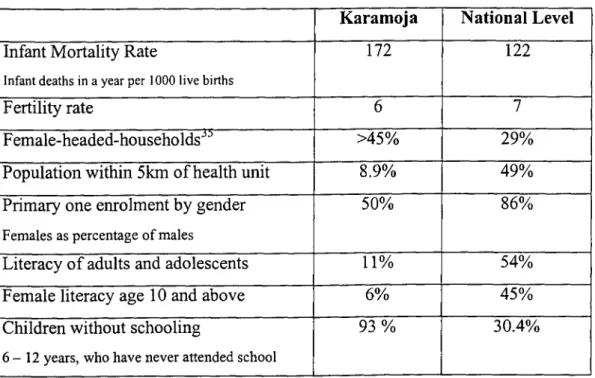
34°25'E S Rwabwoogo, (1997:94). E3Compared to the rest of Uganda Karamoja is a disadvantaged region that lags far behind the most of Uganda in terms of social well-being indicators. Table 1.2 shows some of the indicators for wellbeing for Karamoja compared to the national level.
Table 1.2 Social and health indicators for Karamoja. 34
Karamoja National Level
Infant Mortality Rate
Infant deaths in a year per 1000 live births
172 122
Fertility rate 6 7
Female-headed-households >45% 29% Population within 5km of health unit 8.9% 49% Primary one enrolment by gender
Females as percentage of males
50% 86%
Literacy of adults and adolescents 11% 54%
Female literacy age 10 and above 6% 45%
Children without schooling
6— 12 years, who have never attended school
93 % 30.4%
Matany Hospital near Moroto town has attempted to adapt its patient fee structure to the culture in Karamoja where women and children have a very low status. The hospital has a stated objective to maintain accessibility to the poorest and most vulnerable members of the society. Generally children pay only a small proportion of the adult consultation fee, while simple treatment to children is offered free. Fees for maternity care are kept low to meet the target that 80% of the patients should be women and children. Matany Hospital had to increase their fees in the summer 1997 as the hospital was running a budget deficit,
14 GOU / Uganda National Council for Children, (1994:17-62). The latest publish figure from MOH
estimate the Infant Mortality Rate per 1.000 for Uganda to 97 but as the figure available for Karamoja dates back to the publication from 1994, I will for comparison reason keep the "old" figures.
35 The table on page 46 in GOUfUganda National Council for Children (1994) is not completely clear in the
sense that the percentage of female headed households in the two districts in Karamoja can be read to be between 45-60% or as 60% . I have used >45% . The table shows however, that Karamoja is the area in
after adhering to a government policy to increase health workers salaries to 'a living wage'. 36
1.2 Statement of the problem.
The assumption in this study is that the utilisation of the health services is influenced by factors such as: 37
• the socio-economic characteristics of the health seeker • payment of user fees,
• quality of the offered care,
• availability of alternative health services, • cultural beliefs and perception of disease
A basic argument in the study is that payment structure for health care in combination with the cultural beliefs and perceptions of disease shape the health seeking behaviour for women.
The Government of Uganda has argued that user fees in the health system will create more equal access to services provided in the formal health system. Data from Matany Hospital appears to show the contrary. User fees had a direct negative influence on the attendance of female and child patients in Matany Hospital when they were increased in August 1997.38 My own pilot study found that at rural health units attendance did not
36
St. Kizito Hospital - Matany 1995/96 Hospital Report. St. Kizito Hospital is the formal name of the hospital given by the Catholic Fathers. The hospital is most often referred to as Matany hospital.
37
A variety of studies show these inter-related factors see for example Kleinman, (1980), Nolan and Turbat,
(1995), Oestergaard, (1992).
38
User fees at Matany hospital were reduced again later in 1997, due to the decrease in attendance of women and children. Source: Matany Hospital Archive October 1997.
increase after user fees were increased in Matany Hospital. 39 This suggests that some of the patients sought treatment outside the formal health system, probably in the non-formal sector where payment terms are more sensitive to the capability of the community and of individuals to pay user fees.4°
The findings of my pilot study in Matany and my study of three selected health units in Moroto District supported the hypothesis that payment for health care has a direct impact on women's health seeking behavior, partly because women do not control many
economic resources in Karamoja.4 ' Many Karimojong women must seek consent from a male family member to be able to pay for health services, or they may look for alternative treatment outside the formal health system. Discussions with the Director of District Health Services (DDHS) and 'In-Charges' in health units reveal that health care for men is normally paid for, since men control the necessary resources, but that women and children often found difficulties in paying even a small fee of Shs. 300 (USD 0.21). It was also noted that although cows constitute a major household resource in Karamoja, they are mainly exchanged during marriages and traditional ceremonies. When a male DDHS was asked if men would sell cows to pay for health services, he replied:
"I wish it was so, but cows are for marriages and traditional services, that is all. If it is a man, he will be paid for as the men control the resources, but for women and children no."
Karimojong women are, like women everywhere, the primary health providers in their society.42 This century the status of Karimojong women has declined relative to that of men for a number of reasons. Ocan has shown that Karimojong women have experienced
39 A study was in Oct.-Dec. 1997 conducted by Matany Hospital at the introduction of mcrease user fees. The gender broken data from Matany and interviews with officials from Moroto District were used in two pilot studies: "Equity in access to health services in the changing economic environment in sub-Saharan Africa." and " Introduction of user fees in the Health Sector and consequences for disadvantaged groups such as women." Underlin, (1997).
° Research by Underlin, (1999) at three selected health units revealed that the payment terms which require up-front payment are a constraint to women seeking health care in the formal sector.
41 Underlin, (1997), Underlin, (1999).
decreasing access to resources in the family household. In the traditional Karimojong setting women were responsible for milking and controlling the use of milk. With the change of milk from a product for subsistence to a commodity for sale, the participation of men in its extraction and control has increased greatly. At the same time, the increased risk of raiding and conflicts between groups has resulted in "buffer zones" that deny women access to their fields. 44 Although Karimojong men have, with the introduction of the plough, been involved in cultivation, women still perform the most labour-intensive processes. Control of the harvest is linked to the husbands or another male relative and women do not have direct access to the resources. 45
Despite the fact that women can often only gain access to resources through males, studies suggest that more than 45% of households may be female-headed. 46 This is partly an outcome of the predominance of male deaths in connection with raiding. Traditionally widows became the wives of their husband's brothers. Today many widows are no longer inherited, as their husbands might not have left cattle and only a few men are able to provide adequately for additional dependants. Women whose husbands die may also be rejected due to fear they may carry the AIDS virus. One common implication for the female-headed family is a reduced capacity to meet the needs of the family. 47 Although it is difficult to generalise, we know that female-headed households are more likely to suffer from poverty than male-headed households, as there is usually only a single adult to generate income for the family. A large proportion of Uganda's 19% core poor, who cannot afford adequate food, live in female-headed households. 48 Another study found that female headed households in general have less funds available for health care than
43
Ocan, (1994:122).
44 Lane, (1995:16).
' Ocan, (1994:121).
46
GOU/ Uganda National Council for Children, (1994:46) and Lane, (1995:32).
47
Lane, (1995:32).
48
GOU/ Uganda National Council for Children, (1994: 46 and 61).
male headed households. 49 Studies have shown that priorities resource allocation differ in female and male-headed households. 50 For instance, a survey carried out in 1995 in Uganda by the Inter-Ministerial National Task Force on Health Financing, found that female-headed household spent less on health care per illness, were more likely to use market/shops for care, and were more likely than other types of households to borrow to pay for the health care. 5 ' The utilisation of resources varies from household to household and female-headed-households cannot be considered as a homogenous group. However, studies suggest that many female-headed-household are poorer and have more difficulty in providing the necessary funds for appropriate health care for the family members than male-headed-households.
Most Karimojong women have less access to resources and fewer possibilities to pay for health services than men. It is therefore likely that user fees for health services have a direct impact on the health seeking behaviour of women and children in ways that
strengthen the existing inequalities in the Karimojong society. The current study therefore sought to establish how the payment for health services affects the health seeking
behaviour of women in Moroto District, including their choice of health care options.
1.3 Scope and purpose of the study.
The study was a cross sectional, exploratory, and descriptive study carried out from October 1998 to August 1999. The geographical area of the study was Moroto District in Karamoja, Uganda. Two communities - Campswahili Chini and NafamlNaturumuru - in close proximity to the two hospitals in the districts were studied. 109 Karimojong women
49 Child Health Development Centre, (1995:22-25). ° World Bank, (1997:5).
' Child Health and Development Centre, (1994:13). The female headed households were together with groups of high density households, low-education households, rural households with young children and fishing and pastoralists households identified as vulnerable groups to be specially targeted in monitoring the impact of introduction of user fees.
in the two communities form the core of respondents supplemented by group discussions and interviews with key informants. The major concern is the impact of the introduction of user-fees on the accessibility to health services for Karimojong women and children who, for reasons already stated, must be considered a particularly vulnerable group.
1.4 Objectives.
The study explores the inter-related factors that shape women's health-seeking behaviour in Karamoja, with particular emphasis on the role that user fees play in this process.
Specifically the study:
explorers Karimojong women's first point of entry into the health care system outside the family sphere system.
identifies the contribution of gender relations to the situation in which the Karimojong women has limited access to resources on household level although being the economic provider for payment of health services to their children and themselves.
describes the impact of payment structures within the health sector and on Karimojong women's health seeking behaviour.
discusses proposals for improving accessibility to health care for vulnerable groups such as women and children within the context of a user paid
private/public health care system.
The question to be explored in this dissertation is how type of payment impact on women's health behaviour and the utilisation of the formal health services. 52
52 Kleinman, (1980) introduced a model of three overlapping sectors in the health care system: the popular, the folk and the professional sector. The model is detailed described in the literature review. GOU/Uganda
1.5 Conceptual framework
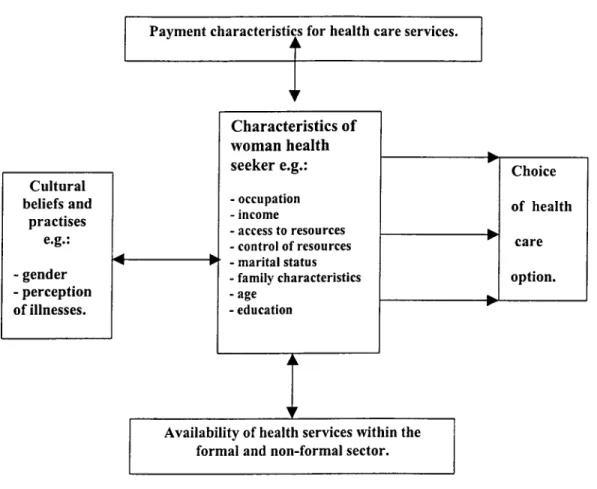
The study is conceived within the health-seeking framework illustrated in Figure 1.1.
Figure 1.1: Conceptual framework.
Payment characteristics for health care services.
Characteristics of woman health
seeker e.g.: Choice
Cultural
beliefs and - occupation of health
practises - income
- access to resources _
e.g.: - control of resources care
4 - marital status
- gender - family characteristics option.
- perception - age _
of illnesses. - education
Availability of health services within the formal and non-formal sector.
The health care seeker, the "actor", is at the centre of a decision making process
influenced by the payment structure for different types of health services, the availability of health care options, and cultural beliefs and perceptions of disease. The model is actor-oriented in the sense that social actions and interactions by actors or groups can change
National Council for Children, (1994:96) differs between the informal sector, the intermediate sector and the formal sector. The three sectors correspond generally to Kleinman's although being a more precise description of the situation in the Ugandan health sector. In this study I have chosen to use the terms
formallin-formal / traditional health care systems. The formal system corresponds to professional sector and in-formal/ traditional covers folk sector, popular sector and intermediate sector.
established social institutions.53 The term interface describes the dynamic process by which on-going negotiations and actions by the community members influence and change established institutions and create new institutions as a result of a local defined need. Social reality is as a result of on-going negotiations between mutually involved sets of actors. Actors are considered as capable, active, and reflective individuals who solve problems by choosing between different behavioural options. The actor oriented approach places the actor as the focus of the analysis by acknowledging that large-scale and remote social forces do alter life chances and behaviour of individuals to a certain extent, but also that external intervention are mediated and transformed by individuals and groups
affected to fit to the local context.54
Arrows in the conceptual framework therefore go in both directions. Payment terms and conditionalities of health services will impact the choice of health care option. The chosen option of health care reflect the availability and willingness of prospective patients to pay. Likewise, cultural beliefs and perception of diseases are dynamic processes, changeable over time. Availability of different types of health care options are influenced by demand, by national health policies, and general 'development' in the area.
1.6 Significance.
Women in Karamoja, as elsewhere, are most often the primary health providers to the family. Women's health seeking behaviour has therefore an impact on the well-being of family members, who need to be healthy to attend schools, to work in the fields, to herd the cattle and so forth.
This study contributes to a better understanding of the factors that influence women's utilisation of health services in Karamoja, with a particular focus on the impact of user fees and the impact of different types of payment systems. It is important to know how
13 For description of Symbolic Interactionism see: Coser, (1977:568-579), Farganis ed.,(1994:
359-375),
Biltonetal,. (1996: 91-96, 620-631).
54Norman L. et al., (1994: 64-65).
people decide between different health care alternatives, since there are situations in which some alternatives will be more appropriate than others.
Many people view Karamoja as a 'special case' due to its remoteness and history of civil unrest, which has an impact on the health care delivery. Nonetheless, many situations faced by Karimojong women are faced by other women in- and out-side of Uganda. To this extent many of the findings are relevant in other settings also.
CHAPTER 2
LITERATURE REVIEW
This literature review is divided into two parts. The first section discusses Karamoja and the Karimojong. The second part focuses on:
women's health status and women's access to resources in Karamoja; the impact of user fees on utilisation of health services in other settings; health seeking behaviour.
2.1 Karamoja and the Karimojong'
Karamoja is the name of the 24800 square kilometer region that occupies the northeastern corner of Uganda. In the 1991 census Karamoja had a human population ofjust under 400.000.2 Ecologically, Karamoja is different from most of the country, resembling the southern part of Sudan and Turkana in northwestern Kenya. Rainfall is unreliable in terms of timing and in spatial distribution. Annual rainfall totals range from 500 mm to 1000 mm, with variations from year to year and from place to place. Thorny bushes,
woodland,and patches of grassland characterize the vegetation in Karamoja. Karamoja can be subdivided into three ecological categories running from east to west, with the west endowed with better prospects. Because of seasonal variations in weather and resource potential, the three zones have been interrelated through social activity in order to ensure sustainable use of resources. Pastures are broadly divided into short and long grass plains, and their respective qualities determine much of the pastoral migratory pattern.3
'For a detailed description of the ecology and development efforts in Karamoja see Wabwire, (1993:28-49).
2
The 1991 census is considered by many in Karamoja as unreliable as the census was conducted in the dry season, when many men were grazing cattle outside of Karamoja.
Traditionally male Karimojong are cattle herders. Although pastoralism is difficult in much of Karamoja, the Karimojong have been able to organize their activities in such a way as to exploit the resources offered by the land without impoverishing it. The essence of this method is the rotation of pastures, - known as transhumance.4
The Karimojong are Plains Nilotes. Other Plains Nilotes include the Samburu, Masaai, Turkana and Jie. Cultivation of crops (mainly sorghum) by women plays an important role in the Karimojong pastoral economy. The Karimojong have permanent settlements in which most of the family stay throughout the year, while male herders move out with their animals in 'cattle camps', sometimes a hundred kilometers or more from home. Crop cultivation takes place in the plains near the settlements, producing important additional sources of food.5
The traditional social organization includes the political system, which is based upon power exercised collectively by elders who have passed through the initiation rites for male Karimojong known as the "asapan".
The traditional age-set structure of men is illustrated below:
2 4
Boys Warriors Elders Grandparents (Labour) (Authority) (Retired) The elders in the Assemblies discuss matters of importance for the Kanmojong. Matters discussed in the Assemblies normally include: raids, disputes among individuals, cases of theft or of adultery, inheritances etc. Decisions are taken on the basis of the arguments contributed by each person. Non-initiated males must remain outside the semi-circle of the Assembly, but have the right to participate in the discussion. Women and children are
40can, (1992b:4-5) distinguishes transhumance from nomadism as nomadism involves movements from
place to place with whole families, and thus no permanent claim on land or territory. Transhumance involves movement with livestock according to seasons, in a regular pattern repeated from one year to the next.
not allowed into Assemblies. 6 Recent studies in Karamoja by Ocan shows that criteria attaining authority are often no longer social age but economic ability. There are many elderly people who are now unable to be members of the elders council because of impoverishment. 7
In 1988 Novelli, a priest who lived among the Karimojong for twenty years, described the traditional Karimojong society as a democratic and egalitarian society.
This democratic and egalitarian system offers a strange contrast with that of neighboring peoples, which are structured among more or less hierarchical lines." 8
Ocan challenged Novelli's opinion and suggested that many anthropologists:
failed to see that not all warriors wielded equal power nor equal benefits. They ignored the social stratification of the society and paid attention to the natural strata. They equally ignored the fact that not all elders in their councils were equal. Those who despite being elders continued to command the youth to war or foretold the fortunes ahead and, above all possessed more cattle gained prominence. "
Novelli believes that raiding has now degenerated to such a degree that it cannot longer be distinguished from pure banditry. 1° Contrary to popular belief, cattle raiding was not a common occurrence in Karamoja before the middle of this century. 11 Raiding has created a new class of leaders, the warlords, who accumulate their wealth and status through cattle raids, and robbery of travelers on highways. Villages and cattle camps are burned,
6Novelli, (1988:44-48). Ocan, (1992a:39). 8 Novelli (1988:46-47). Ocan, (1994:109). '° Novelli, (1988:154). "Ocan, (1992b). 20
and killing is done for its own sake. Rape of women and young girls, unknown earlier, has become a usual feature of raiding.
Raiding and demographic pressures led to a decline in the ratio of people to cattle in Karamoja from 1:3 in 1931 to 1:1 in 1980. 12 The number of people owing large herds in Karamoja is growing smaller while those owing few or no cattle is growing larger. Families without cattle risk a less nutritious diet as they have no immediate access to milk, blood and milk, which is an important part of the staple diet. Lack of cattle impact on gender relations. Male family members may migrate in search for work and leave the female family members to provide for the family.
The lives of Karimojong women differ from those of men economically and socially. Men live a life that is mostly nomadic and their diet reflects this fact. Men's diet is mostly made up of meat, blood, and milk. Although men are increasingly participating in the agricultural sector, male participation does not mean that men perform the same tasks as women. Notably, only males use ploughs. Labour-intensive and time consuming tasks remain feminine tasks, leaving the women to bear the heaviest burdens in agriculture.' 3 Lane (1995), Ocan (1994) and Okwera (1994) demonstrated that during the last 10 years Karimojong women's access to resources has diminished due to men's increasing control of the yields of livestock and agriculture and the increased insecurity due to cattle raiding. Ocan suggests that where a product gets transformed from subsistence to a product for extraction of resources males take over the control.
Women are responsible for all important daily chores around the 'manyatta "a : Women build houses, look after the children, grow vegetables, prepare food and collect firewood. Women's diet is composed mostly of products from the fields including maize, sorghum,
12 Mamdani
et.al., (1992:18) refer to figures by which the total numbers of cattle in 1930 was 192.000
compared to 308.000 in 1980. In the same period the human population in Karamoja has increased from 65.000 in 1931 to 350.086 in 1980, which as a consequence will mean a decrease in the ratio of cattle per person.
B Ocan, (1994:118-122).
14 Compound containing a number of huts. The manyatta is normally housing one extended family. Each family unit consists of one male with one or several wives. Friends can also stay semi-permanently in the compound.
various greens, and chickens. Women bring products from the fields to the men while they herd their animals, including ground meal, beer, and tobacco.' 5 The diet for women and men can be considered well balanced in 'good' times, but women and children will be the first to suffer when there is not sufficient food for everybody. Traditional food taboos prevent women and children from eating protein-rich food such as chicken, eggs and goat meat, which means women are even more reliant on milk, blood and meat from the cattle.
The family of the future husband pays bride price for the Karimojong woman in a system which has been described by some people as an economic transaction, in which the woman is treated in a way similar to an object bought in the market. However, Novelli argued that the Karimojong bride wealth payments and marriage should be seen as a social system of alliances, sealed through the transfer of livestock to the family of the bride, to safeguard individuals. Novelli also argued that polygamy seen in this social perspective loses some of its negative cormotations. By increasing and strengthening the network of alliances with clans, the family group will gain greater social and economic security. Children are perceived as a guarantee of prosperity. Girls will secure the family wealth in form of bride wealth and the sons will generate income as warriors bringing cattle home to the family. It must be stressed that this contributes to the subordination of Karimojong women. For example a divorce would mean that the family should deliver the bride wealth back to the husband's family.' 6 For this reason considerable pressure is usually exercised by the women's family for her to remain in the marriage - even in case of serious and prolonged ill-treatment of the wife.' 7
A woman achieves a new status when she is marries and from that moment, she is no longer called girl (apese), but woman (aberu). Adultery rarely happens and traditionally
15 Novelli, (1988:61-65), Ocan, (1992b:30) mentions also security constraints as a contributing factor for
malnutrition, as the in-security means that the warriors will keep all the cattle with them, and not, as earlier, leave a few cattle behind to feed women and children.
16
Interviews with several key informants June 1999.
' 7Novelli, (1993), Lane, (1995). Confirmed by interviews with key informants June 1999.
was considered one of the gravest offences that a Karimojong could conunit. In the traditional society an adulterous male would be lynched. Now an adulterous male is more likely to be required to make a payment to the offended husband, corresponding to a new marriage (at least sixty heads of cattle). An adulterous woman can be repudiated by her husband, in which case her father must return the bride wealth and cattle of the marriage. If the woman is not repudiated she must undergo a special 'cleaning' ceremony performed by her parents.
Women constitute more than half the population in Karamoja, but are largely absent from public and private decision making. Government policy to increase women's participation in Local Councils has yet to have a significant impact. Vagnby found that Karimojong women are social jsed to feel it is the role of men to take decisions, and that despite being members of Health Unit Management Committees (HUMC) women frequently do not show up. 18 This is one of the reasons why concerns of women and the inability of some women to pay the user fees are rarely raised at the HTJMC, or, if raised , they are discussed and decided upon by the male members of HUMC's. During a management meeting for the Health Unit in Nadunget Sub-county in Moroto District no woman was present in the Health Unit Management Committee, in spite of women being members of the committee. One elder replied when asked if a woman could chair the }{EJIMC
"Women can also lead, provided there is a man to guide." 9
Wamai and Barton also found that Karimojong women and children lack a meaningful voice in domestic and community affairs. Gender roles affect women's and girl's freedom of movement and participation in associations. It is the expectation that married women stay at home in charge of the domestic work, which prevent their active participation in community and political activities. 20
18 Vagnby, (1998:14). 19 Vagnby, (1998:14).
This section has reviewed literature concerned with Karimojong women's lack equal access to resources on household level and how Karimojong women's participation in the decision making process both on family level and in the public sphere is hindered by the traditional gender roles. The next section reviews literature concerned with gender impacts on accessibility to health care for women and their dependants.
2.2 Women's health status and women's access to resources in
Karamoj a.
Ostergaard has shown that gender, health, and development are related in a dynamic triad. 21 Without a certain level of economic and social development a population cannot be provided with basic health care, and without a healthy population, development of the society will not take place. Ostergaard adds to this chicken and egg dilemma a third dimension, which is always present - gender. She raises the following questions:
"Can a nation give birth to healthy babies without healthy mothers?" "Will the suckling survive without sufficient mothers' milk?"
"Will the family gain enough energy from its meagre resources if the food-providing female is not able to produce sufficient provisions and practise good nutrition?"
"Will the growth in population stop exploding if females have no knowledge about and no access to family planning measures?" 22
Clearly, the cultural and socio-economic context within which women live has a bearing on their health. Ugandan women are trapped within a web of traditional values that assign a very high value to martial status and childbearing, and almost no status to anything else women do.
"The health status, as well as the social status, of Ugandan women is of particular concern.
21
Ostergaard, (1994: 110).
22
Ostergaard, (1994: 110-113).
The low status that the traditions assign to them, their lack of voice in decision-making as well as in formulation of politics, further impede their chances to stay healthy and productive."23
Women usually marry at an early age in Uganda despite the legal minimum age of marriage of 18 years. 24 Less than 2% of women never marry. Early marriage and high fertility impact on women's lives in many ways including health, education and material well-being. The majority of mothers - 43% - produce their first child whilst between 15 to
17 years of age. The fertility rate of 7.1 is among the highest in Africa. 25 A baseline study for Moroto conducted in 1999 found that of the mothers who had delivered within the last 12 months, 11.2% had lost their child. 26
Women's resistance to disease is often lower compared to their male counter-parts due to the strain of repeated childbearing and breast-feeding, combined with poor nutrition and long hours of hard work. Many women are most of the time in poor health due to the high prevalence of anemia, malaria, AIDS and other sexually transmitted diseases. A survey in four districts in Uganda showed that the morbidity rate of rural women was alarmingly high and that 76% of women reported being sick in the two weeks prior to the interview. 27 The latest draft of the Health Sector Strategic Plan recognised that:
"... the different health needs and priorities of women and men have not been identified and addressed by the health system. Thus, development of health sector policies and programmes have not responded to gender concerns, showing little appreciation of the way in which inequality impact on health of the population."28
23 Kirumira etal.,
(1993).
24G0U/Uganda National Council for Children, (1994:119) In Uganda 44% of women marry between the age of 15-17 years and 23% of girls marry under 15 years.
25G0U/Uganda National Council for Children, (1994:22).
26 et al.,(1999). 27 Kirumira et
a!, (1993:13). The four districts included covered Gulu in the Northern region, Mbale from Eastern region, Mbarara from Western region and Entebbe representing the central region.
28
Many barriers hinder women's access to health facilities. This is especially true of poor women, who form the vast majority of the population of women. Long distances, poor communication, cost of transportation and insecurity may all discourage women from travelling to health centers. The loss of a day's work in the field and the absence of the mother from unattended children and necessary household duties are also obstacles. 29 Food production must often take priority over health care to ensure the survival of many rather than take time just to care for one. Gender roles further act as a barrier for equal access to health services, as the women has to get the consent from their male counterpart before going to a health clinic. 30 An other obstacle women face in gaining access the appropriate health care is shortages of drug supplies in many health facilities. Women are often given prescriptions and have to buy their medicines on the private market, at prices well beyond the reach of the most women. 31
Karamoja has as many as 37.800 female-headed households, partly due to male deaths in connection with raiding and the change in social situations by which widows are no longer automatically are 'taken over' by the dead husbands brother. Another group of female-headed households are these, where the male breadwinner has migrated in search for work leaving the families behind to produce for themselves. 32 These households with normally only one adult, adopt a number of strategies for survival. One of these strategies may be to reduce expenditures on health. 33
Lack of resources impact on the health seeking behavior. A study from Kenya concerning equity in provision of health care to the poorest part of the population had as major findings:
29 See, for example, Lane
etal., (1995:23).
° Wamai and Barton, (1994: 81). ' Ostergaard, (1992:13 1). 32 Ocan, (1994: 128) and Lane,
(1995:32).
33 Hay, (1998:14).
60% of those who sought an alternative to using government health facility did so due to costs or dissatisfaction with the service or both.
- 95% of the poor households indicated that they new of someone who recently had
not sought care because inability to pay.34
Similar findings have been reported in a survey in Uganda which identified female-headed households as particular vulnerable, and found that the female-female-headed household were more likely to borrow to pay for health services than other types of households and that female-headed households spent less on health care per illness than other
households.35
This section has reviewed literature relevant to the issue of how limited access to
resources at the household level impacts the health seeking behaviour for the Karimojong women and their dependants. The next section in this literature review focuses on
Government of Uganda's overall strategy for implementation of cost-sharing in the formal health sector, including the protective measure envisaged for the poorest part of the
population.
2.3 User fees.
As stated in Chapter One Uganda's health policy concerning cost-sharing is influenced by the Bamako initiative and the World Bank financing model. The Government of Uganda has committed itself to shift from costly curative services to more cost-effective
preventive services. 36 Although the Ugandan population already contributes significantly to payment of health services, the government has stated its desire to increase further individual and conmTlunity contributions to payment of health services. The latest draft of the Health Sector Strategic Plan for the year 2000/1 - 2004/5 states:
34 Newbrander etal., (l995:v).
35 Child Health and Development Centre, (1995:13). 36 See : MOH, (1993b), (1993a),(1997a).
"Government will ensure that such schemes do not unduly discriminate against the poor and vulnerable groups, distort the demand for care, or the provision of health care."37
There is no precise description of how the Government will ensure that the poor and vulnerable have access to health facilities, as it is increasingly the responsibility of the Districts to put such measures in place. It is not clear how implementation of a new health strategic plan will differ from the present situation, where no mechanism in reality is in place for ensuring equal access to health facilities. Moroto District has not implemented the guidelines concerning cost-sharing recommended by MOH in 1997. No overall district policy concerning implementation of user fees has been decided upon in the district. District guidelines defining groups to be considered for exemption are non-existent in the district. Research suggets that groups likely to get exemption in Uganda at present are military, police and health workers including family and relatives.38
Exit interviews with patients at three different formal health facilities in Moroto District have suggested that treatment in the non-formal sector is not always cheaper than in the formal sector. A significant difference observed is that whereas money is the only acceptable form of payment in the formal sector, payments in kinds such as a chicken, beer, food etc. are acceptable in the in-formal sector and that extended credit facilities also exist. This difference in payment terms sometimes wrongly leads to the conclusion that traditional treatment is cheaper than professional treatment. However, a value for the kind
'paid' for traditional treatment needs to be set. A chicken is for example equivalent to Shs. 2500. If this value is compared to the cash payment required for treatment in a formal health facility it is not always possible to argue and document that traditional health care providers demand less payment for their services than what is required in the formal sector.39
MOH, (1999c:52).
38
Underim, (1999).
Because Karamoja belongs to one of the most disadvantaged regions in Uganda, tax revenue is very meager, so funds available on local level to improve the quality of the health care system are extremely limited. It is possible that decentralisation might reinforce the already existing resource inequalities. Delegated funds from central level may decrease leaving District responsible for raising supplementary funds for essential health services. 40
The focus of this section has been the overall health strategy and aspects of the policy for cost-sharing within the health sector. The next section investigates how payment and payment structures impact the utilisation of available health care options.
2.4 Health seeking behaviour.
People choose their health service provider on basis of factors such as cost, on quality of services offered, and the level of service they believe is appropriate to their needs. In rural areas this depends, importantly, on the proximity of the provider, because of transport and time 41 The interface between payment for health services and health seeking behaviour is a dynamic process where the availability of different categories of health care providers impacts the choice of the health care seeker. The health seekers choice and the demand for a particular health care option impact the payment conditions of health care facilities e.g. only a few private practitioners or clinics are available around Matany Hospital in contrast to Moroto town. New health care facilities might open, as have been the situation with private health care providers, if the demand is there and existing health care facilities might adjust their service or/and payment to the ability and willingness to pay by the patients. The market of health care providers is not static but dynamic adapting to the demand and competition.
40 Hay, (1998: 14). 41Hay, (1998:18).