SOLID-LIQUID EQUILIBRIUM MODELLING FOR TRIACYLGLYCEROLS
EXHIBITING MULTIPLE SOLID PHASES
M. TELES DOS SANTOS (1,2), G. A. C. LE ROUX (2), V. GERBAUD (1)
(1) Université de Toulouse, Laboratoire de Génie Chimique (LGC) UMR CNRS/INP/UPS, Allée Emile Monso, Toulouse
31000 FRANCE
e-mail : [email protected], [email protected]
(2) Universidade de São Paulo, Escola Politécnica, Laboratorio de Simulação e Controle de Processos, Av. Prof. Lineu Prestes, São Paulo,
580 BRESIL
e-mail : [email protected]
Abstract. Important end-use properties of vegetable oils based edible products are strong related
to the equilibrium between a solid crystalline network and a liquid phase. This work presents the available literature development of solid-liquid equilibrium in triacylglycerol systems and highlights how it can be coupled with a Computer-Aided Mixture and Blend Design framework, for design new mixtures/blends with improved properties allowing a better use of renewable resources as vegetable oils. Stability tests were implemented as they are an essential step for powerful solid liquid equilibrium resolution and some results were presented for a four component triacylglycerol mixture in different temperatures and compositions.
Key-words. Vegetable oils, triacylglycerol, solid-liquid equilibrium, CAMbD, stability analysis.
INTRODUCTION
Vegetable oils are widely used in edible products. Controlling the microstructure of structured foods is the key quality factor in tailor-made foods, which represents an actual and future trend in the food industry technologies (1). This is especially useful in fat based foods, such as margarines, butters,
chocolates and shortenings, where the crystallization and melting behaviour plays an important role in the product acceptance and quality requirements. Designing tailor-made lipids mixtures that match desired properties can enhance industrial opportunities regarding vegetable oils as renewable raw materials. Such a problem lies within the scope of Computer-Aided Mixture and Blend Design (CAMbD) tools and
requires the ability to compute properties of triacylglycerol (TAG) mixtures, the major constituents of vegetable oils (>95%). Among the properties, multiple solid – liquid phase equilibrium calculations are the key issue. Indeed, besides the interest as fundamental science, phase related properties of lipid mixtures strongly impact the end-user properties that are sought in industrial applications.
Despite its importance, a general phase equilibrium description of all possible mixtures of TAG molecules is lacking and experimental data is scarce. Until 1990, only empirical calculations were used to perform phase related calculations, focused on the solid fat content. Such empirical approach evidently limited the application range as well as fundamental understanding of phase behaviour of TAG systems
(2). After 1990, experimental data on fatty systems (3)(4) were published along with discussions about
general TAG phase equilibrium modelling (2)(5)(6)(7) .
A general thermodynamic approach for mixture equilibrium, widely used in other areas of chemical engineering, is difficult to apply in fat systems due the complexity arising from the multiple scales involved (1): fats consist of hundreds of different TAG, each one been a combination of three fatty acids;
in addition, each TAG crystallizes in 3 different basic polymorphic forms (α, β’ and β).
The aim of this work is review briefly solid-liquid equilibrium based on the literature available and to highlight how it can be coupled in a CAMbD framework for a systematic search for triacylglycerol
mixtures exhibiting pre-defined properties.
MELTING AND CRYSTALLIZATION BEHAVIOUR OF TAG SYSTEMS Pure Component Properties and Polymorphisms
Due to their high molecular weight, triacylglycerols tend to crystallize in a solid network with different crystals packing called polymorphisms: the unstable α-modification, the metastable β’ modification, and the stable β-modification. Many common foods such as chocolate, butter, margarine and spreads derive their sensorial attributes from the structure created by this network of crystalline fat. Polymorphisms are a key issue for molecules and mixtures design. Among the variables affecting the thermodynamic properties of individual TAG molecules, there is the fatty acids distribution, their position on the glycerol backbone and the number and position of double bonds in the fatty acid chains.
Depending on the temperature and composition, a mixture of solid and liquid exists. Controlling the solid fat content and its temperature dependence (melting behaviour) play a significant role in edible product quality.
Mixture Properties
In addition to all the variables previously mentioned for individual molecules, the mole fraction of each molecule can directly affect the properties of mixtures, especially when individual molecules are very different. For example, decreasing the amount of an unsaturated molecule in the mixture increases its melting temperature. Chemically enhanced hydrogenated oils found in many food manufactured products are such an example. But the process also produces trans fatty acids which are linked to total and LDL cholesterol concentration (8).
Edible oils and fats can contain more than 500 different TAG molecules and therefore, such mixtures don’t show a distinct melting point, but a long melting range. This melting range is one of the main factors determining the properties of fat-based foods.
Solid-liquid Equilibrium coupled with CAMbD framework
Thermodynamic solid – liquid equilibrium calculations (PT flash) are defined as: given the overall composition of known molecules and temperature, find the number of phases and their composition. In our development of a framework for finding new structured lipids, the identity of compounds (and their composition) is not known a priori, but generated along the CAMbD procedure: given a set of chemicals
and a specified set of property constraints, determine the optimal mixture or blend (9). Therefore, the solid
– liquid equilibrium must be coupled with a search procedure to identify the molecules and their composition that gives, after an equilibrium calculation, the desired amount of solid and melting profile given by the user.
N i i i Lz
z
RT
g
1ln
(liquid) (1) Set of desired mixture properties o SFC (solid fat content) o Melting range Temperature (T)
Change
Size of fatty acids chains in positions
1,2,3
Number of double bounds Position of chains.
Solid-liquid equilibria (SLE)
Stability Tests
Resolution by minimum GE methods
compute
SFC (solid fat content) Melting range
SFC and melting range calculated = SFC and melting
range desired Type of TAG molecules
and their composition
YES NO Modified fatty acids Natural fatty acids
Known composition in fatty acids
Vegetable Oils
Figure 1: General View of Solid Liquid Equilibrium coupled with CAMbD procedure.
z
m
or
T
T
R
H
z
RT
g
N i i m i m f m f i m ' 1,
ln
1
1
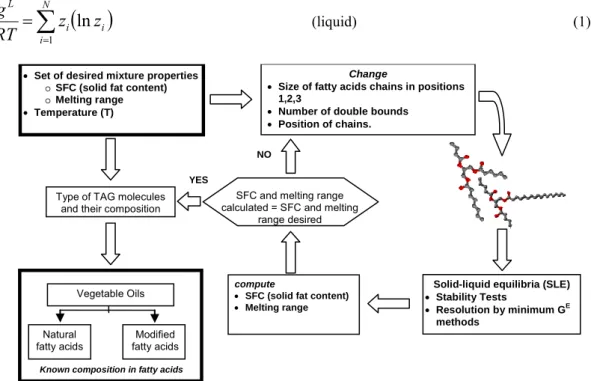
(2) Polymorphic forms are distinguished by their own temperature and enthalpy of fusion for which robust and accurate property models are needed.Figure 1 shows a general description of the CAMbD framework being developed. It shows that
finding the optimal blends of natural and modified lipids that satisfy a set or pre-defined properties is currently a heuristic procedure. But SLE coupled with optimization methods can give an alternative and rational route to find new mixtures/blends of lipids with improved properties.
Normally, fatty acids composition of natural and modified oils are known, and can directly be linked to triacylglycerols results from SLE – CAMbD with statistical models for fatty acids distributions
(1,2,3-ramdom and 1,3-random-2-(1,2,3-ramdom).
MULTICOMPONENT MULTIPHASE SOLID-LIQUID EQUILIBRIUM MODELLING
The ultimate goal of solve SLE is predict the melting range and solid phase amount of fats from their overall composition and temperature. TAGs show limited intersolubility in the solid phase, therefore solid fat is a number of different coexisting solid phases.
In a multi-component system with a liquid phase and at least one solid phase, the condition for thermodynamic equilibrium is that the chemical potential of each component i in each phase must be equal to that in any other phase:
liquid i solid i
(3)T
T
R
C
T
T
T
R
C
T
T
R
H
x
x
pi fi pi fi f i f L i L i S i S i ,1
1
, , ,ln
,ln
(4)According to (2), for TAG systems ΔCp = 0.2 kJ/mol and the difference (T
f – T) is never greater than
70 (usually between 0-20). With these assumptions, Equation 4 becomes:
f i f L i L i S i S iT
T
R
H
x
x
1
1
ln
,
(5) This equation is coupled with the material balance and stoichiometric condition to solve the solid-liquid equilibrium.
P j i j j iz
x
1 (6)
N i j ix
11
(7)The result is the number of phases, the fraction of each phase and their composition. By this, important properties can be assessed as total solid content and melting profile. For solving SLE, three steps have to be considered:
1. Getting pure component properties (Tm and Hm): some experimental data is available by (2).
Alternatively, Group Contribution Models and Group Interaction Contribution Models by (2) (10)
are implemented, giving the framework an estimation capacity for the thermal properties of any type of TAG molecule.
2. Activity coefficients in solid phase: Excess Gibbs Energy Models are used. The necessary interaction parameters (Aij) between two molecules are calculated by using the concept of
isomorphisms (the degree in witch one molecule is similar to another) discussed by (2). There is
experimental and theoretical background to consider liquid and alpha solid phases as ideal (2) (6)(7). Thus, only β’ and β activity coefficients must be determined.
3. Numerical methods to solve de non-linear system of equations.
In a TAG multi-phase problem, the number of phases is unknown at first. The calculation procedure is therefore divided in 2 steps: first a stability test is performed to detect phase split and the state (liquid or solid) of the new phase that will be formed; then, the multi-phase equilibrium problem is solved to refine the compositions of all phases by looking for a global minimum Gibbs Free Energy. There are many works coping with numerical strategies for stability analysis and solving this optimization problem in different types of multi-phase mixtures (11)-(13). However, there is still few works addressing these
issues in triacylglycerol systems.
One of the most important methods to perform stability analysis is the so-called Michelsen Method
(14), derived from the thermodynamic tangent plane criterion. The adaptation of Michelsen’s method for
cope with polymorphism is done by increasing the number of initial estimates for the trial phase that will be formed after split in the original mixture: pure β, β’ and α phase of each component plus an β, β’, α and liquid mixture with average phase composition. Then, these initial guesses are converged to stationary points (new compositions). At this points (x) the displacement (F(x)) from the tangent plane to the Gibbs energy surface at overall composition z can be evaluated, and the point with most negative value of F(x) is used as initial guess for the new phase that will be formed after split. Negatives value for function F(x) mean that the original one-phase mixture is unstable: in the other hand, stationary points with no negative values indicate the original mixture is stable.
Stability test is performed until no more possible splits are possible (mixture stable), giving the number of phases present and an initial guess for their composition and fraction.
RESULTS
Table 1 shows some stability tests performed in a mixture composed by 4 mono-Tags formed by the fatty acids Palmitic, Stearic, Myristic and Oleic (PamPamPam, SteSteSte, MyrMyrMyr, OleOleOle). The overall composition (Z) and its physical state, temperature, stationary points and tangent plane distance are shown with the physical state of the new phase that will be formed in case of instability.
Table 1: Stability tests performed in a triacylglycerol mixture.
Feed (Z1,Z2,Z3,Z4) Temperature (°C) Stationary Points (x1,x2,x3,x4) F(x)/RT Phase Split (0.1135, 0.1713, 0.5438, 0.1713) -0.9610 liquide (0.1598, 0.0441, 0.7520, 0.0441) -0.3044 beta' (0.1369, 0.4103, 0.0424, 0.4103) -0.0417 beta' (0.0546, 0.0058, 0.9338, 0.0058) -0.4127 beta' (0.9170, 0.0227, 0.0376, 0.0227) 1.1466 beta (0.0035, 0.4980, 0.0005, 0.4980) 0.1060 beta β' (0.25,0.25,0.25,0.25) 80 (0.0011, 0.0001, 0.9986, 0.0001) -0.3533 beta (0.0555, 0.0330, 0.6802, 0.2313) -1.2008 liquide (0.0223, 0.0010, 0.9701, 0.0067) -0.8398 beta' (0.0880, 0.1049, 0.0728, 0.7343) 0.0012 beta' (0.0196, 0.0008, 0.9743, 0.0053) -0.8402 beta' (0.6140, 0.0110, 0.2983, 0.0768) 1.3439 beta (0.0022, 0.1246, 0.0009, 0.8723) 0.1268 beta β' (0.1, 0.1, 0.1, 0.7) 35 (0.0004, 0.0000, 0.9994, 0.0001) -0.8160 beta (0.1998, 0.2997, 0.2997, 0.2008) -0.0010 alpha (0.2291, 0.4428, 0.0314, 0.2967) 0.5508 beta' (0.1587, 0.4953, 0.0142, 0.3318) 0.5374 beta' (0.2564, 0.0428, 0.6721, 0.0287) 0.9489 beta' (0.1942, 0.4695, 0.0217, 0.3146) 0.5406 beta' (0.9568, 0.0204, 0.0091, 0.0137) 1.5714 beta (0.0043, 0.5961, 0.0002, 0.3994) 0.6868 beta LIQUIDE (0.2, 0.3, 0.3, 0.2) 0 (0.0038, 0.0003, 0.9957, 0.0002) 1.1997 beta (0.0884, 0.2170, 0.5492, 0.1454) -0.9874 liquide (0.1264, 0.0587, 0.7755, 0.0394) -0.3180 beta' (0.0958, 0.5203, 0.0353, 0.3486) -0.0862 beta' (0.0411, 0.0070, 0.9473, 0.0047) -0.4370 beta' (0.1997, 0.2992, 0.3006, 0.2005) -0.001 beta' (0.8676, 0.0450, 0.0573, 0.0302) 1.3384 beta (0.0026, 0.5969, 0.0005, 0.4000) 0.0244 beta β' (0.2, 0.3, 0.3, 0.2) 80 (0.0009, 0.0001, 0.9989, 0.0001) -0.3892 beta
In the first mixture, the temperature is higher than all melting temperatures of components; the mixture is then in the liquid state. We assume that the initial mixture is a solid phase (β' for example), and the stability test detect correctly that a liquid state is more stable (it has the most negative F(x)/RT).
For the second mixture, the temperature lies between the lower and the higher melting points; a mixture of solid and liquid is expected. Initialization with a one-phase solid (β') leads to a liquid
stationary point with the most negative value of F(x), indicating that the initial one-phase is unstable and liquid phase will be formed in the mixture.
In the third mixture, the temperature is lower than all melting temperatures. A solid state is therefore expected. Stating with a one-phase liquid, the method find a solid (α) as the best stationary point, indicating that a solid phase α must be added. For this same mixture (composition), increasing the temperature to 80 °C leads the method to detect instability in the same way if the initial mixture is assumed to be solid, indicating melting: liquid stationary point with most negative value of plane distance (-0.9874).
We note that the stability test indicates the physical state of the phase that will be formed after phase split and gives a good initial estimate for its composition. The test is therefore repeated until no more instability is detected, giving the number of phases, their fractions and their initial compositions. After that, different methods can be applied for solve the SLE problem (achieving final compositions and fractions of each phases).
Models Validation
Validation of the SLE calculations can be made by computing phase diagrams and DSC curves that can be compared to experimental data. Phase diagrams show some drawbacks: time consuming, not accurate, relative little data available, impurities leads to large deviations, start and end melting points difficult to determine and unstable forms are not covered (2).
On the other hand, DSC calculation is quicker, more reliable and more versatile, as all the points in the curve can be used, instead of using just the clear and softening points reported on the phase diagram (the clear point is the temperature at which the last solid phase disappears -completely fusion- and the softening point is the temperature at which the last liquid phase disappears-complete crystallization). SLE calculations for TAG systems can therefore be applied for simulation of DSC curves of TAG mixtures (2) (15). The DSC simulation is based on the following equations:
n p app p
C
H
T
C
and
(9)
P j N i j i j i En
H
H
H
1 1 , 0After some assumptions:
P j N i i j j i E p app pT
n
H
T
G
C
C
1 1(10)
Equation (10) shows that the apparent heat capacity (given by DSC measurements) can be calculated by using two derivatives obtained by numerical differentiation requiring two flash calculations for each point of the DSC curve.
CONCLUSIONS
Phase equilibrium has been studied for many process design problems. We have noted its potential use in product design problems in fat systems within a CAMbD framework as it is possible to model
solid-liquid equilibrium in triacylglycerol mixtures. This approach can allow a thermodynamic approach for computer solid fat content and melting range in edible fat products, substituting classical empirical calculations and allowing mixtures development in a Computer Aided Mixture and Blend Design environment for structured lipids. Solid-liquid equilibrium for TAG systems has therefore a scientifically and technological importance.
The optimal melting range and solid content for a particular application is typically achieved by carefully blending natural and modified oils and fats. The proposed solid-liquid equilibrium coupled with a CAMbD framework can be useful as an alternative for reducing cost and time for development of
improved mixtures.
For achieving a robust modelling of solid-liquid equilibrium in such systems, two important branches must be connected: knowledge base of triacylglycerols phase behaviour and state of the art of global resolution methods for multi-phase equilibrium.
LIST OF SYMBOLS
app apparent
Cp heat capacity
E excess property
G Gibbs free energy
P: total number of phases R: gas constant S: solid phase T: temperature Greek: : activity coefficient ΔHf: enthalpy of fusion : chemical potential
g: molar Gibbs free energy H enthalpy L: liquid phase N number of components n: number of moles Tf temperature of fusion x: molar fraction
x: vector of molar fraction z: overall composition
: amount of a phase
REFERENCES
[1] Bruin, S., Jongen, T.R.G. 2003. Food Process Engineering: The Last 25 Years and Challenges Ahead. Comprehensive Reviews in Food Science and Food Safety, Vol. 2, 42-81.
[2] Wesdorp, L.H. 1990. Liquid – multiple solid phase equilibrium in fats. Thesis. Delft University of Technology, Netherlands.
[3] Inoue, T., Hisatsugu, Y., Yamamoto, R., Suzuki, M. 2004. Solid–liquid phase behavior of binary fatty acid mixtures 1. Oleic acid/stearic acid and oleic acid/behenic acid mixtures. Chemistry and Physics of Lipids, 127, 143–152.
[4] Zhang, L., Ueno, S., Miura, S., Sato, K. 2007. Binary Phase Behavior of 1,3-Dipalmitoyl-2-oleoyl-sn-glycerol and 1,2-Dioleoyl-3-palmitoyl-rac-glycerol. J Amer Oil Chem Soc., 84, 219 – 227. [5] Won, K.W. 1993. Thermodynamic Model of Liquid-Solid Equilibrium for Natural Fats and Oils.
Fluid Phase Equilibrium, 82, 261-273.
[6] Bruin, S. 1999. Phase equilibrium for food product and process design. Fluid Phase Equilibrium, 158–160, p. 657–671.
[7] Himawan, C., Starov, V.M., Stapley, A.G.F. 2006. Thermodynamic and kinetic aspects of fat crystallization. Advances in Colloid and Interface Science, 122, 3 – 33.
[8] Institute of Medicine (IOM). 2002. Letter Report on Dietary Reference Intakes for Trans Fatty Acids. Dietary Reference Intakes for Energy, Carbohydrate, Fiber, Fat, Fatty Acids, Cholesterol, Protein, and Amino Acids. Institute of Medicine/Food and Nutrition Board, p.14. [http://www.iom.edu/fnb]. Washington, DC: National Acad. Press.
[9] Gani, R. 2004. Chemical product design: challenges and opportunities. Computers and Chemical Engineering, 28, 2441–2457.
[10] Zéberg-Mikkelsen, C.K., Stenby, E.H. 1999. Predicting the melting points and the enthalpies of fusion of saturated triglycerides by a group Contribution method. Fluid Phase Equilibrium. Vol. 162, 7-17.
[11] Wasylkiewicz, S.K., Sridhar, L.N., Doherty, M.F., Malone, M.F. 1996. Global Stability Analysis and Calculation of Liquid-Liquid Equilibrium in Multicomponent Mixtures. Ind. Eng. Chem. Res., 35, 1395-1408.
[12] Lucia, A., Padmanabhan, L., Venkataraman, S. 2000. Multiphase equilibrium flash calculations. Computers and Chemical Engineering, 24, 2557–2569.
[13] Jalali, F., Seader, J.D., Khaleghi, S. 2008. Global solution approaches in equilibrium and stability analysis using homotopy continuation in the complex domain. Computers and Chemical Engineering, 32, 2333–2345.
[14] Michelsen, M.L. 1982. THE ISOTHERMAL FLASH PROBLEM. PART I. STABILITY. Fluid Phase Equilibrium, 9, 1- 19.
[15] Takiyama, H., Suzuki, H., Uchida, H., Matsuoka, M. 2002. Determination of solid–liquid phase equilibrium by using measured DSC curves. Fluid Phase Equilibrium, 194–197, p. 1107–1117.