REVIEW OF RECENT WORK ON THE RECOVERY OF RARE EARTH
ELEMENTS FROM SECONDARY SOURCES
Final report No. R1859
Submitted to:
Natural Resources Canada
588 Booth Street, Room 108
Ottawa, ON K1A 0Y7
Prepared by:
Sophie Costis, Kristin K. Mueller and Jean‐François Blais
Centre Eau, Terre et Environnement (ETE)
Institut national de la recherche scientifique (INRS)
490, rue de la Couronne, Québec (Québec) G1K 9A9
Alexandre Royer‐Lavallée, Lucie Coudert and Carmen Mihaela Neculita
Research Institute on Mines and Environment (RIME)
Université du Québec en Abitibi‐Témiscamingue (UQAT)
445, boul. de l’Université, Rouyn‐Noranda (Québec) J9X 5E4
July 2019
© INRS, Centre - Eau Terre Environnement, 2019
Tous droits réservés
ISBN : 978-2-89146-926-5 (version électronique)
Dépôt légal - Bibliothèque et Archives nationales du Québec, 2019
Dépôt légal - Bibliothèque et Archives Canada, 2019
iii
TABLE OF CONTENTS
LIST OF TABLES ... V
LIST OF FIGURES ... V
LIST OF ABBREVIATIONS ... VII
1
INTRODUCTION... 1
2
PRE‐CONCENTRATION AND POTENTIAL RECOVERY OF REES FROM ACID MINE
DRAINAGE (AMD) ... 3
2.1 PRESENCE OF REES IN AMD ... 3
2.2 PROCESSES AND MATERIALS FROM AMD TREATMENT AND REE PRE‐CONCENTRATION ... 6
2.2.1 (Co‐)precipitation ... 7
2.2.2 Sorption ... 8
2.3 RECOVERY POTENTIAL OF REES FROM AMD AND TREATMENT SLUDGE/RESIDUE ... 14
2.3.1 Case studies ... 14 2.3.2 Ongoing research ... 16 2.4 CONCLUSION AND RESEARCH NEEDS ... 16
3
RECOVERY OF REES FROM BAUXITE RESIDUE (BR) ... 19
3.1 CONTEXT ... 19 3.2 HYDROMETALLURGICAL PROCESS ... 20 3.2.1 Alkaline leaching ... 20 3.2.2 Acid leaching ... 20 3.2.3 Bioleaching ... 21 3.2.4 Ionic leaching ... 22 3.2.5 Purification and recovery of REEs ... 22 3.3 PYROMETALLURGICAL PROCESSES ... 23iv
4
RECOVERY OF REES FROM COAL COMBUSTION PRODUCTS (CCPS) ... 27
4.1 PHYSICAL SEPARATION PROCESSES ... 27 4.2 LEACHING PROCESSES ... 29 4.2.1 Acid and alkaline leaching ... 29 4.2.2 Bioleaching ... 31 4.2.3 Ionic extraction ... 31 4.3 PYROMETALLURGICAL PROCESSES ... 32 4.4 OTHER METHODS ... 334.5 CHALLENGES OF RECOVERY REES FROM CCPS ... 34
5
RECOVERY OF REES FROM PHOSPHOGYPSUM ... 35
5.1 CONTEXT ... 35 5.2 LEACHING OF REES ... 37 5.2.1 Acid leaching ... 37 5.2.2 Organic leaching ... 39 5.2.3 Bioleaching ... 39 5.3 RECOVERY METHODS ... 406
RECOVERY OF REES FROM URANIUM MINING ACTIVITIES ... 41
6.1 CANADIAN CONTEXT ... 416.2 RECOVERY OF REES FROM URANIUM MINING AND MILLING ... 42
7
CONCLUSIONS ... 45
8
REFERENCES ... 47
v
LIST OF TABLES
Table 1. Typical concentrations of REEs in AMD. ... 5 Table 2. Performance of AMD neutralization and metal(loid)s precipitation for REE pre‐
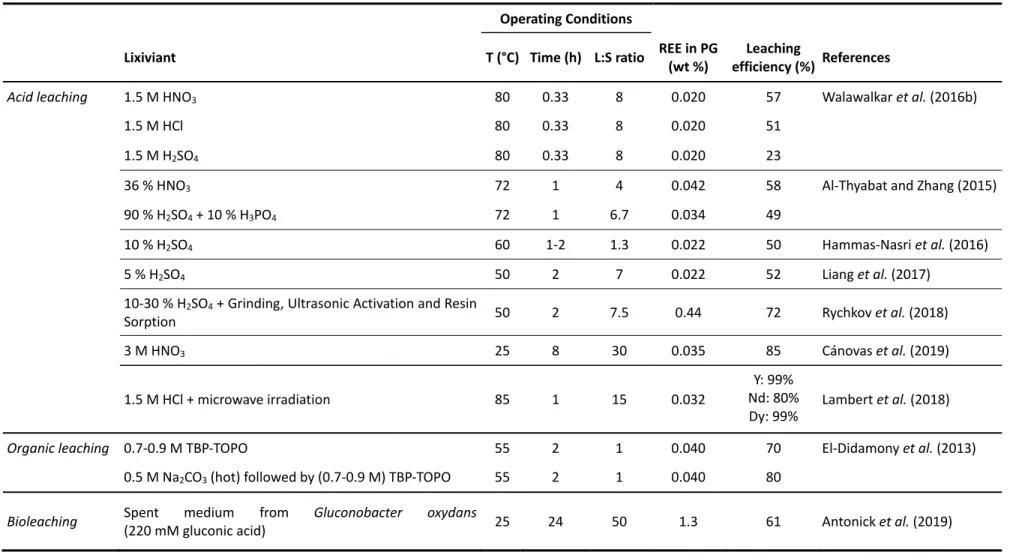
concentration from AMD. ... 10 Table 3. Performance of sorption for REE pre‐concentration from AMD. ... 12 Table 4. Recent literature on leaching of REE from phosphogypsom. Modified from (Lambert et al., 2018). ... 38
LIST OF FIGURES
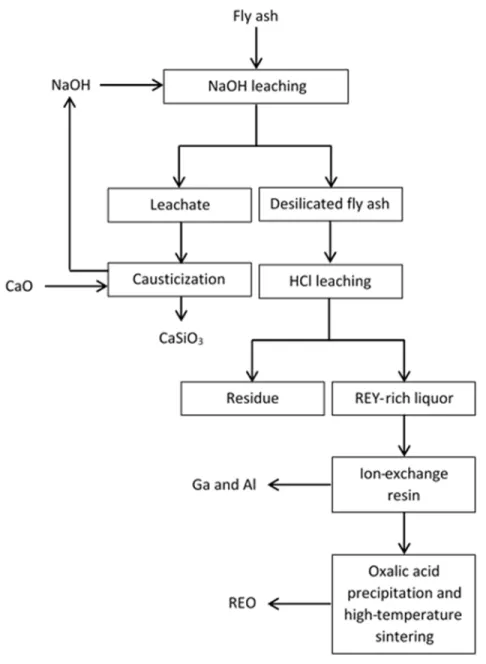
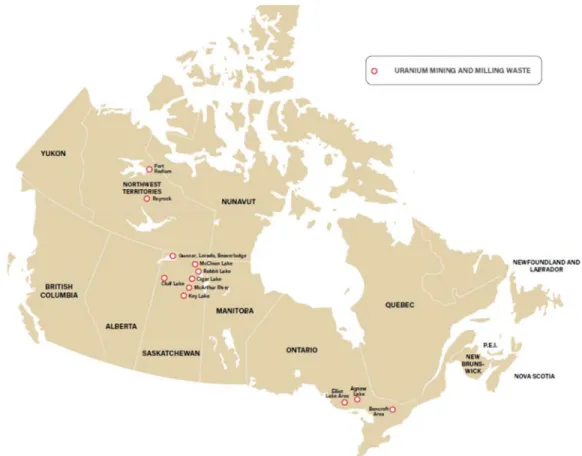
Figure 1. Flow diagram of REY (REEs+Y) extraction from fly ash by Wang et al. (2019). ... 30 Figure 2. Phosphoric acid production flowsheet with REE distribution. Modified from (Wu et al., 2018). ... 36 Figure 3. Locations of operating, closed and decommissioned uranium mining and milling waste sites in Canada. Modified from (NRCan, 2018a). ... 41vii
LIST OF ABBREVIATIONS
[Hbet][Tf2N] bis(trifluorométhylsufonyl)imide [Hbet‐STFSI‐PS‐DVP] betainiumsulfonyl (trifluoromethanesulfonylimide) poly(styrene‐co‐ divinylbenzene) [EMIMHSO4] 1‐ethyl‐3‐methylimidazoliumhydrogensulfate AMD Acid mine drainage AC Activated carbon BR Bauxite residue CCPs Coal combustion products CMD DAS DOE DVB Coal mine drainage Dispersed alkaline substrate Department of energy Divinylbenzene EDTA Ethylenediaminetetraacetic acid HDEPH HRT ISL Di‐(2‐ethylhexyl)phosphoric acid Hydraulic retention time In‐situ leaching HREEs Heavy rare earth elements LREEs Light rare earth elements MREEs Middle rare earth elements NASC North American shale composite NMD Neutral mine drainage PG Phosphogypsum REE Rare earth elements REO Rare earth oxides TBP‐TOPO Tributyl phosphate‐trioctylphosphine oxide TENORM TREE Technically enhanced naturally occurring radioactive material Total rare earth elements WEEE Waste electrical and electronic equipment1
1
INTRODUCTION
Rare earth elements (REEs) are of growing interest and their applications cover many fields. In particular, they are essential in the design of emerging technologies such as wind turbines, hybrid cars and mobile phone speakers (EuRare, 2017). Thus their demand in recent years has continued to increase. China, with nearly half of the world's known reserves, dominates REEs production. Indeed, 94 % of REEs production is held by China (Schlinkert & van den Boogaart, 2015). In view of the growing demand and the desire to emancipate themselves from China, many countries, including Canada, are evaluating the potential to exploit their own resources. Conventionally, REEs are commercially extracted from rare earth deposits that contain REEs‐bearing minerals such as bastnaesite, monazite, and xenotime, and among others. However, demand for REEs exceeded supply between 2010 and 2015 (Standing Committee of Natural Resources‐Canada, 2014). Thus, since conventional fields cannot meet this demand, the recovery of REEs from secondary sources could become a new source of supply. Secondary sources of REEs that appear promising and highlighted in this document are: acid mine drainage (AMD), bauxite residue (BR), coal combustion products (CPP), phosphogypsum (PG) and uranium mine tailings. Depending on the type of secondary source, different methods have developed to recover REEs: acid and/or alkaline leaching, bioleaching, pyrometallurgical processes, co‐precipitation, sorption, etc. The purpose of this review is, therefore, to gather recent information on this subject. To this end, the studies published over the past five years have been compiled and synthesized. This information will allow the improved knowledge of current research, to better understand the challenges involved in the recovery of REEs from these sources and to better target future research.3
2
PRE‐CONCENTRATION AND POTENTIAL RECOVERY OF REES FROM ACID MINE
DRAINAGE (AMD)
2.1 P
RESENCE OFREE
S INAMD
Mine drainage refers to contaminated water resulting from the water flow, which contacts mining residues (tailings, waste rock, ore, mine openings, etc.) containing acidogenic minerals, when exposed to the atmosphere or oxidizing environments and in the absence of sufficient neutralizing minerals (Skousen et al., 1998). Even though it is not the most significant parameter, the classification of contaminated mine drainage is often based on its pH values: acid mine drainage (AMD), neutral mine drainage (NMD), alkaline drainage, etc. (Nordstrom et al., 2015). In principle, all types of mine drainage are contaminated, to a certain extent. AMD is one of the most widespread environmental problems faced by the coal and base/precious metal mining industry worldwide. Resulting from the oxidation of sulfide minerals in mine tailings in the presence of H2O
and O2 (direct) or Fe3+ (indirect), AMD is characterized by low pH and high concentrations of
metal(loid)s and sulfates. The pH of NMD ranges from 6 to 9 and the concentrations of dissolved metal(loid)s (e.g., Cd, Cr, Co, Hg, Mo, Ni, Sb, As, Se, Zn) exceed discharge criteria (Stantec, 2004) . The geochemistry and the behaviour of REEs in mine drainage depends on various factors, including the following: i) the abundance of primary REE‐bearing minerals; ii) the extent of dissolution/alteration of REE‐bearing minerals; iii) the chemistry of REEs in the transporting water; 4) the capacity of solid particulate materials for REE sorption (Serrano et al., 2000; Sun et al., 2012).
Over the past decades, attention was mainly focused on the monitoring and control of common metal(loid)s (e.g. Fe, As, Cu, Ni, Zn), while the presence of REEs in mine drainage is now getting attention in several countries over the world (e.g. United States, Spain, Portugal, Germany) (Ayora
et al., 2016; Chávez & Gissela, 2017; Naidu et al., 2019; Ziemkiewicz et al., 2016). The
concentration of REEs in neutral to basic waters are usually low (10‐6 to 10‐9 m) and NASC‐
normalized patterns are often dominated by carbonate complexing, whereas REE concentrations in acidic waters are higher (10‐4 to 10‐7 m) and NASC‐normalized patterns distinctively different,
4
Table 1 presents typical concentrations of REEs measured in AMD, depending on the type of
deposit exploited, with values ranging from 0.43 to 17,920 µg.L‐1. REE contents are several orders
of magnitude higher than typical groundwater [mean value of 0.008 µg.L‐1 – n = 619 from
31 studies] or surface water such as lakes [mean value of 0.026 µg.L‐1 – n = 74 from 8 studies] and
rivers [mean value of 0.01 µg.L‐1 – n = 259 from 16 studies] (Noack et al., 2014). Recent studies
showed that mine drainage coming from coal exploitation in the Appalachian Basin (USA) are enriched in middle rare earth elements (MREE) by one to four orders of magnitude compared to groundwater or surface water (Stewart et al., 2017; Ziemkiewicz et al., 2016). According to these authors, with more than 540 t of REEs dissolved each year in AMD, coal mine drainage (CMD) represents a promising secondary source of MREE, including several elements (e.g. Nd, Eu, Dy and Tb) identified as critical resources. Similar REE patterns were observed in CMD in Europe (Germany, Romania, Sweden) (Grawunder et al., 2014) and in India (Sahoo et al., 2012).
The enrichment of mine drainage in REEs can be due to the weathering of REE‐bearing minerals [bastnaesite (carbonates) and monazite (phosphates)] found in sedimentary and igneous rocks under the aggressive acidic action of AMD, humic acid and CO2, as well as the dissolution of
secondary Fe‐Mn oxyhydroxide minerals enriched in REEs (Ayora et al., 2015; Gammons et al., 2003).
Contrary to AMD, the presence of REEs in NMD is less documented. A relatively recent study (Shahhosseini et al., 2017) investigated the geochemistry of REEs in NMD (characterized by high sulfate and bicarbonate concentrations) and in a river, both located in the vicinity of a coal washing plant in northern Iran. The results showed NMD was enriched in HREEs, with a similar signature to coal (except for the depletion in LREE and the enrichment of Eu), while the river
presented mostly MREEs. Overall, the total concentrations in the NMD were lower (5.1 ± 3.9 μg.L‐ 1) than in the river water (13.4 ± 1.8 μg.L‐1), where Fe‐rich sediments were enriched in La and Ce. A previous study investigated the geochemistry of REEs in near‐neutral water (mine drainage) and solids at abandoned mines in Italy (Medas et al., 2013). In this last study, mine tailings showed peak concentrations of REEs as high as 300 mg.kg‐1, while mine drainage (pH 6.2 to 7) flowing out of the mine tailings heaps showed a mean concentration of 53 μg.L‐1 REE.
5
Table 1. Typical concentrations of REEs in AMD.
Country Mine Site Localization Type of resources exploited pH Fe (mg/L) SO42‐ (mg.L‐1) REE (µg.L‐1) LREE (µg.L‐1) HREE (µg.L‐1) U (µg.L‐1) Th (µg.L‐1) References USA Appalachian Basin (Pennsylvania, n = 15)
Abandoned and inactive coal mine n.i. n.i. n.i. 70 ‐
2,070
n.i. n.i. n.i. n.i. Ziemkiewicz et
al. (2016) USA Appalachian Basin (Pennsylvania, n = 18) Abandoned and inactive coal mine 2.9‐ 4.4. 9.1‐385 276‐ 2,140 0.43‐ 1,130 0.026‐ 391 0.26‐ 742
n.i. n.i. Stewart et al.
(2017) USA Abandoned mines in the Anthracite and Bituminous Coalfields (Pennsylvania, n = 140) Anthracite and bituminous 2.7‐ 7.3 0.046‐ 512 2.7‐31 1.069‐ 1,185 n.i. n.i. 0.006‐ 100 0.003‐ 24 Cravotta III (2008)
USA Berkeley Pit Lake (Montana, n = 22) Abandoned copper mine 2.3‐
2.4 1,000 9,150 3,340‐ 3,520 1,900‐ 2,050 1,420‐ 1,490 826‐ 883 125‐ 132 Gammons et al. (2003) Spain Monte Romero (Iberian Pyrite Belt ‐ n = 1)
n.i. 2.7 161 3,5 7,900 n.i. n.i. n.i. n.i. Ayora et al.
(2016)
Spain Almagrera (Iberian Pyrite Belt ‐ n = 1) n.i. 2.6 744 11,7 3,500 n.i. n.i. n.i. n.i. Ayora et al.
(2016)
Spain Iberian Pyrite Belt (n = 35) n.i. n.i. n.i. n.i. 70 –
13,000
n.i. n.i. n.i. n.i. Ayora et al.
(2016)
Spain La Poderosa Mine (Rio Odiel Basin) Copper 1.8‐
2.4
1,330‐ 1,730
n.i. 11,000 7,450 3,550 n.i. n.i. Chávez (2017)
Spain Tinto‐Odiel Estuary (n = 5) Fluvial sector contaminated by industrial
water (copper foundries and phosphogypsum deposits) 2.57‐ 2.65 n.i. n.i. 200‐ 1,099 150‐817 50.3‐ 282 12.2‐ 76.7 n.i. Borrego et al. (2012)
Portugal Jales (Iberian Pyrite Belt ‐ n = 12) Inactive gold mine 5.6 ‐
7.4
n.i. 4.0 ‐ 221 0.015 ‐
70.4
n.i. n.i. n.i. n.i. Prudêncio et al.
(2015) Poland Wiśniówka mining area (south‐ central) Quartzites and quartzitic sandstones 1.4‐ 2.2 13,500‐ 45,700 26,900‐ 91,800 219‐ 17,920 127‐ 12,884 91.2‐ 5,030
n.i. n.i. Migaszewski et
al. (2019)
Iran Sarcheshmeh mine (n = 10) Porphyry copper deposit 1.9‐
3.2 329‐ 8,600 121‐ 12,080 30.5‐ 10,650
n.i. n.i. n.i. n.i. Sharifi et al.
(2013) Germany Mining district of Lower Lusatia (n = 10, Contaminated Lake Water depth from 0 to 10 m) Lignite 2.6‐ 5.4 144‐538 478‐ 1,950
267‐329 248‐307 19‐22 n.i. n.i. Bozau et al.
(2004) India Jaintia Hills coalfield (Meghalaya, n =
12)
Coal mine 1.6‐
4.8
38.5‐290 457‐4,.90 714 n.i. n.i. n.i. n.i. Sahoo et al.
(2012) China Xingren County (southwestern Guizhou Province, n = 10) Gold and coal mines 2.7 ‐ 4.6 0.87 ‐ 703 372 ‐ 2,794 118 ‐ 926 97.1‐ 659 21.2‐ 267
n.i. n.i. Li and Wu
(2017)
Cuba Santa Lucia mine (n = 21) Inactive Zn‐Pb mine 2.5‐
2.6
up to 4,620
up to 6,750
370‐860 n.i. n.i. n.i. n.i. Romero et al.
6
Speciation experiments conducted by Serrano et al. (2000) showed that REEs predominately occurred as free‐ion species and sulfate complexes in AMD, while phosphates, hydroxide and chloride complexes were quite negligible. Comparative REE speciation was observed in samples collected from abandoned Cu mines in Montana (Berkeley Pit Lake, MT, USA), showing that REEs are mainly present in AMD as sulfate complexes (Gammons et al., 2003). These authors also observed a depletion of LREE relative to HREE, which can be explained by their sorption on the surfaces of secondary precipitates. They concluded that the mobility of REEs and U can be influenced by the presence of secondary precipitates (e.g. strengite, jarosite and schwertmannite). Verplanck et al. (2004) observed that the mobility of REEs in the environment is strongly dependent on pH. Field studies as well as experiments performed in the laboratory on real AMD (6 samples) showed that REEs remain soluble at a pH below 5.1 in acidic sulfate waters, while their precipitation and/or sorption onto solid phases were observed at pH values between 5.1 and 6.6. Moreover, it appeared that attenuation of REEs is more influenced by the presence of Al colloids than Fe colloids in water streams that received AMD (Verplanck et al., 1999). These results are in accordance with the results obtained by Sun et al. (2011), which indicate that REE mobility is strongly influenced by pH. Other factors including redox conditions, salinity, dissolved organic matter and the type of chelating agents present in water streams can affect the mobility of REEs. The geochemical behaviour of REEs in the environment has been reviewed in detail byMigaszewski and Gałuszka (2015).
2.2 P
ROCESSES AND MATERIALS FROMAMD
TREATMENT ANDREE
PRE‐
CONCENTRATIONBased on REE geochemistry and behaviour in AMD and water streams that received AMD, it is expected that the addition of alkaline agents to neutralize the acidity of AMD during both active and passive chemical treatments will lead to the removal of REEs. Various mechanisms such as co‐precipitation with oxyhydroxides (mainly Al) and sorption onto Al/Fe oxyhydroxide occurred in the immobilization of REEs from AMD treatment. Additional chemical treatments including the sorption of REEs on modified or unmodified sorbents have also been studied over the last few years to evaluate their efficiency to remove REEs from AMD and eventually to pre‐concentrate them on solid phases for their potential subsequent recovery. The following sections will briefly discuss the performances of both (co‐ )precipitation (Table 2) and sorption (Table 3) to remove REEs from AMD.
7
2.2.1 (Co‐)precipitation
REE precipitation as phosphates According to the detailed review by Jha et al. (2016), a large number of REE‐bearing phosphate minerals have been found in nature, indicating that REEs have a strong affinity towards phosphates and a natural tendency to form stable precipitates. Chávez and Gissela (2017) studied the influence of final pH, thenature of acid solutions used to control pH (HCl, H2SO4, HNO3) and the molar ratio of P/REEs on the
precipitation of REEs. Results showed that the precipitation of REEs from diluted solutions is quite ineffective (< 15 %), although an increase in the P/REE ratio (from 2/1 to 41/1) slightly improved the recovery of REEs (from 2‐10 % to 8‐15 %). Despite this slight improvement of REE recovery, the increase in the P/REE ratio should be considered with caution as the amount of transition elements (e.g. Co, Cd, Mg, Al, Ca, Zn) in precipitates also increased, and reduced the purity of the final REE precipitates. A small effect of pH was observed in the different scenarios tested (pH 2.3 and 2.5), while the use of H2SO4 to adjust the pH seemed to be slightly more effective than HCl or H3PO4. Moreover, the use of NaOH to adjust the pH during the pre‐treatment step (Fe removal at pH 3.7‐3.8) was recommended over CaO and MgO, as the amount of Al precipitated during this pretreatment step was reduced with the use of NaOH. Al‐ and Fe‐oxyhydroxides
Barcelos et al. (2018) evaluated the potential to immobilize and pre‐concentrate Eu and Ho from synthetic AMD ([Eu]0 = 75‐380 mg.L‐1, [Ho]0 = 80‐412 mg.L‐1) through (co‐)precipitation and sorption
onto Al/Fe oxyhydroxides. Experiments were conducted using various Al/Fe/REE molar ratios in the range of 500:0:5 to 400:100:25, as the presence of Al can influence the stability of REE‐bearing precipitates and therefore their recovery potential. Results showed that REE removal efficiencies (> 99.99 %) were not influenced by Al/Fe/REE ratios or hydraulic retention time (from 4 to 90 days). However, the proportion of Eu and Ho in the reducible and oxidizable phases slightly increased with the addition of Al in the structure of Fe‐oxyhydroxides, while the amounts of REEs associated with refractory oxides decreased compared to experiments performed without Al addition. These findings are consistent with the results of Pietralonga et al. (2017), where a decrease in La‐bearing precipitates stability was observed as the proportion of both La and Al introduced during the precipitation increased. No difference in terms of La precipitation or retention on solid phase with Fe/Al ratios was found. They also observed a re‐mobilization of La (from 1.4‐37 % after 42‐49 days to 9‐100 % after
8
90 days) from precipitates formed in the presence of high concentrations of La (Fe/Al/La ratios of 500/125/125 and 500/250/125).
Recent studies evaluated the efficiency of active and passive treatment for REE removal from AMD and
their pre‐concentration by a factor of 103 to 104 depending on AMD chemistry and treatment process
used (Ayora et al., 2016; Stewart et al., 2017; Ziemkiewicz et al., 2016). Stewart et al. (2017) found that most REEs were sorbed onto Si/Al and Ca/Mg precipitates relative to Fe‐precipitates, consistent with
the observations made by Ayora et al. (2016) and Zhang and Honaker (2018). Therefore, REE
precipitation as phosphates or Al‐precipitates effectively (> 80%) concentrated REEs from AMD or pregnant solutions (pre‐treatment by ion exchange) in precipitation sludge (Table 2). More details of studies performed on real AMD are given in Section 2.3.
2.2.2 Sorption
Over the past decades, extensive work has been done to evaluate the performance of various sorbents, including raw and modified materials (e.g. granular grafted hydrogel composites, modified biohydrogels, plant and animal‐derived materials, oxidized multiwalled carbon nanotubes), in REE removal from aqueous solutions. A relatively recent detailed review thoroughly discusses the scientific literature on REE sorption, after 2013 (Anastopoulos et al., 2016). Previously, Das and Das (2013)
summarized the literature (1995‐2011), which was then updated by Gupta et al. (2018) on the use of
biosorbents for REE removal. Several operating parameters such as solution pH, contact time, adsorbent dose, initial composition of the solution to be treated and temperature are important factors that influence REE sorption and therefore, the potential to concentrate them on the sorbent.
The literature review by Anastopoulos et al. (2016) synthesizes the key findings on several REE removal methods by sorption using various materials. Maximum sorption capacities for REE were as following: Ce(III), from 50 mg.g‐1 (EDTA‐β‐cyclodextin) to 1,000 mg.g‐1 (prawn carapace); Dy(III), 78 mg.g‐1
(oxidized multiwalled carbon nanotubes); Eu(III), from 0.05 mg.g‐1 (modified cactus fibres) to
156 mg.g‐1 (malt spent rootlets); La(III), from 0.9 mg.g‐1 (hydroxyapatite) to 333 mg.g‐1 (granular grafted
hydrogel composites); Gd(III), from 56.2 to 85.4 (surface modified mesoporous silica nanoparticle, one or two steps); Nd(III), from 0.1 mg.g‐1 (SiO
2) to 323 mg.g‐1 (magnetic nano‐hydroxyapatite); Sm(III), from
90 mg.g‐1 (activated biochars from cactus fibres, pH 3) to 350 mg.g‐1 (activated biochars from cactus
fibres, pH 6.5); Pr(III), from 58.8 mg.g‐1 (orange peel) to 146.4 mg.g‐1 (brown seaweed); Sc(III) and Y(III),
30.5 mg.g‐1 (lysine‐functionalized mesoporous material) vs. 45.5 mg.g‐1 (NaOH modified Pleurotus
9
More recent studies using sorption processes for REE removal and pre‐concentration from aqueous solutions used kaolin (Yanfei et al., 2016), activated biochar (by low‐temperature pyrolysis of sawdust) (Komnitsas et al., 2017), porous amine‐epoxy networks (Wilfong et al., 2017), activated carbon with KMnO4 (Kano et al., 2017), geopolymers (Fiket et al., 2018), etc. However, testing with actual effluents over long periods of time or techno‐economic studies of the various materials for proper comparison are yet to be performed. Kaolin used for the removal of La, Nd and Y showed maximum sorption capacities of 1.73, 1.58, and 0.97 mg/g, respectively (Yanfei et al., 2016). Testing was conducted in batch mode, with 10‐150 mg.L‐1La and Nd, and 10‐120 mg.L‐1 Y. Similarly, geopolymers (prepared from coal ash) were found to be
effective for REE sorption from solutions of 1 mg.L‐1 REEs (Ce, La, Nd, Pm, Dy, Er, Eu, Gd, Ho, Lu, Sc, Sm, Tb, Y, and Yb) (Fiket et al., 2018). Activated biochar was also effective for the removal of Nd and Sc from aqueous solution, but overall performance was found to be inferior to that of activated carbon. Further research was recommended to optimize the biochar production and performance (Komnitsas et al., 2017). Nonetheless, biochar activation is commonly used to improve its physical properties and adsorptive capacity (Braghiroli et
al., 2018). Activation refers to a physical or chemical treatment (using H3PO4, KOH, steam or CO2 gas at
various temperatures, etc.) of biochar to maximize its pore density and surface area available for sorption.
Porous amine‐epoxy monoliths and particles synthetized via a polymer‐induced phase separation process was also effective in REE (La, Nd, Eu, Dy, and Yb) pre‐concentration from aqueous solutions (Wilfong et al., 2017). Moreover, consecutive recovery−strip−recovery of > 93 % of REEs from synthetic AMD, at a fouling metal/REEs ratio of 12,000/1, pH of 2.6 was deemed promising for new studies using these materials.
10
Table 2. Performance of AMD neutralization and metal(loid)s precipitation for REE pre‐concentration from AMD.
AMD Type REEs species Mechanisms involved Set‐up and operating conditions REEs removal (%) REE concentration on sludge (mg/kg) References Synthetic solution [Tb]0 = 31.8 mg/L in the presence of Ce, Eu, Dy and Yb Sorption Precipitation using synthetized nano‐ Mg(OH)2 (< 5 nm), t = 30 min > 97.5 1,830 Li et al. (2013) Synthetic AMD [La]0 = 0.03‐3.47 mg.L‐1 (Co‐)precipitation onto Al/Fe oxyhydroxides and sorption pH = 11.7, HRT = 0‐90 d, Fe/Al/La ratios between 500/125/0 and 500/250/125 90‐99.9 n.i. Pietralonga et al. (2017) Synthetic AMD [Eu]0 = 75‐380 mg/L, [Ho]0 = 80‐ 412 mg.L‐1 (Co‐)precipitation onto Al/Fe oxyhydroxides and sorption pH = 9, HRT = 60 d > 99.99 6,050 ‐ 30,830 for Eu and 7,230 ‐ 29,670 for Ho Barcelos et al. (2018) Real AMD (Cueva de la Mora mine, Spain) All REEs (including Sc and Y); 3,5‐7,9 mg.L‐1 (Co‐)precipitation onto Al oxyhydroxides and sorption CaO‐ and MgO‐dispersed alkaline substrates (passive treatment), pH > 6 for CaO column and pH > 9 for MgO column 100 300 ‐ 8,000 for TREE and < 17 mg.kg‐1 for U and < 4 mg.kg‐1 for Th Ayora et al. (2016); Ayora et al. (2015) Real AMD (La Poderosa mine, Spain) All REEs (including Sc and Y); < 17 mg.L‐1 Direct precipitation of REEs as phosphates Pre‐treatment to remove Fe [addition of H2O2 and adjustment of pH at 3.7‐3.8] 15 % through direct precipitation and 99% if REEs are preconcentrated by ion exchange n.i. Chávez and Gissela (2017) Real AMD (West Kentucky, USA) All REEs (including Sc and Y); 6.14 mg.L‐1 (Co‐)precipitation onto Al/Fe oxyhydroxides and sorption Addition of NaOH to adjust pH at 4.8‐6.1 > 80 11,000 Zhang and Honaker (2018) Real AMD (Appalachian Basin, USA) All REEs (including Sc and Y) (Co‐)precipitation onto Al/Fe oxyhydroxides and sorption Addition of lime to adjust pH > 99 152‐714 Ziemkiewicz et al. (2016)
11
Activated carbonActivated carbon (AC) is a well‐known material in wastewater treatment due to its unique properties (large pore volume and high surface area) which allow the adsorption and pre‐concentration of various elements (e.g. potentially problematic and/or high value‐added) initially contained in aqueous solutions. The application of modified or unmodified AC to remove REEs from aqueous solutions has been evaluated.
Qing (2010) showed that AC produced from bamboo had a maximum sorption capacity of 120 mg.g‐1 La,
at pH 7.20. Similarly, the study of Awwad et al. (2010) used AC prepared from rice husk, a residual low‐ cost biomass material from agriculture, by chemical activation using H3PO4. The parametric study
evaluated the influence of several parameters (time, pH, initial concentration and temperature) on the La
and Er adsorption capacity of the AC produced. The reported sorption capacities were 175.4 mg.g‐1 for
La(III) and 250 mg.g‐1 for Er (III).
Biosorbents
Biosorbents, originating from various sources such as algae, fungi, plants and animals, represent promising low‐cost material to sorb REEs from aqueous solutions. The efficiency and operating factors
influencing REE sorption are reviewed in detail by Das and Das (2013) and, more recently, by Gupta et al.
(2018). Several mechanisms including chelation, ion exchange, electrostatic interaction, complexation, intercellular bioaccumulation and precipitation are involved in the pre‐concentration of REEs by biosorbents (Gupta et al., 2018). According to these authors, biosorbents seem to effectively recover REEs from aqueous solutions but their applications are restricted due to the difficulty to adequately regenerate biosorbents for subsequent use without damaging the biomass.
12
Table 3. Performance of sorption for REE pre‐concentration from AMD.
AMD Type REE species Sorbent used pH Optimal time (min) REE removal (%) Adsorption capacity (mg.g‐1) References
Synthetic solution [La]0 = 1,389‐27,781 mg.L‐1 AC (40 g.L‐1) 6.0 30 n.i. 76.4 Iannicelli‐Zubiani et al. (2018) Synthetic solution [La]0 = 50‐300 mg.L‐1 AC (3 g.L‐1) 3.5 30 n.i. 175 Awwad et al. (2010)
Synthetic solution [La]0 = 100 mg.L‐1, in the presence of Lu, Yb, Eu, Y, Sc
AC (0.25 g.L‐1) 3 480 n.i. 0.048 Kano et al. (2017) Synthetic solution [Er]0 = 50‐300 mg.L‐1 AC (3 g.L‐1) 3.5 60 n.i. 250 Awwad et al. (2010)
Synthetic solution [Eu]0 = 25‐800 mg.L‐1 AC (1 g.L‐1) 3.5 60 ~ 52.5 86 Anagnostopoulos and Symeopoulos (2013)
Synthetic solution [Eu]0 = 800 mg.L‐1 AC (1 g.L‐1) 3.5 60 10 86 Anagnostopoulos and Symeopoulos (2013)
Synthetic solution [Sc]0 = 20 mg.L‐1 AC (10 g.L‐1) 3 1,440 76.8 n.i. Komnitsas et al. (2017) Synthetic solution [Nd]0 = 20 mg.L‐1 AC (10 g.L‐1) 3 1,440 87.9 n.i. Komnitsas et al. (2017) Synthetic solution [La]0 = 1389‐27781 mg.L‐1 Modified AC (40 g.L‐1) 6 90 92.2 ‐ 99.9 107 Iannicelli‐Zubiani et al. (2018) Synthetic solution [La]0 = 25 mg.L‐1 AC and silica composite
(1 g.L‐1)
4 30 ~ 80 103 Ramasamy et al. (2018)
Synthetic solution [Sc]0 = 25 mg.L‐1 AC and silica composite (1 g.L‐1)
4 1,440 ~ 100 113 Ramasamy et al. (2018) Synthetic solution [Y]0 = 25 mg.L‐1 AC and silica composite
(1 g.L‐1)
4 30 ~ 100 84.1 Ramasamy et al. (2018) Synthetic solution [Sc]0 = 20 mg.L‐1 Biochar (10 g.L‐1) 3 1,440 52.3 n.i Komnitsas et al. (2017) Synthetic solution [Nd]0 = 20 mg.L‐1 Biochar (10 g.L‐1) 3 1,440 78.6 n.i Komnitsas et al. (2017) Synthetic solution [La]0 = 25‐500 mg.L‐1 Biochar (1 g.L‐1) 7 1,440 n.i. 275 Wang et al. (2016) Synthetic solution [Y]0 = [La]0 = [Ce]0 = [Nd]0 = [Sm]0 = 100 mg.L‐1 Carbon black (2.4‐40 g.L‐1) 2 1,440 50‐82 4.37 (La) 35.0 (Ce) 36.4 (Nd) 19.9 (Sm) 6.09 (Y) Smith et al. (2016)
Synthetic solution [La]0 = 135‐270 mg.L‐1 Modified charcoal (670 g.L‐1) 7.20 480 n.i. 215 Qing (2010)
13
AMD Type REEs species Sorbent used pH Optimaltime (min) REEs removal (%) Adsorption capacity (mg/g) Reference
Synthetic solution [La]0 = 135‐270 mg.L‐1 Modified charcoal (670 g.L‐1) 7.20 480 n.i. 215 Qing (2010)
Synthetic solution [Sm]0 = 75.2 mg.L‐1 Activated biochar (0.33 g.L‐1) 6.5 1440 ~ 100 350 Hadjittofi et al. (2016) Synthetic solution [La]0 = 25‐500 mg.L‐1 Modified biochar (1 g.L‐1) 7 720 > 85 362 Wang et al. (2016) Synthetic solution [La]0 = 300 mg.L‐1 Fish scale (0.3 g.L‐1) 6.0 240 n.i. 200 Das et al. (2014) Synthetic solution [La]0 = 250 mg.L‐1 Neem Sawdust (0.2 g/L) 6.0 180 n.i. 160 Das et al. (2014) Synthetic solution [Nd]0 = [Dy]0 = 0.10
mg.L‐1
Salmon milt (2 g.L‐1) 4 60 > 99 n.i. Takahashi et al. (2014)
Synthetic solution [Eu]0 = 25 mg.L‐1 Malt spent rootless (1 g.L‐1) 4.5 60 ~ 70 % 156 Anagnostopoulos and Symeopoulos (2013)
Synthetic solution [Eu]0 = 800 mg.L‐1 Malt spent rootless (1 g.L‐1) 4.5 60 ~ 17.5%
156 Anagnostopoulos and Symeopoulos (2013)
Synthetic solution [La]0 = 10‐200 mg.L‐1 Carboxylic acid functionalized diatomite (1 g.L‐1) 4‐7 20‐120 >90 139 Zhou et al. (2016) Synthetic solution [Nd]0 = 288 mg.L‐1 Calcium alginate and γ‐poly glutamic acid (1.6 g.L‐1) 3.5 360 n.i. 238 Wang and Liang (2014) Synthetic solution [Nd]0 = 100‐1, 200 mg.L‐ 1
Salmon milt (20 g.L‐1) 3.5 180 n.i. 50.1 Takahashi et al. (2014) Synthetic solution [Nd]0 = 10‐500 mg.L‐1 Magnetic nanohydroxyapatite
(1 g.L‐1)
5.5 150 98 323 Gok (2014)
Synthetic solution [La]0 = [Yb]0 =10 mg.L‐1 Nanoscale
zerovalent iron particles (1 g.L‐1) 4.7 30 > 99.9
61.0 (La)
409. (Yb) Crane and Sapsford (2018) Real mining effluent [Sc]0 = 5 mg.L‐1, in the
presence of all REEs
Modified AC (1 g.L‐1) 4 n.i. > 90 n.i. Ramasamy et al. (2018) Industrial effluent (ceramic industry, India) [La]0 = 250 mg.L‐1 Fish scale (Glass column: flow rate: 1 ml/min, bed height: 12 cm and dilution: 50 %)
6 n.i. 89.5 n.i. Das et al. (2014)
Acid mine drainage (Parys Mountain, UK) [REE] = 36‐200 µg.L ‐1 Nanoscale zerovalent iron particles (4 g.L‐1) 2.5 30 > 99.9 n.i. Crane and Sapsford (2018)
14
2.3 R
ECOVERY POTENTIAL OFREE
S FROMAMD
AND TREATMENT SLUDGE/
RESIDUE2.3.1 Case studies
As conventional AMD treatments through the neutralization of acidity and (co‐)precipitation of
metals/REEs immobilize nearly 100 % of REEs and concentrates them by a factor of 103 to 104 depending
on AMD chemistry and treatment (active versus passive), research has recently focused on the recovery of REEs from AMD sludge. To date, a limited number of studies emphasized the potential for REE recovery from AMD and precipitates formed during passive or active treatment of AMD, although these residual materials represent a promising secondary source of REEs.
This section will present three case studies on the potential to recover REEs from AMD treatment sludge/residue: Case Study I, located in Cueva de la Mora mine (Iberian Pyrite Belt, Spain)(Ayora et al., 2016; Ayora et al., 2015); Case Study II, located in La Poderosa mine (Rio Odel Basin, Spain) (Chávez & Gissela, 2017); and Case Study III, located in the Appalachian Basin (USA) (Stewart et al., 2017; Ziemkiewicz et al., 2016). Case Study I: Passive treatment of AMD from Cueva de la Mora mine and REEs pre‐concentration (Ayora et al., 2016; Ayora et al., 2015) The first case study, located at the Cueva de la Mora mine site (Spain), evaluated the behaviour of REEs during the passive treatment of AMD using two successive columns of DAS‐systems (dispersed alkalinity substrate, consisting of wood shavings, as coarse and highly porous materials, and calcite or caustic magnesia, as neutralizing materials for trivalent and bivalent metals removal, respectively) through laboratory and field scale experiments. Laboratory experiments confirmed that 100 % of REEs were removed from the AMD and that no REEs were retained by the Fe‐precipitates (schwertmannite and goethite) formed in the calcite column. Most of the REEs were retained on basaluminite precipitates (15‐ 20 %) and on decantation residues (25‐40 %) mainly composed of gypsum, fluorite, epsomite and becherite, while only few amounts (5‐10 %) were retained on the MgO column. Results from field experiments showed similar REE patterns even if no exhaustive characterization of calcite‐ and caustic magnesia‐based DAS were conducted. The estimated concentrations of REEs and radioactive elements in
the AMD sludge were 0.03‐8 % for REEs, but only 17 mg.kg‐1 for U and 4 mg.kg‐1 for Th. Based on these
results, the authors concluded that even if low concentrations of REEs are retained by passive treatment, AMD represents a modest but suitable secondary source of REEs as AMD is expected to persist in this area for at least another 100 years.
15
Case Study II: Potential to recover REEs from AMD from La Poderosa Mine through precipitation as phosphates (Chávez & Gissela, 2017)
In the second case study, Chávez and Gissela (2017) evaluated the potential to recover REEs from actual
AMD produced from an abandoned mine located in the Odiel and Tinto basins (Spain) after pre‐ concentration of these elements by ion exchange. Two series of experiments were conducted: i) direct precipitation of REEs from AMD in the presence of phosphate and ii) pre‐concentration of REEs through ion exchange followed by acid elution and precipitation in the presence of an excess of phosphate (P/REE ratio of 40/1). Results showed a small loss of REEs (< 8 %) during AMD pretreatment for iron removal by oxidation, in the presence of H2O2 and precipitation at pH 3.7‐3.8, indicating that the sorption of REEs on Fe‐oxyhydroxides is not favourable. This observation is in accordance with the results obtained by Ayora et al. (2016). Chávez and Gissela (2017) also observed that only 15 % of REEs can be removed by direct precipitation, while the addition of an ion exchange pretreatment (10‐60 % of REEs recovered) allowed for the recovery of more than 90 % of REEs from pre‐concentrated solution. Therefore, a pre‐ concentration step could significantly improve the potential of recovering the REEs initially present in AMD by precipitation as phosphates, while direct precipitation is more efficient on REEs concentrated solutions (Chávez & Gissela, 2017).
Case Study III: Active and passive treatment of coal mine drainage (CMD) from the Appalachian Basin (USA) (Stewart et al., 2017; Ziemkiewicz et al., 2016)
Recent studies were performed to evaluate the potential of REE recovery from precipitates produced
during active or passive treatment of CMD, located in the Appalachian Basin (USA). Stewart et al. (2017)
sampled precipitates (n = 22) and CMD (n = 18) from inactive and abandoned coal mines to evaluate the potential for REE pre‐concentration from CMD sludge. Their results showed that, at pH values above 6.6, REE concentrations from CMD significantly decreased regardless of the treatment applied (passive versus active), while REE concentrations in precipitates were increased by a factor of 103‐104. Nevertheless, the
concentrations of REEs measured in Ca‐Mg‐rich precipitates (from lime neutralization) and Si‐Al‐rich precipitates (from limestone drains) were higher than for Fe‐precipitates. The authors also observed that acidic CMD represents a better secondary REEs source than circumneutral CMD, due to the higher REE concentrations found in CMD and therefore, in precipitates formed during CMD treatment that produce Ca‐rich or Si/Al‐rich solids. These results confirmed the observations made by Ziemkiewicz et al. (2016) indicating the potential of AMD sludge to concentrate REEs. The factor of concentration was as high as 1 x 10³ to 4 x 10³, depending on AMD composition and treatment used. Experiments performed in the
16
laboratory showed a complete dissolution of AMD sludge in the presence of H2SO4 at a pH of 1 and
ambient temperature, indicating the potential for REE recovery from AMD (Ziemkiewicz et al., 2017). REE products were then recovered (90‐100 %) from the leachate through solvent extraction using D2EHPA and precipitation as oxalate (100 % recovered) (Ziemkiewicz et al., 2018). Based on these promising results related to the potential recovery of REEs from AMD sludge, a pilot scale has been built to confirm the performances observed at laboratory scale and assess capital and operating costs.
2.3.2 Ongoing research
An alternative option to pre‐concentrating REEs from AMD is nanofiltration (NF). López et al. (2018)
evaluated the performance of both fresh and aged (immerged during 1 month in H2SO4 solution at 1 M) NF membrane to reject REEs from AMD. Their results showed that NF270 is an efficient technique to reject more than 98 % of REEs from a synthetic AMD at pH 1. However, the authors demonstrated low chemical resistance of this NF membrane at acidic pH and a decrease in the rejection rates of REEs after one month of exposure to a solution of sulfuric acid. Additional experiments highlighted that polymeric membranes can be more resistant to acidic solution, while allowing satisfactory REE rejections (> 95%) from synthetic AMD (after Fe removal by precipitation) (López et al., 2019). These results showed that a polyamide‐based membrane (Desal DL) is more suitable than a sulphonated‐based membrane (HydraCoRe 70pHT) to pre‐ concentrate REEs from synthetic AMD, while recovering sulphuric acid as a permeate. Researches are currently funded by the US Department of Energy (DOE) to improve knowledge on the potential to recover REEs from AMD. Among the numerous projects funded, there are the following: i) the use of ceramic membranes to recover REEs from AMD sludge (“Low‐Cost Rare Earth Element (REE) Recovery from Acid Mine Drainage Sludge” by Research Triangle Institute) and ii) the development of a hydrometallurgical process to recover REEs from AMD conventional treatment residue (“At‐source Recovery of Rare Earth Elements from Coal Mine Drainage” by West Virginia University Research Corporation) (DOE, 2017).
2.4 C
ONCLUSION AND RESEARCH NEEDSDue to the depletion of high‐grade ore deposits and increasing demands towards high technology metals (e.g. REE, Co, Li), AMD is considered as new promising secondary source of elements including precious or base metals as well as REEs. A limited amount of research is available about the precipitation of REE from AMD in a perspective of value‐added elements recoveries. Actual results showed that passive and active treatments are effective at scavenging REEs from Ca‐Mg‐rich precipitates (from lime neutralization) and Si‐Al‐rich precipitates (from limestone drains) by a factor of 103 to 104, while Fe‐precipitates showed
17
poor REE retention. Recent studies emphasized that its complete dissolution can be achieved under acidic conditions, allowing 100 % of REE recovery from AMD treatment sludge. However, the main limitation in REE recovery from AMD treatment sludge is the complex separation of REEs from undesirable and more reactive metals such as Fe and Al.
Based on previous studies, research needs should mainly be focused on: i) the identification of AMD containing satisfactory REE concentrations produced from Canadian mine waste; ii) the development of effective and low‐cost hydrometallurgical processes to pre‐concentrate REEs from AMD, recover these elements from sludge/residue and produce high‐purity REEs; iii) evaluate the behaviour of radioactive elements (U and Th) during AMD treatment and in radioactive sludge.
19
3
RECOVERY OF REES FROM BAUXITE RESIDUE (BR)
3.1 C
ONTEXTBauxite is a lateritic rock characterized by a high alumina content (Al2O3). It contains 30 to 50 % of alumina and is the main ore used to produce aluminum (Binnemans et al., 2015). The most common process for the production of aluminum from bauxite is the Bayer process. In this process, bauxite is digested in a concentrated solution of sodium hydroxide at a temperature between 150 and 200 °C in an autoclave at pressures of up to 40 atm (Binnemans et al., 2015). Under these conditions, alumina is transformed into aluminum hydroxide, which is soluble in NaOH solution, due to the amphoteric nature of aluminum, while the other bauxite compounds do not dissolve (Binnemans et al., 2015). The remaining constituents are silica, iron oxides, titanium dioxide, calcium and, in lower amounts, gallium, nickel, vanadium, niobium, thorium, uranium and REEs (Binnemans et al., 2013b). The solution is clarified by filtering solid impurities, i.e. bauxite residue (BR) or red mud (pH~12) (Binnemans et al., 2015). Every year, about 150 million tonnes of BR are produced worldwide (Evans, 2016). However, less than 2 million tonnes are recycled (Evans, 2016). In addition, the former reserves, with a total estimated inventory of 3 to 4 billion tonnes (Zhang, 2018) are not included in any plan of waste management. All these residues are stored in landfills that occupy large areas. Long‐term storage can impact the surrounding area by disturbing the air, soil and groundwater quality. For example, a major environmental event took place on October 4, 2010 at the Ajka alumina plant in Hungary as consequence of inappropriate waste management. Following a breach in a dike at a residues disposal site, approximately 600,000 m3 of BR was released (Borra et al., 2016a). This incident was responsible for the contamination of 40 km2 of land. Nine people were killed in the tragedy and 122 were seriously hurt. Contamination was observed in the river closest to the site (Khairul et al., 2019). However, this event is not an isolated case since several places worldwide have suffered similar environmental events (Hammond, 2014). Consequently, the management of the large quantities of residues generated each year has become one of the most important environmental challenges in recent years.
BR is an important potential source of iron (up to 60 % of BR) (Binnemans et al., 2013a). Moreover, REEs are not leached during the Bayer process and are concentrated by a factor of two in the BR, compared to the original bauxite (Ochsenkühn‐Petropulu et al., 1994). In some BR, Sc (natural abundance of 22 ppm) can reach concentrations above 50 ppm (Borra et al., 2016a). Due to its high price ($ 4,600/kg Sc2O3)
20
based on the high price of some REEs and on the growing demand of these elements, BR can represent an interesting alternative source of REEs.
The main processes of REE recovery from BR are purely hydrometallurgical or a combination of pyrometallurgical and hydrometallurgical (Wang et al., 2011).
3.2 H
YDROMETALLURGICAL PROCESSA hydrometallurgical process consists of a succession of chemical operations leading to: i) the leaching of one or several targeted elements from the ore/waste, ii) the purification of the solution (removal of impurities) and iii) the extraction of the targeted element(s) from this solution. In the following section, different leaching techniques applied to the recovery of REEs from BR are presented.
3.2.1 Alkaline leaching
Alkaline leaching has been used for the recovery of REEs, more specifically for scandium. This technique is based on the fact that Sc can form soluble compounds with carbonate ions (Pasechnik et al., 2004). For example, in a solution containing 100 g.L‐1 of NaHCO 3, 16.7 g.L‐1 of Sc2O3 are dissolved at 25 °C. The major advantage of this technique is that large amounts of acid are not needed to acidify the highly alkaline BR (pH~12). The main disadvantage is, however, that Sc is the only element recovered. Indeed, the formation of soluble carbonate complexes for other REEs is less efficient than for Sc (Binnemans et al., 2015). In addition, Sc recovery remained low (< 30 %), which may be due to the presence of scandium in iron oxide matrices (Borra et al., 2016a).3.2.2 Acid leaching
This technique consists of leaching the REEs contained in BR with acids. These acids can be of different types: inorganic acid or organic acid. The most commonly used inorganic acids in this case are nitric acid (HNO3), hydrochloric acid (HCl) and finally sulfuric acid (H2SO4) (Borra et al., 2016a). The organic acidswhich can be used in this process are citric acid, acetic acid or EDTA (ethylene diaminetetraacetic acid) (Borra et al., 2016a).
A comparative study using different acids (HCl, HNO3 and H2SO4) characterized the effectiveness of
leaching BR with HNO3 under the following conditions: 0.5 M HNO3, at ambient pressure and temperature.
Recovery rates for Sc and Y were of 80 % and 96 % respectively (Ochsenkühn‐Petropulu et al., 1996). For the recovery of Sc from BR using HNO3, a pilot‐scale installation has been developed (Ochsenkühn‐
21
limitation of this method. Indeed, nitrate ions were adsorbed on the surface of the BR, and consequently a large volume of water was necessary for their recovery (Petrakova et al., 2014). In order to limit the amount of liquid waste generated, other methods were considered. The formation of silica gel is another problem potentially encountered during acid leaching. The formation of such silica gel induces problem during filtration and therefore during the recovery of REEs. This gel can form when the acid concentration becomes too high. Indeed, the dissolved concentration of silica increases with the concentration of acid. This implies an increase of the saturation index and thus forms a silica gel in the solution. To limit this effect, Rivera et al. (2018) attempted to extract REEs by dry digestion (H2SO4 and HCl) followed by leaching using water. This two‐stage treatment showed a highextraction of REEs and a reduction of silica gel formation. When the generated acid leaching solution was reintroduced into the circulation system (multistage circulation), REE concentrations increased significantly from 6‐8 mg.L‐1 to 20 mg.L‐1. When using this multistage circulation method, acid
consumption remained unchanged and water consumption was greatly reduced at the end of the leaching cycle. By limiting the amount of water consumption, silica gel formation was avoided. Although promising, this method requires further studies, specifically to improve the recovery of REEs. As mentioned previously, organic acids can also be used for the leaching of REEs. However, their efficiency is lower than for inorganic acids at a given temperature (Borra et al., 2016b; Lenz et al., 2015). When mixed together, the combination of organic and inorganic acids can, however, improve selectivity during Sc recovery (Zhou et al., 2018). Vind et al. (2018) showed that Sc was linked to different mineral phases in BR. Hematite (‐FeO3) contained 55 ± 20 % of the total Sc, goethite (‐FeOOH) represented about 25 ± 20 % of the total Sc and 10 ± 5 % of the total Sc was zircon‐related. Thus, during the leaching of the Sc, a co‐dissolution of the iron was observed. To limit this effect, Zhou et al. (2018) conducted selective leaching of Sc under the following conditions: 40 mL (HCl + H2O): 10 g BR: 2 g EDTA. The leaching efficiency of Sc and Fe was 79.6 % and 6.12 %, respectively. This technique implies a reduction of acid consumption and helps to improve the separation of iron and scandium.
3.2.3 Bioleaching
The amount of acid used for REEs recovery processes is a major problem. Thus, bioleaching techniques could help to solve this problem. However, the use of bacteria is less suitable given the high pH of the BR and the lack of nutrients necessary to sustain the bacteria population. Fungi can produce organic acids, amino acids or proteins in the presence of an organic medium. These metabolites then form complexes with the metal ions present in the BR (Borra et al., 2016a). The use of the fungus Aspergillus niger has22
shown its effectiveness in recovering metals from BR (Vakilchap et al., 2016). Aspergillus niger secreted organic acids allowing leaching of Al, Ti and Fe with leaching efficiencies of 69.8 %, 60 % and 25.4 %, respectively. The fungus Penicillium tricolor RM‐10 has also been used in the recovery of REEs and radioactive elements (Qu & Lian, 2013). However, recovery of light rare earth elements (LREEs) remains low and co‐dissolution of the main elements is unknown (Borra et al., 2016a).
A recent study highlights the bioleaching performance of chemoheterotrophic bacteria on BR (Qu et al., 2019). Here, an acid‐generating bacterium has been identified in a BR reservoir, Acetobacter sp. The behaviour of this bacterium has been studied and it appears that even an environment not specifically adapted to the bacterum, Acetobacter sp., allowed the bioleaching of BR.
3.2.4 Ionic leaching
Davris et al. (2014) used the ionic liquid 1‐ethyl‐3‐methylimidazoliumhydrogensulfate [EMIM HSO4] for hot bauxite residue leaching. The recovery rate of REEs at 190 °C was 60 %. However, all of the Fe and Ti and 35 % of Al were in soluble form. In another study, Davris et al. (2016) used bis(trifluoromethylsufonyl)imide [Hbet][Tf2N]. The dissolution of the Sc did not exceed 45 %. The dissolution of iron was < 3 % and that of aluminum was about 30 %. Ca and Na were completely dissolved and a negligible dissolution of silica and titanium was observed. As a consequence of their high price, ionic liquid pickling solutions are often applied to purify/strip the metals dissolved and then reused during the process. Although the recovery rate is lower in this case, selectivity was higher (Nockemann et al., 2006). Ionic liquids are also used for the extraction of REEs from aqueous solution. Avdibegović et al. (2018) used betainium sulfonyl (trifluoromethanesulfonylimide) poly(styrene‐co‐divinylbenzene) [Hbet‐STFSI‐PS‐DVB] to absorb REEs. In this case, the first step consisted of leaching the BR with a high concentration of H2SO4.
Fe(III) was removed with ammonia as a pre‐treatment step. Indeed, a high concentration of Fe(III) decreased the effectiveness of [Hbet‐STFSI‐PS‐DVB] for the absorption of REEs. The results were compared with those from the selective precipitation extraction with a phosphate solution. The study shows that the recovery of Sc is effective after Fe removal. Selective precipitation is less effective than the method with [Hbet‐STFSI‐PS‐DVB]. However, the purity of the Sc (47 %) can be improved by performing additional cycles.
3.2.5 Purification and recovery of REEs
Solvent extraction is a technique based on the non‐miscibility of two phases associated to extract a desired element. An aqueous phase is generally brought into contact with an organic phase containing
23
extractants. The structure of the extractant governs separation and selectivity. Liu and Li (2015) present in their review the different types of organic extractants and their efficiency in the recovery process of metals and REEs from BR. The main disadvantage is the volatility of the organic solvents used. This can make their handling difficult and sometimes dangerous (Zhang, 2018).
At the end of the process, dissolved REEs must be converted to pure REE compounds for use in technological applications. The most common method is the selective precipitation of REEs as oxalate (Bandara et al., 2016). By calcination, these compounds are transformed into oxides. Other methods can also be used such as carbonate or sulfate precipitation for REEs recovery (Xie et al., 2014). After the production of pure compounds, metals are produced by molten electrolysis (Zhang et al., 2019).
3.3 P
YROMETALLURGICAL PROCESSESThe pyrometallurgical process is a thermal process used to separate and recover targeted elements. This technique is presented as a pre‐treatment of the BR or as a step in the recovery of REEs. The energy cost is the main factor to take into account for such process.
Among the pyrometallurgical processes, reductive melting of BR can be used. Reductive melting is a process used in the manufacture of cast iron during the high‐temperature processing of coke and Fe. Since BR contains significant proportions of Fe, this process appears pertinent. In this process, the BR is treated in a blast furnace. However, prior sintering with a reducing agent is necessary to reduce iron oxides and generate pig Fe and Ti‐rich slag. The different fusion processes for the recovery of iron in BR are presented by Borra et al. (2016a). In this article, the different conditions for the following operations are detailed: melting temperature, flows used during melting (limestone, lime, silica, dolomite, etc.), types of reducers (coal, coke, wood, etc.). REEs from the produced slag can be washed with HNO3 or HCl given good recovery rates (Borra et al., 2015). In addition, Rivera et al. (2019) conducted a study on high‐pressure acid leaching of slag to recover REEs. The slags were obtained by reductive fusion. The use of mixtures of coke, lime and silica at 1,500 °C allowed for a good separation of Fe from the slag. Ti and Si were not co‐dissolved due to the application of high‐pressure acid treatment. The tests were carried out with H2SO4 and HCl in order to
compare extraction efficiency but also selectivity. Leaching with H2SO4 at 150 °C allowed for a good
recovery of the scandium (90 % vw.t.) but a low recovery of REEs. The likely formation of CaSO4 hindered
the dissolution of the other REEs. Leaching with HCl at 120 °C resulted in a Sc recovery of 80 % w.t. and approximately 95 % w.t. of Y, La and Nd were recovered. However, a strong co‐dissolution of Al was observed (> 90 % w.t.). This process seems promising for the separation of Fe, the limitation of