
Disparity map estimation under convex constraints using proximal algorithms
Texte intégral
Figure
![Table 1. Some proximity operator properties ( I denotes the identity matrix) [7].](https://thumb-eu.123doks.com/thumbv2/123doknet/12505139.340622/3.892.474.839.106.274/table-proximity-operator-properties-i-denotes-identity-matrix.webp)

Documents relatifs
Ballard The dynamics of discrete mechanical systems with perfect unilateral constraints, Archive for Rational Mechanics and Analysis, 154 (2000), 199–274. [ 2
In this paper, we extended the entropy-like proximal algorithm proposed by Eggermont [12] for convex programming subject to nonnegative constraints, and proposed a class of
In Section 2, we remind the basics on the plain parareal in time algorithm including the current state of the art on the stability and convergence analysis of the algorithm; we use
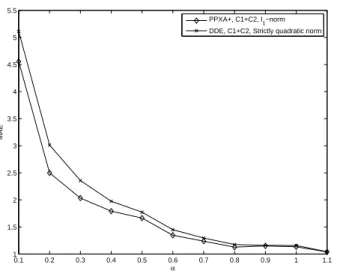
Several proximal algorithms [13, 14] like the primal-dual splitting algorithm [15] or the generalized forward-backward splitting algorithm [16] can minimize efficiently a
In doing so, we put to the fore inertial proximal algorithms that converge for general monotone inclusions, and which, in the case of convex minimization, give fast convergence rates
For this research it is proposed a new architecture based on convolutional networks, for the training of the network we will use the stereo images from the Middlebury database [3]
Использование второго варианта параллельного алгоритма (рисунок 4) позволило достичь ускорения в 17 раз по сравнению с по- следовательным алгоритмом
First, one can notice that for attenuating the effect of the noise with the distribution derivative method, the support length of the chosen test functions must be greater than
