Available online at: www.astm.org
TECHNICAL NOTE
F. Burnotte,
1A. R. Cabral, and G. Lefebvre
2A Simple Field Method to Qualify the State
of Saturation in Capillary Barriers
ABSTRACT: A simple and straightforward field method to rapidly qualify the state of saturation of moisture retaining layers (MRL) is proposed and the details of its calibration and operation, described. The technique is based on the simple fact that if gas samples cannot be taken from a stainless tube that is inserted to the desired depth within the MRL, the air filled voids at that depth are not interconnected and the material can be qualified, for all practical purposes, as saturated. In this case, the threshold degree of saturation beyond which gas flux substantially decreases (approximately 85 %), has been attained. In several sites covered with deinking by-products (DBP), an industrial residue that can be used as alternative construction material for landfills and acid-producing mine sites covers, it has been often impossible to collect gas samples below approximately 20 cm from the surface of the DBP layer. The question was thus to know if this is a reliable indicator that the threshold degree of saturation has or not been attained and that the layer is performing its role of gas barrier. In order to answer this question, a calibration was performed in the laboratory and in the field. The calibration consisted mainly on attempting to extract gas from samples compacted at different degrees of saturation. The results show that the threshold degree of saturation for DBP is attained at approximately 83 %.
KEYWORDS: capillary barriers, moisture retaining layer, landfill gas extraction, acid rock drainage
Introduction
Acid rock drainage (ARD) resulting from the oxidation of reac-tive sulphide-rich mine tailings or waste rock can be controlled by reducing the O2input, i.e., by creating a barrier to oxygen migra-tion. Likewise, the efficiency of landfill gas (LFG) extraction can be improved when a barrier to atmospheric air is created within the cover system. This reduces the costs associated with LFG pumping and purification before conversion to energy.
Such barrier to gas migration can be achieved by different tech-niques, among which covers with capillary barrier effect (CCBE) have been a choice in many cases (Bussi`ere et al. 2003; Aubertin et al. 1997; Yanful 1993; Yanful and St-Arnaud 1991). The hy-draulic principles of CCBEs have been extensively reported in technical literature (Nicholson et al. 1989; Yanful 1993; Bussi`ere et al. 2003). In simple terms, by placing a moisture retention layer (MRL; typically fine-grained soils with high water retention ca-pacity) over a capillary break layer (CBL; typically coarse-grained soils with comparatively low water retention capacity), a capillary break is created at the interface between the two materials. As a result, a high degree of saturation is maintained in the MRL— independently of the degree of saturation within the CBL—which drastically reduces the migration of atmospheric O2 through the MRL.
The MRL can be constructed using several types of materials, including natural soils, nonreactive tailings (Bussi`ere et al. 2003; Bussi`ere et Aubertin 1999), and organic-rich by-products, such Received Jul. 28, 2003; accepted for publication Apr. 26, 2005; published Nov. 2005.
1Professor, Department of Civil Engineering, Coll`ege de Sherbrooke, Sherbrooke, Canada.
2Professor, Department of Civil Engineering, Universit´e de Sherbrooke, Sherbrooke, Canada J1K 2R1.
as deinking by-products (DBP) (Audet et al. 2002; Cabral et al. 2000a,b). Cabral et al. (2004), among other researchers (e.g., Rah-man et al. 2002), observed that beyond a threshold degree of satu-ration (Sr) of approximately 85 %, a one order of magnitude drop in the oxygen diffusion coefficient occurs; the air filled voids are no longer interconnected and gas migration can only occur through the liquid phase. The performance of a CCBE is thus tributary of the degree of saturation (Sr) inside the MRL. As such, this is an important parameter to be monitored, particularly when alternative materials are being tested to be used as MRL.
Several techniques have been used to monitor the evolution of moisture within MRLs, including TDR (Cabral et al. 1999) and various types of pore pressure probes. In order to determine the degree of saturation, moisture data from calibrated probes are converted into degree of saturation using density data. In both cases, one has to rely on the precision of probe readings and their calibration. Destructive methods that allow more precise estima-tion of Sr based on density and moisture data obtained from ex-humed samples are preferably to be avoided during the monitoring phase.
There is thus a need to develop a method to assess the perfor-mance of CCBEs as oxygen barriers (as far as its state of saturation is concerned) in a more straightforward manner. This paper de-scribes the details of a simple monitoring methodology that allows instantaneous field qualification of the state of saturation of a MRL. A stainless steel tube is inserted to the desired depth within the MRL and capped with a septum. Gas samples are then taken using a sy-ringe. If gas cannot be pumped from the tube, the air filled voids are not interconnected and the material can be qualified, for all practical purposes, as saturated. In this case, the threshold degree of saturation beyond which oxygen flux decreases substantially has been attained. The method was calibrated both in the laboratory and in the field.
The proposed method was developed during the monitoring phase of several experimental field covers constructed over poten-tially ARD-generating abandoned mine sites (Cabral et al. 2000b, 2002; Audet et al. 2002). In these projects, deinking by-products (DBP) were used as alternative MRL material. The composition of the DBP, a fibrous and highly compressible industrial by-product produced in large quantities by the pulp and paper industry, has been described by Cabral et al. (1997). Typically, DBP contain from 50 to 70 % organic matter by weight (mainly cellulose fibers) with calcite and kaolinite forming most of the mineral part. The material has a low hydraulic conductivity (typically in the 10−8 to 10−9m/s range) and a relatively high water retention capacity (Cabral et al. 2004b); Burnotte et al. 2000). Attempts to classify the material in geotechnical terms did not prove successful: due to its fibrous nature it is impossible to obtain a grain size distribution and determine the Atterberg limits (Cabral et al. 2000a; Kraus et al. 1997).
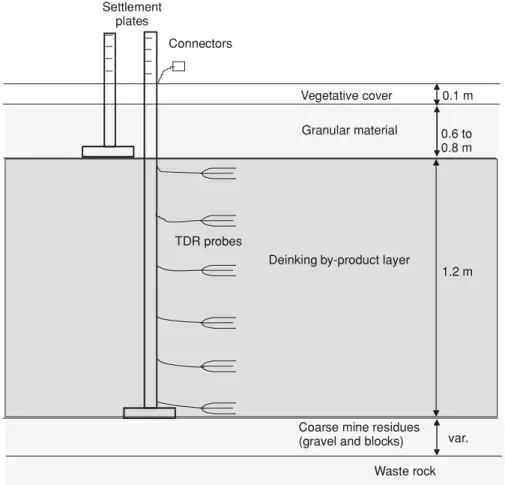
Figure 1 presents a typical profile of a CCBE constituted of DBP. The DBP layer acts as moisture retention layer (MRL), whereas the underlying coarse mine residues acts as CBL, i.e., their superposi-tion creates a capillary barrier. Figure 1 also presents some of the monitoring instruments installed at the Clinton site (Cabral et al. 2000b), including TDR.
The initial field degree of saturation of the MRL was estimated based on density-water content data determined right after com-paction of the DBP layer. Density measurements were performed using the sand cone method (ASTM D 1556). At the Clinton site, the
Deinking by-product layer
0.6 to 0.8 m 1.2 m var. 0.1 m Granular material Vegetative cover Settlement plates TDR probes Connectors
Coarse mine residues (gravel and blocks)
Waste rock
FIG. 1—Typical Profile of the CCBE Constructed at the Clinton Site and Detail of Part of the Monitoring Instrumentation Installed.
using volumetric water content data obtained from TDR readings (Cabral et al. 1999). A limitation of this method of estimating Sr is that it requires the estimation of the volume of voids, which may be quite difficult and imprecise due to compression of the MRL caused by mechanical consolidation due to the overburden of the protective layer and solid loss due to biodegradation (Teixeira 2001; Panarotto et al. 1999). Indeed, important settlements have been observed at several experimental plots where DBP have been used (Audet et al. 2002).
Required periodical gas quality monitoring at the Clinton site was done by sampling gas at various depths inside the DBP layer. The gas monitoring system consists of: 1) a stainless steel tube with a sharp bottom end; 2) a stainless steel bar 10–20 mm longer than the tube, also sharpened at the bottom and equipped with a handle at the top (Fig. 2a); 3) a 7-mm septum (Aldrich Chemical Company, Inc.) and a 60-ml plastic hypodermic syringe with a 21-G needle (Becton Dickinson and Company).
Gas samples were taken according to the following procedure: The tube with the bar inside is first inserted down to the desired depth. The bar is then removed and a septum is placed tightly at the top of the tube (Fig. 2b). The needle of the syringe is then pushed through the septum, and its piston pulled in 2 s up to the 60-ml reading (see Fig. 3). The piston is maintained in this position for 5 s and then released. Laboratory calibration of this procedure has shown that if the piston goes back to approximately the 15-ml reading (for a 1-m long tube) or to the 30-ml reading (for a 2-m long tube), no gas has entered the tube; i.e., the air filled voids are not interconnected. Due to the low hydraulic conductivity of
10 < x < 20 mm 6-mm O.D. stainless steel bar
with handle Stainless steel tube
7 mm I.D 9 mm O.D.
Septum
(a) (b)
DBP
FIG. 2—Scheme of the sampling tube: (a) Before Insertion; (b) After Insertion.
FIG. 3—Piston at the 60 ml reading.
typical DBP layers (∼10−8m/s), water does not enter the tube fast enough to influence the reading. If the piston stays at the 60-ml reading, the state of saturation is such that the air-filled voids in the MRL are interconnected and chances are that the oxygen flux will be high—or much higher than in the opposite case. It is important to use a clean and dry syringe and needle.
At the Clinton site, as well as in other sites covered with DBP, it was often impossible to collect gas samples below approximately 20 cm from the surface of the DBP layer (Cabral et al. 1997, 2000b); i.e., the piston retreated back to a lower reading. This was attributed to the high level of saturation within the MRL (DBP layer). The question was thus raised whether the fact that gas cannot be sampled could be a reliable indicator of a threshold degree of saturation beyond which one can affirm that the MRL (or for that matter, the CCBE) is performing well its role of oxygen barrier.
In order to answer this question and to establish a link between the behavior observed in the field (piston retreated back to a lower reading) and the state of saturation, a calibration was performed in the laboratory following the procedure described below.
Septum
Stainless steel tube
Compaction mold
containing a DBP sample
FIG. 4—Laboratory Setup.
Laboratory Calibration
DBP layers have been typically compacted in the field with gravi-metric water contents between 140 and 160 % for degrees of sat-uration in the vicinity of 90 % (Cabral et al. 2002). A total of 19 DBP samples were prepared in the laboratory at several gravimetric water contents. The material was compacted in three lifts into the compaction mold (Fig. 4), following an adaptation of the standard Proctor procedure (ASTM D 698); the number of blows per lift was adjusted to obtain different degrees of compaction. Since the volume, mass, and water content of each sample can be easily ob-tained, a precise estimation of the degree of saturation can therefore be made.
The same equipment used for field gas monitoring was employed to verify whether the fact that gas cannot be sampled is indicative of the state of saturation. The tube and bar assembly was inserted at the center of the sample to a depth of approximately 60 mm
300 350 400 450 500 550 40 80 120 160 200 240 Water content (%) Dr y d ens it y ( k g/ m 3 ) Saturated (Laboratory) Nearly saturated (Laboratory) Saturated (Field) Unsaturated (Laboratory) Unsaturated (Field) Standard Proctor Sr=100% Sr=80% Sr=60% Sr=40% Sr=83%
FIG. 5—Standard Proctor curve of DBP and values of degree of saturation obtained in the laboratory and in the field.
(Fig. 4). After removing the bar, the septum was installed and the syringe was pushed through in order to try to sample gas following the procedure described previously.
The degrees of saturation of the 19 samples prepared in the lab-oratory are presented in Fig. 5 (black filled symbols). The standard Proctor curve obtained for the same batch of DBP is also pre-sented. Samples were qualified as in “saturated” condition (black filled triangles in Fig. 5), when it was not possible to sample gas. Otherwise, i.e., when gas sampling was possible, they were qual-ified as in “unsaturated” condition (black filled squares in Fig. 5). An intermediate state of saturation, qualified by the term “nearly saturated,” was associated with four samples (indicated in Fig. 5 by circles) for which the piston retreated back to a reading between 60 ml and 15 ml.
The thin lines in Fig. 5 represent equal degree of saturation lines. The continuous thick line (Sr= 83 %) was identified (by trial and error) as the approximate border line between “unsaturated” and “saturated” conditions. With the exception of one black triangle at a water content equal to 110 %, “saturated” samples fall right of the Sr= 83 % line, whereas “unsaturated” samples fall left of it. It can thus be said that the threshold degree of saturation is 83 %, a value comparable to the Sr= 85 % obtained by Cabral et al. (2004) for the same material. It should be noted that the degree of saturation of the samples qualified as “nearly saturated” fall just right of the threshold line and just under the Sr= 85 % line (not presented).
Field Calibration
The state of saturation inside two MRLs constructed with DBP was assessed in the field using the procedure presented above. Three measurements were made right after compaction of the MRL, whereas five others were made after the overlying protective layers of the CCBE had been in place for nearly five years. In the latter case, excavation of the protective layers was necessary and done in the following manner: a 5-cm hole was augered through the top granular layer and a 5-cm diameter PVC was inserted (Fig. 6; see also Fig. 3). The stainless steel tube—with the bar inside—was then pushed down to the desired depth (Fig. 6). After measurement, the
Stainless steel tube
Desired depth
Granular material
DBP
Vegetative cover
5-cm OD PVC tube
FIG. 6—Sketch of the installation requiring excavation of the protective layers.
PVC tube was removed and the hole was sealed with bentonite paste.
In order to determine the degree of saturation in the field, density and moisture content data were required. For that reason, sand cone tests (ASTM D 1556) were performed at the same depths where attempts to sample gas were made. The values obtained are plotted in Fig. 5 (hollow symbols). Only two types of conditions were ob-tained, namely “saturated” (indicated by hollow triangles on Fig. 5) and “unsaturated” (hollow squares). It can be observed that, with the exception of one result at a water content value of 210 %, “un-saturated” samples fall left of the border line (Sr= 83 %), whereas “saturated” samples fall right of it.
These results seem to confirm that the method to estimate the state of saturation is reliable. If a simple laboratory calibration is made, it is possible to assess instantaneously and reliably whether a MRL is performing or not as an oxygen barrier.
Conclusions
Deinking by-products have been used as alternative material for the construction of moisture retention layers in CCBEs that act
as barriers to the migration of atmospheric air. The performance of such barriers depends on maintaining a state of saturation such that the air-filled voids are not interconnected, which substantially reduces oxygen migration. Direct measurement of the degree of saturation of the barrier using destructive methods are costly and often to be avoided, whereas indirect evaluation often involves many assumptions in terms of density and moisture content, particularly in the case of highly compressible materials, such as DBP.
A quick and reliable field method to assess the state of saturation of MRLs was developed and the details of its use presented. It requires the use of inexpensive equipment and limited skills. The proposed method indicates when, in the field, one can consider that the material is sufficiently “saturated,” i.e., that the air-filled voids are no longer interconnected. In order to determine the value of this threshold degree of saturation for a given material (DBP in this case), a simple laboratory calibration is necessary.
The details of the laboratory and field calibration procedure were presented. The laboratory calibration data indicate that the method is reliable. For DBP, the threshold Sr value obtained in the lab-oratory was 83 %. For values greater than that, the method con-sistently indicated a "saturated” state, whereas for values under Sr= 83 %, the method indicated an “unsaturated” state. This cor-roborates the results of Cabral et al. (2004) who observed that beyond Sr= 85 %, the oxygen diffusion coefficient through DBP is significantly reduced. Moreover, field calibration revealed the same value of threshold degree of saturation (83 %), confirming the reliability of the method in situ.
Acknowledgments
The work was partly supported by a grant from the National Science and Engineering Research Council of Canada (NSERC) in partnership with Industries Cascades, Inc., Les Papiers Perkins, Ltd., and D´esencrage Cascades, Inc. Jean-Guy Lemelin, Senior Technician, helped in the development of this method. ´Eric Drouin, Technician, and Alain Lefebvre, undergraduate student, performed parts of the laboratory and field testing.
References
Aubertin, M., Bussi`ere, B., Barbera, B.-M., Chapuis, R. P., Monzon, M., and Aachib, M., 1997, “Construction and Instrumentation of In Situ Test Plots to Evaluate Covers Built with Clean Tail-ings,” Proceedings of the 4th International Conference on Acid
Rock Drainage, Vancouver, BC, Canada, 31 May–6 June, 1997,
Vol. 2, pp. 717–730.
Audet, C., Lefebvre, G., Cabral., A., and Burnotte, F., 2002, “State of Development in the Valorization of Deinking By-Products as an Alternative to Fine Grained Soils in the Building of Cover Systems,” 2002 TAPPI International Environmental Conference
and Exhibit, Technical Association for Pulp and Paper industry,
Montreal, Quebec, Canada, 6–10 April.
Burnotte, F., Lefebvre, G., Cabral, A., Audet, C., and Veilleux, A., 2000, “Use of Deinking Residues for the Final Cover of a MSW Landfill,” 53rd Canadian Geotechnical Conference, Montreal, Quebec, Canada, 16–18 October, pp. 585–591.
Bussi `ere, B., Aubertin, M., and Chapuis, R., 2003, “The Behavior of Inclined Covers Used as Oxygen Barriers,” Canadian
Geotech-nical Journal, Vol. 40, pp. 512–536.
Bussi`ere, B. and Aubertin, M., 1999, “Clean Tailings as Cover Material for Preventing Acid Mine Drainage: an In Situ
Experi-ment,” Proceedings of Sudbury ’99, Mining and the Environment, Sudbury, Ontario, Canada, Vol. 1, pp. 19–28.
Cabral, A. R., Tremblay, P., and Lefebvre, G., 2004a, “Determina-tion of the Diffusion Coefficient of Oxygen for a Cover System Composed of Pulp and Paper Residues,” Geotechnical Testing
Journal, Vol. 27, No. 2, pp. 184–197.
Cabral, A. R., Planchet, L., Marinho, F. A., and Lefebvre, G., 2004b, “Determination of the Soil Water Characteristic Curve of Compressible Materials: Case Study of Deinking Residues,” Geotechnical Testing Journal, Vol. 27, No. 2, pp. 154– 162.
Cabral, A. R., Burnotte, F., Lefebvre, G., and Panarotto, C. T., 2002, “Geotechnical Characterization of a Pulp and Paper Residue to be Used as Alternative Cover Material to Landfill and to Acid Generating Tailings,” Proceedings, 4th International Congress
on Environmental Geotechnics, Rio de Janeiro, Brazil, 11–15
August, pp. 207–211.
Cabral, A. R., Racine, I., Burnotte, F., and Lefebvre, G., 2000a, “Diffusion of Oxygen Through a Pulp and Paper Residue Bar-rier,” Canadian Geotechnical Journal, Vol. 37, pp. 201–217. Cabral, A. R., Burnotte, F., and Lefebvre, G., 2000b,
“Comporte-ment de la Couverture de R´esidus de D´esencrage Au Site Minier Clinton,” Colloque NEDEM 2000, Sherbrooke, Quebec, Canada, 3–5 October.
Cabral, A. R., Burnotte, F., and Lefebvre, G., 1999, “Application of TDR Technology to Water Content Monitoring of Capillary Barriers Made of Pulp and Paper Residues,” Geotechnical Testing
Journal, Vol. 22, pp. 39–43.
Cabral, A. R., et al., 1997, ”Use of Deinking Residues as Cover Material in the Prevention of AMD Generation at an Abandoned Mine Site,” Proceedings, Acid Rock Drainage, Vancouver, BC, Canada, May.
Kraus, J. F., Benson, C. H., Van Maltby, C., and Wang, X., 1997, “Laboratory and Field Hydraulic Conductivity of Three Com-pacted Paper Mill Sludges,” Journal of Geotechnical and
Geoen-vironmental Engineering, Vol. 123, pp. 654–662.
Nicholson, R. V., Gillham, R. W., Cherry, J. A., and Reardon, E. J., 1989, “Reduction of Acid Generation in Mine Tailings Through the Use of Moisture-Retaining Cover Layers as Oxygen Barriers,” Canadian Geotechnical Journal, Vol. 26, pp. 1–8. Panarotto, C. T., Robart, G., Cabral, A. R., Chartier, R., Burnotte,
F., and Lefebvre, G., 1999, “Using Deinking Residues in Cover Systems,” Seventh International Waste Management and Landfill
Symposium, Cagliari, Sardinia, Italia, 4–8 October.
Rahman, F., Bouazza, A., and Kodikara, J. K., 2002, “Oxygen Dif-fusion Through a Neddle Punched Geosynthetic Clay Liner,”
Proceedings, 4th International Conference on Environmental Geotechnology, Rio de Janeiro, Brazil, August, Vol. 1, pp. 539–
543.
Teixeira, C. E., 2001, “ ´Evolution Biochimique des R´esidus de D´esencrage Dans un Contexte de Valorisation Comme Barri`ere de Recouvrement,” Ph.D. Thesis, Departement de G´enie Civil, Universit´e de Sherbrooke, Quebec, Canada.
Yanful, E. K., 1993, “Oxygen Diffusion Through Soil Covers on Sulphidic Mine Tailings,” ASCE Journal of Geotechnical
Engi-neering, Vol. 119, pp. 1207–1228.
Yanful, E. K. and St-Arnaud, L. C., 1991, “Design, Instrumentation and Construction of Engineered Soil Covers for Reactive Tailings Management,” Proceedings, 2nd International Conference on
the Abatement of Acid Drainage, 16–18 September, Montreal,