Fortieth International Conference on Information Systems, Munich 2019 1
“An iron hand in a velvet glove’’: the
embodiment of the platform logic in the
emergency sector
Completed Research Paper
Stan Karanasios
RMIT University
Melbourne, Australia
[email protected]
Vanessa Cooper
RMIT University
Melbourne, Australia
[email protected]
Peter Hayes
RMIT University
Melbourne, Australia
[email protected]
Anouck Adrot
Paris Dauphine University PSL
Paris, France
[email protected]
Abstract
Despite increasing attention on organizational responses to digital platforms the Information Systems research has overlooked the influence of platforms on the public sector. In this paper we draw on the concept of institutional logics to examine the impact of platforms on the emergency sector. A qualitative case study of the emergency sector is undertaken, comprised of interviews with organizations—including emergency response organizations, government agencies, firms, non-government organizations and community and volunteer groups. The findings reveal the interplay between the prevailing ‘command and control’ and ‘community’ logics and the ‘platform’ logic and how the tensions and synergies between them are shaping the information landscape in the sector. We demonstrate how organizations embody and resist aspects of the platform logic.
Keywords: Digital transformation, emergency sector, institutional logics, platforms
Introduction
Digital platforms and the related theme of digital transformation is an important area of research for the field of information systems (IS). Much of this research has focused on sectors at the forefront of change such as the finance and the technology sectors and on exemplar firms. However, research has tended to overlook public sectors such as the emergency sector. Taking an original stance informed by institutional logics, this paper goes beyond theorizing digital transformation at the level of a single organization by examining the interplay between the ‘platform’ logic with the prevailing logics in the emergency sector. The emergency sector is characterized by a complex collection of actors, including emergency response organizations (EROs) such as police and fire, government agencies, non-government organizations (NGOs) and community and volunteer groups who provide information and services. At the same time, it is characterized by the powerful effects of centralization (Greenwood et al. 2011), which aims to ensure consistency. Both centrality and consistency are challenged by the emergence of platforms in the emergency sector (Elbanna et al. 2019). Platforms are defined as “a building block that provides an essential function
to a technological system and serves as a foundation upon which complementary products, technologies, or services can be developed” (Spagnoletti et al. 2015 p.364), which is similar to the conceptualizations by
the ability to mediate and bring together different groups of users (de Reuver et al. 2018). While much research on platforms focuses on ecosystem platforms such as Amazon, Google as well as specific platforms such as Uber, e-bay and Wikipedia, we focus on platforms that embody social networking, online communities and building connections, although we acknowledge overlap across these types of platforms (Asadullah et al. 2018; de Reuver et al. 2018). This is also in line with the platforms used across the emergency sector (Elbanna et al. 2019).
There has been significant academic interest in the role of such platforms in the emergency sector (e.g. Reuter et al. 2018; Tim et al. 2016). The bulk of the research has examined their use by citizens for sensemaking and information sharing (Schmidt et al. 2017). To a lesser extent research has examined how platforms can improve inter-organizational collaboration, information sharing, intelligence and other operational areas of response efforts amongst the range of actors in the emergency sector. An emerging trend, which is more common in other sectors, is that digital transformation results in porous boundaries between organizations where platform actors (e.g. Airbnb, Amazon, Facebook etc.) breach traditional sector boundaries (Teece 2018). For the emergency sector such changes threaten to dislodge the bureaucratic and top-down logic of coordination and information sharing (Luna and Pennock 2018; Schmidt et al. 2017). For instance, Facebook’s safety button—which allows users to inform their friends about their safety when geo-located near the stage of an incident—illustrates how private platforms are currently changing “the rules of
the game” of emergency management by revolutionizing instant connectivity within the population.
Nonetheless, with few exceptions (Elbanna et al. 2019; Hughes and Tapia 2015; Schmidt et al. 2017), little research has sought to understand the tensions emerging in the emergency sector—between EROs and government agencies and informal organizations such as NGOs, community groups, local platform-based groups and private/platform-based organizations—as they seek to grapple with the platform logic. In addition, most of the knowledge on digital transformation is based on organizations as the unit of analysis. As a result, we lack a comprehensive understanding of the transformative aspects of the increasing use of platforms in this sector. As such, we are guided by the following research question: “How are organizations
in the emergency sector responding to the platform logic and what are the implications for the sector?”
Theoretically our research is informed by the notion of institutional logics as a means to make sense of the parallel evolution of operations, structures (Friedland 2012) and technology (Gosain 2004; Mola and Carugati 2012). Drawing on Friedland and Alford (1991) and Jackall (1988), Thornton and Ocasio (1999 p.804) define logics as “the socially constructed, historical pattern of material practices, assumptions,
values, beliefs, and rules by which individuals produce and reproduce their material substance, organize time and space, and provide meaning to their social reality”. Put concisely, logics are socially shared
cultural beliefs and assumptions that shape and constrain the cognitions and behaviors of actors (Lounsbury 2002; Lounsbury 2012) and describe the way a particular world works (Thornton and Ocasio 2008). The research question demanded an understanding of the responses and practices of the range of actors involved in the emergency sector. At a sector level it also required consideration of operational matters and the structural dimensions of the organizations under study. With this in mind, we undertook a theory generating case study which examined the full range of actors playing a role in the sphere in the emergency sector. Our focus was on the role of platforms and the interplay between the dominant logics and the platform logic with a lens on a critical aspect of emergency management, that of external information sharing from organizations to citizens.
Our findings reveal the interplay between the prevailing logics of the sector and platform logic and how the tensions and synergies between them are shaping the information landscape in the emergency sector. In what follows, we first consider the relevant research on the emergency sector and studies on platforms. We then turn to the field of theory related to institutional logics as means to study how platforms are leading to an evolution and tensions within the sector. We then describe the setting of our research study and the methods employed to collect and analyze our data. Subsequently, we present our findings. The discussion section outlines the key theoretical contributions. The paper concludes with a summary of the themes of the research.
Fortieth International Conference on Information Systems, Munich 2019 3
Literature review
Relevant work
Emergencies such as bushfires, floods and earthquakes are complex, high-velocity, unpredictable and time-critical incidents that require simultaneous intervention between several fast-response, high-reliability organizations (Allen et al. 2014; Bigley and Roberts 2001; Faraj and Xiao 2006) and increasingly a range of other actors who provide localized information and services (Schmidt et al. 2017). These are typically categorized in four ways, which may overlap. The first are ‘established’ organizations, such as the EROs, that undertake tasks (e.g. manage fires, close roads), or other government agencies involved in managing a disaster or crisis as part of their core responsibility (e.g. a government department of health or a central emergency management agency). These organizations are at the apex of a bureaucratic or top-down structure (Luna and Pennock 2018). Second are ‘expanding’ organizations, which consist of a small standing organization and a larger group of trained staff and volunteers that can be mobilized. These organizations, such as the Red Cross, can expand and retract as needed. Third are ‘extending’ organizations that perform tasks outside of their traditional role (e.g. organizations that supply food, shelter and logistical support). Fourth are ‘emergent’ groups, such as community groups and volunteers that often have fluid memberships that perform non‐regular tasks (Majchrzak et al. 2007). While established organizations are often the lead agency during disasters and crisis, the other levels are more dynamic and fill the gaps left by the established organizations. Importantly for understanding the information landscape in this space, in the structure described information is distributed from the established actors for action, interpretation and contextualization by other actors. It follows that the institutional landscape of the emergency sector plays an important role in shaping information transmission. While there is overlap, established actors embody what can be labeled as the ‘command and control’ logic which is characterized by centralization and top-down coordination and clear roles, administrative procedures, and command lines that create effective common ground to govern official disaster response organizations (Wolbers et al. 2016). This logic has deeply embedded core beliefs, values and practices that have structured the emergency sector and remain widely applied. Extending organizations traditionally largely embody this logic also, as they follow top-down requests and provide services during emergencies. Expanding and emerging organizations have typically embodied what we label in this work as the ‘community’ logic, which draws on a commonly shared belief regarding community resilience, empowering the population and connecting to local communities. The emerging platform logic—the focus of this paper—advocates social-networking and mediation between groups (e.g. citizens and organizations), hyper-personalization, crowdsourcing, empowerment, as well as peer-to-peer, distributed ownership and democratization of information. This logic embodies that citizens are both consumers and co-creators of information sources through their user-generated content. As such platforms are a socio-technical assemblage (de Reuver et al. 2018).
Studies have built on the four-level conceptualization of organizational types by demonstrating how organizations form clusters to collectively coordinate efforts to handle unfolding disaster events (Noori et al. 2016). However, the emergence of platforms, also contributes to porous boundaries between organizations and activities and compels these clusters to transform (Schmidt et al. 2017). For instance, the Red Cross’ Ready2Help platform matches individuals needing help with people who could offer it (Schmidt et al. 2017). Similarly, crowdsourcing tools and mapping platforms (e.g. QuakeMap) have guided relief efforts (Wolbers et al. 2016). Citizens, volunteers and community groups are also leveraging platforms to address emergent demands and fill localized information and support needs (Tim et al. 2016). Hence, once an incident occurs, these local groups can connect through platforms, develop stable interactions and occasionally interfere as an ad hoc organization with emergency response. These shifts suggest overlapping organizational boundaries and activities as well as the convergence of physical and online spaces (Hughes and Tapia 2015; Schmidt et al. 2017). Such convergence offers new opportunities, it also raises challenges for providing effective support, and consistent and relevant information (Elbanna et al. 2019). As interactions and relationships between organizations, individuals and technology move away from the bureaucratic, top-down logic, they become more complex and may result in behavior that is difficult to predict (Luna and Pennock 2018).
A review of the literature highlights organizations’ use of platforms in the emergency sector. All organizational types increasingly rely on platforms and adapt their information practices accordingly. However as is noted in Table 1, platforms do not always disrupt sectors and organizations’ legacies. Rather,
informational practices can persist or evolve in a progressive fashion. For established actors, evidence suggests widespread use of platforms for pushing out and analyzing data, but this is done to reinforce and improve on existing ways of working and is consistent with digitalization rather than transformation. It is also part of the dichotomy that established organizations face between control and collaboration (Wolbers et al. 2016). At the level of expanding organizations there is some experimentation with platforms beyond the large commercial platforms (Schmidt et al. 2017; Wolbers et al. 2016). At the emergent level there is unequivocal evidence that citizens, volunteers and community groups are also leveraging platforms to address emergent demands and fill localized information and support needs (Tim et al. 2016). Key literature on each of the organizational levels in terms of change and challenges is summarized in Table 1, which shows the emergency sector as embracing platforms, yet also that this is tilted towards non-established organizations. It also highlights that platforms influence information practices beyond the boundaries of organizations even though most studies focus on the intra-organizational level. By doing so, the extant research overlooks the impact of important sector-level features, such as institutional dynamics (Adrot and Bia-Figueiredo 2019), that platforms have been influencing (de Reuver et al., 2019). Hence, we propose to approach the emergence of platforms at a sector level.
Table 1: Summary of literature on platforms, information practices and challenges Org. type Major themes from literature Challenges
Established
(e.g. central organizing agency, police, fire)
How platforms support intelligence
gathering (Elbanna et al. 2019; Kavanaugh et al. 2012); information dissemination (Magro
2012); new organizational roles to
accommodate platforms.
Limited experimentation with their own platforms (Magro 2012) (e.g. Heidmall project). Expanding organizations (e.g. NGOs, community groups)
Engaging with the conversation taking place on platforms and increasing outgoing information visibility (Poell 2014); some independent platform development (e.g. Red Cross’ Read2help).
Need for further development of skills and resources devoted to platforms (Elbanna et al. 2019).
Extending
(e.g. firms and new platform actors)
Growing role of social networking platforms (e.g. Facebook, Twitter) across all levels (Elbanna et al. 2019).
Emergence of unexpected behaviors and ethical challenges (Rizza et al. 2017). Emergent (e.g. social media initiative and enabled groups)
Bottom-up groups use platforms for local
sensemaking, crowdsourcing and
participation (Magro, 2012); platform enabled community groups and individuals as important sources of information and local organizing; emergent roles of citizens for information transmission through platforms (Mirbabaie and Zapatka, 2017)
Limited integration of emergent groups’ use of platforms with other levels beyond big data (Elbanna et al.
2019); bottom-up initiatives
sometimes pushed aside by others levels (Wolbers et al. 2016).
Institutional logics
The previous section examined the changes in the activities and information related practices subsequent to the rise of platforms, as well as the need to consider the whole sector to better understand organizations’ adaptation. This literature and our own data analysis guided us to the notion of institutional logics (Friedland and Alford 1991; Thornton and Ocasio 1999; Thornton and Ocasio 2008) as a means to theoretically ground our study. Institutions are “social structures that have attained a high degree of
resilience” and “provide stability and meaning to social life” (Scott 2001 p.48). Institutions play a
predominant role in the functioning of the emergency sector, where stability and legitimacy are critical for ensuring authoritative information, predicable actions and an infallible chain of command and authority. They underpin the top-down and bureaucratic structure that characterizes the traditional emergency management information provision across the world.
Fortieth International Conference on Information Systems, Munich 2019 5 While multiple understandings of institutional logics exist (Friedland and Alford 1991; Thornton and Ocasio 1999), all are underpinned by the principle that individual and organizational behavior is located in a social and institutional context, which both regularizes behavior and provides opportunity for agency and change (Thornton and Ocasio 2008). Whilst, by definition, institutions signify stability, they are subject to both incremental and irregular change (Scott 2001). That is, rather than privileging a view of homogeneity, the logics view considers any context as potentially influenced by contending logics of different societal sectors. Studies have noted the interplay of logics in the public sector between the logic of the market and of the civil society (Meyer et al. 2014; Vickers et al. 2017) and nonprofits (Coule and Patmore 2013; Skelcher and Smith 2015). In the case of IS, the focus has been on the logics carried by IT and IT professions. For example, IT governance in the healthcare sector is shaped by the ‘managerial logic’, ‘medical professionalism logic’ and ‘IT professionalism logic’ all wrestling to impose their view on how IT is used (Boonstra et al. 2017). While logics shape rational behavior, at the same time individual and organizational actors are able to respond to and shape them (Thornton 2004). That is, actors’ decisions, identities, values etc. result from both individual agency and the influence of prevailing logics, from which they draw legitimacy and identity (Friedland and Alford 1991; Thornton and Ocasio 2008). It follows that logics are never homogeneous but rather multiple logics exist, which are indicative of complex institutional environments that may be simultaneously in play, contributing to institutional contradictions (Friedland and Alford 1991). There may be multiple competing logics (Currie and Guah 2007; Lounsbury 2012), co-existing logics (Reay and Hinings 2009), hybrid logics (Slavova and Karanasios 2018), short-lived logics marked by constant change (van Gestel and Hillebrand 2011), dominant logics and shifts from one logic to another (Lounsbury 2002; Thornton 2002). The contradictions inherent within the different logics provide individuals, groups, and organizations with resources for transforming individuals’ identities, organizations and society (Thornton and Ocasio 2008)—that is, they are constantly trying to reconcile these contradictions and this process fuels change. Nonetheless, as an old institutional logic is eroded there is often resistance and conflict (Lounsbury 2002). This is clearly evident in the case of platform driven digital transformation where radical shifts occurred over short periods of time leading to responses by traditional dominant actors and governments— e.g. the share economy (e.g. Uber, Airbnb) and traditional business models rubbing up against one another. Importantly, such transition periods are important units of analysis because novel practices, rules of engagement and structures can emerge (Lounsbury 2002).
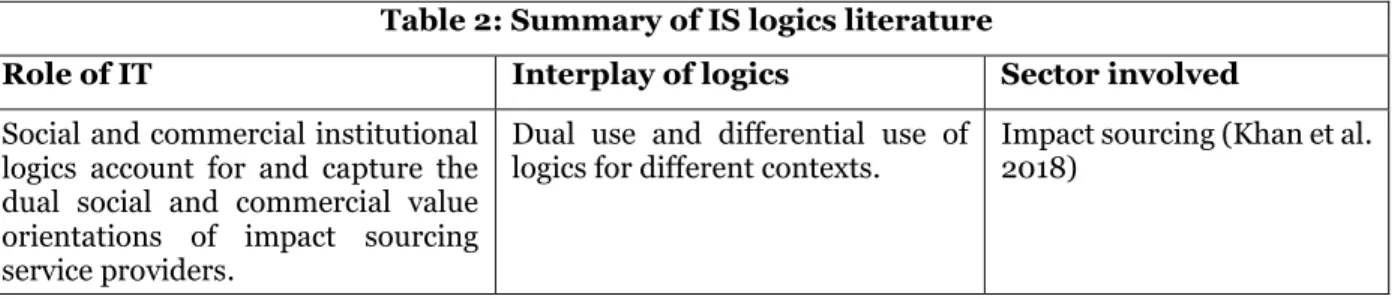
This diverse literature points to how the logics perspective can help explain the transformation of the emergency sector. However, the concept of institutional logics has not been investigated widely in IS research, despite its ability to generate insights concerning contradictions between beliefs, norms and activities within a whole sector of activity. Recent interest in logics in IS demonstrates that IS can act as the impetus for new ways of working, re-imaging entirely different ways of solving problems, working and interacting; at the same time IS can reinforce existing practices and paradigms and lead to conflicts and rejection of IS. Table 2 summarizes the key literature on logics from the IS research. It reveals that in many sectors IS can carry a new institutional logic. Column one shows the role of the technology and study focus; column two identifies the framing of the logics; whilst column three and four provide details of the study focus and references. Whilst the table is not intended to be exhaustive it shows the role of technology in shaping logics. Table 2 also shows that while studies tend to focus on collisions or conflicts between logics (Boonstra et al. 2017; Currie and Guah 2007), there is also a view that their reconciliation or congruity (Khan et al. 2018; Mola and Carugati 2012) may lead to a new aligned set of practices or engender a new logic (or hybrid logic) (Karanasios and Slavova 2019; Slavova and Karanasios 2018). On the other hand, the conflicts may be so contradictory that entrenched logics eclipse the emerging logic and thus lead to the failure of digitalization efforts (Sandeep and Ravishankar 2014).
Table 2: Summary of IS logics literature
Role of IT Interplay of logics Sector involved
Social and commercial institutional logics account for and capture the dual social and commercial value orientations of impact sourcing service providers.
Dual use and differential use of
The evolution from the ‘localism’ logic to the ‘mediated market’ logic and ‘market efficiency’ logic.
Hybridization: partly relying on the open market and its relational network.
Sourcing decisions of firms (Mola and Carugati 2012) Conflict between the existing logics
and logics embedded within a new an IT.
Current logics and ones inscribed in the new IS may result in resistance, selective appropriation or unintended side effects.
Enterprise IS (Gosain 2004)
IT governance and portfolio
institutionalize alternate logics. Competition—dominating logics between and within the groups of
stakeholders persistently compete with each other.
Health care and hospital management (Boonstra et al. 2017; Currie and Guah 2007)
IT driven values and faith in technology fuels a ‘technocratic’ logic and ‘decentralization’ logic.
Complementarity: IT-driven logics both complement and compete with other logics, which can sabotage projects.
Public affairs and local government (Sandeep and Ravishankar 2014)
Creation of new business
opportunities that foster the
emergence of business-oriented ‘value chain logic’, in tension with the view of farming as a way of life and traditional logic.
Hybridization: resulting from
tensions between logics. Agriculture (Karanasios and Slavova sector
2019; Slavova and
Karanasios 2018)
Research study
Framing and setting
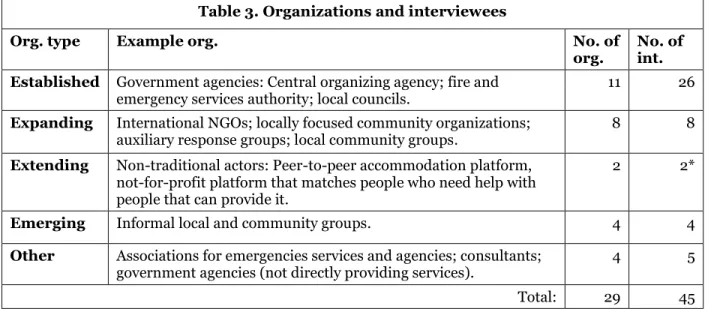
Our study was designed as an interpretive case study (Walsham 1995) which is particularly well-suited to illuminating the use of IS in organizations. We examined a range of organizations involved in providing information to different extents and/or responding to disasters and crisis in a state of Australia. This allowed us to explore the case from multiple, diverse and multilayered perspectives (Yin 2003). The state is interesting because of its diverse natural emergency profile, which includes large scale bushfires, floods and storms. From an institutional perspective the case is pertinent because there have been recent attempts to improve collaboration and information flows through the creation of a central organizing agency which sits at the apex of the command and control structure to ensure consistent and trusted information and communication. At the same time, the landscape of actors is diverse (see Table 3) and ranges from informal, private firms and government organizations. The case therefore allows us to pay attention to the tensions between actors and allows us to develop a sector level perspective.
Data collection
We interviewed 45 actors across 29 organizations (as summarized in Table 3), which provides breadth across the sector. Our sampling approach can be defined as purposive sampling as we identified actors, predominantly through professional networks, and online searches, which was then complemented by a snowballing technique. Interviewees held senior roles within their organization such as Manager for Emergency Management Community Information (for established organizations), Program Manager (for extending organizations) and State Manager Emergency Management and Social Media Administrator (for established/emerging organizations). At the community organization level interviewees were typically the person responsible for the day-to-day operations. In some instances, we interviewed more than one person within the same organization or undertook interviews with multiple interviewees of the same organization at one time. A semi-structured interview schedule was followed and tailored to each organization, which was structured around its role, how it shares information, the tools it uses (with a focus on platforms), how it reaches out to specific communities, and the inter-organizational information sharing approaches and challenges. While most studies in emergency management are framed around a specific incident, interviewees in our study were free to reflect on a range of incidents—primarily bushfires, floods and
Fortieth International Conference on Information Systems, Munich 2019 7 heatwaves in line with the local hazard profile. Importantly, the reflections accounted for incidents over time, providing multiple, rather than a single, snapshot of the study phenomena. Interviews were conducted face-to-face or over the phone, except for one platform-based organization, which although has local operations/presence, responded through their global headquarters via phone discussion and follow up email with detailed responses. Most interviews were audio-recorded with permission of the interviewees, or comprehensive notes were taken allowing for the discussion to be reconstructed immediately after the interview. In addition to the interviews, study participants were forthcoming with numerous additional materials regarding their work. Illustrative examples include both NGO and local government emergency guides and preparation manuals, and ERO and government strategic reports. These materials contributed to our understanding of organizational strategies and procedures.
Table 3. Organizations and interviewees
Org. type Example org. No. of
org. No. of int. Established Government agencies: Central organizing agency; fire and
emergency services authority; local councils. 11 26
Expanding International NGOs; locally focused community organizations;
auxiliary response groups; local community groups. 8 8
Extending Non-traditional actors: Peer-to-peer accommodation platform, not-for-profit platform that matches people who need help with people that can provide it.
2 2*
Emerging Informal local and community groups. 4 4
Other Associations for emergencies services and agencies; consultants;
government agencies (not directly providing services). 4 5
Total: 29 45
*Our sample of extending organizations were all platform based.
Analysis procedure
Data collection and analysis were conducted simultaneously so understanding could emerge from the theoretical concepts and empirical content. The interviews were transcribed verbatim and entered into NVivo qualitative software for analysis, as were notes and memos. In total, 620 pages of qualitative data were analyzed. Saturation point was reached when no new themes emerged from the data. To ensure a systematic and reliable coding process, the following rounds of analysis were undertaken. First, two researchers independently coded a sample of the data, producing a list of open codes for discussion and negotiation. In this round we consulted content categorization schemes from other studies (e.g. Allen et al. 2014; Tim et al. 2016). These open codes identify and describe the phenomena found in the text. Through an iterative comparison process prescribed by the open coding technique (Charmaz and Mitchell 2001), we agreed on a consolidated list of open codes, which was used as the basis of a “code book” and as a heuristic to code the data. Second, using the code book, two researchers separately coded a small sample of transcripts and compared and discussed the coding which led to further adaptation to the code book. Third, through multiple rounds of axial coding, we identified relationships among the open codes. As our analysis developed, we applied selective coding, focusing more on conceptual abstraction (or the “story-line”) based on our insights of the research—i.e., the “conceptual leap” (Klag and Langley 2013)—to address our research question. This process was important because it allowed us to manage the volume of data and constantly organize codes into a coherent structure (Charmaz and Mitchell 2001). This enabled us to close the cycle of analysis by comparing the meaning and relevance of our findings to our initial thinking as well as to the current body of literature. In this way, our analytical procedure followed a logic of discovery rather than a logic of verification (Glaser and Strauss 1967). The process from open coding to aggregate theoretical codes helped us to understand not only how platforms were being used but the unfolding interplay between the logics. For instance, our three-main aggregate theoretical codes were: elements of transformation at the organization and sector level; the interplay of the logics; and, the tensions and evolution resulting from the
interplay between the logics. In the presentation of our findings we rely heavily on interview quotes and examples as interpretative evidence; building an analytical and explanatory narrative, in particular we focus on drawing on the data from organizations most heavily referring to the interplay between the logics
Findings
The presentation of our findings structured around two major themes: the interplay between the logics and the resulting tensions and evolution at the organizational and sectoral level.
Interplay of the logics
Traditionally, the emergency sector draws heavily on the command and control logic which is characterized by clearly specified roles, administrative procedures and command lines that create sufficient common ground to govern official disaster response organizations. In terms of information sharing, framing and transmitting, international standards are adopted within the emergency sector with the aim to orchestrate operations in the field and ensure that crucial information generated by operators gets transmitted to decision makers in a unified format and across the different levels of organizations.
“So, we have to operate as a team and that’s why we absolutely have to operate under the AIIMS
structure [Australasian Inter-Agency Incident Management System] otherwise it would just become actually quite dangerous” (Established Org)
“we have that command and control for a reason to, yes, keep things as streamlined and clear as
we possibly can in, yes, what can be very complex and, you know, incredible incidents”
(Established Org)
The command and control logic is not restricted to established organizations but influences other organizations within the emergency sector that have progressively adopted its main principles. In particular, some expanding organizations and extending organizations are expected to align with commonly accepted procedures and tools and often have formal arrangements in place around information flows. Later in our analysis we show how expanding organizations (NGOs and community groups) and extending organizations (a platform-based actor) strongly embodied the command and control logic when it came to information sharing.
More recently, multiple phenomena, including economic and societal digitalization, have been forcing the integration of citizenship-related values and practices in the emergency sector, which stems from what we label the community logic. Dramatic emergency events within the state fostered collective reflection on the avenues to improve crisis response and paved the way to adapt the command chains to improve communication and information flows with the community to build resilience (see Teague et al. 2010). This is critical for understanding the top-down political impetus for the new management structure that embraces elements of the platform logic and shows that frames are not only shaped by digital technology but past-experience (Nambisan et al. 2017). The community logic draws on a commonly shared belief regarding the importance of empowering the population and support its resilience. Traditionally, this logic has prevailed among expanding organizations, due to their local focus and their connection to local communities. This logic importantly highlights the need to lead and influence rather than provide generic directions. While the community logic initially developed within expanding and extending organizations, it progressively reached established organizations and diffused across the whole sector and established organizations highlighted the importance of its influence in terms of how they adapt information content to citizens.
“Having two-way conversations where it’s back and forth with the community rather than just telling people what to do” (Established Org)
As such, information-related practices increasingly embedded values from both logics. For instance, preparedness and planning around emergencies have increasingly expanded to include citizens. As a result, emergency actors multiply efforts to transmit the appropriate information to foster citizens’ risk awareness and autonomy.
As noted in Table 1 the emergency sector is increasingly relying on platforms such as Twitter and Facebook for information sharing practices. In parallel, platform companies have become economically powerful and
Fortieth International Conference on Information Systems, Munich 2019 9 have strongly influenced the population’s expectations in terms of information response and personalization:
“Social media has to be a part of the communication suite that we use. So, yes, it’s come a long
way. And also, from a community perspective, you know, there’s an expectation that they can contact us and that we will speak to them” (Established Org)
Primarily driven by emerging organizations, the platform logic advocates mediation between groups (e.g. citizens and organizations), hyper-personalization, crowdsourcing, empowerment, as well as peer-to-peer, distributed ownership and democratization of information. This logic embodies that citizens are both consumers and co-creators of information sources through their user-generated content. A flip side of this is the increasing demands for information and emergency responders to be attuned to citizens and in-turn share this information in real-time, while at the same time meet citizen’s needs for hyper-personalized and responsive information services (as opposed to general information and warnings) (Elbanna et al. 2019). Going further, the platform logic does not only relate to information flows between the formal and community focused organizations. Rather, it is infused in how established organizations operate, as evidenced by the new formal roles and systems put in place around platforms such as social media/liaison officers and ways of working:
“We build the template in conjunction with the agencies. We help build and design and interact
with the public facing side of the community warning” (Established Org)
These roles and corresponding information practices break down the silo approach to working which is common in the sector, whereby individual organization and strong professional identities (Weick 1993) limit information flows. However, established organizations increasingly rely on third-party platforms, and in so doing, need to engage with the logic of openness that the platforms espouse. This has led to a shift away from relying predominantly on the top-down approach to information dissemination towards incorporating a citizen centric focus. This challenges the command and control logic:
“I think social media has a much bigger place, but it won’t interest, in a sense, [Government
Agency], because it can’t be written down as a policy and it can’t be controlled by them. So, we control it at a community level, and it would be thoroughly responsive and agile in a way”
(Established Org)
For expanding and emerging organizations, such as NGOs and community groups, platforms allow for further reach, interaction and connections in new ways with their constituents (and in some cases are the foundation of their existence). That is, the platforms largely fit with and sometimes enable the community logic that they have largely embodied and allow them to magnify their information activities. In the case of the extending organizations in our study, platforms have allowed them to become new, and in some cases, unplanned important actors in this space.
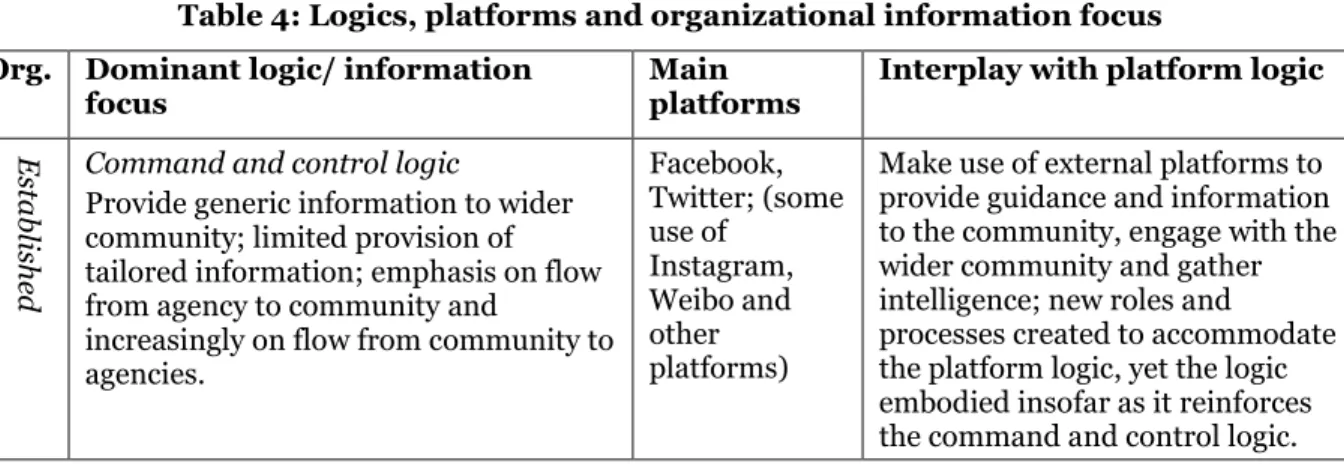
Table 4 provides a summary of the different ways the organizational levels use platforms as well as the goals of their information strategies and practices. It reveals how organizations rely on the platform logic to magnify existing practices while addressing the need for more accurate dialog with citizens with respect to emergencies.
Table 4: Logics, platforms and organizational information focus Org. Dominant logic/ information
focus
Main platforms
Interplay with platform logic
Esta
bl
ish
ed
Command and control logic
Provide generic information to wider community; limited provision of tailored information; emphasis on flow from agency to community and
increasingly on flow from community to agencies. Facebook, Twitter; (some use of Instagram, Weibo and other platforms)
Make use of external platforms to provide guidance and information to the community, engage with the wider community and gather intelligence; new roles and
processes created to accommodate the platform logic, yet the logic embodied insofar as it reinforces the command and control logic.
Expa
nd
ing
Community logic
Utilize local networks and connections to identify and support community member needs, including most at-risk persons; a mix of generic and tailored information.
Facebook,
Twitter Make use of external platforms to engage, guide and inform wider
community; relay official advice; forum for sharing of information and networking; localized intelligence; ‘go to’ information source; some experimentation with the platform logic, but a lack of restructuring or roles and processes to accommodate the platform logic.
Ext
endi
ng
Command and control/platform logic
Provide guidance and information to customers according to established protocols.
Own platforms; Facebook, Twitter
Extending organization that have formal arrangements with
established organizations follow the command and control logic; for others they symbolize and propel the platform/community logic.
Eme
rg
ing
Community logic
Combine information from official sources with localized content; sharing local knowledge/information; greater multi-directional information flow.
Twitter, Facebook (some use of WhatsApp)
For some emerging groups
platforms are the reason they exist, for others’ platforms are a forum for sharing of information and networking; localized intelligence; ‘go to’ source of information and for relaying official-advice.
Tensions and micro-transformation of practices driven by the platform logic
As noted, the interplay between the logics reveals how the platform logic complements and magnifies the prevailing logics. However, a deeper analysis of information practices reveals tensions resulting from the interplay of the three logics. In particular organizations remain in a bind between the prevailing logics and the established information practices on the one hand, and the platform logic and the uncertainty and contradictions it raises on the other. These tensions led to new information practices that infused or hybridized multiple logics or in some instances, resistance towards the platform logic.
An example of this is how established organizations resolved the tension between the platform logic and the command and control logic. On the one hand, the platform logic advocates highly-customized and personalized information. On the other, the command and control logic follows what is referred to as the “one source, one message” information paradigm, whereby all actors and citizens recognize the authority and legitimacy of the established actors (as noted in Table 4). A limitation of this approach is that information is generic to the population. However, for established organizations a risk of fully appropriating the platform logic is information fatigue and messages being misinterpreted. In practice, multiple and conflicting interpretations across organizations and citizens may result in outcomes and behavior that is difficult to predict (e.g. individuals may/may not respond to official warnings) and possibly creates misinformation. This is exacerbated by the volume of information across the increasing number of actors in this space providing information through platforms, which can result in information fragmentation and fatigue.
“Warnings are so tricky. I mean even within the broader community there is mixed understandings about certain words and then you try and translate something like that.”
(Established Org)
To resolve this an established organization developed new information practices by adopting the social networking affordances of the platform logic to target their generic messages towards segments of society that may act as “information brokers” and provide tailored information. By doing so they relegate the information translation and contextualization to others. This is an example of how established organizations embrace (in part) the platform logic, whilst reinforcing the command and control logic:
Fortieth International Conference on Information Systems, Munich 2019 11
“For the heat campaign, we target middle aged women [on their social platforms], because they are more likely to look after young children, as well their elderly parents, who are both vulnerable people in heat” (Established Org)
Such tensions around information practices are not only a concern of established organizations, who also faced the challenge around balancing the right amount and level of information.
“And I’ve got a feeling… yes, I’ve got a feeling that the market is pretty saturated with those messages already.” (Expanding Org)
Some expanding and emerging organizations retreated from the platform logic after a period of experimentation because of the challenges and expectations it raises regarding information. For instance, an international NGO acknowledged that in the past it framed the opportunities of the platform too strongly before it’s organizational resources/structure was ready. This resulted in providing information during emergencies to the public which was not in line with their typical information approach: “a lot of messaging
that was conflicting—potentially”’ (Expanding Org). This experience led to a realization that despite
willingness to adopt the platform logic, the organizational structure and skill base did not exist to truly embody it and it refrained from using platforms for information sharing beyond sharing top-down information and warnings rather than contextualized information:
“It’s not dynamic, it’s not moving, it’s not live, it’s not real, which is the actual premise of those platforms.” (Expanding Org)
“We’re pretty active about getting messages out there to say, you know, look after yourself, prepare and have a think about, and just grabbing the information from the emergency services…pushing that out…using our trusted brand to enhance that.” (Expanding Org)
Similarly, a community organization—which was locally important in terms of local fire resilience and response—refrained from engaging in providing localized information or warnings through its Facebook presence because it in turn raised expectations regarding information and instead it only pointed to top-down information sources: “don’t come to us for info, we’re not going to give it to you” (Expanding Org). The move away from the full realization of the platform logic in the examples above points to a lack of rooting of the logic and the gap between the organizations’ ambitions to adopt new logics and transform, and their structures and resources. While established organizations had developed roles and skill bases which embrace elements of the platform logic (even though it is accommodated only as far as it reinforces and extends existing practices), the expanding and extending organizations have severely limited capability or capacity to develop or maintain and effectively use platforms. Some organizations have embarked on programs to up skill their staff and volunteers (“digital volunteers”). A mixture of issues are identified including: how organizations structure their staff and responsibilities (e.g. dedicated expertise sitting in another area of the organization), prioritization of how platforms are used by the organization, varying approaches to up-skilling staff and volunteers which typically belong to a demographic groups not overly familiar with platforms “the volunteers are not that type of cohort...they’re not Twitter users’ (Expanding Org).
The above examples are different to other emergent organizations that are platform-based, who acknowledge the need for information that is bespoke rather than generic and embody the platform logic and enable the translation of information to occur either by themselves, or by their constituents, whereby official messages are used for local sensemaking:
“There’ll be a Bureau of Meteorology extreme weather warning, we’ll (the community group) put that up (on our Facebook group page) and then that usually starts a conversation with the community. Then the community will post back on the site, images and the community will respond to those messages. So, we would be posting the official messages but it sort of takes-off from there with the community” (Emerging Org)
Some extending organizations - which were platform operators - incorporated both platform and command and control/community logics. For instance, one organization by virtue of its own platform was better positioned to connect with and address the information needs of its constituents (visitors/tourists) who are a hard to reach group in emergencies. Despite this, it firmly follows the command and control logic when it comes to information sharing via its information channels, including Twitter and Facebook. That is, it
blended elements of the command and control logic when it comes to information sharing via its website, email and Twitter and Facebook, by only reaffirming top-down messages via an established memorandum of understanding with the state-level central organizing agency.
“Messaging is sent as soon as an incident is confirmed, and sufficient safety information is being
updated from local authorities…on a weekly basis this happens about two to five times per week”
(Extending Org).
Another platform-based organization was formed on the basis of community and platform logics. In particular, they acknowledge the importance of relying on some citizens’ centrality into social networks to transmit information and foster collective action. Despite being a platform-based organization, it also recognized the issues inherent to platforms. For instance, it remained reluctant to ask for data from their users because of the lack of trust towards another major platform they rely on. However, they also have developed awareness regarding their potential to increase their appeal and attract new users.
Discussion
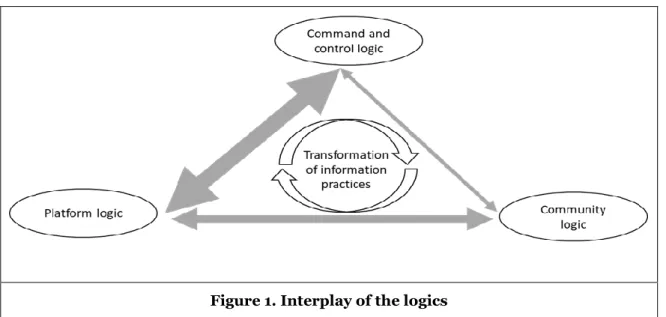
This research addresses the question of how organizations in the emergency sector are responding to the rise of platforms. In particular, our inquiry is concerned with information practices, sharing and flows between the levels of organizations and between organizations and citizens. Our findings reveal the interplay between the three logics and how this interplay progressively shapes information-related practices and paves the way for the digital transformation of the emergency sector. We identified the three logics from the literature. The command and control logic which is common to other states and nations and is dominated by centralization, consistency, coordination and clear roles. The community logic embodies the principals of close community ties and empowering the population to support its resilience. We also introduced and defined the platform logic (evidenced by Table 1) as embodying mediation between groups, hyper-personalization, crowdsourcing, empowerment, as well as peer-to-peer, distributed ownership and democratization of information. Our findings identified two pressures that led to changes in the sector. The first being the platform logic driven by broader societal digital transformation and the increasing expectations of citizens; the second was shaped by exogenous events (reflection after failure to respond to major events in the past) which led to structural level changes. These shifts led to a softening but eventual persistence of the command and control logic. Figure 1 summarizes our findings by representing the investigated interplay of the logics. It represents that the three logics are interconnected and form the new information landscape. The width of the arrows corresponds the intensity of the inter-logic tensions on information practices (for instance, the command and control and platform logics diverge in terms of information generality), which, in turn, fuels the transformation of information practices.
Fortieth International Conference on Information Systems, Munich 2019 13
Unpacking the platform logic: complexity, dilemmas and implications
Our findings highlight the increasingly institutional complexity (Currie and Guah 2007; Greenwood et al. 2011) that comprises the emergency sector, where organizations embody multiple logics and reflect these in their structures and practices. In some cases, the grip of a logic can be “so dominant that it eclipses other
logics” (Besharov and Smith 2014 p.366). Consistent with this view, our work reveals that the platform logic
is embodied in established organizations insofar as it reinforces existing structures and enhances information activities. We refer to this as the “iron hand in the velvet glove” as it reflects how despite some softening the command and control logic still dominates. In other cases, institutional logics are so “similar
they blend to provide a single set of practices, assumptions, values, beliefs and rules” (Besharov and Smith
2014 p.366). We found this to be partially the case as some expanding and emergent organizations, especially platform-based community groups that drive the platform logic or exist because of it. However, clear congruency between the community and platform logics, does not imply one’s substitution, for the other. Some expanding organizations experimented with the platform logic and, through information practices, realized their inability to engage with it fully. In this way, contrary to the tendency in the literature to promote process models that are linear, we show that logics are not moving from one stage to another, but their progress can be thwarted and in conflict (Currie and Guah 2007) and nuanced. Therefore, at a sector level, our study points to what can be referred to as hesitant and restrained changes and an approach that infuses or hybridizes (Mola and Carugati 2012; Slavova and Karanasios 2018) characteristics of the command and control and community logics with the platform logic.
Our study highlighted the dilemmas that the platform logic creates for organizations and the sector (Nambisan et al. 2017) and demonstrates how the platform logic raises new tensions and can lead to information fragmentation across the sector. The nuanced nature of our findings has several theoretical implications that are important for studies on the sector and studies related to platforms and digital transformation more broadly. The fluidity of the present landscape suggests that novel practices may emerge, new actors take on important roles or incumbents adapt and restructure to the new pressures from the platform (Lounsbury 2002). Related to this, our study points to a conundrum for actors in this space. That is, if the emerging opportunities enabled by platforms are interpreted with current frames then radical opportunities afforded by the technology cannot be understood (Nambisan et al. 2017). For instance, there was examples of organizations from all the levels reducing their use of platforms to an information broadcasting tool, rather than fully embracing the platform logic. On the other hand, if the opportunities are framed too strongly (e.g. the redistribution of power) then traditional organizations may view this as questioning the legitimacy and can lead to a response that is either weak or protective (Grégoire et al. 2010; Nambisan et al. 2017).
In our study established organizations preferred to use platforms to reinforce their position and practices, while some expanding organizations that initially embraced the platform logic found that their organizational structure was not setup to accommodate it. A concern is that the restrained adoption of the platform logic may leave the sector open to platform actors exploiting this gap by leveraging the social networking ability of their platforms and data analytic capabilities to meet the growing needs of citizens for hyper-personalized information. This also raises questions around what is the optimal amount of digital transformation driven by platforms? So far, the literature has been silent on this question and focused on hyperbole and success cases and has less to say about sectors such as emergency and the public sector that are characterized by the need for stability and predictability; we turn to this in light of the digital transformation literature in the next section.
Platforms, digital transformation and the evolution of sectors
Digital transformation challenges organizational boundaries (Nambisan et al. 2017). This is an increasing phenomenon whereby technology firms breach sector boundaries and hybridize traditionally siloed content such as media, entertainment, finance, telecommunications, gaming, and consumer electronics (Teece 2018). Our study points to the challenging of traditional boundaries (and the command and control logic) by new actors that, by their nature, create new ecosystems comprising of multiple levels of organizations (de Reuver et al. 2018). Yet, rather than extending organizations taking center stage as in other sectors, it is the affordances of the platforms that are nudging new expectations amongst citizens and the transformation of information practices. At a sector level, our study points to what can be referred to as hesitant and restrained changes and an approach that infuses or hybridizes (Mola and Carugati 2012;
Slavova and Karanasios 2018) characteristics of the command and control and community logics with the platform logic. An example of this was evident in our study, whereby one platform-based actor that could engage and connect with its users directly firmly followed the command and control logic when it came to information sharing. Our study is one of few to point to the emergent tensions across the sector which further constrain the platform logic.
Our study addresses a recommendation in the platform related literature that calls for studies of platforms where there is uneven or less transformational impact and to addresses the broader issue of how digital platforms relate to issues of societal interest (de Reuver et al. 2018). Our research does this by nuancing the embodiment of the platform logic in a sector of critical societal importance and one where radical changes and shifts are not necessarily welcomed. Generally, the literature on platforms and digital transformation tends to privilege examples of radical shifts in sectors prone to transformation, such as finance/fintech and examples of firms with specific sectors (Lucas. et al. 2015). The literature has given less prominence to sectors and organizations that have either remained resilient to wholesale digital transformation or struggled with it; despite this reflecting most sectors and firms (Westerman et al. 2017). For instance, the health sector has been resilient to the impact of platforms and digital transformation (Agarwal et al. 2010; Lucas. et al. 2015). Reasons for this, which are similar to the conditions of the emergency sector, include the importance of information accuracy and planning for predictable actions, the high stakes and political nature of the sector and challenges around the regulatory processes (Agarwal et al. 2010; Tiwana 2014). Similar, to both sectors the impetus for change is driven by patients and individuals. Therefore, our study findings may be particularly useful for explaining the embodiment of the platform logic in sectors characterized by stability, high-reliability, centralization and where incumbents and public organizations hold a unique position regarding information. Such sectors are resistant to new sets of logic that require it to modify their behavior. However, a distinction in our study is the rise of the importance of emerging actors—their role may be unique to the emergency sector and range from online communities and community organizations to platform-based firms who have been shifting patterns of information use.
Conclusion
This study examined the platform logic in the emergency sector. Our findings revealed the interplay between three logics and how the tensions and synergies between them are shaping the new information landscape of the emergency sector. Unlike many studies that focus on platforms and digital transformation in a single organization, our research took the stance that to understand the transformative impact of platforms, it is necessary to consider the collection of actors in the ecosystem. This can help explain not only their use of platforms but also why certain organizations do not fully embody their logic and how it engenders a range of interpretations across different institutional groups. Our study points to a bifurcated evolution of the information landscape in the emergency sector. While clearly, the command and control logic guides information practices, the platform logic hovers over the sector. We found that even amongst the established organizations that have created information roles and refocused their information strategic efforts, the command and control logic maintain the strongest influence on practices and the platform logic is embodied insofar as it reinforces existing structures and enhances information activities. We referred to this as the “iron hand in the velvet glove”. In addition, we showed that despite the clear congruency between the community and platform logics there was not a clear appropriation of the platform logic. In some cases, expanding organizations experimented with the platform logic, yet quickly pulled back once they realized the limitations of their structure to fully engage with it. Therefore, demonstrating that logics are not moving from one stage to another, but their progress can be thwarted and in conflict as well as hybridized. We identified several tensions which underpin the conflicts between the logics. For the emergency sector these critically include the difficulty raised by scattered information and the need to control the message in this context and also how the structures and skill-sets within these organizations are unable to fully accommodate the platform logic.
There are several limitations to this study which are common to inductive case study research in terms of generalizability. While we have attempted to account for cultural historical changes in the sector, the study is cross-sectional and therefore provides a snapshot of the interplay between the logics. As such, future research could provide more longitudinal accounts. The study focuses on a state in Australia, which has its own nuances and has undergone structural changes, there are many commonalities with other countries particularly around the increasing roles of platforms, the deep embeddedness of the command and control
Fortieth International Conference on Information Systems, Munich 2019 15 logic and the increasing role of periphery actors. The findings may also be useful for explaining the embodiment of the platform logic in other sectors where incumbents and public organizations hold a unique position regarding information. Future research may also seek to identify reasons for the variations across different settings—such as states and countries and their particular arrangements and responses to digital transformation. In our study we accounted for a range of organizations, however there are other important actors that future studies may wish to consider such as a such as broadcasters and insurance companies that play an important information role, as well as a broader range of platform actors. The latter group has been noted to be difficult to incorporate in case study research (de Reuver et al. 2018). Some of these new entrants can provide valuable opportunities to address informational and support gaps in the sector. Future research is needed that examines the connections between organizations, community groups and individuals and how they make sense of the technology (Nambisan et al. 2017). For the emergency sector this could translate into improved understanding of how to better utilize the new and overlapping network of actors.
Acknowledgements
This research was funded by the National Disaster Resilience Grant Scheme, Emergency Management Victoria.
References
Adrot, A., and Bia-Figueiredo, M. 2019. "Lost in Digitization: A Spatial Journey in Emergency Response and Pragmatic Legitimacy," in Materiality in Institutions: Spaces, Embodiment and Technology in
Management and Organization, F.-X. De Vaujany, A. Adrot, E. Boxenbaum and B. Leca (eds.), Palgrave
MacMillan, pp. 151-181.
Agarwal, R., Gao, G., DesRoches, C., and Kumar, A. J. 2010. "Research Commentary—The Digital Transformation of Healthcare: Current Status and the Road Ahead," Information Systems Research (21:4), pp. 796-809.
Allen, D. K., Karanasios, S., and Norman, A. 2014. "Information Sharing and Interoperability: the Case of Major Incident Management," European Journal of Information Systems (23:4), pp. 418–432. Asadullah, A., Faik, I., and Kankanhalli, A. Year. "Digital Platforms: A Review and Future Directions,"
Proceedings of the 22nd Pacific Asia Conference on Information Systems, Yokohama, 2018.
Besharov, M. L., and Smith, W. K. 2014. "Multiple Institutional Logics in Organizations: Explaining Their Varied Nature and Implications," Academy of Management Review (39:3), pp. 364-381.
Bigley, G. A., and Roberts, K. H. 2001. "The Incident Command System: High-Reliability Organizing for Complex and Volatile Task Environments," The Academy of Management Journal (44:6), pp. 1281-1299.
Boonstra, A., Eseryel, U. Y., and van Offenbeek, M. A. G. 2017. "Stakeholders’ Enactment of Competing Logics in IT Governance: Polarization, Compromise or Synthesis?," European Journal of Information
Systems (27:4), pp. 415-433.
Charmaz, K., and Mitchell, R. 2001. "Grounded Theory in Ethnography," in Handbook of Ethnography, P. A. Atkinson, A. Coffey, S. Delamont, J. Lofland and L. Lofland (eds.), Sage Publications: Thousand Oaks, CA, pp. 60–174.
Coule, T., and Patmore, B. 2013. "Institutional Logics, Institutional Work, And Public Service Innovation in Non-Profit Organizations," Public Administration (91:4), pp. 980-997.
Currie, W. L., and Guah, M. W. 2007. "Conflicting Institutional Logics: A National Programme for IT in the Organisational Field of Healthcare," Journal of Information Technology (22:3), pp. 235-247.
de Reuver, M., Sørensen, C., and Basole, R. C. 2018. "The Digital Platform: A Research Agenda," Journal
of Information Technology (33:2), pp. 124-135.
Elbanna, A., Bunker, D., Levine, L., and Sleigh, A. 2019. "Emergency Management in the Changing World of Social Media: Framing the Research Agenda with the Stakeholders Through Engaged Scholarship,"
International Journal of Information Management (47), pp. 112-120.
Faraj, S., and Xiao, Y. 2006. "Coordination in Fast-Response Organizations," Management Science (52:8), pp. 1155-1169.
Friedland, R. 2012. "The Institutional logics Perspective: A New Approach to Culture, Structure, and Process," M@n@gement (15:5), pp. 583-595.