A Framework for Summarizing a Log of OLAP
Queries
Julien Aligon
Universit´e Franc¸ois Rabelais Tours Laboratoire d’Informatique Email: [email protected]
Patrick Marcel
Universit´e Franc¸ois Rabelais Tours Laboratoire d’Informatique Email: [email protected]
Elsa Negre
Universit´e Franc¸ois Rabelais Tours Laboratoire d’Informatique Email: [email protected]
Abstract—Leveraging query logs benefits the users analyzing large data warehouses. But so far nothing exists to allow the user to have concise and usable representation of what is in the log. In this paper, we propose a framework for summarizing OLAP query logs. This framework is based on the idea that a query can summarize another query and that a log can summarize another log. It includes a simple language to declaratively specify a summary, a measure to assess the quality of a summary and an algorithm for automatically computing a good quality summary of a query log.
I. INTRODUCTION
It is becoming accepted that leveraging query log would help the user analyzing large databases or data warehouses [1]. This is particularly relevant in a collaborative context for instance to issue recommendations [2], [3], [4], [5]. But to the best of our knowledge, even the simple problem of providing the user with a concise representation of what is inside a large log has rarely been addressed [1]. Using such a summary, that avoids overwhelming the user, would have many advantages, including:
• helping an administrator to manage and tune the OLAP server if the summary indicates the frequently accessed members,
• allowing a user to have a rough idea of the queries launched by other users,
• assisting the user to perform new analysis sessions, for instance by not redoing what has been done, or to write new queries, by looking for what has been done. In this paper, we propose to summarize automatically an OLAP query log. In this context, we work with the following assumptions:
1) A log is a (often very large) sequence of queries that must be summarized with a concise representation, 2) The way summaries are obtained should be very flexible
(i.e., various relevant summaries may be computed from one query log),
3) In addition, the quality of the summary must be evalu-ated, in terms of how faithful it is to the log.
To answer point 1, we consider that a log will be summarized by a sequence of queries, i.e., by another (much shorter) log. Our answer to point 1 entails that a query will summarize other queries. For point 2, we propose that summaries are specified in a declarative fashion, i.e., summaries are the
results expressions constructed with a dedicated manipulation language. This language allows to transform one or more queries into another query for which its quality as a summary is measured (point 3).
Our contributions include:
• A query manipulation language (called QML) tailored for OLAP queries. This language is composed by binary and unary operators that allow to summarize queries, • A quality measure based on the classical notions of
precision and recall that allows to measure to which extent a query is a good summary of another query, • A greedy algorithm for automatically constructing, using
QML, a summary of a query log w.r.t. a quality threshold given by the user.
This paper is organized as follows. The next section mo-tivates the approach with a toy example. In Section III, we propose a method to summarize queries by introducing the lan-guage for manipulating queries and in Section IV we introduce a quality measure for the summarized queries. In Section V we present the algorithm that automatically computes a summary of a query log. Section VI briefly discusses related work. We conclude and draw perspectives in Section VII.
II. MOTIVATION
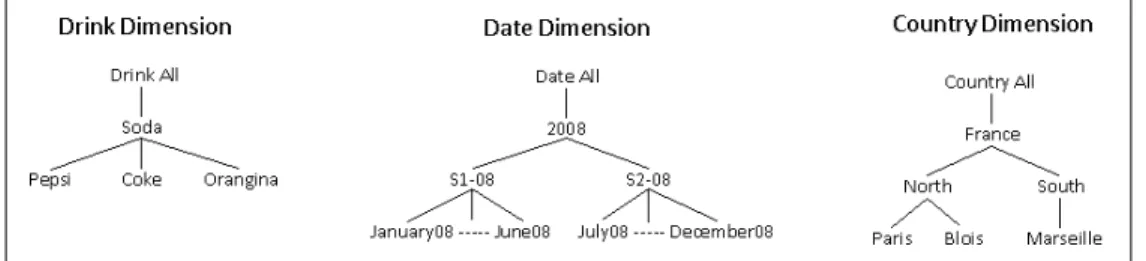
In this section, we illustrate with a toy example our approach for summarizing a log of OLAP queries. The context of this example is that of a user navigating a data warehouse. In our example, the data warehouse records sales of beverages in different locations at different time. The dimensions of this data warehouse are given Figure 1. Consider a sequence of queries s = hq1, q2, q3i where q1 is the first query launched, q2 the second one and q3 the last one. Suppose these queries are logged in a log L and ask respectively for:
1) The sales of Pepsi and Coke for July 2008, in cities Paris or Marseille,
2) The sales of Coke for July 2008, in regions North or South,
3) The sales of Orangina for the second semester 2008, in regions North or South.
Assume we want to summarize these queries by another query. Various solutions are possible. First, we can summarize
Fig. 1. Dimensions of our toy example
the queries by retaining for each dimension the most frequent members. In that case, the resulting query would ask for sales of Coke in regions North or South during July 2008.
A second alternative would be to summarize the queries with another query having for each dimension the members that cover all members present in the initial queries. For example, note that ’Pepsi’, ’Coke’ and ’Orangina’ are sodas, cities ’Paris’ and ’Marseille’ and regions ’North’ and ’South’ are in France and all three queries concern year ’2008’. The query summarizing the log L would then ask for the sales of soda in France in 2008.
Finally, note that we can have a compromise by summariz-ing q1 and q2 first, say with the second alternative, and then summarizing the resulting summary with q3, say with the first alternative. In that case, we would obtain the query asking for the sales of Soda and Orangina in France, region North and region South, for year 2008 and the second semester of 2008. These examples show the need for flexibility in how the summary is computed. That is why in this paper we propose to have a query manipulation language that is used to specify summaries. In addition, as various summaries can be computed from one log, the quality of these summaries should be evaluated. For instance, for our first alternative, the quality measure should take into account the fact that ’Orangina’ is present in the log but not in the summary. In our second alternative, this measure should take into account that indeed ’North’ and ’South’ cover ’Paris’ and ’Marseille’ but also ’Blois’, that is not present in the log.
Finally, note that so far, we have illustrated the problem of summarizing queries by another query. But a set of queries could be summarized by another set of queries. Moreover, summaries for a log should respect the fact that logs are sequences of queries. For instance, consider again L, this log could be summarized by the sequence hq10, q3i where q10 is a summary of q1 and q2 asking for the sales of Soda in France in the second semester of 2008.
III. HOW TO SUMMARIZE QUERIES?
In this section, we formally define the query manipulation language.
A. Preliminary definitions
As the query manipulation language is tailored for OLAP queries, we first begin with the definition of an OLAP query. Note that in this paper, we do not consider query result, and thus the definition of a query result is not given.
An n-dimensional cube C = hD1, ..., Dn, F i is defined as the classical n + 1 relation instances of a star schema, with one relation instance for each of the n dimensions Di and one relation instance for the fact table F . For a dimension Di having schema S = {Li1, . . . , Lidi}, a member m is any
constant inS Li
j∈SπL i
j(Di). For a dimension Di, we consider
that members are arranged into a hierarchy <i and we note m <im0 the fact that the member m0 is the ancestor of m in this hierarchy.
Given such a cube, a cell reference (or reference for short) is an n-tuple hm1, ..., mni where mi is a member of dimension Di, ∀i ∈ [1, n]. We define multidimensional queries as sets of references that can be expressed as Cartesian products of multisets. The reason for having multisets is to be able to define operators that count members’ occurrences.
Definition 3.1: Given an n-dimensional cube C = hD1, ..., Dn, F i, let Ribe a multiset of members of dimension Di, ∀i ∈ [1, n]. A query q over C is the multiset of references q = R1× ... × Rn.
In what follows, we assume an n-dimensional cube C = hD1, ..., Dn, F i. In the following definitions, i ranges from 1 to n. For a query q, mi(q) denotes its multiset of members in dimension Di. A query q will be noted ×imi(q), and multiset mi(q) will be noted hSi, fii, where Si is a set and fi is a function giving the occurrences of each element of Si.
Example 3.1: Consider the three queries q1, q2 and q3 of the toy example described in the previous section. q1 can be expressed in the MDX query language:
SELECT
{[Drink].[DrinkAll].[Soda].[P epsi], [Drink].[DrinkAll].[Soda].[Coke]} ON COLU M N S
Crossjoin({
[Country].[CountryAll].[F rance].[N orth].[P aris], [Country].[CountryAll].[F rance].[South].[M arseille]}, {[Date].[DateAll].[2008].[S2-08].[July08]})
ON ROW S F ROM Cube
We have m1(q1) = {P epsi, Coke}, m2(q1) = {J uly08}, m3(q1) = {P aris, M arseille}. This query is the set of references: q1 = {P epsi, Coke} × {J uly08} × {P aris, M arseille}. The set of references for q2and q3are:
• q3 = {Orangina} × {S2-08} × {N orth, South} The language we propose is composed by unary operators and binary operators that manipulate queries and output a query, that is called a summary query (or simply summary for short). The main idea behind the definition of these operators is that they operate dimension-wise: They construct a new query from the one(s) in parameter by treating each dimension inde-pendently. We now present formally these operators, starting with the binary operators.
B. The binary operators of QML
The first operators are the classical bag operators [6] ex-tended to multiple dimensions.
Definition 3.2: (Bag operators) Given two
queries q1 and q2 and op ∈ {∪B, ∩B, \B}, q1 op q2= ×i(mi(q1) op mi(q2)).
Example 3.2: Consider the first two queries of Example 3.1, we have:
• q4 = q1 ∪B q2 = {P epsi, Coke, Coke} ×
{J uly08, J uly08}×{P aris, M arseille, N orth, South} • q5 = q1∩Bq2 = {Coke} × {J uly08} × ∅ = ∅
• q6 = q1\Bq2 = {P epsi} × ∅ × {P aris, M arseille} = ∅ The next operators give priority to one query over the other. Definition 3.3: (Priority operators) Given two queries q1 and q2, q1C q2= q1.
C. The unary operators of QML
Recall that a query can be seen as a Cartesian products of multisets. Our first operator outputs, for a query q in parameter, a query for which only the most frequent members of q in each dimension is retained.
Definition 3.4: (Most frequent operator) Let q be a query with mi(q) = hSi, fii for all i. mostfreq(q) = ×ihSi0 = {m ∈ Si|@m0 ∈ Si, fi(m0) > fi(m)}, fi|S0
i
i (fi|X denotes the restriction of a function fito
the set X)
Example 3.3: mostfreq(q4) = {Coke, Coke} ×
{J uly08, J uly08} × {P aris, M arseille, N orth, South} Our second operator outputs, for a query q in parameter, a query for which only the most general members of q in each dimension are retained, w.r.t. the hierarchy of the dimension. Definition 3.5: (Max operator) Let q be a query. max(q) = ×ihSi0 = {m ∈ mi(q)|@m0 ∈ mi(q), m <im0}, fi|
S0i
i
Example 3.4: max(q4) = {P epsi, Coke, Coke} × {J uly08, J uly08} × {N orth, South}
Our next operator outputs, for a query q in parameter, a query for which only the lowest common ancestors of the members of q in each dimension are retained, w.r.t. the hierarchy of the dimension.
Definition 3.6: (lca operator) Let q be a query. Let lca be the function that outputs, for a given set of mem-bers M in dimension Di, their common ancestor w.r.t. <i, i.e., {m ∈ Di|∀m0 ∈ M, m0 <i m ∧ @m00, m0<im00m00<im}. lca(q) = ×ilca(mi(q)).
Example 3.5: lca(q4) = {Soda} × {S2-08} × {F rance}
D. Expression of various summaries
We now briefly illustrate how QML can be used. For instance, consider a log L composed by 3 queries: L = hq1, q2, q3i. This log can be summarized by the query qs1 that retain only the references that appear in all queries, i.e., q1
s = q1∩B q2∩B q3. Alternatively, L can be summarized by taking into account the frequency of the members used in the log: q2s = mostf req(q1∪Bq2∪Bq3). Finally, L can be summarized by a query roughly indicating the parts of the cube that were explored: qs3 = lca(q1∪Bq2∪Bq3). We illustrate these possibilities on our running example.
Example 3.6: Summarizing by retaining the common references of all queries, we obtain: q1
s = q1∩B q2 ∩B q3 = ∅. Summarizing by frequencies on these queries, we obtain: q2
s = mostf req(q1∪Bq2∪Bq3) = {Coke, Coke} × {J uly08, J uly08} × {N orth, N orth, South, South}.
Summarizing by lca, we obtain:
q3
s = lca(q1∪Bq2∪Bq3) = {Soda} × {2008} × {F rance}. In the following section, we introduce our measure for assessing the quality of summaries expressed with QML.
IV. QUALITY MEASURE
In this section, we propose a measure that evaluates to which extent a query is a good summary of some other queries. The measure is based on the classical notion of precision and recall. Note that the operators of QML define summaries by adding or deleting references to their operands. It is the case, for instance, of the lca operator which summarizes by adding ancestors.
For instance, in Example 3.5, the added references in the summary are: A = {Soda} × {S2-08} × {F rance}. And in that case, the deleted references in the
summary are: D = {Coke, P epsi} × {J uly08}×
{P aris, M arseille, N orth, South}. The intuition behind this example is that we can consider this summary as a good summary with a good quality. However, if we apply the classical precision and recall measures to evaluate its quality, both are null (since A ∩ D = ∅).
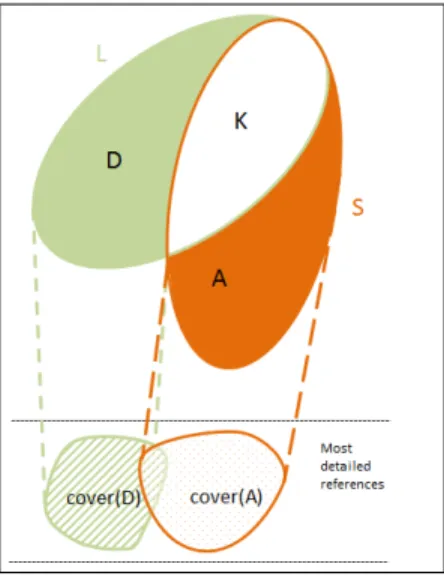
For a given set of queries, our idea of good summary is that the more references of the queries it has, the better quality it achieves. But additions or deletions of references should not decrease the quality if these additions cover, at best, the coverage of deleted references (for the references at the most detailed level w.r.t. the hierarchies of the dimensions). In that sense, it would be preferable that the coverage of additions introduces few references not in the coverage of the deleted references. We now formalize these notions.
Definition 4.1: (Coverage) A reference r covers another r’ if r=hm1, ..., mni, r’=hm01, ..., m0ni and ∀i∈ [1, n], mi >i m0i or mi= m0i.
For a set R of references, cover(R)={f ∈ ΠL1 1(D1) ×
ΠL2
1(D2) × ... × ΠL n
1(Dn) | ∃r ∈ R, r covers f }
In Figure 2, we note L the set of the references of some queries to be summarized, S the set of references of the summary and K as L ∩ S. The shaded parts are the coverages of D and A respectively, for the most detailed references.
Fig. 2. Principle of the quality measure
For instance, consider Example 3.5. L = q1 ∪ q2,
S = lca(q4) and L ∩ S = ∅ thus both A and
D 6= ∅. So, we compare cover(A) and cover(D).
cover(A) = {P epsi, Coke, Orangina}× {J uly08,
August08, September08, October08, N ovember08,
December08} ×{P aris, Blois, M arseille} and
|cover(A)| = 54. cover(D) = {P epsi, Coke} × {July08} × {P aris, M arseille} ∪ {Coke} × {J uly08} × {Blois} and |cover(D)| = 5. We can note that cover(D) ⊂ cover(A). Intuitively, if a recall measure is used, it would be excellent because all covered references are recalled. On the contrary, a precision measure would be very bad because a lot of references are introduced: The noise is consequent.
To formalize this intuition, our measure of recall is the proportion of covered references existing in cover(D) and found in cover(A) compared with the set of references in cover(D). Moreover, recall favors maximality of K. Recall is defined by: r = |K ∪ (cover(D) ∩ cover(A))||K ∪ cover(D)| .
The measure of precision is the proportion of covered ref-erences existing in cover(D) and found in cover(A) com-pared with the set of references in cover(A). As for recall, precision encourages maximality of K. Thus we measure the noise in the case when cover(A) would add new cov-ered references in the summary. Precision is formalized as: p = |K ∪ (cover(D) ∩ cover(A))||K ∪ cover(A)| . If S is the empty set (it is the case of query q5 in Example 3.2), then we consider that p = r = 0.
Note that these recall and precision measures are also relevant in three particular cases:
• If D = ∅ (there is no deleted references, as for instance for the union operator), recall is perfect and precision is only based on the kept references compared with coverage of A, i.e. p = |K ∪ cover(A)||K| .
• If A = ∅ (there is no added references, as for instance for the priority operators), precision is perfect and recall is based on the kept references compared to the coverage of D, i.e. r = |K ∪ cover(D)||K| .
• If K = ∅ (there is no kept references, as for instance for the lca operator), recall and precision are based on the coverage of additions and deletions, i.e. r =
|cover(A) ∩ cover(D)|
|cover(D)| and p =
|cover(A) ∩ cover(D)| |cover(A)| . Finally, our quality measure, simply named quality, aggregates our recall and precision measures, with a simple F-measure. Formally, given a set L of refer-ences, a query R and a set of dimensions {D1, ..., Dn}, quality(L, R, {D1, ..., Dn}) = 2 × p × rp + r. It returns a real in [0,1].
So far, we have introduced a way to express summaries of query sets. In the following section, we present our approach for summarizing a query log, i.e., a sequence of queries.
V. HOW TO SUMMARIZE A LOG?
In this section, we present an algorithm for summarizing a log, based on QML and our quality measure. A log is a finite sequence of queries. The main idea is that a summary of a log is also a log, which is computed w.r.t. a quality threshold given by the user.
Note that, if we summarize a set of queries by one query, summary operators can be combined under the form: u(q1 b q2) where u is a unary operator, b is a binary operator and q1, q2 are two queries of the set to be summarized. The idea is to apply this form in a greedy algorithm (Algorithm Summarize detailed Figures 4 to 6). The algorithm iterates until the quality of the summary falls under a threshold or the summary stops changing. In a first part, the algorithm tests each couple of consecutive queries with a binary operator (line 6 to 17). It takes the best summary w.r.t. the quality measure (line 10 to 15). Then, with this summary query, the algorithm tests each unary operators and the best output is kept (line 19 to 26). Note that the quality is measured w.r.t. the initial query couple and not w.r.t. the output of the binary operator.
Figures 5 and 6 detail the algorithm of the quality measure. Note that the size of coverages are computed without actually computing the coverages. Indeed, we assume that the number of covered members is kept for all members of the dimension tables.
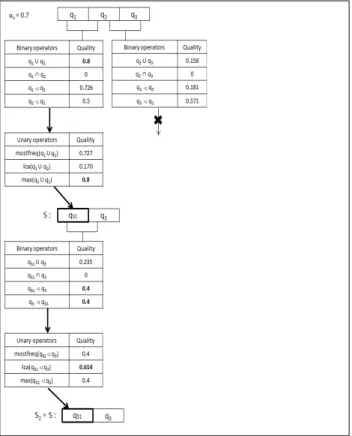
Figure 3 illustrates the algorithm with the following pa-rameters: L = hq1, q2, q3i with q1, q2, q3 the three queries of the toy example, U and B are respectively the sets of unary and binary operators of QML, the dimensions of the toy example and the quality threshold of 0.7. All binary operators are tested on each couple of consecutive queries. The couple {q1, q2} is selected because the quality measure is the highest for the union operator. Then, with the result of binary operator of couple {q1, q2}, all unary operators are tested. max operator is selected. Finally, {q1, q2} can be summarized by qS1. The algorithm tries to summarize with the new sequence of queries hqS1, q3i following the same principle. As the computed qualities are all below the threshold, the algorithm stops with result hqS1, q3i.
Fig. 3. First step of the algorithm on our toy example
VI. RELATEDWORK
Summarization of structured data has attracted a lot of attention in various domain, covering web server log [7] pattern mining (see e.g., [8] that includes a brief survey), sequences of event [9], database [10], multidimensional data stream [11], and datacubes [12].
Many of these works rely on fuzzy set theory ([7], [10]) and/or are compression techniques for which it is important that original data can be regenerated ([12], [8]). Moreover, it can be the case that the summary has not the same type as the data it summarizes. In the domain of database ([10], [11], [12]), summarizing is applied to the database instance where, for OLAP data, measure values are taken into account.
In this paper we address the problem of summarizing an OLAP server query log. Our approach has the following characteristics:
• We do not rely on fuzzy set theory for summarizing. Instead, we leverage the hierarchies described in the dimension tables.
• The type of the summary is the same as the type of the summarized data.
• We do not address the problem of regenerating the summarized data from the summary.
• We do not summarize a database instance, but database queries.
To the best of our knowledge, no work have yet addressed the problem of summarizing a database query log in a suitable and concise representation. As pointed out in [1], many
systems provide query logging, primarily for physical tuning, and allow users to view the log. But the way log is displayed, often in flat table or file, is not suitable for browsing. In our earlier work [13], we propose to organize an OLAP query log under the form of a website. But if the log is large, browsing this website may be tedious. An effective log visualization and browsing tool is yet to be designed, and the present work is a step in that direction.
VII. CONCLUSION ANDPERSPECTIVES
In this paper, we propose a framework for summarizing OLAP query logs. This framework is based on the idea that a query can summarize another query and that a log can summarize another log. Our contributions include a query manipulation language that allows to declaratively specify a summary, a measure to assess the quality of a summary and an algorithm for automatically computing a good quality summary of a query log.
Future work includes the implementation of our approach as well as various tests to assess its efficiency and effectiveness to support on-line analysis. We will also study its extension to a collaborative context where a log, composed by many sequences of queries performed by different users, can be efficiently browsed and searched.
REFERENCES
[1] N. Khoussainova, M. Balazinska, W. Gatterbauer, Y. Kwon, and D. Su-ciu, “A case for a collaborative query management system,” in CIDR. www.crdrdb.org, 2009.
[2] G. Chatzopoulou, M. Eirinaki, and N. Polyzotis, “Query recommenda-tions for interactive database exploration,” in SSDBM, ser. Lecture Notes in Computer Science, M. Winslett, Ed., vol. 5566. Springer, 2009, pp. 3–18.
[3] A. Giacometti, P. Marcel, and E. Negre, “Recommending multidimen-sional queries,” in DaWaK, ser. Lecture Notes in Computer Science, T. B. Pedersen, M. K. Mohania, and A. M. Tjoa, Eds., vol. 5691. Springer, 2009.
[4] A. Giacometti, P. Marcel, E. Negre, and A. Soulet, “Query recommen-dations for olap discovery driven analysis,” in DOLAP, 2009, pp. 81–88. [5] K. Stefanidis, M. Drosou, and E. Pitoura, “”You May Also Like” Results
in Relational Databases,” in PersDB, 2009.
[6] H. Garcia-Molina, J. D. Ullman, and J. Widom, Database Systems: The Complete Book. Upper Saddle River, NJ, USA: Prentice Hall Press, 2008.
[7] S. Zadrozny and J. Kacprzyk, “Summarizing the contents of web server logs: A fuzzy linguistic approach,” in FUZZ-IEEE. IEEE, 2007, pp. 1–6.
[8] M. Ndiaye, C. T.Diop, A. Giacometti, P. Marcel, and A. Soulet, “Cube based summaries of large association rule sets,” in sixth International Conference on Advanced Data Mining and Applications (ADMA). LNCS, 2010.
[9] W. Peng, C. Perng, T. Li, and H. Wang, “Event summarization for system management,” in KDD, P. Berkhin, R. Caruana, and X. Wu, Eds. ACM, 2007, pp. 1028–1032.
[10] R. Saint-Paul, G. Raschia, and N. Mouaddib, “General purpose database summarization,” in VLDB, K. B¨ohm, C. S. Jensen, L. M. Haas, M. L. Kersten, P.- ˚A. Larson, and B. C. Ooi, Eds. ACM, 2005, pp. 733–744. [11] Y. Pitarch, A. Laurent, and P. Poncelet, “Summarizing multidimensional data streams: A hierarchy-graph-based approach,” in PAKDD (2), ser. Lecture Notes in Computer Science, M. J. Zaki, J. X. Yu, B. Ravindran, and V. Pudi, Eds., vol. 6119. Springer, 2010, pp. 335–342.
[12] L. V. S. Lakshmanan, J. Pei, and J. Han, “Quotient cube: How to summarize the semantics of a data cube,” in VLDB. Morgan Kaufmann, 2002, pp. 778–789.
[13] S. Colas, P. Marcel, and E. Negre, “Organisation de log de requˆetes OLAP sous forme de site web,” in 6`emes journ´ees francophones sur les Entrepˆots de Donn´ees et l’Analyse en ligne (EDA 2010), Djerba, Tunisie, ser. RNTI, vol. B-6. Toulouse: C´epadu`es, Juin 2010, pp. 81–95.
INPUT: L: a log,
U : a set of unary operators, B: a set of binary operators, D1, . . . , Dn: the dimensions,
α: quality threshold. OUTPUT: A summary of L. VARIABLES:
SOQ, SOQ0: sequences of queries,
query1S, query2S, qS, queryB, queryU, query1, query2: queries,
quality, qualityQuery, max: reals. 1: SOQ0← hi
2: SOQ ← L 3: qualityQuery ← α
4: while (qualityQuery >= α) and (SOQ06= SOQ) and (sizeOf(SOQ) 6= 1) do 5: max ← 0
6: for each pair hquery1, query2i of consecutive queries in SOQ do
7: for each b ∈ B do 8: qS← query1b query2
9: ref ← query1∪ query2{the union of the references of query1with those of query2}
10: quality ← Quality(ref ,qS,D1, . . . , Dn) {Function Quality() returning the quality degree of a summarized query}
11: if quality > max then
12: max ← quality 13: query1S ← query1 14: query2S ← query2 15: queryB← qS 16: end if 17: end for 18: end for 19: max ← 0 20: for each u ∈ U do 21: qS← u(queryB)
22: ref ← query1S∪ query2S
23: quality ← Quality(ref,qS,D1, . . . , Dn)
24: if quality > max then 25: max ← quality 26: queryU← qS 27: end if 28: end for 29: qualityQuery ← max 30: SOQ0← SOQ
31: SOQ ← SOQ.replace(query1S,query2S,queryU) {Function replace() replacing the pair {query1S,query2S} by queryU}
32: end while 33: return SOQ0
INPUT:
refi, refs: set of references,
D1, . . . , Dn: the dimensions
OUTPUT: The quality of refsw.r.t refi.
VARIABLES:
D, A: a set of references, K, CD, CA,C∩: integer, r, p: float
1: K ← |refi∩ refs|
2: D ← refi- refs
3: A ← refs- refi
4: D ← max(D) {function max() returning a set of reference from D covering every references of D} 5: A ← max(A) 6: CD← CardinalityOfCoverage(D) 7: CA← CardinalityOfCoverage(A) 8: Cov∩← 0 9: M∩← 0 10: C∩← 0
11: for each ref erence rDof D do
12: for each ref erence rAof A do
13: for each dimension d of D1, . . . , Dndo
14: for each member mDof rDdo
15: for each member mAof rAdo
16: if mA<dmDthen
17: Cov∩= Cov∩+ |cover(mA)|
18: else {mD<dmA}
19: Cov∩= Cov∩+ |cover(mD)|
20: end if 21: end for 22: end for 23: M∩= M∩× Cov∩ 24: end for 25: end for 26: C∩= C∩+ M∩ 27: end for 28: r ← K+C∩ K+CD 29: p ←K+C∩K+CA 30: return 2 ×p × r p + r
Fig. 5. Algorithm Quality(refi, refs, D1, . . . , Dn)
INPUT:
Sr: set of references,
D1, . . . , Dn: the dimensions
OUTPUT: |cover(Sr)|.
VARIABLES:
r: a reference, d: a dimension, m: a member, 1: Cov ← 0
2: T ← 0 3: C ← 0;
4: for each ref erence r of Srdo
5: for each dimension d of D1, . . . , Dndo
6: for each member m of r do 7: Cov = Cov + |cover(m)| 8: end for 9: T = T × Cov 10: end for 11: C = C + T 12: end for 13: return C