Journal of Applied Biosciences 143: 14659 - 14680
ISSN 1997-5902Phytoplankton Composition and trophic state of Guessabo
lake (Upstream in Buyo lake, Ivory Coast)
Séverin Kouakou ATTOUNGBRE1, Julie Estelle NIAMIEN-EBROTTIE3, Félix Koffi KONAN1, Charles Koffi
BOUSSOU1, Martin KOUAME1, Benoit Kouamé KOUAKOU2, Gustave Nguessan ALIKO1, Nicole Ahou
YOBOUE1, Séraphin Kouakou KONAN2, Germain GOURENE3.
1 Laboratory of Biology and Topical Ecology, Jean Lorougnon Guédé University, Côte d’Ivoire 2 Laboratory of Geosciences and Environment, Jean Lorougnon Guédé University, Côte d’Ivoire 3 Laboratory of Environment and aquatic biology, Nangui Abrogoua University, Côte d’Ivoire
Corresponding Author: E-mail: [email protected]
Original submitted in on 24th July 2019. Published online at www.m.elewa.org/journals/ on 30th November 2019
https://dx.doi.org/10.4314/jab.v143i1.5
ABSTRACT
Objectives: The trophic quality of Guessabo Lake (Ivory Coast) under the influence of fishing and agriculture was analysed starting according from the phytoplankton composition.
Methodology and results: Sampling spatio-temporal in pelagic zone were made from a plankton net and supplemented with an integrated sampler. A total of three hundred and forty six species were identified. The groups, by orders of prevalence are, Chlorophyta with 164 species (48 %), Euglenophyta with 64 species (19 %), Cyanobacteria represented by 53 species (16 %), Bacillariophyta with 50 species (15 %) and, the other groups (Pyrrophyta, Chrysophyta and Xanthophyta) represented by 15 species (4 %). On the level of sampling stations of Guessabo Lake, 239 species were identified in Guemon sector against 231 and 257 species respectively in bed of the lake and Haut Sassandra sector. Concerning Guemon sector, 181 species were recorded at station G1 and 192 at station G5. In bed of lake (Channel), 154 species were listed at station G2, whereas 157 and 168 species were observed respectively at stations G4 and G6. For Haut Sassandra, stations G3 and G7 respectively presents 208 and 211 species. During this study, 103 species constant were listed against 66 species additional and 170 species accidental. In the floristic list, 73 species are common to all sampling stations. Sorensen index showed a similarity between the sectors and sampling stations. Trophic index based on Phytoplankton composition indicated that lake is from mesotrophy to eutrophy state.
Key words: Phytoplankton, lake, mesotrophy, eutrophy; Ivory Coast. RÉSUMÉ
Objectif de la recherche : La qualité trophique du lac Guessabo (Côte d’Ivoire) sous l’influence de la pêche et de l’agriculture a été analysée à partir de la composition du phytoplancton.
Méthodologie et résultats : Des prélèvements spatio-temporels dans la zone pélagiqueont été réalisé à l’aided’un filet à plancton et d’un préleveur intégré. Au total, 340 taxons phytoplactoniques ont pu être identifiés au nivaux spécifiques et infraspécifiques, Les embranchements, par ordres de prédominance sont, les Chlorophyta avec 164 taxons soit 48%, les Euglenophyta avec 64 taxons soit 19 %, les Cyanobacteria représentés par 53 taxons soit 16 %, les Bacillariophyta avec 50 taxons soit 15 %, et les autres embranchements (Pyrrophyta, Chrysophyta et Xanthophyta) représentés par 15 taxons soit 4 %.
Au niveau des stations de prélèvement du lac Guéssabo, 239 taxa ont été identifiés dans la partie Guemon contre 231 et 257 taxons respectivement dans le lit et dans la partie Haut Sassandra du lac. Concernant le secteur Guémon, 181 taxons ont été enregistrés à la station G1 et 192 à la station G5. Dans le lit du lac (chenal), 154 taxons ont été recensés au point G2, alors que 157 et 168 taxons ont été répertoriés respectivement aux stations G4 et G6. Pour la partie Haut Sassandra, les stations G3 et G7 regorge respectivement 208 et 211 taxons. Au cours de cette étude, 103 taxons constants ont été recensés contre 66 taxons accessoires et 170 taxons accidentels. Dans la liste floristique, 73 taxons sont communs à toutes les stations d’echantillonnage. Les valeurs de l’indice de Sorensen ont montré une ressemblance entre les secteurs et entre stations de prélèvement. Les indices de trophie basés sur la composition du peuplement montrent que l’état du lac tend de mésotrophe à eutrophe.
Mots clés : Phytoplancton, lac, mésotrophe, eutrophe, Côte d’Ivoire. INTRODUCTION
The population explosion and the extension of cities have led, for decades, considerable pressure on aquatic environments by different activities (fishing, agriculture, urbanization). Freshwater ecosystems, especially lakes, are a receptacle for organic and mineral substances from agricultural, domestic and urban wastewater discharges. Thus, these environments are increasingly threatened by eutrophication and / or pollution. According to SCOR WG, 2007 and Collins et al., 2014, the phenomena are related to a nutrient enrichment of the environment whose elements most important are nitrogen and phosphorus. Sources of primary production, their presence and quantity in water generally contribute to the development of aquatic plants and in particular micro-algae. Phytoplankton communities are considered as true sentinels or reflections of environmental conditions (SCOR WG, 2007; MerMex Group et al., 2011). These organisms have a turn-over of a few days allowing them to evolve rapidly when environmental conditions change. However, some authors (Smith, 2003; Chomerat, 2005; Carmichael et al., 2010) affirm that, depending on the conditions of stability and enrichment of useful nutrients, the development of an algal population may be beneficial or detrimental to man. Indeed, some phytoplankton species can secrete toxins into the water and affect heterotrophic species with public health risks (Anderson et al., 2002; Glibert et al., 2005). Faced with such situation, the use of water resources is questioned. Hence the need to envisage a policy of protecting water resources in order to preserve the ecological balance of aquatic
ecosystems (Dziocket et al., 2006; Cabecinha et al., 2009). Therefore, knowledge of ecological status and monitoring of aquatic ecosystems is imperative. In this context, according to Ngansoumana, (2006), knowledge of the phytoplankton composition makes it possible to establish real tools for diagnosis and pollution assessment. In addition, indices of biotic integrities were developed from the composition of the phytoplankton community to assess the trophic status of lakes (Thunmark, 1945 and Nygaard, 1949).In Côte d'Ivoire, Guessabo Lake located upstream of the Buyo Dam and on the Sassandra River is under the influence of several human activities. Main fishing lake, fishing on this lake is becoming more intense and badly practiced. Conventional standards are no longer respected by the use of chemicals for fishing. In addition, the exploitation of the banks for agricultural purposes during periods of low water. According to Kra, (2016), during this period, dry areas are used by farmers for food crops (rice, corn, peanuts, potatoes, bananas). Cocoa and rubber plantations are also activities in the vicinity of the lake. However, the use of agro-pharmaceutical products (weed killer, insecticide, fertilizer ...) in the treatment of crops and soil fertilization is a problem. Nutrient inputs, in particular phosphorus and nitrogen in the lake, are the source of the invasion of aquatic plants (Salomonia molesta, Eicchornia crassipes,) on its surface. Biological data available on this hydrosystem are the results of the works of Mambo et al., (2001) and Kra, (2016). These data are only on the zooplanktonic
diversity, chlorophyll a and on fish production in the lake. Based on this observation and the economic interest of this lake, the knowledge of its current state is important through its phytoplankton organisms because this biology compartment has
not been exploited and remains unknown. The objective of this study is to determine the phytoplankton composition of the lake to assess its trophic status.
MATERIALS AND METHODS
Study Area: located in western Ivory Coast, 3 kilometres from Guessabo and 40 kilometres from Duekoue. Guessabo lake is to upstream of Buyo dam on the Sassandra stream and constitutes the administrative boundary between the regions of Haut-Sassandra and Guemon. The hydrological regime of lake is influenced by the rains and the closure of Buyo dam. The annual rainfall varies between 1300 mm and 1800 mm. The level of low water to high water is governed by the contributions of Sassandra and its tributaries. Four hydrological seasons are defined (Mambo et al., 2001). Sassandra water level drops from December to January corresponding to a period of dry and hot season. From February to May, a period of low water corresponding to the period of low water during a
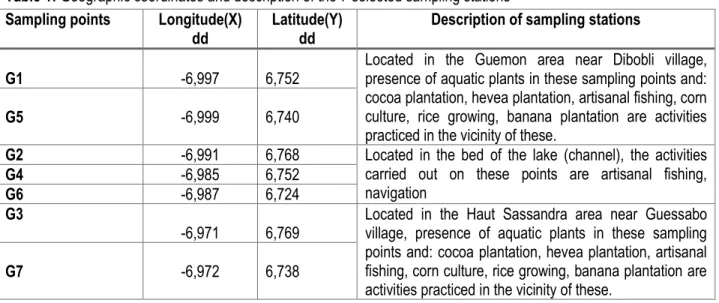
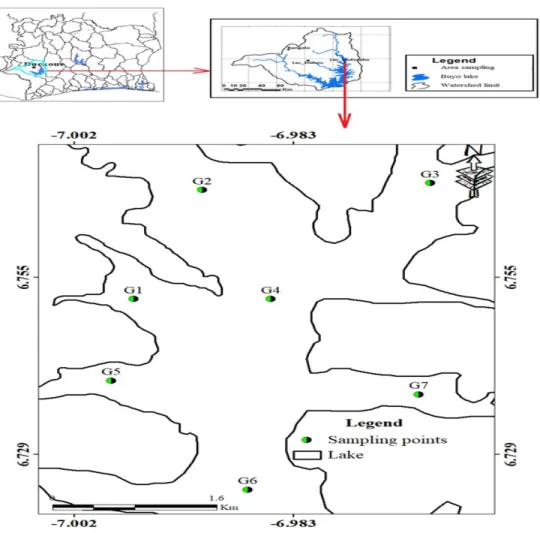
small dry season. Wet season cumulating rainfall and Sassandra flood during August to mid-December completely fill the lake every year. The study is done on the portion of Guessabo lake between 6.72° and 6.775° North latitude and between 6.96° and 7.00° West longitude which seven sampling points were retained (Figure 1). These sampling stations are selected in the following way, G1-G5 in the Guemon part, G2-G4-G6 in the bed of the lake (Channel) and G3-G7 in Haut Sassandra so as to take into account the cumulated effect of the activities to which are subjected Guessabo lake. Geographical coordinates of sampling points and the various carried on activities in the vicinity are consigned in the table below (Table1).
Table 1: Geographic coordinates and description of the 7 selected sampling stations
dd: decimal degree;
Sampling points Longitude(X)
dd Latitude(Y) dd Description of sampling stations
G1 -6,997 6,752
Located in the Guemon area near Dibobli village, presence of aquatic plants in these sampling points and: cocoa plantation, hevea plantation, artisanal fishing, corn culture, rice growing, banana plantation are activities practiced in the vicinity of these.
G5 -6,999 6,740
G2 -6,991 6,768 Located in the bed of the lake (channel), the activities
carried out on these points are artisanal fishing, navigation
G4 -6,985 6,752
G6 -6,987 6,724
G3
-6,971 6,769 Located in the Haut Sassandra area near Guessabo village, presence of aquatic plants in these sampling points and: cocoa plantation, hevea plantation, artisanal fishing, corn culture, rice growing, banana plantation are activities practiced in the vicinity of these.
Figure 1: Map showing position of the sampling points on the Buyo Lake (Guessabo Area) Sampling: Phytoplankton was sampled monthly at
each of the seven points between October 2017 and September 2018. Phytoplankton sampling was performed using the recipient of 10 liter and plankton net (50 µm mesh size)(Ouattara, 2000). These harvests were supplemented by phytoplankton collection with sampler integrated in order to collect algae of very small sizes which pass through the mesh of the net to plankton. The samples were fixed with alcohol 90% and formalin 5% into collection bottles. Observation and identification: In the laboratory, the samples were observed between slide and the cover glass under an optical microscope, LEICA with objective x 40. The various phytoplanktons were identified by consulting work of Förster1964; Philipose, 1967; Compère, 1977; Couté & Iltis, 1981; Komárek & Fott, 1983 and Uherkovich, 1995. The classification suggested in the key established by the editors of "Süsswasserflora" (Starmach, 1985) was used in this study.
Data Analysis: The ecological status of Guessabo Lake has been evaluated from the use of:
- Species richness, which is the number of taxa to which the taxa belong (Alliaume et al., 1990)
- Occurrence frequency (F), which is the ratio (in percentage) between numbers of times that species appears in the samples (N) and total number of samples (Nt) (Dajoz, 2000). Depending on the Occurrence frequency, the groups of distinguished species are constant species (F ≥ 50%), accessory species (25% ≤ F <50%), accidental species (F <25%). - Similarity index of Sorensen (Cs) which is the ratio of the number of species common to 2 stations (station a and station b) on number of species present in station a and in station b. Sorensen similarity index varies from 0 (no similarity) to 1 (identical station) (Throvald, 1949) -Compound index (index A) is the report of sum of species number belonging to groups of Cyanobacteria, Chlorococcales, Euglenophyta and Centrale on number of species of Desmidiaceae (Nygaard, 1949). If this value< 1, water is oligotrophy, if
value is between 1 and 2.5 water is mesotrophy and if value > 2.5 water is eutrophy.
- Chlorophycean quotient (index B), which is the quotient of the number of Chlorococcales and Desmidiaceae species present in a water body (Thunmark, 1945). When the value of B <1, the water is oligotrophy and when the value of B> 1, the water is eutrophy.
- Diatom index (index C) expresses the report of number of Centrales species on Pennales species (Nygaard, 1949)If the index C value is located between 0 and 2 water is oligotrophy and whenthe index C value is between 0, 2 and 3 water is eutrophy.
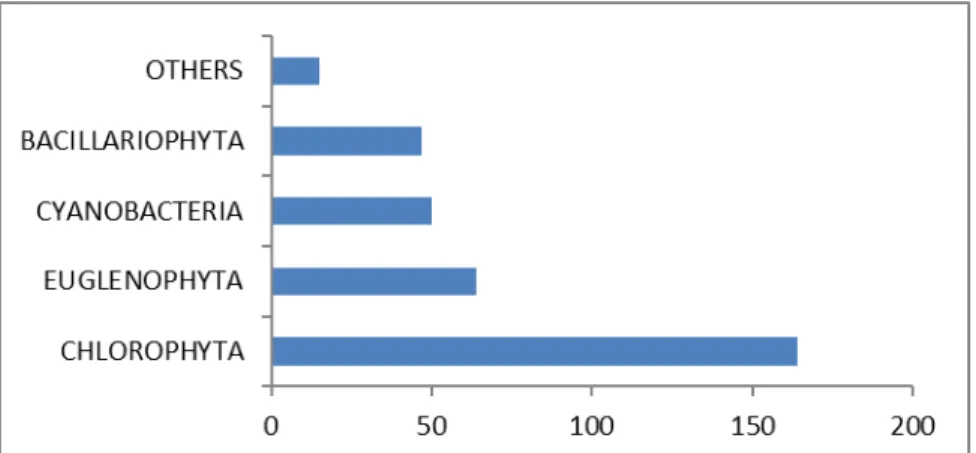
Phytoplankton composition: A total of 340 species divided into 115 genus, 53 families, 25 orders, 11 classes and 7 branches were identified. The branches, in orders of predominance are Chlorophyta with 164 species (48 %), Euglenophyta with 64 species(19 %), Cyanobacteria represented by 50 species (15 %), Bacillariophyta with 47 species(14 %), the other branches (Pyrrophyta, Chrysophyta, Rhodophyta and Xanthophyta) represented by 15 species(4 %) (Figure 2).The Branch of Chlorophyta is constituted of three classes, Chlorophyceae, Zygnematophyceae and Oedogoniophyceae. Class of Zygnematophyceae is richest and comprises three orders, Zygnematales, Volvocales and Chaetophorales. Zygnematales are diversified with mainly the family of Desmidiaceae. In this family, the genera most represented are Staurastrum (20 species), Cosmarium (17 species), Scenedesmus (12 species), Euastrum (11 species) and Pediastrum (9 species). Concerning Euglenophyta, this group is only constituted by the class of Euglenophyceae. This class is also composed one order, that of Euglenales with only one family
(Euglenaceae).The principal genera are
Trachelomonas (25 species), Phacus (12 species), Euglena (10 species) and Strombomonas (10 species). As for Cyanobacteria, the group consists of only one class that of Cyanophyceae.This class gathers five orders which are Synechococcales, Chroococcales, Spirulinales, Nostocales and Oscillatoriales. The first two orders are richest. Synechococcales are composed
of more families. These families are
Merismopediaceae, Coelosphaeriaceae,
Synechococcaceae and Pseudanabaenaceae. Among those, Merismopediaceae are represented by Merismopedia (4 species) and Aphanocapsa (4 species). For Chroococcales, the listed families are
Microcystaceae, Chroococcaceae and
Gomphosphaerioidaceae. In these families, Microcystaceae are more represented with Microcystis genus (8 species). On the level of Bacillariophyta, two classes are observed, Coscinodiscophyceae and Fragilariophyceae. The most diversified class is that of Fragilariophyceae.This class is primarily constituted of the following orders, Naviculales, Eunotiales, Fragilariales and Bacillariales. Among these orders, Naviculales are richest. In this order two families are represented, Pinnulariaceae and Eunotiaceae with respectively the genera Pinnularia (9 species) and Eunotia (6 species). Other groups are the less diversified with 8 species for Xanthophyta, 6 species for Pyrrophyta and 1 specie for Chrysophyta. In Guessabo Lake, 73 species were common for all sampling stations. Concerning the lake Guessabo, the list of the phytoplankton composition regroups 103 species constant against 66 species additional and 170 species accidental.
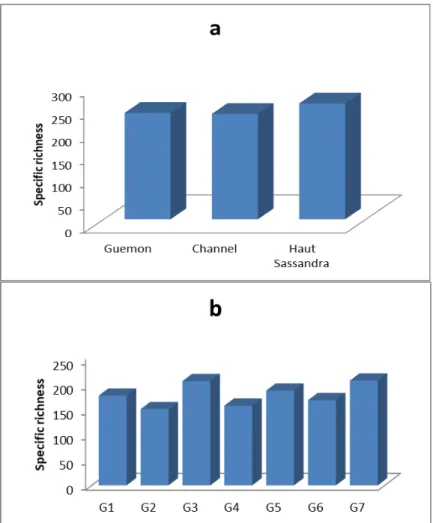
Space variation of the composition: On the level of the sampling stations of the lake Guessabo (Figure 3), 234 species were identified in Guemon sector against 232 and 255 species respectively in bed and Haut Sassandra sector of the lake. Concerning Guemon sector, 179 species were recorded at G1 station and 192 at G5 station. In bed of the lake (channel), 154 species were listed at the G2 point, whereas 157 and 168 species were identified respectively at the G4 station and the G6 station. For sector Haut Sassandra,
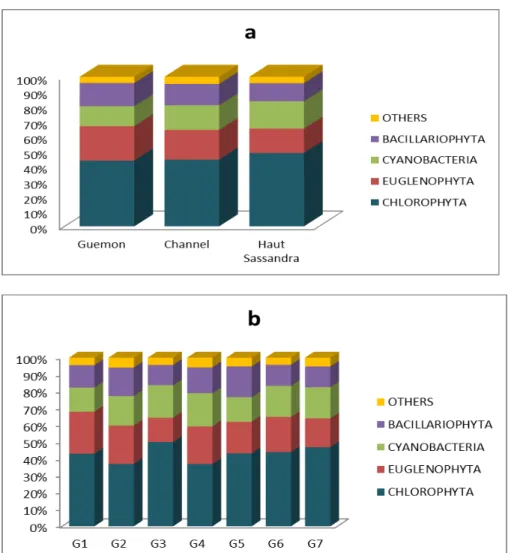
G3 stations and G7 present respectively 208 and 211 species. The algae composition is similar for all stations except G3 and G7. Thus Chlorophyta varies from 37 % (G2) to 50 % (G3) and Euglenophyta from 20.83 % (G5) to 24.86 % (G1). As for Cyanobacteria, the proportions are between 14.36 % (G3) and 19.74 % (G4). For Bacillariophyta, the relative richness oscillates between 12.5 % (G4) and 16.88 % (G2), the other groups represent that only proportions going from 4.16 % (G6) to 5.84 % (G2)(Figure 4).
Figure 3: Space variation of specific richness in Guessabo Lake a: richness of the various sectors; b: richness of the various sampling stations; G: Guessabo; 1 to 7: number of sampling point
Figure 4: Space variation of the relative richness in Guessabo Lake. a: richness of the various sectors; b: richness of the various sampling stations; G: Guessabo; 1 to 7: number of sampling point.
Similarities between sampling points: Similarity between the sampling stations according to the inventoried species was presented in table 2. The values of the Sorensen index calculated between the sampling points reveal values greater than 0.5. The specific richness of phytoplankton is substantially the
same in all points. However, this similarity is stronger on the one hand between G3 and G7 points (Cs: 0.78) of Haut Sassandra sector and on the other hand between G1 and G5 points (Cs: 0.73) of Guemon sector. Also a strong similarity is observed between sectors.
Table 2: Values of Sorensen similarity index between sampling points (a) and between sectors (b). a) b) Sampling stat G1 G2 G3 G4 G5 G6 G2 0.66 G3 0.70 0.62 G4 0.67 0.72 0.64 G5 0.73 0.63 0.72 0.62 G6 0.72 0.71 0.66 0.70 0.64 G7 0.72 0.65 0.78 0.65 0.66 0.64 Guemon Channel Channel 0.73 Haut Sassandra 0.74 0.73
The trophy status of Guessabo Lake: Table 3 presents the trophic index starting from the phytoplankton quotients at the sampling points. In the whole of the stations of the Guessabo lake, the results of the compound index A and the index B (Chlorococcales/ Desmidiaceae) vary respectively from 3 to 4.21 and 1.21 to 1.68. These two indexes
would suggest a eutrophic state of the whole lake stations. As for the index C representing the diatom quotient, it oscillates from 0.18 to 0.33 and thus provides two quite distinct types (oligotrophic and eutrophic) an intermediate type (mesotrophic). The trophic state of the whole of the stations of the lake evolves of a mesotrophic state to a eutrophic state Table 3: Values of trophic index in sampling stations.
Index G1 St G2 St G3 St G4 St G5 St G6 St G7 St
A 3,77 E 3,96 E 3 E 4,21 E 3,56 E 3,47 E 4 E
B 1,29 E 1,21 E 1,28 E 1,29 E 1,38 E 1,25 E 1,68 E
C 0,33 E 0,18 O 0,25 E 0,2 O 0,21 E 0,31 E 0,18 O
E M E M E E M
G: Guessabo; 1 to 7: number of sampling point; St: trophic state; E: eutrophic; M: mesotrophic; O: oligotrophic A: compound index; B: Chlorophycean index; C: diatom quotient
DISCUSSION
In the present study, 340 species were observed in the whole sampling stations of Guessabo Lake. This high taxonomic richness would be due to the combination of two complementary methods. The algae were initially collected by filtration with the plankton net. These collections were supplemented by taking away with the sampler integrated in order to collect the algae of very small sizes which pass through the meshs of plankton net. In comparison with work of Ouattara, 2000 on Ayamé Lake and Groga, 2010 on Kossou Lake in Ivory Coast, Guessabo Lake is most diversified. That could be explained by the high number of samples resulting of sampling stations. Chlorophyta with 164 species either 48 % and Euglenophyta with 64 species or 19 %, represent the most diversified groups. This prevalence of Chlorophyta and Euglenophyta would be characteristic of an environment rich in putrescible matter organic. Staurastrum (20 species), Cosmarium (17 species) and Trachelomonas (25 species) genera are most represented of these groups. Adon, (2013) and Kouassi-Blé, (2013) observed this same taxonomic diversity on Azopé reservoir in Ivory Coast. Moreover Ouattara, (2000) and NJine et al., (2004) had observed respectively a greater diversity of Chlorophyta on Ayamé lake in Ivory Coast and a composition mainly constituted of Euglenophyta on Yaoundé municipal lake in Cameroun. The small proportions of the other groups (Chrysophyta, Xanthophyta, Pyrrophyta) justify eutrophic state of environments subjected to this study. According to Nicholls, (1995), these groups of phytoplankton develop better in oligotrophic aquatic ecosystems. On level of sampling stations of Guessabo lake, stations of Haut Sassandra sectors and Guemon
represents more species that in the bed of lake. This richness would be related to their lentic character which could thus support the complete cycle of reproduction and development of the algae. Indeed, phytoplankton development depends closely on stability in ecosystem fonctionment faced with environmental disturbances (Gonzales and Descam, 2004). Similarity coefficients between the various sampling stations shows a resemblance on algae flora inventoried in seven sampling stations. This resemblance could be explained by the great species number which various stations share commonly and shows that stations have the same environmental characteristics. Ecological conditions of aquatic environment can be evaluated from knowledge of relative species number representing various groups taxonomic in a phytoplankton sample (Ngansoumana, 2006). Thus, the compound index A most largely used because of its appreciations range of all trophy degrees in lakes, indicate eutrophic state of Guessabo lake (A varies from 3 to 4.21). Also, the quotient provides by the two groups taxonomic of Chlorophyceae (Chlorococcales/ Desmidiaceae) in lake stations is higher than 1, translating aneutrophic conditions. That is justified by the fact that in eutrophic lakes the number of species of Chlorococcales would be more significant than the number of Desmidiaceae, and the conditions opposite in oligotrophic lakes (Rawson, 1956). As for the index C
based on the quotient of the diatoms
(Centrales/Pennales), it oscillates between 0.18 to 0.33 and provides a mesotrophic state. All these quotients highlight only qualitative aspect of algae community. Indeed, by considering biological approach, concept of
specific richness with biotic index used, also testifies an eutrophication process of Guessabo Lake. CONCLUSION
The results obtained starting from the specific composition of the phytoplankton in Guessabo Lake indicates a total of 346 species divided in seven groups. These groups represented by orders of prevalence are, Chlorophyta (48 %), Euglenophyta (19 %), Cyanobacteria (16 %), Bacillariophyta or diatoms (14 %) and the other groups (Pyrrophyta, Chrysophyta, and Xanthophyta) with 4 %. The trophic state of the whole
of the stations of lake evolves from mesotrophy state to eutrophy state This state deservesgiving the lake a detailed attention by sensitizing the users and the actors of various activities in the vicinity whichto sanitary risks they are exposed to. Quantitative studies
of the community of phytoplankton and
physicochemical parameters could be undertaken to confirm or change this state of lake.
REFERENCES
Adon M P, Ouattara A, Gourene G, 2014. Variability of phytoplankton community in a shallow tropical reservoir (Adzopé, Côte d’Ivoire). Asian academic research journal of multidisciplinary, 1 (20): 2319 - 2801.
Aliaume C, Lasserre G, Louis M, 1990. Organisation spatiale des peuplements ichtyologiques des herbiers à Thalassia du Grand Cul-de-sac Marin en Guadeloupe. Revue d’hydrobiologie Tropicale, 23: 231 - 250.
Anderson D M, Glibert P M, Burkholder J M, 2002. Harmful algal blooms and eutrophication: nutrient sources, composition, and consequences. Estuaries, 25: 562 – 584. Cabecinha E, Cortes R, Cabral J A, Ferreira T,
Lourenco M, Pardal A P, 2009. Multi-scale approach using phytoplankton as a first step towards the definition of the ecological status of reservoirs. Ecological Indicators, 9: 240-255.
Chomerat N, 2005. Patrons de réponse du phytoplancton à la variabilité des facteurs abiotiques dans un étang méditerranéen hypereutrophe: succès écologique de Planktothrix agardhii (Gomont) Anagnostidis and Komárek (Cyanoprokaryote) dans un écosystème saumâtre. Thèse de Doctorat, Université Paul Cézanne (Aix Marseille III), 307 p.
Collins S., Rost B, Rynearson T A, 2014. Evolutionary Potential of Marine Phytoplankton under Ocean Acidification.‖Evolutionary Applications, 7(1) :140 – 55.
Compère P, 1977. Algues de la région du lac Tchad. VII : Chlorophycophytes (3ième partie : Desrnidiées) (I). Cahiers O.R.S.T.O.M, série Hydrobiologie, 11 (2) : 77 - 177.
Couté A and Iltis A, 1981. Ultrastructure de la logette de Trachelomonas (Algae, Euglenophyta) récoltés en Côte d’Ivoire. Revue Hydrobiologie Tropicale, 14 (2) : 115 - 133.
Dajoz R, 2000. Précis d’Écologie. 7ème édition, Éditions Dunod, Paris, 615 p.
Dziock F, Henle K, Foeckler F, Follner K, Scholz M, 2006. Biological indicator systems in floodplains-a review. International Review of Hydrobiology, 91: 271 - 291.
Förster K, 1964. Desmidiacee naus Brasilien: Bahia, Goyaz, Piauhyund Nord-Brasilien. Acta
Hydrobiologica, Hydrographica et
Protistologica, 22 (3 - 4): 319 - 505.
Glibert P M, Seitzinger S, Heil C, Burkholder J M, Prrow M W, Codispoti L A, Kelly V, 2005. The role of eutrophication in the global proliferation of harmful algal blooms. Oceanography, 18 : 198 - 209.
Gonzales A and Descamps-Julien B, 2004. Population and community variability in randomly fluctuating environments. Oikos, 106: 105 - 116.
Groga N, 2012. Structure, fonctionnement et dynamique du phytoplancton dans le lac de Taabo (Côte d’Ivoire). Thèse de Doctorat de l’Université de Toulouse, France, 224 p.
Komárek J and Anagnostidis K, 1999.
Cyanoprokaryota.1.Teil : Chroococcales. In Ettl H, Gärtner G, Heynig H et Mollenhauer D (Editeurs.), Sübwasserflora von Mittelleuropa, 19 (1) : 1 - 548.
Komárek J and Fott B, 1983. Chlorophyceae (Grünalgen) Ordnung : Chroococcales. In
Huber-Pestalozzi G (editeur), Das
Phytoplankton des Sübwassers, 7 (1) : 1 - 1044 + 253 pl.
Kouassi-Blé A T, 2013. Taxinomie, composition floristique et dynamique spatio-saisonnière des algues périphytiques de la retenue d’eau d’Adzopé (Côte d’Ivoire). Thèse de doctorat, Université Félix Houphouët-Boigny, Côte d’Ivoire, 206 p.
Kra K S, 2016. Le développement de la pêche en côte d’ivoire : le cas de lapêche continentale dans la sous-préfecture de guessabo. Revue de Géographie Tropicale et d’Environnement, 1 : 37 – 45.
Mambo V, Tidou A S, Yapo O B, Ohouenou P, 2001. Evaluation de l’état trophique de Buyo (Côte d’Ivoire) : aspects physico-chimiques et biologies. Journal de la Société Ouest - Africaine de Chimie. 011 : 95 - 135.
Ngansoumana B, 2006. La communauté
phytoplanctonique du lac Guiers (Sénégal) : types d’associations fonctionnelles et approches expérimentales des facteurs de régulation. Thèse de doctorat de 3e cycle de
l’Université Cheikh Anta Diop de Dakar (Sénégal),155 p.
Niamien-Ebrottié J E, Mousso H G, Coulibaly K J, Ouattara A, Gourène G, Dosso M, 2017.
Spatial and seasonal dynamic of
phytoplankton abundance in Aghien lagoon, Côte d’Ivoire. International Journal of Innovation and Applied Studies, 20 (4): 1198 - 1209.
Nicholls R J, Mimura N, Topping J C, 1995. Climate change in South and South-East Asie: Some Implications for Coastal Area. Journal of Global Environment Engineering, 37 (3): 369 – 379.
NJine N K., Zebaze S H, Togouet S H, Niyitegeka D, Nola M, Monkiedje J, Demanou J, Foto Menbohan S, 2004. Phytoplancton du lac
municipal de Yaoundé (Cameroun):
succession écologique et structure des peuplements. Revue des sciences de l’eau, 17 (3) : 301 - 316.
Nygaard G, 1949. Hydrobiological studies insome ponds and lakes. Part II: The quotient hypothesis and some new or little known phytoplankton organisms det kongelige danske videnskabernes selskab. Biologiske. Skrifter, 7 (1) : 1 - 293.
Ouattara A, 2000. Premières données systématiques et écologiques du phytoplancton du lac d’Ayamé (Côte d’Ivoire). Thèse de doctorat, Katholieke Universiteit Leuven, Belgique, 207 p.
Ouattara A., Podoor N, Teugels G.G, Gourène G, 2000. Les micro-algues de deux cours d’eaux (Bia et Agnébi) de Côte d’Ivoire. Systematics and Geography of Plants, 70 : 315 - 372.
Philipose M T, 1967. Chlorococcales. ICAR Indian Council of Agricultural Reseach, New Delhi, 174 p.
Prygiel J and Coste M, 2000. Guide méthodologique pour la mise en œuvre de l’Indice Biologique Diatomées NF T 90-354. Agences de l’Eau : 134 p. + 89 pl. + cd rom TAX’IBD français/anglais.
Rawson D S, 1956. Algal indicators of trophic lake types. Limnology and Oceanography, 1 : 18 – 25.
SCOR W G. 2007. A Proposal for Forming a SCOR
WG: Global Patterns of
PhytoplanktonDynamics in Coastal
Ecosystems: Comparative Analysis of Time Series Observations, 15 p.
Starmach K, 1985. Chrysophyceae und Haptophyceae. In : Süßwasserflora von Mitteleuropa. 1. Gustav Fischer Verlag, 515 p, 1051 pl.
The MerMex Group et al. 2011. Progress in
Oceanography Marine Ecosystems
‘Responses to Climatic and Anthropogenic Forcings in the Mediterranean.‖Progress in Oceanography, 91: 97 – 166.
Throvald S, 1949. A method of establishing groups of equal amplitude in plant sociology based on similarity of species and its application to analyses of the vegetation on Danish commun. Biologiske Skrifter/ Kongelite Danske Videnskabernes Selskab, 5(4): 1 - 34
Thunmark S, 1945. Zur Sociologic des
Süsswasserplanktons. Eine methodologisch ökologische Studie. Folia Limnologica Scandinavica, 3: 1 - 66.
Uherkovich G, 1995. A Scenedesmus zöldalga nemzetség (Chlorococcales, Chlorophyceae) különös tekintettel magyarországi elöfordulású taxonjaira. Magyar Algológiai Társaság, Budapest, 266 p.
Wołowski k and hindák F, 2005. Atlas of euglenophytes. Veda, bratislava, 136 p.
Annexe: phytoplanctonic composition of Guessabo Lake. G1 to G7: sampling stations
Sampling stations TAXONS G1 G2 G3 G4 G5 G6 G7 FO CYANOBACTERIA CYANOPHYCEAE SYNECHOCOCCALES SynechococcaceaeSynechococcus aqualitis Sauvageau x x x x x x x 64,29
synechococcus sp x x x 17,85
Merismopediaceae
Aphanocapsa pulchra (Kützing) Rabenhorst x x x x x x x 85,71
Aphanocapsa thermalis Brügger x x x x x x x 100
Aphanocapsa conferta (W.West. & G.W.West) Komárkova-Legnerova x x x x x x x 100
Aphanocapsa incerta (Lemmermann) Cronberg & Komàrek x x x x x x x 85,71
Merismopedia punctata Meyen x x x x x x x 85,71
Merismopedia tenuissima Lemmermann x x x x x x x 100
Merismopedia glauca (Ehrenberg.) Kützing x x x x x 85,71
Merismopedia elegans Braun x x x x x 35,71
Coelosphaeriaceae
Coelosphaerium micoporum Nägeli x x x x 85,71
Coelosphaerium sp.1 x x x x x x x 85,71
Coelosphaerium sp.2 x x x 14,29
Snowella atomus J. Komárek & Hindák x x x x x x x 100
Pseudanabaenaceae
Pseudanabaena cf. limnetica (Lemmermann) Komárek x x x x x x x 64,29
Pseudanabaena catenata Lauterborn x x 11,90
CHROOCOCCALES
Chroococcaceae
Chroococcus minimus (Keissler) x x x x x x x 100
Chroococcus minutus (Kützing) Nägeli x x x x x x x 100
Chroococcus limneticus Lemmermann x x x x x x x 64,29
Chroococcus turgidus (Kützing) Nägeli x x x x 64,29
Chroococcus dispersus (Keissler) Lemmermann x x x x x x 64,29
Chroococcus aphanocapsoides Skuja x 4,76
Microcystaceae
Microcystis flos-aquae (Wittrock) Kirchner x x x 21,24
Microcystis aeruginosa (Kützing) Kützing x x x x x x x 85,71
Microcystis wesenbergii (Komárek) Komárek x x x x x x x 85,71
Microcystis incerta (Lemmermann) Lemmermann x x x x 47,61
Microcystis robusta (Clark) Nygaard x 2,38
Microcystis densa W.West. & G. W.West. x x 4,76
Sampling stations
TAXONS G1 G2 G3 G4 G5 G6 G7 FO
Microcystis sp.2 x 2,38
Gomphosphaerioidaceae
Gomphosphaeria aponina Kützing x x x x 23,8
Gomphosphaeria sp SPIRULINALES Spirulinaceae Spirulina sp.1 x x 4,76 Spirula sp.2 x 3,57 NOSTOCALES Nostocaceae
Anabaena affinis Lemmermann x x x x x x x 58,33
Anabaena variabilis (Kützing) ex Bornet & Flahault x 3,57
Anabaena circinalis (Rabenhorst) ex Bornet & Flahault x 3,57
Anabaena spiroide Klebahns x x x x x x x 85,71
Nostoc piscinale (Kützing) ex Bornet & Flahault x x x 9,52
Scytonemataceae
Scytonema sp x 3,57
OSCILLATORIALES
Oscillatoriaceae
Planktolyngbya contorta (Lemmermann) Anagnostidis & Komárek x x x x x x x 100
Planktolyngbya lemnetica (Lemmermann) Komárkova-Legnerova x x x x x x x 100
Lyngbya major (Vaucher) Hansgirg x 3,57
Oscillatoria lutae Agardh ex Gomont x x x 21,43
Oscillatoria sancta Kützing x 5,95
Oscillatoria limosa (Dillwyn) Agardh x x x x 28,57
Phormidium articulatum(Gardner) Anagnostidis & Komárek x x x x x x 42,86
Phormidium granulatum (Gardner) Anagnostidis x x 14,28
Plectonema puteale (Kirchner) Hansgirg x x x x x x x 85,71
Microcoleaceae
Planktothrix compressa (Utermöhl) Anagnostidis & Komárek x x 9,52
Gomontiellaceae
Komvophoron constrictum (Szafer) Anagnostidis & Komárek x x x x 23,81
EUGLENOPHYTA EUGLENOPHYCEAE EUGLENALES Euglenaceae
Euglena acus var. acus Ehrenberg x x x x x x x 58,33
Euglena excavata Schiller x 3,57
Euglena charkowiensis Svirenko x 9,52
Euglena gracilis Klebs x x x x x x x 95.52
Sampling stations
TAXONS G1 G2 G3 G4 G5 G6 G7 FO
Euglena sanguinea Ehrenberg x x x x x 42,85
Euglena oxyrus Schmarda x x x 17,85
Euglena sp.1 x 3,57
Euglena sp.2 x x x 17,85
Trachelomona rugulosa Stein x x x x 28,57
Trachelomonas varians Skvortzov x x x x x 35,71
Trachelomonas abrupta Svirenko x x 12,29
Trachelomonas arnata var. arnata E. Stein x 3,57
Trachelomonas arnata (Ehrenberg) Stein var. gordeievi Skvortzov x 3,57
Trachelomonas armata var. heterospina Svirenko x 3,57
Trachelomonas bernardinensis var africana Vischer x x x 28,57
Trachelomonas conica fo. Punctata Deflandre x x x x x x x 33,33
Trachelomonas cylindrica Ehrenberg x x x x x x x 64,28
Trachelomonas dastuguei Balech var. africana Couté & Iltis x x 9,52
Trachelomonas dubia Svirenko x 3,57
Trachelomonas dubia var. lata forma Deflandre x x x 14,29
Trachelomonas lacustris var. ovalis Drezepolski x x x x x x x 64,28
Trachelomonas oblonga Lemmermann x x x x x x x 64,29
Trachelomonas klebsii Deflandre. x x x x x x 53,57
Trachelomonas oblonga var. attenuata Playfair x 3,57
Trachelomonas robusta Svirenko x x x x x x x 58,33
Trachelomonas similis Stockes x x x x x x 42,59
Trachelomonas similis var. hyalina Skvortzov x x x x x 28,59
Trachelomonas volvocina Ehrenberg x x x x x x x 100
Trachelomonas volvocinospis Svirenko x x x x x x x 64,29
Trachelomonas sydneyensis Playflair x x 7,14
Trachelomonas hispida var. coronata Lemmermann x x x x x x x 83,33
Trachelomonas sp.1 x x 7,14
Trachelomonas planctonica Svirenko x x x 28,57
Strombomonas acuminata var. deflandreana W.Conrad x x 14,29
Strombomonas deflandrei (Roll) Deflandre x x x x x x 42,86
Strombomonas girardina (Playfair) Deflandre x x x x 28,58
Strombomonas verrucosa var. verruscosa (Daday) Deflandre x x x x x 41,67
Strombomonas verrucosa var. elongata (Skvortzov) Deflandre x x x x x 41,67
Strombomonas fluviatilis var. levis (Lemmermann) Deflandre x x x x 28,58
Strombomonas cf. triquetra (Playflair) Deflandre x x x x x 35,71
Strombomonas gibberosa Playfair x x x 21,43
Strombomonas verrucosa (Daday) Deflandre var. zmiewika (Svirenko) Deflandre x x x x 23,80
Strombomonas sp.1 x 3,57
Phacaceae
Lepocinclis marssonii Lemmermann. x x x x 47,62
Sampling stations
TAXONS G1 G2 G3 G4 G5 G6 G7 FO
Lepocinclis ovum (Ehrenberg) Minkevich x x x x x x x 100
Lepocinclis ovum cf. texta (Dujardin) Lemmermann x x x x x x x 95.23
Lepocynclis salina Fritsch x x x x x 47,62
Lepocynclis sp.1 x x x x x x x 59.52
Lepocynclis sp.2 x x 11,90
Phacus acuminatus var. acuticauda Pochmann x x x x x x x 64,29
Phacus acuminatus var. discifer (Pochmann) Hüber- Pestalozzi x x x 41,67
Phacus acuminatus var. granulatus (Roll) Hüber-Pestalozzi x 2,38
Phacus angulatus Pochmann x x 14,29
Phacus glaber (Deflandre) Pochmann x x 14,29
Phacus longicauda var. insecta Koczwara x x x x 23,81
Phacus longicauda var. longicauda (Ehrenberg) Dujardin x x x x x 41,67
Phacus platalea Drezepolski x x x 41,67
Phacus sesquitortus Pochmann x x x 21,42
Phacus suecicus Lemmermann x x x 10,71
Phacus sp.1 x 7,14 Phacus sp.2 x 7,15 CHLOROPHYTA CHLOROPHYCEAE CHLOROCOCCALES Golenkiniaceae
Golenkinia radiata Chodat x 10,71
Golenkiniopsis chlorelloides (Lund) Flott x x x 21,42
Palmellaceae
Desmatractum indutum (Geitler) Pascher x x x x 64,29
Treubaria quadrispina(G.M.Smith) Flott & Kovácik x 5,95
Hydrodictyaceae
Pediastrum duplex var. duplex Meyen x x x x x x x 66,67
Pediastrum duplex var. gracilimum W.West & G.S.West x x x x 35,71
Pediastrum tetras var. tetraedron (Ehrenberg) Ralfs x x x 7,14
Pediastrum angulosum var. angulosum (Ehrenberg) ex Meneghini x 3,57
Pediastrum boryanum var. longicorne Reinsch x x x x x x 47,62
Pediastrum biradiatum var. longicornitum Gutwinski x x 5,95
Pediastrum boryanum var. cornutum (Raciborski) Sulek x x x x x x 57,14
Pediastrum duplex var. rugulosum Raciborski x x 16,57
Pediastrum simplex var. simplex Meyen x 7,14
Micractiniaceae
Selenodictyum brasiliense Uherk x 5,96
Dictyosphaerium pulchellum Wood x x x x x x x 57,14
Dictyosphaerium tetrachotonum Printz x x x x x 64,49
Sampling stations
TAXONS G1 G2 G3 G4 G5 G6 G7 FO
Micractinium pusillum Fresenius. x x x x x 23,81
Micractinium valkanovii Vodenicarov x x 14,29
Micractinium bornhemiense (Conrad) Korshikov x 5,96
Chlorellaceae
Kirchneriella dianae var. major (Bohlin) Comas x x x x x 64,49
Kirchneriella obesa (W.West & G.S. West) Schmidle x 5,96
Kirchneriella irregulari (G.M.Smith) Korshikov s x x x x 28,57
Ankistrodesmus gracilis (Reinsch) Korshikov x x x x x x x 100
Ankistrodesmus fusiformis corda sensu Korshikov x x x x 35,71
Ankistrodesmus fusiformis West & G.S.West x x x x x x x 100
Ankistrodesmus falcatus (Corda) Ralfs x x x x x x x 100
Ankistrodesmus bernardii Komárek x 7,11
Ankistrodesmus spiralis (Turner) Lemmermann x x 19,05
Monoraphidium tortile (West & G.S.West) Komárek-Legnerova x x x x x x x 85,71
Closterinospis acicularis (Chodat) Belcher & Swale x x x 21,42
Quadrigula closterioides (Bohl) Printz x x x x 21,42
Chlorella vulgaris Beijerinck x x x x x x x 58,33
Chlorococcum minutum Starr x x x x x 35,71
Gleocystis vesiculosa Nägeli x 5,96
Oocystaceae
Oocystis lacustris Chodat x x x x x x x 100
Oocystis borgei Snow x x 10,71
Oocystis solitaria Wittrock x x x x x x x 85,71
Oocystis sp x x 10,71
Lagerheimia chodatii Bernard x x x x x 59,52
Lagerheimia marssonii Lemmermann x x x 21,42
Elakatothrix gelatinosa Wille x x x x 10,05
Coelastraceae
Coelastrum microporum sphaericum Nägeli x x x x x x 64,29
Coelastrum pseudomicroporum Korshikov x x x x x 71,43
Coelastrum reticulatum (Dangeard) Senn x x x x x 64,29
Actinastrum hantzschii Lagerheim x x x x 64,487
Actinastrum gracillimum Smith x x x x x x 85,71
Chlorococcaceae
Tetraedron arthrodesmiforme f. typicum (West) Woloszyńska x x x 9,52
Tetraedron minimum (Brébisson) Hansgirg x x x x x 71,43
Tetraedron minimum fo. apiculatum (Reinsch) De Tony x 3,57
Tetraedron arthrodesmiforme G.S. West x 3,57
Tetraedron regulare Kützing x 7,14
Tetraedron trigonum (Nägeli) Hansgirg x x x x x 59,52
Pseudostaurastrum hastatum (Reinsch) Chodat x x x x 57,14
Sampling stations
TAXONS G1 G2 G3 G4 G5 G6 G7 FO
Pseudostaurastrum gracile (Reinch) Chodat ex. Bourrelly x x x 21,43
Radiococcaceae Coenocystis quadriguloides Fott
Scenedesmaceae
Crucigenia quadrata Morren x x x x x x x 71,43
Crucigenia fenestrata (Schmidle) Schmidle x 10,71
Crucigenia tetrapedia (Kirchner) Kuntze x x x x x 59,52
Desmodesmus quadricaudata (Turpin) Hegewald x x x x x 64,29
Desmodesmus regularis (Swirenko) Hegewald & Vanormelinger x 7,11
Dimorphococcus lunatus A. Braun x 7,11
Scenedesmus quadricauda (Turpin) Brébisson x x x x x x x 100
Scenedesmus acuminatus var. javanensis f. globolosus Uherkovich x 7,11
Scenedesmus acuminatus var. acuminatus (Lagerheim) Chodat x x x x x 64,29
Scenedesmus denticulatus Lagerheim x x 23,80
Scenedesmus acutiformis Schröder x x x x 42,86
Scenedesmus disciformis (Chodat) Fott & Komárek x x x x x x x 85,71
Scenedesmus bicaudatus (Hansgirg) Chodat x x x x x 64,29
Scenedesmus ecornis (Ehrenberg) Chodat x 10,71
Scenedesmus bernadii Chodat x x 23,80
Scenedesmus naegelii Brebisson x x x x x 64,29
Scenedesmus magnus Meyen x x x x 47,62
Scenedesmus opoliensis Richt x x x x x x 64,29
Tetrastrum elegans Playfair x x x 21,42
Tetrallentos lagerheimii Teiling x x x x 42,86
westella botryoides (W.West) De Wild x x x 21,42
ZYGNEMATOPHYCEAE ZYGNEMATALES
Desmidiaceae
Cladophora holsatica Kützing x x 7,14
Hyalotheca dissilienense Brébisson ex Ralfs x 7,14
Arthrodesmus convergens (Ehrenberg) ex Ralfs x x x x x x 35,71
Arthrodesmus curvatus (Turner) Coesel & Van Geest x x 14,29
Pleurotaenium ehrenbergii var. undulatum (De Bary) x 7,14
Closterium ehrenbergii Meneghini ex Ralfs x 7,14
Closterium lineatum Ehrenberg x 7,14
Closterium dinae var. minus Ehrenberg x x x 32,14
Closterium gracile Brébisson ex Ralfs x x x x x x 85,71
Closterium kuetzingii Brébisson x x x 42,86
Closterium striolatum Ehrenberg ex Ralfs x 7,14
Closterium subulatum (Kützing) Brébisson x x 9,52
Sampling stations
TAXONS G1 G2 G3 G4 G5 G6 G7 FO
Cosmarium granatum Brébisson ex Ralfs var. granatum x x x 21,42
Cosmarium granatum var. concavum Lagerheim x x x 28,57
Cosmarium trilobulatum Reinsch x x 14,29
Cosmarium laeve Rabenhorst x 7,14
Cosmarium depressum (Nägeli) Lundell x x x 21,14
Cosmarium margaritatum (Lundell) Roy et Bisset var. margaritatum x 7,14
Cosmarium binoculatum (Brébisson) ex Ralfs x x x 28,57
Cosmarium obsoletum (Hantzsch) Reinsch x x x 9,52
Cosmarium venustum (Brébisson) Archer x 7,14
Cosmarium brebissonii Ralfs x 7,14
Cosmarium contractum Kirchner x x x 8,33
Cosmarium quadrum Lundell x 7,14
Cosmarium moniliforme var. moniliforme (Turpin) Ralfs x x x x x 42,85
Cosmarium succisum West x 5,85
Cosmarium sp x x x 42,85
Euastrum denticulatum (Kirchner) Gay x x x 42,85
Euastrum denticulatum var. quadrifarium Willi Krieger x x 28,57
Euastrum evolutum (Nordstedt) West. & G.S. West x 7,14
Euastrum sphyroides (Nordstedt) var. hieronyrnusii (Schmidle) Krieger x 7,14
Euastrum elegans (Turpin) Ralfs x x 7,14
Euastrum dubium Nägeli x x x x 42,85
Euastrum germanicum (Schmidle) Krieger x x x x 42,85
Euastrum glaziovii BØrges x x x x x x x 42,85
Euastrum pseudopectinatum Schmidle x x x x 42,85
Euastrum ivoirensis Bourrelly x x x 42,85
Euastrum sp x x 14,29
Sphaerozosma granulatum Roy & Bisset x x 14,29
Sphaerozosma excavatum Ralfs ex Ralf x x x x x x x 100
Sphaerozosma filiformis Ehrenberg ex Ralfs x x 14,29
Teilingia granulata (Roy & Bisset) Bourrelly x x x 7,14
Spondylosium sp x x 14,29
Staurodesmus cuspidatus (brébisson) Teiling x x x x x x 57,14
Staurodesmus dejectus (brébisson) Teiling x x x x x 47,62
Staurodesmus patens (nordstedt) croasdale x 7,14
Staurodesmus triangularis (brébisson) Teiling x x x x x x 57,14
Staurodesmus mucronatus var subtriangularis West.& G.S. West x 7,14
Staurastrum caledonense Hüber-Pestalozzi x x x 28,57
Staurastrum excavatum West & G.S. West x x x x x 41,67
Staurastrum forficulatum var. minus (Fritsch & Rich) Grönblad x x x x x x x 100
Staurastrum furcatum (Ehrenberg) Brebisson x x x x 42,86
Staurastrum gracile Ralf ex Ralf x x x x x x x 100
Sampling stations
TAXONS G1 G2 G3 G4 G5 G6 G7 FO
Staurastrum gracile var. elongatum Scott & Prescott x x x x x x x 100
Staurastrum leptocladum var. cornutum Wille x x x x x x x 71,43
Staurastrum pingue Teiling x x x x x x 42,86
Staurastrum subgracillimum West. & G.S. West x x x 35,71
Staurastrum ginzbergeri Grönblad x x 14,29
Staurastrum setigerum var. occidentale West & G.S.West x x 21,43
Staurastrum setigerum var. setigerum Cleve x x x x 28,57
Staurastrum thomassonianum Compère x x x x x x 47,62
Staurastrum unicorne Turner x 7,14
Staurastrum subarcuatum Wolle x x 23,80
Staurastrum volans West & G.S. West x x x x x x x 100
Staurastrum boreale var. quadriradiatum Korshikov x 11,90
Staurastrum pentasterias Grönblad x 11,90
Staurastrum circulus Grönblad x 7,14
Desmidium Baileyi (Ralfs) Nordstedt x x 10,71
Desmidium aptogonum Brébisson ex Kützing x x 11,90
Ichthyodontum sachlanii Scott & Prescott x x 10,71
Mougeotia sp x 11,90
Zygnemataceae
Zygnema ramosum Ahmad & Goldstein x 3,57
Spirogyra sp x x 10,71
Mesotaeniaceae
Mesotaenium macrococcum (Kützing ex Kützing) Roy & Bisset x 3,57
Netrium pseudactinotaenium Coesel x x 10,71
VOLVOCALES
Volvaceae
Eudorina elegan Ehrenberg x x x x x x 85,71
Eudorina unicocca Smith x x x x x x 85,71
Pandoria morum Bory x x x x x x x 100
Volvox aureus Ehrenberg x x x x 14,29
Volvox carteri Stein x x x x 14,29
OEDOGONIOPHYCEAE OEDOGONIALE Oedogoniacea Oedogonium sp x x 23,80 bulbochaete sp x x 02,38 PYRROPHYTA DINOPHYCEAE GYMNODINIALES Gymnodiniaceae
Sampling stations
TAXONS G1 G2 G3 G4 G5 G6 G7 FO
Alexandrium minutum Halim x x x x x x x 42,86
PERIDINIALES
Peridiniaceae
Peridinium cinctum (Müller) Ehrenberg x x x x x x x 100
Protoperidiniaceae
Protoperidinium quinquecorne (Abé) Balech x x x x x x x 57,14
CRYPTOPHYCEAE CRYPTOMONADALES Cryptomonadaceae cryptomonas sp x 02:38 BACILLARIOPHYTA COSCINODISCOPHYCEAE CHAETOCEROTALES Acanthocerataceae
Acanthoceras zachariasii (Brun) Simonsen x x 23,80
Chaetoceros sp x x 23,80
AULACOSEIRALES
Aulacoseiraceae
Aulacoseira granulata (Ehrenberg) Simonsen x x x x x x x 100
Aulacoseira granulata var. angustissina (Müller) Simonsen x x x x x x x 100
Aulacoseira ambigua (Grunow) Simonsen x x x x x x x 100
Aulacoseira ambigua f. japonica Tuji & Williams x x x x x x x 100
THALASSIOSIRALES Thalassiosiraceae Cyclotella sp x x 7,14 FRAGILARIOPHYCEAE FRAGILARIALES Fragilariaceae
Asterionella formosa Hassall x x x x x x x 85,71
Synedra acus Kützing x x x x x x x 85,71
Synedra ulna (Nitzsch) Ehrenberg. x x x x x x x 85,71
Ulnaria ulna (Nitzsch) Compère x x x x x x x 42,86
Fragilaria crotonensis Kitton x x 14,28
EUNOTIALES
Eunotiaceae
Eunotia bilunaris (Ehrenberg) Mills x 5,85
Eunotia incisa Smith & Gregory x x 14,28
Eunotia mesiana Cholnoky x 5,85
Eunotia monodon var. bidens (Ehrenberg) Hustedt x 5,85
Eunotia pectinalis (Kützing) Grunow x x x x 47,61
Eunotia zasuminensis (Cabejszekowna) Körner x x x 32,14
Sampling stations TAXONS G1 G2 G3 G4 G5 G6 G7 FO Achnanthaceae Achnanthes sp x x x 32,14 CYMBELLALES Cymbellaceae Encyonema sp x x x x x x x 85,71 Gomphonemataceae
Gomphonema affine Kützing x x 14,28
Gomphonema augur Ehrenberg .var. turris (Ehrenberg) Lange-Bertalot x 5,85
NAVICULALES
Pleurosigmataceae
Gyrosigma spencerii (Quekett) Griffith & Henfrey x x x x x x 85,71
Pinnulariaceae
Pinnularia acrosphaeria Smith x x x x x x x 85,71
Pinnularia gibba (Ehrenberg) Ehrenberg x x x x x x x 85,72
Pinnularia interrupta Smith x x x x x x x 85,71
Pinnularia viridis (Nitzsch) Ehrenberg x x 5,85
Pinnularia micostauron (Ehrenberg) Cleve x 5,85
Pinnularia neomajor Krammer. x x 7,14
Pinnularia divergence Smith x x x x 06:57
Pinnularia sp.1 x x 7,14
naviculaceae
Navicula cryptocephala Kützing x x x x 38,09
Craticula cuspidata (Kützing) Mann x 5,85
Sellaphora pupula (Kützing) Mereschkovsky x x x x x x 57,14
Neidiumaceae
Neidium ampliatum (Ehrenberg) Krammer x x x 17,85
Neidium sp x x 5,85
Caloneidaceae
Caloneis silicula (Ehrenberg) Cleve x 5,85
Caloneis sp.1 x 5,85
Stauroneidaceae
Stauroneis anceps Ehrenberg x x x x x 47,61
Stauroneis phoenicenteron (Nitzsch) Ehrenberg x x 7,14
BACILLARIALES
Bacillariaceae
Hantzschia amphioxys (Ehrenberg) Grunow x x 7,14
Nitzschia palea (Kützing) W.Smith x x x x x 85,71
Nitzschia cf. sigmaformis Hustedt x 2,38
Nitzschia sp x x x x x x 85,71
SURIRELLALES
Sampling stations
TAXONS G1 G2 G3 G4 G5 G6 G7 FO
Surirella linearis Smith x x 7,14
Surirella sp x x x x x x 85,71
CHRYSOPHYTA CHRYSOPHYCAEA CHROMULINALES
Dinobryaceae
Dinobryon sertularia Ehrenberg. x x x x x x x 85,71
XANTHOPHYTA XANTHOPHYCEAE MISCHOCOCCALES
Centritractaceae
Xanthonema sp x 2,38
Heterococcus fuornensis Vicher x x x x x x x 41,67
Centritractus belonophorus (Schmidle) Lemmermann x x x x x x x 100
Ophiocytiaceae
Ophiocytium capitatum Wolle x x 14,28
Ophiocytium cochleare (Eichwald) Braun x x 14,29
Pleurochloridaceae
Tetraplektron torsum Turner x x x x x 64,29
Tetraplektron sp x 5,85
Tetraedriella gigas (Pascher) Smith x 5,85
Isthmochloron sp x x 2,38
Total = 340 179 152 208 159 189 170 209