Universit´e de Montr´eal
A Type-Preserving Compiler from System F to Typed Assembly Language
par
Louis-Julien Guillemette
D´epartement d’informatique et de recherche op´erationnelle Facult´e des arts et des sciences
Th`ese pr´esent´ee `a la Facult´e des ´etudes sup´erieures et postdoctorales en vue de l’obtention du grade de
Philosophiae Doctor (Ph.D.) en informatique
Avril 2009
c
Universit´e de Montr´eal
Facult´e des ´etudes sup´erieures et postdoctorales
Cette th`ese intitul´ee:
A Type-Preserving Compiler from System F to Typed Assembly Language
pr´esent´ee par: Louis-Julien Guillemette
a ´et´e ´evalu´ee par un jury compos´e des personnes suivantes: Guy Lapalme (pr´esident-rapporteur) Stefan Monnier (directeur de recherche) Marc Feeley (co-directeur) Julie Vachon (membre du jury) Tim Sheard (examinateur externe) Paul Arminjon
(repr´esentant du doyen de la F.A.S.)
R´
esum´
e
Mots cl´es: Compilation certifi´ee, langage assembleur typ´e, polymorphisme, v´erification formelle, liaisons.
L’utilisation des m´ethodes formelles est de plus en plus courante dans le d´eveloppement logiciel, et les syst`emes de types sont la m´ethode formelle qui a le plus de succ`es. L’avancement des m´ethodes formelles pr´esente de nouveaux d´efis, ainsi que de nouvelles opportunit´es. L’un des d´efis est d’assurer qu’un compilateur pr´eserve la s´emantique des programmes, de sorte que les propri´et´es que l’on garantit `a propos de son code source s’appliquent ´egalement au code ex´ecutable.
Cette th`ese pr´esente un compilateur qui traduit un langage fonctionnel d’ordre sup´erieur avec polymorphisme vers un langage assembleur typ´e, dont la propri´et´e principale est que la pr´eservation des types est v´erifi´ee de mani`ere automatis´ee, `a l’aide d’annotations de types sur le code du compilateur. Notre compilateur implante les transformations de code essentielles pour un langage fonctionnel d’ordre sup´erieur, nomm´ement une conver-sion cps, une converconver-sion des fermetures et une g´en´eration de code. Nous pr´esentons les d´etails des repr´esentation fortement typ´ees des langages interm´ediaires, et les contraintes qu’elles imposent sur l’implantation des transformations de code.
Notre objectif est de garantir la pr´eservation des types avec un minimum d’anno-tations, et sans compromettre les qualit´es g´en´erales de modularit´e et de lisibilit´e du code du compilateur. Cet objectif est atteint en grande partie dans le traitement des fonctionnalit´es de base du langage (les “types simples”), contrairement au traitement du polymorphisme qui demande encore un travail substantiel pour satisfaire la v´erification de type.
Abstract
Keywords: Certified compilation, typed assembly language, polymorphism, program verification, bindings.
Formal methods are rapidly improving and gaining ground in software. Type systems are the most successful and popular formal method used to develop software. As the technology of type systems progresses, new needs and new opportunities appear. One of those needs is to ensure the faithfulness of the translation from source code to machine code, so that the properties you prove about the code you write also apply to the code you run.
This thesis presents a compiler from a polymorphic higher-order functional language to typed assembly language, whose main property is that type preservation is verified statically, through type annotations on the compiler’s code. Our compiler implements the essential code transformations for a higher-order functional language, namely a cps conversion and closure conversion as well as a code generation. The thesis presents the details of the strongly typed intermediate representations and the constraints they set on the implementation of code transformations.
Our goal is to guarantee type preservation with a minimum of type annotations, and without compromising readability and modularity of the code. This goal is already a reality for simple types, and we discuss the problems remaining for polymorphism, which still requires substantial extra work to satisfy the type checker.
Contents
1 Introduction 1
1.1 Typed intermediate languages . . . 4
1.2 Challenges . . . 7
1.3 hTAL . . . 8
1.4 Contributions . . . 12
1.5 Related systems . . . 14
1.6 Structure of the document . . . 15
2 Overview and background 17 2.1 Generalized algebraic datatypes . . . 17
2.2 Abstract syntax . . . 19
2.2.1 Names . . . 19
2.2.2 Higher-order abstract syntax . . . 20
2.2.3 De Bruijn indices . . . 23 2.3 Type families . . . 25 2.4 Compilation phases . . . 25 2.4.1 Type checking . . . 26 2.4.2 CPS conversion . . . 27 2.4.3 Closure conversion . . . 28 2.4.4 Hoisting . . . 31 2.4.5 Code generation . . . 31 3 Encoding of System F 33 3.1 Types . . . 35
x CONTENTS
3.2 Higher-order term encoding . . . 36
3.2.1 Washburn and Weirich’s encoding of HOAS . . . 38
3.3 First-order term encoding . . . 41
3.4 Substitution . . . 41
4 CPS conversion 45 4.1 Target language . . . 46
4.2 Translation . . . 50
4.3 Implementation . . . 52
4.3.1 Fegaras and Sheard’s iterator . . . 52
4.3.2 Danvy and Filinski’s CPS transform . . . 55
4.4 Polymorphism . . . 56
4.4.1 Lemma application . . . 59
4.4.2 Type abstraction . . . 60
4.5 Discussion . . . 61
5 Conversion to de Bruijn indices 63 5.1 Type-level reverse de Bruijn indices . . . 65
5.2 Construction of first-order terms . . . 67
5.3 Reverting to type-level de Bruijn indices . . . 71
6 Closure conversion 75 6.1 Closure conversion and de Bruijn indices . . . 77
6.2 Target language . . . 81
6.3 Translation . . . 86
6.4 Polymorphism . . . 87
6.5 Auxiliary functions . . . 90
6.5.1 Free variables . . . 91
6.5.2 Construction of the variables map . . . 92
7 Hoisting 95 7.1 Target language . . . 96
CONTENTS xi
7.3 Implementation . . . 100
8 Code generation 103 8.1 Typed assembly language . . . 105
8.2 Translation . . . 106 8.3 Type preservation . . . 109 8.4 Implementation . . . 110 8.4.1 Type translation . . . 112 8.4.2 Term translation . . . 114 9 Benchmarks 117 10 Conclusion 125 10.1 Representation of bindings . . . 126 10.2 Implementation language . . . 128 10.3 Related work . . . 130 10.3.1 Representations of bindings . . . 130
10.3.2 Typed intermediate languages . . . 132
10.3.3 Certified compilation . . . 133
10.4 Future work . . . 135
10.4.1 Bootstrap . . . 136
10.5 Summary . . . 137
`
Acknowledgements
First, I have to thank my advisor, Stefan Monnier, for his support and patience during my research. He was always willing to help me out with every aspect of this work. I also thank my co-advisor, Marc Feeley, for his guidance and encouragement, especially while I was finishing the dissertation.
It was a pleasure to work with Tom Schrijvers when he was visiting our group. I thank him for the insightful discussions we had then.
I am very grateful to Tim Sheard for accepting to take part in the thesis committee. This research was funded in part by NATEQ, Le Fonds qu´eb´ecois de la recherche sur la nature et les technologies, and NSERC, the Natural Sciences and Engineering Research Council of Canada.
Chapter 1
Introduction
Type systems are a successful and popular formal method used for developing software. In this dissertation, we will show that the technology of type systems can be applied to improve the reliability of a compiler implementation, with a low impact on common compiler development practices.
The construction of reliable software systems is commonly achieved by incorporating rigorous testing as part of the development cycle. In the best case, a clear specification describes exactly how the software should behave, and a number of test cases can be derived from the specification. By subjecting a program to a large enough array of tests, one gains some degree of confidence in its correct behavior.
In all but the most trivial cases, testing cannot be applied exhaustively. Testing is useful to discover errors, but cannot prove that no bugs remain. Testing can be sufficient for some programming tasks, but mission-critical systems, where failure can be disastrous, require a higher degree of confidence. Formal methods, unlike testing, aim to prove that a program is correct by construction, rather than sampling the program behavior after-the-fact, and can thus give guarantees on its behavior. Formal methods are still not as commonly used in software systems as in digital systems, but they are heavily researched, and are steadily improving and gaining ground.
Given that compilers play a central role in the software development process, it is essential that the compiler produces an executable program which behaves as expected, so that the properties inferred from the source programs also apply to the code that
2 CHAPTER 1. INTRODUCTION is executed. Intuitively, compiler correctness states that a compiler should faithfully implement the language definition.
Realistic compilers are highly complex programs, typically made of hundreds of thou-sands of lines of code, and writing reliable compilers is indeed a major task. In translating programs from a high-level language (such as Java or Eiffel), into a low-level one (such as the Java Virtual Machine), a compiler typically performs a number of transformations on the input program, to progressively turn it into a lower-level one, which makes use of more rudimentary language constructs. A realistic compiler also makes a number of optimizations. As Aho et al. (2006) put it, “Optimizing compilers are so difficult to get right that we dare say that no optimizing compiler is completely error-free! Thus, the most important objective in writing a compiler is that it is correct.”
To ensure some degree of reliability in compilers, the common practice is to run the compiler against a suite of test programs, and check that the compiled programs produce the expected output when executed. This scheme is useful for regression testing, and can also be used to benchmark the performance of the compiled code. In addition, it is useful to instrument the compiler with internal consistency checks, which verify some conditions that internal data structures in the compiler, including intermediate representations of the program being compiled, are expected to satisfy. This helps discover a larger class of bugs, and also gives more precise feedback to the compiler implementor when something goes wrong. To support this kind of sanity check, some compilers maintain some type information about the program as it undergoes the various transformation stages, so that it can be type-checked at various points during compilation. This does not guarantee that the source language semantics is preserved, but it means that the generated program still maintains some form of safety.
To overcome the inherent limitations of informal methods such as these, researchers have in recent years tackled the construction of compilers with completely formalized proofs of correctness, or so-called certified compilers. Compiler correctness means that the semantic of the compiled program must be equivalent to that of the source program, which presupposes a formal notion of equivalence between the semantic models of the source and target languages. A well-known example is the certified compiler of Xavier Leroy (Leroy 2006; Blazy et al. 2006), where the operational semantics of the source
3 and target languages, as well as a proof that the target program simulates the source program’s semantics, are formalized in the language of a proof assistant.
In general, constructing a certified compiler is a task that requires significantly more effort than common compiler development. The correctness proof will typically be sig-nificantly more involved than the actual compiler’s code, and this proof will be harder to read and maintain than the code of a conventional compiler. In the aforementioned example of Leroy’s compiler, the proof is reportedly eight times the size of the compiler’s actual code.
There is thus a large gap between informal methods, which admit the possibility of errors, and full compiler certification, which requires tremendous effort and departs drastically from common compiler implementation practices. Our work explores an inter-mediate approach, where formal methods are used to enforce some important properties of compilers, while staying in line with common compiler implementation practices.
We focus our efforts on preservation of static semantics. The static semantics (or type system) of a language imposes a syntactic discipline on programs, which prevents important classes of errors (such as applying a function with the wrong number or type of arguments). Strongly typed languages enjoy type soundness, which establishes a formal connection between the static and dynamic semantics of a program, and intuitively states that “well-typed programs do not go wrong” at run-time. Preservation of static semantics thus means that the compiled program will enjoy the same safety characteristics as the source program.
A sufficiently strong type discipline on the source language will make erroneous, yet type-correct program manipulations, highly unlikely. Type preservation does not give the same degree of assurance as a completely certified compiler, for which preservation of dynamic semantics has been verified as well. For example, mistakingly generating code which applies an operator whose type is identical to that of the intended one (say, performing a multiplication instead of an addition) will not be reflected in the types, so the error will be undetected. In any case, imposing a type discipline on code manipulations will undoubtedly reduce the possibility of errors by a large factor, and should make any remaining error easier to identify.
4 CHAPTER 1. INTRODUCTION will yield at run time. Early type systems distinguished a small number of types, such as integer and floating-point numbers. Modern type systems can capture a wide variety of properties beyond the simple classification of primitive data. For instance, a type system can be used to track the effect of functions on program state (Gifford and Lucassen 1986; Moggi 1989), to assert the compliance of a program to an information flow security policy (Heintze and Riecke 1998; Ørbæk and Palsberg 1997), or to check that invariants of data structures are never violated, see e.g. (Kahrs 2001). General-purpose programming languages incorporate increasingly powerful features in their type system, which enhance the potential to use type systems as the basis for formal program verification (Sheard 2004; Hinze 2003).
In our work, we will employ the type system of the language in which we implement the compiler to enforce preservation of the static semantics of the program we compile. Instead of writing a formal proof as a separate artifact, the type annotations in the com-piler’s code will constitute the essential elements of the proof, which will be mechanically verified when the compiler is compiled. The use of types in compilers is not a new idea, and we contrast our approach to the customary use of types in the next section.
1.1
Typed intermediate languages
A compiler for a strongly typed language performs type-checking in an early phase, to en-sure that the input program satisfies the type discipline dictated by the source language. After this initial type-checking, the compiler is free to discard all type information, and perform subsequent program manipulations on untyped program representations. In mod-ern compilers, however, it is a common practice to keep some form of type information with the program as it undergoes the various transformation phases. This type infor-mation can be used as a kind of “sanity check” to help catch errors in the compiler: by type-checking the code at certain points during compilation, one can identify subtle bugs in the compiler, which would otherwise be much harder to find.
Typed intermediate languages can be used for other purposes than sanity checks; type information can also be used to drive optimizations, as in the work of Leroy (1992), Tarditi et al. (1996), and Shao (1997a). Another application is to construct proofs that
1.1. TYPED INTERMEDIATE LANGUAGES 5 the generated code verifies some safety properties (Morrisett et al. 1999; Hamid et al. 2002).
Compilers employing typed intermediate languages typically represent types in the form of data structures which have to be carefully manipulated to keep them in sync with the code they annotate as this code progresses through the various stages of compilation. Despite its obvious advantages, this approach has several drawbacks:
1. It amounts to testing the compiler, thus bugs can lurk, undetected. One would normally have to run the compiler on a suite of sample programs to gain assurance that the compiler behaves as expected.
2. A detected type error, reported as an “internal compiler error”, will surely annoy the user, who generally holds no responsibility for what went wrong.
3. It incurs space and time overhead, for manipulating the type information and for type-checking the intermediate languages.
4. The manipulation of type as data can obfuscate the compiler’s code to a certain degree and imposes extra maintenance burden.
The approach taken in this thesis is to use the type system of the language in which the compiler is implemented to track the type of the compiled program as it progresses through the various compilation stages. In this way, type preservation can be checked statically, i.e. when type checking the compiler’s code, rather than every time an object program is compiled.
This scheme has many significant advantages over conventional typed intermediate languages, and has the potential to address all their drawbacks listed above. The main advantages are the following:
1. This approach is formal, and thus exhaustive, in the sense that it completely elim-inates the possibility of internal compiler errors resulting from program manipula-tions which violate the type discipline of the source and intermediate languages. It thus obviates the need for testing the compiler for type preservation on a suite of test programs.
6 CHAPTER 1. INTRODUCTION 2. It gives earlier detection of errors introduced by an incorrect program transforma-tion, as they are discovered when the compiler is type-checked, rather than when compiling object programs which exercise the buggy code.
3. It gives better precision in error reports about faulty code transformations, as it would normally identify the line of code where that faulty manipulation(s) occur. In contrast, in a conventional compiler employing typed intermediate languages, the cause of a type checking failure can be fairly subtle, especially in a large compiler. 4. It can eliminate the time and space overhead of manipulating type information as
data; the compiler itself can then run at full speed without having to manipulate and check any more types.
5. Last but not least, it can in principle eliminate the need for explicit manipula-tion of type informamanipula-tion as data, and to implement separate type checkers for the intermediate languages.
Total vs partial correctness Note that the first point above does not imply total correctness, which requires that the compiler always succeeds to produce a well-typed program when given a well-typed program as input. This may fail to be true as the type discipline would not prevent the compiler from entering an infinite loop, for exam-ple. What is implied is partial correctness: the type discipline imposed on the compiler guarantees that if a program is produced, then this program is well typed.
A long term goal of this research is to formally verify that types are preserved in the compiler, with a minimum of type annotations on the compiler’s code. It should not compromise the basic qualities of modularity and readability of the compiler’s code. That is, the compiler’s code should be as close as possible to that of a conventional compiler which manipulates untyped program representations – in short, what we are aiming for is “type preservation for free”.
The benefits of our approach are not fully realized in the current implementation of the compiler. The objective of “type preservation for free” is not fully achieved, as we still need to employ program representations that are not as intuitive as those typically used in conventional compilers, and the treatment of the advanced features of the source
1.2. CHALLENGES 7 language (in particular, parametric polymorphism) still requires substantial work. We still need to manipulate some type information as data and perform dynamic checks, but this is due in large part to current limitations of the language in which we implement the compiler. We summarize our achievements and the current limitations of our compiler implementation in more detail in the conclusion (Chapter 10).
1.2
Challenges
Given the benefits of our approach, one may wonder why it has not been applied in the past. We mention some reasons which make this approach difficult.
Mechanically verifying type preservation using type annotations on the compiler’s code is certainly more challenging than manipulating type information as data, as done in conventional compilers employing typed intermediate languages. Instead of simply type-checking the produced code after-the-fact, we must arrange for every function that manipulates code to have a type signature that captures its effect on source-level types. It thus presupposes a more precise understanding of the way code transformations preserve types.
Type preservation for code transformations has been proven for various code trans-formations such as cps conversion (Harper and Lillibridge 1993) and closure conver-sion (Minamide et al. 1996). Our approach is a form of machine verification, and as such, it imposes difficulties that do not appear in pen-and-paper proofs.
The first difficulty is to enforce the type discipline of the source (and intermediate) languages, by somehow imposing constraints on the data structures used to represent abstract syntax trees in the compiler. This requires judicious use of advanced features of the type system of the language in which the compiler is implemented. Retaining the general qualities of a traditional compiler implementation rather than developing a proof as a separate artifact calls for the use of a general-purpose programming language for implementing the compiler, rather than a proof assistant. Such type-based verification is still an emerging discipline, and is certainly not as well developed as the more traditional forms of machine verification, such as theorem proving, where the emphasis is on proofs rather than types.
8 CHAPTER 1. INTRODUCTION As in all forms of mechanized proofs involving programs and languages, a central aspect is the representation of program variables and bindings. Several approaches are possible, and many are actively researched in the field of mechanizing programming lan-guage meta-theory, without an emerging consensus as to which one is best suited for applications like ours. A seemingly simple change in the representation of bindings in abstract syntax trees can have a drastic impact on the implementation of code transfor-mations.
In the next section, we further discuss these central difficulties and explain the im-portant choices we have made about them in our compiler.
1.3
hTAL
Our compiler translates a variant of System F to typed assembly language. In this section, we briefly discuss this choice of source and target language, and also discuss our choice of the language Haskell for implementing the compiler.
Terminology To avoid confusion, as we are referring to many languages in this text, we first clarify the terms we use to designate them. A complier is a program that translates programs written in some language, called the source language, to programs in some other language, called the target language. We refer to the language in which the compiler is written as the implementation language, and sometimes the host language. When we use a data structure in the host language to represent the abstract syntax trees for the programs in some language, we call the language in question an object language; in this sense, the source and target language, as well as any intermediate language used in the compiler, is viewed as an object language.
Source language
The source language of our compiler is a variant of System F , that is, a functional pro-gramming language with parametric polymorphism. System F is a powerful system which makes a remarkable economy of features, consisting of a very small number of syntactic constructs, and is thus relatively convenient to manipulate in a compiler. System F can
1.3. HTAL 9 be seen as the core language at the heart of modern (strongly typed) functional program-ming languages such as Haskell and ML. We will introduce the syntax and type discipline of System F in Chapter 3.
The reason for choosing System F is that it is a common choice of typed intermediate language in compilers for richly typed functional languages. For example, the Standard ML of New Jersey (SML/NJ) compiler internally makes use of a variant of System F (Shao and Appel 1995). The Glasgow Haskell Compiler also uses a variant of System F (Sulz-mann et al. 2007) as its main internal representation. System F is a good representative of typed intermediate languages employed in production quality compilers, as most if not all intermediate languages are some sort of derivatives of System F .
Target language
To show that our techniques are indeed applicable to all phases in a compiler, our compiler preserves types all the way down to assembly language. Our typed assembly language models the assembly language of a reduced instruction set computer (risc).
The compilation of System F to typed assembly language is studied in detail by Morrisett et al. (1999), who show a series of code transformations that preserve types. Our compiler follows the same general structure as theirs. Their paper discusses the type discipline of a number of intermediate languages, define precisely each transformation step, and state a type-preservation theorem for each transformation. They also define the dynamic semantics of their typed assembly language and prove a type soundness theorem. Our compiler can be seen as a checked implementation of their type-preserving translation to typed assembly language, as well as a mechanized proof of the type-preservation theorem stated in their paper.
Implementation language
A secondary objective of our research is to identify the language features of the imple-mentation language that best serve the impleimple-mentation of a type-preserving compiler. We believe that type preservation is the perfect example of the kind of properties that type systems of the future should allow programmers to conveniently express and verify. The implementation language must have a type system which is powerful enough to
10 CHAPTER 1. INTRODUCTION construct a strongly typed representation of syntax trees, that is, a representation that enforces the object language’s type system. For instance, we should be able to express in the type signature of a function that it can only return syntax trees representing well-typed expressions.
In general, this sort of constraint can be imposed using dependent types. Languages with dependent types allow term-level expressions to appear in type-level expressions. For example, a dependent type List n could represent lists of n elements. Dependent types are a very powerful notion, but type-checking for general dependent types is non-decidable since we cannot in general determine if two term-level expressions are equivalent.
There are a number of proof assistants based on dependent types which could be used to construct a type-preserving compiler. Coq (Paulin-Mohring 1993) is a mature proof assistant based on the calculus of inductive constructions (CiC). It has a powerful type system with inductive types, polymorphism and dependent types. The system provides an interactive mode for proof development. While Coq “programs” can be given an immediate operational meaning, executable programs are typically obtained by program extraction, which strips down parts of the code required for the proof and produces a simpler ML or Haskell program. Agda (Norell 2007) would be an alternative, with a newer design, but a less mature implementation and with less proof automation.
There is currently much interest in incorporating features from dependently typed lan-guages and proof assistants in general-purpose functional lanlan-guages. Many experimental languages incorporate some form of dependent types. Languages such as DML (Xi and Scott 1999), Cayenne (Augustsson 1998), and Omega (Sheard 2004), fall in this category. While some of these languages would have potentially served us well as implementa-tion language, we decided to go with a more mainstream system, and benefit from an industrial-strength implementation and plentiful libraries.
We have chosen Haskell (with GHC’s extensions) as our implementation language, as it offered what seemed to be the best combination of a robust implementation and modern type system features, while retaining the qualities of a general-purpose programming language. Haskell is a “mainstream” general-purpose functional programming language supported by a production-quality compiler and a plentiful libraries.
1.3. HTAL 11 offers a number of extensions to the Haskell 98 standard, and in particular supports generalized abstract datatypes, or gadts (cf. Section 2.1). gadts allow a limited form of dependently typed programming, where the phase distinction between types and terms is maintained. GHC also supports type families (cf. Section 2.3), which allow the user to define functions at the level of types. This feature plays an important role in our work, both for proving type preservation, and for enforcing the type discipline of System F .
An advantage of using Haskell rather than a language with full dependent types is that it narrows down the “semantic gap” between the host and object languages. Our implementation relies essentially on gadts and type families, and all these features can be encoded in a variant of System F with type equality coercions (Sulzmann et al. 2007). This makes more concrete the possibility of bootstrapping a type-preserving compiler, that is, having the source language be the same as the implementation language, so that we could compile our own compiler.
Representation of binders
An important design decision in systems which manipulate programs, such as compilers, is the way to represent variable bindings, such as local variables and function parameters. In compilers, the most common approach is to represent variables concretely by their name. Alternatively, variables can be identified using some sort of numbering scheme, such as de Bruijn indices, with the advantage that terms which differ only in the name of their bound variables have identical representation. We discuss these approaches further in Section 2.2.
The representation of binders is the subject of much active research. In the field of mechanized meta-theory of programming languages, tools such as proof assistants and theorem provers employ and promote a large variety of approaches. Some systems rep-resent object-level bindings abstractly using bindings in the host language, a technique called higher-order abstract syntax (hoas). Twelf (Pfenning and Schurmann 1999) is an example of a system which promotes such higher-order encodings. Some systems use hybrid representations which combine first-order and higher-order representations. We further discuss research in this area in the related work section (see Section 10.3).
repre-12 CHAPTER 1. INTRODUCTION sentations must allow the type system of the host language to track the types of the object-language variables. Higher-order abstract syntax is a natural way to accomplish this, as it allows us to re-use the facility for tracking the types of variables from the host language. The initial phase of our compiler employs such a higher-order representation to good effect. We also use representations based on de Bruijn indices in other phases of the compiler. We show how the basic strongly typed representation (both first-order and higher-order) work in Section 2.2.
As our compiler manipulates polymorphic code, we have to deal with the extra com-plexity of variables at the level of types. Just like ordinary (i.e. term-level) variables, which abstract values, appear in expressions, type variables abstract types and appear in type-level expressions. The type system of System F comprises a notion of reduction at the type level (which is used to assign a type to a polymorphic term instantiated with a specific type.) This creates delicate interaction between binders at the term and type level. We address these issues in Chapter 3 where we discuss our encoding of System F .
1.4
Contributions
We have implemented a proof-of-concept compiler for all of System F , where type preser-vation is enforced statically, using type annotations on the compiler’s code. Our compiler can be seen as a type-checked implementation of the type-preserving translation to typed assembly language of Morrisett et al. (1999). This constitutes the first mechanized argu-ment of type preservation for these transformations over System F . Our source language supports higher-order functions, parametric polymorphism, term-level recursion (i.e. the ability to define recursive functions), and product types, and is thus sufficiently powerful to encode a large variety of features of modern functional languages.
We show in detail the implementation of the essential code transformations for a call-by-value language to assembly language. We show a cps conversion, closure conversion, and code generation phase over System F (see Section 2.4 for a general presentation of each transformation.) Our implementation precisely captures the way types are preserved as the code undergoes program transformations.
1.4. CONTRIBUTIONS 13 language with term-level and type-level bindings. We show both a first-order and higher-order encoding of System F , as well as a first-higher-order encoding of a number of interme-diate languages and a typed assembly language. Our higher-order encoding adapts the parametric representation of hoas using parametric polymorphism of Washburn and Weirich (2003) to a strongly typed program representation based on gadts and type families (cf. Section 3.2.1). We show a conversion from this higher-order encoding to the first-order one, which clarifies the relationship between the two. We also address subtle issues about the interaction of bindings at the levels of types and terms.
Our experience provides insight into the technical issues of program representations. We argue that none of the existing representations of bindings is suitable in the sense that either they cannot be used, or they introduce significant extra complexity.
To our knowledge, this is the first example of an extensive application of GHC’s type families and type equality coercions. Our work should serve as both a showcase and a stress test for these new features. It also feeds the current debate as to which one of type families, associated types, or multiple-parameter type classes with functional dependencies, should make it to the next Haskell standard (Peyton-Jones et al. 2007). Our work also motivates the development of further Haskell extensions to complement and address the current limitations of type families (cf. Section 4.5), which would extend their power and offer a greater degree of static safety.
Publications Progress in the construction of our compiler has been reported in a num-ber of articles. The first transformation step, cps conversion, was presented at the first Programming Languages meets Program Verification (PLPV ) meeting (Guillemette and Monnier 2006). We later presented the closure conversion phase at the Haskell Work-shop (Guillemette and Monnier 2007). In both cases, the language treated was a simply typed λ-calculus. We subsequently extended the compiler to support parametric polymor-phism, and presented our results at ICFP, the International Conference on Functional Programming (Guillemette and Monnier 2008b); this article gives a concise technical overview of this thesis. This document is a synthesis of these three articles, and also presents a final phase of code generation which has not been published elsewhere.
14 CHAPTER 1. INTRODUCTION use open type families, which were recently implemented in GHC. As a by-product of this research, in an article presented at the Trends in Functional Programming (TFP ) sym-posium (Guillemette and Monnier 2008a), we documented our transition to type families, and took a position in favor of type families. In that article, we also suggested equipping Haskell with a means to specify invariants on type families, which would extend their power for static analysis (cf. Section 4.5). Pursuing this goal, I worked in collaboration with Tom Schrijvers to formalize this idea (Schrijvers et al. 2008). Although it is indeed related to our subject, the material of these two articles is not part of this thesis.
1.5
Related systems
The approach taken in this thesis lies somewhere between conventional compilers employ-ing typed intermediate languages and fully certified compilers. Although type preserva-tion has been formally verified for individual code transformapreserva-tions, our work is the first to apply this idea to the scale of an entire compiler. However, a number of certified compilers have been constructed for various languages, and we describe the most closely related ones below. We review other research in certified compilation in the related work section (Section 10.3).
CompCert As part of the CompCert project Xavier Leroy et al. developed a certified compiler from a C-like language to PowerPC assembly code. The proof of correctness is developed in the Coq proof assistant, and an executable compiler is obtained by means of program extraction.
Their source language is relatively low-level, and has no higher-order features. How-ever their source language is fairly large, and supports all the major features of C. The front-end of the compiler (Blazy et al. 2006) is mainly concerned with resolving operator overloading. The back-end (Leroy 2006) performs register allocation and instruction se-lection, as well as a couple of simple optimizations. All the intermediate languages are given an operational semantics.
The correctness proofs take the form of a simulation argument, relating the operational semantics of the source and target code. The back-end of the compiler is about 35000 line of Coq code. The semantic definitions and correctness proofs account for most of this, so
1.6. STRUCTURE OF THE DOCUMENT 15 that it is notably longer (about 8 times longer) than the actual compiler code.
Lambda Tamer Adam Chlipala (2007) developed a certified compiler from higher-order functional language to typed assembly language. The source language does not have polymorphism or term-level recursion, so it is much simpler than ours. Like Leroy’s compiler, it is developed in the Coq proof assistant, using program extraction to obtain an executable compiler. A distinctive feature of this work is the use of denotational semantics to characterize the intermediate languages, and logical relations to establish correctness of the translation steps.
The program representations he uses are very similar to ours, using de Bruijn indices and de Bruijn contexts encoded as lists of types. They are constructed using the inductive types of Coq, which are similar to gadts (but more general, since they can be indexed by terms instead of just types, and more restrictive, since they disallow negative occurrences.) The compilation phases are roughly those of the original work on compilation to typed assembly language by Morrisett et al. (1999), so they are not very different from ours.
1.6
Structure of the document
We introduce key techniques employed in the implementation of the compiler, and explain the compilation phases of our compiler, in Chapter 2. We also explain different ways of representing syntax trees, using techniques such as higher-order abstract syntax and de Bruijn indices. In particular, we show how to construct a strongly typed encoding of a simply typed language using gadts.
In chapter 3, we show how to extend the program encodings from Chapter 2 to encode a language with parametric polymorphism. We formally define our source language (a variant of System F ) which is the input of the compiler, and show its strongly typed representation.
The subsequent chapters (4 through 8) present the individual transformation phases implemented in the compiler. Chapter 4 presents the implementation of cps conversion over the higher-order representation of our source language from Chapter 3. Chapter 5 shows a conversion from the higher-order program representation to a first-order one, which is done to facilitate closure conversion. Chapter 6 and 7 present the closure
conver-16 CHAPTER 1. INTRODUCTION sion phase and the closely related function hoisting phase. Chapter 8 presents the typed assembly language that is our final target language, and the code generation phase. We report benchmarks of compilation times in Chapter 9. We make general comments on our experience, and mention related and future work in Chapter 10.
Appendix A gives the full code listing of the compiler. In large part, the dissertation and the code can be read in parallel (following the indications at the beginning of each chapter, and consulting the introduction to Appendix A which relates the source files to specific sections of the dissertation.)
Chapter 2
Overview and background
This chapter introduces the types and techniques we use to make the compiler type-preserving, and describes the overall structure of the compiler.
2.1
Generalized algebraic datatypes
Algebraic data types Algebraic data types are a central feature of strongly typed functional languages such as Haskell or ML, and the main mechanism by which the user can define new data types. The definition of an algebraic data type introduces a type constructor, and a set of data constructors, which inject values into the type. Every data constructor accepts a number of arguments of specified types.
For example, we can define a data type for representing lists in this way1:
data List t where
Cons :: t → List t → List t Nil :: List t
This definition introduces a type constructor List, which takes a type parameter t, representing the type of the elements in the list. It also introduces the data constructors Cons and Nil, with explicit type signatures. All the data constructors must have the exact same polymorphic return type, in this case, List t.
1The syntax used here is not the standard Haskell, but the one used in GHC for the definition of
18 CHAPTER 2. OVERVIEW AND BACKGROUND Functions which operate over data types are defined by case analysis over data con-structors. For instance, a function which calculates the length of a list can be written as follows:
length :: List t → Int
length (Cons h t) = 1 + length t length Nil = 0
GADTs Generalized algebraic datatypes (gadts) eliminate the restriction that all data constructors must have identical polymorphic return types: the return types can vary in the arguments to the type constructor being defined.
This allows us to encode in the type of a value additional information about the value. For instance, with gadts, we can define a type ListN which will give information on the length of the list. We define a type ListN t n for lists containing n elements of type t. Of course, we will need a representation of natural numbers at the type level. For this, we will use a type to represent the number zero (we call it Z), and a type constructor (we call it S n) to construct the representation of the successor (n + 1) given the type corresponding to n. For instance, the number three is represented by the type S (S (S Z)). The type ListN is defined as follows:
data Z — natural numbers encoded as types data S i
data ListN t n where
ConsN :: t → ListN t n → ListN t (S n) NilN :: ListN t Z
For example, we can represent a list of three elements by the following term: ConsN 0a0 (ConsN 0b0 (ConsN 0c0 N il))
whose type is ListN Char (S (S (S Z))).
Now, when we define functions that manipulate such lists, we can specify properties of those functions that involve the length of the lists. We can for instance implement a scalar product of two vectors represented as lists, and express the constraint that the two vectors must be of identical dimension:
2.2. ABSTRACT SYNTAX 19
dotProduct :: ListN Int n → ListN Int n → Int dotProduct NilN NilN = 0
dotProduct (ConsN h1 t1) (ConsN h2 t2) = (h1∗ h2) + dotProduct t1 t2
The primary use we make of gadts in our compiler is to construct strongly typed representations of abstract syntax trees, and we discuss the kind of representations we use in the next section.
2.2
Abstract syntax
Consider a simply typed λ-calculus with primitive operations on integers (which we will call LS) defined in bnf as follows:
(exps) e ::= λx . e | e1 e2 | let x = e1 in e2 | x
| n | e1 p e2 | if0 e1 e2 e3
(primops) p ::= + | − | ×
There exists different ways of representing such an object language as a data structure in the host language, depending on the way we encode variables. We describe a few ways of doing this, which are used in different parts of our compiler. We also show how to construct strongly typed representations (that is, representations that enforce the type discipline of the object language) using gadts.
2.2.1 Names
By far the most common way to represent variables in compilers is by their name. For example, the language LS can be represented using the following algebraic data type:
20 CHAPTER 2. OVERVIEW AND BACKGROUND
type ID = String data Exp where
Var :: ID → Exp
Lam :: ID → Exp → Exp
App :: Exp → Exp → Exp Let :: ID → Exp → Exp → Exp
Num :: Int → Exp
Prim :: Op → Exp → Exp → Exp If0 :: Exp → Exp → Exp → Exp data Op where
Add :: Op Sub :: Op Mul :: Op
Each data constructor encodes a particular production from LS’s grammar. The
constructor for variables Var explicitly mentions the variable name, as a character string. Similarly, the constructors that introduce variables (Lam and Let) mention the name of the newly bound variables.
The representation of variables as character strings is very intuitive, but not very well suited to constructing a strongly typed program representation, as we cannot easily associate a type to a variable represented in this way.
2.2.2 Higher-order abstract syntax
Higher-order abstract syntax (hoas) is a program representation in which object-level variables are represented using variables in the host language (Haskell in our case.) All structures which imply bindings (not only functions, but all declarations which introduce variable names) will be represented using functions in the host language. The following algebraic data type would be used to represent LS:
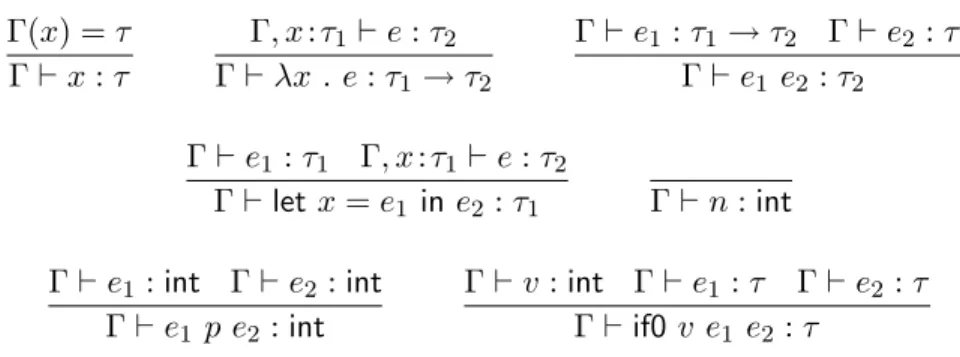
2.2. ABSTRACT SYNTAX 21 Γ(x) = τ Γ ` x : τ Γ, x : τ1` e : τ2 Γ ` λx . e : τ1 → τ2 Γ ` e1: τ1→ τ2 Γ ` e2 : τ1 Γ ` e1 e2 : τ2 Γ ` e1: τ1 Γ, x : τ1` e : τ2 Γ ` let x = e1 in e2 : τ1 Γ ` n : int Γ ` e1: int Γ ` e2: int Γ ` e1 p e2 : int Γ ` v : int Γ ` e1 : τ Γ ` e2: τ Γ ` if0 v e1 e2 : τ
Figure 2.1: Static semantics of LS.
data Exp where
Lam :: (Exp → Exp) → Exp
App :: Exp → Exp → Exp
Let :: Exp → (Exp → Exp) → Exp
Num :: Int → Exp
Prim :: Op → Exp → Exp → Exp If0 :: Exp → Exp → Exp → Exp
Note that, in this representation, there is no need for a data constructor for variables. This representation has the advantage that name-handling is inherited from the host language. For example, we can define a capture-avoiding substitution through a simple function application in the host language. Applications which make extensive use of substitutions can take advantage of this representation. For example, an evaluator which reduces an expression to its normal form:
eval :: Exp → Exp eval (Lam f ) = Lam f
eval (App e1 e2) = case eval e1 of
Lam f → f (eval e2)
→ error ”trying to apply something that is not a function” . . .
Strongly typed encoding Consider the usual typing rules for LSshown in Figure 2.1.
22 CHAPTER 2. OVERVIEW AND BACKGROUND context simply lists the types of all the variables in scope, so it has the form:
Γ ::= x0: τ0, . . . , xn−1: τn−1
and we use • to denote and empty context (i.e. when n = 0).
Using gadts, we can construct a strongly typed encoding of LS which enforces these
typing rules as follows:
data Exp t where
Lam :: (Exp t1→ Exp t2) → Exp (t1 → t2)
App :: Exp (t1→ t2) → Exp t1 → Exp t2
Let :: Exp t1 → (Exp t1→ Exp t2) → Exp t2
Num :: Int → Exp Int
Prim :: Op → Exp Int → Exp Int → Exp Int If0 :: Exp Int → Exp t → Exp t → Exp t
The type parameter t reflects the source type (i.e. object-level type) of the expression. That is, a Haskell term of type Exp t represents a well-typed LS expression e satisfying
a judgment Γ ` e : τ , where t is the Haskell type we have chosen to represent τ . Here, we have chosen to use the Haskell type Int to stand for the object type int, and t1 → t2
to stand for function types. Indeed, this choice is arbitrary, and we could as well use any other types with the same effect. For instance, we could define a type constructor Arw, and use the type Arw t1 t2 instead of t1→ t2 to represent the object-level type τ1 → τ2.
Note that Γ is implicit in this representation: we are implicitly re-using the type context of the implementation language to track the type of variables in scope. This can work as long as the typing contexts of the implementation language behave the same as those of the object language, which is indeed the case as both use static scoping.
The type Exp actually encodes type derivations, not just expression syntax, and in-deed type derivations and well-typed expressions are in one-to-one correspondence in LS.
Thus it is impossible to construct the representation of an ill-typed term, as there is no corresponding type derivation.
2.2. ABSTRACT SYNTAX 23 2.2.3 De Bruijn indices
In contrast to hoas, a first-order representation introduces variables explicitly. With de Bruijn indices, as with hoas, variable names are irrelevant, and variables are instead represented as numbers, called “indices”.
A de Bruijn index indicates the number of variable introductions that take place between the point where a variable is bound, and the point where that variable occurs. For instance, the term λx.λy.x y is written with de Bruijn indices as λλ 1 0.
The following algebraic data type would be used to represent the language LS with
de Bruijn indices: data Exp where
Var :: Int → Exp
Lam :: Exp → Exp
App :: Exp → Exp → Exp Let :: Exp → Exp → Exp . . .
Strongly typed representation With de Bruijn indices, a strongly typed represen-tation can be constructed as follows:
data Exp ts t where
Var :: Index ts t → Exp ts t
Lam :: Exp (t1, ts) t2 → Exp ts (t1 → t2)
App :: Exp ts (s → t) → Exp ts s → Exp ts t Let :: Exp ts t1 → Exp (t1, ts) t2 → Exp ts t2
. . .
The type associated with an index is drawn from an explicit type argument (ts), which represents the type context (Γ). As there are no variable names in de Bruijn, the context Γ simply takes the form:
Γ = τn−1, . . . , τ1, τ0
where ti gives the type associated with variable i (i.e. whose binder is reached by
24 CHAPTER 2. OVERVIEW AND BACKGROUND pairs):
ts = (t0, (t1, . . . (tn−1, ())))
where ti is the Haskell type that stands for τi. Note that we use Haskell’s unit type, (),
to indicate the end of the list, and to denote the empty environment, •. A variable is represented as an index, whose type reflects the type of the corresponding variable. The indices are constructed as Peano numbers:
data Index ts t where I0 :: Index (t, ts) t
Is :: Index ts t → Index (t0, ts) t
Note that individual indices are polymorphic in ts and t, as a given index needs to assume different types in different contexts. Specifically, for an index of the form Isi I0 of type Index ts t, the only relation between ts and t is that the ith type appearing in ts is t, which is why t0 appears free in the type of Is, and ts appears free in the type of I0.
To illustrate the first-order and higher-order encodings, the following expression:
let a = 2 b = 3 in a + b would be represented in hoas as:
Let (Num 2) (λa → Let (Num 3) (λb →
Add a b))
and with de Bruijn indices as: Let (Num 2) (
Let (Num 3) (
Add (Var (Is I0)) (Var I0)))
Now that we have presented gadts and the basics of our strongly typed program representations, we will discuss another important feature of GHC, namely type families, which we use to capture the effect of functions on the object-level types.
2.3. TYPE FAMILIES 25
2.3
Type families
Type families (Schrijvers et al. 2007) are a recent addition to GHC that allows program-mers to directly define functions over types by case analysis, in a way that resembles term-level function definitions with pattern matching.
For example, we can define a type function Add that computes (statically) the sum of two Peano numbers:
type family Add n m
type instance Add Z m = m
type instance Add (S n) m = S (Add n m)
We can then use this type family to express the fact that an append function over length-annotated lists produces a list of the expected length:
data List elem len where
Cons :: elem → List elem n → List elem (S n) Nil :: List elem Z
append :: List elem n → List elem m → List elem (Add n m) append Nil l = l
append (Cons h t) l = Cons h (append t l)
To see how the first clause of append type-checks: by the type signature of append, the returned value should have type List elem (Add Z m); l actually has type List elem m, which is the same, since Add Z m reduces to m by the definition of Add. For the second clause, the type of the returned value should be List elem (Add (S n) m), and Cons h (append t l) has type List elem (S (Add n m)), which is the same after the second clause of Add is applied, in reverse.
2.4
Compilation phases
In this section we briefly describe the transformation steps that take place in the compiler. These compilation steps are fairly typical of a compiler for a call-by-value functional
26 CHAPTER 2. OVERVIEW AND BACKGROUND language. The overall structure of the compiler is as follows:
λ−−−−−−→ λtypecheck → cps convert −−−−→ λK deBruijn convert −−−−−−→ λbK closure convert −−−−→ λC hoist −−−→ λH generate code −−−−−→ TAL
The source language (λ→) and each intermediate language (λK, λbK, etc.) has its own
syntax and type system, so each is encoded as a separate gadt. The language λ→ is
similar to LS but has more features, including parametric polymorphism (cf. Chapter 3).
The final target language is a typed assembly language (TAL), which has the general characteristics of an assembly language for a risc computer, but which has a static type system and carries type information. The first phase infers types for all subterms of the source program, and all the subsequent ones are then careful to preserve them. In general, the way a transformation affects the types is captured by a function on types. For example, the effect of the cps conversion on the types of System F is captured by a function (namely KtypeJ−K, cf. Figure 4.4), which maps function types (τ1 → τ2) to continuation types (written τ → 0) and leaves the other types unchanged.
We briefly describe each transformation below and illustrate them by showing the compilation of a simple program.
2.4.1 Type checking
The type checking phase takes a simple abstract data type AST, then it infers and checks its type t, and returns a gadt of type Exp t which does not just represent the syntax but also a proof that the expression is properly typed, in the form of a type derivation. In order for the cps phase to more closely match the natural presentation, we make it work on a higher-order abstract syntax (hoas) representation of the code, so the type checking phase also converts the first order abstract syntax (where variables are represented by their names) to a hoas (where variables are represented by meta variables) at the same time.
The conversion to hoas is implemented using Template Haskell (Sheard and Jones 2002), a compile-time meta-programming facility bundled with GHC – that is, it allows us to construct a piece of Haskell code under program control. This piece of code gets
2.4. COMPILATION PHASES 27 type-checked by GHC, and since the program representation we construct is strongly typed, we get a source-level type checker for free.
Constructing hoas terms by meta-programming gives us an efficient representation, in contrast to a direct implementation which would lead to residual redexes, i.e. recursive calls to the conversion (or parsing) function hidden inside closures for functional argu-ments, like those for λ or let. To illustrate the problem, consider a parser that directly produces a higher-order representation; such a parser would be of essentially this form:
parse . . . = case . . . of
. . . → Lam (λx → parse . . . x . . .) . . .
The problem is that the body of the function being parsed may indeed refer to the newly bound variable (x), so the variable has to be passed as argument in the recursive call to parse. The resulting syntax tree contains a call to parse under every Lam node, with dramatic consequences on the compiler’s performance. Using Template Haskell, we avoid this problem by constructing a “fresh” Haskell expression which contains no reference to the functions that produce the abstract syntax tree.
2.4.2 CPS conversion
The first transformation rewrites the program in continuation-passing style (cps), in which all intermediate computational results are given a name, and the control structure of the program is made explicit. An important difference is that in cps, a function does not return a value to the caller, but instead communicates its result by calling a continuation, which is a function that represents the “rest of the computation”, that is, the context of the computation that will consume the value produced. Additionally a special form halt is used to indicate the final “answer” produced by the program.
An example is shown in Figure 2.2. After the conversion, the function c2f takes a continuation k as an additional parameter; the body of the function introduces variables v0 and v1 to hold intermediate results of the computation, and finally invokes the
con-tinuation k. The call to c2f passes a concon-tinuation, which in this case merely applies the primitive form halt to the value produced by c2f.
28 CHAPTER 2. OVERVIEW AND BACKGROUND let a = 1.8 b = 32 c = 24 c2f = λx . a × x + b in c2f c cps =⇒ let a = 1.8 b = 32 c = 24 c2f = λhx, ki . let v0 = a × x v1 = v0+ b in k v1 in c2f hc, λv . halt vi Figure 2.2: Example of cps conversion. let a = 1.8
b = 32 c = 24
c2f = hλhhx, ki, envi . let a = env.0 b = env.1 v0 = a × x v1 = v0+ b hkf, kenvi = k in kf hv1, kenvi, ha, bii hc2ff, c2fenvi = c2f
in c2ff hhc, hλhv, envi . halt v, hiii, c2fenvi
Figure 2.3: Closure-converted program.
For an input λ→ expression of type τ , represented internally as a value of type Exp t,
the output of the cps conversion should be of type ExpK (K t), where K is a type family that describes the way types are modified by this phase. In particular, input types of the form τ1 → τ2 are mapped to hτ10, τ20 → 0i → 0, where τ → 0 is the type of a continuation
which consumes a value of type τ . The type of the cps conversion, in simplified form: cps :: Exp t → ExpK (K t)
expresses and enforces directly that the function preserves types.
2.4.3 Closure conversion
A closure is a data structure that consists of a function, paired with a tuple holding a copy of the function’s free variables, called the environment. The function is made to receive the environment as an extra parameter. Functions inside closures are closed, i.e. they do not have any free variables, as they access their free variables by extracting them
2.4. COMPILATION PHASES 29 let a = 1.8
b = 32 c = 24
c2f = pack [hint, inti,
hλhhx, ki, envi . let a = env.0 b = env.1 v0 = a × x v1 = v0+ b (β, hkf, kenvi) = unpack k in kf hv1, kenvi, ha, bii] as τc2f (β, hc2ff, c2fenvi) = unpack c2f
in c2ff hhc, pack [hi, hλhv, envi . halt v, hii] as τhalti, c2fenvi
where τhalt= ∃α.hhint, αi → 0, αi
τc2f = ∃β.hhhint, τhalti, βi → 0, βi
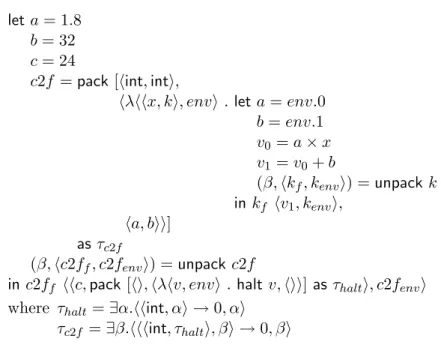
Figure 2.4: Closure-converted program, with existential types.
from the environment parameter. At the call site, the closure is taken apart into its function and environment components and the call is made by passing the environment as an additional argument to the function. Closure conversion makes the manipulation of closures explicit.
For example, the above example in cps will be transformed by the closure conversion as shown in Figure 2.3. The function c2f takes as an extra parameter env, which contains the value of its free variables, namely a and b. In the body of c2f, access to those variables is done through projections of the variable env. When c2f is called, it is passed the environment (extracted from the closure) as an extra parameter.
From the point of view of type preservation, closure conversion must take into account that two functions of identical types would be translated into closures of different types, if the types of their free variables are different. For example, consider two functions f1
and f2, both of type τ → 0, whose environments are characterized by the types env1 and
env2, so that the types of the corresponding closures would be as follows:
f10 : hhτ, env1i → 0, env1i
f20 : hhτ, env2i → 0, env2i
30 CHAPTER 2. OVERVIEW AND BACKGROUND type of the environment. In this way, the two closures can be of the following type:
∃β.hhτ, βi → 0, βi
Syntactically, the form pack is used to construct a so-called “existential package” of a specified type, and thereby hides a part of the type of the expression. For example, we would obtain closures of suitable type in this way:
pack [env1, f10] as ∃β.hhτ, βi → 0, βi
pack [env2, f20] as ∃β.hhτ, βi → 0, βi
The form unpack opens up a package, bringing in scope a type variable that stands for the abstracted type (the variable β in this example.)
Our example program modified to represent closures as existential packages is shown in Figure 2.4. In our example, existential types are not necessary since every call site applies a unique function, but they are needed in general if the source program uses higher-order functions. Higher-order functions are functions which receive functions as parameters or produce functions as return values. Consequently, for a given function application e1 e2,
the function e1 does not necessarily correspond to a unique function in the program. For
example, the following program fragment defines a higher-order function g, which takes a function of type τ → 0 as parameter and applies it to some value v of type τ :
let g :: (τ → 0) → 0 g = λf . f v in if0 w (g f1) (g f2)
The function g is then applied to two function f1 and f2, assuming their type is as given
above. The parameter f will successively assume the values of f1 and f2 as a result of
the calls to g. To be able to give a type to the closure-converted form of the function g, the closure-converted form of f1 and f2 must have identical types, hence the need for
2.4. COMPILATION PHASES 31 let `0= λhhx, ki, envi . let a = env.0
b = env.1 v0 = a × x v1 = v0+ b (β, hkf, kenvi) = unpack k in kf hv1, kenvi `1= λhv, envi . halt v a = 1.8 b = 32 c = 24
c2f = pack [hint, inti, h`0, ha, bii] as τc2f
(β, hc2ff, c2fenvi) = unpack c2f
in c2ff hhc, pack [hi, h`1, hii] as τhalti, c2fenvi
where τhalt= ∃α.hhint, αi → 0, αi
τc2f = ∃β.hhhint, τhalti, βi → 0, βi
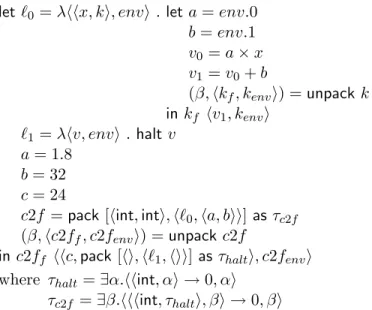
Figure 2.5: Example program after the function hoisting transformation. 2.4.4 Hoisting
After closure conversion, λ-abstractions are closed and can be moved freely in the program. A function hoisting phase moves all λ-abstractions to the top level. The result of the function hoisting transform on the example program is shown in Figure 2.5. This phase re-arranges the bindings so that all functions appear at the top level, but does not otherwise affect the types.
2.4.5 Code generation
The final stage of compilation generates code for a hypothetical typed assembly language. Our target language models the machine language of a typical risc computer. The instruction set has the usual data movement, arithmetic, and control transfer operations, as well as an abstract instruction to allocate a tuple on the heap.
The code generated for our sample program is shown in Figure 2.6. The code still carries type annotations (not shown in the example), so it can be type-checked indepen-dently of the source program. The type system constrains the contents of registers at every point in the program. Code blocks are polymorphic, and type applications, as well packing and unpacking of existentials are explicit (not shown in the example).
32 CHAPTER 2. OVERVIEW AND BACKGROUND `0 : ld r2 r0[0] r2 : x ld r3 r0[1] r3 : k ld r4 r0[0] r4 : env.0 ld r5 r0[1] r5 : env.1 mul r6 r4 r2 r6 : v0 add r6 r6 r5 r6 : v1 ld r7 r3[0] r7 : kf ld r8 r3[1] r8 : kenv mktuple r0 hr6, r8i jmp r7 `1 : halt start : mov r0 1.8 r0 : a mov r1 32 r1 : b mov r2 24 r2 : c mktuple r3 hr0, r1i r3 : ha, bi
mktuple r4 h`0, r3i r4 : c2f (closure for `0)
mktuple r5 hi r5 : hi
mktuple r6 h`1, r5i r6 : closure for `1
mktuple r7 hr2, r6i r7 : hc, closure for `1i
ld r8 r4[1]
mktuple r0 hr7, r8i
ld r9 r4[0] r9 : c2ff
jmp r9
Figure 2.6: Assembly language program. The right column describes the contents of the registers in terms of the variable names used in the example from Figure 2.5.
Chapter 3
Encoding of System F
This chapter describes the strongly typed program representation of the variant of Sys-tem F that constitutes our source language. Given its relative simplicity, SysSys-tem F is a remarkably expressive language, which makes it a good choice for the internal representa-tion in a compiler. Our source language supports term-level recursion and is representative of the internal languages used by compilers for strongly typed functional languages. For example, previous versions of GHC used a variant of System F as its main intermedi-ate language. We have chosen System F as our source language primarily because of is simplicity, and because many language features can be compiled into System F , so the results we obtain here are also valid for a large class of languages.
System F is a formal system that extends the simply typed λ-calculus (cf. Section 2.2) with parametric polymorphism. Parametric polymorphism is a feature that allows the same program entity to be interpreted under different types. Consider the higher-order function double, which recieves a function f as an argument and returns a function which applies f twice to its argument:
double = λf . λx . f (f x)
Suppose we want to apply the function double on functions of different types. In a simply typed (or “monomorphic”) language, we would need to define different versions of double for each type, for instance:
34 CHAPTER 3. ENCODING OF SYSTEM F
doubleint:: (int → int) → int → int
doubleint= λ(f : int → int) . λ(x : int) . f (f x)
doublebool:: (bool → bool) → bool → bool
doublebool= λ(f : bool → bool) . λ(x : bool) . f (f x)
With parametric polymorphism, we can define a generic version of double that is not com-mitted to a particular type for the argument to f . This is done using a type abstraction, as follows:
double = Λα. λ(f : α → α) . λ(x : α) . f (f x)
The construct Λ binds a variable that stands for a type (in the same way that λ binds a variable that stands for a value.) Such a polymorphic term is given a universally quantified type:
double :: ∀α. (α → α) → α → α
Finally, we can instantiate a polymorphic term (e) with a particular type (τ ) using a type application (written e[τ ]). For example, we obtain a version of double applicable to functions on integers as follows:
doubleint:: (int → int) → int → int
doubleint= double[int]
Formally this is captured by the following typing rules for type abstraction and type application:
∆, α; Γ ` e : τ ∆; Γ ` Λα. e : ∀α. τ
∆; Γ ` e : ∀α. τ1
∆; Γ ` e[τ2] : τ1[τ2/α]
In the typing judgment ∆; Γ ` e : τ , ∆ is a component of the static context that lists the type variables in scope (and Γ assigns types to term variables in scope, as in Section 2.2). In particular, this judgment implies that all type variables appearing in τ must be listed in ∆. The type context ∆ is of the form α0, . . . , αn−1, and we will write • to denote the
empty context (i.e. when n = 0).
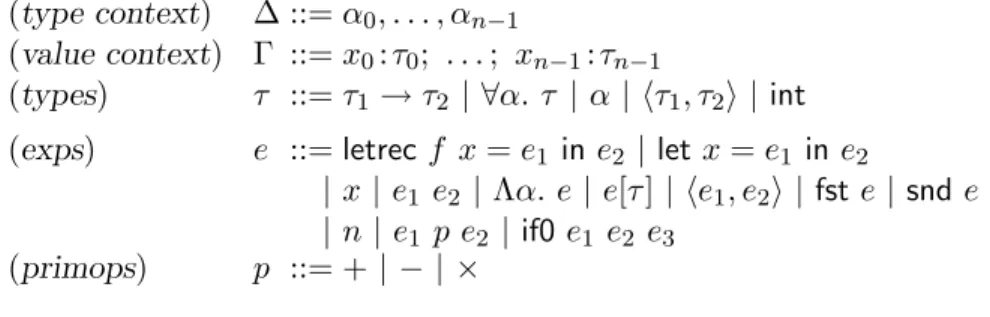
The source language of the compiler, λ→, is shown in Figure 3.1. The term language
is similar to the one from Section 2.2, except that it replaces the λ-abstraction with a more general construct by which recursive functions can be defined (letrec f x = e1 in e2,