HAL Id: hal-01075556
https://hal.archives-ouvertes.fr/hal-01075556
Submitted on 18 Oct 2014
HAL is a multi-disciplinary open access
archive for the deposit and dissemination of
sci-entific research documents, whether they are
pub-lished or not. The documents may come from
teaching and research institutions in France or
abroad, or from public or private research centers.
L’archive ouverte pluridisciplinaire HAL, est
destinée au dépôt et à la diffusion de documents
scientifiques de niveau recherche, publiés ou non,
émanant des établissements d’enseignement et de
recherche français ou étrangers, des laboratoires
publics ou privés.
Requirement engineering of a Cooperative Information
System using viewpoints
Kahina Kessi, Mourad Oussalah, Zaia Alimazighi
To cite this version:
Kahina Kessi, Mourad Oussalah, Zaia Alimazighi. Requirement engineering of a Cooperative
In-formation System using viewpoints. IWAISE 2014 (The 3rd International Workshop on Advanced
Information Systems for Enterprises ), Nov 2014, TUNIS-TUNISIE, Tunisia. �hal-01075556�
Requirement engineering of a Cooperative Information System using viewpoints
Kahina Kessi
USTHB University
LSI laboratory
Algeria
[email protected]
Mourad Oussalah
Nantes University
LINA Laboratory
France
[email protected]
Zaia Alimazighi
USTHB University
LSI laboratory
Algeria
[email protected]
Abstract
In this paper we are interested in cooperative infor-mation systems (CIS) in inter-organizational environments. They are information systems on a large scale, which con-nect different organizations, often autonomous, sharing common goals, forming in this case inter-organizational system (IOS). In order to develop a CIS, we propose a Vp-CIs approach, which incorporates a notion of software en-gineering, which are the viewpoints from the needs analysis phase to describe their requirements and needs. This ap-proach defines a meta-model of viewpoint, which enable us to instantiate the viewpoints necessary to identify the needs and requirements of a CIS.
Keywords: viewpoints, needs analysis, requirements en-gineering, cooperative information system.
1. Introduction
In a context of globalization of markets, companies of today face many challenges posed by: increased competi-tion, the exceptional growth of services they must offer to their customers, the increased need to provide better quality of service and the necessity of cooperation and collabora-tion with other business partners to stay competitive in their activity domain and operating in socio-economic environ-ments characterized by dynamism and increased turbulence. Thus, a company can no longer be content with a closed information system, which would cause it to be unable to exchange information with its collaborators and partners. The Cooperative Information System (CIS) area allows sup-porting the inter-company relations in order to improve in-teractions and communication between partners. An IOIS itself being a CIS [2], defines an inter-organizational in-formation system as a system that has a special function to support processes that cross borders of an organization. In[2], they explain that a central entity will manage a col-laborative process by organizing the intervention of
part-ners. In [12], the authors recognize that enterprise interop-erability passes through the interopinterop-erability of their infor-mation systems to improve overall efficiency of a collabo-rative network. Indeed, behavior, reactivity and dynamics of the company are based largely on the information sys-tem through the processes it supports, the applications it of-fers and data it manages [20]. Size and complexity of these cooperative information systems is therefore growing, their complexity makes their design more difficult. It is so very important to understand the needs and requirements of the system, which leads us to be interested at the first phase of development of a CIS, i.e. the system analysis phase. What we want is to propose an approach which solves the prob-lems related to the development of a CIS in order to propose a tool which let to support this approach using a notion of software engineering: the viewpoints. This article is orga-nized as follow. In the second part we present our motiva-tions and our interest regarding the proposal for an approach oriented viewpoint to the needs analysis phase of CIS. In the third part we present some methods that have addressed the same problem, before moving on to the fourth part where we present our VpCIs approach. Finally we conclude with our perspectives.
2. Motivation
The size and complexity of these cooperative informa-tion systems is therefore growing, their complexity makes their design more difficult. It is so very important to un-derstand the needs and requirements of the system, which leads us to interest and define the first step of development of a CIS, ie the step of Requirements Engineering (RE). RE is the basis phase of the life cycle development of every project, defining what the stakeholders (users, customers, suppliers, developers, businesses ) in a potential new sys-tem need from it, and also what the syssys-tem must do in order to satisfy that need [9]. We need to find a set of require-ments that reflect the needs of these stakeholders. Despite the obvious need for an appropriate level of structure and
rigor, this critical, complex, and potentially expensive ac-tivity in the majority of cases is performed in an ad-hoc manner without a defined process or methodology. The lack of systematic methods with situational process guid-ance, and experience reports that can easily be applied to real-world situations are serious reasons for the current gap between requirements elicitation and needs analysis in re-search and practice. [6]. The methods that exist in the domain of RE in software engineering does not allow to address the complex needs of a CIS which involves the co-operation of many stakeholders in a common purpose and each with their own viewpoint. The use of existing ap-proaches based on concepts of: goal, scenario or viewpoint have shown their limits, and work has been done for their in-tegration into a single approach. [15] for example, proposed an approach named CREWS for requirements elicitation in which the authors use both goal and scenario, [3] proposed an approach inspired from CREWS where they integrated goal, scenario and viewpoints. there is also for example the methods VORD or VOSE which used the viewpoints for the requirement engineering. But these methods have not highlighted the concepts of actors, team (group of ac-tors), activity, actions and interactions between actors that must be in a cooperative information systems. For the anal-ysis needs phase of a cooperative information system other factors should be considered. It will be necessary to deter-mine who does what, on what, when, after what and before what, we must define the systems actors and relations or ac-tions and activities that may exist between them. Which im-plies the intervention of different stakeholders (the expert, designer of CIS, domain user ...) involving several levels of modeling and multiple domains (generic domain (CIS), business application ...). We will try to solve these problems by proposing an approach that highlights these concepts us-ing viewpoints with 5 dimensions in order to have a tool that allows to have a common formalism for each concept and remedy this complexity. This will allow us to decom-pose the needs of a CIS according to viewpoints of each stakeholder. A viewpoint-based approach to requirements engineering recognizes that all information about the sys-tem requirements cannot be discovered by considering the system from a single perspective. Rather, we need to col-lect and organize requirements from a number of different viewpoints. A viewpoint is an encapsulation of partial in-formation about a systems requirements. Inin-formation from different viewpoints must be integrated to form the final sys-tem specification [18]. There is several viewpoints methods in RE like : SADT [16],[14], CORE [13], VOSE [8], [11], VORD [10], [17], [7], PreView [19], ISO/IEC/IEEE 42010 standard [1]. In addition, the main arguments in favor of an approach based on viewpoints in requirements engineering are:
• Systems usage is heterogeneous there is no such thing
as a typical user. Viewpoints may organize system re-quirements from different classes of system end-user and other system stakeholders.
• Different types of information are needed to specify systems including information about the application domain, information about the systems environment and engineering information about the systems devel-opment. Viewpoints may be used to collect and clas-sify this information.
• Viewpoints may be used as a means of structuring the process of requirements elicitation. [18]
The viewpoint establishes the conventions for construct-ing, interpreting and analyzing the view to address con-cerns framed by that viewpoint. Viewpoint conventions can include languages, notations, model kinds, design rules, and/or modeling methods, analysis techniques and other op-erations on views. A viewpoint is a way of looking at sys-tems. [1]
In this approach, we interest to the cooperative informa-tion systems, we first propose a meta-model of viewpoint in the modeling level M2 in order to have a common for-malism and to after instantiate the necessary viewpoints to describe a CIS in M1 level, we expect thereafter to provide a tool which allows to support this approach.
3. Related work and comparison
Several methods have proposed approaches to respond to needs and requirements of systems, we have oriented our choice to tooled methods as we later, want to propose a tool that will support our approach, knowing that we are in-terested in CIS and viewpoints, we then selected CREWS, Tropos-i* and MAMIE methods which are interested in col-laborative work and we choose methods oriented viewpoint: VORD and VOSE. In the analysis needs phase of a cooper-ative information system we have to find these notions: Ac-tor, team (group of actors), interaction between the actors, activity (set of actions of a group of actors), action of an actor and requirements. we base our comparisons on these criteria.
3.1. The CREWS method
The CREWS [15] method (Cooperative Requirements Engineering With Scenario), is developed under the ES-PRIT project (European Research Project Reactive) ap-proach. The objective is to find the system requirements by coupling each goal discovered with a scenario that illus-trates the behavior of the system to achieve the goal. Once an object has been selected, a scenario is written to it. In this way, the coupling goal-scenario reduces the problem of
fuzzy goals.
The method has demonstrated its effectiveness in the re-quirements specification of a cooperative process by high-lighting the concept of goal and scenario, the scenario has to make less fuzzy and more realistic goal, any technique that uses scenarios to discover the goals produces only use-ful purposes. But what we can say about this method is that: - The method does not highlights the actors, group of actors (team) and their descriptions or descriptions of the activities of the system.
- Fragmentation of requirements captured in multiple sce-narios makes difficult the assurance of completeness of the requirements specification.
- It also makes difficult to research the different aspects of the same system functionality across multiple scenarios. - Sometimes non-functional concerns such as security and performance are treated secondarily compared to the central question of functional concerns.
3.2. The MAMIE method
MAMIE (from MAcro to MIcro level requirements Elic-itation) [3] developed by bendjenna 2010, for the elicita-tion of requirements of an inter-organizaelicita-tional system. The MAMIE approach is a methodology which aims to guide systemsˆa analysts to elicit requirements in an ICIS. It is composed of two phases: the macro level cooperation and the micro level of inter-company co-operation . It con-sists, initially, to elicit and specify cooperative activities, constraints of co-operation between companies, and the relevant non functional requirements of the future system (the macro level cooperation). Through interviews, ques-tionnaire, documents study or other elicitation techniques, essential requirements are obtained. In the second phase (the micro level of inter-company co-operation), they try to get requirements necessary to set up goals with constraints identified in the first phase. [4] The method drew inspiration from the CREWS method by coupling the goal (i*-method) and scenario (UML diagram) and added viewpoints (Pre-view) to describe non-functional requirements for the elici-tation of requirements for a cooperative information system. But this method does not explicitly describes the relations between the actors and did not include the concept of activ-ities (group of actions) and team which are important in a cooperative information system.
3.3. Tropos-i* method
Tropos [5], which is requirements-driven in the sense that it is based on concepts used during early requirements analysis. To this end, we adopt the concepts offered by i* [21], a modeling framework offering concepts such as ac-tor, agent, position and role, as well as social dependencies
among actors, including goal, softgoal, task and resource ones. These concepts are used to model not just early re-quirements for a system, but also late rere-quirements, archi-tectural design and detailed design. The methodology spans four phases of software development:
- Early requirements, concerned with the understanding of a problem by studying an existing organizational setting; the output of this phase is a an organizational model which in-cludes relevant actors and their respective goals;
- Late requirements, where the system-to-be is described within its operational environment, along with relevant functions and qualities;
- Architectural design, where the systems global archi-tecture is defined in terms of subsystems, interconnected through data and control flows;
- Detailed design, where each architectural component is defined in further detail in terms of inputs, outputs, control, and other relevant information.
Goal modeling like Tropos-i* is an effective way to iden-tify requirements. The argument of goal driven approaches is that the rationale for developing a system is to be found outside the system itself, in the enterprise in which the sys-tem shall function.
But it is difficult for domain experts to deal with the fuzzy concept of a goal. Yet, domain experts need to discover the goals of real systems. It is often assumed that systems are constructed with some goals in mind. However, goals are not given and therefore the question as to where they origi-nate from acquires importance.
-The goal process do not reflect the actual situation but an idealized environmental one. Therefore, proceeding from this may lead to ineffective requirements. Thus, goal dis-covery is rarely an easy task. Add to this The method does not highlights the teams (group of actors) and their descrip-tions or descripdescrip-tions of the activities and acdescrip-tions of a system that we need to find a CIS.
3.4. VORD method
VORD [10] was developed at the University Lancast-eret proposed by Sommerville and Kotonya (1996). It is a method for pre-validation of specifications, mainly ded-icated to interactive systems and resolution of viewpoints. VORD introduced viewpoints focused on user issues and organizational concerns. The model adopted for the view-points is service oriented; viewview-points play an analogous role to clients in a client-server system.
A viewpoint VORD encapsulates a set of attributes that help define and structure specifications. Briefly, a viewpoint template includes the following components: Identifier, La-bel, Type, Attributes, Requirements, Event scenarios. The VORD method is useful in the detection of user needs, and also in identifying services that the user expects the
sys-tem. It provides a structured method for the collection, doc-umentation, analysis, and specification of viewpoints and needs. The views are used to describe the different system users.
- However VORD method does not explicitly support the analysis of interactions between and within all viewpoints, it is oriented service, and does not represent the cooperation between actors, or the activities descriptions and actions of the system, we don’t find the notion of team which is im-portant in a CIS.
- The viewpoints in VORD are predefined and rigid, it is not flexible and do not let the opportunity for developers to use their own notations and does not support changing require-ments.
3.5. VOSE method
ViewPoint Oriented System Engineering, VOSE, was developed to ”Imperial College” in London in the early 90s by Finkelstein, Nuseibeh et al. (1992) as a framework for the integration of development methods in compound sys-tems (composite syssys-tems). These are syssys-tems that require the combination of different technologies and require the work of experts in various fields of application, each with its own interest in the system.
Each viewpoint is defined as an actor (or role in the context of system development) and his viewpoints on the system, represented by its partial knowledge of the system (respon-sibility). This information is organized in a viewpoint and represented by a scheme of five dimensions: style, domain, specification, work plan, and work record.
This method can well describe the requirements of com-posite systems but is not suited to cooperative information systems because it does not allow to define sets of interac-tion and cooperainterac-tion between actors and we don’t find the notion of team which is important in a CIS.
- As in VORD, the viewpoints in VOSE are predefined and rigid, it is not flexible and do not let the opportunity for de-velopers to use their own notations.
The problem which we have found with these more struc-tured approaches (VOSE, VORD, MAMIE) is that they are too rigid. They are based around the idea of a single type of viewpoint and require the specification to be fitted around this concept, this is why we propose our approach VpCIS which is flexible and explicit defining actors, interaction be-tween the actors, teams, activities and actions of the system, it let the developers and the users to define their needs and requirements using the representation style they want.
4. VpCIS approach
To minimize the disadvantage identified above, we propose a method based on an approach with 5 dimensions
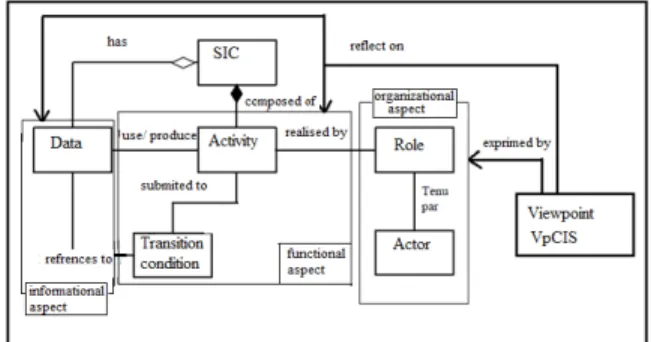
that integrates viewpoints from the needs analysis phase as shown in figure 1 to describe the needs of a CIS, these viewpoints will allow us to describe the actors, interaction between them, activities and actions, notions that we have find in a CIS. (an action is accomplished by an actor, an activity is a group of actions assigned to a group of actors that have to work together to accomplish it).
The figure 1 describes the following basic concepts:
Figure 1. CIS meta-model integrating view-points
Organizational aspect:
-Organizational role : it is the list of attributes, skills and expertise of a CIS actor(participant). This role defines the position of the actor in an organization.
-Actor : also called ”agent”, ”participant” or ”user”, the actor is an entity (person), a member of an organization responsible for carrying out the activities entrusted, through its roles.
Functional aspect:
-Activity : an activity is a step in a process in which an elementary action (ie non-decomposable) is executed. -Transition condition : it is the criterion that is necessary to satisfy to change the status of an activity, or to move to the next activity; it is expressed in the form of event or logical expression.
Informational aspect:
-Relevant data : this is the object that is manipulated during the execution of an activity; the data can be used as input may also be generated by the action.
In what follows we present our approach VpCIS which consists at modeling level M2 in a language of viewpoint for a CIS: a viewpoint meta-model to describe these aspects of a CIS, this meta-model aims to describe an actor and a group of actors (team) using the viewpoints associated to five dimensions: process, level of modeling, level of de-scription, domain and expression mode, that will allow us to describe the actor and his interactions with other actors and his activities and actions. This meta-model will help us to instantiate viewpoints actors and group of actors (team)
at M1 modeling level and use these viewpoints at M0 level to describe a CIS in the real world.
Add to this, we use as a mode of representation of the CIS the use case diagram, an UML diagram as UML provides tools to describe the different phases of development. The use case diagram lets us to highlight the actors, interac-tions between them, the activities and acinterac-tions, and to de-duce two types of actors and actions in the meta-model: primary(intervene directly in the CIS) and secondary (in-tervene indirectly in the CIS).
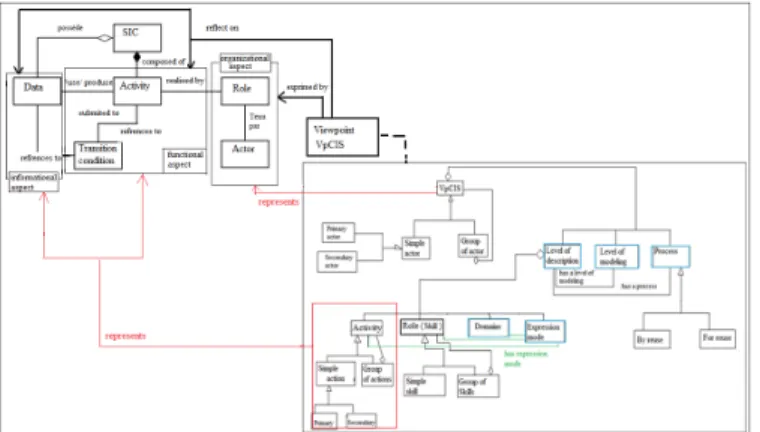
The following figure 2 represents the integration of the meta-model VpCIS in the meta-model CIS.
Figure 2. CIS meta-model integrating VpCIS meta-model
A viewpoint VpCIs meta-model in the M2 level can be a simple actor or a group of actors as shown in Figure 2, it is composed of the following:
1. Process: the construction process can be by or for reuse. We have a set of information systems that want to cooper-ate in order to have a cooperative information system. To describe a CIS we can reuse actors and activities already defined in different cooperating systems or we can have to define new actors and activities.
2. Level modeling: the viewpoint VpCIs may intervene in one of the three layers of the architecture modeling:
• M2, the meta-models such as UML; • M1, the models such as the class diagram; • M0, the real world (case study);
This will allow us to describe the different categories of ac-tors involved in each level modeling.
3. Level of description: this level comprises the following: • Activity: may be a single action or group of actions to
be done by an actor or group of actors.
• Skill: can be a skill of single actor or a group of skills of a group of actors.
• 4. Domain: could be a generic domain or an applica-tion domain:
– Generic domain: in our case it is therefore the CIS, using the viewpoints we describe the actors and activities involved in modeling level M2 and M1 (expert, designer CIS ...)
– Application domain: using also the VPs we de-scribe the actors and activity level M0 (actors and activities of the case study)
• 5. Expression mode: representation mode of activities, skills and domain, the user can choose the expression mode that he wants to describe his needs.
The viewpoint VpCIs simple actor and group of actors (team) and their attributes are described at M1level mod-eling.
We pass now to M1 level, where we instantiate the view-point actor and group of actors (team) from the meta-model of level M2 using the 5 dimensions:
The viewpoint group of actors (team) has the following at-tributes: • Process • Level modeling • Level of description: – Name – Goal – Skills:
∗ Expression mode of the group of skills ∗ Skills
– Domain:
∗ Expression mode of the domain ∗ Domain
– Activity (Group of actions):
∗ Expression mode of the activity ∗ Group of actions
∗ Interaction between the actors: · Inter link · Intra link ∗ Required data ∗ Constraints on data ∗ Output data ∗ history
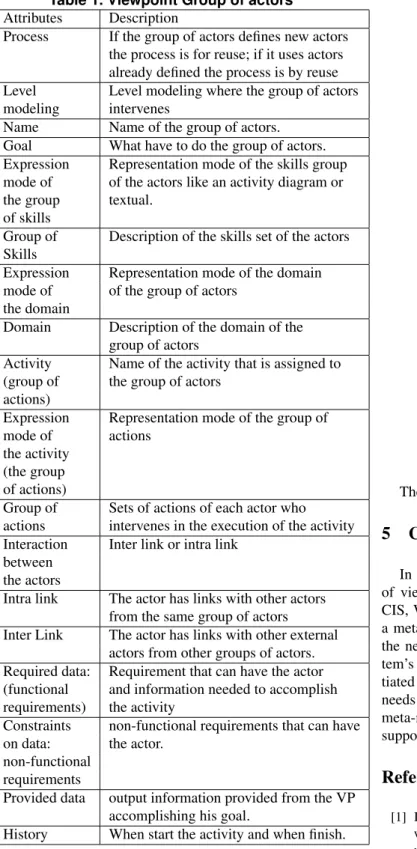
These attributes are detailed in the following table 1: The viewpoint simple actor has the following attributes:
Table 1. Viewpoint Group of actors
Attributes Description
Process If the group of actors defines new actors the process is for reuse; if it uses actors already defined the process is by reuse Level Level modeling where the group of actors modeling intervenes
Name Name of the group of actors. Goal What have to do the group of actors. Expression Representation mode of the skills group mode of of the actors like an activity diagram or the group textual.
of skills
Group of Description of the skills set of the actors Skills
Expression Representation mode of the domain mode of of the group of actors
the domain
Domain Description of the domain of the group of actors
Activity Name of the activity that is assigned to (group of the group of actors
actions)
Expression Representation mode of the group of mode of actions
the activity (the group of actions)
Group of Sets of actions of each actor who actions intervenes in the execution of the activity Interaction Inter link or intra link
between the actors
Intra link The actor has links with other actors from the same group of actors Inter Link The actor has links with other external
actors from other groups of actors. Required data: Requirement that can have the actor (functional and information needed to accomplish requirements) the activity
Constraints non-functional requirements that can have on data: the actor.
non-functional requirements
Provided data output information provided from the VP accomplishing his goal.
History When start the activity and when finish.
• Process • Level modeling • Level of description: – Type – Name – Goal – Skill:
∗ Expression mode of the actor skill ∗ Skill
– Domain:
∗ Expression mode of the domain ∗ Domain
– Action:
∗ Activity (group of actions) ∗ Expression mode of the action ∗ Action (description of the action) ∗ Interaction between the actors:
· Inter link · Intra link ∗ Required data ∗ Constraints on data ∗ Output data ∗ history
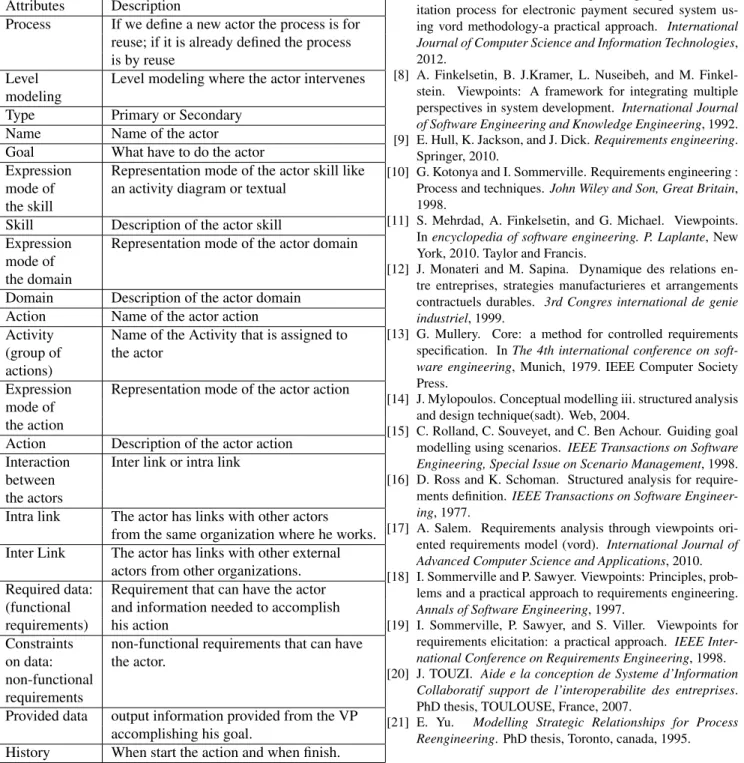
These attributes are detailed in the following table 2:
5
Conclusion
In this article we discussed our motivation for the use of viewpoints in the requirement engineering phase of a CIS, We proposed after the VpCIS approach which define a meta-model of viewpoints in the M2 level modeling for the needs analysis phase of a CIS, to decompose the sys-tem’s needs and simplify the CIS’s modeling. We instan-tiated after that the necessary viewpoints to describe these needs and requirements in the M1 level modeling from the meta-model. We expect to develop a tool which allows to support this approach and develop a CIS.
References
[1] International standard iso/iec/ieee 42010, systems and ware engineering architecture description. Systems and soft-ware engineering Architecture description, 2011.
[2] B. Aubert and A. Dussart. Systemes d’information inter-organisationnels. Rapport Bourgogne, CIRANO, 2002. [3] H. Bendjenna. Ingenierie des exigences pour les processus
inter-organisationnels. PhD thesis, University of Constan-tine and Toulouse, Algeria, France, 2010.
Table 2. Viewpoint Simple actor
Attributes Description
Process If we define a new actor the process is for reuse; if it is already defined the process is by reuse
Level Level modeling where the actor intervenes modeling
Type Primary or Secondary Name Name of the actor Goal What have to do the actor
Expression Representation mode of the actor skill like mode of an activity diagram or textual
the skill
Skill Description of the actor skill
Expression Representation mode of the actor domain mode of
the domain
Domain Description of the actor domain Action Name of the actor action
Activity Name of the Activity that is assigned to (group of the actor
actions)
Expression Representation mode of the actor action mode of
the action
Action Description of the actor action Interaction Inter link or intra link
between the actors
Intra link The actor has links with other actors from the same organization where he works. Inter Link The actor has links with other external
actors from other organizations. Required data: Requirement that can have the actor (functional and information needed to accomplish requirements) his action
Constraints non-functional requirements that can have on data: the actor.
non-functional requirements
Provided data output information provided from the VP accomplishing his goal.
History When start the action and when finish.
[4] H. Bendjenna, N. Zarour, and P. Charrel. Mamie: a method-ology to elicit requirements in inter-company co-operative information systems. CIMCA, 2008.
[5] J. Castro, P. Giorgini, M. Kolp, and J. Mylopoulos. Tro-pos: A requirements-driven methodology for agent-oriented software. 2004.
[6] C. R. Coulin. A Situational Approach and Intelligent Tool for Collaborative Requirements Elicitation. PhD thesis,
University of Sydney and Toulouse, Toulouse, France, 2007. [7] M. Faisal and M. Hussain. Emphasizing requirement elic-itation process for electronic payment secured system us-ing vord methodology-a practical approach. International Journal of Computer Science and Information Technologies, 2012.
[8] A. Finkelsetin, B. J.Kramer, L. Nuseibeh, and M. Finkel-stein. Viewpoints: A framework for integrating multiple perspectives in system development. International Journal of Software Engineering and Knowledge Engineering, 1992. [9] E. Hull, K. Jackson, and J. Dick. Requirements engineering.
Springer, 2010.
[10] G. Kotonya and I. Sommerville. Requirements engineering : Process and techniques. John Wiley and Son, Great Britain, 1998.
[11] S. Mehrdad, A. Finkelsetin, and G. Michael. Viewpoints. In encyclopedia of software engineering. P. Laplante, New York, 2010. Taylor and Francis.
[12] J. Monateri and M. Sapina. Dynamique des relations en-tre enen-treprises, strategies manufacturieres et arrangements contractuels durables. 3rd Congres international de genie industriel, 1999.
[13] G. Mullery. Core: a method for controlled requirements specification. In The 4th international conference on soft-ware engineering, Munich, 1979. IEEE Computer Society Press.
[14] J. Mylopoulos. Conceptual modelling iii. structured analysis and design technique(sadt). Web, 2004.
[15] C. Rolland, C. Souveyet, and C. Ben Achour. Guiding goal modelling using scenarios. IEEE Transactions on Software Engineering, Special Issue on Scenario Management, 1998. [16] D. Ross and K. Schoman. Structured analysis for require-ments definition. IEEE Transactions on Software Engineer-ing, 1977.
[17] A. Salem. Requirements analysis through viewpoints ori-ented requirements model (vord). International Journal of Advanced Computer Science and Applications, 2010. [18] I. Sommerville and P. Sawyer. Viewpoints: Principles,
prob-lems and a practical approach to requirements engineering. Annals of Software Engineering, 1997.
[19] I. Sommerville, P. Sawyer, and S. Viller. Viewpoints for requirements elicitation: a practical approach. IEEE Inter-national Conference on Requirements Engineering, 1998. [20] J. TOUZI. Aide e la conception de Systeme d’Information
Collaboratif support de l’interoperabilite des entreprises. PhD thesis, TOULOUSE, France, 2007.
[21] E. Yu. Modelling Strategic Relationships for Process Reengineering. PhD thesis, Toronto, canada, 1995.