ScienceDirect
Available online at www.sciencedirect.com
Procedia Computer Science 170 (2020) 403–410
1877-0509 © 2020 The Authors. Published by Elsevier B.V.
This is an open access article under the CC BY-NC-ND license (http://creativecommons.org/licenses/by-nc-nd/4.0/) Peer-review under responsibility of the Conference Program Chairs.
10.1016/j.procs.2020.03.082
10.1016/j.procs.2020.03.082 1877-0509
© 2020 The Authors. Published by Elsevier B.V.
This is an open access article under the CC BY-NC-ND license (http://creativecommons.org/licenses/by-nc-nd/4.0/) Peer-review under responsibility of the Conference Program Chairs.
Procedia Computer Science 00 (2020) 000–000
www.elsevier.com/locate/procedia
The 11th International Conference on Ambient Systems, Networks and Technologies (ANT)
April 6 - 9, 2020, Warsaw, Poland
A New Device to Track and Identify people in a Multi-Residents
Context
Patrick Lapointe
a, K´evin Chapron
a, K´evin Bouchard
a, S´ebastien Gaboury
∗,aaLabotatoire d’Intelligence Ambiante pour la Reconnaissance d’Activit´es, Universit´e du Qu´ebec `a Chicoutimi, 555 boulevard de l’Universit´e,
Chicoutimi (Qu´ebec) Canada, G7H2B1
Abstract
In recent years, technologies for monitoring people inside a house lead to the development of smart home. However, the vast majority of works deals only in monitoring the activities of a single inhabitant. Nevertheless, most of the people in the current context of ageing population does not live alone. Recognizing the activities performed by each inhabitant in a house is an important challenge. A first step to achieve this is to be able to distinguish where each inhabitant is in the house. In this paper, we present a new device to track and identify people in a multi-residents context. Experiments have been conducted to validate the reliability and accuracy of the proposed device.
c
2020 The Authors. Published by Elsevier B.V.
This is an open access article under the CC BY-NC-ND license (http://creativecommons.org/licenses/by-nc-nd/4.0/) Peer-review under responsibility of the Conference Program Chairs.
Keywords: Sensors; Smart Home; Indoor localization; RSSI localization; Bluetooth Low Energy; Multi-residents; BLE RSSI
1. Introduction
In the last decades, advancements in sensing and monitoring technologies lead to the development of smart homes which consist in a typical house equipped with different ambient sensors (PIR motion sensors, RFID tags, light sensors, temperature, etc.) [1]. Data collected by these sensors can be continuously analyzed by the use of different techniques such as machine learning [22] to perform the task of recognizing the activity of daily living carried on by the inhabitant. In a context of population ageing and healthcare scarcity, smart homes reveal to be a promising avenue to allow people aging in place [24].
∗ Corresponding author. Tel.: +1-418-545-5011 2604 E-mail address: [email protected]
1877-0509 c 2020 The Authors. Published by Elsevier B.V.
This is an open access article under the CC BY-NC-ND license (http://creativecommons.org/licenses/by-nc-nd/4.0/) Peer-review under responsibility of the Conference Program Chairs.
Procedia Computer Science 00 (2020) 000–000
www.elsevier.com/locate/procedia
The 11th International Conference on Ambient Systems, Networks and Technologies (ANT)
April 6 - 9, 2020, Warsaw, Poland
A New Device to Track and Identify people in a Multi-Residents
Context
Patrick Lapointe
a, K´evin Chapron
a, K´evin Bouchard
a, S´ebastien Gaboury
∗,aaLabotatoire d’Intelligence Ambiante pour la Reconnaissance d’Activit´es, Universit´e du Qu´ebec `a Chicoutimi, 555 boulevard de l’Universit´e,
Chicoutimi (Qu´ebec) Canada, G7H2B1
Abstract
In recent years, technologies for monitoring people inside a house lead to the development of smart home. However, the vast majority of works deals only in monitoring the activities of a single inhabitant. Nevertheless, most of the people in the current context of ageing population does not live alone. Recognizing the activities performed by each inhabitant in a house is an important challenge. A first step to achieve this is to be able to distinguish where each inhabitant is in the house. In this paper, we present a new device to track and identify people in a multi-residents context. Experiments have been conducted to validate the reliability and accuracy of the proposed device.
c
2020 The Authors. Published by Elsevier B.V.
This is an open access article under the CC BY-NC-ND license (http://creativecommons.org/licenses/by-nc-nd/4.0/) Peer-review under responsibility of the Conference Program Chairs.
Keywords: Sensors; Smart Home; Indoor localization; RSSI localization; Bluetooth Low Energy; Multi-residents; BLE RSSI
1. Introduction
In the last decades, advancements in sensing and monitoring technologies lead to the development of smart homes which consist in a typical house equipped with different ambient sensors (PIR motion sensors, RFID tags, light sensors, temperature, etc.) [1]. Data collected by these sensors can be continuously analyzed by the use of different techniques such as machine learning [22] to perform the task of recognizing the activity of daily living carried on by the inhabitant. In a context of population ageing and healthcare scarcity, smart homes reveal to be a promising avenue to allow people aging in place [24].
∗ Corresponding author. Tel.: +1-418-545-5011 2604 E-mail address: [email protected]
1877-0509 c 2020 The Authors. Published by Elsevier B.V.
This is an open access article under the CC BY-NC-ND license (http://creativecommons.org/licenses/by-nc-nd/4.0/) Peer-review under responsibility of the Conference Program Chairs.
Recognizing ongoing activity performed by a resident only from the data collected by various types of sensors is a very difficult task because of the highly complex nature of human activities. There are mainly two categories of technology used to recognize activity in smart homes, that is, computer vision and pervasive sensing. In this paper, we will only focus on the latter one since the use of cameras in private smart homes is too invasive and raises privacy concerns. Many researchers worked on this task along the years [5,12]. Although many challenges remain, significant progress has been made in accomplishing activity recognition. However, almost all of this progress has been made in the case where only one resident lives in the smart home. Nevertheless, living spaces are generally inhabited by more than one person.
In recent years, research on the recognition of activities in a multi-resident context has increased because of its prominent importance. The key challenge in multi-residents activity recognition is to perform effectively the associ-ation between the sensor observassoci-ations and each individual [6]. For example, suppose that two passive infrared (PIR) motion sensors are triggered on at the same time in two different rooms, although this indicates the presence of two persons, we do not know which person is in which room. Moreover, the multi-residents context introduces two more types of activities, namely, parallel activities (many inhabitants perform many activities at the same time) and collabo-rative activities (many inhabitants work together to complete the same activity). Therefore, the complexity of activity recognition is considerably increased in that context and thus the data association (mapping the data sensed to the resident who caused it) becomes essential.
Actually, almost all approaches on this topic are either based on the assumption that data association is provided [7,13,14] or on recognizing ongoing activities without being capable identifying who performs them [15,20,23]. In the perspective of offering personalized assistance to each individual living in the smart home, the second category of approaches is not realistic. Also, assuming that the information of who produced the sensed data is provided is also unrealistic since obtaining this information remains the key challenge to recognize activities in a multi-residents settings as mentioned previously. Since, it is almost impossible to provide data association only from ambient sensors, some authors proposed different individual localization and identification technologies to tackle it. As we shall see, these technologies present different flaws that limit their usage in real case scenarios to accomplish data association. Note that combining some of these technologies with ambient sensors allowed some authors [2,21] to improve the activity recognition accuracy for each individual.
The contributions of this paper are twofold. First, we propose a new device that combines passive infrared (PIR) motion sensor and Bluetooth Low Energy (BLE) capability allowing to detect movement as well as the devices with
BLE technology (e.g., smartwatch, smartphone, wristband) present in a room. Second, we introduce a new system able
to perform the tracking and the identification of each individual wearing a device (with BLE) when each room in a home is equipped with our new device. This system allows to accomplish the data association required for the activity recognition in a multi-residents settings. The advantages of our system are numerous: cheap, robust, reliable, accurate, lightweight and easily deployable. It can also deal with the case where one of the residents does not wear a device with
BLE technology. Moreover, the system requires no data processing on the personal devices of the residents. Finally,
the system and the devices are easily reproducible since all the project is open source. 2. Related work
Distinguishing between inhabitants who performed or participated to a specific activity of daily living is absolutely crucial to have accurate activity recognition in a home occupied by multiple residents. For this purpose, different technologies have been used to carry out localization and identification of each individual continuously in the home. In the literature, we can divide these technologies into three approaches, that is, vision-based, signature-based, and tag-based approach. The vision-based one uses cameras to recognize the activities and the individuals performing them by extracting biometric information (e.g., height, face) [25]. The major issue with this approach is related to the privacy. The second approach based on signature consists in collecting data from different types of sensors such as microphones [4], ultra-wide band (UWB) [16], PIR motion sensors [26], and ultrasound [17], to learn a unique signature for each residents. Unfortunately, this approach presents many drawbacks. In particular, the approach is not very precise and depends strongly on the house where the sensors are installed. Therefore, it is not generalizable. The last approach is based on the use of tags (or devices) worn by all the residents of a home. Each tag (or device) possesses an unique ID that can be broadcasted to a central unit at specific time interval via wireless communication networks
such as BLE, Wi-Fi, ZigBee, or RFID. This approach is the most promising one for the purpose of localization and identification of each resident in a smart home.
As mentioned previously, the tag-based approach relies on the use of wireless technology to achieve the local-ization and the identification. For example, in the work of Ali et al [3], Wi-Fi has been used to conceive an indoor positioning system reaching good accuracy. However, almost all positioning systems using Wi-Fi technology require many antennas and a fingerprinting phase. Moreover, smartphones being almost the only wearable devices equipped with Wi-Fi technology, this implies that each resident must have one to be identified and tracked in the home. Re-cently, Bianchi et al [8] proposed an indoor localization and identification system based on the analysis of Received Signal Strength Indication (RSSI) for ZigBee wireless sensor networks. Although they obtained interesting results in terms of accuracy, their system has the following major disadvantages. On the one hand, they had to use a specially designed ZigBee portable device, as there are no devices commonly used by the people equipped with this technology. On the other hand, their positioning system needs a time consuming fingerprinting phase which makes it unrealistic in our context. Some other research teams [19,27] developped positioning methods using RFID technology and reach sub-centimeter accuracy. The main drawbacks with RFID technology are the very high cost of the RFID reader and antennas (≈ $ 2,000), and the fact that RFID technology is not used in current wearable devices. Finally, many authors presented promising accurate indoor positioning and identifying system exploiting BLE technology [10,11] since it is low cost, low energy, reliable, etc. In particular, the method introduced recently by Mokhtari et al. [18] which uses many BLE devices (iBeacons) as tags carried by the residents as well as smartphones as BLE scanners in each room, provides an efficient room-level accurate, lightweight, and easily deployable localization and identification system. However, their system is expensive since it requires one smartphone per room (≈ $ 600, for a house of four rooms). Moreover, it can not handle the case if one resident does not wear his tag.
3. A new device for tracking and identifying residents
Our goal was to design a device that could be easily reproducible by any person in the domain for a price as low as possible. Since our objective is to share our system with everyone, it will be fully described in terms of physical architecture, networking architecture and software in the following Sections. Besides, we also give the reader an access to our GitHub repository with every necessary details to duplicate it it1.
(a) Schema of the PIR wired to the Raspberry Pi (b) The proposed device (c) Internal view of the proposed device Fig. 1: Representations of the proposed device involving a Raspberry Pi Zero W, a PIR senror and its casing.
3.1. Physical architecture
As previously mentioned, every component we included in the device had to be inexpensive. In particular, as main sensor we selected the Passive Infrared Sensor manufactured by Parallax Inc2, which costs $ 15. The processing task
was entrusted to a Raspberry Pi Zero W. The Raspberry Pi Zero W is one of the best nano-computers in terms of processor frequency, available memory, connectivity, size and price (connections can be observed in Figure1a).
Next, to have a friendly appearance a 3D-printed case was specifically designed. Many problems have occurred with the PIR sensor which was disturbed by the Wi-Fi signals of the Raspberry Pi Zero W. A separation between the
PIR sensor and the Raspberry Pi Zero W was therefore necessary. As it can be observed in Figure1b, the PIR sensor and the Raspberry Pi Zero W are in two separate casing. An aluminium foil connected to the ground of the PIR sensor was incorporated also to shield it against interferences of the Wi-Fi signals emitted by the Raspberry Pi Zero W (see Figure1c).
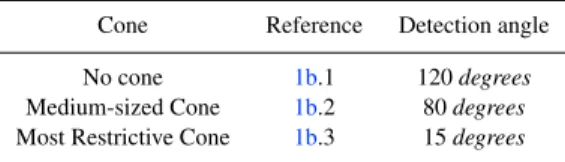
The proposed device costs about $ 45 ($ 15 for the PIR sensor, $ 10 for the Raspberry Pi Zero W and $ 20 for storage, power, electronics). Another interesting point about the proposed device is that multiple possible cones can be attached to the PIR sensor to allow different detection angles. Each cone is designed for a specific motion detection angle. The reader is referred to Table 1 for more details. For example, the most restrictive cone can be installed on the proposed device on the ceiling above a bed to monitor sleep.
Table 1: Motion sensing cones details Cone Reference Detection angle
No cone 1b.1 120 degrees
Medium-sized Cone 1b.2 80 degrees Most Restrictive Cone 1b.3 15 degrees
3.2. Networking architecture
The whole tracking system is composed of many of the proposed devices. All devices are communicating via
Wi-Fi to a main central computing unit. The Raspberry Pi 3 was chosen as this main central computing unit. To
transfer information across this structure, the Message Queuing Telemetry Transport (MQTT) protocol3combined to
the security layer of SSL/TLS was adopted because of their proven reliability and efficiency. In addition, even if our tests showed a really stable connection between every devices, we added another layer of reliability by managing the reconnecting to the main broker. In particular, if the communication is lost between a device and the MQTT broker, the device will automatically retry to connect and store incoming data instead of sending it. Obviously, once reconnected, the data is sent back to the broker as a batch.
The data collected from each device are of two types: binary motion detection (PIR sensor) and BLE advertisements (Raspberry Pi Zero W). So, each device individually collects its own data via either its PIR sensor or BLE and transmits it to the main computing unit for further processing. It worth noting that the BLE RSSI collected via the Raspberry Pi Zero W comes from surrounding portable devices. In our work, we make use of our own customized wearable device (bracelet). The interested reader is referred to [9] for more details. In our experiments, the wearable device was set to advertise twice a second.
Finally, the detected motion events and the collected BLE RSSI advertisements are sent to the Raspberry Pi 3 over
MQTT to be analyzed by different algorithms.
2 https://www.parallax.com/product/555-28027
3.3. Tracking and identification system
The tracking and identification system can be divided into three main processes: data management; real-time BLE
RSSI based positioning; and association between BLE devices and motion detection.
First, each device included in the tracking and identification system processes its own data (motion detection events and BLE RSSI) and transmits them to the MQTT broker. All motion detection events from all PIR sensors are stored in a common vector until further analysis. Then, each time a PIR sensor triggers a motion end event, the system searches for the corresponding motion start event. If the time between the two events lasts more than 1.5 seconds, it is considered a relevant detection, otherwise it is ignored. This threshold makes it possible to filter false detections of the PIR sensors caused by the Wi-Fi signal of the Raspberry Pi. Then, the system tries to associate this event of motion detection to a BLE device to identify if a person of interest (POI) (a POI is a person wearing a BLE device) is the one that activated the PIR sensor. To accomplish this association, a time window of 80 seconds on which BLE RSSI features are extracted (mean and standard deviation) was determined experimentally to provide the best accuracy. In fact, we tried each time window size between 30 seconds and 120 seconds with a step of 5 seconds. Thus, after detecting a valid motion event, the system will consider 40 seconds before and 40 seconds after the mean time of the duration of the detected event to perform the RSSI analysis to find which POI was near of the PIR sensor at the event. The localization of every wearable BLE-enabled device around the multiple PIR sensors is performed with the help of Algorithm1given below. First, for every combination of PIR-POI, the RSSI features (mean and standard deviation) is computed on a time window of selected length. Note that there is one RSSI value per second for each device. Next, every POI are sorted by their RSSI means (in absolute value) in ascending order. The one with the lower RSSI mean (in absolute value) is the closest to the PIR device triggered if its difference with the others RSSI means are not within 1.25 dBm (value experimentally determined) else they are then sorted by their standard deviation. The one with the smallest standard deviation value is then selected as the closest to the PIR device.
Algorithm 1: BLE wearable device localization algorithm input : Wstartand Wend=Start/end of the window input : tag = The BLE wearable to track
input : Xi j=RSSI matrix where rows represents the PIR and columns represent the most recent RSSI
recorded by the PIR for the BLE wearable device output: The nearest PIR from the BLE wearable device
f eatures vect = Vector of extracted features for each PIR;
foreach PIR in X do
rssi vect = RSSI recorded by the current PIR for the tag within Wstartand Wendrange;
Convert all RSSI within rssi vect to positive value (|RS S I|) and remove RSSI equals to 0; Extract features from rssi vect : mean, standard deviation;
Append the current PIR identifier and the extracted features to the features vector; end
Sort the features vector by mean, ascending;
best mean = Mean at the first position of the features vector;
Remove items from features vector where mean > 1.25 + best mean if length of f eatures vect > 1 then
Sort the features vector by standard deviation, ascending; end
nearest PIR =PIR at the first position of the features vector; 4. Experimentation
Our experiments have been approved by the Ethics committee of Universit´e du Qu´ebec `a Chicoutimi with the file number 2019.220. For our experiments, we recruited 8 participants, all males aged from 22 to 38 years old. All of them were healthy people.
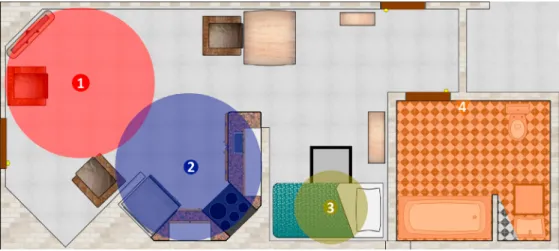
To begin with the experimentation procedure, the whole system has been installed in our smart home apartment of 43m2. One device was installed in each of the following rooms: living room, kitchen, bedroom and bathroom. A
schema of the apartment with the sensors and their sensing area is shown in Figure2. The first two devices have the medium-sized cones, the third one has the most restrictive one and the fourth has none. Once everything was installed, two experiments have been conducted.
In the first one, a wearable device was installed in each zone to collect data . They stood still for an hour and a half before being removed, resulting in a set of static data for each area.
In the second one, the whole system designed to be used in a multi-residents context was tested. To do so, we built an experimentation protocol involving two POI, each equipped with a wearable device, realizing daily activities in the apartment at the same time and one person without wearable device. The two POI had 4 areas to visit and had to stay 3 minutes in each of them. Each scenario lasted for 12 minutes and a half. The first POI had to go in the living room and sit still, then to the bathroom (using toilet, washing hands), then to the bedroom (making the bed, changing clothes) and finally to the kitchen (cooking). At the same time, the second POI had to go to the living room (sweeping the floor), to the kitchen (cooking), to the bathroom (using toilet, washing hands) and finally to the bedroom (relaxing). The third person had to go to the bathroom during the scenario to test if the system would associate someone in this zone, even if no POI are there.
Fig. 2: Schema of the apartment with the installed devices
5. Results
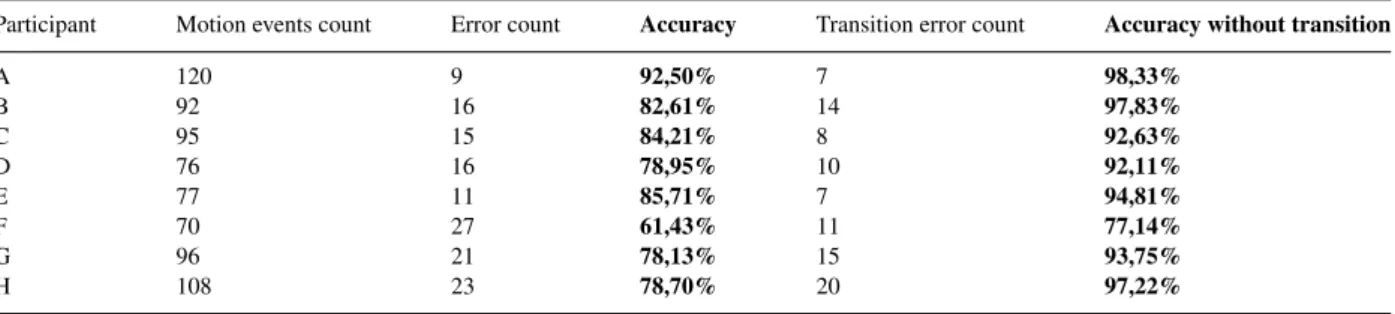
To assess the robustness of our system, we analyzed the data collected during the previously described experiment in multiple ways. The static dataset was analyzed using a sliding window. A time window of length 60 seconds with a 30 seconds overlap provided the best accuracy. Besides, this settings allows us to reach a perfect accuracy of 100 %. However, as all the data were collected in a static mode, this accuracy could be easily expected. In order to be more realistic, the experimentation protocol defined in Section4 was performed by 8 participants. Four groups of two participants was created, each group performed the scenario two times to allow each participant to perform the two roles. This resulted in 8 datasets where the participant had to move in the apartment. Then, Algorithm1was applied on every PIR detection to reach the accuracies given in Table2. During the scenario, participants had to go from one zone to one another, obviously creating some false results. To have a more global view of the reliability of our system, we gave the accuracies with and without the false results caused by these transitions.
In addition, during those experiments, a third person was asked to go to the bathroom while the two POIs were performing their activities in the apartment. At each time, the system always detected it to be someone which is not part of the POIs and kept identified them in the living room.
Next, as the solution we provide is highly BLE-based, we also investigated if the motion detection was really that much important. So, we ran the algorithm without considering any motion sensing. The results are provided in the Table3. We concluded that our system is able to successfully localize a POI with an accuracy of90.22 % with the use of BLE only. Adding the motion detection into the localization algorithm increases the accuracy to92.98 %.
P. Lapointe et al. / Procedia Computer Science 00 (2019) 000–000 7 Table 2: Association of POI to a motion detection
Participant Motion events count Error count Accuracy Transition error count Accuracy without transition
A 120 9 92,50% 7 98,33% B 92 16 82,61% 14 97,83% C 95 15 84,21% 8 92,63% D 76 16 78,95% 10 92,11% E 77 11 85,71% 7 94,81% F 70 27 61,43% 11 77,14% G 96 21 78,13% 15 93,75% H 108 23 78,70% 20 97,22%
Table 3: Association of POI using only BLE advertisements
Participant Instance count Error count Accuracy Transition error count Accuracy without transition
A 46 6 86,96% 4 95,65% B 46 7 84,78% 3 91,30% C 46 11 76,09% 5 86,96% D 46 8 82,61% 3 89,13% E 46 11 76,09% 4 84,78% F 46 10 78,26% 3 84,78% G 46 5 89,13% 2 93,48% H 46 4 91,30% 2 95,65% 6. Discussion
First of all, we observed perfect accuracy with static devices. This can easily be explained by the fact that there was no movement causing the RSSI signals to fluctuate.
Next, a high association accuracy of 92.28 % was reached when combining information (PIR and BLE RSSI) in the case where two participants were performing different activities at the same time in the apartment. We also tested the association accuracy only when considering BLE RSSI of the wearable devices. The BLE RSSI based only association reached an accuracy of 90.22 %. Also, during the experiment, a third person not wearing any device has been asked to go to the bathroom to activate the PIR sensor. The system succeeded in detecting this situation.
In addition, two more analysis have been made about the effects of the transitions between rooms. Even if the above accuracies without considering the transitions are higher, the more realistic is, obviously, the one involving the transitions since in real case scenario, we can not know when a transition happened because we do not have the ground truth information. However, since the time spent in each room was of only three minutes in the experiment, the accuracies obtained with transitions (80.28% with PIR and BLE RSSI and 83.15% with only RSSI) are biased by the high ratio between the number of transitions and the duration of the activity.
Finally, it is important to mention that the apartment could be considered as the worst case since it is rather small (43 m2) and every room, except the bathroom, is open plan. In our opinion, having separate parts would significantly
increase the accuracy of the association. 7. Conclusion and future work
In this work, we proposed a prototype to track and identify people in a multi-residents context. The system we designed for this purpose uses components easily available while being relatively inexpensive to implement. Besides, our experiments showed that the system in a home yields good results and therefore could really help activity monitor-ing in multi-residents context. For future works, the motion sensor (PIR) could be replaced with one less affected by
Wi-Fi interferences. Moreover, we envision a deployment at a larger scale of the system in homes with many occupants
where activity tracking could be made with complementary sensors. 8. Acknowledgements
The authors would like to acknowledge the financial contribution of the Natural Sciences and Engineering Research Council of Canada (NSERC) and the Canadian Foundation for Innovation (CFI). Also, the authors would like to thank all participants, without them, this work would not have been possible.
References
[1] Acampora G., Cook D., Rashidi P., Vasilakos A., A Survey on Ambient Intelligence in Healthcare. Proceedings of the IEEE,101 (2013), 2470-2494.
[2] Alemdar H., Ersoy C., Multi-resident Activity Tracking and Recognition in Smart homes. J. Ambient Intell. Human Comput.,8 (2017), 513-529.
[3] Ali M., Hur S., Park Y., Wi-Fi-Based Effortless Indoor Positioning System Using IoT Sensors. Sensors,19 (2019), 1496.
[4] Altaf M., Butko T., Juang B.-H., Acoustic Gaits: Gait Analysis with Footstep Sounds. IEEE Trans. Biomed. Eng.,62 (2015), 2001-2011. [5] Aminikhanghahi S., Cook D., Enhancing activity recognition using CPD-based activity segmentation. Pervasive and Mobile Computing, bf 53
(2019), 75-89.
[6] Benmansour A., Bouchachia A., Feham M., Multioccupant Activity Recognition in Pervasive Smart Home Environments. ACM Comput. Surv., 48 (3) (2015), 1-36.
[7] Benmansour A., Bouchachia A., Feham M., Modeling interaction in multi-resident activities. Neurocomputing,230 (2016), 133-142. [8] Bianchi V., Ciampolini P., De Munari I., RSSI-Based Indoor Localization and Identification for ZigBee Wireless Sensor Networks in Smart
Homes. IEEE Transactions on Instrumentation and Measurement,68 (2018), 566-575.
[9] Chapron K., Plantevin V., Thullier F., Bouchard K., Duchesne E., Gaboury S., A More Efficient Transportable and Scalable System for Real-Time Activities and Exercises Recognition. Sensors,18 (2018), 268.
[10] Ciabattoni L., Foresi G., Monteri`u A., Pepa L., Pagnotta D., Spalazzi L., Verdinim F., Real Time Indoor Localization Integrating a Model Based Pedestrian Dead Reckoning on Smartphone and BLE Beacons. J. Ambient Intell. Human Comput.,10 (2019), 1-12.
[11] De Blas A., L´opez-de-Ipi˜na D., Improving Trilateration for Indoors Localization Using BLE Beacons. In Proceedings of the 2017 2nd Inter-national Multidisciplinary Conference on Computer and Energy Science, (2017), 1-6.
[12] Fortin-Simard D., et al., Exploiting Passive RFID Technology for Activity Recognition in Smart Homes. IEEE Intelligent Systems,30 (4) (2015), 7-15.
[13] Hao J., Bouzouane A., Gaboury S., Recognizing Multi-Resident Activities in Non Intrusive Sensor-Based Smart Homes using Formal Concept Analysis. Neurocomputing,318 (2018), 75-89.
[14] Hao J., Bouzouane A., Gaboury S., An Incremental Learning Method Based on Formal Concept Analysis for Pattern Recognition in Nonsta-tionary Sensor-Based Smart Environments. Pervasive and Mobile Computing,59 (2019), 101045.
[15] Howedi A., Lotfi A., Pourabdollah A., Exploring Entropy Measurements to Identify Multi-Occupancy in Activities of Daily Living. Entropy, 21 (2019), 416.
[16] Mokhtari G., Zhang Q., Hargrave C., Ralston J., Non-wearable UWB sensor for human identification in smart home. IEEE Sensors Journal, 17 (2017), 3332-3340.
[17] Mokhtari G., Zhang Q., Nourbakhsh G., Ball S., Karunanithi M., M. BLUESOUND: A new resident identification sensor—Using ultrasound array and BLE technology for smart home platform. IEEE Sensors Journal,17 (2017), 1503-1512.
[18] Mokhtari G., Anvari-Moghaddam A., Zhang Q., Karunanithi M., Multi-Residential Activity Labelling in Smart Homes with Wearable Tags Using BLE Technology. Sensors,18 (2018), 908.
[19] Ni L., Liu Y., Lau Y., Patil A., LANDMARC: Indoor location sensing using active RFID. Wireless Networks,10 (2004), 701–710.
[20] Prossegger M., Bouchachia A., Multi-resident Activity Recognition Using Incremental Decision Trees. Adaptive and Intelligent Systems, (2014), 182-191.
[21] Roy N., Misra A., Cook D., Ambient and Smartphone assisted ADL recognition in multi-inhabitant smart environments. J. Ambient Intell. Human. Comput.,7 (2016), 1-19.
[22] Ramamurthy S., Roy N., Recent Trends in Machine Learning for Human Activity Recognition: A Survey. Wiley Interdiscip. Rev. Data Min. Knowl. Discov.,8 (2018), e1254.
[23] Singla G., Cook D., Schmitter-Edgecombe M., Recognizing Independent and Joint Activities Among Multiple Residents in Smart Environ-ments. J. Ambient Intell. Human Comput.,1 (2010), 57-63.
[24] Sprint G., et al., Using smart homes to detect and analyze health events. Computer,49 (11) (2016), 29-37.
[25] Surie D., Partonia S., lindgren H., Human Sensing Using Computer Vision for Personalized Smart Spaces. IEEE 10th International Conference on Ubiquitous Intelligence and Computing, (2013), 487-494.
[26] Yun J., Lee S.-S., Human movement detection and identification using pyroelectric infrared sensors. Sensors,14 (2014), 8057-8081. [27] Yunfei M., Selby N., Adib, F., Minding the Billions: Ultra-wideband Localization for Deployed RFID Tags. 23rd Annual International