HAL Id: inria-00414070
https://hal.inria.fr/inria-00414070
Submitted on 7 Sep 2009
HAL is a multi-disciplinary open access
archive for the deposit and dissemination of
sci-entific research documents, whether they are
pub-lished or not. The documents may come from
teaching and research institutions in France or
abroad, or from public or private research centers.
L’archive ouverte pluridisciplinaire HAL, est
destinée au dépôt et à la diffusion de documents
scientifiques de niveau recherche, publiés ou non,
émanant des établissements d’enseignement et de
recherche français ou étrangers, des laboratoires
publics ou privés.
Enabling Context-Aware Web Services: A Middleware
Approach for Ubiquitous Environments
Daniel Romero, Romain Rouvoy, Lionel Seinturier, Sophie Chabridon, Denis
Conan, Nicolas Pessemier
To cite this version:
Daniel Romero, Romain Rouvoy, Lionel Seinturier, Sophie Chabridon, Denis Conan, et al.. Enabling
Context-Aware Web Services: A Middleware Approach for Ubiquitous Environments. Michael Sheng
and Jian Yu and Schahram Dustdar. Enabling Context-Aware Web Services: Methods, Architectures,
and Technologies, Chapman and Hall/CRC, pp.113-135, 2010, 9781439809853. �inria-00414070�
Contents
III
Technologies
5
2 Middleware Approach for Ubiquitous Environments 7
Daniel Romero1 and Romain Rouvoy1 and Sophie Chabridon2 and Denis
Conan2 and Nicolas Pessemier1 and Lionel Seinturier11 INRIA Lille – Nord
Europe, University of Lille 1 — UMR CNRS LIFL ([email protected]) and 2 Institut Télécom, Télécom & Management SudParis — UMR CNRS SAMOVAR ([email protected])
2.1 Introduction . . . 7
2.2 Motivation . . . 9
2.3 Principles and Background . . . 10
2.3.1 MAPE-K . . . 11 2.3.2 SCA . . . 12 2.3.3 COSMOS . . . 14 2.4 CAPPUCINO Runtime . . . 15 2.4.1 CAPPUCINO . . . 15 2.4.2 FraSCAti . . . 18 2.4.3 SPACES . . . 20 2.5 Illustration . . . 22 2.5.1 On-demand Deployment . . . 22 2.5.2 Dynamic Reconfiguration . . . 25 2.6 Related Works . . . 27 2.7 Conclusion . . . 28 Bibliography 31 0-8493-0052-5/00/$0.00+$.50 c 2001 by CRC Press LLC 1
List of Figures
2.1 Overview of the MAPE-K autonomic control loop. . . 11
2.2 SCA component architecture [21]. . . 13
2.3 COSMOS context node and context policy. . . 14
2.4 Overview of the CAPPUCINO distributed runtime. . . 17
2.5 Architecture of the FraSCAti execution kernel. . . 19
2.6 Principles of the SPACES approach. . . 20
2.7 Mobile commerce application architecture using CAPucine. . 23
2.8 Deploying the CAPPUCINO runtime on a mobile device. . . 24
2.9 Deployment of an applicative service on a mobile device. . . . 25
2.10 Reconfiguration of a mobile device. . . 26
0-8493-0052-5/00/$0.00+$.50 c
Part III
Technologies
Chapter 2
Enabling Context-Aware Web
Services: A Middleware Approach
for Ubiquitous Environments
2.1 Introduction . . . 7
2.2 Motivation . . . 9
2.3 Principles and Background . . . 10
2.4 CAPPUCINO Runtime . . . 15
2.5 Illustration . . . 22
2.6 Related Works . . . 26
2.7 Conclusion . . . 28
Abstract In ubiquitous environments, mobile applications should sense and react to environmental changes to provide a better user experience. In order to deal with these concerns, Service-Oriented Architectures (SOA) pro-vide a solution allowing applications to interact with the services available in their surroundings. In particular, context-aware Web Services can adapt their behavior considering the user context. However, the limited resources of mobile devices restrict the adaptation degree. Furthermore, the diverse nature of context information makes difficult its retrieval, processing and dis-tribution. To tackle these challenges, we present the CAPPUCINO platform for executing context-aware Web Services in ubiquitous environments. In par-ticular, in this chapter we focus on the middleware part that is built as an autonomic control loop that deals with dynamic adaptation. In this auto-nomic loop we use FraSCAti, an implementation of the Service Component
Architecture (SCA) specification, as the execution kernel for Web Services.
The context distribution is achieved with SPACES, a flexible solution based on REST (REpresentational State Transfer ) principles and benefiting from the COSMOS (COntext entitieS coMpositiOn and Sharing) context manage-ment framework. The application of our platform is illustrated with a mobile commerce application scenario that combines context-aware Web Services and social networks.
0-8493-0052-5/00/$0.00+$.50 c
2.1
Introduction
Context awareness enables nowadays systems to sense and react to changes observed in their physical environment (e.g., location, connectivity, bright-ness, resource availability). This capability is particularly critical in ubiqui-tous environments, where context is the central element of mobile applications. In order to cope with these concerns, Service-Oriented Architectures (SOA) have provided an attractive solution to build distributed applications, which can communicate with services discovered in their surroundings. In particu-lar, Web Services [2, 8] enable mobile devices to interact spontaneously with services available on the Internet (weather forecast, news, etc.) in order to improve the Quality of Service (QoS) offered to end-users. Context-aware Web Services can therefore tune dynamically their behavior in order to better integrate the user’s context. Nevertheless, on a mobile device, the degree of adaptation of these applications is often restricted by the device capacities. In order to meet this challenge and provide an uniform approach to context-aware adaptation, we propose to exploit the Service Component Architecture (SCA) technology [5] for enabling end-to-end adaptive applications. We be-lieve that SCA provides an elegant solution to build self-adaptive ubiquitous applications based on Web Services.
This chapter introduces CAPPUCINO1
, which is a SCA-based middle-ware platform for executing context-amiddle-ware Web Services in ubiquitous en-vironments. The CAPPUCINO platform is divided into two technical parts: context-aware software product line2
and a middleware platform for context-aware Web Services. The architecture of our Web Services platform is built as an autonomic control loop [16]. The principle of the control loop from the autonomic computing domain brings several characteristics, such as self-configuration, self-optimization, self-healing, self-reparation [28, 17]. We rely on several of these characteristics to build our platform architecture, which is structured around the following threefold contribution:
The autonomic control loop is built of three parts: i) A “knowledge” part for abstracting modelling of autonomous systems; ii) an “autonomic mana-ger” part for setting adaptation rules; and iii) a “managed resources” composed of context management, deployment, and reconfiguration ser-vices.
The execution kernel is based on FraSCAti, our implementation of the SCA specification and its FraSCAme version for Java ME based mobile devices.
1The development of this platform is supported by the project of the same name from the
research agency PICOM, Nord-Pas-de-Calais, France.
Middleware Approach for Ubiquitous Environments 9 The context-awareness of Web Services is dealt by a context mediation
ser-vice: SPACES. This service applies the principles of REpresentational State Transfer (REST) in order to distribute COSMOS context policies
in ubiquitous environments.
The remainder of this chapter is organized as follows. Section 2.2 motivates the use of context-awareness in mobile commerce applications. Section 2.3 introduces the principles and the background of the contribution. Then, the threefold contribution, that is the realization of an autonomous SOA system with the control loop, the SCA runtime, and the distributed RESTful context manager, is described in Section 2.4 and then illustrated in a mobile commerce scenario in Section 2.5. Finally, Sections 2.6 and 2.7 discuss the contribution with regard to related work and conclude the chapter, respectively.
2.2
Motivating Scenario
In order to motivate the challenges of ubiquitous applications development, this section introduces a mobile commerce application scenario. This scenario takes advantage of some of the new opportunities brought by ubiquitous sys-tems, such as the availability of context-aware Web Services to On-The-Go users and context-aware social networks.
Mary uses an application on her mobile phone to search and buy different items from an online catalog. This application exploits Mary’s profile to offer her personalized services. For example, when subscribing to the reward point program, Mary automatically receives special offers and prices. She can also register important events in her calendar like her best friends birthdays. Using this information, customized notifications with a focused product offer are pushed to her mobile phone. Mary can also find gift ideas by using a special service that connects to a social network to retrieve a list of items selected by her friends as their favorite products. Additionally, according to her location, Mary is informed of Flash Sale offers currently running in the shops nearby. If she does not have an Internet access when she finally makes her choice, she can still complete her order off-line. The application registers the order in memory, as an SMS message, and sends it automatically once the network coverage becomes sufficient again.
Challenges This scenario highlights some of the challenges of the develop-ment of context-aware web services systems concerning the capacity to detect
context changes in the user environment and to dynamically adapt the pro-vided services. We now discuss how the CAPPUCINO platform can fulfill these challenges.
Dynamic adaptation: The scenario requires that applicative services are context-aware and can be dynamically reconfigured after a context change. The customized catalog depends on the user’s context, including both profile and location information. When a special event registered in Mary’s profile (a birthday approaching) occurs, the CAPPUCINO platform prepares a new customized catalog. In order to do that, the platform considers the account preferences and product suggestions coming from several sources (e.g., a so-cial network). A more challenging situation results from combining Mary’s location and the current date and time. When Mary comes close to a shop, where there is a Flash Sale offer running, her mobile device is detected and a new version of the customized catalog is proposed to her. The Flash Sale offer is only available at a given place and during a precise time period. This situation demonstrates the capacity of the CAPPUCINO platform to deal with time and space constraints. Furthermore, the purchase is usually per-formed online. This means that the client remains connected during the whole purchase process. However, the network connection is not necessarily guaran-teed all the time. For this reason, the CAPPUCINO platform provides service continuity in case of a network disconnection. To do that, the order can be continued off line and registered as an SMS message. This message will be sent automatically when the network coverage becomes sufficient again.
Device limitations: As mobile devices vary in terms of hardware and software capabilities, tailoring software components to run on multiple de-vices is a difficult and time-consuming task that must be dealt with carefully. Therefore, the deployment of software components on mobile devices and the dynamic reconfiguration of the application depending on context variation represents a key challenge of the CAPPUCINO approach.
Context mediation: The context information manipulated in this sce-nario is associated to the user profile, location and network connectivity. Mary’s profile aggregates a very rich set of information including her favorite products (published in a social network), the characteristics of her mobile de-vice, and her current subscriptions to the reward point program and to the gift idea service. These pieces of information are not all registered at a single place but are rather distributed on different devices. Location information can be determined using a GPS-like system in outdoor conditions. However, other geo-location mechanisms are necessary for indoor environments involving sen-sors dispersed in the monitored area. Network connectivity information is critical for On-The-Go users. Therefore, it is required to monitor different network interfaces, such as WiFi, Bluetooth, or long-distance access and to anticipate potential disconnections.
Middleware Approach for Ubiquitous Environments 11
2.3
Principles and Background
This section presents the foundations of our contributions, namely the MAPE-K control loop (cf. Section 2.3.1), the SCA component model (cf. Sec-tion 2.3.2) and the COSMOS context framework (cf. SecSec-tion 2.3.3). The combination of these three building blocks represents the foundations of the CAPPUCINO platform.
2.3.1
MAPE-K: Control Loop for Autonomic Computing
The CAPPUCINO runtime follows the principle of autonomic computing, which is a computing environment able to manage itself and dynamically adapt to change according to business policies and objectives. Autonomic sys-tems are characterized by their ability to devise and apply counter-measures when necessary, including the ability to detect these adaptation situations. Self-managing environments can perform such activities based on situations they observe or sense in the IT environment rather than requiring IT pro-fessionals to initiate the task. The following properties are the ones that we elect in the design of the CAPPUCINO runtime (taken from [13, 16, 17]).
Self-configuration stipulates that the system shall be capable of adapting its
behavior to the execution context. For instance, it shall be possible to add or remove some functionalities (e.g., a business component providing a service) without a complete interruption of all the services. Moreover, system parts not directly impacted by the changes shall be able to progressively adapt themselves to these changes. Self-optimization states that the system shall control and monitor the system resources it consumes. It shall then detect a degradation of service and cater with the necessary reconfigurations to im-prove their own performance and efficiency. Self-healing establishes that the detection, analysis, prevention, and resolution of damages shall be managed by the system itself. The system shall be capable to survive hardware and software failures. Self-protecting aims at anticipating, detecting, identifying and protecting against threats. System automatically defends against mali-cious attacks or cascading failures. It uses early warning to anticipate and prevent system-wide failures.
These properties are generally reached in autonomic computing by applying the principles of the MAPE-K control loop (upper side of Figure 2.1). The Knowledge is the standard data shared among the Monitor, Analyze, Plan and Execute functions of an Autonomic Manager, such as symptoms and policies. This run-time knowledge must be complete—i.e., including the whole aspects influencing adaptation decisions—, modifiable—i.e, following the application changes—, and at a high-level of abstraction—i.e, comprising only relevant in-formation. The Monitor part provides the mechanisms that collect, aggregate, filter and report details (such as metrics and topologies) collected from a
man-Monitor Analyze Plan Execute Execution Environment Supporting Platform adaptation policy adaptation situation adaptation plan Application Effectors Sensors Autonomic Manager Managed Resources Knowledge
Figure 2.1: Overview of the MAPE-K autonomic control loop.
aged resource. The Analyze part contains the mechanisms that correlate and model complex adaptation situations. The Plan function encloses the mecha-nisms that construct the actions needed to achieve goals and objectives. The planning mechanism uses adaptation policies information to guide its work. The Execute function groups the mechanisms that control the execution of an adaptation plan with considerations for dynamic updates. The Managed
Resources are entities that exist in the run-time environment of an IT system
and that can be managed. This encloses the Execution Environment, Support-ing Platform, and Application entities. All these managed resources provide Sensors to introspect the entity states, and Effectors to reconfigure them dy-namically.
2.3.2
SCA: Developing Web Service Components
Initiated in 2005, Service Component Architecture (SCA) [21] is a set of specifications for building distributed applications using the principles of SOA and CBSE. The model is promoted by a group of companies, including BEA, IBM, IONA, Oracle, SAP, Sun, and TIBCO. The specifications are now defined and hosted by the Open Service Oriented Architecture (OSOA) collaboration3
and promoted in the Open CSA section of the OASIS consor-tium4
.
SOA, e.g., when based on Web Services, provides a way for exposing coarse-grained and loosely-coupled services, which can be remotely accessed. Yet, the SOA approach seldom addresses the issue of the way these services should be implemented. SCA fills this gap by defining a distributed component model. SCA entities are software components, which may provide interfaces
3OSOA collaboration: http://www.osoa.org 4OASIS consortium: http://www.oasis-opencsa.org
Middleware Approach for Ubiquitous Environments 13 (called services), require interfaces (called references), and expose properties. References and services are connected through wires. The model is hier-archical with components being implemented either by primitive language entities or by subcomponents (the component is then said to be a
compos-ite). Figure 2.2, which is taken from the SCA specifications [21], provides the
graphical notation for these concepts. An XML-based assembly language is available to configure and assemble components.
SCA Legend: Application Composite View Controller binding service reference A component B composite property
Figure 2.2: SCA component architecture [21].
In order to cover a wide range of SOA applications, the SCA specifications are not bound to a particular middleware technology, nor a programming language. They have been kept as open as possible thanks to four main prin-ciples: Independence from programming languages, from interface definition
languages, from communication protocols, and from non-functional properties.
Firstly, SCA does not assume that components will be implemented with a unique programming language. Rather, several language mappings are sup-ported and allow programming SCA components in Java, C++, PHP, BPEL, or COBOL.
Secondly, SCA components provide (resp. require) functionalities through precisely defined interfaces. SCA does not assume that a single Interface
Definition Language (IDL) will fit all needs. Rather, several IDL are
sup-ported, such as WSDL and Java interfaces.
Thirdly, although Web Services are the preferred communication mode for SCA components, this solution may not fit all needs. In some cases, proto-cols with different semantics and properties may be needed. For that, SCA provides the notion of a binding: a service or a reference will be bound to a particular communication protocol, such as SOAP [3, 8] for Web Services, Java RMI, Sun JMS, or REST [10].
Lastly, concerning the non-functional properties, they may be associated to an SCA component with the notion of a policy set (this notion is also referred to with the term intent ). The idea is to let a component declare the set of policies (non-functional services) that it depends upon. The platform is then in charge of guaranteeing that these policies are enforced. So far, security and transactions have been included in the SCA specifications. Yet,
developers may need other types of non-functional services. For that, the body of supported policy sets may be extended with user-specified values.
Therefore, these principles offer a broad scope of solutions for implementing SCA-based applications. Developers may think of incorporating new forms of language mappings (e.g., SCA components programmed with EJB or OSGi, which are two solutions currently investigated by the community), IDLs (e.g., CORBA IDL), communication bindings (e.g., Java Business Integration [JBI] bindings) and non-functional properties (e.g., persistence, logging).
2.3.3
COSMOS: Collecting and Composing Context Data
COntext entitieS coMpositiOn and Sharing (COSMOS) is a
component-based framework for managing context information in ubiquitous environ-ments for context-aware applications [6, 26]. In particular, COSMOS identifies the contextual situations to which a context-aware application is expected to react. These situations are modeled as context policies that are hierarchically decomposed into fine-grained units called context nodes (cf. Figure 2.3).
Context Node A Activity Manager Message Manager Context Operator pull-out push-out pull-in push-in ! Context Node C pull-out push-out push-out ! C B A pull push ! Context Node B pull-out ! component component (shared) Legend: required interface (singleton) provided interface required interface (collection) ! interface binding
Figure 2.3: COSMOS context node and context policy.
A Context Node represents context information modeled by a software com-ponent. The relationships between context nodes are sharing and
encap-sulation. The sharing of a context node—and, by implication, of a partial
or complete hierarchy—corresponds to the sharing of a part of or a whole context policy. Context nodes leaves (the bottom-most elements, with no descendants) encapsulate raw context data obtained from collectors, such as operating system probes, sensors in the vicinity of the user terminal, user pref-erences in profiles, and remote devices. Context nodes should provide all the inputs necessary for reasoning about the execution context. For this reason COSMOS considers user preferences as context information. Thus, the role of a context node is to isolate the inference of high-level context information from lower architectural layers responsible for collecting context information. Context nodes also possess properties that define their behavior with respect
Middleware Approach for Ubiquitous Environments 15 to the context policy: (i) active/passive An active node is associated with a thread of control (attached to the Activity Manager). Typical examples of active nodes include a node in charge of the centralization of several types of context information, a node responsible for the periodic computation of higher-level context information, and a node to provide the latter informa-tion to upper nodes. A passive node gets informainforma-tion upon demand; (ii) observation/notification Communication into a context node’s hierarchy can be top-down or bottom-up. The former—implemented by the interface Pull—corresponds to observations that a parent node triggers, while the latter—realized by the interface Push—corresponds to notifications that con-text nodes send to their parents; (iii) pass-through/blocking Pass-through nodes propagate observations and notifications while blocking nodes stop the traversal. In other words, for observations, a blocking node transmits the most up-to-date context information without polling child nodes, and for no-tifications, a blocking node uses context data to update the node’s state, but it does not notify parent nodes.
COSMOS provides the developer with predefined generic context operators, organized following a typology: elementary operators for collecting raw data; memory operators, such as averaging and translation operators; data mergers; and abstract or inference operators, such as adders or thresholds operators. The only programming is in the Context Operators. If a sufficiently large library of context operators is available and well targeted to a developer’s business, no programming should be necessary—only declarative composition of context nodes.
The context nodes exchange context reports (messages) which are created and manipulated by the Message Manager. The context nodes send and receive these context reports through the Pull and Push interfaces. Each context report is composed of a set of chunks and encloses a set of sub-messages, while each chunk reflects a context information as a 3-tuple (name, value, content type).
2.4
CAPPUCINO: Enabling Context-aware Adaptive
Services
The CAPPUCINO runtime combines the strengths of both the SCA and COSMOS models to provide a versatile infrastructure for supporting context-aware adaptations in SOA environments. After an introduction of the overall infrastructure (cf. Section 2.4.1), this section focuses on the reconfiguration capabilities offered by the FraSCAti platform (cf. Section 2.4.2) as well as on the distribution of context policies using SPACES (cf. Section 2.4.3).
2.4.1
Overview of the CAPPUCINO Runtime
The novelty of CAPPUCINO lies in the exploitation of SCA as an unified model to build both applications and their associated control loops. Each control loop is in charge of monitoring the execution of an SCA application and of adapting it with regards to the evolutions of the ambient context. Figure 2.4 illustrates our contributions and introduces the CAPPUCINO dis-tributed runtime as well as its core constituting components. This illustra-tion considers a deployment on three distinct nodes: the adaptaillustra-tion server, a mobile client, and an application server. The adaptation server hosts the control loop dedicated to an application. This control loop is deployed as a SCA system using the FraSCAti platform. The control loop interacts with the mobile client(s)—i.e., hand-held device(s) hosting a lightweight version of FraSCAti (so called FraSCAme)—to deploy and reconfigure dynamically the client-side application. The server-side application can also be deployed and reconfigured dynamically using the FraSCAti platform available on the application servers.
Specifically, these control loops are implemented as distributed COSMOS context policies using SPACES in order to describe end-to-end adaptations of the system. In particular, such a distributed context policy correlates the ambient context information to infer the reconfiguration actions to execute for adapting the SCA application. The reconfiguration scripts are automatically produced depending on changes observed in the surrounding environment of a mobile device. As the adaptation decision is taken remotely, the context information sensed by the mobile device requires therefore to be propagated to the remote server. Thus, the combination of the SCA and COSMOS concepts enables CAPPUCINO to i) build context-aware SCA applications and ii) distribute the adaptation policies across a set of distributed nodes.
Inspired by the MUSIC definition [25], an adaptation domain is a partition of CAPPUCINO runtime instances executing a distributed application under the control of one adaptation server. This node acts as the nucleus around which the adaptation domain organizes itself as satellite nodes, such as mobile devices and application servers, enter and leave the domain. The movement of satellite nodes or changes in the network topology also cause the dynamic configuration of an adaptation domain. Adaptation domains may overlap in the sense that satellite nodes may be members of multiple adaptation domains. This adds to the dynamics and increases the complexity since the amount of resources the satellite nodes are willing to provide to a given adaptation domain may vary depending on the needs of other served domains. The user of a mobile device may start and stop applications or shared services. The set of running SCA components is therefore safely adapted by the Reconfiguration Engine according to the end-user actions and context changes, while taking into account the resource constraints.
This Reconfiguration Engine pilots the SCA Platform to deploy the SCA ap-plication components, as further described in Section 2.4.2. Once deployed,
M id d le w a re A p p ro a ch fo r U bi qu ito u s E n vi ro n m en ts 1 7 CAPPUCINO Adaptation Runtime CAPPUCINO Control Loop
CAPPUCINO Mobile Runtime SCA Platform (FraSCAme) Context Policy (SPACES) push
CAPPUCINO Client-side Application pull Reconfiguration Engine (FScript) push pull Deployment Engine (DeployWare) View Controller pull CAPPUCINO Server Runtime SCA Platform (FraSCAti) Context Policy (SPACES) push
CAPPUCINO Server-side Application
Reconfiguration Engine (FScript) push Model Storage Adaptation Situation (SPACES) push push SCA Runtime (FraSCAti) Reconfiguration Engine (FScript) Adaptation Policy (SPACES) push push push Decision Engine (SPACES) push Reconfiguration Executor
(SPACES) push push
push
push
push
Artefact Repository
push COSMOS asynchronous push pull COSMOS (a)synchronous pull Local SCA binding
Remote SCA binding (REST, RPC, etc.) SCA service SCA reference A SCA component B SCA composite REST REST RPC REST REST
SCA reconfiguration service
push push push push push push adaptation server application server mobile client push push push
these components can be reconfigured dynamically via a SCA reconfiguration service, provided by the SCA component, in order to reflect changes in the computing environment. Reconfigurations in this application layer include the deployment of new SCA components as well as their bindings to available services. This capability is an original SCA feature enabled by the integra-tion of the FScript reconfiguraintegra-tion language [9] within the CAPPUCINO runtime. Besides, thanks to the adoption of a uniform component model for all the parts of the control loop (including the execution kernel), the Recon-figuration Engine can also exploit the SCA reconRecon-figuration service provided by the SCA Platform and the Context Policy to dynamically reconfigure the CAPPUCINO runtime. Possible reconfigurations in this infrastructure layer include the deployment of new communication protocols (e.g., SOAP) and new context collectors (e.g., GPS sensor).
The Context Policy is responsible for i) providing contextual information and ii) detecting changes in the device’s context. The former supports the realization of context-aware applications, while the latter initiates the adaptation process by sending the reified context information to the context policy hosted on the adaptation server. The distribution of a context policy among hosts is based on the REST architecture style as described in Sec-tion 2.4.3. In particular, SPACES enriches COSMOS with a flexible RESTful architecture for supporting lightweight communication protocols and alter-native resource representations. Once received by the Adaptation Situation, the context information—in addition to application variation points and de-vice characteristics—is processed by the Adaptation Policy to filter out the input data relevant for the Decision Engine. Note that for the sake of clar-ity, Figure 2.4 does not depict observation interactions between context poli-cies performed using the pull calls of COSMOS; the notification mode—i.e., COSMOS push calls—suffices to demonstrate the principles of the control loop.
The Decision Engine applies an application-specific reasoning algorithm (e.g., situation-action rules or constraint satisfaction problems) to produce the adaptation plans (e.g., the reconfiguration script) to execute. The ap-plication artefacts as well as the adaptation knowledge are provided by the Artefact Repository. If a reconfiguration is requested, the Reconfiguration Ex-ecutor can deploy the adaptation artefacts using the Deployment Engine, which is based on the DeployWare framework [11], and then trigger a reconfigura-tion by sending the generated reconfigurareconfigura-tion script(s) to the Reconfigurareconfigura-tion Engine(s) available in the adaptation domain. This typically means that the result of an adaptation may impact not only the mobile device(s), but also the application server(s) as well as the adaptation server. For instance, adap-tations performed in the application server can balance the load and handle potential failures.
Middleware Approach for Ubiquitous Environments 19
2.4.2
FraSCAti: Deploying Adaptive Distributed Systems
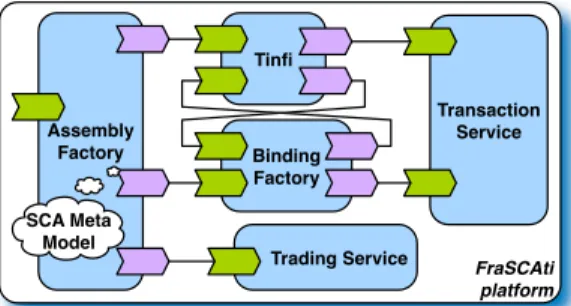
The FraSCAti platform [27] enables the execution of SOA applications with advanced properties, such as the ability to reconfigure at runtime ex-isting assemblies of SCA components (cf. Section 2.3.2). Other available fea-tures include a binding factory supporting various communication protocols, a transaction service, a semantic trader service, a service for deploying au-tonomic SCA-based applications, and a graphical administration and man-agement console. As illustrated in Figure 2.5, the FraSCAti platform is composed of the following elements. The SCA Meta Model defines all the concepts available in the SCA specifications. The meta-model is used by the FraSCAtiAssembly Factory to load component assembly descriptors. The Tinfi Runtime Kernel is in charge of hosting the SCA components. This kernel implements the execution semantics defined by the SCA specifications and provides some additional properties, such as dynamic reconfiguration. This kernel is based on generative programming techniques where most of the code for managing components is generated on-demand at runtime. The Binding Factory is in charge of establishing communication channels between SCA components. This factory supports various protocols, such as SOAP [3, 8], REST [10], and RMI. The Trading Service provides functionalities to perform semantic trading on components published in a registry. This service asso-ciates to each external element of a component (service, reference, property, implementation) a concept defined in a semantic model. This service allows, for example, the replacement of components which would have become inac-cessible, by some semantically equivalent ones. The Assembly Factory is in charge of analyzing, validating, and instantiating assembly descriptors. The analysis step uses the SCA metamodel to load and validate descriptors. The instantiation step uses the runtime kernel and the assembly factory for in-stalling and connecting components.
FraSCAti platform Assembly Factory Tinfi Binding Factory Transaction Service Trading Service SCA Meta Model
Figure 2.5: Architecture of the FraSCAti execution kernel.
platform provides some runtime services for dynamic reconfiguration. These features are of particular importance for adapting applications to new and unforeseen requirements. The runtime adaptation actions, which are enabled by FraSCAti, are described below. They concern the architecture of an SCA application. They can take place at any time during the execution of the application.
Firstly, FraSCAti enables instantiating new components. For example, these new components can provide additional functionalities or provide alter-nate implementations for existing ones. Secondly, new wires can be created and existing wires can be removed. Thirdly, component hierarchies can be queried and modified. The query functionality enables traversing an existing application much like what is available with component browsers. The modifi-cation of the hierarchy, in conjunction with the creation of new wires, enables creating different component compositions. Finally, components can be selec-tively started and stopped. This enables performing maintenance operations in a safe manner.
2.4.3
SPACES: Deploying Distributed Context Policies
This section introduces SPACES: a distributed processing architecturein-tegrating context as RESTful services. SPACES is a lightweight middleware
solution enabling the versatile and efficient mediation of context information. Context policies have been introduced by the COSMOS context framework as a scalable model for processing context information (cf. Section 2.3.3). There-fore, we propose to extend COSMOS with the principles of REpresentational
State Transfer (REST) [10] in order to distribute context policies in
ubiqui-tous environments. These RESTful context policies leverage the provision of
Context as a Service and enable the efficient mediation of context information
among heterogeneous devices.
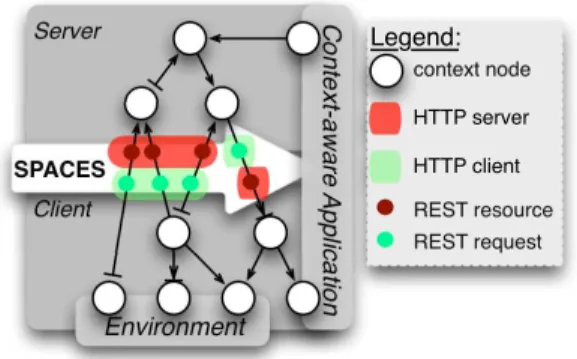
Figure 2.6 illustrates the integration of SPACES into a COSMOS context policy. Specifically, SPACES acts as a mediation middleware, which is res-ponsible for disseminating the context information between two physical enti-ties. This distribution is implemented as a connector based on the HyperText
Transfer Protocol (HTTP). This connector is composed of i) an HTTP server
publishing part of the context nodes as REST resources and ii) an HTTP client sending context requests as REST requests. By considering the context me-diation as a software connector, the realization of the context policy is not impacted by the distribution concerns. In addition to that, the use of a soft-ware connector opens up for multiple implementations of the dissemination mechanism, including message-oriented [19] and peer-to-peer [14] middleware approaches.
In this section, we report the design of SPACES using HTTP to facilitate the integration of adaptation policies with legacy systems. In particular, we can monitor the context surrounding a mobile device from a traditional Internet browser and access this information from any systems supporting HTTP. This
Middleware Approach for Ubiquitous Environments 21 Server Client SPACES Context-aware Application Environment REST resource REST request context node HTTP server HTTP client Legend:
Figure 2.6: Principles of the SPACES approach.
integration is facilitated by the support for multiple representation of a given resource. This means that depending on the client requirements, a REST resource can be retrieved as an HTML document (when accessed from an Internet browser) or as an XML document (when accessed from a legacy system). Therefore, the integration of the REST principles within the context policies requires to map the REST triangle of nouns, verbs, and content types to COSMOS context nodes, which are the first class entities of CAPPUCINO adaptation policies.
SPACES Nouns. The advertisement of context nodes as REST resources requires the definition of context identifiers. These context identifiers are unique nouns described using the Uniform Resource Identifier (URI) for-mat [1]. Therefore, context identifiers include a communication scheme, a server address, a context path, and a sequence of request parameters: scheme://context-server/context-path?request-parameters. The
com-munication scheme, such as HTTP, FTP (File Transfer Protocol ), URN
(Uniform Resource Name), RTSP (Real Time Streaming Protocol ), or file, describes the communication protocol used to transfer the resource represen-tation between the hosting server and the requesting client. Then, the server
address description is specific to a given scheme. For example, an HTTP
server address can be specified using the syntax user:password@host:port to describe the web server host and port as well as the credentials for ac-cessing the context information. The context path points to context node name under which the context information is published. This context path can be hierarchically organized in context domains using the syntax parent-domain/child-domain/context. Finally, the request parameters are used to specify the representation of the requested (or submitted) context information using the syntax format=application/xml.
SPACES Verbs. The dissemination of context information is based on
as Pull and Push interfaces (cf. Section 2.3.3). In SPACES, resource obser-vations are implemented as side-effect free GET requests, while notifications are based on POST. For example, the context information
geolocation-dps can be retrieved from a mobile device using the HTTP request GET
http://device.inria.fr:8080/geolocation-dps?format=application/xml, which returns the requested context information as an XML document. Con-text information can also be pushed into a remote entity by using an HTTP POSTrequest. In this case, the submitted request points to the server-side re-source associated to the context policy. For example, the HTTP request POST http://server.inria.fr/adjusted-bit-rate?format=application/json notifies the server-side context policy that the uploaded JSON document refers to a change of the context information GPS geolocation.
SPACES Content Types. Finally, SPACES supports various types of content for representing the context information. This representation mul-tiplicity benefits from the structure of COSMOS messages used to encode the context information (cf. Section 2.3.3). Therefore, the content types sup-ported by SPACES are based on the MIME media types classification [15]. In particular, SPACES promotes the Java object serialization as the default resource representation (application/octet-stream) for performance con-cerns. Nevertheless, SPACES provides also representations of resources as XML (application/xml) and JSON [7] (application/json) documents.
2.5
Illustrating Dynamic Context-aware Web Services
with a Mobile Commerce Scenario
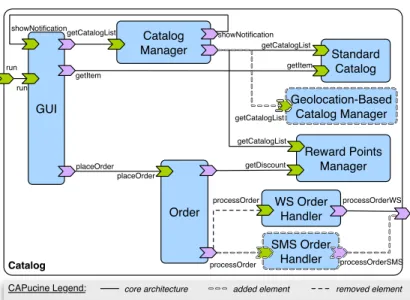
We present in this section the way the CAPPUCINO platform is able to realize the mobile commerce scenario presented in Section 2.2. Figure 2.7 shows the corresponding component architecture obtained using CAPucine (Context-Aware Service-Oriented Product Line), a Context-aware Dynamic
Service-Oriented Product Line (DSOPL) approach described in [22]. We
describe in Section 2.5.1 how deployment takes place on a mobile device. We then detail in Section 2.5.2 a reconfiguration scenario taking place on the mobile device after the detection of an adaptation situation. We focus on the deployment and reconfiguration on the mobile device side for more concision. Nonetheless, the application server side follows the same principles.
2.5.1
On-demand Deployment on a Mobile Device
This section presents the dynamic aspects of the CAPPUCINO architec-ture as UML activity diagrams. We consider that the deployment of the
Middleware Approach for Ubiquitous Environments 23 Catalog GUI Order Standard Catalog Catalog Manager getCatalogList showNotification getItem SMS Order Handler showNotification run run getItem placeOrder placeOrder processOrderSMS processOrder getCatalogList processOrderWS WS Order Handler processOrder Reward Points Manager getDiscount getCatalogList Geolocation-Based Catalog Manager getCatalogList
CAPucine Legend: core architecture added element removed element
Figure 2.7: Mobile commerce application architecture using CAPucine.
CAPPUCINO adaptation server followed by the deployment and the start of the application server have already taken place. The deployment on a mobile device can then be made on-demand. For legal issues, the user intervention is required to request and then validate the deployment of software applications on their device. The artefacts deployed on a mobile device are lightweight versions of the ones deployed on an application server, e.g., the lightweight version of FraSCAti called FraSCAme.
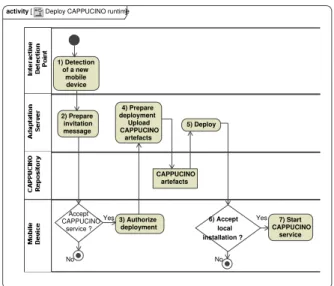
The deployment of the CAPPUCINO runtime on a mobile device is detailed in Figure 2.8. (1) We suppose that the service provider has preliminarily installed access points able to detect mobile devices in their vicinity. We do not detail here the functioning of these access points. We only assume that the user either declares their presence by passing their mobile device in front of a bluetooth antenna or has agreed beforehand to get automatically detected by providing the physical characteristics of their mobile device. Consequently, the interactive point notifies the adaptation server of the arrival of a mobile device. (2) The adaptation server sends to this mobile device an electronic message inviting the detected user to use available services. This message may be a SMS or a MMS message proposing to download the CAPPUCINO runtime to enable the access to personalized services. (3) The user gives an explicit authorization to download and deploy the CAPPUCINO runtime. (4) The adaptation server analyzes the type of the mobile device, prepares the adequate deployment plan and uploads the required software artefacts. (5) The adaptation server then transmits the CAPPUCINO runtime artefacts to the mobile device. (6) A volunteer action is required here from the end user:
The end user must explicitly accept the effective installation of the artefacts on their mobile device. (7) Following the installation of the artefacts, the CAPPUCINO runtime is automatically started. This step concludes the first phase of the deployment on a mobile device.
Deploy CAPPUCINO runtime
activity [ ] 1) Detection of a new mobile device 6) Accept local installation ? 3) Authorize deployment Accept CAPPUCINO service ? 7) Start CAPPUCINO service 4) Prepare deployment Upload CAPPUCINO artefacts 2) Prepare invitation message 5) Deploy CAPPUCINO artefacts No No Yes Yes
Figure 2.8: Deploying the CAPPUCINO runtime on a mobile device.
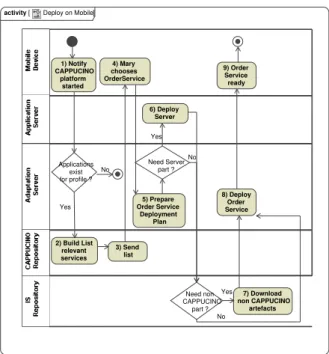
The second phase for deploying on a mobile device corresponds to the de-ployment of an application component. We show as an example the deploy-ment of the Order component on Mary’s mobile device (cf. Figure 2.7). The Ordercomponent will allow Mary to buy an item chosen in a catalog. The dif-ferent deployment steps are depicted in Figure 2.9. (1) At the end of the first phase of the deployment of the CAPPUCINO runtime, this runtime informs the adaptation server that the deployment is completed. (2) The adaptation server then builds the list of the relevant Web Services to be proposed to Mary according to the type of her mobile device (e.g., video feature available or not), her user profile (e.g., recently accessed services, preferred services) and her user network connectivity (e.g., Internet access and high rate network con-nection). (3) The adaptation server transmits the list of the available services to Mary. (4) Mary chooses the Order service in the list. (5) The adaptation server prepares the Order service deployment plan. It includes to upload the WS Order Handlerand the SMS Order Handler components on the mobile device. The former allows an order to be handled directly by the remote web server when the network coverage is sufficient. The latter provides service continuity in case of network disconnection registering the order as a
low-Middleware Approach for Ubiquitous Environments 25 memory consuming SMS message and placing it as soon as the network is available again. Both handlers are deployed but only WS Order Handler is initially bound to the Order service. (6) The deployment on the client side may require to preliminarily deploy a server part on the application server.
(7) Moreover, the deployment on the server side may require to upload non
CAPPUCINO artefacts from the repository of the business information sys-tem. For instance, Mary is registered as a new potential mobile clients and the payment service is activated. (8) Following the deployment of the required applicative services on the server side, the adaptation server sends the Order artefacts together with the WS Order Handler and the SMS Order Handler artefacts and drives their deployment on Mary’s mobile device. This includes initially binding the Order service with the WS Order Handler. (9) Finally, Mary is notified of the availability of the Order service and can use it.
Deploy on Mobile activity [ ] 4) Mary chooses OrderService 1) Notify CAPPUCINO platform started 9) Order Service ready 2) Build List relevant services 3) Send list Need Server part ? 5) Prepare Order Service Deployment Plan Applications exist for profile ? 8) Deploy Order Service 6) Deploy Server 7) Download non CAPPUCINO artefacts Yes No Need non CAPPUCINO part ? Yes No Yes No
Figure 2.9: Deployment of an applicative service on a mobile device.
2.5.2
Dynamic Reconfiguration on a Mobile Device
We present in this section how reconfiguration is enabled at runtime illus-trating the reaction path from the detection of an adaptation situation to the
execution of the reconfiguration actions on the mobile device. We describe two reconfiguration cases corresponding to different runtime reconfiguration services of the FraSCAti platform (see Section 2.4.2) namely the possibi-lity to modify the wires between existing components and the possibipossibi-lity to instantiate new components.
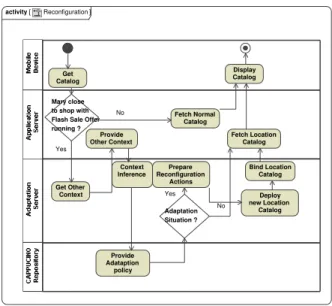
Case 1: Change connections between existing components. As shown in Section 2.5.1, the Order service has been deployed when network connectivity was high, implying that the Order component has been bound to the WS Order Handler. However, the SMS Order Handler has also been deployed in order to tolerate any network disconnection and to provide ser-vice continuity transparently to Mary. When the network connectivity be-comes lower than a threshold indicating there is a risk of disconnection, the adaptation server detects an adaptation situation and establishes the recon-figuration plan. The reconrecon-figuration actions are performed on Mary’s device corresponding to unbinding the WS Order Handler and binding instead to the SMS Order Handler.
Case 2: Deploy a new component and create connections. Consider Mary arriving nearby a shop where a Flash Sale offer is currently running. Mary has accepted to periodically notify the adaptation server with her geo-graphical position. When the adaptation server detects that Mary can benefit from the nearby Flash Sale, it pushes the special offer by presenting a cus-tomized catalog. This new cuscus-tomized catalog is specifically prepared accor-ding to Mary’s preferences as mentioned in her profile and requires the recon-figuration of the application components present on her mobile device. The Geolocation-Based Catalogcomponent shown on Figure 2.7 is instantiated. It is then bound to the Catalog Manager component. These reconfiguration steps taking place on the mobile device are shown on Figure 2.10.
2.6
Related Works
This section compares our contribution with regards to the current state-of-the-art related to the definition of platform supporting the self-adaptation of service-oriented architectures.
MUSIC [25] defines a component-based platform supporting the seamless adaptation of mobile application according to Quality of Service variations. MUSIC integrates a versatile support for discovering, negotiating, and binding to remote services available in the surroundings of a mobile device. Unless CAPPUCINO, MUSIC adopts a device-centric approach where the device decides the adaptation to perform by applying a utility-based decision making
Middleware Approach for Ubiquitous Environments 27 Reconfiguration
activity [ ]
Mary close to shop with Flash Sale Offer running ? Yes Fetch Location Catalog Provide Other Context Fetch Normal Catalog Get Catalog Display Catalog Provide Adataption policy Prepare Reconfiguration Actions Deploy new Location Catalog Adaptation Situation ? Yes Bind Location Catalog Context Inference Get Other Context No No
Figure 2.10: Reconfiguration of a mobile device.
mechanism [17]. CAPPUCINO offers a scalable adaptation model where the decision-making is under the control of an adaptation domain, which can decide to reason on the server-side or to deploy local and efficient control loops within the mobile devices.
The QuA project [12] investigates middleware-managed adaptation, which means that services are specified by their behavior, and then planned, ins-tantiated and maintained automatically by middleware services in such a way that the behavioural requirements are satisfied throughout the service life-time. Central in this approach, is a planning framework that searches through the space of possible configurations, and selects one that fits the current con-text of the application. The planning framework depends on the availability of meta-information about services that has not yet been instantiated, such as meta-information provided by techniques like MDA and ADL. While QuA integrates multiple implementation platforms at the adaptation middleware level, CAPPUCINO offers a versatile programming model based on SCA to leverage the adaptation middleware and thus offer a uniform model for the description and the adaptation of ubiquitous service-oriented architectures.
Adaptive Service Grids (ASG) [18] and VieDAME [20] are initiatives
ena-bling dynamic compositions and bindings of services for provisioning adaptive services. In particular, ASG proposes a sophisticated and adaptive delivery life-cycle composed of three sub-cycles: planning, binding, and enactment. The entry point of this delivery life-cycle is a semantic service request, which consists of a description of what will be achieved and not which concrete
ser-vice has to be executed. VieDAME proposes a monitoring system that ob-serves the efficiency of BPEL processes and performs service replacement au-tomatically upon performance degradation. Compared to our CAPPUCINO platform, ASG and VieDAME focus only on the planning per request of service compositions with regards to the properties defined in the semantic service request. Thus, both approaches do not support a uniform session-based adaptation of both client-side and server-side services as our solution for ubiquitous applications does. Nevertheless, CAPPUCINO provides an extensible infrastructure to integrate ASG and VieDAME adaptive services and thus support the dynamic enactment of service workflows.
CARISMA is a mobile peer-to-peer middleware exploiting the principle of reflection to support the construction of context-aware adaptive applica-tions [4]. In particular, services and adaptation policies are installed and uninstalled on the fly. CARISMA can automatically trigger the adaptation of the deployed applications whenever detecting context changes. CARISMA uses utility functions to select application profiles, which are used to select the appropriate action for a particular context event. If there are conflicting application profiles, then CARISMA proceeds to an auction-like procedure to resolve (both local and distributed) conflicts. However, CARISMA fails to integrate the diversity of service providers and legacy services. Nonethe-less, the auction-like procedure used by CARISMA could be integrated in the CAPPUCINO control loop as a particular decision-making service.
Finally, R-OSGi extends OSGi with a transparent distribution support [23] and uses jSLP to publish and discover services [24]. The communication between a local service proxy and the associated service skeleton is message-based, while different communication protocols (e.g., TCP or HTTP) can be dynamically plugged in. In contrast to R-OSGi, the discovery and binding frameworks of CAPPUCINO are open to support a larger range of discovery and communication protocols.
2.7
Conclusion
Ubiquitous environments strongly constrain the design and development of Context-aware Web Services. An adaptive runtime in such environments should be based on a control loop enclosing i) an adaptive execution ker-nel, ii) distributed context management facilities, iii) a context and situation adaptation analysis, iv) an adaptation policies and reconfiguration planning, and v) a reconfiguration engine orchestrating deployment and reconfiguration actions. The first contribution reported in this chapter is the CAPPUCINO runtime that provides the building blocks of a distributed control loop and relies on CBSE principles to ensure adaptation a service-oriented ubiquitous
Middleware Approach for Ubiquitous Environments 29 systems. Moreover, the use of SCA as a common component model enables CAPPUCINO to perform adaptations of its own structure in order to bet-ter satisfy the requirements of the supported Web Service and therefore the end-user.
The second contribution of the chapter is FraSCAti, an execution kernel conforming to the SCA distributed component model for Web Services. SCA promotes independence from programming languages, interface definition languages, communication protocols, and non-functional properties. The FraSCAtiexecution kernel additionally enables the execution of SOA appli-cations with advanced properties, such as the ability to reconfigure assemblies of SCA components at runtime.
The third contribution of this chapter builds upon the context manager COSMOS to build a lightweight middleware solution enabling the scalable and efficient dissemination of context information. SPACES acts as a com-munication middleware, which is responsible for disseminating the context information between distributed physical entities. This distribution is imple-mented in CAPPUCINO as an HTTP connector. By considering the context dissemination as a software connector, the realization of the composition of context information into software components is not impacted by the distri-bution concerns.
As a matter of future work, we plan to improve the scalability of the CAPPUCINO runtime by enabling the deployment of hierarchical control loops. In particular, the adaptation server should deploy a lightweight full-fledged local control loop within the mobile device in order to tolerate local autonomic adaptation like facing disconnection situations. The mobile de-vices could then react and reconfigure the application autonomously when leaving a given adaptation domain—i.e., when loosing the connectivity with the adaptation server. In addition, adaptation domains could also be grouped as clusters to control a set of applications. Thus, a cluster of adaptation servers will belong to a common adaptation domain, which is dynamically reconfigured by the enclosing adaptation server. Another perspective consists in integrating the concerns of Quality of Service (QoS) in the development of context-aware Web Services. We foresee that this integration will be achieved at the application level and at the middleware level by reflecting the Quality
of Context (QoC). Therefore, we plan to integrate the dynamic negotiation of
Bibliography
[1] Tim Berners-Lee, Roy T. Fielding, and Larry
Masin-ter. Uniform Resource Identifier (URI): Generic Syntax. http://www.ietf.org/rfc/rfc3986.txt, January 2005.
[2] David Booth, Hugo Haas, Francis Mccabe, Eric Newcomer, Michael Champion, Chris Ferris, and David Orchard. Web Services Architec-ture. Working Group Note, February 2004.
[3] Don Box, David Ehnebuske, Gopal Kakivaya, Andrew Layman, Noah Mendelsohn, Henrik Frystyk Nielsen, Satish Thatte, and Dave Winer. Simple Object Access Protocol (SOAP), May 2007. http://www.w3.org/TR/SOAP.
[4] Licia Capra, Wolfgang Emmerich, and Cecilia Mascolo. CARISMA: Contex-Aware Reflective mIddleware System for Mobile Applications. 29(10):929–945, October 2003.
[5] David Chappell. Introducing SCA. white paper, Chappell & Associates, July 2007.
[6] Denis Conan, Romain Rouvoy, and Lionel Seinturier. Scalable Process-ing of Context Information with COSMOS. In ProceedProcess-ings of the 6th
IFIP WG 6.1 International Conference on Distributed Applications and Interoperable Systems, volume 4531 of Lecture Notes in Computer Sci-ence, pages 210–224, Paphos, Cyprus, June 2007. Springer-Verlag.
[7] Douglas Crockford. RFC 4627 - The application/json Media Type for JavaScript Object Notation (JSON). IETF RFC, 2006.
[8] Francisco Curbera, Matthew Duftler, Rania Khalaf, William Nagy, Nir-mal Mukhi, and Sanjiva Weerawarana. Unraveling the Web services web: an introduction to SOAP, WSDL, and UDDI. Internet
Comput-ing, IEEE, 6(2):86–93, 2002.
[9] Pierre-Charles David, Thomas Ledoux, Marc Léger, and Thierry Cou-paye. FPath and FScript: Language support for navigation and reliable reconfiguration of Fractal architectures. Springer Annals of
Telecom-munications, Special Issue on Software Components – The Fractal Initiative, 64(1–2):45–63, January/February 2009.
0-8493-0052-5/00/$0.00+$.50 c
[10] Roy T. Fielding. Architectural Styles and the Design of Network-based
Software Architectures. PhD thesis, University of California, Irvine,
2000.
[11] Areski Flissi, Jérémy Dubus, Nicolas Dolet, and Philippe Merle. De-ploying on the Grid with DeployWare. In Proceedings of the 8th
Inter-national Symposium on Cluster Computing and the Grid (CCGRID’08),
pages 177–184, Lyon, France, May 2008. IEEE.
[12] Eli Gjørven, Romain Rouvoy, and Frank Eliassen. Cross-Layer Self-Adaptation of Service-Oriented Architectures. In Proceedings of the 3rd
International Middleware Workshop on Middleware for Service Oriented Computing (MW4SOC), pages 37–42, Leuven, Belgium, December 2008.
ACM Press.
[13] Salim Hariri, Bithika Khargharia, Houping Chen, Jingmei Yang, Yeliang Zhang, Manish Parashar, and Hua Liu. The autonomic computing paradigm. Cluster Computing, 9(1):5–17, 2006.
[14] Xiaoming Hu, Yun Ding, Nearchos Paspallis, Pyrros Bratskas, George A. Papadopoulos, Paolo Barone, and Alessandro Mamelli. A Peer-to-Peer based infrastructure for Context Distribution in Mobile and Ubiqui-tous Environments. In Proceedings of 3rd International Workshop on
Context-Aware Mobile Systems (CAMS’07), Vilamoura, Algarve,
Por-tugal, November 2007.
[15] IANA. MIME Media Types. http://www.iana.org/assignments/media-types, March 2007.
[16] Jeffrey O. Kephart and David M. Chess. The Vision of Autonomic Computing. IEEE Computer, 36(1), January 2003.
[17] Jeffrey O. Kephart and Rajarshi Das. Achieving Self-Management via Utility Functions. IEEE Internet Computing, 11(1):40–48, 2007. [18] Dominik Kuropka and Mathias Weske. Implementing a Semantic Service
Provision Platform — Concepts and Experiences. Wirtschaftsinformatik
Journal, 1:16–24, 2008.
[19] Matthieu Leclercq, Vivien Quéma, and Jean-Bernard Stefani. Dream: a component framework for the construction of resource-aware, recon-figurable MOMs. In Proceedings of the 3rd Workshop on Adaptive
and reflective middleware (ARM’04), pages 250–255, Toronto, Ontario,
Canada, 2004. ACM.
[20] Oliver Moser, Florian Rosenberg, and Schahram Dustdar. Non-intrusive monitoring and service adaptation for WS-BPEL. In Proceedings of
the 17th International Conference on World Wide Web (WWW). ACM,
Bibliography 33 [21] Open SOA. Service Component Architecture, November 2007.
http://www.osoa.org/display/Main/Service+Component+Architecture+Home. [22] Carlos Parra, Xavier Blanc, Laurence Duchien, Nicolas Pessemier,
Rafael Leano, Chantal Taconet, and Zakia Kazi-Aoul. Dynamic Software
Product Lines for Context-Aware Web Services, chapter 1. Chapman and
Hall/CRC, 2009.
[23] Jan S. Rellermeyer, Gustavo Alonso, and Timothy Roscoe. R-OSGi: Dis-tributed Applications through Software Modularization. In Proceedings
of the, volume 4834, pages 1–20, Newport Beach, CA (USA), November
2007.
[24] Jan S. Rellermeyer and Markus Alexander Kuppe. jSLP, 2009. http://jslp.sourceforge.net.
[25] Romain Rouvoy, Paolo Barone, Yun Ding, Frank Eliassen, Svein Hall-steinsen, Jorge Lorenzo, Alessandro Mamelli, and Ulrich Scholz.
MU-SIC: Middleware Support for Self-Adaptation in Ubiquitous and Service-Oriented Environments, volume 5525 of Lecture Notes on Computer Sci-ence Hot Topics, chapter 2, pages 164–182. Springer-Verlag, 2009.
[26] Romain Rouvoy, Denis Conan, and Lionel Seinturier. Software Architec-ture Patterns for a Context Processing Middleware Framework. IEEE
Distributed Systems Online (DSO), 9(6):12, June 2008.
[27] Lionel Seinturier, Philippe Merle, Damien Fournier, Nicolas Dolet, Va-lerio Schiavoni, and Jean-Bernard Stefani. Reconfigurable SCA Appli-cations with the FraSCAti Platform. In Proceedings of the 6th IEEE
International Conference on Service Computing (SCC’09), Bangalore
Inde, 2009. IEEE.
[28] Roy Sterritt, Manish Parashar, Huaglory Tianfield, and Rainer Unland. A Concise Introduction to Autonomic Computing. Advanced

![Figure 2.2 : SCA component architecture [21].](https://thumb-eu.123doks.com/thumbv2/123doknet/11395625.287473/14.892.288.630.434.540/figure-sca-component-architecture.webp)