HAL Id: pastel-00924232
https://pastel.archives-ouvertes.fr/pastel-00924232
Submitted on 6 Jan 2014
HAL is a multi-disciplinary open access
archive for the deposit and dissemination of
sci-entific research documents, whether they are
pub-lished or not. The documents may come from
teaching and research institutions in France or
abroad, or from public or private research centers.
L’archive ouverte pluridisciplinaire HAL, est
destinée au dépôt et à la diffusion de documents
scientifiques de niveau recherche, publiés ou non,
émanant des établissements d’enseignement et de
recherche français ou étrangers, des laboratoires
publics ou privés.
production in prokaryotes
Emanuele Leoncini
To cite this version:
Emanuele Leoncini. Towards a global and systemic understanding of protein production in
prokary-otes. Quantitative Methods [q-bio.QM]. Ecole Polytechnique X, 2013. English. �pastel-00924232�
École Doctorale de l’École Polytechnique
Thèse présentée en vue de l’obtention du grade de Docteur de l’École Polytechnique
Spécialité Mathématiques Appliquées
Towards a global and systemic understanding of protein
production in prokaryotes
Emanuele Leoncini
Vincent Fromion INRA supervisor
Philippe Robert INRIA supervisor
Loïc Chaumont Université d’Angers reviewer
Patricia Reynaud-Bouret CNRS reviewer
Jean Bérard Université Lyon 1 jury member
Olivier Martin Université Paris Sud jury member
Remerciements
Je tiens tout d’abord à remercier Vincent Fromion et Philippe Robert pour avoir accepté de m’accueillir dans leurs équipes et d’encadrer ma thèse. Je les remercie pour le sujet de recherche passionnant qu’ils m’ont proposé et pour m’avoir guidé dans le monde fascinant des mathématiques appliquées à la biologie. Ils ont su me laisser une grande liberté dans mon travail et m’ont guidé dans le développement de mon indépendance et de mon esprit critique.
Je remercie Philippe pour son exigence scientifique, son esprit critique et ses conseils, qui m’ont motivé quand j’ai été confronté à des problèmes difficiles.
Vincent, d’autre part, a su me donner le plaisir de l’application et m’a aidé à m’approprier le problème biologique. Sa vision claire du système biologique m’a toujours inspiré et poussé à ne jamais perdre de vue la question d’origine et à transférer les résultats obtenus théoriquement dans une perspective biologique.
Tous mes remerciements vont à Patricia Reynaud-Bouret et Loïc Chaumont qui ont accepté d’être rapporteurs de ma thèse. Je suis également très honoré que Jean Bérard, Olivier Martin et Lydia Robert aient accepté de faire partie de mon jury.
Je remercie Hugues Berry et Vincent Calvez pour m’avoir invité et accueilli lorsque du col-loque “Cell Biology” à Lyon. Je remercie également Olivier Gandrillon pour les échanges et les discussions scientifiques que j’ai eus avec lui, ainsi que Fabien Crauste pour sa disponibilité et sympathie. Je tiens à remercier Amandine Veber pour les échanges scientifiques et sa disponibilité et Jonathan Touboul pour les précieux conseils.
Je remercie tous les membres de l’équipe RAP-Inria, Nicolas Broutin, Virginie Collette, Re-naud Dessalles, Sarah Eugène, Mathieu Feuillet, Christine Fricker, Jelena Pesic, Jim Roberts, Nada Sbihi, Henning Sulzbach et Philippe, pour la belle ambiance qui m’a accompagné pendant ces trois ans. Je suis heureux de les avoir initiés au plaisir du bon café (ristretto). Un grand merci à Mathieu pour avoir supporté un tel italien bavard, pour nos longues discussions et pour les greatest hits allemands des années 80s. Merci à Virginie pour son aide, sa patience lorsque je devais me préparer pour une mission et sa bonne humeur communicative. Merci à Christine pour les discussions culturelles et sa gentillesse. Merci à Jim pour ses nombreux conseils et pour son English aplomb lorsqu’il m’écoutait présenter mes travaux. Merci à Jelena, Sarah et Henning pour avoir ravivé l’atmosphère et pour les moments partagés; je regrette de ne les avoir rencontrés que pendant ma troisième année de thèse.
Je remercie tous les membres permanents, les doctorants, les post-doc et les stagiaires de l’équipe MIG-INRA pour leur accueil et et les débats autour des sucreries faites-maison au coin café. Je me suis senti comme à la maison parmi tous ces amateurs de café. Parmi tous, je tiens à remercier Anne Goelzer et Laurent Tournier pour leur amabilité et leur soutien. Je tiens aussi à remercier Juliette Degrouard pour m’avoir aidé dans les différentes démarches administratives au sein de l’INRA, Eric Montaudon pour son aide sur le matériel informatique et Véronique Martin pour nos échanges “routieres”. Merci aussi à Olivier Borkowski pour sa sympathie débordante et à Pierre Flores, tous les trois profitant de l’encadrement vivant de Vincent.
Un merci aux amis et collègues du Bâtiment 16 où j’ai commencé mon expérience à Inria par un stage sous la direction de Dirk Drasdo, qui je remercie également. Merci aussi à Gregory Batt et aux autres membres de l’équipe Contraintes pour nos échanges scientifiques. Merci à l’équipe Gallium pour m’avoir accueilli comme “membre honoraire”, grâce aussi à Jonathan Protzenko et Alexandre Pilkiewicz, et pour m’avoir initié aux mystères de l’informatique.
Un remerciement particulier à Jonathan avec qui j’ai vécu côte à côte tout au long de ces trois ans : merci pour le sport, les cafés, le soutien informatique, les restos chinois, les fipettes et les soirées en compagnie de Gina. Grazie di cuore!
Merci à tous les coureurs et nageurs pour avoir partagé de bons moments pour se déstresser des joies de la thèse : Jonathan, Mathieu, Thierry, Pauline, Saverio, Luna, Damiano, Elisa,
natation Inria.
Merci aux amis avec lesquels j’ai eu occasion de partager de beaux moments au cours de ces dernières années, souvent autour d’une table bien garnie de gourmandises (surtout italiennes). Un grand merci à Giacomo, maître incontesté de style et “d’astio”, et à Alicia. Merci à Filippo et Clara pour les inoubliables dîners sur l’avenue Jean Jaures : je te serai toujours reconnaissant de m’avoir appris les secrets de l’Amatriciana. Merci à Luna et Nick, Paris n’est plus la même ville sans vous ! Merci à Daniele e Raphaëlle : “love is like that, like a fifty fifty”. Merci à Daniel, ami d’aventures entre Chevaleret et Jussieu. Merci Anne-Lise pour sa touche parisienne et les saveurs du Sud-Ouest. Grazie a Giustino e Marco per le serate passate fra pacifici orsacchiotti e mazurche d’altri tempi, grazie anche a Cristina e Irene per portare un po’ di sana toscanità tra gli indigeni. Grazie a Carolina e Ciccio, dal nostro incontro fortuito a quel crocicchio nel 5o
arondissement ai vicoli di Locorotondo.
Ringrazio i miei genitori per avermi incoraggiato negli studi e aver sostenuto le mie scelte, anche quando mi hanno portato lontano da casa. Grazie per avermi insegnato ad essere esigente e responsabile. Grazie per aver sempre creduto in me.
Un pensiero speciale a Yasmine, grazie per avermi spinto a partire e per avermi raggiunto, per essermi stata vicina e avermi sostenuto, in particolare in questo difficile terzo anno di dottorato. Solo io e te.
Résumé
Les réactions biochimiques sous-jacentes au fonctionnement des cellules sont des processus in-trinsèquement stochastiques. En conséquence, le fonctionnement de la cellule, considérée comme un système, est aléatoire en raison des fluctuations de ses composantes fondamentales. Parmi ces dernières se trouvent les protéines, qui jouent un rôle majeur dans les cellules. Le caractère stochastique des protéines est tel qu’il est même responsable des différences observées dans le phénotype et ce même dans le cas de cellules clonées exposées à des conditions environnementales identiques. La grande difficulté rencontrée dans le développement de techniques quantitatives fiables pour la mesure des fluctuations de l’expression génétique au niveau cellulaire a favorisé le développement et l’utilisation de modèles stochastiques essayant de capturer les principales caractéristiques du système. Il est donc crucial que les modèles adoptent des hypothèses réalistes, afin de pouvoir les utiliser comme un véritable outil d’investigation.
Dans ce travail de thèse nous avons mis en place un nouveau cadre mathématique basé sur les Processus Ponctuels de Poisson Marqués (MPPP) pour décrire les principales étapes de la production d’une protéine spécifique, grâce à une analogie entre le système de production de protéines et les réseaux de files d’attente. Cette approche s’est avérée être très adaptée à la tâche, car elle permet de considérer des hypothèses générales pour certaines étapes, tout en gardant le caractère analytique des modèles présents dans la littérature, qui se réduisent à un cas particulier de cette approche générale pour des hypothèses spécifiques. Avec ce cadre, nous avons réussi à surmonter l’hypothèse fondamentale et restrictive des modèles classiques, qui exige une durée exponentielle de toutes les étapes. La description non-markovienne de l’expression génétique obtenue grâce à ce nouveau cadre a permis d’aborder le problème d’une manière plus satisfaisante et, en particulier, de proposer un modèle plus réaliste qui comprend des hypothèses réalistes de l’étape d’élongation de la protéine et de la dilution des protéines en raison de la croissance du volume. Eu égard aux résultats obtenus, cette nouvelle approche a montré que les modèles classiques ont su capturer qualitativement les caractéristiques du bruit dans l’expression d’un gène, mais leur pouvoir de prédiction est limité par le fait que les formules quantitatives obtenues sont incorrectes. L’utilisation des MPPP a permis de d’évaluer l’impact de différents choix de modélisation, tout en gardant la capacité d’obtenir des formules analytiques pour les premiers moments des distributions des différents processus en fonction des paramètres biophysiques.
La modélisation du processus de production d’une seule protéine, bien que puissante, ne prend pas en compte la description des interactions qui peuvent se produire en raison de la production simultanée des différents types de protéines. Pour cette raison, nous avons proposé une première modélisation de la production de plusieurs protéines en considérant les interactions comme le résultat de la compétition pour des ressources communes. Plus précisément, les ribosomes sont responsables de la traduction de tous les types de messagers et leur nombre est limité et stricte-ment contrôlé dans la cellule. En pratique, le coût élevé, en termes de ressources, associé à la production des ribosomes oblige la cellule à optimiser leur usage et il s’avère qu’ils sont presque toujours en train de traduire des messagers et restent très peu inactifs après l’achèvement de leur tâche. En conséquence, il y a une rude compétition entre les messagers pour avoir accès à des ribosomes libres et la production globale en est affectée. Le système de production est étudié par une approche de champ moyen à la fois dans les régimes de sous-charge et de sur-charge d’utilisation des ribosomes. Le modèle multi-protéines est une approche novatrice dans le
domaine qui ouvre une nouvelle direction dans l’étude des fluctuations des protéines au niveau cellulaire.
En conclusion, la thèse a porté sur l’étude de la nature stochastique de l’expression génétique, en développant différents modèles afin de progresser vers une description plus réaliste des phéno-mènes. Toutes ces études ont été menées en essayant de mettre la biologie au premier plan, car nous croyons que ces modèles représentent un outil fondamental dans l’étude et la compréhension des processus biologiques complexes.
vii Abstract
Biochemical reactions underlying the functioning of cells are inherently stochastic processes. As a consequence, the whole system is noisy and undergoes fluctuations in its fundamental com-ponents. Proteins are major players for the living. The behavior of cells as well as their stochastic character manifests itself via striking differences in phenotype. The differences are apparent even in the case of identical, cloned cells which underwent the same environmental conditions. The extreme difficulty in obtaining reliable experimental quantitative results concerning fluctuations in gene expression has fostered the development and intense use of stochastic models. These models aim at capturing the main characteristics of the system. Given the context, it is crucial that models embrace realistic assumptions.
We introduced a new mathematical framework based on Marked Poisson Point Processes (MPPP) to describe the main steps of the production of a specific protein. We leveraged the similarities between the protein production system and queueing networks. This approach has proven to be perfectly suited, since it allowed us to consider general assumptions, while still permitting the derivation of analytical formulas. This is one of the key features of the models found in literature. Furthermore, the classic models are incorporated in this approach and well-known results can be obtained for specific assumptions. This has been possible, since we were able to overcome the restrictive assumption, crucial in classic framework, of exponentially distributed duration of all steps. The non-Markovian description of gene expression obtained through this new framework has permitted to tackle the problem in a more satisfying way and, in particular, propose a more realistic model of gene expression, which includes realistic assumptions of protein elongation step and protein dilution due to volume growth. Such a realistic model shows that if on one hand the classic models have captured the qualitative behavior of the underlying biological processes, on the other hand their quantitative results might have been inaccurate, resulting in a limited predictive power. The MPPP framework has proved to serve as a testing platform, allowing to quantify precisely the impact of different modeling choices, while keeping intact the ability to obtain analytical formulas of statistics depending on the biophysical parameters.
The single-protein modelisation, although powerful, fails to describe the possible interactions deriving from the simultaneous production of different types of proteins. For this reason, we moved the first steps towards a modelisation of the production of many proteins, considering interactions as the result of the competition for common resources. In particular, ribosomes translate any type of messengers and turn to be present in limited and strictly controlled number within a cell. In fact, the high cost in term of resources associated with the production of ribosomes forces the system to have almost always active ribosomes translating messengers into proteins. As a consequence, messengers compete against each other for the rare resource of free ribosomes and the global production is affected. The system of production is studied via a mean-field approach both in the underloaded and overloaded regimes of use of the ribosomes. The multi-protein model brings a completely new approach in the domain and marks a new direction in the investigation of protein fluctuations at the cellular level.
In conclusion, the thesis has focused on the study of the stochastic nature of gene expression, by developing different models in order to progress towards a more realistic description of the phenomena. All these studies have been conducted trying to put biology in the foreground, since we believe these models represent a fundamental step in the investigation and understanding of complex biological processes and are a complementary tool to biological experiments.
Contents
1 Introduction 1
1.1 Gene expression . . . 4
1.1.1 Central Dogma: fifty years of molecular biology . . . 4
1.1.2 Gene expression: main biological mechanisms . . . 5
1.1.3 Translation . . . 8
1.2 Stochasticity: experiments . . . 10
1.3 Intrinsic and extrinsic noise . . . 13
1.4 Stochasticity: models . . . 16
1.4.1 Limits of classic models . . . 19
2 MPPP description of gene expression 21 2.1 Biology and mathematical assumptions . . . 21
2.1.1 Biological context . . . 22
2.1.2 Mathematical model of gene expression: three-stage model . . . 23
2.1.3 Limits of classic models: the exponential assumption . . . 24
2.2 MPPP Description of Gene Expression . . . 26
2.3 General results . . . 28
2.3.1 Gene state . . . 28
2.3.2 Messengers . . . 29
2.3.3 Proteins . . . 33
2.4 Results: explicit formulas and numerical analysis . . . 35
2.A Appendix: classic models . . . 39
2.A.1 The Rigney’s model . . . 39
2.A.2 Paulsson’s model survey . . . 43
2.A.3 Swain’s model . . . 48
3 Realistic model of gene expression 51 3.1 Four-Stage Model . . . 52
3.1.1 Model and general results . . . 52
3.1.2 Realistic assumptions . . . 58
3.1.3 Explicit formulas under realistic assumptions . . . 62
3.2 Qualitative and quantitative analysis . . . 68
3.2.1 Biological data and model parameters . . . 69
3.2.2 Estimation of fluctuations: deterministic elongation . . . 70
3.2.3 Four-Stage Model: a counter-intuitive result . . . 72
3.2.4 Proteolysis vs. dilution . . . 72
3.2.5 Impact of different steps on protein fluctuations. . . 74 ix
3.A Reference parameters . . . 85
4 Multi-protein model 89 4.1 Stochastic model . . . 91
4.2 Asymptotic Behavior . . . 94
4.3 Analysis of fixed point equation . . . 100
4.3.1 The underloaded case . . . 101
4.3.2 The Case of Overloaded mRNAs . . . 102
A Mathematical tools 105 A.0.3 Marked Poisson Point Processes . . . 105
B Biology 107 B.1 Biological Mechanisms . . . 107 B.1.1 Gene activation . . . 107 B.1.2 Transcription . . . 109 B.1.3 Translation . . . 110 B.1.4 mRNA degradation . . . 111 B.1.5 Protein degradation . . . 111 B.2 Biological glossary . . . 113 B.2.1 16S ribosomal RNA . . . 113 B.2.2 β-galactosidase . . . 113 B.2.3 DNA . . . 113 B.2.4 Gene . . . 114 B.2.5 Inducer . . . 114 B.2.6 Operon . . . 115 B.2.7 Promoter . . . 115
B.2.8 Ribosomal Binding Site (RBS) . . . 115
B.2.9 Ribosome . . . 115
B.2.10 RNA . . . 116
B.2.11 Messenger RNA (mRNA) . . . 116
B.2.12 Ribosomal RNA (rRNA) . . . 116
B.2.13 Transfer RNA (tRNA) . . . 116
Chapter 1
Introduction
Aussi la biologie est-elle, pour l’homme, la plus signifiante de toutes les sciences; celle qui a déjà contribué, plus que toute autre sans doute, à la formation de la pensée moderne, profondément bouleversée et définitivement marquée dans tous les domaines [...]
Le hasard et la nécessité Jacques Monod, 1970
Nicolaus Copernicus proposed, in his De revolutionibus orbium coelestium, an heliocentric model for the celestial objects. This theory led to a deep wound in the narcissistic simulacrum that men built around the Ptolemaic model by putting away the man from the center of the Universe.
The chance is then found to be responsible of the mutations and so of the evolution itself. If the Theory of Evolution was well established and phenomenologically accepted since the end of the XIX century, it required a physical theory of heredity in order to have a deeper acceptance and solid foundations. This is the aim of the molecular theory of the genetic code, which tries to connect concepts related to the chemical structure of the genetic material, the information it contains and the molecular mechanisms for the morphogenetic and physiologic expression of this information. The molecular biology has further pushed the man out of the center of the Universe, redefining life in terms of molecular interactions.
In 1953, Watson and Crick proposed their helicoidal model of DNA structure, which, together with subsequent works, has given insights on how genetic information is stocked in cells and how it is possible to pass this information from a generation to the next. If DNA contains the morphogenetic and functional information of an individual, the fulfillment of the cell project is accomplished through the gene expression. The products of gene expression mainly consist of proteins and functional RNAs in the case of non-protein coding genes such as ribosomal RNA (rRNA) or transfer RNA (tRNA). The protein production is the central topic of this PhD work and we will focus on its description via a mathematical modeling.
Since the early works of the 50’s, major advancements have taken place in the understanding of gene expression leading to an extremely detailed biochemical model of the underlying processes. However, if the description of the system is impressively highly detailed, there are still open questions on the fundamental mechanisms, urging a systemic analytic description in order to
identify the laws underlying gene expression. The encounter of different components is the fundamental step common to all elementary biochemical reactions. This, together with the fact that cytoplasm is a stiff disordered medium where different compounds move by diffusion, makes the whole process inherently stochastic. Although the first indirect experimental evidences can be traced back to the end of the 50’s [50], stochasticity has been clearly proven experimentally only in recent years [40]. Noise has become a central topic in molecular biology, bearing new challenges in order to reconcile the random biochemical reactions to the precise development of organisms. It is clear that cells and in particular gene expression are robust with respect to fluctuations both in the environment and in its fundamental components. If noise is firstly an obstacle to the accomplishment of the genetic program, in some specific situations fluctuations can be exploited, as in the case of the decision making process. However, despite observable positive or negative consequences of noise, those mechanisms represent a small portion of the whole picture and a characterization of the status of noise is still an open question.
Q:Before this knowledge how can we characterize the underlying stochastic process via a math-ematical analysis?
The objective of mathematical biology is to extract information on the system and on its specific mechanisms, via a mathematical description and characterization. Nevertheless, there is a number of difficulties connected with gene expression due to the colossal number of elementary steps and the mixing of deterministic and stochastic processes. Moreover, a complex interaction pathway links different processes both at local and global scale making the analysis more and more difficult. Hence the need to combine elementary steps into effective steps and focus on a part of the system, once the level of detail has been decided and pertinent questions have been formulated, with the necessity to be able to perform the analysis in some mathematical framework.
If on one side experimental evidence and measures on the fluctuations in protein production are recent, nevertheless the problem has been tackled since the end of 70’s and a quite large literature has followed in subsequent years. These models of stochastic gene expression have addressed the problem considering effective main steps in the production of a specific protein under reasonable assumptions. These assumptions and this modeling approach have been pro-posed when the process was not yet well studied and understood. A Markovian description of the system has been then adopted, allowing a simplification of the analysis and leading to derive analytic formulas of the mean and variance of the different processes modeled, but such descrip-tion comes with a strong assumpdescrip-tion, i.e. each step has an exponentially distributed duradescrip-tion. If the obtained theoretical results are consistent with experiments with corresponding effective biophysical parameters, however these models are “semi-quantitative”. In fact,if on one side it is possible to find appropriate parameters to fit experimental data, however these models have not been used in a predictive way, i.e. choose parameters beforehand and compare the outcomes with the experiments.
If the Markovian description was adopted to simplify the mathematical analysis of the model, the strong exponential assumption that comes with it has not been discussed in the light of the findings of the last decades. However, in order to investigate the pertinence of the Markovian description and of the strong assumption which comes with, we are forced to leave such classic framework for a more general one. The aim of the thesis work is on one side to revisit the reference model of stochastic gene expression [54] and discuss the assumptions with respect to the knowledge acquired in the last years and, on the other side, to consider the coupling of different proteins. The first objective lead us to introduce a new mathematical framework based on Marked Poisson Point Processes (MPPP), in order to overcome the theoretical limitations of the classic approach, providing a general context to test assumptions and mix processes of different
3 nature. The second objective is instead connected to the observation that all types of proteins share common cellular machinery, such as ribosomes, present in limited numbers. The limited availability of these resources lead to a rude competition between different protein production chains. In particular, we analyze rigorously the impact of the competition of messengers for ribosomes on the resulting fluctuations in protein copies and on the number of free ribosomes. Presentation of subsequent chapters
Chapter 1: Introduction. In this chapter we give few elements of the complex biology that underlies gene expression. In this perspective, this introductory biology-oriented chapter should allow the non-biologist reader to better follow the next chapters. However, this chapter is not intended to be exhaustive from the biological point of view, since the presentation of the biology is functional to the following chapters. Important experimental results concerning stochasticity in gene expression are then presented as well as a short description of few of the fundamental models in the area. Few key concepts of stochastic gene expression are then recalled.
Chapter 2: MPPP description of gene expression. In this chapter we introduce the
MPPP mathematical framework and derive a non-Markovian description of the gene expression of a single protein based on a three-stage model. Analytic formulas of mean and variance of the various modeled processes at equilibrium are derived under general assumptions. Tests in this first approach of possible choices of general steps point towards a counter-intuitive result in terms of protein fluctuations: if the exponential duration of one step is replaced with a deterministic one, the corresponding fluctuations in protein number result increased.
Chapter 3: Realistic model of gene expression. The framework introduced in Chapter 2 is used to build a realistic model of gene expression, the four-stage model, including the supplementary step of the protein elongation step and the description of protein dilution due to volume growth. It is then discussed the choice of realistic biological assumptions and the model is therefore specified and analyzed. In particular, the counter-intuitive result of Chapter 2 is recovered when analyzing the impact of protein elongation on the overall fluctuations. Moreover, the formulas derived with an accurate description of protein dilution prove that the formulas in literature are oversimplified and rely possibly on too strong assumptions.
Chapter 4: Multi-protein model. In this chapter the problem of the interactions deriving from the simultaneous production of many proteins types. Unlike the previous chapters, where the amount of free ribosomes is constant, we suppose ribosomes are present in limited number and consider their switching between actively elongating proteins and freely diffusing in the cytoplasm. Messengers compete against each other for the (rare) resource of free ribosomes and the protein production is globally affected. The system of production is studied, by considering a large number of protein types with specific concentrations, via a mean-field approach both in the underloaded and overloaded regimes of use of the ribosomes. In particular, under the realistic biological assumption of overloaded ribosomes, we find that at equilibrium the number of free ribosomes follows a Poisson distribution and the rate of production of each protein type is obtained.
Appendix. Appendix A recall few fundamental definitions and theorems used in the manuscript. Appendix B is devoted to recalls of biology. In particular, Section B.1 gives a more-in-depth description of few fundamental biological mechanisms, while Section B.2 serves as a biological glossary, describing few specific cellular components.
1.1
Gene expression: main mechanisms
The rest of the chapter should introduce the non-biologist reader to the topic of gene expression and its modeling, through a tour of the main biological mechanisms involved and the state-of-the-art of experiments and models. However, this is not intended to be exhaustive and the biological mechanisms described are oversimplified, since they are introduced in the perspective of the mathematical modeling of the next chapters.
In 1953 James D. Watson and Francis Crick published in the journal Nature an article [72] in which they expose their model of the structure of the DNA, which featured the anti-parallel double helix held together by hydrogen bonds between pairing nucleotides. In those turbulent years, theoretical biologists proposed models using the partial information at their disposal, years before the first experimental results of molecular genetics were available. All the models and mechanisms proposed were based on the information that could be extracted by indirect observations and this was also the case for Watson and Crick, who used X-ray diffraction images to propose their model.
The Watson-Crick model provided also key insights to explain how genetic information is transferred from a generation to the next and how this information may be spread within the cell. The authors, in the Nature article [72], write
It has not escaped our notice that the specific pairing we have postulated immediately suggests a possible copying mechanism for the genetic material.
1.1.1
Central Dogma: fifty years of molecular biology
The central dogma of molecular biology, that was first stated by Crick in 1958 [11], was then re-stated by the author in 1970 as follows:
The central dogma of molecular biology deals with the detailed residue-by-residue transfer of sequential information. It states that such information cannot be trans-ferred from protein to either protein or nucleic acid.
The two main concepts that were produced in the late 50s were those of sequential infor-mation and of defined alphabets. At the time was already known that proteins have a specific three-dimensional configuration, which affects the activity of the protein itself. The researchers decoupled the problem supposing that the amino acid chain was able to fold itself up, reducing the problem to a one dimensional one and allowing to focus just on the assembly of the polypep-tide chain. It was well-established at that time that the alphabet of the proteins is composed by twenty amino acids, but it was unknown the mechanisms that lead to their encoding.
At that time it was well known that DNA, RNA and proteins play a leading role in gene expression and the central dogma is a possible solution to the problem consisting in the formu-lation of general rules for the information transfer from a polymer with a defined alphabet to another one.
Crick represents the flow of detailed sequence information from one chain to the other using arrows, in a schema as in figure 1.1a, where all possible transfers are plotted. The transfers could be divided in three group following the general opinion in the late fifties: those for which that seemed to exist because of direct or indirect evidence, those which have no experimental evidence nor a strong theoretical need and those which were unlikely to exist. Crick carries out a progressive simplification of this scheme excluding first the processes in the last class and validating those more likely to happen.
1.1. GENE EXPRESSION 5
DNA
RNA
PROTEIN
(a) All possible flows of detailed sequence information in gene expression.
DNA
RNA
PROTEIN
(b) Classification of the transfers by Crick in 1970 [12].
Figure 1.1: All possible flows are showed in figure (a). Figure (b) shows the picture resulting in Crick’s paper [12]. The Solid arrows are “general transfers” (first class), dotted arrows are “special transfers” (second class) and the absent arrows are the undetected transfers.
Using the classification made by Crick in 1970 [12], we can draw the schema shown in figure 1.1b. Here the solid arrows represent the “general transfers” (first class), while the dotted arrows are the “special transfers” (second class). The absent arrows are the undetected transfers.
The central dogma has to be read as a negative statement saying that there are no information transfers from protein, stressing out which are the most likely transfers (solid lines) and which are the probable ones (dotted lines). Nevertheless the central dogma does not say anything about the machinery involved and the control mechanisms. It was an attempt to give theoretical insights on the main principles which lead to the expression of a gene, using the partial information available at the time and represents the very foundations of molecular biology.
Experiments have confirmed the correctness of the main principles stated by Crick and new technologies have considerably increased the knowledge on the subject and have given a detailed description of the underlying biochemical reactions. This descriptive approach seems to have no end: finer mechanisms pop up when more accurate techniques are available and take their place in the already complex scenario of gene expression.
Despite extensive researches in the field and the many knowledge acquired, little is known about fundamental mechanisms and strategies underlying protein production, because of the extreme complexity of the whole process and the stochastic nature of the elementary biochemical reactions. For all these reasons, mathematical models represent a tool of investigation, in order to isolate mechanisms and check hypothesis based on the acquired knowledge.
1.1.2
Gene expression: main biological mechanisms
The present section is devoted to a general short introduction of the main steps of gene expression and of the main biological mechanisms which intervene in such complex process. This is not intended to be exhaustive, but to introduce the basic terminology which will be used in the following chapters. Specific biological mechanisms will be introduced through the manuscript when needed.
Despite the Central Dogma gives the fundamental principles of information transfer in gene expression in any cell type, the description of the process via mathematical modeling should take into account the specificity of the cell types. In particular, models need to distinguish between prokaryotic and eukaryotic cells, at least for specific mechanisms and for their different
geometric organization. This PhD work focuses on prokaryotes and the subsequent modelisation is therefore affected. However, we will make clear when a modeling choice is strictly connected with prokaryotes; all other choices must be understood as common to both cell types.
Gene activation
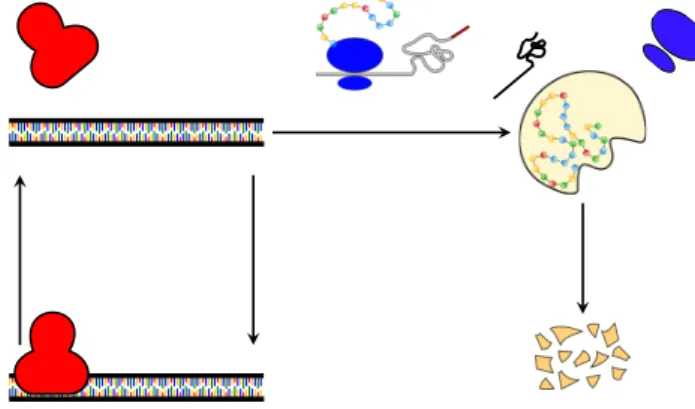
Gene activation is the process which allows a gene to be expressed at a specific time. The way this activation may occur varies a lot from gene to gene and from organism to organism. The main mechanisms causing gene activation are the dissociation of a repressor and the association of an activator.
A repressor is a DNA-binding protein that regulates the expression of a specific gene by binding the operator, which is a segment of DNA that a regulator binds to. The binding of the repressor blocks the attachment of RNA polymerase to the promoter and prevents the transcrip-tion of the genes. If an inducer molecule is present, it can interact with the repressor and inhibit its action by detaching it or preventing its binding to the operator.
An activator is a DNA-binding protein that regulates one or more genes by increasing the transcription rate. RNA polymerase binds to the promoter region of the gene, forming a complex which sometimes proceed to gene transcription. An activator recruits the RNA polymerase to its promoter region.
Active gene
Inactive gene
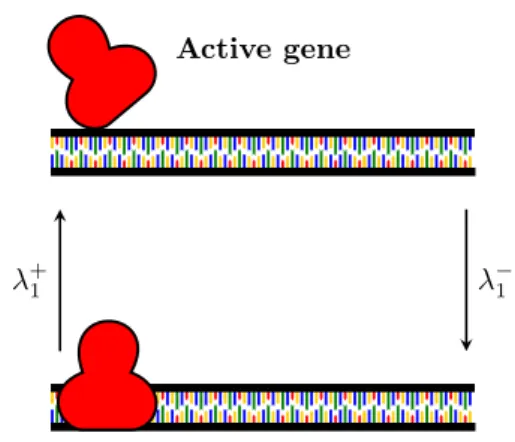
Figure 1.2: Gene activation. When the repressor (red cartoon) binds to the gene, it inhibits the mRNA transcrip-tion while the gene is activated when the repressor unbinds.
If the two previous mechanisms are shared between prokaryotic and eukaryotic cells, chromatin remodeling is specific to eukaryotes. Chromatin is the complex of DNA and histone proteins with which it associates. Hi-stones are highly alkaline proteins found in eukaryotic cell nuclei that package and order the DNA into struc-tural units called nucleosomes. Chromatin on one side serves as a way to condense DNA within the cellular nucleus and, on the other side, as a control of gene ex-pression. Raser and O’Shea [62] hypothesize that chro-matin remodeling is the key regulation mechanism for certain eukaryotic promoters.
Gene activation is a complex process resulting from different mechanisms and it is gene and organism spe-cific. Despite genes may show different states, in first approximation it can be described as a two-states pro-cess, i.e. the gene may show only two possible states, active or inactive.
The number of copies of a gene within bacteria is a fundamental factor and should be considered in a model describing the expression of a specific gene. When bac-teria are growing they duplicate their DNA, that leads to a number of at least two copies per gene, since the genetic information has to be split between daughter cells.
Remark. Bacteria are often obliged to have more than
two copies of DNA, since the duration of replication (∼ 40 minutes) is sometimes longer than cell cycle time, which is ∼ 20 minutes in Escherichia coli in fast growth conditions. For this reason, in “normal” growth conditions we observe DNA regions with one, two or four copies of genes, while in “regeneration” regime, where the cell division cycle takes about 20 minutes, we
1.1. GENE EXPRESSION 7 have up to eight copies of genes localized closer to the origin of replication.
Transcription
The transcription process can be described through the following fundamental steps:
1. initiation: the polymerase binds to one of the specificity factors σ to form a “holoenzyme” in order to attach to a specific promoter in the DNA. The more similar is a sequence to a “consensus sequence” the stronger is the binding to the DNA. After the first bond has been synthesized, the RNA polymerase must clear the promoter (this phase is called promoter clearance). During this time it may occur that a truncated transcript, called abortive initiation, is released;
2. elongation: after the promoter clearance, the polymerase assembles in a controlled fashion the mRNA chain;
3. termination: the ρ-independent transcription termination or the ρ-dependent transcrip-tion terminatranscrip-tion. The first involves terminator sequences within the RNA that signals the RNA polymerase to stop. The latter uses the ρ terminator factor to stop RNA synthesis. For further details we refer to Appendix B.1.2.
Initiation Elongation
Figure 1.3: Transcription. The polymerase binds on the active gene and transcription initiation takes place. Once the initiation step is completed, the polymerase starts copying one DNA strand and elongates the mRNA, which is eventually released into the cytoplasm.
The transcription regulation controls the frequency and the number of produced messengers. The gene transcription is subject to many control mechanisms and we just recall the most common. The specificity factors alter the specificity of RNA polymerase for a given promoter or set of promoters, making it more or less likely to bind to them, i.e. sigma factors in prokaryotic transcription. Other regulations are made at gene level and have been enumerated in the previous section. In post-transcriptional phase the regulatory machine controls the number of mRNAs that are translated into proteins. The stability and distribution of the different transcripts is regulated (post-transcriptional regulation) by means of RNA binding protein (RBP) that controls the various steps and rates of the transcripts.
Prokaryotic and eukaryotic transcription shows peculiar characteristics. In fact, since there is no precise spatial organization in prokaryotes, translation step can start when the polymerase is still building the messenger. This is not possible in eukaryotes since transcription occurs in the nucleus and, therefore, the messenger needs first to be exported out of the nucleus in order that the translation can take place.
1.1.3
Translation
Schematically prokaryotic translation consists of the following steps (see Figure 1.4 for schematic representation):
1. initiation: which involves the assemblage of components such as ribosomal subunits (50S and 30S), mRNA, the first aminoacyl tRNA, GTP (energy) and initiation factors (IF1, IF2, IF3). The tRNA (transfer RNA) serves as the physical link between the nucleotide sequence of mRNA and the amino acid sequence of proteins. In particular, the aminoacyl tRNA (or charged tRNA) carries an amino acid to the ribosome as directed by the three-nucleotide sequence (codon) read by the ribosome. The ribosome has three sites: A, P and E sites. The A site is the entry-point for aminoacyl tRNA, except for the first that binds directly on the P site. In the P site the peptidyl tRNA is formed, i.e. a tRNA bound to the peptide being synthesized, and in the E site the uncharged tRNA detaches from the ribosome;
2. elongation: it is a controlled process in which the polypeptide chain is elongated with the addition of amino acids to the carboxyl end of the growing end. Elongation involves several elongation factors, a conformal change, bond formations, etc. The aminoacyl tRNA attaches in the A site, then moves to the P site where the polypeptide is attached to the growing chain and the uncharged tRNA is moved to the E site where exits from the complex; 3. termination: occurs when one of three terminating codons moves to the A site. These codons are not recognized by any tRNA but by the so called release factors. These factors trigger hydrolysis of the ester bond and release the newly produced protein in the cytoplasm. The ribosome recycling step is responsible of ribosome disassembly in such a way to be ready to start translation of other messengers.
Translation is carried out by more than one ribosome simultaneously. Because of relative large size of ribosomes, they can only attach sites on mRNA at least 35 nucleotides apart. The so called polysome is the complex of one mRNA and a number of ribosomes attached to it.
Initiation Elongation
Figure 1.4: Translation. The ribosome binds on the messenger and translation initiation takes place, involving a series of controls in order to assure the right progress of translation. Once the initiation step has completed, the ribosome starts the elongation of the protein chain and eventually releases it into the cytoplasm.
The translation of mRNA can also be controlled by a number of mechanisms, mostly at the level of initiation. Recruitment of the small ribosomal subunit can be modulated by mRNA secondary structure, anti-sense RNA binding or protein binding. In both prokaryotes and eu-karyotes there is a large number of RNA binding proteins, which are often directed to their target sequence by the secondary structure of the transcript. This structure may change depending on
1.1. GENE EXPRESSION 9 certain conditions, such as temperature or the presence of a ligand. Moreover, some transcripts act as ribozymes and self-regulate their expression.
mRNA degradation
The process of messenger degradation is an essential function for recycling nucleotides and for regulating the level of gene expression and is performed by RNase. The decay process occurs on short time scales, i.e. the typical half-life of a messenger is of about two minutes at 37◦C in most
cases. This rapid decay process serves to permit to continuously adjust the number of specific messengers to the population needs depending on the specific environmental conditions.
The decay process consists of two main steps [14]:
1. initiation: primarily due to endonucleolytic attack mediated by the RNase E enzyme in E. Coli [41].
2. break-down: following the initial endonucleolytic cleavage, which is thought to inactivate the message for translation. Additional cleavages take place and result in breakdown of the mRNA into fragments.
Experiments have shown that prokaryotic mRNAs are more unstable and have shorter lives than in eukaryotes. This is probably connected to the absence of a physical separation be-tween the sites of RNA synthesis and RNA function; decay is possibly the major form of post-transcriptional control in these organisms. The stability of the mRNA is connected also to the competition of RNases and ribosomes to bind to messengers [58], i.e. genes with a weak affin-ity of ribosomes and mRNAs show higher levels of mRNA degradation, since ribosome binding protects the messenger from decay [3, 9, 74].
Protein decay: proteolysis and volume dilution
Two main mechanisms of profoundly different nature are responsible of the decay of proteins: proteolysis and volume dilution.
The first mechanism is analogous of the degradation mechanism of messengers, but it is now mainly used to destroy possibly dangerous proteins, such as misfolded proteins, since protein’s structure determines not only its specific cellular function, but also its intracellular stability. The degradation machinery differs between eukaryotes and prokaryotes, as shown in the review article of Goldberg [21]. Prokaryotes, in particular, have developed an elaborate proteolytic machinery to quickly destroy misfolded proteins. If protease is the enzyme that conducts proteolysis, nev-ertheless, the machinery is much more complex, since if proteases were free to act in the cytosol, “they would quickly convert the cell into a bag of amino-acids” [21]. In any case, the proteolysis appears as a control mechanism to prevent the release/survival of malfunctioning proteins or to remove damaged proteins. Actually, proteins are continuously subjected to stress, such as tem-perature, that eventually causes the protein denaturation. The denatured protein needs to be removed since its functioning has been compromised. This aging phenomenon of proteins occurs on long timescales: the average protein lifetime is usually bigger than the protein cell cycle.
The second mechanism, protein dilution, is of completely different nature. Both prokaryotic and eukaryotic cells double their internal components in order to give rise to two daughter cells. The volume growth associated to the doubling affects the concentration of each cellular component because of volume dilution. Intuitively, if we stop the production of proteins at some point, their concentration will drop down as a consequence of the increase of cell volume. This mechanism is therefore very different from the biochemical interactions which lead to proteolysis. Dilution is strictly connected with the cell growth rate and it turns out to be continuous and
deterministic, since growth rate is fixed, as long as environmental conditions are kept unchanged. In normal conditions and for stable proteins, dilution is the leading degradation mechanism.
1.2
Stochasticity in gene expression: experiments
Randomness and determinism are constantly present in the development, growth and life of cells: random biochemical reactions have to be reconciled to the precise development of organisms. The biological implications of the stochastic fluctuations in gene expression has boosted researches in the field, that have multiplied both theoretical and experimental works.
If the stochastic fluctuations were often taken apart by considering statistics on large numbers and reducing the analysis to deterministic models, experimental scientists have become more and more aware of the inherent stochastic nature of the gene expression. Researchers have found that variability among cells in a genetically identical population is strongly connected with fluctuations in the expression of single genes. Stochasticity in the protein production is often just considered as a danger for the normal development of organisms. Nevertheless, some living organisms may exploit the stochastic fluctuations in the expression of genes to introduce phenotypic diversity in genetically identical cells. This variability can be advantageous in specific cases, like face to drastic variations in environment or stress conditions, but it can also be very dangerous when it turns out to be an obstacle to the realization of the cell program.
We focus on experimental results concerning stochasticity in the gene expression, from experi-mental evidences of the stochastic nature of the phenomenon to negative or positive consequences of fluctuations. Few models are considered here and we refer to Sections 1.3 and 2.A for a detailed description.
In the late 50s Novick and Weiner [50] showed that the production beta-galactosidase (β-galactosidase or β-gal ) was variable and random in individual cells, but those studies were hindered by the lack of reliable measures and were not considered conclusive to prove stochasticity in gene expression. One of the first studies which use an expression reporter in single cells was the work of Ko et al.[40] in early 90s. In this work researchers have examined the effect of different doses of glucocorticoid on the expression of the transgene encoding β-gal and have found a large cell-to-cell variability by directly measuring the amount of protein in different cells. Moreover, as in Novick’s work, increasing the dose does not increase uniformly the expression in every cell, but it increases the frequency of cells displaying high level of expression. The dose dependence has been interpreted by authors as a change in the probability that an individual cell would express the gene at high level, concluding that the gene expression is a stochastic process.
In 2002, Ozbudak et al.[51] studied the fluctuations of gene expressing green fluorescent protein (GFP) driven by an inducible promoter in Bacillus Subtilis. The authors tune the rate of transcription by varying the level of induction of the promoter. Translation rate was modulated by introducing mutations in the ribosome binding site (RBS). It results that the transcription and translation rates affect the protein fluctuations and the results were interpreted using the theoretical model proposed by Thattai and van Oudernaarden [71]. This model predicts that the protein relative variance depends on the transcription rate, but it remains unchanged because of variations in the rate of translation.
Elowitz et al.[16] introduced the dual-reporter technique to measure the stochastic fluctuations of proteins in Escherichia Coli. This technique allows to express two different fluorescent proteins, the CFP and YFP, from identical promoters. Since the two proteins share the same regulatory control, the differences between their expression can be attributed to the “intrinsic" stochasticity of the gene expression process, because of the random microscopic events which govern each reaction. On the other side, the “extrinsic" noise, which derives from cellular heterogeneity,
1.2. STOCHASTICITY: EXPERIMENTS 11 such as regulatory proteins, ribosomes and polymerases, or stochastic events in upstream signal transduction, will affect both proteins. We refer to Section 1.3 for a deeper analysis on these concepts. Authors showed that extrinsic noise represents a non-negligible portion of the overall fluctuations and stressed the necessity to take into account both sources of noise when controlling or minimizing the fluctuations of a system.
Jonathan M. Raser and Erin K. O’Shea [62] used the same technique to study gene expression in yeast. The authors analysed three different promoters in the budding yeast Saccharomyces cervisiae: the PHO5, PHO84 and GAL1 promoters. The total noise on the three promoters was found to be dominated by the contribution of the external factors, such as cell shape and size, cell cycle stage or gene-specific signaling. The authors reduced these possible factors of hetero-geneity by using experimental techniques, like flow cytometry, used to isolate sub-populations with homogeneous sizes. The extrinsic noise resulted to be diminished, but non dramatically. Moreover the extrinsic noise was found to be not promoter-specific, since it resulted correlated when the two fluorescent proteins were associated with promoters that are distinctly regulated. This leads to hypothesize that the extrinsic noise will cause proteins to be maintained in constant relative concentrations. In order to analyze the noise in eukaryotes, the authors use a three-stage model similar to the model presented by Paulsson [54], see Section 2.A.2 for details. The authors claim the applicability of the three-stage model to both prokaryotes and eukaryotes, the main difference being the specific mechanisms of gene regulations. Relative differences in the parame-ters can lead to different scenarios which can be biologically interpreted. It can be easily showed that two promoters can produce the same average number of mRNAs with different fluctuation characteristics in this number: a promoter that undergoes frequent activation processes followed by inefficient transcription will show smaller variability with respect to a promoter which has rare activation processes followed by stable active state. The authors find three characteristic regimes of gene regulation, defined in terms of the rates of the three-stage model and which result in different noise profiles. In this paper, extrinsic noise seems to be predominant with respect to intrinsic and seems to be of global nature, i.e. it affects the expression of any gene.
A global analysis of the production of proteins in Saccharomyces cerevisiae was conducted independently by Bar et al.[2] and by Newman et al.[48] in 2006. Newman and collaborators [48] studied fluctuations in more than 2500 proteins, using the pairing of high-throughput flow cytometry and a library of GFP-tagged yeast strains to monitor protein levels at single cell reso-lution. This new strategy for large-scale protein abundance measurements allowed the scientists to deduce that abundance is the major factor governing protein variation, which most likely originates from the stochastic production and destruction of mRNAs. Bar and collaborators [2] studied 43 different proteins under 11 experimental conditions, founding that the variance is roughly proportional to the mean, as predicted by models of stochastic gene expression. Highly expressed genes seem differentiate from this trend since their variance appears uncorrelated with respect to abundance, as showed also in [48]. The researches point to low-copy mRNA fluctu-ations and gene regulation as the main responsible for protein fluctufluctu-ations, which is consistent with the scaling property observed. Moreover, using a dual-reporter diploid strain in similar fashion than Elowitz [16], they show that intrinsic noise contributes substantially to the overall protein noise in the case of proteins with intermediate expression level, while it is much smaller than extrinsic fluctuations for highly produced proteins. Both works [48] and [2] stress how pro-teasome genes are characterized by low noise levels, while stress proteins are very noisy, which indicates a precise structure in protein-specific variation and suggests that noise levels have been selected to reflect costs and potential benefits.
The works of Yu et al.[75] and Cai et al.[8] have instead focused on the development of techniques allowing real time observations with single cell sensitivity, in order to analyze gene expressed at low levels. β-galactosidase is the protein studied in both works, since this is the
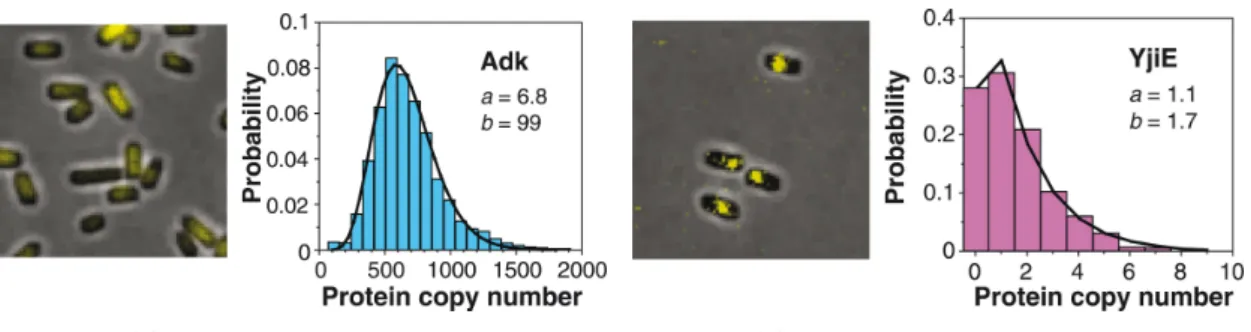
standard reporter for gene expression both in prokaryotes and eukaryotes. A single molecule β-gal can produce a large number of fluorescent product molecules by hydrolysing a synthetic fluorogenic substrate, which makes β-gal an high-sensitivity cellular reporter. However, the drawback of its use is the fast diffusion of the fluorescent products which are quickly dispersed. Cai and collaborators [8] propose to trap the cells into a microfluidic device: cells are trapped into closed microfluidic chambers, such that the fluorescent products expelled from the cells can accumulate in the small volume of each chamber. Yu and collaborators [75] suggest another technique: they designed a fusion protein consisting of YFP (yellow fluorescent protein) and a membrane protein (tsr), slowing down the dispersion of fluorescent material and allowing to take measures. Both works were performed on Escherichia coli cells with a target polypeptide ex-pressed under reex-pressed conditions. Thanks to the use of single-molecule fluorescence microscopy on mRNA [61, 22, 42] and on proteins [75, 8], Taniguchi et al.[70] have performed a quantitative system-wide analysis of mRNA and protein expression in individual cells in Eschierichia coli, see Figure 1.5. The authors, after normalization to account for cell size and gene copy number variation due to cell cycle, have measured protein abundances ranging between 10−1 and 104
copies per cell. They found that while the noise scales with protein abundance for low expressed proteins < 10, as in [2, 48], this is not the case for proteins produced in higher quantities, where noise reaches a plateau suggesting that each protein has at least 30% of variation. They made striking real-time measurements of mRNAs, using FISH technique, and proteins at same time on 137 strains for high expressed proteins, analyzing both mRNA production and mRNA-protein correlation.
Noise and, in particular, intrinsic noise is an obstacle to the genetic program since the stochas-ticity of biochemical reactions leads to uncertainty in the resulting amount of proteins which could be deleterious to the achievement of the cell program. On the other hand, in specific cases these fluctuations positively exploited by cells, as a source of heterogeneity or as fundamental tool of decision making.
Starting with positive effects, fluctuations in gene expression are pointed as a major mech-anism to obtain different phenotypes in an identical population. This differentiation can lead to the spring of sub-populations which are committed to different responses to environmental changes. Cell variability can be boosted in the presence of networks that can produce mutually exclusive profiles such as ON and OFF expression of a gene: small variations in the gene ex-pression can not cause the switch from one state to the other, but rare and large fluctuations can lead to a transition. This is the case, for example, of the lysis - lysogeny decision in lambda phage-infected E. Coli [43, 29] or of the lac operon in E. Coli [52, 45] or the galactose utilization network in yeast [33]. In particular, for the lysis - lysogeny decision the stochastic effects in the expression of some regulatory factors could explain the “decision" of cells to take the lysic or lysogenic pathway. The reason to choose for a stochastic based decisional network can be connected with the performances of the resulting strategy. For example, in the presence of food cells can adopt two different strategies: they can sense food in the environment and then activate the metabolic machinery or they can stochastically decide to activate the metabolic networks in some sub-populations in anticipation of possible food arrival. The first strategy is more effective but it can be slow, while the second sacrifices few resources for a quick response. Researchers have shown how the stochastic switching strategy could be a good alternative to the sensing machinery in the cases in which stochastic fluctuations were more or less synchronized with the environment fluctuations [1]. Cellular stress, such as lack of food or exposure to antibiotics, is another case where stochastic decision could explain the observed behavior in bacterial pop-ulations, as shown in the case of competence in Bacillus subtilis [42, 68]. In particular, it is shown how the reduction of fluctuations results in lower percentage of competent cells, reducing the chances of the survival of the population under stress conditions. Although the utilization
1.3. INTRINSIC AND EXTRINSIC NOISE 13
(a) Cytoplasmic protein Adk (b) DNA-binding protein YjiE
Figure 1.5: Stochasticity in gene expression. Quantitative imaging of a YFP-fusion library. Figures (a) and (b) are representative fluorescence images of two library strains, with respective single-cell protein level histograms fitted to gamma distributions with parameters a and b. (a) The cytoplasmic protein Adk uniformly distributed intracellularly. (b) The DNA-binding protein YjiE with clear intracellular localization. Adapted from Taniguchi et al. [2010] [70].
of noise for specific mechanisms, noise in gene expression has to be thought as deleterious for organisms and for gene expression in particular, which reveals a robustness with respect to fluc-tuations. The genome-wide works of Newman et al.[48] and Bar et al.[2] point how the variability is gene specific, in particular stress-genes, which are non essential for cell functioning, show high fluctuations, while proteasome genes are much less variables. This allocation of noise indicates that different production strategies have been selected and are possibly the result of the tradeoff between low level of noise in the protein production and the cost in term of resources of producing a large number of proteins at any time.
1.3
Intrinsic and extrinsic noise
Biological systems are constituted by individuals interacting in changing environments. In par-ticular, fluctuations in gene expression are due to the probabilistic nature of the underlying biochemical reactions (“intrinsic noise”) as well as to the effect of environment on this production (“extrinsic noise”). The measured fluctuations are therefore the result of the combined effect of these two sources of randomness, which lead to a system hardly treatable. Decomposing noise into separate terms, even if it does not provide information on the latent mechanisms, it al-lows to evaluate models without the obligation to specify simultaneously extrinsic or intrinsic mechanisms.
The concepts of intrinsic and extrinsic noise were introduced by Michael B. Elowitz et al.[16] and Swain et al.[69] in 2002. The stochasticity inherent in biochemical processes underlying gene expression, such as transcription and translation, is referred to as intrinsic noise, while the fluctuation in local environment or in the states of any other cellular factor that affects gene expression results in extrinsic noise. We make these definitions more clear by describing the simple and ingenuous experimental approach designed by Elowitz et al.[16] to perform this separation. The researchers used two equivalent independent gene reporters placed in the same cell and observed the two copies simultaneously. Correlations between the outcomes of the two reporters reflect the influence of the common environment, extrinsic see Figure 1.6a, while differences in their expressions are the consequences of the random microscopic events governing each reaction, intrinsic see Figure 1.6b.
cell-to-(a) Extrinsic noise. (b) Intrinsic noise.
Figure 1.6: Intrinsic and extrinsic noise. Two independent identical promoters marked with CFP (green) and YFP (red) controlled by the same regulatory sequences. (a) In the absence of intrinsic noise, the proteins of the two promoter experiment fluctuate in a synchronous fashion, because of changes in environment or on global factors impacting gene expression, i.e. number of free ribosomes or gene copy number. This correlated fluctuations lead to a population with same amounts of proteins in each cell, even if this amount could change from cell to cell because of extrinsic factors. (b) When considering the random nature of biochemical reactions the levels of the two proteins vary in uncorrelated fashion and produce eventually heterogeneity in the cell population. Figures from Elowitz et al.[16].
cell variability σ2
X by conditioning the data on the state Z of the extrinsic variables, i.e. number
of polymerases, ribosomes, . . . Therefore, the cell-to-cell variability can be decomposed as σ2X= hσX2|Zi | {z } unexplained by Z + σhX|Zi2 | {z } explained by Z , (1.3.1)
where we used the notation of [27] and where we used the law of total variance. In particular, hσ2
X|Zi is the variance of the random variable X in the subpopulation characterized with extrinsic
variables Z and the angular brackets denote the averages over all such subpopulations. The term σ2
hX|Zi is the variance of the conditional expectation of X given Z. The decomposition
(1.3.1) is equivalent to the decomposition in the original theoretical paper of Swain et al.[69]. However, conditioning on the state of the environment captures the correct contributions only under the case of slow environmental fluctuations, but it is not well suited in the case of dynamic environment.
The main issue of decomposition (1.3.1) is that it looks at the environment at a precise point in time, but the whole history matters and, to keep track of it, Hilfinger et al.[27] propose a new decomposition σX2 =hσ2Xt|Z[0,t]i | {z } σ2 int + σ2hXt|Z[0,t]i | {z } σ2 ext , (1.3.2)
where the first term in the right hand side is the variance of Xt in a subpopulation sharing
an environmental history Z[0, t] averaged over all possible histories and the second term is the variance of the conditional expectation of Xt given a history Z[0, t], where t = 0 corresponds to
the infinite past. In ergodic systems, the term σ2
extcan be interpreted as the time variation of the
average, while σ2
int results the fluctuations around the average. By applying the decomposition
(1.3.2) to the two-promoter reporter, see Figure 1.6, we obtain that Cov(X, Y ) ≡ σ2
ext, where
X and Y are the numbers of the two identical and independent reporters in the same cell. This brings back the original ideas of Elowitz et al.in [16], where they interpreted the extrinsic contribution as the correlation between the two reporters, while the intrinsic noise is seen as uncorrelated fluctuations of the reporters under investigation.
1.3. INTRINSIC AND EXTRINSIC NOISE 15 The terms intrinsic and extrinsic remind immediately to “inside” and “outside” of a specific system. Therefore, their meaning depends on the definition of the system and the environment, as pointed out by Paulsson [54] and Hilfinger [27], i.e. if we consider the proteins as a system, then the contributions of gene activation/deactivation and of mRNAs on the protein fluctuations can be classified as extrinsic, while all these fluctuations are intrinsic as long as we consider them in the system under analysis. From a biological viewpoint, this noise classification could be done according to the importance of a cellular compound for the gene expression. Nevertheless in such a classification, ribosomes should be more likely considered intrinsic, since they are essential to gene expression, while gene activation/inactivation may result from the regulation machinery making it dependent on the state of the cell. The intrinsic noise could be connected to the specificity of a protein with respect to the others. More in detail, the specificity of the fluctuations of a protein comes from its birth and death processes and by its average number, by its messengers fluctuations and, lastly, by the specificity of the activation/deactivation of the relative gene. This last process can be less specific for some proteins, since it happens that certain genes have a common regulator which can affect all genes in an operon (see Section B.2.6 for details). Operon regulation may lead to complex correlations in the expression of different proteins. Moreover there are fundamental factors of gene expression which are commonly shared as ribosomes, polymerases, tRNAs, amino acids, . . . For these reasons, when analyzing different sources of noise, it is necessary to clearly define the system under analysis.
Figure 1.7: Intrinsic and extrinsic contributions to noise with respect to protein concentration. Noise for proteins produced in small quantities scales with the inverse of protein abundance, as predicted by theoretical models of intrinsic noise, see [54, 57, 71] and results in Chapters 2 and 3. However, it reaches a plateau for proteins produced in high quantities, as shown in the plot. Figures from Taniguchi et al.[70].
In 2005 Rosenfeld et al.[66] focused on the dynamic evolution of fluctuations and were able to estimate the time scales of both intrinsic and extrinsic noises. Extrinsic fluctuations exercise their effect on the cell-cycle time scales, i.e. about 40 minutes, while intrinsic noise intervenes on shorter time scales, less than 10 minutes. The slow dynamics and the amplitude of extrinsic fluctuations cause the genetic networks to have a memory of about one cell cycle.
differences of the organisms under analysis or quantitative differences in the results, all studies show that at low or intermediate expression levels the intrinsic fluctuations are relevant, while extrinsic fluctuations are prevalent for highly expressed genes. In particular, when intrinsic noise is relevant the noise scales with protein abundance, while it reaches a plateau when extrinsic noise is predominant, see Figure 1.7 for details. The extrinsic noise accounts for a large number of possible fluctuations and can be divided into global, i.e. events that affect expression of all genes, and gene specific, where for example fluctuations of a particular transcription factor affect the expression of one specific gene. The large scale experiments point to global effects of noise affecting all measured proteins, for this reason the noise is associated to fluctuations in cellular components such as polymerases, metabolites and ribosomes.
In conclusion, the concepts of intrinsic and extrinsic noise are important when dealing with experiments, since they permit to separate different sources of noise and allow to analyze in-dependently the two components using specific modeling. However, these concepts do not give any help in the characterization of the underlying mechanisms and further modeling is needed to understand in deep the major steps affecting gene expression both at the level of a single protein and of the whole cell.
1.4
Stochasticity in gene expression: models
Stochastic models of gene expression have been proposed long before the first experimental evidence of the stochasticity of protein production. The works of Rigney and Schieve [1977] [64] and Berg [1978] [5] in the late seventies are the first papers proposing a stochastic modeling of gene expression.
At the time the experimental techniques did not allow to measure quantities in single cell, but the approach was to measure the number of proteins by averaging over a subpopulation. This approach clearly do not allow to take into account the eventual fluctuations between the individ-uals of a bacterial population. On the other hand, few experiments aimed to show fluctuations in protein production by indirect means, as done by Novick in [1957] [50], and there was a growing belief that the gene expression is a complex stochastic process. This theory was corroborated by physical reasons such as the fact that the chaotic motion of the molecules should reflect into fluc-tuations in protein levels. Moreover, a direct visual evidence of flucfluc-tuations was the observation of randomly distributed transcription initiations using electron miographs of microbial genetic activity.
Given the previous context Rigney and Schieve proposed two models of gene expression. In the simpler one, see [64], the authors consider the stochastic transcription as the main process which affects the production of a specific protein. More in detail, they consider a two state promoter:“occupied” status, when a polymerase is bounded on the gene, and “free” status oth-erwise. They then compute characteristic quantities such as the average time of transcription inter-initiation and, more importantly, they compute the average number of mRNAs initiated per promoter and its variance at equilibrium. Moreover, they were able to recover few experi-mental results, such as the fact that the average number of molecules per cell increases linearly proportional to time, and to give a characterisation of the fluctuations around the mean value. The description of the processes is Markovian: no matter of the history of the process, the state at present is sufficient to determine the future path of our process. Despite the simplicity of such model, Rigney and Schieve introduce the main tools of the classic approach. In fact, they describe the time evolution of the probability density function via the Kolmogorov backward equations, also referred to as master equation, and derive all the statistics of interest by using classical tools of renewal theory, see [10] for details. These results can also be derived by using the