ON SOME P ARISIAN RUIN PROBLEMS FOR LEVY
INSURANCE RISK MODELS
THESIS
PRESENTED
AS A PARTIAL REQUIREMENT
FOR THE PH. D. INMATHEMATICS
BY
MOHAMED AMINE LKABOUS
Avertissement
La diffusion de cette thèse se fait dans le respect des droits de son auteur, qui a signé le formulaire Autorisation de reproduire et de diffµser un travail de recherche de cycles supérieurs (SDU-522 - Rév.07-2011 ). Cette autorisation stipule que «conformément à l'article 11 du Règlement no 8 des études de cycles supérieurs, [l'auteur] concède à l'Université du Québec à Montréal une licence non exclusive d'utilisation et de publication de la totalité ou d'une partie importante de [son] travail de recherche pour des fins pédagogiques et non commerciales. Plus précisément, [l'auteur] autorise l'Université du Québec à Montréal à reproduire, diffuser, prêter, distribuer ou vendre des copies de [son] travail de recherche à des fins non commerciales sur quelque support que ce soit, y compris l'Internet. Cette licence et cette autorisation n'entraînent pas une renonciation de [la] part [de l'auteur] à [ses] droits moraux ni à [ses] droits de propriété intellectuelle. Sauf entente contraire, [l'auteur] conserve la liberté de diffuser et de commercialiser ou non ce travail dont [il] possède un exemplaire.»
QUELQUES PROBLÈMES DE RUINE PARISIENNE POUR LES
MODÈLES DE RISQUE DE LÉVY
THÈSE
PRÉSENTÉE
COMME EXIGENCE PARTIELLE
DU DOCTORAT EN MATHÉMATIQUES
PAR
MOHAMED AMINE LKABOUS
Je tiens à remercier dans un premier temps mon directeur de recherche, Jean-François Renaud, pour son encadrement, ses conseils et ses disponibilités qui m'ont permis de terminer ce travail avec succès. J'aimerais aussi le remercier pour son soutien moral et surtout financier sans lequel je n'aurais pu finir mon doctorat. Je le remercie aussi pour l'opportunité qu'il m'a donnée de présenter mes travaux dans plusieurs conférences au Québec et ailleurs.
Je ~iens aussi à remercier l'Institut des sciences mathématiques (ISM) ainsi que la Faculté des sciences de l'UQAM pour leur appui financier durant mes études de doctorat.
J'adresse mes remerciements à Hélène Guérin, Bin Li et Clarence Simard pour avoir accepté de faire partie du jury.
Thanks are given to Irmina Czarna for her contribution in my first paper for which I received an award for the best Actuarial Science Student Research Presentation at the 44th meeting of the Statistical Society of Canada.
Thanks are due to David Landriault for inviting me to the Department of Statistics and Actuarial Science at the University of Waterloo.
Je voudrais aussi transmettre mes remerciements à tout le personnel du Départe-ment de mathématiques de l'UQAM et tout spécialeDéparte-ment aux membres du labora-toire Quantact pour leur accueil et l'ambiance qu'ils y font régner. J'adresse aussi mes remerciements à tous les étudiants qui se sont succédés au local PK-4538. Merci pour votre soutien moral.
se reconnaîtront.
L'achèvement de cette thèse n'aurait pas été possible sans le soutien inestimable de mes parents, mes soeurs et mon frère. Je tiens donc à leur renouveler ma gratitude pour leur soutien qui a été la clé de ma réussite dans mes études.
LIST OF TABLES . LIST OF FIGURES RÉSUMÉ .. ABSTRACT CHAPTER I INTRODUCTION 1.1 A Literature review ... 1.2 Lévy insurance risk models . 1.3 Scale fonctions . . . . . 1.4 Delayed scale fonctions . 1.5 Classical ruin exit problems 1.6 Parisian ruin exit problems
1.6.l Parisian ruin with deterministic delays 1.6.2 Parisian ruin with exponential delays 1. 7 Organization of the thesis and contributions
CHAPTER II PARISIAN RUIN FOR A REFRACTED LÉVY PROCESS 2.1 Introduction
2.2 The rnodel and background rnaterial
ix xi xiii XV 1 1 6 9 12 13 15 15 18 21 25 25 26 2.2.1 Refracted Lévy processes ... ; . . . 28 2.2.2 Classical ruin and exit problems for the refracted Lévy process 29 2.3 Main results . ·. . . .
2.3.1 Other results 2.4 Examples . . . .
2.4.1 Cramér-Lundberg processes with exponential daims . 2.4.2 Brownian risk processes ... .
31 31 33 33 35
2.4.3 Jump-diffusion risk processes with phase-type claims 2.4.4 Stable risk processes
2.5 Proofs and more . . . . 2.5.1 Intermediate results 2.5.2 Proof of Theorem 19 2.5.3 Proof of Theorem 21 37 40 41 41 44
47
2.6 The Gerber-Shiu distribution at Parisian ruin with exponential delays 50 CHAPTER III A UNIFIED APPROACH TO RUIN PROBABILITIES WITH DELAYS . . . 53 3.1 Introduction . . . 53 3.2 Main results . . . 543.2.1 Discussion on the results .
3.2.2 Parisian ruin with exponential delays 3.2.3 Parisian ruin with deterministic delays 3.3 Examples . . . .
3.3.1 Brownian risk process
3.3.2 Cramér-Lundberg process with exponential daims . 3.4 Intermediate results and proofs
3.4.1 Proof of Theorem 28 . 3.4.2 Proof of Corollary 29 .
CHAPTER IV A NOTE ON PARISIAN RUIN UNDER A HYBRID OB-55 56 58 58 59 61
63
65 70 SERVATION SCHEME . . . 71 4.1 Introduction . . . 714.1.1 Parisian ruin under a hybrid observation scheme . 4.2 Main results . . . .
4.3 Discussion on the results . 4.4 Proofs ... . 4.4.1 Proof of Theorem 35 72 73 75 76 78
,_/
CHAPTER V ON A VAR-TYPE RISK MEASURE BASED ON CUMU-LATIVE PARISIAN RUIN .... ... 83 5.1 Introduction ... ... 83 5.2 Insurance risk model ... ... 84
5.2.1 Cumulative Parisian ruin . 5.2.2 Stochastic dominance ...
86
88 5.3 A VaR-type risk measure derived from cumulative Parisian ruin ... 89 5.3.1 Properties of the risk measure ~ . . . 90
5.3.2 Sensitivity analysis in the case of exponential claims .... . 94 CHAPTER VI CONCLUDING REMARKS AND FUTURE RESEARCH 97
Table 2.1 2.2 2.3 2.4 Page Impact of the refraction parameter ôon theprobability of~ isi n
ruin in a refracted Cramér-Lundberg model ... 35 Impact of thedelay parameterron the probability of Parisian ruin in a refracted Cramér-Lundberg model .... ... 36 Impact of the refraction parameterôon theprobability of Parisian ruin in a refracted Brownian risk model .... ... 38 Impact of thedelay parameterron theprobability of Parisian ruin in a refracted Brownian risk model .... ... 39
Figure
1.1 A sample path of a Cramér-Lundberg process. The timeof classicalPage ruin is shown in dashed red and theParisian ruin timeis shown in blue andris the delay. ... ... ... . 4 2.1 A sample path of the refracted processU when X is a
Cramér-Lundberg process. ... . ... ... 27 4.1 Illustration of Parisian ruin under the hybrid observation scheme
fora=O. ... 72 5.1 A sample path of a Cramér-Lundberg processXt. The timeof ruin
r
0
is in red and cumulative Parisian ruin time"'r
is shown in blue. 87 5.2 The probability of cumulative Parisian ruinfor theCramér-Lundbergprocess witha
=
1/8,À=
2,c=
17,r=
1,x=
10 andt=
10. .. 96 5.3 Risk measures ~ anddt)
fora=
1/8,À=
2,c=
17,t=
10,La théorie de la ruine est le cadre de la théorie de risque qui s'intéresse à l'analyse et la modélisation de la situation financière d'une compagnie d'assurance. Sous la théorie de la ruine classique, le processus de risque modélisant l'évolution de la richesse d'une compagnie d'assurance est observé d'une manière continue. La ruine est ainsi déclarée dès que le processus de surplus devient négatif. Récemment, une nouvelle définition de la ruine appelée ruine parisienne a été étudiée pour les processus de Lévy spectralement négatifs. Dans ce cas, la compagnie d'assurance n'est pas immédiatement liquidée lorsqu'elle est en défaut et la ruine survient lorsque le processus de risque reste dans la zone rouge (sous 0) pour une période de temps (consécutive) supérieure à un délai prédéterminé.
Dans cette thèse, nous étudions les problèmes de ruine parisienne pour les pro-cessus de risque de Lévy. Le Chapitre 1 est consacré à quelques rappels sur les processus de Lévy spectralement négatifs, les fonctions d'échelle ainsi qu'un aperçu de la littérature académique récente sur la théorie de la ruine classique et parisi-enne. Motivé par l'article de Loeffen et al.
(60],
au Chapitre 2, nous généralisons les résultats de cet article en considérant un processus de Lévy réfracté, introduit par Kyprianou et Loeffen(43],
comme processus sous-jacent. Des expressions ex-plicites de la probabilité de ruine parisienne et des transformées de Laplace sont obtenues. Quelques exemples sont également présentés. A la fin de ce chapitre, la distribution de Gerber-Shiu à la ruine parisienne pour le processus de Lévy réfracté est obtenue comme une extension du résultat de Baurdoux et al. [8]. Au Chapitre 3, nous unifions les deux types de ruine parisienne en un seul type de ruine appelée ruine parisienne mixte. Dans ce cas, la ruine est déclarée la première fois qu'une excursion dans la zone rouge dure plus longtemps qu'un délai avec composantes déterministe et stochastique. Pour cette ruine parisienne, nous identifions la distribution conjointe du temps de ruine et du déficit à la ruine, généralisant ainsi de nombreux résultats précédemment obtenus.Au Chapitre 4, nous examinons une ruine parisienne sous un modèle avec un schéma d'observation hybride récemment introduit par Li et al. (49]. Dans ce modèle, le processus de surplus est observé d'une manière discrète en des temps d'arrivée d'un processus de Poisson jusqu'à ce que le surplus devienne négatif. À ce moment, le processus est observé d'une manière continue et un délai de recou-vrement est accordé à la compagnie d'assurance. Nous améliorons les résultats obtenus et nous calculons d'autres identités.
Au Chapitre 5, nous proposons une mesure de risque de type VaR basée sur la probabilité de ruine parisienne cumulée, introduite par Guérin et Renaud [33). Nous dérivons quelques propriétés de cette mesure et nous la comparons aux mesures de risque de Trufin et al. [73] et de Loisel et Trufin [62).
Dans le dernier chapitre, des pistes de recherches potentielles sont présentées.
Mots clés : Ruine classique, Ruine parisienne, Processus de risque, Fonction d'échelle, Processus de Lévy réfracté.
Ruin theory, as a part of risk theory, is concerned with the analysis of risk pro cesses also known as insurance risk processes. Under the classical ruin theory, the risk process is monitored continuously and, as soon as the surplus enters the red zone (below 0), ruin is declared and the company ceases its operations. One of the most important risk measure that plays ari important role in quantifying risk is the probability of ruin. Recently, an exotic type of ruin, called Parisian ruin, was studied for Lévy insurance risk processes. In this case, the insurance company is not immediately liquidated when it defaults since ruin occurs when the surplus process stays below 0 for a consecutive period of time greater than a pre-speci:fied delay.
In this thesis, we study Parisian ruin problems for Lévy insurance risk processes. The first chapter is dedicated to some background material on spectrally negative Lévy processes and scale functions and to an overview of recent literature on classical and Parisian ruins. Motivated by the paper of Loeffen et al. [58]; in Chapter 2, we generalize their results by considering a refracted Lévy process, introduced by Kyprianou and Loeffen [43), as the underlying process. Explicit expressions for the Parisian ruin probability and Laplace transforms are presented. A few examples are also considered. At the end of this chapter, the Gerber-Shiu distribution at Parisian ruin for a refracted Lévy Process is obtained as an extension of the results of Baurdoux et al. [8].
In Chapter 3, we unify two types of Parisian ruin into one called mixed Parisian ruin. In this case, ruin is dedared the first time an excursion into the red zone lasts longer than an implementation delay with a deterministic and a stochastic component. For this Parisian ruin with mixed delays, we identify the joint distri-bution of the time of ruin and the deficit at ruin, thus providing generalizations of many previously obtained results in the existing literature.
In the subsequent chapter, we examine a Parisian ruin under a hybrid observation scheme model, as introduced by Li et al. [49). In that model, the surplus process is monitored discretely at Poisson arrival times until a negative surplus is observed. Then; a fixed grace period is granted to the insurance company and the surplus process is monitored continuously during this grace period. We improve the result originally obtained and we compute other fluctuation identities using a different approach.
Iri Chapter 5, we propose a VaR-type risk measure, based on cumulative Parisian ruin, as introduced by Guérin and Renaud [33). We derive some properties of this risk measure and we compare it to the risk measures of Trufin et al. [73) and of Loisel and Trufin [62].
The final chapter discusses some potential directions that future research could take.
Keywords : Classical Ruin, Parisian Ruin, Lévy Insurance Risk Processes, Scale Functions, Refracted Lévy Process.
INTRODUCTION
1.1 A Literature review
Ruin theory is concerned with the study of the behaviour of an insurance com-pany's surplus process. The investigation of classical ruin quantities has a long his-. tory that started with the well-known Cramér-Lundberg risk reserve process first
proposed by Lundberg (63] and further developed by Cramér [15]. The Cramér-Lundberg process is the basic process in risk theory and it refiects the behavior of the insurance business (e.g., number of claims, total claim payments, premium in corne). The first ruin-based risk measure of interest studied under this model was the probability of ruin which is the probability that the surplus process enters the red zone (drops below 0). For this model, an upper bound, called the Lund-berg bound, was first derived for the infinite-time ruin probability (but not for all claim distributions) using either the martingale theory or an inductive approach (see Dickson [21]). Later, a solution to the integral differential equation satisfied by the survival probability of ruin leads to the well known Pollaczeck-Khinchinè formula which states that the probability of ruin is equal to the tail distribu-tion foncdistribu-tion of a compound geometric random variable (see Beekman [9]). In most cases, it is not possible to exactly compute the probability of ruin. Hence, numerical methods, such as the Panjer algorithm [65), De Vylder approximation
(74] and the Beekman-Bowers approximation in (10] have been used to obtain approximations of ruin probabilities.
Contrary to the infinite time ruin probability, the derivation of explicit expressions for the finite-time ruin probability has been and remains a long-standing problem in classical risk theory. The latter can be obtained from the distribution of the time of ruin using either a probabilistic approach, as in Seal
(69],
based on the skip-free upward and strong Markov property, or an analytical approach using the Lagrange's implicit theorem to invert the Laplace transform of the time to ruin (see. Dickson and Willmot (22]). In the particular case of the Cramér-Lundberg model with exponential daims, an explicit expression for the distribution of the time of ruin was derived by Drekic (24]. However, in the literature of Brownian risk pro cesses, many results su ch as the distribution of the time of ruin, the distribution of the occupation time or the distribution of the area in the red are already known; see Akahori (1], Karatzas et al. (36], Perman and Wellener (67]. A more general quantity of interest in ruin theory is the Gerber-Shiu expected discounted penalty function introduced by Gerber and Shiu (30] for the Cramér-Lundberg process, which connects the time of ruin, the surplus before ruin and the deficit at ruin. For example, in a particular case, Lin and Willmot (53], studied the joint and marginal moments of the time of ruin, the surplus before the time of ruin, and the deficit at the time of ruin by solving defective renewal equations. The solutions are expressed in terms of compound geometric tails. A more general treatment of Gerber-Shiu functionals for spectrally negative Lévy processes can be found in Doney and Kyprianou (23], Biffis and Kyprianou (12] and Biffis and Morales (13]. The extension to more general Lévy insurance risk process follows using almost identical arguments as in the case of a Cramér-Lundberg process and, for this class of processes, fluctuation identities involve scale functions (see, e.g., Emery (26], Bertoin (11], Kyprianou (40]). However, difficulties arise whenever the risk processhas paths of unbounded variation and, in this case, thepassage from thebounded to unbounded variation case can be clone using approximation techniques. The first technique, known asE-approximation,consists of a spatial shift of thesample paths of the underlying process which leads to a bound that converges to the desired quantity as in~n i et al. [45], Dassios and Wu [20] and Loeffen et al.
[58). The second approach consists of introducinga sequence of bounded variation processes, n n~ which converge to the unbounded variation processXasn goes toinfinity. Hence, thescale function corresponding toXnconverges totheone of X, which is also truefor thequantity of interest (see Bertoin (11], Loeffen et al. [60), Guérin and Renaud [32]). A technique based on excursion theory, away from zero, of strong Markov processes has also been used by Baurdoux et al. [8] and by Kyprianou et al. [44] for refracted Lévy processes. Recently, a new technique based on discrete Poisson observations was proposed as a unified approach to the bounded or unbounded variation cases. This type of approximation is a bridge between periodic and continuous observations since itallows one torecover results in thecontinuous case; see for example, Albrecher et al. [5], Albrecher and Ivanovs [4] and Albrecher et al. (2].
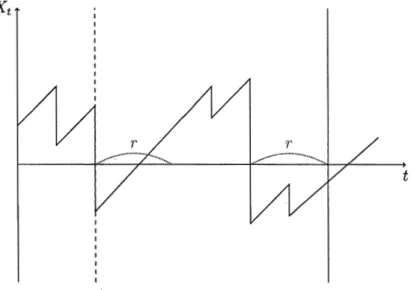
Inthelastfew years, Parisian ruin theoryhas attracted considerable attention.In Parisian-type ruin models, the insurance company is not immediately liquidated when it defaults: a grace period is granted before liquidation. More precisely, Parisian ruin occurs if the time spent below a pre-determined critical level is longer thantheimplementationdelay, also called theclock(the Parisian ruin time is compared to the classical ruin time in Figure 1.1). The idea of Parisian ruin is inspiredfrom Parisian options which are barrier options for which theknock-in or knock-out is activated when price of the underlying asset price process has spent a given period of time beyond a fixed barrier. The concept of Parisian ruin is of practical importance since, under the U .S. bankruptcy code, a reorganization
is proposed to the firm when it defaults instead of immediate liquidation (see François and Morellec [28], Galai et al. [29] and Li et al. [48]).
Xt
t
Figure 1.1 A sample path of a Cramér-Lundberg process. The time of classical
min is shown in dashed red and the Parisian min time is shown in blue and r is the delay.
Two types of Parisian min have been considered: with deterministic delays or with stochastic delays. In the first case, the Parisian min probability was first computed by Dassios and Wu [19] but only for the Brownian motion risk process. The same authors studied in [20] the Laplace transform of the Parisian min time and the Parisian min probability for the special case of the Cramér-Lundberg process with exponential daims. In a more general setup, Czarna and Palmowski [17] generalized these results for spectrally negative Lévy processes. Their analysis is split into two cases, depending on whether the process is of bounded or unbounded variation. The same problem was studied in Loeffen et al. [58], but the clever use of some identities, especially Kendall's identity that provides the distribution of the first upward crossing of a specific level (see Kendall [37] or Borovkov and
Burq [14]), helps to greatly simplify the expression and unifies the bounded and unbounded variation cases.
When each implementation delay is modelled by an exponentially distributed random variable eq, as considered in Landriault et al.
(46],
a copy of eq is assignedto each excursion below 0 of the risk process. They also considered Parisian ruin with Erlang-distributed implementation delays (see also Albrecher and Ivanovs [4]). Also, for this type of ruin, an expression for the probability of Parisian ruin for the refracted process was given by Renaud (68] using a relationship between occupation times and this type of Parisian ruin. As an extension of the results in
(46],
Baùrdoux et al. [8] derived the Gerber-Shiu distribution at Parisian ruin with exponential implementation delays. Recently, more definitions of Parisian ruin have been proposed. Cumulative Parisian min has been proposed in (32]; in that case, the race is between a single deterministic dock and the sum of the excursions below the critical level. Moreover, in(18],
Parisian ruin with an ultimate bankruptcy level which is in the line with the principle of limited liability. This type of ruin occurs if either the process goes below a predetermined negative level or if Parisian ruin with deterministic delays occu:rs.Recently, Poisson observation problems have attracted considerable attention; see Albrecher et al.
[5],
Albrecher and Ivanovs [4], Li et al.(49],
Li et al.(52],
among others. In this case, the risk process is monitored discretely at arrival epochs of an independent Poisson process, which can be interpreted as the observation times of the· regulatory body (see Figure 4.1). The Poisson observation technique was first used to compute the joint Laplace transform of occupation times over dis-joint intervals for spectrally negative Lévy processes (see e.g., Li and Palmowski (47] , Li et al.(52]).
Additionally, by considering a risk process observed at dis-crete Poisson arrival times, we get around the problem caused by the unbounded variation case and we recover classical results (in the continuous monitoring case)when the Poisson observation rate goes to infinity. More interestingly, from the memoryless property of the exponential distribution, Parisian ruin with random delays corresponds to the first time the surplus process is observed below 0 at a Poisson arrivai time. In thesame vein as thatillustratedin Albrecher et al. (5), Li et al. (49) proposed a new approach tostudy Parisian ruin for spectrally negative Lévy process. They introduce the idea of Parisian ruin under a hybrid observa-tion scheme. More specifically, when the risk process is positive, it is monitored discretely at Poisson arrivai times until a negative surplus is observed. Then, the process is observed continuously and a grace period is granted for the insurance company to recover to a solvable level.
Another generalization of models with Parisian ruin with exponential delays is the omega risk model,which was introduced by Albrecher et al. (3). In this model, bankruptcy does not necessarily happen when the surplus is below O. Instead, it happens at a rate fonctionwthatis a decreasing function of the level of negative surplus. Gerber et al. (31] and Albrecher and Lautscham [6) studied this model when the risk process is a Brownian motion with drift or when it is a compound Poisson risk model with exponential claim sizes. Recently, Li and Palmowski [47) studied theLaplace transformsof occupation timesweighted bywand expressions are given in terms of the w-scale fonctions. They recovered previous results on occupation times; see (45) and (60). These results were extended in Li and Zhou (50) for the refracted Lévy process.
1.2 Lévy insurance risk models
Inthis section, we give some background on spectrally negative Lévy processes. LetX= {Xt,t~ O} be a Markov process defined on a filtered probability space (0,F, ~ JF).We will use thefollowing standard notation: thelawofXwhen
starting fromX0=xis denoted by lP xand the corresponding expectation by1Ex.
We write lP and 1E whenx=O.
We refer readers to Kyprianou
[42]
for further discussion and references related to theanalysis of Lévy Insurance Risk Models.Definition1.Astochastic processXis a Lévy process ifitsatisfies thefollowing properties:
• Xo=0a.s.
• For 0~ s~
t
,
the incrementXt -X8 is independent of the process {Xu,u~s}
and has thesame distribution asXt-s ;• The paths ofXare right continuous with left limits.
By the Lévy-Khintchine formula, the characteristic exponent is given as follows : for fJ ER,
w(fJ)=i"yfJ
+
~
+
!.
(1 -
e-iOz+
i8zl1z1<1) II(dz),(1
.1)
2 lR
for 'Y ER and cr ~ 0, and where 11 is a cr-finite measure on 1R \ {O} such that
1
(1 /\z
2)II(dz)
<
oo.The measureIIis called the Lévymeasureof X and theparameter cr theGaussian coefficient. The triplet ("(,cr, 11) is called the Lévytripletand itcharacterizes the processX.From the Lévy-Itô decomposition, there exists a probability space in which a Lévy process with characteristic exponent given in
(1
.1
)
,
can be expressed as followsX=x
1+x
2+x
3,where
• X2is a compound Poisson process with Poisson intensityrate ~ (-1,1)) and the jumps are independent and identically distributed with common distribution II(dz) ~ (-1,1) );
• X3is a square integrablemartingale with an almost surely countable number
of jumpsover a finite time interval and jumps magnitude less than1. We say thatXis aspectrally negative Lévy processifithas no positive jumps, i.e. if II(O, oo)=0(we exclude the case thatXhas monotone paths). As the Lévy processXhas no positive jumps, its Laplace transform exists: for all8,
t
;:::
0,JE [eOXt] =et'l/J(O)'
where'l/J is theLaplace exponent.Then, by theLévy-Khintchine formula, we have, for8E~
1
10
'l/J(8)
=
-w(-i8)=
18+
2
a282+
_
00
(e
0z-1-8zl{z>-l}) II(dz).
(1
.2)
The Laplace exponent'l/J is infinitely differentiable, strictly convex and lim'lf;( 8)
=
oo,0-+oo
whilst 'l/J(O) =O.
A spectrally negative Lévy process might have paths of bounded or unbounded variation.Inthefirst case, thatis when
f
01zII(dz)<
oo anda =0, we can writeXt
=e
t
-
St,where c= {
+
f
01zII(dz)>
0 is thedriftofXand whereS= {St,t ;::: O} is a driftless subordinator which is a Lévy process with non-decreasing paths (e.g. a Gamma process or a compound Poisson process with positive jumps).The right-inverse of'l/J is a fonction <P: [O, OO) --+ [O, OO) defined by <P(p)
=
sup{e
;:::
0: 'l/J(8)=
p} such thatWe will write q>
=
q>(p) when p=
O. Note that we have q>(p)=
0 if and only ifp =
0
and7/1'(0+)
~O.
The last condition is known as the net profit conditionand it ensures that X drifts to infinity (i.e. lim t-too Xt
=
oo). Otherwise, ruin occurs with probability one.In ruin theory, spectrally negative Lévy processes are also called Lévy insurance risk processes.
1.3 Scale functions
In the the study of spectrally negative Lévy processes, we often want to express ruin-related quantities in terms of scale functions.
Definition 2. For q ~ 0, the q-scale function of X is defined as· the unique,
continuous and increasing function on
[O,
oo) with Laplace transformwhere
1
l'°
e-OyW(q)(y)dy=
'l/;q(8),'l/Jq(e) =
7/1(e) -
q, and such that W(q)(x) = 0 for x <O.for()> q>(q), (1.3)
(1.4)
We will write W =
w<
0) when q = O. Unfortunately, explicit expressions of scale function are not always known. However, the inversion of the Laplace transform (1.3) can be clone numerically as in [71].Here are some examples for which the scale functions can be computed explicitly.
Example 3. When X is a Cramér-Lundberg risk process with exponentially dis-tributed claims, then
Nt
Xt - Xo =
et -
L
ci
i=l
{C1,C2, ...}are independent and exponentially distributed random variables with parametera. The Poisson process and the random variables are mutually inde-pendent. In this case, the Laplace exponent of X is given by
,P((!)
=c8+1J
(
(
!
:a
-
1) ,
for
(
!
>
-a
.
Th en, for x2: 0,we have
where
e<I>(q)x e-(1x
w(q)(x)
=
~ \\+--;-;;-;:
\
l(1 =
;c
(
J(7J+q-ac)
2+4caq
-
(1}+q
-ac
)
)
,
<P (q)
=
;c
(
J
(
1J
+
q
-ac
)
2+
4caq
+
(
1J
+
q
-ac))
.
Example 4.IfX is a Brownian risk process, i.e. ifXt -.X0=
e
t+
a
Bt,where B
=
{
Bt, t~ 0}is a standard Brownian motion; then the Laplace exponent of X is given by1
1/J(
8)=
ce+2a
2e
2. Then, for x2: 0,we haveW(q)(x)= 1 (eCJc2+2q0"2-c)x/0"2 -e-<.Jc2+2q0"2+c)x/0"2)
V
c2+
2qa2 'Example 5.When X is a jump diffusion process, then
Nt
Xt -Xo
=
e
t
-
L
ci
+
(]'
Bt, i=lwhere {C1, C2, ...}are independent of N and B, the Laplace exponent of X is given by
a2 ( a )
Then, forx~ 0,we have
e<I>(q)x e-(1x e-(2x
w<q)(x) = 11/h../ \\
+
Ill ,,_ \+
~\
'
where <I>(q), (1and(2are the solutions of the equation'lj;(O)
=
q such that -(2<
-a<
-(1<
0<
<l>(q).Example 6.IfXis a a-stable risk process with aE(1, 2), i.e. if
Xt -Xo=et+ Zt,
where Z
=
{
Zt,t
~O}
is a spectrally negative a-stable process, then the Laplace exponent of X is given by'lj;(O)=
ea. Then, for ~ 0,we haveW(q)(x) =axa-l~ (qxa),
where E"'1(x)= L:n>o-
r
(
l
xn+an )isthei ~ e ie
function,E;,
'1its deriva-tive and
r
is the Gamma function.The Laplace exponent ofXunder the change of measure ~ dJP>C 1 =ec(Xt-X)-1/J(c)t' d1fD X Ft
for c such that1Ex [ëx1]
<
oo, is given by'lj;c(e) ='lj;(e
+
c)
-'lj;(c)
,
e~-c
,
(1.5) and thecorresponding scale functionwJq) is given byw<q)(x)=ecxwlq-'l/J(c))(x). (1.6) The q-scale fonctionW(q) is differentiable except for at most countably many points. Moreover, W(q) is continuously differentiable ifXhas paths of unbounded variation or ifthe tail of the Lévy measure is continuous, and it is twice cont in-uously differentiable on (0, oo) ifa
>
O. The initial values ofW(q) andW(q)t aregiven by
W(q)(O+)
=
{1/cwhenŒ=0andfoi zII(dz)<
oo,0 otherwise,
2/Œ2 whenŒ
>
0,w<q)'(O+)=
<
(II(O, oo)+
q)/c2 when(J=0andII(O, oo)<OOOO otherwise.
Using the notation introduced by Albrecher et al.
[5],
we define another scale fonctionZq(x, 8)byz.(x, IJ)
=
e9x
(
1-.P.(
IJ)1x
e-0•w(q)(y)dy) , (1.7)forx2::: 0, and byZq(x, 8) =e0x,forx<O. We will writeZ=Z
0whenq =O.
The scale fonctionZq(x, 8) was first defined by Avram et al.
[7]
as the Esscher transform of the following scale fonctionz(q)-(x)given byz<•l(x)
=
1+
qfo"
w(ql(y)dy, xER, (1.8) also known as asecond scale fonction. Of course, for8=0,Zq(x, 8)=z<q)(x) . We can also re-write thescale fonctionZq(x, 8) as follows :Zq(X, IJ)
=
'l/Jq(IJ) ["e-OyWq(x+
y)dy, X ;::: Ü, () ;::: iJ'>(q). (1.9) 1.4 Delayed scale fonctionsIn the the study of Parisian ruin problems, identities can be expressed in terms of delayed scale fonctions. Inspired by
[59],
we define the(r, s)-delayed p-scale function of X byA(P)(x;r,s)=
1
~ s s (x+z)-IP(XrEdz),00 z
where the auxiliary functionW (also known as thesecond-generation scale func -tion)is given by
W2"•
l
(x)
=w(p+s)(x
)
-
s [w<v+•l
(x
-
y) W(pl(y)
dy
,
(1
.11)
for p, p+
s~ 0 anda, xER As obtained in (60], we have(s
-p)
{
w<vl(x -y)w<•l(y)dy=
w<•
l
(x
)
-
w(pl(x). (1.12) Thus, using(1.12),~ s can also be written as follows:W
i
'"
•
l
(x
)
= W(pl(x)+
s [ w(p+sl(x -y)W(pl(y)dy, (1.13) and then we can rewriteA(P)(x;
r
,
s)
in the formA(p)(x;r, s) =
1
~ s (x+
z) -1?(XrEdz).00 z
o r (1.14)
When s= 0, we recover the function A(p)defined by Loeffen et al. (59]. To be
more precise, when
s
= 0, we haveA{P)(x;
r
,
0)=A(P)(x
,
r
)
,
whereA(P)(x, r)=
1
w<P)
(x+
z) -1?(XrEdz).00 z
o r
We write A= A(o).Here is another connection between these two functions. We
can re-writeA(P)(x; r,s) using (1.11)
A(P)
(x
;
r, s)=A(p+s)
(x
,
r) -slx
A(p+s)(y
,
r)W(p)(x
-
y)dy
.
(1
.15)
ln Chapter 3, we will see thatthedelayed scale function in(1.10)plays a similar rôle, as the one played by the scale functionsW(P) andZpin the classical andParisian fluctuation identities respectively, for the mixed-type Parisian ruin. 1.5 Classical ruin exit problems
In this section, we present some of theexisting fluctuation identitiesfor spectrally negative Lévy processes in terms of their scale functions.
First, recall thedefinitions of standard first-passage stopping times : forbEIî,
rb-=inf{t
>
0:Xt<
b} and r;;=inf{t>
0:Xt>
b}, with theconvention inf0
=
oo.Ifa ::; x ::;bandq,À ~ 0, we have[-qr;;+>..x _
J
W(q)(x -a)Ex e Ta l{r;;<rït}
=
Zq(X -a,À) -ur{n)/z. _\ Zq(b -a,À), and also[ +
J
W(q)(x -a)Ex e-qTb l{rït<T;;}= W(q)(b -a). Lettinga-+
-oo
in (1.17) and using (1.6), we havelimW(q)(x -a) =e~
a-+-ooW(q)(b -a) '
(1.16)
(1.17)
(1.18) we then obtain the well-known expression for the Laplace transform of the first passage time aboveb
EX[e-qT:1{Tb <oo+ }]= e~ • (1.19) Moreover, theclassicalprobability of ruin is given by
Px
(r
0
<
oo)
=
1-(E [Xi])+W(x), (1.20) where (x)+=max(x, 0).The next identities can be found in numerous references, but first proved in [43] and [60] (and also indirectly proved in(45]).For anyp, q~ 0 anda ::; x ::;b, we have
EX[e-qr;;W(P)
(X
-
Ta+
z)
1{ -Ta <Tb+}]
(
)
w< q)
(x -a) ( )=
W
p,q-p(x+·
z) -W
p,q-p(b
+
z) (1 21)a+z W(q)
(b
_a) a+z ' ·and whenb-+oo, we obtain
, Ex [e-qr;;W(P) (XT;;
+z
)
l{r;;<oo}]These identities (and also similar ones involving the scale function Zq) constitute a major turning point in terms of simplifying many results by getting rid of the Lévy measure in many expressions of quantities involving spectrally negative Lévy processes. Recently, a generalization of Equation (1.21) and (1.22) was derived by Kuang and Zhou [38] in order to compute n-dimensional Laplace transforms of occupation times over n-disjoint subintervals. Also, Renaud [68] derived its analogues for the refracted Lévy process.
We also recall the following expression for the q-potential measure of X killed on exiting (-oo, a]: for a E JR and x, y :::; a, we have
l"'
e-qtJP>x (X, E dy,t< r:)
dt= (é'<•)(x-a)W(q)(a
-y) - w<•l(x
-y)) dy.(1.23) Finally, here is Kendall's identity (see
[11,
Corollary VII.3]): on(0,
oo) x(0,
oo ), we haverlP'(r,: E dr)dz
=
zlP'(Xr E dz)dr. 1.6 Parisian min exit problemsIn this section, we present some of the existing fluctuation identities with delays for a standard Lévy insurance risk process X.
1.6.1 Parisian min with deterministic delays
The time of Parisian min, with a fixed delay r
>
0, has been studied in [58]: it is defined asti;r
=
inf { t>
0 : t - gt> r} ,
(1.24)where gt = sup {O:::; s:::; t: X8 ~ O} is the last time before t when the process was
Dassios and Wu [20] obtained theprobability of Parisian ruin for thespecial case of a Cramér-Lundberg process with exponential daims. Czarna and Palmowski [17] later generalized this result for spectrally negative Lévy processes but the final expression is very explicit and is given in thenext theorem.
Theorem 7 (Theorem1 in[16]).Parisian ruin probability for a spectrally· negative Lévy risk process equals: forXE1îand r,
e
>
01Px (Kr<oo)
=
1Px(T
0
<oo)lP(Kr<
oo)+
(1 -JP' (1>r<
OO))["
'
lP',(r
i
t
>
r)
lP', (r
0-<
oo,-XrOEdz
)
,
(1.25)where
f
e-Br(
f
lP'(r;
>
r)
lP'x(ro
<
oo,-XroEdz)) dr
1-
'l/J'
(ü+)W (x) é(O)x(z(-())
(x)+
B W(-e) (x)) . (1.26)=
e
--e
-
4>(e) <I> (~e 4>(e)In order to compute the probability of Parisian ruin starting atx
=
0, Czarna and Palmowski [17] splitted the results into two cases, for processes of bounded and unbounded variation.Theorem 8 (Theorem 2 in [16]).IfXis a process of bounded variation, then
.f
0 00 1P(T
i">
r)lP (Tc)<
oo,-X;0 Edz) JP(Kr<
00)=
-
-
\
(
)
,
~ lP (T0
=
oo)+
f
0 00 lP(Ti>
r)lP Tc) <oo,-Xr
0Edz wheref
'
e-Br(
f
'
lP'(ri>
r)
lP'(ro
<
oo,-XroEdz)) dr
1 .
=Be
(1 -
e-4>(e)z)Ilx-(z)dz,(1.28) andX
is the dual process of X andIIx
its Lévy measure.IfXis a process of unbounded variation, then.
• • Jp>€
(Ta<
b) -p(b
,
r)where
p(b,
r
)
=JP>(T:
~
r
)
1P'e(To
<
b,Xr()=0)
+
l'°
II'(r:i-,
:S;r)
II',(ro
<
b, -XroEdz) .
(1.30) Later, Loeffen et al. (58] derived a new expression for1P' x (K,r<
oo) and unified thebounded and unbounded variation cases using theE-approximationtechnique. More specifically, theyderived thefollowing new identitiesthatlead to an explicit inverse Laplace transform of (1.28). The key ingredient of the proof is Kendall's identity.Lemma 9.For r,
e
>
0,~e haveA(O,
r
)
=1, (1.31) e-Or -JP> (XrEdz) dr=--e-q_,(o)y,1
001.
00 z 1 o y r <P(O) ~ 0, (1.32) 1P'x(Td
:Sr)= A(x, r) x:::;0, (1.33) [q_,(O)X - ] f}roo
lEx e ro l{rü<oo}= <P(O)
Jo
e-q_,(o)YW'(x+y)dy. (1.34) Using thoseidentities, themain result in(58) is a very nice and compact expression for the probability of Parisian ruin.Theorem 10 (Theorem 1 in[58]). For r
>
0andxEJR, we haveAf?;,r)
1P'x (K,r
<
oo)= 1 -(JE[X1]))+~
(XrE dz). \L.Jù)Remarkll.Applying the Initial Value Theorem to Equation(1.35) (to the nu -merator and the denominator separately), one can recover the expression of the classicalmin(5.2) asr-tO.
Remark12. Instead of looking to invert the Laplace transform (1.28) using again the technique of taking Laplace transform with respect to the delayr,we can compute the right-hand sicle of Equation (1.25) using a probabilistic approach by combining (1.34) with (1.22) and Tonelli's Theorem to get
E. [A(X,0,r}l{<O<oo}]
=
1
00(W(x+
z) -W(x))~
Edz). (1.36} Recently, Loeffen et al. [59] proposed a new analytical approach for computing some Parisian min identities based on thework of Loeffen [57]. They derived the joint Laplace transform of the Parisian min time""r
and the level of the deficit x"'r'Theorem 13 (Theorem 3.1 in [59]).Forp,)..~ 0,b, r
>
0and x:::; b, we have[ ] A(P)(x r)
1E e-P"'r+>.Xx;r
1{
+} =F(p,À) (xr
)
-
'
F(p,>-.) (br
)
x "'r<rb ' A(P)(b,r) ' ' where
F(p,>-.) (x,
r
)
e.p,(>.)r (Zp(
x, >.} -1/Jp (
>.}1•
e-.P(>.)uA
(p) (x; u)du) .
The auxiliary functionF(p,>-.)(x,
r
)
was not defined in [59] but greatly helps to reduce thefinal expression (it will also be generalized in Chapter 3). The Parisian two-sided exit problem is also given by[-prit
]-A(P)(x,r)1Ex e
1{
rit
<"'r} -A(P)(b, r)' (1.37)Remark14.Itis worthwhile to mention that the last result was first derived in [55] (see Theorem 21 forô= 0 in Chapter 3).
1.6.2 Parisian min with exponential delays
The time of Parisian min with exponential delays is defined as
where egt is exponentially distributed with rate q
>
O. More precisely, a copy ofeqis assigned to each excursion below level O. The probability of Parisian ruin
with exponential delays was first computed in [45] through the relation between the occupation times and this type of Parisian ruin (see Remark 18).
Theorem 15.For q
>
0and xEIR, we haveEx [e-•fo=
~
=1-(E[X1]))+i ~
1l(q,-q)(x), (1.38)where the function11,(p,q)(x) was definedbyLoeffen et al. [60]and givenby 1l(p,q)(y)=e"'<•)Y (
1+q1Y
e-<J>(p)zw(p+ql(z)dz) , (1.39) where p2::
0and qEIR such that p+
q2::
0andyERThere is a one-to-one correspondence between Zq(x, 8)and 1lgiven by
/
11,(p,q)(x)
=
Zp+q(x,<I> (p)). (1.40) Thus, Equation (1.38) can be re-written in terms of the scale function Zand the probability of Parisian ruin is given byIP' x(K,q
<
oo)
=
1-(lE[X1]))+<I>( q) Z(x,<I>( q)) .q (1.41)
More general identities were laterobtained. For example, forx~ band p, q
2::
0,·we have ] Zp (x,<I>(p
+
q)) Ex[e-pr,;
~
=z
,
(b, iP(p+
q))' (l.42) and JE~
]= _q_ (z(p) (x) -Zp (x,<I>(p+
q)) z(p)(b)) x {Kq<r:} p+
q Zp (b, <I>(p+
q)) ' (1.43) where thefirst one is taken from [5] but was first proved in [60] (see Remark 18). The secqnd identity is taken from [8] (where a slightly different notation is used).Also, the Gerber-Shiu distribution at Parisian ruin was computed in
[8].
Their expressions can be re-written in terms of the second generation scale fonction W as follows:fore,a,b2::
0, xE[-a,b) andyE[-a,0),we haveq 1", /\T_a .
JE, [e-6<',
~
Edy,I<<
b+ - ]~
(a+
x) _~
(x
-
y)]dy,=q [
w
t
·•>
(b-y)~
(a+
b)
andlEx [e-OKq, XKq E
dy
,
K,q<T
t
]
_ [Zo(x, cI>(8
+
q))W(O,q)(b
-y
)_
~
(x_y)]
dy
,
(1.44) -q Zo (b, cI>(e+
q)) bwhere y :::; 0andx :::; b. When b--+ oo, we obtain lEx [e-OKq, XKq Edy,K,q
<
OO]=
(
(cI>(e+
q) -cI>(8)) Zo (x,cI>(e+
q)) Zo+q (-y,cI>(8)) - ~ (x -y))dy. (1.45)Remark16.The last Gerber-Shiu fonction agrees with the result in Equation
(19)
in Guérin and Renaud[32].
The connexion is made through the following potential measure discounted by the occupation time over the half line(-oo
,
0)
lEx [e-OKq' XKq E
dy
,
K,q<
OO]=~ [e-q1;e 1<-oo,o)(Xs)ds' XeeEdy] . This result was also obtained by Li et al.[52]
using the Poisson observation technique and they also extended it to the joint Laplace transform of both semi -intervals (0, oo) and (-oo,0).Remark17. At first sight, one might thinkthatthelastidentitiescan be recovered from those in Subsection1.6.1only by taking Laplace transforms with respect to r.However, this is not thecase. It is due to thefact thata copy of eq is assigned to each excursion below zero of therisk process X,not a single one for the whole trajectory.
Remark 18. By the memoryless property of the exponential distribution, Parisian ruin with exponential delays corresponds to the first time the process. X is observed to be negative at Poisson arrival times, that is
r
0-=
min{7i>
0: Xri<
0, i EN}, (1.46)where
1i
are the arrival times of an independent Poisson process of rate q>
O. We recall that T0 = 0 and the inter-arrival times1i -
]i_1, for i2::
1, are independentand exponentially distributed with parameter .À. Then, we have the following equalities :
1Ex [
e-pr:
1{r:
<1tq}] 1Ex [e-pr:
1{r:
<To-}]
= 1Ex [e-pr:,
N ( B) = 0,T:
<
OO]
JE X[e-pr:-q
Il
l{xt<o}dtl{ Tb + }] <oo )where N is an independent Poisson random measure with intensity qdt and the set Bis given by
B = { t E
[0,
T:) , Xt< 0} .
See Albrecher el al. [5] and Loeffen et al. [60] for more details. 1. 7 Organization of the thesis and contributions
The rest of the thesis is organized as follows. In Chapter 2, we investigate Parisian ruin for a Lévy surplus process with an adaptive premium rate, namely a refracted Lévy process. The latter has been used to build models with a threshold strategy at a fixed level b which is the strategy where no dividends are paid out when the process is below band dividends are paid out, at rate
o,
when the process is above b. In Kyprianou and Loeffen [43), the refracted Lévy process was introduced and many fluctuation identities, including the probability of ruin, have been derived. Our main contribution is a generalization of Theorem (10) for the probability ofParisian ruin of a standard Lévy insurance risk process. More general Parisian boundary-crossing problems with a deterministic implementation delay are also considered. Despite the more general setup considered here, our main result is as compact and has a similar structure. This Chapter constitutes a paper that has already appeared in Insurance : Mathematics and Economies and has been writ-ten with Irmina Czarna and Jean-François Renaud. At the end of this Chapter, the Gerber-Shiu distribution at Parisian min with stochastic delays for a refracted Lévy Process is obtained as an extension of the results of Baurdoux et al. [8]. This section is nota part of the paper.
Chapter 3 contains the paper A unified approach to ruin probabilities with delays for spectrally negative Lévy· processes, written with Jean-François Renaud, which is still under review. In this Chapter, we unify two approaches for the definition of Parisian min, defined in Subsections 1.6.1and1.6.2, by considering a Parisian min with mixed delays. For this type of Parisian min, we identify the joint distribution of the time of min and the deficit at min, therefore providing generalizations of many results previously obtained in the literature, such as in [8] and (59] for the case of exponential delays and that of deterministic delays, respectively.
Chapter 4 contains the paper A note on Parisian ruin under a hybrid observation scheme that has already appeared in Statistics & Probability Letters and for which I am the sole author (see
(54]).
This paper is still under review. In this paper, we study the concept of Parisian min under a hybrid observation scheme, as introduced by Li et al. (49]. Under this model, the process is observed at Poisson arriva! times whenever the business is financially healthy and it is continuously observed when it enters a period of financial distress (below 0). The Parisian min is then declared when the duration of this period is greater than a fixed delay. We improve the result originally obtained in (49] and we compute other fluctuation identities.In Chapter 5, we investigate a VaR-type risk measure introduced by Guérin and Renaud [33] and which is based on cumulative Parisian ruin. We derive some properties of this risk measure and we compare it to the risk measures of Trufin et al. [73] and Loisel and Trufin [62). This Chapter constitutes the manuscript A VaR-type risk measure derived from cumulative Parisian ruin that has appeared in the special issue "Risk, Ruin and Survival: Decision Making in Insurance and ·Finance" of Risks journal written with Jean-François Renaud (see [56]).
The final Chapter is the conclusion and it discusses some potential directions for future research.
PARISIAN RUIN FOR A REFRACTED LÉVY PROCESS
2.1 Introduction
In this Chapter, we study the Parisian ruin for a Lévy process with adaptive premium known as therefracted Lévy process.More precisely, when the company is in financial distress, that is when its surplus is below the critical level, the premium is increased; and when itssurplus leaves thatred zonethenthepremium is brought back toitsregular level. Therefore, we will use a refracted Lévy process as our surplus process. Note that we could also interpret this change in the premium rate as a way toin e~ (for R&D, modernization, etc.): ifthesurplus of
the company is in a good financial situation, i.e. above thecritical level,then it invests at rate ô; otherwise itdoes not. However, for the rest of this Chapter; we will use the previous interpretation.
In general, fluctuation identities for refracted Lévy processes can be tedious com -pared to theirclassical counterparts because scale functions of two different Lévy risk processes are involved (see [43]). Therefore, our main contribution is a surpr is-ingly compact expression for the probability of Parisian ruin for a refracted Lévy risk process (see Equation (2.13) below), in thespirit of theone in Equation (1.35) for a standard Lévy risk process. Our formula also provides information on how therefraction parameteraffects thisprobability while displaying theimpactof the
delay parameter. Moreover, we analyze more general Parisian boundary-crossing problems for the refracted Lévy process which have not been studied previously, even for a standard Lévy risk process. As a consequence, when the refraction parameter it set to zero, new identities for the classical Lévy setup are obtained. The rest of the Chapter is organized as follows. In Section 2.2, we present our model in more details. The main results are presented in Section 2.3, while Section 2.4 presents a few examples. Section 2.5 is devoted to the proofs of the main results as well as (new) technical lemmas.
2.2 The model and background material
As mentioned in the introduction, we are interested in a surplus process U whose dynamics change by adding a fixed linear drift (premium) whenever it is below the critical level b, a region also called the red zone (see Figure 2.1). Without loss of generality, we will choose b to be O.
In our model, Y is the surplus process during regular business periods (above zero), while X is the surplus process, with an additional rate of premium 8, for critical business periods (below zero). More precisely, let Y be a Lévy insurance risk process (see the definition in section 1.2) modelling the dynamic of the surplus U above O. Below 0, our surplus process U evolves as X= {Xt
= Yt
+
ôt, t
~ O}. Clearly, X is also a Lévy insurance risk process; in fact, X and Y share many properties except for those affected by the value of the linear part of the Lévy process.In other words, our surplus process is given by the solution U = {Ut,
t
~ O} tothe following stochastic differential equation: for 8 ~ 0,
Ut
~~~~~~~~~~~ ~~~
X
t
Figure 2.1 A sample path of the refracted processUwhenXis a Cramér-Lundberg process.
Above0, our surplus processU evolves asY={yt= Xt -ôt, t~ O} which is also a Lévy insurance risk process (if it doesn't have monotone paths): its linear part is given by"Y -ôbut it has thesame Gaussian coefficientaand Lévy measure II as X. In fact, X and Yshare many properties. Note thatwe could have specified Y first and then defineX = {Xt= yt
+
ôt, t~ 0}.The two approaches are equivalent. The Laplace exponent of Yis given byÀ i--+
?/J(.X) -
ÔÀ,where
?fJ(.X)
is defined in(1
.2
)
,
with right-inversecp(q)
=sup{À~0
1?fJ(.X) -
ÔÀ =q}
.
Then, for eachq ~ 0,we define its scale functionsW(q) andz<q)as inEquations(1.3)and(1.8):
e->.yw(q)(y)dy
=
,
forÀ>cp(q)
1
00 10
?fJ(.X) -
ÔÀ -qand
2.2.1 Refracted Lévy processes
Recall from Equation (2.1), that our surplus process U = {Ut,
t
~ O} is equiva-lently the solution todUt = dYt
+
Ôl{Ut<O}dt,t
~ 0, ordUt = dXt - 8l{Ut>O}dt,
t
~ 0,where 8 ~ 0 is the refraction parameter. The second stochastic differential
equa-tion is the one used in [43]. It was proved in that article that such a process exists and that it is a skip-free upward strong Markov process.
For technical reasons, we need to assume that if X (and also Y) has paths of bounded variation then
0 ::; 8
<
c = 1'+ {
zII( dz).l(o,1) (2.2)
Since in this case, X may be written as Xt
=
et-St, the condition in Equation (2.2) amounts to making sure Y has a strictly positive linear drift.In [43], many fluctuation identities, including the probability of ruin for U, have been derived using scale junctions for U: for q ~ 0 and for x E JR, set
w(q)(x; z) = w(ql(x - z)
+
ôl{•2'.0}1·
w(ql(x -
y)w<•l'(y - z)dy.{2.3)
Note that when x
<
0, we havew(q)(x; z) = w(q)(x - z).
For q = 0, we will write w(O)(x; z) = w(x; z). See [42] for more details.
2.2.2 Classical ruin and exit problems for the refracted Lévy process
Here is a collection of known fluctuation identities for the spectrally negative Lévy processes X and Y,as well as for the refracted Lévy proces& U. See [42] for more details. First, for real numbersa andb, we define thefollowing first-passage stopping times:
T-;;
= inf{t>
0: Xt <a} andT:
= inf{t>
0: Xt~ b}v
;
= inf{t>
Q: yt<a} andv
t
=inf{t>
0:yt~ b}K,-;; =
inf{t>
0:Ut<a} andK,t
=
inf{t>
0: ~b}
,
with the convention inf
0
=oo. Fora :::; 0 :::; bandq~ 0, ifa :::; x :::; bthen wehave
-qi-;,b - '
[ +
J
w(q)(x· a) JEx e~
-w(q)(b;a)
'
from which we can deduce that' + e<I>(q)x
+
ô<I>(q)l{x>O}fox e<I>(q)yW(q)(x -y)dyEx
[e-q•q{•i<oo}]
=
eil>(q)b+
ô<I>(q)f:eil>(q)yW(q)(b-y)dy .See Theorem 5 in [43]. For
x:::;
b, we also haveand W(q)(x) JEx [e-qv:l{vt<vü}]=W(q)(b)' JE [X e-qvü1{vü <vt} ...,... ]-'7l/LJ(q)(X )-W(q)(x)W(q)(b) '7l(q)(b)/LJ • (2.4) (2.5) (2.6) Moreover, theclassicalprobability of ruin, associated with the processesYand U,is given by
1P'x
(v
0
<OO)
= 1- (JE [Xi] -8)+W(x) (2.7) and_ (JE
[X1] -
8)+Of course, the expressions in Equations (2.7) and (2.8) should be equal because
{Yt,
t<
v0}
and{Ut,
t<
K,o}
have thesarne distribution with respect toJ.P> xwhenx
>
O. Using Equation (2.11), we can see thatthis is thecase.Finally, since the Laplace exponent ofYis given byÀr-+
'l/J(.X) -
ÔÀ, then for x,8>
0 we haveIEx
[e
0\
ï
l{vQ<oo}]=
e8" - ( ,P(B) -OB) e8"1"
e-0•w(z)dz-,P(B)9-OB W(x ). (2.9) We conclude this section with definitions of auxiliary fonctions. For the sake of compactness, we define forp, p
+
q2::
0 anda, xEIRW(p,q)a,ô (x)
=
W(P)(x) -8W(p+q)(O)W(P)(x)+
1" (
qW(p+q) (x -y) -ow<v+•l'(x -y))w
(p
l
(y)dy=
w<v+•l(x)-1" (
qw<v+.) (x -y) -ow(p+q)' (x -y))W(p)
(y)dy, (2.10) where the second expression forWipJq) in Equation (2.10) follows fromiden-' tity (2.11).
The second identityfollows from thefollowing useful identity taken from [68): for p, q
2::
0 andxEIR,(q -
p)
[
w<
•
l
(x
-y)w<•l(y)dy=
W(ql(x) -W(p
l(x)
+
0 (w<•
l
(o
)W
(p
l
(x
)
+
[
W(p
l(x
-
y)w<•l1(y)dy) . (2.11) Finally, we set1
/f
'"
l(x)
=
ë<•
l•
(
1+
(q -O<p (p))1"
e-,,(p)yw(p+•l(y)dy) . (2.12) Ifno refraction is considered, Equations (2.11) and (2.12) are the analogues of (1.12) and (1.39) respectively, i.e., ~=
1-l(p,q)and ~ = ~2.3 Main results
Following thedefinition for a standard Lévy insurance risk process, we define the time of Parisian ruin, with delayr
>
0, for the refracted Lévy insurance risk processUby~ =inf{
t
>
0 :t
-
g
f
>
r}
,
where
g
f
=
sup{O
~ s~ t:Us ~O}.
Our main objective is to obtain an expres-sion for thecorresponding probability of Parisian ruin thathas a similar structure as theone in Equation (1.35).Theorem 19. For xElR and r
>
01P'x
~
<
oo)
=
1-(1E[Xi] _
8)fo
00w(x;-z)zJP>(XrEdz)+
fo
00zJP>(Xr Edz) -8r · (2.13)For classical ruin and Parisian ruin for a standard SNLP, ifthenet profit condition is not verified then (Parisian) ruin occurs almost surely. In the last result, if
1E[X
1]~ 8, then the probability of Parisian ruin forUis equal to 1. This isbecause asking for
1E[Yi]
=
1E[X
1]-8>
0 is thesame as the net profit conditionin this model, namely for the surplus processU. Also, itshould be clear that, if we set8=0 in theabove result, then we recover Equation (1.35).
Remark20. Using identities from Section 2.5, we can also re-write the result in Equation (2.13) as follows:
J
000w(x;-z)zJP>(XrEdz)1P'x
~
<
oo)
=
1-(1E[X1] -
8)+J
000(1 _ôW (z)) zJP>(Xr Edz) ·
2.3.1 Other results
Using some of the results/lemmas in Section 2.5, it is possible to obtain other fluctuation identities forUinvolving the time of Parisian ruin. For example, the
discounted probability ofUreaching level abefore being Parisian ruined and the Laplace transform of the time of Parisian ruin time can also be computed. Theorem 21.For any a;:::0,x:::; a and
q;:::
0,we have{i) JE X[e-q(Kf-r)
1{
KV<Ka+}]
=zCq) (x)+
[
'
'
(
wC•l(x;
-z
)
JE[e-•"
:
:
\
•V<•
t}
]
-
~
(x
+
z))
~
(X,Edz)
,
where JE [e-qKf1{
Kv <Kt}] 7/)q)(a)+f
000 (w(q)(a; -z)-~
(a+ z))~
(XrEdz) =1- OO fo w(q) (a; -z)~ (XrEdz)f
0 00 ~ (a+ z) ~ (XrEdz) zCq) (a)J
0 00 w(q)(a; -z)~ (XrEdz) -f
000 w(q)(a; -z)~ (XrEdz) {ii) JEx [e-q(Kf-r)lM'<oo}]=
zCq).(x)+
[
"
(
w(q)(x;
-z
)
JE [e-•"V
l{•V<oo}] -~
(x
+
z))
~
(X,Edz
)
'
where ~ (XrEdz) -~ -o ] Jo ô r ,JE [e-q(•:'-r)1{•V <oo}
=
fooo
~
q,O) (z);
jp> (X,Edz
)
-Ôeqr
{iii)JE -qKa 1 _Jo ' r r
[ +
J
roo w<q) (x· ~ (XEdz)x e {Kd<KV} -
f
000w(q)(a; ~ (XrEdz)" (2.14)Remark22. Ifwe set
o
= 0, we obtain the same quantities by replacing<p, w(q), 1l(q,-q)andw<q,-q)by<I> W(q) Jl(q,-q)andW(q,-q) respectively2.4 Examples
We now present four models in which we can compute theprobability of Parisian ruin given in Theorem 19. The task amounts to finding processesXandYfor which both thedistribution and thescalefonction are known. First, we will look at thetwo classical models: theCramér-Lundberg model with exponential claims and the Brownian risk model. Then, we will move toward more sophisticated surplus processes, namely a stable risk process and a jump-diffusion risk process with phase-type claims.
2.4.1 Cramér-Lundberg processes with exponential claims
When XandYare a Cramér-Lundberg risk processes with exponentially d is-tributed claims, then they are given by
Nt Nt
Xt -Xo
=
e
t
-
L
c
i
andYt -Yo
=
(
c -ô
)
t
-
L
c
i
,
i=l i=l
whereN
=
{Nt,t
~ O} is a Poisson process with intensityrJ>
0, and where {C1,C2, ..•}are independentand exponentially distributed randomvariables withparametera. ·The Poisson process and the random variables are mutually inde-pendent. In thiscase, thenet profit condition is given by JE
[Y1]
=c
-
8 -rJ/a
~ O. Then, forx~ 0, we have W(x) =l
(1 _
e ~
C-rJ/a ca ' W(x) =l
(1 _
'r/e ~
c -ô -rJ /a (c -ô) a ' w(x; -z)= 1(i -
e ~
+
K(x, ô, a,'rj,c)
e ~
C-rJ/a ca (c-ô-rJ/a)c ' where K(x, ô,a,1),c):=ÔI) (1)~
00(e<%-a)x -
1) -
~
(1
-
e ~ s e ~
.
As noted in [58], we have
~
C; Edy)
~
~
C1 Edy)
Il'(Nr=
k)(
00
(aryr)m+I ) =
e-rJr
ôo(dy)+
e-ayL
1 1ymdy ,
m=Om.(m
+
1).whereô0(dy)is a Dirac mass at 0, and consequently
l"'
zll'(Xr Edz)=
1
erze-rJr ôo(cr( -dz)+
e-a(cr-z)~ (cr -zrdz00
(ŒrJr)m+l )
o
~=
e-"'r
(cr+
f
m.\T)m+l
m+
l
.
)I[c
r
r
(m
+
1,cra) -.
a.!
.r(m
+
2,cra)])
m=O
wherer(a,
X)
=
J;
e-tta-Idtis theincomplete gamma function, and !}_f
00e ~
Edz)=
f
00zlP(XrEdz) -(c -ry/a)r.ooh
h
Putting all thepieces togetherwith the main result of Theorem 19, we obtain the following expression for the probability of Parisian ruin:.
~
<
oo)=1
-(1 -
ô )(1 -
e ~
r C-TJ/Œ ( ô ) or -e ~ (ôr -(c -ry/a)r) - 1-c
-l]
/a
e ~
(cr+
~ ~i ~
[crr(m
+
1,cra)
-
~
+
2,cra
)]
)
-
Or Œ --K(x,ô, a, ry, c) T/ x(
l+
.
ôr-(c-ry/a)r )·e-rJr