UMR 225 IRD - Paris-Dauphine
UMR DIAL 225
Place du Maréchal de Lattre de Tassigny 75775 • Paris Cedex 16 •Tél. (33) 01 44 05 45 42 • Fax (33) 01 44 05 45 45 • 4, rue d’Enghien • 75010 Paris • Tél. (33) 01 53 24 14 50 • Fax (33) 01 53 24 14 51
E-mail : [email protected] • Site : www.dial.prd.fr
DOCUMENT DE TRAVAIL
DT/2013-06
Economic growth and balance of
payments constraint in Vietnam
Alberto BAGNAI
Arsène RIEBER
Thi Anh-Dao TRAN
ECONOMIC GROWTH AND BALANCE OFPAYMENTS CONSTRAINT IN VIETNAM1
Alberto Bagnai
Université Gabriele D’Annunzio, Chieti, Italie
Arsène Rieber Université de Rouen, France
Thi Anh-Dao Tran UMR DIAL, IRD, Vietnam
Document de travail UMR DIAL
Juin 2013
Abstract
Our paper examines the long run relationship between economic growth and the current account balance equilibrium by relying on the BoP constrained growth model. We find that Vietnam grew less than the rate predicted when the period 1985 to 2010 as a whole is considered, but with different behavior for the 1998-2010 sub-period. The relative price effect is neutral, allowing the volume effects to dominate in setting the BoP constraint. The high income elasticities of exports enable growth in the advanced countries to have a multiplier effect on the Vietnamese economy. However, this effect is hindered by a high ‘appetite’ for imports coming from Asia. We also assess the impact of the current crisis on Vietnam’s growth for the period 2011 to 2017.
Key words: Economic growth, BoP constrained growth model, Multi country model, Asia, Vietnam. Résumé
En se basant sur le modèle de croissance contrainte par la balance des paiements, notre papier examine la relation de long terme au Vietnam entre la croissance économique et l'équilibre de la balance courante. Nous trouvons que sur l’ensemble de la période 1985-2010, le Vietnam a connu un taux de croissance inférieur à celui prédit par le modèle, mais avec une évolution divergente sur la sous-période 1998-2010. L'effet des prix relatifs est neutre, amenant les effets volume à prédominer dans la détermination de la contrainte de balance des paiements. Les élasticités de revenu élevées des exportations permettent à la croissance des pays avancés d'exercer un effet multiplicateur sur l'économie Vietnamienne. Cependant, cet effet est contrecarré par un appétit élevé d’importations venant d'Asie. Nous évaluons également l'impact de la crise actuelle sur la croissance du Vietnam pour la période 2011-2017.
Mots Clés : Croissance économique, modèle de croissance contrainte par la balance des paiements,
modèle multi-pays, Asie, Vietnam.
JEL Code: E12, F43, O11, O53.
1
This paper was presented at the 4th International Conference on Vietnamese Studies (ICVNS), Vietnam on the Road to
Integration and Sustainable Development, 26-28 November 2012 (Hanoi, Vietnam). The views expressed here are those
I. Introduction
In the debate on development, much attention has been given to the role that external trade plays in explaining long term growth. The successful experiences of the first and second tiers of Newly Industrialising Countries (NICs) in Asia have notably given credence to the belief in a positive correlation between trade openness and economic performance (World Bank, 1993). In view of this, priority has been given to market oriented reforms which include the reduction of trade barriers and the opening of domestic markets to foreign competition. From the point of view of developing countries, globalisation has thus been perceived as a process whereby access to markets of the North and inflows of Foreign Direct Investment (FDI) are considered essential to successful integration into the world economy.
However, with the current global crisis, a vigorous debate has risen around this development model. Firstly, globalisation of the world economy has reinforced the interdependence of individual nations, and this may drastically change the pattern of trade inter linkages and price adjustment. In particular, the constraint imposed by international demand invalidates the small country assumption, stressing the importance of demand side factors as determinants of countries’ export performance (Thirlwall, 2002). The fallacy of composition in labour intensive manufactures aptly
illustrates this argument.2 It assumes that if all, and in particular large developing countries, shift
towards more export oriented strategies, there will be a risk that they encounter diminishing demand for exports from developed countries, and that the terms of trade decline to such an extent that the benefits of any increased volume of exports is more than offset by losses due to lower export prices (Faini et al., 1992).
2 Cline (1982) pioneered the fallacy of composition argument in the context of generalised export-oriented strategies in
Secondly, the process of global economic integration followed by financial and trade liberalisation have exacerbated Balance of Payments' (BoP) deterioration and high current account deficits in most of the developing countries. One argument is that trade liberalisation has increased the propensity to import over time. The BoP restrictions which have a negative impact on economic growth have been preeminent since the early 1990s. More than ever, the developing world (including the ‘emerging economies’) has experienced BoP crises and more than anywhere else, it is in the Low and Lower Middle Income (LMI) countries that the BoP constitutes a structural problem.
Concern in this regard has become particularly acute in Vietnam, a success story like those in East Asia. The transition process from central planning to a market economy launched in 1986 with Doi
Moi (‘renovation’ in Vietnamese) enabled Vietnam to shift from one of the poorest countries in the
world (with per capita income of 98 USD in 1990) to a LMI country (with per capita income of 1130 USD in 2010) in less than 20 years. Vietnam’s economy has grown at an annual average rate of 7.3% from 1990 through 2010, outpacing other countries in the Asian region. The ratio of population in absolute poverty has fallen from 58% in 1993 to 14.5% in 2008, while most indicators of welfare have improved (World Bank, 2011). Structural change has involved the shift of workers from low productivity agriculture to labour intensive manufacturing.
Behind the story, integration in the world economy has been the key driver of Vietnam’s economic and social development. The country has gone through a far reaching transformation from an inward looking planned economy to one that is globalized and market based. In the mid 1990s, Vietnam strengthened its international integration by entering discussions about bilateral, regional and multilateral agreements in trade and investment. The country formally completed World Trade Organization (WTO) accession in late 2006, culminating a long process of efforts to integrate the national economy into global markets (Abbott et al., 2009). These changes have had dramatic implications for trade and investment flows: exports and imports as a share of Gross Domestic
Product (GDP) increased tenfold from 1988 to 2008, representing respectively 77.5% and 87.8% in 2010. Over the last two decades, average growth rates of exports and imports were 16.4% and 18% respectively, compared with 7.3% for GDP.
Although the currency and financial crises that hit East Asia in 1997 had less effect on the Vietnamese economy than what had been feared, further integration into the world and regional economies was thought to make a substantial contribution to market transition in the decade ahead. This process then enhanced Vietnam’s attractiveness for foreign direct and portfolio investments. While earlier capital flows following the end of Soviet aid were allowed by the lift of US embargo in 1994, a sudden surge in FDI inflows occurred with the country’s accession to the WTO, encouraging further short term inflows of capital. With the equivalent of 33.7% of GDP, capital inflows in 2007 were four times higher relative to GDP than anything China had experienced since the beginning of its own reform process (World Bank, 2008).
(Insert Figure 1 here)
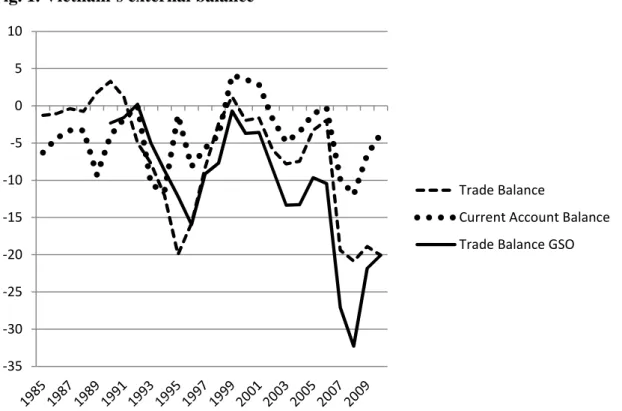
However, with rapid growth and massive capital inflows, the country has experienced growing macroeconomic turbulence in recent years. Between 2005 and 2007, the current account deficit increased from 0.9% to 9.8% of GDP (Fig. 1) while the capital account surplus increased even faster, from 4.8% to 24.6% of GDP (World Bank, 2008). Net positive capital inflows have led to demand pressures and subsequent changes in relative prices. Inflation rates averaged 16% a year between 2008 and 2011, asset price bubbles emerged while the country was coping with persistent pressures on its currency, loss of international reserves and capital flight.
According to the World Bank (2011), the government addressed these macroeconomic imbalances by relying almost exclusively on tight monetary policy, but it has yet to tackle their root causes. From our point of view, the analysis of macroeconomic instability in Vietnam cannot be dissociated from the country’s BoP position. Substantial current account deficits and the rising capital inflows
to finance them played a significant part in disturbing macroeconomic stability. Based on these stylised facts, the question that naturally arises here is whether the country is growing faster than the rate allowed by its BoP equilibrium.
To this purpose, our paper examines the long run relationship between economic growth and the current account balance equilibrium by relying on the BoP constrained growth model, originally developed by Thirlwall (1979). While the conventional theories of growth rely on neoclassical models to explain supply side issues originating from factor accumulation, technological progress or the contribution of productivity growth, this alternative approach emphasises demand driven mechanisms which limit growth. It postulates that the BoP equilibrium of a country is the primary constraint on its economic growth in the long run.
However, our study fills a number of gaps in the literature. From a theoretical point of view, the analytical framework proposed here improves over previous attempts to extend Thirlwall’s law to a multi country setting, by allowing for a more rigorous disaggregation of the BoP constraint among different partner areas (Bagnai et al., 2012). More precisely, we verify the importance of the different channels of transmission involved (real growth, changes in relative prices and import/export market shares). From an empirical point of view, the paper provides fresh evidence on growth performance in Vietnam since Doi Moi, using annual data from 1985 to 2010. There have been a lot of studies applying the BoP constrained growth model to individual countries and groups of countries (Thirlwall, 2012). But to our knowledge, no empirical study has yet tested the model for Vietnam; neither has there been an analysis of long run growth since the country’s accession to the WTO.
The paper is structured as follows. Section 2 presents the BoP constrained growth model and the main extensions proposed in our study. Section 3 describes the methodological aspects of the estimation process. Section 4 presents and interprets our empirical results. Considering the recent
global slowdown, Section 5 attempts some simulation exercises to forecast the impact of external shocks on Vietnam’s future growth. Section 6 summarizes our main results.
II. The theoretical background
Thirlwall’s Law and the developing countries
The relationship between exports and economic growth is among the richest debates present in development macroeconomics. While it has been widely explored in the economic literature (both in the light of international trade theory and growth theory), this relationship is focused here from the point of view of the BoP related factors. For most developing countries, foreign exchange is a scarce resource whose shortage, determined by persistent BoP deficits, may impair growth. The BoP constrained growth model postulates that overall growth of an open economy is primarily constrained by the need to generate foreign exchange, and emphasises the role of demand as the driving force for domestic growth. According to Thirlwall (1979), the relationship between the growth rate of a country and its BoP is the fundamental law for growth because the BoP sets an
upper limit to growth compatible with trade balance equilibrium. In contrast to the other
components of aggregate demand, export is the only one whose expansion stimulates economic growth without leading into a deterioration of the BoP. The role of export performance is then emphasised because no other component of aggregate demand provides the foreign exchange to pay for import requirements associated with the expansion of output (Hussain, 1999).
Thirlwall's Law is expressed in these terms: ‘In the long term, no country can grow faster than the
rate consistent with the balance of payments equilibrium on the current account unless it can finance ever growing deficit which, in general, it cannot’. Consequently, there is a growth rate that
a country cannot exceed for prolonged periods, because if it does, it will quickly run into BoP difficulties. This is the ‘BoP equilibrium growth rate’.
In its basic form, the BoP constrained growth model is a simple model which derives from the demand functions for imports and exports:
π ψ Y EP P M f = (1) ε φ Z P EP X f = (2) M EP = PX f (3)
Where M and X are imports and exports in real terms, P are domestic prices, E is the nominal
exchange rate (the price in domestic currency of one unit of foreign currency), Pf are foreign prices
in foreign currency, Y is real domestic GDP, and Z is world real GDP. The positive parameters
ψ
,π
,φ, ε
denote respectively the price and income elasticities of imports and exports. Equation (3) statesthat in the long run, the current account of the BoP must be balanced.3
By taking growth rates, substituting (1) and (2) into Equation (3), and by assuming constant relative prices, we solve for the domestic income growth rate which is compatible with the BoP equilibrium:
π
π
ε
Z X YBP & & & = = (4)Where a dot over the variables indicates growth rates.
Thirlwall’s Law postulates that the rate of growth of an open economy which is consistent with BoP
equilibrium (denoted here Y& ) is determined by the growth rate of its volume of exports divided by BP
the income elasticity of imports. Put differently, the BoP equilibrium growth rate depends on the growth of world income and on the relative size of the income elasticities of demand for exports
and imports. If a country’s growth rate is lower than Y& , the country will accumulate trade BP
surpluses and will be a net capital exporter. Conversely, if its actual growth exceeds Y& , the BP
current account will worsen and the country will become a net capital importer, implying growth of
capital inflows: but this cannot continue indefinitely.4 An economy is ‘BoP constrained’ whenever
its growth rate must adjust downwards to maintain the BoP equilibrium.
Two remarks are worth emphasising at this stage. Firstly, the model assumes that developing countries operate at less than full capacity, as a result of the lack of foreign exchange and other structural bottlenecks. However, although it places emphasis on growth in demand to raise capacity utilisation, it does not mean that supply factors are unimportant. Rather, any production bottleneck that restricts export growth will be damaging for growth (Felipe et al., 2009). But the dominant constraint is the external constraint.
Secondly, this approach provides a rationale for an export led growth model because exports are the only one component of demand whose growth simultaneously relaxes the BoP constraint.
Therefore, policies designed to increase the income elasticity of export (
ε
) concern the changingcomposition of exports and the measures to improve the performance of exports. But these efforts
could be hindered by the country’s ‘appetite’ for imports (π), that is: the degree of dependence on
imports. This implies that the same rates of export growth in different countries do not produce the same rates of economic growth, because of the existence of different income elasticities of imports.
The theoretical background proposed in our study will extend the original BoP constrained growth model in two ways. Firstly, the hypothesis of relative price constancy in Equation (4) is contradicted by the evidence that developing countries’ terms of trade are trending in the long run, in support of the Prebisch-Singer hypothesis (Faini et al., 1992; Sapsford and Chen, 1998). Such
4 However, there is an asymmetry in the adjustment process resulting from the BoP position. In contrast to a BoP
deficit, a country with a BoP surplus can accumulate foreign exchange reserves almost indefinitely whenever it grows lower than the BoP equilibrium growth rate, so that there is no pressure on the country to raise its growth rate until it reaches its upper limit.
price changes appear to be relevant in transition economies like Vietnam, where the abolition of price and exchange rate controls in 1987, followed by international integration, marked substantial adjustment in relative prices (Fig. 2). Therefore, we decided to include the role of relative price changes in the analytical framework.
(Insert Figure 2 here)
Our second extension deals with the income elasticities of exports and imports: with a rise in π for
instance, Y& will decrease and tighten the BoP constraint. However, does the original Thirlwall's BP
Law provide a unified framework for explaining any change in this behavioural parameter?
In the original model, the long term economic growth of an open economy is determined by the rate of growth of aggregate exports, which is, in turn, determined exogenously by the given growth of ‘world income’. In practice however, an individual country trades goods and services with a number of partner countries, and each bilateral trade relations may have different outcomes. Since the economic growth of a country depends on the growth rate of other countries through the BoP constraint, this mutual interdependence should be captured in a model with multilateral trade relations between the individual country and blocks of countries. By the same token, the import behaviour should be differentiated among the selling countries to assess how geography can be a determinant of trade relations. In view of this, our theoretical background extends the original Thirlwall’s Law by developing a multi country setting both at the export and the import sides. By doing so, we will be able to identify the structural parameters and what they say about the BoP constrained growth rate.
A multi country version of Thirlwall’s Law
The analytical extension is made by assuming that a given country i has n trading partners, which requires disaggregation of the model to allow for several countries. The bilateral trade flows of
country i was disaggregated into five main partner areas: j = A, B, C, D, E (see Appendix A for country grouping). Equation (3) which states the current account equilibrium becomes:
∑
∑
= = = E D C B A j ij j ij E D C B A j ij i X E PM P , , , , , , , ,where Pi are country i export prices, Xij is the real demand of partner j for country i exports, Eij is
the bilateral nominal exchange rate, Pj are export prices in j, and Mij are country i imports from
partner j. Assuming away accounting problems, we consider that Xij = Mji, that is: the exports from
country i to partner j must equal the imports of the latter from the former. This ‘mirror flows’ identity, which is routinely exploited as a convenient simplification in a number of multi country models, offers some practical advantages in terms of data collection and of the specification of the demand functions. Notably, it enables us to work only with import functions.
By exploiting this symmetry, we reformulate the model as follows:
ij ij i j ij i ij Y P E P M π ψ = (5) ji ji j i j ij ji Y P P E M π ψ = (6)
∑
∑
= j ij j ij j ji i M E PM P (7)Where, in addition to the previous variables, ψij and πij are respectively the price and income
elasticities of country i imports from partner j, Mji is the real demand of partner j for imports from
country i (namely, exports from country i to partner j), ψji and πji are the corresponding price and
income elasticities, and Yj is partner j real GDP.
Taking the growth rates in (7) we obtain:
(
)
∑
∑
= + + + j ij j ij ij j ji ji i M E P MP&
ν
&µ
& & & (8)Where: i ij j ji ji ji X X M M v = =
∑
∑
= j ij j ij ij j ij ij M P E M P E µ (j = A,B,C,D,E)νji and µij are respectively the market shares of partner j in country i total exports (in volume) and in
country i total imports (in value).
Solving for the growth rate of country i as before, and denoting Rij = Pi/(EijPj) the bilateral relative
prices (namely, the ratio of domestic to foreign prices expressed in domestic currency), we obtain a multi country version of Thirlwall’s Law:
(
)
[
]
∑
∑
∑
= = = + − − = E D C B A j ij ij E D C B A j j ji ji E D C B A j ji ji ij ij ij BP i Y R Y , , , , , , , , , , , , , 1π
µ
π
ν
ψ
ν
ψ
µ
& & & (9)The multi country specification allows us to separately assess the contribution of each group of countries to country i growth rate predicted by the model. We can observe that the numerator of the multi country law features both a relative price effect (whose sign depends on the market shares weighted bilateral price elasticities), and a volume effect (a weighted sum of real export growth). The denominator instead features a weighted sum of bilateral income elasticities of imports that
corresponds to country i aggregate ‘appetite for imports’ =
∑
j
µ
ijπ
ijπ
. In other words, theaggregate income elasticity, that plays a crucial role in the single country version of Thirlwall’s law, is nothing but a ‘black box’ summarising behavioural parameters that are likely be subject to changes.
Another important feature of the multi country law is that it cannot be decomposed in bilateral terms. In fact, bilateral deficits are not constrained per se: as a consequence, the aggregate BoP constraint cannot be expressed as an additive function of bilateral balances. Having said this, one can measure however the contribution of partner j variables (either in country i export market or import demand) to changes in the aggregate BoP constraint of country i (see Bagnai et al., 2012).
III. Data and estimation issues
In a first step, the long run elasticities featuring the BoP constraint are estimated through the following ten loglinear bilateral trade equations:
mj,t = αj +ψi,j rj,t + πi,j yi,t + uj,t (j = A,B,C,D,E)
xj,t = βj−ψ j,i rj,t + πj,i yj,t + ej,t (j = A,B,C,D,E)
Where lower case letters indicate natural logs of the corresponding variables (therefore, rj,t = pi,t –
ei,j,t – pj,t), and uj,t and ej,t are error terms.
Appendix B provides the data sources and definitions that are used for estimation. In order to estimate the long run elasticities by cointegration, we first need to ascertain whether the Data Generating Process (DGP) of each series features a stochastic trend. The test was performed following the procedure suggested by Elder and Kennedy (2001). The rationale of this procedure, as well as the results, are reported in Appendix C. Summing up, all the time series involved in the estimation of the trade equations for Vietnam turn out to possess a unit root.
Having established the presence of stochastic trends in the DGP of our time series, we tested for the existence of a long run relation between the relevant variables by the usual Engle and Granger (1987) cointegrating residual ADF (CRADF) test. If this test rejected the null of non cointegration, we took the estimated elasticities as the relevant long run parameters. If instead the ordinary cointegration test failed to reject the null of non cointegration, we hypothesised that the non rejection could depend on the presence of a structural break in the long run parameters. In order to cope with this, we applied the cointegration estimator proposed by Gregory and Hansen (1996), which tests the null of non cointegration against the alternative of cointegration in the presence of a
structural break of unknown date. The breaks are modelled using the dummy variable ϕτt = I
US) 5, τ the relative timing of the change point, and [.] the integer part function. The Gregory and
Hansen procedure takes into account several possible alternative models, featuring a break in the intercept only (the ‘level’ shift), or in the intercept and in the slopes (the ‘regime’ shift). Moreover, some alternative modes include a time trend, which in turn can be modelled with or without a break. Owing to the relatively limited dimension of our sample, we decided to test the null of non cointegration against the simplest alternative, that of level shift, where only the intercept is affected
by the structural break.6
Taking the import equation as an example, the level shift is modeled as follows:
mj,t = αj0 + µj0ϕτt + ψi,j rj,t + πi,j yi,t + uj,t (j = A, B, C, D, E)
Where αj0 is the intercept in the first regime, ϕτt is the shift dummy variable defined before, µj0 is
the intercept shift, so that the value taken by the intercept in the second subsample is αj1 = αj0 + µj0.
It is worth noting that in the level shift case the income and price elasticities are unaffected, which implies that a structural break of this kind has no impact on the BoP constraint (as the relevant elasticities remain constant throughout the sample).
The test statistic is evaluated as ADF* =
( )
τ
τ ADFr
inf , where ADF(τ) is the cointegrating ADF
statistic corresponding to the shift occurring in [Tτ]. In other words, ADF* is the smallest among all
the ADF statistics that can be evaluated across all possible dates of structural breaks. The reported
break date T1 = [τT] refers to the last year of the first regime (that is, the change in the parameter
occurs between T1 and T1+1).
5 Since bilateral trade data with the US were subject to embargo until 1994 and only started thereafter, we were not able
to apply the Gregory and Hansen procedure to these equations.
6 Testing the null of non cointegration against other alternatives led to non rejection, or rejection with larger p-values,
or models with imprecisely estimated elasticities. It is worth noting that in our case, the so called regime shift alternative entails the loss of three (instead of one) degrees of freedom (corresponding to the three shift parameters).
IV. Results
The estimates of the long run elasticities
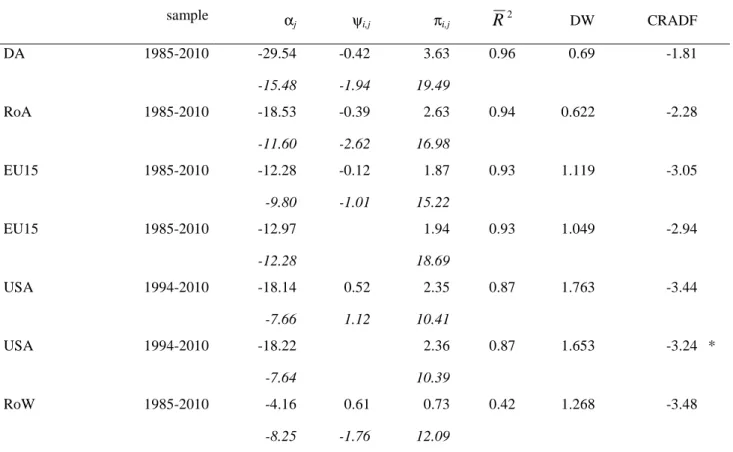
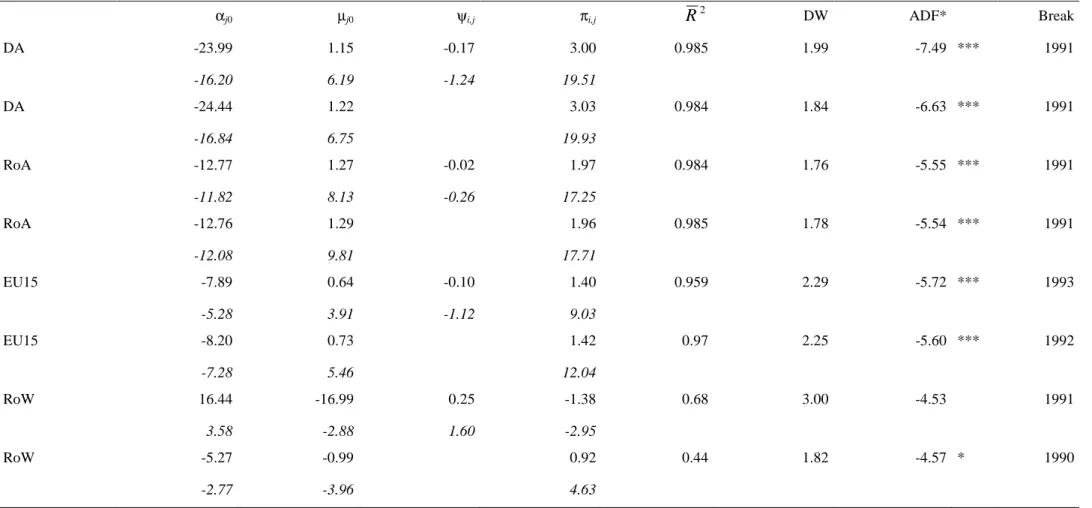
Tables 1 to 4 report the estimation results, starting from the import equations. The Engle-Granger CRADF (reported in Table 1), was unable to reject the null of non cointegration, with the limited exception of the imports from the US, where the null is rejected at the 10% significance level. In most cases, the relative price term is small and statistically insignificant. The Gregory-Hansen procedure confirms that bilateral import flows are rather inelastic to changes in relative prices (Table 2). The structural breaks in the bilateral import equations are all upward level shifts, with the only exception of the Rest of the World ( RoW) case, that features a downward level shift after 1990. This structural break with level shifts makes sense from an economic point of view. The year 1991 corresponds to the collapse of the Soviet bloc countries, forcing Vietnam to reform its trade relations. The country adjusted by shifting its bilateral trade flows from former socialist countries towards Western countries and the Asian neighbours.
(Insert Tables 1 to 4 here)
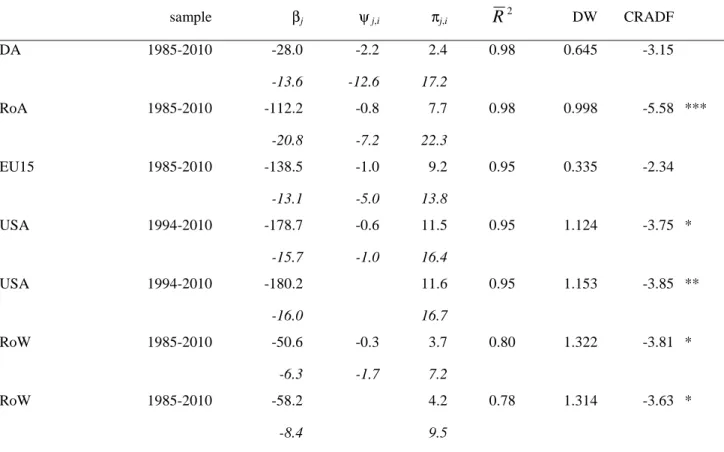
As far as the bilateral export equations are concerned, the results are similar, with two differences: the equations appear to be more stable (non cointegration is strongly rejected against a stable alternative in two cases, the Rest of Asia and the US), and the relative price elasticity is statistically significant in a number of cases (while it was never found to be significant in the bilateral import equations). As shown in Table 3, the Engle-Granger procedure rejects the null of non cointegration in the cases of the Rest of Asia (RoA), USA, and RoW (in the last case only at the 10% level). In the latter two cases the price elasticity, although correctly signed, is found to be statistically insignificant (although marginally in the RoW case). In the remaining cases, the Gregory-Hansen procedure rejects the null of non cointegration against the alternative of cointegration with an upward level shift (Table 4).
Despite using a relatively short sample (in terms of number of observations), all the relevant elasticities are estimated very precisely, with Student’s t typically ranging from about 5 to about 20. This result is consistent with the fact that as far as cointegration estimates are concerned, the sample length (in calendar terms) is more important than the number of observations (Otero and Smith, 2000).
(Insert Table 5 here)
Table 5 summarizes the long run elasticities that will be used to calculate the predicted growth rate for Vietnam. In brief, all the income elasticities are statistically significant and correctly signed, but their effects differ depending upon the partners and the trade considered. The highest values come from the income elasticities of the developed partners’ demand for Vietnam’s exports (the US, the RoA and the EU) and, additionally, there is evidence for higher income elasticities of exports than imports (with the notable exception of the Developing Asia, as will be discussed later). This implies that any favourable change in the Northern partners’ income (especially in the US with an export elasticity of 11.7) will have a great role in relaxing Vietnam’s BoP constraint through the export demand. The higher value of income elasticities of exports than imports means that with unchanged relative prices and market shares, if Vietnam grows at the same rate as its trading partners, the corresponding trade balance will improve.
Another picture that emerges is one where variations in the relative prices do not matter in Vietnam’s imports, neither in the country’s exports to the US and the RoW. This means that in the long run, a large part of foreign goods and services are imported regardless of changes in their prices. This is explained by the structure of Vietnam’s imports, where a large part is dominated by production goods (semi final products, intermediate and capital goods) that are not produced domestically. On the other hand, any competitive devaluation that decreases domestic prices relative to foreign ones will only boost exports to the Developing Asia, and slightly to the RoA and the EU.
The BoP equilibrium growth rate
A second step consists in comparing the average growth rates predicted by the BoP constrained
growth model (Y&BP) with the actual rates (Y& ): the purpose is to test whether or not the country’s
growth was constrained by the BoP related factors over the period 1985 to 2010. However, since most of the Asian countries were affected by the economic recession that hit the region after 1997, we split our time series into two subperiods: before (1985-1997) and after (1998-2010) the East Asian crisis.
(Insert Table 6 here)
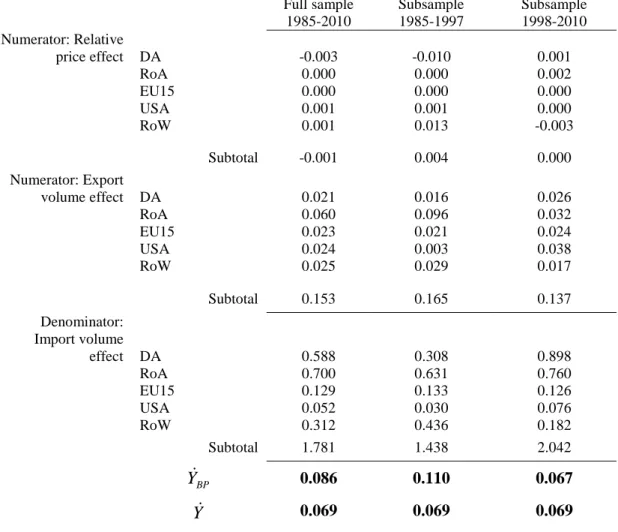
Table 6 reports the elements needed for the evaluation of the BoP equilibrium growth rate following Equation (9). Broadly speaking, Vietnam’s actual growth rate was below the constrained one during the entire period considered: 6.9% compared to 8.6% on average. This indicates that Vietnam was respecting its BoP constraint. This result can be explained looking at Equation (9). The estimation results showed that the coefficients of the relative price term are statistically insignificant in all import equations and in exports to the US and the RoW, allowing us to remove
them from the estimated equations (ψij = ψDi = ψEi = 0). Hence, the relative price effect in the
numerator of Equation (9) is very small, involving income changes to dominate in defining the BoP constraint. The export volume effect (namely, the second term in the numerator) contributes to an increase in the annual growth rate by 1.53%age point in aggregate, counterbalancing the adverse but minor relative price effect (-0.001 in aggregate). A closer look at Equation (9) shows that the volume effect depends on bilateral income elasticities and market shares of exports. The high income elasticities of exports create a favourable environment, allowing for instance growth of income in the RoA (which is the largest export market over the full sample, with a share of 33.2%)
to have a multiplier effect on Vietnam’s economic growth through the term νBiπBi. However, the
denominator reached 1.78 for the whole period under consideration. So, in view of a small effect of relative prices, the divergence between Vietnam’s actual growth rate and the growth of real exports
is explained by the high appetite of domestic demand for imports, mainly coming from the Asian area (high income elasticity of import from the Developing Asia, and the heaviest import market share from the RoA).
Substantial differences emerge however, when we look at averages for the two subperiods. While the actual growth rate displays a surprising stability (in view of the fact that the sample includes the East Asian crisis), the constraint shifts between the first and the second subsample. Prior to the East Asian crisis, Vietnam grew at a rate below the constrained rate, with a spread of 4.1%age points. The large part of trade that occurred with the former Soviet bloc countries may partially explain the much higher growth rate predicted by the model for this subperiod. Still, the sustained rapid growth achieved by the country after Doi Moi illustrates a situation where productive capacity was underutilised within the planned economy and then, the transition reforms brought resources into production. Thus, Vietnam between 1985 and 1997 may be described as capacity constrained, where the country was growing at its capacity growth rate without encountering BoP difficulties. The reverse occurs in the second subperiod, where Vietnam’s actual growth rate marginally exceeded the constrained rate (6.9% compared to 6.7%), resulting in capital inflows to bridge the financing gap. The spread between the BoP equilibrium and the actual averages, which decreased from 4.1 to about -0.2 percentage point, can be taken as evidence of increased demand constraint on Vietnam’s growth. As a matter of fact, the constrained growth rate fell from 11% to 6.7% after the Asian crisis, while the country actually kept growing at 6.9%. So, a question arises here: why was Vietnam’s equilibrium growth rate falling? Which partners were responsible for this and through which channel of transmission?
The previous table also reports the contribution of the various components of the BoP equilibrium growth rate; we can then analyse their changes between the two subperiods. Firstly, the strongest effect which contributed to tightening Vietnam’s BoP came from the volume of exports destined to
the RoA. With the heaviest weight in the bilateral income elasticity of exports, the Rest of Asia (namely, the developed Asia) sustained Vietnam’s export growth over the whole period considered. However, its GDP growth rate declined by 2 percentage points in the second subperiod, eroding Vietnam’s export performance. A Bilateral Trade Agreement (BTA) signed in 2000 between Vietnam and the US evidently boosted Vietnamese exports. But this only partially compensated the former negative effect: while the US contribution increased tenfold (from 0.3 percentage point to 3.8), the export volume effect for the RoA fell to one third (from 9.6 to 3.2).
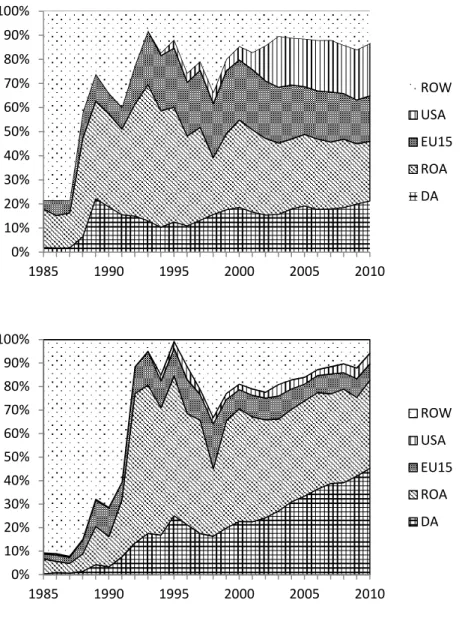
The second reason, which explains Vietnam’s tighter BoP constraint since the Asian crisis, is related to the structural parameters involved in the country’s appetite for imports. The denominator of Equation (9) rose from 1.54 to 2.04 between the two subperiods. While Vietnam was mainly dependent on imports from the Rest of Asia over the whole period considered, the most relevant change came from the share of the Developing Asia in Vietnam’s total imports. As it climbed from 10.1% before the Asian crisis to 29.6% in the last subperiod, the corresponding weighted bilateral elasticity rose sharply from 0.31 to 0.9. This indicates a strong asymmetry in bilateral trade relations between Vietnam and its developing neighbors: the country exports mainly to the advanced countries (with the highest export sensitivity to income changes for the US), but any rise in domestic activity will imply a sustained growth of imports from the Developing Asia. Fig. 3 depicts the evolution of Vietnam’s trade market shares over the period considered: as bilateral flows grew at different rates, the market shares evolved accordingly. Even if the bilateral income elasticities remained constant, the denominator changed over time and impacted negatively on the country’s BoP position.
(Insert Figure 3 here)
These evolutions are consistent with the pattern of economic integration in East Asia, where latecomer countries like Vietnam joined the international production networks organized by multinational firms. The ASEAN Free Trade Area (AFTA) joined by Vietnam in 2001 removed
trade barriers throughout the region and a further step has been taken forward to transform the free trade area into a single market with the establishment of an ASEAN Economic Community by 2015 (Fujita et al., 2011). Meanwhile, subsequent bilateral FTA with China, South Korea and Japan (that is, ASEAN+3) was launched in 2005, 2007 and 2008 respectively, followed by India, Australia and New Zealand (the ASEAN+6 grouping). All these countries are taken into account in our country grouping and show the empirical relevance of our study.
In line with a fragmentation process which has proliferated in the region, the UNCTAD (2008) showed that the largest wave of production sharing schemes has been found in East and South East Asia, often as a part of triangular (South–South–North) trading network. The region is now functioning as a world factory, trading production goods (especially parts and components used for export oriented industries) within the region, and then exporting final products to overseas
destinations.7 Vietnam, as a newcomer in the production network, has experienced dramatic
changes according to the region’s production oriented trade structure. After the regional crisis in 1997, its appetite for imports coming from Asia reached 1.66 out of 2.04 in the denominator. Our study finds evidence in support of Sepheri and Akram-Lodhi (2005), whose estimates for import behaviour demonstrated that Vietnam’s growth is highly dependent on imported capital and intermediate goods. Thus, the greater the rate of capacity utilisation through exports, the greater the extent of necessary imports to keep production moving.
V. Impact of the current global crisis
FilteringA last step of our study assesses the impact of the current global crisis on Vietnam’s economic growth. More precisely, the over reliance on the high income markets for exports has been
7 According to Fujita et al. (2011), East Asia absorbs only a quarter of the consumption goods exported from Asian
questioned since 2008. In order to address this issue, we look at the evolution over time of the BoP constrained rate. Since the BoP constraint is in its nature a long run constraint, we take into account the long run component of the relevant variables, and compare it with an estimate of the long run growth rate.
The long run component of each series was extracted using the Hodrick and Prescott (1997) filter.
The filter computes the smoothed (long run) component st of a series yt by minimising the variance
of the deviation of yt from st, subject to a penalty that constrains the second differences of the
smoothed series. The long run component st thus minimizes the following expression:
(
)
∑
[
(
) (
)
]
∑
− = + − = − − − + − 1 2 2 1 1 1 2 T t t t t t T t t t s s s s s y λThe
λ
parameter equals 100, namely the value suggested by Hodrick and Prescott (1997) whendealing with annual data.
(Insert Figure 4 here)
The filtered series were then inputted in Equation (9), providing us with a time varying estimate of the BoP constraint. The estimate allows us to confirm the previous results (Fig. 4). After successful transition reforms through Doi Moi, Vietnam grew at an impressive rate. From a capacity constrained growth before 1993, the country grew almost at the same rate as the one predicted by the model until 2005 and then switched to a position where it is BoP constrained in its growth. This is not because it grew too fast as the historical rates remained almost stable, but because growth in the different components of demand has contributed to tightening the BoP constraint since 2005. The BoP constrained growth rate model can explain this relevant change. Export growth made a significant contribution to GDP growth, but given the import intensive pattern of growth, the greater the rate of export growth, the greater the extent of imports, and this contributed to deteriorating the BoP position. This is especially relevant in Vietnam, whose export growth was affected by economic slowdown in the RoA; whereas the import growth was simultaneously
accelerated by the process of regional integration (notably towards Developing Asia). Our previous decomposition allowed us to identify the international mechanisms through which Vietnam’s BoP position worsened, related to the nature of the country’s trade partnership.
Growth targets and the global economic turmoil
Vietnam’s Socio Economic Development Strategy (SEDS) for the period 2011 to 2020 identifies the country’s key priorities over the current decade. The overall goal is for Vietnam to lay the foundations for a modern, industrialised society by 2020. Accordingly, the government aspires to achieve a per capita income level of 3000 current USD by that year. This translates into a nearly 10% annual growth in per capita nominal GDP over the decade (World Bank, 2011). Under the five year Socio Economic Development Plan 2011-2015 (SEDP), the Vietnamese National Assembly set a target for real GDP growth of around 6.5-7% annually to meet this ambitious target. The total export receipts are expected to increase by 13%. Gross capital accumulation would occupy 33.5– 35% of GDP in this period, while the trade deficit rate would be gradually reduced from 2012 onwards and is expected to be 10% of total export turnover by 2015.
The question addressed here is whether the government’s medium run growth target is achievable in the context of a weaker global economic environment, and how the foreign exchange requirements will be filled to meet this target. To this purpose, we depart from the last assessment of GDP growth edited by the International Monetary Fund (IMF, 2012). We constructed our baseline scenario by compiling the IMF’s medium term projections for the period 2011 to 2017
with the filtered series for import and export market shares.8 The corresponding BoP equilibrium
growth rate is calculated by substituting our estimates of the long run income and price elasticities.
(Insert Table 7 here)
According to IMF projections, growth prospects differ across the partner areas: while the Developing Asia is expected to maintain a high rate (7.8% per year on average), activity in the Northern partners (the RoA, the EU and the US) will remain rather low. The relatively high growth rate in the RoW is attributable to the recent dynamic expansion of South–South trade, providing developing countries with a favourable external economic climate for export expansion (Bagnai et
al., 2012). Vietnam is expected to continue growing at a rate of 6.7% per year, which is consistent
with the government’s target (Table 7).
Compared with the 1998-2010 subperiod, we can see in our baseline scenario that, provided that all the partner areas confirm the growth rates projected by the IMF for the period 2011 to 2017, Vietnam’s BoP constraint would be relaxed by high demand growth in the RoA, the US and the RoW. The resulting growth rate predicted by the model lifts up (8.2%), enabling the country to achieve the growth target. In other words, the trade partnership through which Vietnam has integrated the global and regional economies, allows the government to achieve the medium growth target without encountering BoP problems.
However, in case the current crisis in the euro area does not lead to visible improvement in the external environment, this relevant change could be reversed. In this perspective, three scenarios are compared here. Scenario 1 assumes a sharp recession in the world economy, with a decrease in all partners’ GDP growth by one percentage point. Under scenario 2, the same slowdown in GDP growth specifically affects the Northern partners (the RoA, the US and the EU). Finally, scenario 3 assesses the geographical aspect of Vietnam’s trade integration and supposes that the Asian area is able to avoid the economic turmoil.
Under scenario 1, recession in all partner areas and the resulting slower demand for Vietnam’s exports will tighten the BoP constraint. As a result, the projected foreign exchange requirements to meet the growth target will imply heavier reliance on capital inflows. Under scenario 2, when only the Northern partners are affected by the economic turmoil, Vietnam’s BoP constraint is less
binding; but the corresponding growth rate (5.5%) remains lower than the government’s target and far lower than the growth rate estimated in the baseline. In other words, a demand led expansion in South–South trade may be a weak alternative locomotive of export expansion. Whatever the scenario undertaken, the ongoing recession reveals the vulnerability of Vietnam’s growth to the external economic climate, as the production networks built in the Asian area work to its disadvantage. To illustrate this argument, scenario 3 results in more optimistic projections when assuming that the Asian area is prevented from the global crisis. Vietnam’s BoP equilibrium growth rate is close to the target (6.2% against 6.5%), allowing the government to achieve the medium growth rate with few capital inflows to bridge the financing gap. In other words, continued robust economic expansion in the Asian region would attenuate the negative impact on Vietnam of what would otherwise be a global economic downturn.
VI. Conclusion
Vietnam has made important progress in achieving economic and social development over the past two decades. The country’s accession to the WTO paved the way to greater market liberalisation and foreign investment inflows. However, recent developments in Vietnam’s economic conditions suggest that the country’s BoP problems come from its integration into global and regional economies. In the face of rapid growth with structural change in trade partnerships, the connection between growth and BoP cannot be ignored.
In view of this, our paper examines the long run relationship between economic growth and the current account balance equilibrium by relying on a multi country BoP constrained growth model. The question that is addressed here is whether the country grows faster than the rate allowed by its BoP equilibrium, and what are the international factors that could prevent any attempt to achieve a sustained growth of rate. The theoretical background proposed in the paper provides a convenient analytical framework to explore BoP related limits to Vietnam’s growth. It then contributes to the
ongoing discussion on some of the most pressing issues about the growth process of developing countries: does participation in the globalized economy through export led growth contribute to relaxing the BoP constraint?
The model specified was estimated using annual data for the period between 1985 and 2010. Notably, we explored differences in behaviour between the two decades covered by our sample period and between trading partners. Our results show that Vietnam grew less than the rate predicted when the period as a whole is considered. However, the model yielded different behaviour for the 1998-2010 subperiod, where the country appeared to be BoP constrained in its growth. In addition, a general picture that emerges is one where the relative price effect is neutral, allowing the volume effects to dominate in setting the BoP constraint: in other words, it is income that adjusted in order to maintain the BoP equilibrium. The high income elasticities of exports enable growth in the advanced countries to have a multiplier effect on the Vietnamese economy. This suggests that Vietnam has partially benefited from a change in bilateral or multilateral trade policies with those partners (for instance, the US-VN BTA). However, growth is hindered by the high ‘appetite’ of the Vietnamese economy for imports, mainly coming from the whole of Asia. The latter features a production oriented trade structure which has proliferated in the region, often as a part of triangular (South–South–North) trading network. In light of the diagnostics, a last step addressed the impact of global recession on Vietnam’s growth for the period 2011 to 2017. With slower demand for exports, the BoP constraint becomes more binding whatever growth projections in the partner areas. However, the capital inflows needed to fill the foreign exchange gap are more limited when the Asian partners keep growing and remain unaffected by the global economic turmoil.
A country’s trade integration offers both the prospect of faster growth and the risk of greater turbulence. For most of the developing countries, exports have become the main driver of economic
growth: since exports represent a source of foreign exchange, the analysis developed here provides a rationale for an export led growth strategy. However, our results suggest that this strategy is highly vulnerable to the external economic environment, notably through the constraint imposed by the pace of growth of high income countries’ demand for exports. Vietnam’s growing appetite for imports is also a worrying concern: to keep pace with the globalising economy, the country will need to reconcile its financing needs with a prudent reliance on foreign saving. To the extent that the outward orientation of the country does not determine a faster increase in imports, one source of growth finance is export revenue, because it is the only one component of demand that can pay for
the import content of allthe components. Finally, there is a need for stronger export diversification
to ensure stable revenue for imported inputs requirements. The ability to develop exports holds the key to reconciling financing needs with macroeconomic stability in an open developing economy.
References
Abbott, P., Bentzen, J. and Tarp, F. (2009) Trade and development: Lessons from Vietnam’s past trade agreements, World Development, 37, 341-353.
Bagnai, A., Rieber, A. and Tran, T.A.D. (2012) Generalised BoP constrained growth and South-South trade in Sub Saharan Africa, in Models of Balance of Payments Constrained Growth:
History, Theory and Empirical Evidence (Eds) E. Soukiazis and P.A. Cerqueira, Palgrave
MacMillan, Basingstoke, forthcoming.
Campbell, J.Y. and Perron, P. (1991) Pitfalls and opportunities: what macroeconomists should know about unit roots, in NBER Macroeconomics Annuals 1991, Vol. 6, MIT Press, Cambridge MA, pp.141-201.
Cline, W.R. (1982) Can the East Asian Model of Development be generalised?, World
Dickey, D. and Fuller, W. (1979) Distribution of the estimators for autoregressive time series with a unit root, Journal of the American Statistical Association, 74, 427-431.
Dolado, J., Jenkinson, T. and Sosvilla-Rivero, S. (1990) Cointegration and unit roots, Journal of
Economic Surveys, 4, 249–73.
Elder, J. and Kennedy, P.E. (2001) Testing for unit roots: what should students be taught?, Journal
of Economic Education, 32, 137-46.
Engle, R.F. and Granger, C.W.J. (1987) Cointegration and error correction: representation, estimation and testing, Econometrica, 55, 251-276.
Faini, R., Clavijo, F. and Senhadji-Semlali, A. (1992) The fallacy of composition argument. Is it relevant for LDCs’ manufactures exports?, European Economic Review, 36, 865-82.
Felipe, J., McCombie, J.S.L. and Naqvi, K. (2009) Is Pakistan’s growth rate Balance of Payments constrained? Policies and implications for development and growth, Asian Development Economics, Working Paper Series, No.160, Asian Development Bank, Manila.
Fujita, M., Kuroiwa, I. and Kumagai, S. (2011) The Economics of East Asian Integration, Edward Elgar, Cheltenham, UK.
Gregory, A.W. and Hansen, B.E. (1996) Residual based tests for cointegration in models with regime shifts, Journal of Econometrics, 70, 99-126.
Hodrick, R.J. and Prescott, E.C. (1997) Postwar U.S. Business Cycles: An Empirical Investigation,
Journal of Money, Credit, and Banking, 29, 1–16.
Hussain, M.N. (1999) The Balance of Payment Constraint and Growth Rate Differences among African and East Asian Economies, African Development Review, 11, 103-137.
IMF (2012) World Economic Outlook, International Monetary Fund, Washington D.C.
Mayer, J. (2003) The fallacy of composition: a review of the literature, UNCTAD Discussion Papers No.166, United Nations, Geneva.
Otero, J. and Smith, J. (2000) Testing for cointegration: power versus frequency of observation – further Monte Carlo results, Economic Letters, 67, 5-9.
Sapsford, D. and Chen, J.R. (1998) The Prebisch-Singer Terms of Trade Hypothesis: Some (Very) New Evidence, in Development Economics and Policy (Eds) D. Sapsford and J.R. Chen, Macmillan, London.
Sepheri, A. and Akram-Lodhi, A.H. (2005) Transition, Savings and Growth in Vietnam: A Three gap Analysis, Journal of International Development, 17, 553-574.
Thirlwall, A.P. (1979) The Balance of Payments Constraint as an Explanation of International Growth Rate Differences, Banca Nazionale del Lavoro Quarterly Review, 128, 45-53.
Thirwall, A.P. (2002) The Nature of Economic Growth. An Alternative Framework for
Understanding the Performance of Nations, Edward Elgar, Cheltenham.
Thirlwall, A.P. (2012) Balance of Payments Constrained Growth Models: History and Overview, in
Models of Balance of Payments Constrained Growth: History, Theory and Empirical Evidence
(Eds) E. Soukiazis and P.A. Cerqueira, Palgrave MacMillan, Basingstoke, forthcoming.
UNCTAD (2008) South-South Trade in Asia: the Role of Regional Trade Agreements, United Nations and JETRO, New-York and Geneva.
World Bank (1993) The East Asian Miracle, World Bank, Washington DC.
World Bank (2008) Vietnam Development Report 2009: Capital Matters, Vietnam Consultative Group Meeting, Hanoi, December.
World Bank (2011) Vietnam Development Report 2012: Market Economy for a Middle income
Appendix A. Countries
Group A (Developing Asia, DA): Bangladesh, Bhutan, Cambodia, China, India, Indonesia, Lao
PDR, Malaysia, Mongolia, Nepal, Pakistan, Philippines, Sri Lanka, Thailand.
Group B (Rest Of Asia, RoA): Australia, Brunei, French Polynesia, Hong Kong, Japan, Macao,
New Caledonia, New Zealand, North. Mariana Islands, Singapore, South Korea.
Group C (EU15): Austria, Belgium, Denmark, Finland, France, Germany, Greece, Ireland, Italy,
Luxembourg, Netherlands, Portugal, Spain, Sweden, United Kingdom.
Group D: USA
Group E: Rest of the World ( RoW)
Appendix B. Data sources and definitions
The bilateral trade flows of Vietnam to and from each partner region were reconstructed using the Comtrade database. The sample runs from 1985 through 2010. Missing data in the bilateral trade series were reconstructed as follows: if either of the two flows is missing, we use its ‘mirror’. If instead they are both reported but with different values, the bilateral series are reconstructed as a weighted average of the import and the export ones (where imports receive a 2/3 weight). The data on the bilateral trade relations between Vietnam and the RoW are missing from the beginning of the sample through 1997. The two series were reconstructed taking for each the difference between the total flow, extracted from the World Development Indicators (WDI) database, and the sum of the other bilateral flows. Then we calculated the RoW flows by subtracting from the total the other four bilateral trade series.
Since the Comtrade series are in USD at current prices, in order to get their real counterparts, the
import series Mj were deflated using country j aggregate export deflator (evaluated as the ratio of
nominal to real exports in USD), while the export series Xj were deflated using Vietnam export
deflator (evaluated accordingly). Vietnam export deflator was missing from 1985 to 1988. The missing data were retropolated using the GDP deflator growth rate. The data on nominal and real
aggregate exports and GDP come from the 2012 edition of the WDI database. All real variables are measured in USD at 2000 prices.
Relative prices were constructed as the ratio of domestic prices (measured by Vietnam export deflator) to foreign prices (measured by partner j GDP deflator). The estimation was also performed using a terms of trade variable constructed as the ratio of Vietnam export deflator to the partner export deflator (that is, to Vietnam import deflator). The empirical results (available upon request) did not compare favourably with the one presented in the paper.
Appendix C. Unit root tests
As well known, the results of unit root tests are strongly dependent on the correct specification of the deterministic component (drift and trend) of the underlying Data Generating Process (DGP). Misspecification of the deterministic component may entail a loss of power (see Campbell and Perron, 1991). In order to cope with this issue, we adopted the testing strategy proposed by Elder and Kennedy (2001). In short, this strategy uses the a priori information, provided by the pattern of the time series, in order to rule out those alternative hypotheses that are inconsistent with the observed behaviour of the data. This allows the researcher to decide on both the correct specification of the deterministic component and the presence of a unit root using a single test, thus reducing the multiple hypotheses testing issues presented by other testing strategies (such as the one proposed by Dolado et al., 1990).
First, the plot of the series is inspected, in order to verify whether it exhibits a trending behaviour. If
the series is trending, we perform an F test for the null hypothesis H0: ρ=1, β=0 in the model:
yt = α+ βt + ρ yt-1 +
ε
tThis F statistic has a non standard distribution under the null and is compared with the critical
values of the Φ3 statistic provided by Dickey and Fuller (1979). Failure to reject the null implies
(namely, ρ<1, β≠0). The other possible alternatives are ruled out, being inconsistent with the observed data behaviour (see Elder and Kennedy, 2001).
If instead the series does not display a regular trending behaviour, we test the null hypothesis
H0:ρ=1, α=0 in the model:
yt = α+ ρ yt-1 +
ε
tIn this case the F statistics follows the Φ1 distribution by Dickey and Fuller (1979). Failure to reject
implies that the series is I(1) without drift, while rejection implies that the series was generated by an I(0) process with unconditional mean different from zero. In both cases, lags of the differenced dependent variable were added to the equation in order to whiten its residuals. The lag length was determined by reduction, starting from a maximum order of lags equal to 2, which was deemed appropriate considering the sample length and the fact that we are using annual data.
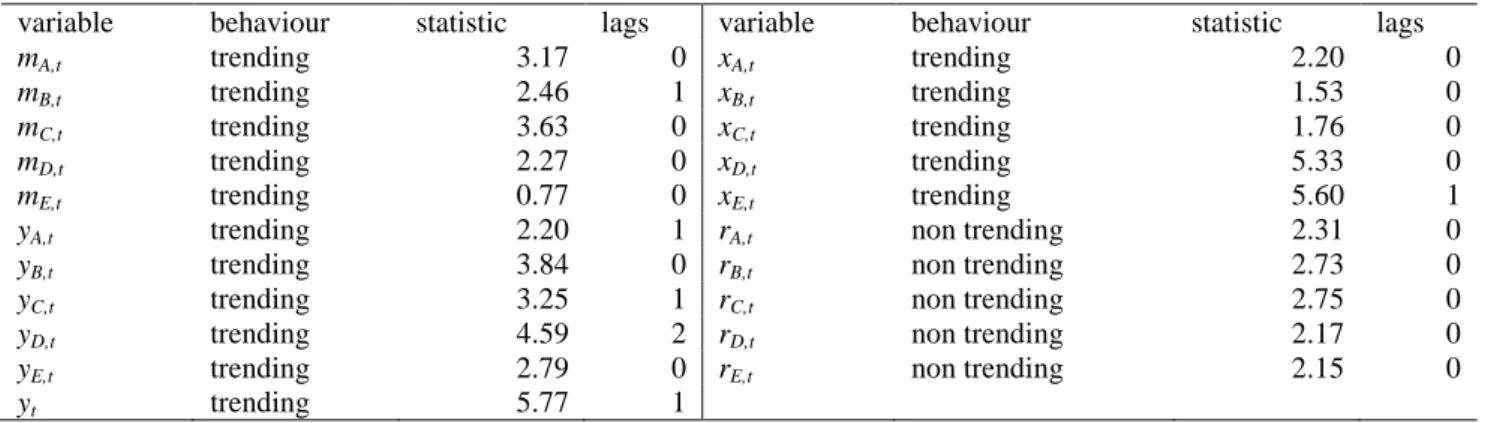
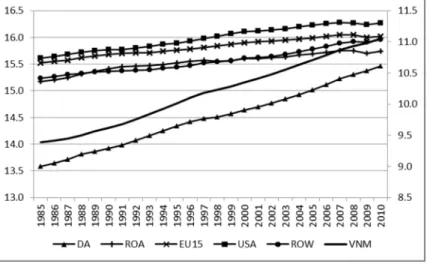
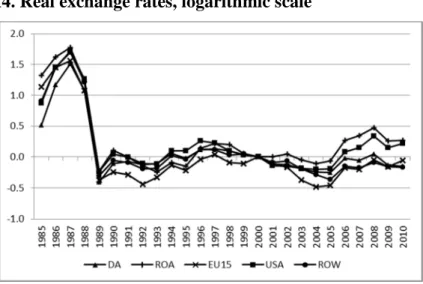
The results of the tests are summarized in Table A1, while the Figs from A1 to A4 illustrate the time series pattern of the data. Starting from the latter, all the variables, except relative prices, display a clear trending behaviour, that could be compatible with either a I(1) with drift process, or with a I(0) process with deterministic trend. The relative price series, instead, display a pronounced reversal occurring at the beginning of the 1990s, which is incompatible with the presence of a deterministic trend. The results show that in all cases we were unable to reject the unit root null.
Table A1. Unit root tests
variable behaviour statistic lags variable behaviour statistic lags
mA,t trending 3.17 0 xA,t trending 2.20 0
mB,t trending 2.46 1 xB,t trending 1.53 0
mC,t trending 3.63 0 xC,t trending 1.76 0
mD,t trending 2.27 0 xD,t trending 5.33 0
mE,t trending 0.77 0 xE,t trending 5.60 1
yA,t trending 2.20 1 rA,t non trending 2.31 0
yB,t trending 3.84 0 rB,t non trending 2.73 0
yC,t trending 3.25 1 rC,t non trending 2.75 0
yD,t trending 4.59 2 rD,t non trending 2.17 0
yE,t trending 2.79 0 rE,t non trending 2.15 0
yt trending 5.77 1
For trending series we applied the Φ3 test and for non trending series the Φ1 test by Dickey and Fuller (1981). The 5%
Fig. A1. Real GDP, logarithmic scale (Vietnam is plotted against the right hand scale)
Fig. A2. Real exports, logarithmic scale
Figures
Fig. 1. Vietnam’s external balance
Sources: Trade balance, UN Comtrade and General Statistics Office of Vietnam (GSO); Current account balance, IMF
World Economic Outlook.
Fig. 2. Vietnam’s export and GDP deflators
Source: World Bank World Development Indicators
-35 -30 -25 -20 -15 -10 -5 0 5 10 Trade Balance
Current Account Balance Trade Balance GSO
0,00 0,50 1,00 1,50 2,00 2,50 3,00 3,50 4,00 4,50 px_VN py_VN
Fig. 3. Export and import market shares (respectively in volume and in value)
Fig. 4. The HP series of BoP equilibrium and actual growth rates
0% 10% 20% 30% 40% 50% 60% 70% 80% 90% 100% 1985 1990 1995 2000 2005 2010 ROW USA EU15 ROA DA 0% 10% 20% 30% 40% 50% 60% 70% 80% 90% 100% 1985 1990 1995 2000 2005 2010 ROW USA EU15 ROA DA 0,000 0,020 0,040 0,060 0,080 0,100 0,120 1990 1992 1994 1996 1998 2000 2002 2004 2006 2008 2010 YBoP Y
Export market shares
Tables
Table 1. Bilateral imports equations, Engle and Granger estimation
sample αj ψi,j πi,j 2
R DW CRADF DA 1985-2010 -29.54 -0.42 3.63 0.96 0.69 -1.81 -15.48 -1.94 19.49 RoA 1985-2010 -18.53 -0.39 2.63 0.94 0.622 -2.28 -11.60 -2.62 16.98 EU15 1985-2010 -12.28 -0.12 1.87 0.93 1.119 -3.05 -9.80 -1.01 15.22 EU15 1985-2010 -12.97 1.94 0.93 1.049 -2.94 -12.28 18.69 USA 1994-2010 -18.14 0.52 2.35 0.87 1.763 -3.44 -7.66 1.12 10.41 USA 1994-2010 -18.22 2.36 0.87 1.653 -3.24 * -7.64 10.39 RoW 1985-2010 -4.16 0.61 0.73 0.42 1.268 -3.48 -8.25 -1.76 12.09
The t-statistics are reported in italic under the coefficient estimates. DW is the statistic of the Durbin-Watson test, CRADF is the cointegrating residual augmented Dickey-Fuller test. An asterisk indicates rejection at the 10% level.