HAL Id: tel-01246698
https://pastel.archives-ouvertes.fr/tel-01246698
Submitted on 19 Dec 2015
HAL is a multi-disciplinary open access
archive for the deposit and dissemination of sci-entific research documents, whether they are pub-lished or not. The documents may come from teaching and research institutions in France or abroad, or from public or private research centers.
L’archive ouverte pluridisciplinaire HAL, est destinée au dépôt et à la diffusion de documents scientifiques de niveau recherche, publiés ou non, émanant des établissements d’enseignement et de recherche français ou étrangers, des laboratoires publics ou privés.
The strategic value of sustainability and its disclosure :
Three essays on the Impact of Sustainability
Performance, Disclosure & Reputation on Firms’
Financial Performance
Samuel Touboul
To cite this version:
Samuel Touboul. The strategic value of sustainability and its disclosure : Three essays on the Impact of Sustainability Performance, Disclosure & Reputation on Firms’ Financial Performance. Business administration. HEC, 2013. English. �NNT : 2013EHEC0004�. �tel-01246698�
ECOLE DES HAUTES ETUDES COMMERCIALES DE PARIS
Ecole Doctorale « Sciences du Management / GODI » - ED 533 Gestion Organisation Décision Information
THESE
présentée et soutenue publiquement le 18 Juin 2013 en vue de l’obtention du
DOCTORAT EN SCIENCES DE GESTION
Par
Samuel TOUBOUL
JURYPrésidente du Jury : Madame Patricia CRIFO
Professeur des universités en Sciences Economiques, HDR Ecole Polytechnique & Université Paris Ouest
Directeur de Recherche : Monsieur Rodolphe DURAND
Professeur de Stratégie et Politique d’Entreprise, HDR Ecoles des Hautes Etudes Commerciales de Paris
Rapporteurs: Madame Magali DELMAS
Professor of Management
University of California, Los Angeles - USA
Madame Sonia JIMENEZ-GARCES
Professeur des universités en Sciences de Gestion Institut Polytechnique de Grenoble
CERAG (Université Pierre Mendès France de Grenoble)
Suffragants : Monsieur Bernard GARRETTE
Professeur de Stratégie et Politique d’Entreprise, HDR Ecoles des Hautes Etudes Commerciales de Paris
Madame Marie GERARD
Vice-Présidente Management & Performance
Direction de la Stratégie et du Développement Durable GDF-Suez
Monsieur Stéphane SAUSSIER
Professeur de Sciences Economiques
Institut d’Administration des Entreprises de Paris 1 Panthéon Sorbonne
[ THE STRATEGIC VALUE OF SUSTAINABILITY AND ITS DISCLOSURE ]
Three essays on the Impact of Sustainability Performance, Disclosure & Reputation on the Firms’Ecole des Hautes Etudes Commerciales
Le Groupe HEC Paris n’entend donner aucune approbation ni improbation aux opinions émises dans les thèses ; ces opinions doivent être considérées
Acknowledgements
“Life is like a box of chocolates, you never know what you’re gonna get”. For me completing my PhD degree was probably the most challenging activity of the first 28 years of my life, but also the most rewarding. This doctoral journey would not have been the same without the support and friendship of the fantastic people I met along this academic path. The first pages of this thesis are here to thank them all.
My first and undeniable debt of gratitude has to go to my advisor, Rodolphe Durand. Rodolphe has been the most enthusiastic, insightful and inspiring supervisor I could ever have. His deep involvement in every step of my thesis, the work he did by reading and commenting on all the drafts of my articles, the energy he has put in teaching me all he knew about research makes me believe that this thesis would never have been the same without him. Most importantly, I would never have learned so much along my Ph.D journey without his priceless commitment, his motivation and enthusiasm to make me succeed. I consider that really few supervisors with his qualities exist, and I’m extremely grateful to him for supervising me during those 4 years. I will always remember in my future career his precious thoughts: “Be positive, not normative!” and more obscure ones: “A paper is a paper!”… But above all his most remarkable achievement has been to open to me, a rigorous economist, the relevance of sociology and institutional perspectives. As I read the final words of this dissertation, I realize that under the mercilessly challenging research question that I developed: “What are the normative limitations to the use of signals?” lies a discussion between an economist with his signaling theory, and a sociologist with his normative perspective, lies 4 years of inestimable discussions between Rodolphe and I.
Besides my advisor, I also would also like to express my gratitude to the professors who agreed to be in my thesis committee: Patricia Crifo, Magali Delmas, Sonia Jimenez-Garces, Bernard Garette, Marie Gerard and Stéphane Saussier, first for taking the time to read this long thesis, I
~ 4 ~
really hope they will enjoy it, and most of all for the precious comments they may offer me, that I’m sure will contribute deeply to my future research.
It has been a great privilege to spend several years doing research in the prestigious institutions that are HEC, Polytechnique, and ESSEC. I would like to give my sincere acknowledgement to all professors who advised me and encouraged me all through this experience and provided me with their insightful and undeniable support. In order of appearance Albert Bemmaor and Marie Kratz, who introduced me to research at ESSEC, and without whose recommendations I would never have been accepted in a PhD program. Blaise Allaz, Franck Ceddaha, François Derrien, Evren Ors and Tristan Tomala from the HEC Finance department, who welcomed me in my first year of the PhD program and offered me my first fantastic experiences of teaching. Patricia Crifo (again) and Jean-Pierre Ponssard from the Ecole Polytechnique, who welcomed me into their laboratory, invited me to my first research seminar, and deeply impacted by their insights the main topic of my thesis. All the professors from the HEC Strategy department and specifically Bernard Garette (again), Pierre-Antoine Kremp and Anup Nandialath for their precious feedback on my first research works; and Tomasz Obloj, for his invaluable tips on how to get HEC students interested in my courses. A special thanks to Elie Matta, from the HEC Organizational Behavior department, for his valuable and smart advice, his awe-inspiring course on CSR, and his numerous (and surprisingly not too harsh) comments on my second paper. I would like also to give credit to my co-authors: Aaron Chatterji from Duke and David Levine from Berkeley, who let me into their research project and offered me my first submission to an alpha journal; Rodolphe Durand (again) for the great and rewarding experience of writing a paper with four hands, and Thomas Roulet, for the experience of publishing together our first paper. Research takes time and time is money, so this research journey would never have been possible without the financial support of many. I am deeply grateful to the HEC foundation (for financing my living expenses), to the GDF-Suez chair on “Business & Sustainability” and the HEC Society and the Organization Research Center (for financing the data without which this thesis would never have existed), and more particularly to Martine Wittig for letting me teach many courses at HEC, and Iris Ritter for inviting me to many HEC interviews as a Jury (which definitely financed all the other extras of my PhD track). Marie-Laure Dage, Laoucine Kerbache, Cecile Marty and Caroline Meriaux from the HEC PhD program have always been of great support (In my academic choices but also in my endless fight with the Notilus ERP), and clearly made this journey much easier. Academic-wise I finally would like to thank all the Masters students I have been teaching in the past years, who taught me as much as I taught them, and specifically those I have been supervising in their thesis work: Dominic Alemany, Christel Dekermandjian, Sophie Ghazal, Melanie Gilles, Jaafar Guessous, Lena Hoffmann, Alexander Ioffe, Jeremy Laurens, Pauline Leroy, Caroline Mamann, Philip Naegelein, Fabien Portier, Florence Procureur, Julie Raimondo, Justina Voveryte and Angela Ursic-Bedoya, I can now tell you that we were almost the same age.
I hope this thesis will be useful to professionals (who might not dare read it fully, but can directly switch to the conclusion which is dedicated to them), and particularly those I have been working
~ 5 ~
with during this thesis, who encouraged me to follow this PhD journey, and deeply impacted its conclusions: Loïc Ratton and Aymeric Marmorat at Entrepreneurs without Border, for introducing me to social entrepreneurship when I was still a young student; Ricardo Albarracin, Benoit Boisseuil, Jean-Luc Boulanger, Perter Kahng, Philippe Roussoully and Aleth Vinchon from CVA for teaching me how to excel in strategy consulting power points; Helina Lam, Andriy Martynenko and Marinus Sikkel from the United Nations ESCAP in Bangkok, for my first and unforgettable experience within an international organization; Cyrille Bellier, Michel Botzung, Luis Iseppe, Bastiaan Mohrmann, Loren Nadres, Janice Ryu, Houria Sammari, Jigar Shah, Pallavi Shah and Sylvia Zulu from the World Bank in Washington DC. My experience at the World Bank deeply impacted my interest in social entrepreneurship and the course I have been teaching in the past two years at HEC would have never been the same without them. Finally I would like to thank all the entrepreneurs who trusted me in developing their business plans, and to whom I should definitely thank for helping me emerge from my thesis when I needed it the most, but also whom I should kindly blame for making me miss most of the deadlines for this thesis work: Simon Legouge and Cynthia Castelletti from Green Tomato Media, thank you for the flight out to Malta, and the skype sessions from Chang Maï, they reminded me that the sun is always brighter somewhere else; Guillaume Rigallaud from Madame Aime, for the free lunches at his apartment; Alexandre Henry for the Whozzy adventure, for reminding me that in any business the most important thing is to have fun (and no, I will not put in my thesis that Whozzy is finally available on Ipad!); Sophie Vermeille, Olivier Jouffroy, Sébastien Denis, Tom François and Clément Mayer from the Rules for Growth Institute, for fighting with me to make research useful to practitioners; and finally of course the whole Business PhD in France community: Alireza Ahmadsimab, Thierry Amslem, Joel Bothello, Helen Etchanchu, Anne Jacqueminet, Benjamin Lehiany, Vlad-Andrei Porumb, Yves Rannou, Pedro Santos, Mahmood Zargar and the others without which PhD students in Paris would never have had a chance to meet up and “socialize” every two months.
A thesis is known to be a solitary work, a Way of the Cross. I had the chance not to be the only monk in this monastery. The support and friendliness of fellow PhD students has been crucial at all points of my thesis, and they deserve my deepest acknowledgement. My first thoughts go to Thomas Roulet (again) and Adrien Matray, my class mates at Sciences Po and Polytechnique, now my colleagues at HEC; to Lionel Paolella for those endless skype sessions trying to dig out the mysteries of STATA, and to Anne Jacqueminet (again), for creating with me (and her daughter Delphine) the course of social entrepreneurship at HEC. I wanted also to thank all my fellow PhD labmates for the stimulating discussions, the less stimulating ones, and for all the fun we had in the last years both in the program and in conferences around the world. Diane Laure Arjaliès, Vanina Forget, Samer Hobeika, François Perrot and Delphine Prady who supported my Master’s thesis work in the Economics department of Polytechnique; Jean-Noël Barrot, Thomas Bourveau, Hedi Benamar, Jérome Dugast, Marcus Fearnley, Luc Goupil and Marie Laclau for showing me that finance was not only, but also sometimes only Matlab simulations; Joao Albino-Pimentel, Birgul Arslan, Maxim Baer, Guilhem Bascle, Navid Bazazzian, Sebastian Becker,
~ 6 ~
Moumita Das, Panikos Georgallis, Martin Goosen, Tiphaine Jerome, Julien Jourdan, Kiattichai Kalasin, Alireza Kershavarz, Patrick Lam Le, Daniela Laurel, Yi Li, Pauline Perez, Chloée Renault, Anisa Shyti, Shiva Taghavi, Floor Van-Den-Born and Jean-Philippe Vergne from the HEC Strategy department. I will not be there any more to be able to see this but keep strong guys, I’m sure that our efforts lobbying will finally lead to having a Jacuzzi in the PhD room!
I have to say that I would never have reached the end of this rewarding, but sometimes challenging journey without my friends in France and other parts of the World. They have always been sources of laughter, joy and encouragement. I sincerely thank all of those, and they are numerous, without whom I would never have finished this journey. Those I met in Bangkok and who saw me drafting my first papers on the white sand beaches of a deserted island: Pauline Ameeuw, Marta Barazzetta, Prabhat Barnwal, Juliette Boumier, Sophie Diquélou, Cyril Espalieu, Thomas Etitia, Benjamin François, Aitor Garcia, Julie Gardet, Marine Gassier, Reyes Gomez Benito, Tanguy Jousse, Esther Levi, Darryl Miller, Lauriane Milis, Hind Naslouby, Thuy Nguyen, Marco Principi, Jan Staal, Dylan Tromp, Matthew Watkins, Cai Wei and Noémie Wetterwald; those I met in Washington DC and who never missed a session of Jazz in the Park with me: Cedric Allio, Cindy Audiguier, Yassine Cherkaoui, Olivier Devoret, Yohana Dukhan, Hélène Ehrhart, Roukaya El Houda, Soren Heitmann, Brodie McNabb, Johann Moreau and Vincent Olicki; and finally those, who have been following me from the beginning, who have been asking me for the last 5 years when my collection of diplomas will finally be completed, and to whom I’m proudly saying that I have finally reached the end of my studies: Brahim Ammarkhodja, Mohamed Bensaïd, Larbi Chraibi, Guillaume Bellon, Marie Bernard, Damien Börjesson, Camille Boyreau, Alice Cases, Jean-Baptiste Corbeau, Emilie Delaval, Alexandra Deligny, Julien Descatoire, Jérome Dewavrin, Yassine El Manouar, Sophie Gallavardin, Fréderic Gerber, Fabien Gicquel, Guillaume Gourbeix, Cécile Guérin, Maxime Guignot, Ciara Halleman, David Jeanjean, Blandine Laffargue, Jules Le Goff, Florent Le Guillouzic, Xavier Leseur, Sébastien Llanta, Brice Martineau, Edouard Manhes, Charlotte Melin, Anne-Sophie Maugis, Vincent Montmoreau, Hien Nguyen, Erwan Ogier, Fabien Palmero, Julien Pigeau, Eliott Reilhac, Romain Renard, Aurélien Roubaud, Vincent Ricot, Nicolas Roth, France Sabourin, Erwan Saint-M’leux, Gregory Scopelitis, Ferdinand Thouard, Sophie Ulmann, Charles Virgile, Heidi Wechtler, and all the others that I may have forgotten but I’m sure will recognize themselves. Last but not the least, among all those that I met along my PhD journey, one is dear to me much more than the others. Asli has been an unwavering source of joy, happiness and affection at all times and I would never have reached the final steps of this journey without her. I hope that one day I will be able to provide her with as much support as she did for me.
I finally would like to thank my family: my parents, my younger brother and sister, for their undeniable support all along these 11 years of study. I know that I missed several Sunday lunches in the past years to finalize this thesis document, but I hope that by reading it you will realize that I was actually working on real science (And no dad, in the end I did not use the “Fourier transforms” or the “spectral analysis”, even if I’m sure that they are quite useful to analyze
~ 7 ~ signals!)
As a final word, my last acknowledgements will be in French, as they are directed to ones who would love reading this thesis, but unfortunately will not be able to understand it, my grandparents. Mamy Dédée, Mamy Huguette, Papy Roger, Grand Père, vous ne comprendrez surement pas un mot de cette thèse écrite dans une langue que grand père n’a pas du entendre depuis la fin de la seconde guerre mondiale, mais sachez qu’à vous qui m’avez appris à lire et écrire, cette thèse vous est entièrement dédiée.
“If you cannot explain it simply, you do not understand it well enough”
Table of Contents
ACKNOWLEDGEMENTS ... 3 TABLE OF CONTENTS ... 9 LIST OF FIGURES ... 12 LIST OF TABLES ... 14 INTRODUCTION ... 16CHAPTER 1: THE STRATEGIC VALUE OF SUSTAINABILITY AND ITS DISCLOSURE ... 19
A. BACKGROUNDTREND:THESTRATEGICVALUEOFSUSTAINABILITY ... 19
1. Definition of Sustainable Responsibility, Sustainability Actions and Sustainability Performance ... 19
2. The role of Sustainability Performance in triggering stakeholders’ support ... 22
3. The empirical debate over the relationship between Sustainability Performance and Financial Performance ... 25
B. RESEARCHGAP:THESTRATEGICVALUEOFSUSTAINABILITYDISCLOSURE ... 28
1. Sustainability Performance is a latent construct... 28
2. Stakeholders observe Sustainability Performance through the filter of Sustainability Disclosure ... 29
3. Stakeholders evaluate Sustainability Performance through the prism of firms’ Prior Reputation ... 31
C. RESEARCHQUESTION ... 37
1. The role of Sustainability Disclosure in the firms-stakeholders relationship ... 37
2. The role of Prior Reputation in the firms-stakeholders relationship ... 43
3. A main research question: What are the normative limitations to the strategic use of Sustainability Disclosure? ... 46
D. THESISSTRUCTURE ... 49
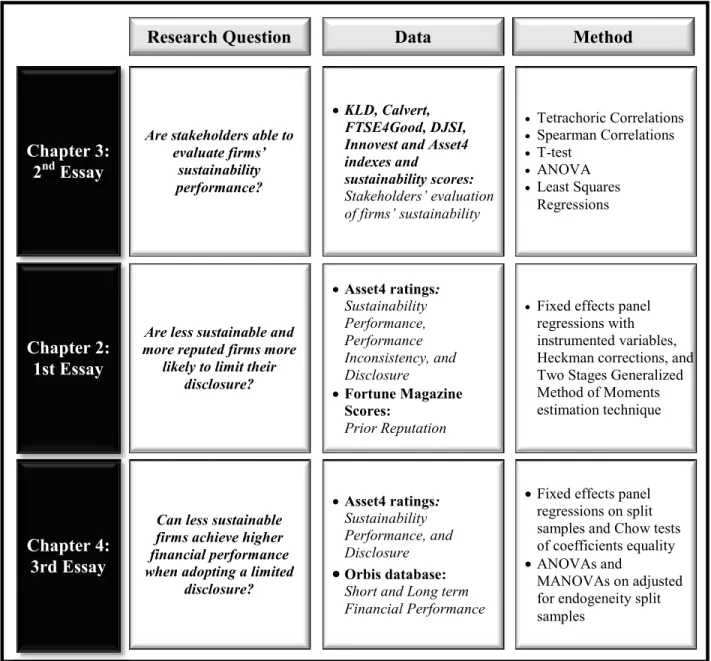
1. Three essays on the relationships between Sustainability Performance, Prior Reputation, Sustainability Disclosure and Financial Performance ... 49
2. Essay 1: The capacity of stakeholders to evaluate firms’ Sustainability Performance ... 51
3. Essay 2: The drivers of Sustainability Disclosure ... 53
4. Essay 3: The Impact of Sustainability Disclosure on firms’ Financial Performance ... 55
5. Structure of the thesis ... 57
E. RESEARCHDESIGN ... 58
1. Methodology... 58
2. Data... 58
3. Methodological choices ... 64
4. Structure of the research design ... 69
CHAPTER 2: ESSAY 1 ... 70
A. ABSTRACT ... 70
B. INTRODUCTION ... 71
~ 10 ~
1. Convergence of SRI Ratings ... 75
2. Will SRI Ratings Have High Convergent Validity? ... 76
D. DATA ... 82
E. METHODSANDRESULTS ... 85
1. Convergent Validity – Hypothesis 1. ... 85
2. Adjusting for Differences in Theorization – Hypotheses 2a and 2b ... 89
3. Predictive Validity ... 96 F. DISCUSSION ... 99 CHAPTER 3: ESSAY 2 ... 104 A. ABSTRACT ... 104 B. INTRODUCTION ... 105 C. BACKGROUND ... 109 1. Sustainability Disclosure ... 111 D. HYPOTHESES ... 113 1. Sustainability Performance ... 113
2. Sustainability Performance Inconsistency ... 115
3. Prior Reputation ... 119
E. DATAANDMETHODS ... 126
1. Dependent variable ... 129 2. Independent variables ... 131 3. Control variables ... 133 4. Analyses ... 134 F. RESULTS ... 138 G. ROBUSTNESSTESTS ... 148
H. DISCUSSIONANDCONCLUSION ... 150
CHAPTER 4: ESSAY 3 ... 156 A. ABSTRACT ... 156 B. INTRODUCTION ... 157 C. THEORY ... 161 1. Sustainability Performance ... 161 2. Sustainability Disclosure ... 163
3. Revelation and conformity mechanisms ... 164
D. HYPOTHESES ... 167
1. Conformity mechanism and the impact of Sustainability Disclosure on Financial Performance ... 167
2. Revelation mechanism and the impact of Sustainability Performance on Financial Performance ... 170
3. Playing with the revelation and conformity mechanisms: the strategic value of Sustainability Disclosure ... 174
E. DATA ... 179
1. Dependent variable ... 182
~ 11 ~
3. Control variables ... 185
F. METHODANDRESULTS ... 188
1. Hypotheses 1, 2 & 3 ... 188
2. Hypotheses 4 & 5 ... 197
G. DISCUSSIONANDCONCLUSION ... 212
CHAPTER 5: CONCLUSION ... 216
A. MAINRESULTS ... 216
B. CONTRIBUTIONS ... 220
1. Contribution to the strategy and business policy literature ... 220
2. Methodological contribution ... 222
3. Contribution to managers and business strategists... 224
C. LIMITATIONS ... 226
D. AVENUESFORFUTURERESEARCH ... 228
REFERENCES ... 232
APPENDIX ... 247
A. CHAPTER2:ESSAY1 ... 247
B. CHAPTER3:ESSAY2 ... 251
C. CHAPTER4:ESSAY3 ... 253
D. SUMMARYOFTHETHESISINFRENCH ... 256
1. Principaux résultats ... 256
2. Contribution à la littérature en stratégie et politique d'entreprise ... 261
3. Contribution méthodologique ... 265
4. Contribution aux managers et stratégistes d'entreprise ... 266
List of Figures
Figure 1: The relationship between sustainable responsibility, sustainability actions & sustainability performance 22 Figure 2: The process in which sustainability performance transforms into financial performance ... 24 Figure 3: The role of sustainability disclosure and prior reputation in the firms-stakeholders relationship ... 36 Figure 4: Contradicting propositions between the signaling and the normative perspectives on sustainability
disclosure: ... 46 Figure 5: Three essays on the relationships between sustainability performance, disclosure, prior reputation and
financial performance ... 50 Figure 6: Structure of the thesis ... 58 Figure 7: Structure of the research design ... 69 Figure 8: Predicted sustainability disclosure based on the sustainability performance inconsistency of firms with
high and low sustainability performance ... 142 Figure 9: Predicted sustainability disclosure based on firms’ sustainability performance inconsistency and
sustainability performance ... 142 Figure 10: The amplitude of the moderating effect of sustainability performance on the linear relationship between
sustainability performance inconsistency and sustainability disclosure ... 142 Figure 11: The amplitude of the moderating effect of sustainability performance on the linear relationship between
prior reputation and sustainability disclosure ... 145 Figure 12: Predicted sustainability disclosure based on the prior reputation of firms with high and low sustainability performance ... 145 Figure 13: The amplitude of the moderating effect of sustainability performance on the curvilinear relationship
between prior reputation and sustainability Disclosure ... 145 Figure 14: Predicted sustainability disclosure based on firms’ prior reputation and sustainability performance ... 145 Figure 15: Adjusted predicted short term financial performance of firms with extensive and limited sustainability
disclosure. ... 199 Figure 16: Adjusted predicted long term financial performance of firms with extensive and limited sustainability
disclosure. ... 199 Figure 17: Adjusted predicted short and long term financial performance of firms with extensive and limited
sustainability disclosure. ... 199 Figure 18: Marginal effects of sustainability performance and sustainability disclosure on firms’ average short term
~ 13 ~
financial performance ... 202 Figure 19: Marginal effects of sustainability performance and sustainability disclosure on firms’ average long term
financial performance ... 203 Figure 20: Marginal effects of sustainability performance and sustainability disclosure on the growth of firms’
financial performance ... 207 Figure 21: Marginal effects of sustainability performance and sustainability disclosure on firms’ total financial
performance ... 209 Figure 22: The amplitude of the moderating effect of sustainability performance on the curvilinear relationship
between prior reputation and sustainability disclosure (Industrial goods) ... 251 Figure 23: The amplitude of the moderating effect of sustainability performance on the curvilinear relationship
between prior reputation and sustainability disclosure (Retailers) ... 252 Figure 24: The amplitude of the moderating effect of sustainability performance on the curvilinear relationship
between prior reputation and sustainability disclosure (Software & IT services) ... 252 Figure 25: The curvilinear effect of sustainability performance on the firms’ short and long term financial
List of Tables
Table 1: Summary statistics ... 85
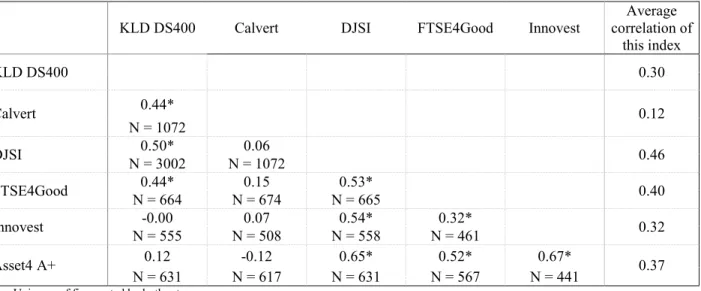
Table 2: Pairwise tetrachoric correlations / Convergent validity of SRI raters on overlapping universes ... 88
Table 3: Pairwise tetrachoric correlations 2003–2006 / Convergent validity of Asset4 A+ with KLD DS400 ... 89
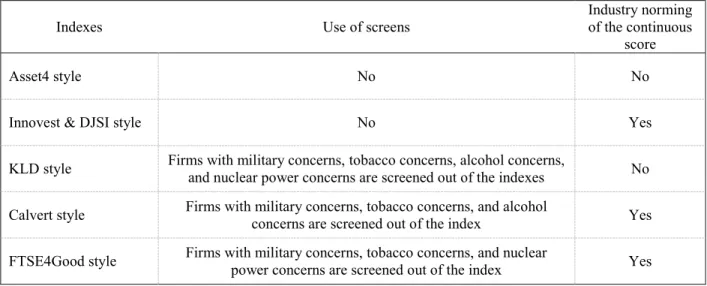
Table 4: Indexes’ methodology ... 90
Table 5: Indexes’ gaps (Asset4 standardized scores of each index’s members minus the Asset4 standardized scores of its non-members) / Convergent validity adjusting for explicit differences in theorization (Industry screening and norming) ... 92
Table 6: Pairwise spearman correlations between KLD, Calvert, DJSI, Innovest, and Asset4’s top-level scores ... 95
Table 7: Relationship between index membership and involvement in major scandals two years later ... 98
Table 8: Relationship between index membership and involvement in major scandals three years later ... 98
Table 9: Listwise Pearson correlations of initial variables and instrument* ... 137
Table 10: The impact of sustainability performance, sustainability performance inconsistency and prior reputation on sustainability disclosure ... 139
Table 11: The impact of the revelation and conformity mechanisms on firms’ achieved degree of financial performance ... 179
Table 12: Listwise Pearson correlations of variables in models with short or long term financial performance as a dependent variable ... 186
Table 13: Descriptive statistics per year for sustainability performance and sustainability disclosure ... 187
Table 14: The impact of sustainability performance and sustainability disclosure on short and long term financial performance ... 189
Table 15: Test of equality of sustainability performance and sustainability disclosure coefficients estimated in models 1 to 6 (Chow tests) ... 192
Table 16: The impact of sustainability performance and sustainability disclosure on short and long term financial performance (Tobins’ Q as a proxy for financial performance) ... 195
Table 17: The effect of sustainability performance and sustainability disclosure on firms’ average short term financial performance (ANOVA & analysis of marginal effects) ... 202
Table 18: The effect of sustainability performance and sustainability disclosure on firms’ average long term financial performance (ANOVA & analysis of marginal effects) ... 203
~ 15 ~
Table 19: The effect of sustainability performance and sustainability disclosure on the growth of firms’ financial performance (MANOVA & analysis of marginal effects) ... 206 Table 20: The effect of sustainability performance and sustainability disclosure on firms’ total financial performance (MANOVA & analysis of marginal effects) ... 208 Table 21: Summary statistics for additional indexes ... 247 Table 22: Pairwise tetrachoric correlations / Convergent validity of SRI raters for firms common to all universes
(413 firms) ... 247 Table 23: Pairwise tetrachoric correlations / Convergent validity of SRI raters on overlapping universes ... 248 Table 24: Pairwise tetrachoric correlations 2003–2006 / Convergent validity of Asset4 A+ with KLD BMS ... 248 Table 25: Indexes’ gaps (KLD standardized scores of each index’s members minus the KLD standardized scores of
its non-members) / Convergent validity adjusting for explicit differences in theorization (Industry
screening and norming) ... 249 Table 26: Pairwise Spearman correlations between KLD and Asset4’s raw data 2002–2010... 250 Table 27: The impact of sustainability performance, sustainability performance inconsistency and prior reputation
on sustainability disclosure (Per Industry) ... 251 Table 28: The impact of sustainability performance and sustainability disclosure on short and long term financial
performance (Sustainability Disclosure at an industry level) ... 253 Table 29: The linear and curvilinear impacts of sustainability performance on firms’ short and long term financial
Introduction
In 1987 the Brundtland Commission defined sustainable development as development that “meets the needs of the present without compromising the ability of future generations to meet their own needs” (Brundtland, 1987). Since then, the concept of sustainability has been raised in different strata of society. When the first United Nations Conference on Sustainable Development1 was organized in Rio (1992), it gathered 172 governments to agree on the sustainable development principles that should guide future policies. The concept of sustainability had gained institutional legitimacy.
Subsequently, sustainability gradually diffused in the organizational field and firms increasingly implemented sustainability strategies. More and more firms see in the poorest strata of the population both business opportunities and a way to support economic and social development. (Prahalad & Hart, 1999; Prahalad, 2010). Several companies went out with “green products” that respect the natural environment (Reinhardt, 1998). Environmental management systems standards such as the ISO 140001 diffused (Delmas & Montes-Sancho, 2011), and fair trade practices with suppliers are now common standards in several industries (Schuler & Christmann, 2011; White, MacDonnell, & Ellard, 2012). As a result, several activists groups are now pressuring companies to transfer from the state to the private sector the responsibility to cope with social and environmental issues (den Hond & de Bakker, 2007).
~ 17 ~
The concept of sustainability dramatically questioned the economic paradigm of business strategies, and therefore academic literature investigated the subject. Why would firms limit their environmental damage or remunerate their suppliers beyond what regulation imposes? Why would firms care about indigenous communities that are not directly related to their sales activities? Why would a firm develop products for the poorest when it knows that 80% of its turnover can be achieved from the 20% richest strata of the population?
Academics adopted several lenses to investigate sustainability as a business concept. On the one hand earlier economists refused the rationale that firms should bear the burden of sustainable development. A firm’s only objective is to meet the needs of their shareholders (Friedman, 1970), while the state should ensure the ability of future generations to meet their own needs. In such a view no firm should act to protect the environment or society beyond what regulation imposes. However, latter behavioural economists recognized that individuals are likely to reward pro-social behaviours, and stigmatize irresponsible ones, which may lead to individual altruism (Bénabou & Tirole, 2006). Organizations being made of individuals, this view also diffused to theories of the firm. In this economic perspective a focal firm evolves in an environment made of distinct entities that affect or are affected by its operations (Suppliers, Customers, Shareholders, Community…), namely its stakeholders (Freeman & Reed, 1983). Stakeholders reward firms’ pro-social behaviours and therefore sustainability strategies can be explained by firms’ delegated exercise of sustainable behaviours on behalf of stakeholders (Bénabou & Tirole, 2010; Brekke & Nyborg, 2008; Bridoux, Coeurderoy, & Durand, 2011; Cespa & Cestone, 2007). In this perspective sustainability is a profitable strategy that firms could implement to differentiate themselves and get stakeholders’ endorsement (Cavaco & Crifo, 2009; Hull & Rothenberg, 2008; Surroca, Tribo, & Waddock, 2010; Waddock & Graves, 1997).
~ 18 ~
On the other hand sociologists also became interested in the phenomena. In their perspective the world is made of institutions that create normative pressures and reward the conformity to norms. The concept of sustainability being institutionalized, it nowadays appears as one of those norms (Philippe & Durand, 2011). By processes of coercive, mimetic and normative isomorphism firms tend to conform to norms and in return gain legitimacy in their organizational field (DiMaggio & Powell, 1983). Therefore in this sociological perspective sustainability is a strategy that stakeholders’ pressure imposes on firms and that may increase firms’ legitimacy.
This thesis aims at a deeper understanding of sustainability strategies and of their consequences in terms of financial performance. It discusses the validity of the economic perspective in light of normative pressure to underscore the conditions under which normative pressure prevents firms from acting strategically. It more specifically concentrates on the construct of sustainability disclosure: the extent of information about a firm and what it may reveal about its degree of sustainability. It identifies the crucial role of disclosure in moderating the relationship between sustainability and financial performance; it also inspects its drivers, and its consequences in terms of financial returns.
The first chapter defines the main constructs, the research gap, research question, and the methodological tools deployed in the dissertation. Chapters 2, 3 and 4 encompass three essays on the research gap, the antecedents and the consequences of sustainability disclosure. Finally chapter 5 discusses the theoretical, methodological and managerial implications of the findings.
Chapter 1: The Strategic Value of
Sustainability and its Disclosure
A. BACKGROUND TREND: THE STRATEGIC VALUE OF SUSTAINABILITY
Past literature defined the constructs of “sustainable responsibility”, “sustainability actions”, and “sustainability performance”, and developed a theoretical approach that proposes sustainability performance as a driver of financial performance. However, an empirical debate still exists on the validity of this relationship and questions the reliability of its theoretical foundations.
1. Definition of Sustainable Responsibility, Sustainability Actions and Sustainability Performance
Firms’ sustainability has been central to academic literature for some years now. Early scholars first took an interest in firms’ corporate social responsibility, the responsibility of firms toward society (Carroll, 1979; Friedman, 1970). Later academics further grasped the granularity of the concept and clearly differentiated between “corporate social responsibility”, “corporate social actions” and “corporate social performance”. “Corporate social responsibility” refers to the responsibility of firms toward society, “corporate social actions” to the corporate actions that this responsibility implies, and “corporate social performance” to the impact of those actions on society (Barnett, 2007; Brammer, Pavelin, & Porter, 2009; Marquis, Glynn, & Davis, 2007). However, the prefix “corporate social” might be confusing, as it excludes firms’ responsibility, actions and impact on the natural environment. This dissertation thus considers the terms of “sustainable responsibility”, “sustainability actions” and “sustainability performance”, to encompass firms’ responsibility, actions and impact on any components of society, including the environment.
~ 20 ~
Following the literature, this dissertation defines sustainable responsibility as the “economic, legal, ethical, and discretionary expectations that society has of organizations” (Carroll, 1979). “Sustainable responsibility” refers to the responsibility of a firm to act in conformity to its stakeholders’ expectations, stakeholders that literature defines as “any identifiable group who can affect the achievement of an organization's objectives, or who are affected by the achievement of an organization's objectives” (Freeman & Reed, 1983). “Sustainability actions” are corporate “behaviours” that arise from sustainable responsibility and are intended to increase social benefits or mitigate social problems of stakeholders (Marquis et al., 2007). Whereas other corporate investments are focused on improving the wealth of shareholders, sustainability actions involve efforts to improve social welfare as a whole such as preserving natural resources, eradicating poverty, enhancing education… (Barnett, 2007). Finally “sustainability performance” is the outcome of sustainability actions, the benefits stakeholders receive from sustainability actions (Waddock & Graves, 1997; Wood, 1991). While sustainable responsibility is disposition, sustainability actions are behaviours, and sustainability performance the impact of those behaviours, such that if firms are responsible, they can achieve a certain degree of sustainability performance through investments in several sustainability actions (Barnett, 2007). A responsible firm can implement fair trade practices with its suppliers, reduce the amount of waste it produces, and limit its CO² emissions, actions which will all result in a certain degree of beneficial impact on its stakeholders: its sustainability performance. Differentiating responsibility, actions and performance is crucial. On the one hand an irresponsible firm may act without its stakeholders in mind and still benefit them, in doing so it may still highlight a certain degree of sustainability performance. On the other hand it may happen that some firms’ sustainability actions trigger unintended detrimental consequences. Those firms thus perform at low degrees of sustainability performance. Sustainable responsibility does not necessarily lead to sustainability actions, and
~ 21 ~
sustainability actions do not always transform into sustainability performance.
Finally, it is fundamental to recognize the heterogeneity of sustainability performance. Stakeholders are heterogeneous and diverse. They encompass governments, customers, competitors, employees, etc… groups that cannot all be targeted by a single sustainability action. Fair trade practices target the welfare of suppliers, prevention of child labour the well-being of employees, while the reduction of CO² emissions benefits the community as a whole. Consequently sustainability actions may trigger a heterogeneous sustainability performance. Sustainability actions may favour certain stakeholders but not others. Equally, they may benefit some stakeholders while being detrimental to others. Firms may protect their employees in developed countries while accepting child labour in their foreign facilities. They may implement practices favourable to suppliers but at the same time degrade the environment. Firms are never good or bad but almost always good and bad at the same time (Strike, Gao, & Bansal, 2006). They can both perform well on some sustainability dimensions and be poorly rated on some others. (Delmas & Blass, 2010). This dissertation therefore considers sustainability performance both in degree and inconsistency. The degree of sustainability performance relates to the average level of sustainability performance achieved, while sustainability performance inconsistency refers to the heterogeneity in the outcome of firms’ sustainability actions. In other words, sustainability performance inconsistency expresses the variance of a firm’s sustainability performance at a certain point in time.
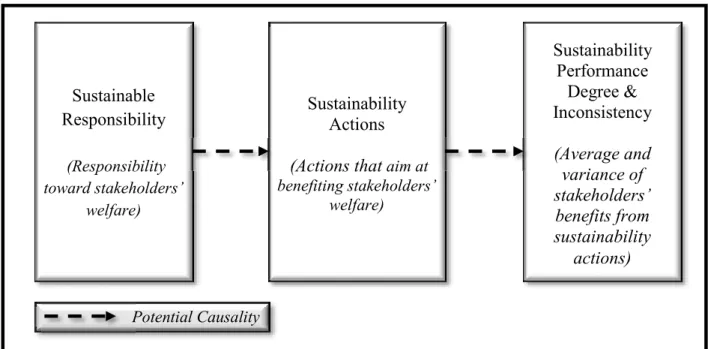
While this dissertation will mainly concentrate on firms’ sustainability performance, it recognizes that sustainability performance is a construct different from sustainable responsibility and sustainability actions. Sustainable responsibility is a disposition that may lead to several sustainability actions, and the diversity of those actions may lead to sustainability performance
~ 22 ~
that can be conceptualized both in degree and inconsistency (see Figure 1). These main constructs being defined, it is then interesting to understand why some firms are responsible, act in favour of their stakeholders, and benefit them.
Figure 1: The relationship between sustainable responsibility, sustainability actions & sustainability performance
2. The role of Sustainability Performance in triggering stakeholders’ support
Most academics who tried to explain sustainability performance and its consequences used the lens of the firms-stakeholders relationship (Jones, 1995). Stakeholders are individuals or organizations that have stakes in a firm’s operations (Freeman & Reed, 1983). They encompass diverse groups that are more or less salient (Mitchell, Agle, & Wood, 1997). From primary stakeholders such as employees, shareholders or customers without which the organizations cannot survive, to secondary stakeholders such as governments, NGOs, local communities or interest groups; all have the opportunity to affect firms in the realization of their objectives (Clarkson, 1995). Employees may adjust their productivity, suppliers provide lesser quality
Potential Causality Sustainable Responsibility (Responsibility toward stakeholders’ welfare) Sustainability Actions (Actions that aim at benefiting stakeholders’ welfare) Sustainability Performance Degree & Inconsistency (Average and variance of stakeholders’ benefits from sustainability actions) Potential Causality
~ 23 ~
materials, NGO’s raise public awareness against or in favour of a firm and governments enact laws that either accommodate or prevent a firm’s operations. Therefore an organization in the pursuit of its objectives not only seeks for stakeholders’ participation, but further for their support (Jones, 1995). For instance a firm does not only expect employees’ contracting, but further their full engagement in their daily work. It not only seeks from governments a license to operate, but further favourable legislation.
Sustainability performance demonstrates a firm’s engagement toward its stakeholders’ welfare. Stakeholders observe and evaluate a focal firm’s sustainability performance. By aligning this firm and its stakeholders interests, sustainability performance triggers stakeholders’ cooperation, which in return benefits the firm in the realization of its objectives (Jones, 1995). A highly sustainable firm enjoys reduced wages, an increased supply of qualified labour (Turban & Greening, 1997), and more innovative managers (Porter & Kramer, 2007). It mitigates the likelihood of negative regulatory actions from governments and attracts socially conscious consumers (Hillman & Keim, 2001).
With this rationale in mind, literature explained firms’ degree of sustainability performance by the salience of their environmental and social stakeholders (Brammer & Millington, 2004), the impact of these firms on their natural and social environment (Bansal & Roth, 2000b), and their willingness to limit stakeholders’ pressures (Delmas & Toffel, 2008). Sustainability actions in this framework can be considered as behaviours proactive to governments’ regulations (Aragon-Correa, 1998), reactions to interest groups’ activism (Baron, Harjoto, & Jo, 2009; Lenox & Eesley, 2009), or ways to differentiate toward customers (Delmas, Russo, & Montes-Sancho, 2007; Hull & Rothenberg, 2008).
~ 24 ~
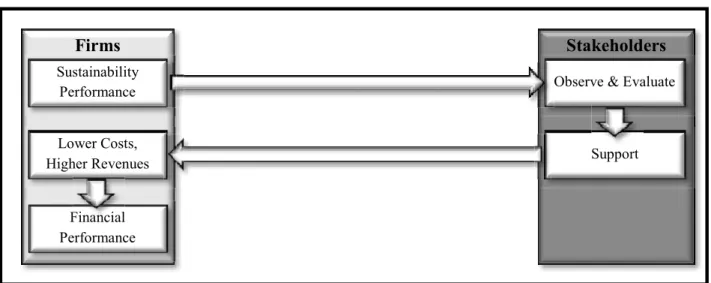
The underlying assumption of those findings is that firms financially benefit from stakeholders’ support and thus see economic opportunities in solving their stakeholders’ issues (Buehler & Shetty, 1974; Hillman & Keim, 2001; Porter & van der Linde, 1995), that firms comply to stakeholders’ interest to the extent that those stakeholders affect their financial performance. (Berman, Wicks, Kotha, & Jones, 1999). While some scholars envisaged sustainability performance as a way to reach reputational gains (Brammer & Pavelin, 2006; Fombrun, 2005; Turban & Greening, 1997), or a specific capital structure (Girerd-Potin, Jimenez-Garcès, & Louvet, 2012a; Graves & Waddock, 1994), most of them tried to dig deeper into its implications in terms of competitive advantage and financial performance (Barnett & Salomon, 2006; Surroca et al., 2010; Waddock & Graves, 1997). This literature that investigated the relationship between sustainability performance and financial performance made the assumption that stakeholders observe and evaluate firms’ sustainability performance. It argued that when a focal firm reaches the degree of sustainability performance its stakeholders expect; stakeholders in return support this focal firm. In such situations both the firm and its stakeholders are in a mutual cooperation equilibrium, which triggers higher profits for the firm (Jones, 1995) (see Figure 2).
Figure 2: The process in which sustainability performance transforms into financial performance
Firms Stakeholders Sustainability Performance Support Financial Performance Lower Costs, Higher Revenues
Observe & Evaluate
~ 25 ~
While at first sight this theoretical rationale might be appealing, several other scholars tried to empirically test its main proposition: that there exists a positive relationship between firms’ sustainability performance and financial performance. The results appear to be more of a contrast.
3. The empirical debate over the relationship between Sustainability Performance and Financial Performance
Financial performance relates to firms’ generation of financial profits from their operations. It can be envisaged as an overall performance, the amount of profits extracted from operations, or relative to investments and costs incurred along those operations, measured then in terms of returns.
Finding a link between sustainability performance and financial performance has been a long and over-studied topic. In 1997 Griffin and Mahon already entitled their publication “Corporate Social Performance and Corporate Financial Performance, Twenty Five Years of Incomparable Research” (Griffin & Mahon, 1997). Friedman in the New York Times first kicked academics’ mindset in arguing that “there is one and only one social responsibility of business,: to use its resources and engage in activities designed to increase its profits” (Friedman, 1970), assessing thus that any sustainability action whose objective was not to benefit shareholders was a strategic mistake. First academic essays on this topic therefore date back from the same period, focusing first on ways for responsible investors to select socially responsible stocks (Moskowitz, 1972, 1975), then trying to quantify their returns (Bowman & Haire, 1975). In the quest for a potential link between sustainability performance and financial performance, early scholars faced the difficulty of measuring a concept as broad as the one of sustainability performance, which
~ 26 ~
includes dimensions as diverse as the ones of firms’ environmental performance, impact on communities, or employees’ health and safety. Due to this measurability issue first scholars only focused on specific dimensions of sustainability performance such as environmental performance (McGuire, Sundgren, & Schneeweis, 1988). It is only at the end of the 90’s, thanks to newly born extra-financial rating agencies which collect and aggregate data on all the dimensions of sustainability performance, that some studies finally tested the positive relationship between sustainability and financial performance with exhaustive measures of sustainability (Waddock & Graves, 1997). However, at the same period and with similar data, several essays also denied this positive relationship. Some scholars argued that the cost of implementing sustainability performance was covering its benefits (McWilliams & Siegel, 2000, 2001). Some others assumed that sustainability actions were an inefficient use of a firm’s resources due to managers’ opportunism (Bénabou & Tirole, 2010). While shareholders want managers to use a firm’s resources with an objective of profitability, they cannot fully control those managers. Managers therefore may not act in shareholders’ interest, but regarding their own preferences for social initiatives. Finally literature also argued that positive empirical evidence was an artifact of reverse causality: It is not by investing in sustainability performance that firms can reach higher financial performance, but because some firms have slack financial resources that they invest in sustainability (Waddock & Graves, 1997)..
Consequently scholars from the past decade concentrated on refining their empirical approach. They first focused on proving that sustainability performance was a necessary but not sufficient condition for financial performance. They underscored that sustainability performance enhanced the impact of R&D and advertising (Hull & Rothenberg, 2008), that it strengthened differentiation and cost reduction strategies (Berman et al., 1999; Brammer & Millington, 2008),
~ 27 ~
and mediated the intangible resources’ influence on returns (Surroca et al., 2010). They secondly tried to identify further the characteristics of the relationship between sustainability performance and financial performance. They differentiated the impact of sustainability performance on profits between different typologies of sustainability (Cavaco & Crifo, 2009; Delmas, Etzion, & Nairn-Birch, 2013; Girerd-Potin, Jimenez-Garcès, & Louvet, 2012b), between already poorly and highly performing firms (Choi & Wang, 2009), between emerging and stabilized industrial sectors (Russo & Fouts, 1997; Surroca et al., 2010), and over long periods of time (Choi & Wang, 2009). However, forty years and several meta-analyses later, no clear result emerges from literature. There is still an ongoing debate on whether sustainability performance may trigger financial performance, and it is still possible to count as many publications proposing a positive effect, as there are for a negative or a neutral one (Griffin & Mahon, 1997; Margolis & Walsh, 2003; Orlitzky, Schmidt, & Rynes, 2003; Ullmann, 1985).
This dissertation argues that the incapacity of the literature to reach a consensus does not come from an empirical issue, but from an insufficient theoretical foundation. Years of literature only prove that refining the empirical approach will only lead to more debate. However, questioning the main assumptions and mechanisms that relate sustainability performance to financial performance is necessary.
~ 28 ~
B. RESEARCH GAP: THE STRATEGIC VALUE OF SUSTAINABILITY DISCLOSURE
Literature that investigated the firms-stakeholders relationship made the strong assumption that stakeholders are able to observe and evaluate firms’ sustainability performance. However when this assumption is relaxed, two constructs appear crucial to understand the relationship between firms and stakeholders: firms’ sustainability disclosure, the extent of information that a firm reveals about its sustainability performance, and firms’ prior reputation, the general assessment that stakeholders made in the recent past about firms’ key capabilities and character.
1. Sustainability Performance is a latent construct
The past literature that investigated the firms-stakeholders relationship is based on one, crucial unspoken assumption: Stakeholders are able to clearly observe and objectively evaluate
firms’ sustainability performance. Under this condition stakeholders are able to select and
support firms that better match their request for sustainability performance, which benefits sustainable firms in return.
However it is hard to believe that stakeholders are able to continuously inspect firms’ sustainability performance. Sustainability actions may target populations that are geographically distant; and it is hard to imagine that stakeholders can organically have a continuous focus on firms’ actions. Consumers hardly observe firms’ educational programmes in developing countries, and most misbehaviours such as child labour or corruption would never be known if not revealed via the media. “Customers cannot determine by inspection whether or not the cotton in a pair of trousers was grown in an organic manner, or a pound of coffee beans was grown under a natural forest canopy.” (King & Toffel, 2007).
~ 29 ~
In addition, it is also hard to believe that stakeholders objectively evaluate firms’ sustainability performance. First because sustainability performance is a complex construct that encompasses several dimensions. From environmental pollutant emissions to governance structures it appeals to different techniques and competences that most stakeholders do not have; Secondly, because the stakeholders’ evaluation of a firm is based and biased by a firm’s past behaviour (Mishina, Block, & Mannor, 2012; Philippe & Durand, 2011). When evaluating a firm’s sustainability performance stakeholders not only consider its actual actions, but further the whole history of its past behaviours. Stakeholders’ objective evaluation of firms’ sustainability performance is a myth. Consumers most often do not have competences to evaluate a firm’s true pollutant emissions, and when they do, they most certainly better evaluate a firm that for years has been proved to act against climate change, than one whom earlier was caught in environmental disasters.
The assumption that stakeholders are able to clearly observe and objectively evaluate firms’ sustainability performance is thus a clear gap in the strategy and management literature. This dissertation relaxes this strong assumption and assumes instead that stakeholders do not observe a focal firm’s sustainability performance, but only its sustainability disclosure, that stakeholders do not objectively evaluate a firm’s sustainability performance, as they consider this firm’s prior reputation as a baseline of their evaluation.
2. Stakeholders observe Sustainability Performance through the filter of Sustainability Disclosure
While literature made the unspoken assumption that stakeholders were able to observe firms’ sustainability performance, this dissertation takes the opposite direction and assumes that
~ 30 ~
performance is in fact a latent construct that is either distant from stakeholders or that stakeholders cannot continuously inspect (King & Toffel, 2007; King, Lenox, & Terlaak, 2005; Ruihua Joy & Bansal, 2003). Stakeholders consequently only observe what an organization is willing to reveal: its sustainability disclosure. Sustainability disclosure is the procedure that a firm implements to transmit information about its sustainability performance. Firms control this procedure and thus the information they are willing to transmit. They may adjust, coat or even try to hide this information.
Sustainability Disclosure therefore is not a dichotomous procedure. Firms do not either communicate or do not. They strategically select what and how they communicate. For instance they may communicate about investments in green facilities, but omit the impact of those investments on local communities. Sustainability information can be buried in annual reports, or clearly published as a stand-alone document (Philippe & Durand, 2011). Firms strategically adjust the amount of sustainability information they disclose. For instance a firm publishing both about its actions toward poverty reduction and its waste management processes provides a higher amount of information than if it had only communicated on its pro-poor operations.
This dissertation consequently defines sustainability disclosure as the amount of available indicators that characterize a firm’s sustainability performance. Higher numbers of disclosed
indicators is associated with a more extensive sustainability disclosure, whereas a lower amount of indicators indicates information in lower quantity, and thus a limited sustainability disclosure. Firms implement the procedure of sustainability disclosure more or less extensively (Philippe & Durand, 2011). They can disclose extensively their sustainability performance, but also hide certain indicators. In such a case the sustainability disclosure is said to be limited. It is an incomplete signal of sustainability performance (Crawford & Sobel, 1982).
~ 31 ~
In the case of a limited disclosure, stakeholders estimate firms’ sustainability performance with less accuracy and comparability than when the disclosure is extensive. Sustainability disclosure in that sense modifies stakeholders’ perception of a firm’s sustainability performance. It is strategically valuable for a firm willing to control its relationship with stakeholders, and gain their support (Reid & Toffel, 2009). Consequently, academics willing to investigate the impact of sustainability performance on firms’ financial performance should not only consider the degree of sustainability performance that firms achieved, but further the characteristics within which firms disclose their sustainability performance (Ullmann, 1985). They should consider the strategic properties of sustainability disclosure, investigate why firms adjust their disclosure, and understand the consequences of such adjustments on financial performance.
3. Stakeholders evaluate Sustainability Performance through the prism of firms’ Prior Reputation
In prior literature another main assumption appears to be misleading: In addition to the assumption that stakeholders clearly observe sustainability performance, whereas they only observe a more or less extensive sustainability disclosure, researchers also assumed that stakeholders objectively evaluate sustainability performance.
This dissertation also relaxes this second assumption as it considers that stakeholders are not
able to evaluate a firm’s sustainability performance independently of its past reputation.
Sustainability performance is a complex construct whose evaluation requires techniques and knowledge that stakeholders most often lack. In addition stakeholders hardly access information about sustainability performance. When they do, this information had already passed through the filter of sustainability disclosure and is thus likely to be limited or biased. Disclosure also limits stakeholders’ capacity to evaluate sustainability performance. Scholars determined that in
~ 32 ~
situations where information is imperfect and outcomes difficult to observe, firms’ prior reputation then works as a reference point that sets the baseline of stakeholders’ evaluation (Weigelt & Camerer, 1988).
Scholars defined reputation as how firms compare to their competitors in terms of quality of their products, management, strategy and prospects (Fombrun & Shanley, 1990). Reputation is constructed by the set of general information that stakeholders gathered over time about firms (Fombrun & Shanley, 1990; Rindova, Williamson, Petkova, & Sever, 2005). Stakeholders continuously receive information on firms’ products, management, and strategic choices (Basdeo, Smith, Grimm, Rindova, & Derfus, 2006; Heil & Robertson, 1991). The outcome of this process is a general evaluation of those firms underlying key capabilities (what firms are able to do, in terms of products and management) and character (what firms would like to do, their strategy and prospects) (Mishina et al., 2012). Scholars labeled this general evaluation: firms’ reputation. When stakeholders cannot easily evaluate a firm’s characteristic, they then base their evaluation on another characteristic that is presumably highly correlated with the initial one, and in particular on firm’s prior reputation (Akerlof, 1970; Fombrun & Shanley, 1990; Spence, 1973; Weigelt & Camerer, 1988). As stakeholders cannot easily evaluate a firm’s sustainability performance, but have formed an assessment of its reputation, they form expectations on this firm’s sustainability performance based on its reputation (Philippe & Durand, 2011). They expect a focal firm to reach a degree of sustainability performance equivalent to its reputational achievements. Stakeholders therefore consider a firm’s prior reputation as a reference point and only inspect the sustainability performance signal relative to this baseline (Love & Kraatz, 2009). Prior reputation consequently acts as a distorting prism that influences how stakeholders perceive a firm’s actual sustainability performance.
~ 33 ~
It is interesting to note that stakeholders also consider a firm’s sustainability performance in their assessment of its reputation (Brammer & Pavelin, 2006; Cho, Guidry, Hageman, & Patten, 2012; Philippe & Durand, 2011). However this sustainability performance is only one of the several components that constitute stakeholders’ reputational assessment. When evaluating the reputation of a firm stakeholders also take into account the firm’s financial performance, market risk, the extent of its institutional ownership, the nature of its business activities, the quality of its products, and are further influenced by the firm’s efforts to stay in their minds through media campaigns (Brammer & Pavelin, 2006; Rindova et al., 2005). Consequently prior reputation is an evaluation from stakeholders that only weakly depends on firms’ sustainability performance. In addition reputation is both constructed from elements a firm controls, such as its disclosed signals, and external factors, such as certifications from outside intermediaries or support from high status actors (Rindova et al., 2005). Furthermore reputation does not only depend on information that stakeholders can directly observe, but further on a whole set of information that they have gathered over time (Fombrun & Shanley, 1990). Therefore prior reputation is an evaluation over which firms have little control because it is embedded in a whole variety of behaviours.
As a result, firms’ prior reputation constrains their relationship with stakeholders. Stakeholders do not evaluate the sustainability performance that a firm discloses as an objective signal, but in comparison with a baseline of previous behaviours that are embedded in its reputation, and on which a firm has limited control (Ruihua Joy & Bansal, 2003). As an example stakeholders will not evaluate in the same way two companies involved in child labour if one was known for the low overall quality of its strategic decisions, and the other one for having always behaved in trustworthy, ethical ways.
~ 34 ~
Therefore academics willing to investigate the impact of sustainability performance in the firm-stakeholders relationship should not only envisage what a firm communicates to its firm-stakeholders (i.e. its sustainability performance), but also how much this firm communicates to its stakeholders (i.e. its sustainability disclosure), and further how stakeholders perceive this firm (i.e. which depends on a firm’s prior reputation).
To sum up, prior literature explained sustainability performance and its consequences by
considering a simplified framework where stakeholders clearly observe and objectively evaluate firms’ sustainability performance and support sustainable firms, which in return access higher profits (see Figure 2). This thesis identifies two theoretical gaps: On the one hand stakeholders do not clearly observe sustainability performance. They only do so through firms’ more or less extensive sustainability disclosure. On the other hand stakeholders cannot objectively evaluate a firm’s sustainability performance. They only evaluate this firm’s sustainability performance relative to its prior reputation (See
~ 35 ~ Figure 3).
~ 36 ~
Figure 3: The role of sustainability disclosure and prior reputation in the firms-stakeholders relationship
These two new assumptions have deep consequences on how the strategy and management literature analyzed the firms-stakeholders relationship. They raise many questions, two of which this thesis will try to answer: When do firms limit their sustainability disclosure? And what are the consequences of incomplete signals in terms of financial performance?
Sustainability
Disclosure Reputation Prior
Firms Stakeholders Sustainability Performance Support Financial Performance Lower Costs, Higher Revenues
Observe & Evaluate
~ 37 ~
C. RESEARCH QUESTION
When one considers the moderating role of sustainability disclosure and prior reputation in the relationship between sustainability performance and stakeholders’ capacity to observe this performance, several questions arise, but contradicting answers can be given. More specifically, a signaling perspective that sees a limited disclosure as a way to appease stakeholders is counterbalanced by a normative view which points at transparency as a norm that stakeholders value even more.
1. The role of Sustainability Disclosure in the firms-stakeholders relationship
1.1. The signaling perspective and its propositions on the antecedents and outcomes of Sustainability disclosure
Sustainability disclosure is strategically valuable in the sense that firms control whether they want to hide or reveal their actual sustainability performance. There exists in the strategy literature a well-defined theory about motivations and consequences of disclosure and signals: the signaling perspective.
The signaling perspective is grounded in economics literature and more specifically in Signaling
Theory (Akerlof, 1970; Crawford & Sobel, 1982; Milgrom & Roberts, 1982; Spence, 1973). In this perspective, while an extensive disclosure ensures stakeholders of the characteristic it discloses, a limited disclosure creates uncertainty among those stakeholders. Incomplete signals leave stakeholders with the decision to form their own opinion about a firm’s unobservable characteristic. A limited sustainability disclosure does not provide stakeholders with accurate information but with a large range of probable values in which may lay the firms’ sustainability performance (Crawford & Sobel, 1982; Hertzendorf, 1993). For the signaling perspective, a firm with extensive sustainability disclosure releases information on its sustainability performance to
~ 38 ~
limit stakeholders’ uncertainty, while a firm with a limited disclosure controls the information available to stakeholders to maintain doubts and mislead them about its true sustainability performance (Delmas & Burbano, 2011; Laufer, 2003; Lyon & Maxwell, 2005). Consequently in this perspective a limited disclosure is seen as a way to mislead stakeholders and prevent them from evaluating the firms’ actual sustainability performance.
In addition, from the signaling perspective sustainability disclosure is a double-edged sword. On the one hand it is a signal that might reveal to stakeholders that a firm achieved the degree of sustainability performance they expected, and thus triggers their support. But on the other hand disclosure may also reveal an actual sustainability performance that is at odd with stakeholders’ expectations, and may thus trigger their withdrawal. Sustainability disclosure triggers both benefits and costs. It may trigger benefits by reducing the information asymmetry between a firm and its shareholders, but may create costs when it reveals information that is at odds with what stakeholders expected to observe (Cormier & Magnan, 1999; Pinghsun & Yan, 2012). Sustainability disclosure is valuable when it reveals stakeholders the beneficial impact they expected, but it also create risks when it reveals social or environmental liabilities that stakeholders did not expect (Bansal & Clelland, 2004; Philippe & Durand, 2011). Firms face a trade-off between the potential benefits of disclosing extensively, and the risks that such strategy induces. For instance firms voluntarily committing to sustainability agreements benefit from greater licenses to operate and public recognition, but also incur the risk of having regulators use the information provided to undertake lawsuits (Delmas & Terlaak, 2001). Firms’ motivation for an extensive disclosure is to enhance their image by revealing their beneficial impact on society (Adams, 2002). When firms’ impact on society is detrimental they better avoid stakeholders’ punishment by limiting their disclosure. Therefore in the signaling perspective sustainable firms