HAL Id: tel-01305508
https://pastel.archives-ouvertes.fr/tel-01305508
Submitted on 21 Apr 2016HAL is a multi-disciplinary open access archive for the deposit and dissemination of sci-entific research documents, whether they are pub-lished or not. The documents may come from teaching and research institutions in France or abroad, or from public or private research centers.
L’archive ouverte pluridisciplinaire HAL, est destinée au dépôt et à la diffusion de documents scientifiques de niveau recherche, publiés ou non, émanant des établissements d’enseignement et de recherche français ou étrangers, des laboratoires publics ou privés.
Modelling of masonry walls under seismic loadings
Michele Godio
To cite this version:
Michele Godio. Modelling of masonry walls under seismic loadings. Materials. Université Paris-Est, 2015. English. �NNT : 2015PESC1150�. �tel-01305508�
Thèse présentée pour l’obtention du grade de
Docteur de l’Université Paris-Est
Spécialité: Structures et Matériaux
MODÉLISATION DES MURS EN MAÇONNERIE
SOUS SOLLICITATIONS SISMIQUES
MODELLING OF MASONRY WALLS UNDER SEISMIC LOADS
Michele Godio
Thèse soutenue à l’Ecole des Ponts et Chaussées le 30 novembre 2015 devant:
M. Samuel FOREST Professeur, MINES Rapporteur
M. Alberto TALIERCIO Professeur, POLIMI Rapporteur
Mme. Katrin BEYER Professeur, EPFL Examinateur
M. Claude BOUTIN Professeur, ENTPE Examinateur
M. Seddik SAKJI Ingénieur Recherche, CSTB Examinateur
M. Ioannis STEFANOU Enseignant Chercheur, ENPC Examinateur
M. Jean SULEM Professeur, ENPC Examinateur
M. Daniel BILLAUX Président, Itasca S.A.S Invité
Remerciements
Je tiens à remercier tout d’abord mon directeur de thèse, Karam Sab, pour l’honneur qu’il m’a fait de m’avoir accueilli dans le prestigieux laboratoire qu’il dirige. D’avoir cru en moi depuis la période de stage et puis tout le long de la thèse.
Je remercie ensuite Jean Sulem, qui a toujours montré un grand intérêt pour mes travaux, en s’associant au projet de thèse dès le début et en alimentant constamment mes recherches par des questions nouvelles.
Ioannis Stefanou a été celui qui m’a suivi de plus proche. Au bout de trois ans et un peu plus passés coude-à-coude avec lui, il est devenu pour moi un véritable interlocuteur. Avec lui j’ai le plaisir de partager cet intérêt tout particulier que j’ai pour la mécanique. Merci infiniment pour ton aide et tes enseignements.
Mes remerciements vont également à Seddik Sakji, pour le soutien qu’il m’a montré, de m’avoir souvent encouragé lorsque j’en avait besoin, et de m’avoir (encore plus souvent) inter-rogé, lorsque qu’il me voyait trop sûr de moi-même. Sa façon de mener son travail au quotidien au CSTB, avec tenace et modestie, reste pour moi exemplaire.
Je souhaite remercier les autres des membres du jury, pour l’honneur qu’ils m’ont fait de lire et juger cette thèse. M. Samuel Forest et M. Alberto Taliercio, d’avoir accepté de rapporter le manuscrit. Mme. Katrin Beyer et M. Claude Boutin, de l’avoir examiné. Vos questions et vos remarques ont été précieuses et constructives. Vos félicitations représentent pour moi une grande motivation qui me pousse à continuer dans le monde de la recherche.
Je dis merci aussi à Daniel Billaux, qui dirige ‘ses’ ingénieurs avec soin et simplicité, de m’avoir accepté dans le programme éducatif organisé par Itasca, de sa participation au jury et de la disponibilité montrée le long du projet.
Je remercie (et pas seulement) mes collègues de bureau aux Ponts. Achille, Bashar, Romain, Stefania, Grégoire. Avec vous j’ai partagé sans doute les moments les plus intenses et plus beaux de ses années passées au Labo. Votre bonne humeur, sympathie et générosité ont été pour moi le plus grand réconfort quotidien.
Je remercie de même mes collègues de l’Open Space du CSTB, où on picole du café pas cher et on discute. Toan, Romain, Medhi, Mathieu, Damien. Merci, vous avez été toujours accueillants et généraux vers moi malgré mes longues absences.
Merci Charisis. Sans toi je n’aurais jamais pensé entreprendre une thèse. Merci Dhionis. Sans toi je n’aurais jamais pensé pouvoir la terminer...
Si faire une thèse a été une petite entreprise, la faire sans jamais changer ses habitudes l’a été encore plus. Merci donc aux amis rencontrés à Paris, en particulier à Assad, Salvador, Carlos, Pablo et Andrea, pour tous les bons moments que j’ai passés avec vous et grâce à vous. Merci à Fabrizio, qui me soutient de loin et avec qui je continue partager tous mes centres d’intérêt et mes idées pour l’avenir. Merci à Marcello, excellent ami (et skieur) qui, désormais par tradition, participe à chaque soutenance.
J’aimerais enfin remercier ma famille du fond de mon cœur : maman papa et Ale. Et enfin Karin, un grand merci à toi, et bien plus encore...
Castello di Rivalta, Gazzola (Piacenza), Italie. Vue de l’escalier en colimaçon à l’intérieur du donjon. Détail sur la maçonnerie. (M.Godio 2015)
Résumé
La formulation de modèles sophistiqués et fiables pour l’évaluation du comportement sous sol-licitations sismiques des structures de maçonnerie reste un vrai défi pour l’Ingénierie. Cette thèse contribue au développement et à l’utilisation de modèles continus pour la maçonnerie non renforcée et non chainée.
Dans ce travail de doctorat, une méthode analytique pour l’estimation de la résistance globale de la maçonnerie est développée. La méthode s’appuie sur la théorie micropolaire (ou du milieu continu de Cosserat) et sur l’utilisation conjointe de l’approche cinématique de l’analyse limite et d’une technique d’homogénéisation. Dans un premier temps, la méthode est présentée pour le cas bidimensionnel. La méthode est introduite de manière générale, en ce qui concerne les milieux discrets périodiques. L’application à la maçonnerie est ensuite abordée. La résistance homogénéisée de colonnes et murs de maçonnerie est calculée en termes de contraintes et couples-contraintes généralisées du milieu continu de Cosserat. La formulation d’une méthode basée sur le milieu de Cosserat permet la prise en compte de l’influence de la rotation relative des particules du milieu discret. Cette influence est mise en évidence à travers l’application à la maçonnerie, en comparaison avec les autres méthodes présentes dans la littérature.
Dans un deuxième temps, la méthode est étendue au cas tridimensionnel. Des milieux dis-crets périodiques ayant leurs particules disposées le long de trois directions spatiales et montrant trois vecteurs de périodicité sont alors considérés. L’extension de la méthode s’inscrit dans le cadre de la théorie micropolaire tridimensionnelle. Cela permet la prise en compte des effets 3D de la translation et la rotation relative des particules. L’application aux colonnes et aux murs de maçonnerie montre comment la résistance dans le plan et hors-plan de la maçonnerie sont, par ces effets, couplées. La rotation relative des blocs accentue cette interaction, qui comporte une diminution de la résistance dans-le-plan précédemment calculée. Les murs de maçonnerie sont ici décrits par des modèles de plaque micropolaire.
Une formulation aux élément finis pour des modèles de plaque micropolaire est ensuite développée. Dans un premier temps, la formulation est présentée pour l’élasticité et la dy-namique. La validation d’un élément fini spécifique pour le calcul des structures est faite à l’aide d’exemples numériques. L’utilisation de cet élément sur des structures de maçon-nerie est ensuite abordée, par l’implémentation d’un modèle d’homogénéisation déjà existant. Les fréquences fondamentales d’un mur maçonné sont ainsi calculées et comparées avec celle obtenues par un modèles aux éléments discrets. L’importance des rotations des blocs dans le plan du mur ainsi que leur participation dans la réponse inertielle du mur vis-à-vis des actions sismiques sont enfin investiguées.
Dans un deuxième temps, la formulation aux élements finis est étendue à la plasticité, à travers l’implémentation de la théorie multi-critère pour les milieux de Cosserat. L’implémentation de cette théorie est basée sur un algorithme de projection, dont le schéma itératif de résolution est reporté. Les aspects numériques reliés à l’implémentation de l’algorithme sont examinés. Une importante limitation de l’implémentation classique de l’algoritme est montrée et une
nou-velle stratégie de solution est proposée. L’élément fini de Cosserat est donc validé pour la plasticite à l’aide de nombreux exemples numériques.
En conclusion, trois approches de modélisation pour les structures de maçonnerie sont pro-posées et comparées. Un model continu d’homogénéisation basée sur le milieu de Cosserat est d’abord présenté. Le modèle est construit en introduisant les critères de ruptures homogénéisés calculés dans la première partie du travail dans l’élément fini développé dans la deuxième partie du travail. Un modèle continu basée sur le milieu de Cauchy est ensuite considéré. Ce denier est construit à partir de modèles déjà présents dans la littérature. L’efficacité de ces deux modèles est examinée dans la représentation du comportement élastoplastique d’un mur de maçonnerie. Leur comparaison se base sur un troisième modèle, crée à l’aide des éléments discrets. La ca-pacité des trois modèles de modéliser l’effet d’échelle dans la formation des mécanismes de ruine est enfin investiguée sur une application pratique aux structures de maçonnerie.
Mots-clés : Maçonnerie • Milieu de Cosserat • Homogénéisation • Analyse limite • Élements finis • Théorie de la plasticité • Élements discrets
Summary
The formulation of reliable and sophisticated models for the seismic assessment of masonry structures is a challenging task. This thesis contributes in this field to the development and the use of continuum models for unreinforced masonry.
An analytical method for the evaluation of the homogenised in-plane strength of masonry is first developed. The method is based on the two-dimensional micropolar continuum theory and makes use of the kinematic approach of limit analysis in conjunction with a rigorous ho-mogenisation technique. The method is introduced in a general way, with regard to the generic class of discrete periodic media made of particles of the same type. The case of masonry is presented as application. The homogenised strength domains of masonry columns and walls are retrieved in terms of the generalized stresses and couple stresses of the Cosserat continuum. The formulation of the method based on the Cosserat continuum enables the investigation of the influence of the relative rotation of the particles on the strength of the discrete medium. This influence is illustrated by the application to masonry structures, in comparison with other methods presented in the literature.
The development of the homogenisation method continues with its extension to discrete periodic media made of particles disposed along three directions and showing three periodicity vectors. In this case, the approach relies on the three-dimensional micropolar theory. This enables to capture the three-dimensional effect of the relative translations and rotations of the particles constituting the discrete medium. The application to masonry columns and walls shows how the in-plane and out-of-plane actions result coupled in the assessment of masonry strength. The relative rotation of the blocks accentuates this effect, which consistently diminishes the in-plane strength. Masonry walls are finally ascribed to homogenised plates with Cosserat kinematics.
A finite element formulation for Cosserat plate models is next developed. The formulation is first presented for elasticity and dynamics. The validation of a specific finite element is made by means of numerical benchmarks and patch tests. The actual use of the element is presented in an application to masonry structures. The natural frequencies of a masonry panel modelled by discrete elements are computed and compared with those given by a homogenisation model implemented in the element. This allows to investigate the role of the in-plane rotations of the blocks and to show their implication towards seismic analyses of masonry structures.
The finite element formulation is next extended to the elastoplastic framework. The im-plementation of the multisurface plasticity theory into the Cosserat finite element is presented. The implementation of this theory is based on a projection algorithm. An important limitation of the classical implementation of this algorithm prevents its use in the framework of multisur-face plasticity in efficient way. This limitation is discussed and a solution strategy is proposed. The finite element for Cosserat plate models is finally validated through numerous numerical benchmarks.
com-pared. A continuum model based on the Cosserat continuum is first presented. The model is constructed by implementing the homogenised yield criteria computed based on the proposed analytical method into the developed finite element. A homogenisation model based on Cauchy continuum is next introduced. This model is constructed by selecting appropriate constitutive laws and yield criteria from the literature. The performance of those homogenisation models in representing the elastoplastic response of a masonry panel is discussed, based on the comparison with a third analogue discrete elements model. The capability of the three models in predicting the scale effect in the formation of failure mechanisms is investigated in a practical application to masonry structures.
Keywords: Masonry • Cosserat continuum • Homogenisation • Limit analysis • Finite elements • Plasticity theory • Discrete elements
Contents
Motivation 1
1 Determination of the homogenised yield criteria for masonry: in-plane
be-haviour 9
1.1 Introduction. . . 15
1.2 The Cosserat continuum: 2D statics and kinematics . . . 18
1.3 The discrete medium: discrete variables and contact model . . . 20
1.4 Homogenisation in limit analysis: average Cosserat variables and kinematic ap-proach . . . 23
1.4.1 Kinematic map . . . 23
1.4.2 Average Cosserat variables. . . 24
1.4.3 Homogenisation kinematic approach . . . 25
1.4.4 Extension to generic periodic media . . . 26
1.5 Application to masonry columns . . . 27
1.5.1 Geometry . . . 27
1.5.2 Average Cosserat variables. . . 28
1.5.3 Homogenisation. . . 30
1.5.4 Discussion. . . 33
1.6 Application to masonry walls . . . 35
1.6.1 Geometry . . . 35
1.6.2 Average Cosserat variables. . . 36
1.6.3 Homogenisation. . . 40
1.7 Comparison with existing works. . . 43
1.7.1 Comparison with de Buhan and de Felice (1997) . . . 43
1.7.2 Comparison with Sulem and Mühlhaus (1997). . . 44
1.8 Conclusions . . . 45
2 Determination of the homogenised yield criteria for masonry: in-plane and out-of-plane coupled behaviour 47 2.1 Introduction. . . 53
2.2 The 3D Cosserat continuum . . . 54
2.3 The 3D discrete medium . . . 56
2.4 From the 3D discrete medium to the 3D Cosserat continuum: the homogenisation limit analysis kinematic approach . . . 58
2.4.1 Kinematic map . . . 58
2.4.2 Homogenisation kinematic approach . . . 58
2.4.3 Average Cosserat variables. . . 59
2.5 Application to masonry columns . . . 60
2.5.2 Average Cosserat variables. . . 61
2.5.3 Homogenisation. . . 63
2.6 Application to masonry walls . . . 65
2.6.1 Geometry . . . 65
2.6.2 Average Cosserat variables. . . 66
2.6.3 Justification of the homogenisation procedure . . . 70
2.6.4 Homogenisation. . . 71
2.7 Conclusions . . . 73
3 Finite element formulation for Cosserat plates: elasticity 75 3.1 Introduction. . . 81
3.2 3D Cosserat dynamics prerequisites. . . 82
3.3 Equations of motion for Cosserat elastic plates . . . 84
3.4 Element formulation . . . 86
3.4.1 Stiffness matrix . . . 87
3.4.2 Mass matrix . . . 89
3.4.3 Element motion. . . 89
3.5 The COSS8R element . . . 90
3.5.1 Choice of the polynomial order of interpolation . . . 90
3.5.2 Zero-energy modes investigation . . . 91
3.5.3 Consistent mass matrix . . . 94
3.6 Element validation . . . 94
3.6.1 Patch test . . . 94
3.6.2 Shear locking investigation . . . 96
3.6.3 Dispersion functions . . . 97
3.7 Application to masonry structures . . . 99
3.7.1 Comparison with Discrete Elements solution . . . 101
3.7.2 The role of drilling rotations . . . 101
3.8 Conclusions . . . 102
4 Finite element formulation for Cosserat plates: plasticity 105 4.1 Introduction. . . 111
4.2 The Cosserat (or micropolar) plate model . . . 113
4.3 Multisurface plasticity theory for Cosserat materials . . . 115
4.3.1 Further notations. . . 117
4.4 Solution algorithm . . . 118
4.4.1 Solution algorithm for multisurface plasticity . . . 118
4.4.2 Implementation of the Newton-Raphson method in the CPP algorithm. . 119
4.5 Finite Element formulation . . . 123
4.5.1 Element implementation . . . 123
4.5.2 Derivation of the elastoplastic tangent stiffness matrix for multisurface plasticity . . . 124
4.6 Element validation . . . 126
4.6.1 The micropolar plate element COSS8R . . . 127
4.6.2 Single element tests for multisurface plane plasticity . . . 128
4.6.3 Structural benchmarks for micropolar plates . . . 130
5 Scale effect in masonry failure: a numerical investigation by finite and
dis-crete elements 143
5.1 Modelling strategies for masonry . . . 149
5.2 The elastoplastic Cosserat continuum model . . . 149
5.2.1 The Cosserat medium . . . 149
5.2.2 A Cosserat model for masonry . . . 151
5.3 The elastoplastic Cauchy continuum model . . . 151
5.3.1 The Cauchy medium . . . 151
5.3.2 A Cauchy model for masonry . . . 152
5.4 The discrete elements model. . . 152
5.4.1 A discrete elements model for masonry. . . 153
5.5 Modelling of a simple shear wall . . . 153
5.5.1 Geometry, material properties and boundary conditions . . . 153
5.5.2 Scale effect . . . 154
5.5.3 Prediction of the wall response . . . 155
5.5.4 Failure mechanisms and local deformations . . . 155
5.6 Conclusions . . . 156
Conclusions 163 Appendices 169 A.1 Average Cosserat deformations of the discrete cell. . . 171
A.2 Macroscopic relative deformations and curvatures on the elementary cell A . . . 173
A.3 Macroscopic stresses and couple stresses on the elementary cell A . . . 174
B.1 Out-of-plane components of the macroscopic Cosserat deformation measures of the cell ¯A . . . 175
B.2 Out-of-plane components of the macroscopic Cosserat stresses and couple stresses of the cell ¯A . . . 177
C.1 Stiffness matrix for materials with in-plane centro-symmetry . . . 179
C.2 Coupling factor . . . 180
C.3 Drilling rigidity . . . 182
C.4 Patch test for anisotropic Cosserat materials. . . 183
C.5 Advanced test to torsion for Cosserat plates . . . 185
List of Figures
1.1 The occurrence of blocks’ rotation (in grey) in the formation of failure mecha-nisms in masonry shear walls. Reference to the shear walls modelled by Lourenço (1996). . . 16
1.2 Classes of continuum media according to Eringen (1999). . . 19
1.3 Stresses and couple stresses of a 2D Cosserat continuum (left). Its strength domain is formulated as the convex region of the generalized space (Tαβ, Mβ)
enclosed by multiple plastic surfaces (right). . . 19
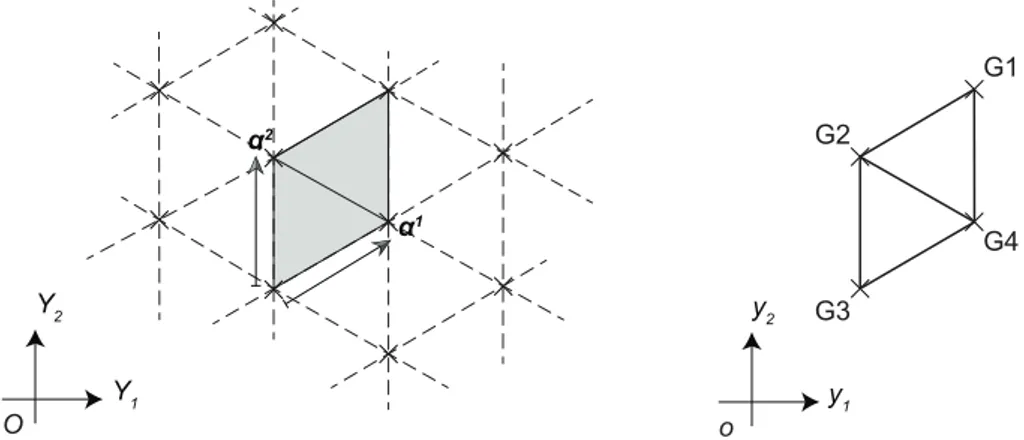
1.4 A periodic collection of discrete hexagonal blocks and the corresponding elemen-tary cell. The elemenelemen-tary cell retained (right) is the parallelogram produced by the periodicity vectors. . . 21
1.5 Kinematics and statics of the contact model adopted for the discrete medium. . . 21
1.6 Relative translationsJvGαKIJ and rotationsJωGKIJ producing opening and sliding of the interface between two blocks. Both depicted mechanisms are related to interface failure. . . 23
1.7 Homogenisation based on the Cosserat continuum is carried out in the frame of limit analysis on a periodic collection of rigid particles. Starting from a failure criterion (left) expressed at the interfaces of the discrete medium (in red), it is possible to retrieve the homogenised yield criterion for the macroscopic Cosserat continuum (right). The resulting homogenised strength domain is the region of the generalized stress space (Tαβ, Mβ) enclosed by these yield criteria. . . 26
1.8 A periodic collection of beams disposed following a mono-atomic lattice (left), and the corresponding elementary cell (right). . . 27
1.9 Periodic masonry column (left) and the corresponding elementary cell (right). . . 28
1.10 Combinations of rigid-body motions of the blocks (translations and rotations) producing 1D Cosserat macroscopic deformation and curvature states on the elementary cell of a masonry column. Solid lines represent the deformed state of the discrete cell. Dotted lines represent its undeformed state. In grey: the deformed state of the elementary cell supposed as a continuum, undergoing 1D macroscopic Cosserat deformations.. . . 29
1.11 Combinations of rigid-body motions of the blocks (translations and rotations) producing in-plane rigid-body translations Vα and Cosserat rotations Ω of the
elementary cell of a masonry column. . . 30
1.12 Displacement jump across the interface of the periodic elementary cell of a ma-sonry column, falling within the Coulomb friction cone. Condition for interface failure is that the displacement jump falls inside this cone. . . 31
1.13 Representation of the homogenised strength domain for the masonry column in the space of the generalized Cosserat deformations (Γα2, K2). In blue: the
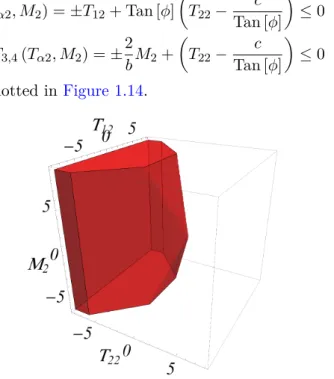
1.14 Representation of the homogenised strength domain for the masonry column in the space of the generalized Cosserat stresses (Tα2, M2). Intersecting plane
(Eq.(1.67)). . . 33
1.15 Condition for failure of the elementary cell (macroscopic failure) of a masonry column. Representation of the homogenised strength criterion for ζ1 = 0 (Cauchy continuum) and for ζ1 6= 0 (Cosserat continuum). . . 34
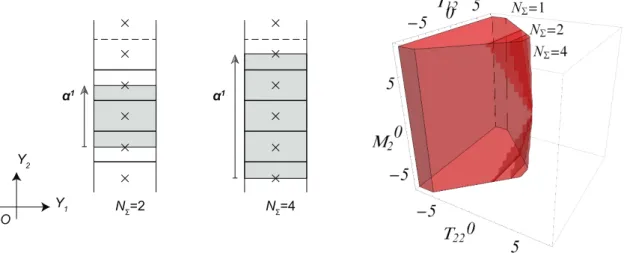
1.16 Periodic masonry column and corresponding elementary cells larger than B (left). Effect of the size of the cell on the computed strength (right). . . 35
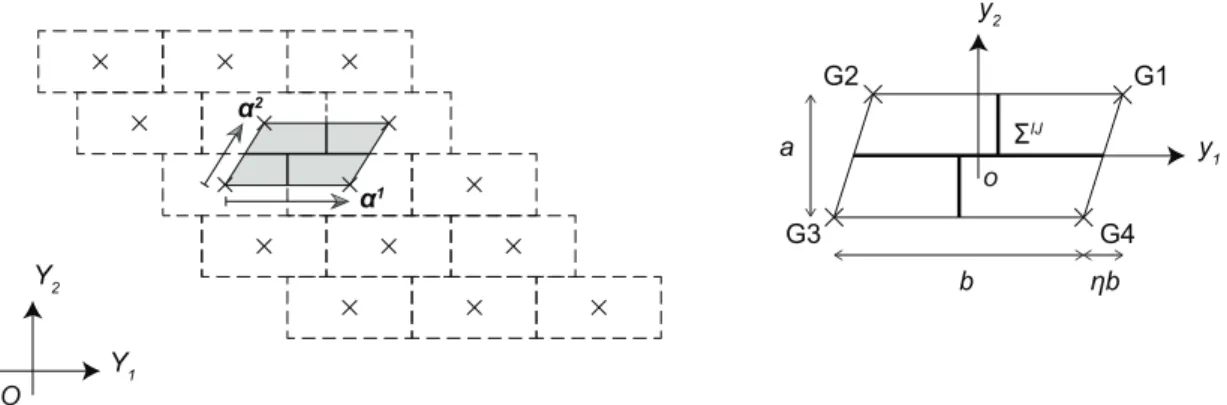
1.17 Periodic masonry wall with generic running bond pattern (left) and the corre-sponding elementary cell (right). . . 36
1.18 Elementary cells for periodic masonry covered by the cell A. Left: the stack bond pattern, for η = 0. Right: the classical (1/2) running bond pattern, for η = 1/2.. 37
1.19 Rigid-body motions of the blocks (translations and rotations) producing 2D Cosserat macroscopic deformation and curvature states on the elementary cell of a periodic masonry wall (stack bond pattern). Solid lines represent the de-formed state of the discrete cell. Dotted lines represent its undede-formed state. In grey: the deformed state of the elementary cell supposed as a continuum, undergoing 2D macroscopic Cosserat deformations. . . 38
1.20 Rigid-body motions of the blocks (translations and rotations) producing in-plane rigid-body translations Vα and Cosserat rotations Ωc of the elementary cell of a masonry wall. . . 39
1.21 Points of the elementary cell where the relevance condition needs to be verified. 41
1.22 Representation of the homogenised strength domain for the masonry wall (1/2 running bond pattern) in the space of Cosserat deformations. Intersections with
K1 = K2 = 0 and Γ12= Γ21= 0 (Γ11= Γ22). . . 42
1.23 Representation of the homogenised strength domain for the masonry wall in the Cauchy stress space. The strength domains for the Cauchy continuum proposed by Sab et al. (2007) (stack bond) and de Buhan and de Felice (1997); Sab (2003) (1/2 running bond) are for β = 0 (in light red). The strength domains for the Cosserat continuum are for β 6= 0, here β = 3 (in dark red). . . . 44
1.24 Comparison between the Cosserat strength domains for running bond pattern by Sulem and Mühlhaus (1997), Eq.(1.87)-(1.88) (in dark red), and the homogenised Cosserat strength domains from the present work (in light red). Intersections with
M1 = M2= 0 and T12= T21= 0 (T11= 0). . . 45
2.1 Stresses and couple stresses of a 3D Cosserat continuum. Stresses (left) are represented by polar vectors. Couple stresses (right) are represented by spin vectors. . . 55
2.2 Examples of three-dimensional discrete periodic media with particles disposed following a mono-atomic lattice. Left: a periodic collection of beams. Right: a periodic collection of cubic blocks in contact. Both discrete media are based on the same elementary cell (in dotted line). . . 56
2.3 Periodic masonry column (left) and the corresponding 3D elementary cell ¯B (right). 60
2.4 Blocks’ motions (vGJi , ωGJi ) producing 6 macroscopic Cosserat deformation modes of the discrete cell ¯B. Top: 3 displacement gradients Di2. Bottom: 3 rotation
gradients Ki2. . . 62
2.5 Blocks’ motions (viGJ, ωiGJ) producing 6 macroscopic rigid-body modes of the discrete cell ¯B. Top: 3 translations Vi. Bottom: 3 Cosserat rotations Ωci. . . 62
2.7 Coulomb slip criterion adopted at the interface level of the 3D cell ¯B. Cone of
plastically admissible displacement jumps. . . 64
2.8 Points of the 3D elementary cell where the relevance condition (Eq.(2.44)) needs to be satisfied. . . 65
2.9 Representations of the cone of the plastically admissible homogenised Cosserat deformations for the masonry column. . . 65
2.10 Periodic masonry wall (left) and the corresponding 3D elementary cell ¯A (right). 66
2.11 Rigid-body motion of the blocks (translations and rotations) producing 6 out-of-plane Cosserat macroscopic deformations of the elementary cell ¯A of a periodic
masonry wall (stack bond pattern). Top: 3 displacement gradients. Bottom: 3 rotation gradients. . . 68
2.12 Rigid-body motion of the blocks (viGJ, ωiGJ) producing 3 macroscopic out-of-plane rigid-body modes of the discrete cell ¯A of a periodic masonry wall (stack bond
pattern). Top: 1 rigid translation V3. Bottom: 3 Cosserat rotations (Ωc1, Ωc2). . . 69
2.13 Points of the 3D elementary cell where the relevance condition (Eq.(2.44)) needs to be satisfied. . . 72
3.1 Higher order continuum theories according to Germain (1973) terminology. Cosserat continuum is a special case of a micromorphic continuum of first order.. . . 83
3.2 Stresses, couple stresses and degrees of freedom of a Cosserat plate: membrane (left) and flexural (right) behaviour. . . 85
3.3 The COSS8R element, with 4 Gauss points (X), 8 nodes and 6 DOF per node: translations (square) and rotations (circle). . . 90
3.4 Elements tested for zero-energy modes investigation: (A) Cosserat element, plate configuration; (B) Cosserat element, membrane configuration; (C) classical Cauchy element, membrane part.. . . 91
3.5 (a) a highly rigid element resting upon a layer of flexible elements with reduced integration; (b) propagating spurious mode in an assembly of Cauchy (S8R) elements; (c) accurate results from a COSS8R subdivision. . . 92
3.6 Definition of the distortion δ of the rigid element. . . . 93
3.7 Normalised distortion factor (left) and normalised vertical displacement (right) versus the coupling factor α. The classical Cauchy (S8R) element is retrieved for
α = 0. The COSS8R element is for α = 1. . . . 94
3.8 Element discretisation employed for the patch test. . . 95
3.9 Bending-plate in two configurations: simply supported (left) and clamped edges (right). . . 96
3.10 Normalised central deflection versus length-to-thickness ratio for given meshes. Left: simply supported plate. Right: clamped-edge plate. . . 97
3.11 Dispersion relations for a one-dimensional Cosserat flexural problem: micro-rotation mode ν1 and shear strain mode ν2. . . 99
3.12 Relative error committed in the evaluation of the first eleven flexural wave lengths.100
3.13 The three simulated masonry panels modelled with DE and with equivalent Cosserat plates by the COSS8R element: notation, boundary conditions and aspect ratios AR = B/A. . . . 100
3.14 Modal frequencies of the masonry panel versus the number of building blocks composing the panel in both directions. Comparison between the results ex-tracted by DE and by the use of the equivalent Cosserat plate model for masonry implemented in a COSS8R FE discretisation. Results for aspect ratio AR = 0.50.102
3.15 Modal frequencies of the masonry panel versus the number of building blocks composing the panel in both directions. Comparison between the results ex-tracted by DE and by the use of the equivalent Cosserat plate model for masonry implemented in a COSS8R FE discretisation. Results for aspect ratio AR = 1.00.103
3.16 Modal frequencies of the masonry panel versus the number of building blocks composing the panel in both directions. Comparison between the results ex-tracted by DE and by the use of the equivalent Cosserat plate model for masonry implemented in a COSS8R FE discretisation. Results for aspect ratio AR = 1.50.104
3.17 Percentage of modal effective masses and moment of inertia for the first in-plane mode of the masonry panel, versus the number of building blocks composing the panel in both directions. The modal masses ¯M1 and ¯M1 are associated to the
horizontal and the vertical displacements. The modal moment of inertia ¯J3 is
associated to the drilling rotations. . . 104
4.1 Stresses and couple-stresses of a Cosserat plate. . . 114
4.2 Schematic representation of the elastic domain of a Cosserat continuum. Accord-ing to the multisurface plasticity theory, it is a convex region in the generalised stress space (τ , µ; q) defined by multiple yield criteria. . . . 116
4.3 Illustration of the Closest-Point-Projection (CPP) algorithm adopted within the multisurface plasticity theory for Cosserat materials. . . 120
4.4 Two possible configurations for which Jacobian matrix is singular for perfect plasticity. . . 122
4.5 The quadratic micropolar plate element COSS8R (Godio et al., 2015a). . . 127
4.6 Configurations used for the single element tests in multisurface plasticity. . . 128
4.7 Element response to uni-axial cyclic loading. Elastic modulus E = 10MPa, hardening modulus h = 10MPa, yield stress τy = 5MPa. . . 129
4.8 Element response to bi-axial test B1. Top: stress path in the (τ11− τ22)-plane. Bottom: stress-strain curve. In-plane elastic properties: K = 5MPa, G = 5MPa,
Gc= 0MPa, lc= 0. Hardening modulus h = 10MPa, yield stress τy = 5MPa. . . 131
4.9 Element response to bi-axial test B2. Top: stress path in the (τ11− τ22)-plane. Bottom: stress-strain curve. . . 132
4.10 Element response to bi-axial test B3. Top: stress path in the (τ11− τ22)-plane. Bottom: stress-strain curve. . . 133
4.11 Element response to bi-axial test B4. Top: stress path in the (τ11− τ22)-plane.
Center and bottom: stress-strain curve. . . 137
4.12 Element response to bi-axial test B5. Top: stress path in the (τ11− τ22)-plane. Center and bottom: stress-strain curve. . . 138
4.13 Hollow cylinder under axial rotation. Notations and boundary conditions. . . 139
4.14 Macroscopic behaviour of the hollow cylinder (left) and localisation of the in-plane shear strain γ12(right) for different discretisations with the COSS8R finite element (FE). . . 139
4.15 Deformation pattern and iso-contour of in-plane shear strain distribution for different discretisations of the hollow cylinder: left 16 × 8 FE, centre 24 × 16 FE, right 32 × 24 FE. Values for the ultimate resulting moment beyond the peak level.139
4.16 Square plate under torsion. Illustration of the boundary conditions and of the expected deformation pattern.. . . 140
4.17 Macroscopic behaviour of the square plate under torsion for different finite ele-ment discretisations. . . 140
4.18 Deformation pattern and iso-contour of the number of activated plastic surfaces for different discretisations of the square plate: left 2 × 2 FE, centre 4 × 4 FE, right 8 × 8 FE. . . 140
4.19 Shallow foundation under distributed pressure supported by a soil with microp-olar properties. Geometry and boundary conditions. . . 141
4.20 Illustration of the set of plastic surfaces describing the elastoplastic response of the soil. . . 141
4.21 Left: macroscopic response of the shallow foundation for soils with different in-ternal lengths. Right: response for small inin-ternal lengths (lc = 0.00025m) and comparison with finite elements based on the Cauchy continuum (Krabbenhøft et al., 2007b). . . 141
5.1 Notations used for the Cosserat medium (in-plane behaviour). Shear stresses and couple stresses (left) and elastic domain (right). . . 150
5.2 Two different elementary cells of a classical 1/2 running-bond masonry wall. Left: the cell with the form of a parallelogram considered for homogenisation in Chapter 1. Right: the diamond-shaped cell considered by Stefanou et al. (2008); de Buhan and de Felice (1997) and in the present Chapter. . . 151
5.3 Notations used for the Cauchy medium (in-plane behaviour). Shear stresses (left) and elastic domain (right). . . 152
5.4 Masonry shear wall. Illustration of the geometry and boundary conditions adopted for the discrete and the continuum models. . . 153
5.5 Set of homogenised yield criteria for 1/2 running-bond masonry, enclosing the elastic domains of the Cosserat (dark red) and the Cauchy (light red) elastoplastic continuum models (Table 5.1). Domains for non-symmetric (left) and symmetric (right) stress states. . . 154
5.6 Walls made up of different number of blocks considered for the study of the scale effect in masonry. . . 155
5.7 Scale effect in a confined masonry wall under shear. Normalized force-displacement diagrams from the discrete (top) and the homogenised continuum models (bot-tom), for walls composed by different number of blocks. The response given by the Cauchy model is invariant of the number of blocks. . . 156
5.8 Comparison between the discrete elements (DE) and the homogenised continuum finite element (FE) models in modelling a masonry shear wall, in terms of nor-malized force-displacement diagrams. Results are presented from the top to the bottom for walls composed by an increasing number of blocks. . . 158
5.9 Development of the inter-block slip in the discrete elements model when δ1 ≈ 0.05 (top - red dots) versus activation of the multiple homogenised yield criteria in the Cauchy (red region - centre) and Cosserat continuum model (bottom). Wall made of 12 × 30 blocks. . . 159
5.10 Development of the inter-block slip in the discrete elements model when δ1 ≈ 0.1 (top - red dots) versus activation of the multiple homogenised yield criteria in the Cauchy (red region - centre) and Cosserat continuum model (bottom). Wall made of 12 × 30 blocks. . . 160
5.11 Development of the inter-block slip in the discrete elements model when δ1 ≈ 0.2
(top - red dots) versus activation of the multiple homogenised yield criteria in the Cauchy (red region - centre) and Cosserat continuum model (bottom). Wall made of 12 × 30 blocks. . . 161
C.1 Rhombic plate subjected to local out-of-plane force F3. Notations, boundary
conditions and element discretisation. . . 185
C.2 Relative error committed in the evaluation of the out-of-plane displacement of point P of the plate. Top: response for isotropic plates. Bottom: comparison with anisotropic plates. Geometry: A = 50mm, B = 45mm, F3 = 1N. Out-of-plane properties: α4 = 1500MPa, β1 = 2000MPa × mm, β2 = 0MPa × mm,
β3 = 4000MPa × mm. Anisotropic plates are for δ = 0.5. . . . 186
D.1 The algorithm through which Abaqus calls the user subroutine UEL and oper-ates on the user-defined elements. CPP indicoper-ates the Closest-Point-Projection algorithm used for the solution of the elastoplastic problem (Chapter 4). . . 189
List of Tables
1.1 Coefficients used in Eqs.(1.81)-(1.83).. . . 42
2.1 Coefficients used in Eqs.(2.63)-(2.65).. . . 73
3.1 Field variables of the Cosserat plate-type model in matrix notation. Membrane and flexural behaviour. The components of the inertia tensor are represented in the principal basis. . . 86
3.2 Computed number of zero-energy modes other than those associated with rigid body modes. . . 92
3.3 Patch test for Cosserat plane elements: boundary conditions and expected solutions. 95
3.4 Results of patch tests at point P1. Exact results are reported in brackets. . . 96
4.1 Membrane and flexural static and kinematics of a Cosserat plate element. . . 127
5.1 Geometric and material properties of discrete and continuum models adopted for the masonry shear wall. . . 154
C.1 Results of patch tests for anisotropic Cosserat material. Stresses and couple stresses at point P1. Exact results are reported in brackets. . . 183
C.2 Generalization of the patch test of Providas and Kattis (2002) for anisotropic Cosserat materials: boundary conditions and expected solutions. . . 184
Context
With the development in the 20th century of building materials such as steel and concrete, masonry was displaced in many important engineering applications. As a result, methods for the design and the assessment of the structural performance of masonry remained far behind those conceived for these newer materials (DeJong, 2009). Nonetheless, masonry remained of great relevance for the construction of load-bearing walls in low- and medium-rise buildings. It was also widely used for internal and infill walls in buildings where the primary structural function was covered by steel and concrete (Hendry,2001).
Nowadays, masonry represents the majority of the built environment in the Mediterranean countries. These countries have the highest risk of damage from earthquakes in Europe, since most of the buildings do not benefit from modern engineering design concepts, but result instead from the use of empirical rules and expertise. In these countries, seismic loadings are certainly a major risk that causes the collapse of masonry buildings.
In this thesis we refer to traditional unreinforced masonry. This typology is comprehensive of a vast array of structures, ranging from those of historical dry-stone monuments to those of more recent mortar-brick buildings. The use of unreinforced masonry in these structures is almost always limited to components mainly subjected to compressive loads, that the material have to bear in the vertical direction (in the form of walls and pillars) or to span across distances (in the form of arches, vaults and domes) (Heyman, 1997;Como,2013). Masonry has instead a limited load-bearing capacity to support horizontal loads acting in the out-of-plane direction and flexural moments (Doherty et al., 2002; Griffith et al., 2007). Therefore the design and modelling of masonry structures still remains an open task for civil engineers.
In modern constructions, traditional masonry is rarely used for the entire structure of the building. It is better employed in mixted structures. Unreinforced masonry panels are usually surrounded by reinforced-concrete or steel boundary frames. The fact that the panel is laid before or subsequently to the frame denotes two types of masonry (Hendry et al., 1997): the confined and the infill masonry. Compared to infill masonry, confined masonry provides better performance during earthquakes, by virtue of the effective connection established between the material and the surrounding frame. In this configuration, masonry has an enhanced shear strength and ductility (Tomazevic and Klemenc, 1997). Furthermore, it gains higher out-of-plane load-bearing capacity, due to the arching mechanisms that it develops within the frame (Tu et al., 2010). The study of the interaction between masonry and the surrounding frame is, however, outside of the scope of the present thesis. Herein, attention is focused on single unreinforced masonry elements and infill panels. The connection with the surrounding frame is in general less well established in these latter (the gap between the frame and masonry is usually poorly filled with mortar). This allows one to model the masonry separately from the rest of the structure, provided that correct boundary conditions are applied.
Today’s Building Codes require the assessment of the seismic vulnerability of unreinforced masonry (Eurocode 8;Eurocode 6). In addition, they demand the estimation of the damage level and the residual load-bearing capacity after earthquake occurrence. This necessitates the use of spatial models for modelling buildings that include masonry elements, even in cases when the uniformity and symmetry of the building could suggest the choice of simplified two-dimensional models for the representation of its structural behaviour (Eurocode 8, Section 4).
According to Eurocode 8, models for masonry have to represent the correct distribution of mass and stiffness of the building. Masonry walls (confined or not) may contribute significantly to the lateral stiffness and resistance of the building and therefore they should be taken into account in the construction of the models. Moreover, particular attention should be given to infill panels and single masonry elements, since they are the most vulnerable to the seismic action
and, especially, to the out-of-plane failure. A number of uncertainties related to the behaviour of these elements should be considered in the construction of the models. For instance: the variability of their mechanical properties, the level of attachment to the surrounding frame, the possible modifications occurred during the use of the building (as the presence of openings), the non-uniform degree of damage suffered during earthquake events, the possibility of premature out-of-plane collapse of slender panels due to brittle failure, the torsional response of the building caused by the damage of the infill panels (Eurocode 8, Section 4, Section 9). These and further aspects may induce possible irregularities and non-uniformities in the building and therefore require spatial models to be captured.
In this context, the use of reliable and sophisticated models that correctly represent the mechanical behaviour of unreinforced masonry is a fundamental task. This certainly avoids premature decisions in masonry structural design that may prove overly conservative or, on the contrary, catastrophic. The formulation of these models requires, however, a higher degree of knowledge and education in the engineering practice, as well as the availability of adequate software.
This thesis contributes to the development and the use of continuum models for unreinforced masonry structures. Whether based on rigorous homogenisation methods (Anthoine, 1995;
Cecchi and Sab,2002b;Milani et al.,2006a;Stefanou et al.,2008) or on more phenomenological approaches (Casolo,2004;Grande et al.,2011;Penna et al.,2014;Liberatore and Addessi,2015), continuum (or macroscopic) models carry important advantages as compared to discrete (or microscopic) models (Lemos,2007b;DeJong and Vibert,2012;Simon and Bagi,2014), in which masonry constituents are modelled separately. First, continuum models are computationally less demanding than the discrete ones (Lourenço et al.,2007). Second, these models are often based on numerical procedures as the Finite Elements Method that are common in today’s engineering practice (Addessi et al., 2014). This enables to combine models for unreinforced masonry with existing models for concrete and steel. Finally, continuum models usually appeal to classical notions from the Continuum and Structural Mechanics (internal actions, moments, strains, etc.) that belong to engineering education and are recurrent in the Codes for masonry.
Research goals
As discussed in the previous Section, the assessment of the seismic performance of masonry structures is the research ground for the present thesis. Within this context, the primary objec-tive is the development of an equivalent continuum model for the description of the mechanical behaviour of masonry. From a theoretical point of view the research focuses on:
• Masonry, studied at the microscopic scale as a discrete medium equipped with an apparent periodic micro-structure. This latter is provided by the brickwork, i.e. the shape, size and disposition of the building blocks. The bridge between the micro- and the macroscopic scale is assured by the use of homogenisation techniques.
• The three-dimensional behaviour of masonry, i.e. the determination of the in-plane and the out-of-plane macroscopic material response (internal actions and deformations). To this purpose, rectilinear and planar structural configurations such as masonry columns and walls are represented respectively by means of equivalent beam and equivalent plate models.
• The non-linear behaviour of masonry, i.e. the formation of macroscopic failure mechanisms as consequence of the plastic evolution of its micro-structure. In this (large) field, the research focuses on the determination of the strength capacities of the masonry, as function
of the mechanical and geometrical properties of the building blocks and of the mortar joints.
• The modal response of masonry, i.e. the study of the inertial effects of the micro-structure (blocks kinematics) and their participation to the overall structural behaviour.
Under these goals, several aspects related to the macroscopic modelling of masonry struc-tures are more closely investigated in this thesis:
• The domain of applicability of the continuum model, i.e. the evaluation of the scale ratio for which the efficiency of the continuum model reaches its limits in representing the actual material response.
• The solution accuracy reached by the continuum within the limits imposed by the scale ratio.
• The capacity of the continuum model to capture the scale effect intrinsic to masonry.
Continuum choice
The formulation of continuum models for masonry leads us to consider the use of the Cosserat (or micropolar) continuous medium. It is well known from the literature that this particular higher order medium allows a more detailed and efficient description of the macroscopic behaviour of masonry as compared to the classical (or Cauchy) continuum (Mühlhaus et al., 1997; Masiani et al., 1995; Sulem and Mühlhaus, 1997; Trovalusci and Masiani, 1999, 2003, 2005; Stefanou et al., 2008; Salerno and de Felice, 2009; Addessi et al., 2010; de Bellis and Addessi, 2011;
Addessi and Sacco,2012;Pau and Trovalusci,2012). Indeed, the absence of an internal length prevents the classical continuum to capture the scale effect, wave dispersion, and the influence that the relative rotations of the building blocks have on the overall structural response. This deficiency is known today (de Borst and Sluys,1991;Lourenço,1996;de Buhan and de Felice,
1997;de Felice et al.,2010) and motivates the development of alternative modelling approaches for masonry, which are based on the introduction of an internal length related to its micro-structure. It is worth noticing that all the higher order continuous media are equipped with an internal length (Mindlin,1964;Germain,1973;Eringen,1999). Some of them have already been used for modelling masonry, see for instance the works ofStefanou et al.(2010);Stefanou and Sulem (2012); Bacigalupo and Gambarotta (2012); Trovalusci and Pau (2014). In this thesis, the Cosserat continuum is selected among the continuous media. As it will be shown, its formulation is relatively simple (limited number of variables and with clear physical meaning) and is flexible enough to accommodate pronounced micro-structural effects.
Modelling strategy
In order to achieve the research goals introduced above, a modelling strategy is followed in the present thesis. This consists in:
(1) Formulating a continuum model for masonry, i.e. the constitutive laws and yield criteria that are capable of reproducing (on the average sense) the actual material response. The development and the use of homogenisation techniques is made. These techniques are referred to the Cosserat continuum.
(2) Developing a numerical tool in order to implement the formulated continuum model and carry out simulations on more complex structural configurations. This new tool is based on the Finite Elements Method, herein formulated in the framework of the micropolar theory.
(3) Validating the continuum model for masonry incorporated into the finite element proce-dure, by comparing its response with that of an analogue discrete model. The Discrete Elements Method is used for the construction of the analogue model.
Outline of the thesis
The structure of the thesis reflects the outlined modelling strategy. Its content is organized as follows:
• Chapter 1reports the development of an analytical homogenisation method for the eval-uation of the in-plane strength of masonry. The method is presented as the extension to the Cosserat continuum of a procedure formulated in the literature for the Cauchy con-tinuum. It is based on the two-dimensional micropolar continuum theory and makes use of the kinematic approach of limit analysis in conjunction with a rigorous homogenisa-tion technique. The method is first presented with regard to a generic periodic collechomogenisa-tion of rigid blocks in contact. Next it is generalized to the whole class of discrete periodic media made of particles of the same type. The case of masonry is presented as applica-tion. The homogenised strength domains of masonry columns and walls are formulated in terms of the deformation measures of the Cosserat continuum. They are then projected into the space of the generalized stresses and couple stresses. This allows to retrieve the homogenised yield criteria for masonry. The formulation of the method based on the Cosserat continuum enables to investigate the influence of the relative rotation of the particles on the strength of the discrete medium. This influence is highlighted by the application to masonry, in comparison with the method based on the Cauchy continuum. • Chapter 2continues the development of the method presented in the previous Chapter, by extending it to the evaluation of the coupled in-plane and out-of-plane strength of masonry. The method is illustrated first for discrete periodic media made of particles disposed along three directions and showing three periodicity vectors. It relies on the use of the kinematic approach of limit analysis, developed, in this case, within the framework of the three-dimensional micropolar theory. This enables to capture the three-three-dimensional effect of both the relative translations and the relative rotations of the particles constituting the discrete medium. The application to masonry columns and walls shows how the in-plane and out-of-plane actions are coupled in the assessment of masonry strength. The relative rotations of the blocks accentuate this effect, which reduces the in-plane strength and suggests the use of three-dimensional models for masonry. Masonry walls are ascribed at the end of this Chapter to homogenised plates with Cosserat kinematics.
• Chapter 3 describes the formulation and the validation of a specific finite element for Cosserat plate models. The finite element formulation is given in detailed form for elas-ticity and dynamics. The validation of the element is made by means of numerical bench-marks and patch tests. The choice of the interpolation order and the degree of integration of the stiffness and the mass matrices are discussed. The possibility of numerical deficien-cies accompanying the occurrence of hourglass modes and the assembly of shell structures is explored. The shear locking phenomenon is also investigated. The actual use of the
element is presented in an application to masonry structures, where the natural frequen-cies of a masonry panel modelled by discrete elements are computed and compared with those given by a homogenisation model implemented in the element. This allows also to investigate the role of the in-plane rotations of the blocks and its implication towards seismic analyses of masonry structures.
• Chapter 4 reports the extension of the finite element presented in the previous Chapter to the elastoplastic framework. The implementation of the multisurface strain-hardening plasticity theory into the Cosserat finite element formulation is presented in extensive manner. The implementation of this theory is based on a projection algorithm, whose solution iterative scheme formulated for implicit time-integration procedures is described. Attention focuses on several numerical aspects concerning the element implementation. An important limitation of the classical implementation of the solution algorithm prevents its use in the framework of multisurface plasticity in an efficient way. This limitation is discussed and a solution strategy is proposed. The finite element for Cosserat plate models is next validated. Numerous numerical benchmarks show its performance in problems involving multiple plastic surfaces, perfect plasticity and strain localisation.
• Chapter 5concludes the thesis, by investigating the scale effect in the formation of failure mechanisms in masonry structures. Three different modelling strategies for masonry are proposed and compared. A homogenisation model based on the Cosserat continuum is first presented in the framework of the multisurface plasticity theory. The model is constructed by implementing the homogenised yield criteria computed in the previous Chapters into the developed Cosserat finite element. A second homogenisation model based on Cauchy continuum is introduced. This model is constructed by selecting appropriate constitutive laws and yield criteria from the literature. The performance of those homogenisation models in representing the elastoplastic response of a masonry panel is discussed, based on the comparison with a third analogue discrete elements model. The capability of the three models in predicting the scale effect in a practical application is investigated. It is worth remarking that the analytical part of the work accomplished in this thesis is mainly concentrated in Chapter 1 and Chapter 2. The numerical part is principally given in
Chapter 3andChapter 4. Chapter 5provides further developments to the analytical work and contains an application to masonry structures. Further applications to masonry are found in the final Sections of Chapter 3.
The reader may notice that different areas of research are tackled throughout the thesis (Continuum Mechanics, Computational Mechanics, Plasticity and Limit Analysis Theory, Me-chanics of Structures). Therefore, in order to gain clarity, a state-of-the art will be reported at the beginning of each Chapter. On the contrary, the Appendices mentioned in the text will be presented all together at the end of the report.
Acknowledgements
This research project has been supported financially by the École des Ponts Paris-Tech and the Centre Scientifique et Technique du Bâtiment (CSTB). The commercial code 3DEC was provided by Itasca Consulting Group (www.itascacg.com) within the framework of the partic-ipation to the Itasca Education Partnership program. The author would like to thank Daniel Billaux and José Lemos for their technical support in the use of 3DEC.
Chapter 1
Determination of the homogenised
yield criteria for masonry: in-plane
behaviour
This Chapter reports the development of an analytical method for the evaluation of the ho-mogenised in-plane strength of masonry. The method is based on the two-dimensional microp-olar (or Cosserat) continuum theory and makes use of the kinematic approach of limit analysis in conjunction with a homogenisation technique. The formulation of the method based on the Cosserat continuum enables to investigate the influence of the relative rotation of the blocks on the masonry strength. This influence is highlighted in view of the comparison with the method based on the Cauchy continuum.
Contents
1.1 Introduction. . . 15
1.2 The Cosserat continuum: 2D statics and kinematics . . . 18
1.3 The discrete medium: discrete variables and contact model . . . 20
1.4 Homogenisation in limit analysis: average Cosserat variables and kinematic ap-proach . . . 23
1.4.1 Kinematic map . . . 23
1.4.2 Average Cosserat variables. . . 24
1.4.3 Homogenisation kinematic approach . . . 25
1.4.4 Extension to generic periodic media . . . 26
1.5 Application to masonry columns . . . 27
1.5.1 Geometry . . . 27
1.5.2 Average Cosserat variables. . . 28
1.5.3 Homogenisation. . . 30
1.5.4 Discussion. . . 33
1.6 Application to masonry walls . . . 35
1.6.1 Geometry . . . 35
1.6.2 Average Cosserat variables. . . 36
1.6.3 Homogenisation. . . 40
1.7 Comparison with existing works. . . 43
1.7.1 Comparison with de Buhan and de Felice (1997) . . . 43
1.7.2 Comparison with Sulem and Mühlhaus (1997). . . 44
Summary
In the frame of Cosserat continuum theory, a homogenisation procedure for the assessment of the in-plane strength of discrete media is developed in this paper. The procedure is the extension to the Cosserat continuum of a procedure initially formulated for the Cauchy con-tinuum, based on the kinematic approach of limit analysis and the classical homogenisation theory. The extension to the Cosserat continuum is made in order to take into account the effect of particles’ rotation on the strength of the discrete medium. The procedure is illus-trated with regard to periodic assemblies of blocks in contact, and then generalized to the whole class of discrete periodic media with particles of the same type. The case of masonry is considered as application. Homogenised strength criteria of columns and walls are formulated in terms of non-symmetric stresses and in-plane couples. The procedure allows to show how the in-plane strength of masonry is reduced, as a result of blocks’ rotation on the material.
1.1
Introduction
In the last three decades, a renewed interest towards the Cosserat (or micropolar) continuum has driven researchers to the development of specific models for masonry. Since the original works ofBesdo(1985);Mühlhaus(1989);Masiani et al.(1995);Dai et al.(1996);Mühlhaus et al.
(1997); Sulem and Mühlhaus (1997) up to the more recent of Stefanou et al. (2008); Addessi et al. (2010); Addessi and Sacco (2012), the resort to the Cosserat continuum has seemed motivated by the advantages enclosed in its enhanced kinematics and the non-symmetry of the stress tensor. Indeed, when used for the formulation of continuum equivalent models for masonry, Cosserat continuum allows to efficiently take into account high deformation gradients (Trovalusci and Masiani, 2005), relative blocks’ rotation (Pau and Trovalusci, 2012) and scale effects (Salerno and de Felice,2009;Godio et al.,2015a). Moreover, Cosserat continuum enables the investigation of the phenomenon of wave dispersion, which governs the dynamic response of periodic media such as masonry (Pain,2005;Mühlhaus et al.,1997;Sulem and Mühlhaus,1997;
Stefanou et al.,2008). Those aspects makes Cosserat-continuum-based models particularly well suited for the description of the mechanical behaviour of masonry structures and preferable, in this sense, with respect to models based on the Cauchy continuum (Salerno and de Felice,2009) or the second gradient continuum (Trovalusci and Pau,2014).
The aforementioned features of the Cosserat continuum are strictly related to rotations. Contrary to the Cauchy continuum, rotations in micropolar continua are inherent to the medium, i.e. attached to the material particle (Germain, 1973; Vardoulakis and Sulem, 1995). Many works have shown how, aiming at representing masonry as an equivalent Cosserat continuum, these rotations are actually representative of blocks’ rotations. They enable a continuum de-scription of the medium which is capable to capture not only the relative rotations occurring between the blocks, but also their relative rotations with respect to the local rigid rotation of masonry considered as a whole (Pau and Trovalusci,2012). The role of rotations is even more apparent in the dynamic regime. Whether regarding the in-plane (Mühlhaus et al.,1997;Sulem and Mühlhaus, 1997) or the out-of-plane behaviour (Stefanou et al., 2008), the mechanical response of masonry is governed by translational and rotational waves. Only their superposi-tion gives the complete structural response. Therefore, blocks’ rotasuperposi-tions can have a significant participation in the inertial response of masonry, for instance when this latter is subjected to in-plane seismic excitations (Godio et al.,2015a).
On the other hand, the effect of blocks’ rotations on masonry behaviour is not always apparent. In general, blocks’ rotations account for the overall deformation of masonry for as little as their relative size with the structure (scale effect). Hence, when blocks are small as compared to the size of the whole structure, the effect of their rotation tends to vanish (Trovalusci and Masiani,1999,2005;Salerno and de Felice,2009).
Nevertheless, the influence of blocks’ rotations on the performance of masonry can be far more important than this proportion indicates. Indeed, the rotation of the blocks contributes to the relative displacements across the joints, which, in many cases, are the main responsible for the deformation of masonry. This may promote the formation of irreversible inelastic defor-mations within masonry and lead, consequently, to the premature development of macroscopic failure mechanisms. Even though this aspect is visible in the majority of the experimental tests carried out on masonry structures (see the recent tests by Petry and Beyer (2014a)), it has been seldom explored in the corresponding literature, see for instanceBesdo(1985);Sulem and Mühlhaus(1997);Trovalusci and Masiani (2003,2005); Addessi and Sacco(2012).
By way of example, we refer to classical full-scale tests made on masonry shear walls, as those reported and modelled byLourenço(1996), seeFigure 1.1. Regarding the test on the shear wall without opening (Figure 1.1-left), consequent to the increasing of the horizontal displacement,
deformation tends to concentrate within masonry in a band of finite size. As observed by
Lourenço(1996), this band goes from one corner of the wall to the other, and leads, at failure, to the formation of two distinct regions under compression (struts). Band formation is initiated by blocks’ slip, which is mainly due to joints’ sliding. This is formerly limited to the central region of the wall. Upon load increase, however, the band tends to cover a larger region of wall and to propagate progressively towards the wall corners. This is accompanied by the rotation of groups of blocks (highlighted inFigure 1.1) that are closed to the wall corners. On the one hand, their rotation promotes the formation of gaps between the blocks, due to joints’ opening and blocks’ cracking, and allows the diagonal band to propagate. On the other hand, it leads to the compression failure of the blocks positioned at the corners (toe crushing). This phenomena are even more accentuated if one regards the shear wall with opening (Figure 1.1-right). Therein, the same mechanisms are responsible for the deformation of the wall. Moreover, the presence of the opening leads to a failure mechanism with two groups of blocks undergoing an apparent rigid-body rotation (Lourenço,1996).
Shear wall without opening Shear wall with opening
Figure 1.1: The occurrence of blocks’ rotation (in grey) in the formation of failure mechanisms in masonry shear walls. Reference to the shear walls modelled byLourenço(1996).
The problem of the influence of blocks’ rotations on the strength capacity of masonry is addressed in this paper. Herein, the purpose is to determine the overall in-plane strength of masonry, by means of a rigorous homogenisation procedure specifically developed in the frame of Cosserat continuum theory. At the microscopic level, masonry is regarded as a discrete medium, i.e. an assemblage of rigid blocks. The blocks interact with each other through Coulomb interfaces, representing the masonry joints. Failure corresponds to the use of the strength capacities of the joints only, and not of the blocks, which are considered infinitely resistant. In particular, whether engendered by the relative blocks’ translation or by the relative blocks’ rotation, joints’ failure is accounted for by a unique Coulomb slip criterion. At the macroscopic level, masonry is ascribed to a 2D Cosserat continuum. The determination of its overall strength is made with reference to the kinematic approach of limit analysis and homogenisation. Originally developed for classical continua (Suquet,1983) the approach is here extended to the micropolar continua.
It is to note that a considerable amount of literature is devoted to the modelling of the in-plane strength of masonry. For instance, one may mention the works ofBaggio and Trovalusci
(1998); Pietruszczak and Ushaksaraei (2003); Mojsilović (2011). Concerning the use of ho-mogenisation models, other than the aforementioned works, one may citede Buhan and de Fe-lice(1997);Sab(2003);Massart et al.(2004);Milani et al.(2006a,b);Sab et al.(2007);Chettah et al.(2013);Stefanou et al. (2015);Milani and Taliercio(2015). However, a very limited num-ber of works have shown the use of Cosserat medium for the evaluation of masonry strength.
Sulem and Mühlhaus(1997) proposed strength criteria for masonry in the framework of plastic-ity theory formulated for Cosserat materials (see alsoBesdo(1985);Mühlhaus(1989);Dai et al.
constructed by considering relevant failure mechanisms at the blocks’ level, and formulated at the macroscopic level by adopting a micropolar continuum. On the same assumption of masonry as a discrete medium were based the works ofTrovalusci and Masiani(2003,2005). However, in that case the strength criteria were not computed explicitly. Failure mechanisms at the joints were formulated and integrated in a numerical procedure for the assessment of masonry overall behaviour. The procedure was based on the identification of the contact stresses exchanged by the blocks with the stress measures of the Cosserat continuum. Addessi et al. (2010) and Ad-dessi and Sacco (2012) developped a sophisticated numerical homogenisation procedure, based on the Transformation Field Analysis technique. Masonry was assumed as a composite Cauchy material at the microscopic level. The transition to the Cosserat continuum at the macroscopic level was made by means of a specific kinematic map (Forest and Sab,1998). The same map was employed in the work of de Bellis and Addessi(2011).
The present work represents somehow the extension of the homogenisation procedure pro-posed by de Buhan and de Felice (1997) based on the Cauchy continuum, to the Cosserat continuum. de Buhan and de Felice (1997) made use of the kinematic limit analysis approach (Suquet, 1983) in order to derive the homogenised strength of masonry. Since the strength properties of the joints were considered significantly lower than those of the blocks, the im-plementation of the kinematic approach required the use of failure mechanisms involving the relative displacements across the joints. In the frame of a Cauchy continuum, this amounted to consider the relative blocks’ translations only, and neglect the relative blocks’ rotations. In that case, the resulting yield criteria gave an upper bound of the researched strength domain, and were formulated in terms of symmetric macroscopic in-plane stresses. In this paper, the work ofde Buhan and de Felice(1997) is extended and generalized in order to take into account both relative blocks’ translation and relative blocks’ rotation. This is made by adopting a Cosserat continuum at the macroscopic scale. Hence, the resulting yield criteria are expressed in terms of non-symmetric in-plane stresses and couple stresses. It is worth noticing that the resort to the micropolar theory for the assessment of masonry in-plane strength was indicated by de Buhan and de Felice(1997) as crucial for capturing the scale effect observed in the failure mechanisms resulted from full-scale tests. Therefore, although the yield criteria computed for the Cosserat continuum may always give upper bounds of the researched strength domain, they are supposed to be better estimates of the actual strength capacity of the material, as compared to those computed for the Cauchy continuum by de Buhan and de Felice (1997). The reason may be found, once again, in the enhanced kinematics of the adopted continuum. On the one hand, they provide an improved estimation of the dissipated power. On the other hand, they allow a finer reproduction of the deformation modes and failure mechanisms of the medium (see the upper bound theorem of limit analysis).
At present, very few works have shown the use of the Cosserat medium in problems related to limit analysis and homogenisation. Concerning reinforced soils and rocks mechanics, one can mentionde Buhan et al.(1998) andde Buhan et al.(2002). Herein, the extension of the classical homogenisation theory to the Cosserat continuum is made in a rigorous, extensive and general way, with regard to discrete periodic media having particles of the same type (mono-atomic pattern). The resulting homogenisation procedure is thus general, and may apply to the whole class of materials with periodic inner micro-structure (Eringen, 1999), to which also masonry belongs.
The paper has the following structure. The first part is devoted to the extension of the kinematic limit analysis homogenisation approach to the Cosserat continuum. A brief summary of the equations governing the micropolar medium is first given in Section 1.2. The contact model adopted for the discrete media and on which homogenisation is illustrated, is presented next in Section 1.3. Cosserat macroscopic variables are then computed as average values of