Computing Pareto Optimal Committees
Haris Aziz
NICTA and UNSW
Sydney, Australia
[email protected]
J´erˆome Lang and J´erˆome Monnot
LAMSADE, Universit´e Paris-Dauphine
Paris, France
{lang, jerome.monnot}@lamsade.dauphine.fr
Abstract
Selecting a set of alternatives based on the prefer-ences of agents is an important problem in commit-tee selection and beyond. Among the various crite-ria put forth for desirability of a committee, Pareto optimality is a minimal and important requirement. As asking agents to specify their preferences over exponentially many subsets of alternatives is prac-tically infeasible, we assume that each agent speci-fies a weak order on single alternatives, from which a preference relation over subsets is derived us-ing some preference extension. We consider four prominent extensions (responsive, leximax, best, and worst). For each of them, we consider the cor-responding Pareto optimality notion, and we study the complexity of computing and verifying Pareto optimal outcomes. We also consider strategic is-sues: for three of the set extensions, we present linear-time, Pareto optimal and strategyproof algo-rithms that work even for weak preferences.
1 Introduction
Pareto optimality is a central concept in economics and has been termed the “single most important tool of normative economic analysis” [Moulin, 2003]. An outcome is Pareto optimal if there does not exist another outcome that all agents like at least as much and at least one agent strictly prefers. Although Pareto optimality has been considered extensively in single-winner voting and other social choice settings such as fair division or hedonic games, it has received only little attention in multiwinner voting, in which the outcomes are sets of alternatives. Multiwinner voting applies to selecting a set of plans or a committee, hiring team members, movie rec-ommendations, and more. For convenience, we use the ter-minology “committee” even if our results have an impact far beyond committee elections.
In single-winner voting setting, agents express preferences over alternatives and a single alternative is selected. Pareto optimality in this context is straightforward to define, achieve, and verify. In multiwinner voting, a well-known difficulty is that it is unrealistic to assume that agents will report pref-erences over all possible committees, since there are an ex-ponential number of them. For this reason, most approaches
assume that they only report a small part of their preferences, and that some extension principle is used to induce a pref-erence over all possible subsets from this ‘small input’ over single alternatives [Barber`a et al., 2004]. Such preference ex-tensions are also widely used in other social choice settings such as fair division or matching. The most two widely used choices of ‘small inputs’ in multiwinner voting are rankings (linear orders) over alternatives and sets of approved alter-natives. In this paper we make a choice that generalizes both of them: agents report weak orders over single alternatives. Then we consider four prominent preference extension prin-ciples: the responsive extension, where a set of alternatives S is at least as preferred as a set of alternatives T if S is obtained from T by repeated replacements of an alternative by another alternative which is at least as preferred; the optimistic, or ‘best’ (respectively pessimistic, or ‘worst’) extension, which orders subsets of alternatives according to their most (respec-tively, least) preferred element; and the leximax extension, a lexicographic refinement of the optimistic extension.
The responsive extension [Barber`a et al., 2004; Roth and Sotomayor, 1990] can be seen as the ordinal counterpart of additivity. The leximax extension has been considered in var-ious papers [Bossert, 1995; Lang et al., 2012; Klamler et al., 2012]. The ‘best’ set extension has been considered in a number of approaches such as full proportional represen-tation [Chamberlin and Courant, 1983; Monroe, 1995] and other committee voting settings [Elkind et al., 2015]. The ‘worst’ set extension, also used by Klamler et al. [2012] and Skowron et al. [2015b], captures settings where the impact of a bad alternative in the selection overwhelms the benefits of good alternatives: for instance, when the decision about a crucial issue will be made by one of the members of the committee but the agent ignores which one and is risk-averse; or the case of a parent’s preferences over a set of movies to be watched by a child. The ‘best’ and ‘worst’ set extensions have been used in coalition formation [Aziz and Savani, 2016; Cechl´arov´a, 2008].
Although set extensions have been implicitly or explicitly considered in multiwinner voting, most of the computational work has dealt with specific voting rules (see the related work section). Instead, we concentrate on Pareto optimality, con-sider the computation and verification of Pareto optimal com-mittees, as well as the existence of a polynomial-time and strategyproof algorithm that returns Pareto optimal outcomes.
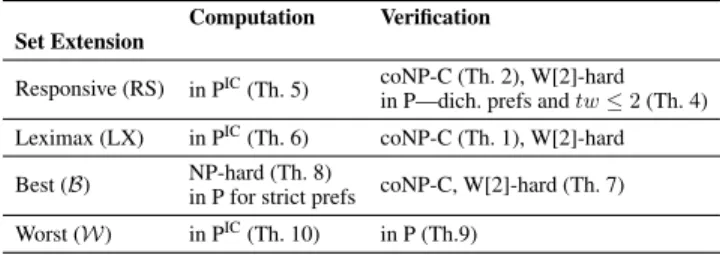
Computation Verification Set Extension
Responsive (RS) in PIC(Th. 5) coNP-C (Th. 2), W[2]-hard
in P—dich. prefs and tw 2 (Th. 4) Leximax (LX) in PIC(Th. 6) coNP-C (Th. 1), W[2]-hard
Best (B) NP-hard (Th. 8)in P for strict prefs coNP-C, W[2]-hard (Th. 7) Worst (W) in PIC(Th. 10) in P (Th.9)
Table 1: Complexity of computing and verifying Pareto op-timal committees. PIC (coined by Christos Papadimitriou in a seminar at Simons Institute in 2015) indicates a class of problems in which agents provide the input and the problems admit a strategyproof and polynomial-time algorithm. Contributions We consider Pareto optimality with respect to the four aforementioned preference set extensions. We present various connections between the Pareto optimality notions. For each of the notions, we undertake a detailed study of complexity of computing and verifying Pareto op-timal outcomes. Table 1 summarizes the complexity results.
An important take-home message of the results is that test-ing Pareto optimality or obtaintest-ing Pareto improvements over status-quo committees is computationally hard even though computing some Pareto optimal committee is easy. For re-sponsive and leximax extensions we give a complete charac-terization of the complexity of testing Pareto optimality when preferences are dichotomous and the size of top equivalence class is two: unless P = NP, Pareto optimality can be tested in polynomial time if and only if the size of the first equivalence classes is at most two. For the ‘best’ extension, we show that even computing a Pareto optimal outcome is NP-hard. An-other interesting contrast with the responsive set extension is that even when preferences are dichotomous and the size of top equivalence class is two, testing Pareto optimality is coNP-complete. In contrast to the other extensions, for the ‘worst’ extension, both problems of computing and verifying Pareto optimal outcomes admit polynomial-time algorithms.
We also consider the requirement of strategyproofness on top of Pareto optimality. We show that there exist linear-time Pareto optimal and strategyproof algorithms for committee voting even for weak preferences for three of the four set ex-tensions. The algorithms can be considered as careful adapta-tions of serial dictatorship for committee voting.
2 Related Work
A first related stream of work involves studying specific com-mittee elections rules from a computational point of view (generally with little or no focus on Pareto optimality). Our focus on determining whether a committee is Pareto optimal or on finding a Pareto optimal committee, is in some sense orthogonal to the study of committee election rules. The sim-plest (and most widely used) rules for electing a commit-tee, called best-k rules, compute a score for each alternative based on the ranks, and the alternatives with the best k scores are elected [Elkind et al., 2014; Faliszewski et al., 2016]. Scoring-based extension principles have also been used by Darmann [2013]. Note that the output of a best k-rule is
obvi-ously Pareto-optimal for the preferences induced by this scor-ing function, but not necessarily with respect to other set ex-tensions.
Klamler et al. [2012] compute optimal committees under a weight constraint for a single agent (therefore optimality is equivalent to Pareto optimality), using several preference extensions including ‘worst’, ‘best’, and leximax.
The ‘best’ (B) extension principle has been used in a num-ber of papers on committee elections by full proportional representation, starting with [Chamberlin and Courant, 1983] and studied from a computational point of view in a long se-ries of papers (e.g., [Procaccia et al., 2008; Lu and Boutilier, 2011; Betzler et al., 2013; Skowron et al., 2015a; Elkind and Ismaili, 2015]. These rules obviously output Pareto optimal committees for B, but not necessarily for other extensions.
Some works are based on the Hamming extension. Each agent specifies his ideal committee and he prefers committees with less Hamming distance from the ideal committee. The Hamming distance notion can be used to define specific rules such as minimax approval voting [Brams et al., 2007], which selects the committee minimizing the maximum Hamming distance for the agents. Although the output of minimax ap-proval voting is not always Pareto-optimal for the Hamming extension, there are good Pareto-optimal approximations of it [Caragiannis et al., 2010]. Note that for dichotomous pref-erences, the Hamming extension coincides with the respon-sive and the leximax extensions, therefore our computational results for responsive set extension for dichotomous prefer-ences also hold for the Hamming and leximax extensions.
A second line of work concerns understanding the classes of rules that result in Pareto optimal outcomes. Most works along this line bear on a different type of committee elections, called designated-seat voting, where candidates must declare the seat they contest [Benoˆıt and Kornhauser, 2010].1Results
about the existence or non-existence of Pareto optimal rules have been presented [ ¨Ozkal-Sanver and Sanver, 2006; Benoˆıt and Kornhauser, 2010; Cuhadaroˇglu and Lain´e, 2012].
3 Setup
We consider a set of agents N = {1, . . . , n}, a set of alter-natives A = {a1, . . . , am} and a preference profile %= (%1
, . . . ,%n)such that each%i is a complete and transitive
re-lation over A. We write a %i bto denote that agent i values
aat least as much as b and use i for the strict part of%i,
i.e., a i biff a%i bbut not b%i a. Finally, ⇠idenotes i’s
indifference relation, i.e., a ⇠ibiff both a%iband b%ia.
The relation %i results in equivalence classes
E1
i, Ei2, . . . , Ekii for some ki such that a i a0 if a 2 Eli
and a0 2 El0
i for some l < l0. We will use these
equiv-alence classes to represent the preference relation of an agent as a preference list i : E1
i, Ei2, . . . , E ki
i . For example,
we will denote the preferences a ⇠i b i c by the list
i : {a, b}, {c}. An agent i’s preferences are strict if the size of each equivalence class is 1. An agent i’s preferences are 1If there are exactly two candidates per seat, then designated
vot-ing is equivalent to multiple referenda, where a decision has to be taken on each of a series of yes-no issues.
dichotomous if he partitions the alternatives into just two equivalence classes, i.e., ki = 2. Let T opwidth(%) be the
maximum size of the most preferred equivalence class, i.e., T opwidth(%) = maxin|E1i|. For any S ✓ A, we will
denote by max%i(S)and min%i(S)the alternatives in S that
are maximally and minimally preferred by i respectively. Thus, if q and r are respectively the smallest and the largest indices such that Eq
i \ S 6= ; and Eir \ S 6= ;, then max%i(S) = E q i \ S and min%i(S) = E r i \ S. For k m, let Sk(A) ={W ✓ A : |W | = k}.
4 Set Extensions and Pareto Optimality
Set Extensions Set extensions are used for reasoning about the preferences of an agent over sets of alternatives given their preferences over single alternatives. For fixed-size committee voting, the responsive extension is very natural and has been applied in various matching settings as well [Barber`a et al., 2004; Roth and Sotomayor, 1990]. For all V, W 2 Sk(A), we
say that W %RS
i V if and only if there is an injection f from
V to W such that for each a 2 V , agent i weakly prefers f(a) to a, i.e. f(a)%ia.
We define the ‘best’ set extension and the ‘worst’ set ex-tension which are denoted B and W respectively. For all W, V 2 Sk(A), W %Bi V if and only if w %i v for
w 2 max%i(W ) and v 2 max%i(V ). On the other side,
W %Wi V if and only if w %i v for w 2 min %i(W )and
v2 min%i(V ).
In the leximax (LX) extension, an agent prefers a committee that selects more alternatives from his most preferred equiv-alence class, in case of equality, the one with more alterna-tives for the second most preferred equivalence class, and so on. Formally, W LX
i V iff for the smallest (if any) l with
|W \ El
i| 6= |V \ Eil| we have |W \ Eil| > |V \ Eli|.2
Efficiency based on Set Extensions With each set exten-sion E, we can define Pareto optimality with respect to E. A committee W 2 Sk(A)is Pareto optimal with respect to E, or
simply E-efficient, if there exists no committee W0 2 S
k(A)
such that W0 %E
i W for all i 2 N and W0 Ei W for some
i2 N. Note that for each of our set extensions, E-efficiency coincides with standard Pareto optimality when k = 1. An outcome is a Pareto improvement over another if each agent weakly improves and at least one agent strictly improved.
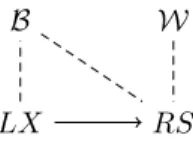
In Figure 1, we illustrate the relations between the different efficiency notions. In one case, The inclusion relation follows from the fact that%LX
i is a refinement of%RSi . Most of the
other observations can be proved by small examples consist-ing of two or three agents.
We also make the following general observation.
Lemma 1. If there is a polynomial-time algorithm to com-pute a Pareto improvement over a committee, then there exists a polynomial-time algorithm to compute an E-efficient com-mittee under set extensions E 2 {RS, LX, W, B}.
2One could define in a similar way a leximin refinement of%W.
For the sake of brevity we do not consider such a refinement here.
B W
RS LX
Figure 1: Relations between the four notions of efficiency. An arrow from E1to E2means that E1-efficiency implies E1
-efficiency; a dashed line means there always exists a commit-tee that is both E1- and E2-efficient; absence of arrow or line
means that the sets of E1- and E2-efficient committees can be
disjoint.
Proof. Here, we start from any committee and we recursively apply Pareto improvement until we reach a Pareto optimal committee. For the ‘best’ and ‘worst’ extensions, there can be at most mn Pareto improvements because for one agent there can be at most m improvements. Since an RS-improvement implies an LX-improvement, let us bound the number of LX-improvements. The maximum number of improvements is when we start from the set of worst alternatives and move to the set of best alternatives. The number of movements for the best alternative in the set is at most m, and similarly for other alternatives. Thus there can be at most m2improvements and
in total there can be nm2Pareto improvements.
We end this section by observing that, under any of the set extensions we consider, a set of Pareto optimal alternatives may be Pareto dominated. Consider the following example. Example 1.
1 : a, c, b, d 2 : a, d, b, c
3 : b, c, a, d 4 : b, d, a, c
The set {c, d} consists of Pareto optimal alternatives but is Pareto dominated by {a, b} under any of our set extensions.
5 Responsive Set Extension
There is a trivial way to achieve Pareto optimality under the responsive set extension by taking any decreasing scoring vector consistent with the ordinal preferences, finding the to-tal score of each alternative and returning the set of k alterna-tives with the maximum scores. For instance, on Example 1, the outcome of the rule that outputs the alternatives with the best k Borda scores is {a, b}.
Theorem 1. A Pareto optimal committee under the respon-sive set extension committee can be computed in linear time.
In many situations, one may already have a status-quo committee and one may want to find a Pareto improvement over it. This problem of testing Pareto optimality and find-ing a Pareto improvement under the responsive set exten-sion turns out to be a much harder task. Note that if there exists a polynomial-time algorithm to compute a Pareto im-provement, then it means that testing Pareto optimality is also polynomial-time solvable.
Theorem 2. Checking whether a committee is Pareto optimal under the responsive set extension is coNP-complete, even for dichotomous preferences and T opwidth(%) 3, or for strict preferences.
Proof. We only present the case where T opwidth(%) = 3. The reduction is from the NP-complete problem VERTEX COVER [Garey and Johnson, 1979]. Given a simple graph G = (V, E), the MINIMUM VERTEX COVER problem con-sists in finding a subset C ✓ V of minimum size such that every edge e 2 E is incident to some node of C. Its deci-sion verdeci-sionVERTEX COVER consists, given a simple graph G = (V, E)and an integer k, of deciding if there exists a vertex cover C ✓ V of G with |C| k.
Let h(V, E), ki be an instance of VERTEX COVER, with [x, y]being one arbitrary edge in E. We build the following instance of Pareto optimality under RS:
• N = [e2ENe[ {a}, where for each edge e 2 E, Neis
a set of k agents, and a is a special agent. • A = V [ D, where D = {d1, . . . , dk}.
• For each e = [u, v] 2 E, the preferences of agent ei, for
i = 1, . . . , k, and of agent a, are ei: {u, v, d
i}, (D di)[ (V \ {u, v})
a : {x, y}, D [ (V \ {x, y})
The reduction is clearly done within polynomial time and preferences are dichotomous. We can check easily that com-mittee D (of size k) is not Pareto optimal under RS if and only if there exists a vertex cover of G of size at most k.
For strict preferences, in the previous reduction we replace {u, v, di}, . . . by {u}, {v}, {di}, . . . in the preferences of ei.
It is easy to see that the proof is similar.
Using a similar reduction from the HITTINGSETproblem, we can also prove Theorem 3 that concerns a parametrized complexity intractability result [Downey and Fellows, 2013]. HITTINGSETis defined as follows: given a ground set X of elements, and a collection C = {C1, . . . , C`} of subsets of X,
does there exist a H ⇢ X such that |H| k and H \ C 6= ; for all C 2 C?
Theorem 3. Checking whether a committee is Pareto optimal under the responsive set extension is W[2]-complete under parameter k, even for dichotomous preferences.
For dichotomous preferences we present a complete char-acterization of the complexity according to the T opwidth(%) parameter. If T opwidth(%) = 1, then in any Pareto improve-ment over committee D, any alternative in D that is most preferred by some agent needs to be remain selected, and therefore the problem of checking RS-efficiency is easy. If T opwidth(%) 3, from Theorem 2, the problem is hard. Remains the case T opwidth(%) = 2.
Theorem 4. For dichotomous preferences, a Pareto im-provement over a committee with respect to the responsive set extension can be computed in polynomial time when T opwidth(%) 2.
Proof. Consider a preference profile %= (%1, . . . ,%n)
where each%iis dichotomous and verifies T opwidth(%) =
2, and let D 2 Sk(A). For each i 2 N, let (Ei1, Ei2)be the
partition associated with%i.
First, if for all i 2 N, E1
i ✓ D, then D is obviously
RS-efficient. Assume it is not the case, that is, (1) for some i 2 N, E1 i \ D 6= ;. Let • N0 ={i 2 N : E1 i \ D = E1i}, W0 =[i2N0Ei1(by construction, W0✓ D), and k0=|W0|. • N00 = {i 2 N \ N0 : E1 i \ (D \ W0) 6= ;} and A00=[i2N00Ei1.
Now, we build a graph G = (V, E) with V = {v1, . . . , vr}
isomorphic to A00, and [v
p, vq] 2 E iff Ei1 = {ap, aq} for
some i 2 N00: each edge of G corresponds to the top two
alternatives of some agent, provided one of them is in D\W0.
Let ⌧(G) be the size of an optimal vertex cover of G. We first claim that there is a Pareto improvement over D if and only if one of follows two conditions is satisfied:
(i) ⌧ (G) < k k0, or
(ii) ⌧ (G) = k k0, and there is an optimal vertex cover of
Gcontaining either at least an element of E1
i for some
i /2 N0[ N00, or two elements of E1
i for some i 2 N00.
We first show that (i) and (ii) are sufficient. If (i) holds then take a committee corresponding to a minimum vertex cover of G, add to it the k0alternatives of W0, and add (k k0) ⌧ (G)
alternatives, with at least one in [i(Ei1\ D); this is
possi-ble because of (1). If (ii) holds, then take a committee corre-sponding to a minimum vertex cover of G, and add to it the k0alternatives of W0. In both cases, the obtained committee contains E1
i for all i 2 N0, contains at least one element of
E1
i for all i 2 N0, and contains either two elements of Ei1for
some i 2 N00, or an element of E1
i for some i /2 N [ N00.
Therefore it is a Pareto-improvement over D.
Now, we show that (i) and (ii) are necessary. Let W 2 Sk(A)be a Pareto improvement of D containing a maximum
number of alternatives from D. We have the following two properties: W0 ✓ W and W \ W0 is a vertex cover of G.
W0 ✓ W holds, since otherwise there would be an i 2 N0
such that W0 %RS
i W does not hold. For similar reasons,
C0 = (W\ W0)\ A00is a vertex cover of G. If |(W \ W0)\
A00| < ⌧(G), then by adding to it any set of D \C0of size k
k0 ⌧ (G)we obtain a set of size k which constitutes a Pareto
improvement of D because now, E1
i ✓ W for some i 2 N00.
If |(W \ W0)\ A00| = ⌧(G), then (W \ W0)\ A00= W\ W0
and necessarily either E1
i \ C 6= ; for some i /2 (N0[ N00)
or E1
i ✓ C for some i 2 N00.
It remains to be shown that (i) and (ii) can be checked in polynomial time. (i) can be done in polynomial-time because Gis bipartite: indeed, by construction, G is two-colorable with color sets A00\ D and A00 \ D, and by K¨onig’s
the-orem, for bipartite graphs, the problem of finding the min-imum vertex cover is equivalent to computing a maxmin-imum matching, hence solvable in polynomial time. As for (ii), if ⌧ (G) = k k0, we have to check whether for some optimal vertex cover C of G, either (ii.1) E1
i \ C 6= ; holds for some
i /2 (N0[ N00), or (ii.2) E1
i ✓ C for some i 2 N00. In order
to check (ii.1), for each i /2 (N0[ N00)such that there exists
x2 E1
i\A00, we transform G into a new bipartite graph G{x}
where we add a new vertex x0and an edge [x, x0]. In order to
check (ii.2), for each i /2 N00, let E1
i ={x, y}; we transform
Ginto a new bipartite graph G{x,y}where we add two new
vertices x0 and y0, and two edges [x, x0]and [y, y0]. Finally,
of these graphs, because all optimal vertex covers of G{x}
(re-spectively G{x,y}) must contain x (respectively {x, y}).
Example 2. We illustrate the algorithm in the proof of Theo-rem 4. Let k = 2 and consider the dichotomous profile, where we specify only the top equivalence class of each agent:
1 :{a, c} 2 :{b, c} 3 :{b, d}
4 :{d, e} 5 :{e, f}
Let D = {a, b}. We have N0 = W0 = ;, k0 = 0,
D\ W0 ={a, b}, N00={1, 2, 3}, and A00={a, b, c, d}. We
construct the graph G = (V, E): V = {va, vb, vc, vd} and
E = {{va, vc}, {vb, vc}, {vb, vd}}. We have ⌧(G) = 2 =
k k0. Now we consider the four graphs G
{d}, resulting from
the addition to G of a new vertex vd0 and edge [vd, vd0], and
G{a,c}, G{b,c}and G{b,d}: G{a,c}results from the addition to
Gof two new vertices va0, vc0and edges [va, va0]and [vc, vc0],
etc. Two of these graphs have an optimal cover of size 2: G{d}, with optimal cover {vc, vd}, and G{b,c}, with optimal
cover {vb, vc}. Therefore, {c, d} and {b, c} are
RS-Pareto-improvements over {a, b}, and {a, b} is not RS-efficient. va vb vd vc va vb vd vd0 vc vc0 va vb vb0 vd vc G G{d} G{b,c}
Note that finding an algorithm that computes a Pareto im-provement over a committee can be used to decide whether a given a committee D of size k, is Pareto optimal under the responsive set extension.
Pareto optimality and Strategyproofness We now try to achieve both RS-efficiency and strategyproofness simultane-ously. A mechanism is strategyproof if no agent can get a more preferred outcome by misreporting his/her preference.
A naive way of achieving RS-efficiency and Pareto opti-mality is to enumerate the list of possible winning sets and implement serial dictatorship over the possible outcomes as is done in voting [Aziz et al., 2013b]. However, the number of possible outcomes is exponential and responsive preferences result in a partial order over the possible winning sets and not a complete and transitive order. This problem is solved by Al-gorithm 1 which can be viewed as a computationally efficient serial dictatorship.
Theorem 5. There exists a linear-time and strategyproof al-gorithm that returns a committee that is Pareto optimal under the responsive set extension.
Proof. Consider Algorithm 1. We show that at each stage i0,
agent ⇡(i0), implicitly refines the set of feasible committees
to the maximal set of most preferred outcomes from the set by providing additional constraints. This is true for the base case i0 = 1. Now assume it holds from 1 to i0. Note that L
con-tains all those alternatives that are strictly less preferred by agents in {⇡(1), . . . , ⇡(i0)} than the ones they respectively
fixed. Moreover, each agent in {1, . . . , ⇡(i0)} is indifferent
between the alternatives in L. As for ⇡(i0+ 1), he fixes the
Input: (N, A,%, k, permutation ⇡ of N) Output: W 2 Sk(A).
1 L(last set to be refined) A
2 r(number of alternatives yet to be fixed) k; W ;
3 i0(index of the permutation ⇡) 1
4 while r 6= 0 or i06= n do
5 Agent i = ⇡(i0)selects first t equivalence classes such that |St j=1E j i \ L| rand | St 1 j=1E j i \ L| < r. 6 W W [ (St 1 j=1E j
i \ L) (we say agent i fixes the
alternatives inSt 1 j=1E j i); 7 r |Stj=1Eij\ L| |St 1j=1Eij\ L| 8 L Et i; ri0 r 9 Increment i0by one 10 if r > 0 then
11 pick any r alternatives from L and add them to W 12 return W
Algorithm 1: Committee Voting Serial Dictatorship best |St 1
j=1E
j
⇡(i0+1)\L| alternatives in L where t is the value
such that |(St j=1E j ⇡(i0+1))\ L| ri0 and | St 1 j=1E j ⇡(i0+1)\
L| < ri0. For Et⇡(i0+1), the agent only requires that ri0+1 =
|(St 1j=1E j ⇡(i0+1))\ L| |(S t 1 j=1E j ⇡(i0+1))\ L| alternatives
are selected from his equivalence class Et
⇡(i0+1)which is
en-sured by the definition of the algorithm. It follows from the argument that the returned set is Pareto optimal under the re-sponsive set extension. For strategyproofness, when an agent ⇡(i0)turn comes, it only has a choice over fixing the alterna-tives in L and requiring ri0 alternatives from his equivalence
class Et
⇡(i0). In this case the algorithm already chooses one of
the best possible committees for the agent.
Note that for k = 1, the algorithm is equivalent to serial dictatorship as formalized by Aziz et al. [2013a]. Note that a committee that is Pareto optimal under the responsive set extension may not be a result of serial dictatorship. This holds even for k = 1 and the basic voting setting.
The problem with the serial dictatorship algorithm formal-ized is that it overly favours the agent that is the first in the permutation. One way to limit his power is to let him choose only dk/ne alternatives. We note that this attempt at having a fairer extension of serial dictatorship comes at an expense because strategyproofness is compromised. Consider the pro-file in which 1 has preferences a, b, c and 2 has preferences a, c, b. For k = 2, and permutation 12, the outcome is {a, c}. But if agent 1 reports b, a, c, then the outcome is {a, b}.
6 Leximax Set Extension
We point out that for dichotomous preferences, the responsive set extension coincides with the leximax set extension. Hence we get a corollary of our results for responsive preferences: Corollary 1. Checking whether a committee is LX-efficient is coNP-complete, even for dichotomous preferences and T opwidth(%) 3.
Note that Algorithm 1 returns a LX-efficient committee. Theorem 6. There exists a linear-time and strategyproof al-gorithm that returns a LX-efficient committee.
7 ‘Best’ Set Extension
Next, we consider Pareto optimality with respect to B, which has been used for defining many rules (see Section 2). Theorem 7. Unless P=NP, there is no polynomitime al-gorithm to compute a Pareto improvement over a commit-tee with respect to B, even for dichotomous preferences and T opwidth(%) = 2.
Proof. We show that if it is not the case, then we can solve polynomially the vertex cover decision problem. Consider an instance of VERTEX COVER given by a simple graph G = (V, E)with V = {v1, . . . , vq} and E = {e1, . . . , er},
and an integer k. Assume the existence of a polynomial-time algorithm Algo that computes a Pareto improvement over a committee with respect to B when T opwidth(%) 2: given a profile% and a set of k alternatives W, Algo(%, W) re-turns, in time polynomial in | % |, Yes if W is Pareto op-timal with respect to B, and otherwise returns a k-set U of alternatives which Pareto dominates W . We will now prove by applying at most n times Algo with different inputs that we can decide in polynomial if G has a vertex cover C ✓ V of G with |C| k. We construct the following profile P :
• The set of agents is N = {1, . . . , q+r k}, where agent i r corresponds to edge ei2 E.
• The set of 2q k alternatives is A = V [ D where D ={d1, . . . , dq k}.
• Let ei= [u, v]2 E be an edge of G; the preferences of
agent i for i = 1, . . . , r are:
i : {u, v}, D [ (V \ {u, v}).
The preferences of the last set of q k agents {r + 1, . . . , q + r k} are given by: for i = 1, . . . , q k,
r + i : di, V [ (D \ {di}).
The reduction is clearly done within polynomial time and the set of preferences given by% are dichotomous.
Consider the following inductive procedure: W0= V and
for i 1, Wi = Algo (%, Wi 1)if Wi 1 is not Pareto
optimal with respect to B, otherwise we return Wi 1. Let
W = Wn kbe the solution output after n k calls. Because
Algois polynomial, the whole procedure is polynomial. We claim that G has a vertex cover of size k iff D ✓ W . We will first prove by induction that at each step i, Wi\ D is
a vertex cover of G. For the initial step, it is valid because V is a vertex cover of G. Assume that it is true for i < n k and let us prove that Wi+1 \ D is a vertex cover of G. If
it is not the case, some edge ej = [u, v] 2 E is not
cov-ered. By assumption, ej is covered by Wi\ D. This implies
Wi Bj Wi+1, which is a contradiction. Hence, Wi+1 %Bj
Wi. From this hypothesis, we deduce D \ Wi+1%Bj D\ Wi
for j = n + 1, . . . , 2n kwith a strict preference for some agent. Equivalently, D \Wi⇢ D \ Wi+1. In conclusion, after
n krecursive calls, |W \D| k if and only if D ✓ W . Theorem 8. Computing a B-efficient committee is NP-hard, even for dichotomous preferences.
Proof. We give a reduction from HITTING SET. Let N = {1, . . . , `}, A = X and for each i 2 N, i’s dichotomous preferences are i : Ci, (X\ Ci).If there exists a
polynomial-time algorithm to compute a B-efficient committee, it will return a committee in which each agent gets a most preferred alternative if such a committee exists. But such a committee corresponds to a hitting set of size k.
8 ‘Worst’ Set Extension
In contrast to all the other set extensions considered in the pa-per, Pareto optimality with respect to the ‘worst’ set extension can be checked in polynomial time.
Theorem 9. There exists a polynomial-time algorithm that checks whether there a committee is W-efficient and com-putes a Pareto improvement over it if possible.
Proof. Let W 2 Sk(A). For each i 2 N, let Etiibe the least
preferred equivalence class such that Eti
i \ W 6= ;. We want
to check whether there is a k-set D of alternatives in which at least some agent i 2 N gets a strictly better outcome and all the other agents get at least as preferred an outcome. We check this as follows. For i 2 N, let Bi = A\ (Sk`=ti iE
` i)[ S j2N\{i} Skj `=tj+1E `
j). We check whether |Bi| kor not.
If |Bi| k, we know that there exists a subset of Bi, that
is strictly more preferred by i 2 N and at least as preferred by each agent. If |Bi| < k, then this means that a Pareto
improvement with i strictly improving is only possible if the size of the winning set is less than k which is not feasible.
We now consider strategyproofness together with W-efficiency. We first note that Algorithm 1 may not return a W-efficient outcome. However, we construct a suitable strat-egyproof and W-efficient by formalising an appropriate serial dictatorship algorithm for the worst set extension.
Theorem 10. There exists a linear-time and strategyproof al-gorithm that returns a W-efficient committee.
Proof. Consider the agents in a permutation ⇡. The set of al-ternatives A0 is initialized to A. We reduce the set A0 while
ensuring that it of size at least k. The next agent i in the per-mutation comes and deletes the maximum number of least preferred equivalence classes from his preferences and the corresponding alternatives in A0while ensuring that |A0| k.
Each successive agent in the permutation gets a most pre-ferred outcome while ensuring that agents before him in the permutation get at least as preferred an outcome as before. Thus the algorithm is strategyproof and Pareto optimal with respect to the ‘worst’ set extension.
9 Conclusions
We considered Pareto optimality in multi-winner voting with respect to a number of prominent set extensions. We pre-sented results on the relations between the notions as well as complexity of computing and verifying Pareto optimal out-comes. Further directions of future work include considering Pareto optimality with respect to other set extensions [Brandt and Brill, 2011].
Acknowledgments
Data61 (formerly known as NICTA) is funded by the Aus-tralian Government through the Department of Communi-cations and the Australian Research Council through the ICT Centre of Excellence Program. The authors thank Felix Brandt for useful pointers and comments. J´erˆome Lang and J´erˆome Monnot thank the ANR project CoCoRICo-CoDec.
References
[Aziz and Savani, 2016] H. Aziz and R. Savani. Hedonic games. In F. Brandt, V. Conitzer, U. Endriss, J. Lang, and A. D. Procaccia, editors, Handbook of Computational Social Choice, chapter 15. Cambridge University Press, 2016. Forthcoming.
[Aziz et al., 2013a] H. Aziz, F. Brandt, and M. Brill. The computa-tional complexity of random serial dictatorship. Economics Let-ters, 121(3):341–345, 2013.
[Aziz et al., 2013b] H. Aziz, F. Brandt, and M. Brill. On the trade-off between economic efficiency and strategyproofness in ran-domized social choice. In Proc. of 12th AAMAS Conference, pages 455–462. IFAAMAS, 2013.
[Barber`a et al., 2004] S. Barber`a, W. Bossert, and P. K. Pattanaik. Ranking sets of objects. In S. Barber`a, P. J. Hammond, and C. Seidl, editors, Handbook of Utility Theory, volume II, chap-ter 17, pages 893–977. Kluwer Academic Publishers, 2004. [Benoˆıt and Kornhauser, 2010] J.-P. Benoˆıt and L. Kornhauser.
Only a dictatorship is efficient. Games and Economic Behavior, 70(2):261–270, 2010.
[Betzler et al., 2013] N. Betzler, A. Slinko, and J. Uhlmann. On the computation of fully proportional representation. JAIR, 47:475– 519, 2013.
[Bossert, 1995] W. Bossert. Preference extension rules for ranking sets of alternatives with a fixed cardinality. Theory and Decision, 39:301—317, 1995.
[Brams et al., 2007] S. Brams, D. Kilgour, and R. Sanver. A min-imax procedure for electing committees. Public Choice, 3-4(132):401–420, 2007.
[Brandt and Brill, 2011] F. Brandt and M. Brill. Necessary and suf-ficient conditions for the strategyproofness of irresolute social choice functions. In Proc. of 13th TARK Conference, pages 136– 142. ACM Press, 2011.
[Caragiannis et al., 2010] I. Caragiannis, D. Kalaitzis, and E. Markakis. Approximation algorithms and mechanism design for minimax approval voting. In Proc. of 24th AAAI Conference, pages 737–742, 2010.
[Cechl´arov´a, 2008] K. Cechl´arov´a. Stable partition problem. In Encyclopedia of Algorithms, pages 885–888. Springer, 2008. [Chamberlin and Courant, 1983] J. R. Chamberlin and P. N.
Courant. Representative deliberations and representative deci-sions: proportional representation and the Borda rule. American Political Science Review, 77(3):718–733, 1983.
[Cuhadaroˇglu and Lain´e, 2012] T. Cuhadaroˇglu and J. Lain´e. Pareto efficiency in multiple referendum. Theory and Decision, 72(4):525–536, 2012.
[Darmann, 2013] A. Darmann. How hard is it to tell which is a condorcet committee? Mathematical Social Sciences, 66(3):282– 292, 2013.
[Downey and Fellows, 2013] R. G. Downey and M. R. Fellows. Fundamentals of Parameterized Complexity. Texts in Computer Science. Springer, 2013.
[Elkind and Ismaili, 2015] E. Elkind and A. Ismaili. OWA-Based Extensions of the Chamberlin-Courant Rule. In Proc. of 4th ADT, pages 486–502. Springer-Verlag, 2015.
[Elkind et al., 2014] E. Elkind, P. Faliszewski, P. Skowron, and A. Slinko. Properties of multiwinner voting rules. In Proc. of 13th AAMAS Conference, pages 53–60, 2014.
[Elkind et al., 2015] E. Elkind, J. Lang, and A. Saffidine. Con-dorcet winning sets. Social Choice and Welfare, 44(3):493–517, 2015.
[Faliszewski et al., 2016] P. Faliszewski, P. Skowron, A. Slinko, and N. Talmon. Multiwinner analogues of the plurality rule: Ax-iomatic and algorithmic views. In Proc. of 28th AAAI Confer-ence, 2016.
[Garey and Johnson, 1979] M. R. Garey and D. S. Johnson. Com-puters and Intractability: A Guide to the Theory of NP-Completeness. W. H. Freeman, 1979.
[Klamler et al., 2012] C. Klamler, U. Pferschy, and S. Ruzika. Committee selection under weight constraints. Mathematical So-cial Sciences, 64(1):48–56, 2012.
[Lang et al., 2012] J. Lang, J. Mengin, and L. Xia. Aggregating conditionally lexicographic preferences on multi-issue domains. In Principles and Practice of Constraint Programming, pages 973–987, 2012.
[Lu and Boutilier, 2011] T. Lu and C. Boutilier. Budgeted social choice: From consensus to personalized decision making. In Proc. of 22nd IJCAI, pages 280–286. AAAI Press, 2011. [Monroe, 1995] B. L. Monroe. Fully proportional representation.
The American Political Science Review, 89(4):925–940, 1995. [Moulin, 2003] H. Moulin. Fair Division and Collective Welfare.
The MIT Press, 2003.
[ ¨Ozkal-Sanver and Sanver, 2006] ˙I. ¨Ozkal-Sanver and R. Sanver. Ensuring Pareto-optimality by referendum voting. Social Choice and Welfare, 27:211–219, 2006.
[Procaccia et al., 2008] A. D. Procaccia, J. S. Rosenschein, and A. Zohar. On the complexity of achieving proportional repre-sentation. Social Choice and Welfare, 30:353–362, 2008. [Roth and Sotomayor, 1990] A. E. Roth and M. A. O. Sotomayor.
Two-Sided Matching: A Study in Game Theoretic Modelling and Analysis. Cambridge University Press, 1990.
[Skowron et al., 2015a] P. Skowron, P. Faliszewski, and A. Slinko. Achieving fully proportional representation: Approximability re-sults. Artif. Intell., 222:67–103, 2015.
[Skowron et al., 2015b] P. K. Skowron, P. Faliszewski, and J. Lang. Finding a collective set of items: From proportional multirep-resentation to group recommendation. In Proc. of 23rd IJCAI, pages 2131–2137. AAAI Press, 2015.