Comparing Sanskrit Texts for Critical Editions
∗Marc Csernel
Projet AXIS: Inria-Rocquencourt & Universite Paris-Dauphine [email protected] Tristan Cazenave LAMSADE Universite Paris-Dauphine, [email protected] Abstract
Traditionally Sanskrit is written without blank, sentences can make thousands of characters without any separation. A crit-ical edition takes into account all the dif-ferent known versions of the same text in order to show the differences between any two distinct versions, in term of words missing, changed or omitted. This pa-per describes the Sanskrit characteristics that make text comparisons different from other languages, and will present different methods of comparison of Sanskrit texts which can be used for the elaboration of computer assisted critical edition of San-skrit texts. It describes two sets of meth-ods used to obtain the alignments needed. The first set is using the L.C.S., the sec-ond one the global alignment algorithm. One of the methods of the second set uses a classical technique in the field of artifi-cial intelligence, the A* algorithm to ob-tain the suitable alignment. We conclude by comparing our different results in term of adequacy as well as complexity.
1 Introduction
A critical edition is an edition that takes into account all the different known versions of the same text. If the text is mainly known through a great number of manuscripts that include non trivial differences, the critical edition often looks rather daunting for readers unfamiliar with the subject: the edition is then formed mainly by ∗This work is supported by the EEC FP7 project IDEAS
footnotes that enlighten the differences between manuscripts, while the main text (that of the edi-tion) is rather short, sometimes a few lines on a page. The differences between the texts are usu-ally described in term of words (sometime sen-tences) missing, added or changed in a specific manuscript. This reminds us the edit distance but in term of words instead of characters. The text of the edition is established by the editor accord-ing to his own knowledge of the text. It can be a particular manuscript or a ”mean” text built ac-cording to some specific criteria. Building a crit-ical edition by comparing texts two by two, espe-cially manuscript ones, is a task which is certainly long and, sometimes, tedious. This is why, for a long time, computer programs have been help-ing philologists in their work (see O’Hara (1993) or Monroy (2002) for example), but most of them are dedicated to texts written in Latin (sometimes Greek) scripts.
In this paper we will focus on the problems in-volved by a critical edition of manuscripts writ-ten in Sanskrit. Our approach will be illustrated by texts that are extracted from manuscripts of the “Banaras gloss”, k¯a´sik¯avr.tti.
The Banaras gloss was written around the 7th century A.D., and is one of the most famous com-mentary on the P¯an.ini’s grammar, which is known as the firstgenerative grammar ever written, and was written around the fifth century B.C. as a set of rules. These rules cannot be understood without the explanation provided by a commen-tary such as the k¯a´sik¯avr.tti. This collection was chosen, because it is one of the largest collection of Sanskrit manuscripts (about hundred different ones) of the same text actually known.
In what follows we will first describe the char-acteristics of Sanskrit that matter for text compar-ison algorithms, we will then show that such a comparison requires the use of a lemmatized text as the main text. The use of a lemmatized text in-duces the need of a lexical preprocessing. Once the lexical preprocessing is achieved, we can pro-ceed to the comparison, where we develop two kinds of approach, one based on the LCS, which was used to solved this problem, the other one lated to sequence alignment. In both cases the re-sults are compared in terms of adequacy as well as complexity. We then conclude and examine the perspective of further work.
2 How to compare Sanskrit manuscripts
One of the main characteristics of Sanskrit is that it is not linked to a specific script. But here we will provide all our examples using the De-van¯agar¯ı script, which is nowadays the most used. The script has a 48 letters alphabet. Due to the long English presence in India, a tradition of writ-ing Sanskrit with the Latin alphabet (a translitera-tion) has been established for a long time. These transliteration schemes were originally carried out to be used with traditional printing. It was adapted for computers by Frans Velthuis (Velthuis, 1991), more specifically to be used with TEX. According to the Velthuis transliteration scheme, each San-skrit letter is written using one, two or three Latin characters; notice that according to most translit-eration schemes, upper case and lower case Ro-man characters have a very different meaning.
In ancient manuscripts, Sanskrit is written with-out spaces, and this is an important graphical specificity, because it increases greatly the com-plexity of text comparison algorithms. On the other hand, each critical edition deals with the no-tion of word. Since electronic Sanskrit lexicons such as the one built by Huet (2006; 2004) do not cope with grammatical texts, we must find a way to identify each Sanskrit word within a character string, without the help of either a lexicon or of spaces to separate the words.
The reader interested in a deeper approach of the Sanskrit characteristics which matters for a computer comparison can look in Csernel and Patte (2009).
The solution comes from the lemmatization of one of the two texts of the comparison: the text of the edition. The lemmatized text is prepared by hand by the editor. We call it a padap¯at.ha, according to a mode of recitation where sylla-bles are separated. From this lemmatized text, we will build the text of the edition, that we call a sam.hitap¯at.ha, according to a mode of recitation where the text is said continuously. The trans-formation of the padap¯at.ha into the sam.hitap¯at.ha is not straightforward because of the existence of sandhi rules.
What is called sandhi — from the Sanskrit: li-aison — is a set of phonetic rules which apply to the morpheme junctions inside a word or to the junction of words in a sentence. These rules are perfectly codified in P¯an.ini’s grammar. Roughly speaking the Sanskrit reflects (via the sandhi) in the writing the liaison(s) which are made by a human speaker. A text with separators (such as spaces) between words, can look rather different (the letter string can change greatly) from a text where no separator is found (see the example of padap¯at.ha on next page).
The processing is done in three steps, but only two of them will be considered in this paper:
• First step: The padap¯at.ha is transformed into a virtual sam.hitap¯at.ha in order to make feasible a comparison with a manuscript. The transformation consists in removing all the separations between words and then in applying the sandhi. This virtual sam.hitap¯at.ha which will form the text of the edition, is compared with each manuscript. As a sub product of this lexical treatment, the places where the separation between words occur will be kept into a table which will be used in further treatments.
• Second step: An alignment of a manuscript and the virtual sam.hitap¯at.ha. We describe three different methods to obtain these align-ments. The aim is to identify, as precisely as possible, the words in the manuscript, using the padap¯at.ha as a pattern. Once the words of the manuscript have been determined, we can see through the alignment those which have been added, modified or suppressed.
• Third step:: Display the results in a compre-hensive way for the editor.
The comparison is done paragraph by para-graph, according to the paragraphs made in the padap¯at.ha during its elaboration by the editor. Each of the obtained alignments, together with the lemmatized text (i.e. padap¯at.ha), suggests an identification of the words of the manuscript.
3 The lexical preprocessing
The goal of this step is to transform both the padap¯at.ha and the manuscript in order to make them comparable. This treatment will mainly consist in transforming the padap¯at.ha into a sam.hitap¯at.ha by applying the sandhi.
At the end of the lexical treatment the texts are transmitted to the comparison module in an inter-nal encoding.
This allows us to ensure the comparison what-ever the text encoding.
An example of padap¯at.ha:
viˆudˆpanna ruupa siddhis+v.rttis+iya.m
kaa"sikaa naama
We can see that words are separated by three dif-ferent lemmatization signs: +, , ˆ which indicate respectively the presence of an inflected item, the component of a compound word, the presence of a prefix.
The previous padap¯at.ha becomes the following sam.hitap¯at.ha:
vyutpannaruupasiddhirv.rttiriya.mkaa"si
kaanaama
after the transformation induced by the lexical pre-processing, the bold letters represent the let-ters (and the lemmatization signs) which have been transformed.
Notice that we were induced (for homogene-ity reasons) to remove all the spaces from the manuscript before the comparison process. Thus no word of the manuscript can appear separately during that process.
The sandhi are perfectly determined by the Sanskrit grammar (see for example Re-nou (1996)). They induce a special kind of dif-ficulties due to the fact that their construction can be, in certain cases, a two-step process. During the first step, a sandhi induces the introduction of
1d0 < tasmai 4c3,5 < gurave ---> gane > " > saaya Word 1 ’tasmai’ is : - Missing Word 2 ’"srii’ is : - Followed by Added word(s) ’ga.ne"saaya’ Word 3 ’gurave’ is : - Missing
Ediffwith spaces L.C.S. based results without space
Table 1: different comparisons
a new letter (or a letter sequence). This new letter can induce, in the second step, the construction of another sandhi.
4 The first trials
The very first trials on Sanskrit critical edition were conducted by Csernel and Patte (2009). Their first idea was to use diff (Myers (1986)) in order to obtain the differences between two San-skrit sequences.
But they find the result quite disappointing. The classical diff command line provided no useful information at all.
They obtained a slightly better result with Emacs ediff, as shown in Table 1, left col-umn: we can see which words are different. But as soon as they wanted to compare the same se-quences without blank, they could not get a better result using ediff than using diff. This is why they started to implement an L.C.S. (Hirschberg, 1975) based algorithm. Its results appear in the right column of Table 1.
4.1 The L.C.S based algorithm
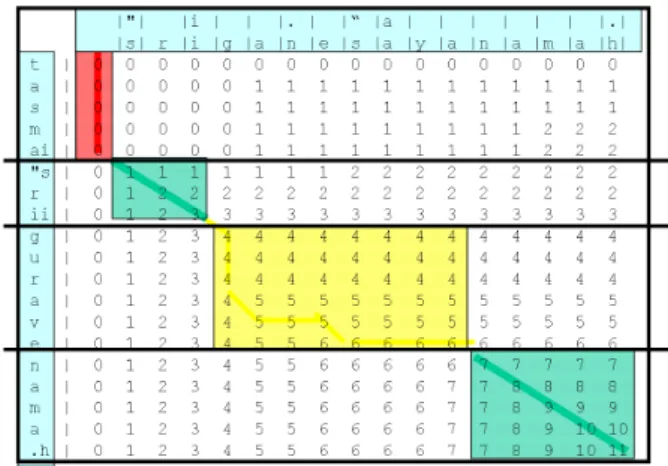
The L.C.S matrix associated with the previous re-sult can be seen on figure 1 on next page.
On this figure the vertical text represents the sam.hitap¯at.ha, the horizontal text is associated with a manuscript. The horizontal bold dark lines have been provided by the padap¯at.ha, before it has been transformed into the sam.hitap¯at.ha.
The rectangles indicate how the correspon-dences have been done between the sam.hitap¯at.ha and the manuscript. One corresponds to a word missing (tasmai), two correspond to a word present in both strings: the words s"rii and nama.h, the last one corresponds to a word with a more ambiguous status, we can say either that
Figure 1: The L.C.S. Matrix
the word has been replaced or that one word is missing and another word has been added. We can see below the result in term of alignment where the double ”|” represents a separation between two words.
t a s m ai "s r ii g u r a v e - - - - n a m a .h - - - "s r ii g - - a .n e "s aa y a n a m a .h
the corresponding alignment
If the result appears quite obvious within this example, it is not always so easy, particularly when different paths within the matrix can lead to different alignments providing different results. This induced them to put a lot of post treat-ments to improve their results, and, at the end, the method looked rather complicated. This is why we were induced to produce an aligment method based on the edit distance.
5 Alignment based on edit distance
We used two different methods to get the align-ments formed by the matrix: the first one, based on the common sense, is the subject of this sec-tion. The second one, based on the IDA* algo-rithm is the subject of the next one.
The idea is to get anyone of the alignments be-tween the sam.hitap¯at.ha and the manuscript, from the distance matrix, and then apply some simple transformations to get the right one.
The first goal is to minimize the number of in-complete words which appear in the alignment (mostly in the manuscript). The second goal is to improve the compactness of each letter sequence
by moving in the same word the letters apart from the gaps.
In the following we consider that the distance matrix has been built from the top left to the bot-tom right, and that the alignment is built by keep-ing a path from the bottom right till the top left of the matrix.
In such case, if some words are missing in the manuscript, some letters can be misaligned (not with the proper word), but this misalignment can be easily corrected by shifting the orphan letters till the correct matching word.
5.1 Shifting the orphan letters
We will call an orphan letter a letter belonging to an incomplete word of the manuscript (generally) and being isolated. To obtain a proper alignment these letters must fit with the words to which they belong.
The sequence Seq 1 below gives a good ex-ample. The upper line of the table represents the padap¯at.ha, the second one the manuscript. In this table, the words pratyaahaaraa and rtha.hare missing in the manuscript. Conse-quently the letters a.h are misplaced, with the word rtha.h. The goal is to shift them to the right place with the word upade"sa.h. The result after shifting the letters appears in the se-quence Seq 2 . u p a d e "s a .h p r a t y aa h aa r aa r th a .h u p a d e "s - - - a .h Seq 1 u p a d e "s a .h p r a t y aa h aa r aa r th a .h u p a d e "s a .h - - - -Seq 2
On the second example (Seq 3 & 4) we see on the left side of the table that the letter a must just be shifted from the beginning of asiddhy to the end of saavarny giving Seq 4.
s aa v a r .n y a p r a s y d dh y s aa v a r .n y - - - a s y d dh y
Seq 3: the orphan letter
s aa v a r .n y a p r a s y d dh y s aa v a r .n y a - - - s y d dh y
But another kind of possible shift is the one linked to the presence of supplementary letters within the manuscript such as in Seq 5. The letters a and nam of the padap¯at.ha are shifted to the right end of the sequence prayoj such as shown in Seq 6.
p r a y o j - - - a - - - - n a m p r a y o j a n a m s a .m j "n aa n a m
Seq 5: before shifting
p r a y o j a n a m - - - -p r a y o j a n a m s a .m j "n aa n a m
Seq 6: once shifted 5.2 The results
The results of the program are first displayed as a text file. They do not come directly from the align-ment but from a further treatalign-ment, which elimi-nates some of the useless differences discovered, and transform the other ones into something more convenient for a human reader.
Paragraph 3 is Missing in File Asb2 Word 11 ’saara’ is:
- Substituted with ’saadhu’ in Man. aa Word 17 ’viv.rta’ is:
- Followed by Added word(s) ’grantha"saa’ in Manuscript A3
Word 21 ’viudpanna’ is:
- Substituted with ’vyutpannaa’ in Man. A3 (P3) Word 32 ’k.rtyam’ is:
- Substituted with ’karyam’ in Manuscript A3
- Substituted with ’kaaryam’ in Manuscripts aa, am4, ba2
Such a result, if not fully perfect, has been vali-dated as a correct base for further ameliorations.
6 Using A* for critical edition
In this section we explain the application of A* (Hart et al., 1968; Ikeda and Imai, 1994) to critical edition. We start defining a position for the prob-lem, then we explain the cost function we have used and the admissible heuristic. We end with the search algorithm.
6.1 Positions
A position is a couple of indexes (x,y) that repre-sents a position in the dynamic programming ma-trix. The starting position is at the bottom right of the matrix. The goal position is at the upper left of the matrix (0,0). There are at most three succes-sors of a position: the upper position (x,y-1), the position on the left (x-1,y) and the position at the upper left (x-1,y-1).
Moving to the position at the upper left means aligning two characters in the sequences. Mov-ing up means alignMov-ing a gap in the horizontal se-quence with a letter in the vertical sese-quence. Mov-ing to the left means alignMov-ing a gap in the vertical sequence with a letter in the horizontal sequence. 6.2 A cost function for the critical edition It appeared at the end of the first trials of Csernel and Patte (2009) that we can consider the most important criteria concerning the text alignment to be an alignment concerning as few words as possible, and as a secondary criteria the highest possible compactness.
It can be formalized by a cost function which will contain
• the edit distance between the two strings. • the number of sequences of gaps.
• the number of words in the manuscript con-taining at least a gap.
6.3 The admissible heuristic
We can observe that the edit distance contained in the dynamic programming matrix is always smaller than the score function we want to min-imize since the score function is the edit distance increased by the number of gap sequences and the number of words containing gaps.
At any node in the tree, the minimum cost path that goes through that node will be greater than the cost of the path to the node (the g value) increased by the edit distance.
The edit distance contained in the dynamic pro-gramming matrix is an admissible heuristic for our problem.
6.4 The search algorithm
The search algorithm is the adaptation of IDA* (Korf, 1985) to the critical edition problem. It takes 7 parameters: g the cost of the path to the node, y and x the coordinates of the current po-sition in the matrix, and four booleans that tell if a gap has already been seen in the same word of the padap¯at.ha, if a gap has already been seen in the same word of the manuscript, if the previous move is a gap in the manuscript or a move in the padap¯at.ha.
The search is successful if it has reached the up-per left of the matrix (x = 0 and y = 0, lines 3 and 4 of the pseudo code), and it fails if the minimal cost of the path going through the current node is greater than the threshold (lines 5-6). The search is also stopped if the position has already been searched during the same iteration, with the same threshold and a less or equal g (lines 7-8).
In other cases recursive calls are performed (lines 15, 22, 36 and 43).
The first case deals with the insertion of a gap in the padap¯at.ha (possible if x is strictly positive, lines 11-16). If this is the first gap in the word we do not add anything to the cost, since we don’t care about the number of words containing gaps in the padap¯at.ha, if the previous move is not a gap in the padap¯at.ha then we add one to the cost (line 14) and the recursive call is made with a cost of g + deltag + 1since inserting a gap also costs one.
The second case deals with alignment of the same letters (lines 17-23). In that case the re-cursive call is performed with the same g since it costs zero to align the same letters and that no gap is inserted.
The third case deals with the insertion of a gap in the manuscript (possible if y is strictly positive, lines 24-37). Then the cost is increased by one for the first gap in the word (line 28), by one for the first gap of a sequence of gaps (line 32), and by one since a gap is inserted.
The fourth case deals with the alignment of two different letters and increases the cost by one since aligning two different letters costs one and no gap is inserted (lines 38-45).
The pseudo code for the search algorithm is:
1 bool search (g, y, x, gapAlreadySeen, gapInMat, 2 previousIsGapInMat, previousIsGapInPad) 3 if y=0 and x=0 4 return true 5 if g + h(y,x) > threshold 6 return false
7 if position already searched with smaller g 8 return false 9 newSeen = gapAlreadySeen 10 newSeenMat = gapInMat 11 if x > 0 12 deltag = 0 13 if not previousIsGapInPad // cost of a sequence of gaps
// in the Padapatha 14 deltag = deltag + 1
15 if search (g+deltag+1, y, x-1, true, gapInMat, false, true) 16 return true
17 if y > 0 and x > 0
18 if alignment of the same letters 19 if new word in the Padapatha 20 newSeen = false
21 newSeenMat = false
22 if search (g, y-1 , x-1, newSeen, newSeenMat, false, false) 23 return true
24 if y > 0 25 deltag = 0; 26 if not gapInMat
27 // cost of each word containing // gaps in the Matrikapatha 28 deltag = 1
29 newSeenMat = true 30 if not previousIsGapInMat
31 // cost of a sequence of gaps in // the Matrikapatha
32 deltag = deltag + 1 33 if new word in the Padapatha 34 newSeen = false;
35 newSeenMat = false;
36 if search (g+deltag+1, y-1, x, newSeen, newSeenMat, true, false) 37 return true;
38 if y>0 and x>0
39 if alignment of different letters 40 if new word in the Padapatha 41 newSeen = false
42 newSeenMat = false
43 if search (g+1, y-1 , x-1, newSeen, newSeenMat, false, false) 44 return true
45 return false
The search function is bounded by a threshold on the cost of the path. In order to find the shortest path, an iterative loop progressively increasing the cost is used.
7 Experiments and Conclusions
We have tested on our Sanskrit texts three differ-ent methods to align them: one based upon the L.C.S., the two other ones based on the edit dis-tance. We have tested them on a set of 43 different manuscripts of a short text, the introduction of the k¯a´sik¯avr.tti: the praty¯ah¯aras¯utrah.. A critical edi-tion of this text exists (Bhate et al., 2009), and we have not seen obvious differences with our results. The size of the padap¯at.ha related to this text is approximately 9500 characters. The time needed for the treatment is approximately 29 seconds for the L.C.S based one, 22 for the second method (with the shifts) and 185 seconds for the third one based on the IDA*algorithm (all mesured on a Pentium 4 (3.2mgz)).
the two others cannot be absolute, because the first one displays its results under a more syn-thetic form, and cannot display only the align-ments. This form takes a little more time to be proceeded but less time to be written.
Comparing the different methods:
• The first trial (L.C.S.) was a very useful one, because it allows displaying significant results to Sanskrit philologists, and opens the possibility of further research. But it is too complicated compared with other ap-proaches, and the different steps needed, though useful, do not provide the opportunity to make easily further improvements. • The second approach gives the best results in
term of time. It is conceptually quite simple, and not too difficult to implement in term of programming. And it gives place, because it has been simple to implement, for further improvements.
• What can we say then about the IDA* method, which is by far the longest to make the computation? That it is unmistakably not the best choice as a production method when computation time is a preoccupation (but the time overhead has nothing definitive), but it is for sure, for the person ”who knows” the most flexible, and the easiest way to imple-ment alignimple-ment methods, and to check an hypothesis. Using A* would probabbly be faster as the branching factor is small. The use of edit distance based methods has been, by the simplifications and the ameliorations it provide for the comparison of the Sanskrit text a great improvement. Both methods will allow us to consider different coefficients for replacing the letters in the edit distance matrix and leads to further simplification of the pre-processing. The IDA* (or other A*) method, opens wide the doors for further experiments. Among these experi-ments one of the most interesting will consist in the modelling of an interaction between the infor-mation provided by the annotations contained in each manuscript (especially the presence of miss-ing parts of the text) and the alignment.
It is difficult to provide a numerical evaluation of the different results, first because they are not provided under the same form, the first method is provided as a human readable text and the two other ones as sequence alignments, secondly be-cause it is difficult (and we did not find it) to provide a criterion which differs from the func-tion we optimize in the A* algorithm. Otherwise even if the differences between the two methods are rather tiny, the A* algorithm which optimizes by construction the criterion will be considered al-ways as slightly better.
Another possible improvement is related to the fact that in Sanskrit, the order of the words is not necessary meaningful. Two sentences with the words appearing in two different orders can have the same meaning.
But there is a problem that none of these meth-ods can solve, the problem induced by the absence of a word which has been used to build a sandhi. Once it disappeared the sandhi disappeared too, and a new sandhi can appear, then it looks like a real change of the text, but these modifications are perfectly justified in term of Sanskrit grammar and should not be notified in the critical edition. For example if we look at the following sequence:
"s aa s t r a p r a v .r t t y a r th a .h "s aa s t r aa - - - r th a .h
• the word "saastra has been changed in "saastraa(with a long a at the end). • the word prav.rtty has disappeared. • the word artha.h has been changed to
rtha.h
In fact only the second point is valid. If we put the words "saastra and artha.h one after another in a Sanskrit text we get "saastraartha.h. The two short a at the junction of the two words become a long aa (in bold) because of a sandhi rule. We have (until now) no precise idea on the way to solve this kind of problem, but we have the deep feeling that the answer will not be straightforward.
On the other hand we believe that the problems induced by the comparison of Sanskrit texts for
the construction of a critical edition, is an inter-esting family of problems. We hope that the so-lutions of these problems can be applied to other languages, and perhaps that it will also benefit to some other problems.
References
Bhate, Saroja, Pascale Haag, and Vincenzo Ver-giani. 2009. The critical edition. In Haag, Pas-cale and Vincenzo Vergiani, editors, Studies in the k¯a´sik¯avr.tti The section on Praty¯ah¯aras. Societa Ed-itrice Fiorentina.
Csernel, Marc and Franc¸ois Patte. 2009. Critical edi-tion of sanskrit texts. In Sanskrit Computaedi-tional Linguistics, volume 5402 of Lecture Notes in Com-puter Science, pages 358–379.
Hart, P., N. Nilsson, and B. Raphael. 1968. A for-mal basis for the heuristic determination of mini-mum cost paths. IEEE Trans. Syst. Sci. Cybernet., 4(2):100–107.
Hirschberg, D.S. 1975. A linear space algorithm for computing maximal common subsequences. CACM, 18(6):341–343.
Huet, Gerard. 2004. Design of a lexical database for sanskrit. In COLING Workshop on Electronic Dic-tionaries, pages 8–14, Geneva.
Huet, Gerard. 2006. H´eritage du sanskrit: Diction-naire franc¸ais-sanskrit.
http://sanskrit.inria.fr/Dico.pd.
Ikeda, T. and T. Imai. 1994. Fast A* algorithms for multiple sequence alignment. In Genome Informat-ics Workshop 94, pages 90–99.
Korf, R. E. 1985. Depth-first iterative-deepening: an optimal admissible tree search. Artificial Intel-ligence, 27(1):97–109.
Monroy, C. et al. 2002. Visualization of variants in textual collations to analyse the evolution of literary works in the cervantes project. In Proceedings of the 6th European Conference, ECDL 2002, pages 638–53, Rome, Italy.
Myers, E.W. 1986. An O(ND) difference algorithm and its variations. Algorithmica, 1(2):251–266. O’Hara, R.J. Robinson, P.M.W. 1993.
Computer-assisted methods of stemmatic analysis. In Blake, Norman and Peter Robinson, editors, Occasional Papers of the Canterbury Tales Project, volume 1, pages 53–74. Office for Humanities Communica-tion, Oxford University.
Renou, Louis. 1996. Grammaire sanskrite: phon´etique, composition, d´erivation, le nom, le verbe, la phrase. Maisonneuve, Paris. (r´eimpression).
Velthuis, F., 1991. Devan¯agar¯ı for TEX, Ver-sion 1.2, User Manual. http://www.ctan.org/tex-archive/language/devanagari/velthuis/.