Any correspondence concerning this service should be sent
to the repository administrator: [email protected]
This is an author’s version published in:
http://oatao.univ-toulouse.fr/22375
Official URL
DOI : https://doi.org/10.24963/ijcai.2017/710
Open Archive Toulouse Archive Ouverte
OATAO is an open access repository that collects the work of Toulouse
researchers and makes it freely available over the web where possible
To cite this version:
Grossi, Davide and Lorini, Emiliano and
Schwarzentruber, François The Ceteris Paribus Structure of Logics
of Game Forms (Extended Abstract). (2017) In: 26th International
Joint Conference on Artificial Intelligence (IJCAI 2017), 19 August
2017 - 25 August 2017 (Melbourne, Australia).
The
Ceteris Paribus Structure of Logics of Game Forms
(Extended
Abstract)
Davide
Grossi
University
of Liverpool
[email protected]
Emiliano
Lorini
IRIT-CNRS,
Toulouse University
[email protected]
Franc¸ois Schwarzentruber
ENS Rennes
[email protected]
Abstract
We present a simple ceteris paribus logic based on propositional equivalence, which we call CP. We show that CP provides an yardstick for compar-ing and unifying existing logics STIT, CL−PC and DL−PA.
1
Introduction
The logical analysis of agency and games—for an exposi-tory introduction to the field see van der Hoek and Pauly’s overview paper 2007—has boomed in the last two decades giving rise to a plethora of different logics in particular within the multi-agent systems field.1 At the heart of these logics are always representations of the possible choices (or actions) of groups of players (or agents) and their powers to force spe-cific outcomes of the game. Some logics take the former as primitives, like STIT (the logic of seeing to it that, [Bel-nap et al., 2001; Horty, 2001]), some take the latter like CL (coalition logic, [Pauly, 2002; Goranko et al., 2013]) and ATL (alternating-time temporal logic, [Alur et al., 2002]).
In these formalisms the power of players is modeled in terms of the notion of effectivity. In a strategic game, the α-effectivity of a group of players consists of those sets of outcomes of the game for which the players have some col-lective action which forces the outcome of the game to end up in that set, no matter what the other players do [Moulin and Peleg, 1982]. So, if a set of outcomes X belongs to the α-effectivity of a set of players J , there exists an individual action for each agent in J such that, for all actions of the other players, the outcome of the game will be contained in X. If we keep the actions of the other agents fixed, then the selec-tion of an individual acselec-tion for each agent in J corresponds to a choice of J under the assumption that the other agents stick to their choices.
Scientific Context It was already observed by [van Ben-them et al., 2009] that this formalization of choice and power
1
The richness of this logical landscape was the object of the IJ-CAI’13 invited talk by A. Herzig Logics for Multi-Agent Systems: a
Critical Overview.
in games is of an ‘all other things being equal’, or ceteris paribus, nature. Considering which outcomes of a game are possible for a set of players J once the other players have fixed their actions, amounts to considering what may be the case under the ceteris paribus condition ‘all actions of the agents not in J being equal (to their current ones)’. In the current paper we leverage this intuition further and show how it can provide a novel systematization of many of the most influential formalisms in the field of logic and games.
Formal relationships linking the logics (or fragments thereof) we mentioned above have been object of several publications. Notable examples are: the embedding of CL into the next-time fragment of ATL [Goranko, 2001] and the embedding of CL into NCL (normal coalition logic, [Broersen et al., 2007; Balbiani et al., 2008a]), the em-bedding of CL and ATL into STIT [Broersen et al., 2005; 2006]. Earlier contributions have also attempted more com-prehensive systematizations of the field of logic and games. Two in particular are worth mentioning: Goranko and Jam-roga’s work 2004, which compares game logics based on the computation tree abstraction like ATL and its variants; and Herzig’s work 2014, which provides a conceptual and syntax-based—while we favor here semantic methods—comparison of all the main formalisms in the literature.
We focus on the components of the semantics of those log-ics that have directly to do with the representation of choice and power, and we abstract away from the representation of time and repeated interaction. So the logics we will be work-ing with are: the atemporal fragment of STIT, logic CL−PC (coalition logic of propositional control, [van der Hoek and Wooldridge, 2005]) and the starless fragment of DL−PA (dy-namic logic of propositional assignments, [van Eijck, 2000; Balbiani et al., 2013]). These logics cover, arguably, a large spectrum of the most influential existing formalisms. Logic STIT is often considered a standard in the litera-ture, as it embeds both CL and ATL [Broersen et al., 2005; 2006], so we use it as a natural starting point. Logic CL−PC is an influential extension of CL. Finally, logic DL−PA is an extension of PDL (propositional dynamic logic, [Harel et al., 2000]), recently proposed in [Herzig et al., 2011; Balbiani et al., 2013].
Contribution To articulate our analysis, whose main tech-nical tool consists of satisfiability-preserving embeddings,
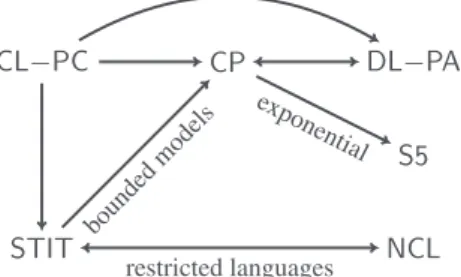
DL−PA CP CL−PC S5 STIT NCL exponential bounded models restricted languages
Figure 1: Summary of the embeddings established in the paper and known from the literature
the paper introduces and studies—in its axiomatization and complexity—a simple ceteris paribus logic based on proposi-tional equivalence, which we call CP. Such logic is the yard-stick allowing us to compare and unify STIT, CL−PC and DL−PA. Figure 1 gives a graphical presentation of the em-beddings established in the paper—as well as relevant ones already known in the literature.
An arrow indicates that each formula of the source logic is satisfiable if and only if a suitable translation of that formula is satisfiable in the target logic. DL−PA denotes the starless version of dynamic logic of propositional assignments, NCL and STIT denote the atemporal version of, respectively, nor-mal coalition logic and the seeing-to-it logic. S5 denotes the normal modal logic of equivalence relations. Dotted lines in-dicate embeddings known in the literature: from CL−PC to DL−PA [Balbiani et al., 2013] and from STIT to NCL (and vice versa) with respect to fragments of the respective lan-guages [Lorini and Schwarzentruber, 2011]. The embedding from STIT to CP assumes a bound on the STIT-models. All embeddings are polynomial except for the one from CP to S5.
2
A Simple Ceteris Paribus Logic
2.1 Equivalence Modulo a Set of Atoms
Consider a structure(W, V ) where W is a set of states, and V : P −→ 2W a valuation function from a countable set of atomic propositions P to subsets of W .
Definition 1. (Equivalence modulo X) Given a pair(W, V ), X⊆ P and |X| < ω, the relation ∼V
X⊆ W
2is defined as: w ∼VXw
′ ⇐⇒ ∀p ∈ X : (w ∈ V (p) ⇐⇒ w′∈ V (p)) WhenX is a singleton (e.g. p), we will often write ∼Vp instead of ∼V
{p}. Also, in order to avoid clutter, we will often drop the reference toV in ∼V
Xwhen clear from the context.
Intuitively, two states w and w′are equivalent up to set X, or X-equivalent, if and only if they satisfy the same atoms in X (according to a given valuation V ). The finiteness of X is clearly not essential in the definition. It is assumed because, as we will see, each set X will be taken to model a set of actions of some agent in a game form and sets of actions are always assumed to be finite.
Fact 1. (Properties of ∼X) The following holds for any set of statesW , valuation V : P −→ 2Wand finite setsX, Y ⊆ P:
(i) ∼X is reflexive, transitive and symmetric; (ii) ifX ⊆ Y then ∼Y ⊆ ∼X; (iii) ifX is a singleton, ∼Xinduces a par-tition ofW with at most 2 cells; (iv) ∼X ∩ ∼Y = ∼X∪Y; (v) ∼∅= W2.
2.2 A Modal Logic of the ∼XRelation
In this section we consider a simple modal language inter-preted on relations ∼X and axiomatize its logic on the class of structures(W, V ). The key modal operator of the language will behXi, whose intuitive meaning is ‘ϕ is the case in some state which is X-equivalent to the current one’ or, to stress a ceteris paribus reading, ‘ϕ is possible all things expressed in X being equal’. We call the resulting logic propositional ce-teris paribus logic, CP in short.
Let P be a countable set of atomic propositions. The lan-guageLCP(P) is defined by the following BNF:
LCP(P) : ϕ ::= p | ¬ϕ | (ϕ ∧ ϕ) | hXiϕ
where p ranges over P and X is a finite subset of atomic propositions (X ⊆ P and X finite). Note that as the set of finite subsets of atomic propositions is countable, the lan-guageLCP(P) is also countable. The Boolean connectives ⊤, ∨, →, ↔ and the dual operators [X] are defined as usual. Although we have taken diamond operators as primitive, we will for convenience also make use of box operators to state some results in later sections. The set SF(ϕ) of subformulas of a formula ϕ is defined inductively in the usual way.
This is the class of models we will be working with: Definition 2. (models) Given a countable set P, a CP-model for LCP(P) is a tuple M = (W, V ) where: W is a non-empty set of states;V : P −→ 2W is a valuation func-tion. A CP-model is calleduniversal if W = 2PandV is s.t. V(p) = {w | p ∈ w}. It is called non-redundant if ∼Pis the identity relation inW2.
Intuitively, a CP-model consists just of a state-space and a valuation function for a given set of atoms.
Definition 3. (Satisfaction for CP-models) LetM = (W, V ) be an CP-model for LCP(P), w ∈ W and ϕ, ψ ∈ LCP(P) (Boolean clauses omitted):
M, w |=CPhXiϕ ⇐⇒ ∃w′: w ∼VXw′ANDM, w′|=CPϕ Formulaϕ is CP-satisfiable, if and only if there exists a model M and a state w such that M, w |=CP ϕ. Formula ϕ is valid inM, noted M |=CPϕ, if and only if for all w∈ W , M, w |=CPϕ. Validity and consequence are defined as usual. So, modal operators are interpreted on the equivalence re-lations ∼Xinduced by the valuation of the model. It is worth observing that the logic of this class of models is not closed under uniform substitution,2that is, logic CP is not uniform.3 To witness that, notice that formula[{p}]p ∨ [{p}]¬p is valid, whereas[{p}]ϕ ∨ [{p}]¬ϕ is not.
2For the definition of uniform substitution the reader is referred to the textbook by [Blackburn et al., 2001, Def. 1.18].
3
Lemma 1. LetL∅
CP(P) the set of formulae ϕ ∈ LCP(P) con-taining onlyh∅i operators. The set of formulae of L∅
CP(P) which are CP-valid is the modal logic of Kripke frames (W, W2), i.e., logic S5.
In other words, theh∅i operator of LCPis nothing but the global modality [Blackburn et al., 2001, pp. 367–370]. The next lemma states that CP is actually the logic of the class of relevant CP-models.
Lemma 2. Every satisfiable CP-formula is satisfiable on a non-redundant model.
One can obtain a sound and strongly complete axiom sys-tem for CP by a standard reduction technique exploiting Lemma 1. It can also be shown that CP can be embedded in S5 by an exponential satisfiability-preserving translation, and therefore that the satisfiability problem for CP is decid-able and in NEXPTIME. We refer to the full paper for the details.
3
The Ceteris Paribus Structure of STIT
3.1 Atemporal Group STIT
First let us recall the syntax and the semantics of atemporal group STIT. The language of this logic is built from a count-able set of atomic propositions P and a finite set of agents AGT = {1, . . . , n} and is defined by the following BNF:
LG−STIT(P, AGT ) : ϕ ::= p | ¬ϕ | (ϕ ∧ ϕ) | [J : stit]ϕ where p ranges over P and J ranges over 2AGT. The con-struction[J : stit]ϕ is read “group J sees to it that ϕ is true regardless of what the other agents choose”. We define the dual operatorhJ : stitiϕ def= ¬[J : stit]¬ϕ. When J = ∅, the construction[∅ : stit]ϕ is read “ϕ is true regardless of what every agent chooses” or simply “ϕ is necessarily true”. Definition 4 (STIT-Kripke model, [Herzig and Schwarzentruber, 2008]). A STIT-Kripke model M = (W, {RJ}J⊆AGT, V) is a 3-tuple where:
• W is a non-empty set of worlds;
• for all J ⊆ AGT , RJ is an equivalence relation such that: (i) RJ ⊆ R∅; (ii) RJ = Tj∈JR{j}; (iii) for all w ∈ W and (w1, . . . , wn) ∈ Wn, if u1 ∈ R{1}(w), . . . , un ∈ R{n}(w) then T
1≤j≤nR{j}(uj) 6= ∅;
• V : P → 2W is a valuation function for atomic propo-sitions;
withRJ(w) = {u ∈ W : (w, u) ∈ RJ} for any J ∈ 2AGT. The partition induced by the equivalence relation RJis the set of possible choices of the group J . Indeed, in STIT a choice of a group J at a given world w is identified with the set of possible worlds RJ(w). We call RJ(w) the set of pos-sible outcomes of group J ’s choice at world w, in the sense that group J ’s current choice at w forces the possible worlds to be in RJ(w). The set R∅(w) is simply the set of possi-ble outcomes at w, or said differently, the set of outcomes of the current game at w. According to Condition (i), the
set of possible outcomes of a group J ’s choice is a subset of the set of possible outcomes. Condition (ii), called addi-tivity, means that the choices of the agents in a group J is made up of the choices of each individual agent and no more. Condition (iii) corresponds to the property of independence of agents: whatever each agent decides to do, the set of out-comes corresponding to the joint action of all agents is non-empty. More intuitively, this means that agents can never be deprived of choices due to the choices made by other agents. In Lorini and Schwarzentruber’s work 2011 determinism for the group AGT was assumed. That is to say that the set of outcomes corresponding to a joint action of all agents is a singleton. Horty’s group STIT logic [Horty, 2001] does not suppose this. Here we deal with Horty’s version of STIT. So a STIT model is a game form in which a joint action of all agents might determine more than one outcome.
3.2 Embedding Atemporal STIT into CP
That STIT is not embeddable into CPcan be inferred from various reasons, for instance: STIT satisfiability problem is undecidable if there are more than 3 agents [Herzig and Schwarzentruber, 2008], unlike CP; STIT does not have the finite model property [Herzig and Schwarzentruber, 2008], unlike CP, which we have seen is embeddable S5.
We can nevertheless embed a variant of group STIT un-der the assumption that every agent has a finite and bounded number of actions in his repertoire. The embedding uses a special formula GRIDmwhich enforces a CP model to en-code a game form, and a suitably defined translation tr1. Theorem 1. Let us consider a group STIT formula ϕ. Let m be an integer. Then the following items are equiva-lent: 1. ϕ is STIT-satisfiable in a STIT-model where each agent has at most 2m actions; 2. ϕ is STIT-satisfiable in a STIT-model where each agent has exactly 2m actions; 3.GRIDm∧ tr1(ϕ) is CP-satisfiable.
3.3 Atemporal Individual STIT
In this subsection, we consider the following fragment of STIT called atemporal individual STIT:
LI−STIT(P, AGT ) : ϕ ::= p | ¬ϕ | (ϕ ∧ ϕ) | [{j} : stit]ϕ where p ranges over P and j ranges over AGT .
This fragment of STIT, axiomatized by [Xu, 1998], has the exponential finite model property (see Lemma 7 in [Balbiani et al., 2008b]). Moreover, as the following theorem high-lights, it can be embedded in logic CP, through the above translation.
Theorem 2. Let us consider a STIT formula ϕ of the indi-vidual STIT fragment. Letm be the length of ϕ. Then the following three items are equivalent: 1.ϕ is STIT-satisfiable 2.ϕ is STIT-satisfiable in a model where each agent has at most2mactions; 3.
GRIDm∧ tr1(ϕ) is CP-satisfiable. Thanks to Theorem 2, we reduce the NEXPTIME-complete satisfiability problem of individual STIT [Balbiani et al., 2008b] to the CP-satisfiability problem. As the re-duction is polynomial, we obtain the following lower bound complexity result for the CP-satisfiability problem. We thus obtain also a lower bound result of NEXPTIME-hardness for the complexity of the satisfiability problem of CP.
4
The Ceteris Paribus Structure of Coalition
Logic of Propositional Control
4.1 Logic CL−PC
CL−PC was introduced by [van der Hoek and Wooldridge, 2005] as a formal language for reasoning about capabilities of agents and coalitions in multiagent environments. In this logic the notion of capability is modeled by means of the con-cept of control. In particular, it is assumed that each agent i is associated with a specific finite subset Pi of the finite set of all propositions P. Piis the set of propositions controlled by the agent i. That is, the agent i has the ability to assign a (truth) value to each proposition Pibut cannot affect the truth values of the propositions in P \ Pi. In the variant of CL−PC studied by [van der Hoek and Wooldridge, 2005] it is also as-sumed that control over propositions is exclusive, that is, two agents cannot control the same proposition. Moreover, it is assumed that control over propositions is complete, that is, every proposition is controlled by at least one agent.
The language of CL−PC is built from a finite set of atomic propositions P and a finite set of agents AGT = {1, . . . , n}, and is defined by the following BNF:
LCL−PC(P, AGT ) : ϕ ::= p | ¬ϕ | (ϕ ∧ ϕ) | ♦Jϕ where p ranges over P and J ranges over 2AGT. Operator ♦J is called cooperation modality, and the construction ♦Jϕ means that “group J has the contigent ability to achieve ϕ”. Definition 5 (CL−PC model). A model for CL−PC is a tuple M = (P1, . . . , Pn, X) where: (i) P1, . . . , Pnis a partition ofP among the agents in AGT ; (ii) X ⊆ P is the set of propositions which are true in the initial state.
For every group of agents J ⊆ AGT , let PJ =Si∈JPi be the set of atomic propositions controlled by the group J . Moreover, for every group J ⊆ AGT and for every set of atomic propositions X⊆ P, let XJ = X ∩ PJ be the set of atomic propositions in X controlled by the group J . Sets XJ are called J -valuations.
Given a CL−PC model M = (P1, . . . , Pn, X), the truth condition for the CL−PC modal operators is:
M |=CL−PC♦Jϕ⇐⇒ ∃XJ′ ⊆ PJ : M M
XJ′ |=CL−PCϕ where MLXJ′ is the CL−PC model (P1, . . . , Pn, X′′) such that: XAGT\J′′ = XAGT\J and XJ′′= XJ′. That is, ♦Jϕ is true at a given modelM if and only if, the coalition J can change the truth values of the atoms that it controls in such a way that ϕ will be true afterwards (i.e., given the actual truth-value combination of the atoms which are not controlled by J , there exists a truth-value combination of the atoms con-trolled by J which ensures ϕ).
4.2 Embedding CL−PC into STIT and CP
The aim of this section is to provide an embedding of CL−PC into the variant of atemporal group STIT with bounded choices (atemporal ‘bounded’ group STIT) that have been presented in Section 3.1. This is achieved by making use of a suitably defined translation tr2and dedicated formulae en-forcing a CL−PC-like structure on STIT models: formulae
EXC+and EXC−enforce that control over atomic proposi-tions in P is exclusive, formula COMPL enforces that exer-cise of control over atomic propositions in P is complete; for-mula GRID∗enforces that all the possible truth-value com-binations of the atomic propositions in P are possible. Theorem 3. Let m = |P|. Then, a CL−PC formula ϕ is CL−PC-satisfiable if and only if (EXC+
∧ EXC− ∧ COMPL∧ GRID∗) ∧ tr2(ϕ) is satisfiable in a STIT model where each agent has at most2mactions.
As CP embeds atemporal ‘bounded’ group STIT (Theorem 1 in Section 3.1), from Theorem 3 it follows that CP also embeds CL−PC.
5
The Ceteris Paribus Structure of Dynamic
Logic of Propositional Assignments
5.1 Logic DL−PA
The dynamic logic of propositional assignments (DL−PA) is the concrete variant of propositional dynamic logic (PDL) [Harel et al., 2000] in which atomic programs are assign-ments of propositional variables to true or to false. The complexities of the model checking and of the satisfiability problem for DL−PA have been recently studied by [Balbiani et al., 2013]. The starless version of DL−PA was previ-ously studied by [van Eijck, 2000] and recently put to use by [Herzig et al., 2011], who have shown that it embeds CL−PC. The language of DL−PA is built from a finite set of atomic propositions P and is defined by the following BNF:
π ::= +p | −p | π; π | π ∪ π | π∗| ϕ? LDL−PA(P) : ϕ ::= p | ¬ϕ | (ϕ ∧ ϕ) | hπiϕ
We will use ±p to denote (+p ∪ −p). A DL−PA-model is a set X ⊆ P, that is, a propositional valuation. We provide the semantics for the key operators, the rest is standard: J+pK = {(X, X′) | X′= X ∪ {p}}; J−pK = {(X, X′) | X′ = X \ {p}}; JhπiϕK = {X | there exists X′s.th.(X, X′) ∈ JπK and X′∈ JϕK}.
We write X |=DL−PA ϕ for X ∈ JϕK. We will refer to the fragment of DL−PA without ∗ operator as starless DL−PA.
5.2 Embeddings between Starless DL−PA and CP
A DL−PA model X can be translated directly to the pointed CP model MCP, X. The desired embedding is obtained through a suitable translation tr3
Theorem 4. Let X be a DL−PA model and ϕ belong to the language of starless DL−PA:
X |=DL−PAϕ ⇐⇒ MCP, X |=CPtr3(ϕ) An embedding in the opposite direction can also be ob-tained, through a suitably defined translation tr4:
Theorem 5. LetM be an CP-model and ϕ ∈ LCP(P): M, w |=CPϕ ⇐⇒ w |=DL−PAtr4(ϕ)
From Theorem 5 we can finally obtain as corollary a satisfiability-preserving embedding of CP into DL−PA ex-ploiting a formula GRID∗∗ forcing a CP-model to contain all propositional valuations from P. Then, tr4(ϕ) is DL−PA satisfiable if and only if GRID∗∗∧ ϕ is CP satisfiable.
References
[Alur et al., 2002] R. Alur, T. Henzinger, and O. Kupferman. Alternating-time temporal logic. Journal of the ACM, 49:672–713, 2002.
[Balbiani et al., 2008a] P. Balbiani, O. Gasquet, A. Herzig, F. Schwarzentruber, and N. Troquard. Coalition games over kripke semantics. In C. D´egremont, L. Keiff, and H. R¨uckert, editors, Festschrift in Honour of Shahid Rah-man, pages 1–12. College Publications, 2008.
[Balbiani et al., 2008b] P. Balbiani, A. Herzig, and N. Tro-quard. Alternative axiomatics and complexity of de-liberative stit theories. Journal of Philosophical Logic, 37(4):387–406, 2008.
[Balbiani et al., 2013] P. Balbiani, A. Herzig, and N. Tro-quard. Dynamic logic of propositional assignments: A well-behaved variant of PDL. In Proceedings of the 28th ACM/IEEE Symposium on Logic in Computer Science (LICS 2013), pages 143–152. IEEE Computer Society, 2013.
[Belnap et al., 2001] N.D. Belnap, M. Perloff, and M. Xu. Facing the future: agents and choices in our indeterminist world. Oxford University Press, USA, 2001.
[Blackburn et al., 2001] P. Blackburn, M. de Rijke, and Y. Venema. Modal Logic. Cambridge University Press, Cambridge, 2001.
[Broersen et al., 2005] J. Broersen, A. Herzig, and N. Tro-quard. From coalition logic to STIT. In A. Lomuscio, E. de Vink, and M. Wooldridge, editors, Proceedings of the Third International Workshop on Logic and Communi-cation in Multi-agent Systems (LCMAS’05), pages 23–35, 2005.
[Broersen et al., 2006] J. Broersen, A. Herzig, and N. Tro-quard. Embedding alternating-time temporal logic in strategic STIT logic of agency. Journal of Logic and Com-putation, 16(5):559–578, 2006.
[Broersen et al., 2007] J. Broersen, A. Herzig, and N. and Troquard. A normal simulation of coalition logic and an epistemic extension. In D. Samet, editor, Proceedings TARK’07, pages 92–101. ACM Press, 2007.
[Goldblatt, 1992] R. Goldblatt. Logics of Time and Compu-tation. CSLI, 1992.
[Goranko and Jamroga, 2004] V. Goranko and W. Jamroga. Comparing semantics of logics for multi-agent systems. Synthese, 139:241–280, 2004.
[Goranko et al., 2013] V. Goranko, W. Jamroga, and P. Tur-rini. Strategic games and truly playable effectivity func-tions. Journal of Autonomous Agents and Multi-Agent Sys-tems, (26):288–314, 2013.
[Goranko, 2001] V. Goranko. Coalition games and alternat-ing temporal logics. In Proceedalternat-ings of the 8th confer-ence on theoretical aspects of rationality and knowledge (TARK’01), pages 259–272, 2001.
[Harel et al., 2000] D. Harel, D. Kozen, and J. Tiuryn. Dy-namic Logic. MIT Press, 2000.
[Herzig and Schwarzentruber, 2008] A. Herzig and F. Schwarzentruber. Properties of logics of individual and group agency. Advances in modal logic, 7:133–149, 2008. [Herzig et al., 2011] A. Herzig, E. Lorini, F. Moisan, and N. Troquard. A dynamic logic of normative systems. In T. Walsh, editor, Proceedings of the Twenty-Second Inter-national Joint Conference on Artificial Intelligence (IJCAI 2011), pages 228–233. AAAI Press, 2011.
[Herzig, 2014] A. Herzig. Logics of knowledge and action: A critical analysis and challenges. Journal of Autonomous Agents and Multi-Agent Systems, DOI: 10.1007/s10458-014-9267-z, 2014.
[Horty, 2001] J. F. Horty. Agency and Deontic Logic. Oxford University Press, Oxford, 2001.
[Lorini and Schwarzentruber, 2011] E. Lorini and F. Schwarzentruber. A logic for reasoning about counterfactual emotions. Artificial Intelligence, 175(3-4):814–847, 2011.
[Moulin and Peleg, 1982] H. Moulin and B. Peleg. Cores of effectivity functions and implementation theory. Journal of Mathematical Economics, 10:115–145, 1982.
[Pauly, 2002] M. Pauly. A modal logic for coalitional power in games. Journal of Logic and Computation, 12(1):149– 166, 2002.
[van Benthem et al., 2009] J. van Benthem, P. Girard, and O. Roy. Everything else being equal: A modal logic for ce-teris paribus preferences. Journal of Philosophical Logic, 38:83–125, 2009.
[van der Hoek and Pauly, 2007] W. van der Hoek and M. Pauly. Modal logic for games and information. In P. Blackburn, J. van Benthem, and F. Wolter, editors, Handbook of Modal Logic, pages 1077–1146. Elsevier, 2007.
[van der Hoek and Wooldridge, 2005] W. van der Hoek and M. Wooldridge. On the logic of cooperation and proposi-tional control. Artificial Intelligence, 164:81–119, 2005. [van Eijck, 2000] J. van Eijck. Making things happen. Studia
logica, 66(1):41–58, 2000.
[Xu, 1998] M. Xu. Axioms for deliberative STIT. Journal of Philosophical Logic, 27:505–552, 1998.